

Model Cards for Model Reporting
Open accessThe DOI matches its Crossref record; 22 of the 22 references it cites were found in a registry or an index; 8 of the 34 sources its claims cite were checked for support.
Abstract
Trained machine learning models are increasingly used to perform high-impact tasks in areas such as law enforcement, medicine, education, and employment. In order to clarify the intended use cases of machine learning models and minimize their usage in contexts for which they are not well suited, we recommend that released models be accompanied by documentation detailing their performance characteristics. In this paper, we propose a framework that we call model cards, to encourage such transparent model reporting. Model cards are short documents accompanying trained machine learning models that provide benchmarked evaluation in a variety of conditions, such as across different cultural, demographic, or phenotypic groups (e.g., race, geographic location, sex, Fitzpatrick skin type [15]) and intersectional groups (e.g., age and race, or sex and Fitzpatrick skin type) that are relevant to the intended application domains. Model cards also disclose the context in which models are intended to be used, details of the performance evaluation procedures, and other relevant information. While we focus primarily on human-centered machine learning models in the application fields of computer vision and natural language processing, this framework can be used to document any trained machine learning model. To solidify the concept, we provide cards for two supervised models: One trained to detect smiling faces in images, and one trained to detect toxic comments in text. We propose model cards as a step towards the responsible democratization of machine learning and related artificial intelligence technology, increasing transparency into how well artificial intelligence technology works. We hope this work encourages those releasing trained machine learning models to accompany model releases with similar detailed evaluation numbers and other relevant documentation.
Overview
CoChat Summary
TL;DR
The paper proposes “model cards,” short documentation records accompanying trained machine learning models to report intended use, performance characteristics, and disaggregated evaluation across demographic, phenotypic, and intersectional groups. It illustrates the framework with worked examples for a smiling classifier and a toxicity classifier.
Key findings
- The authors argue there are no standardized documentation procedures for communicating trained ML model performance, especially for high-impact domains such as health care, employment, education, and law enforcement.
- They propose model card sections covering model details, intended use, factors, metrics, evaluation data, training data, quantitative analyses, ethical considerations, and caveats/recommendations.
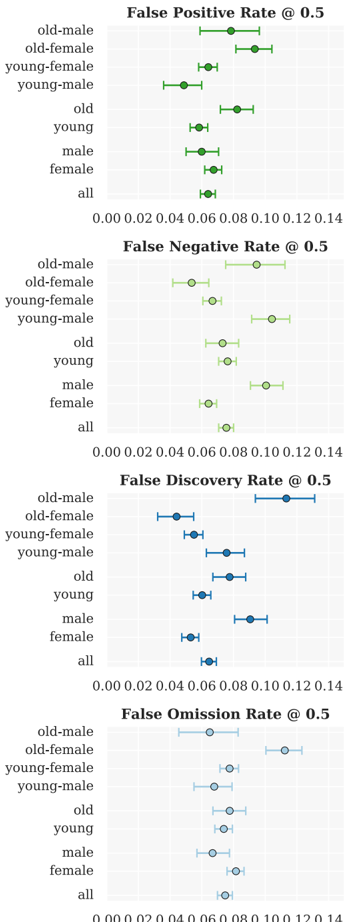
- In the smiling classifier example, all reported metrics at the .5 decision threshold have error types within the range 0.04–0.14, with 95% confidence intervals calculated by bootstrap resampling; the card notes older men have much higher false discovery rate, while men in aggregate have higher false negative rate.
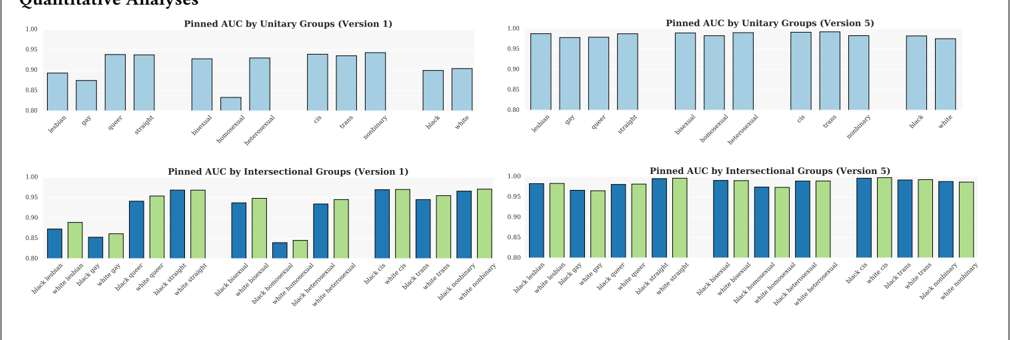
- In the toxicity example, TOXICITY v. 1 has low performance for several terms, especially “lesbian,” “gay,” and “homosexual,” while TOXICITY v. 5 shows more equitable performance after bias mitigation techniques.
Methods
- The paper is a framework/proposal paper, not an empirical study of a new model; it recommends model cards and details suggested sections and prompts.
- It provides two worked examples: a smiling classifier trained and evaluated on the CelebA dataset, using a convolutional neural net pretrained for face recognition and fine-tuned with cross-entropy loss for binary smiling classification.
- It also provides a model card for Perspective API’s TOXICITY classifier, a convolutional neural network developed by Jigsaw in 2017, evaluated on a synthetic Identity Phrase Templates test set; metrics include FPR, FNR, FDR, FOR for the smiling classifier and Pinned AUC for toxicity.
Limitations
- The paper states that model cards rely on the integrity of their creators and that it seems unlikely, at least in the near term, that they could be standardized or formalized enough to prevent misleading representations of model results.
- The paper states that evaluation datasets suitable for disaggregated evaluation are not yet common, and that the synthetic toxicity test data covers only a small set of very specific comments and is not comprehensive.
- The smiling classifier card states it does not capture race or skin type, uses binary gender classes (male/female), and that an ideal evaluation dataset would additionally include Fitzpatrick skin type, camera details, and environment details; the paper also states future work is needed to study how model information is interpreted and used by different stakeholders.
Model-written summary. Check it against the paper before relying on it.
Integrity signals
Registry
Cites
Statistics
Figures
Verification
Claims the paper makes
5 Valid · 1 Not valid · 18 Not checked · 30 Own results and interpretations
The cited sources support only part of this claim — read each source’s verdict below.
In the paper
“Synthetic data is valuable here because [11] shows that real data often has disproportionate amounts of toxicity directed at specific groups.”
What the sources say
- Partly supportedcites [11] [11] Lucas Dixon, John Li, Jeffrey Sorensen, Nithum Thain, and Lucy Vasserman. 2018. Measuring and Mitigating Unintended Bias in Text Classification. Proceedings of the AAAI/ACM Conference on AI, Ethics, and Society (2018). - sourceExperimental — accuracy not yet measured
The 'Quantifying bias in dataset' section (page unavailable) reports that certain identity terms appear disproportionately in toxic comments in the authors’ training data; for example, 'gay' appears in 3% of toxic comments but 0.5% of comments overall. It measures comments containing those terms, not whether toxicity is directed at the groups, and does not establish how often this pattern occurs across real datasets generally. (LLM, conf=0.85)
plainstates an association- Asserted: passes — The authors put it forward as true.
- Checkable: passes — It can be checked against evidence.
- Load-bearing: passes — The paper’s conclusions depend on it.
- Based: passes — The paper gives a reason why it holds.
- Partly supported
A result the paper reports from its own data — it cites no other source for it, so there is none to check. The quote shows it is in the paper.
In the paper
“For example, the false discovery rate on older men is much higher than that for other groups.”
plainstates an association- Asserted: passes — The authors put it forward as true.
- Checkable: passes — It can be checked against evidence.
- Load-bearing: passes — The paper’s conclusions depend on it.
- Based: passes — The paper gives a reason why it holds.
A result the paper reports from its own data — it cites no other source for it, so there is none to check. The quote shows it is in the paper.
In the paper
“TOXICITY v. 1 has low performance for several terms, especially 'lesbian', 'gay', and 'homosexual'.”
plain- Asserted: passes — The authors put it forward as true.
- Checkable: passes — It can be checked against evidence.
- Load-bearing: passes — The paper’s conclusions depend on it.
- Based: passes — The paper gives a reason why it holds.
None of the sources cited for this claim have been checked yet.
In the paper
“she collaborated with other researchers to demonstrate the disproportionate errors of computer vision systems on historically marginalized groups in the United States, such as darker-skinned women [5, 41].”
What the sources say
- Not checked yetcites [5] [5] Joy Buolamwini and Timnit Gebru. 2018. Gender Shades: Intersectional Accuracy Disparities in Commercial Gender Classification. In Proceedings of the 1st Conference on Fairness, Accountability and Transparency (Proceedings of Machine Learning Research) , Sorelle A. Friedler and Christo Wilson (Eds.), Vol. 81. PMLR, New York, NY, USA, 77-91. http://proceedings.mlr.press/v81/buolamwini18a.html -
- Not checked yetcites [41] [41] Inioluwa Raji. 2018. Black Panther Face Scorecard: Wakandans Under the Coded Gaze of AI. (2018). -
boostedstates an association- Asserted: passes — The authors put it forward as true.
- Checkable: passes — It can be checked against evidence.
- Load-bearing: passes — The paper’s conclusions depend on it.
- Based: passes — The paper gives a reason why it holds.
In the paper
“after MIT Media Lab graduate student Joy Buolamwini found that commercial face recognition systems failed to detect her face [4]”
What the sources say
- Not checked yetcites [4] [4] Joy Buolamwini. 2016. How I'm fighting Bias in Algorithms. (2016). https://www.ted.com/talks/joy\_buolamwini\_how\_i\_m\_fighting\_bias\_in\_ algorithms#t-63664 -
plainSingle case- Asserted: passes — The authors put it forward as true.
- Checkable: passes — It can be checked against evidence.
- Load-bearing: unclear — It is unclear whether the paper’s conclusions depend on it.
- Based: passes — The paper gives a reason why it holds.
13 more claims
Create a free account to see all 54 claims and to verify the 13 references still open.
- Probably not a substantial claim. 34
- It may state two separate claims as one. 8
Claims other papers make about this one
Each is checked against this paper’s own text: does it say what the citing paper says it does?
The source backs part of the claim, not all of it — or backs it for a different population, condition or comparison.
In the citing paper
“Model cards represent the field's standard for disclosing and documenting key facts about the architecture, training and evaluation of the model [14, 40].”
From Rethinking open source generative AI: open washing and the EU AI Act (2024) · cites this paper as [40]
Experimental — accuracy not yet measuredThe source backs part of the claim, not all of it — or backs it for a different population, condition or comparison.
In the citing paper
“Model cards (SMCs) [44] have been foundational in standardizing documentation for AI/ML model performance and characteristics, along with risks and unintended uses.”
From Interactive Model Cards: A Human-Centered Approach to Model Documentation (2022) · cites this paper as [44]
Experimental — accuracy not yet measuredThe source backs part of the claim, not all of it — or backs it for a different population, condition or comparison.
In the citing paper
“A second phase saw a more technical approach from the computer science community focusing on fairness, accountability and transparency as an engineering 'ethicalby-design' problem-solving exercise [20][21][22].”
From Putting AI ethics to work: are the tools fit for purpose? (2022) · cites this paper as [21]
Experimental — accuracy not yet measuredThe source backs part of the claim, not all of it — or backs it for a different population, condition or comparison.
In the citing paper
“These are either materials for use in design teams in workshop style events [76,77], tools for producing documentation of the design, build and test process [21,68], or technical tools for testing models, protecting privacy and security, testing for bias [69,93,94], or tracking provenance of data [95].”
From Putting AI ethics to work: are the tools fit for purpose? (2022) · cites this paper as [21]
Experimental — accuracy not yet measuredThe source backs part of the claim, not all of it — or backs it for a different population, condition or comparison.
In the citing paper
“There is some work on fairness relating to AI services, though this tends to focus on either exposing or 'auditing' certain AI services [22,38,126,133], or devising tools, methods and interventions relevant for those building (rather than using) such services [12,96,106,128].”
From Out of Context: Investigating the Bias and Fairness Concerns of “Artificial Intelligence as a Service” (2023) · cites this paper as [106]
Experimental — accuracy not yet measured
17 more claims about this paper
Create a free account to see every claim other papers make about this one.
Citations
Cites
BLEU: a method for automatic evaluation of machine translation
Papineni, K., Roukos, S., Ward, T., & Zhu, W.-J. (2001) · Proceedings of the 40th Annual Meeting on Association for Computational Linguistics - ACL '02 · doi:10.3115/1073083.1073135 · Cited by 21,344 · cited 1×
“translation system could compare BLEU scores [40] across demographic groups, and a model card for a speech recognition system could compare word-error rates.”
BackgroundCrenshaw, K. (2018) · Feminist Legal Theory · doi:10.4324/9780429500480-5 · Cited by 9,510
Deep Learning Face Attributes in the Wild
Liu, Z., Luo, P., Wang, X., & Tang, X. (2015) · 2015 IEEE International Conference on Computer Vision (ICCV) · doi:10.1109/iccv.2015.425 · Cited by 7,747 · cited 4×
“ms [5, 26] that report details of the datasets used to train and test machine learning models. We provide two example model cards in Section 5: A smiling detection model trained on the CelebA dataset [33] (Figure 2), and a public toxicity detection model, Perspective API [29] (Figure 3). Where Datasheets highlight cha…”
BackgroundMethodInfluentialThe validity and practicality of sun-reactive skin types I through VI
Fitzpatrick, T. B. (1988) · Archives of Dermatology · doi:10.1001/archderm.1988.01670060015008 · Cited by 4,339
Differential Privacy: A Survey of Results
Dwork, C. (2008) · Lecture Notes in Computer Science · doi:10.1007/978-3-540-79228-4_1 · Cited by 3,542 · cited 2×
“As such, collaboration with policy, privacy, and legal experts is necessary in order to ascertain which groups may be responsibly inferred, and how that information should be stored and accessed (for example, using differential privacy [12]).”
BackgroundCollins, G. S., Reitsma, J. B., Altman, D. G., & Moons, K. G. M. (2015) · Annals of Internal Medicine · doi:10.7326/m14-0697 · Cited by 3,267
Equality of Opportunity in Supervised Learning
Hardt, M., Price, E., & Srebro, N. (2016) · arXiv · doi:10.48550/arxiv.1610.02413 · Cited by 2,536 · cited 2×
“of Opportunity, and equal false negative and false positive rates across groups is equivalent to fulfilling Equality of Odds [26].”
BackgroundGebru, T., Morgenstern, J., Vecchione, B., Vaughan, J. W., Wallach, H., Daumé, H., & Crawford, K. (2018) · arXiv · doi:10.48550/arxiv.1803.09010 · Cited by 2,474
Self-citationA Probabilistic Interpretation of Precision, Recall and F-Score, with Implication for Evaluation
Goutte, C., & Gaussier, E. (2005) · Lecture Notes in Computer Science · doi:10.1007/978-3-540-31865-1_25 · Cited by 2,285 · cited 1×
“Confidence intervals for metrics derived from confusion matrices can be calculated by treating the matrices as probabilistic models of system performance [24].”
MethodFair prediction with disparate impact: a study of bias in recidivism prediction instruments
Chouldechova, A. (2017) · Big Data · doi:10.1089/big.2016.0047 · Cited by 2,159 · cited 1×
“or different errors that can be calculated from the confusion matrix for binary classification systems. • These also correspond to metrics in recent definitions of “fairness” in machine learning (cf. [8, 25]), where parity across subgroups for different metrics correspond to different fairness criteria. • 95% confiden…”
Background
Research works printed but not linked: 9
- [1] Avrio AI. 2018. Avrio AI: AI Talent Platform. (2018). https://www.goavrio.com/ -
- [5] Joy Buolamwini and Timnit Gebru. 2018. Gender Shades: Intersectional Accuracy Disparities in Commercial Gender Classification. In Proceedings of the 1st Conference on Fairness, Accountability and Transparency (Proceedings of Machine Learning Research) , Sorelle A. Friedler and Christo Wilson (Eds.), Vol. 81. PMLR, New York, NY, USA, 77-91. http://proceedings.mlr.press/v81/buolamwini18a.html -
- [13] Entelo. 2018. Recruitment Software | Entelo. (2018). https://www.entelo.com/ -
- [17] U.S. Food and Drug Administration. 2013. FDA Drug Safety Communication: Risk of next-morning impairment after use of insomnia drugs; FDA requires lower recommended doses for certain drugs containing zolpidem (Ambien, Ambien CR, Edluar, and Zolpimist). (2013). https://web.archive.org/web/20170428150213/ https://www.fda.gov/drugs/drugsafety/ucm352085.htm -
- [18] IIHS (Insurance Institute for Highway Safety: Highway Loss Data Institute). 2003. Special Issue: Side Impact Crashworthiness. Status Report 38, 7 (2003). -
- [19] Institute for the Future, Omidyar Network's Tech, and Society Solutions Lab. 2018. Ethical OS. (2018). https://ethicalos.org/ -
- [32] Jigsaw. 2017. Perspective API. (2017). https://www.perspectiveapi.com/ -
- [39] AI Now. 2018. Litigating Algorithms: Challenging Government Use Of Algorithmic Decision Systems. AI Now Institute. -
- [43] Mukund Sundararajan, Ankur Taly, and Qiqi Yan. 2017. In Proceedings of the 34th International Conference on Machine Learning , Vol. 70. PMLR, Sydney, Australia. -
Cited by
Items 2,001–2,100 of 2,239
Climate-control ChatGPT for EFL writing and AI literacy
Aldamen, H., Alawneh, S. M., Almashour, M., Al-Deaibes, M., & Alsharefeen, R. (2026) · Frontiers in Artificial Intelligence · doi:10.3389/frai.2026.1869343 · Cited by 1
“…participant-level cross-validation split files, random seeds, preprocessing scripts, TF-IDF baseline hyperparameters, software and package versions, preserved transformer-family prediction outputs, and a short (Gebru et al., 2021; Mitchell et al., 2019; Papi et al., 2024; Storks et al., 2023).”
InfluentialTruong, N., Hickling, A., Rahman, R., Flanigen, J., Huang, P., Kastelic, J., Truex, B., Parthemore, G., Pilewicz, J., Gooneratne, P., et al. (2026) · IEEE International Conference on AI and Data Analytics (ICAD) · doi:10.1109/icad69378.2026.11608485
“Model transparency and subgroup evaluation are also key technical requirements for responsible deployment [68], [67]. v. Environmental Factors: AI development can be resource-intensive.”
InfluentialWang, Y., Peng, Y., Wang, Z., Liu, P., & Chen, Z. (2026) · Frontiers in Medicine · doi:10.3389/fmed.2026.1879402 · Cited by 1
“In addition, the disclosure of algorithm training datasets and known limitations via model cards—akin to pharmaceutical package inserts—can help physicians and patients make informed decisions (51) of informed consent documents and facilitate patient education (52, 53).”
Autonomous Bias Mitigation in Talent Acquisition: An Intelligent Redaction Framework for Fair Hiring
Lata, S. (2026) · IEEE International Conference on AI and Data Analytics (ICAD) · doi:10.1109/icad69378.2026.11608591
Elsayed, S. (2026) · ACM SIGCAS/SIGCHI Conference on Computing and Sustainable Societies (COMPASS) · doi:10.1145/3811242.3819088
Berman, G., & Smithies, J. (2026) · Cambridge University Press eBooks · doi:10.1017/9781009625180.009
Linde, F., Ali, D., & Papakyriakopoulos, O. (2026) · Cambridge University Press eBooks · doi:10.1017/9781009625180.007
Maes, M., Shrestha, S., Keith, D. A., Handa, S., Lee, Y., der Cruyssen, F. V., Verhelst, P.-J., Sillmann, Y. M., Jacobs, R., & Guastaldi, F. P. S. (2026) · Digital Dentistry Journal · doi:10.1016/j.ddj.2026.100106 · Cited by 1
Kun, A. L. (2026) · Cambridge University Press eBooks · doi:10.1017/9781009625180.005 · Cited by 1
Theodorakopoulos, L., & Theodoropoulou, A. (2026) · Wiley Interdisciplinary Reviews Data Mining and Knowledge Discovery · doi:10.1002/widm.70116 · Cited by 3
Safety-Critical Bias: Assessing Demographic Disparities in SAM2 for Autonomous Vehicle Applications
Aziz, J., & El-Messiry, H. (2026) · IEEE International Conference on Smart Mobility (SM) · doi:10.1109/sm69703.2026.11614115
“These findings carry specific implications for AI governance frameworks [8].”
Transformer Models and their Cross-Domain Applications: A Systematic Review
Pathania, K., Singh, S., & Sharma, A. (2026) · Archives of Computational Methods in Engineering · doi:10.1007/s11831-026-10742-0
Gender-Responsive Generative AI–Empowered Entrepreneurship: Challenges and Opportunities
Nikghadam-Hojjati, S., Barata, J., & Marchetti, E. (2026) · IntechOpen eBooks · doi:10.5772/intechopen.1017036 · Cited by 1
A Multilevel Framework for the Safe and Ethical Use of AI in Mental Health Practice
Pedrosa, I. (2026) · Psicothema · doi:10.70478/psicothema.2026.38.11
Navigating Ethical Considerations and Regulations
(2026) · Royal Society of Chemistry eBooks · doi:10.1039/9781837072163-00072
Conclusion: Embracing the AI-driven Future of Chemistry
(2026) · Royal Society of Chemistry eBooks · doi:10.1039/9781837072163-00103
Alharbi, R., & Abbadeni, N. (2026) · IEEE Access · doi:10.1109/access.2026.3717516
“Its quality and usability evaluations prove the communication of fairness findings to non-technical stakeholders, thereby promoting transparency and trust in AI systems [3].”
Rafi, M. U. (2026) · Research Square · doi:10.21203/rs.3.rs-10498693/v1
Harada, Y. (2026) · Cureus Journal of AI-Augmented Research · doi:10.7759/s44568-026-00185-3
Certifying Regime Detectors Before UsePreprint
Achong, D. F. U., Martel, C., Boztosun, M., & Zhang, E. (2026) · SSRN Electronic Journal · doi:10.2139/ssrn.7100358
Governing Clinical Readiness Claims Derived from Medical AI Benchmark Results
Dong, Y., Cheng, J., Ding, C., & Lu, R. (2026) · Journal of Medical Systems · doi:10.1007/s10916-026-02445-7 · Cited by 3
“It is informed by model cards, benchmark documentation, task-specific readiness principles, AI reporting guidance and life-cycle governance literature [ 8 , 13 – 25 ], but is not a direct summary of sources.”
Abiri, G. (2026) · Cambridge Forum on AI Law and Governance · doi:10.1017/cfl.2026.10044 · Cited by 1
Remache, A., Refae, G. A. E., Remache, R., Belarbi, A. K., Remache, S. A. Q., & Almheiri, S. (2026) · International Conference on Artificial Intelligence Systems (AIS) · doi:10.1109/ais69919.2026.11621192
“These recommendations are consistent with data statements for NLP [14], datasheets for datasets [15], and model cards for model reporting [16].”
Secure and Explainable AI Infrastructure for Digital Transformation
Kumar, R., & Sharma, H. (2026) · Advances in computational intelligence and robotics book series · doi:10.4018/979-8-3373-8755-0.ch004
Somerville, J. G., Mustafa, M. H., Seweid, M. M., & Arab, R. A. E. (2026) · Diagnostics · doi:10.3390/diagnostics16152389 · Cited by 2
“These domains were adapted from established data governance and transparency frameworks, including Datasheets for Datasets [48], Model Cards for Model Reporting [49], and recommendations for bias assessment in AI healthcare reporting from CONSORT-AI [50].”
Algorithmic Dignity: Human-Centered Governance in AI-Driven Workplaces
Akande, N. A. (2026) · Advances in computational intelligence and robotics book series · doi:10.4018/979-8-3373-5213-8.ch003
$\mathrm{A}^{4}$ -Gov: A Governance Architecture for AI Service Systems
Ahn, M. S., & Yoon, Y. I. (2026) · IEEE/ACIS International Conference on Software Engineering Research, Management and Applications (SERA) · doi:10.1109/sera69989.2026.11618631 · Cited by 1
“Model cards improve structured reporting and downstream review, but they remain primarily documentation mechanisms rather than internal control structures [12].”
A Framework for Systematic Stability Assessment of Post-hoc Explanations in Text Classification
Mohammadalizadeh, P., Mohammadalizadeh, P., & Mahmoudian, A. (2025) · International Conference on Information and Knowledge Technology (IKT) · doi:10.1109/ikt69652.2025.11626800
“Model cards [14] provide structured reporting of model performance and limitations.”
The Emergence of Digital Human CEOs: A Conceptual Framework for Trust, Legitimacy, and Governance
Bonelli, M. I. (2026) · Advances in Human-Computer Interaction · doi:10.1155/ahci/8461946
AI Aversion: Do People Trust and Accept Artificial Intelligence Risk Calculator Recommendations?
Ramasubramanian, M., & Zikmund‐Fisher, B. J. (2026) · Medical Decision Making · doi:10.1177/0272989x261467775
Gold, N. O., & Coovadia, H. (2026) · CSR, sustainability, ethics & governance · doi:10.1007/978-3-032-20091-4_2
Wang, Y., & Tang, Y. (2026) · Measurement Science and Technology · doi:10.1088/1361-6501/ae9438
“This connects our work to a broader methodological literature on responsible reporting in machine learning [34].”
Bag-of-words or embedding-based topic models? Comparing LDA, BERTopic, and six other methods
Lamirel, J.-C., Lareau, F., Prouteau, T., & Malaterre, C. (2026) · Scientometrics · doi:10.1007/s11192-026-05745-4 · Cited by 3
“This lack of visibility complicates reproducibility and broader scientific validation (Bommasani et al., 2022; Mitchell et al., 2019).”
23Chapter 2 Predictive Modeling with AI: Methods, NLP Applications, and Deployment
Sharma, R., & Gupta, A. (2026) · De Gruyter eBooks · doi:10.1515/9783112211991-002
A Green Compute Procurement Policy for AI Labs: Minimum Disclosures, Metering, and Targets
Gupta, U. (2026) · Lecture notes in networks and systems · doi:10.1007/978-3-032-24810-7_24
Vassileva, J. (2026) · International Conference on Revolutionary Artificial Intelligence and Future Applications (Rev-AI) · doi:10.1109/rev-ai70456.2026.11622089
“The emphasis on structured documentation is also consistent with broader transparency tools such as model cards [30].”
Decision Support or High-Risk? Classifying AI Workforce-Intelligence Systems Under the EU AI ActPreprint
Aasaithambi, S. (2026) · Qeios · doi:10.32388/yxjx0t
Nanni, R., Bizzaro, P. G., Celepija, A., Usmani, M., & Napolitano, M. (2026) · Data & Policy · doi:10.1017/dap.2026.10088 · Cited by 1
“For example, in response to the increasing need for transparency and accountability in the development of AI applications, the concept of the Model Card (Mitchell et al., 2019) was introduced as a viable solution.”
PCA-OS: A Planetary Climate Adaptation Operating System
He, C., Zhou, X., Wang, D., Xu, H. W., Liu, W., & Miao, C. (2026) · ACM SIGKDD Conference on Knowledge Discovery and Data Mining (KDD) · doi:10.1145/3770855.3818654 · Cited by 1
TRACE: Tamper-Resistant Accountability and Cryptographic Evidence for Multi-Agent AI Systems
Vijayakumar, B., Varadaraju, S. K., & Baskaran, L. B. (2026) · IEEE Conference on Big Data Security on Cloud (BigDataSecurity) · doi:10.1109/bigdatasecurity69476.2026.00021 · Cited by 1
“Model cards [8] document properties but lack forensic capabilities.”
Béchara, H., Manohara, K., Dasandi, N., & Mikhaylov, S. (2026) · ACM SIGKDD Conference on Knowledge Discovery and Data Mining (KDD) · doi:10.1145/3770855.3817597
Martínez, I. C., Jara, A. J., & Fernández‐Breis, J. T. (2026) · Sustainability · doi:10.3390/su18158017
Query-Based Fingerprinting of Text-to-Image Large Language Models
Josyabhatla, S. R., Son, J., & Kim, D. (2026) · IEEE Conference on Big Data Security on Cloud (BigDataSecurity) · doi:10.1109/bigdatasecurity69476.2026.00015
“At the same time, this rapid advancement has introduced significant challenges related to model verification, attribution, and security [3], [4].”
The Decision Twin: Metaverse Patient Digital Twins as Executable Clinical Reality
Cenacchi, F., Cao, L., & Richards, D. (2026) · ACM SIGKDD Conference on Knowledge Discovery and Data Mining (KDD) · doi:10.1145/3770855.3818659
agure, Z. I., Ramasamy, L. K., Allam, H., & Dempere, J. M. (2026) · Advances in Science, Technology & Innovation/Advances in science, technology & innovation · doi:10.1007/978-3-032-24784-1_25
Ferreira, L. D. S. (2026) · RCMOS - Revista Científica Multidisciplinar O Saber · doi:10.51473/rcmos.v1i2.2026.2716
Generative AI as an Enabler of Inclusive and Personalized Learning in Special Education
Pandey, S. (2026) · Advances in computational intelligence and robotics book series · doi:10.4018/979-8-3373-9169-4.ch003
Data-Centric AI and MLOPS: Drift Detection and Model Monitoring
Sakhtipriyanka, V. (2026) · Eduschool International Journal of Data Science and Machine learning (EIJDSML) · doi:10.63090/eijdsml/3139.7344.0007 · Cited by 2
Ankam, J. (2024) · International Journal of Computational and Experimental Science and Engineering · doi:10.22399/ijcesen.5469 · Cited by 14
“Model cards and dataset documentation improve transparency about intended use, evaluation, and provenance [21]–[23].”
Lin¹, D., Chen², Y., Liu², Y., & Zhang¹, Y. (2026) · Research Square · doi:10.21203/rs.3.rs-10446347/v1
Mdluli, N. T., Chang, Y., Wu, C.-H., & Cheng, W.-J. (2026) · doi:10.2196/preprints.108578
Lynch, N. S. J., Hugh, M. M., Loughran, R., McCaffery, F., & Kowalski, D. (2026) · Communications in computer and information science · doi:10.1007/978-3-032-25809-0_7
Ortiz, P. M. B., & Qamar, M. N. (2026) · Lecture notes in computer science · doi:10.1007/978-3-032-35387-0_40
Detecting Hate Speech in Hindi Digital Discourse Using Transformer–Long Short-Term Memory Models
Narula, R., Gupta, V., Khan, J., Rahim, T., & Kumar, V. (2026) · Journal of Communication Language and Culture · doi:10.33093/jclc.2026.6.2.16
Same System, Opposite Verdicts: Metric Discretion in AI Ethics Audits and the Limits of DisclosurePreprint
Tsaban, S. (2026) · Research Square · doi:10.21203/rs.3.rs-10576395/v1
Türk, D., & Wu, D. (2026) · IEEE International Conference on Healthcare Informatics (ICHI) · doi:10.1109/ichi69079.2026.00095 · Cited by 1
Sargsyan, J. (2026) · IEEE International Conference on Healthcare Informatics (ICHI) · doi:10.1109/ichi69079.2026.00157
“From a responsible-use standpoint, the recommendation is to treat threshold sweeps, stability summaries, reliability diagrams, and slice analyses as a minimum-evidence package for review rather than as optional diagnostics [12].”
InfluentialAlharbi, N., Albassam, E., & Alkhuraiji, S. (2026) · IEEE Access · doi:10.1109/access.2026.3723027 · Cited by 1
“We therefore manually curated the keyword and keyphrase sets by analyzing Model Cards written by the HF team, official descriptions of Model Card sections [2], HF guidance on writing Model Cards [28], and domain knowledge.”
Lahbabi, Y., Oufkir, A. A., Belgnaoui, L. T., & Lafou, T. (2026) · International Conference on Electrical, Computer and Energy Technologies (ICECET) · doi:10.1109/icecet65726.2026.11632685
“Model cards and datasheets for datasets further demonstrate that trustworthy AI depends not only on algorithmic performance, but also on transparent documentation of intended use, limitations, training data, evaluation conditions, and monitoring procedures [16], [17].”
Reimagining Truth and Trust: Toward Epistemic Sustainability in AI Fact-Checking
Shin, D. (2026) · Oxford University Press eBooks · doi:10.1093/9780197849644.003.0015
Sheelavant, S., Narasimhan, A., & Hegde, A. G. (2026) · Springer eBooks · doi:10.1007/978-3-032-26901-0_10
Aguilar-Ortíz, J., Díaz-Parra, O., Vera-Jiménez, M. A., Zamudio-García, V. M., & Domínguez-Mayorga, C. R. (2026) · Advances in computational intelligence and robotics book series · doi:10.4018/979-8-3373-9675-0.ch009
Measuring and Mitigating Bias and Discrimination in AI
Ghalme, G. S. (2026) · Springer eBooks · doi:10.1007/978-3-032-22368-5_3
Azhad, M. R. D., & Rachmawati, E. (2026) · Research Square · doi:10.21203/rs.3.rs-10672263/v1
Facts label for transparent communication of AI Risks in mental health technology
Moon, K., Tamura, M., Redmond, J. R., Craigen, G., Haidari, Z., Trainum, B., & King, D. R. (2026) · Frontiers in Psychiatry · doi:10.3389/fpsyt.2026.1887887
Explainable AI for delinquency risk monitoring in U.S. auto lease securitizations
Прокопенко, Ж. В., Levchenko, O., Sergiienko, L., Kochubei, L., DOMASHENKO, O., & Shcheglova, K. (2026) · Investment Management and Financial Innovations · doi:10.21511/imfi.23(3).2026.16
Prabhu, G. A. (2026) · Advances in computational intelligence and robotics book series · doi:10.4018/979-8-3373-7837-4.ch013
Varimani, M. S., & Jaidev, D. U. (2026) · SSRN Electronic Journal · doi:10.2139/ssrn.7291578
Bornet, A., Sandralegar, A., Yazdani, A., Benguettat, E., Righini, M. F., Ravarelli, F., Constanthin, P. E., Lavé, A., Haemmerli, J., Janssen, I. K., et al. (2026) · Machine Learning and Knowledge Extraction · doi:10.3390/make8080248
“The model’s technical specifications and intended clinical use cases are provided as a standardized clinical model card (Supplementary S2, Supplementary Information) [50].”
Dadashova, L. T., & Alekberli, R. Z. (2026) · International Conference on Cybersecurity, Digital Forensics, and AI Applications (ICCSDFAI) · doi:10.1109/iccsdfai70505.2026.11647955 · Cited by 1
“Model Card Coverage (≥ 95% of production models within six months of deployment) implements the transparency standard of Mitchell et al. [30] at a measurable, auditable level.”
A survey of reward hacking in agentic large language model systems
Morampudi, A., Irrink, U., Grandhi, R., Pagadala, V., & Maddula, M. (2026) · Discover Artificial Intelligence · doi:10.1007/s44163-026-01980-z · Cited by 1
“Model Cards and Datasheets for Datasets provide templates [77, 78]; analogous checklists for agentic alignment experiments would improve comparability.”
Kim, H., Moon, J., & Baik, N. (2026) · Electronics · doi:10.3390/electronics15163643 · Cited by 1
Dunlap, C., Olabiyi, R., Al-Hindawi, F., Pandey, H., Pierson, S., Curl, D., Stevens, B., Hossain, M. I., Parjuli, A., Joshi, C., et al. (2026) · Transport Phenomena · doi:10.1515/tp-2026-0081
Gros, I.-C., Popa, D.-C., Valasutean, E., Cotor, S.-I., & Szabó, L. (2026) · Electronics · doi:10.3390/electronics15163672 · Cited by 3
Research, G. (2026) · SSRN Electronic Journal · doi:10.2139/ssrn.7301221
GÜNAL, C. N. (2026) · Sustainability · doi:10.3390/su18168439 · Cited by 1
Moussa, M., Ibrahim, M., Mahmoud, D., & El-Din, D. (2026) · SSRN Electronic Journal · doi:10.2139/ssrn.7307710
Kızılkurtlu, A. A., & Akpek, A. (2026) · Biosensors · doi:10.3390/bios16080448 · Cited by 1
Martin, M. A., Copado, P. J., Vellido, A., & König, C. (2026) · Computational and Structural Biotechnology Journal · doi:10.34133/csbj.0215
Meacham, S., Grimm, F., Phalp, K. T., Machado, N., & Pawar, S. K. M. (2026) · IEEE Annual International Computer Software and Applications Conference (COMPSAC) · doi:10.1109/compsac69091.2026.00310
“Unlike approaches that focus primarily on algorithmic fairness metrics (e.g., demographic parity or equalised odds) [28] or post hoc auditing frameworks [29], our approach makes bias requirements explicit at design time, enabling integration into architectural reasoning and system-level validation.”
Agentic AI and the New Architecture of Marketing Relationships
Pattabhiramaiah, A., Mende, M., Gao, H., & Sridhar, S. (2026) · Journal of Marketing · doi:10.1177/00222429261481116 · Cited by 6
Scaffolding Data-Centric AI: Engineering Patterns and Problem Categories in Undergraduate Projects
Jaros, M., Pitner, T., & Trenz, O. (2026) · EAI/Springer Innovations in Communication and Computing · doi:10.1007/978-3-032-32104-6_2
AI- Powered Multi-Language Resume Analyzer And Job Recommendation System
Rao, D. S., Meharunnisa, S., Nikhilesh, C., et al. (2026) · International Conference on Circuit, Power and Computing Technologies · doi:10.1109/iccpct70290.2026.11654846
“Fairness-aware machine learning methods and model interpretability frameworks have been suggested to use to reduce unfair outputs and build trust in automated decision systems[16], [19], [20].”
Responsible Use Cards for Students Evaluating AI Technologies
Dungan, C. (2026) · ASEE Annual Conference & Exposition · doi:10.18260/1-2--60722
Privacy-First Generative AI in Digital Marketing, Global Frameworks, and Risk Governance
Awad, A., Fikri, Y., & Al-Alshaqi, M. (2026) · Advances in computational intelligence and robotics book series · doi:10.4018/979-8-2600-0408-1.ch012
Zhan, J., Lim, Y. S., Shih, H., Plas, K., Jarvis, N., & Holton, J. (2026) · ASEE Annual Conference & Exposition · doi:10.18260/1-2--59411
AUDITING ARTIFICAL INTELLIGENCE
Turan, O., Müftüoğlu, Z., & Özbilge, T. (2026) · Denetişim · doi:10.58348/denetisim.1965976
Karunanayaka, I. P. (2026) · AI and Ethics · doi:10.1007/s43681-026-01325-7
“Documentation regimes such as datasheets [38, pp. 1–4, 7–8] and model cards [39, pp. 1–6] are tools for distributing this responsibility by making the relevant choices legible to others.”
Wang, B., Ciriello, R., & Richter, A. (2026) · Business & Information Systems Engineering · doi:10.1007/s12599-026-01018-9 · Cited by 6
Overcoming the opaque side of AI in healthcare: a lifecycle-based approach
Bianchini, E., Billeci, L., Conditi, N., Coro, F., & Ravizza, A. (2026) · Expert Review of Medical Devices · doi:10.1080/17434440.2026.2723944
Cicatiello, C., & Fusco, P. (2026) · Encyclopedia · doi:10.3390/encyclopedia6090182 · Cited by 1
“Documentation tools such as model cards and datasheets can make intended uses, data composition, evaluation limits, and known risks more visible [55,56].”
Liu, D., & Fan, G. F. (2026) · Social Media + Society · doi:10.1177/20563051261475922 · Cited by 1
Kővári, A. (2026) · Computers · doi:10.3390/computers15090560 · Cited by 1
Temporal Injustice in Human-Reviewed Public-Sector AIPreprint
Dimakopoulos, S. (2026) · SSRN Electronic Journal · doi:10.2139/ssrn.7354124
Khoso, R. H., Dunputh, V. M., & Monter, A. C. (2026) · Advances in computational intelligence and robotics book series · doi:10.4018/979-8-3373-7262-4.ch012
Engineering Trustworthy AI: The VERITAS Framework for Responsible AI Research
Crockett, K. A., Mishra, K., Doan, T. V. K., & Obafemi-Ajayi, T. (2026) · IEEE International Conference on Digital Health (ICDH) · doi:10.1109/icdh72779.2026.00019
“Google’s Model Cards for Model Reporting [24] are standardized open source documentation templates that provide essential information about an AI model, including its intended use, performance metrics, limitations, ethical considerations, and potential risks.”
Yagouni-Bouzar, H. (2026) · Papers in Applied Geography · doi:10.1080/23754931.2026.2718099
Metadata
- Authors
- Mitchell, M., Wu, S., Zaldivar, A., Barnes, P., Vasserman, L., Hutchinson, B., Spitzer, E., Raji, I. D., & Gebru, T.
- Venue
- Proceedings of the Conference on Fairness, Accountability, and Transparency
- Publisher
- ACM
- Published
- 2019-01-29
- Pages
- 220-229
- OpenAlex
- W2897042519
- Semantic Scholar
- 7365f887c938ca21a6adbef08b5a520ebbd4638f
- Cited by
- 2,681
- References
- 12
- Citations by year
- 2026: 831 · 2025: 446 · 2024: 376 · 2023: 366 · 2022: 243 · 2021: 260 · 2020: 102 · 2019: 54
- FWCI
- 170.95
- Type
- conference paper
- Language
- en
- Open access
- green
- arxiv.org
- Locations
- ACM Conference on Fairness, Accountability, and Transparency (FAccT) (publishedVersion)
- arXiv (Cornell University) (submittedVersion)
- arXiv (Cornell University)
- Topics
- Physical Sciences › Computer Science › Artificial Intelligence › Ethics and Social Impacts of AI
- Physical Sciences › Computer Science › Artificial Intelligence › Explainable Artificial Intelligence (XAI)
- Physical Sciences › Computer Science › Computer Vision and Pattern Recognition › Face recognition and analysis
- Keywords
- model cards, model transparency, algorithmic fairness, demographic bias, responsible AI, democratization of AI, toxic comment detection, model documentation
About these checks
Registry, retraction, Cites and statistics results are computed, not judged, with one exception: a printed reference that no index lists is read once by a model before it counts as a citation error. Claims are extracted by a model and kept only when their quote appears verbatim in the text; each cited source is then checked, with a model’s help, for whether it says what the claim relies on. Those verdicts can be wrong — read the claim’s quote and the cited source before relying on one.
The claim verdicts this report counts are experimental: their accuracy is not yet measured.
A language model drew the claims from the paper on 2026-10-07, under version 3 of the claim definition (model deepseek-v4.1-flash, prompt extract-v3).
A second model labelled each claim on 2026-10-07 (model jev-1.13-20260917, definition revision gold-guideline-v0.2).
Cited sources are checked with a language model’s help (gpt-6-sol).
Statistics and arithmetic are recomputed, not judged.
Confidence bands are shown only for fields calibrated on our annotated test set. None is calibrated yet, so no band is shown.
What counts as a claim ›How we measure confidence ›How we check this ›
Are you an author, or do you see a problem with this page? Request a review
Data sources
Bibliographic data: Semantic Scholar, OpenAlex, Crossref.
Contains information from the Semantic Scholar Academic Graph Datasets, made available under the ODC Attribution License (ODC-BY 1.0).
Semantic Scholar’s data is described in: Kinney, R., et al. (2023). The Semantic Scholar Open Data Platform. arXiv:2301.10140.
