

Model Cards for Model Reporting
Open accessThe DOI matches its Crossref record; 22 of the 22 references it cites were found in a registry or an index; 8 of the 34 sources its claims cite were checked for support.
Abstract
Trained machine learning models are increasingly used to perform high-impact tasks in areas such as law enforcement, medicine, education, and employment. In order to clarify the intended use cases of machine learning models and minimize their usage in contexts for which they are not well suited, we recommend that released models be accompanied by documentation detailing their performance characteristics. In this paper, we propose a framework that we call model cards, to encourage such transparent model reporting. Model cards are short documents accompanying trained machine learning models that provide benchmarked evaluation in a variety of conditions, such as across different cultural, demographic, or phenotypic groups (e.g., race, geographic location, sex, Fitzpatrick skin type [15]) and intersectional groups (e.g., age and race, or sex and Fitzpatrick skin type) that are relevant to the intended application domains. Model cards also disclose the context in which models are intended to be used, details of the performance evaluation procedures, and other relevant information. While we focus primarily on human-centered machine learning models in the application fields of computer vision and natural language processing, this framework can be used to document any trained machine learning model. To solidify the concept, we provide cards for two supervised models: One trained to detect smiling faces in images, and one trained to detect toxic comments in text. We propose model cards as a step towards the responsible democratization of machine learning and related artificial intelligence technology, increasing transparency into how well artificial intelligence technology works. We hope this work encourages those releasing trained machine learning models to accompany model releases with similar detailed evaluation numbers and other relevant documentation.
Overview
CoChat Summary
TL;DR
The paper proposes “model cards,” short documentation records accompanying trained machine learning models to report intended use, performance characteristics, and disaggregated evaluation across demographic, phenotypic, and intersectional groups. It illustrates the framework with worked examples for a smiling classifier and a toxicity classifier.
Key findings
- The authors argue there are no standardized documentation procedures for communicating trained ML model performance, especially for high-impact domains such as health care, employment, education, and law enforcement.
- They propose model card sections covering model details, intended use, factors, metrics, evaluation data, training data, quantitative analyses, ethical considerations, and caveats/recommendations.
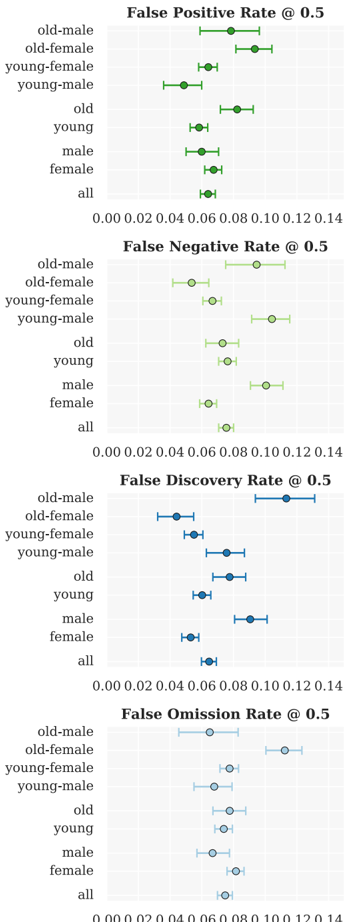
- In the smiling classifier example, all reported metrics at the .5 decision threshold have error types within the range 0.04–0.14, with 95% confidence intervals calculated by bootstrap resampling; the card notes older men have much higher false discovery rate, while men in aggregate have higher false negative rate.
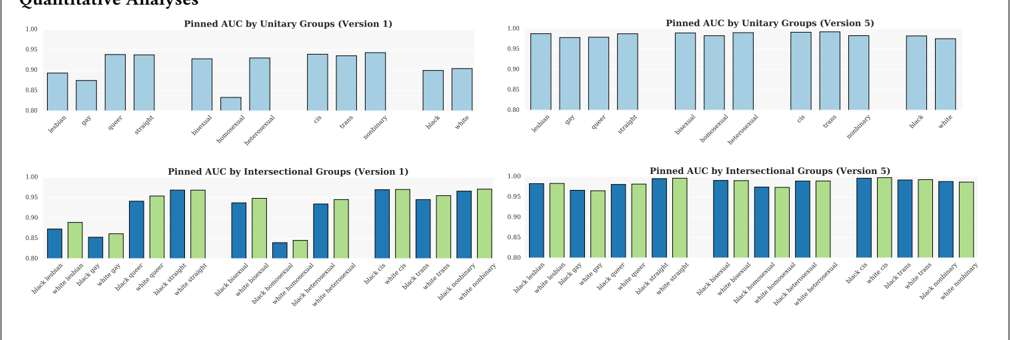
- In the toxicity example, TOXICITY v. 1 has low performance for several terms, especially “lesbian,” “gay,” and “homosexual,” while TOXICITY v. 5 shows more equitable performance after bias mitigation techniques.
Methods
- The paper is a framework/proposal paper, not an empirical study of a new model; it recommends model cards and details suggested sections and prompts.
- It provides two worked examples: a smiling classifier trained and evaluated on the CelebA dataset, using a convolutional neural net pretrained for face recognition and fine-tuned with cross-entropy loss for binary smiling classification.
- It also provides a model card for Perspective API’s TOXICITY classifier, a convolutional neural network developed by Jigsaw in 2017, evaluated on a synthetic Identity Phrase Templates test set; metrics include FPR, FNR, FDR, FOR for the smiling classifier and Pinned AUC for toxicity.
Limitations
- The paper states that model cards rely on the integrity of their creators and that it seems unlikely, at least in the near term, that they could be standardized or formalized enough to prevent misleading representations of model results.
- The paper states that evaluation datasets suitable for disaggregated evaluation are not yet common, and that the synthetic toxicity test data covers only a small set of very specific comments and is not comprehensive.
- The smiling classifier card states it does not capture race or skin type, uses binary gender classes (male/female), and that an ideal evaluation dataset would additionally include Fitzpatrick skin type, camera details, and environment details; the paper also states future work is needed to study how model information is interpreted and used by different stakeholders.
Model-written summary. Check it against the paper before relying on it.
Integrity signals
Registry
Cites
Statistics
Figures
Verification
Claims the paper makes
5 Valid · 1 Not valid · 18 Not checked · 30 Own results and interpretations
The cited sources support only part of this claim — read each source’s verdict below.
In the paper
“Synthetic data is valuable here because [11] shows that real data often has disproportionate amounts of toxicity directed at specific groups.”
What the sources say
- Partly supportedcites [11] [11] Lucas Dixon, John Li, Jeffrey Sorensen, Nithum Thain, and Lucy Vasserman. 2018. Measuring and Mitigating Unintended Bias in Text Classification. Proceedings of the AAAI/ACM Conference on AI, Ethics, and Society (2018). - sourceExperimental — accuracy not yet measured
The 'Quantifying bias in dataset' section (page unavailable) reports that certain identity terms appear disproportionately in toxic comments in the authors’ training data; for example, 'gay' appears in 3% of toxic comments but 0.5% of comments overall. It measures comments containing those terms, not whether toxicity is directed at the groups, and does not establish how often this pattern occurs across real datasets generally. (LLM, conf=0.85)
plainstates an association- Asserted: passes — The authors put it forward as true.
- Checkable: passes — It can be checked against evidence.
- Load-bearing: passes — The paper’s conclusions depend on it.
- Based: passes — The paper gives a reason why it holds.
- Partly supported
A result the paper reports from its own data — it cites no other source for it, so there is none to check. The quote shows it is in the paper.
In the paper
“For example, the false discovery rate on older men is much higher than that for other groups.”
plainstates an association- Asserted: passes — The authors put it forward as true.
- Checkable: passes — It can be checked against evidence.
- Load-bearing: passes — The paper’s conclusions depend on it.
- Based: passes — The paper gives a reason why it holds.
A result the paper reports from its own data — it cites no other source for it, so there is none to check. The quote shows it is in the paper.
In the paper
“TOXICITY v. 1 has low performance for several terms, especially 'lesbian', 'gay', and 'homosexual'.”
plain- Asserted: passes — The authors put it forward as true.
- Checkable: passes — It can be checked against evidence.
- Load-bearing: passes — The paper’s conclusions depend on it.
- Based: passes — The paper gives a reason why it holds.
None of the sources cited for this claim have been checked yet.
In the paper
“she collaborated with other researchers to demonstrate the disproportionate errors of computer vision systems on historically marginalized groups in the United States, such as darker-skinned women [5, 41].”
What the sources say
- Not checked yetcites [5] [5] Joy Buolamwini and Timnit Gebru. 2018. Gender Shades: Intersectional Accuracy Disparities in Commercial Gender Classification. In Proceedings of the 1st Conference on Fairness, Accountability and Transparency (Proceedings of Machine Learning Research) , Sorelle A. Friedler and Christo Wilson (Eds.), Vol. 81. PMLR, New York, NY, USA, 77-91. http://proceedings.mlr.press/v81/buolamwini18a.html -
- Not checked yetcites [41] [41] Inioluwa Raji. 2018. Black Panther Face Scorecard: Wakandans Under the Coded Gaze of AI. (2018). -
boostedstates an association- Asserted: passes — The authors put it forward as true.
- Checkable: passes — It can be checked against evidence.
- Load-bearing: passes — The paper’s conclusions depend on it.
- Based: passes — The paper gives a reason why it holds.
In the paper
“after MIT Media Lab graduate student Joy Buolamwini found that commercial face recognition systems failed to detect her face [4]”
What the sources say
- Not checked yetcites [4] [4] Joy Buolamwini. 2016. How I'm fighting Bias in Algorithms. (2016). https://www.ted.com/talks/joy\_buolamwini\_how\_i\_m\_fighting\_bias\_in\_ algorithms#t-63664 -
plainSingle case- Asserted: passes — The authors put it forward as true.
- Checkable: passes — It can be checked against evidence.
- Load-bearing: unclear — It is unclear whether the paper’s conclusions depend on it.
- Based: passes — The paper gives a reason why it holds.
13 more claims
Create a free account to see all 54 claims and to verify the 13 references still open.
- Probably not a substantial claim. 34
- It may state two separate claims as one. 8
Claims other papers make about this one
Each is checked against this paper’s own text: does it say what the citing paper says it does?
The source backs part of the claim, not all of it — or backs it for a different population, condition or comparison.
In the citing paper
“Model cards represent the field's standard for disclosing and documenting key facts about the architecture, training and evaluation of the model [14, 40].”
From Rethinking open source generative AI: open washing and the EU AI Act (2024) · cites this paper as [40]
Experimental — accuracy not yet measuredThe source backs part of the claim, not all of it — or backs it for a different population, condition or comparison.
In the citing paper
“Model cards (SMCs) [44] have been foundational in standardizing documentation for AI/ML model performance and characteristics, along with risks and unintended uses.”
From Interactive Model Cards: A Human-Centered Approach to Model Documentation (2022) · cites this paper as [44]
Experimental — accuracy not yet measuredThe source backs part of the claim, not all of it — or backs it for a different population, condition or comparison.
In the citing paper
“A second phase saw a more technical approach from the computer science community focusing on fairness, accountability and transparency as an engineering 'ethicalby-design' problem-solving exercise [20][21][22].”
From Putting AI ethics to work: are the tools fit for purpose? (2022) · cites this paper as [21]
Experimental — accuracy not yet measuredThe source backs part of the claim, not all of it — or backs it for a different population, condition or comparison.
In the citing paper
“These are either materials for use in design teams in workshop style events [76,77], tools for producing documentation of the design, build and test process [21,68], or technical tools for testing models, protecting privacy and security, testing for bias [69,93,94], or tracking provenance of data [95].”
From Putting AI ethics to work: are the tools fit for purpose? (2022) · cites this paper as [21]
Experimental — accuracy not yet measuredThe source backs part of the claim, not all of it — or backs it for a different population, condition or comparison.
In the citing paper
“There is some work on fairness relating to AI services, though this tends to focus on either exposing or 'auditing' certain AI services [22,38,126,133], or devising tools, methods and interventions relevant for those building (rather than using) such services [12,96,106,128].”
From Out of Context: Investigating the Bias and Fairness Concerns of “Artificial Intelligence as a Service” (2023) · cites this paper as [106]
Experimental — accuracy not yet measured
17 more claims about this paper
Create a free account to see every claim other papers make about this one.
Citations
Cites
BLEU: a method for automatic evaluation of machine translation
Papineni, K., Roukos, S., Ward, T., & Zhu, W.-J. (2001) · Proceedings of the 40th Annual Meeting on Association for Computational Linguistics - ACL '02 · doi:10.3115/1073083.1073135 · Cited by 21,344 · cited 1×
“translation system could compare BLEU scores [40] across demographic groups, and a model card for a speech recognition system could compare word-error rates.”
BackgroundCrenshaw, K. (2018) · Feminist Legal Theory · doi:10.4324/9780429500480-5 · Cited by 9,510
Deep Learning Face Attributes in the Wild
Liu, Z., Luo, P., Wang, X., & Tang, X. (2015) · 2015 IEEE International Conference on Computer Vision (ICCV) · doi:10.1109/iccv.2015.425 · Cited by 7,747 · cited 4×
“ms [5, 26] that report details of the datasets used to train and test machine learning models. We provide two example model cards in Section 5: A smiling detection model trained on the CelebA dataset [33] (Figure 2), and a public toxicity detection model, Perspective API [29] (Figure 3). Where Datasheets highlight cha…”
BackgroundMethodInfluentialThe validity and practicality of sun-reactive skin types I through VI
Fitzpatrick, T. B. (1988) · Archives of Dermatology · doi:10.1001/archderm.1988.01670060015008 · Cited by 4,339
Differential Privacy: A Survey of Results
Dwork, C. (2008) · Lecture Notes in Computer Science · doi:10.1007/978-3-540-79228-4_1 · Cited by 3,542 · cited 2×
“As such, collaboration with policy, privacy, and legal experts is necessary in order to ascertain which groups may be responsibly inferred, and how that information should be stored and accessed (for example, using differential privacy [12]).”
BackgroundCollins, G. S., Reitsma, J. B., Altman, D. G., & Moons, K. G. M. (2015) · Annals of Internal Medicine · doi:10.7326/m14-0697 · Cited by 3,267
Equality of Opportunity in Supervised Learning
Hardt, M., Price, E., & Srebro, N. (2016) · arXiv · doi:10.48550/arxiv.1610.02413 · Cited by 2,536 · cited 2×
“of Opportunity, and equal false negative and false positive rates across groups is equivalent to fulfilling Equality of Odds [26].”
BackgroundGebru, T., Morgenstern, J., Vecchione, B., Vaughan, J. W., Wallach, H., Daumé, H., & Crawford, K. (2018) · arXiv · doi:10.48550/arxiv.1803.09010 · Cited by 2,474
Self-citationA Probabilistic Interpretation of Precision, Recall and F-Score, with Implication for Evaluation
Goutte, C., & Gaussier, E. (2005) · Lecture Notes in Computer Science · doi:10.1007/978-3-540-31865-1_25 · Cited by 2,285 · cited 1×
“Confidence intervals for metrics derived from confusion matrices can be calculated by treating the matrices as probabilistic models of system performance [24].”
MethodFair prediction with disparate impact: a study of bias in recidivism prediction instruments
Chouldechova, A. (2017) · Big Data · doi:10.1089/big.2016.0047 · Cited by 2,159 · cited 1×
“or different errors that can be calculated from the confusion matrix for binary classification systems. • These also correspond to metrics in recent definitions of “fairness” in machine learning (cf. [8, 25]), where parity across subgroups for different metrics correspond to different fairness criteria. • 95% confiden…”
Background
Research works printed but not linked: 9
- [1] Avrio AI. 2018. Avrio AI: AI Talent Platform. (2018). https://www.goavrio.com/ -
- [5] Joy Buolamwini and Timnit Gebru. 2018. Gender Shades: Intersectional Accuracy Disparities in Commercial Gender Classification. In Proceedings of the 1st Conference on Fairness, Accountability and Transparency (Proceedings of Machine Learning Research) , Sorelle A. Friedler and Christo Wilson (Eds.), Vol. 81. PMLR, New York, NY, USA, 77-91. http://proceedings.mlr.press/v81/buolamwini18a.html -
- [13] Entelo. 2018. Recruitment Software | Entelo. (2018). https://www.entelo.com/ -
- [17] U.S. Food and Drug Administration. 2013. FDA Drug Safety Communication: Risk of next-morning impairment after use of insomnia drugs; FDA requires lower recommended doses for certain drugs containing zolpidem (Ambien, Ambien CR, Edluar, and Zolpimist). (2013). https://web.archive.org/web/20170428150213/ https://www.fda.gov/drugs/drugsafety/ucm352085.htm -
- [18] IIHS (Insurance Institute for Highway Safety: Highway Loss Data Institute). 2003. Special Issue: Side Impact Crashworthiness. Status Report 38, 7 (2003). -
- [19] Institute for the Future, Omidyar Network's Tech, and Society Solutions Lab. 2018. Ethical OS. (2018). https://ethicalos.org/ -
- [32] Jigsaw. 2017. Perspective API. (2017). https://www.perspectiveapi.com/ -
- [39] AI Now. 2018. Litigating Algorithms: Challenging Government Use Of Algorithmic Decision Systems. AI Now Institute. -
- [43] Mukund Sundararajan, Ankur Taly, and Qiqi Yan. 2017. In Proceedings of the 34th International Conference on Machine Learning , Vol. 70. PMLR, Sydney, Australia. -
Cited by
Items 1,301–1,400 of 2,235
Human-Centered AI in Healthcare
Majumder, N. N., & Adebiyi, B. O. (2026) · Springer eBooks · doi:10.1007/978-981-97-8440-0_112-1 · Cited by 2
Unified Federated AI Framework for Credit Scoring
Kaarat, A., Batthula, V. J. R., & Segall, R. S. (2026) · International Journal of Artificial Intelligence · doi:10.4018/ijaibm.398859 · Cited by 2
Good practices for documenting AI-based studies on energy and buildings
Hong, T., & Li, H. (2026) · Energy and Buildings · doi:10.1016/j.enbuild.2026.117043 · Cited by 5
Chinnaraju, A., & Loganathan, K. A. (2026) · International Journal of Latest Technology in Engineering Management & Applied Science · doi:10.51583/ijltemas.2026.150100018 · Cited by 6
Investigating transformer models for textual bias detection in model, data, and dataspace cards
Donald, A., Galanopoulos, A., Ojha, A. K., Curry, E., Muñoz, E., Ullah, I., McCrae, J. P., Kalra, M., Saxena, S., & Iqbal, T. (2026) · AI and Ethics · doi:10.1007/s43681-025-00975-3 · Cited by 1
“This vulnerability is particularly concerning in the context of artificial intelligence (AI) documentation tools such as Model Cards, Data Cards, and Dataspace Cards, which aim to promote transparency and accountability in AI systems [4, 5].”
Towards a Fuzzy MCDM-Based Framework for Multi-Metric Bias Auditing in Generative AI
Ravikumar, R., Rajan, A. V., Narayan, A., & Maheshwari, P. (2025) · International Conference on Information Technology Trends (ITT) · doi:10.1109/itt69610.2025.11352932 · Cited by 1
“• Context-Specific Risk Sensitivity – Recognizes domain specific tolerance for bias, with stricter requirements in domains like healthcare, finance and elections [24].”
Shababi, H. (2026) · AI and Ethics · doi:10.1007/s43681-026-00986-8 · Cited by 1
Sultana, D. S. F. B. A. D. F. (2026) · International Journal of Advanced Research in Science Communication and Technology · doi:10.48175/ijarsct-31102 · Cited by 2
Agbeyibor, R., Bowers, R., Kolb, J., & Feigh, K. M. (2026) · AIAA SciTech Forum · doi:10.2514/6.2026-2731 · Cited by 1
Ethics and Compliance: Navigating Data Privacy in AI Applications
Awasthi, A. P., Singh, N. K., & Mondal, B. (2026) · Advances in computational intelligence and robotics book series · doi:10.4018/979-8-3373-5238-1.ch012 · Cited by 1
Martins, D. G. D. S., Martins, T. G. D. S., Damasceno, E. D. F., Martins, T. G. D. S., & Schor, P. (2026) · Revista Brasileira de Oftalmologia · doi:10.37039/1982.8551.20260009 · Cited by 1
Quantum artificial intelligence: A comprehensive survey
Jiang, H., Pan, Y., Chen, J., Liu, Z., Sun, L., Li, Q., Zhang, L., Zhu, D., Wang, X., Liu, W., et al. (2026) · Meta-Radiology · doi:10.1016/j.metrad.2026.100205 · Cited by 3
Singh, P., Angra, P. K., & Ahmed, H. M. (2026) · Advances in computational intelligence and robotics book series · doi:10.4018/979-8-3373-5871-0.ch009 · Cited by 1
Decoding Drift: Trustworthy Prompt Optimization in High-Stakes AI Environments
Natarajan, G. N., Paul, S., Shah, J. K., Tiwari, A., & Bellamkonda, R. (2025) · International Conference on Electronics and Computing, Communication Networking Automation Technologies (ICEC2NT) · doi:10.1109/icec2nt65402.2025.11380079 · Cited by 1
“Fail-safe guardrails are also guaranteed with our drift-aware assessment, a value that is becoming a common tenet in industry security measures of AI applications [21].”
InfluentialEthical and legal challenges of integrating artificial intelligence into paediatric surgery
Anand, A., & Sinha, C. (2026) · Annals of The Royal College of Surgeons of England · doi:10.1308/rcsann.2025.0110 · Cited by 4
Reconsidering the Rules: Legal and Ethical Frameworks for the Governance of Foundation Models
Ranjan, K. P. (2026) · Advances in computational intelligence and robotics book series · doi:10.4018/979-8-2600-0000-7.ch005 · Cited by 1
Audit-as-code: a policy-as-code framework for continuous AI assurance
Muhammad, A. E., Yow, K., & Alsenan, S. A. (2026) · Frontiers in Artificial Intelligence · doi:10.3389/frai.2026.1759211 · Cited by 13
Yerneni, R. (2025) · International Conference on Intelligent Systems and Embedded Design (ISED) · doi:10.1109/ised67359.2025.11405305 · Cited by 1
“Complementary documentation practices such as Datasheets for Datasets and Model Cards promote disciplined disclosure about data and model behavior [13], [14].”
Adaptive diagnostic reasoning framework for pathology with multimodal large language models
Hong, Y., Kao, K.-C., Edwards, L., Liu, N. T., Huang, C., Oliveira-Kowaleski, A., Hsieh, C.-J., & Lin, N. Y. C. (2026) · Communications Medicine · doi:10.1038/s43856-026-01491-z · Cited by 3
“To address this, future work should stress-test open-source local models for comparability and adopt standardized, multi-metric evaluation protocols and clinical reporting guidelines to ensure robustness, calibration, and transparent documentation 70 – 72 .”
Caridi, A., Giovannini, M., & Celsi, L. R. (2026) · Electronics · doi:10.3390/electronics15061155 · Cited by 8
“Documentation artifacts further improve auditability and reproducibility [23,24].”
GBP-Audit: AI Bias Intervention with Built-In Safety-First Guardrails
Doku, R., Osafo, N. Y. A., & Rawat, D. B. (2025) · IEEE International Conference on Cognitive Machine Intelligence (CogMI) · doi:10.1109/cogmi67134.2025.00052 · Cited by 1
“GBP-Audit adopts calibration and AUROC guardrails explicitly to implement calibration-preserving fairness edits. e) Governance, auditability, and documentation: Model Cards [39], Datasheets for Datasets [40], and internal audit frameworks [41] emphasize structured transparency.”
Fuentes, R. S., Valenzuela, N. A., Figueroa-Flores, C., et al. (2025) · Proceedings/Proceedings - International Conference of the Chilean Computer Science Society · doi:10.1109/sccc67219.2025.11420311 · Cited by 1
“• Using model cards and datasheets to document forensic AI models [22].”
Pepe, F., Nardone, V., Mastropaolo, A., Canfora, G., Bavota, G., & Penta, M. D. (2026) · Empirical Software Engineering · doi:10.1007/s10664-026-10843-1 · Cited by 5
Bias-Aware Resume Screening: A Survey and Analytical Framework Using NLP and Machine Learning
Rajendran, D., Venugopal, S., Gowri, C. S., Khan, N. B. L., Krithiga, R., & Nikash, B. A. (2026) · International Conference on Electronics, Materials Engineering & Nano-Technology (IEMENTech) · doi:10.1109/iementech202669403.2026.11434402 · Cited by 1
“Ribeiro et al. presented model-agnostic interpretability methods for black-box predictions used to examine fairness in NLP models [10].”
How cultural cognition affects trust and perceived quality of AI explanations
Yuan, C. W., & Lee, Y.-H. (2026) · Computers in Human Behavior Reports · doi:10.1016/j.chbr.2026.101021 · Cited by 3
Siavvas, M., Tsoukalas, D., Kehagias, D., & Tzovaras, D. (2026) · IEEE Transactions on Artificial Intelligence · doi:10.1109/tai.2026.3677323 · Cited by 2
“A reasoning similar to NIST’s AI RMF is also adopted by other recent research endeavors [9], [10], [11].”
Board-level governance and risk oversight framework for Artificial Intelligence systems
Kumar, K., & Jaya, J. (2026) · EDPACS · doi:10.1080/07366981.2026.2645658 · Cited by 3
AgriIR: A Scalable Framework for Domain-Specific Knowledge Retrieval
Seal, S. B., Poddar, A., Mishra, A., & Roy, D. (2026) · Lecture notes in computer science · doi:10.1007/978-3-032-21324-2_37 · Cited by 2
“Beyond technical modularity, the responsible IR community has emphasized the necessity of transparency, fairness, and efficiency in information systems [28,3,4].”
Theodorakopoulos, L., & Theodoropoulou, A. (2026) · Electronics · doi:10.3390/electronics15071405 · Cited by 1
Artificial Intelligence-Based Digital Transformation
Volpentesta, T. (2026) · Emerald Group Publishing Limited eBooks · doi:10.1108/978-1-80592-096-020261002 · Cited by 1
Ray, G., & Molla, N. (2026) · Journal of Digital Security and Forensics · doi:10.29121/digisecforensics.v3.i1.2026.92 · Cited by 1
Bridging Racial and Age Gaps in Face Recognition: A Data-Augmentation Framework for Fair AI
Kitharidis, S., Schaap, A., Bäck, T., & van Stein, B. (2026) · SN Computer Science · doi:10.1007/s42979-026-04885-x · Cited by 1
The ML FMEA in Action: Lessons from Applications of Machine Learning Safety
Schmitt, P., Shinde, C., Diemert, S., Pennar, K., Seifert, B., Poh, J., Lopez, J., Mannan, F., Mohammed, M., Chalana, A., et al. (2026) · SAE technical papers on CD-ROM/SAE technical paper series · doi:10.4271/2026-01-0079 · Cited by 1
Alu, F. F., Oluwadare, S., Halliday, N., & Agwunobi, U. E. (2026) · Frontiers in Artificial Intelligence · doi:10.3389/frai.2026.1756023 · Cited by 4
“Concurrently, the proposal of Model cards are concise reports accompanying ML models that detail their intended use, performance across subgroups, and evaluation conditions (Mitchell et al., 2019).”
Ye, H. (2026) · Social Semiotics · doi:10.1080/10350330.2026.2659880 · Cited by 4
Falcon, G., & Carillo, K. (2026) · Behaviour and Information Technology · doi:10.1080/0144929x.2026.2657460 · Cited by 5
Vienna International Centre, 100, P. B., Vienna, A.-1., Austria, 2600-0, T. +. (., & 2600-7, F. +. (. (2026) · IAEA human health series · doi:10.61092/iaea.9olq-aqa9 · Cited by 3
Control and Safety Boundaries for Agentic AI in Cloud-Native Distributed Systems
Maji, S. (2026) · Proceedings of IEEE Southeastcon · doi:10.1109/southeastcon63549.2026.11476125 · Cited by 1
“Autonomous units make decisions that are temporally consequential to system state, and operators must know what was done, under what conditions and with what cumulative effect in a form that is interpretable and auditable by humans [21].”
Beyond the Algorithm: Navigating Ethics, Quality, and Accountability in AI-Powered Translation
Aqad, M. H. A., Amirdabbaghian, A., & Alhasani, H. M. A. (2026) · Advances in computational intelligence and robotics book series · doi:10.4018/979-8-3373-6420-9.ch010 · Cited by 1
From Barthes to algorithms: reimagining authorship and reader agency in the AI era
Guadu, A., & Dibekulu, D. (2026) · AI and Ethics · doi:10.1007/s43681-026-01108-0 · Cited by 2
Perspective Chapter: Operationalizing NIST AI RMF for LLMs – Architecture, RAG and Secure Deployment
Oz, G., & Keskin, F. (2026) · Artificial intelligence · doi:10.5772/intechopen.1014752 · Cited by 2
Svøðstein, J., & Kristmundsson, J. (2026) · International Conference on Information Networking · doi:10.1109/icoin68469.2026.11480463 · Cited by 1
“Sambasivan et al. [5] highlight persistent undervaluation of data preparation, while Mitchell et al. [10] advocate structured documentation of model limitations and data dependencies.”
Who legitimises the AI algorithm? Leadership, volatility and the governance of algorithmic authority
Anning‐Dorson, T. (2026) · Strategy and Leadership · doi:10.1108/sl-12-2025-0453 · Cited by 1
Mrabet, M., & Sliti, M. (2026) · Urban Science · doi:10.3390/urbansci10050251 · Cited by 4
Garcia, C. A., Reed, K. A., Lantz, E., Day, P. L., Stadler, B. C., Zarella, M. D., Hart, S. N., Han, W., Tavolara, T. E., Wahsh, E. A., et al. (2026) · American Journal of Clinical Pathology · doi:10.1093/ajcp/aqag029 · Cited by 1
Nilsson, A., Eijsbroek, V. C., Gu, Z., Kjell, K., Giorgi, S., Kotov, R., Ganesan, A. V., Schwartz, H. A., & Kjell, O. (2026) · Advances in Methods and Practices in Psychological Science · doi:10.1177/25152459261419036 · Cited by 4
“We expect that most well-validated models will be accompanied by additional documentation, such as a peer-reviewed article, a model card describing the model in depth (Mitchell et al., 2019), and/or a data sheet clearly describing the training data set (Gebru et al., 2021).”
Pimenow, S., Pimenowa, O., Prus, P., & Zieliński, M. (2026) · Sustainability · doi:10.3390/su18104892 · Cited by 6
Beyond Bias Detection: Community Auditors and Normative Reasoning in AI Oversight CSCW006
Jackson, C., Ahmad, T., Raj, S. D., & Wu, N. (2026) · Proceedings of the ACM on Human-Computer Interaction · doi:10.1145/3788042 · Cited by 1
“In recent years, there has been considerable momentum in developing frameworks, guidelines, and tools for auditing AI systems for potential issues such as bias, unfairness, and broader societal harms (e.g., [2, 5, 8, 29]).”
Gandhi, S., & Balas, M. (2026) · BMC Medical Ethics · doi:10.1186/s12910-026-01496-2 · Cited by 1
Empowering healthcare 5.0 with deep learning: techniques, trends, and future directions
Maji, P. K., Chakraborty, S., Sadiq, A., Basu, S., & Ghosh, K. (2026) · Artificial Intelligence Review · doi:10.1007/s10462-026-11593-8 · Cited by 2
Foundation Models in Cancer Pathology: Techniques, Applications, and Future Directions
Zhang, B., Cui, V. Y., Wu, T., Su, G., Huang, Q., Shang, B., Kong, M., Yu, W., Yuan, Y., & Tu, H. (2026) · Research · doi:10.34133/research.1332 · Cited by 2
Bujek-Kubas, I. (2026) · Journal of Medical Internet Research · doi:10.2196/94952 · Cited by 2
“Educational clinical materials may enter machine learning pipelines through web scraping of publicly accessible repositories, digitization of legacy textbooks, downstream aggregation, secondary dataset reuse, and incorporation into multimodal training datasets [7-11, 23, 24].”
Georgiou, G. P. (2026) · Algorithms · doi:10.3390/a19060441 · Cited by 3
An Explainable Hybrid AI Framework for Real-Time Point-of-Sale Credit Scoring
Zakariya, G., Moldagulova, A., & Ali, N. B. (2026) · AI · doi:10.3390/ai7060211 · Cited by 1
“Third, the model-card discipline [51] provides a standardised transparency artefact; we maintain a model card per production model recording intended use, training window, performance by segment, calibration method, fairness audit results, and known limitations.”
Regulatory and technical gaps for foundation models in chemical process safety
Nouman, M., Ali, Y., & Zafar, Z. U. R. (2026) · Journal of Loss Prevention in the Process Industries · doi:10.1016/j.jlp.2026.106076 · Cited by 2
Making floras computable: Audited translation of flora of China as reusable taxonomic knowledge
Liu, B., Ai, F.-Z., Liao, C., Xu, C., Luo, H., Xuan, J., Song, Y., & Li, M. (2026) · Acta Botanica Yunnanica · doi:10.1016/j.pld.2026.05.015 · Cited by 1
“The Machine Learning (ML) community has argued that documentation tools such as dataset “datasheets” and model “cards” provide basic scaffolding for responsible reuse (Gebru et al., 2018; Mitchell et al., 2019).”
Jenkins, A. D. G., Bagchi, P., Curtis, H., Seymour, W., Coté, M., & Such, J. M. (2026) · Designing Interactive Systems Conference · doi:10.1145/3800645.3812975 · Cited by 1
“While similar to model cards [54], our work highlights the potential to integrate such transparency information into conversational interactions [33].”
A Safety-Constrained Architecture for Adaptive Clinical Decision Support
Wendakoon, K., & Tripathi, N. (2026) · Communications in computer and information science · doi:10.1007/978-3-032-28819-6_21 · Cited by 1
The Double-Edged Blade: Navigating Confidentiality in Context-Injected Language Generation
Gantla, S. R., & Devireddy, S. (2025) · doi:10.1109/iccetm66557.2025.11557724 · Cited by 1
“While not a privacy breach per se, the inability of the system to distinguish between permissive and restrictive licenses exposed legal vulnerabilities [30].”
Protection-grade artificial intelligence for modern power systems
Meydani, A., Shahinzadeh, H., Nafisi, H., & Ramezani, A. (2026) · Energy Conversion and Management X · doi:10.1016/j.ecmx.2026.102060 · Cited by 2
Dikici, S., & Bilgin, T. T. (2026) · Expert Systems · doi:10.1111/exsy.70331 · Cited by 5
“We recommend that future SLM research require formal privacy audits as a reporting standard, including differential privacy certification where personally identifiable data is involved (Mitchell et al. 2019).”
Joldić, A., Bijedić, N., & Gašpar, D. (2026) · International Conference on Integrated Intelligence and Cognitive Engineering (ICIICE) · doi:10.1109/iciice69672.2026.11565460 · Cited by 1
“In governance-oriented settings, decision makers must balance predictive performance, reliability, interpretability, expected cost, and stability under role-specific priorities and accountability constraints [1] – [4].”
Data protection in the era of large language models: challenges and opportunities
Revesai, Z., & Chipfumbu, C. T. (2026) · AI and Ethics · doi:10.1007/s43681-026-01223-y · Cited by 5
“Model cards provide high-level documentation of training procedures and benchmark performance [ 75 ] but cannot satisfy the Article 22 requirement for meaningful information about individual automated decisions.”
InfluentialChambers, L. M., & Davenport, D. (2026) · ACM Conference on Fairness, Accountability, and Transparency (FAccT) · doi:10.1145/3805689.3806542 · Cited by 1
“…technical work: approaches that foreground social and community values in design praxes [23, 41, 78, 79, 97]; documentation and reporting artifacts such as model cards [57] and datasheets [39]; and accountability-oriented practices including algorithmic audits and evaluations [51, 69, 88, 92].”
Inspectable AI for Science: A Research Object Approach to Generative AI Governance
Binkytė, R., Abuaddba, S., Mahawaga, C., Ding, M., Fernandes, N., & Fritz, M. (2026) · IEEE Security and Privacy Workshops (SPW) · doi:10.1109/spw72489.2026.00039 · Cited by 6
“While traditional model cards describe a model’s capabilities, limitations, and recommended uses [23], AI-ROIC functions as a compact inspection interface, allowing readers to understand how the generative system was configured, what materials are available for audit, and how responsibility is…”
Kurashkin, S. O., Тынченко, В. С., Бородулин, А. С., Hammoud, A., & Connie, T. (2026) · Machine Learning and Knowledge Extraction · doi:10.3390/make8070194 · Cited by 2
“The reproducibility program and paper checklist introduced at NeurIPS were developed with the community and with experts in responsible machine learning, drew on model cards [52] and datasheets for datasets [53], and were piloted before they were required [54].”
Lee, H.-K., Yoon, C., & Lee, B. G. (2026) · Systems · doi:10.3390/systems14070849 · Cited by 6
Joldić, A., Bijedić, N., Gašpar, D., & Mabić, M. (2026) · International Conference on Intelligent Systems and Digital Applications (ISDA) · doi:10.1109/isda70544.2026.11605984 · Cited by 1
“The broader literature shows that single-metric model evaluation is often insufficient for deployment-oriented decisions, because it omits important properties such as robustness, documentation quality, and usage constraints [5], [6].”
Fernandes, A., Moleirinho, S., Gomes, L. M., & Machado, J. (2026) · Informatics in Medicine Unlocked · doi:10.1016/j.imu.2026.101787 · Cited by 1
Kabir-Chisty, M. (2026) · AI and Ethics · doi:10.1007/s43681-026-01296-9 · Cited by 2
“…small set of guiding principles [9 ] and the European guidelines for trustworthy AI [14 ], and on early work that operationalised accountability through documen - tation and auditing [ 21 , 28], the AITTF extends that lineage from governing the AI system to governing the transfer that produced it.”
Deploying Experiment-Trained Models: Safe Retraining Pipelines and Governance
Lei, M. (2026) · Apress eBooks · doi:10.1007/979-8-8688-2721-1_20 · Cited by 1
Permissive-Washing in the Open AI Supply Chain: A Large-Scale Audit of License Integrity
Jewitt, J., Rajbahadur, G. K., Li, H., Adams, B., & Hassan, A. E. (2026) · ACM SIGKDD Conference on Knowledge Discovery and Data Mining (KDD) · doi:10.1145/3770855.3818130 · Cited by 2
From Principles to Practice: Engineering Responsible AI for Geospatial Intelligence
Hassan, M., Sardar, B., Islam, S., Imani, M., & Hakiri, A. (2026) · SN Computer Science · doi:10.1007/s42979-026-05258-0 · Cited by 1
“● Model Documentation (Model Card) [25]”
Machine learning of artistic fingerprints in jazz
Cheston, H., Bance, R., & Harrison, P. M. C. (2026) · Nature Machine Intelligence · doi:10.1038/s42256-026-01279-9 · Cited by 1
CRAYON: Supporting the Elicitation of Pluralistic Normative Requirements for Autonomous Systems
Abodinar, L. M. D., Adubi, P., Ayad, R., Hogedez, B., Standen, I., Townsend, B., Foundjem, A. T., Khomh, F., & Marsso, L. (2026) · IEEE International Requirements Engineering Conference (RE) · doi:10.1109/re68928.2026.00009 · Cited by 1
“Tim Puhlf¨urß et al. [12] analyzed 26 ethics and AI guidelines, including those from the European Commission (e.g., EU AI act) [2], AI governance and documentation frameworks [13]–[15], as well as relevant research papers [16]– [21].”
Mask-Like Alignment: A Psychopathy-Informed Heuristic for Persona-Driven LLM Deployment
Danagher, L. (2026) · Philosophy & Technology · doi:10.1007/s13347-026-01188-0 · Cited by 2
“System cards, model cards, and auditing practices similarly document risk categories, behavioural targets, safety limitations, and mitigations (Mitchell et al., 2019; Raji et al., 2020).”
Dube, S. (2021) · Springer eBooks · doi:10.1007/978-3-030-68624-6_16 · Cited by 1
Machine Learning Bias in Computer Vision: Why do I have to care?
Laranjeira, C., Mota, V. F., & dos Santos, J. A. (2021) · SIBGRAPI Conference on Graphics, Patterns and Images (SIBGRAPI) · doi:10.1109/sibgrapi54419.2021.00010 · Cited by 3
Whatever Happened to the Logic of Discovery? From Transparent Logic to Alien Reasoning
Nickles, T. (2022) · Synthese Library/Synthese library · doi:10.1007/978-3-031-01315-7_5 · Cited by 1
Developing a Ranking Problem Library (RPLIB) from a data-oriented perspective
Anderson, P. E., Langville, A. N., Pedings, K. E., Tat, B., & Ward, C. (2022) · Optimization and Engineering · doi:10.1007/s11081-022-09771-y · Cited by 1
“1 RPLIB Model Card Because ranking is a common task in machine learning, we adopt the standard documentation from that field, namely storing and visualizing the output as a model card [20].”
MethodCharacterization of AI Model Configurations for Model Reuse
Bajcsy, P., Majurski, M. P., Cleveland, T. E., Carrasco, M., & Keyrouz, W. (2023) · Lecture notes in computer science · doi:10.1007/978-3-031-25069-9_30 · Cited by 4
Dimensions of Explanatory Value in NLP Models
van Deemter, K. (2023) · Computational Linguistics · doi:10.1162/coli_a_00480 · Cited by 6
“Different policy mechanisms may help our community to achieve this, similar to (or even as a component of) the model cards that are starting to be used to enhance the documentation of NLP models in terms of their intended use, evaluation details, and so on (Mitchell et al. 2019).”
BackgroundDeveloping Modular Autonomous Capabilities for sVAS Operations
Quigley, K., Goodwin, V., Álvarez, L., et al. (2023) · Proceedings - IEEE Aerospace Conference · doi:10.1109/aero55745.2023.10115575 · Cited by 1
“For additional details about our trained object detection model, including metrics on its performance, please refer to Appendix B for our model card [15].”
MethodCombining Semantic Web and Machine Learning for Auditable Legal Key Element Extraction
Breit, A., Waltersdorfer, L., Ekaputra, F. J., Karampatakis, S., Miksa, T., & Käfer, G. (2023) · Lecture notes in computer science · doi:10.1007/978-3-031-33455-9_36 · Cited by 7
Mitigating Bias in Algorithmic Decision-making: Evaluating Claims and Practices
Raghavan, M. (2023) · ACM eBooks · doi:10.1145/3603195.3603212 · Cited by 1
Dudzik, B., Hrkalović, T. M., Küster, D., St-Onge, D., Putze, F., & Devillers, L. Y. (2023) · INTERNATIONAL CONFERENCE ON MULTIMODAL INTERACTION · doi:10.1145/3577190.3616883 · Cited by 1
“While some of these may take the form of technological approaches, other elements will require the development and adoption of practices by the community (e.g., formats for documentation to improve accountability [10]).”
BackgroundVidela, A. (2023) · Communications of the ACM · doi:10.1145/3610283 · Cited by 1
ARD, FAIR Earth Observation Principles, Data Fusion: Where are we and where do we need to go?
Lunga, D., Hänsch, R., Verma, U., et al. (2023) · IEEE International Geoscience and Remote Sensing Symposium (IGARSS) · doi:10.1109/igarss52108.2023.10281577 · Cited by 1
“The ideas of developing datasheets [10] for data and model-cards [11] for models have been introduced as mechanisms to organize the essential facts about datasets and ML models in a structured way.”
BackgroundMethodAlgorithmic Bias in De-Identification Tools
Heider, P. M. (2023) · IEEE International Conference on Healthcare Informatics (ICHI) · doi:10.1109/ichi57859.2023.00129 · Cited by 1
“We test these hypotheses through both disaggregated analysis [1] of a pre-existing corpus and targeted synthetic alteration of a pre-existing corpus.”
MethodHate Speech Detection and Bias in Supervised Text Classification
Davidson, T. (2023) · Oxford University Press eBooks · doi:10.1093/oxfordhb/9780197653609.013.16 · Cited by 4
What the embedded ethics approach brings to AI-enhanced neuroscience
McLennan, S., Willem, T., & Fiske, A. (2024) · Developments in neuroethics and bioethics · doi:10.1016/bs.dnb.2024.02.010 · Cited by 1
Learning Gaze-aware Compositional GAN from Limited Annotations
Aranjuelo, N., Huang, S., Arganda‐Carreras, I., Unzueta, L., Otaegui, O., Pfister, H., & Wei, D. (2024) · Proceedings of the ACM on Computer Graphics and Interactive Techniques · doi:10.1145/3654706 · Cited by 5
“Another possibility to promote responsible artificial intelligence is the data and model cards [Mitchell et al. 2019; Pushkarna et al. 2022].”
BackgroundResponsible Model Selection with Virny and VirnyView
Herasymuk, D., Khan, F. A., & Stoyanovich, J. (2024) · ACM SIGMOD International Conference on Management of Data (SIGMOD) · doi:10.1145/3626246.3654738 · Cited by 3
“Incontrasttoexistingfairnesssoftwarelibraries[2, 18, 21] and model card generating frameworks [5, 17], our system stands out in four key aspects.”
BackgroundSystems Engineering Processes to Test AI Right (SEPTAR)
Lockett, J. A., Reeder, F. M., Chen, I., et al. (2024) · Conference record (1995) - Autotestcon/Conference record - Autotestcon · doi:10.1109/autotestcon47465.2024.10697513 · Cited by 1
Schedl, M., Anelli, V. W., & Lex, E. (2024) · The information retrieval series · doi:10.1007/978-3-031-69978-8_2 · Cited by 1
Zapata, S. M., Hutchings, A., Grieve, R., Hinchliffe, R. J., Smart, N. J., Moonesinghe, R., Bellingan, G. J., Vohra, R., Moug, S. J., & O’Neill, S. (2024) · Medical Decision Making · doi:10.1177/0272989x241289336 · Cited by 2
The Groundwork for an Ethics of Artificial Intelligence in Defence
Taddeo, M. (2024) · Oxford University Press eBooks · doi:10.1093/oso/9780197745441.003.0001 · Cited by 1
The Use of Generative Artificial Intelligence for Business Decision-Making
Mummar, A., Pacheco, A., Saunders, S., Ratliff-Villarreal, L., & Schmitt, A. (2024) · The Pinnacle A Journal by Scholar-Practitioners · doi:10.61643/c16259 · Cited by 3
Mirończuk, M., Müller, A., & Pedrycz, W. (2024) · IEEE Access · doi:10.1109/access.2024.3513550 · Cited by 3
“…adopting standardized reporting guidelines tailored to machine learning research, such as the Machine Learning Reproducibility Checklist [210] or Model Cards for Model Reporting [211], to ensure that all necessary details are provided for replication and to enhance trans-parency in reporting.”
To Share or Hide: Confidential Model Compilation as a Service with Privacy-Preserving Transparency
Qin, K., & Gu, D. (2024) · IEEE Symposium on Reliable Distributed Systems (SRDS) · doi:10.1109/srds64841.2024.00022 · Cited by 2
Metadata
- Authors
- Mitchell, M., Wu, S., Zaldivar, A., Barnes, P., Vasserman, L., Hutchinson, B., Spitzer, E., Raji, I. D., & Gebru, T.
- Venue
- Proceedings of the Conference on Fairness, Accountability, and Transparency
- Publisher
- ACM
- Published
- 2019-01-29
- Pages
- 220-229
- OpenAlex
- W2897042519
- Semantic Scholar
- 7365f887c938ca21a6adbef08b5a520ebbd4638f
- Cited by
- 2,681
- References
- 12
- Citations by year
- 2026: 831 · 2025: 446 · 2024: 376 · 2023: 366 · 2022: 243 · 2021: 260 · 2020: 102 · 2019: 54
- FWCI
- 170.95
- Type
- conference paper
- Language
- en
- Open access
- green
- arxiv.org
- Locations
- ACM Conference on Fairness, Accountability, and Transparency (FAccT) (publishedVersion)
- arXiv (Cornell University) (submittedVersion)
- arXiv (Cornell University)
- Topics
- Physical Sciences › Computer Science › Artificial Intelligence › Ethics and Social Impacts of AI
- Physical Sciences › Computer Science › Artificial Intelligence › Explainable Artificial Intelligence (XAI)
- Physical Sciences › Computer Science › Computer Vision and Pattern Recognition › Face recognition and analysis
- Keywords
- model cards, model transparency, algorithmic fairness, demographic bias, responsible AI, democratization of AI, toxic comment detection, model documentation
About these checks
Registry, retraction, Cites and statistics results are computed, not judged, with one exception: a printed reference that no index lists is read once by a model before it counts as a citation error. Claims are extracted by a model and kept only when their quote appears verbatim in the text; each cited source is then checked, with a model’s help, for whether it says what the claim relies on. Those verdicts can be wrong — read the claim’s quote and the cited source before relying on one.
The claim verdicts this report counts are experimental: their accuracy is not yet measured.
A language model drew the claims from the paper on 2026-10-07, under version 3 of the claim definition (model deepseek-v4.1-flash, prompt extract-v3).
A second model labelled each claim on 2026-10-07 (model jev-1.13-20260917, definition revision gold-guideline-v0.2).
Cited sources are checked with a language model’s help (gpt-6-sol).
Statistics and arithmetic are recomputed, not judged.
Confidence bands are shown only for fields calibrated on our annotated test set. None is calibrated yet, so no band is shown.
What counts as a claim ›How we measure confidence ›How we check this ›
Are you an author, or do you see a problem with this page? Request a review
Data sources
Bibliographic data: Semantic Scholar, OpenAlex, Crossref.
Contains information from the Semantic Scholar Academic Graph Datasets, made available under the ODC Attribution License (ODC-BY 1.0).
Semantic Scholar’s data is described in: Kinney, R., et al. (2023). The Semantic Scholar Open Data Platform. arXiv:2301.10140.
