

Model Cards for Model Reporting
Open accessThe DOI matches its Crossref record; 22 of the 22 references it cites were found in a registry or an index; 8 of the 34 sources its claims cite were checked for support.
Abstract
Trained machine learning models are increasingly used to perform high-impact tasks in areas such as law enforcement, medicine, education, and employment. In order to clarify the intended use cases of machine learning models and minimize their usage in contexts for which they are not well suited, we recommend that released models be accompanied by documentation detailing their performance characteristics. In this paper, we propose a framework that we call model cards, to encourage such transparent model reporting. Model cards are short documents accompanying trained machine learning models that provide benchmarked evaluation in a variety of conditions, such as across different cultural, demographic, or phenotypic groups (e.g., race, geographic location, sex, Fitzpatrick skin type [15]) and intersectional groups (e.g., age and race, or sex and Fitzpatrick skin type) that are relevant to the intended application domains. Model cards also disclose the context in which models are intended to be used, details of the performance evaluation procedures, and other relevant information. While we focus primarily on human-centered machine learning models in the application fields of computer vision and natural language processing, this framework can be used to document any trained machine learning model. To solidify the concept, we provide cards for two supervised models: One trained to detect smiling faces in images, and one trained to detect toxic comments in text. We propose model cards as a step towards the responsible democratization of machine learning and related artificial intelligence technology, increasing transparency into how well artificial intelligence technology works. We hope this work encourages those releasing trained machine learning models to accompany model releases with similar detailed evaluation numbers and other relevant documentation.
Overview
CoChat Summary
TL;DR
The paper proposes “model cards,” short documentation records accompanying trained machine learning models to report intended use, performance characteristics, and disaggregated evaluation across demographic, phenotypic, and intersectional groups. It illustrates the framework with worked examples for a smiling classifier and a toxicity classifier.
Key findings
- The authors argue there are no standardized documentation procedures for communicating trained ML model performance, especially for high-impact domains such as health care, employment, education, and law enforcement.
- They propose model card sections covering model details, intended use, factors, metrics, evaluation data, training data, quantitative analyses, ethical considerations, and caveats/recommendations.
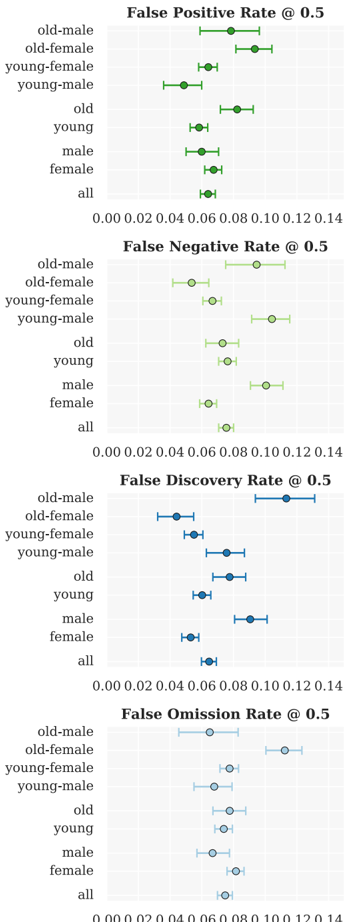
- In the smiling classifier example, all reported metrics at the .5 decision threshold have error types within the range 0.04–0.14, with 95% confidence intervals calculated by bootstrap resampling; the card notes older men have much higher false discovery rate, while men in aggregate have higher false negative rate.
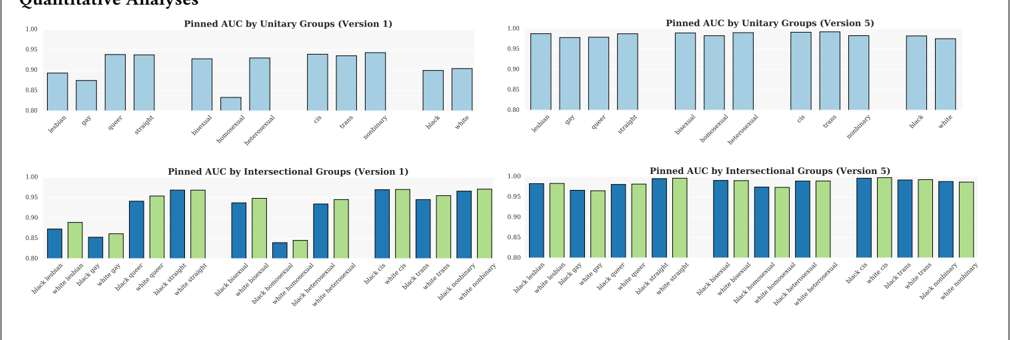
- In the toxicity example, TOXICITY v. 1 has low performance for several terms, especially “lesbian,” “gay,” and “homosexual,” while TOXICITY v. 5 shows more equitable performance after bias mitigation techniques.
Methods
- The paper is a framework/proposal paper, not an empirical study of a new model; it recommends model cards and details suggested sections and prompts.
- It provides two worked examples: a smiling classifier trained and evaluated on the CelebA dataset, using a convolutional neural net pretrained for face recognition and fine-tuned with cross-entropy loss for binary smiling classification.
- It also provides a model card for Perspective API’s TOXICITY classifier, a convolutional neural network developed by Jigsaw in 2017, evaluated on a synthetic Identity Phrase Templates test set; metrics include FPR, FNR, FDR, FOR for the smiling classifier and Pinned AUC for toxicity.
Limitations
- The paper states that model cards rely on the integrity of their creators and that it seems unlikely, at least in the near term, that they could be standardized or formalized enough to prevent misleading representations of model results.
- The paper states that evaluation datasets suitable for disaggregated evaluation are not yet common, and that the synthetic toxicity test data covers only a small set of very specific comments and is not comprehensive.
- The smiling classifier card states it does not capture race or skin type, uses binary gender classes (male/female), and that an ideal evaluation dataset would additionally include Fitzpatrick skin type, camera details, and environment details; the paper also states future work is needed to study how model information is interpreted and used by different stakeholders.
Model-written summary. Check it against the paper before relying on it.
Integrity signals
Registry
Cites
Statistics
Figures
Verification
Claims the paper makes
5 Valid · 1 Not valid · 18 Not checked · 30 Own results and interpretations
The cited sources support only part of this claim — read each source’s verdict below.
In the paper
“Synthetic data is valuable here because [11] shows that real data often has disproportionate amounts of toxicity directed at specific groups.”
What the sources say
- Partly supportedcites [11] [11] Lucas Dixon, John Li, Jeffrey Sorensen, Nithum Thain, and Lucy Vasserman. 2018. Measuring and Mitigating Unintended Bias in Text Classification. Proceedings of the AAAI/ACM Conference on AI, Ethics, and Society (2018). - sourceExperimental — accuracy not yet measured
The 'Quantifying bias in dataset' section (page unavailable) reports that certain identity terms appear disproportionately in toxic comments in the authors’ training data; for example, 'gay' appears in 3% of toxic comments but 0.5% of comments overall. It measures comments containing those terms, not whether toxicity is directed at the groups, and does not establish how often this pattern occurs across real datasets generally. (LLM, conf=0.85)
plainstates an association- Asserted: passes — The authors put it forward as true.
- Checkable: passes — It can be checked against evidence.
- Load-bearing: passes — The paper’s conclusions depend on it.
- Based: passes — The paper gives a reason why it holds.
- Partly supported
A result the paper reports from its own data — it cites no other source for it, so there is none to check. The quote shows it is in the paper.
In the paper
“For example, the false discovery rate on older men is much higher than that for other groups.”
plainstates an association- Asserted: passes — The authors put it forward as true.
- Checkable: passes — It can be checked against evidence.
- Load-bearing: passes — The paper’s conclusions depend on it.
- Based: passes — The paper gives a reason why it holds.
A result the paper reports from its own data — it cites no other source for it, so there is none to check. The quote shows it is in the paper.
In the paper
“TOXICITY v. 1 has low performance for several terms, especially 'lesbian', 'gay', and 'homosexual'.”
plain- Asserted: passes — The authors put it forward as true.
- Checkable: passes — It can be checked against evidence.
- Load-bearing: passes — The paper’s conclusions depend on it.
- Based: passes — The paper gives a reason why it holds.
None of the sources cited for this claim have been checked yet.
In the paper
“she collaborated with other researchers to demonstrate the disproportionate errors of computer vision systems on historically marginalized groups in the United States, such as darker-skinned women [5, 41].”
What the sources say
- Not checked yetcites [5] [5] Joy Buolamwini and Timnit Gebru. 2018. Gender Shades: Intersectional Accuracy Disparities in Commercial Gender Classification. In Proceedings of the 1st Conference on Fairness, Accountability and Transparency (Proceedings of Machine Learning Research) , Sorelle A. Friedler and Christo Wilson (Eds.), Vol. 81. PMLR, New York, NY, USA, 77-91. http://proceedings.mlr.press/v81/buolamwini18a.html -
- Not checked yetcites [41] [41] Inioluwa Raji. 2018. Black Panther Face Scorecard: Wakandans Under the Coded Gaze of AI. (2018). -
boostedstates an association- Asserted: passes — The authors put it forward as true.
- Checkable: passes — It can be checked against evidence.
- Load-bearing: passes — The paper’s conclusions depend on it.
- Based: passes — The paper gives a reason why it holds.
In the paper
“after MIT Media Lab graduate student Joy Buolamwini found that commercial face recognition systems failed to detect her face [4]”
What the sources say
- Not checked yetcites [4] [4] Joy Buolamwini. 2016. How I'm fighting Bias in Algorithms. (2016). https://www.ted.com/talks/joy\_buolamwini\_how\_i\_m\_fighting\_bias\_in\_ algorithms#t-63664 -
plainSingle case- Asserted: passes — The authors put it forward as true.
- Checkable: passes — It can be checked against evidence.
- Load-bearing: unclear — It is unclear whether the paper’s conclusions depend on it.
- Based: passes — The paper gives a reason why it holds.
13 more claims
Create a free account to see all 54 claims and to verify the 13 references still open.
- Probably not a substantial claim. 34
- It may state two separate claims as one. 8
Claims other papers make about this one
Each is checked against this paper’s own text: does it say what the citing paper says it does?
The source backs part of the claim, not all of it — or backs it for a different population, condition or comparison.
In the citing paper
“Model cards represent the field's standard for disclosing and documenting key facts about the architecture, training and evaluation of the model [14, 40].”
From Rethinking open source generative AI: open washing and the EU AI Act (2024) · cites this paper as [40]
Experimental — accuracy not yet measuredThe source backs part of the claim, not all of it — or backs it for a different population, condition or comparison.
In the citing paper
“Model cards (SMCs) [44] have been foundational in standardizing documentation for AI/ML model performance and characteristics, along with risks and unintended uses.”
From Interactive Model Cards: A Human-Centered Approach to Model Documentation (2022) · cites this paper as [44]
Experimental — accuracy not yet measuredThe source backs part of the claim, not all of it — or backs it for a different population, condition or comparison.
In the citing paper
“A second phase saw a more technical approach from the computer science community focusing on fairness, accountability and transparency as an engineering 'ethicalby-design' problem-solving exercise [20][21][22].”
From Putting AI ethics to work: are the tools fit for purpose? (2022) · cites this paper as [21]
Experimental — accuracy not yet measuredThe source backs part of the claim, not all of it — or backs it for a different population, condition or comparison.
In the citing paper
“These are either materials for use in design teams in workshop style events [76,77], tools for producing documentation of the design, build and test process [21,68], or technical tools for testing models, protecting privacy and security, testing for bias [69,93,94], or tracking provenance of data [95].”
From Putting AI ethics to work: are the tools fit for purpose? (2022) · cites this paper as [21]
Experimental — accuracy not yet measuredThe source backs part of the claim, not all of it — or backs it for a different population, condition or comparison.
In the citing paper
“There is some work on fairness relating to AI services, though this tends to focus on either exposing or 'auditing' certain AI services [22,38,126,133], or devising tools, methods and interventions relevant for those building (rather than using) such services [12,96,106,128].”
From Out of Context: Investigating the Bias and Fairness Concerns of “Artificial Intelligence as a Service” (2023) · cites this paper as [106]
Experimental — accuracy not yet measured
17 more claims about this paper
Create a free account to see every claim other papers make about this one.
Citations
Cites
BLEU: a method for automatic evaluation of machine translation
Papineni, K., Roukos, S., Ward, T., & Zhu, W.-J. (2001) · Proceedings of the 40th Annual Meeting on Association for Computational Linguistics - ACL '02 · doi:10.3115/1073083.1073135 · Cited by 21,344 · cited 1×
“translation system could compare BLEU scores [40] across demographic groups, and a model card for a speech recognition system could compare word-error rates.”
BackgroundCrenshaw, K. (2018) · Feminist Legal Theory · doi:10.4324/9780429500480-5 · Cited by 9,510
Deep Learning Face Attributes in the Wild
Liu, Z., Luo, P., Wang, X., & Tang, X. (2015) · 2015 IEEE International Conference on Computer Vision (ICCV) · doi:10.1109/iccv.2015.425 · Cited by 7,747 · cited 4×
“ms [5, 26] that report details of the datasets used to train and test machine learning models. We provide two example model cards in Section 5: A smiling detection model trained on the CelebA dataset [33] (Figure 2), and a public toxicity detection model, Perspective API [29] (Figure 3). Where Datasheets highlight cha…”
BackgroundMethodInfluentialThe validity and practicality of sun-reactive skin types I through VI
Fitzpatrick, T. B. (1988) · Archives of Dermatology · doi:10.1001/archderm.1988.01670060015008 · Cited by 4,339
Differential Privacy: A Survey of Results
Dwork, C. (2008) · Lecture Notes in Computer Science · doi:10.1007/978-3-540-79228-4_1 · Cited by 3,542 · cited 2×
“As such, collaboration with policy, privacy, and legal experts is necessary in order to ascertain which groups may be responsibly inferred, and how that information should be stored and accessed (for example, using differential privacy [12]).”
BackgroundCollins, G. S., Reitsma, J. B., Altman, D. G., & Moons, K. G. M. (2015) · Annals of Internal Medicine · doi:10.7326/m14-0697 · Cited by 3,267
Equality of Opportunity in Supervised Learning
Hardt, M., Price, E., & Srebro, N. (2016) · arXiv · doi:10.48550/arxiv.1610.02413 · Cited by 2,536 · cited 2×
“of Opportunity, and equal false negative and false positive rates across groups is equivalent to fulfilling Equality of Odds [26].”
BackgroundGebru, T., Morgenstern, J., Vecchione, B., Vaughan, J. W., Wallach, H., Daumé, H., & Crawford, K. (2018) · arXiv · doi:10.48550/arxiv.1803.09010 · Cited by 2,474
Self-citationA Probabilistic Interpretation of Precision, Recall and F-Score, with Implication for Evaluation
Goutte, C., & Gaussier, E. (2005) · Lecture Notes in Computer Science · doi:10.1007/978-3-540-31865-1_25 · Cited by 2,285 · cited 1×
“Confidence intervals for metrics derived from confusion matrices can be calculated by treating the matrices as probabilistic models of system performance [24].”
MethodFair prediction with disparate impact: a study of bias in recidivism prediction instruments
Chouldechova, A. (2017) · Big Data · doi:10.1089/big.2016.0047 · Cited by 2,159 · cited 1×
“or different errors that can be calculated from the confusion matrix for binary classification systems. • These also correspond to metrics in recent definitions of “fairness” in machine learning (cf. [8, 25]), where parity across subgroups for different metrics correspond to different fairness criteria. • 95% confiden…”
Background
Research works printed but not linked: 9
- [1] Avrio AI. 2018. Avrio AI: AI Talent Platform. (2018). https://www.goavrio.com/ -
- [5] Joy Buolamwini and Timnit Gebru. 2018. Gender Shades: Intersectional Accuracy Disparities in Commercial Gender Classification. In Proceedings of the 1st Conference on Fairness, Accountability and Transparency (Proceedings of Machine Learning Research) , Sorelle A. Friedler and Christo Wilson (Eds.), Vol. 81. PMLR, New York, NY, USA, 77-91. http://proceedings.mlr.press/v81/buolamwini18a.html -
- [13] Entelo. 2018. Recruitment Software | Entelo. (2018). https://www.entelo.com/ -
- [17] U.S. Food and Drug Administration. 2013. FDA Drug Safety Communication: Risk of next-morning impairment after use of insomnia drugs; FDA requires lower recommended doses for certain drugs containing zolpidem (Ambien, Ambien CR, Edluar, and Zolpimist). (2013). https://web.archive.org/web/20170428150213/ https://www.fda.gov/drugs/drugsafety/ucm352085.htm -
- [18] IIHS (Insurance Institute for Highway Safety: Highway Loss Data Institute). 2003. Special Issue: Side Impact Crashworthiness. Status Report 38, 7 (2003). -
- [19] Institute for the Future, Omidyar Network's Tech, and Society Solutions Lab. 2018. Ethical OS. (2018). https://ethicalos.org/ -
- [32] Jigsaw. 2017. Perspective API. (2017). https://www.perspectiveapi.com/ -
- [39] AI Now. 2018. Litigating Algorithms: Challenging Government Use Of Algorithmic Decision Systems. AI Now Institute. -
- [43] Mukund Sundararajan, Ankur Taly, and Qiqi Yan. 2017. In Proceedings of the 34th International Conference on Machine Learning , Vol. 70. PMLR, Sydney, Australia. -
Cited by
Items 1,601–1,700 of 2,235
Silva, J. I. D., Burlamaqui, A. A. R. S. D. S., & Burlamaqui, A. M. F. (2025) · Revista Linguagem em Foco · doi:10.46230/lef.v17i3.16015
Navigating Ethical Frontiers in Automation and Human-Robot Synergy for Organizational Transformation
Pushpalatha, S., & Pandian, R. D. (2025) · Advances in computational intelligence and robotics book series · doi:10.4018/979-8-3373-3404-2.ch007
Evaluation of AI ethics tools in language models: a developers’ perspective case study
Silva, J., Moreira, D. A. B., dos Santos, G. O., Ferreira, A., Maia, H., Avila, S., & Pedrini, H. (2026) · AI and Ethics · doi:10.1007/s43681-025-00914-2 · Cited by 3
Inherent Tradeoffs in the Fair Determination of Risk Scores
Raghavan, M. (2023) · ACM eBooks · doi:10.1145/3603195.3603206 · Cited by 3
The Externalities of Exploration and How Data Diversity Helps Exploitation
Raghavan, M. (2023) · ACM eBooks · doi:10.1145/3603195.3603199
Algorithmic monoculture and social welfare
(2023) · The Societal Impacts of Algorithmic Decision-Making · doi:10.1145/3603195.3603202
Selection Problems in the Presence of Implicit Bias
Raghavan, M. (2023) · ACM eBooks · doi:10.1145/3603195.3603200
Towards a Standardized Interactive AI Transparency Label
Goram, M. (2025) · Lecture notes in networks and systems · doi:10.1007/978-3-031-99958-1_34 · Cited by 2
Vargas‐Solar, G. (2025) · Communications in computer and information science · doi:10.1007/978-3-032-05727-3_20
Evaluation Reporting in AI Model Releases should be StandardizedPreprint
Dhar, R., Villegas, D. S., Karamolegkou, A., Schiavone, A., Yuan, Y., Chen, X., Li, J., Frank, S., Grazia, L. D., Swain, M., et al. (2025) · SSRN Electronic Journal · doi:10.2139/ssrn.5444574
Fairness-aware Machine Learning
Kamishima, T. (2025) · Ouyou toukeigaku · doi:10.5023/jappstat.54.81 · Cited by 1
Vakilzadeh, A., Jang, H., Kim, J., Rafieizonooz, M., & Khankhaje, E. (2025) · SSRN Electronic Journal · doi:10.2139/ssrn.5506702
Ethical AI in Enterprise Analytics: Balancing Innovation with Fairness, Privacy, and Transparency
Sura, R. (2025) · International Journal of Computational and Experimental Science and Engineering · doi:10.22399/ijcesen.3762 · Cited by 1
“…[16] Transparency and documentation standards for datasets Proposes “datasheets” as a method to ensure ethical dataset usage [17] Standardized reporting mechanisms for machine learning models Introduces “model cards” to improve communication of model purpose, performance, and fairness [18]”
MRM3: Machine Readable ML Model Metadata
Čop, A., Bertalanič, B., Grobelnik, M., & Fortuna, C. (2025) · International Conference on Mobile Systems, Applications, and Services · doi:10.1145/3711875.3736685 · Cited by 2
Template-Driven Specification of Requirements for LLM-Based Chatbots
da Silva, C. V. M., Maita, A. R. C., Filho, G. A. D. A., da Silva, C. H. C., Dimant, G., Almeida, R. A. R., Costa, G. M. L., Araujo, A. M. C., Santana, B. C. D. S., Blay, E. A., et al. (2025) · doi:10.5753/wbots.2025.14151 · Cited by 1
“The method generates structured requirement cards, inspired by [Mitchell et al. 2019], to capture both functional and non-functional roles while clearly separating the LLM’s core activities (reading, writing, conversing) from the broader sys-tem requirements.”
Lamba, K., & Rani, S. (2025) · De Gruyter eBooks · doi:10.1515/9783111612034-007
Artificial Intelligence and Diversity, Equity, and Inclusion
Garard, J., Ezirigwe, J., & Ayoub, M. (2025) · Springer eBooks · doi:10.1007/978-3-031-32257-0_72-1
Embracing Training Dataset Bias for Automated Harmful Detection
Schöpke-Gonzalez, A., Kim, N., & Hemphill, L. (2025) · Proceedings of the Association for Information Science and Technology · doi:10.1002/pra2.1282
“However, the model cards approach (Mitchell et al., 2019) includes recommendations for documenting appropriate use and context for pre-trained models.”
Let’s Talk AI with Computer Science Expert Taylor T. Johnson
Johnson, T. T., & Steffen, B. (2025) · Lecture notes in computer science · doi:10.1007/978-3-032-09008-9_15
Ilyas, A. A., & Ilyas, S. A. (2025) · SSRN Electronic Journal · doi:10.2139/ssrn.5712602
Lin, X., & Losavio, M. (2025) · Smart innovation, systems and technologies · doi:10.1007/978-981-96-7273-8_22 · Cited by 9
Styger, S. A., Kloots, M. D. H., van der Wal, O., & Russo, F. (2025) · Synthese Library/Synthese library · doi:10.1007/978-3-032-03083-2_15 · Cited by 1
Wu, G., & Yang, F. (2025) · Hospitals · doi:10.3390/hospitals2040029 · Cited by 1
“Transparent reporting frameworks such as Model Cards for Clinical natural language processing (NLP) and the CONSORT-AI extension help standardize documentation of dataset composition and subgroup performance [39,40].”
Wilkie, P. Y., Namdar, K., Samsel, K., Pasricha, S. V., Jaiswal, N., Salo, Z., So, M., Panchal, S., Malhotra, A. K., Nashnoush, E., et al. (2025) · FACETS · doi:10.1139/facets-2025-0117 · Cited by 1
Experiment Cards: A Documentation Framework for Trustworthy AI Experiments
Gkioka, G., Apostolou, D., Verginadis, Y., & Mentzas, G. N. (2025) · IEEE International Conference on Tools with Artificial Intelligence (ICTAI) · doi:10.1109/ictai66417.2025.00065
“As for model cards, proposed by Mitchell et al. [1], those present a standardized format for capturing machine learning models’ details.”
The AI Paradox: Marketing Missteps in the Age of Artificial Intelligence
Gani, M. O., Ariffin, A. A. M., & Rafi, K. N. (2025) · Springer eBooks · doi:10.1007/978-3-031-75316-9_78-1
Artificial intelligence and the transformation of employment: a systematic literature review
Isataeva, G. B., Bigeldiyeva, Z. A., & Nurtayeva, D. K. (2025) · Bulletin of Turan University · doi:10.46914/1562-2959-2025-1-4-205-217 · Cited by 1
Nakanishi, T., Chophuk, P., & Chinnasarn, K. (2025) · International Computer Science and Engineering Conference · doi:10.1109/icsec67360.2025.11298030
“Nevertheless, explicitly “visualizing” data-driven biases using XAI [5, 6] and presenting their breakdown is essential for enhancing the transparency and accountability of model operations and accelerating the design of corrective measures.”
Andrès, F., Knoppers, J. V. T., & Dhungana, S. R. (2025) · Advances in computational intelligence and robotics book series · doi:10.4018/979-8-3373-2235-3.ch006
Inam, A. (2025) · Artificial intelligence · doi:10.5772/intechopen.1012981
Bridging the Bench-to-Bedside Gap with Multimodal Artificial Intelligence in Digestive Diseases
Weiskirchen, R. (2026) · Livers · doi:10.3390/livers6010001 · Cited by 1
Lima, T. G. L. (2025) · Global political sociology · doi:10.1007/978-3-032-05954-3_2
Ethical and Legal Considerations in Impact Assessment
Derbez, L. P. (2025) · Springer eBooks · doi:10.1007/978-3-032-11862-2_8
Modelcards für die Bewertung der Umweltauswirkungen von KI-Systemen
Kirnberger, J. L. (2025) · SDG - Forschung, Konzepte, Lösungsansätze zur Nachhaltigkeit · doi:10.1007/978-3-658-46577-3_18
An Infrastructure for Managing AI Bias in Complex Web Systems
Heil, S., Ferdous, J., Gaber, A., & Gaedke, M. (2025) · IEEE/ACS International Conference on Computer Systems and Applications (AICCSA) · doi:10.1109/aiccsa66935.2025.11315299
“Future work aims at transforming the experimental feedback into an improved version of the platform, the integration with further architectural modeling tools and the combination with model cards [17].”
Linardos, A., Willem, T., Buyx, A., Hossain, S., Jung, T., Makris, D., & Bakas, S. (2026) · AI & Society · doi:10.1007/s00146-025-02817-6
“Previous work has introduced Datasheets (Gebru et al. 2021) and Model Cards (Mitchell et al. 2019), proposing structured documentation frameworks that encapsulate data composition, collection practices, and intended use.”
A.I.’s Impact on Nursing Practice and Care
Walker, R., Khastar, S. M., Kuehnle, F., & Shen, M. (2026) · Springer eBooks · doi:10.1007/978-3-032-12402-9_6
Fawareh, H. J., & Saleh, Y. M. (2026) · Studies in systems, decision and control · doi:10.1007/978-3-031-95310-1_172
Ethical Considerations in AI-Driven Drug Development and Pharmaceutical Industry
Bari, Y. C., Wani, M. S., Nagare, G. D., Chogale, M. M., & Pai, R. (2026) · Advances in computational intelligence and robotics book series · doi:10.4018/979-8-3373-5258-9.ch010 · Cited by 1
The Alignment Tax: Why Safety Shouldn’t Slow Innovation
Khalid, Z. (2026) · Journal of Artificial Intelligence Research and Innovation · doi:10.29328/journal.jairi.1001013
STAMM: Soft sensor moniToring and mAintenance framework for Machine learning ModelsPreprint
Suarez, C., Astudillo, A., Metcalfe, B., Crowther, M., Koehorst, J. J., Castillo, E., Bize, A., & Corrales, D. C. (2026) · SSRN Electronic Journal · doi:10.2139/ssrn.6054948
Current Challenges and Issues in Car Traffic Forecasting
Bielecki, P., & Hachaj, T. (2026) · IEEE Access · doi:10.1109/access.2026.3653629 · Cited by 1
“Model-level reporting should likewise include clear descriptions of inputs, training procedures, evaluation conditions, and disaggregated performance across regions, time periods, and population subgroups— consistently presented in model cards to support comparability and informed oversight [116].”
Trust and Ethics in Chatbots: A Framework for Responsible AI Interactions
Sowmya, P., & Vasudeva (2026) · IEEE Access · doi:10.1109/access.2026.3653763 · Cited by 6
OpenITI Tabanlı RAG Sistemi ile Doğal Dil İşleme
Tay, M. (2026) · Akademisyen Kitabevi eBooks · doi:10.37609/akya.4033
Srivastava, A., Jain, S., & Maity, R. (2026) · Advances in chemical pollution, environmental management and protection · doi:10.1016/bs.apmp.2025.11.004
Impact of fine-tuning large language model in society: a comprehensive study
Chandra, J., Joseph, A., Joseph, J., Upadhyay, P., & Kumar, S. (2026) · Elsevier eBooks · doi:10.1016/b978-0-443-33592-1.00008-5
Understanding and Mitigating Bias in Artificial Intelligence Systems: An Ontological Perspective
Roy, O., Shingala, D., & Patel, P. (2026) · Lecture notes in networks and systems · doi:10.1007/978-3-032-12990-1_41
A Study of Fairness and Bias of Deep Learning Models
Lohani, K., Meena, T., Vanjara, D., Barde, G., Raj, A., Rawat, S., Chaubey, G., Kumar, B., & Singh, K. P. (2025) · IEEE International Conference on Computer Vision and Machine Intelligence (CVMI) · doi:10.1109/cvmi66673.2025.11337368
AI Bias in Marketing: Challenges, DEI Concerns, and Mechanisms for Ethical Innovation
Haridasan, A. C., & Xavier, N. (2026) · Advances in computational intelligence and robotics book series · doi:10.4018/979-8-3373-6731-6.ch002
Нейросетевой аудит рекламных кампаний: обзор и концептуальный фреймворк
Алексеев, Д. В. (2026) · Regional and Branch Economy · doi:10.47576/2949-1916.2025.9.9.027
Singh, S., & Singh, V. (2026) · Advances in computational intelligence and robotics book series · doi:10.4018/979-8-3373-5403-3.ch017
AuditingAI: Explainability-Driven Verification of Machine Learning Models
Tripathi, A. (2025) · International Conference on Responsible, Generative and Explainable AI (ResGenXAI) · doi:10.1109/resgenxai64788.2025.11343999
“More systematic efforts like datasheets [17], model cards [18], and process-level audits [19] have emerged, but lack theoretical guarantees.”
Visibility into Agentic AI for Required System Theory and Increasing Harms in Algorithmic System
Kunchakuri, N., Patchigolla, V. L., Kedlaya, A. S., & Upreti, T. (2025) · International Conference on Information Systems and Computer Networks (ISCON) · doi:10.1109/iscon65210.2025.11340987 · Cited by 1
“RL systems showed superhuman performance on a wider variety of specific activities, including video games [14] and increasingly complex board games [15], with little to no human supervision when deep learning was incorporated.”
A Formal Framework for Ethics-by-Design in AI Entertainment Systems
Arora, S., Josyula, P., & Rajput, A. (2025) · IEEE International Conference on Cyber Security and Cloud Computing / IEEE International Conference on Edge Computing and Scalable Cloud (CSCloud/EdgeCom) · doi:10.1109/edgecom66327.2025.00019
“L3 (Transparency): L 3 = ( E user , E dev , E audit , T adapt ) - Multi-level explanations following model card guidelines [18].”
Detecting AI-Generated Scientific Abstracts Using Galactica and Graph Neural Networks
Pathak, A., Sharma, D. K., Agrawal, H., Chawuthai, R., & Petchhan, J. (2025) · International Conference on Information Systems and Computer Networks (ISCON) · doi:10.1109/iscon65210.2025.11341445
Cracking the Circuits: Mechanistic Interpretability in Large Language Models
Muhammad, D., Salman, M., Ali, M., & Bendechache, M. (2025) · International Multi-Topic Conference · doi:10.1109/inmic65900.2025.11348249 · Cited by 2
“Conversely, opaque models used in high-stakes settings (e.g., healthcare, finance, legal systems) pose accountability risks [27], [29].”
C-RLM: Schema-Enforced Recursive Synthesis for Auditable, Long-Context Clinical DocumentationPreprint
Yu, Y. (2026) · medRxiv · doi:10.64898/2026.01.24.26344761
Smart Data Portfolios: A Quantitative Framework for Input Governance in AIPreprint
Yalta, A. T., & Yalta, A. T. (2026) · SSRN Electronic Journal · doi:10.2139/ssrn.5942058
Retrospective Quality Analysis of a Clinical RAG Chatbot: Observable Signals and Lessons LearnedPreprint
Khashei, I., Presciani, D., Martinelli, L. P., et al. (2026) · medRxiv · doi:10.64898/2026.01.26.26344757
Tran, D. T. (2026) · IntechOpen eBooks · doi:10.5772/intechopen.1013235
Fluent, Fast, and Fragile: How Shadow Prompts Distort Performance CalibrationPreprint
Frollová, N. (2026) · SSRN Electronic Journal · doi:10.2139/ssrn.6138965
Architecting Governable Artifact Evolution in AI-Enabled Production Systems: A Model-Driven DSLPreprint
Caballero, M., Hernández, J.-J., Gómez, J. É., Galvez, J. J. H., Andrés, O. R., & Santana, J. C. (2026) · SSRN Electronic Journal · doi:10.2139/ssrn.6140218
Aqad, M. H. A., & Al-Saggaf, M. A. (2026) · IGI Global eBooks · doi:10.4018/979-8-3373-5717-1.ch008
Jose, A., Kaithathara, S. T., Mohan, R., Bhat, N., & Tapase, P. (2026) · IGI Global eBooks · doi:10.4018/979-8-3373-1454-9.ch005 · Cited by 1
Mapping News Categories: An Experiment on Louvain Community Discovery and Machine Learning
KANBUR, Y., & AYDIN, H. (2026) · Erciyes İletişim Dergisi · doi:10.17680/erciyesiletisim.1761752
Transparent and Equitable Metrics and Models
Arias-Duart, A., Cortés, Á., & Cortés, U. (2026) · Springer eBooks · doi:10.1007/978-3-031-61050-9_28-1
Fischer, K. (2026) · SSRN Electronic Journal · doi:10.2139/ssrn.6090766
Artificial intelligence-enabled personalized medicine: strategies and challenges
Chavda, V. P., Vyas, A., Rathore, N., Sheth, T. J., Shah, N., & Shah, S. (2026) · Elsevier eBooks · doi:10.1016/b978-0-443-34059-8.00017-8
Datasheets for machine learning sensors
Stewart, M. P., Zhang, Y., Warden, P., Omri, Y., Prakash, S., Huckelberry, J., Santos, J. H., Hymel, S., Brown, B. P., MacArthur, J., et al. (2026) · AI Magazine · doi:10.1002/aaai.70050 · Cited by 6
The Role of Computational Parallelism in Artificial Intelligence Learning Models
Sousa, C., Couto, P., Rocha, G. A., Quintas, J. M., & Lopes, S. (2026) · Springer eBooks · doi:10.1007/978-3-031-99147-9_20
Challenges and Future Directions: Transforming OBE with Machine Learning
Magotra, S., Awasthi, H., Kaur, S., Wasson, V., & Kaur, B. (2026) · Springer eBooks · doi:10.1007/978-981-95-4925-2_9
Third-Party AI Vendor Risk: Developing Assessment Frameworks for Machine Learning Service Providers
Narayanan, S. N. S. (2024) · International Journal of Scientific Research in Computer Science Engineering and Information Technology · doi:10.32628/cseit2425454
The Benchmark Illusion: How Bounded AI Performance Becomes Unsupported Institutional ProofPreprint
Devin, A. (2026) · SSRN Electronic Journal · doi:10.2139/ssrn.6135667
Bottomly, D., Suciu, C. G., Cordier, B. A., Evans, N., Poire, A., ZHENG, C. L., Myers, J. L., Sandulache, V. C., Bivona, T. G., Roth, J., et al. (2026) · Scientific Data · doi:10.1038/s41597-026-06670-0 · Cited by 1
“It is important to note that Model Cards were originally defined as “short documents accompanying trained machine learning models that provide bench-marked evaluation in a variety of conditions” 14 .”
InfluentialAI and the Human Touch: Building Trust in Cloud-Automated Business Ecosystems
Najeeb, A., Sharma, G. M., & Gaur, P. (2026) · Advances in computational intelligence and robotics book series · doi:10.4018/979-8-3373-7442-0.ch003
Discursive behavior of generative language models in geopolitical and humanitarian contexts
Giacalone, M. (2026) · Discover Artificial Intelligence · doi:10.1007/s44163-026-00965-2 · Cited by 4
Ethical Considerations in GenAI Integration in TESOL
Savvidou, C. (2026) · Springer eBooks · doi:10.1007/978-3-032-14502-4_5
Towards a Representation Framework for EO Deep Learning Models in SDI
Yue, P., Teng, B., Wu, H., & Wang, K. (2026) · Transactions in GIS · doi:10.1111/tgis.70216
“While related work such as Model Card and STAC MLM Extension generally state to work on machine learning models, it turns out that most are on DL models.”
InfluentialDetecting and Evaluating Bias in Large Language Models: Concepts, Methods, and Challenges
Gao, Z., Tong, L., & Zhang, Z. J. (2026) · Journal of Behavioral Data Science · doi:10.35566/jbds/gao · Cited by 4
Agent Cards: A Documentation Standard for Operational AI Agents
Urteaga-Reyesvera, J. C., & Murphy, J. J. L. (2026) · Lecture notes in computer science · doi:10.1007/978-3-032-17933-3_25 · Cited by 1
Plimakis, S., & Mantas, C. (2026) · IGI Global eBooks · doi:10.4018/979-8-3373-4606-9.ch009 · Cited by 1
Pedagogy, Ethics, and Best Practices
Rosandi, A. A., & Fauziah, S. (2026) · IGI Global eBooks · doi:10.4018/979-8-3373-8297-5.ch014
Communicating the Rationale Behind AI Decisions (Explainability)
Andrae, S. (2026) · IGI Global eBooks · doi:10.4018/979-8-3373-6935-8.ch004
Ensuring Equity and Mitigating Harm in AI (Fairness and Bias)
Bhardwaj, R., & Sangal, S. (2026) · IGI Global eBooks · doi:10.4018/979-8-3373-6935-8.ch007
Open Source, Community-Driven Best Practices
Dave, S. (2026) · Springer eBooks · doi:10.1007/978-3-032-15606-8_14
Trust and Safety in Financial AI Systems
SAXENA, P. M., & Thirumalai, V. (2026) · Springer eBooks · doi:10.1007/978-3-032-15606-8_9
The Future of Trustworthy AI: Trends and Predictions
Sudarsan, S., & Karra, N. (2026) · Springer eBooks · doi:10.1007/978-3-032-15606-8_15
Girma, A., Abnew, J., & Kelkay, B. (2026) · The Journal of Engineering · doi:10.1049/tje2.70171
Practical Frameworks for Integrating Artificial Intelligence in Forensic Psychology
Rilen, S. (2026) · Journal of Forensic Psychology Research and Practice · doi:10.1080/24732850.2026.2630383 · Cited by 1
Recommender Systems in Health Professions Education (HPE): A Scoping Review (Preprint)Preprint
Healy, P. M., Latifi, S., O’Tuathaigh, C., Heavin, C., & McCarthy, N. (2026) · doi:10.2196/preprints.93799
From Text to Graph: Lightweight Graph Surrogates for Auditable Text ClassificationPreprint
Yáñez-Romero, F., Montoyo, A., Cueto, A. S., Gutiérrez, Y., & Mitkov, R. (2026) · SSRN Electronic Journal · doi:10.2139/ssrn.6328757
Mendes, V., Mouloudi, A., Jolou, J., Nałęcz, T., Abecasis, A. B., Pereira, T., & Sologashvili, T. (2026) · Journal of Cardiothoracic Surgery · doi:10.1186/s13019-026-03882-8
“…with recent literature on fairness in machine learning, which advocates for approaches such as “fair-ness through unawareness” – developing models that intentionally exclude sensitive or proxy attributes – and model audits to identify potential disparities in predictions across subgroups [21, 22].”
Education, E-Governance, and Inclusive Digital Ecosystems
Jain, A. K., Mamodiya, U., & Jain, N. (2026) · IGI Global eBooks · doi:10.4018/979-8-3373-9968-3.ch007
Yoo, S. H., & Suh, H.-J. (2026) · SSRN Electronic Journal · doi:10.2139/ssrn.6340597
Sağlam, M. H. (2026) · Advances in computational intelligence and robotics book series · doi:10.4018/979-8-3373-5525-2.ch004
Rectifying illusion: a Buddhist–Confucian framework for LLM hallucinations
Sankaran, S. (2026) · AI and Ethics · doi:10.1007/s43681-026-01053-y
Abaker, E., Alduhayan, R., Taha, A. M., & Nasser, N. (2026) · Arabian Journal for Science and Engineering · doi:10.1007/s13369-026-11113-4
Yamsani, N. (2025) · International Journal of Scientific Research in Science and Technology · doi:10.32628/ijsrst2512940
Generating the language of AI harms: mapping guardrails using critical code studies
Ciston, S. (2026) · AI & Society · doi:10.1007/s00146-026-02922-0 · Cited by 1
“6 The increasing adoption of model cards and datasheets (Mitchell et al. 2019; Gebru et al. 2020) has been helpful, to the limited extent it is taken up as more than a cursory task.”
Metadata
- Authors
- Mitchell, M., Wu, S., Zaldivar, A., Barnes, P., Vasserman, L., Hutchinson, B., Spitzer, E., Raji, I. D., & Gebru, T.
- Venue
- Proceedings of the Conference on Fairness, Accountability, and Transparency
- Publisher
- ACM
- Published
- 2019-01-29
- Pages
- 220-229
- OpenAlex
- W2897042519
- Semantic Scholar
- 7365f887c938ca21a6adbef08b5a520ebbd4638f
- Cited by
- 2,681
- References
- 12
- Citations by year
- 2026: 831 · 2025: 446 · 2024: 376 · 2023: 366 · 2022: 243 · 2021: 260 · 2020: 102 · 2019: 54
- FWCI
- 170.95
- Type
- conference paper
- Language
- en
- Open access
- green
- arxiv.org
- Locations
- ACM Conference on Fairness, Accountability, and Transparency (FAccT) (publishedVersion)
- arXiv (Cornell University) (submittedVersion)
- arXiv (Cornell University)
- Topics
- Physical Sciences › Computer Science › Artificial Intelligence › Ethics and Social Impacts of AI
- Physical Sciences › Computer Science › Artificial Intelligence › Explainable Artificial Intelligence (XAI)
- Physical Sciences › Computer Science › Computer Vision and Pattern Recognition › Face recognition and analysis
- Keywords
- model cards, model transparency, algorithmic fairness, demographic bias, responsible AI, democratization of AI, toxic comment detection, model documentation
About these checks
Registry, retraction, Cites and statistics results are computed, not judged, with one exception: a printed reference that no index lists is read once by a model before it counts as a citation error. Claims are extracted by a model and kept only when their quote appears verbatim in the text; each cited source is then checked, with a model’s help, for whether it says what the claim relies on. Those verdicts can be wrong — read the claim’s quote and the cited source before relying on one.
The claim verdicts this report counts are experimental: their accuracy is not yet measured.
A language model drew the claims from the paper on 2026-10-07, under version 3 of the claim definition (model deepseek-v4.1-flash, prompt extract-v3).
A second model labelled each claim on 2026-10-07 (model jev-1.13-20260917, definition revision gold-guideline-v0.2).
Cited sources are checked with a language model’s help (gpt-6-sol).
Statistics and arithmetic are recomputed, not judged.
Confidence bands are shown only for fields calibrated on our annotated test set. None is calibrated yet, so no band is shown.
What counts as a claim ›How we measure confidence ›How we check this ›
Are you an author, or do you see a problem with this page? Request a review
Data sources
Bibliographic data: Semantic Scholar, OpenAlex, Crossref.
Contains information from the Semantic Scholar Academic Graph Datasets, made available under the ODC Attribution License (ODC-BY 1.0).
Semantic Scholar’s data is described in: Kinney, R., et al. (2023). The Semantic Scholar Open Data Platform. arXiv:2301.10140.
