

Model Cards for Model Reporting
Open accessThe DOI matches its Crossref record; 22 of the 22 references it cites were found in a registry or an index; 8 of the 34 sources its claims cite were checked for support.
Abstract
Trained machine learning models are increasingly used to perform high-impact tasks in areas such as law enforcement, medicine, education, and employment. In order to clarify the intended use cases of machine learning models and minimize their usage in contexts for which they are not well suited, we recommend that released models be accompanied by documentation detailing their performance characteristics. In this paper, we propose a framework that we call model cards, to encourage such transparent model reporting. Model cards are short documents accompanying trained machine learning models that provide benchmarked evaluation in a variety of conditions, such as across different cultural, demographic, or phenotypic groups (e.g., race, geographic location, sex, Fitzpatrick skin type [15]) and intersectional groups (e.g., age and race, or sex and Fitzpatrick skin type) that are relevant to the intended application domains. Model cards also disclose the context in which models are intended to be used, details of the performance evaluation procedures, and other relevant information. While we focus primarily on human-centered machine learning models in the application fields of computer vision and natural language processing, this framework can be used to document any trained machine learning model. To solidify the concept, we provide cards for two supervised models: One trained to detect smiling faces in images, and one trained to detect toxic comments in text. We propose model cards as a step towards the responsible democratization of machine learning and related artificial intelligence technology, increasing transparency into how well artificial intelligence technology works. We hope this work encourages those releasing trained machine learning models to accompany model releases with similar detailed evaluation numbers and other relevant documentation.
Overview
CoChat Summary
TL;DR
The paper proposes “model cards,” short documentation records accompanying trained machine learning models to report intended use, performance characteristics, and disaggregated evaluation across demographic, phenotypic, and intersectional groups. It illustrates the framework with worked examples for a smiling classifier and a toxicity classifier.
Key findings
- The authors argue there are no standardized documentation procedures for communicating trained ML model performance, especially for high-impact domains such as health care, employment, education, and law enforcement.
- They propose model card sections covering model details, intended use, factors, metrics, evaluation data, training data, quantitative analyses, ethical considerations, and caveats/recommendations.
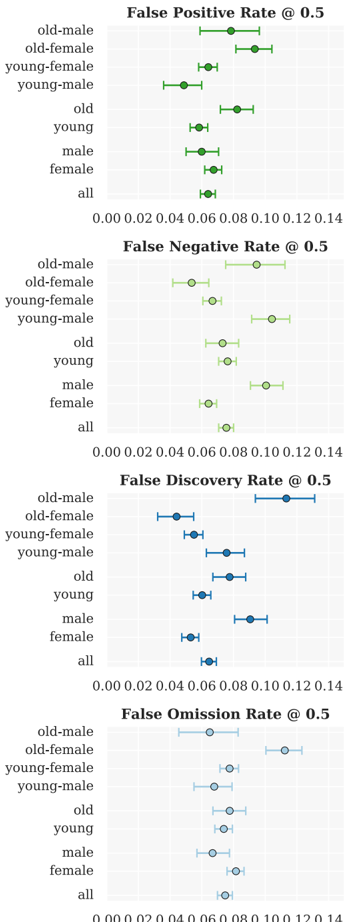
- In the smiling classifier example, all reported metrics at the .5 decision threshold have error types within the range 0.04–0.14, with 95% confidence intervals calculated by bootstrap resampling; the card notes older men have much higher false discovery rate, while men in aggregate have higher false negative rate.
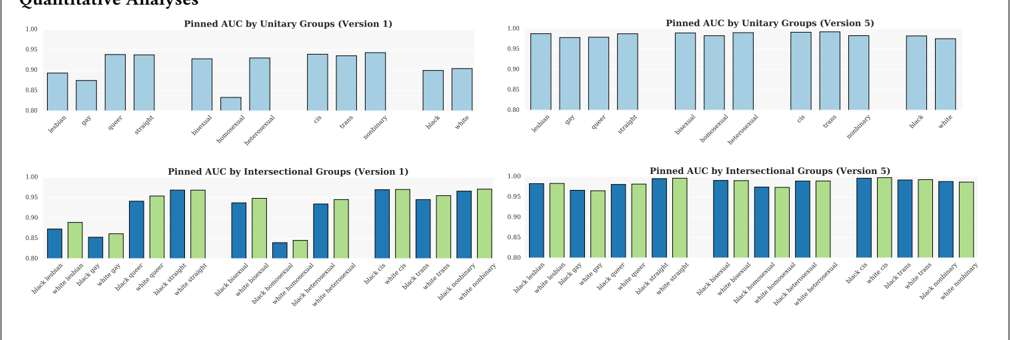
- In the toxicity example, TOXICITY v. 1 has low performance for several terms, especially “lesbian,” “gay,” and “homosexual,” while TOXICITY v. 5 shows more equitable performance after bias mitigation techniques.
Methods
- The paper is a framework/proposal paper, not an empirical study of a new model; it recommends model cards and details suggested sections and prompts.
- It provides two worked examples: a smiling classifier trained and evaluated on the CelebA dataset, using a convolutional neural net pretrained for face recognition and fine-tuned with cross-entropy loss for binary smiling classification.
- It also provides a model card for Perspective API’s TOXICITY classifier, a convolutional neural network developed by Jigsaw in 2017, evaluated on a synthetic Identity Phrase Templates test set; metrics include FPR, FNR, FDR, FOR for the smiling classifier and Pinned AUC for toxicity.
Limitations
- The paper states that model cards rely on the integrity of their creators and that it seems unlikely, at least in the near term, that they could be standardized or formalized enough to prevent misleading representations of model results.
- The paper states that evaluation datasets suitable for disaggregated evaluation are not yet common, and that the synthetic toxicity test data covers only a small set of very specific comments and is not comprehensive.
- The smiling classifier card states it does not capture race or skin type, uses binary gender classes (male/female), and that an ideal evaluation dataset would additionally include Fitzpatrick skin type, camera details, and environment details; the paper also states future work is needed to study how model information is interpreted and used by different stakeholders.
Model-written summary. Check it against the paper before relying on it.
Integrity signals
Registry
Cites
Statistics
Figures
Verification
Claims the paper makes
5 Valid · 1 Not valid · 18 Not checked · 30 Own results and interpretations
The cited sources support only part of this claim — read each source’s verdict below.
In the paper
“Synthetic data is valuable here because [11] shows that real data often has disproportionate amounts of toxicity directed at specific groups.”
What the sources say
- Partly supportedcites [11] [11] Lucas Dixon, John Li, Jeffrey Sorensen, Nithum Thain, and Lucy Vasserman. 2018. Measuring and Mitigating Unintended Bias in Text Classification. Proceedings of the AAAI/ACM Conference on AI, Ethics, and Society (2018). - sourceExperimental — accuracy not yet measured
The 'Quantifying bias in dataset' section (page unavailable) reports that certain identity terms appear disproportionately in toxic comments in the authors’ training data; for example, 'gay' appears in 3% of toxic comments but 0.5% of comments overall. It measures comments containing those terms, not whether toxicity is directed at the groups, and does not establish how often this pattern occurs across real datasets generally. (LLM, conf=0.85)
plainstates an association- Asserted: passes — The authors put it forward as true.
- Checkable: passes — It can be checked against evidence.
- Load-bearing: passes — The paper’s conclusions depend on it.
- Based: passes — The paper gives a reason why it holds.
- Partly supported
A result the paper reports from its own data — it cites no other source for it, so there is none to check. The quote shows it is in the paper.
In the paper
“For example, the false discovery rate on older men is much higher than that for other groups.”
plainstates an association- Asserted: passes — The authors put it forward as true.
- Checkable: passes — It can be checked against evidence.
- Load-bearing: passes — The paper’s conclusions depend on it.
- Based: passes — The paper gives a reason why it holds.
A result the paper reports from its own data — it cites no other source for it, so there is none to check. The quote shows it is in the paper.
In the paper
“TOXICITY v. 1 has low performance for several terms, especially 'lesbian', 'gay', and 'homosexual'.”
plain- Asserted: passes — The authors put it forward as true.
- Checkable: passes — It can be checked against evidence.
- Load-bearing: passes — The paper’s conclusions depend on it.
- Based: passes — The paper gives a reason why it holds.
None of the sources cited for this claim have been checked yet.
In the paper
“she collaborated with other researchers to demonstrate the disproportionate errors of computer vision systems on historically marginalized groups in the United States, such as darker-skinned women [5, 41].”
What the sources say
- Not checked yetcites [5] [5] Joy Buolamwini and Timnit Gebru. 2018. Gender Shades: Intersectional Accuracy Disparities in Commercial Gender Classification. In Proceedings of the 1st Conference on Fairness, Accountability and Transparency (Proceedings of Machine Learning Research) , Sorelle A. Friedler and Christo Wilson (Eds.), Vol. 81. PMLR, New York, NY, USA, 77-91. http://proceedings.mlr.press/v81/buolamwini18a.html -
- Not checked yetcites [41] [41] Inioluwa Raji. 2018. Black Panther Face Scorecard: Wakandans Under the Coded Gaze of AI. (2018). -
boostedstates an association- Asserted: passes — The authors put it forward as true.
- Checkable: passes — It can be checked against evidence.
- Load-bearing: passes — The paper’s conclusions depend on it.
- Based: passes — The paper gives a reason why it holds.
In the paper
“after MIT Media Lab graduate student Joy Buolamwini found that commercial face recognition systems failed to detect her face [4]”
What the sources say
- Not checked yetcites [4] [4] Joy Buolamwini. 2016. How I'm fighting Bias in Algorithms. (2016). https://www.ted.com/talks/joy\_buolamwini\_how\_i\_m\_fighting\_bias\_in\_ algorithms#t-63664 -
plainSingle case- Asserted: passes — The authors put it forward as true.
- Checkable: passes — It can be checked against evidence.
- Load-bearing: unclear — It is unclear whether the paper’s conclusions depend on it.
- Based: passes — The paper gives a reason why it holds.
13 more claims
Create a free account to see all 54 claims and to verify the 13 references still open.
- Probably not a substantial claim. 34
- It may state two separate claims as one. 8
Claims other papers make about this one
Each is checked against this paper’s own text: does it say what the citing paper says it does?
The source backs part of the claim, not all of it — or backs it for a different population, condition or comparison.
In the citing paper
“Model cards represent the field's standard for disclosing and documenting key facts about the architecture, training and evaluation of the model [14, 40].”
From Rethinking open source generative AI: open washing and the EU AI Act (2024) · cites this paper as [40]
Experimental — accuracy not yet measuredThe source backs part of the claim, not all of it — or backs it for a different population, condition or comparison.
In the citing paper
“Model cards (SMCs) [44] have been foundational in standardizing documentation for AI/ML model performance and characteristics, along with risks and unintended uses.”
From Interactive Model Cards: A Human-Centered Approach to Model Documentation (2022) · cites this paper as [44]
Experimental — accuracy not yet measuredThe source backs part of the claim, not all of it — or backs it for a different population, condition or comparison.
In the citing paper
“A second phase saw a more technical approach from the computer science community focusing on fairness, accountability and transparency as an engineering 'ethicalby-design' problem-solving exercise [20][21][22].”
From Putting AI ethics to work: are the tools fit for purpose? (2022) · cites this paper as [21]
Experimental — accuracy not yet measuredThe source backs part of the claim, not all of it — or backs it for a different population, condition or comparison.
In the citing paper
“These are either materials for use in design teams in workshop style events [76,77], tools for producing documentation of the design, build and test process [21,68], or technical tools for testing models, protecting privacy and security, testing for bias [69,93,94], or tracking provenance of data [95].”
From Putting AI ethics to work: are the tools fit for purpose? (2022) · cites this paper as [21]
Experimental — accuracy not yet measuredThe source backs part of the claim, not all of it — or backs it for a different population, condition or comparison.
In the citing paper
“There is some work on fairness relating to AI services, though this tends to focus on either exposing or 'auditing' certain AI services [22,38,126,133], or devising tools, methods and interventions relevant for those building (rather than using) such services [12,96,106,128].”
From Out of Context: Investigating the Bias and Fairness Concerns of “Artificial Intelligence as a Service” (2023) · cites this paper as [106]
Experimental — accuracy not yet measured
17 more claims about this paper
Create a free account to see every claim other papers make about this one.
Citations
Cites
BLEU: a method for automatic evaluation of machine translation
Papineni, K., Roukos, S., Ward, T., & Zhu, W.-J. (2001) · Proceedings of the 40th Annual Meeting on Association for Computational Linguistics - ACL '02 · doi:10.3115/1073083.1073135 · Cited by 21,344 · cited 1×
“translation system could compare BLEU scores [40] across demographic groups, and a model card for a speech recognition system could compare word-error rates.”
BackgroundCrenshaw, K. (2018) · Feminist Legal Theory · doi:10.4324/9780429500480-5 · Cited by 9,510
Deep Learning Face Attributes in the Wild
Liu, Z., Luo, P., Wang, X., & Tang, X. (2015) · 2015 IEEE International Conference on Computer Vision (ICCV) · doi:10.1109/iccv.2015.425 · Cited by 7,747 · cited 4×
“ms [5, 26] that report details of the datasets used to train and test machine learning models. We provide two example model cards in Section 5: A smiling detection model trained on the CelebA dataset [33] (Figure 2), and a public toxicity detection model, Perspective API [29] (Figure 3). Where Datasheets highlight cha…”
BackgroundMethodInfluentialThe validity and practicality of sun-reactive skin types I through VI
Fitzpatrick, T. B. (1988) · Archives of Dermatology · doi:10.1001/archderm.1988.01670060015008 · Cited by 4,339
Differential Privacy: A Survey of Results
Dwork, C. (2008) · Lecture Notes in Computer Science · doi:10.1007/978-3-540-79228-4_1 · Cited by 3,542 · cited 2×
“As such, collaboration with policy, privacy, and legal experts is necessary in order to ascertain which groups may be responsibly inferred, and how that information should be stored and accessed (for example, using differential privacy [12]).”
BackgroundCollins, G. S., Reitsma, J. B., Altman, D. G., & Moons, K. G. M. (2015) · Annals of Internal Medicine · doi:10.7326/m14-0697 · Cited by 3,267
Equality of Opportunity in Supervised Learning
Hardt, M., Price, E., & Srebro, N. (2016) · arXiv · doi:10.48550/arxiv.1610.02413 · Cited by 2,536 · cited 2×
“of Opportunity, and equal false negative and false positive rates across groups is equivalent to fulfilling Equality of Odds [26].”
BackgroundGebru, T., Morgenstern, J., Vecchione, B., Vaughan, J. W., Wallach, H., Daumé, H., & Crawford, K. (2018) · arXiv · doi:10.48550/arxiv.1803.09010 · Cited by 2,474
Self-citationA Probabilistic Interpretation of Precision, Recall and F-Score, with Implication for Evaluation
Goutte, C., & Gaussier, E. (2005) · Lecture Notes in Computer Science · doi:10.1007/978-3-540-31865-1_25 · Cited by 2,285 · cited 1×
“Confidence intervals for metrics derived from confusion matrices can be calculated by treating the matrices as probabilistic models of system performance [24].”
MethodFair prediction with disparate impact: a study of bias in recidivism prediction instruments
Chouldechova, A. (2017) · Big Data · doi:10.1089/big.2016.0047 · Cited by 2,159 · cited 1×
“or different errors that can be calculated from the confusion matrix for binary classification systems. • These also correspond to metrics in recent definitions of “fairness” in machine learning (cf. [8, 25]), where parity across subgroups for different metrics correspond to different fairness criteria. • 95% confiden…”
Background
Research works printed but not linked: 9
- [1] Avrio AI. 2018. Avrio AI: AI Talent Platform. (2018). https://www.goavrio.com/ -
- [5] Joy Buolamwini and Timnit Gebru. 2018. Gender Shades: Intersectional Accuracy Disparities in Commercial Gender Classification. In Proceedings of the 1st Conference on Fairness, Accountability and Transparency (Proceedings of Machine Learning Research) , Sorelle A. Friedler and Christo Wilson (Eds.), Vol. 81. PMLR, New York, NY, USA, 77-91. http://proceedings.mlr.press/v81/buolamwini18a.html -
- [13] Entelo. 2018. Recruitment Software | Entelo. (2018). https://www.entelo.com/ -
- [17] U.S. Food and Drug Administration. 2013. FDA Drug Safety Communication: Risk of next-morning impairment after use of insomnia drugs; FDA requires lower recommended doses for certain drugs containing zolpidem (Ambien, Ambien CR, Edluar, and Zolpimist). (2013). https://web.archive.org/web/20170428150213/ https://www.fda.gov/drugs/drugsafety/ucm352085.htm -
- [18] IIHS (Insurance Institute for Highway Safety: Highway Loss Data Institute). 2003. Special Issue: Side Impact Crashworthiness. Status Report 38, 7 (2003). -
- [19] Institute for the Future, Omidyar Network's Tech, and Society Solutions Lab. 2018. Ethical OS. (2018). https://ethicalos.org/ -
- [32] Jigsaw. 2017. Perspective API. (2017). https://www.perspectiveapi.com/ -
- [39] AI Now. 2018. Litigating Algorithms: Challenging Government Use Of Algorithmic Decision Systems. AI Now Institute. -
- [43] Mukund Sundararajan, Ankur Taly, and Qiqi Yan. 2017. In Proceedings of the 34th International Conference on Machine Learning , Vol. 70. PMLR, Sydney, Australia. -
Cited by
Items 1,901–2,000 of 2,235
Mushtaq, A. (2026) · International Conference on Integrated Intelligence and Cognitive Engineering (ICIICE) · doi:10.1109/iciice69672.2026.11565510
“Governance artefacts such as datasheets and model cards are often seen as compliance tools, but they also support UX by improving transparency and accountability across the system lifecycle [13].”
Saarathy, S. C. P., & Riaz, S. (2026) · International Conference on Integrated Intelligence and Cognitive Engineering (ICIICE) · doi:10.1109/iciice69672.2026.11565233
“This human-in-the-loop (HITL) framing aligns with emerging model-reporting and accountability practice in applied machine learning [9].”
"Are you biased right now, AI?": Investigating Supporting Youths' Systematic Evaluation of GenAI
Solyst, J., Walker, L., Handa, S., Nurdin, F., & Shapiro, R. B. (2026) · ACM International Conference on Interaction Design and Children (IDC) · doi:10.1145/3773077.3806125
Иванович, П. М. (2026) · Право и политика · doi:10.7256/2454-0706.2026.6.80455
O., E. F. T. (2026) · Research Square · doi:10.21203/rs.3.rs-10084276/v1 · Cited by 1
To Build or Not to Build? Factors that Lead to Non-Development or Abandonment of AI Systems
Chappidi, S., & Singh, J. (2026) · ACM Conference on Fairness, Accountability, and Transparency (FAccT) · doi:10.1145/3805689.3806736 · Cited by 2
“Many academic works interrogate and propose artifacts to improve development practices, including auditing datasets and their creation [56], toolkits for fairness evaluations [94], and approaches to improve model transparency [107].”
Deva, R., Thapa, A., Mehta, Z., Kapile, S. K., Jalota, S., Karusala, N., & Ismail, A. (2026) · ACM Conference on Fairness, Accountability, and Transparency (FAccT) · doi:10.1145/3805689.3806721 · Cited by 1
“Within the Fairness, Accountability, and Transparency (FAccT) community and related fields, scholars have developed a rich body of work focused on evaluating AI systems along dimensions such as bias, robustness, safety, explainability, and alignment with human values [22, 37, 43, 46].”
Sharma, R. R., Kaur, A., Gupta, S., Gulkotwar, N., & Bhatia, K. (2026) · AI and Ethics · doi:10.1007/s43681-026-01198-w
Pereira, R. G., Brito, L. E. L., Avelar, I., Carvalho, M., Vasconcelos, M., Brandão, M. A., & Meira, W. (2026) · doi:10.5753/sbcas.2026.20414
“Auditability (reproducible and documented modeling procedures) ensures traceability and reproducibility of modeling decisions, supporting institutional oversight and accountability mechanisms [Mitchell et al. 2019].”
The meek shall inherit the Earth: personality, empathy, and the human shaping of LLMs
Mangalam, M. (2026) · AI and Ethics · doi:10.1007/s43681-026-01215-y
“Traditional bench - marks assess question-answering, task completion, and instruction-following, yet rarely capture how well models integrate evolving user feedback, adapt to shifting contexts, or develop communicative rapport over time [93].”
In the Shadows of Transparency: Engaging Concealment in AI-Mediated Crisis
Mirizio, A., & Kaziunas, E. (2026) · ACM Conference on Fairness, Accountability, and Transparency (FAccT) · doi:10.1145/3805689.3812383
“Shadow bodies, we argue, offer FAccT researchers a theoretical counterpart to explainability, as contextually messy (poetically formed in "clouds of indicators" [8]) as explainability seeks to be precise (represented through nutrition labels, model cards and datasheets) [34, 46, 60].”
Yi, H., Xian, L., Zhang, Y., Zeng, J., & Zhang, Z. (2026) · ACM Conference on Fairness, Accountability, and Transparency (FAccT) · doi:10.1145/3805689.3812239 · Cited by 1
“…discussions in FAccT have moved away from “opening up” the internal workings of machine learning models to center around effective explanations that connect legal requirements to data practices of technical systems [7, 34, 66] and around artifacts of data and model documentation [17, 63, 75].”
Pluralistic-Alignment Urbanism: Operationalizing a Right to AI for Inclusive Public Space
Mushkani, R. A. (2026) · ACM Conference on Fairness, Accountability, and Transparency (FAccT) · doi:10.1145/3805689.3812244
“Documentation is treated as a governance artifact that enables audit and contestation, including versioned criteria definitions, evaluation protocols, and records of disagreement [29, 54, 60].”
Lee, H. P., Sidnam-Mauch, E., Mendoza, S., Wane, K., Knijnenburg, B. P., McGregor, S. E., & Caine, K. E. (2026) · ACM Conference on Fairness, Accountability, and Transparency (FAccT) · doi:10.1145/3805689.3812246
“It may lead researchers, product designers, and other stakeholders to misinterpret the applicability of research findings about AI systems to broader populations [47].”
Voices in the Loop: Mapping Participatory AI
Mushkani, R. A. (2026) · ACM Conference on Fairness, Accountability, and Transparency (FAccT) · doi:10.1145/3805689.3812241
“Where available, project records should link to datasheets, model cards, and data statements [2, 19, 30], while preserving participation metadata that those artifacts usually omit.”
A Human-Centric Framework for Data Attribution in Large Language Models
Wuehrl, A., Ruckdeschel, M., Lo, K., & Rogers, A. (2026) · ACM Conference on Fairness, Accountability, and Transparency (FAccT) · doi:10.1145/3805689.3812236 · Cited by 1
“Beyond inference attacks, NLP research could further advance model transparency, documentation and reporting practices (e.g. datasheets [94], model cards [157], see §2), that could serve as conventions for such acknowledgment-based attribution.”
Hand-off Zones in AI Accountability: Beyond Static-Gap FramingsPreprint
Saviano, S. (2026) · SSRN Electronic Journal · doi:10.2139/ssrn.6886800
Kiang, Y. W., Li, Z., Lee, A. T. L., Tam, V. W. L., Lam, K. H., & Lee, V. C. S. (2026) · Communications in computer and information science · doi:10.1007/978-3-032-29791-4_26
Beyond Collected Data: Surfacing and Controlling Shadow Inferences in Everyday Workflows
GUDIPATI, S. K., & MISHRA, N. A. (2026) · Lecture notes in computer science · doi:10.1007/978-3-032-30047-8_2
Rodríguez-Espinosa, N. (2026) · AI & Society · doi:10.1007/s00146-026-03196-2
Ahmed, M. M., Adebayo, U. O., Othman, Z. K., Oweidat, M. H., Okesanya, O. J., Kasimieh, O., Musa, S. S., Ong, C. J. N., Branda, F., & Lucero‐Prisno, D. E. (2026) · Intelligent Oncology · doi:10.1016/j.intonc.2026.100071
A Governance-Oriented Evaluation of Explainable AI in Business Analytics
Vahedi, S., Abayomi-Alli, A. A., Abayomi‐Alli, O., & Stefanovič, P. (2026) · Applied Sciences · doi:10.3390/app16136427
The Explainability Relay: Aligning Technical Standards with the AI Act's Right to Explanation
Nannini, L. (2026) · ACM Conference on Fairness, Accountability, and Transparency (FAccT) · doi:10.1145/3805689.3806439
Disclosure or Marketing? Analyzing the Efficacy of Vendor Self-reports for Vetting Public-sector AI
Kuehnert, B., Johnson, N., Dotan, R., & Heidari, H. (2026) · Proceedings of the 2026 ACM Conference on Fairness, Accountability, and Transparency · doi:10.1145/3805689.3812220
“Early work on documentation in machine learning such as Model Cards for Model Reporting [51] and Datasheets for Datasets [30] argue that structured documentation could uncover design decisions laden with implicit values, encourage responsible development practices, and provide stakeholders with…”
Safety Theater in Anthropomorphic AI: Why We Need to Shift from Safety to Accountability Narratives
Maeda, T., & Buening, R. (2026) · ACM Conference on Fairness, Accountability, and Transparency (FAccT) · doi:10.1145/3805689.3812282 · Cited by 1
“…for cases that might warrant police follow-up [31, 104] Safety narrative • California AI Transparency Act [110] •Datasheets [75] • Model cards [129] Accountability narrative External auditing • Third-party audits (e.g., pre-audit, audit reports, additional guidance and mitigation strategies,…”
Havens, L., Terras, M., Bach, B., & Alex, B. (2026) · ACM Conference on Fairness, Accountability, and Transparency (FAccT) · doi:10.1145/3805689.3812283
“Still other work proposes new practices to encourage greater reflection during AI system creation, including dataset collection [14, 54], model design [80, 103], and evaluation [87, 114, 155].”
Options Without Agency: Diversity as a Requirement for Fair Actionable Recourse
VanNostrand, P. M., Hofmann, D. M., Ma, L., & Rundensteiner, E. A. (2026) · ACM Conference on Fairness, Accountability, and Transparency (FAccT) · doi:10.1145/3805689.3812337
“Given that techniques can optimize for different goals and perform differently across model types, a system similar to model cards [36] may be useful for XAI methods to declare their desiderata and behavior in different scenarios.”
Responsible NLP: Why performance is no longer enough
Lamsiyah, S. (2026) · Natural language processing. · doi:10.1017/nlp.2026.10030 · Cited by 1
“Model cards (Mitchell et al. 2019), audits (Raji et al. 2020), and risk management frameworks (National Institute of Standards and Technology 2023) offer partial tools for this broader view.”
Bureaucratic Silences: What the Canadian AI Register Reveals, Omits, and Obscures
Das, D., Tessono, C., Ahmed, S. I., & Guha, S. (2026) · ACM Conference on Fairness, Accountability, and Transparency (FAccT) · doi:10.1145/3805689.3812336 · Cited by 8
“These concepts are often operationalized through technical and procedural interventions, such as explainable models, documentation frameworks, audit mechanisms, and reporting standards, which aim to render algorithmic systems more legible to developers, regulators, and affected users [40, 72, 119].”
Connective Democratic Tissue: Second-Order Technologies for Civic Ecosystems
Goñi, J., Hughes, M. A., & Lynn, S. (2026) · ACM Conference on Fairness, Accountability, and Transparency (FAccT) · doi:10.1145/3805689.3812416
“…in parallel, has dedicated extensive scholarship to mapping, documentation standards, and transparency infrastructure for machine learning systems, using tools such as model cards [26], datasheets for datasets [14], and data cards as boundary objects for cross-stakeholder transparency [31].”
Gao, Z., Ajibola, Y., & Thebault-Spieker, J. (2026) · ACM Conference on Fairness, Accountability, and Transparency (FAccT) · doi:10.1145/3805689.3812214
Haidemariam, T., & Zheng, X. (2026) · Frontiers in Virtual Reality · doi:10.3389/frvir.2026.1860842 · Cited by 1
Gebremeskel, H. G., Feng, C., & Abera, A. M. (2026) · Communications in computer and information science · doi:10.1007/978-981-92-0199-0_1
Mishra, S. K., Mishra, S., Priyadarshini, R., & Mayaluri, Z. L. (2026) · SN Business & Economics · doi:10.1007/s43546-026-01239-w
“…operational requirements for documentation, transparency, logging, and human oversight, as reflected in data - sheets, model cards, and contemporary regulatory frameworks such as the EU AI Act (European Parliament and Council of the European Union 2024; Gebru et al. 2021; Mitchell et al. 2019 ).”
AI-Enhanced Credit Approval System: Innovations for the Financial Industry
-, B. S. (2026) · Advances in computational intelligence and robotics book series · doi:10.4018/979-8-2600-2706-6.ch001
Five Educational-Psychology Lenses for Training and Evaluating AI Models
Wang, P., & PAAS, F. G. W. C. (2026) · Educational Psychology Review · doi:10.1007/s10648-026-10195-8
“…for evaluation, and who may see them), and results should be reported with uncertainty and slice analyses (performance broken down by subgroups of items or users, in the spirit of differential item functioning) to reveal where gains are fragile or uneven (Dodge et al., 2021; Mitchell et al., 2019).”
Azeroual, O. (2026) · Advances in computational intelligence and robotics book series · doi:10.4018/979-8-3373-7082-8.ch001
A Survey and Computational Atlas of Personality Models
Raetano, J., Gregor, J., & Tamang, S. R. (2026) · ACM Transactions on Intelligent Systems and Technology · doi:10.1145/3828667 · Cited by 1
“Mitchell et al. [98] introduced model cards as standardized documentation for machine learning models, covering intended use, performance metrics, and ethical considerations.”
Making Privacy Public: Toward a Differential Privacy Deployment Registry
Nanayakkara, P., Ghazi, E., & Vadhan, S. (2026) · IEEE Symposium on Security and Privacy (S&P) · doi:10.1109/sp63933.2026.00157
“Model cards [35] were proposed as an approach to documenting machine learning models—including intended uses and performance across different groups of people— while datasheets [36] aim to document intended uses and other details of datasets.”
Saikia, D., Basumatary, P., & Saikia, A. (2026) · AI & Society · doi:10.1007/s00146-026-03181-9
ADT: a digital card-based toolkit for AI-augmented design thinking
Yin, Y., Sungprasit, V., & Lin, M. (2026) · Proceedings of the Design Society · doi:10.1017/pds.2026.10474 · Cited by 1
“Other tools address specific ethical dilemmas in machine learning, uncover biases via the AntiBias Cards, and cultivate AI literacy through concepts such as the AI Audit or Model Card (Mitchell et al., 2019).”
Topological Auditing of Synthetic Public Data for Trustworthy Governance
Aguilar-Ortíz, J., Díaz-Parra, O., Ruíz-Vanoye, J. A., et al. (2026) · IGI Global eBooks · doi:10.4018/979-8-2600-2845-2.ch005
Ishibashi, S., & Kubota, K. (2026) · Asian/Pacific Island Nursing Journal · doi:10.2196/86237
“Fairness should be treated as a practical obligation: subgroup performance should be documented, and disparities should be remediated with targeted outreach, assistive technologies, and human review for edge cases [17,18,23,24].”
Berger, E., Henke, J., Mehlstäubl, J., & Paetzold-Byhain, K. (2026) · Proceedings of the Design Society · doi:10.1017/pds.2026.10576 · Cited by 5
“…traceability (Schelmetic, 2022), human-in-the-loop evaluation to embed expert oversight (Amershi et al., 2019), and transparent model documentation (e.g., model cards and datasheets) to communicate model limitations and intended use (Gebru et al., 2021; Mitchell et al., 2019; Müller et al., 2025a)”
Verifier Ecology Theory: Packetized Self-Verification Under Residual AccountabilityPreprint
Takahashi, K. (2026) · Zenodo (CERN European Organization for Nuclear Research) · doi:10.5281/zenodo.21147093 · Cited by 1
From Models to Systems: The Evolution of T&E for Artificial Intelligence from 2020 to 2030
Cody, T., & Beling, P. A. (2026) · Insight · doi:10.1002/inst.70059
Li, Y., Chen, T., Ke, W., & Pang, P. C. (2026) · Informatics · doi:10.3390/informatics13070106
“Dataset documentation work argues for recording provenance, intended use, scope, and collection conditions [42]; model cards extend the same logic to model outputs and evaluation settings [43].”
A comprehensive review of recent advancements in hyperspectral object tracking
Islam, M. A., Xiong, F., Zhou, J. W., Xing, W., Bao, D., & Gao, Y. (2026) · Artificial Intelligence Review · doi:10.1007/s10462-026-11625-3 · Cited by 2
Kanyiki, Y. (2026) · ACM International Conference on AI-Powered Software (AIware) · doi:10.1145/3805760.3814901
Rothe‐Wulf, A., Sekar, S. D., & Marsden, N. (2026) · Lecture notes in computer science · doi:10.1007/978-3-032-30846-7_34
Stratum-eval: A Normative-First Evaluation Framework for Clinical Machine LearningPreprint
Farooq, H., Jawad, A., & Butt, M. S. (2026) · Research Square · doi:10.21203/rs.3.rs-10235878/v1
Demenko, Y., & Yavtushenko, V. (2025) · ГРААЛЬ НАУКИ · doi:10.36074/grail-of-science.23.05.2025.120
Artificial human leaders: The Transport–Ethics Model of trust and governance in digital human CEOs
Bonelli, M. I. (2026) · Computers in Human Behavior Artificial Humans · doi:10.1016/j.chbah.2026.100344
A data-centric trust pipeline:an empirical framework for trustworthy AI in sensitive domains
Pereira, C. D. C. (2026) · AI and Ethics · doi:10.1007/s43681-026-01247-4 · Cited by 1
“Datasheets for Datasets [25], Data Cards [26], and Model Cards [27] have established that machine-learning artifacts should travel with structured metadata describing their composition, intended use, and known limitations.”
Aranganathan, P., Sheela, S. C., Manikandan, S., Sivarethinamohan, R., & Yıldırım, S. (2026) · De Gruyter eBooks · doi:10.1515/9783111633909-032
Ali, S., Raza, S. M., & Dey, S. (2026) · International Conference on Computing, Mathematics and Engineering Technologies (iCoMET) · doi:10.1109/icomet69771.2026.11591638
“Governance tools emphasise documentation and transparency (e.g., model cards,datasheets)[9],[10].”
Evaluation-Aware Agentic AI: Agentic AI With Built-In Evaluation for Teaching, Research, and Service
Lingam, R. (2026) · Advances in computational intelligence and robotics book series · doi:10.4018/979-8-3373-7665-3.ch006
Gender, Race, and Class in the AI-Driven Workplace
Subrahmanyam, S., & Azzi, G. (2026) · Advances in computational intelligence and robotics book series · doi:10.4018/979-8-2600-2900-8.ch003
Fundamentals of Artificial Intelligence in Drug Discovery and Healthcare
Fakhoury, N. (2026) · Springer eBooks · doi:10.1007/978-3-032-19536-4_2
Frameworks and Key Concepts for Developing Personalized Reference Models in Human Pose Estimation
Katović, D., Bronzin, T., Adamec, D., Prole, B., Stipić, A., Ćelić, J., Matek, D., & Horvat, M. (2026) · International Convention on Information and Communication Technology, Electronics and Microelectronics · doi:10.1109/mipro70003.2026.11592029
“[18], [19]”
Justifi: An AI-Powered Legal Research and Document Automation System
Ranjan, A., Dwivedi, D., Muraday, A., Goel, D., & Devi, D. (2026) · IEEE International Conference on Computing, Power and Communication Technologies (IC2PCT) · doi:10.1109/ic2pct68894.2026.11584368
“Long-document transformers including Longformer [14] have been used to perform tasks more effectively through contextual manipulation, although more modern models optimized on longer contexts [19] may be more effective at the task of multi-page contracts and legislative amendments.”
Avramović, N., Comic, T., Markovic, A. P., Čavoški, S., Zornić, N., & Vujović, V. (2026) · IPSI Transactions on Internet Research · doi:10.58245/ipsi.tir.2603.03
Ethical guidelines for machine learning competitions
Clements, R. A., Makam, S. M., Dixon, H., & Shen, Y. (2026) · AI and Ethics · doi:10.1007/s43681-026-01201-4
“Similar to how Gebru et al. [ 20 ] proposes documenting datasets and Mitchell et al. and [ 29 ] proposes documenting ML models, we propose a list of questions below, grouped into ethical categories.”
Huang, Y., Ke, G., Du, Y., Feng, K., & Su, Y. (2026) · Energies · doi:10.3390/en19143230 · Cited by 1
Dávalos-Saucedo, C. A., Marquez, G. R., Rodríguez-Miranda, S., & Castaneda, C. E. (2026) · Coatings · doi:10.3390/coatings16070812 · Cited by 2
Sorokin, I., & Tekić, Ž. (2026) · Technology in Society · doi:10.1016/j.techsoc.2026.103456 · Cited by 1
Waschke, H., Krüger, J., & Leich, T. (2026) · IEEE/ACM International Conference on Software Engineering: Software Engineering in Practice (ICSE-SEIP) · doi:10.1145/3786583.3786909
Embodied Intelligence Security with Vision-language Models: A Survey
Duan, J., Zhu, H., Liu, C., Li, S. Y., Tang, X., & Wang, Y. (2026) · Machine Intelligence Research · doi:10.1007/s11633-025-1626-x · Cited by 2
Harmful Content Moderation in e-Participation Platforms
Vidal, R., Neto, M., Dias, T., Tomas, P. R., Rosa, L., & Cordeiro, L. (2026) · IFIP advances in information and communication technology · doi:10.1007/978-3-032-30507-7_12
Non-intrusive copyright auditing in DNN-based AI systems: A lifecycle-oriented survey
Chen, H., Ye, F., Shao, B., Chang, W., Jin, J., Mao, X., & Huang, C. (2026) · Journal of Information and Intelligence · doi:10.1016/j.jiixd.2026.07.001
Equal Access, Unequal Interaction: A Counterfactual Audit of Large Language Models Fairness
Amiri-Margavi, A., Gharagozlou, A., Davodi, A. G., Davoudi, S. P. M., & Balyani, H. H. (2026) · IFIP advances in information and communication technology · doi:10.1007/978-3-032-30805-4_15 · Cited by 5
Panner, E., Scheffer, S., & Matyas, K. (2026) · IEEE International Conference on Human-Machine Systems (ICHMS) · doi:10.1109/ichms69701.2026.11602295 · Cited by 2
“To support accountability and transparency, the literature proposes standardized documentation artifacts, including datasheets for datasets [15] and model cards [16].”
Κουτσουπιάς, Ν., & Nosios, M. (2026) · Peace Studies · doi:10.3390/peacestud1030008
Become an AI Tool User or Builder: Designing Introductory AI Courses in a Liberal Arts Context
Chowdhury, T., & Stent, A. J. (2026) · ACM Transactions on Computing Education · doi:10.1145/3831242
“Each project team produced a data sheet [36], model card [57], annotation guidelines, and final presentation, which were provided to the end-user (faculty members leading data collection) looking for an ML solution to their problem.”
A Mandate Beyond Accuracy: Forging the Algorithm’s Social Contract
Singh, N., & Foulds, J. R. (2026) · Artificial intelligence · doi:10.5772/intechopen.1015619
Abdulrahman, B., Zhu, Z., & Conway, A. J. (2026) · Electronics · doi:10.3390/electronics15143139
AI-Enhanced Learning Systems for Sustainable Education Ecosystems
Badawy, W. (2026) · IEEE International Conference on Smart Sustainable Systems for Computer and Engineering Applications (3SCEA) · doi:10.1109/3scea68071.2026.11602869
Data Governance for Generative AI: Curation, Documentation, and Lifecycle Management
Armand, K. W. (2026) · Advances in computational intelligence and robotics book series · doi:10.4018/979-8-2600-0368-8.ch006
Mazurek, M., & Gurczyński, J. (2026) · AI and Ethics · doi:10.1007/s43681-026-01276-z
“Mitchell and colleagues propose model cards, and Gebru and colleagues propose datasheets for datasets as tools to increase transparency and limit the misuse of models and data [12, 30].”
Álvarez, A. G., Cerezo, O., Franch, X., & Martínez‐Fernández, S. (2026) · ACM Joint European Software Engineering Conference and Symposium on the Foundations of Software Engineering (ESEC/FSE) · doi:10.1145/3803437.3806403
Badillo, R. (2026) · Qeios · doi:10.32388/28u0sw
Alhalangy, A. (2026) · Information · doi:10.3390/info17070694 · Cited by 1
Beyond “Easy AI”: a proof-of-impact case study of an Automation Risk Checklist for AutoML deployment
Abdelhay, O., Altamimi, T., & Abdelhay, H. (2026) · International Journal of Data Science and Analytics · doi:10.1007/s41060-026-01210-w
Tran, N. T., & Doan, H.-M. X. (2026) · Communications in computer and information science · doi:10.1007/978-3-032-33381-0_14
Building the Foundations for Trustworthy AI in Pediatrics
Finlayson, S. G., Wightman, A. G., Weiss, E. M., Gallo, V., Rabbani, N., Diekema, D. S., Sarabu, C. R., Vo, H. H., MacDuffie, K. E., Mazwi, M., et al. (2026) · PEDIATRICS · doi:10.1542/peds.2026-076194 · Cited by 1
Clear by Design: Consensus-Based Transparency Practices to Foster Trust in Health AI
Lehmann, L. S., Overgaard, S. M., Saria, S., Jenders, R. A., Saenz, A. D., Durón, Y., Moreno, R., Brereton, T. A., Liza, F. F., Hill, B., et al. (2026) · The American Journal of Bioethics · doi:10.1080/15265161.2026.2699626
Erbay, H., & Baysal, Z. (2026) · Journal of Bioethical Inquiry · doi:10.1007/s11673-026-10593-1
Measuring complex constructs in large-scale text with computational social mixed methods
Herderich, A., Lasser, J., Galešić, M., Aroyehun, S., García, D., & Garland, J. (2026) · Behavior Research Methods · doi:10.3758/s13428-026-03046-5
“…resulting in the formulation of a number of reporting standards for human annotation (Geiger et al., 2021), data (Gebru et al., 2021), and models (Mitchell et al., 2019), as well as overall reporting recommendations (Kapoor et al., 2024; Parsons et al., 2022), which we discuss in Appendix F.”
Digital and Substance Dependence in the Post-Digital Era
Romeo, V. M. (2026) · Encyclopedia · doi:10.3390/encyclopedia6070160
“Concrete reporting tools—model cards for model transparency and datasheets for datasets—exist to document provenance, intended use, performance, and known biases; adopting these across health, education, and platform research would markedly raise evidentiary quality and reproducibility [112,113].”
Who Is Accountable When the Agent Speaks? Toward Accountability Graphs for Conversational AI Chains
Haklıdır, M. (2026) · ACM Conference on Conversational User Interfaces (CUI) · doi:10.1145/3816046.3816264
The Default Speaker: Why Neutral Conversational AI is a Myth Worth Retiring
Gaba, A. (2026) · ACM Conference on Conversational User Interfaces (CUI) · doi:10.1145/3816046.3816304
“Researchers have begun advocating for transparency as a norm for documenting what a model was trained on and what it is likely to get wrong [8, 12].”
SEMODS: A Validated Dataset of Open-Source Software Engineering Models
Álvarez, A. G., Franch, X., & Martínez‐Fernández, S. (2026) · IEEE/ACM International Conference on AI Foundation Models and Software Engineering (FORGE) · doi:10.1145/3793655.3793717 · Cited by 1
AI Ethics Beyond AI Developers — A Survey of the Finnish Software IndustryPreprint
Kemell, K., Vakkuri, V., & Tyrväinen, P. (2026) · SSRN Electronic Journal · doi:10.2139/ssrn.7153924
From Convolution to Attention and Beyond: A Systematic Review of Modern Vision Architectures
Chakrabarty, A., Aziz, A., Tahsin, A., Nawreen, N. I., Alam, M. G. R., & Maidin, S. S. (2026) · IEEE Access · doi:10.1109/access.2026.3715655
“The paper also pushes for a final Caveats and Recommendations block so limitations are not buried inside metric tables [144].”
Mitigating Risks in Agents and Robots
Maybury, M. T. (2026) · IEEE International Conference on AI and Data Analytics (ICAD) · doi:10.1109/icad69378.2026.11608950
“• Agent and robot model cards [34] and associated training and transparency/explanation so users understand capabilities and limitations, applicability, and risks with particular agents and robots in specific use cases.”
InfluentialMohanty, P., & Mishra, S. (2026) · Business Strategy and the Environment · doi:10.1002/bse.71333
Climate-control ChatGPT for EFL writing and AI literacy
Aldamen, H., Alawneh, S. M., Almashour, M., Al-Deaibes, M., & Alsharefeen, R. (2026) · Frontiers in Artificial Intelligence · doi:10.3389/frai.2026.1869343 · Cited by 1
“…participant-level cross-validation split files, random seeds, preprocessing scripts, TF-IDF baseline hyperparameters, software and package versions, preserved transformer-family prediction outputs, and a short (Gebru et al., 2021; Mitchell et al., 2019; Papi et al., 2024; Storks et al., 2023).”
InfluentialTruong, N., Hickling, A., Rahman, R., Flanigen, J., Huang, P., Kastelic, J., Truex, B., Parthemore, G., Pilewicz, J., Gooneratne, P., et al. (2026) · IEEE International Conference on AI and Data Analytics (ICAD) · doi:10.1109/icad69378.2026.11608485
“Model transparency and subgroup evaluation are also key technical requirements for responsible deployment [68], [67]. v. Environmental Factors: AI development can be resource-intensive.”
InfluentialWang, Y., Peng, Y., Wang, Z., Liu, P., & Chen, Z. (2026) · Frontiers in Medicine · doi:10.3389/fmed.2026.1879402 · Cited by 1
“In addition, the disclosure of algorithm training datasets and known limitations via model cards—akin to pharmaceutical package inserts—can help physicians and patients make informed decisions (51) of informed consent documents and facilitate patient education (52, 53).”
Metadata
- Authors
- Mitchell, M., Wu, S., Zaldivar, A., Barnes, P., Vasserman, L., Hutchinson, B., Spitzer, E., Raji, I. D., & Gebru, T.
- Venue
- Proceedings of the Conference on Fairness, Accountability, and Transparency
- Publisher
- ACM
- Published
- 2019-01-29
- Pages
- 220-229
- OpenAlex
- W2897042519
- Semantic Scholar
- 7365f887c938ca21a6adbef08b5a520ebbd4638f
- Cited by
- 2,681
- References
- 12
- Citations by year
- 2026: 831 · 2025: 446 · 2024: 376 · 2023: 366 · 2022: 243 · 2021: 260 · 2020: 102 · 2019: 54
- FWCI
- 170.95
- Type
- conference paper
- Language
- en
- Open access
- green
- arxiv.org
- Locations
- ACM Conference on Fairness, Accountability, and Transparency (FAccT) (publishedVersion)
- arXiv (Cornell University) (submittedVersion)
- arXiv (Cornell University)
- Topics
- Physical Sciences › Computer Science › Artificial Intelligence › Ethics and Social Impacts of AI
- Physical Sciences › Computer Science › Artificial Intelligence › Explainable Artificial Intelligence (XAI)
- Physical Sciences › Computer Science › Computer Vision and Pattern Recognition › Face recognition and analysis
- Keywords
- model cards, model transparency, algorithmic fairness, demographic bias, responsible AI, democratization of AI, toxic comment detection, model documentation
About these checks
Registry, retraction, Cites and statistics results are computed, not judged, with one exception: a printed reference that no index lists is read once by a model before it counts as a citation error. Claims are extracted by a model and kept only when their quote appears verbatim in the text; each cited source is then checked, with a model’s help, for whether it says what the claim relies on. Those verdicts can be wrong — read the claim’s quote and the cited source before relying on one.
The claim verdicts this report counts are experimental: their accuracy is not yet measured.
A language model drew the claims from the paper on 2026-10-07, under version 3 of the claim definition (model deepseek-v4.1-flash, prompt extract-v3).
A second model labelled each claim on 2026-10-07 (model jev-1.13-20260917, definition revision gold-guideline-v0.2).
Cited sources are checked with a language model’s help (gpt-6-sol).
Statistics and arithmetic are recomputed, not judged.
Confidence bands are shown only for fields calibrated on our annotated test set. None is calibrated yet, so no band is shown.
What counts as a claim ›How we measure confidence ›How we check this ›
Are you an author, or do you see a problem with this page? Request a review
Data sources
Bibliographic data: Semantic Scholar, OpenAlex, Crossref.
Contains information from the Semantic Scholar Academic Graph Datasets, made available under the ODC Attribution License (ODC-BY 1.0).
Semantic Scholar’s data is described in: Kinney, R., et al. (2023). The Semantic Scholar Open Data Platform. arXiv:2301.10140.
