

Model Cards for Model Reporting
Open accessThe DOI matches its Crossref record; 22 of the 22 references it cites were found in a registry or an index; 8 of the 34 sources its claims cite were checked for support.
Abstract
Trained machine learning models are increasingly used to perform high-impact tasks in areas such as law enforcement, medicine, education, and employment. In order to clarify the intended use cases of machine learning models and minimize their usage in contexts for which they are not well suited, we recommend that released models be accompanied by documentation detailing their performance characteristics. In this paper, we propose a framework that we call model cards, to encourage such transparent model reporting. Model cards are short documents accompanying trained machine learning models that provide benchmarked evaluation in a variety of conditions, such as across different cultural, demographic, or phenotypic groups (e.g., race, geographic location, sex, Fitzpatrick skin type [15]) and intersectional groups (e.g., age and race, or sex and Fitzpatrick skin type) that are relevant to the intended application domains. Model cards also disclose the context in which models are intended to be used, details of the performance evaluation procedures, and other relevant information. While we focus primarily on human-centered machine learning models in the application fields of computer vision and natural language processing, this framework can be used to document any trained machine learning model. To solidify the concept, we provide cards for two supervised models: One trained to detect smiling faces in images, and one trained to detect toxic comments in text. We propose model cards as a step towards the responsible democratization of machine learning and related artificial intelligence technology, increasing transparency into how well artificial intelligence technology works. We hope this work encourages those releasing trained machine learning models to accompany model releases with similar detailed evaluation numbers and other relevant documentation.
Overview
CoChat Summary
TL;DR
The paper proposes “model cards,” short documentation records accompanying trained machine learning models to report intended use, performance characteristics, and disaggregated evaluation across demographic, phenotypic, and intersectional groups. It illustrates the framework with worked examples for a smiling classifier and a toxicity classifier.
Key findings
- The authors argue there are no standardized documentation procedures for communicating trained ML model performance, especially for high-impact domains such as health care, employment, education, and law enforcement.
- They propose model card sections covering model details, intended use, factors, metrics, evaluation data, training data, quantitative analyses, ethical considerations, and caveats/recommendations.
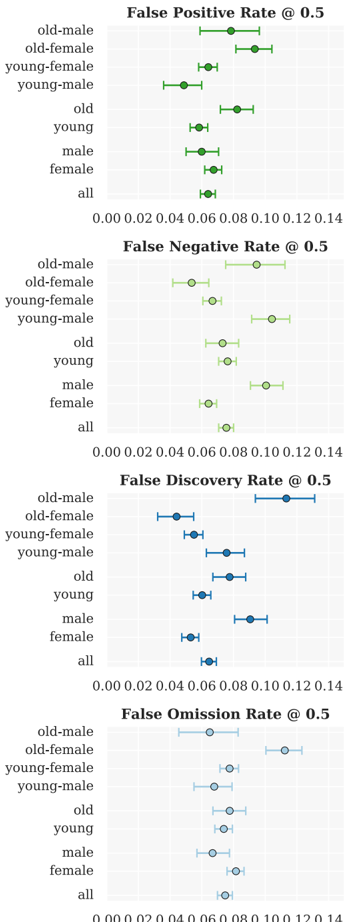
- In the smiling classifier example, all reported metrics at the .5 decision threshold have error types within the range 0.04–0.14, with 95% confidence intervals calculated by bootstrap resampling; the card notes older men have much higher false discovery rate, while men in aggregate have higher false negative rate.
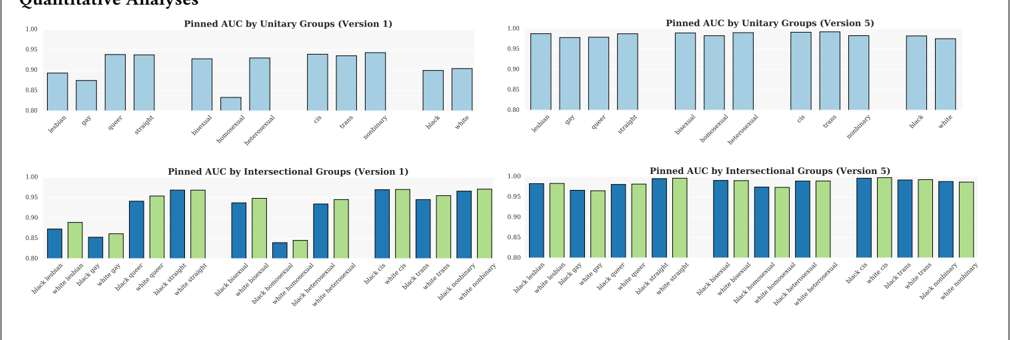
- In the toxicity example, TOXICITY v. 1 has low performance for several terms, especially “lesbian,” “gay,” and “homosexual,” while TOXICITY v. 5 shows more equitable performance after bias mitigation techniques.
Methods
- The paper is a framework/proposal paper, not an empirical study of a new model; it recommends model cards and details suggested sections and prompts.
- It provides two worked examples: a smiling classifier trained and evaluated on the CelebA dataset, using a convolutional neural net pretrained for face recognition and fine-tuned with cross-entropy loss for binary smiling classification.
- It also provides a model card for Perspective API’s TOXICITY classifier, a convolutional neural network developed by Jigsaw in 2017, evaluated on a synthetic Identity Phrase Templates test set; metrics include FPR, FNR, FDR, FOR for the smiling classifier and Pinned AUC for toxicity.
Limitations
- The paper states that model cards rely on the integrity of their creators and that it seems unlikely, at least in the near term, that they could be standardized or formalized enough to prevent misleading representations of model results.
- The paper states that evaluation datasets suitable for disaggregated evaluation are not yet common, and that the synthetic toxicity test data covers only a small set of very specific comments and is not comprehensive.
- The smiling classifier card states it does not capture race or skin type, uses binary gender classes (male/female), and that an ideal evaluation dataset would additionally include Fitzpatrick skin type, camera details, and environment details; the paper also states future work is needed to study how model information is interpreted and used by different stakeholders.
Model-written summary. Check it against the paper before relying on it.
Integrity signals
Registry
Cites
Statistics
Figures
Verification
Claims the paper makes
5 Valid · 1 Not valid · 18 Not checked · 30 Own results and interpretations
The cited sources support only part of this claim — read each source’s verdict below.
In the paper
“Synthetic data is valuable here because [11] shows that real data often has disproportionate amounts of toxicity directed at specific groups.”
What the sources say
- Partly supportedcites [11] [11] Lucas Dixon, John Li, Jeffrey Sorensen, Nithum Thain, and Lucy Vasserman. 2018. Measuring and Mitigating Unintended Bias in Text Classification. Proceedings of the AAAI/ACM Conference on AI, Ethics, and Society (2018). - sourceExperimental — accuracy not yet measured
The 'Quantifying bias in dataset' section (page unavailable) reports that certain identity terms appear disproportionately in toxic comments in the authors’ training data; for example, 'gay' appears in 3% of toxic comments but 0.5% of comments overall. It measures comments containing those terms, not whether toxicity is directed at the groups, and does not establish how often this pattern occurs across real datasets generally. (LLM, conf=0.85)
plainstates an association- Asserted: passes — The authors put it forward as true.
- Checkable: passes — It can be checked against evidence.
- Load-bearing: passes — The paper’s conclusions depend on it.
- Based: passes — The paper gives a reason why it holds.
- Partly supported
A result the paper reports from its own data — it cites no other source for it, so there is none to check. The quote shows it is in the paper.
In the paper
“For example, the false discovery rate on older men is much higher than that for other groups.”
plainstates an association- Asserted: passes — The authors put it forward as true.
- Checkable: passes — It can be checked against evidence.
- Load-bearing: passes — The paper’s conclusions depend on it.
- Based: passes — The paper gives a reason why it holds.
A result the paper reports from its own data — it cites no other source for it, so there is none to check. The quote shows it is in the paper.
In the paper
“TOXICITY v. 1 has low performance for several terms, especially 'lesbian', 'gay', and 'homosexual'.”
plain- Asserted: passes — The authors put it forward as true.
- Checkable: passes — It can be checked against evidence.
- Load-bearing: passes — The paper’s conclusions depend on it.
- Based: passes — The paper gives a reason why it holds.
None of the sources cited for this claim have been checked yet.
In the paper
“she collaborated with other researchers to demonstrate the disproportionate errors of computer vision systems on historically marginalized groups in the United States, such as darker-skinned women [5, 41].”
What the sources say
- Not checked yetcites [5] [5] Joy Buolamwini and Timnit Gebru. 2018. Gender Shades: Intersectional Accuracy Disparities in Commercial Gender Classification. In Proceedings of the 1st Conference on Fairness, Accountability and Transparency (Proceedings of Machine Learning Research) , Sorelle A. Friedler and Christo Wilson (Eds.), Vol. 81. PMLR, New York, NY, USA, 77-91. http://proceedings.mlr.press/v81/buolamwini18a.html -
- Not checked yetcites [41] [41] Inioluwa Raji. 2018. Black Panther Face Scorecard: Wakandans Under the Coded Gaze of AI. (2018). -
boostedstates an association- Asserted: passes — The authors put it forward as true.
- Checkable: passes — It can be checked against evidence.
- Load-bearing: passes — The paper’s conclusions depend on it.
- Based: passes — The paper gives a reason why it holds.
In the paper
“after MIT Media Lab graduate student Joy Buolamwini found that commercial face recognition systems failed to detect her face [4]”
What the sources say
- Not checked yetcites [4] [4] Joy Buolamwini. 2016. How I'm fighting Bias in Algorithms. (2016). https://www.ted.com/talks/joy\_buolamwini\_how\_i\_m\_fighting\_bias\_in\_ algorithms#t-63664 -
plainSingle case- Asserted: passes — The authors put it forward as true.
- Checkable: passes — It can be checked against evidence.
- Load-bearing: unclear — It is unclear whether the paper’s conclusions depend on it.
- Based: passes — The paper gives a reason why it holds.
13 more claims
Create a free account to see all 54 claims and to verify the 13 references still open.
- Probably not a substantial claim. 34
- It may state two separate claims as one. 8
Claims other papers make about this one
Each is checked against this paper’s own text: does it say what the citing paper says it does?
The source backs part of the claim, not all of it — or backs it for a different population, condition or comparison.
In the citing paper
“Model cards represent the field's standard for disclosing and documenting key facts about the architecture, training and evaluation of the model [14, 40].”
From Rethinking open source generative AI: open washing and the EU AI Act (2024) · cites this paper as [40]
Experimental — accuracy not yet measuredThe source backs part of the claim, not all of it — or backs it for a different population, condition or comparison.
In the citing paper
“Model cards (SMCs) [44] have been foundational in standardizing documentation for AI/ML model performance and characteristics, along with risks and unintended uses.”
From Interactive Model Cards: A Human-Centered Approach to Model Documentation (2022) · cites this paper as [44]
Experimental — accuracy not yet measuredThe source backs part of the claim, not all of it — or backs it for a different population, condition or comparison.
In the citing paper
“A second phase saw a more technical approach from the computer science community focusing on fairness, accountability and transparency as an engineering 'ethicalby-design' problem-solving exercise [20][21][22].”
From Putting AI ethics to work: are the tools fit for purpose? (2022) · cites this paper as [21]
Experimental — accuracy not yet measuredThe source backs part of the claim, not all of it — or backs it for a different population, condition or comparison.
In the citing paper
“These are either materials for use in design teams in workshop style events [76,77], tools for producing documentation of the design, build and test process [21,68], or technical tools for testing models, protecting privacy and security, testing for bias [69,93,94], or tracking provenance of data [95].”
From Putting AI ethics to work: are the tools fit for purpose? (2022) · cites this paper as [21]
Experimental — accuracy not yet measuredThe source backs part of the claim, not all of it — or backs it for a different population, condition or comparison.
In the citing paper
“There is some work on fairness relating to AI services, though this tends to focus on either exposing or 'auditing' certain AI services [22,38,126,133], or devising tools, methods and interventions relevant for those building (rather than using) such services [12,96,106,128].”
From Out of Context: Investigating the Bias and Fairness Concerns of “Artificial Intelligence as a Service” (2023) · cites this paper as [106]
Experimental — accuracy not yet measured
17 more claims about this paper
Create a free account to see every claim other papers make about this one.
Citations
Cites
BLEU: a method for automatic evaluation of machine translation
Papineni, K., Roukos, S., Ward, T., & Zhu, W.-J. (2001) · Proceedings of the 40th Annual Meeting on Association for Computational Linguistics - ACL '02 · doi:10.3115/1073083.1073135 · Cited by 21,344 · cited 1×
“translation system could compare BLEU scores [40] across demographic groups, and a model card for a speech recognition system could compare word-error rates.”
BackgroundCrenshaw, K. (2018) · Feminist Legal Theory · doi:10.4324/9780429500480-5 · Cited by 9,510
Deep Learning Face Attributes in the Wild
Liu, Z., Luo, P., Wang, X., & Tang, X. (2015) · 2015 IEEE International Conference on Computer Vision (ICCV) · doi:10.1109/iccv.2015.425 · Cited by 7,747 · cited 4×
“ms [5, 26] that report details of the datasets used to train and test machine learning models. We provide two example model cards in Section 5: A smiling detection model trained on the CelebA dataset [33] (Figure 2), and a public toxicity detection model, Perspective API [29] (Figure 3). Where Datasheets highlight cha…”
BackgroundMethodInfluentialThe validity and practicality of sun-reactive skin types I through VI
Fitzpatrick, T. B. (1988) · Archives of Dermatology · doi:10.1001/archderm.1988.01670060015008 · Cited by 4,339
Differential Privacy: A Survey of Results
Dwork, C. (2008) · Lecture Notes in Computer Science · doi:10.1007/978-3-540-79228-4_1 · Cited by 3,542 · cited 2×
“As such, collaboration with policy, privacy, and legal experts is necessary in order to ascertain which groups may be responsibly inferred, and how that information should be stored and accessed (for example, using differential privacy [12]).”
BackgroundCollins, G. S., Reitsma, J. B., Altman, D. G., & Moons, K. G. M. (2015) · Annals of Internal Medicine · doi:10.7326/m14-0697 · Cited by 3,267
Equality of Opportunity in Supervised Learning
Hardt, M., Price, E., & Srebro, N. (2016) · arXiv · doi:10.48550/arxiv.1610.02413 · Cited by 2,536 · cited 2×
“of Opportunity, and equal false negative and false positive rates across groups is equivalent to fulfilling Equality of Odds [26].”
BackgroundGebru, T., Morgenstern, J., Vecchione, B., Vaughan, J. W., Wallach, H., Daumé, H., & Crawford, K. (2018) · arXiv · doi:10.48550/arxiv.1803.09010 · Cited by 2,474
Self-citationA Probabilistic Interpretation of Precision, Recall and F-Score, with Implication for Evaluation
Goutte, C., & Gaussier, E. (2005) · Lecture Notes in Computer Science · doi:10.1007/978-3-540-31865-1_25 · Cited by 2,285 · cited 1×
“Confidence intervals for metrics derived from confusion matrices can be calculated by treating the matrices as probabilistic models of system performance [24].”
MethodFair prediction with disparate impact: a study of bias in recidivism prediction instruments
Chouldechova, A. (2017) · Big Data · doi:10.1089/big.2016.0047 · Cited by 2,159 · cited 1×
“or different errors that can be calculated from the confusion matrix for binary classification systems. • These also correspond to metrics in recent definitions of “fairness” in machine learning (cf. [8, 25]), where parity across subgroups for different metrics correspond to different fairness criteria. • 95% confiden…”
Background
Research works printed but not linked: 9
- [1] Avrio AI. 2018. Avrio AI: AI Talent Platform. (2018). https://www.goavrio.com/ -
- [5] Joy Buolamwini and Timnit Gebru. 2018. Gender Shades: Intersectional Accuracy Disparities in Commercial Gender Classification. In Proceedings of the 1st Conference on Fairness, Accountability and Transparency (Proceedings of Machine Learning Research) , Sorelle A. Friedler and Christo Wilson (Eds.), Vol. 81. PMLR, New York, NY, USA, 77-91. http://proceedings.mlr.press/v81/buolamwini18a.html -
- [13] Entelo. 2018. Recruitment Software | Entelo. (2018). https://www.entelo.com/ -
- [17] U.S. Food and Drug Administration. 2013. FDA Drug Safety Communication: Risk of next-morning impairment after use of insomnia drugs; FDA requires lower recommended doses for certain drugs containing zolpidem (Ambien, Ambien CR, Edluar, and Zolpimist). (2013). https://web.archive.org/web/20170428150213/ https://www.fda.gov/drugs/drugsafety/ucm352085.htm -
- [18] IIHS (Insurance Institute for Highway Safety: Highway Loss Data Institute). 2003. Special Issue: Side Impact Crashworthiness. Status Report 38, 7 (2003). -
- [19] Institute for the Future, Omidyar Network's Tech, and Society Solutions Lab. 2018. Ethical OS. (2018). https://ethicalos.org/ -
- [32] Jigsaw. 2017. Perspective API. (2017). https://www.perspectiveapi.com/ -
- [39] AI Now. 2018. Litigating Algorithms: Challenging Government Use Of Algorithmic Decision Systems. AI Now Institute. -
- [43] Mukund Sundararajan, Ankur Taly, and Qiqi Yan. 2017. In Proceedings of the 34th International Conference on Machine Learning , Vol. 70. PMLR, Sydney, Australia. -
Cited by
Items 2,101–2,200 of 2,235
Liu, J., Li, C., Wang, X., & Wang, B. (2026) · Sensors · doi:10.3390/s26175498
“Model cards provide a useful structure for documenting training data, test scenarios, hardware, input resolution, applicability boundaries, and unsuitable conditions [205].”
Goel, S. (2026) · Asian Bioethics Review · doi:10.1007/s41649-026-00423-2
Komendantova, N., & Pesov, P. (2026) · Statistical Journal of the IAOS · doi:10.1177/18747655261480969
An, R., & Yang, F. (2026) · Translational Data Science for Social Impact · doi:10.1177/27556662261481896
Perdana, A. (2026) · AI and Ethics · doi:10.1007/s43681-026-01342-6 · Cited by 1
“This complements Model Cards for Model Reporting and Datasheets for Datasets by focusing specifically on stake - holder engagement and accountability mechanisms that technical audits typically overlook [21, 22].”
Close to Some, Distant to OthersEvaluator-Product Distance Dispersion and Polarized ReceptionPreprint
Du, M. (2026) · SSRN Electronic Journal · doi:10.2139/ssrn.7389430
Close to Some, Distant to OthersEvaluator-Product Distance Dispersion and Polarized ReceptionPreprint
Du, M. (2026) · SSRN Electronic Journal · doi:10.2139/ssrn.7387975
Generative large language models in medicine: a scoping review of recent methodological advances
LI, F., Li, J., Cao, W., Li, H., Li, Y., Sun, Z., Chen, D., Duan, T., Li, P., Tizhoosh, H., et al. (2026) · npj Health Systems · doi:10.1038/s44401-026-00137-5 · Cited by 1
Alecu, Ş., & Onea, G. A. (2026) · AI · doi:10.3390/ai7090343
Lopez, M. M. (2026) · Advances in computational intelligence and robotics book series · doi:10.4018/979-8-3373-9200-4.ch012
Fairness and Bias Auditing of Decision Models in Credit and Service Delivery: A Review
Unamma, U. M.-L., & Ashore-Onisemo, F. (2023) · Gyanshauryam International Scientific Refereed Research Journal · doi:10.32628/gisrrj236341 · Cited by 4
Zarabi, H. (2026) · Current Issues in Language Planning · doi:10.1080/14664208.2026.2728062 · Cited by 1
ПРОГРАММНАЯ МОДЕЛЬ ТРАССИРУЕМОГО КОНТУРА ВИДЕОАНАЛИТИКИ С КОНТРОЛЕМ ПРОИСХОЖДЕНИЯ РЕЗУЛЬТАТОВ
Белкин, Е. Н. (2026) · Современные наукоемкие технологии (Modern High Technologies) · doi:10.17513/snt.40895
Human-centric skills are essential for the responsible and rigorous application of AI in ecology
Kendall-Bar, J. M., Payne, A. R., Czapanskiy, M. F., Fox, N., Leivesley, J. A., Alksne, M. N., French, B., Malivert, A., O’Leary, G., Biswas, A., et al. (2026) · Environmental Data Science · doi:10.1017/eds.2026.10042
“…AI-specific practices such as datasheets for datasets (paper: Gebru et al., 2021; Overleaf template: Garbin, 2021) and AI model cards (paper: Mitchell et al., 2019; Markdown template: Garbin, 2024) can alleviate these challenges, but requires planning and organization that combines…”
BISHT, H. (2026) · SSRN Electronic Journal · doi:10.2139/ssrn.7422309
Varma, D., Parmar, R., Bhat, S., & Dutta, P. (2026) · Future Generation Computer Systems · doi:10.1016/j.future.2026.108807
Mpia, H. N., Christelle, K. L., Kombi, M. M., et al. (2026) · SSRN Electronic Journal · doi:10.2139/ssrn.7423826
219Chapter 11 Means of Discrimination. A Feminist Materialist Analysis of Making and Collecting Data
Savić, S. (2026) · De Gruyter eBooks · doi:10.1515/9783111373096-012
Artificial Intelligence, Law, and Governance in Pakistan
Asghar, M. S., & Naz, H. (2025) · doi:10.65758/isbn.9786277813635
Software Engineering for Foundation Models (SE4FM)
Chen, B., Lin, D., Leung, A., Chen, Z., Rajbahadur, G. K., Oliva, G. A., Chen, Y., Liu, X., Chong, C. Y., & Hassan, A. E. (2026) · ACM/IEEE International Conference on Software Engineering: Companion Proceedings (ICSE-Companion) · doi:10.1145/3774748.3776600
Vibe Engineering: Software Engineering for Software Makers
Gallaba, K., Fan, Z., Lin, J., Cogo, F. R., Rombaut, B., Lin, D., & Hassan, A. E. (2026) · ACM/IEEE International Conference on Software Engineering: Companion Proceedings (ICSE-Companion) · doi:10.1145/3774748.3776599
From Benchmark Preparation to Learning Readiness: An Evidence-Driven Framework for Machine LearningPreprint
Alshar'e, M. (2026) · SSRN Electronic Journal · doi:10.2139/ssrn.7442697
Fiebrink, R., Gillies, M. F. P., & Ramos, G. (2026) · Cambridge University Press eBooks · doi:10.1017/9781108872225.010
ZKBrainScape: A Deployment-Oriented Framework for Multimodal EEG Foundation Models
Chongliang, Z., Che, Q., Che, J., et al. (2026) · doi:10.1109/ipmml71439.2026.11682721
“[44].”
Alkhadour, W. (2026) · Advances in computational intelligence and robotics book series · doi:10.4018/979-8-2600-0136-3.ch008
Suladay, E. J. C., Ganesh, K., Lagman, M. P., Burgos, M. P. J., Torres, J. C., & Alvaro, M. M. F. (2026) · International Conference on Cloud Computing and Big Data Analytics (ICCCBDA) · doi:10.1109/icccbda69573.2026.11676426
“Calibration studies will refine operating thresholds (60), (61), and transparency will be strengthened through Model Cards and Data Statements (62), (63).”
Transcending natural evolution in the age of artificial intelligence
Guo, P., Jia, X., Tao, L.-Q., Yang, Y., & Ren, T.-L. (2026) · Science China Information Sciences · doi:10.1007/s11432-026-5041-7
BISHT, H. (2026) · SSRN Electronic Journal · doi:10.2139/ssrn.7450653
Indu (2026) · Journal for Research in Applied Sciences and Biotechnology · doi:10.55544/jrasb.5.4.14
GovtBench: A Multidimensional Evaluation Framework for Large Language Models in the Public Sector
Mulder, T., Bouali, N., & Haeri, M. A. (2026) · Lecture notes in networks and systems · doi:10.1007/978-3-032-32732-1_11
Governing AI through character: moral agency and corporate authority in Anthropic’s public texts
Vulpe, S., Rughiniş, C., Rughiniș, R., & Țurcanu, D. (2026) · Frontiers in Sociology · doi:10.3389/fsoc.2026.1912778
“Model cards make systems legible through selected purposes, measures, limitations, and audiences (Mitchell et al., 2019; Gebru et al., 2021; Liang et al., 2024), while sociomaterial genealogies show how an AI object is held together across changing relations and performances (Scott and Orlikowski,…”
Wang, X., Yu, H., & Niu, F. (2026) · Big Data and Cognitive Computing · doi:10.3390/bdcc10090315
Okuno, M. J., & Okuno, H. G. (2026) · Systems · doi:10.3390/systems14091157 · Cited by 1
A Risk-Governed Deployment Framework for LLM-Powered Educational Companion Robots in K--12 Education
Wu, L., Zhang, M., Zhai, P., & Cao, Y. (2026) · International Conference on Digital Society and Artificial Intelligence (DSAI) · doi:10.1145/3833541.3833774
Algorithmic Litigation Finance and Civil Justice Market IntegrityPreprint
Durojaiye, I. (2026) · SSRN Electronic Journal · doi:10.2139/ssrn.7451918
Francesconi, C., Valdebenito, R., Aguirre, C., & Forcael, E. (2026) · Buildings · doi:10.3390/buildings16183667
Li, J. (2026) · ACM Conference on Human-AI Complementarity and Alignment · doi:10.1145/3834580.3838756
Eltaher, M. A., Belghassem, I., Alqadhi, F., & Alkilany, A. (2026) · مجلة جامعة الزيتونة · doi:10.35778/169pxc15
Educating Citizens in the Algorithmic State
Panagiotidou, G., & Bouranta, V. (2026) · Advances in computational intelligence and robotics book series · doi:10.4018/979-8-3373-9164-9.ch017
Governance and Accountability Framework for Agentic AI in Personalized Education (GAF -AI -EDU)
Kumar, K., Shanthan, H., & Arputharaj, J. V. (2026) · International Conference on Trends in Quantum Computing and Emerging Business Technologies (TQCEBT) · doi:10.1109/tqcebt67648.2026.11681808
“Example Key Performance Indicators include audit pass rate, disparate impact ratio within thresholds, incident response time, and drift detection frequency [6], [8].”
Data Leakage in Automotive Perception: Practitioners' Insights
Babu, M. A. A., Pandey, S. K., Durisic, D., Bálint, A. F., & Staron, M. (2026) · IEEE/ACM International Conference on AI Engineering – Software Engineering for AI (CAIN) · doi:10.1145/3793653.3793775
Machine Learning-Based Crime Prediction for Smart Policing: A Replicable Application
Aguilar-Ortíz, J., Díaz-Parra, O., Ruíz-Vanoye, J. A., Vera-Jiménez, M. A., Zamudio-García, V. M., Trejo-Macotela, F. R., Domínguez-Mayorga, C. R., & Ramos, M. Y. G. (2026) · Advances in wireless technologies and telecommunication book series · doi:10.4018/979-8-2600-1533-9.ch015
SCAA-PLC: An Auditable Evidence-Reporting Contract for PLC Binary AnalysisPreprint
Ning, B., Zong, X., Lian, L., et al. (2026) · SSRN Electronic Journal · doi:10.2139/ssrn.7477250
Artificial intelligence in toxicology: current advances, challenges and future directions
Kuča, K., Otari, S., Singh, N., Gide, M., Somani, R., Křenek, J., Palla, D., & Nepovimová, E. (2026) · Archives of Toxicology · doi:10.1007/s00204-026-04551-4
Traceable Generative AI Workflow for Exhibit Product Design
Yang, Y., Li, S., Lin, Z., Wang, Y., Fu, B., Xiao, L., & Zhou, Y. (2026) · International Conference on Artificial Intelligence and Product Design · doi:10.1145/3829918.3829930
“Transparency practices—including model cards [6] and datasheets [7]—improve documentation, but they usually operate at the dataset or model level rather than at the level of individual design units.”
Interaction-induced knowledge narrowing risk in LLM systems
Rutherford, D., & Wu, N. (2026) · Discover Artificial Intelligence · doi:10.1007/s44163-026-02101-6
“This practice extends transparency from model-level to interaction-level artifacts, paralleling established documentation and accountability frameworks such as model cards [20] and internal audit frameworks for algorithmic accountability [27].”
Lund, B. D., Alizai, K., Amoje, E., Chandrasekaran, A., Darvischi, S., Denmark, J., PAULRAJ, N. J., Nallamothula, L., Paes, A., & Vemulapalli, B. S. (2026) · AI in Education · doi:10.3390/aieduc2030032
Who Owns AI When It Breaks? The Convergence of AI Governance and Cybersecurity Accountability
Montgomery, J., & Copeland, J. (2026) · The Pinnacle: A Journal by Scholar-Practitioners · doi:10.61643/c79060
Introducing Accountable Design
Urquhart, L. D. (2026) · Cambridge University Press eBooks · doi:10.1017/9781108985734.002
Mesquita, T. D. (2026) · Boletim Científico Escola Superior do Ministério Público da União · doi:10.63601/bcesmpu.2026.n67.e-67tc01
Doing Accountable Design Now and in the Future
Urquhart, L. D. (2026) · Cambridge University Press eBooks · doi:10.1017/9781108985734.006
F lexico : Machine Translation Sustainability via Self-Adaptation
Casimiro, M., Romano, P., de Souza, J. G. C., Khan, A. M., & Garlan, D. (2026) · ACM Transactions on Autonomous and Adaptive Systems · doi:10.1145/3843772
Chincholikar, S., & Chawla, R. (2026) · Research Square · doi:10.21203/rs.3.rs-10721656/v1
Tanveer, R. (2026) · AI and Ethics · doi:10.1007/s43681-026-01402-x
“The closest precedents are the lifecycle-harm framework [1], internal algorithmic auditing [ 2 ], and standardised reporting artefacts such as model cards [8 ].”
Operationalizing ethical AI for safe clinical integration: A qualitative interview study
ÇAYIRTEPE, Z., Demir, B., & Ertuğrul, Ö. F. (2026) · International Journal of Medical Informatics · doi:10.1016/j.ijmedinf.2026.106721
Ferreira, J. C., & Rosa, I. (2026) · Frontiers in Digital Health · doi:10.3389/fdgth.2026.1865568 · Cited by 4
Srinivasan, I., & Subramani, A. K. (2026) · Advances in computational intelligence and robotics book series · doi:10.4018/979-8-3373-4642-7.ch007
The Evolution of Question Generation: Analyzing the Impact of Large Language Models
Bhakuni, P., Singh, G. B., Punia, A., Suyal, H., & Sharma, N. (2026) · Wiley Interdisciplinary Reviews Data Mining and Knowledge Discovery · doi:10.1002/widm.70133
“In particular, conventional model and dataset documentation could be extended with question cards that describe the origin, intended purpose, hazards, evaluation results, and mitigation strategies associated with the generated question sets (Mitchell et al. 2019).”
U-NetL2O: An explainable model for low-dose CT image reconstruction
Pham, S., Nguyen, N.-T., & Le, B. H. (2026) · Applied Intelligence · doi:10.1007/s10489-026-07480-y
Stephan, J., & Elmazi, G. (2026) · Smart Cities · doi:10.3390/smartcities9090159 · Cited by 1
“Each GeoAI application should also include a model documentation record based on established approaches such as Model Cards [67].”
From principlism to practice: a five-principle safeguard framework for workplace AI
Guttmann, M. D. (2026) · AI and Ethics · doi:10.1007/s43681-026-01404-9
“Raji and colleagues propose an end-to-end internal algo - rithmic auditing framework for closing accountability gaps [13], and model cards have become a common vehicle for reporting a model's intended use, evaluation conditions and limitations [14 ].”
Altamirano, S., Anadria, D., van der Wees, S., Tensen, P., van de Vijver, S. J. M., & Ghebreab, S. (2026) · Frontiers in Artificial Intelligence · doi:10.3389/frai.2026.1911214
From Technical Capability to Institutional Authority: Human Responsibility Before AI Execution
Κόλλια, Μ. (2026) · Dia-noesis. · doi:10.12681/dia.46982
“Documentation mechanisms such as factsheets, datasheets, and model cards improve transparency and evaluation; they do not authorize a specific consequential act (Arnold et al., 2019; Gebru et al., 2021; Mitchell et al., 2019).”
Watfa, M. K., Audi, D., & Watfa, W. (2026) · Risk sciences. · doi:10.1016/j.risk.2026.100064
Akinwumi, P. O., & Qian, M. (2026) · Frontiers in Artificial Intelligence · doi:10.3389/frai.2026.1934329
“To ensure transparency and ethical compliance, this study followed established best practices for AI research in education (Mitchell et al., 2019).”
Constructing Corporate Sustainability in a Danish IT Company
Hockenhull, M., & Dalsgaard, S. (2026) · Sustainability · doi:10.3390/su18199711
Shao, Y., Mao, L., & Zhou, G. (2026) · Sustainability · doi:10.3390/su18189656
Experimental Validation of Configurational AI Architectures
Yavich, R., & Rotkin, V. (2026) · Applied Sciences · doi:10.3390/app16189265
Zhao, Z., & Arnesano, C. (2026) · IEEE International Conference on Pattern Recognition and Machine Learning (PRML) · doi:10.1109/prml71097.2026.11686893
“Second, a Model Card [26] specifies the architecture, calibration method, and decision thresholds.”
Sun, Y., Yi, Z., Mao, J., Tang, M., Ma, X., Chen, R., Guo, Z., Tong, X., & Gu, N. (2026) · Proceedings of the ACM on Human-Computer Interaction · doi:10.1145/3817002
“Third, our work remains subject to broader limitations inherent to GenAI-powered NPIs, particularly those associated with GenAI, such as black-box characteristic-caused trust and accountability [23, 86], privacy and safety [5, 62], and data governance [70, 94].”
Balayn, A., Rancourt, F., Casati, F., & Gadiraju, U. (2026) · Proceedings of the ACM on Human-Computer Interaction · doi:10.1145/3816909
“In this work, we adopt a broad definition that reflects diverse forms of knowledge identified in AI and HCI research [57, 93, 105, 107, 133, 141] — “Knowledge is the combination of data and information, to which is added expert opinion, skills, and experience, to result in a valuable asset which…”
InfluentialResponsible AI in Education: Multilingual, Multimodal, and Relational Futures
Lee, H. H. (2026) · Teachers College Record The Voice of Scholarship in Education · doi:10.1177/01614681261493389
Acharya, N., & Kar, P. (2026) · Frontiers in Future Transportation · doi:10.3389/ffutr.2026.1951756
Agents-TAI: Fusing Lifecycle Evidence into Trust Decisions for the Internet of AgentsPreprint
Herrera, F., Khan, S., Buscemi, A., Cabot, J., & de Prado, M. L. (2026) · SSRN Electronic Journal · doi:10.2139/ssrn.7519014
From User--Item Edges to Exposure Allocation: Matching Evidence to Platform-Level Recommender Claims
Zhang, T. (2026) · ACM Conference on Recommender Systems (RecSys) · doi:10.1145/3773078.3831833
Which LLM to Fine-Tune? Agent-Driven Model Selection at Scale
Luo, C., Liu, Y., Liu, Y., Lei, X., Yan, Y., Zhang, X., Zeng, H., Mao, H., & Cheng, M. (2026) · ACM Conference on Recommender Systems (RecSys) · doi:10.1145/3773078.3831880
What Remains of XAI in Practice? Comparing Literature-Based Methods and Operational Explainability
Geliev, A., Rieder, J. S. I., Aschenbrenner, D., & Gries, T. (2026) · IFIP advances in information and communication technology · doi:10.1007/978-3-032-38618-2_10
From the platform society to the AI society
Törnberg, P., & Uitermark, J. (2026) · Dialogues on Digital Society · doi:10.1177/29768640261487931 · Cited by 3
Vargas‐Solar, G. (2026) · Communications in computer and information science · doi:10.1007/978-3-032-39823-9_24
Lin, Z., Li, Z., Liao, X., & Wang, X. (2026) · ACM Internet Measurement Conference (IMC) · doi:10.1145/3777912.3839799 · Cited by 1
“Model cards, introduced by Google in 2019 [157, 160], have become a widely adopted standard for documenting model information.”
Neuro-Symbolic Agent Graphs (NSAG): A Verifiable Architecture for Safe and Sustainable Agentic AI
Geethanjali, K. S., A, A. C., & R, P. K. (2026) · IEEE International Conference on Electronics, Computing and Communication Technologies (CONECCT) · doi:10.1109/conecct68978.2026.11700705
Cascaes, F. E. D. M. (2026) · Revista Multidisciplinar do Nordeste Mineiro · doi:10.66104/aczpy604
Enem-VL: A Multimodal Benchmark of Brazilian Exams for Evaluating Vision-Language Models
Soares, A. L. B., Ferreira, L. N., Leme, G. M., Scatolin, M. F., Interian, R., & Dias, Z. (2026) · Lecture notes in computer science · doi:10.1007/978-3-032-39882-6_21
Oke, F. (2026) · Frontiers in Digital Health · doi:10.3389/fdgth.2026.1953969 · Cited by 1
Lu, Y., Karanjai, R., Diallo, N., Alsagheer, D., Xu, L., & Shi, W. (2026) · International Conference on eDemocracy & eGovernment · doi:10.1109/icedeg70169.2026.11695570
“…sociotechnical context [25], Suresh and Guttag trace harms across the full ML lifecycle [26], Raji et al. advocate end-to-end internal algorithmic auditing [27], and documentation artifacts such as model cards and datasheets aim to make model assumptions and intended use more legible [28], [29].”
autoDrift: A Practical Drift Detection Framework for Production ML Systems
Reeves, A., Mukherjee, S., McClean, S. I., & Khan, K. (2026) · EAI/Springer Innovations in Communication and Computing · doi:10.1007/978-3-032-29627-6_7
Patel, R. K. (2026) · Advances in computational intelligence and robotics book series · doi:10.4018/979-8-2600-4473-5.ch007
The implications of implications
Brown, B. A. T. (2026) · Nordic Conference on Human-Computer Interaction · doi:10.1145/3821402.3830164
AI and ML Use in Modern Electronic Devices
Thorat, P. P., & Agrawal, R. (2026) · Springer eBooks · doi:10.1007/978-981-96-8867-8_51-1
AÇIK DENETİM BORSASI: DENETLENEN DENETİM TEMELLİ KÜRESEL YAPAY ZEKÂ GÜVENLİK VE YÖNETİŞİM MODELİ
Kalmaz, Ş. (2026) · Akademi Sosyal Bilimler Dergisi · doi:10.65083/asbider.1958208
Explainability-preserving, Privacy-aware Multi-teacher Distillation for Regulated Enterprise AI
Banisetti, K. K., Banisetti, P., & Maganti, R. (2026) · Journal of Artificial Intelligence & Research · doi:10.55662/jair.2026.6207
Detecting and Mitigating Bias in AI Systems: A Methodological Approach to Social Inequality
Grimaccia, E. (2026) · Societies · doi:10.3390/soc16100316
Significance of a Classification Scheme for Assessing Evidence Quality in AI Systems
Andrae, S. (2026) · IGI Global eBooks · doi:10.4018/979-8-2600-0090-8.ch014
Mahl, D., & Guenther, L. (2026) · Information Communication & Society · doi:10.1080/1369118x.2026.2740745 · Cited by 2
O., E. F. T. (2026) · Research Square · doi:10.21203/rs.3.rs-11210583/v1
Miguel, J. A. S. R. D. S. (2026) · Water · doi:10.3390/w18192443
From Large Language Models to Agentic Systems: A Systematic Review of Generative AI in GIScience
Zhang, J., Huang, X., Mai, G., Zhou, B., Jia, Y., Wu, Q., & Franklin, R. S. (2026) · Transactions in GIS · doi:10.1111/tgis.70400
Metadata
- Authors
- Mitchell, M., Wu, S., Zaldivar, A., Barnes, P., Vasserman, L., Hutchinson, B., Spitzer, E., Raji, I. D., & Gebru, T.
- Venue
- Proceedings of the Conference on Fairness, Accountability, and Transparency
- Publisher
- ACM
- Published
- 2019-01-29
- Pages
- 220-229
- OpenAlex
- W2897042519
- Semantic Scholar
- 7365f887c938ca21a6adbef08b5a520ebbd4638f
- Cited by
- 2,681
- References
- 12
- Citations by year
- 2026: 831 · 2025: 446 · 2024: 376 · 2023: 366 · 2022: 243 · 2021: 260 · 2020: 102 · 2019: 54
- FWCI
- 170.95
- Type
- conference paper
- Language
- en
- Open access
- green
- arxiv.org
- Locations
- ACM Conference on Fairness, Accountability, and Transparency (FAccT) (publishedVersion)
- arXiv (Cornell University) (submittedVersion)
- arXiv (Cornell University)
- Topics
- Physical Sciences › Computer Science › Artificial Intelligence › Ethics and Social Impacts of AI
- Physical Sciences › Computer Science › Artificial Intelligence › Explainable Artificial Intelligence (XAI)
- Physical Sciences › Computer Science › Computer Vision and Pattern Recognition › Face recognition and analysis
- Keywords
- model cards, model transparency, algorithmic fairness, demographic bias, responsible AI, democratization of AI, toxic comment detection, model documentation
About these checks
Registry, retraction, Cites and statistics results are computed, not judged, with one exception: a printed reference that no index lists is read once by a model before it counts as a citation error. Claims are extracted by a model and kept only when their quote appears verbatim in the text; each cited source is then checked, with a model’s help, for whether it says what the claim relies on. Those verdicts can be wrong — read the claim’s quote and the cited source before relying on one.
The claim verdicts this report counts are experimental: their accuracy is not yet measured.
A language model drew the claims from the paper on 2026-10-07, under version 3 of the claim definition (model deepseek-v4.1-flash, prompt extract-v3).
A second model labelled each claim on 2026-10-07 (model jev-1.13-20260917, definition revision gold-guideline-v0.2).
Cited sources are checked with a language model’s help (gpt-6-sol).
Statistics and arithmetic are recomputed, not judged.
Confidence bands are shown only for fields calibrated on our annotated test set. None is calibrated yet, so no band is shown.
What counts as a claim ›How we measure confidence ›How we check this ›
Are you an author, or do you see a problem with this page? Request a review
Data sources
Bibliographic data: Semantic Scholar, OpenAlex, Crossref.
Contains information from the Semantic Scholar Academic Graph Datasets, made available under the ODC Attribution License (ODC-BY 1.0).
Semantic Scholar’s data is described in: Kinney, R., et al. (2023). The Semantic Scholar Open Data Platform. arXiv:2301.10140.
