

The Regulation of Entry
Open accessThe DOI matches its Crossref record, with a small difference in title or year; 39 of the 39 references it cites were found in a registry or an index; none of the 13 sources its claims cite is checked for support yet.
Abstract
1%(5 :25.,1* 3$3(5 6(5,(6 7+( 5(*8/$7,21 2) (175< 6LPHRQ 'MDQNRY 5DIDHO /D 3RUWD )ORUHQ.LR /RSH]GH6LODQHV $QGUHL 6KOHLIHU :RUNLQJ 3DSHU KWWSZZZQEHURUJSDSHUVZ 1$7,21$/ %85($8 2) (&2120,& 5(6($5&+ 0DVVD.KXVHWWV $YHQXH &DPEULGJH 0$ 6HSWHPEHU :H WKDQN 2OJD ,RIIH 7DWLDQD 1HQRYD DQG (NDWHULQD 7UL]ORYD IRU DEOH UHVHDU.K DVVLVWDQ.H DQG +DPLG $ODYL ,ULQD $VWUDNKDQ $EKLMLW %DQHUMHH 5L.KDUG &DYHV -D.TXHOLQH &RROLGJH -DPHV (PHU\ 1LKDO (O0DJKDUEHO -HDQ 3DXO *DXWKLHU (G *ODHVHU 6LPRQ -RKQVRQ /DZUHQ.H .DW] 3HWHU .X.HUD 'DYLG /DLEVRQ ,UD /LHEHUPDQ 'DYLQ 0D.NLQ]LH 0DULH )UDQ.RLVH 0DULH1HOO\ 0DU.HOR 2ODUUHDJD *X\ 3IHIIHUPDQQ 6DQWLDJR 6HGD.D /HLOD :HEVWHU 3HWHU :ULJKW DQG VHPLQDU SDUWL.LSDQWV DW WKH 8QLYHUVLW\ RI 0DU\ODQG DW &ROOHJH 3DUN IRU KHOSIXO .RPPHQWV 7KH .ROOH.WLRQ RI GDWD IRU WKLV SDSHU ZDV RUJDQL]HG DQG ILQDQ.HG E\ WKH :RUOG %DQN $Q DSSHQGL[ GHV
Overview
CoChat Summary
TL;DR
This paper assembles a new cross-country dataset on business entry regulation in 75 countries and uses it to compare the helping-hand, capture, and tollbooth theories of regulation. The evidence is most consistent with the tollbooth view: heavier entry regulation is associated with more corruption, a larger unofficial economy, and less representative, more autocratic governments.
Key findings
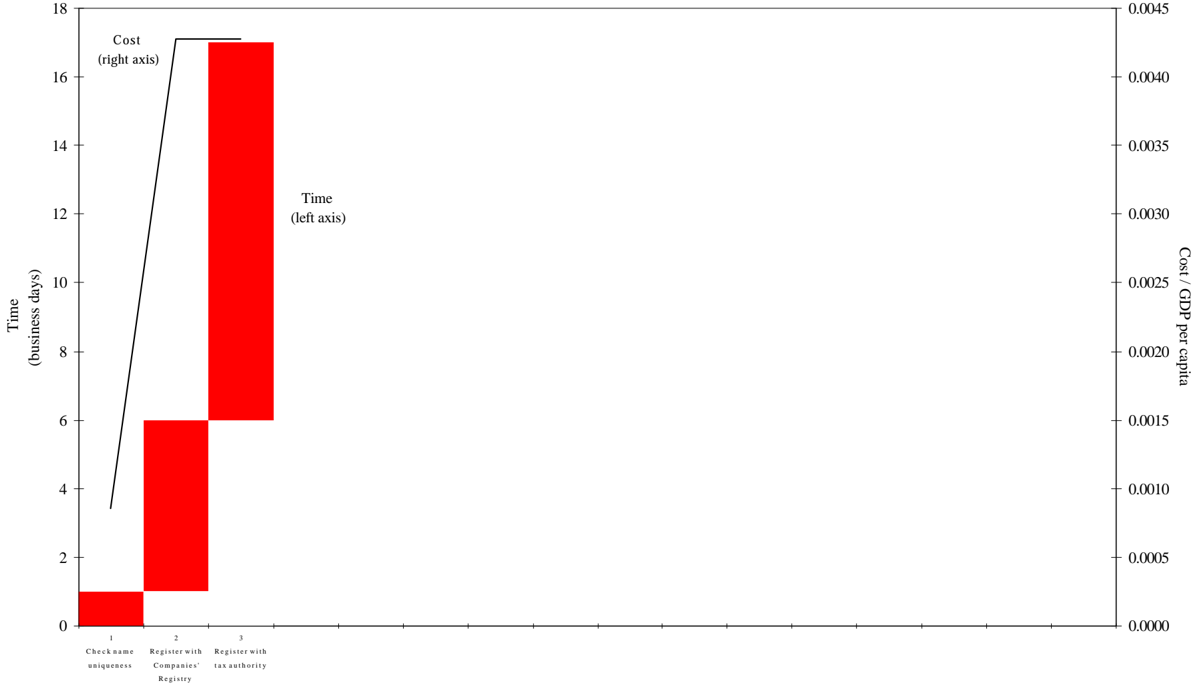
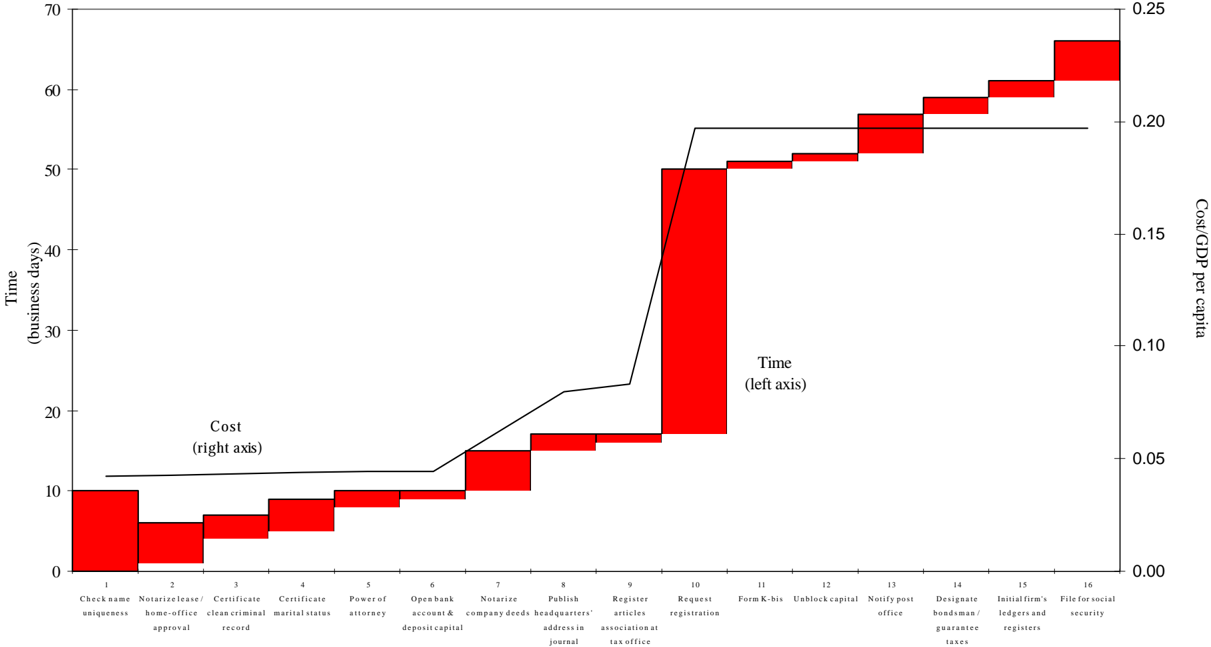
- Across the 75-country sample, the number of entry procedures ranges from 2 in Canada to 20 in Bolivia, with a sample average of 10.17 procedures; the average official time is 63.05 business days and the average cost is 0.34 of GDP per capita.
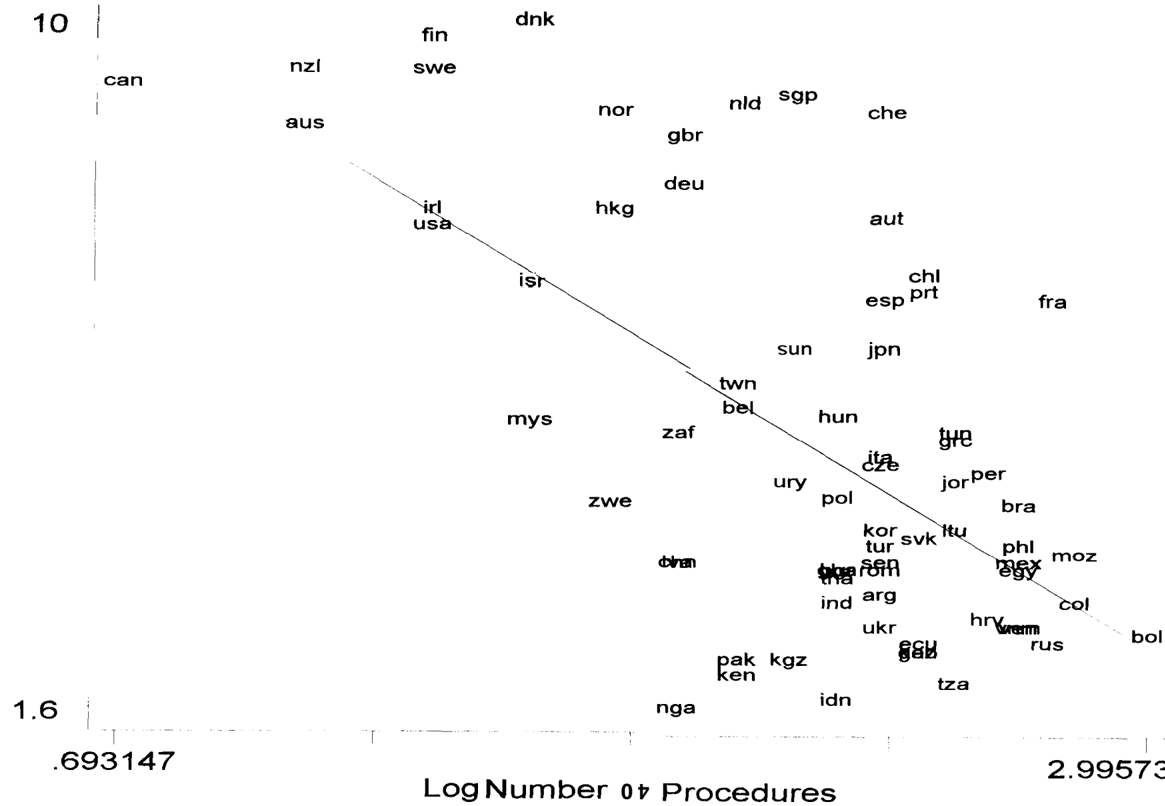
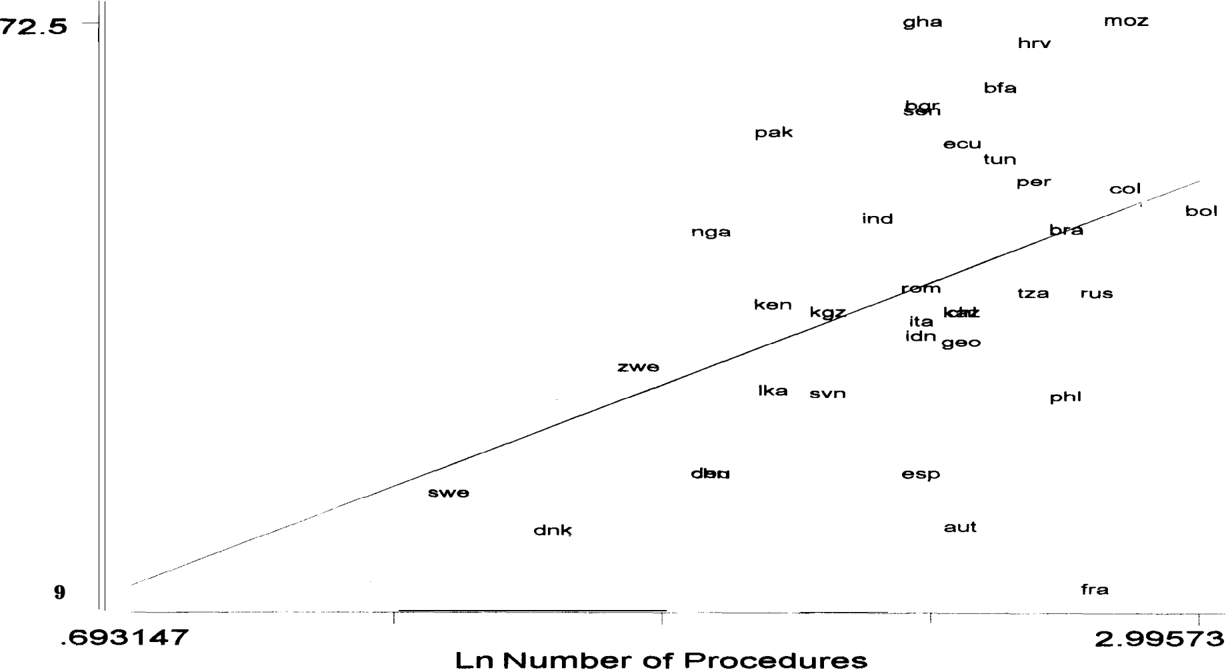
- The number of procedures is strongly correlated with time and cost: the paper reports correlations of 0.75 with log time and 0.62 with log cost.
- The helping-hand tests do not support a beneficial-regulation story: in Table IV, more procedures are associated with lower ISO quality standards (e.g. coefficient -0.2646) and larger unofficial economy measures (e.g. coefficient 13.6277 for size of unofficial economy; 19.8763 for employment in the unofficial economy), while pollution and health outcomes do not improve.
- The tollbooth evidence is stronger: Table VI reports that more procedures are associated with worse corruption scores, with a coefficient of -3.2809 (and -1.7249 with GDP per capita controls) for the corruption regressions.
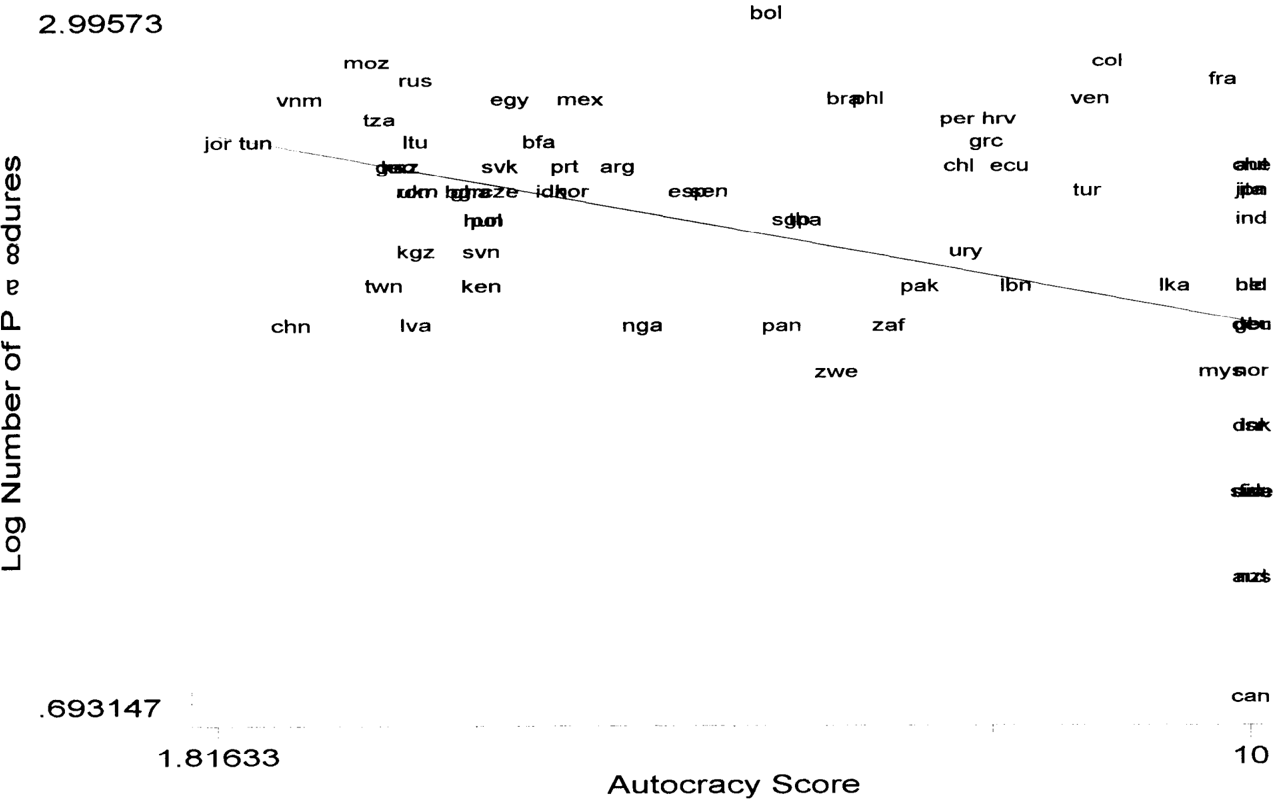
- In Table VIII, better government is associated with lighter regulation; the paper states that countries with more limited and representative governments have statistically significantly fewer procedures using 5 out of 6 measures of better government, and that more autocratic countries regulate more heavily.
Methods
- The paper builds a new database on entry regulation for 75 countries, focusing on the legal requirements, official time, and official cost for a standardized start-up firm.
- Data were gathered from written government sources, World Bank- and USAID-sponsored studies, government web pages, direct contacts with agencies, and independent double-checks in 73 countries via local consulting reports; the remaining 2 countries were double-checked through government contacts.
- The main analysis uses cross-country OLS regressions relating entry regulation measures to outcomes such as quality, pollution, unofficial economy, corruption, political institutions, legal origin, and GDP per capita; the paper also reports correlations and test-of-means comparisons across income quartiles.
Limitations
- The paper itself notes that the capture-theory tests are based on crude measures and that the data are probably least suited to test the capture hypothesis.
- The authors say the data almost surely underestimate the cost and complexity of entry because they focus on the capital city, omit industry-specific requirements and foreign-ownership steps, and ignore some informal delays and bribes.
- Evident from the text: the study is cross-sectional and based on official procedures/costs, so causal interpretation is limited and informal corruption/bureaucratic delays are not directly measured except indirectly through correlations.
Model-written summary. Check it against the paper before relying on it.
Integrity signals
Registry
Cites
Statistics
Figures
Verification
Claims the paper makes
0 Valid · 3 Not valid · 13 Not checked · 114 Own results and interpretations
A result the paper reports from its own data — it cites no other source for it, so there is none to check. The quote shows it is in the paper.
In the paper
“Very few entry regulations cover tax and labor issues.”
plain- Asserted: passes — The authors put it forward as true.
- Checkable: passes — It can be checked against evidence.
- Load-bearing: unclear — It is unclear whether the paper’s conclusions depend on it.
- Based: passes — The paper gives a reason why it holds.
In the paper
“The data show that the numbers of entry and of labor market regulations are positively correlated across countries, contrary to the substitutes hypothesis.”
What the sources say
- Not matchedcites Djankov et al., 2000
An author–year citation the paper’s reference list doesn’t settle. We don’t search these by name.
plainstates an association- Asserted: passes — The authors put it forward as true.
- Checkable: passes — It can be checked against evidence.
- Load-bearing: unclear — It is unclear whether the paper’s conclusions depend on it.
- Based: passes — The paper gives a reason why it holds.
- Not matched
A result the paper reports from its own data — it cites no other source for it, so there is none to check. The quote shows it is in the paper.
In the paper
“It often takes the form of screening procedures.”
- Also stated in: § III. Basic Results. · plain
“Instead, much of what governments do to regulate entry falls into the category of screening procedures.”
plain- Asserted: passes — The authors put it forward as true.
- Checkable: passes — It can be checked against evidence.
- Load-bearing: unclear — It is unclear whether the paper’s conclusions depend on it.
- Based: passes — The paper gives a reason why it holds.
- Also stated in: § III. Basic Results. · plain
A result the paper reports from its own data — it cites no other source for it, so there is none to check. The quote shows it is in the paper.
In the paper
“First, the cost-to-per-capita-GDP ratio decreases uniformly with GDP per capita.”
plainstates an association- Asserted: passes — The authors put it forward as true.
- Checkable: passes — It can be checked against evidence.
- Load-bearing: unclear — It is unclear whether the paper’s conclusions depend on it.
- Based: passes — The paper gives a reason why it holds.
A result the paper reports from its own data — it cites no other source for it, so there is none to check. The quote shows it is in the paper.
In the paper
“In contrast, countries in the other three quartiles of per capita income are not statistically different from each other in terms of the number of procedures and the time required to fulfill them.”
plain- Asserted: passes — The authors put it forward as true.
- Checkable: passes — It can be checked against evidence.
- Load-bearing: passes — The paper’s conclusions depend on it.
- Based: passes — The paper gives a reason why it holds.
49 more claims
Create a free account to see all 130 claims and every source verdict.
- Probably not a substantial claim. 21
- It may state two separate claims as one. 54
- The quote only partly states this claim. 26
Claims other papers make about this one
Each is checked against this paper’s own text: does it say what the citing paper says it does?
The source backs part of the claim, not all of it — or backs it for a different population, condition or comparison.
In the citing paper
“Our findings suggest an explanation for the low level of incorporation in Italy: the average direct cost associated with fulfilling the bureaucratic regulations for registering a new corporation in Italy is 20% of per capita GNP compared to 10% of per capita GNP on average for other G-7 European countries.”
From Entry regulation as a barrier to entrepreneurship (2006) · cites this paper as Djankov et al. (2002)
Experimental — accuracy not yet measuredThe cited source says what the claim attributes to it.
In the citing paper
“Given the explicit link made by Djankov et al . (2002) between the speed and ease with which businesses may be established in a country and its economic performance - and the enthusiasm with which this link has been grasped by European Union policy makers - our findings imply this link needs reconsidering.”
From The Effect of Business Regulations on Nascent and Young Business Entrepreneurship (2007) · cites this paper as Djankov et al . (2002)
Citations
Cites
La Porta, R., Lopez‐de‐Silanes, F., Shleifer, A., & Vishny, R. W. (1998) · Journal of Political Economy · doi:10.1086/250042 · Cited by 18,025
Self-citationThe Theory of Economic Regulation
Stigler, G. J. (1971) · The Bell Journal of Economics and Management Science · doi:10.2307/3003160 · Cited by 8,098
Journal of Economic Literature
(2019) · AEA Papers and Proceedings · doi:10.1257/pandp.109.633 · Cited by 7,468
The Quarterly Journal of Economics
Kuznets, S. (2024) · Business Cycle Theory, Part I Volume 4 · doi:10.4324/9781003549741-8 · Cited by 7,176
La Porta, R. (1999) · Journal of Law, Economics, and Organization · doi:10.1093/jleo/15.1.222 · Cited by 5,699 · cited 2×
“Legal origin has been viewed as a proxy for the government’s proclivity to intervene in the economy and the stance of the law toward the security of property rights in a country [La Porta et al. 1999].”
The Theory of Economic Regulation
Stigler, G. J. (2021) · The Political Economy · doi:10.4324/9781315495811-8 · Cited by 5,483
Pigou, A. C. (1933) · The Economic Journal · doi:10.2307/2224491 · Cited by 5,137
Toward a More General Theory of Regulation
Peltzman, S. (1976) · The Journal of Law and Economics · doi:10.1086/466865 · Cited by 4,729
Moffitt, R. A. (2009) · American Economic Review · doi:10.1257/aer.99.2.660 · Cited by 4,694
Shleifer, A., & Vishny, R. W. (1993) · The Quarterly Journal of Economics · doi:10.2307/2118402 · Cited by 3,778
Self-citation
Research works printed but not linked: 7
- McLiesh Caralee, 2001, NBER Working Paper No., 8288
- Kasnako lu, Zehra, and Münür Yayla, 'Unrecorded Economy in Turkey: A Monetary Approach', 1999. "Unrecorded Economy in Turkey (A Monetary Approach)" in Informal Sector in Turkey (I), Tuncer Bulutay (ed.), SIS, Ankara, forthcoming.
- Fred, 1987, Journal of Legal Studies, 101
- Olson, Mancur, 1991, 'Autocracy, Democracy, and Prosperity,' in Richard Zeckhauser, ed., Strategy of Choice, Cambridge, MA: MIT Press.
- 1967, Western Economic Journal, 232
- World Economic Forum (1999), The Global Competitiveness Report 1999 , Schwab, Klaus et al., eds., New York: Oxford University Press.
- World Economic Forum, The Global Competitiveness Report 2001, Klaus Schwab et al., eds. (New York, NY: Oxford University Press, 2001).
Cited by
Items 2,401–2,500 of 3,986
The Retail Trade Sector and the Food Industry in ItalyPreprint
Viviano, E., Luciana, A. G., Ciapanna, E., Coin, D., Colonna, F., Lagna, F., & Santioni, R. (2012) · SSRN Electronic Journal · doi:10.2139/ssrn.2045591 · Cited by 5
Regulatory Bottlenecks, Transaction Costs and Corruption: A Cross-Country InvestigationPreprint
Goel, R. K. (2008) · SSRN Electronic Journal · doi:10.2139/ssrn.1147533 · Cited by 5
Preferences for Rigid versus Individualized Wage Setting in Search Economies with Frictions
Burda, M. C., & Boeri, T. (2004) · Econstor (Econstor) · Cited by 5
Formal and Informal Institutions of DevelopmentPreprint
Casson, M., Giusta, M. D., & Kambhampati, U. S. (2008) · SSRN Electronic Journal · Cited by 5
The Measurement of Regulator Independence in Practice: Latin America and the CaribbeanPreprint
Montoya, M. Á., & Trillas, F. (2014) · SSRN Electronic Journal · doi:10.2139/ssrn.2398519 · Cited by 5
“Levy and Spiller (1996) stress this point for the case of the regulation of privatised utilities.”
Jandik, T., & Kali, R. (2005) · SSRN Electronic Journal · doi:10.2139/ssrn.820784 · Cited by 5
Promouvoir la croissance en Europe : vérités et mystifications
Gaffard, J. (2003) · Revue de l'OFCE/La Revue de l'OFCE · doi:10.3917/reof.087.0203 · Cited by 5
Interest Group Activity and Long-Run Stock Market PerformancePreprint
Coates, D., & Wilson, B. (2004) · SSRN Electronic Journal · doi:10.2139/ssrn.594881 · Cited by 5
International Sourcing, Product Complexity and Intellectual Property RightsPreprint
Naghavi, A. J., Spies, J., & Toubal, F. (2011) · SSRN Electronic Journal · doi:10.2139/ssrn.1892726 · Cited by 6
“Furthermore, we add measures of trade and FDI openness from the Heritage Foundation and an entry cost variable in line with Djankov et al. (2002).”
Red Tape, Corruption and FinancePreprint
Blackburn, K., & Sarmah, R. (2006) · RePEc: Research Papers in Economics · Cited by 7
Deregulation, Economic Growth and Growth AccelerationPreprint
Stankov, P. (2010) · SSRN Electronic Journal · doi:10.2139/ssrn.1699983 · Cited by 7
The European Debt Crisis: How did we get into this mess? How can we get out of it?Preprint
Burda, M. C. (2013) · RePEc: Research Papers in Economics · Cited by 5
US-Europe Differences in Technology Adoption and Growth The Role of Education and Other Policies ∗
Krueger, D., & Kumar, K. B. (2003) · Cited by 6
Assessment of Tariff Equivalents for Services Considering the Zero-FlowsPreprint
Guillin, A. (2011) · SSRN Electronic Journal · doi:10.2139/ssrn.1737106 · Cited by 5
Financial Infrastructure, Technological Shift, and Inequality in Economic Development∗
Horii, R., Kazuhiro, Y., Ryoji, O., Ohdoi, R., Yamamoto, K., Saito, M., Sakuragawa, M., Shibata, A., & Wang, P. (2008) · Munich Personal RePEc Archive (Ludwig Maximilian University of Munich) · Cited by 5
QUADERNI DEL DIPARTIMENTO DI SCIENZE ECONOMICHE E SOCIALI
Cerrato, D., & Depperu, D. (2012) · Cited by 5
The Shadow Economy and Banks’ Lending TechnologyPreprint
Capasso, S., Monferrà, S., & Sampagnaro, G. (2015) · SSRN Electronic Journal · doi:10.2139/ssrn.2564888 · Cited by 6
“The concept of measuring the underground economy through the job market is consistent with those studies that consider the intensity of regulations, primarily labor market regulations, as one of the most important incentives for staying out of the official economy (Friedman et al. 2000; Johnson et al. 1997; Johnson et…”
InfluentialBottling Up Innovation in Craft Brewing: A Review of the Current Barriers and ChallengesPreprint
Mitchell, M. D., & Koopman, C. (2014) · SSRN Electronic Journal · doi:10.2139/ssrn.2511022 · Cited by 5
Georgiou, M. N. (2009) · SSRN Electronic Journal · doi:10.2139/ssrn.1489878 · Cited by 5
Creating an Enabling Business Environment in Asia: To what Extent is Public Support Warranted?Preprint
Altenburg, T., & von Drachenfels, C. (2007) · RePEc: Research Papers in Economics · Cited by 13
The Selective Enforcement of Government Regulation: Battleground States and the EPAPreprint
Gulen, H., & Myers, B. W. (2017) · SSRN Electronic Journal · doi:10.2139/ssrn.2826741 · Cited by 5
A Theory of SME Governance RegulationPreprint
McCahery, J. A., & Veiga, M. G. (2017) · SSRN Electronic Journal · doi:10.2139/ssrn.3179493 · Cited by 5
Bureaucracy Intermediaries, Corruption and Red TapePreprint
Fredriksson, A. (2017) · SSRN Electronic Journal · doi:10.2139/ssrn.3006070 · Cited by 5
Demand Risk and Diversification through TradePreprint
Esposito, F. (2019) · SSRN Electronic Journal · doi:10.2139/ssrn.3498593 · Cited by 5
“…the two-steps methodology as in Head and Mayer (2013).60 58As in Helpman et al. (2008b), I use the number of procedures to start a business, from Djankov et al. (2002), as the variable that satisfies the exclusion restriction, i.e. it affects selection into foreign markets but does not affect…”
The Changing Nature of the OECD Shadow EconomyPreprint
Bovi, M., & Dell’Anno, R. (2007) · SSRN Electronic Journal · doi:10.2139/ssrn.985867 · Cited by 5
Cassar, A., D’Adda, G., & Grosjean, P. A. (2013) · SSRN Electronic Journal · doi:10.2139/ssrn.2263989 · Cited by 6
Transaction Structures in the Developing World: Evidence from Private EquityPreprint
Lerner, J., & Schoar, A. (2004) · RePEc: Research Papers in Economics · Cited by 5
Kacperczyk, A. J., & Rocha, V. C. (2021) · SSRN Electronic Journal · doi:10.2139/ssrn.3798302 · Cited by 8
Groh, A. P., & Liechtenstein, H. (2012) · SSRN Electronic Journal · doi:10.2139/ssrn.2021987 · Cited by 9
Ánh, N. H., Giang, H. T., & Tram, H. B. (2016) · SSRN Electronic Journal · doi:10.2139/ssrn.2905163 · Cited by 6
Does Taxpayer Assistance Encourage Entrepreneurship?Preprint
Armstrong, D. M., & Glaeser, S. A. (2023) · SSRN Electronic Journal · doi:10.2139/ssrn.4653065 · Cited by 5
D’Andrea, S., D'Andrea, S., Bartolomeo, G. D., D’Imperio, P., Infantino, G., & Meacci, M. (2023) · SSRN Electronic Journal · doi:10.2139/ssrn.4546997 · Cited by 5
A Quantitative Survey of Corporate Governance in Russia
岩崎, 一. (2005) · Econometric Reviews · Cited by 5
Shareholderism Around the World: Corporate Purpose, Culture, and Law
Adams, R. B., & Licht, A. (2025) · Management Sciences · doi:10.1287/mnsc.2022.00463 · Cited by 7
Przekota, G., Kowal, A., & Szczepańska-Przekota, A. (2025) · Sustainability · doi:10.3390/su17209033 · Cited by 4
Sun, K., Zhong, X., & Xiong, D. (2025) · Managerial and Decision Economics · doi:10.1002/mde.70060 · Cited by 6
“On the regulatory margin, lighter entry regulation is associated with more firm creation and better competitive selection (Djankov et al. 2002).”
The impact of formal and informal credit institutions on entrepreneurship
Malkova, A. (2024) · Journal of Financial Economic Policy · doi:10.1108/jfep-01-2024-0014 · Cited by 8
Colson, M., Vandekerkhof, P., Marneffe, W., Schepers, J., & Aparicio, S. (2024) · Journal of Regulatory Economics · doi:10.1007/s11149-024-09486-1 · Cited by 5
“…on how answering calls to account for informal institutions’ interaction effects, and how studying start-up decisions from different (border) regions adds new understanding to the entry regulations literature (Chambers & Munemo, 2019; Djankov et al., 2002; Grilli et al., 2023; Laing et al., 2022).”
InfluentialHow Selling Online Is Affecting Informal Firms in South Asia
Bussolo, M., Dixit, A., Golla, A. M., Kotia, A., Lee, J. N., Narasimhan, P., & Sharma, S. (2025) · Asian Development Review · doi:10.1142/s0116110525500064 · Cited by 7
Impact of cultural values and practices on entrepreneurial behavior: bibliometric literature review
Aly, M., Grimm, H., & Audretsch, D. B. (2025) · Journal of Entrepreneurship and Public Policy · doi:10.1108/jepp-08-2024-0131 · Cited by 8
Hechavarria, D. M., & Terjesen, S. A. (2025) · Small Business Economics · doi:10.1007/s11187-025-01083-6 · Cited by 5
“( 1234567890) Djankov et al., 2002).”
Dhanora, M., & Sharma, R. (2020) · Springer eBooks · doi:10.1007/978-981-15-3611-3_5 · Cited by 4
When are instruments generated from geographic characteristics in bilateral relationships invalid?
Deij, S., Madsen, J. B., & Puzzello, L. (2021) · Journal of Applied Econometrics · doi:10.1002/jae.2815 · Cited by 4
Unlocking Egypt’s Potential for Poverty Reduction and Inclusive Growth
Bank, W. (2021) · World Bank, Washington, DC eBooks · doi:10.1596/36437 · Cited by 8
Chang, Y., Wannamakok, W., & Schatzl, K. (2022) · Journal of Enterprising Culture · doi:10.1142/s021849582250008x · Cited by 5
Does the Belt and Road Initiative affect the business environment of participating countries?
Chen, Y., van Marrewijk, C., Xu, C., et al. (2022) · Journal of the Asia Pacific Economy · doi:10.1080/13547860.2022.2082748 · Cited by 4
Richard Cantillon and public policy
Thornton, M., & Brown, C. R. (2023) · Journal of Entrepreneurship and Public Policy · doi:10.1108/jepp-02-2022-0031 · Cited by 7
Jeong, J. (2023) · Journal of Asian Public Policy · doi:10.1080/17516234.2023.2248643 · Cited by 9
“The Doing Business data are measured as the number of procedures required for import and export and the time (days) required to complete all procedures for import and export (Djankov et al., 2002; Botero et al., 2004; Djankov et al., 2006).”
InfluentialInvestigating the factors influencing ease of doing business in Gilan province
Miraskari, S. R., & Pitenoei, Y. R. (2024) · Business Process Management Journal · doi:10.1108/bpmj-01-2024-0032 · Cited by 4
Volatility Spillover and Connectedness Between SME and Main Markets of India and China
Behera, P. K., Sahu, N. C., & Mahanta, A. (2024) · Asia-Pacific Financial Markets · doi:10.1007/s10690-024-09492-5 · Cited by 4
“The expansion of an economy has a strong association with the rise of SMEs (Djankov et al., 2002) and creates an opportunity for employment (Thurik & Wennekers, 2004).”
Market Access and Firm Productivity: Evidence from China
Jiang, M.-T., Gong, P., & Kong, D. (2024) · Finance Research Letters · doi:10.1016/j.frl.2024.106267 · Cited by 4
The underappreciated role of logistics in national systems of entrepreneurship
Friske, W., Yun, G., & Özpolat, K. (2024) · Journal of Research in Marketing and Entrepreneurship · doi:10.1108/jrme-05-2024-0134 · Cited by 6
Colonial Experiences and Contemporary Laws
Chang, Y., Chilton, A. S., Garoupa, N. M., & Versteeg, M. (2024) · Journal of law & empirical analysis. · doi:10.1177/2755323x241308009 · Cited by 8
Unsolicited justice: the impact of FCPA enforcement on corruption and investment
Xu, J. X. (2025) · Review of International Political Economy · doi:10.1080/09692290.2025.2465428 · Cited by 4
“…amount of profits to be shared among market incumbents, and provide officials with more opportunities of self-enrichment (Black & Strahan, 2001; Blanchard & Giavazzi, 2003; Degryse & Ongena, 2008; Djankov, 2009; Djankov et al., 2002; Maijoor & Van Witteloostuijn, 1996; McChesney, 1987; Rose, 1987).”
Sewaid, A., Zahra, S. A., & Aparicio, S. (2025) · Technovation · doi:10.1016/j.technovation.2025.103355 · Cited by 6
Investment climate and government turnover in russian regions
Syunyaev, G., & Polishchuk, L. (2014) · Voprosy Ekonomiki · doi:10.32609/0042-8736-2014-2-88-117 · Cited by 9
Informal Production and Labour Market Segmentation
Bennett, J. R., Jr. (2011) · Journal of Institutional and Theoretical Economics JITE · doi:10.1628/jite-2011-0009 · Cited by 4
EMPIRICAL EVIDENCE REGARDING REGULATORY BURDENS AND GLOBAL INCOME PERFORMANCE
Licerio, E., Fullerton, T. M. J., & Clark, D. P. (2010) · RePEc: Research Papers in Economics · Cited by 4
Bright stars in the urban galaxy – the efficiency of ethnic entrepreneurs in the urban economy
Sahin, M., Todiras, A., Nijkamp, P. J., & Suzuki, S. (2012) · Innovation The European Journal of Social Science Research · doi:10.1080/13511610.2012.660329 · Cited by 4
“requirements, and environment-related requirements (Djankov et al. 2002).”
An Assessment of Indian Telecommunications Reform
Noll, R., & Wallsten, S. (2012) · Cambridge University Press eBooks · doi:10.1017/cbo9781139096638.016 · Cited by 4
Development and inefficient regulation under the threat of revolution
Dorsch, M., Dunz, K., & Maarek, P. (2016) · Journal of Comparative Economics · doi:10.1016/j.jce.2016.03.003 · Cited by 4
Dove, J. A. (2017) · Applied Economics Letters · doi:10.1080/13504851.2016.1273483 · Cited by 5
“…the interconnectedness and overall effect that corruption and taxation have on firm entry and entrepreneurial behaviour (Dreher and Gassebner 2013; Djankov et al. 2002; Klapper, Laeven, and Rajan 2006; Shleifer and Vishny 1993; Bruce and Mohsin 2006; Cullen and Gordon 2007; Mitchell and Campbell…”
Genetic distance and the difference in new firm entry between countries
Guedes, M. J., Nicolaou, N., & Patel, P. C. (2019) · Journal of Evolutionary Economics · doi:10.1007/s00191-019-00613-2 · Cited by 8
FDI & New Business Startups: Does Financial Development Matter?
Arif, I., & Khan, L. (2019) · South Asian Journal of Management Sciences · doi:10.21621/sajms.2019131.01 · Cited by 7
Economic and Political Determinants of Economic and Financial Crime
Achim, M. V., & Borlea, S. N. (2020) · Studies of organized crime · doi:10.1007/978-3-030-51780-9_2 · Cited by 6
Institutional Determinants of New Firm Entry in Russia: A Cross Regional Analysis
Bruno, R. L., Bytchkova, M., & Estrin, S. (2008) · AMS Acta (University of Bologna) · doi:10.6092/unibo/amsacta/4596 · Cited by 4
The quality of institutions: Problems of definition and evaluation
Tambovtsev, V. (2021) · Voprosy Ekonomiki · doi:10.32609/0042-8736-2021-7-49-67 · Cited by 23
International determinants of asymmetric dependence in investment returns
Alcock, J., & Sinagl, P. (2021) · Journal of International Money and Finance · doi:10.1016/j.jimonfin.2021.102576 · Cited by 4
Shadow Economy and Economic Growth
Zouhaier, H., Mrad, F., Lafi, M., et al. (2021) · Review of Economics and Finance · doi:10.55365/1923.x2021.19.25 · Cited by 4
Long, C. X., Xu, L. C., & Yang, J. (2022) · Journal of Government and Economics · doi:10.1016/j.jge.2022.100037 · Cited by 7
Blast from the Past? A Comparative Analysis of Broadcast Licensing in the Digital Era
Schweizer, C., Puppis, M., Künzler, M., et al. (2014) · Journal of Information Policy · doi:10.5325/jinfopoli.4.2014.507 · Cited by 4
Trust and firms’ performance in Western Balkan countries
Vučković, V., Škuflić, L., & Mangafić, J. (2022) · Economic Research-Ekonomska Istraživanja · doi:10.1080/1331677x.2022.2142255 · Cited by 5
“Within the public choice theory, the role of secure property rights and a supportive institutional framework for new business entry is strongly emphasised and includes an impartial judiciary (Djankov et al., 2002, 2003).”
BackgroundThe Post-Arab Spring Social Contract in Tunisia: Social Actors’ Comparative Gains and Losses
Sabry, M. I. (2026) · International Journal of Politics Culture and Society · doi:10.1007/s10767-026-09591-3 · Cited by 4
Street-level responsiveness of city governments in China, Germany, and the United States
Köhler, E. A., Matsusaka, J. G., & Wu, Y. (2023) · Journal of Comparative Economics · doi:10.1016/j.jce.2023.01.001 · Cited by 5
Azad, P., & Kalam, S. P. (2023) · Journal of Public Affairs · doi:10.1002/pa.2855 · Cited by 5
Gasmi, F., Virto, L. R., & Couvet, D. (2023) · Economic Systems · doi:10.1016/j.ecosys.2023.101130 · Cited by 8
The impact of maximum markup regulation on prices
Genakos, C., Koutroumpis, P., & Pagliero, M. (2018) · Journal of Industrial Economics · doi:10.17863/cam.18353 · Cited by 4
Who Benefits From Economic Reform? Firms and Distributive Politics
Szakonyi, D., & Urpelainen, J. (2014) · The Journal of Politics · doi:10.1017/s0022381614000061 · Cited by 4
“On the one hand, some scholars have maintained that liberalization generally reduces the importance of politics in the distribution of gains (Djankov et al., 2002; Krueger 1974; Milner and Kubota 2005; Shleifer and Vishny 1994).”
On the Efficiency of Labor Market Reforms: How to Solve the Spanish Puzzle?
Sacht, S. (2015) · Economics · doi:10.5018/economics-ejournal.ja.2015-44 · Cited by 4
Extensive and intensive margins and exchange rate regimes
Hamano, M., & Picard, P. M. (2017) · Canadian Journal of Economics/Revue canadienne d économique · doi:10.1111/caje.12279 · Cited by 4
Electronic Government and the Ease of Doing Business
Martins, J., & Veiga, L. G. (2018) · International Conference on Theory and Practice of Electronic Governance · doi:10.1145/3209415.3209438 · Cited by 4
Peña-Mir, J. L. (2020) · Revista de Historia Económica / Journal of Iberian and Latin American Economic History · doi:10.1017/s0212610920000099 · Cited by 4
“…design to solve information asymmetries by Hart (1995); the interaction of formal and informal institutions by Greif et al. (1994); the need to create institutions which provide useful information about contractual partners by De Soto (2000), Djankov et al. (2002) and Arruñada (2007, 2012).”
Malinowska, A. P. (2021) · Journal of Economic Issues · doi:10.1080/00213624.2021.1873045 · Cited by 4
The effect of legal barriers to entry in the Spanish retail market: a local market approach
Orea, L. (2010) · RePEc: Research Papers in Economics · Cited by 4
Gómez‐Galvarriato, A., & Musacchio, A. (2004) · Cited by 4
12 Marketable Wealth in a Poor African Country: Wealth Accumulation by Households in Ghana
Burger, R., Booysen, F., van der Berg, S., & von Maltitz, M. (2008) · Oxford University Press eBooks · doi:10.1093/acprof:oso/9780199548880.003.0012 · Cited by 5
Revisiting the Constraints to Pakistan's Growth
López-Cálix, J. R., & Touqeer, I. (2013) · World Bank, Washington, DC eBooks · doi:10.1596/17858 · Cited by 8
Bierwisch, A., Goluchowicz, K., & Som, O. (2014) · Technological Forecasting and Social Change · doi:10.1016/j.techfore.2014.08.006 · Cited by 4
Trade Liberalization and Institutional Reform
Zhao, M., Fogel, K., Mørck, R., & Yeung, B. Y. (2010) · Asian Economic Papers · doi:10.1162/asep_a_00001 · Cited by 11
“Ineffective legal systems and weak private property rights expose entrepreneurs to predation by corrupt ofªcials or established businesses, and further shrink their expected returns (Djankov et al. 2002).”
InfluentialBusiness environment reforms: Why it is necessary to rethink priorities and strategies
Altenburg, T., & von Drachenfels, C. (2008) · Enterprise Development and Microfinance · doi:10.3362/1755-1986.2008.018 · Cited by 4
Institutional Determinants of the Argentinean Crisis: A Systemic Approach
Cardoza, G., Díaz, J., & Ángel, A. (2006) · Latin American Business Review · doi:10.1300/j140v07n01_01 · Cited by 5
“As an example, note that the opening of a new company in Argentina required 60 more days of bureaucratic procedure, in comparison to the number of days required in Canada (Djankov et al., 2002).”
Business Policies and New Firm Birth Rates Internationally
Nofsinger, J. R., & Reca, B. (2014) · Accounting and Finance Research · doi:10.5430/afr.v3n4p1 · Cited by 4
Globalization and the natural limits of competition
Martin, S. (2013) · Edward Elgar Publishing eBooks · doi:10.4337/9781849802680.00006 · Cited by 4
Policies Fostering New Firm Formation and Self-Employment in Italy
Carree, M., Piergiovanni, R., Santarelli, E., et al. (2009) · International studies in entrepreneurship · doi:10.1007/978-1-4419-0249-8_2 · Cited by 4
Denis, A., & Parfait, B. (2015) · British Journal of Economics Management & Trade · doi:10.9734/bjemt/2015/15017 · Cited by 4
ELHENNAWI, K. (2016) · Journal of Developmental Entrepreneurship · doi:10.1142/s1084946716500266 · Cited by 6
A Theory of Approval Regulation
Carpenter, D. P., & Ting, M. (2004) · Cited by 4
Yonk, R. M., Harris, K., Martin, R. C., & Anderson, B. (2017) · Journal of Entrepreneurship and Public Policy · doi:10.1108/jepp-08-2016-0031 · Cited by 7
Barriers to Entry and their Impact on Private Sector Growth in Poland
Balcerowicz, E. (2003) · Springer eBooks · doi:10.1007/978-1-4419-9234-5_7 · Cited by 4
THE AUDIT BOARD OF REPUBLIC OF INDONESIA OPINION AND BRIBERY IN LOCAL GOVERNMENTS IN INDONESIA
Astuti, Y. D., & Adrison, V. (2019) · Jurnal Tata Kelola dan Akuntabilitas Keuangan Negara · doi:10.28986/jtaken.v5i2.379 · Cited by 4
Metadata
- Authors
- Djankov, S., La Porta, R., Lopez-de-Silanes, F., & Shleifer, A.
- Affiliations
- World Bank (US)
- National Bureau of Economic Research (US)
- ORCID
- Djankov, S.
- Venue
- The Quarterly Journal of Economics
- Publisher
- Oxford University Press (OUP)
- Published
- 2002-02-01
- Volume
- 117
- Issue
- 1
- Pages
- 1-37
- ISSN
- 0033-5533
- 1531-4650
- OpenAlex
- W2139896179
- Cited by
- 3,956
- References
- 30
- Citations by year
- 2026: 223 · 2025: 185 · 2024: 157 · 2023: 120 · 2022: 140 · 2021: 150 · 2020: 151 · 2019: 161 · 2018: 157 · 2017: 162 · 2016: 166 · 2015: 193 · 2014: 200 · 2013: 183 · 2012: 193
- Type
- report
- Language
- en
- Open access
- green
- doi.org
- Licence
- other-oa
- Locations
- World Bank, Washington, DC eBooks (publishedVersion)
- The Quarterly Journal of Economics (publishedVersion)
- The World Bank Open Knowledge Repository (World Bank) (publishedVersion)
- National Bureau of Economic Research (publishedVersion, other-oa)
- RePEc: Research Papers in Economics (submittedVersion)
- Digital Access to Scholarship at Harvard (DASH) (Harvard University) (submittedVersion, cc-by)
- SSRN Electronic Journal (submittedVersion)
- OpenGrey (Institut de l'Information Scientifique et Technique) (submittedVersion)
- The World Bank Open Knowledge Repository (World Bank) (submittedVersion, cc-by)
- Topics
- Social Sciences › Sociology and Political Science › Corruption and Economic Development
- Social Sciences › Economics, Econometrics and Finance › Economics and Econometrics › Taxation and Compliance Studies
- Social Sciences › Business, Management and Accounting › Strategy and Management › Political Influence and Corporate Strategies
- Keywords
- start-up firms, bureaucratic procedures, corruption, informal economy, democracy, government size, public choice theory, public interest theory
About these checks
Registry, retraction, Cites and statistics results are computed, not judged, with one exception: a printed reference that no index lists is read once by a model before it counts as a citation error. Claims are extracted by a model and kept only when their quote appears verbatim in the text; each cited source is then checked, with a model’s help, for whether it says what the claim relies on. Those verdicts can be wrong — read the claim’s quote and the cited source before relying on one.
A language model drew the claims from the paper on 2026-10-01, under version 3 of the claim definition (model deepseek-v4.1-flash, prompt extract-v3).
A second model labelled each claim on 2026-10-01 (model jev-1.13-20260917, definition revision gold-guideline-v0.2).
Statistics and arithmetic are recomputed, not judged.
Confidence bands are shown only for fields calibrated on our annotated test set. None is calibrated yet, so no band is shown.
What counts as a claim ›How we measure confidence ›How we check this ›
Are you an author, or do you see a problem with this page? Request a review
Data sources
Bibliographic data: Semantic Scholar, OpenAlex, Crossref.
Contains information from the Semantic Scholar Academic Graph Datasets, made available under the ODC Attribution License (ODC-BY 1.0).
Semantic Scholar’s data is described in: Kinney, R., et al. (2023). The Semantic Scholar Open Data Platform. arXiv:2301.10140.
