

Dimensions and Dynamics of National Culture: Synthesizing Hofstede With Inglehart
Open accessThe DOI matches its Crossref record; 115 of the 115 references it cites were found in a registry or an index; 1 of the 66 sources its claims cite were checked for support.
Abstract
Cross-national research on cultural differences across space and time intersects multiple disciplines but the prominence of concepts varies by academic fields. Hofstede’s dimensional concept of culture, to begin with, dominates in cross-cultural psychology and international management. Inglehart’s dynamic concept of culture, by contrast, prevails in sociology and political science. We argue that this disciplinary division is unfortunate because the two concepts are complementary, for which reason a synthesis rectifies their mutual weaknesses. Indeed, while Hofstede’s dimensional concept neglects cultural dynamics, Inglehart’s dynamic concept is dimensionally reductionist. We demonstrate empirically that combining these two concepts leads to an improved understanding of cultural differences. Inspired by Hofstede’s cultural dimensions, we use data from the European Value Studies and World Values Surveys for 495,011 individuals born between 1900 and 1999 in 110 countries and then show that change on these dimensions proceeds as Inglehart and his collaborators suggest. Most notably, younger generations have become more individualistic and more joyous. But even though economic development and generational replacement drive this cultural change, roughly half of the variation in national cultural orientations is unique to each country, due to lasting intercept differences in developmental trajectories that trace back to remote historic drivers. We discuss the implications for cross-national cultural research.
Overview
CoChat Summary
## TL;DR
The paper synthesizes Hofstede’s cultural dimensions with Inglehart’s theory of cultural change and re-estimates national culture using WVS/EVS data for 110 countries and 495,011 individuals. It reduces Hofstede’s six dimensions to three, and finds that cultures have generally shifted toward more Individualism and Joy, while Trust has declined somewhat; about half of the variation is linked to economic development and generational change, and about half to country-specific historical/geographic factors.
## Key findings
- Factor analysis of 15 WVS-EVS items yields three factors (n = 63 countries in the factor analysis), with eigenvalues 4.9, 3.2, and 2.5; the fourth factor drops below 1 (.89) and the three-factor model has the best BIC.
- The three dimensions are Collectivism–Individualism, Duty–Joy, and Distrust–Trust; the paper reports Cronbach’s alphas of .87, .77, and .75, respectively.
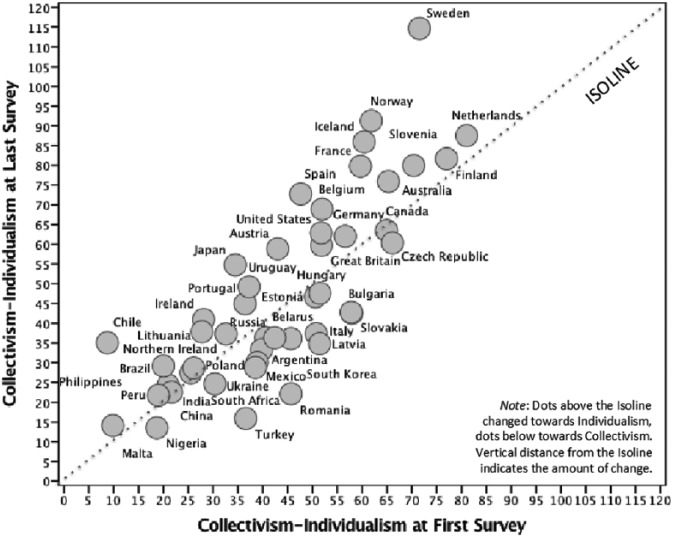
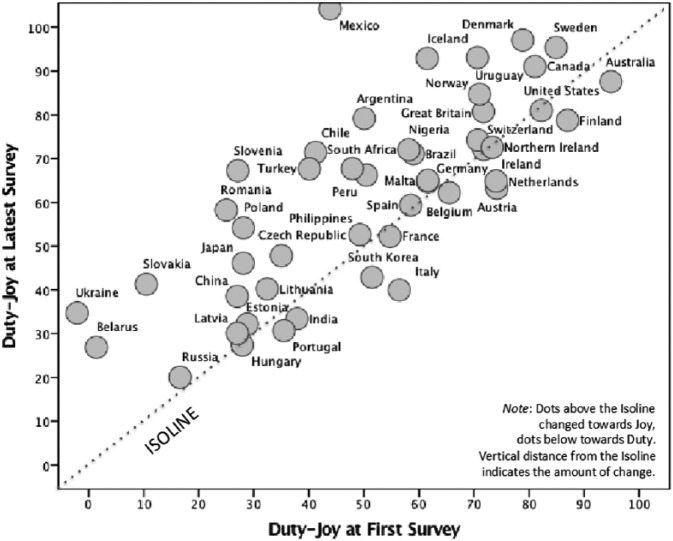
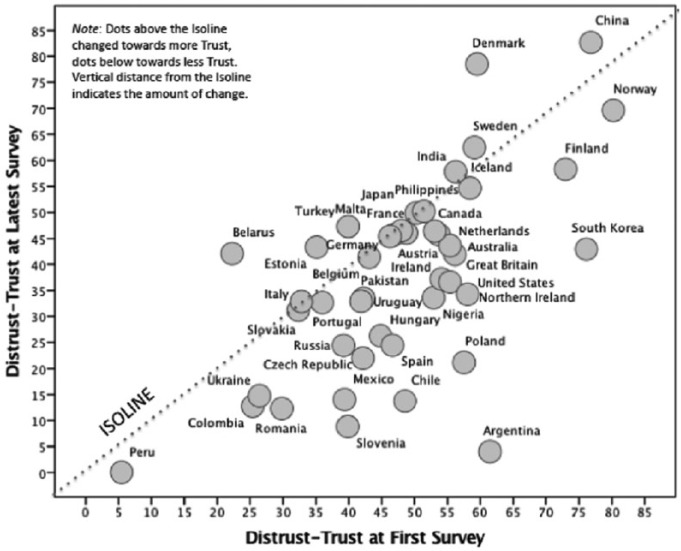
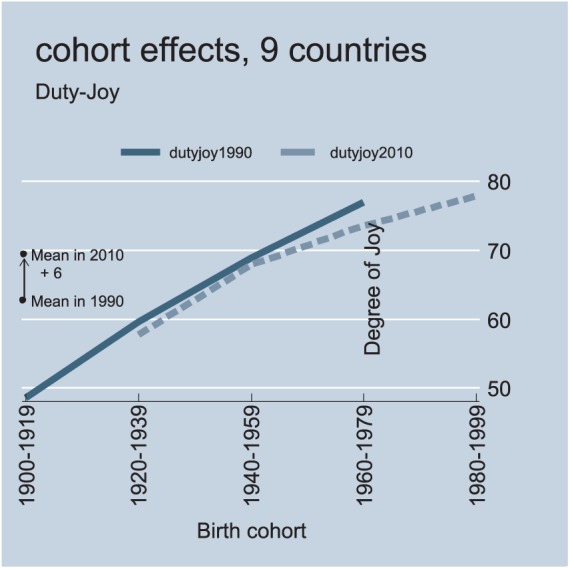
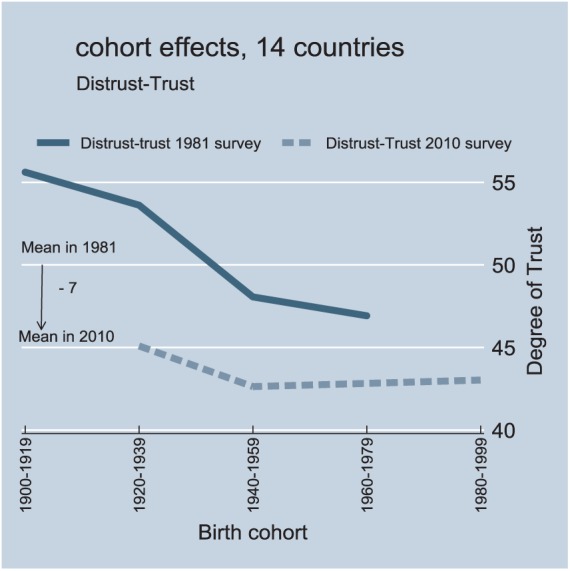
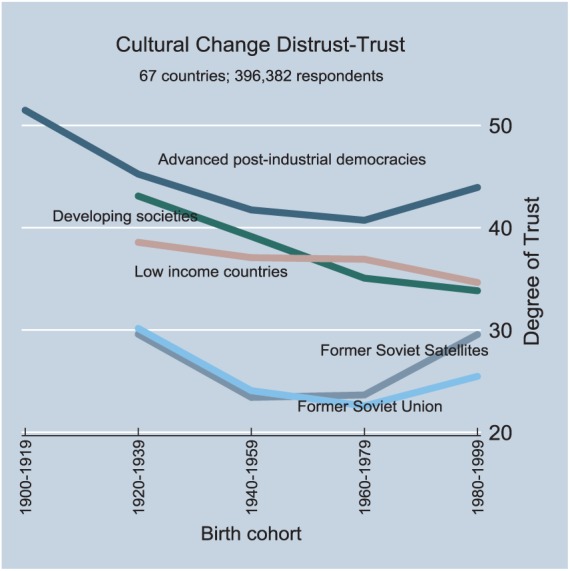
- Over at least 15 years, country scores change by +4 points on Collectivism–Individualism (44 to 48, N = 46 countries), +11 points on Duty–Joy (N = 47), and -10 points on Distrust–Trust (N = 44).
- In the panel models, GDP per capita is significantly related to Collectivism–Individualism (β = 3.30; p < .01) and Duty–Joy (β = 9.29; p < .001), and marginally to Distrust–Trust (β = 2.76; p < .10).
- The paper reports that approximately 50% of the variation in Collectivism–Individualism and Duty–Joy is explained by GDP per capita and cohort-fixed effects, with the other 50% explained by country-fixed effects; for Distrust–Trust, country-fixed effects account for the largest share.
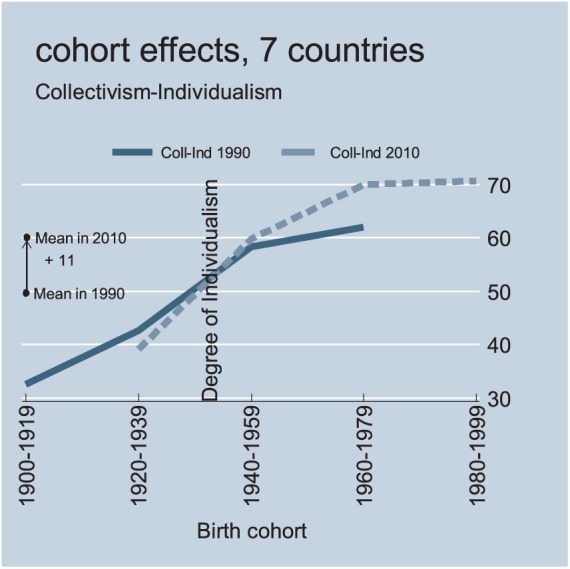
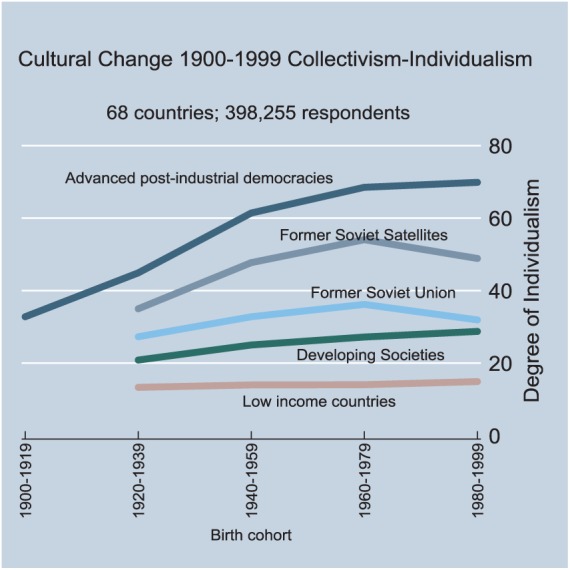
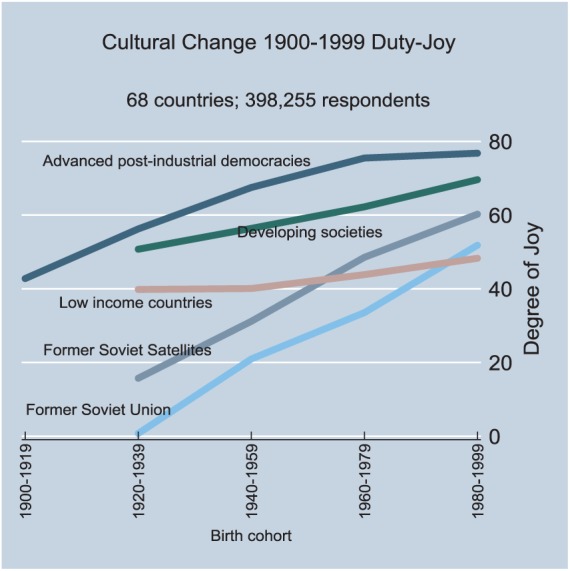
- For the youngest cohort (born after 1980), controlling for GDP per capita and country-fixed effects, scores are 25 points higher on Individualism/Joy and 17 points lower on Trust compared with the 1900–1920 cohort.
## Methods
- The study pools WVS and EVS data from 110 countries and 495,011 individuals surveyed between 1981 and 2014; respondents are grouped into five birth cohorts (1900–1919, 1920–1939, 1940–1959, 1960–1979, 1980–1999).
- The authors construct country-level cultural scores from attitude items, screen items by coverage and correlation with Hofstede’s dimensions, and use factor analysis (oblique rotation), reliability analysis, and rescaling to 0–100.
- To study change, they use fixed-effects panel models with GDP per capita, country-fixed effects, cohort-fixed effects, and cluster-adjusted standard errors, plus comparisons of earliest vs latest survey waves and a five-cohort analysis.
## Limitations
- The paper itself notes that the first cohort (1900–1919) has limited coverage for 21 countries, and that restricting analyses to countries with at least 15 years between first and last survey waves reduces sample size considerably.
- It also states that the study is conducted at the group level, and that aggregate dimensions are often impossible to replicate at the individual level within countries; this is presented as a general limitation of interpreting national-culture patterns.
- Evident from the text: some analyses rely on item exclusion/imputation because of missing wave or country coverage, including dropping items for limited coverage and imputing one missing item for 16 countries in the first dimension.
Model-written summary. Check it against the paper before relying on it.
Integrity signals
Registry
Cites
Statistics
Figures
Verification
Claims the paper makes
0 Valid · 4 Not valid · 51 Not checked · 147 Own results and interpretations
The cited sources that could be checked couldn’t confirm or dispute this claim.
In the paper
“while Hofstede’s dimensional concept neglects cultural dynamics”
§ Dimensions and Dynamics of National Culture: Synthesizing Hofstede With Inglehart > Abstract Cross-national research on cultural differences across space and time intersects multiple disciplines but the prominence of concepts varies by academic fields. Hofstede’s dimensional concept of culture, to begin with, dominates in cross-cultural psychology and international management. Inglehart’s dynamic concept of culture, by contrast, prevails in sociology and political science. We argue that this disciplinary division is unfortunate because the two concepts are complementary, for which reason a synthesis rectifies their mutual weaknesses. Indeed, while Hofstede’s dimensional concept neglects cultural dynamics, Inglehart’s dynamic concept is dimensionally reductionist. We demonstrate empirically that combining these two concepts leads to an improved understanding of cultural differences. Inspired by Hofstede’s cultural dimensions, we use data from the European Value Studies and World Values Surveys for 495,011 individuals born between 1900 and 1999 in 110 countries and then show that change on these dimensions proceeds as Inglehart and his collaborators suggest. Most notably, younger generations have become more individualistic and more joyous. But even though economic development and generational replacement drive this cultural change, roughly half of the variation in national cultural orientations is unique to each country, due to lasting intercept differences in developmental trajectories that trace back to remote historic drivers. We discuss the implications for cross-national cultural research.
What the sources say
- Not checked — no full text of the sourcecites Minkov & Hofstede, 2014 matched to “A replication of Hofstede's uncertainty avoidance dimension across nationally representative samples from Europe” (2014) source
- Could not verifycites Shenkar, 2001 matched to “Cultural Distance Revisited: Towards a More Rigorous Conceptualization and Measurement of Cultural Differences” (2001) sourceExperimental — accuracy not yet measured
Our copy of Shenkar (2001) criticises Hofstede's dimensional framework, but on other grounds: in Methodological Properties it lists the criticisms 'leveled against Hofstede, e.g., non-exhaustiveness, reliance on single company data, and the like', plus the Assumptions of Corporate Homogeneity, Spatial Homogeneity and Equivalence, and notes the Kogut & Singh index 'has not been updated to incorporate latter work by Hofstede and others' (the fifth dimension, Confucian dynamism/LTO). None of these states that Hofstede's dimensional concept neglects cultural dynamics or change over time; the only 'dynamics' usages refer to Confucian dynamism as a dimension and to corporate culture altering 'the dynamics of national CD' (Methodological Properties). Searched: cultural dynamics, static/dynamic framework, cultural change over time, temporal evolution, limitations of Hofstede's dimensions — no passage addresses the claim's point, so it can be neither confirmed nor contradicted from our copy. (LLM, conf=0.68)
- Not checked — no full text of the sourcecites Tung, 2008 matched to “The cross-cultural research imperative: the need to balance cross-national and intra-national diversity” (2008) source
plain- Asserted: passes — The authors put it forward as true.
- Checkable: passes — It can be checked against evidence.
- Load-bearing: passes — The paper’s conclusions depend on it.
- Based: passes — The paper gives a reason why it holds.
The paper states this without a source or data behind it here, so there is nothing to check it against. The quote shows it is in the paper.
In the paper
“From an empirical point of view, Hofstede’s six-dimensional framework (4 IBM-based + 2 WVS-based) consists of four dimensions (3 IBM-based + 1 WVS-based).”
§ Dimensions and Dynamics of National Culture: Synthesizing Hofstede With Inglehart > Hofstede’s Dimensions and Inglehart’s Dynamics > Hofstede’s National Cultural Dimensions and the Critique of His Framework
plain- Asserted: passes — The authors put it forward as true.
- Checkable: passes — It can be checked against evidence.
- Load-bearing: passes — The paper’s conclusions depend on it.
- Based: unclear — It is unclear why the paper says it holds.
A result the paper reports from its own data — it cites no other source for it, so there is none to check. The quote shows it is in the paper.
In the paper
“roughly half of the variation in national cultural orientations is unique to each country, due to lasting intercept differences in developmental trajectories that trace back to remote historic drivers.”
§ Dimensions and Dynamics of National Culture: Synthesizing Hofstede With Inglehart > Abstract Cross-national research on cultural differences across space and time intersects multiple disciplines but the prominence of concepts varies by academic fields. Hofstede’s dimensional concept of culture, to begin with, dominates in cross-cultural psychology and international management. Inglehart’s dynamic concept of culture, by contrast, prevails in sociology and political science. We argue that this disciplinary division is unfortunate because the two concepts are complementary, for which reason a synthesis rectifies their mutual weaknesses. Indeed, while Hofstede’s dimensional concept neglects cultural dynamics, Inglehart’s dynamic concept is dimensionally reductionist. We demonstrate empirically that combining these two concepts leads to an improved understanding of cultural differences. Inspired by Hofstede’s cultural dimensions, we use data from the European Value Studies and World Values Surveys for 495,011 individuals born between 1900 and 1999 in 110 countries and then show that change on these dimensions proceeds as Inglehart and his collaborators suggest. Most notably, younger generations have become more individualistic and more joyous. But even though economic development and generational replacement drive this cultural change, roughly half of the variation in national cultural orientations is unique to each country, due to lasting intercept differences in developmental trajectories that trace back to remote historic drivers. We discuss the implications for cross-national cultural research.
plainstates a causen = 495,011- Asserted: passes — The authors put it forward as true.
- Checkable: passes — It can be checked against evidence.
- Load-bearing: passes — The paper’s conclusions depend on it.
- Based: passes — The paper gives a reason why it holds.
A result the paper reports from its own data — it cites no other source for it, so there is none to check. The quote shows it is in the paper.
In the paper
“we use data from the European Value Studies and World Values Surveys for 495,011 individuals born between 1900 and 1999 in 110 countries and then show that change on these dimensions proceeds as Inglehart and his collaborators suggest.”
§ Dimensions and Dynamics of National Culture: Synthesizing Hofstede With Inglehart > Abstract Cross-national research on cultural differences across space and time intersects multiple disciplines but the prominence of concepts varies by academic fields. Hofstede’s dimensional concept of culture, to begin with, dominates in cross-cultural psychology and international management. Inglehart’s dynamic concept of culture, by contrast, prevails in sociology and political science. We argue that this disciplinary division is unfortunate because the two concepts are complementary, for which reason a synthesis rectifies their mutual weaknesses. Indeed, while Hofstede’s dimensional concept neglects cultural dynamics, Inglehart’s dynamic concept is dimensionally reductionist. We demonstrate empirically that combining these two concepts leads to an improved understanding of cultural differences. Inspired by Hofstede’s cultural dimensions, we use data from the European Value Studies and World Values Surveys for 495,011 individuals born between 1900 and 1999 in 110 countries and then show that change on these dimensions proceeds as Inglehart and his collaborators suggest. Most notably, younger generations have become more individualistic and more joyous. But even though economic development and generational replacement drive this cultural change, roughly half of the variation in national cultural orientations is unique to each country, due to lasting intercept differences in developmental trajectories that trace back to remote historic drivers. We discuss the implications for cross-national cultural research.
boostedstates a causen = 495,011- Asserted: passes — The authors put it forward as true.
- Checkable: passes — It can be checked against evidence.
- Load-bearing: passes — The paper’s conclusions depend on it.
- Based: passes — The paper gives a reason why it holds.
A result the paper reports from its own data — it cites no other source for it, so there is none to check. The quote shows it is in the paper.
In the paper
“LTO and IVR also form one factor in an ecological factor analysis.”
§ Dimensions and Dynamics of National Culture: Synthesizing Hofstede With Inglehart > Hofstede’s Dimensions and Inglehart’s Dynamics > Hofstede’s National Cultural Dimensions and the Critique of His Framework
plainstates an association- Asserted: passes — The authors put it forward as true.
- Checkable: passes — It can be checked against evidence.
- Load-bearing: passes — The paper’s conclusions depend on it.
- Based: passes — The paper gives a reason why it holds.
105 more claims
Create a free account to see all 202 claims and every source verdict.
- It may state two separate claims as one. 72
- Probably not a substantial claim. 29
Citations
Cites
Cultures and Organizations: Software of the Mind.
Triandis, H. C., & Hofstede, G. (1993) · Administrative Science Quarterly · doi:10.2307/2393257 · Cited by 17,696
Putnam, R. (2000) · doi:10.1145/358916.361990 · Cited by 17,114 · cited 1×
“Using the Trust label for this dimension resonates well with the vast literature on trust in economics (e.g., Zak & Knack, 2001), political science (e.g., Fukuyama, 1995; Putnam, 1993, 2000), and sociology (e.g., Delhey & Newton, 2005).”
Method(1997) · Naming the Mind: How Psychology Found its Language · doi:10.4135/9781446221815.n7 · Cited by 15,148
Making Democracy Work: Civic Traditions in Modern Italy
Stern, F., & Putnam, R. (1993) · Foreign Affairs · doi:10.2307/20045657 · Cited by 11,137
Trust: The Social Virtues and the Creation of Prosperity
Schneider, P. A., & Fukuyama, F. (1996) · Journal of Marketing · doi:10.2307/1251846 · Cited by 10,501
Culture's Consequences: International Differences in Work-Related Values
Gladwin, T. N., & Hofstede, G. (1981) · The Academy of Management Review · doi:10.2307/257651 · Cited by 9,275
Assessing construct validity in organizational research
Bagozzi, R. P., Yi, Y., & Phillips, L. W. (1991) · Administrative Science Quarterly · doi:10.2307/2393203 · Cited by 6,621 · cited 1×
“The correlations between the newly developed dimensions are lower than the correlations among the items included in each dimension, showing convergent and discriminant validity (Fornell & Larcker, 1981).”
BackgroundThe Effect of National Culture on the Choice of Entry Mode
Kogut, B., & Singh, H. (1988) · Journal of International Business Studies · doi:10.1057/palgrave.jibs.8490394 · Cited by 6,240 · cited 1×
“Second, cultural frameworks like ours have been used to develop a composite measure of cultural distance collapsing all cultural dimensions into a single Euclidean distance index (Beugelsdijk et al., 2017; Kogut & Singh, 1988).”
MethodRethinking individualism and collectivism: Evaluation of theoretical assumptions and meta-analyses.
Oyserman, D., Coon, H. M., & Kemmelmeier, M. (2002) · Psychological Bulletin · doi:10.1037/0033-2909.128.1.3 · Cited by 5,758
Making Democracy Work: Civic Traditions in Modern Italy
Putnam, R. D., Leonardi, R., & Nonetti, R. Y. (1994) · Princeton University Press eBooks · doi:10.2307/j.ctt7s8r7 · Cited by 5,580
Research works printed but not linked: 8
- Banfield E., 1958, Glencoe, illinois
- Diamond J., 1997, Guns, germs and steel
- Gelfand M., 2004, Culture, leadership and organizations: The GLOBE study of 62 societies, 438
- Greene W. H., 2008, Econometric analysis
- Hofstede G., 2001, Culture’s consequences: Comparing values, behaviors, institutions, and organizations across nations
- Inglehart R., 2003, Sacred and secular
- Nunnally J. C., 1994, Psychometric theory
- Schwartz S. H., 1994, Individualism and collectivism: Theory, method and applications, 85
Cited by
Items 101–200 of 455
Li, Z., Mirko, C., D’Agostino, M. T., & Jin, J. (2023) · Frontiers in Psychology · doi:10.3389/fpsyg.2023.1119258 · Cited by 17
“According to Hofstede’s theory, culture refers to the shared values of a group, with people in the same region thinking and acting in a similar way (Beugelsdijk and Welzel, 2018).”
BackgroundElements of Schwartz’s Model in the WVS: How Do They Relate to Other Cultural Models?
Kaasa, A., & Welzel, C. (2023) · Cross-Cultural Research · doi:10.1177/10693971231179792 · Cited by 26
“‘ Being successful and recognised ’ is placed between the duty and collectivism axes of Beugelsdijk and Welzel (2018), as it covers both materialist and relationship-oriented elements – again, inherently intelligible.”
BackgroundMethodResultInfluentialSelf-citationIs “regional culture” a meaningful concept? Cultural differences across 60 Russian regions
Minkov, M., Соколов, Б. О., Понарин, Э. Д., Almakaeva, A., & Nastina, E. (2023) · Cross Cultural & Strategic Management · doi:10.1108/ccsm-07-2022-0126 · Cited by 28
Saeed, A., Kehkishan, S., & Sameer, M. A. (2022) · Equality Diversity and Inclusion An International Journal · doi:10.1108/edi-05-2021-0129 · Cited by 26
National Culture and Africa Revisited: Ethnolinguistic Group Data From 35 African Countries
van Pinxteren, B. (2019) · Cross-Cultural Research · doi:10.1177/1069397119835783 · Cited by 27
“To determine which questions would be the most relevant for my research, I made use of the recent cultural dimension scores that were published by Beugelsdijk and Welzel (2018).”
MethodGear, R. C., & Sood, K. (2021) · Education Sciences · doi:10.3390/educsci11110753 · Cited by 29
“Beugelsdijk and Welzel [23] refer to Hofstede’s cultural dimensions to describe the various power regimes that normatively exist in schools [24,25].”
BackgroundTRADITIONAL BELIEFS AND ELECTORAL BEHAVIOR IN INDONESIA
Harakan, A., Pelizzo, R., & Kuzenbayev, N. (2023) · World Affairs · doi:10.1177/00438200231203005 · Cited by 22
“This literature on what culture is and how it is, or could be, operationalized and measured also went on to note that while culture does not change quickly, it does change over time (Beugelsdijk and Welzel 2018).”
BackgroundMinkov, M., Соколов, Б. О., & Lomakin, I. (2023) · Sotsiologicheskoe Obozrenie / Russian Sociological Review · doi:10.17323/1728-192x-2023-3-287-317 · Cited by 35
Is culture related to strong science? An empirical investigation
Khosrowjerdi, M., & Bornmann, L. (2021) · Journal of Informetrics · doi:10.1016/j.joi.2021.101160 · Cited by 20
“Recent research (Beugelsdijk, Maseland, & Van Hoorn, 2015; Beugelsdijk & Welzel, 2018) showed that both approaches are complementary.”
Understanding the relationship between advertising spending and happiness at the country level
Griffith, D. A., Lee, H. S., & Yalcinkaya, G. (2022) · Journal of International Business Studies · doi:10.1057/s41267-022-00510-0 · Cited by 15
Randomness, Not Representation: The Unreliability of Evaluating Cultural Alignment in LLMs
Khan, A., Casper, S., & Hadfield-Menell, D. (2025) · ACM Conference on Fairness, Accountability, and Transparency (FAccT) · doi:10.1145/3715275.3732147 · Cited by 68
“Global Opinion QA (GQA): The GQA dataset offers an additional method for analyzing global opinion distributions across an expanded question corpus.”
Barbalat, G., & Liu, S. Y. (2021) · Australian & New Zealand Journal of Psychiatry · doi:10.1177/00048674211066764 · Cited by 16
“Geographical regions regroup individuals with similar genetic and cultural backgrounds, probably based on historical (e.g. colonial history) and geological (e.g. climatic conditions) contexts (Beugelsdijk and Welzel, 2018; Elhaik et al., 2014).”
BackgroundThe relationship between culture and sustainable development goal compliance at the municipal level
Benito, B., Guillamón, M., Ríos, A. M., & Cifuentes‐Faura, J. (2024) · Sustainable Development · doi:10.1002/sd.3128 · Cited by 21
Poulová, P., Wang, H., Lin, S., Wu, X., Tehseen, S., & Liu, X. (2024) · Acta Psychologica · doi:10.1016/j.actpsy.2024.104538 · Cited by 26
Anatomy of the chimera: Environmental, Social, and Governance ratings beyond the myth
Lucarelli, C., & Severini, S. (2024) · Business Strategy and the Environment · doi:10.1002/bse.3688 · Cited by 22
Turkish validity and reliability of the individual cultural values scale on nurses
Bılgın, N., & Kutlu, A. (2021) · Journal of research in nursing · doi:10.1177/17449871211045220 · Cited by 16
An Acceptance Model of Using Mobile-Government Services (AMGS)
Althunibat, A., Abdallah, M. M. A., Almaiah, M. A., et al. (2022) · Computer Modeling in Engineering & Sciences · doi:10.32604/cmes.2022.019075 · Cited by 14
Individualism and nationally determined contributions to climate change
Zheng, X., Guo, K., Luo, H., Pan, X., Hertwich, E. G., Jin, L., & Wang, C. (2021) · The Science of The Total Environment · doi:10.1016/j.scitotenv.2021.146076 · Cited by 18
Karaçay, G., Bayraktar, S., Kabasakal, H., & Dastmalchian, A. (2019) · Journal of International Management · doi:10.1016/j.intman.2019.100704 · Cited by 20
Introduction to the special issue on institutions and culture in economic contexts
Andriani, L., & Bruno, R. L. (2021) · Journal of Institutional Economics · doi:10.1017/s1744137421000710 · Cited by 16
“These taxonomies have been validated, through time, thanks to their repeated use in studies investigating a broad range of behaviours (Beugelsdijk and Welzel, 2018).”
BackgroundPrivacy protection laws, national culture, and artificial intelligence innovation around the world
Yoon, H. D., Belkhouja, M., & Dau, L. A. (2025) · Journal of International Business Studies · doi:10.1057/s41267-025-00790-2 · Cited by 18
“Moreover, another important limitation is that Beugelsdijk and Welzel (2018)’s work suggests that Hofstede’s how national culture conditions the impact of GDPR on AI innovation.”
Lee, M., Ryoo, J. H., & Walker, A. D. (2021) · American Journal of Education · doi:10.1086/712174 · Cited by 17
The Curvilinear Impact of Cultural Friction on Foreign Divestment
Nguyen, H., Larimo, J. A., & Dow, D. (2024) · Management International Review · doi:10.1007/s11575-024-00528-6 · Cited by 16
“In this regard, operating in culturally distant context, MNEs and their subsidiaries may acquire certain benefits, e.g., providing a potential source of important value, learning opportunities, and networks (Arregle et al., 2016; Beugelsdijk et al., 2018; Regnér & Edman, 2014; Wang & Schaan, 2008).”
InfluentialHistorical roots of loneliness and its impact on second-generation immigrants’ health
Casabianca, E. J., & Kovačič, M. (2024) · Journal of Economic Behavior & Organization · doi:10.1016/j.jebo.2024.06.011 · Cited by 21
Ying, T., Ma, Z., Liang, D., Song, S., & Zheng, Y. (2024) · Journal of Business Research · doi:10.1016/j.jbusres.2024.114816 · Cited by 15
Wasti, S. A., Aydın, Ç., Altunsu, B., & Baykent-Beyhan, T. (2021) · Journal of Applied Research in Memory and Cognition · doi:10.1016/j.jarmac.2020.10.001 · Cited by 14
Hashimoto, H. (2021) · Frontiers in Psychology · doi:10.3389/fpsyg.2021.676526 · Cited by 16
“The current Japanese cultural context is believed to be changing to a more independent and/or individualistic-oriented one (Hamamura, 2012; Beugelsdijk and Welzel, 2018; see also, Toivonen et al., 2011; Ogihara, 2017).”
BackgroundEffects of country success on COVID-19 cumulative cases and excess deaths in 169 countries
Kaklauskas, A., Milevicius, V., & Kaklauskiene, L. (2022) · Ecological Indicators · doi:10.1016/j.ecolind.2022.108703 · Cited by 16
“Derived from these findings, it was concluded that the single-factor solution was the more appropriate one (Li and Bond, 2010; Beugelsdijk and Welzel, 2018).”
Daskalopoulou, I., & Karakitsiou, A. (2020) · Sustainability · doi:10.3390/su12156037 · Cited by 17
“Among the large body of research that reports the various components, which sum up to social capital, we base our analysis on the works of Paldam [26], Engbers, Thompson, and Slaper [27], and Beugelsdijk and Welzel [37].”
MethodHofstede, GLOBE, Schwartz and Inglehart’s cultural dimensions: a critical examination and assessment
Yeganeh, H. (2025) · European Business Review · doi:10.1108/ebr-05-2025-0144 · Cited by 21
Hsu, Y., Chen, Y., Chiang, F. F. T., & Shaffer, M. A. (2024) · Journal of Knowledge Management · doi:10.1108/jkm-02-2023-0128 · Cited by 14
Linking trust, performance, and governance quality: what can explain the incongruity?
Baniamin, H. M. (2021) · Commonwealth and Comparative Politics · doi:10.1080/14662043.2020.1863018 · Cited by 13
“…a universal principle affecting how the human mind functions, Inglehart and his colleagues assert that due to an increasing adoption of a post-materialist worldview, people’s preferences are changing and they are becoming more critical of the state and its institutions (Beugelsdijk & Welzel, 2018).”
BackgroundBeugelsdijk, S., van Herk, H., & Maseland, R. (2022) · JCMS Journal of Common Market Studies · doi:10.1111/jcms.13342 · Cited by 16
“Many of the selected questions have been used in existing studies and indices (Beugelsdijk and Welzel, 2018; Inglehart and Welzel, 2005; Welzel, 2013).”
MethodSelf-citationOverconfidence among solo entrepreneurs: the role of national culture
Cieślik, J., Nolan, E., O’Hagan-Luff, M., & van Stel, A. J. (2023) · Journal of Small Business and Enterprise Development · doi:10.1108/jsbed-08-2022-0361 · Cited by 15
Shorter hours wanted? A systematic review of working‐time preferences and outcomes
Antal, M., Lehmann, B., Guimarães, T., et al. (2023) · International Labour Review · doi:10.1111/ilr.12406 · Cited by 12
“Such efforts could connect WT research to the analysis of values in different geographical contexts and their changes over time (Beugelsdijk and Welzel 2018).”
Happiness and Hostile Attributions in a Cross-Cultural Context: The Importance of Interdependence
Jasielska, D., Rogoza, R., Russa, M. B., Park, J., & Zajenkowska, A. M. (2020) · Journal of Happiness Studies · doi:10.1007/s10902-020-00224-w · Cited by 13
“Nevertheless, it is important to note that latest data from large studies on individualism–collectivism, based on nationally representative samples (Beugelsdijk & Welzel 2018; Minkov 2018), imply that there is more similarity across the three studied countries than previous research (Hofstede et …”
ResultNordin, H., Singh, D., Mansor, Z., & Yadegaridehkordi, E. (2022) · IEEE Access · doi:10.1109/access.2022.3183117 · Cited by 27
“This study's power distance score is low compared to Hofstede's original score due to generational or time effects [40].”
ResultCulture, financial literacy, and leverage of small firms
Basha, S. A., Ben‐Nasr, H., & Goaïed, M. (2025) · Research in International Business and Finance · doi:10.1016/j.ribaf.2025.102759 · Cited by 18
Joshanloo, M., Weijers, D., & Bond, M. H. (2021) · Personality and Individual Differences · doi:10.1016/j.paid.2021.110891 · Cited by 13
Bekiaris, E. D., & Daskalopoulou, I. (2021) · Review of Political Economy · doi:10.1080/09538259.2021.1894807 · Cited by 12
“Finally, the interpretation of social capital levels as contextually formed personal attitudes might be more thoroughly interpreted via a well-established national culture theory that complements social capital theory (Hofstede 2001; Kaasa, Vadi, and Varblane 2014; Beugelsdijk and Welzel 2018).”
BackgroundKokkinos, C. M., Tsouloupas, C. N., & Voulgaridou, I. (2021) · Human Arenas · doi:10.1007/s42087-021-00253-8 · Cited by 16
“Although Hofstede’s framework has been scrutinized for putting forward a fairly unchanging conception of culture (Venaik & Brewer, 2010), Beugelsdijk and Welzel (2018) argued that change in values is an autonomously propelled mechanism through which an individual’s thoughts attempt to regulate her…”
BackgroundBalakrishnan, K. (2022) · Journal of Communication Language and Culture · doi:10.33093/jclc.2022.2.1.4 · Cited by 18
Public Strategies for Artificial Intelligence: Which Value Drivers?
Viscusi, G., Anca, R. G., & Florin, M. (2020) · Computer · doi:10.1109/mc.2020.2995517 · Cited by 18
“25 As to the methodology, it will be improved during the next steps of this research to fix the following weaknesses.”
MethodFonn, E. K., Zahl, J. H., & Thomsen, L. (2022) · Child Development · doi:10.1111/cdev.13722 · Cited by 18
Business of deep transformations: How can geography contribute to understanding degrowth business?
Nesterova, I. (2022) · Geography and sustainability · doi:10.1016/j.geosus.2022.03.004 · Cited by 16
Showcasing green: how culture influences sustainable behavior in food eco-labeling
Manta, F., Campobasso, F., Tarulli, A., & Morrone, D. (2021) · British Food Journal · doi:10.1108/bfj-05-2021-0478 · Cited by 13
Emerging Economies: An Investigation of National Culture and Sustainable Development
Cahyadi, A., Raneo, A. P., Marwa, T., Adam, M., & Szabó, K. (2024) · Economies · doi:10.3390/economies12090226 · Cited by 15
“His study, alongside Ronald Inglehart’s, commands substantial scholarly attention, evidenced by citations exceeding 200,000, thereby positioning them as influential figures in the realm of social science (Beugelsdijk and Welzel 2018).”
Kwok, Z. C. M., Tao, A., & Chan, H. Y. L. (2022) · American Journal of Health Promotion · doi:10.1177/08901171221137332 · Cited by 13
“Another possible reason for the nonsignificant changes is that individualistic culture among participants from the Western countries, including USA and Australia where majority of the reviewed studies conducted, might be a hindrance for the development of partnership during the health coaching process.(32) Participant…”
ResultCross-Cultural Variations in Extreme Rejecting and Extreme Affirming Response Styles
Guo, T., & Spina, R. R. (2019) · Journal of Cross-Cultural Psychology · doi:10.1177/0022022119873072 · Cited by 16
“Notwithstanding its significance and popularity, Hofstede’s individualism index was criticized on the ground of being less representative in their survey respondents and assuming temporal stability of the scores (Beugelsdijk & Welzel, 2018).”
BackgroundLi, Z., Wei, A. X., Palanivel, V., & Jackson, J. C. (2021) · Journal of Cross-Cultural Psychology · doi:10.1177/00220221211040243 · Cited by 14
“However, Hofstede’s measure is now several decades old which makes it potentially outdated (Beugelsdijk & Welzel, 2018; Minkov & Kaasa, 2021; Minkov et al., 2017).”
BackgroundSociocultural specifics of Russia’s regions: common features and differences
Bakhtigaraeva, A., Bryzgalin, V. A., Nikishina, E., & Pripuzova, N. (2021) · Lomonosov Economics Journal · doi:10.38050/01300105202152 · Cited by 13
Cognitive vulnerabilities and Depression: A Culture-Moderated Meta-Analysis
Bartucz, M. B., David, D. O., & Matu, S. A. (2022) · Cognitive Therapy and Research · doi:10.1007/s10608-022-10299-9 · Cited by 16
“We retrieved country-level individualism scores from two sources, namely from Hofstede, Hofstede & Minkov (2010), and from Beugelsdijk & Welzel (2018).”
BackgroundMethodInfluentialFlexible societies excelled in saving lives in the first phase of the COVID-19 pandemic
Li, J., Akaliyski, P., Heisig, J. P., Löbl, S., & Minkov, M. (2022) · Frontiers in Psychology · doi:10.3389/fpsyg.2022.924385 · Cited by 19
“org It misclassifies East Asian countries as highly collectivist, and it places the United States and other English-speaking countries at the top of the individualism ranking, which has not been confirmed in more recent studies (Takano and Osaka, 1999; Schwartz, 2006; Takano and Sogon, 2008; Welzel, 2013; Beugelsdijk…”
BackgroundStephan, U., Uhlaner, L. M., & Stride, C. (2025) · Journal of International Business Studies · doi:10.1057/s41267-025-00829-4 · Cited by 21
“Change in cultural values occurs over the course of generations, related to economic development (Egri & Ralston, 2004; Inglehart, 1997), but, even then, the trajectory of change is influenced by country-specific historical patterns (Beugelsdijk & Welzel, 2018).”
Corruption revisited: the influence of national personality, culture, and wealth
Obschonka, M., Stuetzer, M., Newman, A., Gibson, C. B., Gosling, S. D., Rentfrow, P. J., & Potter, J. (2023) · Journal of International Business Studies · doi:10.1057/s41267-023-00632-z · Cited by 17
“Other significant findings were a positive and robust association between distrust, as defined by Beugelsdijk and Welzel (2018), and corruption, and, from the GLOBE study, a positive relationship between both uncertainty avoidance (societal values) and future orientation (societal values) and…”
BackgroundMethodResultInfluentialAn evaluation of the influence of budgeting process on budget performance in Malaysia
Khoo, S. V., Rahman, N. H. A., & Kamil, N. L. M. (2024) · Public Administration and Policy · doi:10.1108/pap-03-2023-0035 · Cited by 45
Venczel, T. (2024) · Employee Responsibilities and Rights Journal · doi:10.1007/s10672-024-09504-6 · Cited by 10
Suseno, Y., & Nguyen, D. (2021) · Journal of Strategic Marketing · doi:10.1080/0965254x.2021.1902373 · Cited by 14
“…preference for achievement, asser-tiveness, ambition, competition and the material reward of success, whereas the femininity value represents an emphasis on being caring, friendly, cooperative and showing solidarity (Beugelsdijk & Welzel, 2018; Hofstede, 1984, 1991; Kirkman et al., 2006, 2017).”
BackgroundOrganizing cultural dimensions within and across six frameworks: A human development perspective
Yeganeh, H. (2021) · Journal for the Theory of Social Behaviour · doi:10.1111/jtsb.12324 · Cited by 10
Colman, R. D., Vione, K. C., & Kotera, Y. (2022) · British Journal of Guidance and Counselling · doi:10.1080/03069885.2022.2110214 · Cited by 10
“…et al., 2010) international cultural comparison index, are shown to be signi fi cantly di ff erent between the USA and UK (Hofstede et al., 2010), indicating cultural di ff erences relevant to the individual ’ s perceptions of stability and change (Bearden et al., 2006; Beugelsdijk & Welzel, 2018).”
Cross-temporal changes in people’s ways of thinking, feeling, and behaving
Hamamura, T. (2019) · Current Opinion in Psychology · doi:10.1016/j.copsyc.2019.06.019 · Cited by 11
The DNA of Healthy Organizations: Building Adaptive Corporate Cultures
Akande, A., & Furnham, A. F. (2025) · Diversity and inclusion research · doi:10.1007/978-3-031-82900-0_4 · Cited by 8
Personality, Culture and Extreme Response Style: A Multilevel Modelling Analysis
Klar, A., Costello, S. C., Sadusky, A., & Kraska, J. (2022) · Journal of Research in Personality · doi:10.1016/j.jrp.2022.104301 · Cited by 7
Pishchik, V. I., & Spivachuk, Z. (2020) · E3S Web of Conferences · doi:10.1051/e3sconf/202021018035 · Cited by 8
National culture dimensions as predictors of innovation, creativity, and entrepreneurship
Jourdan, L., & Smith, M. (2021) · Journal of Global Business Insights · doi:10.5038/2640-6489.6.2.1093 · Cited by 13
“Researchers have empirically investigated the efficacy of fewer dimensions and redefined his dimensions (Beugelsdijk & Welzel, 2018; Minkov, 2018; Minkov et al., 2018; Venaik & Brewer, 2010).”
BackgroundMethodInfluentialRe-examining the links between cultural values and innovation
Soloviov, V. (2022) · Economics & Sociology · doi:10.14254/2071-789x.2022/15-2/3 · Cited by 10
“On the other hand, the initial work of Hofstede was built upon and refocused, reflecting several decades of criticism and refining the factor analysis to produce more internally consistent and logically sound dimensions (Beugelsdijk and Welzel., 2018; Minkov et al. 2017, 2018a).”
BackgroundMethodInfluentialShen, L. (2022) · Cross-Cultural Research · doi:10.1177/10693971221139523 · Cited by 14
“Cross-cultural comparison of explicitness has been performed with a wide range of questionnaires, notably the World Values Surveys (Beugelsdijk & Welzel, 2018; Inglehart & Welzel, 2005).”
BackgroundChudnovskaya, E. V., & Millette, D. M. (2023) · Journal of Intercultural Communication · doi:10.36923/jicc.v23i1.81 · Cited by 8
National culture and the demand for physical money during the first year of the COVID-19 pandemic
Kotkowski, R. (2022) · Finance research letters · doi:10.1016/j.frl.2022.103483 · Cited by 12
“During this time culture slowly changed (e.g. people became more individualistic and less long term orientated), however, studies shown that this not necessary means that relative position between countries changed (Beugelsdijk & Welzel, 2018).”
International negotiation prototypes: The impact of culture
Ogliastri, E., Quintanilla, C., & Benetti, S. (2023) · Journal of Business Research · doi:10.1016/j.jbusres.2023.113712 · Cited by 16
Laing, D., & Smythe, A. (2024) · International Nursing Review · doi:10.1111/inr.13078 · Cited by 9
Žídková, R., Fürstová, J., Maliňáková, K., van Dijk, J. P., Tavel, P., & Guliš, G. (2025) · BMC Public Health · doi:10.1186/s12889-025-22915-w · Cited by 13
“Although there has been some criticism of the Hof-stede concept [22, 23], his dimensions are the most frequently cited in the cross-cultural framework [19] validated, and considered the most comprehensive [24–26].”
Minkov, M., Akaliyski, P., & Kaasa, A. (2025) · World Development · doi:10.1016/j.worlddev.2025.107117 · Cited by 12
Work–family conflict: A systematic literature review and research agenda
Sohal, A., Sharma, D., & Sharma, S. (2025) · European Management Journal · doi:10.1016/j.emj.2025.10.002 · Cited by 20
da Motta, L. A. S., & Gomes, J. S. (2021) · Public Organization Review · doi:10.1007/s11115-021-00516-6 · Cited by 7
Culture and the way of granting job autonomy: Goal or execution?
Jiang, F., Lu, S., Ji, L., & Wang, H. (2023) · Journal of Occupational and Organizational Psychology · doi:10.1111/joop.12438 · Cited by 11
Παπαδιονυσίου, Ε., & Myloni, B. (2023) · Cogent Business & Management · doi:10.1080/23311975.2023.2197157 · Cited by 15
“To what extent they feel close and how much supportive they are (Aycan et al., 1999, 2000;Beugelsdijk & Welzel, 2018; Hofstede, 1980, 1998;1990;1994;Minkov, 2018, 2017).”
BackgroundInfluentialAligning Schwartz’s model of culture with that of Minkov-Hofstede
Minkov, M., & Kaasa, A. (2024) · International Journal of Cross Cultural Management · doi:10.1177/14705958241235021 · Cited by 15
“High latitudes have cultures known as individualist (Beugelsdijk and Welzel, 2018; Hofstede, 2001; Minkov et al., 2018b; Van de Vliert, 2019), emancipated (Christian, 2013) or autonomous (Schwartz, 2008b).”
BackgroundCultural Considerations in Interprofessional Education: A Systematic Review
Dowell, S., Charnetski, M., Tarbet, A., & Palaganas, J. C. (2022) · Journal of Research in Interprofessional Practice and Education · doi:10.22230/jripe.2022v12n1a333 · Cited by 10
Neves, M. E., Almeida, D., & Vieira, E. F. S. (2022) · Cross Cultural & Strategic Management · doi:10.1108/ccsm-10-2021-0180 · Cited by 9
Culture and law enforcement influence on m-government adoption: An exploratory study
Althunibat, A., Alnuhait, H., Almanasra, S., Almajali, M. H., Aljarrah, E., & Al-Khawaja, H. A. (2024) · Journal of Infrastructure Policy and Development · doi:10.24294/jipd.v8i5.3353 · Cited by 11
“Over time, two additional dimensions were introduced, expanding the framework to include Long Term versus Short Term Orientation, and Indulgence versus Restraint (Beugelsdijk and Welzel, 2018).”
BackgroundInfluentialSadigov, T. (2020) · International Journal of Sociology and Social Policy · doi:10.1108/ijssp-03-2020-0075 · Cited by 12
The lacuna model: A new approach to cross-cultural management research
Denisova–Schmidt, E., Markovina, I. Y., & Nicolas-Kryzhko, L. (2020) · International Journal of Cross Cultural Management · doi:10.1177/1470595820973448 · Cited by 9
“, 2016), leadership (Lofquist and Matthiesen, 2018) and beyond (Beugelsdijk and Welzel, 2018; Chapman, 1997; Kirkman et al., 2006), including, for example, higher education (cf.”
BackgroundLanguage, education and identity in Africa
van Pinxteren, B. (2021) · Leiden Repository (Leiden University) · doi:10.48273/lot0595 · Cited by 17
Essays on drivers and long-term impact of migration
Özer, M. N. (2020) · Research Publications (Maastricht University) · doi:10.26481/dis.20201104mo · Cited by 11
Examining Hofstede’s Cultural Dimensions in Iranian and Chinese Context: A Mixed Methods Approach
Moradi, E. (2024) · Innovare Journal of Education · doi:10.22159/ijoe.2024v12i2.50259 · Cited by 11
“Various studies, such as Beugelsdijk and Welzel (2018), Gelfand et al. (2011), and Welzel (2013), have employed this approach.”
BackgroundStroila, I., & Shi, H. (2025) · Journal of Business Research · doi:10.1016/j.jbusres.2025.115270 · Cited by 11
Intercultural differences in issue interpretation: Effects of emotions and framing
Neumann, F., & Wulf, T. (2021) · European Management Journal · doi:10.1016/j.emj.2021.06.007 · Cited by 8
Nordic no more? How recent trends may prevent the Nordic organization model to adapt and develop
Tryding, P. (2022) · The Learning Organization · doi:10.1108/tlo-05-2021-0070 · Cited by 10
Tao, Y., Yang, W., Wu, R., Xu, J., & Yang, J. (2025) · Behavioral Sciences · doi:10.3390/bs15020164 · Cited by 21
“Cross-country comparisons will further validate the impact of cultural dimensions on film reception behavior and assist filmmakers in crafting more culturally adaptive strategies in global markets.”
Assessing the impact of national culture on digital maturity
Festing, C., & Proff, H. (2025) · Digital Business · doi:10.1016/j.digbus.2025.100121 · Cited by 15
Allison, L., Wang, C., & Kaminsky, J. (2021) · PLoS ONE · doi:10.1371/journal.pone.0245231 · Cited by 18
Stefanidis, A., Banai, M., Schinzel, U., & Erkuş, A. (2021) · Cross Cultural & Strategic Management · doi:10.1108/ccsm-11-2019-0213 · Cited by 13
Multiculturalism and Interculturalism - Managing Diversity in Cross-Cultural Environment
Mohiuddin, M., Aziz, M. T., & Jayashree, S. (2023) · IntechOpen eBooks · doi:10.5772/intechopen.102114 · Cited by 5
Business Culture and Behavioral Characteristics
Tóth, Z. E., Józsa, L., Huszárik, E. S., & Fam, K. (2022) · Acta Polytechnica Hungarica · doi:10.12700/aph.19.7.2022.7.4 · Cited by 7
A Relational View on Culture and Transculturality
Hofstede, G. J. (2023) · Relational economics and organization governance · doi:10.1007/978-3-031-27454-1_4 · Cited by 6
Does national culture influence malfeasance in banks around the world?
Conlon, T., Huan, X., & Muckley, C. B. (2023) · Journal of International Financial Markets Institutions and Money · doi:10.1016/j.intfin.2023.101888 · Cited by 6
Evidence from 43 countries that disease leaves cultures unchanged in the short-term
Pasin, G. L., Székely, Á., Eriksson, K., Guido, A., di Sorrentino, E. P., & Andrighetto, G. (2024) · Scientific Reports · doi:10.1038/s41598-023-33155-6 · Cited by 6
“We follow the operationalisation of Beugelsdijk and Welzel 43 such that Collectivism = Religious faith + Obedience−Feeling of responsibility, where the qualities are coded 1 if selected, 0 otherwise.”
BackgroundMethodInfluentialDoes culture matter for consumer confidence?
Eratalay, M. H., & Kaasa, A. (2024) · Economics & Sociology · doi:10.14254/2071-789x.2024/17-2/1 · Cited by 7
Nourkova, V. V. (2020) · PsyCh Journal · doi:10.1002/pchj.375 · Cited by 6
Metadata
- Authors
- Beugelsdijk, S., & Welzel, C.
- Affiliations
- University of Groningen (NL)
- Leuphana University of Lüneburg, Germany
- Corresponding author
- Beugelsdijk, Sjoerd
- Venue
- Journal of Cross-Cultural Psychology
- Publisher
- SAGE Publications
- Published
- 2018-10-02
- Volume
- 49
- Issue
- 10
- Pages
- 1469-1505
- ISSN
- 0022-0221 (ISSN-L)
- 1552-5422
- PMC
- PMC6191680
- OpenAlex
- W2895010120
- Semantic Scholar
- 184b6ce25f1e5968ea64b262eaf307142b51f38c
- Cited by
- 461
- References
- 113
- Citations by year
- 2026: 60 · 2025: 77 · 2024: 63 · 2023: 64 · 2022: 73 · 2021: 69 · 2020: 38 · 2019: 15 · 2018: 1
- FWCI
- 41.73
- Type
- journal article
- Language
- en
- Open access
- hybrid
- doi.org
- Licence
- cc-by-nc
- journals.sagepub.com/page/policies/text-and-data-mining-license (tdm)
- Locations
- Journal of Cross-Cultural Psychology (publishedVersion, cc-by-nc)
- Europe PMC (PubMed Central) (publishedVersion, cc-by-nc)
- PubMed Central (publishedVersion, cc-by-nc)
- PubMed (publishedVersion)
- University of Groningen research database (University of Groningen / Centre for Information Technology) (publishedVersion, cc-by-nc)
- Multilingual Matters (Channel View Publications) (submittedVersion, cc-by-nc)
- University of Groningen research database (University of Groningen / Centre for Information Technology) (submittedVersion, cc-by-nc)
- Funders
- Nederlandse Organisatie voor Wetenschappelijk Onderzoek (VIDI 452-11-010)
- Topics
- Social Sciences › Psychology › Social Psychology › Cultural Differences and Values
- Social Sciences › Development › Culture, Economy, and Development Studies
- Social Sciences › Business, Management and Accounting › Business and International Management › Global and Cross-Cultural Management
- Keywords
- national culture, Hofstede cultural dimensions, cultural dynamics, cross-cultural comparison, individualism, joy, generational change, economic development, cultural trajectories, World Values Survey, interdisciplinary synthesis
About these checks
Registry, retraction, Cites and statistics results are computed, not judged, with one exception: a printed reference that no index lists is read once by a model before it counts as a citation error. Claims are extracted by a model and kept only when their quote appears verbatim in the text; each cited source is then checked, with a model’s help, for whether it says what the claim relies on. Those verdicts can be wrong — read the claim’s quote and the cited source before relying on one.
The claim verdicts this report counts are experimental: their accuracy is not yet measured.
A language model drew the claims from the paper on 2026-10-10, under version 3 of the claim definition (model deepseek-v4.1-flash, prompt extract-v3).
A second model labelled each claim on 2026-10-10 (model jev-1.13-20260917, definition revision gold-guideline-v0.2).
Cited sources are checked with a language model’s help (qwen3.8-omni-flash).
Statistics and arithmetic are recomputed, not judged.
Confidence bands are shown only for fields calibrated on our annotated test set. None is calibrated yet, so no band is shown.
What counts as a claim ›How we measure confidence ›How we check this ›
Are you an author, or do you see a problem with this page? Request a review
Data sources
Bibliographic data: Semantic Scholar, OpenAlex, Crossref.
Contains information from the Semantic Scholar Academic Graph Datasets, made available under the ODC Attribution License (ODC-BY 1.0).
Semantic Scholar’s data is described in: Kinney, R., et al. (2023). The Semantic Scholar Open Data Platform. arXiv:2301.10140.
