

Dimensions and Dynamics of National Culture: Synthesizing Hofstede With Inglehart
Open accessThe DOI matches its Crossref record; 115 of the 115 references it cites were found in a registry or an index; 1 of the 66 sources its claims cite were checked for support.
Abstract
Cross-national research on cultural differences across space and time intersects multiple disciplines but the prominence of concepts varies by academic fields. Hofstede’s dimensional concept of culture, to begin with, dominates in cross-cultural psychology and international management. Inglehart’s dynamic concept of culture, by contrast, prevails in sociology and political science. We argue that this disciplinary division is unfortunate because the two concepts are complementary, for which reason a synthesis rectifies their mutual weaknesses. Indeed, while Hofstede’s dimensional concept neglects cultural dynamics, Inglehart’s dynamic concept is dimensionally reductionist. We demonstrate empirically that combining these two concepts leads to an improved understanding of cultural differences. Inspired by Hofstede’s cultural dimensions, we use data from the European Value Studies and World Values Surveys for 495,011 individuals born between 1900 and 1999 in 110 countries and then show that change on these dimensions proceeds as Inglehart and his collaborators suggest. Most notably, younger generations have become more individualistic and more joyous. But even though economic development and generational replacement drive this cultural change, roughly half of the variation in national cultural orientations is unique to each country, due to lasting intercept differences in developmental trajectories that trace back to remote historic drivers. We discuss the implications for cross-national cultural research.
Overview
CoChat Summary
## TL;DR
The paper synthesizes Hofstede’s cultural dimensions with Inglehart’s theory of cultural change and re-estimates national culture using WVS/EVS data for 110 countries and 495,011 individuals. It reduces Hofstede’s six dimensions to three, and finds that cultures have generally shifted toward more Individualism and Joy, while Trust has declined somewhat; about half of the variation is linked to economic development and generational change, and about half to country-specific historical/geographic factors.
## Key findings
- Factor analysis of 15 WVS-EVS items yields three factors (n = 63 countries in the factor analysis), with eigenvalues 4.9, 3.2, and 2.5; the fourth factor drops below 1 (.89) and the three-factor model has the best BIC.
- The three dimensions are Collectivism–Individualism, Duty–Joy, and Distrust–Trust; the paper reports Cronbach’s alphas of .87, .77, and .75, respectively.
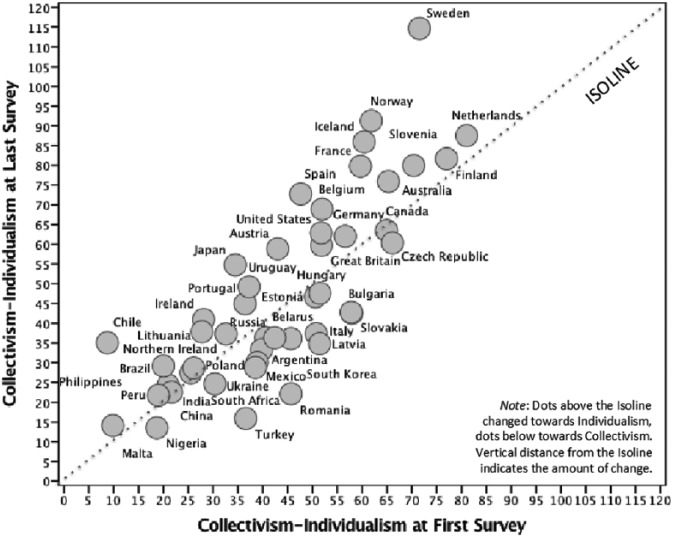
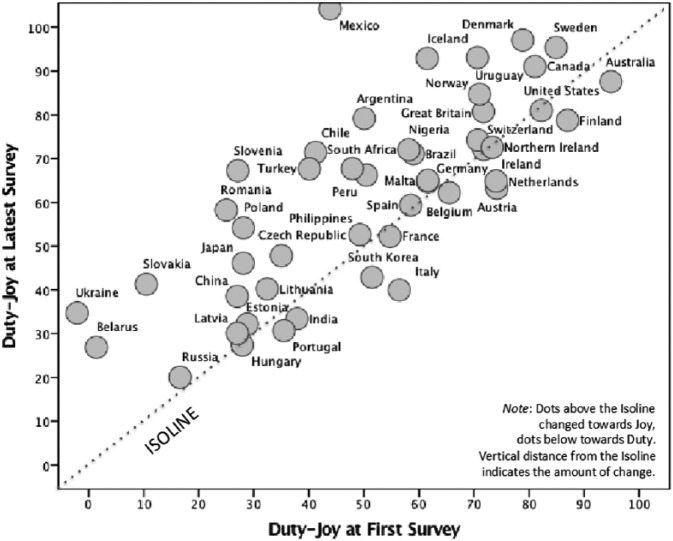
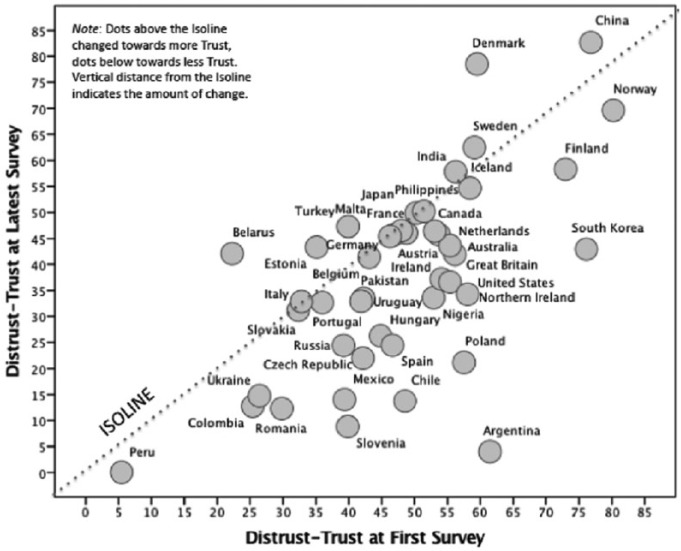
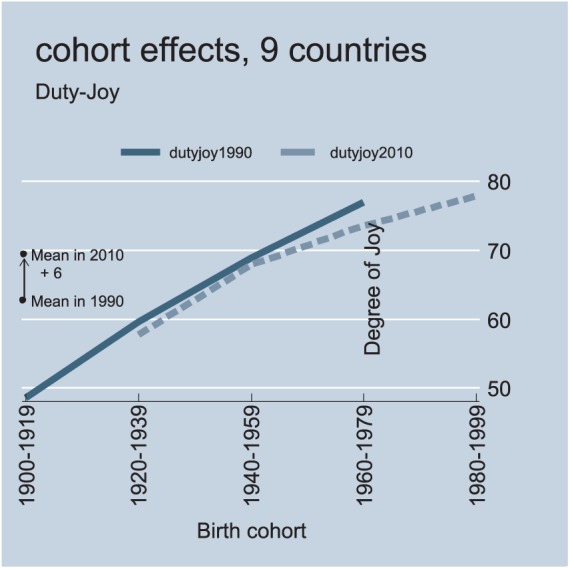
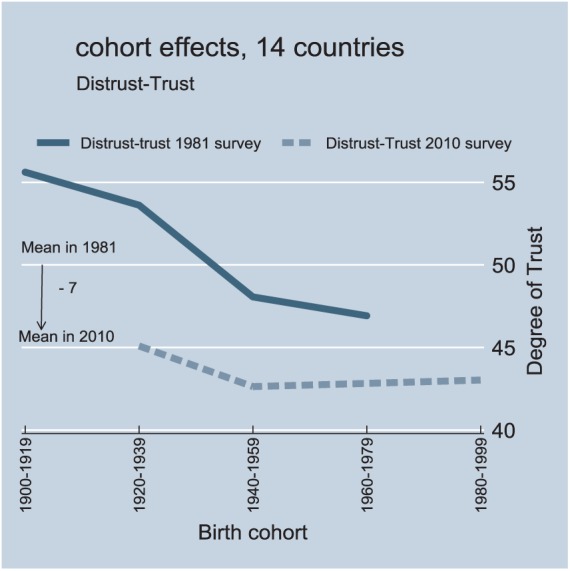
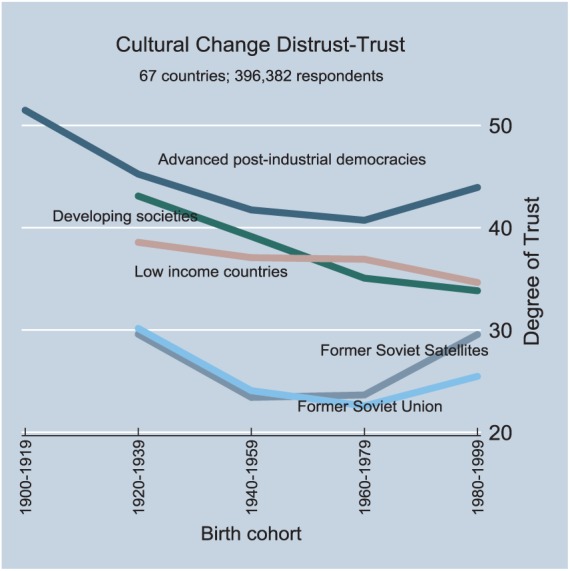
- Over at least 15 years, country scores change by +4 points on Collectivism–Individualism (44 to 48, N = 46 countries), +11 points on Duty–Joy (N = 47), and -10 points on Distrust–Trust (N = 44).
- In the panel models, GDP per capita is significantly related to Collectivism–Individualism (β = 3.30; p < .01) and Duty–Joy (β = 9.29; p < .001), and marginally to Distrust–Trust (β = 2.76; p < .10).
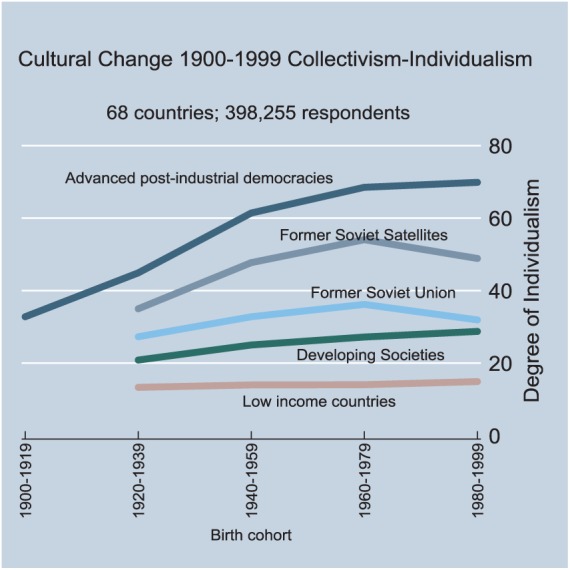
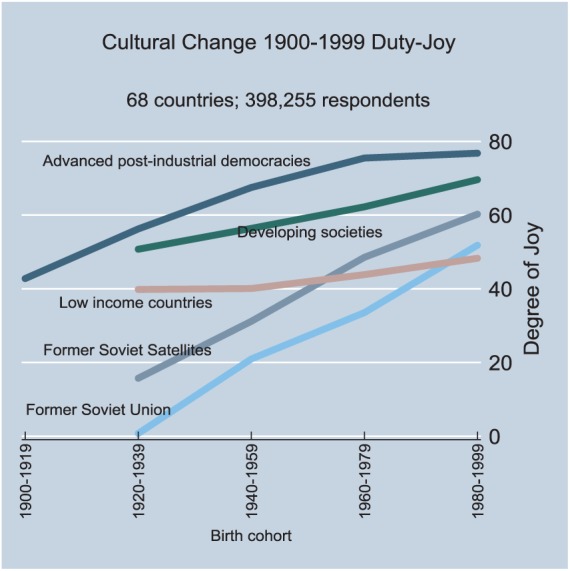
- The paper reports that approximately 50% of the variation in Collectivism–Individualism and Duty–Joy is explained by GDP per capita and cohort-fixed effects, with the other 50% explained by country-fixed effects; for Distrust–Trust, country-fixed effects account for the largest share.
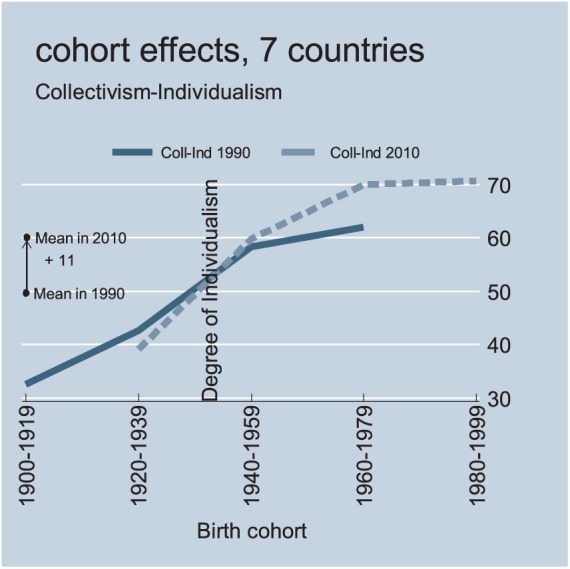
- For the youngest cohort (born after 1980), controlling for GDP per capita and country-fixed effects, scores are 25 points higher on Individualism/Joy and 17 points lower on Trust compared with the 1900–1920 cohort.
## Methods
- The study pools WVS and EVS data from 110 countries and 495,011 individuals surveyed between 1981 and 2014; respondents are grouped into five birth cohorts (1900–1919, 1920–1939, 1940–1959, 1960–1979, 1980–1999).
- The authors construct country-level cultural scores from attitude items, screen items by coverage and correlation with Hofstede’s dimensions, and use factor analysis (oblique rotation), reliability analysis, and rescaling to 0–100.
- To study change, they use fixed-effects panel models with GDP per capita, country-fixed effects, cohort-fixed effects, and cluster-adjusted standard errors, plus comparisons of earliest vs latest survey waves and a five-cohort analysis.
## Limitations
- The paper itself notes that the first cohort (1900–1919) has limited coverage for 21 countries, and that restricting analyses to countries with at least 15 years between first and last survey waves reduces sample size considerably.
- It also states that the study is conducted at the group level, and that aggregate dimensions are often impossible to replicate at the individual level within countries; this is presented as a general limitation of interpreting national-culture patterns.
- Evident from the text: some analyses rely on item exclusion/imputation because of missing wave or country coverage, including dropping items for limited coverage and imputing one missing item for 16 countries in the first dimension.
Model-written summary. Check it against the paper before relying on it.
Integrity signals
Registry
Cites
Statistics
Figures
Verification
Claims the paper makes
0 Valid · 4 Not valid · 51 Not checked · 147 Own results and interpretations
The cited sources that could be checked couldn’t confirm or dispute this claim.
In the paper
“while Hofstede’s dimensional concept neglects cultural dynamics”
§ Dimensions and Dynamics of National Culture: Synthesizing Hofstede With Inglehart > Abstract Cross-national research on cultural differences across space and time intersects multiple disciplines but the prominence of concepts varies by academic fields. Hofstede’s dimensional concept of culture, to begin with, dominates in cross-cultural psychology and international management. Inglehart’s dynamic concept of culture, by contrast, prevails in sociology and political science. We argue that this disciplinary division is unfortunate because the two concepts are complementary, for which reason a synthesis rectifies their mutual weaknesses. Indeed, while Hofstede’s dimensional concept neglects cultural dynamics, Inglehart’s dynamic concept is dimensionally reductionist. We demonstrate empirically that combining these two concepts leads to an improved understanding of cultural differences. Inspired by Hofstede’s cultural dimensions, we use data from the European Value Studies and World Values Surveys for 495,011 individuals born between 1900 and 1999 in 110 countries and then show that change on these dimensions proceeds as Inglehart and his collaborators suggest. Most notably, younger generations have become more individualistic and more joyous. But even though economic development and generational replacement drive this cultural change, roughly half of the variation in national cultural orientations is unique to each country, due to lasting intercept differences in developmental trajectories that trace back to remote historic drivers. We discuss the implications for cross-national cultural research.
What the sources say
- Not checked — no full text of the sourcecites Minkov & Hofstede, 2014 matched to “A replication of Hofstede's uncertainty avoidance dimension across nationally representative samples from Europe” (2014) source
- Could not verifycites Shenkar, 2001 matched to “Cultural Distance Revisited: Towards a More Rigorous Conceptualization and Measurement of Cultural Differences” (2001) sourceExperimental — accuracy not yet measured
Our copy of Shenkar (2001) criticises Hofstede's dimensional framework, but on other grounds: in Methodological Properties it lists the criticisms 'leveled against Hofstede, e.g., non-exhaustiveness, reliance on single company data, and the like', plus the Assumptions of Corporate Homogeneity, Spatial Homogeneity and Equivalence, and notes the Kogut & Singh index 'has not been updated to incorporate latter work by Hofstede and others' (the fifth dimension, Confucian dynamism/LTO). None of these states that Hofstede's dimensional concept neglects cultural dynamics or change over time; the only 'dynamics' usages refer to Confucian dynamism as a dimension and to corporate culture altering 'the dynamics of national CD' (Methodological Properties). Searched: cultural dynamics, static/dynamic framework, cultural change over time, temporal evolution, limitations of Hofstede's dimensions — no passage addresses the claim's point, so it can be neither confirmed nor contradicted from our copy. (LLM, conf=0.68)
- Not checked — no full text of the sourcecites Tung, 2008 matched to “The cross-cultural research imperative: the need to balance cross-national and intra-national diversity” (2008) source
plain- Asserted: passes — The authors put it forward as true.
- Checkable: passes — It can be checked against evidence.
- Load-bearing: passes — The paper’s conclusions depend on it.
- Based: passes — The paper gives a reason why it holds.
The paper states this without a source or data behind it here, so there is nothing to check it against. The quote shows it is in the paper.
In the paper
“From an empirical point of view, Hofstede’s six-dimensional framework (4 IBM-based + 2 WVS-based) consists of four dimensions (3 IBM-based + 1 WVS-based).”
§ Dimensions and Dynamics of National Culture: Synthesizing Hofstede With Inglehart > Hofstede’s Dimensions and Inglehart’s Dynamics > Hofstede’s National Cultural Dimensions and the Critique of His Framework
plain- Asserted: passes — The authors put it forward as true.
- Checkable: passes — It can be checked against evidence.
- Load-bearing: passes — The paper’s conclusions depend on it.
- Based: unclear — It is unclear why the paper says it holds.
A result the paper reports from its own data — it cites no other source for it, so there is none to check. The quote shows it is in the paper.
In the paper
“roughly half of the variation in national cultural orientations is unique to each country, due to lasting intercept differences in developmental trajectories that trace back to remote historic drivers.”
§ Dimensions and Dynamics of National Culture: Synthesizing Hofstede With Inglehart > Abstract Cross-national research on cultural differences across space and time intersects multiple disciplines but the prominence of concepts varies by academic fields. Hofstede’s dimensional concept of culture, to begin with, dominates in cross-cultural psychology and international management. Inglehart’s dynamic concept of culture, by contrast, prevails in sociology and political science. We argue that this disciplinary division is unfortunate because the two concepts are complementary, for which reason a synthesis rectifies their mutual weaknesses. Indeed, while Hofstede’s dimensional concept neglects cultural dynamics, Inglehart’s dynamic concept is dimensionally reductionist. We demonstrate empirically that combining these two concepts leads to an improved understanding of cultural differences. Inspired by Hofstede’s cultural dimensions, we use data from the European Value Studies and World Values Surveys for 495,011 individuals born between 1900 and 1999 in 110 countries and then show that change on these dimensions proceeds as Inglehart and his collaborators suggest. Most notably, younger generations have become more individualistic and more joyous. But even though economic development and generational replacement drive this cultural change, roughly half of the variation in national cultural orientations is unique to each country, due to lasting intercept differences in developmental trajectories that trace back to remote historic drivers. We discuss the implications for cross-national cultural research.
plainstates a causen = 495,011- Asserted: passes — The authors put it forward as true.
- Checkable: passes — It can be checked against evidence.
- Load-bearing: passes — The paper’s conclusions depend on it.
- Based: passes — The paper gives a reason why it holds.
A result the paper reports from its own data — it cites no other source for it, so there is none to check. The quote shows it is in the paper.
In the paper
“we use data from the European Value Studies and World Values Surveys for 495,011 individuals born between 1900 and 1999 in 110 countries and then show that change on these dimensions proceeds as Inglehart and his collaborators suggest.”
§ Dimensions and Dynamics of National Culture: Synthesizing Hofstede With Inglehart > Abstract Cross-national research on cultural differences across space and time intersects multiple disciplines but the prominence of concepts varies by academic fields. Hofstede’s dimensional concept of culture, to begin with, dominates in cross-cultural psychology and international management. Inglehart’s dynamic concept of culture, by contrast, prevails in sociology and political science. We argue that this disciplinary division is unfortunate because the two concepts are complementary, for which reason a synthesis rectifies their mutual weaknesses. Indeed, while Hofstede’s dimensional concept neglects cultural dynamics, Inglehart’s dynamic concept is dimensionally reductionist. We demonstrate empirically that combining these two concepts leads to an improved understanding of cultural differences. Inspired by Hofstede’s cultural dimensions, we use data from the European Value Studies and World Values Surveys for 495,011 individuals born between 1900 and 1999 in 110 countries and then show that change on these dimensions proceeds as Inglehart and his collaborators suggest. Most notably, younger generations have become more individualistic and more joyous. But even though economic development and generational replacement drive this cultural change, roughly half of the variation in national cultural orientations is unique to each country, due to lasting intercept differences in developmental trajectories that trace back to remote historic drivers. We discuss the implications for cross-national cultural research.
boostedstates a causen = 495,011- Asserted: passes — The authors put it forward as true.
- Checkable: passes — It can be checked against evidence.
- Load-bearing: passes — The paper’s conclusions depend on it.
- Based: passes — The paper gives a reason why it holds.
A result the paper reports from its own data — it cites no other source for it, so there is none to check. The quote shows it is in the paper.
In the paper
“LTO and IVR also form one factor in an ecological factor analysis.”
§ Dimensions and Dynamics of National Culture: Synthesizing Hofstede With Inglehart > Hofstede’s Dimensions and Inglehart’s Dynamics > Hofstede’s National Cultural Dimensions and the Critique of His Framework
plainstates an association- Asserted: passes — The authors put it forward as true.
- Checkable: passes — It can be checked against evidence.
- Load-bearing: passes — The paper’s conclusions depend on it.
- Based: passes — The paper gives a reason why it holds.
105 more claims
Create a free account to see all 202 claims and every source verdict.
- It may state two separate claims as one. 72
- Probably not a substantial claim. 29
Citations
Cites
Cultures and Organizations: Software of the Mind.
Triandis, H. C., & Hofstede, G. (1993) · Administrative Science Quarterly · doi:10.2307/2393257 · Cited by 17,696
Putnam, R. (2000) · doi:10.1145/358916.361990 · Cited by 17,114 · cited 1×
“Using the Trust label for this dimension resonates well with the vast literature on trust in economics (e.g., Zak & Knack, 2001), political science (e.g., Fukuyama, 1995; Putnam, 1993, 2000), and sociology (e.g., Delhey & Newton, 2005).”
Method(1997) · Naming the Mind: How Psychology Found its Language · doi:10.4135/9781446221815.n7 · Cited by 15,148
Making Democracy Work: Civic Traditions in Modern Italy
Stern, F., & Putnam, R. (1993) · Foreign Affairs · doi:10.2307/20045657 · Cited by 11,137
Trust: The Social Virtues and the Creation of Prosperity
Schneider, P. A., & Fukuyama, F. (1996) · Journal of Marketing · doi:10.2307/1251846 · Cited by 10,501
Culture's Consequences: International Differences in Work-Related Values
Gladwin, T. N., & Hofstede, G. (1981) · The Academy of Management Review · doi:10.2307/257651 · Cited by 9,275
Assessing construct validity in organizational research
Bagozzi, R. P., Yi, Y., & Phillips, L. W. (1991) · Administrative Science Quarterly · doi:10.2307/2393203 · Cited by 6,621 · cited 1×
“The correlations between the newly developed dimensions are lower than the correlations among the items included in each dimension, showing convergent and discriminant validity (Fornell & Larcker, 1981).”
BackgroundThe Effect of National Culture on the Choice of Entry Mode
Kogut, B., & Singh, H. (1988) · Journal of International Business Studies · doi:10.1057/palgrave.jibs.8490394 · Cited by 6,240 · cited 1×
“Second, cultural frameworks like ours have been used to develop a composite measure of cultural distance collapsing all cultural dimensions into a single Euclidean distance index (Beugelsdijk et al., 2017; Kogut & Singh, 1988).”
MethodRethinking individualism and collectivism: Evaluation of theoretical assumptions and meta-analyses.
Oyserman, D., Coon, H. M., & Kemmelmeier, M. (2002) · Psychological Bulletin · doi:10.1037/0033-2909.128.1.3 · Cited by 5,758
Making Democracy Work: Civic Traditions in Modern Italy
Putnam, R. D., Leonardi, R., & Nonetti, R. Y. (1994) · Princeton University Press eBooks · doi:10.2307/j.ctt7s8r7 · Cited by 5,580
Research works printed but not linked: 8
- Banfield E., 1958, Glencoe, illinois
- Diamond J., 1997, Guns, germs and steel
- Gelfand M., 2004, Culture, leadership and organizations: The GLOBE study of 62 societies, 438
- Greene W. H., 2008, Econometric analysis
- Hofstede G., 2001, Culture’s consequences: Comparing values, behaviors, institutions, and organizations across nations
- Inglehart R., 2003, Sacred and secular
- Nunnally J. C., 1994, Psychometric theory
- Schwartz S. H., 1994, Individualism and collectivism: Theory, method and applications, 85
Cited by
Items 401–455 of 455
Mapping family and marriage values in Asia: a comparative study of value proximity across cities
Huh, J., & Shim, W. (2025) · Asian Journal of Political Science · doi:10.1080/02185377.2025.2602429
Baran, M., Boczkowska, M., Hamer, K., Górecka, M., Mazurowska, K., Hekiert, D., & Grzymała-Moszczyńska, H. (2025) · Journal of Cross-Cultural Psychology · doi:10.1177/00220221251387706 · Cited by 2
“However, both countries are experiencing a shift toward greater distrust and a stronger emphasis on joy (Beugelsdijk & Welzel, 2018).”
Impact of Societal Secrecy on Eco-InnovationPreprint
Ibrahim, M., Tingbani, I., & Bassyouny, H. (2025) · SSRN Electronic Journal · doi:10.2139/ssrn.5936822
Culturally Attuned Promotional Strategies of Food Brands in Diverse Markets
Hussain, M. (2025) · IGI Global eBooks · doi:10.4018/979-8-3373-1544-7.ch005
“I feel good… I knew that I would…”: The role of self in musical reward across cultures
Tang, J. (2026) · PLoS ONE · doi:10.1371/journal.pone.0340597 · Cited by 1
Li, Z., Li, D., Li, M., & Zhang, Y. (2026) · Computers in Human Behavior Reports · doi:10.1016/j.chbr.2026.100937 · Cited by 1
Khan, S. I., Shaw, M. R., & Bandara, P. (2026) · Administrative Sciences · doi:10.3390/admsci16020059
Alves, C. L. (2026) · medRxiv · doi:10.64898/2026.01.25.26344795
Delving into Vietnamese talent motivations: Why they stay in western companies in Vietnam
Côté, A.-M., & Su, Z. (2026) · International Journal of Cross Cultural Management · doi:10.1177/14705958261421062
“…measurement and uneven empirical support across cultural contexts (Kaasa and Welzel, 2023), while Inglehart ’ s model has been faulted for oversimplifying cultural variation and for overemphasizing generational replacement as the primary mechanism of cultural change (Beugelsdijk and Welzel, 2018).”
Chen, X. (2026) · Management International Review · doi:10.1007/s11575-025-00612-5
Hidayatullah, M. S., Kadiyono, A. L., Sulastiana, M., & Nugraha, Y. (2026) · BMC Psychology · doi:10.1186/s40359-026-04259-1 · Cited by 1
Salgado, S., de la Hera, C. M. A., & González-Suhr, C. (2026) · Behavioral Sciences · doi:10.3390/bs16030389 · Cited by 2
“The literature has debated how values influence people’s perceptions, cognitions, emotions, and behaviors (Beugelsdijk & Welzel, 2018; Sagiv & Schwartz, 2022; Schwartz, 2011).”
Shi, H., Mueller-Bryson, S., & Ahn, R. J. (2026) · Journal of Advertising · doi:10.1080/00913367.2026.2638131
“Research shows that Hofstede’s national rankings can shift over time (Beugelsdijk and Welzel 2018) and that individual UA levels likewise change in response to broader trends or events (e.g., Carleton et al. 2019; Heanoy and Brown 2024), underscoring the need to assess UA directly rather than rely…”
Kim, H. H., & Cho, A. (2026) · Ethnicities · doi:10.1177/14687968261437365
Empathy and national identification as predictors of immigrant prejudice across European countries
Paksoy, C., & Hochman, O. (2026) · International Journal of Intercultural Relations · doi:10.1016/j.ijintrel.2026.102421
Mourato, A. M. (2023) · theses.fr (ABES) · doi:10.70675/8dfc726az7e04z4056z8b1ez5e532bdcf096 · Cited by 1
Cultural Similarities and Migration Flows: Evidence from 45 Countries
Ip, W.-Y., & Fong, E. (2026) · Social Constellations A World Perspective · doi:10.66630/sc.2026.0003
Evaluation of Large Language Model’s Cross-Cultural Non-Verbal Behavior Understanding
Li, Z., Zou, Y., Cen, C., et al. (2026) · doi:10.1109/btfm69084.2026.11484108
“This work is theoretically grounded in Hall ’ s high/low-context theory and Hofstede ’ s cultural dimensions [18] for maximising intercultural distance, and Ekman & Friesen’s emblematic gesture framework [13] .”
Uddin, U., & Jun, L. (2026) · Asia Pacific Business Review · doi:10.1080/13602381.2026.2649253 · Cited by 1
Social culture and lean–green practices: perspectives from medium and large firms in Ecuador
Aguilar-Rodríguez, I. E., Tapia-Andino, G. F., & Artieda-Cajilema, C. H. (2026) · International Journal of Lean Six Sigma · doi:10.1108/ijlss-08-2025-0233
Pokyčių kartos Lietuvoje: vertybių kaitos perspektyva
Savicka, A., & Žiliukaitė, R. (2026) · Lietuvos kultūros tyrimų institutas eBooks · doi:10.53630/savicka_ziliukaite2026
Nguyen, L. T. V., Nguyen, T. Q., Duong, H. T., & Nguyen, C. T. M. (2026) · Media Asia · doi:10.1080/01296612.2026.2656600
“…the social context of a culture, whether there is a strong, coherent, close-knit group across different levels within that culture and how it affects its people (Beugelsdijk & Welzel, 2018), rather than the collective outcomes resulting from group members ’ communication through media platforms.”
Antecedents of asymmetric cost behaviour: managerial perceptions across four institutional contexts
Gürkan, N., & Gürkan, S. (2026) · Review of Managerial Science · doi:10.1007/s11846-026-01028-7 · Cited by 2
Hofstede’s Cultural Dimensions as Predictors of International Competitiveness
Ţîmbalari, C., & Herciu, M. (2026) · Studies in Business and Economics · doi:10.2478/sbe-2026-0003 · Cited by 1
“Building on existing theoretical and empirical contributions (Hofstede, 2001; Beugelsdijk et al., 2018), this study conceptualizes competitiveness as a function of national cultural dimensions, operationalized through Hofstede’s 6D model and measured using the Global Competitiveness Index (GCI).”
An Empirical Analysis of Institutional Coevolution in the European Union
Casagrande, S., & Dallago, B. (2026) · Kyklos · doi:10.1111/kykl.70060
“Although there is no lack of criticisms, Hofstede's approach attracted recently also the interest of economists (Beugelsdijk and Welzel 2018).”
Mera, A. L., Martín, P. D. C., & Merillas, O. F. (2026) · Heritage · doi:10.3390/heritage9050189
Steyn, R., & Msweli, P. (2026) · Journal of African Business · doi:10.1080/15228916.2026.2670888
“For instance, not all French citizens share identical value systems, though some nations may show greater cultural coherence than others (Beugelsdijk & Welzel, 2018).”
Mitteregger, R., & Jocker, T. (2026) · Swiss Political Science Review · doi:10.1111/spsr.70029 · Cited by 1
Is It All About the Costs? Cultural Distance and Adjustment of Recent German Migrants
Genoni, A., Décieux, J. P., & Murdock, E. (2026) · Journal of Cross-Cultural Psychology · doi:10.1177/00220221261455885
Maji, S. G., Saha, R., & Goswami, P. N. (2026) · Journal of Global Responsibility · doi:10.1108/jgr-07-2025-0189
COSTA, R. A. T., Birkbeck, C. H., Hazel, N., & Bazon, M. R. (2026) · International Criminology · doi:10.1007/s43576-026-00229-0
Is it all about the costs? Cultural distance and adjustment of recent migrantsPreprint
Décieux, J. P., Genoni, A., & Murdock, E. (2026) · SocArXiv (OSF Preprints)
Chankuna, D. (2026) · Organizations and Markets in Emerging Economies · doi:10.15388/omee.2026.17.7
Gvura, A., & Eliyahu‐Levi, D. (2026) · Religions · doi:10.3390/rel17070802
“…show that people tend to prefer their own in-group over other groups, a phenomenon known as “in-group bias”, which may be expressed in discriminatory behavior, prejudices, and stereotypical thinking (Hewstone et al. 2002; Reimer et al. 2022; Beugelsdijk and Welzel 2018; Pettigrew and Tropp 2006).”
Culture and enthusiasm for immersive technology: evidence from 29 countries
Pezzuti, T. (2026) · International Marketing Review · doi:10.1108/imr-10-2025-0507
Páez, D., & Martínez‐Zelaya, G. (2026) · Springer eBooks · doi:10.1007/978-3-032-25985-1_2
Decolonizing Public Relations Ethics: Insights from Ghana’s Cultural Context
Afriyie, D. N. O., Anani-Bossman, A., & Iddrisu, F. (2026) · Journal of Media Ethics · doi:10.1080/23736992.2026.2706199
O’Connell, V., & Froese, F. J. (2026) · Systems · doi:10.3390/systems14070876
“Beugelsdijk and Welzel [31] show that such deep-seated cultural values remain consistent over 30-year horizons, functioning as the slow-moving deep structure that constrains organizational design.”
InfluentialHigh-tech, higher barriers: age, education, skills, culture, and non-binary employment
Zhao, T., & Chen, Y. (2026) · The International Journal of Human Resource Management · doi:10.1080/09585192.2026.2707306
“For example, Beugelsdijk and Welzel (2018) show that dimensions derived from Hofstede’s framework remain meaningfully connected to contemporary value systems, including gender-related values.”
Measuring Social Connectedness as a Dimension of Multidimensional Poverty or Well-Being
McQuillen, S., Anand, P., & Samuel, K. (2026) · Social Indicators Research · doi:10.1007/s11205-026-03908-7
“…Measuring Social Connectedness as a Dimension of Multidimensional… OECD surveys, might be more policy-relevant outside of OECD member countries where social lives might be structured more so around neighbourhood, familial, or religious networks than interpersonal ones (Beugelsdijk & Welzel, 2018 ).”
Mapping the Priorities: A Study of the Composition of Importance in Life Domains
Chiara, E. D., & Matteazzi, E. (2026) · Social Indicators Research · doi:10.1007/s11205-026-03897-7
“This shift aligns with sociological and psychological research suggesting that younger generations are becom - ing more individualistic and inclined toward indulgence (Beugelsdijk & Welzel, 2018 ).”
Cultural Factors and Popular Music on Spotify in Different Countries
Kok, K. Q. X., North, A. C., & Hamamura, T. (2026) · Music Perception An Interdisciplinary Journal · doi:10.1525/mp.2026.2682775
Measuring intercultural competences: analysis of selected constructs and research tools
Szydło, J., Rzepka, A., Nica, E., Lăzăroiu, G., & Czerniawska, M. (2026) · Economics and Environment · doi:10.34659/eis.2026.97.2.1299
“…different cultures but also adaptability, empathy, and a reflective approach to one’s own beliefs and behaviours (Dharm et al., 2015; Sułkowski & ; Beugelsdijk & Welzel, 2018; Beugelsdijk et al., 2018; Szydło, 2018; Mączyński et al., 2019; Szy - dło et al., 2020; Przytuła, 2019; 2020; Sułkowski…”
The spillover effect of luxury “masstige” extensions' authenticity on parent brand status signaling
Boisvert, J., Ashill, N. J., & Christodoulides, G. (2026) · International Marketing Review · doi:10.1108/imr-03-2025-0107
How Societal Cultures Moderate Gender Differences in Career Success: A Meta‐Analysis
Ng, T. W. H., Oh, S., & Xu, H. (2026) · Journal of Management Studies · doi:10.1111/joms.70151
Do, B., Nguyễn, H., & Thanh, L. M. (2026) · Tạp chí Khoa học Thương mại · doi:10.54404/jts.2026.216v.03
Mert, İ. S., Şen, C., & Sert, O. (2026) · Journal of Organizational Effectiveness People and Performance · doi:10.1108/joepp-03-2026-0350
Soydaş, Ş. S. (2026) · Review of Behavioral Finance · doi:10.1108/rbf-02-2026-0056
Agranovich, A. V., Melikyan, Z. A., Álvarez, A. D., Messinis, L., Vogel, A., Jørgensen, K., & Nielsen, T. R. (2026) · Applied Neuropsychology Adult · doi:10.1080/23279095.2026.2735449
Šimić, A., & Soltoković, A. (2026) · Basic and Applied Social Psychology · doi:10.1080/01973533.2026.2741815
Die transkulturelle Dimension der Psychiatrie
Erfurth, A. (2026) · psychopraxis neuropraxis · doi:10.1007/s00739-026-01202-2
Scaling the Open City: A Micro-Meso-Macro Approach
Andersson, D. E. (2026) · Springer eBooks · doi:10.1007/978-981-92-3722-7_3
Eyasu, A., Negash, M., & Weldehawariat, G. T. (2026) · Circular Economy and Sustainability · doi:10.1007/s43615-026-01155-z
“Hofstede’s cultural dimensions reveal considerable variation across African nations in individualism-collectivism, power distance, and uncertainty avoidance [ 5, 14].”
Byrd, A. R., Lamm, A. J., Lamm, K. W., Holt, J., & Sapp, R. (2026) · Journal of Agricultural Education · doi:10.5032/jae.v67i4.3214
Metadata
- Authors
- Beugelsdijk, S., & Welzel, C.
- Affiliations
- University of Groningen (NL)
- Leuphana University of Lüneburg, Germany
- Corresponding author
- Beugelsdijk, Sjoerd
- Venue
- Journal of Cross-Cultural Psychology
- Publisher
- SAGE Publications
- Published
- 2018-10-02
- Volume
- 49
- Issue
- 10
- Pages
- 1469-1505
- ISSN
- 0022-0221 (ISSN-L)
- 1552-5422
- PMC
- PMC6191680
- OpenAlex
- W2895010120
- Semantic Scholar
- 184b6ce25f1e5968ea64b262eaf307142b51f38c
- Cited by
- 461
- References
- 113
- Citations by year
- 2026: 60 · 2025: 77 · 2024: 63 · 2023: 64 · 2022: 73 · 2021: 69 · 2020: 38 · 2019: 15 · 2018: 1
- FWCI
- 41.73
- Type
- journal article
- Language
- en
- Open access
- hybrid
- doi.org
- Licence
- cc-by-nc
- journals.sagepub.com/page/policies/text-and-data-mining-license (tdm)
- Locations
- Journal of Cross-Cultural Psychology (publishedVersion, cc-by-nc)
- Europe PMC (PubMed Central) (publishedVersion, cc-by-nc)
- PubMed Central (publishedVersion, cc-by-nc)
- PubMed (publishedVersion)
- University of Groningen research database (University of Groningen / Centre for Information Technology) (publishedVersion, cc-by-nc)
- Multilingual Matters (Channel View Publications) (submittedVersion, cc-by-nc)
- University of Groningen research database (University of Groningen / Centre for Information Technology) (submittedVersion, cc-by-nc)
- Funders
- Nederlandse Organisatie voor Wetenschappelijk Onderzoek (VIDI 452-11-010)
- Topics
- Social Sciences › Psychology › Social Psychology › Cultural Differences and Values
- Social Sciences › Development › Culture, Economy, and Development Studies
- Social Sciences › Business, Management and Accounting › Business and International Management › Global and Cross-Cultural Management
- Keywords
- national culture, Hofstede cultural dimensions, cultural dynamics, cross-cultural comparison, individualism, joy, generational change, economic development, cultural trajectories, World Values Survey, interdisciplinary synthesis
About these checks
Registry, retraction, Cites and statistics results are computed, not judged, with one exception: a printed reference that no index lists is read once by a model before it counts as a citation error. Claims are extracted by a model and kept only when their quote appears verbatim in the text; each cited source is then checked, with a model’s help, for whether it says what the claim relies on. Those verdicts can be wrong — read the claim’s quote and the cited source before relying on one.
The claim verdicts this report counts are experimental: their accuracy is not yet measured.
A language model drew the claims from the paper on 2026-10-10, under version 3 of the claim definition (model deepseek-v4.1-flash, prompt extract-v3).
A second model labelled each claim on 2026-10-10 (model jev-1.13-20260917, definition revision gold-guideline-v0.2).
Cited sources are checked with a language model’s help (qwen3.8-omni-flash).
Statistics and arithmetic are recomputed, not judged.
Confidence bands are shown only for fields calibrated on our annotated test set. None is calibrated yet, so no band is shown.
What counts as a claim ›How we measure confidence ›How we check this ›
Are you an author, or do you see a problem with this page? Request a review
Data sources
Bibliographic data: Semantic Scholar, OpenAlex, Crossref.
Contains information from the Semantic Scholar Academic Graph Datasets, made available under the ODC Attribution License (ODC-BY 1.0).
Semantic Scholar’s data is described in: Kinney, R., et al. (2023). The Semantic Scholar Open Data Platform. arXiv:2301.10140.
