

Dimensions and Dynamics of National Culture: Synthesizing Hofstede With Inglehart
Open accessThe DOI matches its Crossref record; 115 of the 115 references it cites were found in a registry or an index; 1 of the 66 sources its claims cite were checked for support.
Abstract
Cross-national research on cultural differences across space and time intersects multiple disciplines but the prominence of concepts varies by academic fields. Hofstede’s dimensional concept of culture, to begin with, dominates in cross-cultural psychology and international management. Inglehart’s dynamic concept of culture, by contrast, prevails in sociology and political science. We argue that this disciplinary division is unfortunate because the two concepts are complementary, for which reason a synthesis rectifies their mutual weaknesses. Indeed, while Hofstede’s dimensional concept neglects cultural dynamics, Inglehart’s dynamic concept is dimensionally reductionist. We demonstrate empirically that combining these two concepts leads to an improved understanding of cultural differences. Inspired by Hofstede’s cultural dimensions, we use data from the European Value Studies and World Values Surveys for 495,011 individuals born between 1900 and 1999 in 110 countries and then show that change on these dimensions proceeds as Inglehart and his collaborators suggest. Most notably, younger generations have become more individualistic and more joyous. But even though economic development and generational replacement drive this cultural change, roughly half of the variation in national cultural orientations is unique to each country, due to lasting intercept differences in developmental trajectories that trace back to remote historic drivers. We discuss the implications for cross-national cultural research.
Overview
CoChat Summary
## TL;DR
The paper synthesizes Hofstede’s cultural dimensions with Inglehart’s theory of cultural change and re-estimates national culture using WVS/EVS data for 110 countries and 495,011 individuals. It reduces Hofstede’s six dimensions to three, and finds that cultures have generally shifted toward more Individualism and Joy, while Trust has declined somewhat; about half of the variation is linked to economic development and generational change, and about half to country-specific historical/geographic factors.
## Key findings
- Factor analysis of 15 WVS-EVS items yields three factors (n = 63 countries in the factor analysis), with eigenvalues 4.9, 3.2, and 2.5; the fourth factor drops below 1 (.89) and the three-factor model has the best BIC.
- The three dimensions are Collectivism–Individualism, Duty–Joy, and Distrust–Trust; the paper reports Cronbach’s alphas of .87, .77, and .75, respectively.
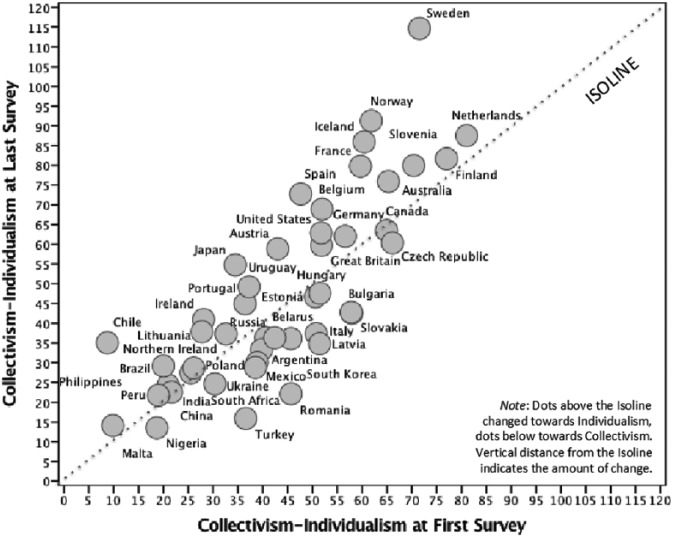
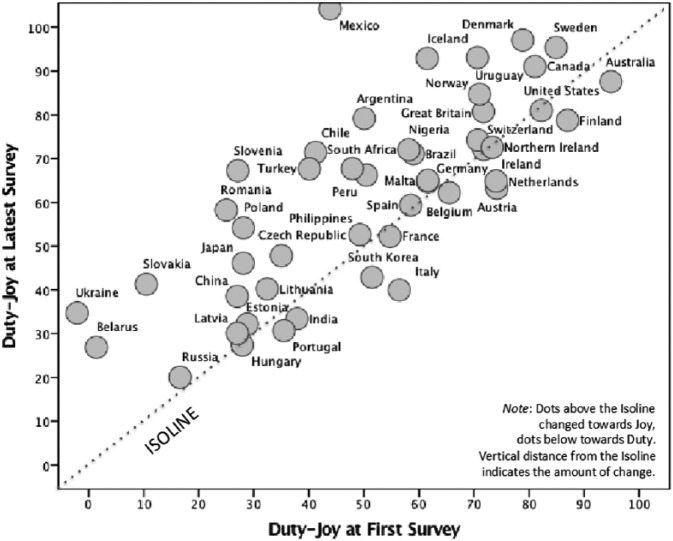
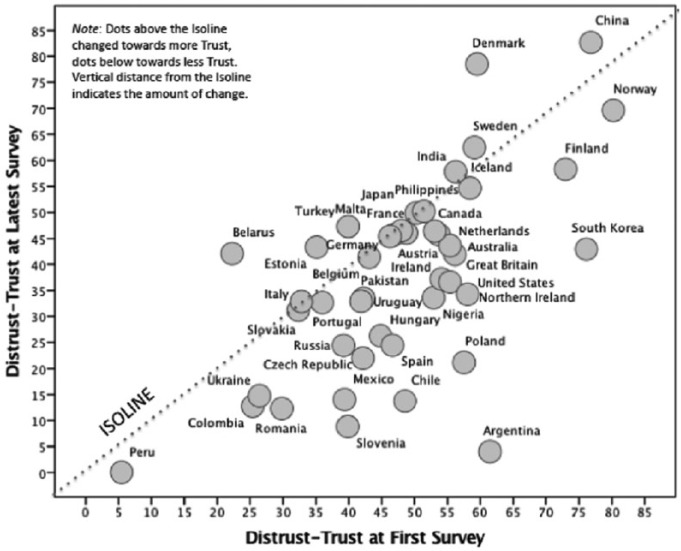
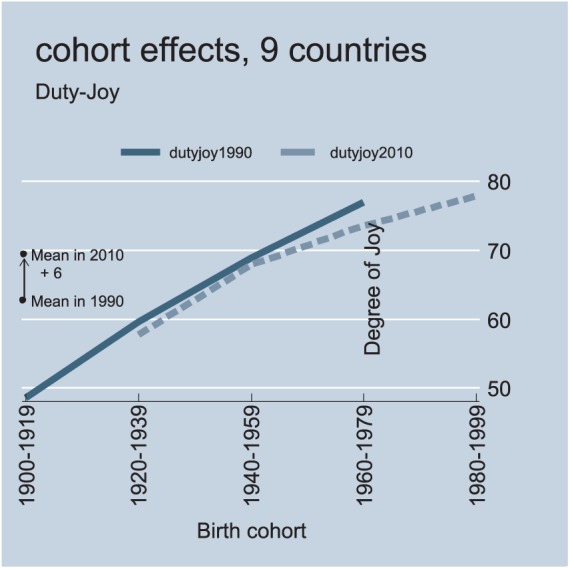
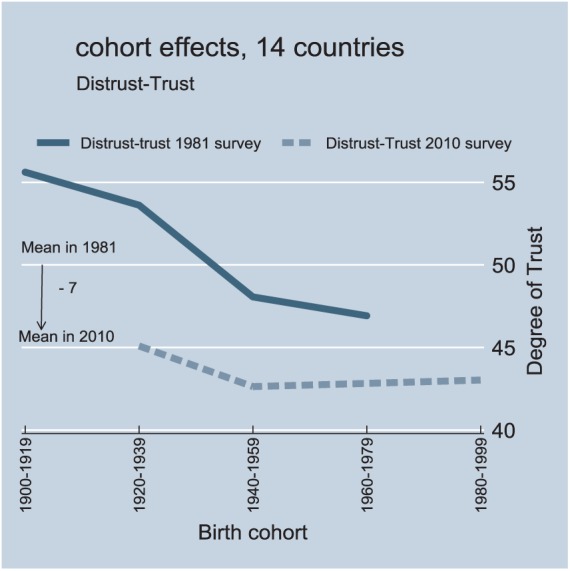
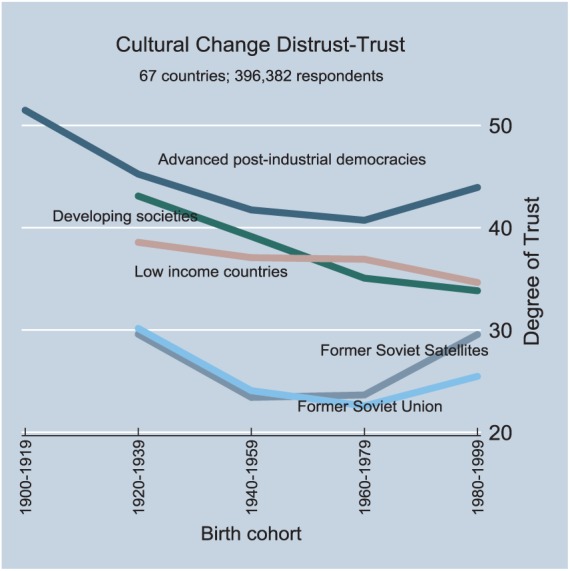
- Over at least 15 years, country scores change by +4 points on Collectivism–Individualism (44 to 48, N = 46 countries), +11 points on Duty–Joy (N = 47), and -10 points on Distrust–Trust (N = 44).
- In the panel models, GDP per capita is significantly related to Collectivism–Individualism (β = 3.30; p < .01) and Duty–Joy (β = 9.29; p < .001), and marginally to Distrust–Trust (β = 2.76; p < .10).
- The paper reports that approximately 50% of the variation in Collectivism–Individualism and Duty–Joy is explained by GDP per capita and cohort-fixed effects, with the other 50% explained by country-fixed effects; for Distrust–Trust, country-fixed effects account for the largest share.
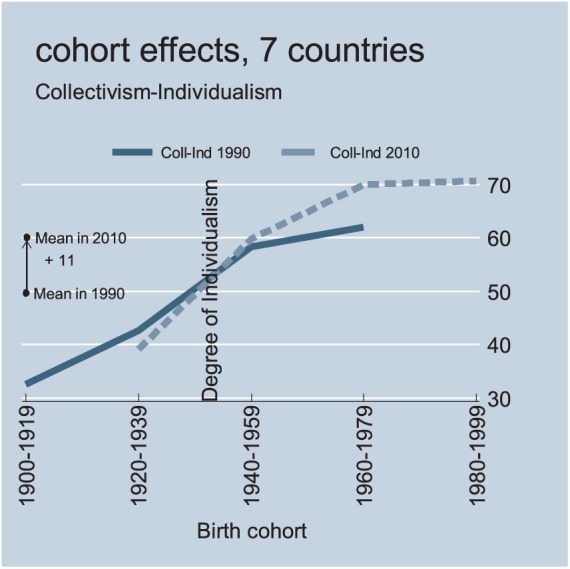
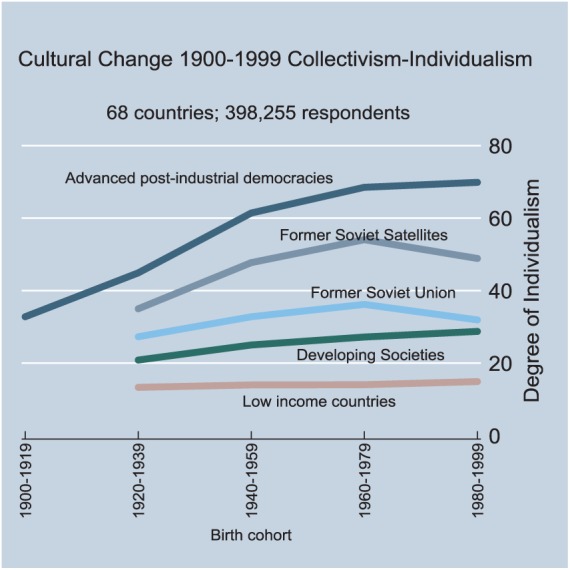
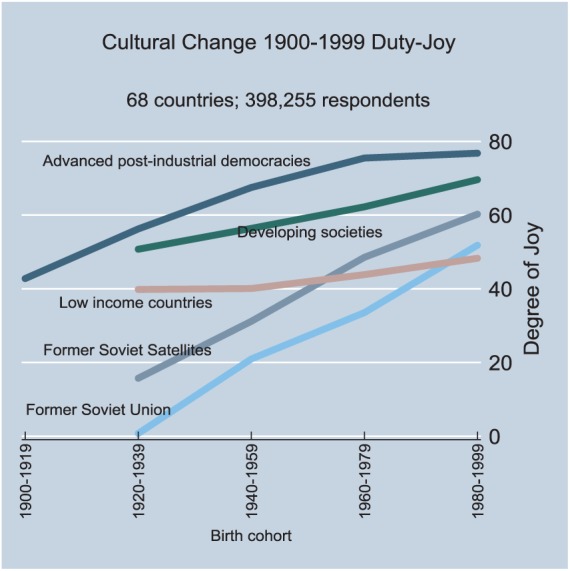
- For the youngest cohort (born after 1980), controlling for GDP per capita and country-fixed effects, scores are 25 points higher on Individualism/Joy and 17 points lower on Trust compared with the 1900–1920 cohort.
## Methods
- The study pools WVS and EVS data from 110 countries and 495,011 individuals surveyed between 1981 and 2014; respondents are grouped into five birth cohorts (1900–1919, 1920–1939, 1940–1959, 1960–1979, 1980–1999).
- The authors construct country-level cultural scores from attitude items, screen items by coverage and correlation with Hofstede’s dimensions, and use factor analysis (oblique rotation), reliability analysis, and rescaling to 0–100.
- To study change, they use fixed-effects panel models with GDP per capita, country-fixed effects, cohort-fixed effects, and cluster-adjusted standard errors, plus comparisons of earliest vs latest survey waves and a five-cohort analysis.
## Limitations
- The paper itself notes that the first cohort (1900–1919) has limited coverage for 21 countries, and that restricting analyses to countries with at least 15 years between first and last survey waves reduces sample size considerably.
- It also states that the study is conducted at the group level, and that aggregate dimensions are often impossible to replicate at the individual level within countries; this is presented as a general limitation of interpreting national-culture patterns.
- Evident from the text: some analyses rely on item exclusion/imputation because of missing wave or country coverage, including dropping items for limited coverage and imputing one missing item for 16 countries in the first dimension.
Model-written summary. Check it against the paper before relying on it.
Integrity signals
Registry
Cites
Statistics
Figures
Verification
Claims the paper makes
0 Valid · 4 Not valid · 51 Not checked · 147 Own results and interpretations
The cited sources that could be checked couldn’t confirm or dispute this claim.
In the paper
“while Hofstede’s dimensional concept neglects cultural dynamics”
§ Dimensions and Dynamics of National Culture: Synthesizing Hofstede With Inglehart > Abstract Cross-national research on cultural differences across space and time intersects multiple disciplines but the prominence of concepts varies by academic fields. Hofstede’s dimensional concept of culture, to begin with, dominates in cross-cultural psychology and international management. Inglehart’s dynamic concept of culture, by contrast, prevails in sociology and political science. We argue that this disciplinary division is unfortunate because the two concepts are complementary, for which reason a synthesis rectifies their mutual weaknesses. Indeed, while Hofstede’s dimensional concept neglects cultural dynamics, Inglehart’s dynamic concept is dimensionally reductionist. We demonstrate empirically that combining these two concepts leads to an improved understanding of cultural differences. Inspired by Hofstede’s cultural dimensions, we use data from the European Value Studies and World Values Surveys for 495,011 individuals born between 1900 and 1999 in 110 countries and then show that change on these dimensions proceeds as Inglehart and his collaborators suggest. Most notably, younger generations have become more individualistic and more joyous. But even though economic development and generational replacement drive this cultural change, roughly half of the variation in national cultural orientations is unique to each country, due to lasting intercept differences in developmental trajectories that trace back to remote historic drivers. We discuss the implications for cross-national cultural research.
What the sources say
- Not checked — no full text of the sourcecites Minkov & Hofstede, 2014 matched to “A replication of Hofstede's uncertainty avoidance dimension across nationally representative samples from Europe” (2014) source
- Could not verifycites Shenkar, 2001 matched to “Cultural Distance Revisited: Towards a More Rigorous Conceptualization and Measurement of Cultural Differences” (2001) sourceExperimental — accuracy not yet measured
Our copy of Shenkar (2001) criticises Hofstede's dimensional framework, but on other grounds: in Methodological Properties it lists the criticisms 'leveled against Hofstede, e.g., non-exhaustiveness, reliance on single company data, and the like', plus the Assumptions of Corporate Homogeneity, Spatial Homogeneity and Equivalence, and notes the Kogut & Singh index 'has not been updated to incorporate latter work by Hofstede and others' (the fifth dimension, Confucian dynamism/LTO). None of these states that Hofstede's dimensional concept neglects cultural dynamics or change over time; the only 'dynamics' usages refer to Confucian dynamism as a dimension and to corporate culture altering 'the dynamics of national CD' (Methodological Properties). Searched: cultural dynamics, static/dynamic framework, cultural change over time, temporal evolution, limitations of Hofstede's dimensions — no passage addresses the claim's point, so it can be neither confirmed nor contradicted from our copy. (LLM, conf=0.68)
- Not checked — no full text of the sourcecites Tung, 2008 matched to “The cross-cultural research imperative: the need to balance cross-national and intra-national diversity” (2008) source
plain- Asserted: passes — The authors put it forward as true.
- Checkable: passes — It can be checked against evidence.
- Load-bearing: passes — The paper’s conclusions depend on it.
- Based: passes — The paper gives a reason why it holds.
The paper states this without a source or data behind it here, so there is nothing to check it against. The quote shows it is in the paper.
In the paper
“From an empirical point of view, Hofstede’s six-dimensional framework (4 IBM-based + 2 WVS-based) consists of four dimensions (3 IBM-based + 1 WVS-based).”
§ Dimensions and Dynamics of National Culture: Synthesizing Hofstede With Inglehart > Hofstede’s Dimensions and Inglehart’s Dynamics > Hofstede’s National Cultural Dimensions and the Critique of His Framework
plain- Asserted: passes — The authors put it forward as true.
- Checkable: passes — It can be checked against evidence.
- Load-bearing: passes — The paper’s conclusions depend on it.
- Based: unclear — It is unclear why the paper says it holds.
A result the paper reports from its own data — it cites no other source for it, so there is none to check. The quote shows it is in the paper.
In the paper
“roughly half of the variation in national cultural orientations is unique to each country, due to lasting intercept differences in developmental trajectories that trace back to remote historic drivers.”
§ Dimensions and Dynamics of National Culture: Synthesizing Hofstede With Inglehart > Abstract Cross-national research on cultural differences across space and time intersects multiple disciplines but the prominence of concepts varies by academic fields. Hofstede’s dimensional concept of culture, to begin with, dominates in cross-cultural psychology and international management. Inglehart’s dynamic concept of culture, by contrast, prevails in sociology and political science. We argue that this disciplinary division is unfortunate because the two concepts are complementary, for which reason a synthesis rectifies their mutual weaknesses. Indeed, while Hofstede’s dimensional concept neglects cultural dynamics, Inglehart’s dynamic concept is dimensionally reductionist. We demonstrate empirically that combining these two concepts leads to an improved understanding of cultural differences. Inspired by Hofstede’s cultural dimensions, we use data from the European Value Studies and World Values Surveys for 495,011 individuals born between 1900 and 1999 in 110 countries and then show that change on these dimensions proceeds as Inglehart and his collaborators suggest. Most notably, younger generations have become more individualistic and more joyous. But even though economic development and generational replacement drive this cultural change, roughly half of the variation in national cultural orientations is unique to each country, due to lasting intercept differences in developmental trajectories that trace back to remote historic drivers. We discuss the implications for cross-national cultural research.
plainstates a causen = 495,011- Asserted: passes — The authors put it forward as true.
- Checkable: passes — It can be checked against evidence.
- Load-bearing: passes — The paper’s conclusions depend on it.
- Based: passes — The paper gives a reason why it holds.
A result the paper reports from its own data — it cites no other source for it, so there is none to check. The quote shows it is in the paper.
In the paper
“we use data from the European Value Studies and World Values Surveys for 495,011 individuals born between 1900 and 1999 in 110 countries and then show that change on these dimensions proceeds as Inglehart and his collaborators suggest.”
§ Dimensions and Dynamics of National Culture: Synthesizing Hofstede With Inglehart > Abstract Cross-national research on cultural differences across space and time intersects multiple disciplines but the prominence of concepts varies by academic fields. Hofstede’s dimensional concept of culture, to begin with, dominates in cross-cultural psychology and international management. Inglehart’s dynamic concept of culture, by contrast, prevails in sociology and political science. We argue that this disciplinary division is unfortunate because the two concepts are complementary, for which reason a synthesis rectifies their mutual weaknesses. Indeed, while Hofstede’s dimensional concept neglects cultural dynamics, Inglehart’s dynamic concept is dimensionally reductionist. We demonstrate empirically that combining these two concepts leads to an improved understanding of cultural differences. Inspired by Hofstede’s cultural dimensions, we use data from the European Value Studies and World Values Surveys for 495,011 individuals born between 1900 and 1999 in 110 countries and then show that change on these dimensions proceeds as Inglehart and his collaborators suggest. Most notably, younger generations have become more individualistic and more joyous. But even though economic development and generational replacement drive this cultural change, roughly half of the variation in national cultural orientations is unique to each country, due to lasting intercept differences in developmental trajectories that trace back to remote historic drivers. We discuss the implications for cross-national cultural research.
boostedstates a causen = 495,011- Asserted: passes — The authors put it forward as true.
- Checkable: passes — It can be checked against evidence.
- Load-bearing: passes — The paper’s conclusions depend on it.
- Based: passes — The paper gives a reason why it holds.
A result the paper reports from its own data — it cites no other source for it, so there is none to check. The quote shows it is in the paper.
In the paper
“LTO and IVR also form one factor in an ecological factor analysis.”
§ Dimensions and Dynamics of National Culture: Synthesizing Hofstede With Inglehart > Hofstede’s Dimensions and Inglehart’s Dynamics > Hofstede’s National Cultural Dimensions and the Critique of His Framework
plainstates an association- Asserted: passes — The authors put it forward as true.
- Checkable: passes — It can be checked against evidence.
- Load-bearing: passes — The paper’s conclusions depend on it.
- Based: passes — The paper gives a reason why it holds.
105 more claims
Create a free account to see all 202 claims and every source verdict.
- It may state two separate claims as one. 72
- Probably not a substantial claim. 29
Citations
Cites
Cultures and Organizations: Software of the Mind.
Triandis, H. C., & Hofstede, G. (1993) · Administrative Science Quarterly · doi:10.2307/2393257 · Cited by 17,696
Putnam, R. (2000) · doi:10.1145/358916.361990 · Cited by 17,114 · cited 1×
“Using the Trust label for this dimension resonates well with the vast literature on trust in economics (e.g., Zak & Knack, 2001), political science (e.g., Fukuyama, 1995; Putnam, 1993, 2000), and sociology (e.g., Delhey & Newton, 2005).”
Method(1997) · Naming the Mind: How Psychology Found its Language · doi:10.4135/9781446221815.n7 · Cited by 15,148
Making Democracy Work: Civic Traditions in Modern Italy
Stern, F., & Putnam, R. (1993) · Foreign Affairs · doi:10.2307/20045657 · Cited by 11,137
Trust: The Social Virtues and the Creation of Prosperity
Schneider, P. A., & Fukuyama, F. (1996) · Journal of Marketing · doi:10.2307/1251846 · Cited by 10,501
Culture's Consequences: International Differences in Work-Related Values
Gladwin, T. N., & Hofstede, G. (1981) · The Academy of Management Review · doi:10.2307/257651 · Cited by 9,275
Assessing construct validity in organizational research
Bagozzi, R. P., Yi, Y., & Phillips, L. W. (1991) · Administrative Science Quarterly · doi:10.2307/2393203 · Cited by 6,621 · cited 1×
“The correlations between the newly developed dimensions are lower than the correlations among the items included in each dimension, showing convergent and discriminant validity (Fornell & Larcker, 1981).”
BackgroundThe Effect of National Culture on the Choice of Entry Mode
Kogut, B., & Singh, H. (1988) · Journal of International Business Studies · doi:10.1057/palgrave.jibs.8490394 · Cited by 6,240 · cited 1×
“Second, cultural frameworks like ours have been used to develop a composite measure of cultural distance collapsing all cultural dimensions into a single Euclidean distance index (Beugelsdijk et al., 2017; Kogut & Singh, 1988).”
MethodRethinking individualism and collectivism: Evaluation of theoretical assumptions and meta-analyses.
Oyserman, D., Coon, H. M., & Kemmelmeier, M. (2002) · Psychological Bulletin · doi:10.1037/0033-2909.128.1.3 · Cited by 5,758
Making Democracy Work: Civic Traditions in Modern Italy
Putnam, R. D., Leonardi, R., & Nonetti, R. Y. (1994) · Princeton University Press eBooks · doi:10.2307/j.ctt7s8r7 · Cited by 5,580
Sample size in factor analysis.
MacCallum, R. C., Widaman, K. F., Zhang, S., & Hong, S. (1999) · Psychological Methods · doi:10.1037/1082-989x.4.1.84 · Cited by 5,497
Modernization and Postmodernization: Cultural, Economic, and Political Change in 43 Societies
Inglehart, R. (1997) · doi:10.1515/9780691214429 · Cited by 5,392
Culture, leadership, and organizations: the GLOBE study of 62 societies
(2005) · Choice Reviews Online · doi:10.5860/choice.42-4132 · Cited by 5,058 · cited 2×
“To that end, we follow an empirical–criterion referenced approach (House et al., 2004; Nunnally & Bernstein, 1994) using the WVS-EVS data.8 The purpose of this exploratory re-examination is to find and establish the best-fitting dimensional structure of national cultures based on items resonating…”
BackgroundMethodMcClelland, D. C. (1961) · doi:10.1037/14359-000 · Cited by 4,998
The Clash of Civilizations and the Remaking of the World Order
Evans, P., & Huntington, S. P. (1997) · Contemporary Sociology · doi:10.2307/2654621 · Cited by 4,865
Modernization, Cultural Change, and the Persistence of Traditional Values
Inglehart, R., & Baker, W. E. (2000) · American Sociological Review · doi:10.2307/2657288 · Cited by 4,524 · cited 3×
“Inglehart and Baker (2000) show that, despite cultural change in a common direction, countries have a unique historical past that continues to shape their national cultures (see also Inglehart & Welzel, 2005).”
BackgroundMethodCulture Shift in Advanced Industrial Society
Inglehart, R. (1990) · doi:10.1515/9780691186740 · Cited by 4,477
The Confucius connection: From cultural roots to economic growth
Hofstede, G., & Bond, M. H. (1988) · Organizational Dynamics · doi:10.1016/0090-2616(88)90009-5 · Cited by 4,380 · cited 1×
“The LTO dimension was uncovered in a study by the Chinese Culture Connection (1987) project, which sought to remedy the potential Western bias in the original IBM survey by running a separate survey designed by an independent team of Asian researchers (Hofstede & Bond, 1988).”
BackgroundIndividualism and collectivism
Oetzel, J. G. (1996) · International Journal of Intercultural Relations · doi:10.1016/0147-1767(96)83678-9 · Cited by 3,781
The Rise of the Creative Class: And How It's Transforming Work, Leisure, Community and Everyday Life
Naylor, T. D., & Florida, R. (2003) · Canadian Public Policy / Analyse de Politiques · doi:10.2307/3552294 · Cited by 3,717
Administrative Science Quarterly
Miewald, R. (1981) · The American Review of Public Administration · doi:10.1177/027507408101500109 · Cited by 3,638
Robust Standard Errors for Panel Regressions with Cross-Sectional Dependence
Hoechle, D. (2007) · The Stata Journal: Promoting communications on statistics and Stata · doi:10.1177/1536867x0700700301 · Cited by 3,333 · cited 1×
“For a discussion of these econometric issues, we refer to Hoechle (2007) and Tiokhin and Hruschka (2017).”
BackgroundIndividualism and collectivism: Cross-cultural perspectives on self-ingroup relationships.
Triandis, H. C., Bontempo, R., Villareal, M. J., Asai, M., & Lucca, N. (1988) · Journal of Personality and Social Psychology · doi:10.1037/0022-3514.54.2.323 · Cited by 2,970
Converging measurement of horizontal and vertical individualism and collectivism.
Triandis, H. C., & Gelfand, M. J. (1998) · Journal of Personality and Social Psychology · doi:10.1037//0022-3514.74.1.118 · Cited by 2,967 · cited 1×
“…a society’s prevalent mentality and culture, and has evolved into a multidimensional and multi-level construct (see Earley & Gibson, 1998; Oyserman, Coon, & Kemmelmeier, 2002; Singelis, Triandis, Bhawuk, & Gelfand, 1995; Triandis, Bontempo, Villareal, Asai, & Lucca, 1988; Triandis & Gelfand, 1998).”
Relation of sample size to the stability of component patterns.
Guadagnoli, E., & Velicer, W. F. (1988) · Psychological Bulletin · doi:10.1037/0033-2909.103.2.265 · Cited by 2,880 · cited 1×
“Loadings of this size have been shown to be interpretable whatever the sample size used (Guadagnoli & Velicer, 1988).”
MethodThe Coming of Post-Industrial Society
Schroyer, T. (1974) · Telos · doi:10.3817/0374019162 · Cited by 2,772
Zak, P. J., & Knack, S. (2001) · The Economic Journal · doi:10.1111/1468-0297.00609 · Cited by 2,685 · cited 1×
“Using the Trust label for this dimension resonates well with the vast literature on trust in economics (e.g., Zak & Knack, 2001), political science (e.g., Fukuyama, 1995; Putnam, 1993, 2000), and sociology (e.g., Delhey & Newton, 2005).”
MethodModernization, Cultural Change, and Democracy: The Human Development Sequence
Inglehart, R., & Welzel, C. (2001) · Cambridge University Press eBooks · doi:10.1017/cbo9780511790881 · Cited by 2,596 · cited 7×
“Inglehart and Baker (2000) show that, despite cultural change in a common direction, countries have a unique historical past that continues to shape their national cultures (see also Inglehart & Welzel, 2005).”
BackgroundMethodInfluentialSelf-citationIndividualism-collectivism and personality
Triandis, H. C. (2001) · Journal of Personality · doi:10.1111/1467-6494.696169 · Cited by 2,589 · cited 1×
“There is a high tolerance of deviation from specific in-group norms, and a low emphasis on conformity and obedience, again especially to expectations from parents or other family (Hofstede, 2001; Triandis, 2001).”
BackgroundMcSweeney, B. (2002) · Human Relations · doi:10.1177/0018726702055001602 · Cited by 2,543 · cited 3×
“Notwithstanding its significance and continuing popularity, Hofstede’s framework is certainly not without criticism (McSweeney, 2002, 2009; Minkov, 2018; Nakata, 2009).”
BackgroundSingelis, T. M., Triandis, H. C., Bhawuk, D. P. S., & Gelfand, M. J. (1995) · Cross-Cultural Research · doi:10.1177/106939719502900302 · Cited by 2,319
Kirkman, B. L., Lowe, K. B., & Gibson, C. B. (2006) · Journal of International Business Studies · doi:10.1057/palgrave.jibs.8400202 · Cited by 2,212 · cited 3×
“This is an important conclusion in light of the criticism that such distance indices received (Kirkman et al., 2006; Shenkar, 2001).”
BackgroundGenerations: The History of America's Future, 1584 to 2069
Strauss, W. M., & Howe, N. (1991) · Cited by 2,185
Cultures and Organizations: Software of the Mind
Mintu, A. T. (1992) · Journal of International Business Studies · doi:10.1057/jibs.1992.23 · Cited by 1,885
(2016) · The SAGE Encyclopedia of Theory in Psychology · doi:10.4135/9781483346274.n199 · Cited by 1,800
The Silent Revolution in Europe: Intergenerational Change in Post-Industrial Societies
Inglehart, R. (1971) · American Political Science Review · doi:10.2307/1953494 · Cited by 1,736 · cited 5×
“cross-cultural variation, Inglehart’s key contribution consists in a dynamic theory of cultural change. Although their work on national cultures is fundamentally related, they only met once1 and there has never been an attempt to combine their frameworks. Our article intends to close this gap and to synthesize the wor…”
BackgroundInfluentialGenerational differences: revisiting generational work values for the new millennium
Wey Smola, K., & Sutton, C. D. (2002) · Journal of Organizational Behavior · doi:10.1002/job.147 · Cited by 1,657 · cited 1×
“These generational cohorts roughly correspond with the generations as commonly defined (Parry & Urwin, 2011; Smola & Sutton, 2002).”
MethodShenkar, O. (2001) · Journal of International Business Studies · doi:10.1057/palgrave.jibs.8490982 · Cited by 1,650 · cited 2×
“This is an important conclusion in light of the criticism that such distance indices received (Kirkman et al., 2006; Shenkar, 2001).”
BackgroundChinese Values and the Search for Culture-Free Dimensions of Culture
Connection, T. C. C. (1987) · Journal of Cross-Cultural Psychology · doi:10.1177/0022002187018002002 · Cited by 1,450
Freedom Rising: Human Empowerment and the Quest for Emancipation
Welzel, C. (2013) · doi:10.1017/cbo9781139540919 · Cited by 1,294
Self-citationPredicting Cross-National Levels of Social Trust: Global Pattern or Nordic Exceptionalism?
Delhey, J., & Newton, K. (2005) · European Sociological Review · doi:10.1093/esr/jci022 · Cited by 1,267
Cross-Cultural Organizational Behavior
Gelfand, M. J., Erez, M., & Aycan, Z. (2007) · Annual Review of Psychology · doi:10.1146/annurev.psych.58.110405.085559 · Cited by 1,238 · cited 1×
“Gelfand, Erez, and Aycan (2007) provide an almost exhaustive overview of cross-cultural organizational behavior and psychology.”
BackgroundTaras, V., Kirkman, B. L., & Steel, P. (2010) · Journal of Applied Psychology · doi:10.1037/a0018938 · Cited by 1,160 · cited 1×
“Taras, Kirkman, and Steel (2010) perform a large meta-analysis of all of Hofstede’s dimensions in 598 studies.”
BackgroundBecoming Modern: Individual Change in Six Developing Countries
Inkeles, A., & Smith, D. H. (1974) · Harvard University Press eBooks · doi:10.4159/harvard.9780674499348 · Cited by 1,059
Cross-National, Cross-Cultural Organizational Behavior Research: Advances, Gaps, and Recommendations
Tsui, A. S., Nifadkar, S. S., & Ou, A. Y. (2007) · Journal of Management · doi:10.1177/0149206307300818 · Cited by 980
Generational Differences in Work Values: A Review of Theory and Evidence
Parry, E., & Urwin, P. (2011) · International Journal of Management Reviews · doi:10.1111/j.1468-2370.2010.00285.x · Cited by 879 · cited 1×
“Moreover, as people in postindustrial societies are used to handle complex situations, to deal with abstract constructs and to cope with social diversity, their moral reasoning capacity and empathy expand (Flynn, 2012; Pinker, 2011).”
BackgroundHofstede never studied culture
Baskerville, R. F. (2003) · Accounting, Organizations and Society · doi:10.1016/s0361-3682(01)00048-4 · Cited by 867 · cited 2×
“…his framework has also been questioned for overestimating the number of dimensions, misinterpreting their meaning, and using data of questionable quality (Ailon, 2008; Baskerville, 2003; Baskerville-Morley, 2005; Fang, 2003; McSweeney, 2002, 2009; Taras et al., 2012; Venaik & Brewer, 2016).”
BackgroundJavidan, M., House, R. J., Dorfman, P. W., Hanges, P. J., & Sully de Luque, M. (2006) · Journal of International Business Studies · doi:10.1057/palgrave.jibs.8400234 · Cited by 863
Smith, P. B., Dugan, S., & Trompenaars, F. (1996) · Journal of Cross-Cultural Psychology · doi:10.1177/0022022196272006 · Cited by 807 · cited 1×
“A third critical comment concerns the empirical observation that Individualism versus Collectivism and Power Distance versus Closeness are one factor, with Individualism and Power Distance merging in a single pole (Smith et al., 1996).”
BackgroundSpolaore, E., & Wacziarg, R. (2009) · Quarterly Journal of Economics · doi:10.1162/qjec.2009.124.2.469 · Cited by 793 · cited 2×
“…set of ecological factors identified by Varnum and Grossmann (2017) as deep determinants of cultural change, complemented by variables taken from the literature on remote determinants of socioeconomic and human development (e.g., Murray & Schaller, 2010; Parker, 2010; Spolaore & Wacziarg, 2009).”
BackgroundResearch Note: Hofstede's Consequences: A Study of Reviews, Citations and Replications
Søndergaard, M. (1994) · Organization Studies · doi:10.1177/017084069401500307 · Cited by 786 · cited 1×
“…have in common is that they highlight the significant impact Hofstede’s framework has had on various fields, specifically cross-cultural management, international business, comparative management, and cross-cultural psychology (Beugelsdijk et al., 2018; Beugelsdijk et al., 2017; Søndergaard, 1994).”
BackgroundWhat Have We Learned About Generalized Trust, If Anything?
Nannestad, P. (2008) · Annual Review of Political Science · doi:10.1146/annurev.polisci.11.060606.135412 · Cited by 772 · cited 1×
“Proponents of “multiple modernities,” by contrast, insist that cultural differences along civilizational faultlines will prevail, if not increase in what Huntington (1996) described as a “clash of civilizations.”
BackgroundMapping and interpreting cultural differences around the world
Schwartz, S. H. (2004) · Comparing Cultures · doi:10.1163/9789047412977_007 · Cited by 761 · cited 1×
“Alternative frameworks and dimensions of national culture have appeared since, such as the Globe study (House, Hanges, Javidan, Dorfman, & Gupta, 2004) and most notably the Schwartz Personal Values Inventory (Schwartz, 1994, 2004).”
BackgroundBeyond Hofstede and GLOBE: Improving the quality of cross-cultural research
Tung, R. L., & Verbeke, A. (2010) · Journal of International Business Studies · doi:10.1057/jibs.2010.41 · Cited by 650 · cited 1×
“The temporal stability of the scores on Hofstede’s cultural dimensions is increasingly questioned (Minkov & Hofstede, 2014; Shenkar, 2001; Tung, 2008; Tung & Verbeke, 2010).”
BackgroundTaking stock in our progress on individualism-collectivism: 100 years of solidarity and community
Christopher Earley, P. (1998) · Journal of Management · doi:10.1016/s0149-2063(99)80063-4 · Cited by 624
TheMaddisonProject: collaborative research on historical national accounts
Bolt, J., & van Zanden, J. L. (2014) · The Economic History Review · doi:10.1111/1468-0289.12032 · Cited by 619
Generation Cohorts and Personal Values: A Comparison of China and the United States
Egri, C. P., & Ralston, D. A. (2004) · Organization Science · doi:10.1287/orsc.1030.0048 · Cited by 573 · cited 1×
“Such an approach would work in a single or two-country study (e.g., Egri & Ralston, 2004), but it is practically impossible to define generations in each country based on each country’s unique historical and political experiences when the sample includes more than 10 countries.”
MethodA Critique of Hofstede’s Fifth National Culture Dimension
Fang, T. (2003) · International Journal of Cross Cultural Management · doi:10.1177/1470595803003003006 · Cited by 564
Which Dimensions of Culture Matter for Long-Run Growth?
Gorodnichenko, Y., & Roland, G. (2011) · American Economic Review · doi:10.1257/aer.101.3.492 · Cited by 550 · cited 1×
“…psychology (for overviews, see Beugelsdijk, Kostova, Kunst, Spadafora, & van Essen, 2018; Beugelsdijk, Kostova, & Roth, 2017; Kirkman, Lowe, & Gibson, 2006; Taras, Steel, & Kirkman, 2012), and has recently sparked the interest of economists too (e.g., Gorodnichenko & Roland, 2011; Klasing, 2013).”
Hamamura, T. (2012) · Personality and Social Psychology Review · doi:10.1177/1088868311411587 · Cited by 497
Improving national cultural indices using a longitudinal meta-analysis of Hofstede's dimensions
Taras, V., Steel, P., & Kirkman, B. L. (2012) · Journal of World Business · doi:10.1016/j.jwb.2011.05.001 · Cited by 488 · cited 2×
“While Hofstede has been questioned for presuming a too stable notion of national culture, his framework has also been questioned for overestimating the number of dimensions, misinterpreting their meaning, and using data of questionable quality (Ailon, 2008; Baskerville, 2003; Baskerville-Morley, 2005; Fang, 2003; McSw…”
BackgroundBeugelsdijk, S., Kostova, T., Kunst, V. E., Spadafora, E., & van Essen, M. (2018) · Journal of Management · doi:10.1177/0149206317729027 · Cited by 457 · cited 2×
“This approach relates cultural distance to a variety of firm-level outcomes (e.g., host country location choice of multinational firms) and is very popular in international management (Beugelsdijk et al., 2018).”
BackgroundSelf-citationAre Scores on Hofstede's Dimensions of National Culture Stable over Time? A Cohort Analysis
Beugelsdijk, S., Maseland, R., & van Hoorn, A. (2015) · Global Strategy Journal · doi:10.1002/gsj.1098 · Cited by 455
Self-citationMurray, D. R., & Schaller, M. (2010) · Journal of Cross-Cultural Psychology · doi:10.1177/0022022109349510 · Cited by 446
An overview of Hofstede-inspired country-level culture research in international business since 2006
Beugelsdijk, S., Kostova, T., & Roth, K. (2017) · Journal of International Business Studies · doi:10.1057/s41267-016-0038-8 · Cited by 443 · cited 5×
“What all these studies have in common is that they highlight the significant impact Hofstede’s framework has had on various fields, specifically cross-cultural management, international business, comparative management, and cross-cultural psychology (Beugelsdijk et al., 2018; Beugelsdijk et al., 2017; Søndergaard, 199…”
BackgroundMethodInfluentialSelf-citationAmerican political science review
(1983) · Electoral Studies · doi:10.1016/0261-3794(83)90111-7 · Cited by 438
Tung, R. L. (2008) · Journal of International Business Studies · doi:10.1057/palgrave.jibs.8400331 · Cited by 430
Social capital and growth in European regions: an empirical test
Beugelsdijk, S., & van Schaik, T. (2005) · European Journal of Political Economy · doi:10.1016/j.ejpoleco.2004.07.004 · Cited by 407 · cited 1×
“Interestingly, whereas higher scores on trust have been shown to have a positive effect on economic development (Beugelsdijk, De Groot, & van Schaik, 2004; Beugelsdijk & van Schaik, 2005), our cohort analysis shows that over time generations have moved in the direction toward distrust.”
BackgroundSelf-citationTrust and economic growth: a robustness analysis
Beugelsdijk, S. (2004) · Oxford Economic Papers · doi:10.1093/oep/56.1.118 · Cited by 403
Self-citationOn the Empirical Identification of Dimensions for Cross-Cultural Comparisons
Leung, K., & Bond, M. H. (1989) · Journal of Cross-Cultural Psychology · doi:10.1177/0022022189202002 · Cited by 403 · cited 1×
“The relatively small subject-to-item ratio is no cause of concern (Leung & Bond, 1989; MacCallum, Widaman, Zhang, & Hong, 1999).”
BackgroundFlanagan, S. C., & Lee, A.-R. (2003) · Comparative Political Studies · doi:10.1177/0010414002250664 · Cited by 396
Mapping world cultures: Cluster formation, sources and implications
Ronen, S., & Shenkar, O. (2013) · Journal of International Business Studies · doi:10.1057/jibs.2013.42 · Cited by 377
The Index of Cultural Tightness and Looseness Among 68 Countries
Uz, I. (2015) · Journal of Cross-Cultural Psychology · doi:10.1177/0022022114563611 · Cited by 367 · cited 1×
“9 We select those countries from the WVS-EVS for which the same question has been asked to a substantial number of respondents (Uz, 2015).”
MethodMirror, Mirror on the Wall: Culture's Consequences in A Value Test of its Own Design
Ailon, G. (2008) · Academy of Management Review · doi:10.5465/amr.2008.34421995 · Cited by 350 · cited 2×
“While Hofstede has been questioned for presuming a too stable notion of national culture, his framework has also been questioned for overestimating the number of dimensions, misinterpreting their meaning, and using data of questionable quality (Ailon, 2008; Baskerville, 2003; Baskerville-Morley, 2005; Fang, 2003; McSw…”
BackgroundHofstede’s Fifth Dimension: New Evidence From the World Values Survey
Minkov, M., & Hofstede, G. (2012) · Journal of Cross-Cultural Psychology · doi:10.1177/0022022110388567 · Cited by 346 · cited 1×
“While national scores on LTO were originally available only for a limited number of countries, Hofstede et al. (2010) added scores for more countries using WVS data and imputing techniques (Minkov & Hofstede, 2012).”
BackgroundGeneration and Family Effects in Value Socialization
Bengtson, V. L. (1975) · American Sociological Review · doi:10.2307/2094463 · Cited by 312 · cited 2×
“This socialization hypothesis assumes that values take shape during adolescence and tend to become more stable as people age, so that similar cohort differences are visible at different cross-sections in time (Bengtson, 1975).”
BackgroundSocial Structure, Infectious Diseases, Disasters, Secularism, and Cultural Change in America
Grossmann, I., & Varnum, M. E. W. (2015) · Psychological Science · doi:10.1177/0956797614563765 · Cited by 299 · cited 5×
“Hofstede reports six replication studies (Hofstede et al., 2010). All these studies focus on replicating one or more of the dimensions as such, but they have not addressed cultural change over time. It goes beyond the scope of this article to describe the many ways in which scholars have applied Hofstede’s culture fra…”
BackgroundInfluentialCultural Change: The How and the Why
Varnum, M. E. W., & Grossmann, I. (2017) · Perspectives on Psychological Science · doi:10.1177/1745691617699971 · Cited by 294 · cited 2×
“The answer to this question is obvious to us, as it seems self-evident that Collectivism and Duty are more adaptive to existential pres- sures, while the opposite values—Individualism and Joy—are adaptive to existential opportunities (Varnum & Grossmann, 2017).”
BackgroundMethodAvoiding uncertainty in Hofstede and GLOBE
Venaik, S., & Brewer, P. (2010) · Journal of International Business Studies · doi:10.1057/jibs.2009.96 · Cited by 292 · cited 2×
“A more detailed discussion on the data collection and psychometric techniques used can be found in Hofstede (1980, 2001), Hofstede et al. (2010), and Venaik and Brewer (2010), as well as Brewer and Venaik (2011).”
BackgroundMethodA revision of Hofstede’s model of national culture: old evidence and new data from 56 countries
Minkov, M. (2018) · Cross Cultural & Strategic Management · doi:10.1108/ccsm-03-2017-0033 · Cited by 288
Comparing Cultures: Dimensions of Culture in a Comparative Perspective
Sa'ar, A. (2006) · International Sociology · doi:10.1177/026858090602100311 · Cited by 272
Individualism–Collectivism in Hofstede and GLOBE
Brewer, P., & Venaik, S. (2011) · Journal of International Business Studies · doi:10.1057/jibs.2010.62 · Cited by 269 · cited 7×
“Other scholars have suggested to re-label this dimension individual freedom vs individual development and intrinsic (work related) vs extrinsic (non-work related) (Gelfand, Bhawuk, Nishii, & Bechtold, 2004) or self-orientation– work orientation (Brewer & Venaik, 2011).”
BackgroundMethodInfluentialThe crossvergence perspective: reflections and projections
Ralston, D. A. (2008) · Journal of International Business Studies · doi:10.1057/palgrave.jibs.8400333 · Cited by 231
Are We Getting Smarter?: Rising IQ in the Twenty-First Century
Flynn, J. R. (2012) · doi:10.1017/cbo9781139235679 · Cited by 228
Cultural differences in a globalizing world
(2012) · Choice Reviews Online · doi:10.5860/choice.49-3944 · Cited by 225 · cited 1×
“Hofstede et al. (2010) further provided scores on a sixth dimension called Indulgence versus Restraint, originally discovered by Minkov (2011).”
BackgroundIndustrial Man: The Relation of Status to Experience, Perception, and Value
Inkeles, A. (1960) · American Journal of Sociology · doi:10.1086/222819 · Cited by 218 · cited 1×
“…are dominated by modernization theory, predicting that continued economic development goes together with predictable changes in norms, values, and beliefs (Bell, 1973; Flanagan, 1987; Inglehart, 1971, 1990, 1997; Inkeles, 1960; Inkeles & Smith, 1974; McClelland, 1961; Nash, 1964; Welzel, 2013).”
BackgroundThe better angels of our nature
Stonerook, E. (2021) · JAAPA · doi:10.1097/01.jaa.0000743024.59636.91 · Cited by 213
A Theory of Individualism and Collectivism
Triandis, H. C., & Gelfand, M. J. (2012) · Handbook of Theories of Social Psychology · doi:10.4135/9781446249222.n51 · Cited by 208
Dynamic Diversity: Variety and Variation Within Countries
McSweeney, B. (2009) · Organization Studies · doi:10.1177/0170840609338983 · Cited by 201 · cited 3×
“Notwithstanding its significance and continuing popularity, Hofstede’s framework is certainly not without criticism (McSweeney, 2002, 2009; Minkov, 2018; Nakata, 2009).”
Background(1934) · The Economic History Review · doi:10.1111/j.1468-0289.1934.tb00857.x · Cited by 165
Variations in Value Orientations
Ervin, S. M., Kluckhohn, F. R., & Strodtbeck, F. L. (1963) · The American Journal of Psychology · doi:10.2307/1419185 · Cited by 162 · cited 2×
“This second dimension also captures beliefs about proper goals in life (living also for the moment, that is, joy) thereby capturing two classic cultural dimensions (Kluckhohn & Strodtbeck, 1961).”
BackgroundWelzel, C. (2007) · International Political Science Review · doi:10.1177/0192512107079640 · Cited by 162 · cited 1×
“Flanagan (1987) argued early on that Inglehart’s narrow concept of postmaterialism presses into single dimension things that are in fact dimensionally distinct: namely, postauthoritarian liberalism and postmaterial idealism (see also Welzel, 2007).”
BackgroundSelf-citationThe next America: boomers, millennials, and the looming generational showdown
(2014) · Choice Reviews Online · doi:10.5860/choice.52-0573 · Cited by 158 · cited 1×
“…on the question regarding state versus private ownership and the two questions on justifiability of homosexuality and abortion, the youngest generation is markedly more collectivist, less individualistic than the previous generation, an observation that has been made before (e.g., Taylor, 2014).”
BackgroundA note on the theory and measurement of trust in explaining differences in economic growth
Beugelsdijk, S. (2006) · Cambridge Journal of Economics · doi:10.1093/cje/bei064 · Cited by 152
Self-citationAn Ecocultural Taxonomy for Cross-Cultural Psychology
Georgas, J., & Berry, J. W. (1995) · Cross-Cultural Research · doi:10.1177/106939719502900202 · Cited by 142 · cited 1×
“…of country-specific factors rooted in history and geography and climate resonates very well with cross-cultural studies highlighting the importance of such ecological factors to understand cross-country cultural scores (Georgas & Berry, 1995; Kashima & Kashima, 2003; van de Vliert, 2006, 2011).”
BackgroundA research note: the unfinished business of culture
Baskerville-Morley, R. F. (2004) · Accounting Organizations and Society · doi:10.1016/j.aos.2004.08.002 · Cited by 142
Climato-Economic Origins of Variation in Ingroup Favoritism
Van de Vliert, E. (2011) · Journal of Cross-Cultural Psychology · doi:10.1177/0022022110381120 · Cited by 132 · cited 2×
“…of country-specific factors rooted in history and geography and climate resonates very well with cross-cultural studies highlighting the importance of such ecological factors to understand cross-country cultural scores (Georgas & Berry, 1995; Kashima & Kashima, 2003; van de Vliert, 2006, 2011).”
BackgroundCultural Traits, Collective Values and the Roots of Political Institutions
Klasing, M. J. (2011) · Journal of Comparative Economics · doi:10.1016/j.jce.2012.09.003 · Cited by 126
Culture in economics: history, methodological reflections, and contemporary applications
(2011) · Choice Reviews Online · doi:10.5860/choice.48-7026 · Cited by 117
Minkov, M., & Hofstede, G. (2014) · International Journal of Cross Cultural Management · doi:10.1177/1470595814521600 · Cited by 114
Kashima, Y., & Kashima, E. S. (2003) · Journal of Cross-Cultural Psychology · doi:10.1177/0022022102239159 · Cited by 111 · cited 1×
“…of country-specific factors rooted in history and geography and climate resonates very well with cross-cultural studies highlighting the importance of such ecological factors to understand cross-country cultural scores (Georgas & Berry, 1995; Kashima & Kashima, 2003; van de Vliert, 2006, 2011).”
BackgroundNakata, C. C. (2009) · Palgrave Macmillan UK eBooks · doi:10.1057/9780230240834 · Cited by 111
Value Orientations From the World Values Survey: How Comparable Are They Cross-Nationally?
Alemán, J., & Woods, D. (2016) · Comparative Political Studies · doi:10.1177/0010414015600458 · Cited by 106 · cited 1×
“…on the contrary, has been criticized for a flawed dimensional understanding of culture that reduces cross-national variation to two misspecified dimensions and for overestimating the generational replacement dynamic in cultural change (Aléman & Woods, 2016; Flanagan, 1987; Flanagan & Lee, 2003).”
BackgroundBhagat, R. S. (2002) · Academy of Management Review · doi:10.5465/amr.2002.7389951 · Cited by 105
Evolution, Empowerment, and Emancipation: How Societies Climb the Freedom Ladder
Welzel, C. (2014) · World Development · doi:10.1016/j.worlddev.2014.05.016 · Cited by 104 · cited 1×
“A correlation of practically similar strength (r = .85), which covers 22 countries more (N = 91), exists with a purely geographic variable, labeled the Cool Water (CW) Index by Welzel (2013, 2014).”
BackgroundSelf-citationNational Wealth and Thermal Climate as Predictors of Motives for Volunteer Work
Van de Vliert, E., Huang, X., & Levine, R. V. (2004) · Journal of Cross-Cultural Psychology · doi:10.1177/0022022103260379 · Cited by 69
Zhou, C., Yiu, W. Y. V., Wu, M. S., & Greenfield, P. M. (2018) · Journal of Cross-Cultural Psychology · doi:10.1177/0022022117736029 · Cited by 64
Li, L. M. W., & Bond, M. H. (2010) · The Social Science Journal · doi:10.1016/j.soscij.2009.12.004 · Cited by 43 · cited 1×
“…distinct dimensions, the answer is a resounding “No”: There is just one dimension, which is mostly due to the fact that the traditional end in “Traditional versus Secular-rational Values” and the survival end in “Survival versus Self-expression Values” are highly convergent (Li & Bond, 2010).”
BackgroundGenetic polymorphisms predict national differences in life history strategy and time orientation
Minkov, M., & Bond, M. H. (2015) · Personality and Individual Differences · doi:10.1016/j.paid.2014.12.014 · Cited by 39 · cited 1×
“This interpretation is supported by the fact that differences in what Minkov and Bond (2015) call the “long-term life strategy gene complex” maps on the Distrust–Trust difference, with Sub-Saharan Africans and East Asians being the most polar groups.”
ResultVarieties of Multiple Modernities: New Research Design
Preyer, G., & Sussmann, M. (2016) · doi:10.1163/9789004306714 · Cited by 38
Democratization: A Comparative Analysis of 170 Countries
Vanhanen, T. (2004) · doi:10.4324/9780203614501 · Cited by 31
Tiokhin, L., & Hruschka, D. J. (2017) · Psychological Science · doi:10.1177/0956797616680396 · Cited by 28
Social Prerequisites to Economic Growth in Latin America and Southeast Asia
Nash, M. (1964) · Economic Development and Cultural Change · doi:10.1086/450059 · Cited by 9 · cited 2×
“The writings in sociology and political science on cultural change are dominated by modernization theory, predicting that continued economic development goes together with predictable changes in norms, values, and beliefs (Bell, 1973; Flanagan, 1987; Inglehart, 1971, 1990, 1997; Inkeles, 1960; Inkeles & Smith, 1974; M…”
BackgroundPhysioeconomics: The Basis for Long-Run Economic Growth
Holbrook, M. B. (2002) · Journal of Macromarketing · doi:10.1177/0276146702238227 · Cited by 3
Culture in Economics: History, Methodological Reflections and Contemporary Applications
Beugelsdijk, S., & Maseland, R. (2011) · doi:10.1017/cbo9780511761539
Self-citation
Research works printed but not linked: 8
- Banfield E., 1958, Glencoe, illinois
- Diamond J., 1997, Guns, germs and steel
- Gelfand M., 2004, Culture, leadership and organizations: The GLOBE study of 62 societies, 438
- Greene W. H., 2008, Econometric analysis
- Hofstede G., 2001, Culture’s consequences: Comparing values, behaviors, institutions, and organizations across nations
- Inglehart R., 2003, Sacred and secular
- Nunnally J. C., 1994, Psychometric theory
- Schwartz S. H., 1994, Individualism and collectivism: Theory, method and applications, 85
Cited by
Personal Values Across Cultures
Sagiv, L., & Schwartz, S. H. (2022) · Annual Review of Psychology · doi:10.1146/annurev-psych-020821-125100 · Cited by 379
Robinson, S. C. (2020) · Technology in Society · doi:10.1016/j.techsoc.2020.101421 · Cited by 338
Globally representative evidence on the actual and perceived support for climate action
Andre, P., Boneva, T., Chopra, F., & Falk, A. (2024) · Nature Climate Change · doi:10.1038/s41558-024-01925-3 · Cited by 326
Minkov, M., & Kaasa, A. (2022) · Journal of International Management · doi:10.1016/j.intman.2022.100971 · Cited by 325
Beugelsdijk, S., Ambos, B., & Nell, P. C. (2018) · Journal of International Business Studies · doi:10.1057/s41267-018-0182-4 · Cited by 245
Self-citation
Metadata
- Authors
- Beugelsdijk, S., & Welzel, C.
- Affiliations
- University of Groningen (NL)
- Leuphana University of Lüneburg, Germany
- Corresponding author
- Beugelsdijk, Sjoerd
- Venue
- Journal of Cross-Cultural Psychology
- Publisher
- SAGE Publications
- Published
- 2018-10-02
- Volume
- 49
- Issue
- 10
- Pages
- 1469-1505
- ISSN
- 0022-0221 (ISSN-L)
- 1552-5422
- PMC
- PMC6191680
- OpenAlex
- W2895010120
- Semantic Scholar
- 184b6ce25f1e5968ea64b262eaf307142b51f38c
- Cited by
- 461
- References
- 113
- Citations by year
- 2026: 60 · 2025: 77 · 2024: 63 · 2023: 64 · 2022: 73 · 2021: 69 · 2020: 38 · 2019: 15 · 2018: 1
- FWCI
- 41.73
- Type
- journal article
- Language
- en
- Open access
- hybrid
- doi.org
- Licence
- cc-by-nc
- journals.sagepub.com/page/policies/text-and-data-mining-license (tdm)
- Locations
- Journal of Cross-Cultural Psychology (publishedVersion, cc-by-nc)
- Europe PMC (PubMed Central) (publishedVersion, cc-by-nc)
- PubMed Central (publishedVersion, cc-by-nc)
- PubMed (publishedVersion)
- University of Groningen research database (University of Groningen / Centre for Information Technology) (publishedVersion, cc-by-nc)
- Multilingual Matters (Channel View Publications) (submittedVersion, cc-by-nc)
- University of Groningen research database (University of Groningen / Centre for Information Technology) (submittedVersion, cc-by-nc)
- Funders
- Nederlandse Organisatie voor Wetenschappelijk Onderzoek (VIDI 452-11-010)
- Topics
- Social Sciences › Psychology › Social Psychology › Cultural Differences and Values
- Social Sciences › Development › Culture, Economy, and Development Studies
- Social Sciences › Business, Management and Accounting › Business and International Management › Global and Cross-Cultural Management
- Keywords
- national culture, Hofstede cultural dimensions, cultural dynamics, cross-cultural comparison, individualism, joy, generational change, economic development, cultural trajectories, World Values Survey, interdisciplinary synthesis
About these checks
Registry, retraction, Cites and statistics results are computed, not judged, with one exception: a printed reference that no index lists is read once by a model before it counts as a citation error. Claims are extracted by a model and kept only when their quote appears verbatim in the text; each cited source is then checked, with a model’s help, for whether it says what the claim relies on. Those verdicts can be wrong — read the claim’s quote and the cited source before relying on one.
The claim verdicts this report counts are experimental: their accuracy is not yet measured.
A language model drew the claims from the paper on 2026-10-10, under version 3 of the claim definition (model deepseek-v4.1-flash, prompt extract-v3).
A second model labelled each claim on 2026-10-10 (model jev-1.13-20260917, definition revision gold-guideline-v0.2).
Cited sources are checked with a language model’s help (qwen3.8-omni-flash).
Statistics and arithmetic are recomputed, not judged.
Confidence bands are shown only for fields calibrated on our annotated test set. None is calibrated yet, so no band is shown.
What counts as a claim ›How we measure confidence ›How we check this ›
Are you an author, or do you see a problem with this page? Request a review
Data sources
Bibliographic data: Semantic Scholar, OpenAlex, Crossref.
Contains information from the Semantic Scholar Academic Graph Datasets, made available under the ODC Attribution License (ODC-BY 1.0).
Semantic Scholar’s data is described in: Kinney, R., et al. (2023). The Semantic Scholar Open Data Platform. arXiv:2301.10140.
