

Dimensions and Dynamics of National Culture: Synthesizing Hofstede With Inglehart
Open accessThe DOI matches its Crossref record; 115 of the 115 references it cites were found in a registry or an index; 1 of the 66 sources its claims cite were checked for support.
Abstract
Cross-national research on cultural differences across space and time intersects multiple disciplines but the prominence of concepts varies by academic fields. Hofstede’s dimensional concept of culture, to begin with, dominates in cross-cultural psychology and international management. Inglehart’s dynamic concept of culture, by contrast, prevails in sociology and political science. We argue that this disciplinary division is unfortunate because the two concepts are complementary, for which reason a synthesis rectifies their mutual weaknesses. Indeed, while Hofstede’s dimensional concept neglects cultural dynamics, Inglehart’s dynamic concept is dimensionally reductionist. We demonstrate empirically that combining these two concepts leads to an improved understanding of cultural differences. Inspired by Hofstede’s cultural dimensions, we use data from the European Value Studies and World Values Surveys for 495,011 individuals born between 1900 and 1999 in 110 countries and then show that change on these dimensions proceeds as Inglehart and his collaborators suggest. Most notably, younger generations have become more individualistic and more joyous. But even though economic development and generational replacement drive this cultural change, roughly half of the variation in national cultural orientations is unique to each country, due to lasting intercept differences in developmental trajectories that trace back to remote historic drivers. We discuss the implications for cross-national cultural research.
Overview
CoChat Summary
## TL;DR
The paper synthesizes Hofstede’s cultural dimensions with Inglehart’s theory of cultural change and re-estimates national culture using WVS/EVS data for 110 countries and 495,011 individuals. It reduces Hofstede’s six dimensions to three, and finds that cultures have generally shifted toward more Individualism and Joy, while Trust has declined somewhat; about half of the variation is linked to economic development and generational change, and about half to country-specific historical/geographic factors.
## Key findings
- Factor analysis of 15 WVS-EVS items yields three factors (n = 63 countries in the factor analysis), with eigenvalues 4.9, 3.2, and 2.5; the fourth factor drops below 1 (.89) and the three-factor model has the best BIC.
- The three dimensions are Collectivism–Individualism, Duty–Joy, and Distrust–Trust; the paper reports Cronbach’s alphas of .87, .77, and .75, respectively.
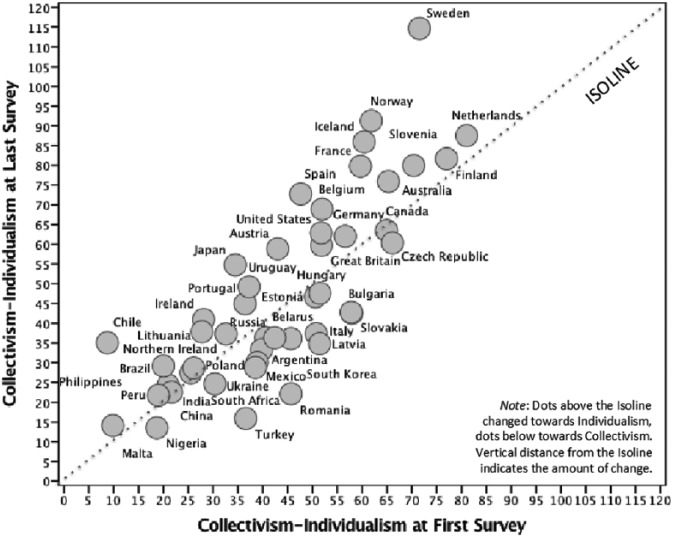
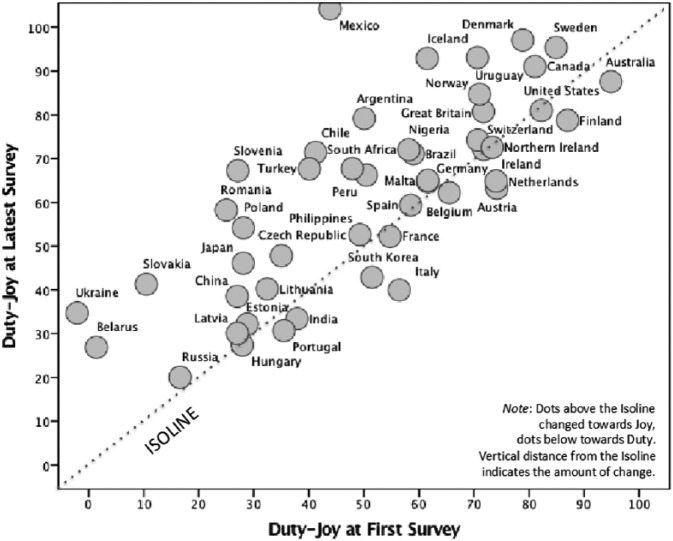
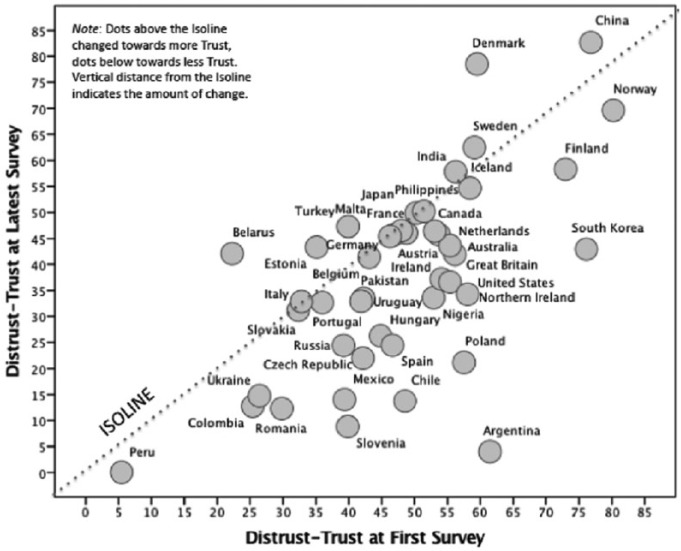
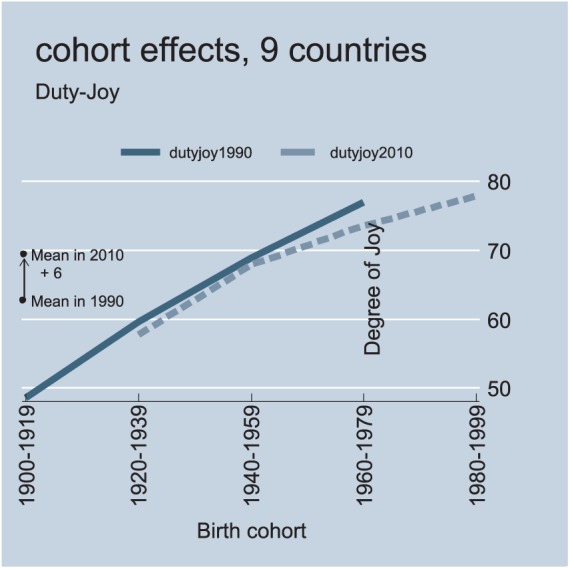
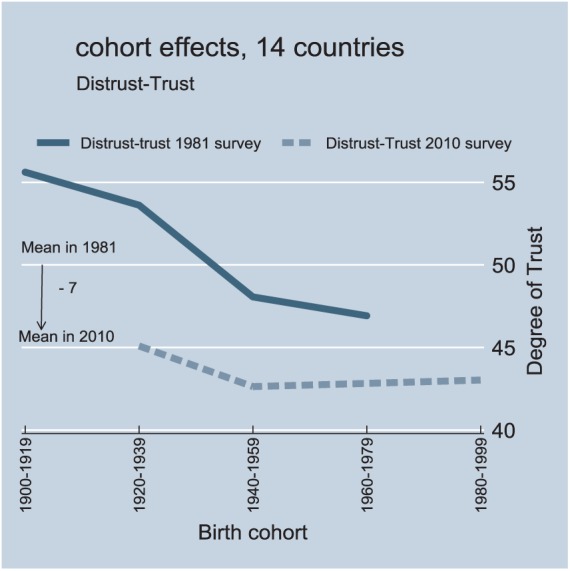
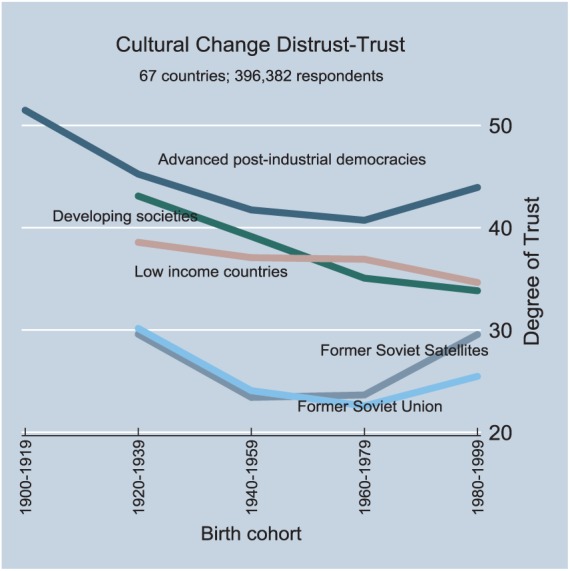
- Over at least 15 years, country scores change by +4 points on Collectivism–Individualism (44 to 48, N = 46 countries), +11 points on Duty–Joy (N = 47), and -10 points on Distrust–Trust (N = 44).
- In the panel models, GDP per capita is significantly related to Collectivism–Individualism (β = 3.30; p < .01) and Duty–Joy (β = 9.29; p < .001), and marginally to Distrust–Trust (β = 2.76; p < .10).
- The paper reports that approximately 50% of the variation in Collectivism–Individualism and Duty–Joy is explained by GDP per capita and cohort-fixed effects, with the other 50% explained by country-fixed effects; for Distrust–Trust, country-fixed effects account for the largest share.
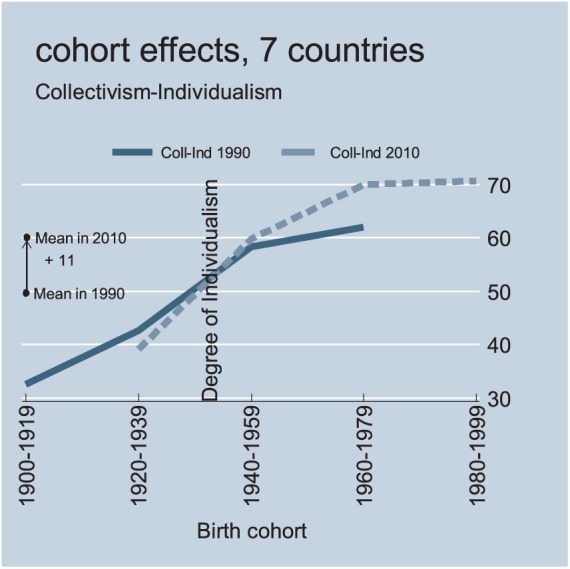
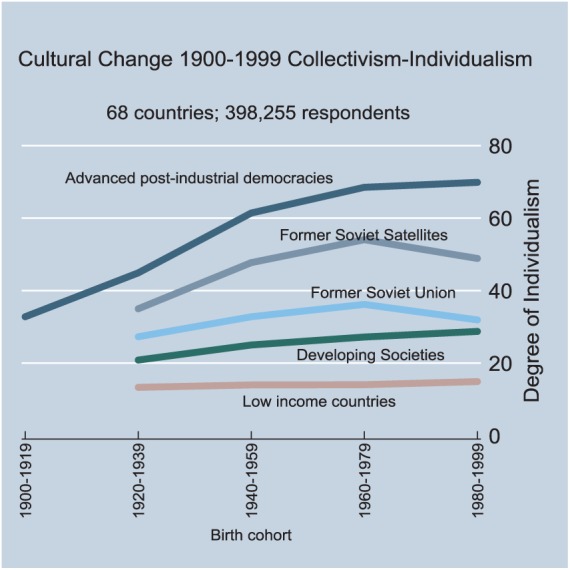
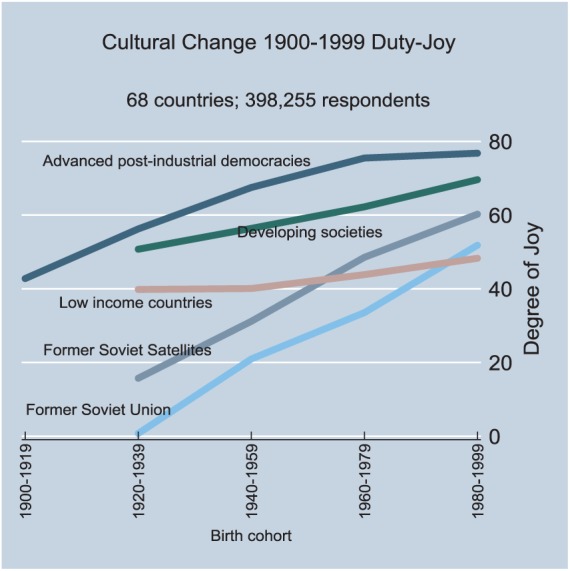
- For the youngest cohort (born after 1980), controlling for GDP per capita and country-fixed effects, scores are 25 points higher on Individualism/Joy and 17 points lower on Trust compared with the 1900–1920 cohort.
## Methods
- The study pools WVS and EVS data from 110 countries and 495,011 individuals surveyed between 1981 and 2014; respondents are grouped into five birth cohorts (1900–1919, 1920–1939, 1940–1959, 1960–1979, 1980–1999).
- The authors construct country-level cultural scores from attitude items, screen items by coverage and correlation with Hofstede’s dimensions, and use factor analysis (oblique rotation), reliability analysis, and rescaling to 0–100.
- To study change, they use fixed-effects panel models with GDP per capita, country-fixed effects, cohort-fixed effects, and cluster-adjusted standard errors, plus comparisons of earliest vs latest survey waves and a five-cohort analysis.
## Limitations
- The paper itself notes that the first cohort (1900–1919) has limited coverage for 21 countries, and that restricting analyses to countries with at least 15 years between first and last survey waves reduces sample size considerably.
- It also states that the study is conducted at the group level, and that aggregate dimensions are often impossible to replicate at the individual level within countries; this is presented as a general limitation of interpreting national-culture patterns.
- Evident from the text: some analyses rely on item exclusion/imputation because of missing wave or country coverage, including dropping items for limited coverage and imputing one missing item for 16 countries in the first dimension.
Model-written summary. Check it against the paper before relying on it.
Integrity signals
Registry
Cites
Statistics
Figures
Verification
Claims the paper makes
0 Valid · 4 Not valid · 51 Not checked · 147 Own results and interpretations
The cited sources that could be checked couldn’t confirm or dispute this claim.
In the paper
“while Hofstede’s dimensional concept neglects cultural dynamics”
§ Dimensions and Dynamics of National Culture: Synthesizing Hofstede With Inglehart > Abstract Cross-national research on cultural differences across space and time intersects multiple disciplines but the prominence of concepts varies by academic fields. Hofstede’s dimensional concept of culture, to begin with, dominates in cross-cultural psychology and international management. Inglehart’s dynamic concept of culture, by contrast, prevails in sociology and political science. We argue that this disciplinary division is unfortunate because the two concepts are complementary, for which reason a synthesis rectifies their mutual weaknesses. Indeed, while Hofstede’s dimensional concept neglects cultural dynamics, Inglehart’s dynamic concept is dimensionally reductionist. We demonstrate empirically that combining these two concepts leads to an improved understanding of cultural differences. Inspired by Hofstede’s cultural dimensions, we use data from the European Value Studies and World Values Surveys for 495,011 individuals born between 1900 and 1999 in 110 countries and then show that change on these dimensions proceeds as Inglehart and his collaborators suggest. Most notably, younger generations have become more individualistic and more joyous. But even though economic development and generational replacement drive this cultural change, roughly half of the variation in national cultural orientations is unique to each country, due to lasting intercept differences in developmental trajectories that trace back to remote historic drivers. We discuss the implications for cross-national cultural research.
What the sources say
- Not checked — no full text of the sourcecites Minkov & Hofstede, 2014 matched to “A replication of Hofstede's uncertainty avoidance dimension across nationally representative samples from Europe” (2014) source
- Could not verifycites Shenkar, 2001 matched to “Cultural Distance Revisited: Towards a More Rigorous Conceptualization and Measurement of Cultural Differences” (2001) sourceExperimental — accuracy not yet measured
Our copy of Shenkar (2001) criticises Hofstede's dimensional framework, but on other grounds: in Methodological Properties it lists the criticisms 'leveled against Hofstede, e.g., non-exhaustiveness, reliance on single company data, and the like', plus the Assumptions of Corporate Homogeneity, Spatial Homogeneity and Equivalence, and notes the Kogut & Singh index 'has not been updated to incorporate latter work by Hofstede and others' (the fifth dimension, Confucian dynamism/LTO). None of these states that Hofstede's dimensional concept neglects cultural dynamics or change over time; the only 'dynamics' usages refer to Confucian dynamism as a dimension and to corporate culture altering 'the dynamics of national CD' (Methodological Properties). Searched: cultural dynamics, static/dynamic framework, cultural change over time, temporal evolution, limitations of Hofstede's dimensions — no passage addresses the claim's point, so it can be neither confirmed nor contradicted from our copy. (LLM, conf=0.68)
- Not checked — no full text of the sourcecites Tung, 2008 matched to “The cross-cultural research imperative: the need to balance cross-national and intra-national diversity” (2008) source
plain- Asserted: passes — The authors put it forward as true.
- Checkable: passes — It can be checked against evidence.
- Load-bearing: passes — The paper’s conclusions depend on it.
- Based: passes — The paper gives a reason why it holds.
The paper states this without a source or data behind it here, so there is nothing to check it against. The quote shows it is in the paper.
In the paper
“From an empirical point of view, Hofstede’s six-dimensional framework (4 IBM-based + 2 WVS-based) consists of four dimensions (3 IBM-based + 1 WVS-based).”
§ Dimensions and Dynamics of National Culture: Synthesizing Hofstede With Inglehart > Hofstede’s Dimensions and Inglehart’s Dynamics > Hofstede’s National Cultural Dimensions and the Critique of His Framework
plain- Asserted: passes — The authors put it forward as true.
- Checkable: passes — It can be checked against evidence.
- Load-bearing: passes — The paper’s conclusions depend on it.
- Based: unclear — It is unclear why the paper says it holds.
A result the paper reports from its own data — it cites no other source for it, so there is none to check. The quote shows it is in the paper.
In the paper
“roughly half of the variation in national cultural orientations is unique to each country, due to lasting intercept differences in developmental trajectories that trace back to remote historic drivers.”
§ Dimensions and Dynamics of National Culture: Synthesizing Hofstede With Inglehart > Abstract Cross-national research on cultural differences across space and time intersects multiple disciplines but the prominence of concepts varies by academic fields. Hofstede’s dimensional concept of culture, to begin with, dominates in cross-cultural psychology and international management. Inglehart’s dynamic concept of culture, by contrast, prevails in sociology and political science. We argue that this disciplinary division is unfortunate because the two concepts are complementary, for which reason a synthesis rectifies their mutual weaknesses. Indeed, while Hofstede’s dimensional concept neglects cultural dynamics, Inglehart’s dynamic concept is dimensionally reductionist. We demonstrate empirically that combining these two concepts leads to an improved understanding of cultural differences. Inspired by Hofstede’s cultural dimensions, we use data from the European Value Studies and World Values Surveys for 495,011 individuals born between 1900 and 1999 in 110 countries and then show that change on these dimensions proceeds as Inglehart and his collaborators suggest. Most notably, younger generations have become more individualistic and more joyous. But even though economic development and generational replacement drive this cultural change, roughly half of the variation in national cultural orientations is unique to each country, due to lasting intercept differences in developmental trajectories that trace back to remote historic drivers. We discuss the implications for cross-national cultural research.
plainstates a causen = 495,011- Asserted: passes — The authors put it forward as true.
- Checkable: passes — It can be checked against evidence.
- Load-bearing: passes — The paper’s conclusions depend on it.
- Based: passes — The paper gives a reason why it holds.
A result the paper reports from its own data — it cites no other source for it, so there is none to check. The quote shows it is in the paper.
In the paper
“we use data from the European Value Studies and World Values Surveys for 495,011 individuals born between 1900 and 1999 in 110 countries and then show that change on these dimensions proceeds as Inglehart and his collaborators suggest.”
§ Dimensions and Dynamics of National Culture: Synthesizing Hofstede With Inglehart > Abstract Cross-national research on cultural differences across space and time intersects multiple disciplines but the prominence of concepts varies by academic fields. Hofstede’s dimensional concept of culture, to begin with, dominates in cross-cultural psychology and international management. Inglehart’s dynamic concept of culture, by contrast, prevails in sociology and political science. We argue that this disciplinary division is unfortunate because the two concepts are complementary, for which reason a synthesis rectifies their mutual weaknesses. Indeed, while Hofstede’s dimensional concept neglects cultural dynamics, Inglehart’s dynamic concept is dimensionally reductionist. We demonstrate empirically that combining these two concepts leads to an improved understanding of cultural differences. Inspired by Hofstede’s cultural dimensions, we use data from the European Value Studies and World Values Surveys for 495,011 individuals born between 1900 and 1999 in 110 countries and then show that change on these dimensions proceeds as Inglehart and his collaborators suggest. Most notably, younger generations have become more individualistic and more joyous. But even though economic development and generational replacement drive this cultural change, roughly half of the variation in national cultural orientations is unique to each country, due to lasting intercept differences in developmental trajectories that trace back to remote historic drivers. We discuss the implications for cross-national cultural research.
boostedstates a causen = 495,011- Asserted: passes — The authors put it forward as true.
- Checkable: passes — It can be checked against evidence.
- Load-bearing: passes — The paper’s conclusions depend on it.
- Based: passes — The paper gives a reason why it holds.
A result the paper reports from its own data — it cites no other source for it, so there is none to check. The quote shows it is in the paper.
In the paper
“LTO and IVR also form one factor in an ecological factor analysis.”
§ Dimensions and Dynamics of National Culture: Synthesizing Hofstede With Inglehart > Hofstede’s Dimensions and Inglehart’s Dynamics > Hofstede’s National Cultural Dimensions and the Critique of His Framework
plainstates an association- Asserted: passes — The authors put it forward as true.
- Checkable: passes — It can be checked against evidence.
- Load-bearing: passes — The paper’s conclusions depend on it.
- Based: passes — The paper gives a reason why it holds.
105 more claims
Create a free account to see all 202 claims and every source verdict.
- It may state two separate claims as one. 72
- Probably not a substantial claim. 29
Citations
Cites
Cultures and Organizations: Software of the Mind.
Triandis, H. C., & Hofstede, G. (1993) · Administrative Science Quarterly · doi:10.2307/2393257 · Cited by 17,696
Putnam, R. (2000) · doi:10.1145/358916.361990 · Cited by 17,114 · cited 1×
“Using the Trust label for this dimension resonates well with the vast literature on trust in economics (e.g., Zak & Knack, 2001), political science (e.g., Fukuyama, 1995; Putnam, 1993, 2000), and sociology (e.g., Delhey & Newton, 2005).”
Method(1997) · Naming the Mind: How Psychology Found its Language · doi:10.4135/9781446221815.n7 · Cited by 15,148
Making Democracy Work: Civic Traditions in Modern Italy
Stern, F., & Putnam, R. (1993) · Foreign Affairs · doi:10.2307/20045657 · Cited by 11,137
Trust: The Social Virtues and the Creation of Prosperity
Schneider, P. A., & Fukuyama, F. (1996) · Journal of Marketing · doi:10.2307/1251846 · Cited by 10,501
Culture's Consequences: International Differences in Work-Related Values
Gladwin, T. N., & Hofstede, G. (1981) · The Academy of Management Review · doi:10.2307/257651 · Cited by 9,275
Assessing construct validity in organizational research
Bagozzi, R. P., Yi, Y., & Phillips, L. W. (1991) · Administrative Science Quarterly · doi:10.2307/2393203 · Cited by 6,621 · cited 1×
“The correlations between the newly developed dimensions are lower than the correlations among the items included in each dimension, showing convergent and discriminant validity (Fornell & Larcker, 1981).”
BackgroundThe Effect of National Culture on the Choice of Entry Mode
Kogut, B., & Singh, H. (1988) · Journal of International Business Studies · doi:10.1057/palgrave.jibs.8490394 · Cited by 6,240 · cited 1×
“Second, cultural frameworks like ours have been used to develop a composite measure of cultural distance collapsing all cultural dimensions into a single Euclidean distance index (Beugelsdijk et al., 2017; Kogut & Singh, 1988).”
MethodRethinking individualism and collectivism: Evaluation of theoretical assumptions and meta-analyses.
Oyserman, D., Coon, H. M., & Kemmelmeier, M. (2002) · Psychological Bulletin · doi:10.1037/0033-2909.128.1.3 · Cited by 5,758
Making Democracy Work: Civic Traditions in Modern Italy
Putnam, R. D., Leonardi, R., & Nonetti, R. Y. (1994) · Princeton University Press eBooks · doi:10.2307/j.ctt7s8r7 · Cited by 5,580
Research works printed but not linked: 8
- Banfield E., 1958, Glencoe, illinois
- Diamond J., 1997, Guns, germs and steel
- Gelfand M., 2004, Culture, leadership and organizations: The GLOBE study of 62 societies, 438
- Greene W. H., 2008, Econometric analysis
- Hofstede G., 2001, Culture’s consequences: Comparing values, behaviors, institutions, and organizations across nations
- Inglehart R., 2003, Sacred and secular
- Nunnally J. C., 1994, Psychometric theory
- Schwartz S. H., 1994, Individualism and collectivism: Theory, method and applications, 85
Cited by
Personal Values Across Cultures
Sagiv, L., & Schwartz, S. H. (2022) · Annual Review of Psychology · doi:10.1146/annurev-psych-020821-125100 · Cited by 379
Robinson, S. C. (2020) · Technology in Society · doi:10.1016/j.techsoc.2020.101421 · Cited by 338
Globally representative evidence on the actual and perceived support for climate action
Andre, P., Boneva, T., Chopra, F., & Falk, A. (2024) · Nature Climate Change · doi:10.1038/s41558-024-01925-3 · Cited by 326
Minkov, M., & Kaasa, A. (2022) · Journal of International Management · doi:10.1016/j.intman.2022.100971 · Cited by 325
Beugelsdijk, S., Ambos, B., & Nell, P. C. (2018) · Journal of International Business Studies · doi:10.1057/s41267-018-0182-4 · Cited by 245
Self-citationConsideration of culture is vital if we are to achieve the Sustainable Development Goals
Zheng, X., Wang, R., Hoekstra, A. Y., Krol, M. S., Zhang, Y., Guo, K., Sanwal, M., Sun, Z., Zhu, J., Zhang, J., et al. (2021) · One Earth · doi:10.1016/j.oneear.2021.01.012 · Cited by 158
“Gender inequality can be exacerbated in a collectivistic culture that emphasizes the norms and duties of the community and subordinates women’s personal goals to their social obligations.(36,54)Bycontrast, such inequality is reduced in an individualistic culture that upholds impartial institutions and universal norms.”
BackgroundResultInfluentialRisk of burnout in French entrepreneurs during the COVID-19 crisis
Torrès, O., Benzari, A., Fisch, C. O., Mukerjee, J., Swalhi, A., & Thurik, R. (2021) · Small Business Economics · doi:10.1007/s11187-021-00516-2 · Cited by 171
Rattrie, L. T. B., Kittler, M. G., & Paul, K. I. (2020) · Applied Psychology · doi:10.1111/apps.12209 · Cited by 141
Rockstuhl, T., Eisenberger, R., Shore, L. M., Kurtessis, J. N., Ford, M. T., Buffardi, L. C., & Mesdaghinia, S. (2020) · Journal of International Business Studies · doi:10.1057/s41267-020-00311-3 · Cited by 185
Non-invariance? An Overstated Problem With Misconceived Causes
Welzel, C., Brunkert, L. J., Kruse, S., & Inglehart, R. (2021) · Sociological Methods & Research · doi:10.1177/0049124121995521 · Cited by 147
Self-citationSchug, C., Morawa, E., Geiser, F., Hiebel, N., Beschoner, P., Jerg-Bretzke, L., Albus, C., Weidner, K., Steudte-Schmiedgen, S., Borho, A., et al. (2021) · International Journal of Environmental Research and Public Health · doi:10.3390/ijerph18073827 · Cited by 106
“As cultures differ between continents and countries [35,36], the perception, manifestation, or protective role of social support might also.”
BackgroundEstimating the Number of Civilian Casualties in Modern Armed Conflicts–A Systematic Review
Khorram-Manesh, A., Burkle, F. M., Goniewicz, K., & Robinson, Y. (2021) · Frontiers in Public Health · doi:10.3389/fpubh.2021.765261 · Cited by 104
Smith, P. B., & Bond, M. H. (2019) · Frontiers in Psychology · doi:10.3389/fpsyg.2019.02689 · Cited by 125
Knoll, M., Götz, M., Adriasola, E., Al‐Atwi, A. A., Arenas, A., Atitsogbe, K. A., Barrett, S., Bhattacharjee, A., Blanco, N. D., Bogilović, S., et al. (2021) · Journal of Organizational Behavior · doi:10.1002/job.2512 · Cited by 145
“These features may result, for example, from specific traditions of providing participatory rights (see Szabo et al., 2002) and collective experiences relevant for silence (so-called “remote historic drivers”; Beugelsdijk & Welzel, 2018).”
BackgroundStudent-Centered Learning and Sustainability: Solution or Problem?
Komatsu, H., Rappleye, J., & Silova, I. (2021) · Comparative Education Review · doi:10.1086/711829 · Cited by 129
“We note that many succeeding studies have confirmed the continued conceptual robustness and analytical usefulness of this dimension (e.g., Beugelsdijk and Welzel 2018; Minkov 2018).”
BackgroundCreativity as a Means to Well-Being in Times of COVID-19 Pandemic: Results of a Cross-Cultural Study
Tang, M., Hofreiter, S., Reiter‐Palmon, R., Bai, X., & Murugavel, V. R. (2021) · Frontiers in Psychology · doi:10.3389/fpsyg.2021.601389 · Cited by 123
Minkov, M., & Kaasa, A. (2021) · Cross-Cultural Research · doi:10.1177/10693971211014468 · Cited by 84
“For validation purposes, we also use the latest available national IDV measure (Beugelsdijk & Welzel, 2018), and two closely related dimensions: Schwartz’s (2008a) embeddedness and Welzel’s (2013) emancipative values.”
BackgroundMethodInfluentialMerging Hofstede, Schwartz, and Inglehart into a Single System
Kaasa, A. (2021) · Journal of Cross-Cultural Psychology · doi:10.1177/00220221211011244 · Cited by 107
“The arrangement of dimensions proposed in this article is also supported by the views of some authors (Beugelsdijk & Welzel, 2018; Dobewall & Strack, 2014; Welzel, 2013) that autonomy versus embeddedness and hierarchy and mastery versus egalitarianism and harmony as in Schwartz’s value space are…”
ResultSustainable Agroforestry Landscape Management: Changing the Game
van Noordwijk, M., Speelman, E. N., Hofstede, G. J., Farida, A., Abdurrahim, A. Y., Miccolis, A., Hakim, A. L., Wamucii, C. N., Lagneaux, E., Andreotti, F., et al. (2020) · Land · doi:10.3390/land9080243 · Cited by 98
A test of Hofstede's model of culture following his own approach
Minkov, M., & Kaasa, A. (2020) · Cross Cultural & Strategic Management · doi:10.1108/ccsm-05-2020-0120 · Cited by 132
Lomas, T., Diego‐Rosell, P., Shiba, K., Standridge, P., Lee, M. T., Case, B., Lai, A. Y., & VanderWeele, T. J. (2022) · Journal of Cross-Cultural Psychology · doi:10.1177/00220221221130978 · Cited by 102
“Then, adapting this taxonomy, Beugelsdijk and Welzel (2018) collapsed it into three dimensions: IvC, duty-joy, and distrust-trust. In sum, cross-cultural research is increasingly attuned to the fine-grained complexities of IvC, both vis-à-vis the binary itself and in how it intersects with other aspects of culture. Ho…”
MethodDifferent worlds of contention? Protest in Northwestern, Southern and Eastern Europe
Borbáth, E., & Gessler, T. (2020) · European Journal of Political Research · doi:10.1111/1475-6765.12379 · Cited by 82
“…on individual-level determinants is in line with a recent paper, which finds that absolute differences in cultural orientations between regions do not disappear with the economic development of post-communist countries due to the persistence of cohort-level differences (Beugelsdijk & Welzel 2018).”
ResultGerlach, P., & Eriksson, K. (2021) · Frontiers in Psychology · doi:10.3389/fpsyg.2021.662604 · Cited by 122
“(2011) or Beugelsdijk and Welzel (2018). Cultural dimensions provide a basis for scientific comparisons across cultures.”
BackgroundInfluentialWang, Z., Yuan, R., Liu, M. J., & Luo, J. (2022) · International Marketing Review · doi:10.1108/imr-02-2021-0090 · Cited by 85
Krishna, B., Krishnan, S., & Sebastian, M. P. (2022) · Information Systems Frontiers · doi:10.1007/s10796-022-10280-7 · Cited by 104
“However, a study conducted by Beugelsdijk and Welzel (2018) report that cohorts of people born in over 100 countries from 1900 to 2000 exhibit substantial change in national culture.”
Political Influencers on YouTube: Business Strategies and Content Characteristics
Fischer, T.-S., Kolo, C., & Mothes, C. (2022) · Media and Communication · doi:10.17645/mac.v10i1.4767 · Cited by 95
Commemorating Geert Hofstede, a pioneer in the study of culture and institutions
Sent, E., & Kroese, A. L. J. (2020) · Journal of Institutional Economics · doi:10.1017/s174413742000051x · Cited by 86
Digital Consumer Engagement: National Cultural Differences and Cultural Tightness
Thompson, F. M., & Brouthers, K. D. (2021) · Journal of International Marketing · doi:10.1177/1069031x211005729 · Cited by 85
“In line with other recent work (Beugelsdijk and Welzel 2018), we use the CTL_C score (i.e. the combined index of domain-specific [tolerance for moral deviation] and domaingeneral [endorsement of diverse set of values and behavioral practices] tightness) as our measure of cultural tightness.”
MethodBeugelsdijk, S. (2022) · Journal of International Business Studies · doi:10.1057/s41267-022-00545-3 · Cited by 66
“As a result of generational replacement, many societies have generally become more individualistic, less hierarchical, and more focused on the short term (Beugelsdijk & Welzel, 2018), with important implications for firms, for example, in terms of HRM practices.”
BackgroundSelf-citationA Test of the Reproducibility of the Clustering of Cultural Variables
Fog, A. (2020) · Cross-Cultural Research · doi:10.1177/1069397120956948 · Cited by 72
“A recalculation based on the same data as Inglehart and Welzel’s factor analysis has led to the conclusion that a single-factor solution is more appropriate (Beugelsdijk & Welzel, 2018; Li & Bond, 2010).”
BackgroundMethodAre the World’s National Cultures Becoming More Similar?
Kaasa, A., & Minkov, M. (2020) · Journal of Cross-Cultural Psychology · doi:10.1177/0022022120933677 · Cited by 68
Personality traits, migration intentions, and cultural distance
Fouarge, D. J. A. G., Özer, M. N., & Seegers, P. (2019) · Papers of the Regional Science Association · doi:10.1111/pirs.12468 · Cited by 80
Clashing Values: Supranational Identities, Geopolitical Rivalry and Europe’s Growing Cultural Divide
Akaliyski, P., & Welzel, C. (2020) · Journal of Cross-Cultural Psychology · doi:10.1177/0022022120956716 · Cited by 58
“Given the relative plasticity of culture (Beugelsdijk & Welzel, 2018), such an investigation is warranted and long overdue.”
Self-citationRuparel, N., Bhardwaj, S., Seth, H., & Choubisa, R. (2022) · Journal of Business Research · doi:10.1016/j.jbusres.2022.113482 · Cited by 85
Social trust more strongly associated with well-being in individualistic societies
Guo, Q., Zheng, W., Shen, J., Huang, T., & Kuan-bin, M. (2021) · Personality and Individual Differences · doi:10.1016/j.paid.2021.111451 · Cited by 57
Tehseen, S., Deng, P., Bing, W., & Gao, Y. (2021) · Journal of Small Business Management · doi:10.1080/00472778.2021.1934848 · Cited by 79
“…effects of national culture on innovation-related topics are because researchers often focus on Hofstede’s several selected cultural dimensions (Beugelsdijk & Welzel, 2018; Cakar & Erturk, 2010; Tian et al., 2020; Watts et al., 2020), we incorporate all six of Hofstede’s cultural dimensions…”
BackgroundInfluentialProfiling for sustainable tourism: young travellers’ self- transcendence values and motivations
Cavagnaro, E., Staffieri, S., Carrieri, A., Burns, K., Chen, N., & Fermani, A. (2021) · European Journal of Tourism Research · doi:10.54055/ejtr.v28i.2261 · Cited by 74
“The two countries where data was gathered for this study, China and Italy, differ in their political, economic, and socio-cultural system.”
BackgroundInfluentialKantorowicz‐Reznichenko, E., Folmer, C. R., & Kantorowicz, J. (2022) · Personality and Individual Differences · doi:10.1016/j.paid.2022.111666 · Cited by 53
Long-term orientation and the passage of time: Is it time to revisit Hofstede’s cultural dimensions?
Chun, D., Zhang, Z., Cohen, E. D., Florea, L., & Genc, O. F. (2021) · International Journal of Cross Cultural Management · doi:10.1177/14705958211026342 · Cited by 62
“One major criticism is that the framework fails to capture the dynamics of culture (Beugelsdijk and Welzel, 2018; Kirkman et al., 2006).”
BackgroundNeubert, M. J., de Luque, M. S., Quade, M. J., & Hunter, E. M. (2021) · Journal of World Business · doi:10.1016/j.jwb.2021.101268 · Cited by 64
Himawan, K. K., Helmi, J., & Fanggidae, J. P. (2022) · Knowledge and Process Management · doi:10.1002/kpm.1708 · Cited by 58
Is tax morale culturally driven?
Andriani, L., Bruno, R. L., Douarin, E., & Stępień-Baig, P. (2021) · Journal of Institutional Economics · doi:10.1017/s1744137421000072 · Cited by 57
“Such an approach would be more in line with Inglehart’s dynamic conceptualisation of culture (see Beugelsdijk and Welzel, 2018 for a discussion of both approaches).”
Luxury value perceptions and consumer outcomes: A meta‐analysis
Akarsu, T. N., Shaikh, S., & Maity, M. (2024) · Psychology and Marketing · doi:10.1002/mar.22120 · Cited by 63
“…financial benefits derived from luxury goods and services are expected to have a stronger influence on consumers' affective (e.g., emotions, feelings) and cognitive (e.g., perceptions, thoughts, and beliefs) outcomes in individualistic cultures (Beugelsdijk & Welzel, 2018; Donthu & Yoo, 1998).”
Beugelsdijk, S., Ambos, B., & Nell, P. C. (2019) · JIBS special collections · doi:10.1007/978-3-030-22113-3_26 · Cited by 42
Self-citationCross-Cultural Values: A Meta-Analysis of Major Quantitative Studies in the Last Decade (2010–2020)
Goodwin, J. L., Williams, A. L., & Herzog, P. S. (2020) · Religions · doi:10.3390/rel11080396 · Cited by 57
Abeysekera, I., Manalang, L., David, R., & Guiao, B. G. M. (2022) · Sustainability · doi:10.3390/su141912565 · Cited by 71
“The short-term versus long-term orientation and indulgence versus restrain; are highly but negatively correlated into a single factor [73].”
BackgroundGlobal variations in online privacy concerns across 57 countries
Engström, E., Eriksson, K., Björnstjerna, M., & Strimling, P. (2023) · Computers in Human Behavior Reports · doi:10.1016/j.chbr.2023.100268 · Cited by 48
Komisarof, A., & Akaliyski, P. (2025) · International Journal of Intercultural Relations · doi:10.1016/j.ijintrel.2025.102200 · Cited by 56
Kordyaka, B., Park, S., Krath, J., & Laato, S. (2023) · ACM Transactions on Social Computing · doi:10.1145/3580346 · Cited by 49
“In fact, individuals’ country of residence explains about half of the variance in national cultural orientations in one large dataset of 495,011 individuals from 110 countries [8], which indicates that a group of people who have been brought up within a given country tend to share certain expectations and values.”
BackgroundThe Effects of Cultural Differences on Consumers’ Willingness to Share Personal Information
Schumacher, C., Eggers, F., Verhoef, P. C., & Maas, P. (2022) · Journal of Interactive Marketing · doi:10.1177/10949968221136555 · Cited by 40
“…2010).9 We collected data on each country’s four cultural dimensions from the Hofstede website (Hofstede Insights 2020), displayed in Web Appendix A. National cultural differences tend to be largely persistent, as relative country scores remain quite stable over time (Beugelsdijk and Welzel 2018).”
MethodOverparenting and psychological well‐being of emerging adult children in the United States and China
Hong, P., & Cui, M. (2023) · Family Relations · doi:10.1111/fare.12839 · Cited by 36
Epidemiological overview of major depressive disorder in Scandinavia using nationwide registers
Pasman, J. A., Meijsen, J. J., Haram, M., Kowalec, K., Harder, A., Xiong, Y., Nguyen, T.-D., Jangmo, A., Shorter, J. R., Bergstedt, J., et al. (2023) · The Lancet Regional Health - Europe · doi:10.1016/j.lanepe.2023.100621 · Cited by 42
Cultural dimensions as correlates of favoritism and the mediating role of trust
Im, H., & Chen, C. (2020) · Cross Cultural & Strategic Management · doi:10.1108/ccsm-09-2019-0165 · Cited by 43
Endorsement on Instagram and cultural dimensions: an analysis of digital influencers
Silva, M. J. D. B., de Farias, S. A., & Silva, C. J. (2023) · The Bottom Line Managing Library Finances · doi:10.1108/bl-12-2021-0127 · Cited by 51
Intercultural Competencies for Fostering Technology-Mediated Collaboration in Developing Countries
Kampermann, A., Opdenakker, R., Heijden, B. V. D., & Bücker, J. (2021) · Sustainability · doi:10.3390/su13147790 · Cited by 32
“The idea behind this approach is that a culture can be mapped by describing the distinguished dimensions [39,40].”
BackgroundMinkov, M., Vignoles, V. L., Welzel, C., Akaliyski, P., Bond, M. H., Kaasa, A., & Smith, P. B. (2024) · Journal of Cross-Cultural Psychology · doi:10.1177/00220221231220027 · Cited by 56
“As individualism-collectivism (IDV-COLL) is the best-known and perhaps most important dimension of national culture (Beugelsdijk & Welzel, 2018; Smith et al., 1996), we use examples related to this dimension throughout this paper.”
BackgroundMethodSelf-citationCross-cultural comparison of behavioural itinerary actions and times in wildfire evacuations
Vaiciulyte, S., Hulse, L. M., Veeraswamy, A., & Galea, E. R. (2020) · Safety Science · doi:10.1016/j.ssci.2020.105122 · Cited by 36
Temporal orientation as a robust predictor of innovation
Barreto, T. S., Lanivich, S. E., & Cox, K. C. (2021) · Journal of Business Research · doi:10.1016/j.jbusres.2021.09.003 · Cited by 37
Tu, W., Jian-guo, Y., & Yang, Z. (2020) · Asian Journal Of Social Psychology · doi:10.1111/ajsp.12402 · Cited by 41
Homophily and peer influence in early-stage new venture informal investment
Qin, F., Mickiewicz, T. M., & Estrin, S. (2021) · Small Business Economics · doi:10.1007/s11187-021-00523-3 · Cited by 39
The paradox and change of Russian cultural values
Chimenson, D., Tung, R. L., Panibratov, A. Y., & Fang, T. (2021) · International Business Review · doi:10.1016/j.ibusrev.2021.101944 · Cited by 39
A cross-cultural comparison of peer-to-peer accommodation experience: A mixed text mining approach
Zhang, G., Cheng, M., & Zhang, J. (2022) · International Journal of Hospitality Management · doi:10.1016/j.ijhm.2022.103296 · Cited by 34
Cultural Evolution Shifts the Source of Happiness from Religion to Subjective Freedom
Minkov, M., Welzel, C., & Schachner, M. (2020) · Journal of Happiness Studies · doi:10.1007/s10902-019-00203-w · Cited by 32
Self-citationAccommodation providers’ motives in sharing economy: comparison between Turkey and Lithuania
Urbonavičius, S., & Sezer, A. (2019) · International Journal of Culture Tourism and Hospitality Research · doi:10.1108/ijcthr-07-2018-0096 · Cited by 32
Minds of gods and human cognitive constraints: socio-ecological context shapes belief
McNamara, R. A., & Purzycki, B. G. (2019) · Religion Brain & Behavior · doi:10.1080/2153599x.2019.1678510 · Cited by 31
Transformational Leadership across Cultures: Follower Perception and Satisfaction
Caza, A., Caza, B. B., & Posner, B. Z. (2021) · Administrative Sciences · doi:10.3390/admsci11010032 · Cited by 50
“1996); questioning whether national values are sufficient (Adler and Aycan 2018); and skepticism that cultures remain unchanged over time (Beugelsdijk et al. 2015). Inglehart (1997) and his colleagues (Inglehart and Baker 2000; Inglehart and Welzel 2005) have argued for a theory of modernization, positing that economi…”
BackgroundSociocultural factors in economics: Milestones and perspectives
Auzan, A. A., Bakhtigaraeva, A., Bryzgalin, V. A., Золотов, А. В., Nikishina, E., Pripuzova, N., & Stavinskaya, A. A. (2020) · Voprosy Ekonomiki · doi:10.32609/0042-8736-2020-7-75-91 · Cited by 50
Kosakowska‐Berezecka, N., Sawicki, A. J., Celikkol, G. C., Bosson, J. K., van Laar, C., Rossum, A. V., Best, D. L., Jurek, P., Besta, T., Olech, M., et al. (2024) · Social Psychological and Personality Science · doi:10.1177/19485506231221913 · Cited by 34
“To detect culture-specific effects, we followed best practices by calculating the country-fixed effect that results after controlling for national wealth (cf. Beugelsdijk & Welzel, 2018; Minkov et al., 2023; Minkov & Kaasa, 2022).”
Rosa, V. L. L., Ching, B. H., & Commodari, E. (2024) · The Journal of Genetic Psychology · doi:10.1080/00221325.2024.2413490 · Cited by 39
“However, the meaning of helicopter parenting differs according to Western and Eastern cultural models, based on the contrast between collectivism and individualism (Beugelsdijk & Welzel, 2018).”
A comprehensive overview of Generation Z in the workplace: Insights from a scoping review
Zahra, Y., Handoyo, S., & Fajrianthi, F. (2025) · SA Journal of Industrial Psychology · doi:10.4102/sajip.v51i0.2263 · Cited by 32
Kaasa, A., & Minkov, M. (2022) · Journal of Cross-Cultural Psychology · doi:10.1177/00220221211072790 · Cited by 34
“Studies by Minkov (2018) and Beugelsdijk and Welzel (2018) found that some of those dimensions are seriously flawed or superfluous, possibly because the IBM database that Hofstede used did not properly represent the cultures from which it was drawn.”
BackgroundMethodResultInfluentialIndulgence and risk-taking behavior of firms: Direct and interactive influences
Alipour, A., & Yaprak, A. (2022) · Journal of International Management · doi:10.1016/j.intman.2022.100945 · Cited by 37
Aguilar-Rodríguez, I. E., Torres, C. A. B., Aldana‐Bernal, J. C., Aguinaga, A. A., Artieda-Cajilema, C. H., & Chalá-Mejía, P. (2021) · Journal of Industrial Engineering and Management · doi:10.3926/jiem.3560 · Cited by 44
Conceptual and methodological issues in the study of the personality-and-culture relationship
Allïk, J., Realo, A., & McCrae, R. R. (2023) · Frontiers in Psychology · doi:10.3389/fpsyg.2023.1077851 · Cited by 37
“Although researchers of culture have not yet reached agreement on what dimensions provide the best description of culture (Beugelsdijk and Welzel, 2018; Minkov, 2018; Kaasa and Minkov, 2022), no one seems to question that a relatively small number of abstract and directly unobservable factors are the best descriptors…”
BackgroundCan Consumers’ Altruistic Inferences Solve the CSR Initiative Puzzle? A Meta-analytic Investigation
Carrillat, F. A., Plewa, C., Pupovac, L., Vanasse, C., Willmott, T., Legoux, R., & Napolova, E. (2024) · Journal of Business Ethics · doi:10.1007/s10551-024-05704-0 · Cited by 35
“We consider Inglehart and Baker’s framework particularly well adapted to our study, because it accounts for the evolving nature of culture (Tung & Verbeke, 2010), as it progressively moves toward more self-expressive and secular-rational values (Beugelsdijk & Welzel, 2018).”
Cultural novelty and international students’ experience: a five-country study
Wilczewski, M., Wang, R., Du, J., Søderberg, A., Giuri, P., Mughan, T., Puffer, S. M., & Jacob, M. J. (2022) · Higher Education · doi:10.1007/s10734-022-00964-z · Cited by 35
“Given recent research confirming a high validity of the individualism-collectivism dimension for cross-cultural research (Beugelsdijk & Welzel, 2018; Minkov & Kaasa, 2021), while questioning the validity of other Hofstede’s dimensions (Minkov & Kaasa, 2021), we will use individualism-col-lectivism…”
BackgroundPerret, J. K., Udalov, V., & Fabisch, N. (2021) · International Economics and Economic Policy · doi:10.1007/s10368-021-00521-6 · Cited by 28
“As the level of economic development of a country increases, a certain value shift can be explored and as security and prosperity increase people tend to behave more individualistic (Beugelsdijk and Welzel 2018).”
BackgroundPro-environmental behavior and subjective well-being: Culture has a role to play
Mavisakalyan, A., Sharma, S., & Weber, C. (2023) · Ecological Economics · doi:10.1016/j.ecolecon.2023.108081 · Cited by 28
Yu, H., Wei‐ying, Z., You‐qing, P., Yun‐ying, H., chi, C., Yang‐yang, L., & li‐li, H. (2019) · Journal of Nursing Management · doi:10.1111/jonm.12854 · Cited by 32
Cultural values, genes and savings behavior in China
Chan, K. S., Lai, J. T., & Li, T. (2022) · International Review of Economics & Finance · doi:10.1016/j.iref.2022.02.009 · Cited by 29
CEOs’ International Work Experience and Compensation
Schmid, S., & Baldermann, S. (2021) · Management International Review · doi:10.1007/s11575-021-00444-z · Cited by 39
Nationality differences in Gen Z work values: an exploratory study
de Boer, P., & Bordoloi, P. (2022) · Journal of International Education in Business · doi:10.1108/jieb-09-2021-0088 · Cited by 51
The relationship between culture and entrepreneurship: the role of Trust
Kara, A., & Dheer, R. J. S. (2023) · International Entrepreneurship and Management Journal · doi:10.1007/s11365-023-00901-1 · Cited by 27
“For example, Beugelsdijk and Welzel ( 2018 ) found support for younger generations becoming more individualistic and joyous.”
BackgroundAkaliyski, P., Minkov, M., Li, J., Bond, M. H., & Gehrig, S. (2022) · Social Science & Medicine · doi:10.1016/j.socscimed.2022.115167 · Cited by 32
Can Confucian culture promote enterprise total factor productivity? Evidence from China
Xiong, N., & Du, L. (2023) · International Journal of Emerging Markets · doi:10.1108/ijoem-05-2022-0739 · Cited by 22
Latorre, F., Pérez-Nebra, A. R., Queiroga, F., & de la Hera, C. M. A. (2021) · International Journal of Environmental Research and Public Health · doi:10.3390/ijerph182312522 · Cited by 24
“Brazilians show low trust in institutions [7] and a collectivist and loose [5,8,9] culture.”
BackgroundGötz, F. M., Ebert, T., Gosling, S. D., Obschonka, M., Potter, J., & Rentfrow, P. J. (2021) · American Psychologist · doi:10.1037/amp0000812 · Cited by 26
Cultural Roots of Entrepreneurship: Evidence from Second-Generation Immigrants
Kleinhempel, J., Klasing, M. J., & Beugelsdijk, S. (2022) · Organization Science · doi:10.1287/orsc.2022.1645 · Cited by 34
Self-citationMinkov, M., Соколов, Б. О., Tasse, M. A., Jamballuu, E., Schachner, M., & Kaasa, A. (2023) · Cross-Cultural Research · doi:10.1177/10693971231153461 · Cited by 27
“Beugelsdijk and Welzel (2018) failed to find equivalents to these dimensions in all waves of the whole World Values Survey.”
BackgroundWallace, C. K., Vandevijvere, S., Lee, A. C.-L., Jaacks, L. M., Schachner, M., & Swinburn, B. A. (2019) · Obesity Reviews · doi:10.1111/obr.12884 · Cited by 26
“Studies have shown that while the culture of countries does change, the relative position of countries remains largely the same, and replication studies and other surveys have validated all the scores.(39,34) The four covariates that were accounted for as potential confounders were income inequality (Gini coefficient)…”
Dingil, A. E., Rupi, F., Schweizer, J., et al. (2019) · Social Sciences · doi:10.3390/socsci8080227 · Cited by 19
Flipo, C., Mannucci, P. V., & Yong, K. (2022) · Journal of International Business Studies · doi:10.1057/s41267-022-00525-7 · Cited by 21
“…the three cultural dimensions found to positively correlate with tightness in previous work (Chua et al., 2019; Gelfand et al., 2011, 2021)4 – regardless of how they were measured (e.g., Beugelsdijk & Welzel, 2018; Hofstede, Hofstede, & Minkov, 2010; House, Hanges, Javidan, Dorfman, & Gupta, 2004).”
ResultDealing with cultural diversity in palliative care
Six, S., Bilsen, J. J. R., & Deschepper, R. (2020) · BMJ Supportive & Palliative Care · doi:10.1136/bmjspcare-2020-002511 · Cited by 24
Balabanis, G. I., Σταθοπούλου, Α., & Chen, X. (2024) · International Marketing Review · doi:10.1108/imr-01-2024-0009 · Cited by 26
Effective communication during organizational change: a cross-cultural perspective
Shrivastava, S., Pazzaglia, F., Sonpar, K., & McLoughlin, D. (2022) · Cross Cultural & Strategic Management · doi:10.1108/ccsm-08-2021-0144 · Cited by 98
Quantifying expenditure hierarchies and the expansion of global consumption diversity
Chai, A., Степанова, Е., & Moneta, A. (2023) · Journal of Economic Behavior & Organization · doi:10.1016/j.jebo.2023.07.012 · Cited by 20
National culture and firms’ cash holdings: The role of indulgence and its boundaries
Alipour, A., & Yaprak, A. (2023) · Journal of Business Research · doi:10.1016/j.jbusres.2023.114414 · Cited by 18
Heydari, A., Laroche, M., Paulin, M., & Richard, M. (2025) · Journal of Retailing and Consumer Services · doi:10.1016/j.jretconser.2025.104344 · Cited by 23
Two-Dimensional Models of Cultural Differences: Statistical and Theoretical Analysis
Fog, A. (2022) · Cross-Cultural Research · doi:10.1177/10693971221135703 · Cited by 35
“If there is a certain statistical relationship between two different cultures at a certain point in time, then there is likely to be a similar relationship at a later time if the two cultures are following approximately parallel trajectories (Beugelsdijk & Welzel, 2018).”
BackgroundLee, H.-S., Chernikov, S. U., Nagy, S., & Degtereva, E. A. (2022) · Social Sciences · doi:10.3390/socsci11110522 · Cited by 25
Metadata
- Authors
- Beugelsdijk, S., & Welzel, C.
- Affiliations
- University of Groningen (NL)
- Leuphana University of Lüneburg, Germany
- Corresponding author
- Beugelsdijk, Sjoerd
- Venue
- Journal of Cross-Cultural Psychology
- Publisher
- SAGE Publications
- Published
- 2018-10-02
- Volume
- 49
- Issue
- 10
- Pages
- 1469-1505
- ISSN
- 0022-0221 (ISSN-L)
- 1552-5422
- PMC
- PMC6191680
- OpenAlex
- W2895010120
- Semantic Scholar
- 184b6ce25f1e5968ea64b262eaf307142b51f38c
- Cited by
- 461
- References
- 113
- Citations by year
- 2026: 60 · 2025: 77 · 2024: 63 · 2023: 64 · 2022: 73 · 2021: 69 · 2020: 38 · 2019: 15 · 2018: 1
- FWCI
- 41.73
- Type
- journal article
- Language
- en
- Open access
- hybrid
- doi.org
- Licence
- cc-by-nc
- journals.sagepub.com/page/policies/text-and-data-mining-license (tdm)
- Locations
- Journal of Cross-Cultural Psychology (publishedVersion, cc-by-nc)
- Europe PMC (PubMed Central) (publishedVersion, cc-by-nc)
- PubMed Central (publishedVersion, cc-by-nc)
- PubMed (publishedVersion)
- University of Groningen research database (University of Groningen / Centre for Information Technology) (publishedVersion, cc-by-nc)
- Multilingual Matters (Channel View Publications) (submittedVersion, cc-by-nc)
- University of Groningen research database (University of Groningen / Centre for Information Technology) (submittedVersion, cc-by-nc)
- Funders
- Nederlandse Organisatie voor Wetenschappelijk Onderzoek (VIDI 452-11-010)
- Topics
- Social Sciences › Psychology › Social Psychology › Cultural Differences and Values
- Social Sciences › Development › Culture, Economy, and Development Studies
- Social Sciences › Business, Management and Accounting › Business and International Management › Global and Cross-Cultural Management
- Keywords
- national culture, Hofstede cultural dimensions, cultural dynamics, cross-cultural comparison, individualism, joy, generational change, economic development, cultural trajectories, World Values Survey, interdisciplinary synthesis
About these checks
Registry, retraction, Cites and statistics results are computed, not judged, with one exception: a printed reference that no index lists is read once by a model before it counts as a citation error. Claims are extracted by a model and kept only when their quote appears verbatim in the text; each cited source is then checked, with a model’s help, for whether it says what the claim relies on. Those verdicts can be wrong — read the claim’s quote and the cited source before relying on one.
The claim verdicts this report counts are experimental: their accuracy is not yet measured.
A language model drew the claims from the paper on 2026-10-10, under version 3 of the claim definition (model deepseek-v4.1-flash, prompt extract-v3).
A second model labelled each claim on 2026-10-10 (model jev-1.13-20260917, definition revision gold-guideline-v0.2).
Cited sources are checked with a language model’s help (qwen3.8-omni-flash).
Statistics and arithmetic are recomputed, not judged.
Confidence bands are shown only for fields calibrated on our annotated test set. None is calibrated yet, so no band is shown.
What counts as a claim ›How we measure confidence ›How we check this ›
Are you an author, or do you see a problem with this page? Request a review
Data sources
Bibliographic data: Semantic Scholar, OpenAlex, Crossref.
Contains information from the Semantic Scholar Academic Graph Datasets, made available under the ODC Attribution License (ODC-BY 1.0).
Semantic Scholar’s data is described in: Kinney, R., et al. (2023). The Semantic Scholar Open Data Platform. arXiv:2301.10140.
