

Dimensions and Dynamics of National Culture: Synthesizing Hofstede With Inglehart
Open accessThe DOI matches its Crossref record; 115 of the 115 references it cites were found in a registry or an index; 1 of the 66 sources its claims cite were checked for support.
Abstract
Cross-national research on cultural differences across space and time intersects multiple disciplines but the prominence of concepts varies by academic fields. Hofstede’s dimensional concept of culture, to begin with, dominates in cross-cultural psychology and international management. Inglehart’s dynamic concept of culture, by contrast, prevails in sociology and political science. We argue that this disciplinary division is unfortunate because the two concepts are complementary, for which reason a synthesis rectifies their mutual weaknesses. Indeed, while Hofstede’s dimensional concept neglects cultural dynamics, Inglehart’s dynamic concept is dimensionally reductionist. We demonstrate empirically that combining these two concepts leads to an improved understanding of cultural differences. Inspired by Hofstede’s cultural dimensions, we use data from the European Value Studies and World Values Surveys for 495,011 individuals born between 1900 and 1999 in 110 countries and then show that change on these dimensions proceeds as Inglehart and his collaborators suggest. Most notably, younger generations have become more individualistic and more joyous. But even though economic development and generational replacement drive this cultural change, roughly half of the variation in national cultural orientations is unique to each country, due to lasting intercept differences in developmental trajectories that trace back to remote historic drivers. We discuss the implications for cross-national cultural research.
Overview
CoChat Summary
## TL;DR
The paper synthesizes Hofstede’s cultural dimensions with Inglehart’s theory of cultural change and re-estimates national culture using WVS/EVS data for 110 countries and 495,011 individuals. It reduces Hofstede’s six dimensions to three, and finds that cultures have generally shifted toward more Individualism and Joy, while Trust has declined somewhat; about half of the variation is linked to economic development and generational change, and about half to country-specific historical/geographic factors.
## Key findings
- Factor analysis of 15 WVS-EVS items yields three factors (n = 63 countries in the factor analysis), with eigenvalues 4.9, 3.2, and 2.5; the fourth factor drops below 1 (.89) and the three-factor model has the best BIC.
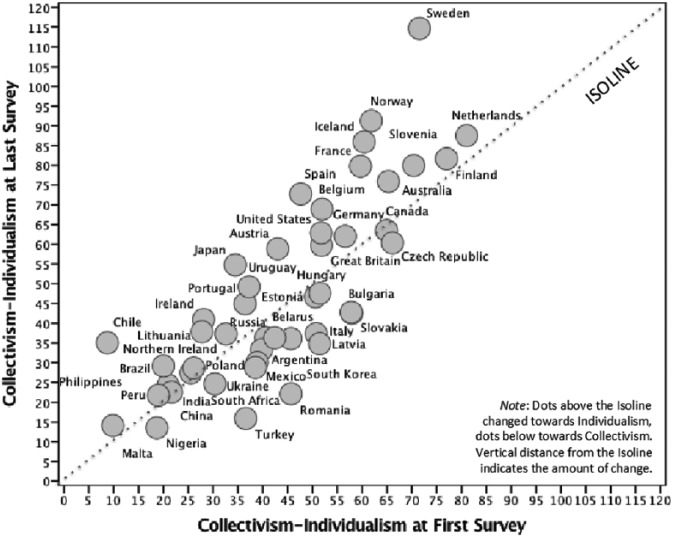
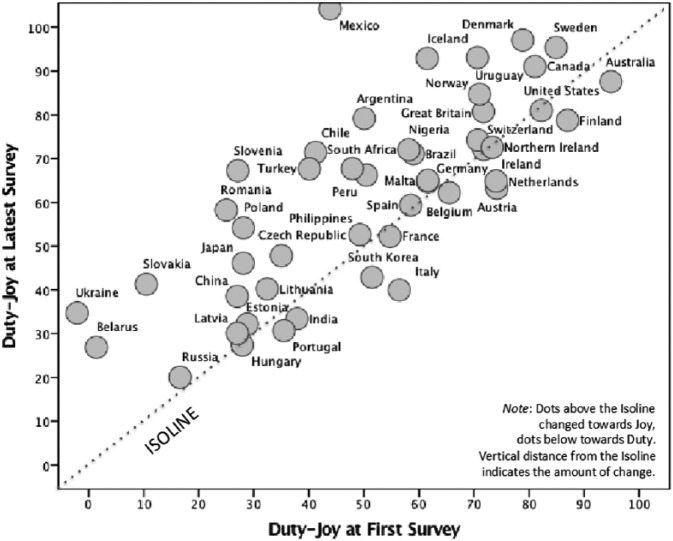
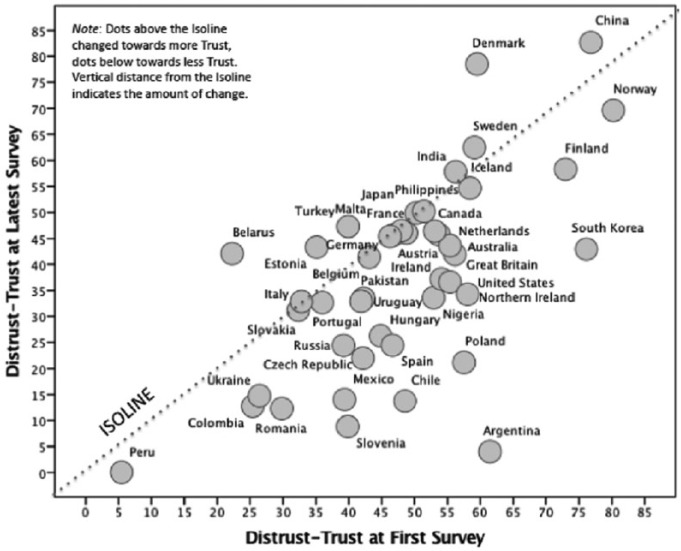
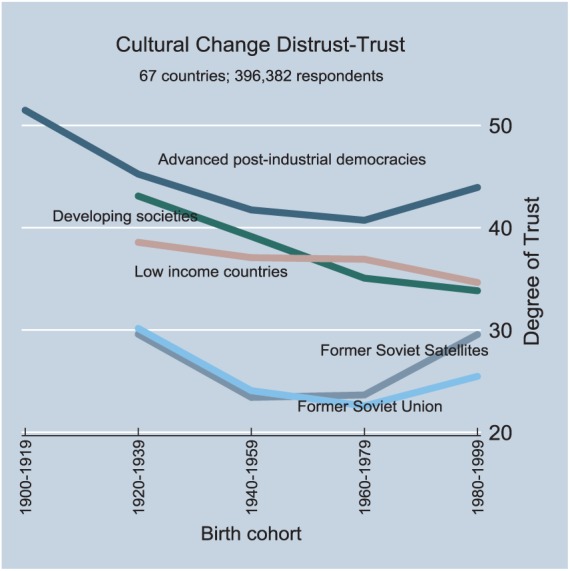
- The three dimensions are Collectivism–Individualism, Duty–Joy, and Distrust–Trust; the paper reports Cronbach’s alphas of .87, .77, and .75, respectively.
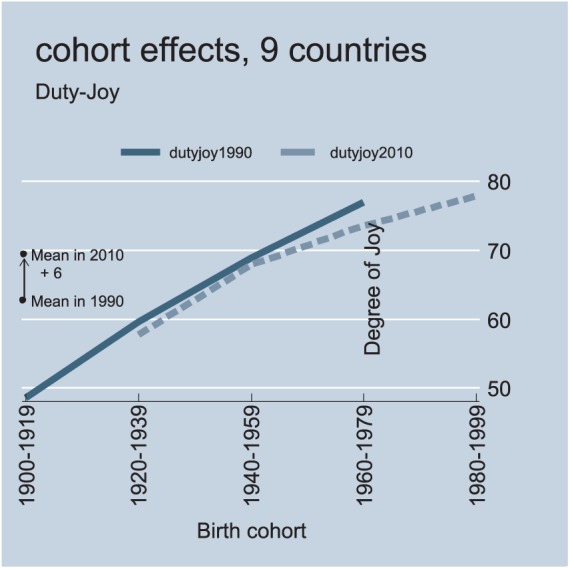
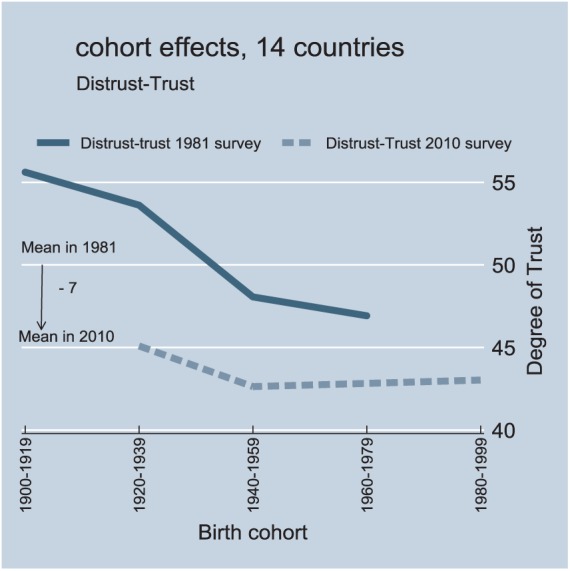
- Over at least 15 years, country scores change by +4 points on Collectivism–Individualism (44 to 48, N = 46 countries), +11 points on Duty–Joy (N = 47), and -10 points on Distrust–Trust (N = 44).
- In the panel models, GDP per capita is significantly related to Collectivism–Individualism (β = 3.30; p < .01) and Duty–Joy (β = 9.29; p < .001), and marginally to Distrust–Trust (β = 2.76; p < .10).
- The paper reports that approximately 50% of the variation in Collectivism–Individualism and Duty–Joy is explained by GDP per capita and cohort-fixed effects, with the other 50% explained by country-fixed effects; for Distrust–Trust, country-fixed effects account for the largest share.
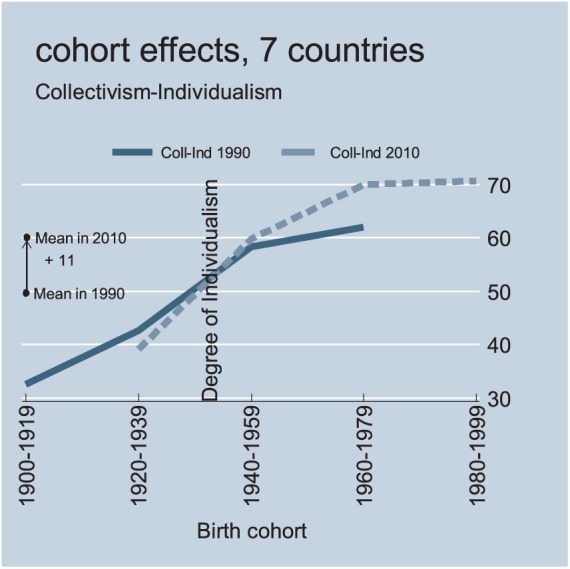
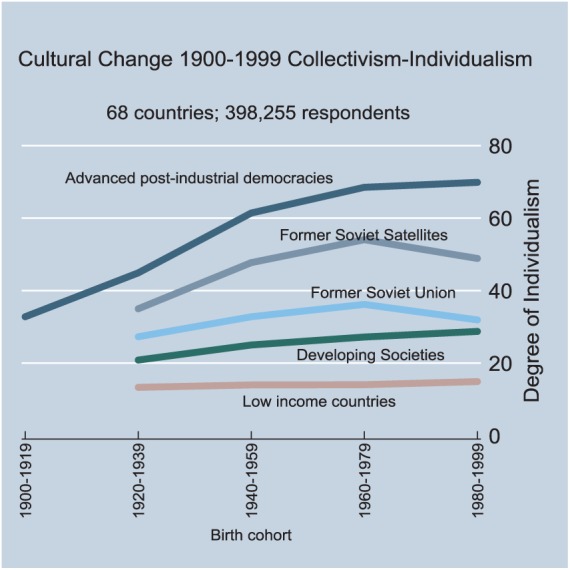
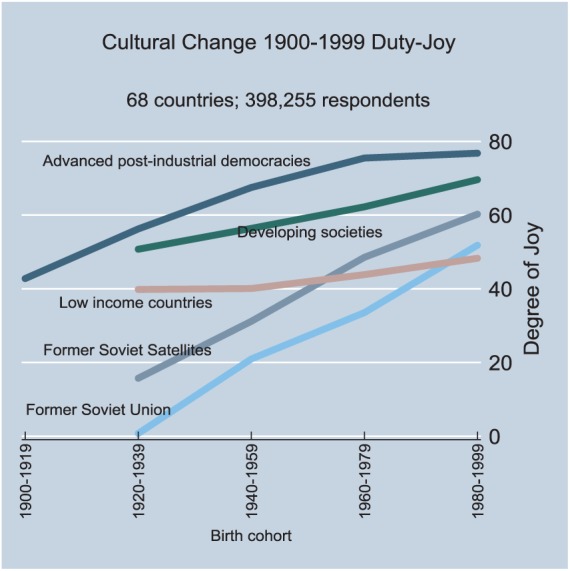
- For the youngest cohort (born after 1980), controlling for GDP per capita and country-fixed effects, scores are 25 points higher on Individualism/Joy and 17 points lower on Trust compared with the 1900–1920 cohort.
## Methods
- The study pools WVS and EVS data from 110 countries and 495,011 individuals surveyed between 1981 and 2014; respondents are grouped into five birth cohorts (1900–1919, 1920–1939, 1940–1959, 1960–1979, 1980–1999).
- The authors construct country-level cultural scores from attitude items, screen items by coverage and correlation with Hofstede’s dimensions, and use factor analysis (oblique rotation), reliability analysis, and rescaling to 0–100.
- To study change, they use fixed-effects panel models with GDP per capita, country-fixed effects, cohort-fixed effects, and cluster-adjusted standard errors, plus comparisons of earliest vs latest survey waves and a five-cohort analysis.
## Limitations
- The paper itself notes that the first cohort (1900–1919) has limited coverage for 21 countries, and that restricting analyses to countries with at least 15 years between first and last survey waves reduces sample size considerably.
- It also states that the study is conducted at the group level, and that aggregate dimensions are often impossible to replicate at the individual level within countries; this is presented as a general limitation of interpreting national-culture patterns.
- Evident from the text: some analyses rely on item exclusion/imputation because of missing wave or country coverage, including dropping items for limited coverage and imputing one missing item for 16 countries in the first dimension.
Model-written summary. Check it against the paper before relying on it.
Integrity signals
Registry
Cites
Statistics
Figures
Verification
Claims the paper makes
0 Valid · 4 Not valid · 51 Not checked · 147 Own results and interpretations
The cited sources that could be checked couldn’t confirm or dispute this claim.
In the paper
“while Hofstede’s dimensional concept neglects cultural dynamics”
§ Dimensions and Dynamics of National Culture: Synthesizing Hofstede With Inglehart > Abstract Cross-national research on cultural differences across space and time intersects multiple disciplines but the prominence of concepts varies by academic fields. Hofstede’s dimensional concept of culture, to begin with, dominates in cross-cultural psychology and international management. Inglehart’s dynamic concept of culture, by contrast, prevails in sociology and political science. We argue that this disciplinary division is unfortunate because the two concepts are complementary, for which reason a synthesis rectifies their mutual weaknesses. Indeed, while Hofstede’s dimensional concept neglects cultural dynamics, Inglehart’s dynamic concept is dimensionally reductionist. We demonstrate empirically that combining these two concepts leads to an improved understanding of cultural differences. Inspired by Hofstede’s cultural dimensions, we use data from the European Value Studies and World Values Surveys for 495,011 individuals born between 1900 and 1999 in 110 countries and then show that change on these dimensions proceeds as Inglehart and his collaborators suggest. Most notably, younger generations have become more individualistic and more joyous. But even though economic development and generational replacement drive this cultural change, roughly half of the variation in national cultural orientations is unique to each country, due to lasting intercept differences in developmental trajectories that trace back to remote historic drivers. We discuss the implications for cross-national cultural research.
What the sources say
- Not checked — no full text of the sourcecites Minkov & Hofstede, 2014 matched to “A replication of Hofstede's uncertainty avoidance dimension across nationally representative samples from Europe” (2014) source
- Could not verifycites Shenkar, 2001 matched to “Cultural Distance Revisited: Towards a More Rigorous Conceptualization and Measurement of Cultural Differences” (2001) sourceExperimental — accuracy not yet measured
Our copy of Shenkar (2001) criticises Hofstede's dimensional framework, but on other grounds: in Methodological Properties it lists the criticisms 'leveled against Hofstede, e.g., non-exhaustiveness, reliance on single company data, and the like', plus the Assumptions of Corporate Homogeneity, Spatial Homogeneity and Equivalence, and notes the Kogut & Singh index 'has not been updated to incorporate latter work by Hofstede and others' (the fifth dimension, Confucian dynamism/LTO). None of these states that Hofstede's dimensional concept neglects cultural dynamics or change over time; the only 'dynamics' usages refer to Confucian dynamism as a dimension and to corporate culture altering 'the dynamics of national CD' (Methodological Properties). Searched: cultural dynamics, static/dynamic framework, cultural change over time, temporal evolution, limitations of Hofstede's dimensions — no passage addresses the claim's point, so it can be neither confirmed nor contradicted from our copy. (LLM, conf=0.68)
- Not checked — no full text of the sourcecites Tung, 2008 matched to “The cross-cultural research imperative: the need to balance cross-national and intra-national diversity” (2008) source
plain- Asserted: passes — The authors put it forward as true.
- Checkable: passes — It can be checked against evidence.
- Load-bearing: passes — The paper’s conclusions depend on it.
- Based: passes — The paper gives a reason why it holds.
The paper states this without a source or data behind it here, so there is nothing to check it against. The quote shows it is in the paper.
In the paper
“From an empirical point of view, Hofstede’s six-dimensional framework (4 IBM-based + 2 WVS-based) consists of four dimensions (3 IBM-based + 1 WVS-based).”
§ Dimensions and Dynamics of National Culture: Synthesizing Hofstede With Inglehart > Hofstede’s Dimensions and Inglehart’s Dynamics > Hofstede’s National Cultural Dimensions and the Critique of His Framework
plain- Asserted: passes — The authors put it forward as true.
- Checkable: passes — It can be checked against evidence.
- Load-bearing: passes — The paper’s conclusions depend on it.
- Based: unclear — It is unclear why the paper says it holds.
A result the paper reports from its own data — it cites no other source for it, so there is none to check. The quote shows it is in the paper.
In the paper
“roughly half of the variation in national cultural orientations is unique to each country, due to lasting intercept differences in developmental trajectories that trace back to remote historic drivers.”
§ Dimensions and Dynamics of National Culture: Synthesizing Hofstede With Inglehart > Abstract Cross-national research on cultural differences across space and time intersects multiple disciplines but the prominence of concepts varies by academic fields. Hofstede’s dimensional concept of culture, to begin with, dominates in cross-cultural psychology and international management. Inglehart’s dynamic concept of culture, by contrast, prevails in sociology and political science. We argue that this disciplinary division is unfortunate because the two concepts are complementary, for which reason a synthesis rectifies their mutual weaknesses. Indeed, while Hofstede’s dimensional concept neglects cultural dynamics, Inglehart’s dynamic concept is dimensionally reductionist. We demonstrate empirically that combining these two concepts leads to an improved understanding of cultural differences. Inspired by Hofstede’s cultural dimensions, we use data from the European Value Studies and World Values Surveys for 495,011 individuals born between 1900 and 1999 in 110 countries and then show that change on these dimensions proceeds as Inglehart and his collaborators suggest. Most notably, younger generations have become more individualistic and more joyous. But even though economic development and generational replacement drive this cultural change, roughly half of the variation in national cultural orientations is unique to each country, due to lasting intercept differences in developmental trajectories that trace back to remote historic drivers. We discuss the implications for cross-national cultural research.
plainstates a causen = 495,011- Asserted: passes — The authors put it forward as true.
- Checkable: passes — It can be checked against evidence.
- Load-bearing: passes — The paper’s conclusions depend on it.
- Based: passes — The paper gives a reason why it holds.
A result the paper reports from its own data — it cites no other source for it, so there is none to check. The quote shows it is in the paper.
In the paper
“we use data from the European Value Studies and World Values Surveys for 495,011 individuals born between 1900 and 1999 in 110 countries and then show that change on these dimensions proceeds as Inglehart and his collaborators suggest.”
§ Dimensions and Dynamics of National Culture: Synthesizing Hofstede With Inglehart > Abstract Cross-national research on cultural differences across space and time intersects multiple disciplines but the prominence of concepts varies by academic fields. Hofstede’s dimensional concept of culture, to begin with, dominates in cross-cultural psychology and international management. Inglehart’s dynamic concept of culture, by contrast, prevails in sociology and political science. We argue that this disciplinary division is unfortunate because the two concepts are complementary, for which reason a synthesis rectifies their mutual weaknesses. Indeed, while Hofstede’s dimensional concept neglects cultural dynamics, Inglehart’s dynamic concept is dimensionally reductionist. We demonstrate empirically that combining these two concepts leads to an improved understanding of cultural differences. Inspired by Hofstede’s cultural dimensions, we use data from the European Value Studies and World Values Surveys for 495,011 individuals born between 1900 and 1999 in 110 countries and then show that change on these dimensions proceeds as Inglehart and his collaborators suggest. Most notably, younger generations have become more individualistic and more joyous. But even though economic development and generational replacement drive this cultural change, roughly half of the variation in national cultural orientations is unique to each country, due to lasting intercept differences in developmental trajectories that trace back to remote historic drivers. We discuss the implications for cross-national cultural research.
boostedstates a causen = 495,011- Asserted: passes — The authors put it forward as true.
- Checkable: passes — It can be checked against evidence.
- Load-bearing: passes — The paper’s conclusions depend on it.
- Based: passes — The paper gives a reason why it holds.
A result the paper reports from its own data — it cites no other source for it, so there is none to check. The quote shows it is in the paper.
In the paper
“LTO and IVR also form one factor in an ecological factor analysis.”
§ Dimensions and Dynamics of National Culture: Synthesizing Hofstede With Inglehart > Hofstede’s Dimensions and Inglehart’s Dynamics > Hofstede’s National Cultural Dimensions and the Critique of His Framework
plainstates an association- Asserted: passes — The authors put it forward as true.
- Checkable: passes — It can be checked against evidence.
- Load-bearing: passes — The paper’s conclusions depend on it.
- Based: passes — The paper gives a reason why it holds.
105 more claims
Create a free account to see all 202 claims and every source verdict.
- It may state two separate claims as one. 72
- Probably not a substantial claim. 29
Citations
Cites
Cultures and Organizations: Software of the Mind.
Triandis, H. C., & Hofstede, G. (1993) · Administrative Science Quarterly · doi:10.2307/2393257 · Cited by 17,696
Putnam, R. (2000) · doi:10.1145/358916.361990 · Cited by 17,114 · cited 1×
“Using the Trust label for this dimension resonates well with the vast literature on trust in economics (e.g., Zak & Knack, 2001), political science (e.g., Fukuyama, 1995; Putnam, 1993, 2000), and sociology (e.g., Delhey & Newton, 2005).”
Method(1997) · Naming the Mind: How Psychology Found its Language · doi:10.4135/9781446221815.n7 · Cited by 15,148
Making Democracy Work: Civic Traditions in Modern Italy
Stern, F., & Putnam, R. (1993) · Foreign Affairs · doi:10.2307/20045657 · Cited by 11,137
Trust: The Social Virtues and the Creation of Prosperity
Schneider, P. A., & Fukuyama, F. (1996) · Journal of Marketing · doi:10.2307/1251846 · Cited by 10,501
Culture's Consequences: International Differences in Work-Related Values
Gladwin, T. N., & Hofstede, G. (1981) · The Academy of Management Review · doi:10.2307/257651 · Cited by 9,275
Assessing construct validity in organizational research
Bagozzi, R. P., Yi, Y., & Phillips, L. W. (1991) · Administrative Science Quarterly · doi:10.2307/2393203 · Cited by 6,621 · cited 1×
“The correlations between the newly developed dimensions are lower than the correlations among the items included in each dimension, showing convergent and discriminant validity (Fornell & Larcker, 1981).”
BackgroundThe Effect of National Culture on the Choice of Entry Mode
Kogut, B., & Singh, H. (1988) · Journal of International Business Studies · doi:10.1057/palgrave.jibs.8490394 · Cited by 6,240 · cited 1×
“Second, cultural frameworks like ours have been used to develop a composite measure of cultural distance collapsing all cultural dimensions into a single Euclidean distance index (Beugelsdijk et al., 2017; Kogut & Singh, 1988).”
MethodRethinking individualism and collectivism: Evaluation of theoretical assumptions and meta-analyses.
Oyserman, D., Coon, H. M., & Kemmelmeier, M. (2002) · Psychological Bulletin · doi:10.1037/0033-2909.128.1.3 · Cited by 5,758
Making Democracy Work: Civic Traditions in Modern Italy
Putnam, R. D., Leonardi, R., & Nonetti, R. Y. (1994) · Princeton University Press eBooks · doi:10.2307/j.ctt7s8r7 · Cited by 5,580
Research works printed but not linked: 8
- Banfield E., 1958, Glencoe, illinois
- Diamond J., 1997, Guns, germs and steel
- Gelfand M., 2004, Culture, leadership and organizations: The GLOBE study of 62 societies, 438
- Greene W. H., 2008, Econometric analysis
- Hofstede G., 2001, Culture’s consequences: Comparing values, behaviors, institutions, and organizations across nations
- Inglehart R., 2003, Sacred and secular
- Nunnally J. C., 1994, Psychometric theory
- Schwartz S. H., 1994, Individualism and collectivism: Theory, method and applications, 85
Cited by
Items 301–400 of 455
Romana, F. A., Gestoso, C. G., & Lopes, A. (2025) · Journal of Intercultural Management · doi:10.2478/joim-2025-0003 · Cited by 1
Wang, C., Bakota, I., Buljan, I., & Shang, Y. (2025) · Frontiers in Sociology · doi:10.3389/fsoc.2025.1487913 · Cited by 2
“As Hofstede’s theory is still widely used and referred to by researchers and practitioners across disciplines (Beugelsdijk and Welzel, 2018), we adopted it as the analytical framework in this study.”
Eliyahu‐Levi, D., & Gvura, A. (2025) · Journal of Intercultural Communication · doi:10.36923/jicc.v25i3.1186 · Cited by 2
Prete, A. L., & Sacchi, A. (2025) · Kyklos · doi:10.1111/kykl.70027 · Cited by 3
“Summarising a long-standing debate in cross-cultural psychology and comparative sociology, we follow Beugelsdijk and Welzel (2018) who quantify cultural absolute and relative change.”
Pearl, M. (2025) · Social Sciences · doi:10.3390/socsci14120698 · Cited by 1
“Hofstede’s framework has been widely utilized in cultural studies, influencing numerous researchers globally (e.g., Beugelsdijk and Welzel 2018; Bond et al. 2004; House and Javidan 2004).”
Bratt, C. (2025) · Sociological Methods & Research · doi:10.1177/00491241251405869 · Cited by 2
Ghazali, I., Semiun, N., Tanjung, T., et al. (2025) · International Journal of Low-Carbon Technologies · doi:10.1093/ijlct/ctaf064 · Cited by 1
Acculturation and Educational Support for ASEAN Students in a Less-Developed Region of China
Wu, F. Z., & Teng, P. (2026) · SAGE Open · doi:10.1177/21582440251410431 · Cited by 1
“According to cultural distance theory (Beugelsdijk & Welzel, 2018) international students from countries with a smaller cultural distance to the host country tend to experience less culture shock and adapt more rapidly..”
Pinquart, M., & Nguyen, V. A. (2026) · Journal of Child and Family Studies · doi:10.1007/s10826-026-03281-6 · Cited by 4
Yi, J.-S. (2026) · Journal of Intercultural Communication · doi:10.36923/jicc.v26i1.1312 · Cited by 4
“Hofstede was the first scholar to quantify cultural orientations (Beugelsdijk & Welzel, 2018) through his original survey of cultural values initiated in the late 1960s (Cooper, Calloway-Thomas, & Simonds, 2007).”
InfluentialThe private solution trap in collective action problems across 34 nations
Malthouse, E., Pilgrim, C., Sgroi, D., Accerenzi, M., Alfonso, A., Ashraf, R. U., Baard, M., Banerjee, S., Belianin, A. V., Bhattacharjee, S., et al. (2026) · Proceedings of the National Academy of Sciences · doi:10.1073/pnas.2504632123 · Cited by 2
Sarihasan, İ. (2026) · Journal of Enterprising Communities People and Places in the Global Economy · doi:10.1108/jec-05-2024-0096 · Cited by 2
AKGÜR, T. (2026) · Kültür Araştırmaları Dergisi · doi:10.46250/kulturder.1860012 · Cited by 1
Navigating a demographically bifurcated multipolar world: labor, capital, and the multinational firm
Beugelsdijk, S., & Narula, R. (2026) · Journal of International Business Policy · doi:10.1057/s42214-026-00252-y · Cited by 1
“…theory has yet to reconcile with these ultra-low birth rates, in part because one of its underlying assumptions is that economic and social modernization–including gender norms - plays out in the same way across the world which others regard to be unrealistic (Beugelsdijk & Welzel, 2018).”
Self-citationValue foundations of experiencing stress and adaptation of students: Cross-cultural study
Koltunov, E. I., Gryazeva-Dobshinskaya, V. G., Dmitrieva, Y. A., et al. (2022) · The Education and science journal · doi:10.17853/1994-5639-2022-2-138-168 · Cited by 1
“Hofstede, используя данные, собранные с помощью проекта «Всемирный обзор ценностей», сокращая их количество до трех: дистанция власти; долг – радость; доверие – недоверие [13].”
Pengembangan Skala Nilai Budaya Jawa: Studi Kasus Abdi Dalem Keraton Surakarta
Lusiono, A., & Suhartanti, P. D. (2022) · E-Bisnis Jurnal Ilmiah Ekonomi dan Bisnis · doi:10.51903/e-bisnis.v15i1.673 · Cited by 5
Barbalat, G., & Liu, S. Y. (2022) · Current Psychology · doi:10.1007/s12144-022-04065-z · Cited by 1
“In particular, two cultural dimensions strongly linked to development may be related to the burden of mental disorders: so-called “indulgence” (vs. Restraint) and “individual-ism” (vs. Collectivism) (Beugelsdijk & Welzel, 2018; Hofst-ede, 2010).”
BackgroundMethodResultInfluentialIntercultural Differences in Road Safety Performance and Support for Road Safety Policy Measures
den Berghe, W. V. (2023) · IntechOpen eBooks · doi:10.5772/intechopen.109305 · Cited by 1
Susánszky, P., Kittel, B., & Kopper, Á. (2023) · International Journal of Comparative Sociology · doi:10.1177/00207152231187196 · Cited by 2
“…model fit statistics and the conditional probabilities of the latent classes are shown in Appendix A. 23 Following the discussion on value clusters (Beugelsdijk and Welzel, 2018; Rabušicová and Rabušic, 2001; Yu, 2015), we described and labeled the two latent classes as traditional or collectivist…”
BackgroundEvolutionary research confirms that a need for collective action increases puritanism
Fog, A. (2023) · Behavioral and Brain Sciences · doi:10.1017/s0140525x2300050x · Cited by 1
Mai, C., Chen, D., Olivos, F., & Chen, A. X. (2023) · Gerontology · doi:10.1159/000534680 · Cited by 1
“Previous studies have shown that China made more progress towards collectivism compared with the USA from 1981 to 2014 [30, 31].”
ResultJabarkhail, S., Dirani, K. M., & Ehsas, H. (2023) · Human Resource Development International · doi:10.1080/13678868.2023.2279888 · Cited by 2
“Regardless of its critique (Beugelsdijk and Welzel 2018; Gerlach and Eriksson 2021), VSM-2013 serves as a valuable tool for researchers and professionals in empirically exploring culture across various contexts.”
The effect of national culture on SME competitive dynamics
Upson, J. W., Ndemo, B., lobo, R., Fadil, N., & Green, K. M. (2023) · Journal of global entrepreneurship research · doi:10.1007/s40497-023-00368-y · Cited by 2
“In contrast, collectivist societies foster strong bonds within tightly-knit in-groups from birth, such as family, clans, and organizations (Beugelsdijk & Welzel, 2018).”
BackgroundWasti, S. A., & Erdil, S. E. (2024) · Oxford University Press eBooks · doi:10.1093/oxfordhb/9780190085384.013.8 · Cited by 1
Baorui, S., Zhiyuan, Z., & Zhao, L. (2024) · American Journal of Economics and Sociology · doi:10.1111/ajes.12567 · Cited by 1
Preferred Leadership Behavior in the Serbian Setting: A Cross-Regional Perspective
Stošić, D., & Simić, I. (2024) · Cross-Cultural Research · doi:10.1177/10693971241262065 · Cited by 1
“While Hofstede ’ s model faced substantial criticism in the literature (Kaasa et al., 2014), it remains the most widely used model of national culture and continues to dominate cross-cultural psychology and international management (Beugelsdijk & Welzel, 2018).”
A model-driven approach for prospective ergonomics: application to ikigai robotics
Buisine, S., Sartore, M., Ocnarescu, I., & Joly, L.-R. (2024) · Ergonomics · doi:10.1080/00140139.2024.2418960 · Cited by 5
“…up to individual empowerment, which is modelled as a universalist self-driven automatism by which human mind adjusts to its existential condition (Beugelsdijk and Welzel 2018). these principles of modernisation and universalism may be challenged by a multipolar, post-liberal world order…”
Cultural Drivers of Vice–Virtue Preferences: The Role of Justification and Trait Self‐Control
Heydari, A., Laroche, M., Paulin, M., & Richard, M. (2025) · Psychology and Marketing · doi:10.1002/mar.70032 · Cited by 3
“Extending this perspective, on the indulgence end of the continuum, societies impose fewer constraints on gratification and value individual freedom of choice (Beugelsdijk and Welzel 2018; Hofstede et al. 2010; Minkov 2007, 2011).”
InfluentialConsumer Lifestyle Forming Under the Influence of National Culture
Šapić, S., Lazarević, J., & Marinković, V. (2021) · Management Journal of Sustainable Business and Management Solutions in Emerging Economies · doi:10.7595/management.fon.2021.0028 · Cited by 3
“Uncertainty avoidance indicates how strongly people feel the need to operate under well-organized and predictable circumstances or how much they are able to cope with unplanned situations (Beugelsdijk & Welzel, 2018).”
BackgroundNguyen-Phuong-Mai, M. (2021) · Frontiers in Psychology · doi:10.3389/fpsyg.2021.644145 · Cited by 3
Conflict Resolution Styles and Organisational Performance: The Mediating Role of Cultural Factor
Sinnaiah, T., Adam, S., & Mahadi, B. (2023) · International Journal of Academic Research in Business and Social Sciences · doi:10.6007/ijarbss/v13-i1/16156 · Cited by 3
Götz, F. M., Ebert, T., Gosling, S. D., Obschonka, M., & Rentfrow, P. J. (2021) · doi:10.31234/osf.io/7wt89 · Cited by 1
Rings, G., & Rasinger, S. (2020) · Cambridge University Press eBooks · doi:10.1017/9781108555067.007 · Cited by 1
Social interactions, loneliness and collective health: A new angle on an old debatePreprint
Kovačič, M., & Casabianca, E. J. (2023) · Research Square · doi:10.21203/rs.3.rs-2814409/v1 · Cited by 1
Social Capital, Institutional Rules, and Constitutional Amendment RatesPreprint
Blake, W. D., Cozza, J. F., Armstrong, D. A., et al. (2023) · doi:10.33774/apsa-2021-kcnvt-v2 · Cited by 1
Does National Culture Influence Malfeasance in Banks Around the World?Preprint
Conlon, T., Huan, X., & Muckley, C. B. (2023) · SSRN Electronic Journal · doi:10.2139/ssrn.4545089 · Cited by 1
Experimental Economics of CulturePreprint
Chuah, S., & Hoffmann, R. F. (2024) · SSRN Electronic Journal · doi:10.2139/ssrn.4814739 · Cited by 1
The significance of cultural risks for Western consultants executing GCC megaprojects
Walsh, A., & Walker, P. (2020) · University of Salford Institutional Repository (University of Salford) · Cited by 1
The Emigration of Pro-social Behaviors: A Comparative Analysis of Colombian and US Latter-day Saints
Heist, H. D., Cnaan, R. A., Ruiz, A. S., & Evans, V. C. (2020) · VOLUNTAS International Journal of Voluntary and Nonprofit Organizations · doi:10.1007/s11266-020-00243-4
Cross-Cultural Issues and Human Resources Management in BRIC Countries
Awalluddin, M. A. (2020) · Journal of Applied Economics and Business Studies · doi:10.34260/jaebs.433 · Cited by 3
“While a study done by (Beugelsdijk & Welzel, 2018; Lee Park & Paiva, 2018) indicate that Brazil has shifted toward individualism, while there is a consistent result for Russia, China and India for collectivism.”
ResultThree Essays on the Role of Indulgence vs. Restraint in Consumer Behavior
Heydari, A. (2020) · Spectrum Research Repository (Concordia University) · Cited by 3
Caza, A., & Posner, B. Z. (2021) · International Journal of Business Administration · doi:10.5430/ijba.v12n6p17
“While these clusters clearly contain significant heterogeneity, they are nonetheless similar enough in shared values, economic development, generational effects, and geo-political history to be identifiable groups (Beugelsdijk & Welzel, 2018).”
BackgroundMethodResultInfluentialOptimal COVID RestrictionsPreprint
Montone, M., & Potì, V. (2022) · SSRN Electronic Journal · doi:10.2139/ssrn.4016302
Obschonka, M., Fritsch, M., & Stuetzer, M. (2021) · Edward Elgar Publishing eBooks · doi:10.4337/9781788973380.00013
Millennials ¿similares o diferentes? Inclinación al individualismo en una sociedad colectivista
Aguilar-Rodríguez, I. E., Artieda-Cajilema, C. H., & Aguinaga, A. A. (2022) · Estudios de la Gestión revista internacional de administración · doi:10.32719/25506641.2022.12.9 · Cited by 4
How WEIRD is the US and why does this matter for the rest of the world?Preprint
van Pinxteren, B. (2022) · doi:10.32388/y9dpff
Zhu, J., Wang, Y., & Han, P. (2022) · International Journal of Science and Engineering Applications · doi:10.7753/ijsea1112.1019
Where might brewers make better managers than MBAs ?
Behrens, A. (2022) · Thunderbird International Business Review · doi:10.1002/tie.22324
De-marginalising Social-Democracy: The Recovery of Collectivity in Europe During Covid-19 Pandemic
Miternique, H. C. (2022) · Perspectives on geographical marginality · doi:10.1007/978-3-031-11139-6_3
Inoguchi, T. (2022) · Springer eBooks · doi:10.1007/978-981-19-5466-5_5
Gastronomy Tourist Behavior in Macao as the “UNESCO Creative City of Gastronomy”
Jiang, V. W., & Leou, E. C.-H. (2023) · Springer proceedings in business and economics · doi:10.1007/978-3-031-29426-6_33
Informal Institution on the Extension of Value Transformation: Experiences from Developing Countries
Rahman, A., & Aaneela, R. S. (2023) · South Asian Journal of Social Sciences and Humanities · doi:10.48165/sajssh.2023.4307 · Cited by 1
Introducing Cultural Tolerance: Developing a Composite Index and Exploring its Impact
Avloniti, A., Anaxagorou, C., & Theocharous, S. (2023) · Academy of Management Proceedings · doi:10.5465/amproc.2023.17118abstract
International Communication Path of Chinese Minority Culture
Yang Liu1, C. L. (2023) · International Journal of Frontiers in Sociology · doi:10.25236/ijfs.2023.050914
“The diversity of culture is considered a common property of humanity [14-16], and China’s national culture has become an important symbol internationally with its unique ethnic cultural characteristics.”
BackgroundIntroduction: The Emergence of the Creative Society
Andersson, D. E. (2023) · Palgrave studies in classical liberalism · doi:10.1007/978-3-031-46050-0_1
Is it all about the costs? Cultural distance and adjustment of recent migrantsPreprint
Genoni, A., Décieux, J. P., & Murdock, E. (2023) · SocArXiv (OSF Preprints) · doi:10.31235/osf.io/uskq9
Калининградцы: «особый» социум и его жизненные принципы
Вендина, О., & Гриценко, А. (2023) · Zhurnal Sotsiologii i Sotsialnoy Antropologii (The Journal of Sociology and Social Anthropology) · doi:10.31119/jssa.2023.26.4.3
Ashley, N. (2023) · ResearchSpace (University of KwaZulu-Natal) · doi:10.29086/10413/22590
Saari, L. M. (2024) · Oxford University Press eBooks · doi:10.1093/oxfordhb/9780190085384.013.28
CONSEPTUAL FRAMEWORK OF THE RUSSIAN LEGAL AWARENESS AND LEGAL MYTH "LEGAL NIHILISM"
Belozerova, N., & Sotnikov, A. (2024) · Psychological and pedagogical problems of human and social security · doi:10.61260/2074-1618-2024-2023-4-38-46
Antal, M., Lehmann, B., Guimarães, T., et al. (2024) · Revista Internacional del Trabajo · doi:10.1111/ilrs.12300
Travailler moins? Revue systématique des préférences et décisions en matière de temps de travail
Antal, M., Lehmann, B., Guimarães, T., et al. (2024) · Revue internationale du Travail · doi:10.1111/ilrf.12299
Spaces of Cultural Confluence: Performative Elements of Leadership
Vonk, A., & Silva, V. F. (2024) · Palgrave Studies in African Leadership · doi:10.1007/978-3-031-45403-5_8
Culture, Financial Literacy, and Leverage of Small FirmsPreprint
Basha, S. A., Ben‐Nasr, H., & Goaïed, M. (2024) · SSRN Electronic Journal · doi:10.2139/ssrn.4806960
A radiography of the value register of future teacher students
Ilie, V., & FRĂSINEANU, E. S. (2024) · Analele Universității din Craiova seria Psihologie-Pedagogie/Annals of the University of Craiova Series Psychology- Pedagogy · doi:10.52846/aucpp.2024.1.03
Measuring Shared Collective Knowledge and Belief Systems
Maltseva, K. (2024) · Culture, mind, and society · doi:10.1007/978-3-031-48181-9_8
Household Sector Innovation, Diffusion Failure and Business Ownership: Evidence from South AfricaPreprint
de Jong, J. P. J., Cowen, D. R., Onyango, L., et al. (2024) · SSRN Electronic Journal · doi:10.2139/ssrn.4867555
ASEE 2024 Paper—Examining Cultural Elements to Enable Change
Jamieson, M. V., & Donald, J. R. (2024) · ASEE Annual Conference & Exposition · doi:10.18260/1-2--46599 · Cited by 1
“In their empirical analysis, Beuglisdijk and Welzer [41] found they are opposite poles of the same dimension.”
BackgroundMethodInfluentialSocioeconomic development and the evolution of workplace values in contemporary Poland
Woldu, H. G., Skuza, A., & Budhwar, P. S. (2024) · European Management Review · doi:10.1111/emre.12670
Epaminonda, E. (2024) · International Journal of Cross Cultural Management · doi:10.1177/14705958241267139
A kultúra hatásának vizsgálata a tudásmegosztásra Magyarország és Svédország esetében
Vágner, V., & Bencsik, A. (2024) · Vezetéstudomány / Budapest Management Review · doi:10.14267/veztud.2024.10.05
What is the Recipe for High or Low General Trust?
Kaasa, A. (2024) · International Journal of Sociology · doi:10.1080/00207659.2024.2429240
“It was first introduced by Hofstede (1980), but then recreated by many authors, for example, Schwartz (1994, 2004), Minkov et al. (2017), and Beugelsdijk and Welzel (2018).”
"Success" as a socio-cultural category: the Russian and Chinese value systems
RARENKO, A. A. (2025) · Proceedings of the Southwest State University Series Economics Sociology and Management · doi:10.21869/2223-1552-2024-14-6-203-212
Kao, Y. (2025) · Information Communication & Society · doi:10.1080/1369118x.2025.2462781
The Post-2021 Afghan Situation: Romanian Students’ Knowledge, Views and Cultural Receptiveness
Şimon, S., Dragomir, G.-M., & Fărcașiu, M. A. (2025) · Societies · doi:10.3390/soc15030058
Ahrweiler, P., Abe, J., & Neumann, M. (2025) · Artificial intelligence, simulation and society · doi:10.1007/978-3-031-71678-2_1
Household sector innovation, diffusion failure, and business ownership: evidence from South Africa
de Jong, J. P. J., Mulhuijzen, M., Cowen, D. R., Onyango, L., & Kraemer‐Mbula, E. (2025) · Science and Public Policy · doi:10.1093/scipol/scaf009 · Cited by 1
Ljubica, J., Littrell, R. F., Chen, C., & Jiang, S. (2025) · Asia Pacific Journal of Management · doi:10.1007/s10490-025-10024-6
“Chinese also traditionally score lower in Indulgence and moderately in Uncertainty Avoidance and Femininity (Beugelsdijk et al., 2018; Fang, 2015; Hwang, 2012).”
InfluentialJob preferences of international science and engineering students: a discrete-choice experiment
Özer, M. N., & de Grip, A. (2025) · International Journal of Manpower · doi:10.1108/ijm-05-2024-0341
Osiobe, E. U., Noor, S. A., Malallah, S. A., et al. (2025) · SSRN Electronic Journal · doi:10.2139/ssrn.5191098
Die soziale Dimension des Lebenssinns
Schnell, T. (2025) · Springer eBooks · doi:10.1007/978-3-662-70097-6_8
Descifrando las dinámicas culturales de América del Sur: análisis de la escala de valores culturales
Contreras, C. R., Oliva, E. J. D., da Cunha, C. F., & Borges, M. D. L. (2025) · ReMark - Revista Brasileira de Marketing · doi:10.5585/2025.25672
Decoding cultural dynamics in South America: Cultural values scale analysis
Contreras, C. R., Oliva, E. J. D., da Cunha, C. F., & Borges, M. D. L. (2025) · ReMark - Revista Brasileira de Marketing · doi:10.5585/2025.28486 · Cited by 2
Brockinton, A., Salnitri, M., Kooner-Evans, F., McAlaney, J., & Thompson, S. (2025) · Technology in Society · doi:10.1016/j.techsoc.2025.103000 · Cited by 2
Conclusions: New insights about failure learning and areas of future research
Dahlin, K., & Chuang, Y. (2025) · Oxford University Press eBooks · doi:10.1093/9780191995170.003.0013
Business Crises in Europe and Asia: The Role of Aggressive Expansion
Hernik, J., Mazur, R., Mínguez‐Vera, A., Grīnberga-Zālīte, G., Bąk, I. D., & Oesterreich, M. (2025) · International Journal of Contemporary Management · doi:10.2478/ijcm-2025-0001
“The concept posits that individualism is characterized by a loosely-knit social framework that emphasizes individual achievement and self-reliance, while power distance relates to a society’s acceptance of unequal power distribution in organizations and institutions (Beugelsdijk and Welzel, 2018).”
Conceptualizing Cultural Food and Nutrition Security: Implications for Collectivist Cultures
Gingell, T., & Gallegos, D. (2025) · Springer eBooks · doi:10.1007/978-3-031-32047-7_51-1
High-Skill Jobs and Favoritism: A Mixed-Method Analysis
Sadigov, T. (2025) · Public Organization Review · doi:10.1007/s11115-025-00872-7
“An alternative measure of Individualism-collectivism (Beugelsdijk & Welzel, 2018; Hofstede, 1997) proves inadequate because of limited country coverage.”
Evaluating Consumer Markets: Macro, Micro, and Cultural Analyses
Bagozzi, R. P., & Yaprak, A. (2025) · International Marketing and Management Research · doi:10.1007/978-3-031-93185-7_7
remy, J. P. V. (2025) · SSRN Electronic Journal · doi:10.2139/ssrn.5388474
Uncertain Times, Decentralized Choices: Local Geopolitical Risk and Cryptocurrency ActivitiesPreprint
Huynh, N., & Huynh, N. A. (2025) · SSRN Electronic Journal · doi:10.2139/ssrn.5386928 · Cited by 1
Derkenbaeva, E., Yoo, H. K., Hofstede, G. J., Galanakis, K., & Ackrill, R. (2025) · JCMS Journal of Common Market Studies · doi:10.1111/jcms.13769 · Cited by 1
Koban, K. (2025) · Mobile Media & Communication · doi:10.1177/20501579251378561 · Cited by 1
“…toward individualism (including in Indonesia) (Santos et al., 2017), which may be particularly pronounced among today ’ s youth, who already tend toward individualist values (Beugelsdijk & Welzel, 2018), challenging whether categorizations of individualist and collectivist countries are valid.”
Amidžić, R., Leković, B., Fazekaš, T., Petković, S., & Glavaš, J. (2025) · Strategic Management · doi:10.5937/straman2500009a · Cited by 1
Lemma, T., Muttakin, M. B., & Mihret, D. G. (2025) · Journal of Accounting Literature · doi:10.1108/jal-09-2024-0245
Bouderbala, R., Eljammi, J., & Gherib, J. (2020) · Social Business · doi:10.1362/204440820x15929907056742 · Cited by 12
Cross Cultural Management Practices in International Business: Challenges and Strategies
Sheng, L. (2025) · Journal of Digitainability Realism & Mastery (DREAM) · doi:10.56982/dream.v4i10.319
“Recent studies continue to apply Hofstede’s framework to analyze international business challenges, although critics note its limitations in addressing intra-country variations and evolving cultural contexts (Beugelsdijk & Welzel, 2018).”
Socioeconomic Status, Collectivism, and Prosocial Civic EngagementPreprint
Tak, H. (2025) · SSRN Electronic Journal · doi:10.2139/ssrn.5930157
Metadata
- Authors
- Beugelsdijk, S., & Welzel, C.
- Affiliations
- University of Groningen (NL)
- Leuphana University of Lüneburg, Germany
- Corresponding author
- Beugelsdijk, Sjoerd
- Venue
- Journal of Cross-Cultural Psychology
- Publisher
- SAGE Publications
- Published
- 2018-10-02
- Volume
- 49
- Issue
- 10
- Pages
- 1469-1505
- ISSN
- 0022-0221 (ISSN-L)
- 1552-5422
- PMC
- PMC6191680
- OpenAlex
- W2895010120
- Semantic Scholar
- 184b6ce25f1e5968ea64b262eaf307142b51f38c
- Cited by
- 461
- References
- 113
- Citations by year
- 2026: 60 · 2025: 77 · 2024: 63 · 2023: 64 · 2022: 73 · 2021: 69 · 2020: 38 · 2019: 15 · 2018: 1
- FWCI
- 41.73
- Type
- journal article
- Language
- en
- Open access
- hybrid
- doi.org
- Licence
- cc-by-nc
- journals.sagepub.com/page/policies/text-and-data-mining-license (tdm)
- Locations
- Journal of Cross-Cultural Psychology (publishedVersion, cc-by-nc)
- Europe PMC (PubMed Central) (publishedVersion, cc-by-nc)
- PubMed Central (publishedVersion, cc-by-nc)
- PubMed (publishedVersion)
- University of Groningen research database (University of Groningen / Centre for Information Technology) (publishedVersion, cc-by-nc)
- Multilingual Matters (Channel View Publications) (submittedVersion, cc-by-nc)
- University of Groningen research database (University of Groningen / Centre for Information Technology) (submittedVersion, cc-by-nc)
- Funders
- Nederlandse Organisatie voor Wetenschappelijk Onderzoek (VIDI 452-11-010)
- Topics
- Social Sciences › Psychology › Social Psychology › Cultural Differences and Values
- Social Sciences › Development › Culture, Economy, and Development Studies
- Social Sciences › Business, Management and Accounting › Business and International Management › Global and Cross-Cultural Management
- Keywords
- national culture, Hofstede cultural dimensions, cultural dynamics, cross-cultural comparison, individualism, joy, generational change, economic development, cultural trajectories, World Values Survey, interdisciplinary synthesis
About these checks
Registry, retraction, Cites and statistics results are computed, not judged, with one exception: a printed reference that no index lists is read once by a model before it counts as a citation error. Claims are extracted by a model and kept only when their quote appears verbatim in the text; each cited source is then checked, with a model’s help, for whether it says what the claim relies on. Those verdicts can be wrong — read the claim’s quote and the cited source before relying on one.
The claim verdicts this report counts are experimental: their accuracy is not yet measured.
A language model drew the claims from the paper on 2026-10-10, under version 3 of the claim definition (model deepseek-v4.1-flash, prompt extract-v3).
A second model labelled each claim on 2026-10-10 (model jev-1.13-20260917, definition revision gold-guideline-v0.2).
Cited sources are checked with a language model’s help (qwen3.8-omni-flash).
Statistics and arithmetic are recomputed, not judged.
Confidence bands are shown only for fields calibrated on our annotated test set. None is calibrated yet, so no band is shown.
What counts as a claim ›How we measure confidence ›How we check this ›
Are you an author, or do you see a problem with this page? Request a review
Data sources
Bibliographic data: Semantic Scholar, OpenAlex, Crossref.
Contains information from the Semantic Scholar Academic Graph Datasets, made available under the ODC Attribution License (ODC-BY 1.0).
Semantic Scholar’s data is described in: Kinney, R., et al. (2023). The Semantic Scholar Open Data Platform. arXiv:2301.10140.
