

Dimensions and Dynamics of National Culture: Synthesizing Hofstede With Inglehart
Open accessThe DOI matches its Crossref record; 115 of the 115 references it cites were found in a registry or an index; 1 of the 66 sources its claims cite were checked for support.
Abstract
Cross-national research on cultural differences across space and time intersects multiple disciplines but the prominence of concepts varies by academic fields. Hofstede’s dimensional concept of culture, to begin with, dominates in cross-cultural psychology and international management. Inglehart’s dynamic concept of culture, by contrast, prevails in sociology and political science. We argue that this disciplinary division is unfortunate because the two concepts are complementary, for which reason a synthesis rectifies their mutual weaknesses. Indeed, while Hofstede’s dimensional concept neglects cultural dynamics, Inglehart’s dynamic concept is dimensionally reductionist. We demonstrate empirically that combining these two concepts leads to an improved understanding of cultural differences. Inspired by Hofstede’s cultural dimensions, we use data from the European Value Studies and World Values Surveys for 495,011 individuals born between 1900 and 1999 in 110 countries and then show that change on these dimensions proceeds as Inglehart and his collaborators suggest. Most notably, younger generations have become more individualistic and more joyous. But even though economic development and generational replacement drive this cultural change, roughly half of the variation in national cultural orientations is unique to each country, due to lasting intercept differences in developmental trajectories that trace back to remote historic drivers. We discuss the implications for cross-national cultural research.
Overview
CoChat Summary
## TL;DR
The paper synthesizes Hofstede’s cultural dimensions with Inglehart’s theory of cultural change and re-estimates national culture using WVS/EVS data for 110 countries and 495,011 individuals. It reduces Hofstede’s six dimensions to three, and finds that cultures have generally shifted toward more Individualism and Joy, while Trust has declined somewhat; about half of the variation is linked to economic development and generational change, and about half to country-specific historical/geographic factors.
## Key findings
- Factor analysis of 15 WVS-EVS items yields three factors (n = 63 countries in the factor analysis), with eigenvalues 4.9, 3.2, and 2.5; the fourth factor drops below 1 (.89) and the three-factor model has the best BIC.
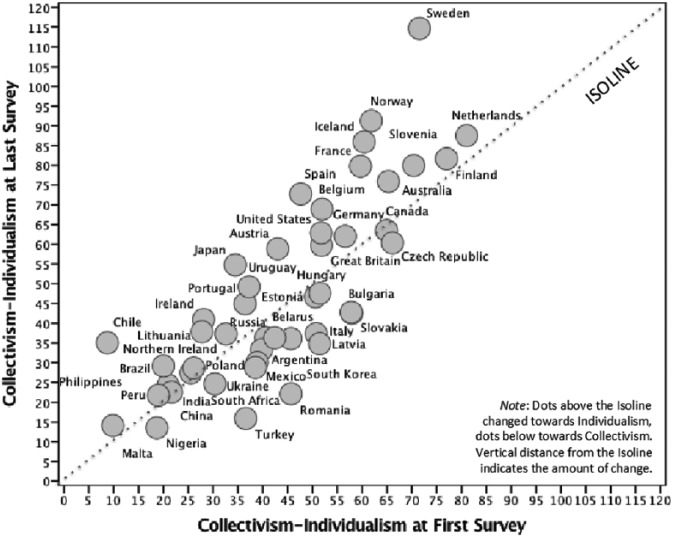
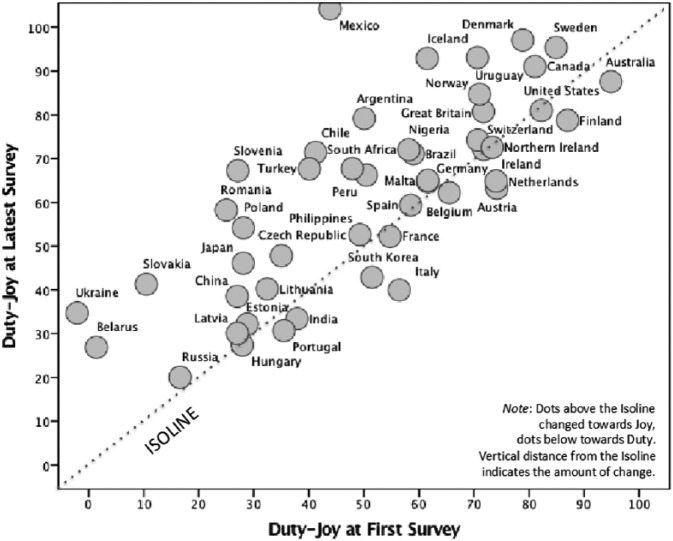
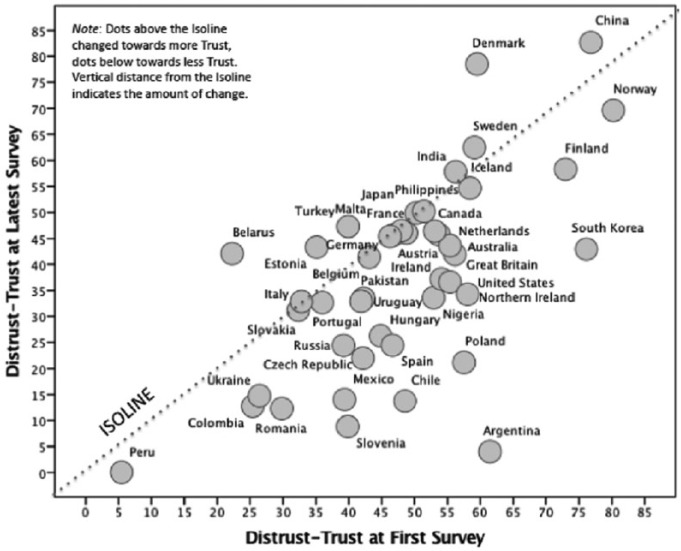
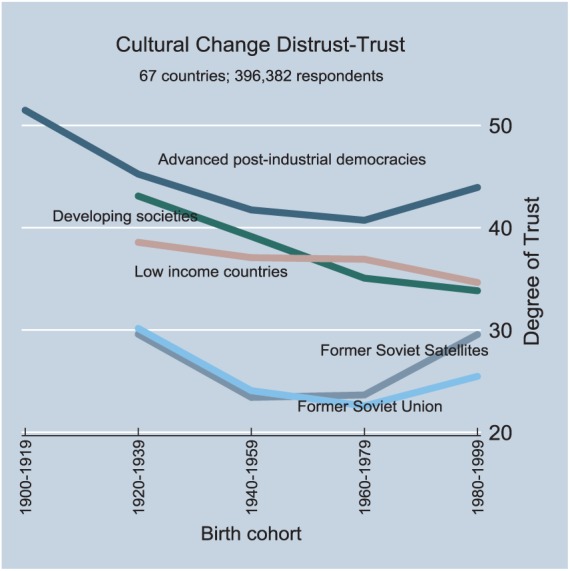
- The three dimensions are Collectivism–Individualism, Duty–Joy, and Distrust–Trust; the paper reports Cronbach’s alphas of .87, .77, and .75, respectively.
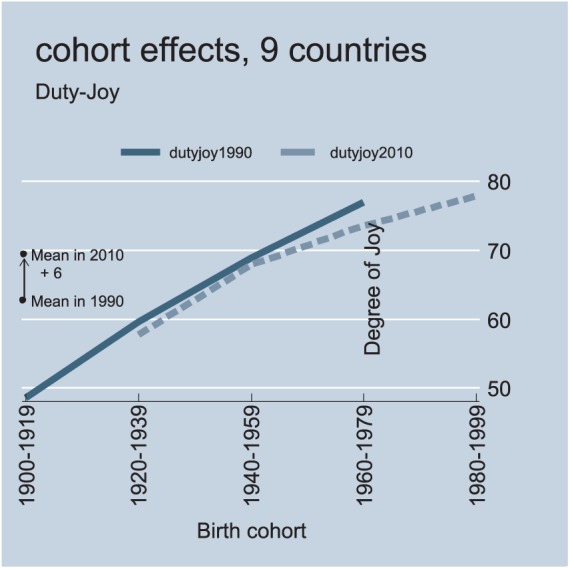
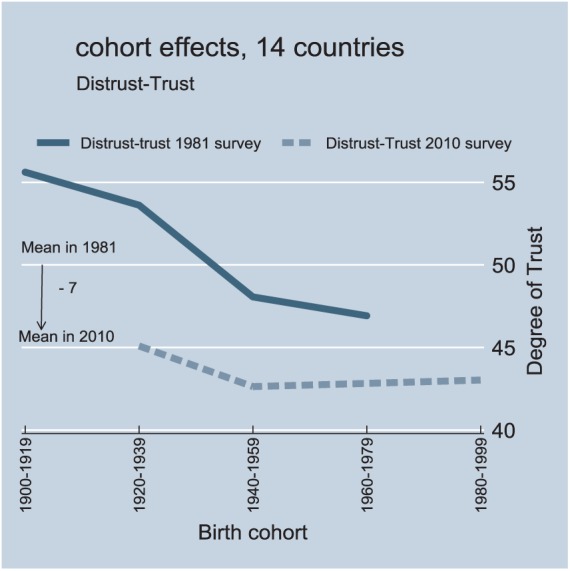
- Over at least 15 years, country scores change by +4 points on Collectivism–Individualism (44 to 48, N = 46 countries), +11 points on Duty–Joy (N = 47), and -10 points on Distrust–Trust (N = 44).
- In the panel models, GDP per capita is significantly related to Collectivism–Individualism (β = 3.30; p < .01) and Duty–Joy (β = 9.29; p < .001), and marginally to Distrust–Trust (β = 2.76; p < .10).
- The paper reports that approximately 50% of the variation in Collectivism–Individualism and Duty–Joy is explained by GDP per capita and cohort-fixed effects, with the other 50% explained by country-fixed effects; for Distrust–Trust, country-fixed effects account for the largest share.
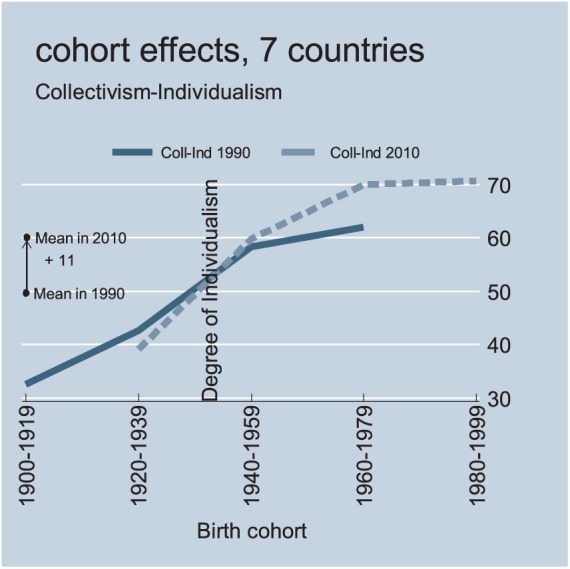
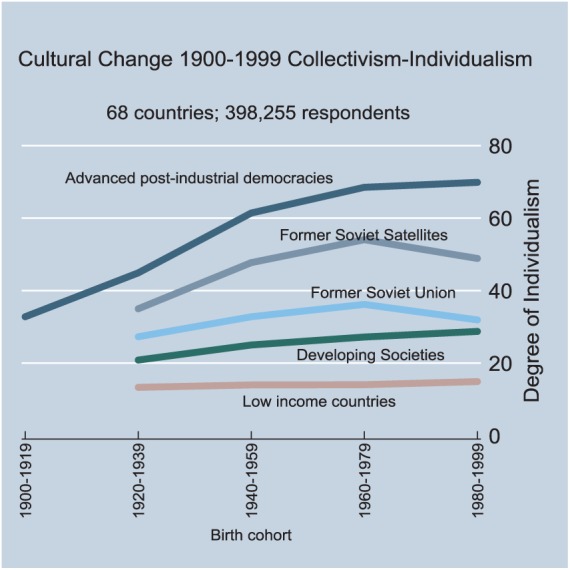
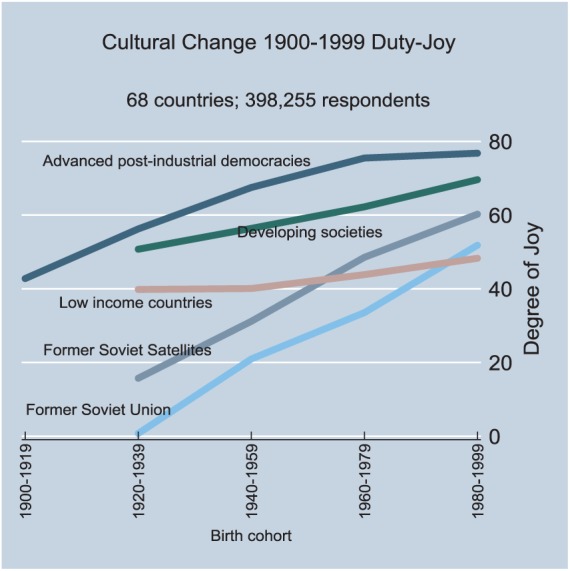
- For the youngest cohort (born after 1980), controlling for GDP per capita and country-fixed effects, scores are 25 points higher on Individualism/Joy and 17 points lower on Trust compared with the 1900–1920 cohort.
## Methods
- The study pools WVS and EVS data from 110 countries and 495,011 individuals surveyed between 1981 and 2014; respondents are grouped into five birth cohorts (1900–1919, 1920–1939, 1940–1959, 1960–1979, 1980–1999).
- The authors construct country-level cultural scores from attitude items, screen items by coverage and correlation with Hofstede’s dimensions, and use factor analysis (oblique rotation), reliability analysis, and rescaling to 0–100.
- To study change, they use fixed-effects panel models with GDP per capita, country-fixed effects, cohort-fixed effects, and cluster-adjusted standard errors, plus comparisons of earliest vs latest survey waves and a five-cohort analysis.
## Limitations
- The paper itself notes that the first cohort (1900–1919) has limited coverage for 21 countries, and that restricting analyses to countries with at least 15 years between first and last survey waves reduces sample size considerably.
- It also states that the study is conducted at the group level, and that aggregate dimensions are often impossible to replicate at the individual level within countries; this is presented as a general limitation of interpreting national-culture patterns.
- Evident from the text: some analyses rely on item exclusion/imputation because of missing wave or country coverage, including dropping items for limited coverage and imputing one missing item for 16 countries in the first dimension.
Model-written summary. Check it against the paper before relying on it.
Integrity signals
Registry
Cites
Statistics
Figures
Verification
Claims the paper makes
0 Valid · 4 Not valid · 51 Not checked · 147 Own results and interpretations
The cited sources that could be checked couldn’t confirm or dispute this claim.
In the paper
“while Hofstede’s dimensional concept neglects cultural dynamics”
§ Dimensions and Dynamics of National Culture: Synthesizing Hofstede With Inglehart > Abstract Cross-national research on cultural differences across space and time intersects multiple disciplines but the prominence of concepts varies by academic fields. Hofstede’s dimensional concept of culture, to begin with, dominates in cross-cultural psychology and international management. Inglehart’s dynamic concept of culture, by contrast, prevails in sociology and political science. We argue that this disciplinary division is unfortunate because the two concepts are complementary, for which reason a synthesis rectifies their mutual weaknesses. Indeed, while Hofstede’s dimensional concept neglects cultural dynamics, Inglehart’s dynamic concept is dimensionally reductionist. We demonstrate empirically that combining these two concepts leads to an improved understanding of cultural differences. Inspired by Hofstede’s cultural dimensions, we use data from the European Value Studies and World Values Surveys for 495,011 individuals born between 1900 and 1999 in 110 countries and then show that change on these dimensions proceeds as Inglehart and his collaborators suggest. Most notably, younger generations have become more individualistic and more joyous. But even though economic development and generational replacement drive this cultural change, roughly half of the variation in national cultural orientations is unique to each country, due to lasting intercept differences in developmental trajectories that trace back to remote historic drivers. We discuss the implications for cross-national cultural research.
What the sources say
- Not checked — no full text of the sourcecites Minkov & Hofstede, 2014 matched to “A replication of Hofstede's uncertainty avoidance dimension across nationally representative samples from Europe” (2014) source
- Could not verifycites Shenkar, 2001 matched to “Cultural Distance Revisited: Towards a More Rigorous Conceptualization and Measurement of Cultural Differences” (2001) sourceExperimental — accuracy not yet measured
Our copy of Shenkar (2001) criticises Hofstede's dimensional framework, but on other grounds: in Methodological Properties it lists the criticisms 'leveled against Hofstede, e.g., non-exhaustiveness, reliance on single company data, and the like', plus the Assumptions of Corporate Homogeneity, Spatial Homogeneity and Equivalence, and notes the Kogut & Singh index 'has not been updated to incorporate latter work by Hofstede and others' (the fifth dimension, Confucian dynamism/LTO). None of these states that Hofstede's dimensional concept neglects cultural dynamics or change over time; the only 'dynamics' usages refer to Confucian dynamism as a dimension and to corporate culture altering 'the dynamics of national CD' (Methodological Properties). Searched: cultural dynamics, static/dynamic framework, cultural change over time, temporal evolution, limitations of Hofstede's dimensions — no passage addresses the claim's point, so it can be neither confirmed nor contradicted from our copy. (LLM, conf=0.68)
- Not checked — no full text of the sourcecites Tung, 2008 matched to “The cross-cultural research imperative: the need to balance cross-national and intra-national diversity” (2008) source
plain- Asserted: passes — The authors put it forward as true.
- Checkable: passes — It can be checked against evidence.
- Load-bearing: passes — The paper’s conclusions depend on it.
- Based: passes — The paper gives a reason why it holds.
The paper states this without a source or data behind it here, so there is nothing to check it against. The quote shows it is in the paper.
In the paper
“From an empirical point of view, Hofstede’s six-dimensional framework (4 IBM-based + 2 WVS-based) consists of four dimensions (3 IBM-based + 1 WVS-based).”
§ Dimensions and Dynamics of National Culture: Synthesizing Hofstede With Inglehart > Hofstede’s Dimensions and Inglehart’s Dynamics > Hofstede’s National Cultural Dimensions and the Critique of His Framework
plain- Asserted: passes — The authors put it forward as true.
- Checkable: passes — It can be checked against evidence.
- Load-bearing: passes — The paper’s conclusions depend on it.
- Based: unclear — It is unclear why the paper says it holds.
A result the paper reports from its own data — it cites no other source for it, so there is none to check. The quote shows it is in the paper.
In the paper
“roughly half of the variation in national cultural orientations is unique to each country, due to lasting intercept differences in developmental trajectories that trace back to remote historic drivers.”
§ Dimensions and Dynamics of National Culture: Synthesizing Hofstede With Inglehart > Abstract Cross-national research on cultural differences across space and time intersects multiple disciplines but the prominence of concepts varies by academic fields. Hofstede’s dimensional concept of culture, to begin with, dominates in cross-cultural psychology and international management. Inglehart’s dynamic concept of culture, by contrast, prevails in sociology and political science. We argue that this disciplinary division is unfortunate because the two concepts are complementary, for which reason a synthesis rectifies their mutual weaknesses. Indeed, while Hofstede’s dimensional concept neglects cultural dynamics, Inglehart’s dynamic concept is dimensionally reductionist. We demonstrate empirically that combining these two concepts leads to an improved understanding of cultural differences. Inspired by Hofstede’s cultural dimensions, we use data from the European Value Studies and World Values Surveys for 495,011 individuals born between 1900 and 1999 in 110 countries and then show that change on these dimensions proceeds as Inglehart and his collaborators suggest. Most notably, younger generations have become more individualistic and more joyous. But even though economic development and generational replacement drive this cultural change, roughly half of the variation in national cultural orientations is unique to each country, due to lasting intercept differences in developmental trajectories that trace back to remote historic drivers. We discuss the implications for cross-national cultural research.
plainstates a causen = 495,011- Asserted: passes — The authors put it forward as true.
- Checkable: passes — It can be checked against evidence.
- Load-bearing: passes — The paper’s conclusions depend on it.
- Based: passes — The paper gives a reason why it holds.
A result the paper reports from its own data — it cites no other source for it, so there is none to check. The quote shows it is in the paper.
In the paper
“we use data from the European Value Studies and World Values Surveys for 495,011 individuals born between 1900 and 1999 in 110 countries and then show that change on these dimensions proceeds as Inglehart and his collaborators suggest.”
§ Dimensions and Dynamics of National Culture: Synthesizing Hofstede With Inglehart > Abstract Cross-national research on cultural differences across space and time intersects multiple disciplines but the prominence of concepts varies by academic fields. Hofstede’s dimensional concept of culture, to begin with, dominates in cross-cultural psychology and international management. Inglehart’s dynamic concept of culture, by contrast, prevails in sociology and political science. We argue that this disciplinary division is unfortunate because the two concepts are complementary, for which reason a synthesis rectifies their mutual weaknesses. Indeed, while Hofstede’s dimensional concept neglects cultural dynamics, Inglehart’s dynamic concept is dimensionally reductionist. We demonstrate empirically that combining these two concepts leads to an improved understanding of cultural differences. Inspired by Hofstede’s cultural dimensions, we use data from the European Value Studies and World Values Surveys for 495,011 individuals born between 1900 and 1999 in 110 countries and then show that change on these dimensions proceeds as Inglehart and his collaborators suggest. Most notably, younger generations have become more individualistic and more joyous. But even though economic development and generational replacement drive this cultural change, roughly half of the variation in national cultural orientations is unique to each country, due to lasting intercept differences in developmental trajectories that trace back to remote historic drivers. We discuss the implications for cross-national cultural research.
boostedstates a causen = 495,011- Asserted: passes — The authors put it forward as true.
- Checkable: passes — It can be checked against evidence.
- Load-bearing: passes — The paper’s conclusions depend on it.
- Based: passes — The paper gives a reason why it holds.
A result the paper reports from its own data — it cites no other source for it, so there is none to check. The quote shows it is in the paper.
In the paper
“LTO and IVR also form one factor in an ecological factor analysis.”
§ Dimensions and Dynamics of National Culture: Synthesizing Hofstede With Inglehart > Hofstede’s Dimensions and Inglehart’s Dynamics > Hofstede’s National Cultural Dimensions and the Critique of His Framework
plainstates an association- Asserted: passes — The authors put it forward as true.
- Checkable: passes — It can be checked against evidence.
- Load-bearing: passes — The paper’s conclusions depend on it.
- Based: passes — The paper gives a reason why it holds.
105 more claims
Create a free account to see all 202 claims and every source verdict.
- It may state two separate claims as one. 72
- Probably not a substantial claim. 29
Citations
Cites
Cultures and Organizations: Software of the Mind.
Triandis, H. C., & Hofstede, G. (1993) · Administrative Science Quarterly · doi:10.2307/2393257 · Cited by 17,696
Putnam, R. (2000) · doi:10.1145/358916.361990 · Cited by 17,114 · cited 1×
“Using the Trust label for this dimension resonates well with the vast literature on trust in economics (e.g., Zak & Knack, 2001), political science (e.g., Fukuyama, 1995; Putnam, 1993, 2000), and sociology (e.g., Delhey & Newton, 2005).”
Method(1997) · Naming the Mind: How Psychology Found its Language · doi:10.4135/9781446221815.n7 · Cited by 15,148
Making Democracy Work: Civic Traditions in Modern Italy
Stern, F., & Putnam, R. (1993) · Foreign Affairs · doi:10.2307/20045657 · Cited by 11,137
Trust: The Social Virtues and the Creation of Prosperity
Schneider, P. A., & Fukuyama, F. (1996) · Journal of Marketing · doi:10.2307/1251846 · Cited by 10,501
Culture's Consequences: International Differences in Work-Related Values
Gladwin, T. N., & Hofstede, G. (1981) · The Academy of Management Review · doi:10.2307/257651 · Cited by 9,275
Assessing construct validity in organizational research
Bagozzi, R. P., Yi, Y., & Phillips, L. W. (1991) · Administrative Science Quarterly · doi:10.2307/2393203 · Cited by 6,621 · cited 1×
“The correlations between the newly developed dimensions are lower than the correlations among the items included in each dimension, showing convergent and discriminant validity (Fornell & Larcker, 1981).”
BackgroundThe Effect of National Culture on the Choice of Entry Mode
Kogut, B., & Singh, H. (1988) · Journal of International Business Studies · doi:10.1057/palgrave.jibs.8490394 · Cited by 6,240 · cited 1×
“Second, cultural frameworks like ours have been used to develop a composite measure of cultural distance collapsing all cultural dimensions into a single Euclidean distance index (Beugelsdijk et al., 2017; Kogut & Singh, 1988).”
MethodRethinking individualism and collectivism: Evaluation of theoretical assumptions and meta-analyses.
Oyserman, D., Coon, H. M., & Kemmelmeier, M. (2002) · Psychological Bulletin · doi:10.1037/0033-2909.128.1.3 · Cited by 5,758
Making Democracy Work: Civic Traditions in Modern Italy
Putnam, R. D., Leonardi, R., & Nonetti, R. Y. (1994) · Princeton University Press eBooks · doi:10.2307/j.ctt7s8r7 · Cited by 5,580
Research works printed but not linked: 8
- Banfield E., 1958, Glencoe, illinois
- Diamond J., 1997, Guns, germs and steel
- Gelfand M., 2004, Culture, leadership and organizations: The GLOBE study of 62 societies, 438
- Greene W. H., 2008, Econometric analysis
- Hofstede G., 2001, Culture’s consequences: Comparing values, behaviors, institutions, and organizations across nations
- Inglehart R., 2003, Sacred and secular
- Nunnally J. C., 1994, Psychometric theory
- Schwartz S. H., 1994, Individualism and collectivism: Theory, method and applications, 85
Cited by
Items 201–300 of 455
Eine, B., & Charoensukmongkol, P. (2021) · Asian Journal of Business Research · doi:10.14707/ajbr.210097 · Cited by 12
Gender and generation gaps in government organization: does it affect work engagement?
Kismono, G., & Hanggarawati, U. B. (2022) · Jurnal Siasat Bisnis · doi:10.20885/jsb.vol26.iss1.art1 · Cited by 17
Apriyantopo, W., & Aprianingsih, A. (2020) · Binus Business Review · doi:10.21512/bbr.v11i3.6299 · Cited by 11
“Hofstede’s national culture dimension initially comprises four dimensions (individualism, power distance, uncertainty avoidance, and masculinity) (Beugelsdijk & Welzel, 2018; Gladwin, 1981).”
BackgroundFonn, E. K., Zahl, J. H., & Thomsen, L. (2019) · doi:10.31234/osf.io/wskd4 · Cited by 6
Bosker, J., & Gürtler, M. (2024) · Annals of Operations Research · doi:10.1007/s10479-024-06200-4 · Cited by 11
“Theresulting datasetcomprisessixdimensions,whichcanbedescribedasfollows(e.g. Beugelsdijkand Welzel(2018)) 6 : • The Power Distance Index (PDI) measures the extent people accept unequal power distribution in a country.”
Opportunity and necessity entrepreneurship: do linguistic structures matter?
Dutta, N., Sobel, R. S., Stivers, A., & Lienhard, T. (2024) · Small Business Economics · doi:10.1007/s11187-024-00972-6 · Cited by 9
Morality across time and space
Atari, M., & Zewail, A. (2025) · European Review of Social Psychology · doi:10.1080/10463283.2025.2500839 · Cited by 10
Schreiber, E., Dijk, D. V., & Drory, A. (2025) · Leadership & Organization Development Journal · doi:10.1108/lodj-10-2024-0661 · Cited by 9
Living up to Parental Expectations, Psychological Separation, and Life Satisfaction
Lee, S.-J., Kim, M. S., Lee, D., Yon, K. J., & Nelson, A. J. (2022) · Emerging Adulthood · doi:10.1177/21676968221114584 · Cited by 10
“As global cultures become more individualistic (Beugelsdijk & Welzel, 2018), psychologists are raising concerns that young adults in neo-Confucianism-influenced cultures may experience unique difficulties transitioning to adulthood; they must simultaneously form their own identities as independent…”
BackgroundMusic consumption and uses in Japan
Kok, K. Q. X., North, A. C., Hamamura, T., & Liew, K. (2024) · Psychology of Music · doi:10.1177/03057356241234071 · Cited by 8
Chu, V. T., Nguyen, D. H. T., Pham, T. H. L., Pham, N. T. B., & Nguyen, K. D. (2024) · Journal of the Knowledge Economy · doi:10.1007/s13132-024-02079-5 · Cited by 8
“Beugelsdijk and Welzel (2018) found that societies with stronger emancipative values tend to demonstrate higher levels of innovative output.”
Culture and Response Behavior: An Overview of Cultural Mechanisms Explaining Survey Error
Silber, H., & Johnson, T. P. (2020) · Frontiers in sociology and social research · doi:10.1007/978-3-030-47256-6_4 · Cited by 5
Şimon, S., Fărcașiu, M. A., & Dragomir, G.-M. (2022) · International Journal of Environmental Research and Public Health · doi:10.3390/ijerph191912445 · Cited by 11
Application of the 6D Hofstede Model in an Analysis of the Polish and Portuguese Business Culture
Siemiński, M., Andruszkiewicz, K., & Pinho, T. (2022) · Olsztyn Economic Journal · doi:10.31648/oej.8651 · Cited by 5
Khalili, N., Bosacki, S., & Talwar, V. (2023) · Frontiers in Psychology · doi:10.3389/fpsyg.2023.1134826 · Cited by 10
“On the other hand, Ringov and Zollo (2007) and Onder (2011) found no relations between prosocial behavior and national culture, shared values, behaviors, customs, and norms shared by the population of a certain country (Beugelsdijk and Welzel, 2018; Martí-Vilar et al., 2019).”
BackgroundMamatzakis, E. C. M., Neri, L., & Russo, A. (2023) · Journal of Accounting & Organizational Change · doi:10.1108/jaoc-09-2022-0129 · Cited by 10
Ghantous, N., & Belkhiria, E. (2023) · Innovations in Education and Teaching International · doi:10.1080/14703297.2023.2254291 · Cited by 9
“Through the plurality of the introduced frameworks, the course adopted a critical approach, highlighting the differences among the various models and their complementarities, with the aim of palliating their mutual weaknesses (Beugelsdijk & Welzel, 2018).”
Langa, E., & Albuquerque, F. (2023) · Contaduría y Administración · doi:10.22201/fca.24488410e.2024.4682 · Cited by 5
“…proposed by Hofstede (1980), and its later developments, represents one of the seminal works in culture that has been the object of numerous replicas (Beugelsdijk & Welzel, 2018; Zhou & Kwon, 2020; Sent & Kroese, 2022), despite criticism that it has also been targeted (e.g., Baskerville, 2003).”
Gallyamova, A. A., & Григорьев, Д. (2023) · Zhurnal Sotsiologii i Sotsialnoy Antropologii (The Journal of Sociology and Social Anthropology) · doi:10.31119/jssa.2023.26.3.5 · Cited by 8
Urban cultural dynamics in planning: a bibliometric analysis
Kattimani, R., & Devadas, V. (2024) · Frontiers of Urban and Rural Planning · doi:10.1007/s44243-024-00042-1 · Cited by 5
“The term ‘Cultural Dynamics’ is often used in the domain of Anthropology, Psychology, Archaeology, and Sociology (Beugelsdijk & Welzel, 2018; Euler et al., 1979; Flache & Macy, 2011; Kashima et al., 2019).”
Chen, V. Z. (2019) · Corporate Governance An International Review · doi:10.1111/corg.12273 · Cited by 10
Convergence or divergence? A multilevel analysis of political values in 18 EU countries 1990–2017
van Houwelingen, P., Akaliyski, P., Dekker, P., & Iedema, J. (2021) · Comparative European Politics · doi:10.1057/s41295-021-00241-w · Cited by 9
How National Culture Influences the Speed of COVID-19 Spread: Three Cross-Cultural Studies
Huang, X., Gupta, V., Feng, C., Yang, F., Zhang, L., Zheng, J., & Wart, M. V. (2022) · Cross-Cultural Research · doi:10.1177/10693971221141478 · Cited by 8
“Moreover, asmany studies have noted the dynamic nature of national cultures (e.g., Beugelsdijk & Welzel, 2018; Inglehart, 1990, 1997; Inglehart & Welzel, 2005), we recommend that future studies reexamine the effects of national culture on the speed of COVID-19 spread with updated cultural indexes.”
BackgroundGuided Cultural Evolution and Sustainable Development: Proof of Concept and Exploratory Results
Kearney, N. (2021) · UWSpace (University of Waterloo) · doi:10.13140/rg.2.2.31015.88488 · Cited by 6
Multinational team leadership in the marine sector: a review of cross-cultural management practices
Iriogbe, H. O., Ebeh, C. O., & Onita, F. B. (2024) · International Journal of Management & Entrepreneurship Research · doi:10.51594/ijmer.v6i8.1416 · Cited by 4
Khan, F. M., Rasul, T., Ahmed, S. S., Ladeira, W. J., Santini, F. D. O., Azhar, M., & Khan, M. (2025) · Global Business and Organizational Excellence · doi:10.1002/joe.70012 · Cited by 8
Grobelny, J., Szymański, K., & Strozyk, Z. (2025) · Acta Psychologica · doi:10.1016/j.actpsy.2025.105813 · Cited by 9
How does language diversity influence AI development? Evidence from China
Xia, Q., & Zhang, S. (2025) · International Review of Economics & Finance · doi:10.1016/j.iref.2025.104753 · Cited by 6
Feng, Q., Yang, Y., & Cui, M. (2024) · Children · doi:10.3390/children11091132 · Cited by 6
“The U.S. and China are particularly relevant for cultural comparison along the spec‑ trum of Collectivism–Individualism [34].”
BackgroundSocietal happiness and corporate cash holdings: The contingency role of climate policies
Almustafa, H., Alipur, A., Faizulayev, A., et al. (2025) · Journal of Environmental Management · doi:10.1016/j.jenvman.2025.127722 · Cited by 4
Minkov, M., & Kaasa, A. (2022) · Cross Cultural & Strategic Management · doi:10.1108/ccsm-09-2021-0163 · Cited by 4
Batova, T., & Ruediger, S. (2023) · Substance Use & Misuse · doi:10.1080/10826084.2023.2177957 · Cited by 5
“Although cultural dimensions scores change between generations, such changes are world-wide, meaning that countries’ scores on the dimensions relative to the scores of other countries remain relatively stable over time (Beugelsdijk, Maseland, & van Hoorn, 2015; Beugelsdijk & Welzel, 2018).”
BackgroundFog, A. (2023) · Culture and Evolution · doi:10.1556/2055.2023.00029 · Cited by 4
A post-individualistic turn? Intergenerational change in self-orientation in Poland and Germany
Sadowski, I. (2023) · International Journal of Comparative Sociology · doi:10.1177/00207152231205599 · Cited by 6
“The main assumptions in the debate on individualism posit its role as an important coordinate on the contemporary vectors of progress and emancipation (Beugelsdijk and Welzel, 2018; Sadowski, 2009).”
InfluentialSocial-ecological semiotics and the complex organization of psyche, language, and culture
Rutherford, G., & Tuntivivat, S. (2024) · Culture & Psychology · doi:10.1177/1354067x241236726 · Cited by 4
“Of note, Beugelsdijk and Welzel (2018) recently analysed data from 110 contemporary national cultures and found three (rather than Hofstede ’ s six) culture dimensions/factors: collectivism-individualism; duty-joy; and distrust-trust.”
Does culture moderate the innovation input–output relationship? A two-stage configurational analysis
Duarte, M. P., & Carvalho, F. M. P. D. O. (2024) · Cross Cultural & Strategic Management · doi:10.1108/ccsm-07-2023-0125 · Cited by 7
The role of national culture and lifestyle in shaping consumer behavior
Marinković, V., Lazarević, J., & Šapić, S. (2024) · Marketing · doi:10.5937/mkng2404245m · Cited by 4
Perceived corporate individualism culture and corporate bond issuing costs
Su, Y. (2025) · International Review of Financial Analysis · doi:10.1016/j.irfa.2025.104191 · Cited by 5
Death beyond the means: Funeral overspending and its government regulation around the world
Sadigov, T. (2021) · Rationality and Society · doi:10.1177/1043463121990015 · Cited by 4
“this shortcoming of Hofstede’s model, I use Beugelsdijk and Welzel’s work (Beugelsdijk and Welzel, 2018).”
MethodKismono, G., & Pranabella, D. S. (2021) · Journal of Leadership in Organizations · doi:10.22146/jlo.68003 · Cited by 4
“The survey questionnaires are then checked for face validity, which includes observing the relevance of items to measurable variables (Beugelsdijk & Welzel, 2018) and working circumstances based on potential respondents' perceptions and experiences.”
BackgroundBayraktar, S., Karaçay, G., Dastmalchian, A., & Kabasakal, H. (2022) · Canadian Journal of Administrative Sciences / Revue Canadienne des Sciences de l Administration · doi:10.1002/cjas.1665 · Cited by 5
Minkov, M., Kaasa, A., Akaliyski, P., & Schachner, M. (2022) · Comparative Sociology · doi:10.1163/15691330-bja10049 · Cited by 6
The performance of active investment positions in foreign markets
Fedenia, M. A., Skiba, H., & Sokolyk, T. (2022) · Journal of International Business Studies · doi:10.1057/s41267-022-00548-0 · Cited by 5
“Although there is no definitive metric for cross-national distance, Beugelsdijk et al. (2018), Beugelsdijk & Welzel (2018), Kostova et al. (2020), and Berry et al. (2010) highlight that measuring cross-national distance is complicated by its multidimensional nature.”
BackgroundThe Implementation of Character Education Based on Bugis Local Wisdom in Social Science Subjects
Abdullah, A., Illah, A. T., & Nasir, M. (2022) · Al-Musannif · doi:10.56324/al-musannif.v4i1.65 · Cited by 4
“Play” or “Labour”, the perception of university teachers towards MOOCs: Moderating role of culture
Wang, K., Almazor, E. V. H., & Criado, J. R. (2022) · Education and Information Technologies · doi:10.1007/s10639-022-11502-w · Cited by 7
“Hofstede is one of the most fre‑ quently quoted social scientists due to identifying several dimensions of cross‑cul‑ ture (Beugelsdijk & Welzel, 2018).”
BackgroundStarodubska, M. (2022) · Connections The Quarterly Journal · doi:10.11610/connections.21.3.03 · Cited by 8
Rutgers system for solar heating of commercial greenhouses
Mears, D. R., Kendall, P. W., Roberts, W. J., Cipolletti, J. P., Simpkins, J. C., & Janes, H. W. (1980) · Proc. Annu. Meet. - Am. Sect. Int. Sol. Energy Soc.; (United States) · Cited by 6
Employer brand attractiveness: the effect of demographic variables on career goals
Kismono, G., & Rahayu, N. L. (2021) · Jurnal Siasat Bisnis · doi:10.20885/jsb.vol25.iss2.art1 · Cited by 9
“After having back translation, face validity was performed to check the relevance of the items in measuring variables in the context (Beugelsdijk & Welzel, 2018) based on the perception of respondents.”
MethodBurying Instability: Post-Soviet Governments' Regulation of Funerals
Sadigov, T. (2020) · Problems of Post-Communism · doi:10.1080/10758216.2020.1716196 · Cited by 4
Bridging Context and Culture: Designing Cross-Cultural Solutions for Type 2 Diabetes Care in Nigeria
Arueyingho, O., O’Kane, A. A., Marshall, P., Aprioku, J. S., Webb, H., & Shivam, R. (2025) · Designing Interactive Systems Conference · doi:10.1145/3715336.3735710 · Cited by 7
“It is also argued that while the model emphasizes national culture, it overlooks intra-national differences (e.g., regional, ethnic, or social group variations) that can significantly influence behavior and design preferences [34, 88, 246].”
Meng, B., & Xing, N. (2024) · Journal Of Vacation Marketing · doi:10.1177/13567667241257713 · Cited by 5
“Compared to that, people with a high level of independent self-construal maintain their personal goals as the ultimate orientation (e.g., self-esteem and self-image) (Beugelsdijk and Welzel, 2018).”
Šimić, A., & Soltoković, A. (2025) · Current Psychology · doi:10.1007/s12144-024-07188-7 · Cited by 4
“Additionally, Bosnia and Herzegovina shares some characteristics with prototypical collectivistic cultures (Beugelsdijk & Welzel, 2018; Kla - rin et al., 2012 ) that favor expressions of patriotic attitudes in impression formation (Realo et al., 1997 ; Yoo & Lee, 2020 ).”
Organizational Justice as Anticolonial Intervention: Intersectional and Intercultural Approaches
Kim, H., Awonuga, T., & Katreeb, M. (2025) · Sociology Compass · doi:10.1111/soc4.70039 · Cited by 3
The Essence of Cross-Cultural Management in Global Business
Akande, A., Bobek, V., Adewuyi, M. F., Coker, D. C., Horvat, T., Akande, E. T., Doohan, L., Kellner, D. M., & Pinto, J. F. (2025) · Diversity and inclusion research · doi:10.1007/978-3-031-82900-0_5 · Cited by 5
Varotsis, G., Hammar, U., Bonander, C., Lundmark, P., Kennedy, B., Gomez, M. F., Martinell, M., Dyar, O. J., Sarkadi, A., Kristiansson, R. S., et al. (2025) · European Journal of Public Health · doi:10.1093/eurpub/ckaf097 · Cited by 3
“…potential effect modifiers, individuals were classified according to institutional confidence of their country of birth into three categories; born in Sweden, born abroad in a high-trust country, and born abroad in a low-trust country based on a revised Hofstede-Inglehart trust index [25].”
InfluentialThe Protective Effect of Culture on Depression During Covid-19 Pandemic: A Romanian National Study
Bartucz, M. B., Matu, S. A., & David, D. O. (2022) · Journal of Cross-Cultural Psychology · doi:10.1177/00220221221109564 · Cited by 5
“Although this conceptualization is currently endorsed across numerous studies (Beugelsdijk & Welzel, 2018; Santos et al., 2017), other authors suggested that individualism and collectivism represent orthogonal dimensions and that the same country or region could present high levels of individualism…”
BackgroundRELIGIOSITY, PERSONAL VALUES, AND SOCIAL CAPITAL IN MIDDLE EAST AND NORTH AFRICAN (MENA) COUNTRIES
Saleh, D., & Vergil, H. (2022) · Beykent Üniversitesi Sosyal Bilimler Dergisi · doi:10.18221/bujss.1190456 · Cited by 3
Homocianu, D. (2023) · Mathematics · doi:10.3390/math11030786 · Cited by 4
Happiness in the Javanese context: Exploring the role of emotion regulation and resilience
Yunanto, T. A. R. (2023) · Humanitas Indonesian Psychological Journal · doi:10.26555/humanitas.v20i2.42 · Cited by 4
“…from fitting into their environment and culture and having positive relationships than from autonomy and independence (Matsumoto & Juang, 2016) and fosters strong integration from birth, with individuals remaining loyal and caring for one another in their lives (Beugelsdijk & Welzel, 2018).”
BackgroundUnpacking collective materialism: how values shape consumption in seven Asian markets
Batra, R., Arunachalam, S., Wong, N., & Lee, M. (2023) · Journal of International Business Studies · doi:10.1057/s41267-023-00661-8 · Cited by 9
“Scholars have argued that higher affluence (as observed in Asia) increases individualistic tendencies (Beugelsdijk & Welzel, 2018; Cohen & Varnum, 2016), and anecdotal reports suggest younger Asians are becoming more materialistic, while older generations disapprove.”
Cultural Aspects of Tax Preferences in Transition Economies
Andriani, L., Ashyrov, G., & Douarin, E. (2024) · Kyklos · doi:10.1111/kykl.12427 · Cited by 4
“These taxonomies are, by definition, empirical constructs, which have been validated, through time, thanks to their repeated use in studies investigating a broad range of behaviours (Beugelsdijk & Welzel, 2018).”
Associations between openness and intergroup attitudes: A facet level analysis
Ng, D. X., Lin, P. K. F., Marsh, N. V., & Ramsay, J. E. (2024) · Personality and Individual Differences · doi:10.1016/j.paid.2024.112985 · Cited by 3
Agnoli, L., Vasileiou, E., & Outreville, J. F. (2025) · EuroMed Journal of Business · doi:10.1108/emjb-11-2024-0309 · Cited by 3
Gutauskaite, D., & Koster, F. (2019) · Dynamic Relationships Management Journal · doi:10.17708/drmj.2019.v08n01a02 · Cited by 3
Does culture play a role in the stock market's response to uncertainty?
Xu, J. (2020) · International Journal of Finance & Economics · doi:10.1002/ijfe.2285 · Cited by 4
From Shared Values to Cultural Dimensions: A Comparative Review
Tuleja, E. A., & Schachner, M. (2020) · Cambridge University Press eBooks · doi:10.1017/9781108555067.009 · Cited by 6
Lago, I., & Lago‐Peñas, C. (2020) · Social Science Quarterly · doi:10.1111/ssqu.12890 · Cited by 3
Analysis of Character Education Values in 4th Grade Student Thematic Books in the 2013 Curriculum
Jamaludin, U., Awiria, A., Sudrajat, A., et al. (2021) · AL-ISHLAH Jurnal Pendidikan · doi:10.35445/alishlah.v13i2.561 · Cited by 3
“The criteria for good men, good citizens, and good citizens for a community or nation, in general, is specific social value, which is influenced by the culture of the people and nation (Beugelsdijk & Welzel, 2018; Puntaswari & Mukminan, 2020; Sim et al., 2017).”
BackgroundSpontaneous Order and the Hayekian Challenge to Interdisciplinary Social Scientists
Andersson, D. E. (2021) · Atlantic Economic Journal · doi:10.1007/s11293-022-09735-8 · Cited by 5
“The political scientists Beugelsdijk and Welzel (2018) offered an even closer analogy to Hayek’s reasoning when they claimed that increasing individualism and freedom emerges spontaneously without a directing agent: “it needs no agent, no campaign, no program, and no particular political system–…”
BackgroundInfluentialLoneliness and Health Among the Elderly. The Role of Cultural Heritage and Relationship QualityPreprint
Casabianca, E. J., & Kovačič, M. (2022) · SSRN Electronic Journal · doi:10.2139/ssrn.4094612 · Cited by 4
“As shown by Beugelsdijk and Welzel (2018), the values within each cultural dimension are transferred from parents to children, and rarely change in later life.”
BackgroundResultInfluentialKonieczny, P. (2023) · Innovation The European Journal of Social Science Research · doi:10.1080/13511610.2023.2195584 · Cited by 8
“As discussed by Beugelsdijk and Welzel (2018), ‘combining these two concepts leads to an improved understanding of cultural differences’.”
WORK VALUES AND ATTITUDES TOWARD THE TECHNOLOGY OF GENERATION Z IN BRAZIL AND GERMANY
Münz, C., & de Mascena, K. M. C. (2024) · Internext · doi:10.18568/internext.v19i1.773 · Cited by 9
Wang, Z., Liu, P. C. Y., Yuan, R., & de Kerviler, G. C. (2024) · International Marketing Review · doi:10.1108/imr-05-2023-0090 · Cited by 3
Kim, S., Kim, T., Hood, M., & Creed, P. A. (2025) · Journal of Career Assessment · doi:10.1177/10690727251341265 · Cited by 7
“This categorisation has gained widespread acceptance in scholarly research, with individualism versus collectivism widely recognized as the fundamental indicator of the prevalent societal mentality and cultural representation (Beugelsdijk & Welzel, 2018).”
Strebinger, A., & Treiblmaier, H. (2025) · International Journal of Information Management · doi:10.1016/j.ijinfomgt.2025.102939 · Cited by 5
The predictive power of agency theory in a multipolar world
Kunst, V. E., & Beugelsdijk, S. (2025) · International Business Review · doi:10.1016/j.ibusrev.2025.102526 · Cited by 7
Self-citationZhang, J., van Herk, H., & Goldman, S. (2025) · Transportation Research Part A Policy and Practice · doi:10.1016/j.tra.2025.104781 · Cited by 6
Khanjani, M., Kim, S., Yazdani, H. R., & Sadeghi, M. R. (2026) · European journal of training and development · doi:10.1108/ejtd-01-2026-0010 · Cited by 5
Bılgın, N., & Kutlu, A. (2022) · Work · doi:10.3233/wor-220152 · Cited by 7
“Individual-ism can be defined as the degree to which people see themselves primarily as autonomous personalities [3].”
Wang, X., & Xin, Z. (2023) · Journal of Pacific Rim Psychology · doi:10.1177/18344909231164770 · Cited by 3
“Taking the fi ndings of Study 1 and Study 2 together, it can be concluded that both internal and external control of college students in China have maintained stable levels in the past two decades.”
BackgroundInfluentialChuah, S., & Hoffmann, R. F. (2022) · Springer eBooks · doi:10.1007/978-981-19-5546-4_3 · Cited by 3
LINKING ENTREPRENEURIAL INTENTIONS TO HOFSTEDE’S CULTURAL DIMENSIONS: AN ANALYSIS OF AFRICAN STUDIES
Shayo, F. (2023) · International journal of business management and economic review · doi:10.35409/ijbmer.2023.3484 · Cited by 3
Andersson, D. E. (2023) · Palgrave studies in classical liberalism · doi:10.1007/978-3-031-46050-0_4 · Cited by 2
The Hofstede Model: Understanding a Multicultural Environment
Vonk, A., & Silva, V. F. (2024) · Palgrave Studies in African Leadership · doi:10.1007/978-3-031-45403-5_4 · Cited by 5
Between Past and Present: Age, Period, and Cohort Effects on Changing Values in Lithuania
Mockaitis, A. I., Kumpikaitè-Valiüniené, V., Duobienė, J., Banevičienė, I., & Žičkutė, I. (2025) · Journal of Cross-Cultural Psychology · doi:10.1177/00220221251326957 · Cited by 5
“Beugelsdijk and Welzel (2018) analyzed value change across societies and birth cohorts during the 1990s.”
Kuznetsova, O. V., Кремнёв, Е. В., & Alexeyuk, S. E. (2024) · SOCIETY AND SECURITY INSIGHTS · doi:10.14258/ssi(2024)3-06 · Cited by 2
Conceptualizations of Happiness Among University Youth in Uzbekistan
Doi, K. (2025) · Journal of Cross-Cultural Psychology · doi:10.1177/00220221251364744 · Cited by 3
“Such meetings between cultures predict a decline in collec-tivistic values and an increase in individualistic values (Beugelsdijk & Welzel, 2018; Greenfield, 2009; Santos et al., 2017).”
What can the EU Learn from the USA in the Field of Innovation?
Komani, L., Bobek, V., & Horvat, T. (2021) · Journal of Economics and Management Sciences · doi:10.30560/jems.v4n1p29 · Cited by 2
Thạch, N. N., Ngan, T. H., Linh, N. T. X., & Nam, O. V. (2020) · Studies in computational intelligence · doi:10.1007/978-3-030-48853-6_21 · Cited by 3
Modeling Impression Formation Processes Among Chinese and Americans
Zhao, J. (2022) · American Behavioral Scientist · doi:10.1177/00027642211066025 · Cited by 3
“Although countries change their position on dimensions in absolute terms, the relative cultural positions of countries are rather stable (Beugelsdijk & Welzel, 2018).”
BackgroundCulture and emotion in Paralympic swimming medalists
Martin, J. J., Snapp, E. E., Loetzner, F., Dehghan, F., Prokešová, E., & Bastos, T. C. L. (2022) · AUC KINANTHROPOLOGICA · doi:10.14712/23366052.2022.7 · Cited by 2
Inclusion in the academic workplace: accounts of intercultural communication between faculty
Zanin‐Yost, A. (2023) · Communication Quarterly · doi:10.1080/01463373.2023.2213284 · Cited by 2
“Furthermore, Hofstede’s theory is still used to create new cultural dimensions (Beugelsdijk & Welzel, 2018) continuing to acknowledge his impact on cultural studies.”
MethodInvestigating Cultural Values and Educational Technology Adoption in Central Asia: A Case Study
Gwin, R. W. (2021) · ScholarWorks (Boise State University) · doi:10.18122/td/1883/boisestate · Cited by 3
Managing Resources and Financial Planning
Murray, D. E. (2023) · Educational linguistics · doi:10.1007/978-3-031-28601-8_15 · Cited by 1
Ценностно-смысловые ориентации личности потенциальной научно-инженерной элиты
Karabushchenko, N. B., & Bobkov, A. N. (2023) · Vestnik Yaroslavskogo gosudarstvennogo universiteta im P G Demidova Seriya gumanitarnye nauki · doi:10.18255/1996-5648-2023-4-586-597 · Cited by 1
Individualism, universalism and climate change
Douarin, E., & Hinks, T. (2024) · Journal of Institutional Economics · doi:10.1017/s174413742400002x · Cited by 6
“This definition of individualism has been criticised, notably for its complexity as it bundles together different notions of self-determination and rejection of hierarchy or willingness to challenge the status quo (Beugelsdijk and Welzel, 2018; Singelis et al ., 1995).”
BackgroundMethodSocial Representation of Passionate Love Among Brazilian and French Youngsters
Feybesse, C. (2024) · Trends in Psychology · doi:10.1007/s43076-024-00369-0 · Cited by 1
Pasamonik, B. (2024) · Kultura i Społeczeństwo · doi:10.35757/kis.2024.68.3.1 · Cited by 1
Hong, P., Wu, H., Mei, Q., He, J., & Cui, M. (2025) · Journal of Happiness Studies · doi:10.1007/s10902-024-00843-7 · Cited by 3
“For instance, the United States ranks among the most individualistic nations, whereas China is among the most collectivistic, evident at both country (Beugelsdijk & Welzel, 2018) and individual levels (Roskam et al., 2023).”
Sadıkoğlu, Z. Z., COŞKUN, A. E., Baş, M., Şentürk, M., & Tekgöz, N. (2025) · Journal of Southeast European and Black Sea Studies · doi:10.1080/14683857.2025.2480447 · Cited by 2
Metadata
- Authors
- Beugelsdijk, S., & Welzel, C.
- Affiliations
- University of Groningen (NL)
- Leuphana University of Lüneburg, Germany
- Corresponding author
- Beugelsdijk, Sjoerd
- Venue
- Journal of Cross-Cultural Psychology
- Publisher
- SAGE Publications
- Published
- 2018-10-02
- Volume
- 49
- Issue
- 10
- Pages
- 1469-1505
- ISSN
- 0022-0221 (ISSN-L)
- 1552-5422
- PMC
- PMC6191680
- OpenAlex
- W2895010120
- Semantic Scholar
- 184b6ce25f1e5968ea64b262eaf307142b51f38c
- Cited by
- 461
- References
- 113
- Citations by year
- 2026: 60 · 2025: 77 · 2024: 63 · 2023: 64 · 2022: 73 · 2021: 69 · 2020: 38 · 2019: 15 · 2018: 1
- FWCI
- 41.73
- Type
- journal article
- Language
- en
- Open access
- hybrid
- doi.org
- Licence
- cc-by-nc
- journals.sagepub.com/page/policies/text-and-data-mining-license (tdm)
- Locations
- Journal of Cross-Cultural Psychology (publishedVersion, cc-by-nc)
- Europe PMC (PubMed Central) (publishedVersion, cc-by-nc)
- PubMed Central (publishedVersion, cc-by-nc)
- PubMed (publishedVersion)
- University of Groningen research database (University of Groningen / Centre for Information Technology) (publishedVersion, cc-by-nc)
- Multilingual Matters (Channel View Publications) (submittedVersion, cc-by-nc)
- University of Groningen research database (University of Groningen / Centre for Information Technology) (submittedVersion, cc-by-nc)
- Funders
- Nederlandse Organisatie voor Wetenschappelijk Onderzoek (VIDI 452-11-010)
- Topics
- Social Sciences › Psychology › Social Psychology › Cultural Differences and Values
- Social Sciences › Development › Culture, Economy, and Development Studies
- Social Sciences › Business, Management and Accounting › Business and International Management › Global and Cross-Cultural Management
- Keywords
- national culture, Hofstede cultural dimensions, cultural dynamics, cross-cultural comparison, individualism, joy, generational change, economic development, cultural trajectories, World Values Survey, interdisciplinary synthesis
About these checks
Registry, retraction, Cites and statistics results are computed, not judged, with one exception: a printed reference that no index lists is read once by a model before it counts as a citation error. Claims are extracted by a model and kept only when their quote appears verbatim in the text; each cited source is then checked, with a model’s help, for whether it says what the claim relies on. Those verdicts can be wrong — read the claim’s quote and the cited source before relying on one.
The claim verdicts this report counts are experimental: their accuracy is not yet measured.
A language model drew the claims from the paper on 2026-10-10, under version 3 of the claim definition (model deepseek-v4.1-flash, prompt extract-v3).
A second model labelled each claim on 2026-10-10 (model jev-1.13-20260917, definition revision gold-guideline-v0.2).
Cited sources are checked with a language model’s help (qwen3.8-omni-flash).
Statistics and arithmetic are recomputed, not judged.
Confidence bands are shown only for fields calibrated on our annotated test set. None is calibrated yet, so no band is shown.
What counts as a claim ›How we measure confidence ›How we check this ›
Are you an author, or do you see a problem with this page? Request a review
Data sources
Bibliographic data: Semantic Scholar, OpenAlex, Crossref.
Contains information from the Semantic Scholar Academic Graph Datasets, made available under the ODC Attribution License (ODC-BY 1.0).
Semantic Scholar’s data is described in: Kinney, R., et al. (2023). The Semantic Scholar Open Data Platform. arXiv:2301.10140.
