

The DOI matches its Crossref record; 38 of the 41 references it cites were found in a registry or an index, and 3 are not checked yet.
Fighting COVID-19 Misinformation on Social Media: Experimental Evidence for a Scalable Accuracy-Nudge Intervention
Open accessAbstract
Across two studies with more than 1,700 U.S. adults recruited online, we present evidence that people share false claims about COVID-19 partly because they simply fail to think sufficiently about whether or not the content is accurate when deciding what to share. In Study 1, participants were far worse at discerning between true and false content when deciding what they would share on social media relative to when they were asked directly about accuracy. Furthermore, greater cognitive reflection and science knowledge were associated with stronger discernment. In Study 2, we found that a simple accuracy reminder at the beginning of the study (i.e., judging the accuracy of a non-COVID-19-related headline) nearly tripled the level of truth discernment in participants’ subsequent sharing intentions. Our results, which mirror those found previously for political fake news, suggest that nudging people to think about accuracy is a simple way to improve choices about what to share on social media.
Overview
The claims and statistics of this paper haven’t been checked yet.
Run the check — free, no account needed. It reads the open-access text and checks the sources it cites.
Integrity signals
Registry
Cites
Statistics
Figures
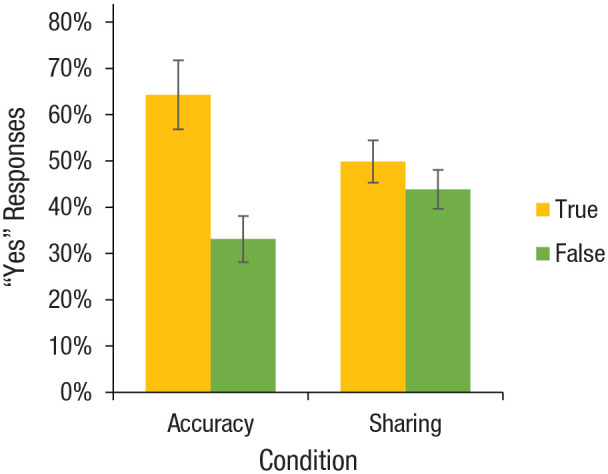
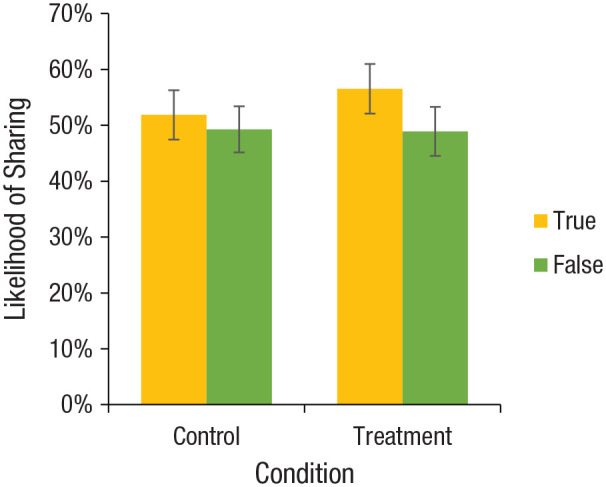
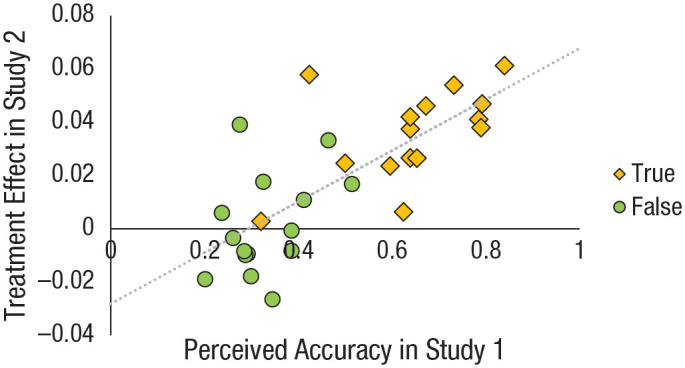
Verification
Claims the paper makes
The claims and statistics of this paper haven’t been checked yet.
Run the check — free, no account needed. It reads the open-access text and checks the sources it cites.
Claims other papers make about this one
Each is checked against this paper’s own text: does it say what the citing paper says it does?
The source backs part of the claim, not all of it — or backs it for a different population, condition or comparison.
In the citing paper
“Under these current plausible COVID-19 vaccine acceptance rates, possible levels of existing protective immunity-though it is unclear whether post-infection immunity confers long-term immunity 29 and the rapidly evolving nature of misinformation surrounding the pandemic 23,30 , it is unclear whether vaccination will reach the levels required for herd immunity.”
From Measuring the impact of COVID-19 vaccine misinformation on vaccination intent in the UK and USA (2021) · cites this paper as [23]
Experimental — accuracy not yet measuredThe cited source says what the claim attributes to it.
In the citing paper
“Experimental work indicates that directing users' attention to accuracy can improve sharing quality and reduce misinformation circulation (Pennycook et al., 2020(Pennycook et al., , 2021;;Roozenbeek et al., 2021).”
From Sensational Headlines, Engagement, and Credibility in Nepal’s Online News (2025) · cites this paper as Pennycook et al., 2020
The cited source says what the claim attributes to it.
In the citing paper
“Pennycook et al. (2020) and Roozenbeek et al. (2021) show that accuracy prompts can modestly improve users' sharing decisions, while Pennycook et al. (2021) argue that shifting attention toward accuracy can reduce misinformation sharing online.”
From Sensational Headlines, Engagement, and Credibility in Nepal’s Online News (2025) · cites this paper as Pennycook et al. (2020)
The check wasn’t confident either way, so it gives no verdict — never disputed.
In the citing paper
“Consistent with this view, a growing number of empirical studies have uncovered evidence that people update their political attitudes and beliefs in line with evidence (e.g., refs. 4,13,27–29) and arguments23,30,31 presented to them.”
From Factual knowledge can reduce attitude polarization (2025) · cites this paper as [28]
Experimental — accuracy not yet measured
Self-check
Percentages, sums and reported differences re-computed from the paper’s own numbers.
The self-check needs the paper’s full text.
Citations
Cites
The case for motivated reasoning.
Kunda, Z. (1990) · Psychological Bulletin · doi:10.1037/0033-2909.108.3.480 · Cited by 9,022 · cited 1×
“A great deal of evidence suggests that people are motivated to seek out, believe, and share politically congenial information (Kahan, Peters, Dawson, & Slovic, 2017; Kunda, 1990; Lee, Shin, & Hong, 2018; Mercier & Sperber, 2011; Shin & Thorson, 2017).”
BackgroundCognitive Reflection and Decision Making
Frederick, S. (2005) · Journal of Economic Perspectives · doi:10.1257/089533005775196732 · Cited by 5,256
Lazer, D. M. J., Baum, M. A., Benkler, Y., Berinsky, A. J., Greenhill, K. M., Menczer, F., Metzger, M. J., Nyhan, B., Pennycook, G., Rothschild, D., et al. (2018) · Science · doi:10.1126/science.aao2998 · Cited by 4,160
Self-citationWhy do humans reason? Arguments for an argumentative theory
Mercier, H., & Sperber, D. (2011) · Behavioral and Brain Sciences · doi:10.1017/s0140525x10000968 · Cited by 2,254
Pennycook, G., & Rand, D. G. (2019) · Cognition · doi:10.1016/j.cognition.2018.06.011 · Cited by 2,022
Self-citationShifting attention to accuracy can reduce misinformation online
Pennycook, G., Epstein, Z., Mosleh, M., Arechar, A. A., Eckles, D., & Rand, D. G. (2021) · Nature · doi:10.1038/s41586-021-03344-2 · Cited by 1,155
Self-citationThe Cognitive Reflection Test as a predictor of performance on heuristics-and-biases tasks
Toplak, M. E., West, R. F., & Stanovich, K. E. (2011) · Memory & Cognition · doi:10.3758/s13421-011-0104-1 · Cited by 1,047
Coppock, A., & McClellan, O. A. (2019) · Research & Politics · doi:10.1177/2053168018822174 · Cited by 987
Berinsky, A. J., Margolis, M. F., & Sances, M. W. (2014) · American Journal of Political Science · doi:10.1111/ajps.12081 · Cited by 951
Fighting misinformation on social media using crowdsourced judgments of news source quality
Pennycook, G., & Rand, D. G. (2019) · Proceedings of the National Academy of Sciences · doi:10.1073/pnas.1806781116 · Cited by 947 · cited 4×
“…2017; Van Bavel & Pereira, 2018), our data are more consistent with recent studies on political misinformation that provide both correlational (Pennycook & Rand, 2019b; including data from Twitter sharing, Mosleh, Pennycook, Arechar, & Rand, 2020) and experimental (Bago, Rand, & Pennycook,…”
BackgroundResultInfluentialSelf-citation
Research works printed but not linked: 2
- Adhanom Ghebreyesus T. (2020, February 15). Munich Security Conference. World Health Organization. Retrieved from https://www.who.int/dg/speeches/detail/munich-security-conference
- Ross R. M., 2019, PsyArXiv
Cited by
Sorted by citations
Items 701–800 of 1,004
The Role of Media During COVID-19 Global Outbreak: A Conservation Perspective
Tarakini, G., Mwedzi, T., Manyuchi, T., & Tarakini, T. (2021) · Tropical Conservation Science · doi:10.1177/19400829211008088 · Cited by 11
Fake News and Social Media Censorship
Adetayo, A. J. (2021) · Advances in educational technologies and instructional design book series · doi:10.4018/978-1-7998-6474-5.ch004 · Cited by 10
Yesmin, S., & Ahmed, S. M. Z. (2021) · Digital Library Perspectives · doi:10.1108/dlp-03-2021-0020 · Cited by 10
La creencia en fake news y su rol en el acatamiento de medidas contra COVID-19 en México
Molina, R. A. G., & Múñiz, C. (2021) · Universitas · doi:10.17163/uni.n35.2021.01 · Cited by 11
Atikuzzaman, M. (2022) · Journal of Information & Knowledge Management · doi:10.1142/s0219649222400020 · Cited by 10
The Role of Political Ideology and Open-Minded Thinking Style in the (in)Accuracy of Factual Beliefs
Kossowska, M., Szwed, P., & Czarnek, G. (2022) · Political Behavior · doi:10.1007/s11109-022-09789-z · Cited by 10
Lee, K. S., & Wei, H.-X. (2022) · Journal of Media Ethics · doi:10.1080/23736992.2022.2107524 · Cited by 7
Balcaen, P., Buts, C., du Bois, C., & Tkacheva, O. (2022) · Journal of Behavioral and Experimental Economics · doi:10.1016/j.socec.2022.101968 · Cited by 6
Memotret Hoaks Covid-19 di Awal Pandemi Melalui Analisis Wacana Berbasis Linguistik Korpus
Puspitasari, D., & Sukma, B. P. (2022) · Ranah Jurnal Kajian Bahasa · doi:10.26499/rnh.v11i2.5152 · Cited by 10
Folk Models of Misinformation on Social Media
Sharevski, F., Devine, A., Pieroni, E., & Jachim, P. (2023) · Network and Distributed System Security Symposium · doi:10.14722/ndss.2023.24293 · Cited by 15
Raciborski, F., Jankowski, M., Gujski, M., Pinkas, J., Samel-Kowalik, P., Zaczyński, A., Pańkowski, I., Rakocy, K., & Wierzba, W. (2020) · International Journal of Environmental Research and Public Health · doi:10.3390/ijerph17239072 · Cited by 11
Agarwal, A., Uniyal, D., Toshniwal, D., & Deb, D. (2021) · IEEE Transactions on Emerging Topics in Computational Intelligence · doi:10.1109/tetci.2021.3067661 · Cited by 10
KESGİN, Y., & Ünlü, D. G. (2021) · Galatasaray Üniversitesi İleti-ş-im Dergisi · doi:10.16878/gsuilet.914875 · Cited by 10
VICTOR: An Implicit Approach to Mitigate Misinformation via Continuous Verification Reading
Lo, K.-C., Dai, S.-C., Xiong, A., Jiang, J., & Ku, L. (2022) · International World Wide Web Conference (WWW) · doi:10.1145/3485447.3512246 · Cited by 10
Uwalaka, T. (2022) · Media International Australia · doi:10.1177/1329878x221101216 · Cited by 16
Scheibe, D. A., Fitzsimmons, C. J., Mielicki, M. K., Taber, J. M., Sidney, P. G., Coifman, K. G., & Thompson, C. A. (2022) · Metacognition and Learning · doi:10.1007/s11409-022-09300-3 · Cited by 14
Bonafé-Pontes, A., Couto, C., Kakinohana, R. K., Travain, M., Schimidt, L., & Rodrigues, R. P. (2021) · LA Referencia (Red Federada de Repositorios Institucionales de Publicaciones Científicas) · Cited by 10
Aymerich-Franch, L. (2023) · Journal of Leisure Research · doi:10.1080/00222216.2022.2136987 · Cited by 45
Ju, B., Dai, H. M., & Sandel, T. L. (2023) · SAGE Open · doi:10.1177/21582440231160480 · Cited by 13
Schippers, M. C. (., & Rus, D. C. (. (2020) · RePub (Erasmus University Rotterdam) · Cited by 10
Schüz, B., & Jones, C. M. (2024) · Bundesgesundheitsblatt - Gesundheitsforschung - Gesundheitsschutz · doi:10.1007/s00103-024-03836-2 · Cited by 10
Misinformation and Disinformation in the Era of Social Media: The Need for Fact-Checking Skills
Oladokun, B. D., Aruwa, J. E., Ottah, G. A., & Ajani, Y. A. (2024) · Journal of Information and Knowledge · doi:10.17821/srels/2024/v61i1/171266 · Cited by 14
Susceptibility to Unreliable Information Sources: Swift Adoption with Minimal Exposure
Ye, J., Luceri, L., Jiang, J., & Ferrara, E. (2024) · International World Wide Web Conference (WWW) · doi:10.1145/3589334.3648154 · Cited by 12
Oladapo, R. K., Obidiro, O. P., Oyetola, A. B., Olajide, A., Oladapo, M. O., Lawrence, U. S., Hasan, M. M., Islam, Z., Mustapha, A. A., Osuagwu‐Nwogu, E., et al. (2024) · The International Journal of Health Planning and Management · doi:10.1002/hpm.3834 · Cited by 12
Barman, D., & Conlan, O. (2024) · ACM Conference on Hypertext and Social Media (HT) · doi:10.1145/3648188.3675125 · Cited by 9
Can GPT-4 Models Detect Misleading Visualizations?
Alexander, J., Nanda, P., Yang, K.-C., & Sarvghad, A. (2024) · Visualization · doi:10.1109/vis55277.2024.00029 · Cited by 15
Shehata, A. M. K., Al‐Suqri, M. N., Osman, N. E., Hamad, F. F., Husaini, Y. N. A., & Mahfouz, A. (2024) · IEEE Access · doi:10.1109/access.2024.3518204 · Cited by 14
Melchior, C., Warin, T., & Oliveira, M. F. D. A. (2025) · Technological Forecasting and Social Change · doi:10.1016/j.techfore.2024.123969 · Cited by 13
Trust issues: Adolescents' epistemic vigilance towards online sources
Brown, P. R., & Gummerum, M. (2025) · British Journal of Developmental Psychology · doi:10.1111/bjdp.12559 · Cited by 14
King-Kizito, K., & Escobari, D. (2025) · Journal of Management Information Systems · doi:10.1080/07421222.2025.2520174 · Cited by 11
Sánchez, L., Torres, B. D. F., & Martín, A. G. (2020) · Revista de Comunicación y Salud · doi:10.35669/rcys.2020.10(2).355-384 · Cited by 11
Nurbakova, D., Магдановна, Е. Л., & Ovchinnikova, I. (2020) · IEEE ... International Conference on Data Mining workshops · doi:10.1109/icdmw51313.2020.00016 · Cited by 10
Chory, A., Nyandiko, W. M., Ashimosi, C., Aluoch, J., Martin, R. B.-S., Biegon, W., Munyoro, D., Apondi, E., & Vreeman, R. (2021) · Frontiers in Public Health · doi:10.3389/fpubh.2021.757267 · Cited by 9
The Promises and Perils of Social Media for Pediatric Rheumatology
Hausmann, J. S., & Weitzman, E. R. (2021) · Rheumatic Disease Clinics of North America · doi:10.1016/j.rdc.2021.09.005 · Cited by 9
Singh, S., & Kaurav, R. P. S. (2022) · Vision The Journal of Business Perspective · doi:10.1177/09722629221130831 · Cited by 10
Public health communication and the Covid-19: A review of the literature during the first wave
Noguero, A. M., Wennberg‐Capellades, L., González, E. R., & Goñi-Fuste, B. (2023) · El Profesional de la Informacion · doi:10.3145/epi.2023.may.13 · Cited by 12
Fard, S. P., Taheri, A. A., Ghvami, M., Ahmadi, S. M., & Mohammadpour, M. (2020) · Shenakht Journal of Psychology and Psychiatry · doi:10.52547/shenakht.7.4.67 · Cited by 9
Nourmoradi, H., Kazembeigi, F., Kakaei, H., Jalilian, M., & Mirzaei, A. (2020) · Open Access Macedonian Journal of Medical Sciences · doi:10.3889/oamjms.2020.5094 · Cited by 9
Development of vaccines at the time of COVID-19
Almond, J., Hacker, J. H., Harwood, C. R., Pizza, M., Rappuoli, R., Ron, E. Z., Sansonetti, P. J., Vanderslott, S., & Wieler, L. H. (2020) · microLife · doi:10.1093/femsml/uqaa003 · Cited by 9
Information challenges of COVID-19: A qualitative research
Atighechian, G., Rezaei, F. M., Tavakoli, N., & Abarghoian, M. (2021) · Journal of Education and Health Promotion · doi:10.4103/jehp.jehp_1271_20 · Cited by 9
Ashraf, M. U., Raza, S., Ashraf, A., Mehmood, W., & Patwary, A. K. (2021) · Journal of Public Affairs · doi:10.1002/pa.2716 · Cited by 9
Üniversite Öğrencilerinin Gözünden COVID-19 Salgını: Nitel Bir Araştırma
Asıcı, E., & Günlü, A. (2021) · Gençlik Araştırmaları Dergisi · doi:10.52528/genclikarastirmalari.770078 · Cited by 9
Khokhlova, O., Lamba, N., Bhatia, A., & Виноградова, М. Г. (2021) · Mind & Society · doi:10.1007/s11299-021-00282-4 · Cited by 9
Understanding the characteristics of COVID-19 misinformation communities through graphlet analysis
Ashford, J. R., Turner, L. D., Whitaker, R. M., Preece, A. D., & Felmlee, D. (2021) · Online Social Networks and Media · doi:10.1016/j.osnem.2021.100178 · Cited by 10
Barua, Z. (2022) · Human Arenas · doi:10.1007/s42087-022-00291-w · Cited by 6
A multistage retrieval system for health-related misinformation detection
Fernández-Pichel, M., Losada, D. E., & Pichel, J. C. (2022) · Engineering Applications of Artificial Intelligence · doi:10.1016/j.engappai.2022.105211 · Cited by 10
Faruk, M. O., Devnath, P., Kar, S., Eshaa, E. A., & Naziat, H. (2022) · Health Policy OPEN · doi:10.1016/j.hpopen.2022.100075 · Cited by 9
García-Borrego, M., & Casero-Ripollés, A. (2022) · Estudios sobre el Mensaje Periodístico · doi:10.5209/esmp.82881 · Cited by 12
Digital Innovation in Healthcare Entrepreneurship
Mohammed-Nasir, R., Oshikoya, K. A., & Oreagba, I. A. (2023) · Springer eBooks · doi:10.1007/978-981-19-6696-5_22 · Cited by 13
Gong, W., & Liu, J. (2023) · Telemedicine Journal and e-Health · doi:10.1089/tmj.2022.0352 · Cited by 11
Probabilistic social learning improves the public’s judgments of news veracity
Guilbeault, D., Woolley, S., & Becker, J. A. (2021) · PLoS ONE · doi:10.1371/journal.pone.0247487 · Cited by 11
Al‐Motlaq, M. (2021) · Journal of Consumer Health on the Internet · doi:10.1080/15398285.2020.1867412 · Cited by 9
Representations of Health and Wellness on Instagram: An Analysis of 285,000 PostsPreprint
Bak, C., & Priniski, J. H. (2020) · doi:10.31234/osf.io/6nxvu · Cited by 9
Misinformation about COVID-19: Psychological Insights
Anastasiades, E., Argyrides, M., & Mousoulidou, M. (2021) · Encyclopedia · doi:10.3390/encyclopedia1040091 · Cited by 10
Lawson, M. A., & Kakkar, H. (2020) · PsyArXiv (OSF Preprints) · doi:10.31234/osf.io/ves5m · Cited by 11
WITHDRAWNPreprint
Sultan, M., Tump, A. N., Ehmann, N., Lorenz-Spreen, P., Hertwig, R., Gollwitzer, A., & Kurvers, R. H. J. M. (2024) · doi:10.31234/osf.io/7u4fg · Cited by 9
Ng, J. Y., Liu, S., Maini, I., Pereira, W., Cramer, H., & Moher, D. (2023) · Integrative Medicine Research · doi:10.1016/j.imr.2023.100975 · Cited by 12
Chae, J. H., Lee, S. Y., & Song, H. (2023) · Political Psychology · doi:10.1111/pops.12914 · Cited by 10
Barclay, E. G. (2022) · The Open Review · doi:10.47967/tor2022col/vol8.02 · Cited by 8
Stewart, A. J., Arechar, A. A., Rand, D. G., & Plotkin, J. B. (2024) · Proceedings of the National Academy of Sciences · doi:10.1073/pnas.2315195121 · Cited by 16
Self-citationOnline rumors during the COVID-19 pandemic: co-evolution of themes and emotions
Shen, C., Song, Z., He, P., Liu, L., & Xiong, Z. (2024) · Frontiers in Public Health · doi:10.3389/fpubh.2024.1375731 · Cited by 8
Systematic Review of Educational Approaches to Misinformation
Rau, M. A., & Premo, A. E. (2025) · Educational Psychology Review · doi:10.1007/s10648-025-10012-8 · Cited by 18
Lim, W. X., Lim, H. M., Lee, Y. K., Chuah, C. J. W., Abdullah, A. B., Ng, C. J., & Dunn, A. G. (2025) · Digital Health · doi:10.1177/20552076251334438 · Cited by 8
Willingness to share information on social media: a systematic literature review (2020–2024)
Cai, Y.-Y., Kamarudin, S., & Nujaimi, S. (2025) · Frontiers in Psychology · doi:10.3389/fpsyg.2025.1567506 · Cited by 12
Spinde, T., Wu, F., Gaissmaier, W., Demartini, G., Echizen, I., & Giese, H. (2025) · Information Processing & Management · doi:10.1016/j.ipm.2025.104244 · Cited by 11
Bandeira, A., Gonçalves, L. H. D. N., Holl, F., Shaibu, J. U., Gonçalves, M. L., Payinda, R., Paudel, S., Berionni, A., WFPHA, Y., Purnat, T. D., et al. (2025) · JMIR Infodemiology · doi:10.2196/69474 · Cited by 9
Using generative AI to increase sceptics’ engagement with climate science
Bagó, B., Müller, P., & Bonnefon, J. (2025) · Nature Climate Change · doi:10.1038/s41558-025-02424-9 · Cited by 8
Health literacy of adolescents in the COVID-19 pandemic: an integrative review
Prata, R. A., Bicudo, T. B., da Silva, J. B., & de Ávila, M. A. G. (2022) · Revista Brasileira de Enfermagem · doi:10.1590/0034-7167-2021-0956 · Cited by 8
Myneni, S., Cuccaro, P. M., Montgomery, S., Pakanati, V., Tang, J., Singh, T., Dominguez, O., Cohen, T., Reininger, B. M., Savas, L. S., et al. (2022) · JMIR Infodemiology · doi:10.2196/40156 · Cited by 12
Reuter, C., Kaufhold, M., Biselli, T., & Pleil, H. (2023) · International Journal of Disaster Risk Reduction · doi:10.1016/j.ijdrr.2023.103880 · Cited by 8
Al‐Jabr, H., Windle, K., Clifton, A., Thompson, D. R., Castle, D. J., & Ski, C. F. (2023) · BJGP Open · doi:10.3399/bjgpo.2023.0137 · Cited by 8
Tracing the dynamics of misinformation and vaccine stance in Finland amid COVID-19
Ünlü, A., Truong, S., Sawhney, N., Sivelä, J., & Tammi, T. (2024) · Information Communication & Society · doi:10.1080/1369118x.2024.2331756 · Cited by 7
Ahmed, S., Masood, M., & Ting, A. B. W. (2025) · Journalism & Mass Communication Quarterly · doi:10.1177/10776990251313756 · Cited by 11
Improving Media Education as a Way to Combat Fake News
(2020) · Mediaobrazovanie · doi:10.13187/me.2020.4.730 · Cited by 8
Lo, K.-C., Dai, S.-C., Xiong, A., Jiang, J., & Ku, L. (2021) · ACM International Conference on Web Search and Data Mining (WSDM) · doi:10.1145/3437963.3441696 · Cited by 8
CMTA: COVID-19 Misinformation Multilingual Analysis on Twitter
Pranesh, R. R., Farokhenajd, M., Shekhar, A., & Solar, G. V. (2021) · doi:10.18653/v1/2021.acl-srw.28 · Cited by 8
Lundberg, P., Ojala, A., Suominen, K. M., Lilley, T. M., & Vainio, A. (2021) · Frontiers in Psychology · doi:10.3389/fpsyg.2021.635874 · Cited by 9
Using impression data to improve models of online social influence
Liu, R., Greene, K. T., Liu, R., Mandic, M., Valentino, B. A., Vosoughi, S., & Subrahmanian, V. S. (2021) · Scientific Reports · doi:10.1038/s41598-021-96021-3 · Cited by 8
Teng, F., Wang, X., Shi, J., Chen, Z., Huang, Q., & Cheng, W. (2021) · International Journal of Environmental Research and Public Health · doi:10.3390/ijerph18168672 · Cited by 9
Scuotto, C., Ilardi, C. R., Avallone, F., Maggi, G., Ilardi, A., Borrelli, G., Gamboz, N., Marra, M. L., & Perrella, R. (2021) · Brain Sciences · doi:10.3390/brainsci11111489 · Cited by 8
Wang, Y., Gao, S., & Gao, W. (2021) · Journal of Contingencies and Crisis Management · doi:10.1111/1468-5973.12385 · Cited by 11
LaPoe, B. R., Olson, C. S. C., LaPoe, V. L., Jain, P., Woellert, A., & Long, A. (2021) · Electronic News · doi:10.1177/19312431211057488 · Cited by 8
Unravelling social media racial discriminations through a semi-supervised approach
Balakrishnan, V., Ng, K. S., & Arabnia, H. R. (2021) · Telematics and Informatics · doi:10.1016/j.tele.2021.101752 · Cited by 8
O’Neil, M., Khan, M. I., Holland, K., & Cai, X. (2022) · Information Communication & Society · doi:10.1080/1369118x.2022.2032260 · Cited by 9
Meyrer, K. P., & Kersch, D. F. (2022) · Journal of Media Literacy Education · doi:10.23860/jmle-2022-14-1-2 · Cited by 8
Interventions to mitigate COVID-19 misinformation: protocol for a scoping review
Kumar, N., Walter, N., Nyhan, K., Khoshnood, K., Tucker, J. D., Bauch, C. T., Ding, Q., Jones-Jang, S. M., Choudhury, M. D., Schwartz, J. L., et al. (2022) · Systematic Reviews · doi:10.1186/s13643-022-01917-4 · Cited by 10
Gao, L., An, Y., & Yin, Q. (2022) · Frontiers in Environmental Science · doi:10.3389/fenvs.2022.941247 · Cited by 8
Wong, J. C. S., Yang, J. Z., & Liu, Z. (2022) · Health Communication · doi:10.1080/10410236.2022.2109394 · Cited by 8
Multidimensional Analysis of Fake News Spreaders on Twitter
Singh, M., Kaur, R., & Iyengar, S. R. S. (2020) · Lecture notes in computer science · doi:10.1007/978-3-030-66046-8_29 · Cited by 8
Health Information Seeking Behaviors Related to COVID-19 Among Young People: An Online Survey
Jalilian, M., Kakaei, H., Nourmoradi, H., Bakhtiyari, S., Mazloomi, S., & Mirzaei, A. (2021) · international journal high risk behaviors & addiction · doi:10.5812/ijhrba.105863 · Cited by 8
Houlden, S., Hodson, J., Veletsianos, G., Thompson, C. P., & Reid, D. (2021) · American Behavioral Scientist · doi:10.1177/00027642211050903 · Cited by 8
The role of political devotion in sharing partisan misinformationPreprint
Pretus, C., Servin-Barthet, C., Harris, E., Brady, W. J., Vilarroya, Ó., & Bavel, J. J. V. (2022) · Research Square · doi:10.21203/rs.3.rs-1665189/v1 · Cited by 8
Impact of Human and Economic Development on Fake News Propensity During the COVID-19 Crisis
Shirish, A., & Kotwal, K. (2023) · Journal of Global Information Management · doi:10.4018/jgim.322401 · Cited by 7
Softening Online Extremes Using Network Engineering
Restrepo, E. M., Moreno, M., Illari, L., & Johnson, N. F. (2024) · IEEE Access · doi:10.1109/access.2024.3388851 · Cited by 7
Xu, C., Li, K., Li, C., Xu, H., & Sun, Y. (2024) · Social Science & Medicine · doi:10.1016/j.socscimed.2024.116952 · Cited by 7
Neoliberalism and pandemics: A critical cultural psychological perspective
Jimenez, T., & Schmitt, H. J. (2024) · Journal of Social and Political Psychology · doi:10.5964/jspp.10099 · Cited by 7
Zarzosa, J., & Ruvalcaba, C. (2025) · Journal of Marketing Education · doi:10.1177/02734753251319559 · Cited by 12
A path forward on online misinformation mitigation based on current user behavior
King, C., Phillips, S. C., & Carley, K. M. (2025) · Scientific Reports · doi:10.1038/s41598-025-93100-7 · Cited by 8
How Do Users Perceive Nudges Against Online Misinformation? A Repertory-Grid Study*
Konstantinou, L., & Karapanos, E. (2025) · International Journal of Human-Computer Interaction · doi:10.1080/10447318.2025.2499163 · Cited by 7
Bode, L., & Vraga, E. K. (2025) · doi:10.1093/oso/9780197565896.001.0001 · Cited by 10
Metadata
- Authors
- Pennycook, G., McPhetres, J., Zhang, Y., Lu, J. G., & Rand, D. G.
- Affiliations
- University of Regina (CA)
- Massachusetts Institute of Technology (US)
- Corresponding author
- Pennycook, Gordon
- Venue
- Psychological Science
- Publisher
- SAGE Publications
- Published
- 2020-06-30
- Volume
- 31
- Issue
- 7
- Pages
- 770-780
- ISSN
- 0956-7976 (ISSN-L)
- 1467-9280
- PMC
- PMC7366427
- OpenAlex
- W3013473577
- Cited by
- 1,715
- References
- 38
- Citations by year
- 2026: 111 · 2025: 188 · 2024: 238 · 2023: 299 · 2022: 329 · 2021: 416 · 2020: 132
- FWCI
- 393.97
- Type
- journal article
- Language
- en
- Open access
- hybrid
- doi.org
- Locations
- Psychological Science (publishedVersion, cc-by)
- PubMed Central (publishedVersion, cc-by)
- PubMed (publishedVersion)
- DSpace@MIT (Massachusetts Institute of Technology) (submittedVersion, cc-by-nc-sa)
- Funders
- miami foundation
- William and Flora Hewlett Foundation
- Omidyar Network
- John Templeton Foundation
- Canadian Institutes of Health Research
- Social Sciences and Humanities Research Council of Canada
- Topics
- Social Sciences › Sociology and Political Science › Misinformation and Its Impacts
- Social Sciences › Communication › Communication and COVID-19 Impact
- Social Sciences › Library and Information Sciences › Academic Publishing and Open Access
- Keywords
- COVID-19 misinformation, social media sharing, truth discernment, fake news, cognitive reflection, scientific knowledge, misinformation prevention, sharing intention
- MeSH terms
- Betacoronavirus, COVID-19, SARS-CoV-2, Adolescent, Adult, Aged, Aged, 80 and over, Communication, Decision Making, Female, Humans, Male, Middle Aged, Pneumonia, Viral, Coronavirus Infections, Information Dissemination, Young Adult, Pandemics, Social Media
About these checks
Registry, retraction, Cites and statistics results are computed, not judged, with one exception: a printed reference that no index lists is read once by a model before it counts as a citation error. Claims are extracted by a model and kept only when their quote appears verbatim in the text; each cited source is then checked, with a model’s help, for whether it says what the claim relies on. Those verdicts can be wrong — read the claim’s quote and the cited source before relying on one.
Statistics and arithmetic are recomputed, not judged.
Confidence bands are shown only for fields calibrated on our annotated test set. None is calibrated yet, so no band is shown.
What counts as a claim ›How we measure confidence ›How we check this ›
Are you an author, or do you see a problem with this page? Request a review
