

The DOI matches its Crossref record; 38 of the 41 references it cites were found in a registry or an index, and 3 are not checked yet.
Fighting COVID-19 Misinformation on Social Media: Experimental Evidence for a Scalable Accuracy-Nudge Intervention
Open accessAbstract
Across two studies with more than 1,700 U.S. adults recruited online, we present evidence that people share false claims about COVID-19 partly because they simply fail to think sufficiently about whether or not the content is accurate when deciding what to share. In Study 1, participants were far worse at discerning between true and false content when deciding what they would share on social media relative to when they were asked directly about accuracy. Furthermore, greater cognitive reflection and science knowledge were associated with stronger discernment. In Study 2, we found that a simple accuracy reminder at the beginning of the study (i.e., judging the accuracy of a non-COVID-19-related headline) nearly tripled the level of truth discernment in participants’ subsequent sharing intentions. Our results, which mirror those found previously for political fake news, suggest that nudging people to think about accuracy is a simple way to improve choices about what to share on social media.
Overview
The claims and statistics of this paper haven’t been checked yet.
Run the check — free, no account needed. It reads the open-access text and checks the sources it cites.
Integrity signals
Registry
Cites
Statistics
Figures
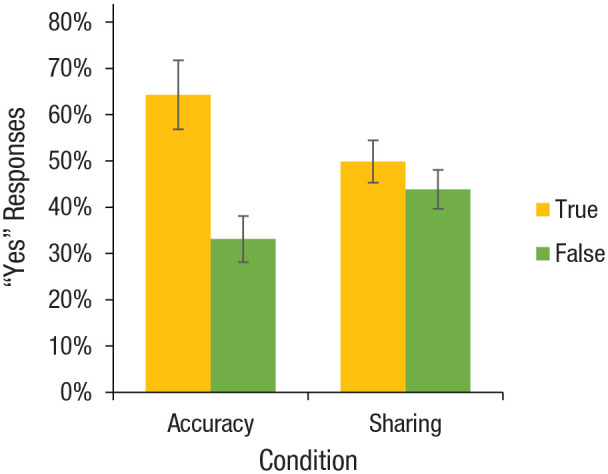
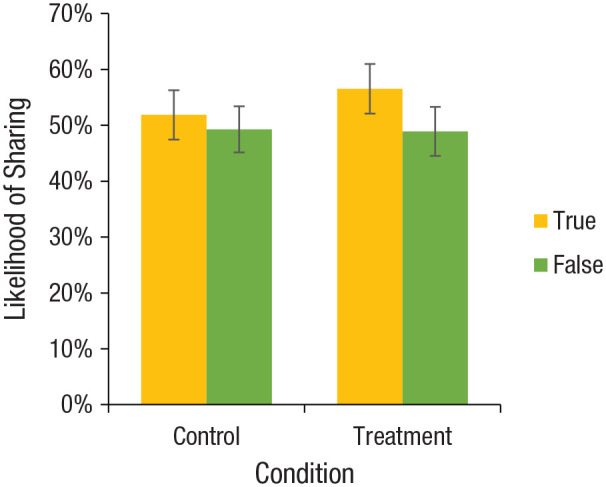
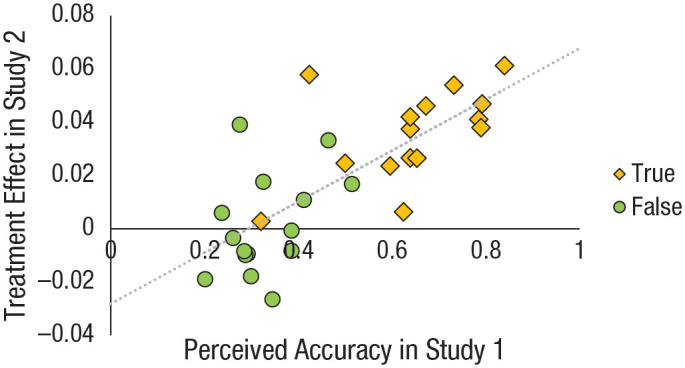
Verification
Claims the paper makes
The claims and statistics of this paper haven’t been checked yet.
Run the check — free, no account needed. It reads the open-access text and checks the sources it cites.
Claims other papers make about this one
Each is checked against this paper’s own text: does it say what the citing paper says it does?
The source backs part of the claim, not all of it — or backs it for a different population, condition or comparison.
In the citing paper
“Under these current plausible COVID-19 vaccine acceptance rates, possible levels of existing protective immunity-though it is unclear whether post-infection immunity confers long-term immunity 29 and the rapidly evolving nature of misinformation surrounding the pandemic 23,30 , it is unclear whether vaccination will reach the levels required for herd immunity.”
From Measuring the impact of COVID-19 vaccine misinformation on vaccination intent in the UK and USA (2021) · cites this paper as [23]
Experimental — accuracy not yet measuredThe cited source says what the claim attributes to it.
In the citing paper
“Experimental work indicates that directing users' attention to accuracy can improve sharing quality and reduce misinformation circulation (Pennycook et al., 2020(Pennycook et al., , 2021;;Roozenbeek et al., 2021).”
From Sensational Headlines, Engagement, and Credibility in Nepal’s Online News (2025) · cites this paper as Pennycook et al., 2020
The cited source says what the claim attributes to it.
In the citing paper
“Pennycook et al. (2020) and Roozenbeek et al. (2021) show that accuracy prompts can modestly improve users' sharing decisions, while Pennycook et al. (2021) argue that shifting attention toward accuracy can reduce misinformation sharing online.”
From Sensational Headlines, Engagement, and Credibility in Nepal’s Online News (2025) · cites this paper as Pennycook et al. (2020)
The check wasn’t confident either way, so it gives no verdict — never disputed.
In the citing paper
“Consistent with this view, a growing number of empirical studies have uncovered evidence that people update their political attitudes and beliefs in line with evidence (e.g., refs. 4,13,27–29) and arguments23,30,31 presented to them.”
From Factual knowledge can reduce attitude polarization (2025) · cites this paper as [28]
Experimental — accuracy not yet measured
Self-check
Percentages, sums and reported differences re-computed from the paper’s own numbers.
The self-check needs the paper’s full text.
Citations
Cites
The case for motivated reasoning.
Kunda, Z. (1990) · Psychological Bulletin · doi:10.1037/0033-2909.108.3.480 · Cited by 9,022 · cited 1×
“A great deal of evidence suggests that people are motivated to seek out, believe, and share politically congenial information (Kahan, Peters, Dawson, & Slovic, 2017; Kunda, 1990; Lee, Shin, & Hong, 2018; Mercier & Sperber, 2011; Shin & Thorson, 2017).”
BackgroundCognitive Reflection and Decision Making
Frederick, S. (2005) · Journal of Economic Perspectives · doi:10.1257/089533005775196732 · Cited by 5,256
Lazer, D. M. J., Baum, M. A., Benkler, Y., Berinsky, A. J., Greenhill, K. M., Menczer, F., Metzger, M. J., Nyhan, B., Pennycook, G., Rothschild, D., et al. (2018) · Science · doi:10.1126/science.aao2998 · Cited by 4,160
Self-citationWhy do humans reason? Arguments for an argumentative theory
Mercier, H., & Sperber, D. (2011) · Behavioral and Brain Sciences · doi:10.1017/s0140525x10000968 · Cited by 2,254
Pennycook, G., & Rand, D. G. (2019) · Cognition · doi:10.1016/j.cognition.2018.06.011 · Cited by 2,022
Self-citationShifting attention to accuracy can reduce misinformation online
Pennycook, G., Epstein, Z., Mosleh, M., Arechar, A. A., Eckles, D., & Rand, D. G. (2021) · Nature · doi:10.1038/s41586-021-03344-2 · Cited by 1,155
Self-citationThe Cognitive Reflection Test as a predictor of performance on heuristics-and-biases tasks
Toplak, M. E., West, R. F., & Stanovich, K. E. (2011) · Memory & Cognition · doi:10.3758/s13421-011-0104-1 · Cited by 1,047
Coppock, A., & McClellan, O. A. (2019) · Research & Politics · doi:10.1177/2053168018822174 · Cited by 987
Berinsky, A. J., Margolis, M. F., & Sances, M. W. (2014) · American Journal of Political Science · doi:10.1111/ajps.12081 · Cited by 951
Fighting misinformation on social media using crowdsourced judgments of news source quality
Pennycook, G., & Rand, D. G. (2019) · Proceedings of the National Academy of Sciences · doi:10.1073/pnas.1806781116 · Cited by 947 · cited 4×
“…2017; Van Bavel & Pereira, 2018), our data are more consistent with recent studies on political misinformation that provide both correlational (Pennycook & Rand, 2019b; including data from Twitter sharing, Mosleh, Pennycook, Arechar, & Rand, 2020) and experimental (Bago, Rand, & Pennycook,…”
BackgroundResultInfluentialSelf-citation
Research works printed but not linked: 2
- Adhanom Ghebreyesus T. (2020, February 15). Munich Security Conference. World Health Organization. Retrieved from https://www.who.int/dg/speeches/detail/munich-security-conference
- Ross R. M., 2019, PsyArXiv
Cited by
Sorted by citations
Items 501–600 of 1,004
Pandemic publication: correction and erratum in COVID-19 publications
Moradi, S., & Abdi, S. (2020) · Scientometrics · doi:10.1007/s11192-020-03787-w · Cited by 20
Berger, L., Kerkhof, A., Mindl, F., & Münster, J. (2025) · Journal of Public Economics · doi:10.1016/j.jpubeco.2025.105345 · Cited by 38
Giroux, M., Park, J., Kim, J.-E., Choi, Y., Lee, J. C., Kim, S., Jang, S., Gonzalez-Jimenez, H., & Kim, J. (2021) · Australasian Marketing Journal · doi:10.1177/18393349211028670 · Cited by 17
Cegarra‐Navarro, J., Bolisani, E., & Cepeda‐Carrión, G. (2021) · Journal of Knowledge Management · doi:10.1108/jkm-05-2021-0395 · Cited by 19
Mathews, C. J., McGuire, L., Joy, A., Law, F., Winterbottom, M., Rutland, A., Drews, M., Hoffman, A. J., Mulvey, K. L., & Hartstone‐Rose, A. (2021) · PLoS ONE · doi:10.1371/journal.pone.0259523 · Cited by 21
Kadinski, L., Salcedo, C. A., Boccelli, D. L., Berglund, E. Z., & Ostfeld, A. (2022) · Water · doi:10.3390/w14071088 · Cited by 19
Evaluative mindsets can protect against the influence of false information
Salovich, N. A., Kirsch, A. M., & Rapp, D. N. (2022) · Cognition · doi:10.1016/j.cognition.2022.105121 · Cited by 24
Wang, R., & Zhang, H. (2022) · Computers in Human Behavior · doi:10.1016/j.chb.2022.107486 · Cited by 19
Misinformation about medication during the COVID– 19 pandemic: A perspective of medical staff
Coman, C., Bularca, M. C., Repanovici, A., & Rogozea, L. M. (2022) · PLoS ONE · doi:10.1371/journal.pone.0276693 · Cited by 19
Pinto, P. A., Brasileiro, F. S., Antunes, M. J., & Almeida, A. M. (2020) · Comunicação pública · doi:10.4000/cp.11288 · Cited by 22
Logan, A. C., Berman, S. H., Berman, B., & Prescott, S. L. (2021) · Challenges · doi:10.3390/challe12010001 · Cited by 23
Arpacı, İ., Karataş, K., Kiran, F., Kuşci, İ., & Topcu, A. E. (2021) · Death Studies · doi:10.1080/07481187.2021.1923588 · Cited by 19
Santirocchi, A., Spataro, P., Costanzi, M., Doricchi, F., Rossi‐Arnaud, C., & Cestari, V. (2022) · Journal of Personalized Medicine · doi:10.3390/jpm12010111 · Cited by 22
Social Media as Source of Information, Stress Symptoms, and Burden Caused by Coronavirus (COVID-19)
Brailovskaia, J., Margraf, J., & Schneider, S. (2021) · European Psychologist · doi:10.1027/1016-9040/a000452 · Cited by 20
Risk perception, public health interventions, and Covid-19 pandemic control in sub-saharan Africa
Aduh, U., Foláyan, M. O., Afe, A. J., Onyeaghala, A. A., Ajayi, I. O., Coker, M. O., Tebeje, Y. K., & Ndembi, N. (2020) · Journal of Public Health in Africa · doi:10.4081/jphia.2021.1622 · Cited by 18
When Deaths Are Dehumanized: Deathcare During COVID-19 as a Public Value Failure
Zavattaro, S. M., Entress, R. M., Tyler, J., & Sadiq, A. (2021) · Administration & Society · doi:10.1177/00953997211023185 · Cited by 18
Psychological Factors Affecting Risk Perception of COVID-19: Evidence from Peru and China
Monge, F. S., Jiang, H., Zhang, L., Alvarado-Yepez, A. J., Cardona-Rivero, A., Chulluncuy, E. T. H., & Torres-Mejía, A. (2021) · International Journal of Environmental Research and Public Health · doi:10.3390/ijerph18126513 · Cited by 19
Choi, D.-H. (2021) · Asian Journal of Communication · doi:10.1080/01292986.2021.1968447 · Cited by 19
COVID-19 and fake news dissemination among Malaysians – Motives and its sociodemographic correlates
Balakrishnan, V. (2022) · International Journal of Disaster Risk Reduction · doi:10.1016/j.ijdrr.2022.102900 · Cited by 18
Hatemi, P., & Fazekas, Z. (2022) · Current Psychology · doi:10.1007/s12144-022-03080-4 · Cited by 21
Factors affecting misinformation combating intention in Pakistan during COVID-19
Malik, A., Islam, T., & Mahmood, K. (2022) · Kybernetes · doi:10.1108/k-02-2022-0263 · Cited by 17
Mark, E., Udod, G., Skinner, J., & Jones, M. (2022) · PLoS ONE · doi:10.1371/journal.pone.0271212 · Cited by 19
Zheng, X., Qian, M., Ye, X., Zhang, M., Zhan, C., Li, H., & Luo, T. (2022) · Journal of Clinical Nursing · doi:10.1111/jocn.16537 · Cited by 18
The effectiveness of a scientific reasoning intervention for conspiracy theory beliefs
Georgiou, N., Delfabbro, P., & Balzan, R. P. (2023) · Applied Cognitive Psychology · doi:10.1002/acp.4039 · Cited by 18
Designing Technologies to Support Critical Thinking in an Age of Misinformation
Boonprakong, N., Tag, B., & Dingler, T. (2023) · IEEE Pervasive Computing · doi:10.1109/mprv.2023.3275514 · Cited by 18
Artmann, B., Scheibenzuber, C., & Nistor, N. (2023) · Journal of Media Literacy Education · doi:10.23860/jmle-2023-15-2-3 · Cited by 22
An, Y., Huang, Y., Danjuma, N. U., Apuke, O. D., & Tunca, E. A. (2023) · Information Development · doi:10.1177/02666669231194357 · Cited by 18
Quantifying the vulnerabilities of the online public square to adversarial manipulation tactics
Truong, B. T., Lou, X., Flammini, A., & Menczer, F. (2024) · PNAS Nexus · doi:10.1093/pnasnexus/pgae258 · Cited by 28
Significant Role of Modern Technologies for COVID-19 Pandemic
Vaishya, R., Javaid, M., Khan, I. H., Vaish, A., & Iyengar, K. P. (2021) · Journal of Industrial Integration and Management · doi:10.1142/s242486222150010x · Cited by 19
Toward a New Strategic Public Health Science for Policy, Practice, Impact, and Health Equity
Bunnell, R. E., Ryan, J., & Kent, C. K. (2021) · American Journal of Public Health · doi:10.2105/ajph.2021.306355 · Cited by 20
Buchanan, T. (2021) · The Social Science Journal · doi:10.1080/03623319.2021.1975085 · Cited by 19
Wang, S., Li, L. Z., van Antwerpen, N., Suparman, S., Gayatri, M., Sari, N. P., & Zhang, S. X. (2021) · American Journal of Tropical Medicine and Hygiene · doi:10.4269/ajtmh.21-0463 · Cited by 20
Din, A., Li, Y., Yusuf, A., Liu, J., & Aly, A. A. (2022) · The European Physical Journal Special Topics · doi:10.1140/epjs/s11734-022-00453-5 · Cited by 18
A Unified Framework for Understanding and Intervening on False News SharingPreprint
Gollwitzer, A., Tump, A. N., Martel, C., Deffner, D., Sultan, M., Kurvers, R. H. J. M., & Hertwig, R. (2024) · PsyArXiv (OSF Preprints) · doi:10.31234/osf.io/pxn29 · Cited by 19
Suryani, A. (2024) · Social Communication · doi:10.57656/sc-2024-0009 · Cited by 17
Kuatewo, M., Ebelin, W., Doegah, P. T., Kpodo, L., Kpordorlor, A. G., Lissah, S., Djokoto, S., Aberese-Ako, M., & Ansah, E. (2025) · PLoS ONE · doi:10.1371/journal.pone.0316969 · Cited by 22
Lee, S. J., Lee, C., & Hwang, H. (2022) · Health Communication · doi:10.1080/10410236.2022.2125119 · Cited by 17
Xiang, H., Zhou, J., & Wang, Z. (2023) · International Journal of Human-Computer Interaction · doi:10.1080/10447318.2022.2158263 · Cited by 21
Ivanov, A., Tacheva, Z., Alzaidan, A., Souyris, S., & England, A. C. (2023) · Production and Operations Management · doi:10.1111/poms.13982 · Cited by 18
Addressing the spread of health-related misinformation on social networks: an opinion article
Polyzou, M., KIEFER, D. M., Baraliakos, X., & Sewerin, P. (2023) · Frontiers in Medicine · doi:10.3389/fmed.2023.1167033 · Cited by 17
A Survey on COVID-19 Data Analysis Using AI, IoT, and Social Media
Butt, M. J., Malik, A. K., Qamar, N., Yar, S., Malik, A. J., & Rauf, U. (2023) · Sensors · doi:10.3390/s23125543 · Cited by 20
Confidence as a metacognitive contributor to and consequence of misinformation experiences
Rapp, D. N., & Withall, M. M. (2024) · Current Opinion in Psychology · doi:10.1016/j.copsyc.2023.101735 · Cited by 17
Warnke, L., Maier, A.-L., & Gilbert, D. U. (2024) · Journal of Management & Governance · doi:10.1007/s10997-023-09694-5 · Cited by 17
Deceptive choice architecture and behavioral audits: A principles‐based approach
Mills, S. (2024) · Regulation & Governance · doi:10.1111/rego.12590 · Cited by 22
Don’t believe them! Reducing misinformation influence through source discreditation
Ecker, U. K. H., Prike, T., Paver, A. B., Scott, R. J., & Swire‐Thompson, B. (2024) · Cognitive Research Principles and Implications · doi:10.1186/s41235-024-00581-7 · Cited by 19
Inoculation and accuracy prompting increase accuracy discernment in combination but not alone
Pennycook, G., Berinsky, A. J., Bhargava, P., Lin, H., Cole, R., Goldberg, B., Lewandowsky, S., & Rand, D. G. (2024) · Nature Human Behaviour · doi:10.1038/s41562-024-02023-2 · Cited by 32
Self-citationThe psychology of science rejection
Rutjens, B. T., & Hornsey, M. J. (2024) · Advances in experimental social psychology · doi:10.1016/bs.aesp.2024.10.002 · Cited by 18
Bridging the Health Disparity of African Americans Through Conversational Agents
Kim, J., Park, S. Y., & Robert, L. (2020) · Digital Government Research and Practice · doi:10.1145/3428122 · Cited by 19
Krawiec, J. M., Piaskowska, O. M., Piesiewicz, P. F., & Białaszek, W. (2021) · Globalization and Health · doi:10.1186/s12992-021-00782-5 · Cited by 17
Alshareef, M., & Alotiby, A. A. (2021) · International Journal of General Medicine · doi:10.2147/ijgm.s326767 · Cited by 17
Social media, fake news and fake COVID-19 cures in Nigeria
Uwalaka, T., Nwala, B., & Amadi, C. C. (2021) · Journal of African Media Studies · doi:10.1386/jams_00058_1 · Cited by 17
An Optimized Hybrid Deep Learning Model to Detect COVID‐19 Misleading Information
Alouffi, B., Alharbi, A., Sahal, R., & Saleh, H. (2021) · Computational Intelligence and Neuroscience · doi:10.1155/2021/9615034 · Cited by 19
Rudloff, J. P., Hutmacher, F., & Appel, M. (2022) · Journal of Personality · doi:10.1111/jopy.12706 · Cited by 22
People’s Perspectives on Social Media Use during COVID-19 Pandemic
Karhu, M., Suoheimo, M., & Häkkilä, J. (2021) · International Conference on Mobile and Ubiquitous Multimedia (MUM) · doi:10.1145/3490632.3490666 · Cited by 20
Ahmed, S., & Gil‐López, T. (2022) · Journalism & Mass Communication Quarterly · doi:10.1177/10776990221110113 · Cited by 21
Education alone is insufficient to combat online medical misinformation
Bronstein, M. V., & Vinogradov, S. (2021) · EMBO Reports · doi:10.15252/embr.202052282 · Cited by 17
Johansson, P., Enoch, F., Hale, S. A., Vidgen, B., Bereskin, C., Margetts, H. Z., & Bright, J. (2023) · SSRN Electronic Journal · doi:10.2139/ssrn.4648332 · Cited by 30
Enyinnaya, J. C., Anderson, A. A., Kelp, N., Long, M., & Duncan, C. (2024) · Vaccine · doi:10.1016/j.vaccine.2024.01.001 · Cited by 16
Mapping the terrain of social media misinformation: A scientometric exploration of global research
Wang, J., Zhai, Y., & Shahzad, F. (2025) · Acta Psychologica · doi:10.1016/j.actpsy.2025.104691 · Cited by 21
Hiaeshutter-Rice, D., Chinn, S., & Chen, K. (2021) · Frontiers in Political Science · doi:10.3389/fpos.2021.642394 · Cited by 17
COVID-19-related conspiracy theories in China
Wang, X., Zuo, S., Chan, H., Chiu, C. P., & Hong, Y. (2021) · Journal of Pacific Rim Psychology · doi:10.1177/18344909211034928 · Cited by 17
Social media use in government health agencies: The COVID-19 impact
Sandoval‐Almazán, R., & Valle-Cruz, D. (2021) · Information Polity · doi:10.3233/ip-210326 · Cited by 23
Moral grandstanding, narcissism, and self-reported responses to the COVID-19 crisis
Grubbs, J. B., James, A. S., Warmke, B., & Tosi, J. (2022) · Journal of Research in Personality · doi:10.1016/j.jrp.2021.104187 · Cited by 19
Lee, C., Jung, E.-K., Kang, S., Petrick, J. F., & Park, Y. (2022) · Journal of Air Transport Management · doi:10.1016/j.jairtraman.2022.102191 · Cited by 17
Zahinos, D. G., Sánchez, M. J. F., Tráver, M. T. B., & Sánchez, S. (2022) · Sustainability · doi:10.3390/su14095490 · Cited by 16
Alshare, K. A., Moqbel, M., & Merhi, M. I. (2022) · Journal of Enterprise Information Management · doi:10.1108/jeim-07-2021-0292 · Cited by 19
Digital nudging for technical debt management at Credit Suisse
Haki, K., Rieder, A., Buchmann, L., & W.Schneider, A. (2022) · European Journal of Information Systems · doi:10.1080/0960085x.2022.2088413 · Cited by 11
Fake news zealots: Effect of perception of news on online sharing behavior
t'Serstevens, F., Piccillo, G., & Grigoriev, A. (2022) · Frontiers in Psychology · doi:10.3389/fpsyg.2022.859534 · Cited by 16
Lee, E. H., Lee, T., & Lee, B. (2022) · New Media & Society · doi:10.1177/14614448221130955 · Cited by 16
Riaz, M., Wu, J., Sherani, M., Ali, S., Boamah, F. A., & Zhu, Y. D. (2023) · Internet Research · doi:10.1108/intr-04-2022-0247 · Cited by 23
Predicting the virality of fake news at the early stage of dissemination
Esteban-Bravo, M., Jimenez-Rubido, L. D. L. M., & Vidal-Sanz, J. M. (2024) · Expert Systems with Applications · doi:10.1016/j.eswa.2024.123390 · Cited by 20
Peer-supplied credibility labels as an online misinformation intervention
Pareek, S., & Gonçalves, J. (2024) · International Journal of Human-Computer Studies · doi:10.1016/j.ijhcs.2024.103276 · Cited by 20
Unleashing knowledge arbitrage potential: empowering startups through knowledge management
Nawaz, R., Hina, M., Sharma, V., Srivastava, S., & Briamonte, M. F. (2024) · Journal of Knowledge Management · doi:10.1108/jkm-06-2023-0503 · Cited by 16
READ-COGvid: A Database From Reading and Media Habits During COVID-19 Confinement in Spain and Italy
Salmerón, L., Arfé, B., Clemente, V. Á., Cerdán, R., Herrera, R. D. S., Delgado, P., Fajardo, I., Ferrer, A., García, M., Gil, L., et al. (2020) · Frontiers in Psychology · doi:10.3389/fpsyg.2020.575241 · Cited by 16
Banakar, M., Sadati, A. K., Zarei, L., Shahabi, S., Heydari, S. T., & Lankarani, K. B. (2021) · BMC Public Health · doi:10.1186/s12889-021-12254-x · Cited by 16
It's Not the Flu: Popular Perceptions of the Impact of COVID-19 in the U.S.
Niemi, L., Kniffin, K. M., & Doris, J. M. (2021) · Frontiers in Psychology · doi:10.3389/fpsyg.2021.668518 · Cited by 15
How can systems thinking help us in the COVID‐19 crisis?
Zięba, K. (2021) · Knowledge and Process Management · doi:10.1002/kpm.1680 · Cited by 17
O’Connor, C., O’Connell, N., Burke, E., Nolan, A., Dempster, M., Graham, C. D., Nicolson, G., Barry, J., Scally, G., Crowley, P., et al. (2021) · International Journal of Environmental Research and Public Health · doi:10.3390/ijerph18189542 · Cited by 20
Network Structure Impacts the Synchronization of Collective Beliefs
Vlasceanu, M., Morais, M. J., & Coman, A. (2021) · Journal of Cognition and Culture · doi:10.1163/15685373-12340120 · Cited by 16
Forecasting sub-national trends in COVID-19 vaccine uptake in the UKPreprint
de Figueiredo, A. (2020) · medRxiv · doi:10.1101/2020.12.17.20248382 · Cited by 16
Online Interventions Addressing Health Misinformation: Scoping Review
Grover, H., Nour, R., Zary, N., & Powell, L. (2025) · Journal of Medical Internet Research · doi:10.2196/69618 · Cited by 15
Sun, Z., Yim, W.-W., Uzuner, Ö., Xia, F., & Yetişgen, M. (2025) · Journal of Biomedical Informatics · doi:10.1016/j.jbi.2025.104866 · Cited by 20
COVID-19 vaccine disinformation on YouTube: analysis of a viewing network
Calvo, D., Cano‐Orón, L., & Abad, G. L. (2022) · Communication & Society · doi:10.15581/003.35.2.223-238 · Cited by 17
A hobgoblin of large minds: Troubles with consistency in belief
Sommer, J., Musolino, J., & Hemmer, P. (2022) · Wiley Interdisciplinary Reviews Cognitive Science · doi:10.1002/wcs.1639 · Cited by 14
Machine Learning-Based Identifications of COVID-19 Fake News Using Biomedical Information Extraction
Fifita, F., Smith, J. J., Hanzsek-Brill, M. B., Li, X., & Zhou, M. (2023) · Big Data and Cognitive Computing · doi:10.3390/bdcc7010046 · Cited by 17
Deepfakes: Vehicles for Radicalization, Not Persuasion
Nieweglowska, M., Stellato, C., & Sloman, S. A. (2023) · Current Directions in Psychological Science · doi:10.1177/09637214231161321 · Cited by 15
Wu, Y. (2023) · Psychology Research and Behavior Management · doi:10.2147/prbm.s404911 · Cited by 15
Online media literacy intervention in Indonesia reduces misinformation sharing intention
Ford, T. W., Yankoski, M. G., Facciani, M. J., & Weninger, T. (2023) · Journal of Media Literacy Education · doi:10.23860/jmle-2023-15-2-8 · Cited by 15
Alizadeh, M., Hoes, E., & Gilardi, F. (2023) · Scientific Reports · doi:10.1038/s41598-023-40716-2 · Cited by 17
Zhang, Z., & Cheng, Z. (2024) · Acta Psychologica · doi:10.1016/j.actpsy.2024.104215 · Cited by 24
The shift to authenticity: a framework for analysis of political truth claims
Sorensen, L., & Krämer, B. (2024) · Communication Theory · doi:10.1093/ct/qtae013 · Cited by 11
Sotis, C. (2021) · Quality & Quantity · doi:10.1007/s11135-020-01089-0 · Cited by 15
The belief in health in the adoption of COVID-19 prevention and control measures
de Carvalho, K. M., Silva, C. R. D. T., Felipe, S. G. B., & Gouvéia, M. T. D. O. (2021) · Revista Brasileira de Enfermagem · doi:10.1590/0034-7167-2020-0576 · Cited by 15
Nxumalo, C., & Mchunu, G. (2021) · African Journal of Primary Health Care & Family Medicine · doi:10.4102/phcfm.v13i1.3084 · Cited by 16
Zhang, C., Cao, T., & Ali, A. (2022) · Frontiers in Psychology · doi:10.3389/fpsyg.2022.930088 · Cited by 19
Awan, I., Carter, P., Sutch, H., & Lally, H. (2022) · Ethnic and Racial Studies · doi:10.1080/01419870.2022.2146449 · Cited by 20
Allen, J. D., Fu, Q. J., Nguyen, K. H., Rose, R., Silva, D., & Corlin, L. (2023) · Journal of Health Communication · doi:10.1080/10810730.2023.2172107 · Cited by 15
Believability and Harmfulness Shape the Virality of Misleading Social Media Posts
Drolsbach, C., & Pröllochs, N. (2023) · International World Wide Web Conference (WWW) · doi:10.1145/3543507.3583857 · Cited by 22
Appel, R. E., Roozenbeek, J., Rayburn-Reeves, R. M., Basol, M., Corbin, J. C., Compton, J., & van der Linden, S. (2025) · Scientific Reports · doi:10.1038/s41598-025-09462-5 · Cited by 17
Fake news and participatory propaganda
Lewandowsky, S. (2022) · Routledge eBooks · doi:10.4324/9781003154730-23 · Cited by 15
Metadata
- Authors
- Pennycook, G., McPhetres, J., Zhang, Y., Lu, J. G., & Rand, D. G.
- Affiliations
- University of Regina (CA)
- Massachusetts Institute of Technology (US)
- Corresponding author
- Pennycook, Gordon
- Venue
- Psychological Science
- Publisher
- SAGE Publications
- Published
- 2020-06-30
- Volume
- 31
- Issue
- 7
- Pages
- 770-780
- ISSN
- 0956-7976 (ISSN-L)
- 1467-9280
- PMC
- PMC7366427
- OpenAlex
- W3013473577
- Cited by
- 1,715
- References
- 38
- Citations by year
- 2026: 111 · 2025: 188 · 2024: 238 · 2023: 299 · 2022: 329 · 2021: 416 · 2020: 132
- FWCI
- 393.97
- Type
- journal article
- Language
- en
- Open access
- hybrid
- doi.org
- Locations
- Psychological Science (publishedVersion, cc-by)
- PubMed Central (publishedVersion, cc-by)
- PubMed (publishedVersion)
- DSpace@MIT (Massachusetts Institute of Technology) (submittedVersion, cc-by-nc-sa)
- Funders
- miami foundation
- William and Flora Hewlett Foundation
- Omidyar Network
- John Templeton Foundation
- Canadian Institutes of Health Research
- Social Sciences and Humanities Research Council of Canada
- Topics
- Social Sciences › Sociology and Political Science › Misinformation and Its Impacts
- Social Sciences › Communication › Communication and COVID-19 Impact
- Social Sciences › Library and Information Sciences › Academic Publishing and Open Access
- Keywords
- COVID-19 misinformation, social media sharing, truth discernment, fake news, cognitive reflection, scientific knowledge, misinformation prevention, sharing intention
- MeSH terms
- Betacoronavirus, COVID-19, SARS-CoV-2, Adolescent, Adult, Aged, Aged, 80 and over, Communication, Decision Making, Female, Humans, Male, Middle Aged, Pneumonia, Viral, Coronavirus Infections, Information Dissemination, Young Adult, Pandemics, Social Media
About these checks
Registry, retraction, Cites and statistics results are computed, not judged, with one exception: a printed reference that no index lists is read once by a model before it counts as a citation error. Claims are extracted by a model and kept only when their quote appears verbatim in the text; each cited source is then checked, with a model’s help, for whether it says what the claim relies on. Those verdicts can be wrong — read the claim’s quote and the cited source before relying on one.
Statistics and arithmetic are recomputed, not judged.
Confidence bands are shown only for fields calibrated on our annotated test set. None is calibrated yet, so no band is shown.
What counts as a claim ›How we measure confidence ›How we check this ›
Are you an author, or do you see a problem with this page? Request a review
