

The DOI matches its Crossref record; 38 of the 41 references it cites were found in a registry or an index, and 3 are not checked yet.
Fighting COVID-19 Misinformation on Social Media: Experimental Evidence for a Scalable Accuracy-Nudge Intervention
Open accessAbstract
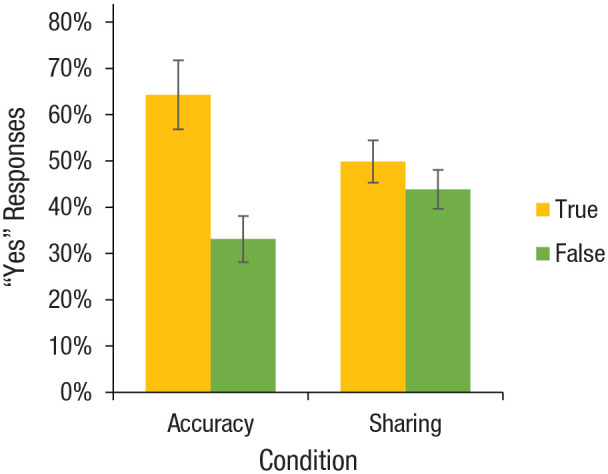
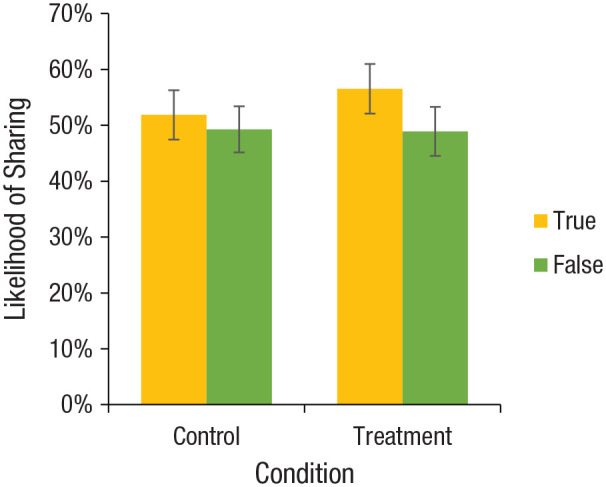
Across two studies with more than 1,700 U.S. adults recruited online, we present evidence that people share false claims about COVID-19 partly because they simply fail to think sufficiently about whether or not the content is accurate when deciding what to share. In Study 1, participants were far worse at discerning between true and false content when deciding what they would share on social media relative to when they were asked directly about accuracy. Furthermore, greater cognitive reflection and science knowledge were associated with stronger discernment. In Study 2, we found that a simple accuracy reminder at the beginning of the study (i.e., judging the accuracy of a non-COVID-19-related headline) nearly tripled the level of truth discernment in participants’ subsequent sharing intentions. Our results, which mirror those found previously for political fake news, suggest that nudging people to think about accuracy is a simple way to improve choices about what to share on social media.
Overview
The claims and statistics of this paper haven’t been checked yet.
Run the check — free, no account needed. It reads the open-access text and checks the sources it cites.
Integrity signals
Registry
Cites
Statistics
Figures
Verification
Claims the paper makes
The claims and statistics of this paper haven’t been checked yet.
Run the check — free, no account needed. It reads the open-access text and checks the sources it cites.
Claims other papers make about this one
Each is checked against this paper’s own text: does it say what the citing paper says it does?
The source backs part of the claim, not all of it — or backs it for a different population, condition or comparison.
In the citing paper
“Under these current plausible COVID-19 vaccine acceptance rates, possible levels of existing protective immunity-though it is unclear whether post-infection immunity confers long-term immunity 29 and the rapidly evolving nature of misinformation surrounding the pandemic 23,30 , it is unclear whether vaccination will reach the levels required for herd immunity.”
From Measuring the impact of COVID-19 vaccine misinformation on vaccination intent in the UK and USA (2021) · cites this paper as [23]
Experimental — accuracy not yet measuredThe cited source says what the claim attributes to it.
In the citing paper
“Experimental work indicates that directing users' attention to accuracy can improve sharing quality and reduce misinformation circulation (Pennycook et al., 2020(Pennycook et al., , 2021;;Roozenbeek et al., 2021).”
From Sensational Headlines, Engagement, and Credibility in Nepal’s Online News (2025) · cites this paper as Pennycook et al., 2020
The cited source says what the claim attributes to it.
In the citing paper
“Pennycook et al. (2020) and Roozenbeek et al. (2021) show that accuracy prompts can modestly improve users' sharing decisions, while Pennycook et al. (2021) argue that shifting attention toward accuracy can reduce misinformation sharing online.”
From Sensational Headlines, Engagement, and Credibility in Nepal’s Online News (2025) · cites this paper as Pennycook et al. (2020)
The check wasn’t confident either way, so it gives no verdict — never disputed.
In the citing paper
“Consistent with this view, a growing number of empirical studies have uncovered evidence that people update their political attitudes and beliefs in line with evidence (e.g., refs. 4,13,27–29) and arguments23,30,31 presented to them.”
From Factual knowledge can reduce attitude polarization (2025) · cites this paper as [28]
Experimental — accuracy not yet measured
Self-check
Percentages, sums and reported differences re-computed from the paper’s own numbers.
The self-check needs the paper’s full text.
Citations
Cites
The case for motivated reasoning.
Kunda, Z. (1990) · Psychological Bulletin · doi:10.1037/0033-2909.108.3.480 · Cited by 9,022 · cited 1×
“A great deal of evidence suggests that people are motivated to seek out, believe, and share politically congenial information (Kahan, Peters, Dawson, & Slovic, 2017; Kunda, 1990; Lee, Shin, & Hong, 2018; Mercier & Sperber, 2011; Shin & Thorson, 2017).”
BackgroundCognitive Reflection and Decision Making
Frederick, S. (2005) · Journal of Economic Perspectives · doi:10.1257/089533005775196732 · Cited by 5,256
Lazer, D. M. J., Baum, M. A., Benkler, Y., Berinsky, A. J., Greenhill, K. M., Menczer, F., Metzger, M. J., Nyhan, B., Pennycook, G., Rothschild, D., et al. (2018) · Science · doi:10.1126/science.aao2998 · Cited by 4,160
Self-citationWhy do humans reason? Arguments for an argumentative theory
Mercier, H., & Sperber, D. (2011) · Behavioral and Brain Sciences · doi:10.1017/s0140525x10000968 · Cited by 2,254
Pennycook, G., & Rand, D. G. (2019) · Cognition · doi:10.1016/j.cognition.2018.06.011 · Cited by 2,022
Self-citationShifting attention to accuracy can reduce misinformation online
Pennycook, G., Epstein, Z., Mosleh, M., Arechar, A. A., Eckles, D., & Rand, D. G. (2021) · Nature · doi:10.1038/s41586-021-03344-2 · Cited by 1,155
Self-citationThe Cognitive Reflection Test as a predictor of performance on heuristics-and-biases tasks
Toplak, M. E., West, R. F., & Stanovich, K. E. (2011) · Memory & Cognition · doi:10.3758/s13421-011-0104-1 · Cited by 1,047
Coppock, A., & McClellan, O. A. (2019) · Research & Politics · doi:10.1177/2053168018822174 · Cited by 987
Berinsky, A. J., Margolis, M. F., & Sances, M. W. (2014) · American Journal of Political Science · doi:10.1111/ajps.12081 · Cited by 951
Fighting misinformation on social media using crowdsourced judgments of news source quality
Pennycook, G., & Rand, D. G. (2019) · Proceedings of the National Academy of Sciences · doi:10.1073/pnas.1806781116 · Cited by 947 · cited 4×
“…2017; Van Bavel & Pereira, 2018), our data are more consistent with recent studies on political misinformation that provide both correlational (Pennycook & Rand, 2019b; including data from Twitter sharing, Mosleh, Pennycook, Arechar, & Rand, 2020) and experimental (Bago, Rand, & Pennycook,…”
BackgroundResultInfluentialSelf-citation
Research works printed but not linked: 2
- Adhanom Ghebreyesus T. (2020, February 15). Munich Security Conference. World Health Organization. Retrieved from https://www.who.int/dg/speeches/detail/munich-security-conference
- Ross R. M., 2019, PsyArXiv
Cited by
Sorted by citations
Items 101–200 of 1,004
Altay, S., de Araujo, E., & Mercier, H. (2021) · Digital Journalism · doi:10.1080/21670811.2021.1941163 · Cited by 120
Khan, A. N. (2021) · Technological Forecasting and Social Change · doi:10.1016/j.techfore.2021.120968 · Cited by 109
Understanding patterns of COVID infodemic: A systematic and pragmatic approach to curb fake news
Gupta, A. V., Li, H., Farnoush, A., & Jiang, W. (2021) · Journal of Business Research · doi:10.1016/j.jbusres.2021.11.032 · Cited by 108
Human Cooperation and the Crises of Climate Change, COVID-19, and Misinformation
Lange, P. A. M. V., & Rand, D. G. (2021) · Annual Review of Psychology · doi:10.1146/annurev-psych-020821-110044 · Cited by 104
Self-citationHealth-related fake news on social media platforms: A systematic literature review
Melchior, C., & Oliveira, M. F. D. A. (2021) · New Media & Society · doi:10.1177/14614448211038762 · Cited by 114
Prosocial behavior promotes positive emotion during the COVID-19 pandemic.
Varma, M. M., Chen, D., Lin, X., Aknin, L. B., & Hu, X. (2022) · Emotion · doi:10.1037/emo0001077 · Cited by 106
Communication of COVID-19 Misinformation on Social Media by Physicians in the US
Sule, S., DaCosta, M. C., DeCou, E., Gilson, C. F., Wallace, K. F., & Goff, S. L. (2023) · JAMA Network Open · doi:10.1001/jamanetworkopen.2023.28928 · Cited by 96
Saul, J. M. (2023) · doi:10.1093/oso/9780192871756.001.0001 · Cited by 96
Apuke, O. D., & Omar, B. (2020) · Health Education Research · doi:10.1093/her/cyaa030 · Cited by 112
Naeem, M., & Ozuem, W. (2022) · Information Technology & People · doi:10.1108/itp-01-2021-0061 · Cited by 94
Digital literacy is associated with more discerning accuracy judgments but not sharing intentions
Sirlin, N., Epstein, Z., Arechar, A. A., & Rand, D. G. (2021) · Harvard Kennedy School Misinformation Review · doi:10.37016/mr-2020-83 · Cited by 124
Self-citationSampat, B. H., & Raj, S. (2022) · Aslib Journal of Information Management · doi:10.1108/ajim-08-2021-0232 · Cited by 109
Salvi, C., Iannello, P., Cancer, A., McClay, M., Rago, S., Dunsmoor, J. E., & Antonietti, A. (2021) · Frontiers in Communication · doi:10.3389/fcomm.2020.562588 · Cited by 100
Evolution of honesty in higher-order social networks
Kumar, A., Chowdhary, S., Capraro, V., & Perc, M. (2021) · Physical review. E · doi:10.1103/physreve.104.054308 · Cited by 93
Lu, C. F., Hu, B., Li, Q., Bi, C., & Ju, X. (2023) · Journal of Medical Internet Research · doi:10.2196/49255 · Cited by 112
Digital Media’s Role in the COVID-19 Pandemic
Bao, H., Cao, B., Xiong, Y. Y., & Tang, W. (2020) · JMIR mhealth and uhealth · doi:10.2196/20156 · Cited by 100
Kim, B., Xiong, A., Lee, D., & Han, K. (2021) · PLoS ONE · doi:10.1371/journal.pone.0260080 · Cited by 113
Fake news: Why do we believe it?
Beauvais, C. (2022) · Joint Bone Spine · doi:10.1016/j.jbspin.2022.105371 · Cited by 130
Measuring exposure to misinformation from political elites on Twitter
Mosleh, M., & Rand, D. G. (2022) · Nature Communications · doi:10.1038/s41467-022-34769-6 · Cited by 90
Self-citationA Bibliometric Analysis and Review of Nudge Research Using VOSviewer
Jia, C., & Mustafa, H. (2022) · Behavioral Sciences · doi:10.3390/bs13010019 · Cited by 90
Arresting fake news sharing on social media: a theory of planned behavior approach
Pundir, V., Devi, E. B., & Nath, V. (2021) · Management Research Review · doi:10.1108/mrr-05-2020-0286 · Cited by 105
Technique-based inoculation against real-world misinformation
Roozenbeek, J., Traberg, C. S., & van der Linden, S. (2022) · Royal Society Open Science · doi:10.1098/rsos.211719 · Cited by 89
Analytic-thinking predicts hoax beliefs and helping behaviors in response to the COVID-19 pandemic
Stanley, M. L., Barr, N., Peters, K., & Seli, P. (2020) · Thinking & Reasoning · doi:10.1080/13546783.2020.1813806 · Cited by 88
Sultan, M., Tump, A. N., Ehmann, N., Lorenz-Spreen, P., Hertwig, R., Gollwitzer, A., & Kurvers, R. H. J. M. (2024) · Proceedings of the National Academy of Sciences · doi:10.1073/pnas.2409329121 · Cited by 130
Arechar, A. A., & Rand, D. G. (2021) · Behavior Research Methods · doi:10.3758/s13428-021-01588-4 · Cited by 105
Self-citationTackling misinformation: What researchers could do with social media data
Pasquetto, I. V., Swire‐Thompson, B., & Amazeen, M. A. (2020) · Harvard Kennedy School Misinformation Review · doi:10.37016/mr-2020-49 · Cited by 99
Brailovskaia, J., Cosci, F., Mansueto, G., & Margraf, J. (2021) · Journal of Affective Disorders Reports · doi:10.1016/j.jadr.2020.100067 · Cited by 84
Mining Physicians’ Opinions on Social Media to Obtain Insights Into COVID-19: Mixed Methods Analysis
Wahbeh, A., Nasralah, T., Al-Ramahi, M. A., & El-Gayar, O. (2020) · JMIR Public Health and Surveillance · doi:10.2196/19276 · Cited by 89
Five Crucial Challenges in Digital Health
Cummins, N., & Schuller, B. W. (2020) · Frontiers in Digital Health · doi:10.3389/fdgth.2020.536203 · Cited by 84
The Impact of the COVID-19 Pandemic on the Uptake of Influenza Vaccine: UK-Wide Observational Study
Bächtiger, P., Adamson, A., Chow, J., Sisodia, R., Quint, J. K., & Peters, N. S. (2021) · JMIR Public Health and Surveillance · doi:10.2196/26734 · Cited by 84
Who Is Susceptible to Online Health Misinformation?
Scherer, L. D., & Pennycook, G. (2020) · American Journal of Public Health · doi:10.2105/ajph.2020.305908 · Cited by 84
Self-citationDeveloping an accuracy-prompt toolkit to reduce COVID-19 misinformation online
Epstein, Z., Berinsky, A. J., Cole, R., Gully, A., Pennycook, G., & Rand, D. G. (2021) · Harvard Kennedy School Misinformation Review · doi:10.37016/mr-2020-71 · Cited by 93
Self-citationNudging Social Media toward Accuracy
Pennycook, G., & Rand, D. G. (2022) · The ANNALS of the American Academy of Political and Social Science · doi:10.1177/00027162221092342 · Cited by 106
Self-citationThe impact of COVID-19 among Black women: evaluating perspectives and sources of information
Chandler, R. D., Guillaume, D., Parker, A. G., Mack, A., Hamilton, J. B., Dorsey, J., & Hernandez, N. (2020) · Ethnicity and Health · doi:10.1080/13557858.2020.1841120 · Cited by 84
CoVerifi: A COVID-19 news verification system
Kolluri, N. L., & Murthy, D. (2021) · Online Social Networks and Media · doi:10.1016/j.osnem.2021.100123 · Cited by 84
The illusory truth effect leads to the spread of misinformation
Vellani, V., Zheng, S., Ercelik, D., & Sharot, T. (2023) · Cognition · doi:10.1016/j.cognition.2023.105421 · Cited by 83
Lee, J., & Shin, S. Y. (2022) · Media Psychology · doi:10.1080/15213269.2021.2007489 · Cited by 89
Psychological inoculation strategies to fight climate disinformation across 12 countries
Spampatti, T., Hahnel, U. J. J., Trutnevyte, E., & Brosch, T. (2023) · Nature Human Behaviour · doi:10.1038/s41562-023-01736-0 · Cited by 104
LLMs and generative agent-based models for complex systems research
Lu, Y., Aleta, A., Du, C., Shi, L., & Moreno, Y. (2024) · Physics of Life Reviews · doi:10.1016/j.plrev.2024.10.013 · Cited by 107
Exposure to social engagement metrics increases vulnerability to misinformation
Avram, M., Micallef, N., Patil, S., & Menczer, F. (2020) · Harvard Kennedy School Misinformation Review · doi:10.37016/mr-2020-033 · Cited by 83
COVID-19 Misinformation on Social Media: A Scoping Review
Joseph, A. M., Fernández, V., Kritzman, S., Eaddy, I., Cook, O. M., Lambros, S., Silva, C. E. J., Arguelles, D., Abraham, C., Dorgham, N., et al. (2022) · Cureus · doi:10.7759/cureus.24601 · Cited by 97
Raghu Raman, R., Nair, V. K., Nedungadi, P., Sahu, A. K., Kowalski, R. M., Ramanathan, S., & Achuthan, K. (2024) · Heliyon · doi:10.1016/j.heliyon.2024.e24727 · Cited by 114
Nudging Away False News: Evidence from a Social Norms Experiment
Andı, S., & Akesson, J. (2020) · Digital Journalism · doi:10.1080/21670811.2020.1847674 · Cited by 87
Su, Y., Lee, D. K. L., & Xiao, X. (2021) · Computers in Human Behavior · doi:10.1016/j.chb.2021.107111 · Cited by 84
On the Disposition to Think Analytically: Four Distinct Intuitive-Analytic Thinking Styles
Newton, C., Feeney, J. R., & Pennycook, G. (2023) · Personality and Social Psychology Bulletin · doi:10.1177/01461672231154886 · Cited by 120
Self-citationIshizumi, A., Kolis, J., Abad, N., Prybylski, D., Brookmeyer, K. A., Voegeli, C., Wardle, C., & Chiou, H. (2024) · The Lancet Public Health · doi:10.1016/s2468-2667(24)00031-8 · Cited by 79
Vijaykumar, S., Jin, Y., Rogerson, D., Lu, X., Sharma, S., Maughan, A. D., Fadel, B., de Oliveira-Costa, M. S., Pagliari, C., & Morris, D. (2021) · Humanities and Social Sciences Communications · doi:10.1057/s41599-021-00752-7 · Cited by 79
Velásquez, N., Leahy, R., Restrepo, N. J., Lupu, Y., Sear, R. F., Gabriel, N., Jha, O. K., Goldberg, B., & Johnson, N. F. (2021) · Scientific Reports · doi:10.1038/s41598-021-89467-y · Cited by 79
Optimism Bias during the Covid-19 Pandemic: Empirical Evidence from Romania and Italy
Druică, E., Musso, F., & Ianole-Călin, R. (2020) · Games · doi:10.3390/g11030039 · Cited by 79
Customers' social interactions and panic buying behavior: Insights from social media practices
Naeem, M., & Ozuem, W. (2021) · Journal of Consumer Behaviour · doi:10.1002/cb.1925 · Cited by 77
Mirzaei, A., Kazembeigi, F., Kakaei, H., Jalilian, M., Mazloomi, S., & Nourmoradi, H. (2021) · Journal of Education and Health Promotion · doi:10.4103/jehp.jehp_747_20 · Cited by 77
Melchior, C., & Oliveira, M. F. D. A. (2023) · New Media & Society · doi:10.1177/14614448231174224 · Cited by 103
A model of online misinformation
Acemoglu, D., Ozdaglar, A., & Siderius, J. (2024) · Review of Economic Studies · doi:10.1093/restud/rdad111 · Cited by 82
Blockchain and COVID-19 pandemic: applications and challenges
Ahmad, R. W., Salah, K., Jayaraman, R., Yaqoob, I., Ellahham, S. H., & Omar, M. (2023) · Cluster Computing · doi:10.1007/s10586-023-04009-7 · Cited by 81
Loomba, S., de Figueiredo, A., Piatek, S. J., de Graaf, K., & Larson, H. J. (2020) · medRxiv · doi:10.1101/2020.10.22.20217513 · Cited by 72
Majeed, M., Irshad, M., Fatima, T., Khan, J., & Hassan, M. M. (2020) · Frontiers in Psychology · doi:10.3389/fpsyg.2020.557987 · Cited by 73
Combatting Against Covid-19 & Misinformation: A Systematic Review
Ali, S. (2020) · Human Arenas · doi:10.1007/s42087-020-00139-1 · Cited by 73
Stigma and misconceptions in the time of the COVID-19 pandemic: A field experiment in India
Islam, A., Pakrashi, D., Vlassopoulos, M., & Wang, L. C. (2021) · Social Science & Medicine · doi:10.1016/j.socscimed.2021.113966 · Cited by 73
Gunasekeran, D. V., Chew, A., Chandrasekar, E. K., Rajendram, P., Kandarpa, V., Rajendram, M., Chia, A., Smith, H. E., & Leong, C. K. (2022) · Journal of Medical Internet Research · doi:10.2196/33680 · Cited by 81
Misinformation and the epistemic integrity of democracy
Lewandowsky, S., Ecker, U. K. H., Cook, J., van der Linden, S., Roozenbeek, J., & Орескес, Н. (2023) · Current Opinion in Psychology · doi:10.1016/j.copsyc.2023.101711 · Cited by 123
How Can Psychological Science Help Counter the Spread of Fake News?
van der Linden, S., Roozenbeek, J., Maertens, R., Basol, M., Kácha, O., Rathje, S., & Traberg, C. S. (2021) · The Spanish Journal of Psychology · doi:10.1017/sjp.2021.23 · Cited by 71
“Additionally, encouraging people to pause, deliberate, or think about accuracy before rating headlines (Bago et al., 2020; Fazio, 2020; Pennycook et al., 2020) can lead to more accurate identification of false news for both politically congruent and politically-incongruent headlines (Pennycook&…”
BackgroundEmotion and humor as misinformation antidotes
Yeo, S. K., & McKasy, M. (2021) · Proceedings of the National Academy of Sciences · doi:10.1073/pnas.2002484118 · Cited by 80
Antecedents and consequences of COVID-19 conspiracy beliefs: a systematic reviewPreprint
van Mulukom, V., Pummerer, L., Alper, S., Bai, H., Čavojová, V., Farias, J. E. M., Kay, C. S., Lazarević, L. B., Lobato, E. J. C., Marinthe, G., et al. (2020) · doi:10.31234/osf.io/u8yah · Cited by 71
Larsen, E. M., Donaldson, K. R., Liew, M., & Mohanty, A. (2020) · doi:10.31234/osf.io/mb65f · Cited by 71
The role of religion in mitigating the COVID-19 pandemic: the Malaysian multi-faith perspectives
Tan, M., Musa, A. F., & Su, T. T. (2021) · Health Promotion International · doi:10.1093/heapro/daab041 · Cited by 81
Vax attacks: How conspiracy theory belief undermines vaccine support
Farhart, C. E., Douglas-Durham, E., Trujillo, K. L., & Vitriol, J. A. (2022) · Progress in molecular biology and translational science · doi:10.1016/bs.pmbts.2021.11.001 · Cited by 80
Zhao, Y.-J., Jin, Y., Rao, W., Li, W., Zhao, N., Cheung, T. C. C., Ng, C. H., Wang, Y. Y., Zhang, Q., & Xiang, Y. (2021) · Journal of Affective Disorders · doi:10.1016/j.jad.2021.03.016 · Cited by 71
Kumari, R., Kumar, N. A., Ghosal, T., & Ekbal, A. (2021) · Information Processing & Management · doi:10.1016/j.ipm.2021.102631 · Cited by 72
Oleksy, T., Wnuk, A., Gambin, M., & Łyś, A. (2021) · Social Science & Medicine (1967) · doi:10.1016/j.socscimed.2021.114028 · Cited by 35
A framework for understanding reasoning errors: From fake news to climate change and beyond
Pennycook, G. (2022) · Advances in experimental social psychology · doi:10.1016/bs.aesp.2022.11.003 · Cited by 95
The role of political devotion in sharing partisan misinformation and resistance to fact-checking.
Pretus, C., Servin-Barthet, C., Harris, E., Brady, W. J., Vilarroya, Ó., & Bavel, J. J. V. (2023) · Journal of Experimental Psychology General · doi:10.1037/xge0001436 · Cited by 73
Zettler, I., Schild, C., Lilleholt, L., Kroencke, L., Utesch, T., Moshagen, M., BOHM, R. M., Back, M. D., & Utesch, K. (2020) · doi:10.31234/osf.io/pkm2a · Cited by 71
Combating Misinformation by Sharing the Truth: a Study on the Spread of Fact-Checks on Social Media
Li, J., & Chang, X. (2022) · Information Systems Frontiers · doi:10.1007/s10796-022-10296-z · Cited by 83
Vandormael, A. M., Adam, M., Greuel, M., Gates, J., Favaretti, C., Hachaturyan, V., & Bärnighausen, T. (2021) · JMIR Public Health and Surveillance · doi:10.2196/29060 · Cited by 66
Social Media News Use and COVID-19 Misinformation Engagement: Survey Study
Ahmed, S., & Rasul, M. E. (2022) · Journal of Medical Internet Research · doi:10.2196/38944 · Cited by 86
Did the Roll-Out of Community Notes Reduce Engagement With Misinformation on X/Twitter?
Chuai, Y., Tian, H., Pröllochs, N., & Lenzini, G. (2024) · Proceedings of the ACM on Human-Computer Interaction · doi:10.1145/3686967 · Cited by 98
COVID-19 News and Misinformation: Do They Matter for Public Health Prevention?
Dhawan, D., Bekalu, M. A., Pinnamaneni, R., McCloud, R. F., & Viswanath, K. (2021) · Journal of Health Communication · doi:10.1080/10810730.2021.2010841 · Cited by 68
Negative Consequences of Informing Voters about Deepfakes: Evidence from Two Survey Experiments
Ternovski, J., Kalla, J., & Aronow, P. M. (2022) · Journal of Online Trust and Safety · doi:10.54501/jots.v1i2.28 · Cited by 76
Misinformation About COVID-19 in Sub-Saharan Africa: Evidence from a Cross-Sectional Survey
Osuagwu, U. L., Miner, C. A., Bhattarai, D., Mashige, K. P., Oloruntoba, R., Abu, E. K., Ekpenyong, B. N., Timothy, C. G., Goson, P. C., Ovenseri-Ogbomo, G. O., et al. (2021) · Health Security · doi:10.1089/hs.2020.0202 · Cited by 67
The Interaction between Political Typology and Filter Bubbles in News Recommendation Algorithms
Liu, P., Shivaram, K., Culotta, A., Shapiro, M. A., & Bilgic, M. (2021) · International World Wide Web Conference (WWW) · doi:10.1145/3442381.3450113 · Cited by 75
Giri, S. P., & Maurya, A. K. (2021) · Personality and Individual Differences · doi:10.1016/j.paid.2021.110962 · Cited by 72
Does Servant Leadership Control Psychological Distress in Crisis? Moderation and Mediation Mechanism
Zada, M., Zada, S., Khan, J., Saeed, I., Zhang, Y. J., Vega-Muñoz, A., & Salazar-Sepúlveda, G. (2022) · Psychology Research and Behavior Management · doi:10.2147/prbm.s354093 · Cited by 70
Self-citationInoculating against the spread of Islamophobic and radical-Islamist disinformation
Lewandowsky, S., & Yesilada, M. (2021) · Cognitive Research: Principles and Implications · doi:10.1186/s41235-021-00323-z · Cited by 62
#COVID-19 on Twitter: Bots, Conspiracies, and Social Media Activism
Ferrara, E. (2020) · Europe PMC (PubMed Central) · Cited by 67
Stigma on first responders during COVID-19.
Zolnikov, T. R., & Furio, F. (2020) · Stigma and Health · doi:10.1037/sah0000270 · Cited by 69
Belief in Science Influences Physical Distancing in Response to COVID-19 Lockdown Policies
Brzezinski, A., Kecht, V., Dijcke, D. V., & Wright, A. L. (2020) · Nature Human Behaviour · doi:10.1038/s41562-021-01227-0 · Cited by 172
Detecting COVID-19-Related Fake News Using Feature Extraction
Khan, S. A., Hakak, S., Deepa, N., Prabadevi, B., Dev, K., & Treľová, S. (2022) · Frontiers in Public Health · doi:10.3389/fpubh.2021.788074 · Cited by 63
Updating the identity-based model of belief: From false belief to the spread of misinformation
Bavel, J. J. V., Rathje, S., Vlasceanu, M., & Pretus, C. (2024) · Current Opinion in Psychology · doi:10.1016/j.copsyc.2023.101787 · Cited by 76
Yu, J., Bekerian, D. A., & Osback, C. (2024) · Encyclopedia · doi:10.3390/encyclopedia4040109 · Cited by 114
Antonakis, J. (2021) · Group Processes & Intergroup Relations · doi:10.1177/1368430220981418 · Cited by 62
Social and Cognitive Aspects of the Vulnerability to Political Misinformation
Pantazi, M., Hale, S. A., & Klein, O. (2021) · Political Psychology · doi:10.1111/pops.12797 · Cited by 81
Alshaabi, T., Arnold, M., Minot, J. R., Adams, J. L., Dewhurst, D. R., Reagan, A. J., Muhamad, R., Danforth, C. M., & Dodds, P. S. (2021) · PLoS ONE · doi:10.1371/journal.pone.0244476 · Cited by 69
Eder, S. J., Steyrl, D., Stefańczyk, M., Pieniak, M., Molina, J. M., Pešout, O., Binter, J., Smela, P., Scharnowski, F., & Nicholson, A. A. (2021) · PLoS ONE · doi:10.1371/journal.pone.0247997 · Cited by 65
Gratz, K. L., Richmond, J. R., Woods, S. E., Dixon–Gordon, K. L., Scamaldo, K. M., Rose, J. P., & Tull, M. T. (2021) · Annals of Behavioral Medicine · doi:10.1093/abm/kaab024 · Cited by 62
Emotion, analytic thinking and susceptibility to misinformation during the COVID-19 outbreak
Li, M., Chen, Z., & Rao, L. (2022) · Computers in Human Behavior · doi:10.1016/j.chb.2022.107295 · Cited by 64
Pandemics and infodemics: Research on the effects of misinformation on memory
Greenspan, R. L., & Loftus, E. F. (2020) · Human Behavior and Emerging Technologies · doi:10.1002/hbe2.228 · Cited by 70
Agley, J. D., Xiao, Y., Thompson, E. E., Chen, X., & Golzarri‐Arroyo, L. (2021) · Journal of Medical Internet Research · doi:10.2196/32425 · Cited by 77
How to Combat Health Misinformation: A Psychological Approach
Roozenbeek, J., & van der Linden, S. (2022) · American Journal of Health Promotion · doi:10.1177/08901171211070958 · Cited by 60
Martikainen, J., & Sakki, I. (2021) · Journal of Community & Applied Social Psychology · doi:10.1002/casp.2515 · Cited by 63
A hierarchical network-oriented analysis of user participation in misinformation spread on WhatsApp
Nobre, G. P., Ferreira, C. H. G., & Almeida, J. M. (2021) · Information Processing & Management · doi:10.1016/j.ipm.2021.102757 · Cited by 68
Metadata
- Authors
- Pennycook, G., McPhetres, J., Zhang, Y., Lu, J. G., & Rand, D. G.
- Affiliations
- University of Regina (CA)
- Massachusetts Institute of Technology (US)
- Corresponding author
- Pennycook, Gordon
- Venue
- Psychological Science
- Publisher
- SAGE Publications
- Published
- 2020-06-30
- Volume
- 31
- Issue
- 7
- Pages
- 770-780
- ISSN
- 0956-7976 (ISSN-L)
- 1467-9280
- PMC
- PMC7366427
- OpenAlex
- W3013473577
- Cited by
- 1,715
- References
- 38
- Citations by year
- 2026: 111 · 2025: 188 · 2024: 238 · 2023: 299 · 2022: 329 · 2021: 416 · 2020: 132
- FWCI
- 393.97
- Type
- journal article
- Language
- en
- Open access
- hybrid
- doi.org
- Locations
- Psychological Science (publishedVersion, cc-by)
- PubMed Central (publishedVersion, cc-by)
- PubMed (publishedVersion)
- DSpace@MIT (Massachusetts Institute of Technology) (submittedVersion, cc-by-nc-sa)
- Funders
- miami foundation
- William and Flora Hewlett Foundation
- Omidyar Network
- John Templeton Foundation
- Canadian Institutes of Health Research
- Social Sciences and Humanities Research Council of Canada
- Topics
- Social Sciences › Sociology and Political Science › Misinformation and Its Impacts
- Social Sciences › Communication › Communication and COVID-19 Impact
- Social Sciences › Library and Information Sciences › Academic Publishing and Open Access
- Keywords
- COVID-19 misinformation, social media sharing, truth discernment, fake news, cognitive reflection, scientific knowledge, misinformation prevention, sharing intention
- MeSH terms
- Betacoronavirus, COVID-19, SARS-CoV-2, Adolescent, Adult, Aged, Aged, 80 and over, Communication, Decision Making, Female, Humans, Male, Middle Aged, Pneumonia, Viral, Coronavirus Infections, Information Dissemination, Young Adult, Pandemics, Social Media
About these checks
Registry, retraction, Cites and statistics results are computed, not judged, with one exception: a printed reference that no index lists is read once by a model before it counts as a citation error. Claims are extracted by a model and kept only when their quote appears verbatim in the text; each cited source is then checked, with a model’s help, for whether it says what the claim relies on. Those verdicts can be wrong — read the claim’s quote and the cited source before relying on one.
Statistics and arithmetic are recomputed, not judged.
Confidence bands are shown only for fields calibrated on our annotated test set. None is calibrated yet, so no band is shown.
What counts as a claim ›How we measure confidence ›How we check this ›
Are you an author, or do you see a problem with this page? Request a review
