

The DOI matches its Crossref record; 38 of the 41 references it cites were found in a registry or an index, and 3 are not checked yet.
Fighting COVID-19 Misinformation on Social Media: Experimental Evidence for a Scalable Accuracy-Nudge Intervention
Open accessAbstract
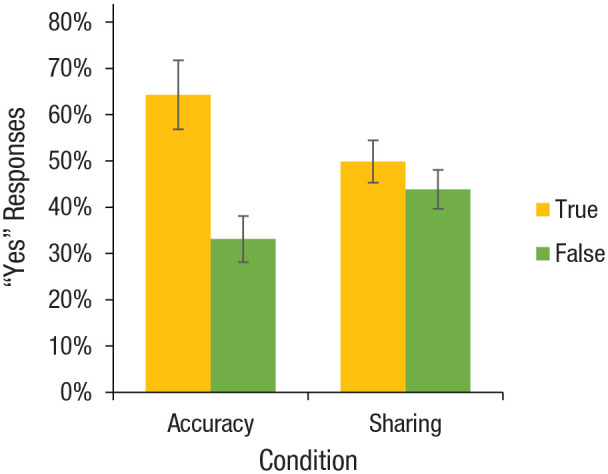
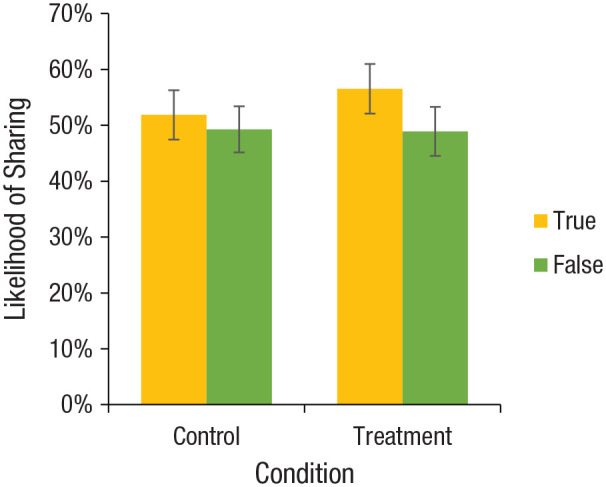
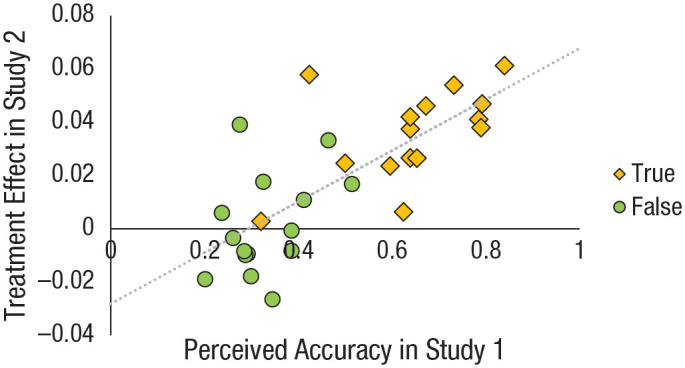
Across two studies with more than 1,700 U.S. adults recruited online, we present evidence that people share false claims about COVID-19 partly because they simply fail to think sufficiently about whether or not the content is accurate when deciding what to share. In Study 1, participants were far worse at discerning between true and false content when deciding what they would share on social media relative to when they were asked directly about accuracy. Furthermore, greater cognitive reflection and science knowledge were associated with stronger discernment. In Study 2, we found that a simple accuracy reminder at the beginning of the study (i.e., judging the accuracy of a non-COVID-19-related headline) nearly tripled the level of truth discernment in participants’ subsequent sharing intentions. Our results, which mirror those found previously for political fake news, suggest that nudging people to think about accuracy is a simple way to improve choices about what to share on social media.
Overview
The claims and statistics of this paper haven’t been checked yet.
Run the check — free, no account needed. It reads the open-access text and checks the sources it cites.
Integrity signals
Registry
Cites
Statistics
Figures
Verification
Claims the paper makes
The claims and statistics of this paper haven’t been checked yet.
Run the check — free, no account needed. It reads the open-access text and checks the sources it cites.
Claims other papers make about this one
Each is checked against this paper’s own text: does it say what the citing paper says it does?
The source backs part of the claim, not all of it — or backs it for a different population, condition or comparison.
In the citing paper
“Under these current plausible COVID-19 vaccine acceptance rates, possible levels of existing protective immunity-though it is unclear whether post-infection immunity confers long-term immunity 29 and the rapidly evolving nature of misinformation surrounding the pandemic 23,30 , it is unclear whether vaccination will reach the levels required for herd immunity.”
From Measuring the impact of COVID-19 vaccine misinformation on vaccination intent in the UK and USA (2021) · cites this paper as [23]
Experimental — accuracy not yet measuredThe cited source says what the claim attributes to it.
In the citing paper
“Experimental work indicates that directing users' attention to accuracy can improve sharing quality and reduce misinformation circulation (Pennycook et al., 2020(Pennycook et al., , 2021;;Roozenbeek et al., 2021).”
From Sensational Headlines, Engagement, and Credibility in Nepal’s Online News (2025) · cites this paper as Pennycook et al., 2020
The cited source says what the claim attributes to it.
In the citing paper
“Pennycook et al. (2020) and Roozenbeek et al. (2021) show that accuracy prompts can modestly improve users' sharing decisions, while Pennycook et al. (2021) argue that shifting attention toward accuracy can reduce misinformation sharing online.”
From Sensational Headlines, Engagement, and Credibility in Nepal’s Online News (2025) · cites this paper as Pennycook et al. (2020)
The check wasn’t confident either way, so it gives no verdict — never disputed.
In the citing paper
“Consistent with this view, a growing number of empirical studies have uncovered evidence that people update their political attitudes and beliefs in line with evidence (e.g., refs. 4,13,27–29) and arguments23,30,31 presented to them.”
From Factual knowledge can reduce attitude polarization (2025) · cites this paper as [28]
Experimental — accuracy not yet measured
Self-check
Percentages, sums and reported differences re-computed from the paper’s own numbers.
The self-check needs the paper’s full text.
Citations
Cites
The case for motivated reasoning.
Kunda, Z. (1990) · Psychological Bulletin · doi:10.1037/0033-2909.108.3.480 · Cited by 9,022 · cited 1×
“A great deal of evidence suggests that people are motivated to seek out, believe, and share politically congenial information (Kahan, Peters, Dawson, & Slovic, 2017; Kunda, 1990; Lee, Shin, & Hong, 2018; Mercier & Sperber, 2011; Shin & Thorson, 2017).”
BackgroundCognitive Reflection and Decision Making
Frederick, S. (2005) · Journal of Economic Perspectives · doi:10.1257/089533005775196732 · Cited by 5,256
Lazer, D. M. J., Baum, M. A., Benkler, Y., Berinsky, A. J., Greenhill, K. M., Menczer, F., Metzger, M. J., Nyhan, B., Pennycook, G., Rothschild, D., et al. (2018) · Science · doi:10.1126/science.aao2998 · Cited by 4,160
Self-citationWhy do humans reason? Arguments for an argumentative theory
Mercier, H., & Sperber, D. (2011) · Behavioral and Brain Sciences · doi:10.1017/s0140525x10000968 · Cited by 2,254
Pennycook, G., & Rand, D. G. (2019) · Cognition · doi:10.1016/j.cognition.2018.06.011 · Cited by 2,022
Self-citationShifting attention to accuracy can reduce misinformation online
Pennycook, G., Epstein, Z., Mosleh, M., Arechar, A. A., Eckles, D., & Rand, D. G. (2021) · Nature · doi:10.1038/s41586-021-03344-2 · Cited by 1,155
Self-citationThe Cognitive Reflection Test as a predictor of performance on heuristics-and-biases tasks
Toplak, M. E., West, R. F., & Stanovich, K. E. (2011) · Memory & Cognition · doi:10.3758/s13421-011-0104-1 · Cited by 1,047
Coppock, A., & McClellan, O. A. (2019) · Research & Politics · doi:10.1177/2053168018822174 · Cited by 987
Berinsky, A. J., Margolis, M. F., & Sances, M. W. (2014) · American Journal of Political Science · doi:10.1111/ajps.12081 · Cited by 951
Fighting misinformation on social media using crowdsourced judgments of news source quality
Pennycook, G., & Rand, D. G. (2019) · Proceedings of the National Academy of Sciences · doi:10.1073/pnas.1806781116 · Cited by 947 · cited 4×
“…2017; Van Bavel & Pereira, 2018), our data are more consistent with recent studies on political misinformation that provide both correlational (Pennycook & Rand, 2019b; including data from Twitter sharing, Mosleh, Pennycook, Arechar, & Rand, 2020) and experimental (Bago, Rand, & Pennycook,…”
BackgroundResultInfluentialSelf-citation
Research works printed but not linked: 2
- Adhanom Ghebreyesus T. (2020, February 15). Munich Security Conference. World Health Organization. Retrieved from https://www.who.int/dg/speeches/detail/munich-security-conference
- Ross R. M., 2019, PsyArXiv
Cited by
Sorted by citations
Items 201–300 of 1,004
Machine Learning in Detecting COVID-19 Misinformation on Twitter
Alenezi, M. N., & AlQenaei, Z. M. (2021) · Future Internet · doi:10.3390/fi13100244 · Cited by 59
Kiviniemi, M. T., Orom, H., Hay, J. L., & Waters, E. A. (2022) · BMC Public Health · doi:10.1186/s12889-022-12649-4 · Cited by 63
Community notes increase trust in fact-checking on social media
Drolsbach, C., Solovev, K., & Pröllochs, N. (2024) · PNAS Nexus · doi:10.1093/pnasnexus/pgae217 · Cited by 82
FibVID: Comprehensive fake news diffusion dataset during the COVID-19 period
Kim, J., Aum, J., Lee, S., Jang, Y., Park, E., & Choi, D. (2021) · Telematics and Informatics · doi:10.1016/j.tele.2021.101688 · Cited by 59
Hammad, M. A., & Alqarni, T. M. (2021) · PLoS ONE · doi:10.1371/journal.pone.0248811 · Cited by 64
Juanchich, M., Sirota, M., Jolles, D., & Whiley, L. A. (2021) · European Journal of Social Psychology · doi:10.1002/ejsp.2796 · Cited by 70
Barzilai, S., Mor-Hagani, S., Abed, F., Tal-Savir, D., Goldik, N., Talmon, I., & Davidow, O. (2023) · Computers & Education · doi:10.1016/j.compedu.2023.104832 · Cited by 69
Perceptions of Health Misinformation on Social Media: Cross-Sectional Survey Study
Gaysynsky, A., Senft, N., Heley, K. M., & Chou, W. S. (2024) · JMIR Infodemiology · doi:10.2196/51127 · Cited by 77
Beyond belief: How social engagement motives influence the spread of conspiracy theories
Ren, Z., Dimant, E., & Schweitzer, M. E. (2022) · Journal of Experimental Social Psychology · doi:10.1016/j.jesp.2022.104421 · Cited by 72
Lu, J. G., Swaab, R. I., & Galinsky, A. D. (2021) · Organization science (Providence, R.I.) · doi:10.1287/orsc.2021.1480 · Cited by 63
Self-citationBowes, S. M., & Tasimi, A. (2022) · Journal of Research in Personality · doi:10.1016/j.jrp.2022.104220 · Cited by 62
How social identity shapes conspiratorial belief
Robertson, C. E., Pretus, C., Rathje, S., Harris, E. A., & Van Bavel, J. J. (2022) · Current Opinion in Psychology · doi:10.1016/j.copsyc.2022.101423 · Cited by 57
Fact-checker warning labels are effective even for those who distrust fact-checkers
Martel, C., & Rand, D. G. (2024) · Nature Human Behaviour · doi:10.1038/s41562-024-01973-x · Cited by 74
Self-citationIndividual differences in susceptibility to false memories for COVID-19 fake news
Greene, C. M., & Murphy, G. (2020) · Cognitive Research Principles and Implications · doi:10.1186/s41235-020-00262-1 · Cited by 60
COVID-19 and social-politics of medical misinformation on social media in Pakistan
Ittefaq, M., Hussain, S. A., & Fatima, M. (2020) · Media Asia · doi:10.1080/01296612.2020.1817264 · Cited by 56
Individual Differences in Belief in Fake News about Election Fraud after the 2020 U.S. Election
Calvillo, D. P., Rutchick, A. M., & Garcia, R. J. B. (2021) · Behavioral Sciences · doi:10.3390/bs11120175 · Cited by 61
Moral Emotions Shape the Virality of COVID-19 Misinformation on Social Media
Solovev, K., & Pröllochs, N. (2022) · International World Wide Web Conference (WWW) · doi:10.1145/3485447.3512266 · Cited by 74
Prevalence and source analysis of COVID-19 misinformation in 138 countries
Al-Zaman, M. S. (2021) · IFLA Journal · doi:10.1177/03400352211041135 · Cited by 58
The Landscape of User-centered Misinformation Interventions - A Systematic Literature Review
Hartwig, K., Doell, F., & Reuter, C. (2024) · ACM Computing Surveys · doi:10.1145/3674724 · Cited by 71
Reliance on emotion promotes belief in fake news
Martel, C., Pennycook, G., & Rand, D. G. (2019) · doi:10.31234/osf.io/a2ydw · Cited by 49
Self-citationAllen, J. D., Abuelezam, N. N., Rose, R., & Fontenot, H. B. (2021) · Translational Behavioral Medicine · doi:10.1093/tbm/ibab014 · Cited by 53
Viruses, vaccines, and COVID-19: Explaining and improving risky decision-making.
Reyna, V. F., Broniatowski, D. A., & Edelson, S. M. (2021) · Journal of Applied Research in Memory and Cognition · doi:10.1016/j.jarmac.2021.08.004 · Cited by 59
The COVID-19 Infodemic and the Efficacy of Interventions Intended to Reduce Misinformation
Kreps, S. E., & Kriner, D. L. (2022) · Public Opinion Quarterly · doi:10.1093/poq/nfab075 · Cited by 51
Nurse, M. S., Ross, R. M., İşler, O., & Rooy, D. V. (2021) · Memory & Cognition · doi:10.3758/s13421-021-01219-5 · Cited by 52
Capraro, V., & Celadin, T. (2023) · Personality and Social Psychology Bulletin · doi:10.1177/01461672221117691 · Cited by 49
Model Generalization on COVID-19 Fake News Detection
Bang, Y., Ishii, E., Cahyawijaya, S., Ji, Z., & Fung, P. (2021) · Communications in Computer and Information Science · doi:10.1007/978-3-030-73696-5_13 · Cited by 52
Moucheraud, C., Guo, H., & Macinko, J. A. (2021) · Health Affairs · doi:10.1377/hlthaff.2020.02006 · Cited by 52
Zaman, A., Zhang, B., Hoque, M. E., Silenzio, V., & Kautz, H. (2020) · JMIR Mental Health · doi:10.2196/24012 · Cited by 52
Checking and Sharing Alt-Facts
Henry, E., Zhuravskaya, E. V., & Guriev, S. M. (2022) · American Economic Journal Economic Policy · doi:10.1257/pol.20210037 · Cited by 53
Lanius, C. L., Weber, R., & MacKenzie, W. I. (2021) · Social Network Analysis and Mining · doi:10.1007/s13278-021-00739-x · Cited by 47
Attitude, Perception, and Knowledge of COVID-19 Among General Public in Pakistan
Mahmood, S., Hussain, T. A., Mahmood, F., Ahmad, M., Majeed, A., Beg, B. M., & Areej, S. (2020) · Frontiers in Public Health · doi:10.3389/fpubh.2020.602434 · Cited by 53
Rijo, A., & Waldzus, S. (2022) · Computers in Human Behavior · doi:10.1016/j.chb.2022.107619 · Cited by 55
Malik, A., Bashir, F., & Mahmood, K. (2023) · SAGE Open · doi:10.1177/21582440221147022 · Cited by 62
Political Deepfakes Are as Credible as Other Fake Media and (Sometimes) Real Media
Barari, S., Lucas, C., & Munger, K. (2024) · The Journal of Politics · doi:10.1086/732990 · Cited by 71
Digital Ecosystems, Children, and Adolescents: Policy Statement
Munzer, T. G., Parga-Belinkie, J., Milkovich, L. M., Tomopoulos, S., Ajumobi, T., Cross, C., Gerwin, R. L., Madigan, S. L., Psych, R., Radesky, J. S., et al. (2026) · PEDIATRICS · doi:10.1542/peds.2025-075320 · Cited by 81
Martel, C., Mosleh, M., & Rand, D. G. (2021) · Media and Communication · doi:10.17645/mac.v9i1.3519 · Cited by 56
Self-citationTrust in science increases conservative support for social distancing
Koetke, J., Schumann, K., & Porter, T. (2021) · Group Processes & Intergroup Relations · doi:10.1177/1368430220985918 · Cited by 52
Impact of COVID-19 First Wave on Psychological and Psychosocial Dimensions: A Systematic Review
Filindassi, V., Pedrini, C., Sabadini, C., Duradoni, M., & Guazzini, A. (2022) · COVID · doi:10.3390/covid2030022 · Cited by 56
Displaying News Source Trustworthiness Ratings Reduces Sharing Intentions for False News Posts
Celadin, T., Capraro, V., Pennycook, G., & Rand, D. G. (2023) · Journal of Online Trust and Safety · doi:10.54501/jots.v1i5.100 · Cited by 54
Self-citationSpotting false news and doubting true news: a systematic review and meta-analysis of news judgements
Pfänder, J., & Altay, S. (2025) · Nature Human Behaviour · doi:10.1038/s41562-024-02086-1 · Cited by 89
Giachanou, A., Ghanem, B., Ríssola, E. A., Rosso, P., Crestani, F., & Oberski, D. L. (2021) · Data & Knowledge Engineering · doi:10.1016/j.datak.2021.101960 · Cited by 53
Attention dynamics on the Chinese social media Sina Weibo during the COVID-19 pandemic
Cui, H., & Kertész, J. (2021) · EPJ Data Science · doi:10.1140/epjds/s13688-021-00263-0 · Cited by 49
Epistemic vice predicts acceptance of Covid-19 misinformation
Meyer, M., Alfano, M., & de Bruin, B. (2021) · Episteme · doi:10.1017/epi.2021.18 · Cited by 49
Geospatial analysis of misinformation in COVID-19 related tweets
Forati, A. M., & Ghose, R. (2021) · Applied Geography · doi:10.1016/j.apgeog.2021.102473 · Cited by 49
Don’t Fish in Troubled Waters! Characterizing Coronavirus-themed Cryptocurrency Scams
Xia, P., Wang, H., Luo, X., Wu, L., Zhou, Y., Bai, G., Xu, G., Huang, G., & Liu, X. (2020) · APWG Symposium on Electronic Crime Research (eCrime) · doi:10.1109/ecrime51433.2020.9493255 · Cited by 51
Incidental news exposure and COVID-19 misperceptions: A moderated-mediation model
Borah, P., Su, Y., Xiao, X., & Lee, D. K. L. (2021) · Computers in Human Behavior · doi:10.1016/j.chb.2021.107173 · Cited by 57
Zhan, Z., Wei, Q., & Hong, J.-C. (2021) · Computers in Human Behavior · doi:10.1016/j.chb.2021.106790 · Cited by 49
Review of social science research on the impact of countermeasures against influence operations
Courchesne, L., Ilhardt, J. G., & Shapiro, J. N. (2021) · Harvard Kennedy School Misinformation Review · doi:10.37016/mr-2020-79 · Cited by 56
Combating the infodemic: COVID-19 induced fake news recognition in social media networks
Biradar, S., Saumya, S., & Chauhan, A. (2022) · Complex & Intelligent Systems · doi:10.1007/s40747-022-00672-2 · Cited by 52
Rothmund, T., Farkhari, F., Ziemer, C., & Azevedo, F. (2022) · Public Understanding of Science · doi:10.1177/09636625211068131 · Cited by 52
A science of collaborative learning health systems
Seid, M., Hartley, D., & Margolis, P. A. (2021) · Learning Health Systems · doi:10.1002/lrh2.10278 · Cited by 49
The Matching Effect of Destinations’ Crisis Communication
Zhang, J., Xie, C., Chen, Y., Dai, Y.-D., & Yi-Jun, W. (2022) · Journal of Travel Research · doi:10.1177/00472875211067548 · Cited by 51
User perspectives on digital literacy as a response to misinformation
Diepeveen, S., & Pinet, M. (2022) · Development Policy Review · doi:10.1111/dpr.12671 · Cited by 86
Diffusion of Community Fact-Checked Misinformation on Twitter
Drolsbach, C., & Pröllochs, N. (2023) · Proceedings of the ACM on Human-Computer Interaction · doi:10.1145/3610058 · Cited by 60
AI-driven disinformation: policy recommendations for democratic resilience
Romanishyn, A., Malytska, O., & Goncharuk, V. (2025) · Frontiers in Artificial Intelligence · doi:10.3389/frai.2025.1569115 · Cited by 47
Debunking Misinformation About Consumer Products: Effects on Beliefs and Purchase Behavior
Fong, J., Guo, T., & Rao, A. (2022) · Journal of Marketing Research · doi:10.1177/00222437221147088 · Cited by 54
Public information needs during the COVID-19 outbreak: a qualitative study in mainland China
Yi, Y., & Chiu, D. K. W. (2023) · Library Hi Tech · doi:10.1108/lht-08-2022-0398 · Cited by 46
Prike, T., Butler, L. H., & Ecker, U. K. H. (2024) · Scientific Reports · doi:10.1038/s41598-024-57560-7 · Cited by 46
Leveraging Twitter data to analyze the virality of Covid-19 tweets: a text mining approach
Nanath, K., & Joy, G. (2021) · Behaviour and Information Technology · doi:10.1080/0144929x.2021.1941259 · Cited by 47
Darius, P., & Urquhart, M. (2021) · Online Social Networks and Media · doi:10.1016/j.osnem.2021.100174 · Cited by 57
Lateral reading and monetary incentives to spot disinformation about science
Panizza, F., Ronzani, P., Martini, C. M. C., Mattavelli, S., Morisseau, T., & Motterlini, M. (2022) · Scientific Reports · doi:10.1038/s41598-022-09168-y · Cited by 47
Pehlivanoglu, D., Lighthall, N. R., Lin, T., Kevin, J., Polk, R. J., Perez, E., Cahill, B. S., & Ebner, N. C. (2022) · Journal of Experimental Psychology Applied · doi:10.1037/xap0000426 · Cited by 52
Evidence-based Fact-Checking of Health-related Claims
Sarrouti, M., Ben Abacha, A., Mrabet, Y., & Demner-Fushman, D. (2021) · Findings of the Association for Computational Linguistics: EMNLP 2021 · doi:10.18653/v1/2021.findings-emnlp.297 · Cited by 71
What the fake? Probing misinformation detection standing on the shoulder of novelty and emotion
Kumari, R., Kumar, N. A., Ghosal, T., & Ekbal, A. (2021) · Information Processing & Management · doi:10.1016/j.ipm.2021.102740 · Cited by 48
Hyperpartisan, Alternative, and Conspiracy Media Users: An Anti-Establishment Portrait
de León, E., Makhortykh, M., & Adam, S. (2024) · Political Communication · doi:10.1080/10584609.2024.2325426 · Cited by 53
Lawson, M. A., Larrick, R. P., & Soll, J. B. (2020) · Judgment and Decision Making · doi:10.1017/s1930297500007865 · Cited by 45
How Dramatic Events Can Affect Emotionality in Social Posting: The Impact of COVID-19 on Reddit
Basile, V., Cauteruccio, F., & Terracina, G. (2021) · Future Internet · doi:10.3390/fi13020029 · Cited by 47
Perceptions of blame on social media during the coronavirus pandemic
Choli, M., & Kuss, D. J. (2021) · Computers in Human Behavior · doi:10.1016/j.chb.2021.106895 · Cited by 48
Howard, M. C. (2021) · International Journal of Psychology · doi:10.1002/ijop.12809 · Cited by 52
Factors Indicating Media Dependency and Online Misinformation Sharing in Jordan
Habes, M., Elareshi, M., Mansoori, A. S., Pasha, S. A., Salloum, S. A., & Al-Rahmi, W. M. (2023) · Sustainability · doi:10.3390/su15021474 · Cited by 45
The Impact of Affect on the Perception of Fake News on Social Media: A Systematic Review
Ali Adeeb, R., & Mirhoseini, M. (2023) · Social Sciences · doi:10.3390/socsci12120674 · Cited by 45
Psychology of misinformation and the media: Insights from the COVID-19 pandemic
Banerjee, D., & Rao, T. S. (2020) · Indian Journal of Social Psychiatry · doi:10.4103/ijsp.ijsp_112_20 · Cited by 54
Dang, C. T., & Joshi, A. (2022) · Academy of Management Journal · doi:10.5465/amj.2021.0999 · Cited by 44
Orosz, G., Faragó, L., Paskuj, B., & Krekó, P. (2024) · Computers in Human Behavior · doi:10.1016/j.chb.2024.108338 · Cited by 62
Sternisko, A., Cichocka, A. K., Cisłak, A., & Bavel, J. J. V. (2020) · doi:10.31234/osf.io/4c6av · Cited by 44
Pseudoscience and fraudulent products for COVID-19 management
Chavda, V. P., Sonak, S. S., Munshi, N. K., & Dhamade, P. N. (2022) · Environmental Science and Pollution Research · doi:10.1007/s11356-022-21967-4 · Cited by 48
Chowdhury, A. H., Kabir, K. H., Abdulai, A., & Alam, M. F. (2023) · Sustainability · doi:10.3390/su15064753 · Cited by 57
Lin, H., Pennycook, G., & Rand, D. G. (2022) · Cognition · doi:10.1016/j.cognition.2022.105312 · Cited by 51
Self-citationCOVID-19 Public Sentiment Insights: A Text Mining Approach to the Gulf Countries
Albahli, S., Algsham, A., Aeraj, S., Alsaeed, M., Alrashed, M., Rauf, H. T., Arif, M., & Mohammed, M. A. (2021) · Computers, materials & continua/Computers, materials & continua (Print) · doi:10.32604/cmc.2021.014265 · Cited by 42
Ren, Z., Carton, A. M., Dimant, E., & Schweitzer, M. E. (2022) · Current Opinion in Psychology · doi:10.1016/j.copsyc.2022.101388 · Cited by 42
Understanding and neutralising covid-19 misinformation and disinformation
Wang, Y., Bye, J., Bales, K., Gurdasani, D., Mehta, A., Abba‐Aji, M., Stückler, D., & McKee, M. (2022) · BMJ · doi:10.1136/bmj-2022-070331 · Cited by 42
COVID-19 fake news detection: A hybrid CNN-BiLSTM-AM model
Xia, H., Wang, Y., Zhang, Z., Zheng, L. J., Kamal, M. M., & Arya, V. (2023) · Technological Forecasting and Social Change · doi:10.1016/j.techfore.2023.122746 · Cited by 47
Countering misinformation through psychological inoculation
van der Linden, S. (2023) · Advances in experimental social psychology · doi:10.1016/bs.aesp.2023.11.001 · Cited by 51
Saleh, N., Roozenbeek, J., Makki, F., McClanahan, W. P., III, & van der Linden, S. (2021) · Behavioural Public Policy · doi:10.1017/bpp.2020.60 · Cited by 44
Brodsky, J. E., Brooks, P. J., Scimeca, D., Galati, P., Todorova, R., & Caulfield, M. (2021) · AERA Open · doi:10.1177/23328584211038937 · Cited by 56
Brailovskaia, J., Schneider, S., & Margraf, J. (2021) · PLoS ONE · doi:10.1371/journal.pone.0260230 · Cited by 43
Cognitive cascades: How to model (and potentially counter) the spread of fake news
Rabb, N., Cowen, L., de Ruiter, J. P., & Scheutz, M. J. (2022) · PLoS ONE · doi:10.1371/journal.pone.0261811 · Cited by 46
Social media may hinder learning about science; social media's role in learning about COVID-19
Lee, S., Tandoc, E. C., & Lee, E. W. J. (2022) · Computers in Human Behavior · doi:10.1016/j.chb.2022.107487 · Cited by 49
Laurent, C. D. S., Murphy, G., Hegarty, K., & Greene, C. M. (2022) · Cognitive Research Principles and Implications · doi:10.1186/s41235-022-00437-y · Cited by 53
Explaining Conspiracy Beliefs and Scepticism around the COVID‐19 Pandemic
Gemenis, K. (2021) · Swiss Political Science Review · doi:10.1111/spsr.12467 · Cited by 41
Gjoneska, B. (2021) · Frontiers in Psychology · doi:10.3389/fpsyg.2021.736838 · Cited by 46
Sarraf, S., Kushwaha, A. K., Kar, A. K., Dwivedi, Y. K., & Giannakis, M. (2023) · International Journal of Production Economics · doi:10.1016/j.ijpe.2023.109064 · Cited by 46
Psychological Underpinnings of Misinformation Countermeasures
Ziemer, C., & Rothmund, T. (2024) · Journal of Media Psychology Theories Methods and Applications · doi:10.1027/1864-1105/a000407 · Cited by 41
Knowledge and awareness of COVID-19 among Indonesian migrant workers in the Greater China Region
Liem, A., Wang, C., Dong, C.-R., Lam, A. I. F., Latkin, C. A., & Hall, B. J. (2021) · Public Health · doi:10.1016/j.puhe.2021.05.029 · Cited by 45
Chen, L., & Tang, H. (2022) · Public Understanding of Science · doi:10.1177/09636625221138357 · Cited by 40
A Framework for Understanding the Effects of Strategic Communication Campaigns
Goldberg, M. H., & Gustafson, A. (2022) · International Journal of Strategic Communication · doi:10.1080/1553118x.2022.2137674 · Cited by 43
Is Journalistic Truth Dead? Measuring How Informed Voters Are about Political News
Angelucci, C., & Prat, A. (2024) · American Economic Review · doi:10.1257/aer.20211003 · Cited by 42
Roitero, K., Soprano, M., Portelli, B., Spina, D., Mea, V. D., Serra, G., Mizzaro, S., & Demartini, G. (2020) · ACM International Conference on Information and Knowledge Management (CIKM) · doi:10.1145/3340531.3412048 · Cited by 46
Pre-Service Teachers’ Analysis of Claims About COVID-19 in an Online Course
Sarıbaş, D., & Çetinkaya, E. (2020) · Science & Education · doi:10.1007/s11191-020-00181-z · Cited by 43
Combating misinformation: The effects of infographics in verifying false vaccine news
Domgaard, S., & Park, M. (2021) · Health Education Journal · doi:10.1177/00178969211038750 · Cited by 46
Metadata
- Authors
- Pennycook, G., McPhetres, J., Zhang, Y., Lu, J. G., & Rand, D. G.
- Affiliations
- University of Regina (CA)
- Massachusetts Institute of Technology (US)
- Corresponding author
- Pennycook, Gordon
- Venue
- Psychological Science
- Publisher
- SAGE Publications
- Published
- 2020-06-30
- Volume
- 31
- Issue
- 7
- Pages
- 770-780
- ISSN
- 0956-7976 (ISSN-L)
- 1467-9280
- PMC
- PMC7366427
- OpenAlex
- W3013473577
- Cited by
- 1,715
- References
- 38
- Citations by year
- 2026: 111 · 2025: 188 · 2024: 238 · 2023: 299 · 2022: 329 · 2021: 416 · 2020: 132
- FWCI
- 393.97
- Type
- journal article
- Language
- en
- Open access
- hybrid
- doi.org
- Locations
- Psychological Science (publishedVersion, cc-by)
- PubMed Central (publishedVersion, cc-by)
- PubMed (publishedVersion)
- DSpace@MIT (Massachusetts Institute of Technology) (submittedVersion, cc-by-nc-sa)
- Funders
- miami foundation
- William and Flora Hewlett Foundation
- Omidyar Network
- John Templeton Foundation
- Canadian Institutes of Health Research
- Social Sciences and Humanities Research Council of Canada
- Topics
- Social Sciences › Sociology and Political Science › Misinformation and Its Impacts
- Social Sciences › Communication › Communication and COVID-19 Impact
- Social Sciences › Library and Information Sciences › Academic Publishing and Open Access
- Keywords
- COVID-19 misinformation, social media sharing, truth discernment, fake news, cognitive reflection, scientific knowledge, misinformation prevention, sharing intention
- MeSH terms
- Betacoronavirus, COVID-19, SARS-CoV-2, Adolescent, Adult, Aged, Aged, 80 and over, Communication, Decision Making, Female, Humans, Male, Middle Aged, Pneumonia, Viral, Coronavirus Infections, Information Dissemination, Young Adult, Pandemics, Social Media
About these checks
Registry, retraction, Cites and statistics results are computed, not judged, with one exception: a printed reference that no index lists is read once by a model before it counts as a citation error. Claims are extracted by a model and kept only when their quote appears verbatim in the text; each cited source is then checked, with a model’s help, for whether it says what the claim relies on. Those verdicts can be wrong — read the claim’s quote and the cited source before relying on one.
Statistics and arithmetic are recomputed, not judged.
Confidence bands are shown only for fields calibrated on our annotated test set. None is calibrated yet, so no band is shown.
What counts as a claim ›How we measure confidence ›How we check this ›
Are you an author, or do you see a problem with this page? Request a review
