

The DOI matches its Crossref record; 38 of the 41 references it cites were found in a registry or an index, and 3 are not checked yet.
Fighting COVID-19 Misinformation on Social Media: Experimental Evidence for a Scalable Accuracy-Nudge Intervention
Open accessAbstract
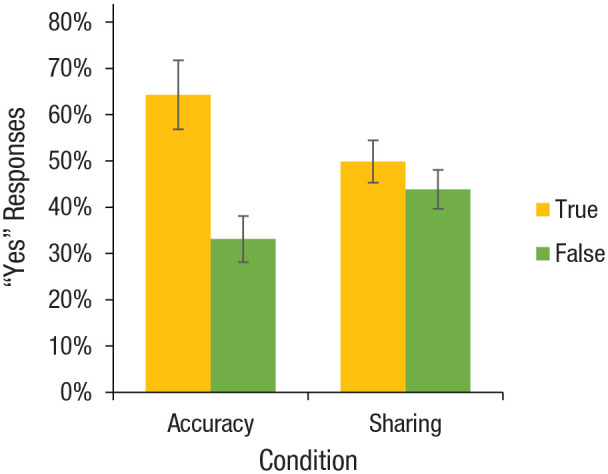
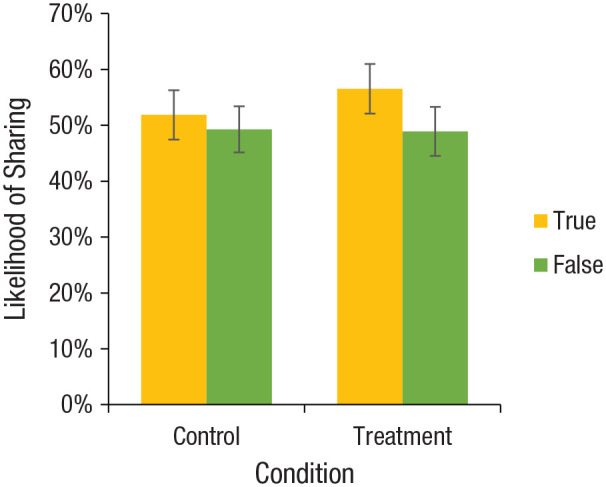
Across two studies with more than 1,700 U.S. adults recruited online, we present evidence that people share false claims about COVID-19 partly because they simply fail to think sufficiently about whether or not the content is accurate when deciding what to share. In Study 1, participants were far worse at discerning between true and false content when deciding what they would share on social media relative to when they were asked directly about accuracy. Furthermore, greater cognitive reflection and science knowledge were associated with stronger discernment. In Study 2, we found that a simple accuracy reminder at the beginning of the study (i.e., judging the accuracy of a non-COVID-19-related headline) nearly tripled the level of truth discernment in participants’ subsequent sharing intentions. Our results, which mirror those found previously for political fake news, suggest that nudging people to think about accuracy is a simple way to improve choices about what to share on social media.
Overview
The claims and statistics of this paper haven’t been checked yet.
Run the check — free, no account needed. It reads the open-access text and checks the sources it cites.
Integrity signals
Registry
Cites
Statistics
Figures
Verification
Claims the paper makes
The claims and statistics of this paper haven’t been checked yet.
Run the check — free, no account needed. It reads the open-access text and checks the sources it cites.
Claims other papers make about this one
Each is checked against this paper’s own text: does it say what the citing paper says it does?
The source backs part of the claim, not all of it — or backs it for a different population, condition or comparison.
In the citing paper
“Under these current plausible COVID-19 vaccine acceptance rates, possible levels of existing protective immunity-though it is unclear whether post-infection immunity confers long-term immunity 29 and the rapidly evolving nature of misinformation surrounding the pandemic 23,30 , it is unclear whether vaccination will reach the levels required for herd immunity.”
From Measuring the impact of COVID-19 vaccine misinformation on vaccination intent in the UK and USA (2021) · cites this paper as [23]
Experimental — accuracy not yet measuredThe cited source says what the claim attributes to it.
In the citing paper
“Experimental work indicates that directing users' attention to accuracy can improve sharing quality and reduce misinformation circulation (Pennycook et al., 2020(Pennycook et al., , 2021;;Roozenbeek et al., 2021).”
From Sensational Headlines, Engagement, and Credibility in Nepal’s Online News (2025) · cites this paper as Pennycook et al., 2020
The cited source says what the claim attributes to it.
In the citing paper
“Pennycook et al. (2020) and Roozenbeek et al. (2021) show that accuracy prompts can modestly improve users' sharing decisions, while Pennycook et al. (2021) argue that shifting attention toward accuracy can reduce misinformation sharing online.”
From Sensational Headlines, Engagement, and Credibility in Nepal’s Online News (2025) · cites this paper as Pennycook et al. (2020)
The check wasn’t confident either way, so it gives no verdict — never disputed.
In the citing paper
“Consistent with this view, a growing number of empirical studies have uncovered evidence that people update their political attitudes and beliefs in line with evidence (e.g., refs. 4,13,27–29) and arguments23,30,31 presented to them.”
From Factual knowledge can reduce attitude polarization (2025) · cites this paper as [28]
Experimental — accuracy not yet measured
Self-check
Percentages, sums and reported differences re-computed from the paper’s own numbers.
The self-check needs the paper’s full text.
Citations
Cites
The case for motivated reasoning.
Kunda, Z. (1990) · Psychological Bulletin · doi:10.1037/0033-2909.108.3.480 · Cited by 9,022 · cited 1×
“A great deal of evidence suggests that people are motivated to seek out, believe, and share politically congenial information (Kahan, Peters, Dawson, & Slovic, 2017; Kunda, 1990; Lee, Shin, & Hong, 2018; Mercier & Sperber, 2011; Shin & Thorson, 2017).”
BackgroundCognitive Reflection and Decision Making
Frederick, S. (2005) · Journal of Economic Perspectives · doi:10.1257/089533005775196732 · Cited by 5,256
Lazer, D. M. J., Baum, M. A., Benkler, Y., Berinsky, A. J., Greenhill, K. M., Menczer, F., Metzger, M. J., Nyhan, B., Pennycook, G., Rothschild, D., et al. (2018) · Science · doi:10.1126/science.aao2998 · Cited by 4,160
Self-citationWhy do humans reason? Arguments for an argumentative theory
Mercier, H., & Sperber, D. (2011) · Behavioral and Brain Sciences · doi:10.1017/s0140525x10000968 · Cited by 2,254
Pennycook, G., & Rand, D. G. (2019) · Cognition · doi:10.1016/j.cognition.2018.06.011 · Cited by 2,022
Self-citationShifting attention to accuracy can reduce misinformation online
Pennycook, G., Epstein, Z., Mosleh, M., Arechar, A. A., Eckles, D., & Rand, D. G. (2021) · Nature · doi:10.1038/s41586-021-03344-2 · Cited by 1,155
Self-citationThe Cognitive Reflection Test as a predictor of performance on heuristics-and-biases tasks
Toplak, M. E., West, R. F., & Stanovich, K. E. (2011) · Memory & Cognition · doi:10.3758/s13421-011-0104-1 · Cited by 1,047
Coppock, A., & McClellan, O. A. (2019) · Research & Politics · doi:10.1177/2053168018822174 · Cited by 987
Berinsky, A. J., Margolis, M. F., & Sances, M. W. (2014) · American Journal of Political Science · doi:10.1111/ajps.12081 · Cited by 951
Fighting misinformation on social media using crowdsourced judgments of news source quality
Pennycook, G., & Rand, D. G. (2019) · Proceedings of the National Academy of Sciences · doi:10.1073/pnas.1806781116 · Cited by 947 · cited 4×
“…2017; Van Bavel & Pereira, 2018), our data are more consistent with recent studies on political misinformation that provide both correlational (Pennycook & Rand, 2019b; including data from Twitter sharing, Mosleh, Pennycook, Arechar, & Rand, 2020) and experimental (Bago, Rand, & Pennycook,…”
BackgroundResultInfluentialSelf-citation
Research works printed but not linked: 2
- Adhanom Ghebreyesus T. (2020, February 15). Munich Security Conference. World Health Organization. Retrieved from https://www.who.int/dg/speeches/detail/munich-security-conference
- Ross R. M., 2019, PsyArXiv
Cited by
Sorted by citations
Items 801–900 of 1,004
Community-based fact-checking reduces the spread of misleading posts on X (formerly Twitter)
Chuai, Y., Pilarski, M., Renault, T., Amariles, D. R., Troussel, A., Lenzini, G., & Pröllochs, N. (2026) · Nature Communications · doi:10.1038/s41467-026-72597-0 · Cited by 11
Understanding the Information Disseminated Using Twitter During the COVID-19 Pandemic
Torres, J., Anu, V. K., & Varde, A. S. (2021) · IEEE International IOT, Electronics and Mechatronics Conference (IEMTRONICS) · doi:10.1109/iemtronics52119.2021.9422523 · Cited by 7
Data-driven analytics of COVID-19 ‘infodemic’
Wan, M., Su, Q., Xiang, R., & Huang, C. (2022) · International Journal of Data Science and Analytics · doi:10.1007/s41060-022-00339-8 · Cited by 7
Ding, Q., & Luo, X. (2022) · International Journal of Environmental Research and Public Health · doi:10.3390/ijerph20010703 · Cited by 7
Realtime user ratings as a strategy for combatting misinformation: an experimental study
Stein, J., Frey, V., & van de Rijt, A. (2023) · Scientific Reports · doi:10.1038/s41598-023-28597-x · Cited by 8
Awwad, M. S., Awwad, R. M., & Awwad, R. M. (2023) · Journal of Contingencies and Crisis Management · doi:10.1111/1468-5973.12455 · Cited by 7
Mattarozzi, K., Bagnis, A., Kłosowska, J., Bąbel, P., Cremonini, V., Palma, A. D., Fabbri, A., Farinella, E., Puccini, L., Sambri, V., et al. (2023) · Psychological Science · doi:10.1177/09567976231163875 · Cited by 7
Spirituality and intentions to engage in Covid‐19 protective behaviours
Zarzeczna, N., Većkalov, B., & Rutjens, B. T. (2023) · Social and Personality Psychology Compass · doi:10.1111/spc3.12765 · Cited by 7
Communication Strategies in Relation to COVID-19 in South Africa and Ghana: A Systematic Review
Boateng, A. B., & Gumede, N. (2023) · Journal of Creative Communications · doi:10.1177/09732586231168945 · Cited by 7
Wenjuan, L., Zhaotong, Y., Yuhua, D., & Midi, Z. (2023) · Journal of Cognitive Psychology · doi:10.1080/20445911.2023.2241699 · Cited by 9
Testing the Effect of Information on Discerning the Veracity of News in Real Time
Aslett, K., Sanderson, Z., Godel, W., Persily, N., Nagler, J., Bonneau, R., & Tucker, J. A. (2023) · Journal of Experimental Political Science · doi:10.1017/xps.2023.20 · Cited by 7
Brandts, J., Busom, I., López-Mayán, C., & Panadés, J. (2024) · Experimental Economics · doi:10.1007/s10683-023-09817-7 · Cited by 7
Susceptibility to cancer misinformation: Predictors of false belief and false memory formation
King, N., & Greene, C. M. (2024) · Applied Cognitive Psychology · doi:10.1002/acp.4184 · Cited by 8
Buchanan, T., Perach, R., Husbands, D., Tout, A. F., Kostyuk, E., Kempley, J., & Joyner, L. C. (2024) · PLoS ONE · doi:10.1371/journal.pone.0304855 · Cited by 9
Mazhar, B., Niu, J., Zhong, Q.-Y., & Haq, I. U. (2024) · Telematics and Informatics Reports · doi:10.1016/j.teler.2024.100155 · Cited by 7
Making sense of COVID-19 over time in New Zealand: Assessing the public conversation using Twitter
Jafarzadeh, H., Pauleen, D. J., Abedin, E., Weerasinghe, K., Taşkın, N., & Coşkun, M. (2021) · PLoS ONE · doi:10.1371/journal.pone.0259882 · Cited by 7
Jin, R., Lim, H. J., Hamilton, S. N., & Ingledew, P. (2022) · Journal of Cancer Education · doi:10.1007/s13187-022-02136-0 · Cited by 7
Medical Decision Style and COVID-19 Behavior
Tinghög, G., & Strand, L. (2022) · Medical Decision Making · doi:10.1177/0272989x221079354 · Cited by 7
Preschool children weigh accuracy against partisanship when seeking information
Chalik, L., Over, H., & Dunham, Y. C. (2022) · Journal of Experimental Child Psychology · doi:10.1016/j.jecp.2022.105423 · Cited by 8
Design Principles for an Educational Intervention Into Online Vaccine Misinformation
Veletsianos, G., Houlden, S., Reid, D., Hodson, J., & Thompson, C. P. (2022) · TechTrends · doi:10.1007/s11528-022-00755-4 · Cited by 7
Health information seeking behaviour among the Kuwaiti population during the COVID-19 pandemic
Aldousari, E., & Al‐Sejari, M. M. (2021) · Malaysian Journal of Library & Information Science · doi:10.22452/mjlis.vol26no3.6 · Cited by 7
Life course explanations of consumer responses to threats: the case of COVID-19
Suttharattanagul, S. L., Cai, Y., & Moschis, G. P. (2022) · Cogent Business & Management · doi:10.1080/23311975.2022.2151193 · Cited by 7
Caliskan, C., & Kilicaslan, A. (2022) · Journal of Computational Social Science · doi:10.1007/s42001-022-00193-5 · Cited by 7
The Usage and Impact of ICTs during the Covid-19 Pandemic
Yang, S., Zhu, X. A., & Fichman, P. (2023) · Routledge eBooks · doi:10.4324/9781003231769 · Cited by 10
Qerimi, G., & Gërguri, D. (2022) · Information & Media · doi:10.15388/im.2021.94.56 · Cited by 12
Felton, M. K., Middaugh, E., & Fan, H. (2023) · Public Understanding of Science · doi:10.1177/09636625231178428 · Cited by 8
Dangaiso, P., Makudza, F., Tshuma, S., Hogo, H., Mpondwe, N., Masona, C., Sakarombe, U., Nedure, T., Muchowe, R. M., Nyathi, G. B., et al. (2023) · Cogent Public Health · doi:10.1080/27707571.2023.2234599 · Cited by 7
Analyzing User Behavior in Social Media through Big Data Analytics
Yadav, A., Alahmar, M., Singh, A., Sharma, K., Agrawal, R., & Sharma, C. B. (2023) · IEEE International Conference on ICT in Business Industry & Government (ICTBIG) · doi:10.1109/ictbig59752.2023.10456112 · Cited by 7
Model-averaged Bayesian t tests
Maier, M., Bartos̆, F., Quintana, D. S., Dablander, F., van den Bergh, D., Marsman, M., Ly, A., & Wagenmakers, E. (2024) · Psychonomic Bulletin & Review · doi:10.3758/s13423-024-02590-5 · Cited by 8
BAYDİLİ, I. (2020) · Journal of Turkish Studies · doi:10.7827/turkishstudies.44188 · Cited by 7
Kadinski, L., & Ostfeld, A. (2021) · Water · doi:10.3390/w13202863 · Cited by 7
Divide in Vaccine Belief in COVID-19 Conversations: Implications for Immunization PlansPreprint
Tyagi, A., & Carley, K. M. (2020) · medRxiv · doi:10.1101/2020.07.23.20160887 · Cited by 8
A Hierarchical Network-Oriented Analysis of UserParticipation in Misinformation Spread on WhatsApp
Nobre, G. P., Ferreira, C. H. G., & Almeida, J. M. (2021) · Figshare · doi:10.5281/zenodo.4774374 · Cited by 7
Capraro, V., & Celadin, T. (2022) · doi:10.31234/osf.io/s3q5n · Cited by 7
Martí-Danés, A., Besalú, R., Pont‐Sorribes, C., & Puertas, L. G. (2023) · Journalism · doi:10.1177/14648849231215190 · Cited by 6
Massey, P. M., Murray, R. M., Chiang, S. C., Russell, A. M., & Yudell, M. (2023) · JMIR Public Health and Surveillance · doi:10.2196/49881 · Cited by 11
Hawkins, I., & Campbell, S. W. (2025) · Computers in Human Behavior · doi:10.1016/j.chb.2025.108658 · Cited by 9
Mitigating Misinformation Sharing on Social Media through Personalised Nudging
Biselli, T., Hartwig, K., & Reuter, C. (2025) · Proc. ACM Hum. Comput. Interact. · doi:10.1145/3711034 · Cited by 9
Trust in doctors, social support, and belief in COVID-19 misinformation
Horoszko, U. A., Smith, L., Murphy, A., Taylor, B. G., Lamuda, P. A., Pollack, H. A., Schneider, J. A., Taxman, F. S., & Zhao, X. (2025) · BMC Public Health · doi:10.1186/s12889-025-23470-0 · Cited by 6
Li, M., Liang, R., Zhou, Y., Wang, K., Yang, R., Li, T., & Zhou, X. (2025) · BMJ Open · doi:10.1136/bmjopen-2025-102818 · Cited by 6
Catch me if you search: When contextual web search results affect the detection of hallucinations
Nahar, M., Lee, E.-J., Park, J. W., & Lee, D. (2025) · Computers in Human Behavior · doi:10.1016/j.chb.2025.108763 · Cited by 7
Trust me, I’m wrong: The perils of AI hallucinations, a silent killer
Samanta, S. K., & Chakraborty, A. (2026) · Journal of Information Technology Teaching Cases · doi:10.1177/20438869261423221 · Cited by 6
Aboubakr, H. A., & Magdy, A. (2020) · doi:10.1145/3423459.3430758 · Cited by 6
Alfasi, Y. (2023) · Journal of Social Psychology · doi:10.1080/00224545.2023.2286592 · Cited by 5
Kanashina, O., Huertas-García, R., & Jiménez‐Zarco, A. I. (2023) · Intangible Capital · doi:10.3926/ic.2312 · Cited by 11
Moseray, A., Fatoma, P., & Kamara, A.-B. S. (2024) · Risk Management and Healthcare Policy · doi:10.2147/rmhp.s444658 · Cited by 6
Dangaiso, P., Jaravaza, D. C., & Mukucha, P. (2024) · Cogent Social Sciences · doi:10.1080/23311886.2023.2299141 · Cited by 8
Taub, G., Elmalech, A., & Aharony, N. (2024) · Heliyon · doi:10.1016/j.heliyon.2024.e25944 · Cited by 10
Masele, J. J. (2024) · Human Vaccines & Immunotherapeutics · doi:10.1080/21645515.2024.2324527 · Cited by 6
Zhang, L., Liu, P. L., Lam, C., & Huang, Z. (2024) · Social Science & Medicine · doi:10.1016/j.socscimed.2024.117271 · Cited by 6
Mede, N. G., Kobilke, L., Fawzi, N., & Zerback, T. (2025) · Social Media + Society · doi:10.1177/20563051251341792 · Cited by 10
Chen, C.-C., & Chiu, Y. (2021) · Data Technologies and Applications · doi:10.1108/dta-09-2020-0232 · Cited by 8
Perceived Accuracy of Fake News on Social Media
Fadhila, S., Nisa, Y. F., Nihayah, Z., Hayat, B., Syani, P. A., & Adelina, R. (2021) · International Conference on Cyber and IT Service Management (CITSM) · doi:10.1109/citsm52892.2021.9588841 · Cited by 5
Wang, K., Lin, K., Yang, S., & Na, S.-G. (2021) · Frontiers in Psychology · doi:10.3389/fpsyg.2021.702423 · Cited by 6
ENSINO DE CIÊNCIAS NA ERA DA PÓS-VERDADE: CONSIDERAÇÕES ACERCA DO DISCURSO PRESENTE EM FAKE NEWS
de Britto, D. M. C., & de Mello, I. C. (2022) · REAMEC - Rede Amazônica de Educação em Ciências e Matemática · doi:10.26571/reamec.v10i1.13007 · Cited by 10
Gu, Y., Kalibatseva, Z., Song, X., & Prakash, S. (2022) · Journal of American College Health · doi:10.1080/07448481.2022.2080505 · Cited by 7
COVID-19, Vaccination, and Conspiracies: A Micro-Level Qualitative Study in Islamabad, Pakistan.
Ali, S., Pasha, S. A., & Khalid, A. (2022) · PubMed Central · Cited by 6
Liu, J., Reif-Stice, C. E., & Getz, B. (2022) · Online Media and Global Communication · doi:10.1515/omgc-2022-0033 · Cited by 6
COVID-19 Misinformation: A Potent Co-Factor in the COVID-19 Pandemic
Aiyer, I., Shaik, L., Kashyap, R., & Surani, S. (2022) · Cureus · doi:10.7759/cureus.30026 · Cited by 6
How Has COVID-19 Impacted Our Language Use?
Pisano, F., Manfredini, A., Brachi, D., Landi, L., Sorrentino, L., Bottone, M., Incoccia, C., & Marangolo, P. (2022) · International Journal of Environmental Research and Public Health · doi:10.3390/ijerph192113836 · Cited by 7
Lee, P.-C., Huang, C., Liang, L.-L., Huang, M.-H., & Hsu, M.-J. (2022) · Human Vaccines & Immunotherapeutics · doi:10.1080/21645515.2022.2148500 · Cited by 6
Misinformation, Anticipated Regret, and Vaccine-Related Behaviors
Wong, J. C., & Yang, J. Z. (2022) · Journal of Health Communication · doi:10.1080/10810730.2022.2148022 · Cited by 7
Waddell, T. F., & Moss, C. E. (2023) · Communication Studies · doi:10.1080/10510974.2023.2196432 · Cited by 6
Digital Innovation in Healthcare
Moulay, B. (2023) · Advances in healthcare information systems and administration book series · doi:10.4018/978-1-6684-8337-4.ch001 · Cited by 7
Hong, L., & Wang, S. (2023) · Health Communication · doi:10.1080/10410236.2023.2229093 · Cited by 6
Huang, J., Chan, S. C., Keung, V. M. W., Cheung, C. K. M., Lo, A. S. C., Lau, V. T. C., Mui, L. W. H., Lee, A., & Wong, M. C. S. (2023) · Health Expectations · doi:10.1111/hex.13894 · Cited by 6
Encouraging vaccination against COVID-19 has no compensatory spillover effects
Kourtidis, P., Fasolo, B., & Galizzi, M. M. (2024) · Behavioural Public Policy · doi:10.1017/bpp.2024.1 · Cited by 6
Masele, J. J., & Daud, E. (2022) · Global Knowledge, Memory and Communication · doi:10.1108/gkmc-05-2022-0103 · Cited by 6
Exploring the effectiveness of virtual reality in combating misinformation on climate change
Erişen, E., Yildirim, F., Duran, E., Şar, B., & Kalkan, I. (2024) · Political Psychology · doi:10.1111/pops.13057 · Cited by 7
O’Mahony, C., Murphy, G., & Linehan, C. (2024) · advances in/psychology · doi:10.56296/aip00030 · Cited by 6
The Potentials of Radio in Combating Misinformation about COVID-19 in Nigeria
Ephraim, P. E. (2020) · IntechOpen eBooks · doi:10.5772/intechopen.93949 · Cited by 6
Finding the Relationship Between News and Social Media Users’ Emotions in the COVID-19 Process
Müngen, A. A., Aygün, İ., & Kaya, M. (2020) · Sakarya University Journal of Computer and Information Sciences · doi:10.35377/saucis.03.03.830867 · Cited by 6
Efek Twitter di Masa Pandemi COVID-19 pada Sikap dan Perilaku
Rihhadatul'aisyi, N., Muthmainnah, S., Zahra, H. P., Putri, T. W., & Febrian, F. T. (2021) · Jurnal Ilmu Komunikasi · doi:10.31315/jik.v19i2.4178 · Cited by 6
Identifying Early Opinion Leaders on COVID-19 on Twitter
Hatami, Z., Hall, M., & Thorne, N. (2021) · Lecture notes in computer science · doi:10.1007/978-3-030-90238-4_20 · Cited by 6
COVID-19 vaccine prioritization based on district classification in Yogyakarta Province, Indonesia
Hanifa, S., Puspitasari, D., Ramadhan, C., & Herastuti, K. O. (2022) · Geospatial health · doi:10.4081/gh.2022.1010 · Cited by 6
Ghisi, G. L. D. M., dos Santos, R. Z., Körbes, A. S., de Souza, C. A., Karsten, M., OH, P. I., & Benetti, M. (2022) · Arquivos Brasileiros de Cardiologia · doi:10.36660/abc.20210447 · Cited by 6
Leigh, J. P., Brundin‐Mather, R., Soo, A., FitzGerald, E. A., Mizen, S. J., Dodds, A., Ahmed, S. B., Burns, K. E. A., Plotnikoff, K. M., Rochwerg, B. N., et al. (2022) · BMC Public Health · doi:10.1186/s12889-022-13058-3 · Cited by 9
Mitigating and managing COVID-19 conspiratorial beliefs
Dow, B. J., Wang, C. S., Whitson, J., & Deng, Y. (2022) · BMJ Leader · doi:10.1136/leader-2022-000600 · Cited by 6
Lai, K., Yang, Y., Na, Y., & Wang, H. (2022) · International Journal of Environmental Research and Public Health · doi:10.3390/ijerph192416670 · Cited by 7
Impact of Social Media on Knowledge of the COVID-19 Pandemic on Bangladeshi University Students
Chowdhury, S., Rahman, M., Doddanavar, I., Zayed, N. M., Nitsenko, V. S., MELNYKOVYCH, O., & Holik, O. (2023) · Computation · doi:10.3390/computation11020038 · Cited by 8
A systematic review for netizens’ response to the truth manipulation on social media
Akram, M., Nasar, A., Arshad‐Ayaz, A., & |, |. (2023) · Knowledge Management & E-Learning An International Journal · doi:10.34105/j.kmel.2023.15.018 · Cited by 17
Ivory, M. R., Towse, J. N., Sturdee, M., Levine, M., & Nuseibeh, B. (2023) · Technology Mind and Behavior · doi:10.1037/tmb0000122 · Cited by 8
Cartwright, B., Frank, R. W., Weir, G. R. S., Padda, K. K., & Strange, S.-M. (2023) · Hawaii International Conference on System Sciences (HICSS) · doi:10.24251/hicss.2023.266 · Cited by 6
Aboul-ata, M. A., & Qonsua, F. T. (2021) · Current Psychology · doi:10.1007/s12144-021-01701-y · Cited by 6
A public online resource to track COVID-19 misinfodemic
Marcoux, T., Galeano, K., Galeano, R., DiCicco, K. W., Rubaye, H. A., Mead, E. L., Agarwal, N., & Galeano, A. (2021) · Social Network Analysis and Mining · doi:10.1007/s13278-021-00748-w · Cited by 6
Ковидный ресентимент в социальных сетях: репертуар мотивированных суждений
Isupova, O., Рождественская, Е. Ю., & Лагерева, А. Е. (2021) · Monitoring obŝestvennogo mneniâ: èkonomičeskie i socialʹnye peremeny · doi:10.14515/monitoring.2021.5.2004 · Cited by 6
COVID-19 vaccine perceptions: An observational study on RedditPreprint
Kumar, N., Corpus, I., Hans, M., Harle, N., Yang, N., McDonald, C., Sakai, S. N., Janmohamed, K., Tang, W., Schwartz, J. L., et al. (2021) · medRxiv · doi:10.1101/2021.04.09.21255229 · Cited by 6
Social Media, Risk Perceptions Related to COVID ‐19, and Health Outcomes
Wright, K. B. (2021) · Wiley eBooks · doi:10.1002/9781119751809.ch6 · Cited by 6
Lack of evidence for correlation between COVID-19 infodemic and vaccine acceptancePreprint
Valensise, C. M., Cinelli, M., Nadini, M., Galeazzi, A., Peruzzi, A., Etta, G., Zollo, F., Baronchelli, A., & Quattrociocchi, W. (2021) · arXiv (Cornell University) · doi:10.48550/arxiv.2107.07946 · Cited by 18
Refuting Spurious COVID-19 Treatment Claims Reduces Demand and Misinformation SharingPreprint
MacFarlane, D., Tay, L. Q., Hurlstone, M. J., & Ecker, U. K. H. (2020) · doi:10.31234/osf.io/q3mkd · Cited by 6
Akca, A., & Ayaz‐Alkaya, S. (2022) · International Journal of Nursing Practice · doi:10.1111/ijn.13035 · Cited by 5
Pan, T., Sun, Y., Guo, X., & Zhang, M. (2024) · Internet Research · doi:10.1108/intr-12-2023-1137 · Cited by 6
Designing Accessible Audio Nudges for Voice Interfaces
Jamshed, H., Nurain, N., & Brewer, R. N. (2025) · CHI Conference on Human Factors in Computing Systems · doi:10.1145/3706598.3713563 · Cited by 5
Gauch, E. C., & Smollich, M. (2025) · Bundesgesundheitsblatt - Gesundheitsforschung - Gesundheitsschutz · doi:10.1007/s00103-025-04138-x · Cited by 5
Debunking fake ad claims: the moderating role of gender
Banerjee, S., Rocereto, J. F., Kwak, H., & Pandey, A. (2023) · International Journal of Advertising · doi:10.1080/02650487.2023.2171554 · Cited by 5
Scales, D. A., Hurth, L., Xi, W., Gorman, S. E., Radhakrishnan, M., Windham, S., Akunne, A., Florman, J., Leininger, L. J., & Gorman, J. M. (2023) · JMIR Infodemiology · doi:10.2196/50138 · Cited by 5
Scientists’ behaviour towards information disorder: A systematic review
Revez, J. M. R., & Corujo, L. (2024) · Journal of Information Science · doi:10.1177/01655515241244460 · Cited by 8
Khan, S. O., Ghafourian, T., & Patil, S. (2024) · Proceedings of the ACM on Human-Computer Interaction · doi:10.1145/3637403 · Cited by 6
Ingram, D. J., Morcatty, T. Q., Bizri, H. R. E., Poudyal, M., & Mundy, E. (2024) · Conservation Letters · doi:10.1111/conl.13023 · Cited by 5
The demand for safety measures in the hospitality industry: Changes over three phases of a pandemic
Pennington-Gray, L. A., & Lee, S. (2024) · International Journal of Hospitality Management · doi:10.1016/j.ijhm.2024.103873 · Cited by 5
Metadata
- Authors
- Pennycook, G., McPhetres, J., Zhang, Y., Lu, J. G., & Rand, D. G.
- Affiliations
- University of Regina (CA)
- Massachusetts Institute of Technology (US)
- Corresponding author
- Pennycook, Gordon
- Venue
- Psychological Science
- Publisher
- SAGE Publications
- Published
- 2020-06-30
- Volume
- 31
- Issue
- 7
- Pages
- 770-780
- ISSN
- 0956-7976 (ISSN-L)
- 1467-9280
- PMC
- PMC7366427
- OpenAlex
- W3013473577
- Cited by
- 1,715
- References
- 38
- Citations by year
- 2026: 111 · 2025: 188 · 2024: 238 · 2023: 299 · 2022: 329 · 2021: 416 · 2020: 132
- FWCI
- 393.97
- Type
- journal article
- Language
- en
- Open access
- hybrid
- doi.org
- Locations
- Psychological Science (publishedVersion, cc-by)
- PubMed Central (publishedVersion, cc-by)
- PubMed (publishedVersion)
- DSpace@MIT (Massachusetts Institute of Technology) (submittedVersion, cc-by-nc-sa)
- Funders
- miami foundation
- William and Flora Hewlett Foundation
- Omidyar Network
- John Templeton Foundation
- Canadian Institutes of Health Research
- Social Sciences and Humanities Research Council of Canada
- Topics
- Social Sciences › Sociology and Political Science › Misinformation and Its Impacts
- Social Sciences › Communication › Communication and COVID-19 Impact
- Social Sciences › Library and Information Sciences › Academic Publishing and Open Access
- Keywords
- COVID-19 misinformation, social media sharing, truth discernment, fake news, cognitive reflection, scientific knowledge, misinformation prevention, sharing intention
- MeSH terms
- Betacoronavirus, COVID-19, SARS-CoV-2, Adolescent, Adult, Aged, Aged, 80 and over, Communication, Decision Making, Female, Humans, Male, Middle Aged, Pneumonia, Viral, Coronavirus Infections, Information Dissemination, Young Adult, Pandemics, Social Media
About these checks
Registry, retraction, Cites and statistics results are computed, not judged, with one exception: a printed reference that no index lists is read once by a model before it counts as a citation error. Claims are extracted by a model and kept only when their quote appears verbatim in the text; each cited source is then checked, with a model’s help, for whether it says what the claim relies on. Those verdicts can be wrong — read the claim’s quote and the cited source before relying on one.
Statistics and arithmetic are recomputed, not judged.
Confidence bands are shown only for fields calibrated on our annotated test set. None is calibrated yet, so no band is shown.
What counts as a claim ›How we measure confidence ›How we check this ›
Are you an author, or do you see a problem with this page? Request a review
