

The DOI matches its Crossref record; 38 of the 41 references it cites were found in a registry or an index, and 3 are not checked yet.
Fighting COVID-19 Misinformation on Social Media: Experimental Evidence for a Scalable Accuracy-Nudge Intervention
Open accessAbstract
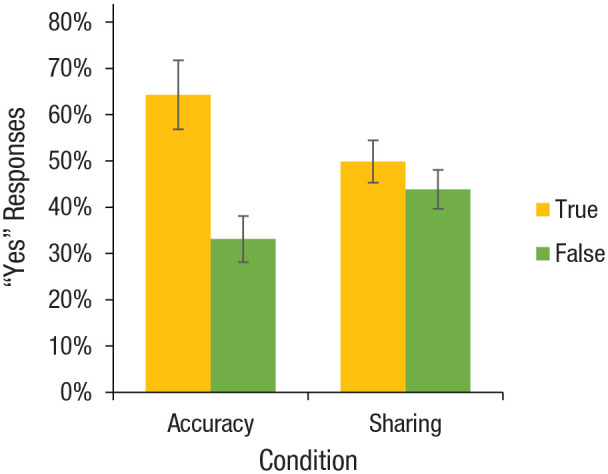
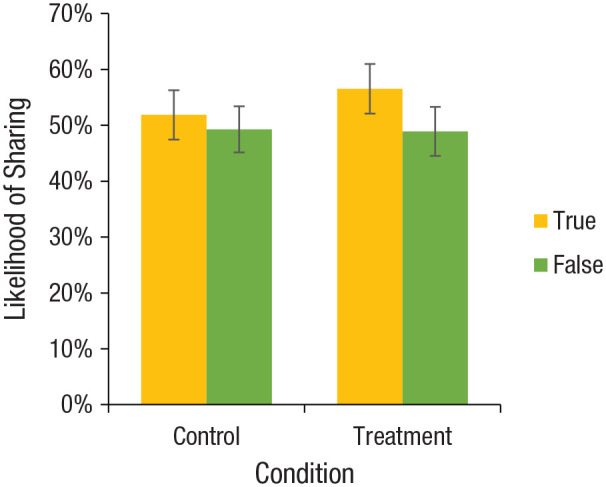
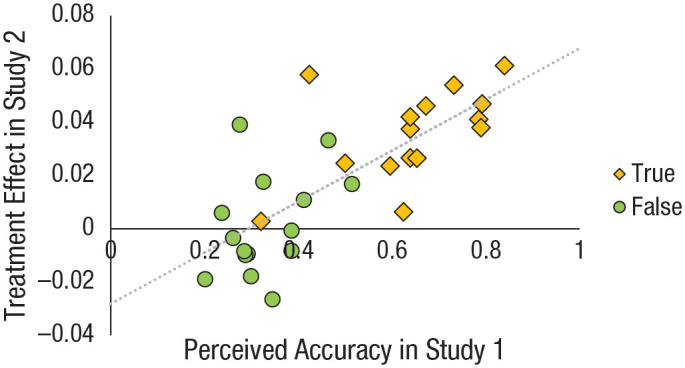
Across two studies with more than 1,700 U.S. adults recruited online, we present evidence that people share false claims about COVID-19 partly because they simply fail to think sufficiently about whether or not the content is accurate when deciding what to share. In Study 1, participants were far worse at discerning between true and false content when deciding what they would share on social media relative to when they were asked directly about accuracy. Furthermore, greater cognitive reflection and science knowledge were associated with stronger discernment. In Study 2, we found that a simple accuracy reminder at the beginning of the study (i.e., judging the accuracy of a non-COVID-19-related headline) nearly tripled the level of truth discernment in participants’ subsequent sharing intentions. Our results, which mirror those found previously for political fake news, suggest that nudging people to think about accuracy is a simple way to improve choices about what to share on social media.
Overview
The claims and statistics of this paper haven’t been checked yet.
Run the check — free, no account needed. It reads the open-access text and checks the sources it cites.
Integrity signals
Registry
Cites
Statistics
Figures
Verification
Claims the paper makes
The claims and statistics of this paper haven’t been checked yet.
Run the check — free, no account needed. It reads the open-access text and checks the sources it cites.
Claims other papers make about this one
Each is checked against this paper’s own text: does it say what the citing paper says it does?
The source backs part of the claim, not all of it — or backs it for a different population, condition or comparison.
In the citing paper
“Under these current plausible COVID-19 vaccine acceptance rates, possible levels of existing protective immunity-though it is unclear whether post-infection immunity confers long-term immunity 29 and the rapidly evolving nature of misinformation surrounding the pandemic 23,30 , it is unclear whether vaccination will reach the levels required for herd immunity.”
From Measuring the impact of COVID-19 vaccine misinformation on vaccination intent in the UK and USA (2021) · cites this paper as [23]
Experimental — accuracy not yet measuredThe cited source says what the claim attributes to it.
In the citing paper
“Experimental work indicates that directing users' attention to accuracy can improve sharing quality and reduce misinformation circulation (Pennycook et al., 2020(Pennycook et al., , 2021;;Roozenbeek et al., 2021).”
From Sensational Headlines, Engagement, and Credibility in Nepal’s Online News (2025) · cites this paper as Pennycook et al., 2020
The cited source says what the claim attributes to it.
In the citing paper
“Pennycook et al. (2020) and Roozenbeek et al. (2021) show that accuracy prompts can modestly improve users' sharing decisions, while Pennycook et al. (2021) argue that shifting attention toward accuracy can reduce misinformation sharing online.”
From Sensational Headlines, Engagement, and Credibility in Nepal’s Online News (2025) · cites this paper as Pennycook et al. (2020)
The check wasn’t confident either way, so it gives no verdict — never disputed.
In the citing paper
“Consistent with this view, a growing number of empirical studies have uncovered evidence that people update their political attitudes and beliefs in line with evidence (e.g., refs. 4,13,27–29) and arguments23,30,31 presented to them.”
From Factual knowledge can reduce attitude polarization (2025) · cites this paper as [28]
Experimental — accuracy not yet measured
Self-check
Percentages, sums and reported differences re-computed from the paper’s own numbers.
The self-check needs the paper’s full text.
Citations
Cites
The case for motivated reasoning.
Kunda, Z. (1990) · Psychological Bulletin · doi:10.1037/0033-2909.108.3.480 · Cited by 9,022 · cited 1×
“A great deal of evidence suggests that people are motivated to seek out, believe, and share politically congenial information (Kahan, Peters, Dawson, & Slovic, 2017; Kunda, 1990; Lee, Shin, & Hong, 2018; Mercier & Sperber, 2011; Shin & Thorson, 2017).”
BackgroundCognitive Reflection and Decision Making
Frederick, S. (2005) · Journal of Economic Perspectives · doi:10.1257/089533005775196732 · Cited by 5,256
Lazer, D. M. J., Baum, M. A., Benkler, Y., Berinsky, A. J., Greenhill, K. M., Menczer, F., Metzger, M. J., Nyhan, B., Pennycook, G., Rothschild, D., et al. (2018) · Science · doi:10.1126/science.aao2998 · Cited by 4,160
Self-citationWhy do humans reason? Arguments for an argumentative theory
Mercier, H., & Sperber, D. (2011) · Behavioral and Brain Sciences · doi:10.1017/s0140525x10000968 · Cited by 2,254
Pennycook, G., & Rand, D. G. (2019) · Cognition · doi:10.1016/j.cognition.2018.06.011 · Cited by 2,022
Self-citationShifting attention to accuracy can reduce misinformation online
Pennycook, G., Epstein, Z., Mosleh, M., Arechar, A. A., Eckles, D., & Rand, D. G. (2021) · Nature · doi:10.1038/s41586-021-03344-2 · Cited by 1,155
Self-citationThe Cognitive Reflection Test as a predictor of performance on heuristics-and-biases tasks
Toplak, M. E., West, R. F., & Stanovich, K. E. (2011) · Memory & Cognition · doi:10.3758/s13421-011-0104-1 · Cited by 1,047
Coppock, A., & McClellan, O. A. (2019) · Research & Politics · doi:10.1177/2053168018822174 · Cited by 987
Berinsky, A. J., Margolis, M. F., & Sances, M. W. (2014) · American Journal of Political Science · doi:10.1111/ajps.12081 · Cited by 951
Fighting misinformation on social media using crowdsourced judgments of news source quality
Pennycook, G., & Rand, D. G. (2019) · Proceedings of the National Academy of Sciences · doi:10.1073/pnas.1806781116 · Cited by 947 · cited 4×
“…2017; Van Bavel & Pereira, 2018), our data are more consistent with recent studies on political misinformation that provide both correlational (Pennycook & Rand, 2019b; including data from Twitter sharing, Mosleh, Pennycook, Arechar, & Rand, 2020) and experimental (Bago, Rand, & Pennycook,…”
BackgroundResultInfluentialSelf-citation
Research works printed but not linked: 2
- Adhanom Ghebreyesus T. (2020, February 15). Munich Security Conference. World Health Organization. Retrieved from https://www.who.int/dg/speeches/detail/munich-security-conference
- Ross R. M., 2019, PsyArXiv
Cited by
Sorted by citations
Items 401–500 of 1,004
Debunking Three Myths About Misinformation
Gawronski, B., Nahon, L. S., & Ng, N. L. (2024) · Current Directions in Psychological Science · doi:10.1177/09637214241280907 · Cited by 27
Temporal clustering of disorder events during the COVID-19 pandemic
Campedelli, G. M., & D'Orsogna, M. R. (2021) · PLoS ONE · doi:10.1371/journal.pone.0250433 · Cited by 27
Political polarization, misinformation, and media literacy
Gaultney, I. B., Sherron, T., & Boden, C. J. (2022) · Journal of Media Literacy Education · doi:10.23860/jmle-2022-14-1-5 · Cited by 27
Battling the coronavirus ‘infodemic’ among social media users in Kenya and Nigeria
Offer‐Westort, M., Rosenzweig, L. R., & Athey, S. C. (2024) · Nature Human Behaviour · doi:10.1038/s41562-023-01810-7 · Cited by 34
Cognitive ability and voting behaviour in the 2016 UK referendum on European Union membership
Dawson, C., & Baker, P. L. (2023) · PLoS ONE · doi:10.1371/journal.pone.0289312 · Cited by 26
Chao, F., Zhou, Q., Zhao, J., Xu, Y., & Yu, G. (2024) · Information Processing & Management · doi:10.1016/j.ipm.2024.103747 · Cited by 30
‘Distant socializing,’ not ‘social distancing’ as a public health strategy for COVID-19
Pandi-Perumal, S. R., Vaccarino, S. R., Chattu, V. K., Zaki, N. F. W., BaHammam, A. S., Manzar, M. D., Maestroni, G. J. M., Suchecki, D., Moscovitch, A., Zizi, F., et al. (2021) · Pathogens and Global Health · doi:10.1080/20477724.2021.1930713 · Cited by 26
Keselman, A., Smith, C. A., Gondy Leroy, A., & Kaufman, D. R. (2021) · Journal of Medical Internet Research · doi:10.2196/30323 · Cited by 29
Caddick, Z. A., & Feist, G. J. (2021) · Thinking & Reasoning · doi:10.1080/13546783.2021.1994009 · Cited by 32
Designing a conceptual framework for misinformation on social media: a qualitative study on COVID-19
Bastani, P., Hakimzadeh, S. M., & Bahrami, M. A. (2021) · BMC Research Notes · doi:10.1186/s13104-021-05822-2 · Cited by 26
Who falls for fake news? Psychological and clinical profiling evidence of fake news consumers
Escolà‐Gascón, Á., Dagnall, N., Denovan, A., Drinkwater, K. G., & Bosch, M. D. (2022) · Personality and Individual Differences · doi:10.1016/j.paid.2022.111893 · Cited by 34
Zhang, L., Iyendo, T. O., Apuke, O. D., & Gever, V. C. (2022) · Journal of Information Science · doi:10.1177/01655515221131797 · Cited by 28
A prosocial fake news intervention with durable effects
Orosz, G., Paskuj, B., Faragó, L., & Krekó, P. (2023) · Scientific Reports · doi:10.1038/s41598-023-30867-7 · Cited by 24
Combating Fake News on Social Media: A Framework, Review, and Future Opportunities
Nasery, M., Turel, O., & Yuan, Y. (2023) · Communications of the Association for Information Systems · doi:10.17705/1cais.05335 · Cited by 33
Success-driven opinion formation determines social tensions
Chica, M., Perc, M., & Santos, F. C. (2024) · iScience · doi:10.1016/j.isci.2024.109254 · Cited by 25
Partisan Bias in Political Judgment
Ditto, P. H., Celniker, J. B., Siddiqi, S. S., Güngör, M., & Relihan, D. P. (2025) · Annual Review of Psychology · doi:10.1146/annurev-psych-030424-122723 · Cited by 25
An empiric validation of linguistic features in machine learning models for fake news detection
Puraivan, E., René Venegas, V., & Riquelme, F. (2023) · Data & Knowledge Engineering · doi:10.1016/j.datak.2023.102207 · Cited by 25
Emotions unveiled: detecting COVID-19 fake news on social media
Farhoudinia, B., Öztürkcan, S., & Kasap, N. (2024) · Humanities and Social Sciences Communications · doi:10.1057/s41599-024-03083-5 · Cited by 30
Agley, J. D., Xiao, Y., Thompson, E. E., & Golzarri‐Arroyo, L. (2020) · JMIR Research Protocols · doi:10.2196/24383 · Cited by 26
Baum, J., & Rahman, R. A. (2021) · NeuroImage · doi:10.1016/j.neuroimage.2021.118572 · Cited by 28
Dharawat, A., Lourentzou, I., Morales, A., & Zhai, C. (2022) · Proceedings of the International AAAI Conference on Web and Social Media · doi:10.1609/icwsm.v16i1.19372 · Cited by 51
Neylan, J., Biddlestone, M., Roozenbeek, J., & van der Linden, S. (2023) · Scientific Reports · doi:10.1038/s41598-023-43885-2 · Cited by 33
On the Efficacy of Accuracy Prompts Across Partisan Lines: An Adversarial Collaboration
Martel, C., Rathje, S., Clark, C. J., Pennycook, G., Bavel, J. J. V., Rand, D. G., & van der Linden, S. (2024) · Psychological Science · doi:10.1177/09567976241232905 · Cited by 34
Self-citationJerit, J., & Kam, C. D. (2023) · Oxford University Press eBooks · doi:10.1093/oxfordhb/9780197541302.013.14 · Cited by 25
Guay, B., Berinsky, A. J., Pennycook, G., & Rand, D. G. (2022) · doi:10.31234/osf.io/y762k · Cited by 25
Self-citationWhen Truth Trumps Facts: Studies on Partisan Moral Flexibility in American Politics
Kim, M. J., Hahl, O., Poskanzer, E. J., & Zuckerman, E. W. (2024) · American Journal of Sociology · doi:10.1086/730763 · Cited by 25
Do we need the criminalization of medical fake news?
Mamak, K. (2021) · Medicine Health Care and Philosophy · doi:10.1007/s11019-020-09996-7 · Cited by 23
The cognitive science of COVID-19: Acceptance, denial, and belief change
Thagard, P. R. (2021) · Methods · doi:10.1016/j.ymeth.2021.03.009 · Cited by 28
Zhang, J. S., Keegan, B., Lv, Q., & Tan, C. (2021) · Proceedings of the International AAAI Conference on Web and Social Media · doi:10.1609/icwsm.v15i1.18112 · Cited by 28
Liu, L., Wu, W., & McEntire, D. A. (2021) · International Journal of Disaster Risk Reduction · doi:10.1016/j.ijdrr.2021.102516 · Cited by 29
Jiang, L., Chu, T. H., & Sun, M. (2021) · JMIR Infodemiology · doi:10.2196/25636 · Cited by 27
Political orientation, moral foundations, and COVID-19 social distancing
Tarry, H., Vézina, V., Bailey, J. M., & Lopes, L. (2022) · PLoS ONE · doi:10.1371/journal.pone.0267136 · Cited by 25
Erişen, C. (2022) · International Political Science Review · doi:10.1177/01925121221084625 · Cited by 24
Exploring the determinants of global vaccination campaigns to combat COVID-19
Yin, F., Ji, M., Yang, Z., Wu, Z., Xia, X., Xing, T., She, Y., & Zhi, H. (2022) · Humanities and Social Sciences Communications · doi:10.1057/s41599-022-01106-7 · Cited by 26
Adherence to Misinformation on Social Media Through Socio-Cognitive and Group-Based Processes
Efstratiou, A., & Cristofaro, E. D. (2022) · Proceedings of the ACM on Human-Computer Interaction · doi:10.1145/3555589 · Cited by 33
Truth and Bias, Left and Right: Testing Ideological Asymmetries with a Realistic News Supply
von Hohenberg, B. C. (2023) · Public Opinion Quarterly · doi:10.1093/poq/nfad013 · Cited by 25
Repetition could increase the perceived truth of conspiracy theories
Béna, J., Rihet, M., Carreras, O., & Terrier, P. (2023) · Psychonomic Bulletin & Review · doi:10.3758/s13423-023-02276-4 · Cited by 32
Facts and their Discontents: A Research Agenda for Online Disinformation, Race, and GenderPreprint
Thakur, D., & Hankerson, D. L. (2022) · OSF Preprints (OSF Preprints) · doi:10.31219/osf.io/3e8s5 · Cited by 25
Nan, X., Wang, Y., & Thier, K. (2022) · doi:10.31234/osf.io/x48qs · Cited by 24
Tayal, P., & Bharathi. S, V. (2021) · Journal of Human Behavior in the Social Environment · doi:10.1080/10911359.2020.1825254 · Cited by 23
Think Fast, Think Slow, Think Critical: Designing an Automated Propaganda Detection Tool
Zavolokina, L., Sprenkamp, K., Katashinskaya, Z., Jones, D. G., & Schwabe, G. (2024) · CHI Conference on Human Factors in Computing Systems · doi:10.1145/3613904.3642805 · Cited by 32
Mahamud, E., Assaduzzaman, M., Islam, J., Fahad, N., Hossen, M. J., & Ramanathan, T. T. (2025) · Intelligence-Based Medicine · doi:10.1016/j.ibmed.2025.100240 · Cited by 26
Community notes reduce engagement with and diffusion of false information online
Slaughter, I., Peytavin, A., Ugander, J. H., & Saveski, M. (2025) · Proceedings of the National Academy of Sciences · doi:10.1073/pnas.2503413122 · Cited by 51
Psychological preparedness for the COVID-19 pandemic, perspectives from India
Banerjee, D. (2020) · Psychiatry Research · doi:10.1016/j.psychres.2020.112999 · Cited by 23
Balakrishnan, V. (2022) · Information Development · doi:10.1177/02666669221118922 · Cited by 29
Lees, J. M., McCarter, A., & Sarno, D. M. (2022) · Journal of Online Trust and Safety · doi:10.54501/jots.v1i3.39 · Cited by 22
Debriefing works: Successful retraction of misinformation following a fake news study
Greene, C. M., & Murphy, G. (2023) · PLoS ONE · doi:10.1371/journal.pone.0280295 · Cited by 23
Personality and misinformation
Calvillo, D. P., León, A., & Rutchick, A. M. (2023) · Current Opinion in Psychology · doi:10.1016/j.copsyc.2023.101752 · Cited by 35
The extent of people's response to rumors and false news in light of the crisis of the Corona virus
Almomani, H. A., & Al-Qur’an, W. (2020) · Annales Médico-psychologiques revue psychiatrique · doi:10.1016/j.amp.2020.06.011 · Cited by 23
Schmid, P., Schwarzer, M., & Betsch, C. (2020) · Journal of Cognition · doi:10.5334/joc.125 · Cited by 22
The impact of information sources on COVID-19 knowledge accumulation and vaccination intention
Vlasceanu, M., & Coman, A. (2022) · International Journal of Data Science and Analytics · doi:10.1007/s41060-021-00307-8 · Cited by 23
Retractions and post-retraction citations in the COVID-19 infodemic
Santos-d’Amorim, K., de Melo, R. R., & dos Santos, R. N. M. (2021) · Liinc em Revista · doi:10.18617/liinc.v17i1.5593 · Cited by 20
Reflective reasoning & philosophy
Byrd, N. (2021) · Philosophy Compass · doi:10.1111/phc3.12786 · Cited by 25
Misinformation and Algorithmic Bias
Shin, D. (2024) · Springer eBooks · doi:10.1007/978-3-031-52569-8_2 · Cited by 25
COVID-19 pandemic preventive behaviors and causal beliefs among Italian community dwelling adults
Somma, A., Gialdi, G., Frau, C., Barranca, M., & Fossati, A. (2020) · Journal of Health Psychology · doi:10.1177/1359105320962243 · Cited by 22
Combating the Infodemic: A Chinese Infodemic Dataset for Misinformation Identification
Luo, J., Xue, R., Hu, J., & Baz, D. E. (2021) · Healthcare · doi:10.3390/healthcare9091094 · Cited by 22
Kruijt, J., Meppelink, C. S., & Vandeberg, L. (2022) · European Journal of Health Communication · doi:10.47368/ejhc.2022.203 · Cited by 29
Gender as a moderating variable in online misinformation acceptance during COVID-19
Mansoori, A. S., Tahat, K. M., Tahat, D. N., Habes, M., Salloum, S. A., Mesbah, H., & Elareshi, M. (2023) · Heliyon · doi:10.1016/j.heliyon.2023.e19425 · Cited by 23
Li, J., Jin, X., Zhao, T., & Ma, T. (2021) · SAGE Open · doi:10.1177/21582440211032152 · Cited by 29
The impact of social norms on health‐related belief update
Vlasceanu, M., & Coman, A. (2022) · Applied Psychology: Health and Well-Being · doi:10.1111/aphw.12313 · Cited by 38
Peng, R. X., & Shen, F. (2024) · Journal of Health Psychology · doi:10.1177/13591053241273647 · Cited by 26
Mohamed, H., Kittle, E., Nour, N., Hamed, R., Feeney, K. M., Salsberg, J., & Kelly, D. (2024) · PLOS Digital Health · doi:10.1371/journal.pdig.0000638 · Cited by 21
Rateau, P., Tavani, J., & Delouvée, S. (2021) · Health An Interdisciplinary Journal for the Social Study of Health Illness and Medicine · doi:10.1177/13634593211005172 · Cited by 30
Sotis, C., Romano, A., Reyes, R., & Allena, M. (2021) · International Journal of Environmental Research and Public Health · doi:10.3390/ijerph18168800 · Cited by 21
Chawla, Y., Radziwon, A., Scaringella, L., Lazarczyk, E., Greco, M., Silveira, P. D., de Aguiar, E. P., Shen, Q., Will, M., & Kowalska-Pyzalska, A. (2021) · Information Processing & Management · doi:10.1016/j.ipm.2021.102720 · Cited by 21
Testing the Generalization of Neural Language Models for COVID-19 Misinformation Detection
Wahle, J. P., Kumar, N. A., Ruas, T., Meuschke, N., Ghosal, T., & Gipp, B. (2022) · Lecture notes in computer science · doi:10.1007/978-3-030-96957-8_33 · Cited by 21
Misinformation: an empirical study with scientists and communicators during the COVID-19 pandemic
Parker, L., Byrne, J. A., Goldwater, M. B., & Enfield, N. J. (2021) · BMJ Open Science · doi:10.1136/bmjos-2021-100188 · Cited by 25
Lorettu, L., Mastrangelo, G., Stępień, J., Grabowski, J., Meloni, R., Piu, D., Michalski, T., Waszak, P. M., Bellizzi, S., & Cegolon, L. (2021) · Frontiers in Psychology · doi:10.3389/fpsyg.2021.805790 · Cited by 21
The use of emotions in conspiracy and debunking videos to engage publics on YouTube
Kim, S. J., & Chen, K. (2022) · New Media & Society · doi:10.1177/14614448221105877 · Cited by 30
Lyu, Z., & Takikawa, H. (2022) · Heliyon · doi:10.1016/j.heliyon.2022.e10419 · Cited by 26
Tabak, I., & Dubovi, I. (2023) · Science Education · doi:10.1002/sce.21789 · Cited by 29
Panic buying and fake news in urban vs. rural England: A case study of twitter during COVID-19
Ali, M., Gomes, L. M., Azab, N., Souza, J. G. D. M., Sorour, M. K., & Kimura, H. (2023) · Technological Forecasting and Social Change · doi:10.1016/j.techfore.2023.122598 · Cited by 22
Disinformation and Conspiracy Theories in the Age of COVID-19
Pereira, P. S., Silveira, A. D. S., & Pereira, A. (2020) · Frontiers in Sociology · doi:10.3389/fsoc.2020.560681 · Cited by 24
Impacts of a COVID-19 E-Service-Learning Module in a Non-Major Biology Course †
Adkins-Jablonsky, S. J., Fleming, R., Esteban, M. S., Bucio, D., Morris, J., & Raut, S. A. (2021) · Journal of Microbiology and Biology Education · doi:10.1128/jmbe.v22i1.2489 · Cited by 21
Green, M. A., Musi, E., Rowe, F., Charles, D., Darlington‐Pollock, F., Kypridemos, C., Morse, A. P., Rossini, P., Tulloch, J. S. P., Davies, A. D., et al. (2021) · Big Data & Society · doi:10.1177/20539517211013869 · Cited by 22
COVID-19: Impact of Diagnosis Threat and Suggestibility on Subjective Cognitive Complaints
Winter, D., & Braw, Y. (2021) · International Journal of Clinical and Health Psychology · doi:10.1016/j.ijchp.2021.100253 · Cited by 26
The effects of misinformation on COVID-19 vaccine hesitancy in Bangladesh
Mahmud, M. R., Reza, R. B., & Ahmed, S. M. Z. (2021) · Global Knowledge, Memory and Communication · doi:10.1108/gkmc-05-2021-0080 · Cited by 20
COVID-19, Governance, and Conflict: Emerging Impacts and Future Evidence Needs
Herbert, S., & Marquette, H. (2021) · doi:10.19088/k4d.2021.029 · Cited by 21
The Misleading count: an identity-based intervention to counter partisan misinformation sharing
Pretus, C., Javeed, A. M., Hughes, D., Hackenburg, K., Tsakiris, M., Vilarroya, O., & Van Bavel, J. J. (2024) · Philosophical Transactions of the Royal Society B Biological Sciences · doi:10.1098/rstb.2023.0040 · Cited by 35
Tao, R., Li, J., Shen, L., & Yang, S. (2023) · Social Science & Medicine · doi:10.1016/j.socscimed.2023.116132 · Cited by 21
Swiping more, thinking less: Using TikTok hinders analytic thinking
Ma, L., & Jiang, Q. (2024) · Cyberpsychology Journal of Psychosocial Research on Cyberspace · doi:10.5817/cp2024-3-1 · Cited by 20
Sitar‐Tăut, D., Mican, D., Frömbling, L., & Sarstedt, M. (2021) · Social Science Computer Review · doi:10.1177/08944393211065872 · Cited by 20
Impact of correcting misinformation on social disruption
Iizuka, R., Toriumi, F., Nishiguchi, M., Takano, M., & Yoshida, M. (2022) · PLoS ONE · doi:10.1371/journal.pone.0265734 · Cited by 29
Fake news during the pandemic times: A Systematic Literature Review using PRISMA
Awan, T. M., Aziz, M., Sharif, A., Ch, T. R., Jasam, T., & Alvi, Y. (2022) · Open Information Science · doi:10.1515/opis-2022-0131 · Cited by 20
Greškovičová, K., Masaryk, R., Synak, N., & Čavojová, V. (2022) · Frontiers in Psychology · doi:10.3389/fpsyg.2022.940903 · Cited by 22
Gavin, L., McChesney, J. E., Tong, A., Sherlock, J., Thompson, L. F., & Tomsa, S. (2022) · Technology Mind and Behavior · doi:10.1037/tmb0000086 · Cited by 19
Partisan bias in false memories for misinformation about the 2021 U.S. Capitol riot
Calvillo, D. P., Harris, J. D., & Hawkins, W. C. (2022) · Memory · doi:10.1080/09658211.2022.2127771 · Cited by 22
Jones, C. M., Diethei, D., Schöning, J., Shrestha, R., Jahnel, T., & Schüz, B. (2023) · Journal of Medical Internet Research · doi:10.2196/45583 · Cited by 21
Dobber, T., Kruikemeier, S., Votta, F. A., Helberger, N., & Goodman, E. (2023) · Journal of Information Technology & Politics · doi:10.1080/19331681.2023.2224316 · Cited by 20
Scientific Fact-Checking: A Survey of Resources and Approaches
Vladika, J., & Matthes, F. (2023) · Findings of the Association for Computational Linguistics: ACL (Findings of ACL) · doi:10.18653/v1/2023.findings-acl.387 · Cited by 46
Should we agree to disagree about Twitter’s bot problem?
Varol, O. (2023) · Online Social Networks and Media · doi:10.1016/j.osnem.2023.100263 · Cited by 20
Mao, J., Zeng, Z., Yang, S., Guo, Y., & van Prooijen, J. (2023) · Political Psychology · doi:10.1111/pops.12924 · Cited by 20
“Was It Me or Was It Gender Discrimination?” How Women Respond to Ambiguous Incidents at Work
Doering, L. B., Doering, J., & Tilcsik, A. (2023) · Sociological Science · doi:10.15195/v10.a18 · Cited by 21
Mean rating difference scores are poor measures of discernment: The role of response criteria
Higham, P. A., Modirrousta-Galian, A., & Seabrooke, T. (2023) · Current Opinion in Psychology · doi:10.1016/j.copsyc.2023.101785 · Cited by 22
Confronting misinformation related to health and the environment: a systematic review
de Oliveira, T. M., Cardoso, N. D. O., Machado, W. D. L., Gonçalves, R. A., Quinan, R., Salvador, E. Z., Almeida, C., & Paes, A. (2024) · Journal of Science Communication · doi:10.22323/2.23010901 · Cited by 25
Sustainable Education Starts in the Classroom
Pilotti, M., & Alghazo, R. (2020) · Sustainability · doi:10.3390/su12229573 · Cited by 23
Desinformação, infodemia e caos social: impactos negativos das fake news no cenário da COVID-19
Ferreira, J. R. S., Lima, P. R. S., & de Souza, E. D. (2020) · Em Questão · doi:10.19132/1808-5245271.30-53 · Cited by 29
Spang, R. P., & Pieper, K. (2021) · Scientific Reports · doi:10.1038/s41598-021-99100-7 · Cited by 20
Brenes-Peralta, C., Sánchez, R. P., & Siles, I. (2021) · Journalism Studies · doi:10.1080/1461670x.2021.1994446 · Cited by 23
Sharma, R., Kumar, M., & Rohilla, K. K. (2022) · Cureus · doi:10.7759/cureus.20910 · Cited by 22
Metadata
- Authors
- Pennycook, G., McPhetres, J., Zhang, Y., Lu, J. G., & Rand, D. G.
- Affiliations
- University of Regina (CA)
- Massachusetts Institute of Technology (US)
- Corresponding author
- Pennycook, Gordon
- Venue
- Psychological Science
- Publisher
- SAGE Publications
- Published
- 2020-06-30
- Volume
- 31
- Issue
- 7
- Pages
- 770-780
- ISSN
- 0956-7976 (ISSN-L)
- 1467-9280
- PMC
- PMC7366427
- OpenAlex
- W3013473577
- Cited by
- 1,715
- References
- 38
- Citations by year
- 2026: 111 · 2025: 188 · 2024: 238 · 2023: 299 · 2022: 329 · 2021: 416 · 2020: 132
- FWCI
- 393.97
- Type
- journal article
- Language
- en
- Open access
- hybrid
- doi.org
- Locations
- Psychological Science (publishedVersion, cc-by)
- PubMed Central (publishedVersion, cc-by)
- PubMed (publishedVersion)
- DSpace@MIT (Massachusetts Institute of Technology) (submittedVersion, cc-by-nc-sa)
- Funders
- miami foundation
- William and Flora Hewlett Foundation
- Omidyar Network
- John Templeton Foundation
- Canadian Institutes of Health Research
- Social Sciences and Humanities Research Council of Canada
- Topics
- Social Sciences › Sociology and Political Science › Misinformation and Its Impacts
- Social Sciences › Communication › Communication and COVID-19 Impact
- Social Sciences › Library and Information Sciences › Academic Publishing and Open Access
- Keywords
- COVID-19 misinformation, social media sharing, truth discernment, fake news, cognitive reflection, scientific knowledge, misinformation prevention, sharing intention
- MeSH terms
- Betacoronavirus, COVID-19, SARS-CoV-2, Adolescent, Adult, Aged, Aged, 80 and over, Communication, Decision Making, Female, Humans, Male, Middle Aged, Pneumonia, Viral, Coronavirus Infections, Information Dissemination, Young Adult, Pandemics, Social Media
About these checks
Registry, retraction, Cites and statistics results are computed, not judged, with one exception: a printed reference that no index lists is read once by a model before it counts as a citation error. Claims are extracted by a model and kept only when their quote appears verbatim in the text; each cited source is then checked, with a model’s help, for whether it says what the claim relies on. Those verdicts can be wrong — read the claim’s quote and the cited source before relying on one.
Statistics and arithmetic are recomputed, not judged.
Confidence bands are shown only for fields calibrated on our annotated test set. None is calibrated yet, so no band is shown.
What counts as a claim ›How we measure confidence ›How we check this ›
Are you an author, or do you see a problem with this page? Request a review
