

Making the future together: Shaping autism research through meaningful participation
Open accessThe DOI matches its Crossref record; 50 of the 50 references it cites were found in a registry or an index.
Abstract
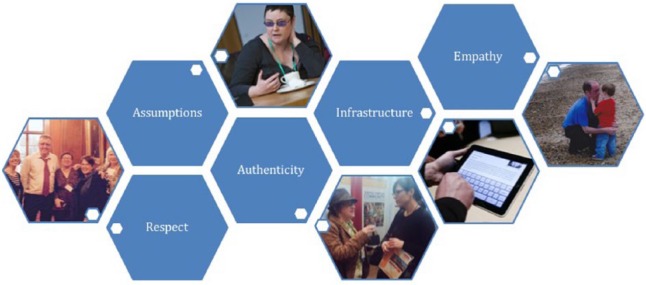
Participatory research methods connect researchers with relevant communities to achieve shared goals. These methods can deliver results that are relevant to people’s lives and thus likely to have a positive impact. In the context of a large and growing body of autism research, with continued poor implementation, and some evidence of community dissatisfaction, there is a powerful case for participatory autism research. In order to develop a framework for such collaborative working, a UK seminar series was organised and co-produced by autistic and non-autistic people with academic, practitioner and lived expertise. This article reports on the outcomes from the series, identifying five topics relevant to building a community of practice in participatory research: Respect, Authenticity, Assumptions, Infrastructure and Empathy. Each topic is connected to a specific example from within and beyond research, to inspire new practices in the field. We call for the development of participatory research skills among the autism research community and the facilitation of greater autistic leadership of, and partnership in, research. Such work, if delivered to a high standard, is likely to lead to better translation into practice and improved outcomes for autistic people and those who support them.
Overview
The claims and statistics of this paper haven’t been checked yet.
Free: it reads the open-access text and checks the first 5 claims that cite a source we can check. Create a free account to check every claim.
Integrity signals
Registry
Cites
Statistics
Figures
Verification
Claims the paper makes
The claims and statistics of this paper haven’t been checked yet.
Free: it reads the open-access text and checks the first 5 claims that cite a source we can check. Create a free account to check every claim.
Claims other papers make about this one
Each is checked against this paper’s own text: does it say what the citing paper says it does?
The source backs part of the claim, not all of it — or backs it for a different population, condition or comparison.
In the citing paper
“In the past decade, autism researchers worldwide have begun to engage with the autistic community, consulting with autistic people at all stages of the research process, exploring ways to work with autistic people as partners, and addressing research topics prioritised by the community (see Fletcher‐Watson et al., 2019; Nicolaidis et al., 2011; Pellicano et al., 2014a, 2014b; Pellicano & Stears, 2”
From Annual Research Review: Shifting from ‘normal science’ to neurodiversity in autism science (2022) · cites this paper as Fletcher‐Watson et al., 2019
Experimental — accuracy not yet measuredThe cited source says what the claim attributes to it.
In the citing paper
“The few studies that have reflected upon lessons learnt from such partnerships have suggested that effective partnerships depend on strong relationships – that is, those in which there is mutual trust between partners, respect for each other’s expertise and ways of being, and an openness to learning from one another (Fletcher-Watson et al., 2019; Jose et al., 2020; Le Cunff et al., 2023; Maye et a”
From ‘You feel part of something bigger’: Stakeholders’ experiences of a long-term community–academic participatory research partnership (2025) · cites this paper as Fletcher-Watson et al., 2019
The cited source says what the claim attributes to it.
In the citing paper
“Though participatory action research comes with its own set of challenges (Fletcher-Watson et al., 2019; Nicolaidis et al., 2011)”
From Neurodiversity and Autism Intervention: Reconciling Perspectives Through a Naturalistic Developmental Behavioral Intervention Framework (2022) · cites this paper as Fletcher-Watson et al., 2019
The cited source says what the claim attributes to it.
In the citing paper
“Such antipathy makes respectful debate framed by contemporary best practice approaches to autism research (Fletcher-Watson et al., 2019, 2021; den Houting et al., 2021; Keating, 2021) unlikely.”
From Perspective: Presuming Autistic Communication Competence and Reframing Facilitated Communication (2022) · cites this paper as Fletcher-Watson et al., 2019
Self-check
Percentages, sums and reported differences re-computed from the paper’s own numbers.
The self-check needs the paper’s full text.
Citations
Cites
A Ladder Of Citizen Participation
Arnstein, S. R. (1969) · Journal of the American Institute of Planners · doi:10.1080/01944366908977225 · Cited by 17,064
What is participatory research?
Cornwall, A., & Jewkes, R. (1995) · Social Science & Medicine · doi:10.1016/0277-9536(95)00127-s · Cited by 2,560 · cited 1×
“By participatory research , we mean incorporating the views of autistic people and their allies about what research gets done, how it is done and how it is implemented (Cornwall and Jewkes, 1995).”
The Third Wave of Science Studies: Studies of Expertise and Experience
Collins, H. M., & Evans, R. (2002) · Social Studies of Science · doi:10.1177/0306312702032002003 · Cited by 2,094 · cited 2×
“Seminar delegates reported that the lived experiences of autistic people – their ‘experiential expertise’ (Collins and Evans, 2002) – is rarely apparent in the context of autism research, though notable exceptions were identified (see Box 1).”
On the ontological status of autism: the ‘double empathy problem’
Milton, D. E. M. (2012) · Disability & Society · doi:10.1080/09687599.2012.710008 · Cited by 2,082 · cited 1×
“The double empathy problem (Milton, 2012) highlights the issue of ‘mutual incomprehension’ that exists between some autistic and non-autistic people, in all walks of life.”
Self-citationWhich terms should be used to describe autism? Perspectives from the UK autism community
Kenny, L., Hattersley, C., Molins, B., Buckley, C., Povey, C., & Pellicano, E. (2016) · Autism · doi:10.1177/1362361315588200 · Cited by 1,941 · cited 1×
“The number of autistic-led organisations, publications (e.g. Autonomy; Beardon, 2017; Lawson et al., 2017; Murray, 2005), online communities (e.g. wrongplanet.net) and events (e.g. Autistic Pride, Autreat and Autscape) is a testament to the energy and dedication of this community.”
Self-citationBrett, J., Staniszewska, S., Mockford, C., Herron‐Marx, S., Hughes, J., Tysall, C., & Suleman, R. (2014) · Health Expectations · doi:10.1111/j.1369-7625.2012.00795.x · Cited by 1,598 · cited 1×
“In so doing, we should draw on the experiences of pioneers within (Frauenberger et al., 2013; Gillespie-Lynch et al., 2017; Mason et al., submitted; McConachie et al., 2018; Nicolaidis et al., 2013; Parsons et al., 2013) and outside (Brett et al., 2014; Rose, 2003) autism research.”
What should autism research focus upon? Community views and priorities from the United Kingdom
Pellicano, E., Dinsmore, A., & Charman, T. (2014) · Autism · doi:10.1177/1362361314529627 · Cited by 800 · cited 1×
“Fortunately, there has been increasing recognition inter-nationally that this situation needs to change, with autistic advocates, academics and activists being some of the strongest voices to speak to these issues (Michael, 2016; Milton, 2014; Nicolaidis et al., 2011; Pellicano et al., 2011).”
Self-citationThe snakes and ladders of user involvement: Moving beyond Arnstein
Tritter, J. Q., & McCallum, A. (2006) · Health Policy · doi:10.1016/j.healthpol.2005.05.008 · Cited by 794 · cited 1×
“There are signs of a much-needed improvement, from openly discussing these issues (Wright et al., 2014), to communities of researchers and autistic people beginning to enact change (Stahmer et al., 2017).”
Israel, B. A., Parker, E. A., Rowe, Z., Salvatore, A., Minkler, M., López, J., Butz, A., Mosley, A., Coates, L., Lambert, G., et al. (2005) · Environmental Health Perspectives · doi:10.1289/ehp.7675 · Cited by 601
Neurotypical Peers are Less Willing to Interact with Those with Autism based on Thin Slice Judgments
Sasson, N. J., Faso, D. J., Nugent, J., Lovell, S., Kennedy, D. P., & Grossman, R. B. (2017) · Scientific Reports · doi:10.1038/srep40700 · Cited by 584 · cited 2×
“, 2016), or negatively judge them based on minimal evidence (Sasson et al., 2017).”
Research works printed but not linked: 14
- Arnold L (2012) Introduction to Autonomy: The Critical Journal of Interdisciplinary Autism Studies. Autonomy: The Critical Journal of Interdisciplinary Autism Studies 1(1): 1.
- Cusack J Sterry R (2016) Your Questions: Shaping Future Autism Research. London: Autistica.
- Gaudion K Hall A Myerson J et al (2014) Design and wellbeing: bridging the empathy gap between neurotypical designers and autistic adults. Design for Sustainable Wellbeing and Empowerment 2014: 61– 77.
- Lawson W Turner T Wilkinson A et al (2017) Love, Partnership, or Singleton on the Autism Spectrum. London: Jessica Kingsley Publishers.
- Long J Panese J Ferguson J et al (2017) Enabling voice and participation in autism services: using practitioner research to develop inclusive practice. Good Autism Practice 18(2): 6– 14.
- Martin N (2010) Minimising the stress of the PhD viva for students with Asperger syndrome. Good Autism Practice 11(1): 52– 57.
- Milton DE Bracher M (2013) Autistics speak but are they heard? Journal of the BSA Medsoc Group 7: 61– 69.
- Murray D (Ed.) (2005) Coming Out Asperger. London: Jessica Kingsley Publishers.
- Pellicano E (2018) Engaging ‘seldom heard’ individuals in participatory autism research. In: Milton D Martin N (eds) Autism and Learning Disability Annual, vol. 2 London: Pavilion Publishing, pp. 29– 34.
- Pellicano E Crane L Gaudion K et al (2017) Participatory Autism Research: A Starterpack. London: UCL Institute of Education.
- Ridout S (2014) More than picture-making: reflecting on collage as a narrative tool for opening discourse on the involvement of autistics in autism research. Autonomy: The Critical Journal of Interdisciplinary Autism Studies 1(3). Available at: http://www.larry-arnold.net/Autonomy/index.php/autonomy/article/view/AR14/html
- Ridout S (2018) Autism and Mental Well-being in Higher Education: A Practical Resource for Students, Mentors and Study Skills Support Workers. Hove: Pavilion Publishing and Media.
- Rose D (2003) Collaborative research between users and professionals: peaks and pitfalls. The Psychiatrist 27(11): 404– 406.
- Sinclair J (2013) Why I dislike ‘person first’ Language. Autonomy, The Critical Journal Of Interdisciplinary Autism Studies, 1(2). Retrieved from http://www.larry-arnold.net/Autonomy/index.php/autonomy/article/view/OP1
Cited by
Items 401–500 of 916
Löthberg, M., Wirström, E., Meyer, J., Girdler, S. J., Bölte, S., & Jonsson, U. (2024) · Journal of Autism and Developmental Disorders · doi:10.1007/s10803-024-06425-z · Cited by 6
Developing a Phenomenology of Autism
Shaughnessy, N., Green, J., Williams, E., Smith, J. A., Tzovaras, B. G., Aitkenhead, G., Milton, D. E. M., Jones, E. J. H., & Buckle, K. L. (2024) · Springer eBooks · doi:10.1007/978-3-031-66127-3_14 · Cited by 7
Self-citationAn investigation of autistic opinions about autism-related genomic research
Ellis, R., & Asbury, K. (2024) · Neurodiversity · doi:10.1177/27546330241287317 · Cited by 7
“Alongside this, the Autistic voice is often excluded from knowledge production and from determining research priorities (Fletcher-Watson et al., 2018; Milton, 2014).”
Walsh, C., Lydon, S., Geoghegan, R., Carey, C., Creed, M., O’Loughlin, L., Walsh, E., Byrne, D., & O'Connor, P. E. (2021) · BMC Health Services Research · doi:10.1186/s12913-021-06842-1 · Cited by 7
“The authors recognise, however, that as research on the barriers to healthcare experienced by autistic individuals increases and tools are developed to represent the perspectives of patients, caregivers and HCPs, there is a need to engage in co-creation of tools and interventions with autistic individuals, HCPs and ca…”
BackgroundUncertainty and Autism: How Changing with the Times is Harder for Some
Sheridan, K., Allen, K., Foggo, R. S. V., Hurem, A., Leif, E., & Freeman, N. C. (2022) · Springer eBooks · doi:10.1007/978-981-19-7757-2_13 · Cited by 6
Anxiety Disorders in Autistic People
Schiltz, H. K., McVey, A. J., & Lord, C. (2024) · Psychiatric Clinics of North America · doi:10.1016/j.psc.2024.04.016 · Cited by 5
Sternberg, K. F., Cloutier, J. G., Ahlers, K. P., Moore, C. C., Koth, K. A., Soda, T., Malhi, N. K., Verma, S., Yeh, L. C., & McLaren, J. (2025) · Journal of Applied Research in Intellectual Disabilities · doi:10.1111/jar.70010 · Cited by 5
A mixed-methods study of autistic and non-autistic community member participation in autism research
Curtiss, S. L., Tillman, S., Subih, M., & Myers, K. (2025) · Autism · doi:10.1177/13623613251348543 · Cited by 5
Stark, E. A., Stacey, J., & Knight, M. T. D. (2025) · Neurodiversity · doi:10.1177/27546330251370652 · Cited by 5
Inclusion by design a-neuro-cognitive trait interaction approach-to neurodivergent research
Dark, J. (2025) · Methodological Innovations · doi:10.1177/20597991251396144 · Cited by 6
“…but discussions tend to focus on participatory approaches, research methods in which participants are included as co-producers of knowledge (Aldridge, 2016; Brown, 2022; Fletcher-Watson et al., 2018; Nicolaidis, 2019) rather than on how inclusion can be embedded within research design more broadly.”
Humour as emotion regulation and resource in autism: a narrative review
Manfredi, M., Laulan, P., & Samson, A. C. (2026) · Frontiers in Psychiatry · doi:10.3389/fpsyt.2026.1770298 · Cited by 6
Zhang, R., Chen, J., Wang, G., Xu, R., Zhang, K., Wang, J., & Zheng, W. (2021) · Interactive Learning Environments · doi:10.1080/10494820.2021.1952273 · Cited by 5
Minnie, C. (2023) · Australasian Journal of Special and Inclusive Education · doi:10.1017/jsi.2023.14 · Cited by 5
Wenneborg, K., Roll, L. P., Bölte, S., Odom, S. L., & Bejnö, H. (2024) · Journal of Autism and Developmental Disorders · doi:10.1007/s10803-024-06544-7 · Cited by 6
A Systematic Review of Strategies and Interventions to Promote the Inclusion of Autistic Adolescents
Mercado-Garrido, E., González, N. C., O’Connor, A., & McTiernan, A. (2024) · Review Journal of Autism and Developmental Disorders · doi:10.1007/s40489-024-00491-w · Cited by 5
Petty, S., & Cantwell, A. (2025) · Diversity & Inclusion Research · doi:10.1002/dvr2.70018 · Cited by 5
“It is important that a collective understanding of what it means to be autistic reflects pluralistic and updated theoretical understandings (Vivanti and Messinger 2021), including expertise from personal experience (Fletcher ‐ Watson et al. 2019).”
Layers of the Skin: Three Perspectives on Tactile Sensation in Autism
Boldsen, S. (2025) · Human Development · doi:10.1159/000546063 · Cited by 6
“For empirical research, this could involve adopting a participatory research design where autistic persons are involved and consulted in designing and conducting research Layers of the Skin Human Development 2025;69:206 – 220 DOI: 10.1159/000546063 (Fletcher-Watson et al., 2019).”
InfluentialWaardenburg, T., van Huizen, N., van Dijk, J., Magnée, M. J. C. M., Staal, W., Teunisse, J., & van der Voort, M. C. (2021) · Lecture notes in computer science · doi:10.1007/978-3-030-78224-5_26 · Cited by 8
“Morally, a call for empowerment through participation has been advocated more broadly within what is called the ‘neurodiversity movement’ [6].”
BackgroundGrant, A., Williams, K., Henry, K., Holloway, W., Nicolaidis, C., Kara, H., & Brown, A. (2024) · Springer eBooks · doi:10.1007/978-3-031-66127-3_4 · Cited by 7
Kuzminski, R., Bölte, S., Lawson, W. B., Falkmer, M., Black, M. H., Girdler, S. J., & Milbourn, B. T. (2024) · Autism in Adulthood · doi:10.1089/aut.2023.0091 · Cited by 7
“18 Working with community stakeholders in the research process is considered best practice, especially in autism research.”
Systematic Review: The Psychosocial Impacts of Autism-Related Genetic Testing
Wills, B. C., Matthews, M. M., Johnston, J., Bolo, I., Ottman, R., & Appelbaum, P. S. (2025) · Journal of the American Academy of Child & Adolescent Psychiatry · doi:10.1016/j.jaac.2025.06.024 · Cited by 5
Have we outgrown the reduced social motivation theory of autism?
Gillespie‐Lynch, K. (2019) · Behavioral and Brain Sciences · doi:10.1017/s0140525x18002431 · Cited by 5
Scholle, P., Herrera, G., Sevilla, J., & Brosnan, M. (2020) · Journal of Enabling Technologies · doi:10.1108/jet-06-2020-0025 · Cited by 5
Nieto, C., & Martínez, J. A. H. (2020) · Journal for the Study of Education and Development Infancia y Aprendizaje · doi:10.1080/02103702.2020.1802149 · Cited by 6
Chapko, D., Rothstein, P. A. A. P., Emeh, L., Frumiento, P., Kennedy, D. A., McNicholas, D., Orjiekwe, I., Overton, M., Snead, M., Steward, R., et al. (2021) · Designing Interactive Systems Conference · doi:10.1145/3461778.3462010 · Cited by 9
Autism Acceptance and Mental Health
Cage, E. (2019) · Springer eBooks · doi:10.1007/978-1-4614-6435-8_102427-1 · Cited by 5
Drouillard, B. (2019) · Scholarship at UWindsor (University of Windsor) · Cited by 6
Woods, R., & Waldock, K. E. (2020) · Springer eBooks · doi:10.1007/978-1-4614-6435-8_102297-2 · Cited by 5
Woods, R., & Waldock, K. E. (2021) · Springer eBooks · doi:10.1007/978-3-319-91280-6_102297 · Cited by 5
Community involvement in PhD students’ autism research projects: Challenges and opportunities
Genovesi, E., Grant, S., Kifle, T. H., Li, J., Shand, A. J., & Hoekstra, R. A. (2024) · Autism · doi:10.1177/13623613241300683 · Cited by 6
Durben, D. L. (2024) · Neurodiversity · doi:10.1177/27546330241266726 · Cited by 6
Kenny, N., Doyle, A., O’Neill, C., Doyle, J. K., O’Kelly, J., Earley, F., & Neilson, S. (2026) · Autism · doi:10.1177/13623613261440799 · Cited by 5
Sarraf, M., Girdler, S. J., & Bölte, S. (2025) · Cities & Health · doi:10.1080/23748834.2025.2535246 · Cited by 5
Øverland, E., Andersen, P. N., Skogli, E. W., Hauge, Å. L., & Pellicano, E. (2025) · Journal of Autism and Developmental Disorders · doi:10.1007/s10803-025-07070-w · Cited by 4
Self-citationSterman, J. J., Wagland, Z., Scott-Cole, L., Spassiani, N. A., & Njelesani, J. E. (2025) · PLOS mental health. · doi:10.1371/journal.pmen.0000481 · Cited by 5
Quetsch, L. B., Shah, E. N., Kiefer, J. L., & Family and Community Intervention Lab: Autism Community Advisory Board (2025) · Research Involvement and Engagement · doi:10.1186/s40900-025-00825-w · Cited by 4
“Participants received $25 Amazon gift cards following these conversations to demonstrate respect and acknowledge the current power imbalance as the Autism CAB was in the initial formation stage [23].”
Neurodiversity: Integrating evolutionary, philosophical, and sociocultural perspectives
Isacoff, N. M., Imanova, S., Kis-Herczegh, P., Toner, S., Urosevic, T., Varma, V., & Cunff, A. L. (2026) · Research in Autism · doi:10.1016/j.reia.2025.202783 · Cited by 5
Libbi, C. A., Frijns, J. H. M., Stronks, H. C., Eichengreen, A., Koutamanis, A., & Rieffe, C. J. (2026) · Journal of Environmental Psychology · doi:10.1016/j.jenvp.2026.103028 · Cited by 4
Odoom, S., Osei, E. O., Effah, E. Q., Boafo, V., Dusu, S., & Appiah, A. K. (2026) · Discover Global Society · doi:10.1007/s44282-026-00378-7 · Cited by 4
What the Double Empathy Problem Is (and Is Not)
Kilgallon, E., Botha, M., Dwyer, P. S. R., Bottema‐Beutel, K., Milton, D., Sasson, N. J., & Crompton, C. J. (2026) · Autism in Adulthood · doi:10.1177/25739581261456653 · Cited by 4
Self-citationUnmasking: A Mixed-Methods Study of Autistic College Students’ Efforts to Stop Masking/Camouflaging
Durben, D. L. (2026) · Journal of Autism and Developmental Disorders · doi:10.1007/s10803-026-07409-x · Cited by 5
Diseñar para personas con autismo: cultura digital, etnografía, investigación situada
Rodríguez, N. L. (2023) · Cuadernos info · doi:10.7764/cdi.54.53197 · Cited by 4
Autismus-Spektrum-Störung im Erwachsenenalter
Thaler, H., & Falter, C. M. (2023) · Fortschritte der Neurologie · Psychiatrie · doi:10.1055/a-1898-5347 · Cited by 4
Rankin, J. A., DiGiovanni, G. M., McKeown, E. S., Shah, C. K., & Brodkin, E. S. (2024) · Research in Autism · doi:10.1016/j.rasd.2024.102425 · Cited by 4
In support of neurodiverse participatory sensemaking
van Dijk, J., & Oral, L. (2025) · Language Sciences · doi:10.1016/j.langsci.2025.101717 · Cited by 5
South, M., Park, S. Y., & Berman, M. (2025) · Autism in Adulthood · doi:10.1089/aut.2024.0122 · Cited by 4
“13,15,23,95,115 118 Acknowledging that budget constraints and existing structural barriers may prevent a fully neuro-divergent acceptable space, there are many fi xes that are reasonable and enhanced by co-production. de Vries 119 argues that sensory-friendly of fi ce spaces (e.g., mitigating or…”
Autism and employment: challenges and strategies for a bright future
Farkas, T. N., Kargas, N., & Mendy, J. (2021) · Elsevier eBooks · doi:10.1016/b978-0-323-85031-5.00015-3 · Cited by 7
A user-based information rating scale to evaluate the design of technology-based supports for autism
Zervogianni, V., Fletcher‐Watson, S., Herrera, G., Goodwin, M. S., Triquell, É., Pérez-Fuster, P., Brosnan, M., & Grynszpan, O. (2023) · Universal Access in the Information Society · doi:10.1007/s10209-023-00995-y · Cited by 6
“Technology-based support requires not only a robust evidence base but also the involvement of the autistic community in the research and development process [30, 73–75] to ensure the needs of the community are met.”
Self-citationParent Perceptions of Participating in a Parent-Mediated Program for Young Autistic Children
van Noorden, L. E., Sigafoos, J., Wallace-Watkin, C., & Waddington, H. L. (2023) · Journal of Early Intervention · doi:10.1177/10538151231214749 · Cited by 5
“Will I Be Celebrated at the End of This Training?” Inclusive Research in Kenya
Wanjagua, R. W., van Heumen, L., & Harris, S. P. (2024) · Social Sciences · doi:10.3390/socsci13020095 · Cited by 4
Interests, Plans, and Hopes for Life After High School From Autistic Young Adults’ Perspectives
Hall, L. J., Brum, C., Steinbrenner, J. R. D., Hume, K., Grundon, G. S., & Spitzer, H. (2024) · Remedial and Special Education · doi:10.1177/07419325241271377 · Cited by 4
Special school staff perspectives on how careers guidance is provided to their autistic young people
Dexter, S., Remington, A., McAuley, R. J., Willans, A., Gross, J., Culmer, K., Littlebury, N., & Crane, L. (2025) · British Educational Research Journal · doi:10.1002/berj.4169 · Cited by 4
Self-citationHorton, E., Brownhill, L. A., Tones, D., Goldschmied, A. Z., Knops, M. J. J., Gürbüz, E., Dommett, E. J., Wilkinson, L., Taylor, J., Toro, C. T., et al. (2026) · Autism in Adulthood · doi:10.1177/25739581261428642 · Cited by 6
Neurodivergent Researchers in Autism Research: A Survey within the AIMS-2-TRIALS Consortium
Bianco, T. D., Estrin, G. L., Lautarescu, A., Oakley, B. F. M., Eaton, E., Terčon, J., Douglas, S., Plas, J. R. D., Belton, D., Loth, E., et al. (2026) · Open Research Europe · doi:10.12688/openreseurope.19394.2 · Cited by 4
Promoting Interdisciplinary and Participatory Autism Research
Rosenau, K. A., & Hotez, E. (2022) · PEDIATRICS · doi:10.1542/peds.2020-049437p · Cited by 4
Thompson, E. C., Feldman, J. I., Valle, A. C., Davis, H., Keçeli-Kaysılı, B., Dunham-Carr, K., Woynaroski, T. G., Tharpe, A. M., & Picou, E. M. (2023) · Journal of Speech Language and Hearing Research · doi:10.1044/2023_jslhr-22-00720 · Cited by 5
Suhrheinrich, J., Haine‐Schlagel, R., Chlebowski, C., Lee, J., & Brookman-Frazee, L. I. (2024) · Autism · doi:10.1177/13623613241280011 · Cited by 4
“Communities of researchers and autistic people are partnering to enact change (Stahmer et al., 2017), and there are calls for research professionals to build knowledge and skills to effectively use participatory research practices (Fletcher-Watson et al., 2019).”
Phan, J., Middleton, S. L., Azevedo, F., Iley, B. J., Grose-Hodge, M., Tyler, S. L., Kapp, S. K., Yeung, S. K., Hartmann, H., FORRT, et al. (2025) · MetArXiv (OSF Preprints) · doi:10.31222/osf.io/k7a9p_v2 · Cited by 5
Involving children, teachers and parents/carers in dialogues around child well-being in schools
Kakoulidou, M., Al-Jayoosi, H., Kambouri, M. A., & Pavlopoulou, G. (2023) · Research for All · doi:10.14324/rfa.07.1.12 · Cited by 3
Singh, S., & Wilson, C. (2024) · ACM International Conference on Interaction Design and Children (IDC) · doi:10.1145/3628516.3655792 · Cited by 4
“Autism is a neurodevelopmental condition which the proponents of neurodiversity conceptualize as a natural variation in human neurology, akin to other forms of diversity such as race, ethnicity and gender [4, 12].”
BackgroundMethodCritical Autism Studies: Roots and Branches
Jackson‐Perry, D. (2024) · Springer eBooks · doi:10.1007/978-3-031-66127-3_2 · Cited by 3
Pour une recherche participative dans le trouble du spectre de l’autisme
Pieron, M., Lacroix, A., Sylvie Chokron, A., & Demily, C. (2025) · L Encéphale · doi:10.1016/j.encep.2024.11.020 · Cited by 4
Parsons, K., Payne, S. M., Bhaska, L., Wallace, J., & Holt, N. (2025) · Psychology of sport and exercise · doi:10.1016/j.psychsport.2025.102867 · Cited by 3
Szechy, K. A., & O’Donnell, L. A. (2025) · Autism in Adulthood · doi:10.1089/aut.2024.0261 · Cited by 3
Ryan, J., Brown, H. M., Borden, A., Devlin, C., Kedmy, A., Lee, A., Nicholas, D. B., & Thompson‐Hodgetts, S. (2025) · Journal of Applied Research in Intellectual Disabilities · doi:10.1111/jar.70106 · Cited by 4
“A community-based participatory research (CBPR) approach informed the research process from study conception to dissemination (Fletcher-Watson et al. 2018; Nicolaidis et al. 2011, 2019).”
Tibber, M. S., Rose, K., Mandy, W., Pellicano, E., & Pavlopoulou, G. (2025) · Autism in Adulthood · doi:10.1177/25739581251377915 · Cited by 4
Self-citationMcGowan, J. J., & Mcgregor, I. P. (2025) · ACM Transactions on Accessible Computing · doi:10.1145/3777370 · Cited by 4
“…on technological stress interventions for autistic adults, including Robertson and Simmons [122] on sensory preferences, Fletcher-Watson et al. [50] on participatory research approaches, and Kalantari et al. [65] who provide relevant evidence on stress and emotion regulation using digital…”
McNally, S., Keenan, L., Lynam, A., O’Keeffe, C., & Sweeney, M. R. (2025) · International Journal of Qualitative Methods · doi:10.1177/16094069251397808 · Cited by 4
Affective intensities and autistic misfitting: on surviving violence at school
Straus, E. J., Douglas, P., & Carla, R. (2025) · Critical Studies in Education · doi:10.1080/17508487.2025.2608091 · Cited by 4
Building Consensus Around Adult Autism Diagnostic Assessment: A Mixed-Methods Approach
Stewardson, C. I., McEwen, L. P., & Kerns, C. M. (2025) · Autism in Adulthood · doi:10.1177/25739581251376356 · Cited by 3
Bates, J. R., Morris, I. F., Dameh, A., Paulus, C. R., Legrid, K., Chen, C., Zelazo, P. D., & Hall‐Lande, J. (2026) · Autism in Adulthood · doi:10.1177/25739581261424784 · Cited by 3
Autistic Children’s Wellbeing at School: A Systematic Review
Carroll, A., Simpson, K., & Adams, D. (2026) · Review Journal of Autism and Developmental Disorders · doi:10.1007/s40489-026-00540-6 · Cited by 5
Nadwodny, N., VanHook, B., Esham, B., Larsen, L. N., Levinson, S., & Eisenhower, A. (2026) · Autism · doi:10.1177/13623613261426691 · Cited by 3
Towards an Autistic User Experience (aUX) Design for Assistive Technologies
Trew, S., & Brown, S. A. (2023) · Springer series on cultural computing · doi:10.1007/978-3-031-28138-9_10 · Cited by 3
Evaluación formativa: tableta y estudiantes con trastorno del espectro autista
Gómez-León, M. I. (2023) · Revista Tecnología Ciencia y Educación · doi:10.51302/tce.2023.9025 · Cited by 5
“Esto puede dar lugar a incoherencias entre las fuentes de información utilizadas por el docente para identificar bajo qué circunstancia una aplicación o un diseño es más confiable, atractivo o efectivo (Fletcher-Watson et al., 2019; Parsons et al., 2020).”
BackgroundOn the Simple Joys of Bouncing: Duoethnography of Neurodivergent Researchers in Academia
Goetz, T. G., & Adams, N. (2024) · Springer eBooks · doi:10.1007/978-3-031-66127-3_17 · Cited by 4
Services in Minoritized Autistic Adolescents and Adults Varying in Language Skills
Girolamo, T. M., Escobedo, A. G., Ghali, S., Greene-Pendelton, K., Campos, I., & Ram-Kiran, P. (2024) · Seminars in Speech and Language · doi:10.1055/s-0044-1793913 · Cited by 3
“However, prior work reveals inadequate attention to intersectional nuance (Anderson et al., 2018b; Chen et al., 2024; Fletcher-Watson et al., 2019; Nicolaidis & Raymaker, 2015), which is critical in considering the experiences of transition-aged autistic individuals (Schendel et al., 2022).”
Tien, I. S., Wolpe, S., Pearson, A., & Seers, K. (2025) · Neurodiversity · doi:10.1177/27546330241306380 · Cited by 4
Cognitive Neuroscience and Neurodiversity: Implications for Autistic People and Clinicians
Muggleton, J., Booth, R. D. L., & de Haan, M. D. H. (2025) · Advances in Neurodevelopmental Disorders · doi:10.1007/s41252-025-00470-0 · Cited by 3
Keating, C. T., Kraaijkamp, C., & Cook, J. L. (2026) · Autism Research · doi:10.1002/aur.70162 · Cited by 3
Reflective Practitioners and Participant Observers in Autism Services
Long, J. J. (2020) · Anthropology in Action · doi:10.3167/aia.2020.270104 · Cited by 4
Giarelli, E., Fisher, K. M., Wilson, L. S., Bonacquisti, L. M., Chornobroff, M., DiPietro, A. M. T., Weiss, M. J., & Bannett, G. (2021) · Journal of Developmental and Physical Disabilities · doi:10.1007/s10882-021-09817-6 · Cited by 4
“Self-advocates were uniquely inciteful with respect to becoming aware of the kinds of behaviors that are most important to accommodate during a therapeutic encounter (Fletcher-Watson et al., 2019).”
BackgroundOverview of autism interventions
Kang, E., McDonald, R. G., & White, S. W. (2022) · Elsevier eBooks · doi:10.1016/b978-0-12-816393-1.00004-x · Cited by 4
Pilot Feasibility of a Community Inclusion Preschool Program for Children With Autism
Jobin, A., Stahmer, A. C., Camacho, N., May, G. C., Gist, K., & Brookman-Frazee, L. I. (2023) · Journal of Early Intervention · doi:10.1177/10538151231217483 · Cited by 3
AI Empowers Autism Nutritional Care Solutions: A Family-Centred Innovation
Maspul, K. A., & Ardhin, M. (2025) · Health & Medical Sciences · doi:10.47134/phms.v2i3.418 · Cited by 3
Introduction aux Études critiques en autisme (ÉCA) issues de la recherche anglophone
Lefebvre, M.-E., Chown, N., & Martin, N. C. (2023) · Canadian Journal of Disability Studies · doi:10.15353/cjds.v12i1.972 · Cited by 7
Wagner, L., Frisch, M., Turner‐Brown, L., Andrews, S. M., Edwards, A., Moultrie, R., Rivas, A. A., Wheeler, A., & Raspa, M. (2020) · Disability and health journal · doi:10.1016/j.dhjo.2020.100927 · Cited by 4
“These approaches gather meaningful input from the target population to help shape research questions, aims, and methods; translate findings into accessible formats; address barriers to participation; and conduct research that helps improve the lives of the people being studied (30).”
BackgroundThe AutGO Initiative: A Conceptual Framework for Developing Genetics‐Outcomes Research Hypotheses
Talebizadeh, Z., Shah, A., & AutGO Working Group (2020) · Autism Research · doi:10.1002/aur.2331 · Cited by 3
“Another key roadblock in fortifying translational aspects of autism research is insufficient community engagement in the research process [Pellicano, Dinsmore, & Charman, 2014a; Pellicano, Dinsmore, & Charman, 2014b; Fletcher-Watson et al., 2019].”
BackgroundPellicano, E., & Stears, M. (2019) · Journal of Empirical Research on Human Research Ethics · doi:10.1177/1556264619858524a · Cited by 4
“There is a growing movement toward participatory research in the field of autism (Chown et al., 2017; Fletcher-Watson et al., 2019; Nicolaidis et al., 2011).”
BackgroundSelf-citationWoods, R., & Waldock, K. E. (2019) · Springer eBooks · doi:10.1007/978-1-4614-6435-8_102297-1 · Cited by 3
Autism and sleep across development: Advancing research and treatment through co-production
Spanò, G., Combs, D., Dwyer, P. S. R., Luongo, A., Parent-Johnson, W., & Edgin, J. O. (2024) · Neurodiversity · doi:10.1177/27546330241238668 · Cited by 3
The roles of music in the well-being of autistic adults
Korošec, K. (2024) · doi:10.69622/26984167 · Cited by 4
From humble beginnings: Reflections on 10 years of the Participatory Autism Research Collective
Milton, D. E. M., Moore, A., & Martin, N. C. (2025) · Autism · doi:10.1177/13623613251319887 · Cited by 3
Self-citationTafla, T. L., Lira, P. G. R., Godoy, P. B. G., & Shephard, E. (2026) · Autism · doi:10.1177/13623613261434813 · Cited by 3
Pellicano, E., Bent, C. A., Iacono, T., Capes, K., Upson, S., & Hudry, K. (2025) · Autism · doi:10.1177/13623613251348485 · Cited by 2
Self-citationIndependent Living for Individuals With Autism
Stavrou, K. (2024) · Advances in medical technologies and clinical practice book series · doi:10.4018/979-8-3693-6026-2.ch008 · Cited by 2
Sensory Interventions: Evidence and Appropriate Use
Dumont, R. L., Williams, K. L., Barrett, A. L., Schiano, N. R., & Schaaf, R. C. (2025) · Springer eBooks · doi:10.1007/978-3-031-78143-8_13 · Cited by 2
Relationship Between Self-Determination and IEP Goal Attainment for Autistic Adolescents
Kan, D. D. D., Hume, K., Shogren, K. A., Tomaszewski, B. R., & Ng, J. M. (2025) · Career Development and Transition for Exceptional Individuals · doi:10.1177/21651434251333405 · Cited by 2
Analysing Autism and Gender Diversity with an Intersectional Approach: a Scoping Review
Gava, M. M., Mairena, M. Á., Polo-Rangel, D., Coll‐Planas, G., Sanz-Huidobro, E., & Marsà-Sambola, F. (2025) · Review Journal of Autism and Developmental Disorders · doi:10.1007/s40489-025-00503-3 · Cited by 5
Metadata
- Authors
- Fletcher-Watson, S., Adams, J., Brook, K., Charman, T., Crane, L., Cusack, J., Leekam, S., Milton, D., Parr, J. R., & Pellicano, E.
- Affiliations
- The University of Edinburgh, UK
- Flow Observatorium, UK
- Autism Rights Group Highland, UK
- King's College London (GB)
- University College London (GB)
- Autistica (GB)
- Cardiff University (GB)
- University of Kent (GB)
- Newcastle University (GB)
- Macquarie University (AU)
- ORCID
- Venue
- Autism
- Publisher
- SAGE Publications
- Published
- 2018-08-10
- Volume
- 23
- Issue
- 4
- Pages
- 943-953
- ISSN
- 1362-3613 (ISSN-L)
- 1461-7005
- PMC
- PMC6512245
- OpenAlex
- W2807975560
- Cited by
- 776
- References
- 50
- Citations by year
- 2026: 142 · 2025: 137 · 2024: 119 · 2023: 100 · 2022: 83 · 2021: 91 · 2020: 63 · 2019: 37 · 2018: 3
- FWCI
- 74.07
- Type
- journal article
- Language
- en
- Open access
- hybrid
- doi.org
- Licence
- cc-by
- journals.sagepub.com/page/policies/text-and-data-mining-license (tdm)
- Locations
- Autism (publishedVersion, cc-by)
- PubMed Central (publishedVersion, cc-by)
- PubMed (publishedVersion)
- ORCA Online Research @Cardiff (Cardiff University) (acceptedVersion)
- Kent Academic Repository (University of Kent) (submittedVersion, other-oa)
- UCL Discovery (University College London) (submittedVersion)
- Research Portal (King's College London) (submittedVersion, cc-by)
- University of Birmingham Research Portal (University of Birmingham) (submittedVersion)
- Edinburgh Research Explorer (University of Edinburgh) (submittedVersion, cc-by)
- Newcastle University ePrints (Newcastle Univesity) (cc-by)
- Funders
- Economic and Social Research Council (ES/M00225X/1)
- Leverhulme Trust (Philip Leverhulme Prize)
- Topics
- Health Sciences › Health Professions › General Health Professions › Mental Health and Patient Involvement
- Social Sciences › Sociology and Political Science › Participatory Visual Research Methods
- Health Sciences › Medicine › Public Health, Environmental and Occupational Health › Community Health and Development
- Keywords
- participatory research, autism research, autistic people, communities of practice, research collaboration, lived expertise, research translation, co-production
- MeSH terms
- Stakeholder Participation, Respect, Autistic Disorder, Empathy, United Kingdom, Health Services, Humans, Social Work, Biomedical Research, Community-Based Participatory Research
About these checks
Registry, retraction, Cites and statistics results are computed, not judged, with one exception: a printed reference that no index lists is read once by a model before it counts as a citation error. Claims are extracted by a model and kept only when their quote appears verbatim in the text; each cited source is then checked, with a model’s help, for whether it says what the claim relies on. Those verdicts can be wrong — read the claim’s quote and the cited source before relying on one.
Statistics and arithmetic are recomputed, not judged.
Confidence bands are shown only for fields calibrated on our annotated test set. None is calibrated yet, so no band is shown.
What counts as a claim ›How we measure confidence ›How we check this ›
Are you an author, or do you see a problem with this page? Request a review
Data sources
Bibliographic data: Semantic Scholar, OpenAlex, Crossref.
Contains information from the Semantic Scholar Academic Graph Datasets, made available under the ODC Attribution License (ODC-BY 1.0).
Semantic Scholar’s data is described in: Kinney, R., et al. (2023). The Semantic Scholar Open Data Platform. arXiv:2301.10140.
