

Making the future together: Shaping autism research through meaningful participation
Open accessThe DOI matches its Crossref record; 50 of the 50 references it cites were found in a registry or an index.
Abstract
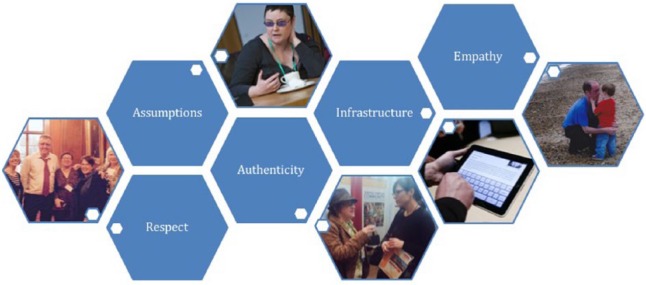
Participatory research methods connect researchers with relevant communities to achieve shared goals. These methods can deliver results that are relevant to people’s lives and thus likely to have a positive impact. In the context of a large and growing body of autism research, with continued poor implementation, and some evidence of community dissatisfaction, there is a powerful case for participatory autism research. In order to develop a framework for such collaborative working, a UK seminar series was organised and co-produced by autistic and non-autistic people with academic, practitioner and lived expertise. This article reports on the outcomes from the series, identifying five topics relevant to building a community of practice in participatory research: Respect, Authenticity, Assumptions, Infrastructure and Empathy. Each topic is connected to a specific example from within and beyond research, to inspire new practices in the field. We call for the development of participatory research skills among the autism research community and the facilitation of greater autistic leadership of, and partnership in, research. Such work, if delivered to a high standard, is likely to lead to better translation into practice and improved outcomes for autistic people and those who support them.
Overview
The claims and statistics of this paper haven’t been checked yet.
Free: it reads the open-access text and checks the first 5 claims that cite a source we can check. Create a free account to check every claim.
Integrity signals
Registry
Cites
Statistics
Figures
Verification
Claims the paper makes
The claims and statistics of this paper haven’t been checked yet.
Free: it reads the open-access text and checks the first 5 claims that cite a source we can check. Create a free account to check every claim.
Claims other papers make about this one
Each is checked against this paper’s own text: does it say what the citing paper says it does?
The source backs part of the claim, not all of it — or backs it for a different population, condition or comparison.
In the citing paper
“In the past decade, autism researchers worldwide have begun to engage with the autistic community, consulting with autistic people at all stages of the research process, exploring ways to work with autistic people as partners, and addressing research topics prioritised by the community (see Fletcher‐Watson et al., 2019; Nicolaidis et al., 2011; Pellicano et al., 2014a, 2014b; Pellicano & Stears, 2”
From Annual Research Review: Shifting from ‘normal science’ to neurodiversity in autism science (2022) · cites this paper as Fletcher‐Watson et al., 2019
Experimental — accuracy not yet measuredThe cited source says what the claim attributes to it.
In the citing paper
“The few studies that have reflected upon lessons learnt from such partnerships have suggested that effective partnerships depend on strong relationships – that is, those in which there is mutual trust between partners, respect for each other’s expertise and ways of being, and an openness to learning from one another (Fletcher-Watson et al., 2019; Jose et al., 2020; Le Cunff et al., 2023; Maye et a”
From ‘You feel part of something bigger’: Stakeholders’ experiences of a long-term community–academic participatory research partnership (2025) · cites this paper as Fletcher-Watson et al., 2019
The cited source says what the claim attributes to it.
In the citing paper
“Though participatory action research comes with its own set of challenges (Fletcher-Watson et al., 2019; Nicolaidis et al., 2011)”
From Neurodiversity and Autism Intervention: Reconciling Perspectives Through a Naturalistic Developmental Behavioral Intervention Framework (2022) · cites this paper as Fletcher-Watson et al., 2019
The cited source says what the claim attributes to it.
In the citing paper
“Such antipathy makes respectful debate framed by contemporary best practice approaches to autism research (Fletcher-Watson et al., 2019, 2021; den Houting et al., 2021; Keating, 2021) unlikely.”
From Perspective: Presuming Autistic Communication Competence and Reframing Facilitated Communication (2022) · cites this paper as Fletcher-Watson et al., 2019
Self-check
Percentages, sums and reported differences re-computed from the paper’s own numbers.
The self-check needs the paper’s full text.
Citations
Cites
A Ladder Of Citizen Participation
Arnstein, S. R. (1969) · Journal of the American Institute of Planners · doi:10.1080/01944366908977225 · Cited by 17,064
What is participatory research?
Cornwall, A., & Jewkes, R. (1995) · Social Science & Medicine · doi:10.1016/0277-9536(95)00127-s · Cited by 2,560 · cited 1×
“By participatory research , we mean incorporating the views of autistic people and their allies about what research gets done, how it is done and how it is implemented (Cornwall and Jewkes, 1995).”
The Third Wave of Science Studies: Studies of Expertise and Experience
Collins, H. M., & Evans, R. (2002) · Social Studies of Science · doi:10.1177/0306312702032002003 · Cited by 2,094 · cited 2×
“Seminar delegates reported that the lived experiences of autistic people – their ‘experiential expertise’ (Collins and Evans, 2002) – is rarely apparent in the context of autism research, though notable exceptions were identified (see Box 1).”
On the ontological status of autism: the ‘double empathy problem’
Milton, D. E. M. (2012) · Disability & Society · doi:10.1080/09687599.2012.710008 · Cited by 2,082 · cited 1×
“The double empathy problem (Milton, 2012) highlights the issue of ‘mutual incomprehension’ that exists between some autistic and non-autistic people, in all walks of life.”
Self-citationWhich terms should be used to describe autism? Perspectives from the UK autism community
Kenny, L., Hattersley, C., Molins, B., Buckley, C., Povey, C., & Pellicano, E. (2016) · Autism · doi:10.1177/1362361315588200 · Cited by 1,941 · cited 1×
“The number of autistic-led organisations, publications (e.g. Autonomy; Beardon, 2017; Lawson et al., 2017; Murray, 2005), online communities (e.g. wrongplanet.net) and events (e.g. Autistic Pride, Autreat and Autscape) is a testament to the energy and dedication of this community.”
Self-citationBrett, J., Staniszewska, S., Mockford, C., Herron‐Marx, S., Hughes, J., Tysall, C., & Suleman, R. (2014) · Health Expectations · doi:10.1111/j.1369-7625.2012.00795.x · Cited by 1,598 · cited 1×
“In so doing, we should draw on the experiences of pioneers within (Frauenberger et al., 2013; Gillespie-Lynch et al., 2017; Mason et al., submitted; McConachie et al., 2018; Nicolaidis et al., 2013; Parsons et al., 2013) and outside (Brett et al., 2014; Rose, 2003) autism research.”
What should autism research focus upon? Community views and priorities from the United Kingdom
Pellicano, E., Dinsmore, A., & Charman, T. (2014) · Autism · doi:10.1177/1362361314529627 · Cited by 800 · cited 1×
“Fortunately, there has been increasing recognition inter-nationally that this situation needs to change, with autistic advocates, academics and activists being some of the strongest voices to speak to these issues (Michael, 2016; Milton, 2014; Nicolaidis et al., 2011; Pellicano et al., 2011).”
Self-citationThe snakes and ladders of user involvement: Moving beyond Arnstein
Tritter, J. Q., & McCallum, A. (2006) · Health Policy · doi:10.1016/j.healthpol.2005.05.008 · Cited by 794 · cited 1×
“There are signs of a much-needed improvement, from openly discussing these issues (Wright et al., 2014), to communities of researchers and autistic people beginning to enact change (Stahmer et al., 2017).”
Israel, B. A., Parker, E. A., Rowe, Z., Salvatore, A., Minkler, M., López, J., Butz, A., Mosley, A., Coates, L., Lambert, G., et al. (2005) · Environmental Health Perspectives · doi:10.1289/ehp.7675 · Cited by 601
Neurotypical Peers are Less Willing to Interact with Those with Autism based on Thin Slice Judgments
Sasson, N. J., Faso, D. J., Nugent, J., Lovell, S., Kennedy, D. P., & Grossman, R. B. (2017) · Scientific Reports · doi:10.1038/srep40700 · Cited by 584 · cited 2×
“, 2016), or negatively judge them based on minimal evidence (Sasson et al., 2017).”
Research works printed but not linked: 14
- Arnold L (2012) Introduction to Autonomy: The Critical Journal of Interdisciplinary Autism Studies. Autonomy: The Critical Journal of Interdisciplinary Autism Studies 1(1): 1.
- Cusack J Sterry R (2016) Your Questions: Shaping Future Autism Research. London: Autistica.
- Gaudion K Hall A Myerson J et al (2014) Design and wellbeing: bridging the empathy gap between neurotypical designers and autistic adults. Design for Sustainable Wellbeing and Empowerment 2014: 61– 77.
- Lawson W Turner T Wilkinson A et al (2017) Love, Partnership, or Singleton on the Autism Spectrum. London: Jessica Kingsley Publishers.
- Long J Panese J Ferguson J et al (2017) Enabling voice and participation in autism services: using practitioner research to develop inclusive practice. Good Autism Practice 18(2): 6– 14.
- Martin N (2010) Minimising the stress of the PhD viva for students with Asperger syndrome. Good Autism Practice 11(1): 52– 57.
- Milton DE Bracher M (2013) Autistics speak but are they heard? Journal of the BSA Medsoc Group 7: 61– 69.
- Murray D (Ed.) (2005) Coming Out Asperger. London: Jessica Kingsley Publishers.
- Pellicano E (2018) Engaging ‘seldom heard’ individuals in participatory autism research. In: Milton D Martin N (eds) Autism and Learning Disability Annual, vol. 2 London: Pavilion Publishing, pp. 29– 34.
- Pellicano E Crane L Gaudion K et al (2017) Participatory Autism Research: A Starterpack. London: UCL Institute of Education.
- Ridout S (2014) More than picture-making: reflecting on collage as a narrative tool for opening discourse on the involvement of autistics in autism research. Autonomy: The Critical Journal of Interdisciplinary Autism Studies 1(3). Available at: http://www.larry-arnold.net/Autonomy/index.php/autonomy/article/view/AR14/html
- Ridout S (2018) Autism and Mental Well-being in Higher Education: A Practical Resource for Students, Mentors and Study Skills Support Workers. Hove: Pavilion Publishing and Media.
- Rose D (2003) Collaborative research between users and professionals: peaks and pitfalls. The Psychiatrist 27(11): 404– 406.
- Sinclair J (2013) Why I dislike ‘person first’ Language. Autonomy, The Critical Journal Of Interdisciplinary Autism Studies, 1(2). Retrieved from http://www.larry-arnold.net/Autonomy/index.php/autonomy/article/view/OP1
Cited by
Items 601–700 of 916
Autism Artisans: Pioneering Neuro-Inclusive Halal Markets
Maspul, K. A., & Ardhin, M. (2025) · Jurnal Pemberdayaan Ekonomi dan Masyarakat · doi:10.47134/jpem.v2i3.797 · Cited by 1
Brickwood, E. (2025) · IGI Global eBooks · doi:10.4018/979-8-3373-4445-4.ch007 · Cited by 1
Grahame, V., Kernohan, A., Kharatikoopaei, E., Mathias, A., Butcher, C., Dixon, L., Fletcher‐Watson, S., Garland, D., Glod, M., Goodwin, J., et al. (2025) · Health Technology Assessment · doi:10.3310/whtu0367 · Cited by 2
Self-citationde Wit, M. M., Zinkstok, J., Buijsman, R., Abdellaoui, A., Begeer, S., & Polderman, T. J. C. (2025) · Autism · doi:10.1177/13623613251384342 · Cited by 1
Babalola, T. T., Moss, R., Dipper, L. T., & Botting, N. (2026) · Journal of Autism and Developmental Disorders · doi:10.1007/s10803-026-07533-8 · Cited by 1
Enabling autistic sociality: unrealised potentials intwo-sided social interaction
Heasman, B. (2018) · London School of Economics and Political Science Theses Online (London School of Economics and Political Science) · Cited by 14
The Influence of Coparenting Support on Fathers’ Involvement with their Children with Autism
Bloom, J. L. (2019) · Scholarship at UWindsor (University of Windsor) · Cited by 3
Influence of technology on social interaction and play in autistic children
Laurie, M. (2020) · ERA · doi:10.7488/era/373 · Cited by 4
Georgiou, K. (2020) · University of Hertfordshire Research Archive (University of Hertfordshire) · doi:10.18745/th.22978 · Cited by 1
Autistic Dreaming: a phenomenological study of dreaming and well-being
Pindar, S.-A. (2019) · Sheffield Hallam University · doi:10.7190/shu-thesis-00319 · Cited by 2
Diversity, Difference or Disorder? Exploring neurodiversity in police-community partnerships
Siberry, A. (2020) · White Rose eTheses Online (University of Leeds, The University of Sheffield, University of York) · Cited by 5
How students on the autism spectrum experience higher education
Connolly, S. (2020) · Sheffield Hallam University · doi:10.7190/shu-thesis-00382 · Cited by 5
Frazier, T. W. (2019) · Springer eBooks · doi:10.1007/978-1-4614-6435-8_102338-1 · Cited by 1
Pelton, M., Adams, J., Crawford, H., Bul, K., Robertson, A. E., Rodgers, J., & Cassidy, S. (2024) · PsyArXiv (OSF Preprints) · doi:10.31234/osf.io/4f3vt · Cited by 1
Self-citationEvaluation of a Two-Tiered Coaching Programme for Parents of Young Autistic Children
van Noorden, L. E. (2024) · Open Access Victoria University of Wellington | Te Herenga Waka (Figshare) · doi:10.26686/wgtn.25303966 · Cited by 1
Helbig, K. A., Vincent, L. B., & McKenney, E. L. W. (2024) · Journal of Educational and Psychological Consultation · doi:10.1080/10474412.2024.2366233 · Cited by 1
Wilde, J. (2025) · QUT ePrints (Queensland University of Technology) · doi:10.5204/thesis.eprints.258460 · Cited by 1
Fisher, E., MacLennan, K., Mullally, S. L., Rodgers, J., & Tzemou, E. (2025) · OSF Preprints (OSF Preprints) · doi:10.31219/osf.io/849gd_v1 · Cited by 1
Editorial: Probing the limits of youth participation in the translational science of neurodivergence
Sonuga-Barke, E. J. S. (2025) · Journal of Child Psychology and Psychiatry · doi:10.1111/jcpp.70082 · Cited by 1
Nicholson, C., Fernandes, M., Abbott, J., Johnson, A., & Leung, J. K. Y. (2025) · Journal of Participatory Research Methods · doi:10.35844/001c.145745 · Cited by 1
Gale, E. (2024) · Kent Academic Repository (University of Kent) · doi:10.22024/unikent/01.02.105549 · Cited by 1
Botha, M., Grant, A., Memmott, A., Milton, D., Pearson, A., Williams, G. L., & Woods, R. (2021) · OSF Preprints (OSF Preprints) · doi:10.31219/osf.io/9578b · Cited by 1
Self-citationPritchard-Rowe, E. (2024) · Apollo (University of Cambridge) · doi:10.17863/cam.108972 · Cited by 1
“No one wants to understand me enough to make it better”
Denisen, C. A. (2024) · Iowa Research Online (The University of Iowa) · doi:10.25820/etd.007740 · Cited by 1
Kan, D. D. D. (2023) · Carolina Digital Repository (University of North Carolina at Chapel Hill) · doi:10.17615/yq6q-5b23 · Cited by 1
Almendinger, K. D., Holingue, C., Faucett, M., DiJulia, F., Daley, K., Williams, Z., Brasher, S. N., Gallo, J. J., & Pellicano, E. (2026) · medRxiv · doi:10.64898/2026.01.13.26343894 · Cited by 1
Self-citationEmbodied, Intelligent and Empathic: Reframing Autism Using Insider Perspectives
Welch, C. (2019) · TSpace (University of Toronto)
"Still out in the cold" : self-advocacy and the disabled people's movement
Petri, G. (2018) · Kent Academic Repository (University of Kent) · Cited by 3
Unwin, K. L. (2019) · ORCA Online Research @Cardiff (Cardiff University) · Cited by 2
Recognising Autistic women: A minority within a minority
Hefferon, K. A. (2020) · Research Commons (University of Waikato) · Cited by 2
Experiences of Post-Diagnostic Support for Children and Young People on the Autism Spectrum
Hasson, L. (2019) · University of Hertfordshire Research Archive (University of Hertfordshire) · doi:10.18745/th.22550
Howard, K. (2020) · Apollo (University of Cambridge) · doi:10.17863/cam.52528
Social Motivation in Adults with Autism: A Multi-method Approach
Gürbüz, E. (2020) · Durham e-Theses (Durham University) · Cited by 2
Browne, T. (2020) · Stirling Online Research Repository (University of Stirling)
Howse, J. (2019) · UCL Discovery (University College London) · Cited by 1
Rimon-Zarfaty, N., Raz, A. E., Bar-Nadav, B., & Vaintropov, E. (2020) · Voluntary Sector Review · doi:10.1332/204080520x16050133060491
“When it comes to autism advocacy organisations, this diversity of representation is also manifested and augmented by their diverse constituencies, which may include family members, professionals and autistic people (Fletcher-Watson et al, 2017, 2019).”
Recommendations for Research in the Future and Final Comments
Bennett, M., & Goodall, E. (2021) · SpringerBriefs in well-being and quality of life research · doi:10.1007/978-3-030-65599-0_4
Bolton, M. J., Ault, L. K., & Meigs, S. D. (2020) · PsyArXiv (OSF Preprints) · doi:10.31234/osf.io/3jzt5
Approaches Perceived to Promote Allyship Between Researchers and the Autistic Community
Orjasaeter, J. (2021) · doi:10.11575/prism/38848 · Cited by 6
Minnie, C. (2021) · Queensland University of Technology · doi:10.5204/thesis.eprints.213217
A Call for Expanding the Diversity of Voices in Autism Research Engagement
Salt, M. (2021) · Canadian Journal of Autism Equity · doi:10.15173/cjae.v1i1.4991
Cândido, G. G., Lima, L. M., & de Moraes, J. B. E. (2013) · LA Referencia (Red Federada de Repositorios Institucionales de Publicaciones Científicas) · Cited by 1
Critical Perspectives in Clinical Psychology: Autistic Identities
Fasulo, A. (2021) · Cambridge University Press eBooks · doi:10.1017/9781108755146.025
Bamberg, M., Demuth, C., & Watzlawik, M. (2021) · Cambridge University Press eBooks · doi:10.1017/9781108755146.024
Frazier, T. W. (2021) · Springer eBooks · doi:10.1007/978-3-319-91280-6_102338
Researching African American Autistics
Bennett, M., & Goodall, E. (2022) · Emerald Group Publishing Limited eBooks · doi:10.1108/978-1-80382-463-520221008 · Cited by 1
Negotiating self, autism, adolescence and school: a participatory inquiry
Rice, E. J. (2021) · Sheffield Hallam University · doi:10.7190/shu-thesis-00444 · Cited by 2
Low, M. Y., & Bradt, J. (2021) · iDEA - Drexel University Institutional Repository · doi:10.17918/00000882 · Cited by 3
Heilpädagogische Forschung: Bildung für Alle. Forschungsbericht 2021
Klaver, P. (2021) · Zenodo (CERN European Organization for Nuclear Research) · doi:10.5281/zenodo.5541057
Gillespie‐Lynch, K. (2019) · American Educational Research Association Annual Meeting (AERA) · doi:10.3102/1443911 · Cited by 1
Recommendations to improve primary healthcare for people with autism: a Delphi-studyPreprint
Warreman, E. B., Ester, W. A., Geurts, H. M., Vermeiren, R. R. J. M., & Nooteboom, L. A. (2022) · PsyArXiv (OSF Preprints) · doi:10.31234/osf.io/wu8t4
The Right Tool for the Job: A Taxonomy for Stakeholder Engagement
MacDuffie, K. E. (2023) · The American Journal of Bioethics · doi:10.1080/15265161.2022.2146803
Mauti, J. M., Pacho, T. O., & Nyatuka, B. O. (2023) · Journal of Education Management and Leadership (JEML) · doi:10.51317/jeml.v2i1.330 · Cited by 1
Creating Studies That Are Respectful of Autistic Participants
Bennett, M. (2023) · Springer eBooks · doi:10.1007/978-981-19-9240-7_6
An Instagram Content Analysis: Investigating the Autisticats
Villatoro, L. R. (2023) · doi:10.32920/22557595.v1
Martin, R. J., Iadarola, S., Iovannone, R., Cavanaugh, B. M., Fontechia, K., Levato, L., & Anderson, C. M. (2023) · Journal of Developmental and Physical Disabilities · doi:10.1007/s10882-023-09918-4
Decolonisation of Health in Africa: Opinion PiecePreprint
Said, S., Yongolo, N. M., Biswaro, S. M., & Kelly, C. A. (2023) · Qeios · doi:10.32388/lj8pv0
Decolonisation of Health in East Africa: Opinion PiecePreprint
Kelly, C. A., Said, S., Yongolo, N. M., Biswaro, S. M., & Walker, R. W. (2023) · Qeios · doi:10.32388/lj8pv0.2
Belongingness and Psychosexual Socialization in a Neurodiverse Sample in the U.S.Preprint
Dufresne, S., & Crehan, E. T. (2024) · OSF Preprints (OSF Preprints) · doi:10.31219/osf.io/7nxmu
Fostering Community at the Graduate Level: One University’s Student-led Approach
Tzamaras, H. M., Hicks, S., Sallai, G. M., Cummings, C., Dennis, L., Nolte, H., Restrepo, A. M., & Howard-Reed, C. (2024) · ASEE Annual Conference & Exposition · doi:10.18260/1-2--43736
Bellalou, L. (2019) · theses.fr (ABES) · doi:10.70675/1cc23caaz6c21z4d57z8c7dze2df6b9a6c02
Clifford, A., & Camps, D. (2024) · Advances in Autism · doi:10.1108/aia-05-2023-0024
Development of an online skills training platform for autistic adults: A participatory approach
Doorn, G. H. V., Klein, B., Edwards, S. L., Shandley, K. A., & Caine, J. A. (2024) · Research in Autism · doi:10.1016/j.rasd.2024.102407
Wallace-Watkin, C. (2024) · Open Access Victoria University of Wellington | Te Herenga Waka (Figshare) · doi:10.26686/wgtn.25858234
Karaminis, T. N., Gabrielatos, C., Maden-Weinberger, U., & Beattie, G. W. (2024) · OSF Preprints (OSF Preprints) · doi:10.31219/osf.io/7udnr
(2024) · Puncta · doi:10.61372/pjcp
O’Donoghue, M., Kennedy, N., & Murphy, C. (2024) · HRB Open Research · doi:10.12688/hrbopenres.13907.1
Suzuki, K., Oi, Y., Mitsuhashi, S., Hirata, S., & Goto, T. (2024) · Advances in Autism · doi:10.1108/aia-04-2024-0030
Maia-Pike, L. (2024) · Queensland University of Technology · doi:10.5204/thesis.eprints.251654 · Cited by 1
Das Rätsel Autismus: Versuch einer Bestandsaufnahme
Kummer, K.-R. (2024) · Der Merkurstab · doi:10.14271/dms-21829-de · Cited by 1
Introduction to Autism and Music
Heaton, P. F. (2024) · Springer eBooks · doi:10.1007/978-3-031-70403-1_1
Scheerer, N. E., Hargreaves, A., Ng, C. S. M., & Lerner, M. (2024) · Frontiers research topics · doi:10.3389/978-2-8325-5703-7
Désormeaux-Moreau, M. (2024) · Cahiers franco-latino-américains d études sur le handicap · doi:10.56078/cfla_discapacidad.382
Sharing an Example of Neurodiversity Affirmative Hiring
Petty, S., Hanser, C. H., Williams, J. A., & Hamilton, L. (2025) · Autism in Adulthood · doi:10.1089/aut.2024.0134 · Cited by 1
Self-Determination in Adolescents on the Autism Spectrum and Intellectual Disability
Kan, D. D. D., & Poon, K. K. (2024) · Springer eBooks · doi:10.1007/978-3-031-40858-8_238-1
Wiley, A. L., & Burgess, S. R. (2025) · Springer international handbooks of education · doi:10.1007/978-3-031-57286-9_11-1
MacNaul, H. L., Castro‐Villarreal, F., Neely, L. C., Sullivan, J. R., & Nichols, S. L. (2025) · Journal of Community Psychology · doi:10.1002/jcop.70007 · Cited by 1
Coburn, K. L., & Shipley, E. P. (2025) · American Journal of Speech-Language Pathology · doi:10.1044/2025_ajslp-24-00470
(2025) · Frontiers research topics · doi:10.3389/978-2-8325-6334-2
Sivakami, M. A. (2025) · RICSH Revista Iberoamericana de las Ciencias Sociales y Humanísticas · doi:10.23913/ricsh.v14i27.365
Milgramm, A. (2022) · Scholars Archive - University at Albany (University at Albany, State University of New York) · doi:10.54014/6kqd-nrw8
Social cognitive and interactive abilities in autismPreprint
Thaler, H., Albantakis, L., & Schilbach, L. (2021) · PsyArXiv (OSF Preprints) · doi:10.31234/osf.io/et8uv_v1
Otizm Araştırmaları Perspektifinden Katılımlı Araştırma Yöntemleri
Baştan, E. (2025) · Yaşam Becerileri Psikoloji Dergisi · doi:10.31461/ybpd.1679305
Stepping into Who I Fully Am: A Creative Exploration of Autistic Menopause
Matthews, R. J., Jenkins, C. A., van Rensburg, M. J., Brady, M. J., Moseley, R. L., & Turner‐Cobb, J. M. (2025) · International Journal of Disability and Social Justice · doi:10.13169/intljofdissocjus.5.1.0004
Miotti, S. (2025) · IGI Global eBooks · doi:10.4018/979-8-3373-4445-4.ch002
Context and Coping Skills: A (New) Theoretical Approach to Program Development
Dufresne, S., & Crehan, E. T. (2025) · IGI Global eBooks · doi:10.4018/979-8-3693-8920-1.ch003
Dual Challenges – Dual Strengths: Neurodivergent Parenthood in Higher Education
Callander, K. A. (2025) · IGI Global eBooks · doi:10.4018/979-8-3693-8044-4.ch002
Neurodivergent Children's Reading Experiences: A Review
Vendelbo, S. H., Freund, A., & Andersen, M. E. (2025) · IGI Global eBooks · doi:10.4018/979-8-3693-8044-4.ch016
The Autistic Advantage as an Researcher in Autism
Whitney, E. (2025) · IGI Global eBooks · doi:10.4018/979-8-3693-8044-4.ch017
Jack, C. (2025) · IGI Global eBooks · doi:10.4018/979-8-3693-8044-4.ch014
Rudroff, T. (2025) · NeuroSci · doi:10.3390/neurosci6030080
“This perspective aligns with the contemporary understanding of autism as a stable neurotype with distinct cognitive and social characteristics, rather than a condition requiring normalization [117,118].”
Art therapy for autistic adults against depression: A multi-perspective study
Wang, Y., & Digard, B. G. (2026) · Research in Autism · doi:10.1016/j.reia.2026.202998
Oakley, B. F. M., Canitano, R., López‐Zamora, M., & Mazzoni, N. (2025) · Frontiers in Child and Adolescent Psychiatry · doi:10.3389/frcha.2025.1697025
“Participatory approaches and involvement of underrepresented voices (e.g., autistic people with co-occurring intellectual disability, those from lower socioeconomic backgrounds) in these efforts is essential (27).”
Wiley, A. L., & Burgess, S. R. (2025) · Springer international handbooks of education · doi:10.1007/978-3-031-60258-0_11
Understanding Perspectives on Wearable Technologies: Insights from Parents and Autistic IndividualsPreprint
Rosenberger, C. A., Hassan, M. Z., Vozka, V., Patel, M. M., Kelleher, B., & McCormick, C. E. B. (2025) · Research Square · doi:10.21203/rs.3.rs-7180182/v1
Green, M., Kenny, N., & Kavanagh, A. M. (2025) · Irish Educational Studies · doi:10.1080/03323315.2025.2561631
When music rethinks empathy in autism: A commentary on Heaton (2025)
Zhong, Y. (2025) · Research in Neurodiversity · doi:10.1016/j.rin.2025.100005
Barbaro, J. (2025) · Research and Practice in Intellectual and Developmental Disabilities · doi:10.1080/23297018.2025.2576187
No longer keeping a secret: what autistic people intend for their blogs
Petty, S., & Noddings-Walker, M. (2025) · Advances in Autism · doi:10.1108/aia-09-2025-0089
Metadata
- Authors
- Fletcher-Watson, S., Adams, J., Brook, K., Charman, T., Crane, L., Cusack, J., Leekam, S., Milton, D., Parr, J. R., & Pellicano, E.
- Affiliations
- The University of Edinburgh, UK
- Flow Observatorium, UK
- Autism Rights Group Highland, UK
- King's College London (GB)
- University College London (GB)
- Autistica (GB)
- Cardiff University (GB)
- University of Kent (GB)
- Newcastle University (GB)
- Macquarie University (AU)
- ORCID
- Venue
- Autism
- Publisher
- SAGE Publications
- Published
- 2018-08-10
- Volume
- 23
- Issue
- 4
- Pages
- 943-953
- ISSN
- 1362-3613 (ISSN-L)
- 1461-7005
- PMC
- PMC6512245
- OpenAlex
- W2807975560
- Cited by
- 776
- References
- 50
- Citations by year
- 2026: 142 · 2025: 137 · 2024: 119 · 2023: 100 · 2022: 83 · 2021: 91 · 2020: 63 · 2019: 37 · 2018: 3
- FWCI
- 74.07
- Type
- journal article
- Language
- en
- Open access
- hybrid
- doi.org
- Licence
- cc-by
- journals.sagepub.com/page/policies/text-and-data-mining-license (tdm)
- Locations
- Autism (publishedVersion, cc-by)
- PubMed Central (publishedVersion, cc-by)
- PubMed (publishedVersion)
- ORCA Online Research @Cardiff (Cardiff University) (acceptedVersion)
- Kent Academic Repository (University of Kent) (submittedVersion, other-oa)
- UCL Discovery (University College London) (submittedVersion)
- Research Portal (King's College London) (submittedVersion, cc-by)
- University of Birmingham Research Portal (University of Birmingham) (submittedVersion)
- Edinburgh Research Explorer (University of Edinburgh) (submittedVersion, cc-by)
- Newcastle University ePrints (Newcastle Univesity) (cc-by)
- Funders
- Economic and Social Research Council (ES/M00225X/1)
- Leverhulme Trust (Philip Leverhulme Prize)
- Topics
- Health Sciences › Health Professions › General Health Professions › Mental Health and Patient Involvement
- Social Sciences › Sociology and Political Science › Participatory Visual Research Methods
- Health Sciences › Medicine › Public Health, Environmental and Occupational Health › Community Health and Development
- Keywords
- participatory research, autism research, autistic people, communities of practice, research collaboration, lived expertise, research translation, co-production
- MeSH terms
- Stakeholder Participation, Respect, Autistic Disorder, Empathy, United Kingdom, Health Services, Humans, Social Work, Biomedical Research, Community-Based Participatory Research
About these checks
Registry, retraction, Cites and statistics results are computed, not judged, with one exception: a printed reference that no index lists is read once by a model before it counts as a citation error. Claims are extracted by a model and kept only when their quote appears verbatim in the text; each cited source is then checked, with a model’s help, for whether it says what the claim relies on. Those verdicts can be wrong — read the claim’s quote and the cited source before relying on one.
Statistics and arithmetic are recomputed, not judged.
Confidence bands are shown only for fields calibrated on our annotated test set. None is calibrated yet, so no band is shown.
What counts as a claim ›How we measure confidence ›How we check this ›
Are you an author, or do you see a problem with this page? Request a review
Data sources
Bibliographic data: Semantic Scholar, OpenAlex, Crossref.
Contains information from the Semantic Scholar Academic Graph Datasets, made available under the ODC Attribution License (ODC-BY 1.0).
Semantic Scholar’s data is described in: Kinney, R., et al. (2023). The Semantic Scholar Open Data Platform. arXiv:2301.10140.
