

Making the future together: Shaping autism research through meaningful participation
Open accessThe DOI matches its Crossref record; 50 of the 50 references it cites were found in a registry or an index.
Abstract
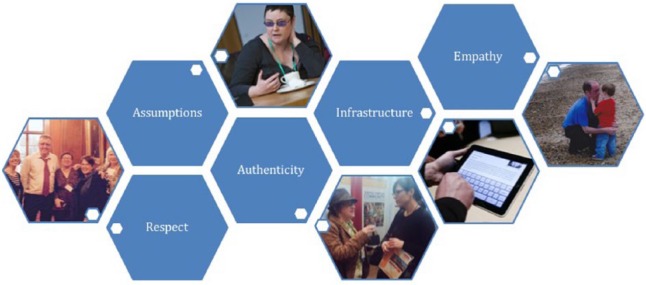
Participatory research methods connect researchers with relevant communities to achieve shared goals. These methods can deliver results that are relevant to people’s lives and thus likely to have a positive impact. In the context of a large and growing body of autism research, with continued poor implementation, and some evidence of community dissatisfaction, there is a powerful case for participatory autism research. In order to develop a framework for such collaborative working, a UK seminar series was organised and co-produced by autistic and non-autistic people with academic, practitioner and lived expertise. This article reports on the outcomes from the series, identifying five topics relevant to building a community of practice in participatory research: Respect, Authenticity, Assumptions, Infrastructure and Empathy. Each topic is connected to a specific example from within and beyond research, to inspire new practices in the field. We call for the development of participatory research skills among the autism research community and the facilitation of greater autistic leadership of, and partnership in, research. Such work, if delivered to a high standard, is likely to lead to better translation into practice and improved outcomes for autistic people and those who support them.
Overview
The claims and statistics of this paper haven’t been checked yet.
Free: it reads the open-access text and checks the first 5 claims that cite a source we can check. Create a free account to check every claim.
Integrity signals
Registry
Cites
Statistics
Figures
Verification
Claims the paper makes
The claims and statistics of this paper haven’t been checked yet.
Free: it reads the open-access text and checks the first 5 claims that cite a source we can check. Create a free account to check every claim.
Claims other papers make about this one
Each is checked against this paper’s own text: does it say what the citing paper says it does?
The source backs part of the claim, not all of it — or backs it for a different population, condition or comparison.
In the citing paper
“In the past decade, autism researchers worldwide have begun to engage with the autistic community, consulting with autistic people at all stages of the research process, exploring ways to work with autistic people as partners, and addressing research topics prioritised by the community (see Fletcher‐Watson et al., 2019; Nicolaidis et al., 2011; Pellicano et al., 2014a, 2014b; Pellicano & Stears, 2”
From Annual Research Review: Shifting from ‘normal science’ to neurodiversity in autism science (2022) · cites this paper as Fletcher‐Watson et al., 2019
Experimental — accuracy not yet measuredThe cited source says what the claim attributes to it.
In the citing paper
“The few studies that have reflected upon lessons learnt from such partnerships have suggested that effective partnerships depend on strong relationships – that is, those in which there is mutual trust between partners, respect for each other’s expertise and ways of being, and an openness to learning from one another (Fletcher-Watson et al., 2019; Jose et al., 2020; Le Cunff et al., 2023; Maye et a”
From ‘You feel part of something bigger’: Stakeholders’ experiences of a long-term community–academic participatory research partnership (2025) · cites this paper as Fletcher-Watson et al., 2019
The cited source says what the claim attributes to it.
In the citing paper
“Though participatory action research comes with its own set of challenges (Fletcher-Watson et al., 2019; Nicolaidis et al., 2011)”
From Neurodiversity and Autism Intervention: Reconciling Perspectives Through a Naturalistic Developmental Behavioral Intervention Framework (2022) · cites this paper as Fletcher-Watson et al., 2019
The cited source says what the claim attributes to it.
In the citing paper
“Such antipathy makes respectful debate framed by contemporary best practice approaches to autism research (Fletcher-Watson et al., 2019, 2021; den Houting et al., 2021; Keating, 2021) unlikely.”
From Perspective: Presuming Autistic Communication Competence and Reframing Facilitated Communication (2022) · cites this paper as Fletcher-Watson et al., 2019
Self-check
Percentages, sums and reported differences re-computed from the paper’s own numbers.
The self-check needs the paper’s full text.
Citations
Cites
A Ladder Of Citizen Participation
Arnstein, S. R. (1969) · Journal of the American Institute of Planners · doi:10.1080/01944366908977225 · Cited by 17,064
What is participatory research?
Cornwall, A., & Jewkes, R. (1995) · Social Science & Medicine · doi:10.1016/0277-9536(95)00127-s · Cited by 2,560 · cited 1×
“By participatory research , we mean incorporating the views of autistic people and their allies about what research gets done, how it is done and how it is implemented (Cornwall and Jewkes, 1995).”
The Third Wave of Science Studies: Studies of Expertise and Experience
Collins, H. M., & Evans, R. (2002) · Social Studies of Science · doi:10.1177/0306312702032002003 · Cited by 2,094 · cited 2×
“Seminar delegates reported that the lived experiences of autistic people – their ‘experiential expertise’ (Collins and Evans, 2002) – is rarely apparent in the context of autism research, though notable exceptions were identified (see Box 1).”
On the ontological status of autism: the ‘double empathy problem’
Milton, D. E. M. (2012) · Disability & Society · doi:10.1080/09687599.2012.710008 · Cited by 2,082 · cited 1×
“The double empathy problem (Milton, 2012) highlights the issue of ‘mutual incomprehension’ that exists between some autistic and non-autistic people, in all walks of life.”
Self-citationWhich terms should be used to describe autism? Perspectives from the UK autism community
Kenny, L., Hattersley, C., Molins, B., Buckley, C., Povey, C., & Pellicano, E. (2016) · Autism · doi:10.1177/1362361315588200 · Cited by 1,941 · cited 1×
“The number of autistic-led organisations, publications (e.g. Autonomy; Beardon, 2017; Lawson et al., 2017; Murray, 2005), online communities (e.g. wrongplanet.net) and events (e.g. Autistic Pride, Autreat and Autscape) is a testament to the energy and dedication of this community.”
Self-citationBrett, J., Staniszewska, S., Mockford, C., Herron‐Marx, S., Hughes, J., Tysall, C., & Suleman, R. (2014) · Health Expectations · doi:10.1111/j.1369-7625.2012.00795.x · Cited by 1,598 · cited 1×
“In so doing, we should draw on the experiences of pioneers within (Frauenberger et al., 2013; Gillespie-Lynch et al., 2017; Mason et al., submitted; McConachie et al., 2018; Nicolaidis et al., 2013; Parsons et al., 2013) and outside (Brett et al., 2014; Rose, 2003) autism research.”
What should autism research focus upon? Community views and priorities from the United Kingdom
Pellicano, E., Dinsmore, A., & Charman, T. (2014) · Autism · doi:10.1177/1362361314529627 · Cited by 800 · cited 1×
“Fortunately, there has been increasing recognition inter-nationally that this situation needs to change, with autistic advocates, academics and activists being some of the strongest voices to speak to these issues (Michael, 2016; Milton, 2014; Nicolaidis et al., 2011; Pellicano et al., 2011).”
Self-citationThe snakes and ladders of user involvement: Moving beyond Arnstein
Tritter, J. Q., & McCallum, A. (2006) · Health Policy · doi:10.1016/j.healthpol.2005.05.008 · Cited by 794 · cited 1×
“There are signs of a much-needed improvement, from openly discussing these issues (Wright et al., 2014), to communities of researchers and autistic people beginning to enact change (Stahmer et al., 2017).”
Israel, B. A., Parker, E. A., Rowe, Z., Salvatore, A., Minkler, M., López, J., Butz, A., Mosley, A., Coates, L., Lambert, G., et al. (2005) · Environmental Health Perspectives · doi:10.1289/ehp.7675 · Cited by 601
Neurotypical Peers are Less Willing to Interact with Those with Autism based on Thin Slice Judgments
Sasson, N. J., Faso, D. J., Nugent, J., Lovell, S., Kennedy, D. P., & Grossman, R. B. (2017) · Scientific Reports · doi:10.1038/srep40700 · Cited by 584 · cited 2×
“, 2016), or negatively judge them based on minimal evidence (Sasson et al., 2017).”
Research works printed but not linked: 14
- Arnold L (2012) Introduction to Autonomy: The Critical Journal of Interdisciplinary Autism Studies. Autonomy: The Critical Journal of Interdisciplinary Autism Studies 1(1): 1.
- Cusack J Sterry R (2016) Your Questions: Shaping Future Autism Research. London: Autistica.
- Gaudion K Hall A Myerson J et al (2014) Design and wellbeing: bridging the empathy gap between neurotypical designers and autistic adults. Design for Sustainable Wellbeing and Empowerment 2014: 61– 77.
- Lawson W Turner T Wilkinson A et al (2017) Love, Partnership, or Singleton on the Autism Spectrum. London: Jessica Kingsley Publishers.
- Long J Panese J Ferguson J et al (2017) Enabling voice and participation in autism services: using practitioner research to develop inclusive practice. Good Autism Practice 18(2): 6– 14.
- Martin N (2010) Minimising the stress of the PhD viva for students with Asperger syndrome. Good Autism Practice 11(1): 52– 57.
- Milton DE Bracher M (2013) Autistics speak but are they heard? Journal of the BSA Medsoc Group 7: 61– 69.
- Murray D (Ed.) (2005) Coming Out Asperger. London: Jessica Kingsley Publishers.
- Pellicano E (2018) Engaging ‘seldom heard’ individuals in participatory autism research. In: Milton D Martin N (eds) Autism and Learning Disability Annual, vol. 2 London: Pavilion Publishing, pp. 29– 34.
- Pellicano E Crane L Gaudion K et al (2017) Participatory Autism Research: A Starterpack. London: UCL Institute of Education.
- Ridout S (2014) More than picture-making: reflecting on collage as a narrative tool for opening discourse on the involvement of autistics in autism research. Autonomy: The Critical Journal of Interdisciplinary Autism Studies 1(3). Available at: http://www.larry-arnold.net/Autonomy/index.php/autonomy/article/view/AR14/html
- Ridout S (2018) Autism and Mental Well-being in Higher Education: A Practical Resource for Students, Mentors and Study Skills Support Workers. Hove: Pavilion Publishing and Media.
- Rose D (2003) Collaborative research between users and professionals: peaks and pitfalls. The Psychiatrist 27(11): 404– 406.
- Sinclair J (2013) Why I dislike ‘person first’ Language. Autonomy, The Critical Journal Of Interdisciplinary Autism Studies, 1(2). Retrieved from http://www.larry-arnold.net/Autonomy/index.php/autonomy/article/view/OP1
Cited by
Items 701–800 of 916
Formação Continuada de Profissionais: Capacitação no Contexto do TEA
LEITE, A. D. C., RODRIGUES, P. D. S., Souza, T. F., & SILVA, A. B. (2025) · doi:10.55333/rima-978-65-83933-26-3_011
Williamson, J. (2024) · doi:10.11575/prism/46972 · Cited by 1
Investigating the Role of Actin57B Gene on Age-Related Changes in Immune Response
Ravi, Y., & Ober, E. (2024) · Maryland Shared Open Access Repository (USMAI Consortium) · doi:10.13016/m2sldr-ropl
Ee, B. (2025) · cIRcle (University of British Columbia) · doi:10.14288/1.0448290
Perspectives of stakeholders in assessment accommodations for autistic learners in grade 4 to 12
(2022) · UpSpace Institutional Repository (University of Pretoria) · doi:10.25403/upresearchdata.21936618 · Cited by 2
Mezinska, S., Gallagher, L., Verbrugge, M., & Bunnik, E. M. (2021) · Figshare · doi:10.6084/m9.figshare.14211587
Nimbley, E., Gillespie‐Smith, K., Duffy, F., Maloney, E., Ballantyne, C. J., & Sharpe, H. (2024) · Figshare · doi:10.6084/m9.figshare.26594279
Mezinska, S., Gallagher, L., Verbrugge, M., & Bunnik, E. M. (2021) · Figshare · doi:10.6084/m9.figshare.14211596
Mezinska, S., Gallagher, L., Verbrugge, M., & Bunnik, E. M. (2021) · Figshare · doi:10.6084/m9.figshare.14211593
Carter, C. K. (2024) · Lancaster EPrints (Lancaster University) · doi:10.17635/lancaster/thesis/2553 · Cited by 1
Waldock, K. E. (2024) · Kent Academic Repository (University of Kent) · doi:10.22024/unikent/01.02.107678 · Cited by 4
Walsh, C., Lydon, S., Geoghegan, R., Carey, C., Creed, M., O’Loughlin, L., Walsh, E., Byrne, D., & O’Connor, P. (2021) · Figshare · doi:10.6084/m9.figshare.16456380
Mezinska, S., Gallagher, L., Verbrugge, M., & Bunnik, E. M. (2021) · Figshare · doi:10.6084/m9.figshare.14211590
Immigrant Attitudes Toward Women’s Political Participation in Maryland
Patel, R. (2024) · Maryland Shared Open Access Repository (USMAI Consortium) · doi:10.13016/m2pjgc-a9yf
Hoffman, K. M. (2023) · University Libraries (University of Maryland) · doi:10.13016/dspace/vleg-qb2h · Cited by 5
Naumann, S. (2023) · edoc Publication server (Humboldt University of Berlin) · doi:10.18452/27468
Going "full autistic" in improv: reduction in anxiety and other benefits
Keates, N. (2023) · Kent Academic Repository (University of Kent) · doi:10.22024/unikent/01.02.102080 · Cited by 1
Walsh, C., Lydon, S., Geoghegan, R., Carey, C., Creed, M., O’Loughlin, L., Walsh, E., Byrne, D., & O’Connor, P. (2021) · Figshare · doi:10.6084/m9.figshare.16456377
Mechanisms underpinning sleep problems and links to mental ill health in autism
Zahir, R. (2025) · ERA · doi:10.7488/era/6059 · Cited by 1
Scottish Journal of Residential Child Care : Vol 23 No.2
Connelly, G. (2024) · Strathprints: The University of Strathclyde institutional repository (University of Strathclyde) · doi:10.17868/strath.00091005
Walsh, C., Lydon, S., Geoghegan, R., Carey, C., Creed, M., O’Loughlin, L., Walsh, E., Byrne, D., & O’Connor, P. (2021) · Figshare · doi:10.6084/m9.figshare.16456386
Kassir, P. (2024) · Maryland Shared Open Access Repository (USMAI Consortium) · doi:10.13016/m2fc6e-gjgn
ADAMS, D. (2024) · Maryland Shared Open Access Repository (USMAI Consortium) · doi:10.13016/m2rbn6-tsfi
Rentschler, L. F. (2023) · Carolina Digital Repository (University of North Carolina at Chapel Hill) · doi:10.17615/6n6h-vm09
Autism and Internationalised Schools
Hay, J. (2024) · Lancaster EPrints (Lancaster University) · doi:10.17635/lancaster/thesis/2587
Fletcher, A. (2025) · Enlighten: Theses (The University of Glasgow) · doi:10.5525/gla.thesis.85238 · Cited by 4
Field, S. L., Fox, J. R. E., Jones, C. R. G., & Williams, M. O. (2024) · Figshare · doi:10.6084/m9.figshare.26567414
Walsh, C., Lydon, S., Geoghegan, R., Carey, C., Creed, M., O’Loughlin, L., Walsh, E., Byrne, D., & O’Connor, P. (2021) · Figshare · doi:10.6084/m9.figshare.16456395
Nimbley, E., Gillespie‐Smith, K., Duffy, F., Maloney, E., Ballantyne, C. J., & Sharpe, H. (2024) · Figshare · doi:10.6084/m9.figshare.26594285
Breen, T. (2022) · Tuwhera (Auckland University of Technology) · Cited by 4
How do we perceive autistic individuals in a non-social context?
Jaffrani, A. A. (2022) · Nottingham ePrints (University of Nottingham) · Cited by 3
Charnick, C. L. (2024) · ePrints Soton (University of Southampton)
Caregiver Perspectives on Service Needs for Individuals with Profound Autism
Ferguson, E. F. (2023) · eScholarship (California Digital Library)
Jónsdóttir, S. L. (2023) · Opin vísindi (Opin vísindi)
Exploring the Experiences of Autistic Graduate Women in Navigating the World of Work
Gleeson, C. (2024) · Trinity's Access to Research Output (TARA) (Trinity College Dublin)
Naylor, C. (2023) · Nottingham ePrints (University of Nottingham) · Cited by 8
Understanding playtime behaviours of autistic children in mainstream primary school
Kemp, H. (2024) · ePrints Soton (University of Southampton)
Foggo, R. V. (2023) · Research Online (University of Wollongong) · Cited by 1
Exploring family relationships in the context of autism.
Francis, L. (2023) · ePrints Soton (University of Southampton)
Affirming neurodiversity : a study on the ethics of early autism detection and intervention
Vanaken, G.-J. (2023) · Lirias · Cited by 12
Developing a new self-harm assessment tool with and for autistic adults
Newell, V. (2025) · Nottingham ePrints (University of Nottingham)
Umagami, K. (2023) · UCL Discovery (University College London) · Cited by 7
Making room for autism at work: Designing a participatory research project
Jelić, A., Nguyen, L. P., Kinnaer, J., Lackovicova, M., Saelens, D., & Heylighen, A. (2024) · Lirias (KU Leuven) · Cited by 3
Kirkland, J. B. (2023) · ScholarWorks (Walden University)
Sociability and Social Vulnerability in Williams Syndrome
Ridley, E. (2024) · Durham e-Theses (Durham University)
Atkinson, E. K. (2023) · ePrints Soton (University of Southampton) · Cited by 2
Naser, A., Trandafir, L., & Varsamidis, A. (2023) · DiVA (Mälardalen University College)
Da Mata Da Silva Costa, E. (2023) · UEA Digital Repository (University of East Anglia) · Cited by 7
Ojaniemi, E. (2023) · Lauda (University of Lapland)
Colat-Parros, L. (2023) · UCL Discovery (University College London) · Cited by 3
Ashworth, M. (2024) · UCL Discovery (University College London)
Overton, G. L. (2023) · UEA Digital Repository (University of East Anglia) · Cited by 1
Brede, J. (2024) · UCL Discovery (University College London)
McNally, S., Sweeney, M. R., Keenan, L., Lynam, A., Ramsbottom, C., & Radhakrishnan, A. (2025) · Dublin City University Open Access Institutional Repository (Dublin City University)
The role of informational support in online groups for people on the autism spectrum
Duffin, S. (2024) · White Rose eTheses Online (University of Leeds, The University of Sheffield, University of York) · Cited by 2
Introduction aux Études critiques en autisme (ÉCA) issues de la recherche anglophone
Lefebvre, M.-E., Chown, N., & Martin, N. (2023) · Research Open (London South Bank University)
La transition d’adultes autistes vers les études postsecondaires : ancrage dans leur vécu
Lefebvre, M.-E. (2024) · Bibliothèque et Archives nationales du Québec (Québec government) · doi:10.71781/5187 · Cited by 2
Amouei, M. (2023) · OpenMETU (Middle East Technical University)
Successful Strategies to Operate Profitably in Bottom of the Pyramid Markets
George, O. (2025) · ScholarWorks (Walden University)
Promoting Mental Health and Wellbeing for Autistic Students in Mainstream Secondary School
Exley, M. E. L. (2023) · UCL Discovery (University College London)
Juselius, S., & Mattila, H. (2025) · Theseus (Ammattikorkeakoulujen)
Thomas Persechino, S. (2025) · Archipel (Université du Québec à Montréal)
Williams Harryman, E. (2025) · ScholarWorks (Walden University) · Cited by 5
In their words: Understanding social motivation in Autistic adults
Baro, K.-M. (2025) · eScholarship@McGill (McGill) · doi:10.82308/19917
Ahmed, L. (2024) · Maryland Shared Open Access Repository (USMAI Consortium) · doi:10.13016/m2dprf-hnyj
Fishing for Social Inequities: An Exploration of the Sexual and Oriental in Les pêcheurs de perles
Tran, K. (2024) · Maryland Shared Open Access Repository (USMAI Consortium) · doi:10.13016/m220my-ixpc
The Effect of Financial Literacy on Student Loan Behavior
Cornielles, Z. P. (2024) · Maryland Shared Open Access Repository (USMAI Consortium) · doi:10.13016/m2vp7b-wzoy
Vasquez, M. C., & Couvertier, C. R. (2025) · International Review of Qualitative Research · doi:10.1177/19408447251407264
Roberts, R. J. (2022) · Oxford University Research Archive (ORA) (University of Oxford) · doi:10.5287/ora-exmmpkgk0
Hassard, J., & Spence, H. (2025) · Educational Psychology in Scotland · doi:10.53841/bpsepis.2025.25.1.31
Resilience Building Strategies in Autism Research: A Capabilities Resilience and Inclusion Model
Mendy, J. (2025) · International journal for autism challenges & solution. · doi:10.54878/kpqt2g98
Beyond the Avatar: Understanding Autistic Preferences in Immersive Learning Environments
Kumari, G., & Broll, W. (2026) · Lecture notes in computer science · doi:10.1007/978-3-032-12781-5_19
Esparza, S., Aragón, A. O., Trout, İ. Y., Salazar, P., & with contributions from Isabella Olivares, R. J. (2026) · International Review of Qualitative Research · doi:10.1177/19408447251398586
Németh, V. (2024) · Eötvös Loránd Tudományegyetem · doi:10.15476/elte.2024.089
Professional Perspectives on the Barriers to Autistic Adult Mental Health in Ottawa, Canada
van Rensburg, M. J. (2025) · Carleton University's Institutional Repository (MacOdrum Library, Carleton University) · doi:10.22215/etd/2025-16694
Ellis, R., Waldock, K. E., Axbey, H., Nisa, A., & Grant, A. (2026) · Research Square · doi:10.21203/rs.3.rs-8785210/v1
van Calis, J. F. E., Bevelander, K. E., van der Cruijsen, A. W. C., Naaldenberg, J., & Leusink, G. L. (2026) · JMIR Human Factors · doi:10.2196/81941
“This illustrates how lived experience can transition from consulting to initiating in the design process [54].”
Gender identity development in autistic individuals: An interview study
Michiels, R., Groffi, M., Dewinter, J., Noens, I. L. J., & Enzlin, P. (2026) · Autism · doi:10.1177/13623613261421391
“Third, despite their potential to enhance relevance and impact on well-being by reflecting autistic needs (Fletcher-Watson et al., 2018; Strang et al., 2019), participatory research designs remain underutilized in studies of both gender identity and autism (Mittertreiner et al., 2024; Moore et al.,…”
Multi-stakeholder Perspectives on Acceptability of Pediatric Autism Therapies: A Mixed Methods Study
Caven, I. (2022) · TSpace (University of Toronto)
Klein, J., Krahn, R., Howe, S. J., Cormier, A., Rush, J., Ames, M. E., McMorris, C. A., & Macoun, S. J. (2026) · BMJ Open · doi:10.1136/bmjopen-2025-111221
Autism in Viet Nam: A systematic scoping review
Boyle, L., Perepa, P., Thalia, K., & Crane, L. (2026) · Autism · doi:10.1177/13623613261425838
Self-citationRieffe, C. J., Libbi, C. A., Bos, M. G. N., Nooteboom, L. A., & Smit, D. (2026) · Wetenschappelijk Tijdschrift Autisme · doi:10.36254/wta.2026.1.02
Grillo, V. D., Zani, M., Veronesi, V., & Venuti, P. (2026) · Healthcare · doi:10.3390/healthcare14060702
“…from participatory autism research [57,58], which suggest that accounts of autistic experience are more accurate and ecologically valid when autistic individuals are positioned as active contributors to knowledge production (‘epistemic partners’) rather than as passive ‘subjects’ [3,11,59–62].”
Vaughan, K. I. M. (2026) · Digital Commons (Liberty University)
Children With ADHD Diagnoses and Adverse Childhood Experiences in A Public Mental Health System
Cassidy, J., & Altschuler, M. R. (2026) · Neurodiversity · doi:10.1177/27546330261430021
Endlessly Becoming Orc: A case for making our classrooms monstrous
Gustafson, K. (n.d.) · Summit (Simon Fraser University)
Exploring the role of technology in the lives of autistic youth
Pirritano, M. A. (n.d.) · Summit (Simon Fraser University)
The Role of Family in Autistic Students’ Higher Education Journeys: A Scoping Review
Lim, E., Kapp, S. K., López, B., & Gürbüz, E. (2026) · Review Journal of Autism and Developmental Disorders · doi:10.1007/s40489-026-00539-z
Lichtlé, J. (2021) · theses.fr (ABES) · doi:10.70675/9794a420zc49dz4f71zb1cbz01370d833c18
Manukyan, A. (2022) · theses.fr (ABES) · doi:10.70675/fe245c52z7fe0z4aefzb78ez45a0a9c80a14 · Cited by 2
Painter, S. (2019) · theses.fr (ABES) · doi:10.70675/8c078f96ze54dz439cz9754z2519c5dff640 · Cited by 2
Creating the space for autistic children’s agency and genuine engagement in research
Narayanan, V., Bourke, R., & Dharan, V. M. (2026) · International Journal of Research & Method in Education · doi:10.1080/1743727x.2026.2651326 · Cited by 1
Bureau, R. (2023) · theses.fr (ABES) · doi:10.70675/febd4b68zb137z40d4z9941z5df349b8a9ff · Cited by 1
Metadata
- Authors
- Fletcher-Watson, S., Adams, J., Brook, K., Charman, T., Crane, L., Cusack, J., Leekam, S., Milton, D., Parr, J. R., & Pellicano, E.
- Affiliations
- The University of Edinburgh, UK
- Flow Observatorium, UK
- Autism Rights Group Highland, UK
- King's College London (GB)
- University College London (GB)
- Autistica (GB)
- Cardiff University (GB)
- University of Kent (GB)
- Newcastle University (GB)
- Macquarie University (AU)
- ORCID
- Venue
- Autism
- Publisher
- SAGE Publications
- Published
- 2018-08-10
- Volume
- 23
- Issue
- 4
- Pages
- 943-953
- ISSN
- 1362-3613 (ISSN-L)
- 1461-7005
- PMC
- PMC6512245
- OpenAlex
- W2807975560
- Cited by
- 776
- References
- 50
- Citations by year
- 2026: 142 · 2025: 137 · 2024: 119 · 2023: 100 · 2022: 83 · 2021: 91 · 2020: 63 · 2019: 37 · 2018: 3
- FWCI
- 74.07
- Type
- journal article
- Language
- en
- Open access
- hybrid
- doi.org
- Licence
- cc-by
- journals.sagepub.com/page/policies/text-and-data-mining-license (tdm)
- Locations
- Autism (publishedVersion, cc-by)
- PubMed Central (publishedVersion, cc-by)
- PubMed (publishedVersion)
- ORCA Online Research @Cardiff (Cardiff University) (acceptedVersion)
- Kent Academic Repository (University of Kent) (submittedVersion, other-oa)
- UCL Discovery (University College London) (submittedVersion)
- Research Portal (King's College London) (submittedVersion, cc-by)
- University of Birmingham Research Portal (University of Birmingham) (submittedVersion)
- Edinburgh Research Explorer (University of Edinburgh) (submittedVersion, cc-by)
- Newcastle University ePrints (Newcastle Univesity) (cc-by)
- Funders
- Economic and Social Research Council (ES/M00225X/1)
- Leverhulme Trust (Philip Leverhulme Prize)
- Topics
- Health Sciences › Health Professions › General Health Professions › Mental Health and Patient Involvement
- Social Sciences › Sociology and Political Science › Participatory Visual Research Methods
- Health Sciences › Medicine › Public Health, Environmental and Occupational Health › Community Health and Development
- Keywords
- participatory research, autism research, autistic people, communities of practice, research collaboration, lived expertise, research translation, co-production
- MeSH terms
- Stakeholder Participation, Respect, Autistic Disorder, Empathy, United Kingdom, Health Services, Humans, Social Work, Biomedical Research, Community-Based Participatory Research
About these checks
Registry, retraction, Cites and statistics results are computed, not judged, with one exception: a printed reference that no index lists is read once by a model before it counts as a citation error. Claims are extracted by a model and kept only when their quote appears verbatim in the text; each cited source is then checked, with a model’s help, for whether it says what the claim relies on. Those verdicts can be wrong — read the claim’s quote and the cited source before relying on one.
Statistics and arithmetic are recomputed, not judged.
Confidence bands are shown only for fields calibrated on our annotated test set. None is calibrated yet, so no band is shown.
What counts as a claim ›How we measure confidence ›How we check this ›
Are you an author, or do you see a problem with this page? Request a review
Data sources
Bibliographic data: Semantic Scholar, OpenAlex, Crossref.
Contains information from the Semantic Scholar Academic Graph Datasets, made available under the ODC Attribution License (ODC-BY 1.0).
Semantic Scholar’s data is described in: Kinney, R., et al. (2023). The Semantic Scholar Open Data Platform. arXiv:2301.10140.
