

Making the future together: Shaping autism research through meaningful participation
Open accessThe DOI matches its Crossref record; 50 of the 50 references it cites were found in a registry or an index.
Abstract
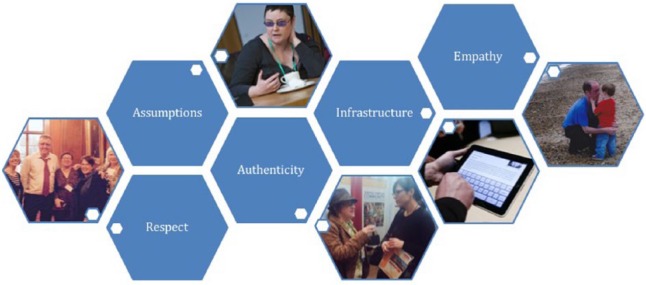
Participatory research methods connect researchers with relevant communities to achieve shared goals. These methods can deliver results that are relevant to people’s lives and thus likely to have a positive impact. In the context of a large and growing body of autism research, with continued poor implementation, and some evidence of community dissatisfaction, there is a powerful case for participatory autism research. In order to develop a framework for such collaborative working, a UK seminar series was organised and co-produced by autistic and non-autistic people with academic, practitioner and lived expertise. This article reports on the outcomes from the series, identifying five topics relevant to building a community of practice in participatory research: Respect, Authenticity, Assumptions, Infrastructure and Empathy. Each topic is connected to a specific example from within and beyond research, to inspire new practices in the field. We call for the development of participatory research skills among the autism research community and the facilitation of greater autistic leadership of, and partnership in, research. Such work, if delivered to a high standard, is likely to lead to better translation into practice and improved outcomes for autistic people and those who support them.
Overview
The claims and statistics of this paper haven’t been checked yet.
Free: it reads the open-access text and checks the first 5 claims that cite a source we can check. Create a free account to check every claim.
Integrity signals
Registry
Cites
Statistics
Figures
Verification
Claims the paper makes
The claims and statistics of this paper haven’t been checked yet.
Free: it reads the open-access text and checks the first 5 claims that cite a source we can check. Create a free account to check every claim.
Claims other papers make about this one
Each is checked against this paper’s own text: does it say what the citing paper says it does?
The source backs part of the claim, not all of it — or backs it for a different population, condition or comparison.
In the citing paper
“In the past decade, autism researchers worldwide have begun to engage with the autistic community, consulting with autistic people at all stages of the research process, exploring ways to work with autistic people as partners, and addressing research topics prioritised by the community (see Fletcher‐Watson et al., 2019; Nicolaidis et al., 2011; Pellicano et al., 2014a, 2014b; Pellicano & Stears, 2”
From Annual Research Review: Shifting from ‘normal science’ to neurodiversity in autism science (2022) · cites this paper as Fletcher‐Watson et al., 2019
Experimental — accuracy not yet measuredThe cited source says what the claim attributes to it.
In the citing paper
“The few studies that have reflected upon lessons learnt from such partnerships have suggested that effective partnerships depend on strong relationships – that is, those in which there is mutual trust between partners, respect for each other’s expertise and ways of being, and an openness to learning from one another (Fletcher-Watson et al., 2019; Jose et al., 2020; Le Cunff et al., 2023; Maye et a”
From ‘You feel part of something bigger’: Stakeholders’ experiences of a long-term community–academic participatory research partnership (2025) · cites this paper as Fletcher-Watson et al., 2019
The cited source says what the claim attributes to it.
In the citing paper
“Though participatory action research comes with its own set of challenges (Fletcher-Watson et al., 2019; Nicolaidis et al., 2011)”
From Neurodiversity and Autism Intervention: Reconciling Perspectives Through a Naturalistic Developmental Behavioral Intervention Framework (2022) · cites this paper as Fletcher-Watson et al., 2019
The cited source says what the claim attributes to it.
In the citing paper
“Such antipathy makes respectful debate framed by contemporary best practice approaches to autism research (Fletcher-Watson et al., 2019, 2021; den Houting et al., 2021; Keating, 2021) unlikely.”
From Perspective: Presuming Autistic Communication Competence and Reframing Facilitated Communication (2022) · cites this paper as Fletcher-Watson et al., 2019
Self-check
Percentages, sums and reported differences re-computed from the paper’s own numbers.
The self-check needs the paper’s full text.
Citations
Cites
A Ladder Of Citizen Participation
Arnstein, S. R. (1969) · Journal of the American Institute of Planners · doi:10.1080/01944366908977225 · Cited by 17,064
What is participatory research?
Cornwall, A., & Jewkes, R. (1995) · Social Science & Medicine · doi:10.1016/0277-9536(95)00127-s · Cited by 2,560 · cited 1×
“By participatory research , we mean incorporating the views of autistic people and their allies about what research gets done, how it is done and how it is implemented (Cornwall and Jewkes, 1995).”
The Third Wave of Science Studies: Studies of Expertise and Experience
Collins, H. M., & Evans, R. (2002) · Social Studies of Science · doi:10.1177/0306312702032002003 · Cited by 2,094 · cited 2×
“Seminar delegates reported that the lived experiences of autistic people – their ‘experiential expertise’ (Collins and Evans, 2002) – is rarely apparent in the context of autism research, though notable exceptions were identified (see Box 1).”
On the ontological status of autism: the ‘double empathy problem’
Milton, D. E. M. (2012) · Disability & Society · doi:10.1080/09687599.2012.710008 · Cited by 2,082 · cited 1×
“The double empathy problem (Milton, 2012) highlights the issue of ‘mutual incomprehension’ that exists between some autistic and non-autistic people, in all walks of life.”
Self-citationWhich terms should be used to describe autism? Perspectives from the UK autism community
Kenny, L., Hattersley, C., Molins, B., Buckley, C., Povey, C., & Pellicano, E. (2016) · Autism · doi:10.1177/1362361315588200 · Cited by 1,941 · cited 1×
“The number of autistic-led organisations, publications (e.g. Autonomy; Beardon, 2017; Lawson et al., 2017; Murray, 2005), online communities (e.g. wrongplanet.net) and events (e.g. Autistic Pride, Autreat and Autscape) is a testament to the energy and dedication of this community.”
Self-citationBrett, J., Staniszewska, S., Mockford, C., Herron‐Marx, S., Hughes, J., Tysall, C., & Suleman, R. (2014) · Health Expectations · doi:10.1111/j.1369-7625.2012.00795.x · Cited by 1,598 · cited 1×
“In so doing, we should draw on the experiences of pioneers within (Frauenberger et al., 2013; Gillespie-Lynch et al., 2017; Mason et al., submitted; McConachie et al., 2018; Nicolaidis et al., 2013; Parsons et al., 2013) and outside (Brett et al., 2014; Rose, 2003) autism research.”
What should autism research focus upon? Community views and priorities from the United Kingdom
Pellicano, E., Dinsmore, A., & Charman, T. (2014) · Autism · doi:10.1177/1362361314529627 · Cited by 800 · cited 1×
“Fortunately, there has been increasing recognition inter-nationally that this situation needs to change, with autistic advocates, academics and activists being some of the strongest voices to speak to these issues (Michael, 2016; Milton, 2014; Nicolaidis et al., 2011; Pellicano et al., 2011).”
Self-citationThe snakes and ladders of user involvement: Moving beyond Arnstein
Tritter, J. Q., & McCallum, A. (2006) · Health Policy · doi:10.1016/j.healthpol.2005.05.008 · Cited by 794 · cited 1×
“There are signs of a much-needed improvement, from openly discussing these issues (Wright et al., 2014), to communities of researchers and autistic people beginning to enact change (Stahmer et al., 2017).”
Israel, B. A., Parker, E. A., Rowe, Z., Salvatore, A., Minkler, M., López, J., Butz, A., Mosley, A., Coates, L., Lambert, G., et al. (2005) · Environmental Health Perspectives · doi:10.1289/ehp.7675 · Cited by 601
Neurotypical Peers are Less Willing to Interact with Those with Autism based on Thin Slice Judgments
Sasson, N. J., Faso, D. J., Nugent, J., Lovell, S., Kennedy, D. P., & Grossman, R. B. (2017) · Scientific Reports · doi:10.1038/srep40700 · Cited by 584 · cited 2×
“, 2016), or negatively judge them based on minimal evidence (Sasson et al., 2017).”
Research works printed but not linked: 14
- Arnold L (2012) Introduction to Autonomy: The Critical Journal of Interdisciplinary Autism Studies. Autonomy: The Critical Journal of Interdisciplinary Autism Studies 1(1): 1.
- Cusack J Sterry R (2016) Your Questions: Shaping Future Autism Research. London: Autistica.
- Gaudion K Hall A Myerson J et al (2014) Design and wellbeing: bridging the empathy gap between neurotypical designers and autistic adults. Design for Sustainable Wellbeing and Empowerment 2014: 61– 77.
- Lawson W Turner T Wilkinson A et al (2017) Love, Partnership, or Singleton on the Autism Spectrum. London: Jessica Kingsley Publishers.
- Long J Panese J Ferguson J et al (2017) Enabling voice and participation in autism services: using practitioner research to develop inclusive practice. Good Autism Practice 18(2): 6– 14.
- Martin N (2010) Minimising the stress of the PhD viva for students with Asperger syndrome. Good Autism Practice 11(1): 52– 57.
- Milton DE Bracher M (2013) Autistics speak but are they heard? Journal of the BSA Medsoc Group 7: 61– 69.
- Murray D (Ed.) (2005) Coming Out Asperger. London: Jessica Kingsley Publishers.
- Pellicano E (2018) Engaging ‘seldom heard’ individuals in participatory autism research. In: Milton D Martin N (eds) Autism and Learning Disability Annual, vol. 2 London: Pavilion Publishing, pp. 29– 34.
- Pellicano E Crane L Gaudion K et al (2017) Participatory Autism Research: A Starterpack. London: UCL Institute of Education.
- Ridout S (2014) More than picture-making: reflecting on collage as a narrative tool for opening discourse on the involvement of autistics in autism research. Autonomy: The Critical Journal of Interdisciplinary Autism Studies 1(3). Available at: http://www.larry-arnold.net/Autonomy/index.php/autonomy/article/view/AR14/html
- Ridout S (2018) Autism and Mental Well-being in Higher Education: A Practical Resource for Students, Mentors and Study Skills Support Workers. Hove: Pavilion Publishing and Media.
- Rose D (2003) Collaborative research between users and professionals: peaks and pitfalls. The Psychiatrist 27(11): 404– 406.
- Sinclair J (2013) Why I dislike ‘person first’ Language. Autonomy, The Critical Journal Of Interdisciplinary Autism Studies, 1(2). Retrieved from http://www.larry-arnold.net/Autonomy/index.php/autonomy/article/view/OP1
Cited by
Items 801–900 of 916
Linden, A. H., Norbury, C., McCabe, M., Saul, J., Killick, E., Sam, E., Dufresne, S., Elise, F., Gurusamy, K. S., & Crane, L. (2026) · JCPP Advances · doi:10.1002/jcv2.70125
“These team members were involved at every stage of the project, including: applying for funding; designing and conducting the research; and analysing, writing, and disseminating the findings (cf. Fletcher - Watson et al., 2019).”
Self-citationThe Lived Experiences of Employed Middle-Aged Adults Having Autism Spectrum in Batangas Province
Quicho, J. D., Ocampo, L. Q. D., Villa, K. M. D., Evangelista, A. E., & Ramos, D. R. (2026) · International Journal of Multidisciplinary Applied Business and Education Research · doi:10.11594/ijmaber.07.03.30
Werner, D. I. (2025) · Carolina Digital Repository (University of North Carolina at Chapel Hill) · doi:10.17615/ngxs-ze60
Witzmann, M., Auer, E., & Prommersberger, M. (2026) · Prävention und Gesundheitsförderung · doi:10.1007/s11553-026-01318-8
Deakin, M., Hamilton, L., Heasman, B., & Petty, S. (2026) · Autism & Developmental Language Impairments · doi:10.1177/23969415261436238
Autism and Education Research in Sub-Saharan Africa: A Systematic Literature Review
Nowack, S. K., Gibson, J. L., & Singal, N. (2026) · Review Journal of Autism and Developmental Disorders · doi:10.1007/s40489-026-00574-w
Löthberg, M., Niman, A., Engström, S., Meyer, J., Wirström, E., Girdler, S. J., Bölte, S., & Jonsson, U. (2026) · Disability and Rehabilitation · doi:10.1080/09638288.2026.2674620
Roncaglia, I. (2026) · International Journal of Educational and Life Transitions · doi:10.20933/k8wkv469
Ndengeyingoma, A., Fecteau, S.-M., Bonilla, S., & Mairena, P. M. G. (2026) · Recherches qualitatives · doi:10.7202/1125169ar
Interdisciplinary Approaches to Enhancing Child and Adolescent Mental Health in Schools
(2026) · Frontiers research topics · doi:10.3389/978-2-8325-8053-0
RUTTENBERG, D. (2026) · Frontiers in Psychiatry · doi:10.3389/fpsyt.2026.1852731
Rattu, N. R., Hastings, O., Hall, C., Prentice, K.-M., Woodcock, R., McNally, E., Stevenson, P., Parsons, S., Groom, M. J., & Babbage, C. M. (2026) · Research Involvement and Engagement · doi:10.1186/s40900-026-00909-1
Miles, M. R. (2026) · ePrints Soton (University of Southampton) · doi:10.5258/soton/01/t206
Howe, S. J., Andreasen, S., Schwartzman, J. M., Exner‐Cortens, D., Thompson‐Hodgetts, S., Weiss, J. A., Chaput, K. H., Maroney, M. R., Jacobs, A. X., Mattingly, J., et al. (2026) · Frontiers in Psychiatry · doi:10.3389/fpsyt.2026.1736168
Community Insights on Autistic Self-Advocates’ Perspectives and Experiences Regarding ABA
Riosa, P. B., Robertson, T., Malkin, A., Mullins, L. E., Thomson, K. M., Layle, P., Neil, N. M., & Lee, G. T. (2026) · Behavior Analysis in Practice · doi:10.1007/s40617-026-01186-w
Diversity of words and words for diversity
Arbey, A., Demily, C., & Soumier, A. (2026) · Frontiers in Psychiatry · doi:10.3389/fpsyt.2026.1834531
Portfolio for Professional Doctorate in Health Psychology
Anderson, H. (2026) · Staffordshire Online Repository (Staffordshire University)
Godoy, P. B. G., Windlin, I. C., Cardoso, L. M. D. S., Yoshida, J., Lopes, D. C. P., Arruda, K. D. S., Junior, P. C. P. D. O., de Aquino, I. F., Alves, R. P., Constancio, T. N., et al. (2026) · medRxiv · doi:10.64898/2026.06.18.26355880
Marcotte, J., Dupéré, S., & Grandisson, M. (2026) · Journal of Participatory Research Methods · doi:10.35844/001c.157921
Empowering voices of the neurodiverse community through inclusive research
Doan, T. (2026) · Journal of Organizational Effectiveness People and Performance · doi:10.1108/joepp-05-2025-0408
Greenlee, J. L. (2026) · Theory & Psychology · doi:10.1177/09593543261458008
Kumari, G., & Broll, W. (2026) · International Conference of the Immersive Learning Research Network (iLRN) · doi:10.56198/s7usiqjbl
Lao, U., Liang, F. Y., Dai, J., Wei, C., Chen, Q., Wang, M., Zou, X., & Zhu, H. (2026) · Humanities and Social Sciences Communications · doi:10.1057/s41599-026-07772-1
“…Action Research) are challenging the one-way power structures of traditional medical research (Armitt et al., 2024; Batalden et al., 2016; Cornish et al., 2023; Cornwall and Jewkes, 1995; Fletcher-Watson et al., 2019), repositioning autistic individuals as “ experiential experts ” (Milton, 2014).”
Designing a participatory research project on autism and the built work environment
Jelić, A., Nguyen, P., Kinnaer, J., Lackovicova, M., Saelens, D., & Heylighen, A. (2026) · Journal of Corporate Real Estate · doi:10.1108/jcre-03-2025-0026 · Cited by 1
Lines of Perception: VR Drawing as Method and Expression
Savickaite, S. (2026) · Springer eBooks · doi:10.1007/978-3-032-19636-1_4
Validation of the Examination of Autistic Intersubjective Experiences
Schnitzler, T., Feix, M., Bizzari, V., & Fuchs, T. A. E. (2026) · Psychopathology · doi:10.1159/000552698 · Cited by 1
“Recent research with a phenomenological background or involving autistic individuals has increasingly prioritized the perspectives of those affected [9] as understanding autism requires consideration of the first-person experience.”
(2026) · Frontiers research topics · doi:10.3389/978-2-8325-8279-4
Ferreira, G. J., & Sihvonen, A. (2026) · Springer eBooks · doi:10.1007/978-3-030-12852-4_104-1
Devenir adulte aux côtés d’un frère ou d’une sœur présentant un trouble du spectre de l’autisme
Turbis, C. (2026) · Le dépôt institutionnel (Université du Québec à Trois-Rivières)
Occupational identity and competence in autistic adults: An exploratory study
Magan, A., Franzsen, D., Witt, P. A. D., & Koch, L. (2026) · South African Journal of Occupational Therapy · doi:10.17159/2310-3833/2026/vol56no2a11
Staying With the Trouble: An Argument for Transdisciplinary Autism Research
Campbell-Mapplebeck, A., Schrag, A., & Davis, R. (2026) · Autism · doi:10.1177/13623613261459639
Licensed Professional Counselors’ Experiences of Treating Youth With Autism Spectrum Disorder
Dallas, J. (2026) · ScholarWorks (Walden University)
Kelly, C. M. (2026) · University of Hertfordshire Research Archive (University of Hertfordshire) · doi:10.18745/00027164
CONSTRUCTING WHAT CAN BE SAID: CONCOURSE DEVELOPMENT IN Q-METHODOLOGICAL AUTISM RESEARCH
Ahmetovic, M., & Schuwerk, T. (2026) · Research in Education and Rehabilitation · doi:10.51558/2744-1555.2026.9.1.129
Barbosa, I., & de Oliveira, E. R. (2026) · Journal of Organizational Effectiveness People and Performance · doi:10.1108/joepp-08-2025-0689
Johnson, C., Wood, C. P., Daley, D., & Iao, L. (2026) · Autism · doi:10.1177/13623613261460932
Facilitating autistic student voice in reasonable adjustments
Clayden, D., Lemon, N. S., & Main, S. (2026) · Learning and Instruction · doi:10.1016/j.learninstruc.2026.102423
A Critical Historical Account of Sensory Sensitivities Research in Autism
Baggott, J. (2026) · Springer eBooks · doi:10.1007/978-3-030-12852-4_103-1
Shukla, V., Jaswal, V. K., & Arunachalam, S. (2026) · Acta Psychologica · doi:10.1016/j.actpsy.2026.107434
Design and content validation of AUTIVA: an ecobiopsychosocial instrument for childhood autism
Castillo-España, R. A., Hewstone-Garcia, C., Belmar-Riquelme, G., & Jara-Mella, V. (2026) · Frontiers in Public Health · doi:10.3389/fpubh.2026.1768438
“Thus, a holistic and ecological perspective is currently required to complement existing instruments in order to expand the understanding of the multidimensionality of the autistic person (21, 22).”
da Silva, M. F. A. (2026) · Revista Tópicos. · doi:10.70773/revistatopicos/785000388
Brice, S., Petrou, A., Hamilton, J., McConachie, H., Couteur, A. S. L., Ingham, B., Wilson, C., Hardy, R., Berney, T., Mason, D., et al. (2026) · Research in Autism · doi:10.1016/j.reia.2026.202963
Self-citationGriffiths, L. (2026) · Journal of Business Venturing Insights · doi:10.1016/j.jbvi.2026.e00658
Meaningful Participation in AI-Mediated Clinical Trial Recruitment
Subrahmanyam, V. R., Bailar, M. A., Ostherr, K., Kostick, K. M., McGuire, A. L., Neitzke‐Spruill, L., & Rahimzadeh, V. N. (2026) · The American Journal of Bioethics · doi:10.1080/15265161.2026.2690962
Dimitriou, D., Lagakou, L., Sartzetaki, M. F., Dimitriou, P., & Karagkouni, A. G. (2026) · Artificial Intelligence in Health · doi:10.36922/aih026240059
Introduction: Space for Interpretation
Swai, E., Waldock, K. E., & Jacobs, N. L. (2026) · Journal of Literary & Cultural Disability Studies · doi:10.3828/jlcds.2026.8
van Beusekom, F. (2023) · Otago University Research Archive (University of Otago) · Cited by 1
Barker, M. (2026) · BCU Open Access Repository (Birmingham City University)
Krystamtsi, C., & Anastasiadis, T. (2026) · Advances in computational intelligence and robotics book series · doi:10.4018/979-8-3373-9169-4.ch001
Rituals and Routines: A Delphi Study With Autistic Young People as Experiential Experts
Petty, S., Clegg, V., & Cantwell, A. (2026) · Infant and Child Development · doi:10.1002/icd.70133
Stimming and support assemblages: autistic improvisation, sensory worlds and wellbeing
Rose, M. C., & Lupton, D. (2026) · Disability & Society · doi:10.1080/09687599.2026.2715012
“…paradigm (Chapman 2020; Pellicano et al. 2022), which foregrounds autistic flourishing and the importance of centring autistic perspectives in research (Fletcher-Watson et al. 2019; Hedlund, eriksson Wester, edenvik, ingard, isakson, Kron Sabel, Unéus, et al. 2025; Pellicano and Heyworth 2023).”
Fair foundations: ensuring epistemic justice in neurodiversity research and practice
Praslova, L. N. (2026) · Frontiers in Psychology · doi:10.3389/fpsyg.2026.1826790
A UK-based mixed-methods study investigating the mental health of autistic adolescents
Casper-White, R., Shloim, N., Hebron, J., & Hugh‐Jones, S. (2026) · Advances in Autism · doi:10.1108/aia-03-2026-0027
Zarins, A., Petropoulou, E., & Gekas, N. (2026) · Review Journal of Autism and Developmental Disorders · doi:10.1007/s40489-026-00588-4
Pearson, J. N., Palazzo, K. M., Johnson, J. A., Bergmann, E., Lewis, J., Elias, M., & Painter, J. (2026) · Frontiers in Education · doi:10.3389/feduc.2026.1886542
Understanding autism in education: Teacher's opinions, student's lives
Hollingworth, C., & Farr, W. J. (2026) · Support for Learning · doi:10.1111/1467-9604.70070
Caven, I., Hamdani, Y., Lunsky, Y., Weaver, C., & Penner, M. (2026) · PLoS ONE · doi:10.1371/journal.pone.0353678
“There’s No Greater Feeling”: Empowerment and Achievement Through Neurodivergent Co-Design
Glaser, N. J., & Newbutt, N. A. (2026) · Autism · doi:10.1177/13623613261478883
Koteyko, N., Manni, S., van Driel, M., & Pena, B. B. (2026) · Linguistics and the Human Sciences · doi:10.3138/lhs-2025-0011
Baba, D., Atinga, B.-E., & Tettey, F. (2026) · Nurse Education Today · doi:10.1016/j.nedt.2026.107367
Fung, L. K., McLaughlin, C., & Healy, S. (2026) · Neurodiversity · doi:10.1177/27546330261481550
Mancilla, N. H. (n.d.) · UWE Research Repository (UWE Bristol)
Kaplan‐Kahn, E. A., Garagozzo, A., Leach, M., GETTINGS, J. M., Kuschner, E. S., & Yerys, B. E. (2026) · Cognitive and Behavioral Practice · doi:10.1016/j.cbpra.2026.08.001
Special or Restricted? Autistic People's Experiences of Special Interests
Aydogan, C. (2026) · DalSpace (Dalhousie University)
Xia, Y., Vincent, J., & Zhu, Q. (2026) · Research in Neurodiversity · doi:10.1016/j.rin.2026.100068
Ahmetovic, M., Schuwerk, T., & Platte, A. (2026) · Belonging. · doi:10.1177/30290805261487074
Transing the archive: Toward a trans‐autistic historiography of neurodivergent futures
Bates, J. R. (2026) · Medical Anthropology Quarterly · doi:10.1111/maq.70096
Trivedi, N. B., & Tiwari, S. (2026) · International Journal of Artificial Intelligence and Machine Learning · doi:10.51483/ijaiml.6.9s.2026.1020-1030
Understanding disparities in autism diagnosis and care: A socioecological perspective
Bala, A., Deban, C. A., Hoskinson, H., Mukhtar, M., Shah, A., Syeda, A., & Hashmi, A. O. (2026) · PLOS mental health. · doi:10.1371/journal.pmen.0000703
“Research design and recruitment must be intentionally inclusive and culturally responsive, ensuring that interventions are relevant and effective for the diverse populations they aim to serve [85,87].”
Understanding the Use of Community Advisory Boards in Autism Research: A Scoping Review
van Rensburg, M. J., Niunin, E., Ostrolenk, A., Arsenault, S., Wilson, A., Weaver, C., Courchesne, V., & Hock, R. (2026) · Review Journal of Autism and Developmental Disorders · doi:10.1007/s40489-026-00590-w
Gisbert, L., Martínez-Ramírez, M., Setién-Ramos, I., Restoy, D., Ramos‐Quiroga, J. A., & Lugo‐Marín, J. (2026) · Autism · doi:10.1177/13623613261483298
Morris, P. O., Fox, A., & Farr, J. (2026) · Neurodiversity · doi:10.1177/27546330261486329
Zhao, X. H., Liang, A., Chen, J., Ma, D., Nie, Y., Zhai, Z., Wang, J., Sun, R., & Zhang, G. (2026) · American Journal of Occupational Therapy · doi:10.1177/19437676261484891
Evaluating Partnership Quality and Outcomes Within an Autism Community Collaborative
Hendrix, N. M., Ransom, L., Chatson, E., Zambrano, T., & Pickard, K. E. (2026) · Journal of Autism and Developmental Disorders · doi:10.1007/s10803-026-07512-z
Drewett, A., & O’Reilly, M. J. (2026) · Health An Interdisciplinary Journal for the Social Study of Health Illness and Medicine · doi:10.1177/13634593261481928
Kim, G. Y., Na, J., Lee, U., & Eom, J. (2026) · International Journal of Developmental Disabilities · doi:10.1080/20473869.2026.2733843
School community perspectives on making schools more inclusive for autistic adolescents
Mercado-Garrido, E., O’Connor, A., & McTiernan, A. (2026) · Discover Education · doi:10.1007/s44217-026-02149-7
“This lack of clear accountability may help explain why well-established recommendations in the literature, such as experiential teacher training [24, 40] or co-produced approaches to policy and practice [20, 36], have not consistently translated into sustained change in everyday school contexts.”
Duong, V. N., Thompson, C., McVeigh, J. A., & Quested, E. (2026) · Research Quarterly for Exercise and Sport · doi:10.1080/02701367.2026.2733279
Selanon, P., Dejnirattisai, S., Naknawaphan, O., & Sapsangthong, A. (2026) · Urban Science · doi:10.3390/urbansci10100548
Trotta, A. (2026) · Frontiers in Psychiatry · doi:10.3389/fpsyt.2026.1898132
Sowińska, A. (2026) · Language and Dialogue · doi:10.1075/ld.00229.sow
Mello, C., Rivard, M., & Lefebvre, C. (2026) · Evaluation and Program Planning · doi:10.1016/j.evalprogplan.2026.102824
Erdal, K., Larson, T., & Billstedt, E. (2026) · Research Involvement and Engagement · doi:10.1186/s40900-026-00990-6
“In autism research, calls for participatory research have intensified in response to longstanding epistemic asymmetries [3, 8, 13].”
Rosqvist, H. B., Deacon, L., & Guthrie, J. (2026) · Springer eBooks · doi:10.1007/978-3-032-18034-6_1
Neurodiversity-Affirming Autism Training for School Staff in the United Kingdom: A Scoping Review
Mesa, S., Linley, E., Hobman, T., & Hamilton, L. (2026) · Neurodiversity · doi:10.1177/27546330261496185
From Silence to Sound: Amplifying the lived experience of Black Educational Psychologists
Bennett-Grant, Y. (2026) · UEA Digital Repository (University of East Anglia)
Barr, T. (2026) · ODU Digital Commons (Old Dominion University) · doi:10.25777/mae7-7v71
Diversity and Equity in Autism Research
(2026) · Frontiers research topics · doi:10.3389/978-2-8325-8820-8
Kelley, H. H., Knudsen, F. M., Covington, B. P., Levin, M. E., & Aller, T. B. (2026) · International Journal of Developmental Disabilities · doi:10.1080/20473869.2026.2740756
Co-Designing Social Robots for Social-Cognition Training with Autistic Adults
Zohar, Y., Benhamou, M., & Laban, G. (2026) · IEEE RO-MAN · doi:10.1109/ro-man72286.2026.11714771
“…contributors to the design process, has been increasingly recognised as both an ethical imperative and an epistemic necessity in autism research [9], [10]: autistic people hold first-person expertise about their own social-cognitive experience that is not recoverable through researcher…”
Cristescu, L., Pellicano, E., Scerif, G., Herwegen, J. V., & Farran, E. K. (2026) · Mind Brain and Education · doi:10.1111/mbe.70065
Self-citationWard, T. (2025) · Otago University Research Archive (University of Otago)
Zant, O. M., Anderson, C., Howell, A., Schafer, E. C., Miller, S. E., & Mathews, L. (2026) · American Journal of Audiology · doi:10.1044/2026_aja-26-00107 · Cited by 1
An, R., Yan, M., & 程艳 (2026) · Perspectives of the ASHA Special Interest Groups · doi:10.1044/2026_persp-26-00110
Commentary: A Neurodiversity-Affirming Framework for Evaluating Autism Support Research
Jordan, P., Tupou, J., Hammond, M. D., Uljarević, M., Patrick, L., & Waddington, H. L. (2026) · Autism · doi:10.1177/13623613261489842
Wohofsky, L., Küffner, C., Fink, S., Sulopuisto, O., Orter-Jerney, R., Seifert, N., & Krainer, D. (2026) · Journal of Autism and Developmental Disorders · doi:10.1007/s10803-026-07570-3
Metadata
- Authors
- Fletcher-Watson, S., Adams, J., Brook, K., Charman, T., Crane, L., Cusack, J., Leekam, S., Milton, D., Parr, J. R., & Pellicano, E.
- Affiliations
- The University of Edinburgh, UK
- Flow Observatorium, UK
- Autism Rights Group Highland, UK
- King's College London (GB)
- University College London (GB)
- Autistica (GB)
- Cardiff University (GB)
- University of Kent (GB)
- Newcastle University (GB)
- Macquarie University (AU)
- ORCID
- Venue
- Autism
- Publisher
- SAGE Publications
- Published
- 2018-08-10
- Volume
- 23
- Issue
- 4
- Pages
- 943-953
- ISSN
- 1362-3613 (ISSN-L)
- 1461-7005
- PMC
- PMC6512245
- OpenAlex
- W2807975560
- Cited by
- 776
- References
- 50
- Citations by year
- 2026: 142 · 2025: 137 · 2024: 119 · 2023: 100 · 2022: 83 · 2021: 91 · 2020: 63 · 2019: 37 · 2018: 3
- FWCI
- 74.07
- Type
- journal article
- Language
- en
- Open access
- hybrid
- doi.org
- Licence
- cc-by
- journals.sagepub.com/page/policies/text-and-data-mining-license (tdm)
- Locations
- Autism (publishedVersion, cc-by)
- PubMed Central (publishedVersion, cc-by)
- PubMed (publishedVersion)
- ORCA Online Research @Cardiff (Cardiff University) (acceptedVersion)
- Kent Academic Repository (University of Kent) (submittedVersion, other-oa)
- UCL Discovery (University College London) (submittedVersion)
- Research Portal (King's College London) (submittedVersion, cc-by)
- University of Birmingham Research Portal (University of Birmingham) (submittedVersion)
- Edinburgh Research Explorer (University of Edinburgh) (submittedVersion, cc-by)
- Newcastle University ePrints (Newcastle Univesity) (cc-by)
- Funders
- Economic and Social Research Council (ES/M00225X/1)
- Leverhulme Trust (Philip Leverhulme Prize)
- Topics
- Health Sciences › Health Professions › General Health Professions › Mental Health and Patient Involvement
- Social Sciences › Sociology and Political Science › Participatory Visual Research Methods
- Health Sciences › Medicine › Public Health, Environmental and Occupational Health › Community Health and Development
- Keywords
- participatory research, autism research, autistic people, communities of practice, research collaboration, lived expertise, research translation, co-production
- MeSH terms
- Stakeholder Participation, Respect, Autistic Disorder, Empathy, United Kingdom, Health Services, Humans, Social Work, Biomedical Research, Community-Based Participatory Research
About these checks
Registry, retraction, Cites and statistics results are computed, not judged, with one exception: a printed reference that no index lists is read once by a model before it counts as a citation error. Claims are extracted by a model and kept only when their quote appears verbatim in the text; each cited source is then checked, with a model’s help, for whether it says what the claim relies on. Those verdicts can be wrong — read the claim’s quote and the cited source before relying on one.
Statistics and arithmetic are recomputed, not judged.
Confidence bands are shown only for fields calibrated on our annotated test set. None is calibrated yet, so no band is shown.
What counts as a claim ›How we measure confidence ›How we check this ›
Are you an author, or do you see a problem with this page? Request a review
Data sources
Bibliographic data: Semantic Scholar, OpenAlex, Crossref.
Contains information from the Semantic Scholar Academic Graph Datasets, made available under the ODC Attribution License (ODC-BY 1.0).
Semantic Scholar’s data is described in: Kinney, R., et al. (2023). The Semantic Scholar Open Data Platform. arXiv:2301.10140.
