

Making the future together: Shaping autism research through meaningful participation
Open accessThe DOI matches its Crossref record; 50 of the 50 references it cites were found in a registry or an index.
Abstract
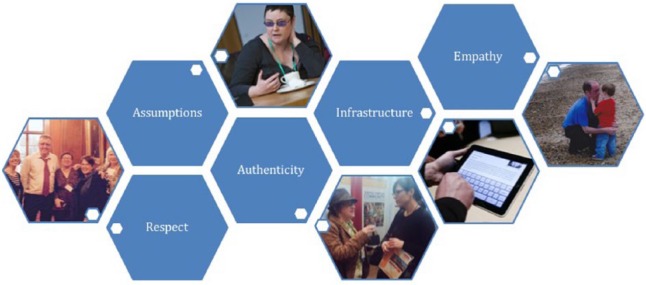
Participatory research methods connect researchers with relevant communities to achieve shared goals. These methods can deliver results that are relevant to people’s lives and thus likely to have a positive impact. In the context of a large and growing body of autism research, with continued poor implementation, and some evidence of community dissatisfaction, there is a powerful case for participatory autism research. In order to develop a framework for such collaborative working, a UK seminar series was organised and co-produced by autistic and non-autistic people with academic, practitioner and lived expertise. This article reports on the outcomes from the series, identifying five topics relevant to building a community of practice in participatory research: Respect, Authenticity, Assumptions, Infrastructure and Empathy. Each topic is connected to a specific example from within and beyond research, to inspire new practices in the field. We call for the development of participatory research skills among the autism research community and the facilitation of greater autistic leadership of, and partnership in, research. Such work, if delivered to a high standard, is likely to lead to better translation into practice and improved outcomes for autistic people and those who support them.
Overview
The claims and statistics of this paper haven’t been checked yet.
Free: it reads the open-access text and checks the first 5 claims that cite a source we can check. Create a free account to check every claim.
Integrity signals
Registry
Cites
Statistics
Figures
Verification
Claims the paper makes
The claims and statistics of this paper haven’t been checked yet.
Free: it reads the open-access text and checks the first 5 claims that cite a source we can check. Create a free account to check every claim.
Claims other papers make about this one
Each is checked against this paper’s own text: does it say what the citing paper says it does?
The source backs part of the claim, not all of it — or backs it for a different population, condition or comparison.
In the citing paper
“In the past decade, autism researchers worldwide have begun to engage with the autistic community, consulting with autistic people at all stages of the research process, exploring ways to work with autistic people as partners, and addressing research topics prioritised by the community (see Fletcher‐Watson et al., 2019; Nicolaidis et al., 2011; Pellicano et al., 2014a, 2014b; Pellicano & Stears, 2”
From Annual Research Review: Shifting from ‘normal science’ to neurodiversity in autism science (2022) · cites this paper as Fletcher‐Watson et al., 2019
Experimental — accuracy not yet measuredThe cited source says what the claim attributes to it.
In the citing paper
“The few studies that have reflected upon lessons learnt from such partnerships have suggested that effective partnerships depend on strong relationships – that is, those in which there is mutual trust between partners, respect for each other’s expertise and ways of being, and an openness to learning from one another (Fletcher-Watson et al., 2019; Jose et al., 2020; Le Cunff et al., 2023; Maye et a”
From ‘You feel part of something bigger’: Stakeholders’ experiences of a long-term community–academic participatory research partnership (2025) · cites this paper as Fletcher-Watson et al., 2019
The cited source says what the claim attributes to it.
In the citing paper
“Though participatory action research comes with its own set of challenges (Fletcher-Watson et al., 2019; Nicolaidis et al., 2011)”
From Neurodiversity and Autism Intervention: Reconciling Perspectives Through a Naturalistic Developmental Behavioral Intervention Framework (2022) · cites this paper as Fletcher-Watson et al., 2019
The cited source says what the claim attributes to it.
In the citing paper
“Such antipathy makes respectful debate framed by contemporary best practice approaches to autism research (Fletcher-Watson et al., 2019, 2021; den Houting et al., 2021; Keating, 2021) unlikely.”
From Perspective: Presuming Autistic Communication Competence and Reframing Facilitated Communication (2022) · cites this paper as Fletcher-Watson et al., 2019
Self-check
Percentages, sums and reported differences re-computed from the paper’s own numbers.
The self-check needs the paper’s full text.
Citations
Cites
A Ladder Of Citizen Participation
Arnstein, S. R. (1969) · Journal of the American Institute of Planners · doi:10.1080/01944366908977225 · Cited by 17,064
What is participatory research?
Cornwall, A., & Jewkes, R. (1995) · Social Science & Medicine · doi:10.1016/0277-9536(95)00127-s · Cited by 2,560 · cited 1×
“By participatory research , we mean incorporating the views of autistic people and their allies about what research gets done, how it is done and how it is implemented (Cornwall and Jewkes, 1995).”
The Third Wave of Science Studies: Studies of Expertise and Experience
Collins, H. M., & Evans, R. (2002) · Social Studies of Science · doi:10.1177/0306312702032002003 · Cited by 2,094 · cited 2×
“Seminar delegates reported that the lived experiences of autistic people – their ‘experiential expertise’ (Collins and Evans, 2002) – is rarely apparent in the context of autism research, though notable exceptions were identified (see Box 1).”
On the ontological status of autism: the ‘double empathy problem’
Milton, D. E. M. (2012) · Disability & Society · doi:10.1080/09687599.2012.710008 · Cited by 2,082 · cited 1×
“The double empathy problem (Milton, 2012) highlights the issue of ‘mutual incomprehension’ that exists between some autistic and non-autistic people, in all walks of life.”
Self-citationWhich terms should be used to describe autism? Perspectives from the UK autism community
Kenny, L., Hattersley, C., Molins, B., Buckley, C., Povey, C., & Pellicano, E. (2016) · Autism · doi:10.1177/1362361315588200 · Cited by 1,941 · cited 1×
“The number of autistic-led organisations, publications (e.g. Autonomy; Beardon, 2017; Lawson et al., 2017; Murray, 2005), online communities (e.g. wrongplanet.net) and events (e.g. Autistic Pride, Autreat and Autscape) is a testament to the energy and dedication of this community.”
Self-citationBrett, J., Staniszewska, S., Mockford, C., Herron‐Marx, S., Hughes, J., Tysall, C., & Suleman, R. (2014) · Health Expectations · doi:10.1111/j.1369-7625.2012.00795.x · Cited by 1,598 · cited 1×
“In so doing, we should draw on the experiences of pioneers within (Frauenberger et al., 2013; Gillespie-Lynch et al., 2017; Mason et al., submitted; McConachie et al., 2018; Nicolaidis et al., 2013; Parsons et al., 2013) and outside (Brett et al., 2014; Rose, 2003) autism research.”
What should autism research focus upon? Community views and priorities from the United Kingdom
Pellicano, E., Dinsmore, A., & Charman, T. (2014) · Autism · doi:10.1177/1362361314529627 · Cited by 800 · cited 1×
“Fortunately, there has been increasing recognition inter-nationally that this situation needs to change, with autistic advocates, academics and activists being some of the strongest voices to speak to these issues (Michael, 2016; Milton, 2014; Nicolaidis et al., 2011; Pellicano et al., 2011).”
Self-citationThe snakes and ladders of user involvement: Moving beyond Arnstein
Tritter, J. Q., & McCallum, A. (2006) · Health Policy · doi:10.1016/j.healthpol.2005.05.008 · Cited by 794 · cited 1×
“There are signs of a much-needed improvement, from openly discussing these issues (Wright et al., 2014), to communities of researchers and autistic people beginning to enact change (Stahmer et al., 2017).”
Israel, B. A., Parker, E. A., Rowe, Z., Salvatore, A., Minkler, M., López, J., Butz, A., Mosley, A., Coates, L., Lambert, G., et al. (2005) · Environmental Health Perspectives · doi:10.1289/ehp.7675 · Cited by 601
Neurotypical Peers are Less Willing to Interact with Those with Autism based on Thin Slice Judgments
Sasson, N. J., Faso, D. J., Nugent, J., Lovell, S., Kennedy, D. P., & Grossman, R. B. (2017) · Scientific Reports · doi:10.1038/srep40700 · Cited by 584 · cited 2×
“, 2016), or negatively judge them based on minimal evidence (Sasson et al., 2017).”
Research works printed but not linked: 14
- Arnold L (2012) Introduction to Autonomy: The Critical Journal of Interdisciplinary Autism Studies. Autonomy: The Critical Journal of Interdisciplinary Autism Studies 1(1): 1.
- Cusack J Sterry R (2016) Your Questions: Shaping Future Autism Research. London: Autistica.
- Gaudion K Hall A Myerson J et al (2014) Design and wellbeing: bridging the empathy gap between neurotypical designers and autistic adults. Design for Sustainable Wellbeing and Empowerment 2014: 61– 77.
- Lawson W Turner T Wilkinson A et al (2017) Love, Partnership, or Singleton on the Autism Spectrum. London: Jessica Kingsley Publishers.
- Long J Panese J Ferguson J et al (2017) Enabling voice and participation in autism services: using practitioner research to develop inclusive practice. Good Autism Practice 18(2): 6– 14.
- Martin N (2010) Minimising the stress of the PhD viva for students with Asperger syndrome. Good Autism Practice 11(1): 52– 57.
- Milton DE Bracher M (2013) Autistics speak but are they heard? Journal of the BSA Medsoc Group 7: 61– 69.
- Murray D (Ed.) (2005) Coming Out Asperger. London: Jessica Kingsley Publishers.
- Pellicano E (2018) Engaging ‘seldom heard’ individuals in participatory autism research. In: Milton D Martin N (eds) Autism and Learning Disability Annual, vol. 2 London: Pavilion Publishing, pp. 29– 34.
- Pellicano E Crane L Gaudion K et al (2017) Participatory Autism Research: A Starterpack. London: UCL Institute of Education.
- Ridout S (2014) More than picture-making: reflecting on collage as a narrative tool for opening discourse on the involvement of autistics in autism research. Autonomy: The Critical Journal of Interdisciplinary Autism Studies 1(3). Available at: http://www.larry-arnold.net/Autonomy/index.php/autonomy/article/view/AR14/html
- Ridout S (2018) Autism and Mental Well-being in Higher Education: A Practical Resource for Students, Mentors and Study Skills Support Workers. Hove: Pavilion Publishing and Media.
- Rose D (2003) Collaborative research between users and professionals: peaks and pitfalls. The Psychiatrist 27(11): 404– 406.
- Sinclair J (2013) Why I dislike ‘person first’ Language. Autonomy, The Critical Journal Of Interdisciplinary Autism Studies, 1(2). Retrieved from http://www.larry-arnold.net/Autonomy/index.php/autonomy/article/view/OP1
Cited by
Items 501–600 of 916
Parsons, S., Wright, A., Roberts, L., Lewis, J., McGiveron, M., & Kovshoff, H. (2025) · Societal Impacts · doi:10.1016/j.socimp.2025.100125 · Cited by 2
“Consequently, there are strong calls from the autism and research communities to develop more participatory research methods that are inclusive of autistic people such that their needs and strengths can be explored and understood in more effective ways that make a difference to everyday life [8].”
Citizen science in psychology: Challenges, opportunities, and recommendations
den Bussche, E. V., Verhaegen, K. A., Reynvoet, B., & Hughes, G. (2026) · Behavior Research Methods · doi:10.3758/s13428-026-03019-8 · Cited by 3
Murphy, A., Bailey, B., Savage, R. S., Parrila, R., & Arciuli, J. (2025) · International Journal of Speech-Language Pathology · doi:10.1080/17549507.2025.2555990 · Cited by 2
Babalola, T. T., Dipper, L. T., & Botting, N. (2025) · International Journal of Developmental Disabilities · doi:10.1080/20473869.2025.2554819 · Cited by 3
Berry, L. M., Sutherland, D., Monk, R., Lim, M. S., & McLay, L. (2025) · Research in Neurodiversity · doi:10.1016/j.rin.2025.100003 · Cited by 2
Weiss, J. A., Modica, P. T., Gallant, C., Roudbarani, F., Weaver, C., Bouma, A., Goldsmith, L., Leef, J., & Lunsky, Y. (2025) · Health Research Policy and Systems · doi:10.1186/s12961-025-01403-y · Cited by 2
“Meaningful participatory research takes an iterative approach to soliciting the lived experience and values of those selected to represent a particular issue, which results in the creation of a shared understanding while fostering informed, relevant and transparent decision-making [31–34].”
Johnson, A., Murray, E., Schenke, K. C., & Stephens-Lewis, D. (2025) · Research in Autism · doi:10.1016/j.reia.2025.202704 · Cited by 3
Proceedings of the 24th EuroFM Research Symposium
Kyrö, R. K., & Danivska, V. (2025) · KTH Publication Database DiVA (KTH Royal Institute of Technology) · doi:10.5281/zenodo.17847261 · Cited by 2
Declercq, D., Dikomitis, E., Meinen, L., Schoendube, F., Shaughnessy, N., & Vanhoof, S. (2025) · Asian Journal of Medical Humanities · doi:10.1515/ajmedh-2025-0019 · Cited by 2
“The rise of the neurodiversity movement, increased diagnosis in girls, women and adults and a wealth of scholarship and autobiographical testimony offers experiential insights, contributing to a revolution in autism studies [5, 19–22].”
Pugsley, K., Siryj, N., Alvares, G. A., Baxter, E. W., Bellgrove, M. A., Chau, T., Cooper, L., Curd, H., Douglas, S., Furley, K., et al. (2026) · Autism in Adulthood · doi:10.1177/25739581251370568 · Cited by 2
Self-citationMontiel‐Nava, C., Rattazzi, A., Sepúlveda, R. G., Valdez, D., Candela, G. G., Rosoli, A., Alzugaray, F., Liz, G. P., Agosto, N. M. V., Montenegro, M. C., et al. (2026) · Autism in Adulthood · doi:10.1177/25739581261432581 · Cited by 2
The Experiences of Autistic Healthcare Students in a Clinical Learning Environment: A Scoping Review
Edwards, E., Porter, N., Handley-Stone, R., Hingley‐Jones, H., & Reynolds, G. (2026) · Autism · doi:10.1177/13623613261427125 · Cited by 2
Guo, G. S., Kwon, N., Li, J., Won, A. S., Leshed, G., & Green, K. E. (2026) · CHI Conference on Human Factors in Computing Systems · doi:10.1145/3772318.3791830 · Cited by 2
“This approach aligns with participatory design values that prioritize experiential expertise over clinical labels [28, 66].”
Vincent, J., Kajjumba, D., Amone, R., Estlin, E. J., Okello, K. K., Akello, F., Okello, J., Idro, R., Abbo, C., & Ouma, S. (2026) · Autism · doi:10.1177/13623613261434571 · Cited by 2
When Is Engagement ‘Good’? Values and Integrity in Community-Engaged Autism Research
van Rensburg, M. J. (2026) · Autism in Adulthood · doi:10.1177/25739581261441775 · Cited by 2
Transition Out of School for Autistic Young People: An Umbrella Review
Richards, N., Pellicano, E., Han, E. K. L., Spiegler, J., & Crane, L. (2026) · Review of Educational Research · doi:10.3102/00346543261442123 · Cited by 2
Self-citationAdvances in supporting development in autistic children and youth
Penner, M., Zwaigenbaum, L., Piroddi, N., Park, S., Minhas, R. S., & Singal, D. (2026) · BMJ · doi:10.1136/bmj-2025-086562 · Cited by 2
Lo, C. O., Tan, Y. S. M., Chang, C.-J., Lin, C.-H., Lau, M., Ng, N. K., Tsao, Y.-T., Huang, A., Chan, D., Guryil, G., et al. (2026) · International Journal of Qualitative Methods · doi:10.1177/16094069261476902 · Cited by 2
Co-designed yoga nidra targeting anxiety in autistic children: A mixed methods feasibility study
Loftus, T., Yau, S. H., Soares, S., Byrne, J., & Mathersul, D. C. (2026) · Research in Developmental Disabilities · doi:10.1016/j.ridd.2026.105367 · Cited by 3
Rojas, V. G., & Poveda, A. M. S. (2021) · Actualidades Investigativas en Educación · doi:10.15517/aie.v21i3.48156 · Cited by 2
“Entre sus resultados, se identificaron cinco temas relevantes e ideales que deben ser considerados en las prácticas de investigación participativas: respeto, autenticidad, supuestos, infraestructura y empatía (Fletcher-Watson et al., 2018).”
BackgroundInfluentialLester, J. N., & O’Reilly, M. J. (2021) · Education, equity, economy · doi:10.1007/978-94-024-2134-7_4 · Cited by 2
Engaging patients in identifying risk factors for ALS
Raz, A. E., Schneid, I., Carmi, E., Kedem, O., & Lerner, B. (2022) · SSM - Qualitative Research in Health · doi:10.1016/j.ssmqr.2022.100179 · Cited by 2
Adding to the Evidence Base: Effects of I-Connect in a Secondary Special Education Rural Classroom
Kester, J. L., & Bross, L. A. (2024) · Journal of Special Education Technology · doi:10.1177/01626434241236714 · Cited by 2
Exploring the Paradigm of Co-Produced Research Within the Context of the COVID-19 Pandemic
Kenny, N., Neilson, S., O’Kelly, J., Doyle, J. K., & McDonald, J. (2024) · International perspectives on inclusive education · doi:10.1108/s1479-363620240000023012 · Cited by 2
Co-Designing Space Science Curricula for and with Neurodivergent Learners
Martin, W., Elsayed, R., Grillo-Hill, A., Hellman, H., Hupert, N., Melchior, K., Méndez, B. J., Nguyen, K. A., Peticolas, L. M., Riccio, A., et al. (2024) · Connected Science Learning · doi:10.1080/24758779.2024.2352775 · Cited by 2
Schuck, R. K., Baiden, K. M. P., Wang, M., Olis, S., Ingram, C., & Fisher, G. (2024) · Review of Research in Education · doi:10.3102/0091732x241281268 · Cited by 2
Femme-bracing Neurodiversity: Applying Femme Theory to the Experiences of Feminine Autistics
Coombs, E. C., & Comeau, E. E. (2024) · Journal of femininities. · doi:10.1163/29501229-bja10006 · Cited by 3
Bianco, T. D., Estrin, G. L., Lautarescu, A., Oakley, B. F. M., Eaton, E., Terčon, J., Douglas, S., Plas, J. R. D., Belton, D., Loth, E., et al. (2025) · Open Research Europe · doi:10.12688/openreseurope.19394.1 · Cited by 3
Tan, D. W., Blasko, G., Girolamo, T. M., Grant, A., Sutherland, H., Ryan, J., Kapp, S. K., & Jaswal, V. K. (2026) · Autism in Adulthood · doi:10.1177/25739581261502602 · Cited by 4
Autistic Librarians in the Academic Library Hiring Process
Cohen, R. A., Cooke, P., Holt, M., Lounsberry, M., Roga, E., Farrell, K. S., & Squires, J. M. (2025) · doi:10.5860/crl.86.5.705 · Cited by 3
Autism data sharing: Benefits, challenges, and recommendations
Lautarescu, A., Trost, B., Kushki, A., Oakley, B. F. M., Heraty, S., Belton, D., Boyle, A., Douglas, S., Molloy, C. J., Holt, R., et al. (2026) · PLOS Digital Health · doi:10.1371/journal.pdig.0001249 · Cited by 3
“Several recent publications have summarised approaches to promoting neurodiversity-affirmative and meaningful participatory autism research practices [40,126,127].”
Self-citationParticipatory Research Practices With Autistics
Bennett, M., & Goodall, E. (2022) · Emerald Group Publishing Limited eBooks · doi:10.1108/978-1-80382-463-520221010 · Cited by 2
Lamash, L., Gal, E., Yaar, E., & Bedell, G. M. (2023) · Children · doi:10.3390/children10091514 · Cited by 2
Brief Report: Exploring Some Aspects of Social Activism in the Online Autistic CommunityPreprint
Bolton, M. J., & Ault, L. K. (2019) · PsyArXiv (OSF Preprints) · doi:10.31234/osf.io/nqkgr · Cited by 2
Autism Acceptance and Mental Health
Cage, E. (2021) · Springer eBooks · doi:10.1007/978-3-319-91280-6_102427 · Cited by 2
Perceiving and Producing Prosody: Perspectives and Insights from Autistic AdultsPreprint
O’Brien, A. M., Liu, T., Cardinaux, A. L., Gabrieli, J. D. E., & Zuk, J. (2024) · OSF Preprints (OSF Preprints) · doi:10.31219/osf.io/f7mqn · Cited by 2
Bervoets, J., Beljaars, D., & De Jaegher, H. (2021) · doi:10.31234/osf.io/bpzhn · Cited by 1
Participatory Methods: Researching Autistic Sexuality, Intimacy, and Authenticity
Jackson‐Perry, D. (2024) · Springer eBooks · doi:10.1007/978-3-031-66127-3_20 · Cited by 2
Hepburn, S. (2024) · International review of research in developmental disabilities · doi:10.1016/bs.irrdd.2024.09.010 · Cited by 1
Should newborn genetic testing for autism be introduced?
Aishworiya, R., Chin, H.-L. L., & Savulescu, J. (2024) · Journal of Medical Ethics · doi:10.1136/jme-2024-110166 · Cited by 1
“49 Thus, the act of actively deciding against the birth of an individual with higher than population risk to be diagnosed on the autism spectrum may be perceived to go against the concepts of inclusiveness and embracing neurodiversity.”
Désormeaux-Moreau, M. (2024) · Cahiers franco-latino-américains d études sur le handicap · doi:10.56078/cfla_discapacidad.373 · Cited by 1
Misunderstood, excluded, and othered: Lay constructions of autistic women
Rhodes, M., & Seeley-Wait, E. (2025) · Feminism & Psychology · doi:10.1177/09593535241306535 · Cited by 1
Horton, E., Brownhill, L. A., Bycroft, A., Goldschmied, A. Z., Knops, M. J. J., Lloyd, A., Tones, D., Wiltshire, B., Toro, C. T., & Jutley-Neilson, J. (2025) · Neurodiversity · doi:10.1177/27546330241310372 · Cited by 2
Schmidt, M., Lu, J., Glaser, N. J., Li, S. E., & Weng, Y. (2025) · Communications in computer and information science · doi:10.1007/978-3-031-80475-5_18 · Cited by 1
Beckwith, A., & López, B. (2025) · Research in Autism · doi:10.1016/j.reia.2025.202584 · Cited by 1
Atchulo, K., Korsah, K. A., & Farhan, A. A. (2025) · Women and Children Nursing · doi:10.1016/j.wcn.2025.05.002 · Cited by 1
Exploring Young Autistic Children's Family and Independent Digital Experiences at Home
Silva, I. M.-H. F. D. S., Danby, S. J., & Saggers, B. R. (2025) · Children & Society · doi:10.1111/chso.12987 · Cited by 2
Newton, C., Hudry, K., Aulich, A., Bent, C. A., Constantine, C., Franks, K., Goonetilleke, N., Green, C. C., Ijaz, R., Ma, E., et al. (2025) · Research in Autism · doi:10.1016/j.reia.2025.202655 · Cited by 1
Joint Ignorance: A Critical Phenomenological Account
Jacobs, H. (2025) · Puncta · doi:10.61372/puncta.v8i1.3050 · Cited by 3
Exercise as Medicine across the Autism Spectrum: A Conceptualized Framework
Geslak, D. S., Boudreaux, R. T., & Boudreaux, B. D. (2025) · Current Sports Medicine Reports · doi:10.1249/jsr.0000000000001273 · Cited by 1
Autism research, autistic co-researchers, and PhD projects: a collaborative autoethnography
McLennan, H., Aberdein, R., Saggers, B. R., & Gillett‐Swan, J. K. (2025) · The Australian Educational Researcher · doi:10.1007/s13384-025-00887-5 · Cited by 1
“Several advocates of participatory autism research note the importance of individualising communication methods to meet the needs of autistic community partners (e.g., den Houting, 2021; Fletcher-Watson et al., 2019; Nicolaidis et al., 2019).”
InfluentialJenks, E., Selman, F., Harmens, M., Graham, R., Boon, S., Tran, T., Hobson, H., Eagle, S., & Sedgewick, F. (2025) · Journal of Participatory Research Methods · doi:10.35844/001c.137307 · Cited by 1
Srinivasan, S. M., & Bubela, D. J. (2025) · Oxford University Press eBooks · doi:10.1093/oso/9780197635841.003.0025 · Cited by 1
An exploration of students’ experiences of participating in a photovoice project
Murthi, K., Hurst, A. K., Robles-Fernandez, R., & Patten, K. K. (2025) · Research in Autism · doi:10.1016/j.reia.2025.202693 · Cited by 1
Krishnan, S. G., & Orsmond, G. I. (2025) · Research in Autism · doi:10.1016/j.reia.2025.202717 · Cited by 1
Expanding Descriptions of Autistic Rituals and Routines: A Co‐Produced Update
Petty, S., Cantwell, A., Clayton, L., Matthews, L., & Angell‐McGregor, S. (2025) · Diversity & Inclusion Research · doi:10.1002/dvr2.70039 · Cited by 1
“This understanding can be used in psychoeducation, therapeutic work, and post ‐ diagnostic supports, and investment in research topics chosen by autistic people (Fletcher ‐ Watson et al. 2019; Pukki et al. 2022).”
van Huizen, N., Staal, W., van der Voort, M. C., & van Dijk, J. (2025) · Assistive Technology · doi:10.1080/10400435.2025.2579654 · Cited by 1
Exley, M., & Morgan, G. (2025) · Review Journal of Autism and Developmental Disorders · doi:10.1007/s40489-025-00527-9 · Cited by 1
Inclusive Research: Reflections on Co‐Producing Autism Educational Research
Saggers, B. R., McKeown, G., Carrington, S. B., & Mavropoulou, S. (2025) · Journal of Policy and Practice in Intellectual Disabilities · doi:10.1111/jppi.70026 · Cited by 1
Applying Social Identity Theory to the Fit and Misfit of Autistic People in the Workplace
Archibald, D., & Spoor, J. R. (2025) · Springer eBooks · doi:10.1007/978-981-96-8208-9_9 · Cited by 2
Rodgers, J., Bhattarai, N., Goodwin, J., Gordon, I., Heslop, P., Nielsen, E., O’Connor, R. C., Ogundimu, E. O., Pelton, M., Ramsay, S. E., et al. (2025) · Public Health Research · doi:10.3310/cgdf8525 · Cited by 1
Nimbley, E., Bradley, S., Pickard, A., Sader, M., Maloney, E., Moore, F. R., Suratwala, T., Sharpe, H., Duffy, F., & Gillespie‐Smith, K. (2025) · European Eating Disorders Review · doi:10.1002/erv.70062 · Cited by 1
Falk, S. F., Hellquist, A., & Tammimies, K. (2026) · Autism · doi:10.1177/13623613261458410 · Cited by 1
Muharikah, A., Yossa, N., Turgarini, D., Hazairin, A. N., & Wismayanti, Y. F. (2025) · Social Sciences & Humanities Open · doi:10.1016/j.ssaho.2025.102344 · Cited by 2
Adjusting the volume : reflections on engagement with autistic young people living in secure care
Wilson, C. (2024) · Strathprints: The University of Strathclyde institutional repository (University of Strathclyde) · doi:10.17868/strath.00091142 · Cited by 1
Felix, I. G. U. (2025) · International journal of research and scientific innovation · doi:10.51244/ijrsi.2025.12120029 · Cited by 1
Transdiagnostic neurocognitive compensatory strategies
Altschuler, M. R., & Faja, S. (2026) · Research in Autism · doi:10.1016/j.reia.2026.202787 · Cited by 1
Interoception in Autism, Pitfalls, and Promise: A Participatory Research Perspective
Palser, E. R., Lawson, W. B., Goodall, E., & Pellicano, E. (2026) · Autism in Adulthood · doi:10.1177/25739581251414545 · Cited by 2
Self-citationÇetintaş, Ş., Herwegen, J. V., Al-Jayoosi, H., McEvoy, R., Hurry, J., & Pavlopoulou, G. (2026) · Frontiers in Education · doi:10.3389/feduc.2025.1662602 · Cited by 1
Hotez, E., & Tomiyama, A. J. (2026) · Obesity Science & Practice · doi:10.1002/osp4.70117 · Cited by 1
“Indeed, it is increasingly recognized that lived and experiential expertise is equally as valuable as professional expertise in shaping high‐quality research [29].”
Enhancing social collaboration in autistic pre-teens through Minecraft ™
Thirumanickam, A., Attrill, S., Welz, N., & Hobbs, D. (2026) · International Journal of Speech-Language Pathology · doi:10.1080/17549507.2026.2630836 · Cited by 1
Lovell, A., Becker, K., Barnish, M. S., Arthur, T., Kirby, J., Dodd, H. F., Raghavan, V., Meléndez‐Torres, G. J., & Price, A. (2026) · JAACAP Open · doi:10.1016/j.jaacop.2026.02.004 · Cited by 1
Rethinking Employment Research on Autism: A Scientometric Analysis of Paradigm Change
Dimitriou, D., Zhong, Y., Carollo, A., Esposito, G., & Almalky, H. A. (2026) · Autism in Adulthood · doi:10.1177/25739581261433084 · Cited by 1
East, C., Parsons, S., & Kovshoff, H. (2026) · International Journal of Research & Method in Education · doi:10.1080/1743727x.2026.2651336 · Cited by 2
The Neurodivergent Musician: A Methodology Report on A Participatory Action Research Study
Détári, A., Dawson, G., Ballam, L., Chapman, A., Redelinghys, J., Baines, E., Furniss, P., Hugill, A., & Heaton, P. F. (2026) · Neurodiversity · doi:10.1177/27546330261434045 · Cited by 1
Livingston, L. A., Leekam, S., Davies, G., Shah, P., Layinka, O., Carrington, S. J., & Jones, C. R. G. (2026) · Molecular Autism · doi:10.1186/s13229-026-00714-3 · Cited by 1
“In line with participatory research practice [46], before the main study, we consulted with four paid autistic adults (two males, two females, aged 22– 64 ) to assess the acceptability and accessibility of the SQ-A-2 SQ-A-2 SQ-A-2 items.”
Self-citationSupport services for autistic adults: What helps and why?
Jonkman, K. M., Back, E., Scheeren, A. M., Begeer, S., & Staal, W. (2026) · Research in Autism · doi:10.1016/j.reia.2026.202929 · Cited by 1
Kemp, H., Ward, R. J., & Wood‐Downie, H. (2026) · Journal of Research in Special Educational Needs · doi:10.1111/1471-3802.70085 · Cited by 1
Designing comics based on Picture Exchange Communication System (PECS) for students with autism
Noer, R. Z., Nursalim, M., Arianto, F., Abrori, F. M., Hanif, M., & Kantina, S. (2026) · Journal of Graphic Novels & Comics · doi:10.1080/21504857.2026.2666790 · Cited by 1
Trew, S., & Russell, D. H. (2026) · Child Psychiatry & Human Development · doi:10.1007/s10578-026-02023-5 · Cited by 1
Wong, M. L., Milbourn, B. T., Afsharnejad, B., Ntoumanis, N., Arnell, S., Kebble, P. G., & Girdler, S. J. (2026) · Autism · doi:10.1177/13623613261435412 · Cited by 1
Kan, D. D. D., Chuai, A., Bong, K., Chng, E., Ang, M., & Lim, E. (2026) · Frontiers in Psychiatry · doi:10.3389/fpsyt.2026.1825357 · Cited by 1
Hwang, S. K., Heslop, P., Wang, P., Pandya, S., Zhai, B., Metcalfe, D., Woo, W. L., & Morgan, C. (2026) · The British Journal of Social Work · doi:10.1093/bjsw/bcag063 · Cited by 1
Gatekeeping potentially harmful research: The case of autism genetics
Gopakumar, M. (2026) · Synthese · doi:10.1007/s11229-026-05597-8 · Cited by 1
Albin, M., Rosenbaum, P., Bode-Akinboye, E., Hamdani, Y., & Phoenix, M. P. (2026) · Autism · doi:10.1177/13623613261448948 · Cited by 1
A comprehensive mapping review of participatory autism research over a 22-year period
Tan, D. W., den Houting, J., Rabuka, M., Winspear-Schillings, H., Haar, T., & Pellicano, E. (2026) · Research Involvement and Engagement · doi:10.31234/osf.io/q52wz_v1 · Cited by 1
Self-citationSrinivasan, H. (2026) · Educational Psychologist · doi:10.1080/00461520.2026.2689599 · Cited by 1
Aligning Counseling Psychology with Neurodiversity Scholarship: A Call to Action
Sivathasan, S., Moravvej, M., Botha, M., & Bottema‐Beutel, K. (2026) · The Counseling Psychologist · doi:10.1177/00110000261458822 · Cited by 1
Grillo, V. D., Tanini, G., Rana, F. C., & Venuti, P. (2026) · Frontiers in Child and Adolescent Psychiatry · doi:10.3389/frcha.2026.1770399 · Cited by 1
Discerning the Heart and Soul of Public Sociology
May, M. L., Treviño, L., & Garcia, E. (2020) · Sociological Quarterly · doi:10.1080/00380253.2020.1773351 · Cited by 1
Benefits of Life Skill Based Education for Neurodiverse Adults: An Integrative Review and Analysis
Ravichandren, N., & O'Connor, A. N. (2021) · World Journal of Educational Research · doi:10.22158/wjer.v8n4p21 · Cited by 1
Yepez, G., Arora, A. S., & Arora, A. (2022) · International Marketing and Management Research · doi:10.1007/978-3-031-04867-8_3 · Cited by 2
Establishing an Irish autism research network
Ghrálaigh, F. N., Brennan, A., Bolshakova, N., Foley, M., Gallagher, L., & Lopez, L. M. (2022) · Irish Journal of Psychological Medicine · doi:10.1017/ipm.2022.39 · Cited by 1
Towards Equity and Inclusion Excellence Using Diverse Interventions
Leifler, E. (2023) · Advances in educational technologies and instructional design book series · doi:10.4018/978-1-6684-7370-2.ch004 · Cited by 3
Debate: Responses to commentaries – neurodiversity, autism and healthcare
Green, J. (2023) · Child and Adolescent Mental Health · doi:10.1111/camh.12691 · Cited by 1
Do We Need Autistic Autism Researchers to Understand Autism?
Kędra, A. (2023) · ETHICS IN PROGRESS · doi:10.14746/eip.2023.2.2 · Cited by 1
Désormeaux-Moreau, M. (2024) · Cahiers franco-latino-américains d études sur le handicap · doi:10.56078/cfla_discapacidad.345 · Cited by 1
Differentiation of autistic adults’ perceptions of research by gender: a mixed methods exploration
Wolpe, S., Tien, I. S., Lee, N., & Sozeri, S. (2025) · Advances in Autism · doi:10.1108/aia-03-2024-0021 · Cited by 1
Riosa, P. B., Phan, J., Whittingham, L. M., Kenyeres, N., Bishop, C., Roberts, W., Rezze, B. D., Wan, Q., Walker, N., & Seymour, J. (2025) · Autism in Adulthood · doi:10.1089/aut.2024.0179 · Cited by 1
“16,17 This article describes using an integrated knowledge translation framework to iteratively develop an online platform to support the employment of autistic people.”
Metadata
- Authors
- Fletcher-Watson, S., Adams, J., Brook, K., Charman, T., Crane, L., Cusack, J., Leekam, S., Milton, D., Parr, J. R., & Pellicano, E.
- Affiliations
- The University of Edinburgh, UK
- Flow Observatorium, UK
- Autism Rights Group Highland, UK
- King's College London (GB)
- University College London (GB)
- Autistica (GB)
- Cardiff University (GB)
- University of Kent (GB)
- Newcastle University (GB)
- Macquarie University (AU)
- ORCID
- Venue
- Autism
- Publisher
- SAGE Publications
- Published
- 2018-08-10
- Volume
- 23
- Issue
- 4
- Pages
- 943-953
- ISSN
- 1362-3613 (ISSN-L)
- 1461-7005
- PMC
- PMC6512245
- OpenAlex
- W2807975560
- Cited by
- 776
- References
- 50
- Citations by year
- 2026: 142 · 2025: 137 · 2024: 119 · 2023: 100 · 2022: 83 · 2021: 91 · 2020: 63 · 2019: 37 · 2018: 3
- FWCI
- 74.07
- Type
- journal article
- Language
- en
- Open access
- hybrid
- doi.org
- Licence
- cc-by
- journals.sagepub.com/page/policies/text-and-data-mining-license (tdm)
- Locations
- Autism (publishedVersion, cc-by)
- PubMed Central (publishedVersion, cc-by)
- PubMed (publishedVersion)
- ORCA Online Research @Cardiff (Cardiff University) (acceptedVersion)
- Kent Academic Repository (University of Kent) (submittedVersion, other-oa)
- UCL Discovery (University College London) (submittedVersion)
- Research Portal (King's College London) (submittedVersion, cc-by)
- University of Birmingham Research Portal (University of Birmingham) (submittedVersion)
- Edinburgh Research Explorer (University of Edinburgh) (submittedVersion, cc-by)
- Newcastle University ePrints (Newcastle Univesity) (cc-by)
- Funders
- Economic and Social Research Council (ES/M00225X/1)
- Leverhulme Trust (Philip Leverhulme Prize)
- Topics
- Health Sciences › Health Professions › General Health Professions › Mental Health and Patient Involvement
- Social Sciences › Sociology and Political Science › Participatory Visual Research Methods
- Health Sciences › Medicine › Public Health, Environmental and Occupational Health › Community Health and Development
- Keywords
- participatory research, autism research, autistic people, communities of practice, research collaboration, lived expertise, research translation, co-production
- MeSH terms
- Stakeholder Participation, Respect, Autistic Disorder, Empathy, United Kingdom, Health Services, Humans, Social Work, Biomedical Research, Community-Based Participatory Research
About these checks
Registry, retraction, Cites and statistics results are computed, not judged, with one exception: a printed reference that no index lists is read once by a model before it counts as a citation error. Claims are extracted by a model and kept only when their quote appears verbatim in the text; each cited source is then checked, with a model’s help, for whether it says what the claim relies on. Those verdicts can be wrong — read the claim’s quote and the cited source before relying on one.
Statistics and arithmetic are recomputed, not judged.
Confidence bands are shown only for fields calibrated on our annotated test set. None is calibrated yet, so no band is shown.
What counts as a claim ›How we measure confidence ›How we check this ›
Are you an author, or do you see a problem with this page? Request a review
Data sources
Bibliographic data: Semantic Scholar, OpenAlex, Crossref.
Contains information from the Semantic Scholar Academic Graph Datasets, made available under the ODC Attribution License (ODC-BY 1.0).
Semantic Scholar’s data is described in: Kinney, R., et al. (2023). The Semantic Scholar Open Data Platform. arXiv:2301.10140.
