

Partner Effects of Childhood Maltreatment: A Systematic Review and Meta-Analysis
Open accessThe DOI matches its Crossref record; 75 of the 76 references it cites were found in a registry or an index; 23 of the 109 sources its claims cite were checked for support.
Abstract
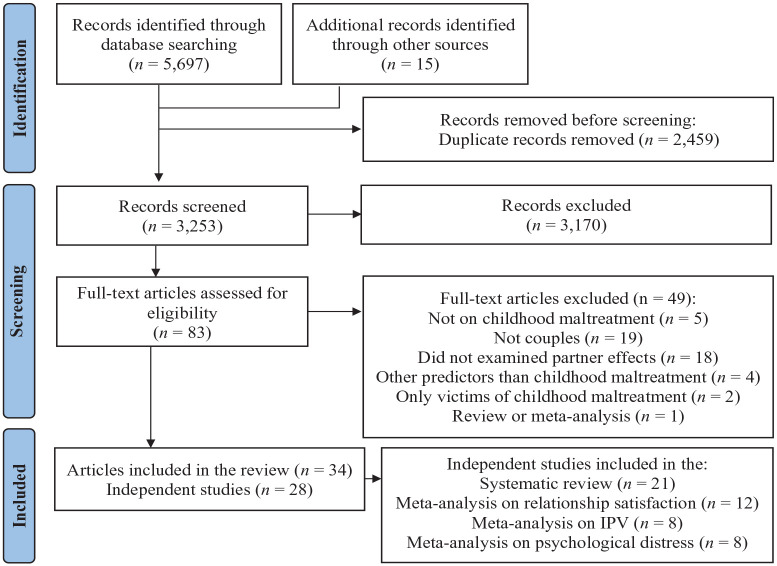
Although several studies have shown that childhood maltreatment (CM) is associated with a host of negative consequences including romantic relationship difficulties for victims in adulthood, most overlooked the potential effects on the romantic partner. This systematic review and meta-analysis aims to comprehensively synthesize the literature on the association between a person’s CM and their partner’s individual and couple outcomes. We searched PubMed, PsycNET, Medline, CINAHL, and Eric using search strings related to CM and partner. We identified 3,238 articles after removal of duplicates; 28 studies met the inclusion criteria and relied on independent sample. The studies reported associations between a person’s CM and a wide breadth of partner’s negative couple outcomes (e.g., communication, sexuality) as well as intra-individual psychological difficulties (e.g., psychological distress, emotion, and stress reactivity). Meta-analytic results showed significant, but trivial to small associations between a person’s CM and their partner’s lower relationship satisfaction ( r = −.09, 95% CI [−.14, −.04]), higher intimate partner violence ( r = .08, [.05, .12]), and higher psychological distress ( r = .11, [.06, .16]). These associations were similar for women and men and did not differ as a function of sample’s mean age, proportion of cultural diversity, and publication year. These findings suggest that a person’s CM is related to their partner’s outcomes including to the partner’s intra-individual outcomes. Prevention and intervention strategies should acknowledge that a person’s CM may also affect their romantic partner, considering the couple as a reciprocal system, and offer victims’ romantic partners specific services.
Overview
CoChat Summary
TL;DR
This systematic review and meta-analysis of 28 independent samples found that a person’s childhood maltreatment is significantly related to their romantic partner’s lower relationship satisfaction, higher intimate partner violence, and higher psychological distress, though effect sizes were trivial to small. Effects were similar for women and men and did not vary by sample mean age, cultural diversity proportion, or publication year.
Key findings
- Meta-analytic associations were significant but trivial to small: partner’s lower relationship satisfaction, k = 12, N = 25,348, r = −.09, 95% CI [−.14, −.04]; higher intimate partner violence, k = 8, N = 7,724, r = .08, 95% CI [.05, .12]; higher psychological distress, k = 8, N = 7,110, r = .11, 95% CI [.06, .16].
- Gender did not moderate the associations, and no significant moderation was found for sample mean age, proportion of cultural diversity, or publication year.
- The systematic review found mixed findings across other partner outcomes, with some studies reporting significant negative partner effects for communication/perceptions, attachment, sexuality, emotion reactivity/regulation, and stress reactivity/health, while many other associations were non-significant.
- Publication bias tests suggested little evidence of bias; fail-safe N indicated 117, 94, and 64 null studies would be needed to reduce the relationship satisfaction, IPV, and psychological distress effects to non-significance, respectively.
Methods
- Systematic review and meta-analysis following PRISMA; searched PubMed, PsycNET, Medline, CINAHL, and Eric, identifying 3,238 articles after duplicate removal, with 28 independent samples (34 articles) meeting inclusion criteria.
- Included studies had dyadic data, assessed any form of childhood maltreatment before age 18, and were peer-reviewed in English or French; gray literature, qualitative-only studies, and case studies were excluded. The total sample was 40,690 participants (20,345 couples), mean age 31.96 years.
- Random-effects meta-analyses were conducted for outcomes with at least four studies: relationship satisfaction, IPV, and psychological distress. Pearson r was the effect size; heterogeneity was assessed with Q and I²; moderators were gender, sample mean age, proportion of cultural diversity, and publication year; publication bias was assessed with funnel plots, trim-and-fill, and fail-safe N.
Limitations
- Stated: all included studies relied on retrospective self-report and almost all were cross-sectional, preventing causal conclusions; most used convenience community samples with low ethnic diversity and all but one included only mixed-sex couples, limiting generalizability.
- Stated: the meta-analyses included a small number of studies (k = 8–12), lowering confidence in effect sizes and preventing comparisons across different forms of childhood maltreatment or IPV.
- Stated: the protocol was not registered, and gray literature, qualitative-only studies, and case studies were excluded; the review also notes that some outcomes (e.g., sexuality, attachment, stress reactivity, health) were understudied and findings were mixed.
Model-written summary. Check it against the paper before relying on it.
Integrity signals
Registry
Cites
Statistics
Figures
Verification
Claims the paper makes
16 Valid · 5 Not valid · 65 Not checked · 84 Own results and interpretations
At least one cited source doesn’t support this claim or points to a different paper, and none confirmed it — see the verdicts below.
In the paper
“men’s CSA was related to their partner’s maladaptive attempts to cope with negative affect (DiLillo et al., 2016)”
§ Partner Effects of Childhood Maltreatment: A Systematic Review and Meta-Analysis > Results > Systematic Review on the Associations Between a Person’s CM and Their Partner’s Individual Outcomes
What the sources say
- Disputedcites DiLillo et al., 2016 matched to “The occurrence and traumatic impact of sexual revictimization in newlywed couples.” (2016) sourceExperimental — accuracy not yet measured
The Method > Measures section defines self-dysfunction symptoms as including maladaptive attempts to cope with negative affect. But Results > TSI Self-Dysfunction Symptoms reports that men’s CSA was associated with men’s own symptoms and that no significant partner effects were found; it does not report the claimed association with their partners’ symptoms. No page numbers are available in our copy. (LLM, conf=0.89)
Checked by a reasoning model — may be wrong.
plainstates an association- Asserted: passes — The authors put it forward as true.
- Checkable: passes — It can be checked against evidence.
- Load-bearing: unclear — It is unclear whether the paper’s conclusions depend on it.
- Based: passes — The paper gives a reason why it holds.
- Disputed
The cited sources support only part of this claim — read each source’s verdict below.
In the paper
“Conversely, other studies have failed to find significant associations between one person’s CM and their partner’s relationship satisfaction and trauma symptoms (Evans et al., 2014; Fritz et al., 2012; Georgia et al., 2018; Nguyen et al., 2017).”
§ Partner Effects of Childhood Maltreatment: A Systematic Review and Meta-Analysis > Abstract
What the sources say
- Partly supportedcites Evans et al., 2014 matched to “Childhood exposure to family violence and adult trauma symptoms: The importance of social support from a spouse.” (2014) sourceExperimental — accuracy not yet measured
The Results (Positive Support Received) report no significant partner effects on trauma symptoms, and the Discussion says partners’ childhood experiences were largely unrelated to spouses’ trauma symptoms. But the Discussion identifies an exception for men’s childhood IPV exposure and women’s trauma symptoms; the paper does not report relationship satisfaction as an outcome. No page numbers are available in our copy. (LLM, conf=0.88)
- Not checked — no full text of the sourcecites Fritz et al., 2012 matched to “Couple-level analysis of the relation between family-of-origin aggression and intimate partner violence.” (2012) source
- Not checked — no full text of the sourcecites Georgia et al., 2018 matched to “Sexual Assault and Dyadic Relationship Satisfaction: Indirect Associations Through Intimacy and Mental Health” (2018) source
plain- Asserted: passes — The authors put it forward as true.
- Checkable: passes — It can be checked against evidence.
- Load-bearing: passes — The paper’s conclusions depend on it.
- Based: passes — The paper gives a reason why it holds.
- Partly supported
Every source the paper cites for this claim was checked and supports it.
In the paper
“a person’s CM was related to their partner’s greater day-to-day variability in their perception of partner responsiveness (Vaillancourt-Morel et al., 2023)”
§ Partner Effects of Childhood Maltreatment: A Systematic Review and Meta-Analysis > Results > Systematic Review on the Associations Between a Person’s CM and Their Partner’s Couple Outcomes
What the sources say
- Supportedcites Vaillancourt-Morel et al., 2023 matched to “Maltreatment in Childhood and Perceived Partner Responsiveness in Adult Romantic Relationships: A Dyadic Daily Diary and Longitudinal Study” (2023) source
The Discussion section, under “Associations with Variability in Perceived Partner Responsiveness,” states that a person’s cumulative childhood maltreatment was related to greater day-to-day variability in their partner’s perceived partner responsiveness. This directly supports the citing sentence. (LLM, conf=0.94)
plainstates an association- Asserted: passes — The authors put it forward as true.
- Checkable: passes — It can be checked against evidence.
- Load-bearing: unclear — It is unclear whether the paper’s conclusions depend on it.
- Based: passes — The paper gives a reason why it holds.
- Supported
The cited sources that could be checked couldn’t confirm or dispute this claim.
In the paper
“Women’s adverse childhood experiences were not significantly related to their partner’s impulsivity and frequency of intoxication (Mair et al., 2012)”
§ Partner Effects of Childhood Maltreatment: A Systematic Review and Meta-Analysis > Results > Systematic Review on the Associations Between a Person’s CM and Their Partner’s Individual Outcomes
What the sources say
- Could not verifycites Mair et al., 2012 matched to “Adverse childhood experiences and intimate partner violence: testing psychosocial mediational pathways among couples” (2012) sourceExperimental — accuracy not yet measured
The Results section reports significant associations between each partner’s ACEs and their own impulsivity, but does not report whether women’s ACEs were associated with their male partners’ impulsivity or intoxication frequency. Searches for cross-partner associations and Table 4 did not yield a passage establishing the claimed nonsignificant relationships. (LLM, conf=0.70)
plain- Asserted: passes — The authors put it forward as true.
- Checkable: passes — It can be checked against evidence.
- Load-bearing: unclear — It is unclear whether the paper’s conclusions depend on it.
- Based: passes — The paper gives a reason why it holds.
- Could not verify
The cited sources support only part of this claim — read each source’s verdict below.
In the paper
“men’s adverse childhood experience was related to their partner’s higher impulsivity and frequency of intoxication (Mair et al., 2012)”
§ Partner Effects of Childhood Maltreatment: A Systematic Review and Meta-Analysis > Results > Systematic Review on the Associations Between a Person’s CM and Their Partner’s Individual Outcomes
What the sources say
- Partly supportedcites Mair et al., 2012 matched to “Adverse childhood experiences and intimate partner violence: testing psychosocial mediational pathways among couples” (2012) sourceExperimental — accuracy not yet measured
The Results report that men’s ACE scores were positively related to their own impulsivity, and the Discussion describes a significant pathway from men’s ACEs through their own impulsivity and intoxication. Neither passage establishes the claimed relationship with their partners’ impulsivity or intoxication frequency. (LLM, conf=0.85)
plainstates an association- Asserted: passes — The authors put it forward as true.
- Checkable: passes — It can be checked against evidence.
- Load-bearing: unclear — It is unclear whether the paper’s conclusions depend on it.
- Based: passes — The paper gives a reason why it holds.
- Partly supported
89 more claims · 9 with their cited sources checked
Create a free account to see all 170 claims and to verify the 17 references still open.
- Probably not a substantial claim. 20
- It may state two separate claims as one. 62
- The quote only partly states this claim. 3
Self-check
Percentages, sums and reported differences re-computed from the paper’s own numbers.
Each contradiction between two passages listed here was confirmed by an independent check.
Rated minor: it would not touch a result — a value no result rests on, a p-value that stays on the same side of the significance level, or a conflict that is clerical, resolved elsewhere in the paper, or outside its own findings.
In the paper
§ Partner Effects of Childhood Maltreatment: A Systematic Review and Meta-Analysis > Results > Study Quality and Characteristics
“they were all similar in the methodology used (i.e., correlational, non-representative sample, validated tools)”
§ Partner Effects of Childhood Maltreatment: A Systematic Review and Meta-Analysis > Results > Study Quality and Characteristics
“Most studies used a convenience sample of couples (k = 24) and four used a representative sample.”
Rated minor: it would not touch a result — a value no result rests on, a p-value that stays on the same side of the significance level, or a conflict that is clerical, resolved elsewhere in the paper, or outside its own findings.
In the paper
§ Partner Effects of Childhood Maltreatment: A Systematic Review and Meta-Analysis > Results > Meta-Analysis on the Associations Between a Person’s CM and Their Partner’s Outcomes
“k = 8; N = 7,724; r = .08, 95% CI = [0.05, 0.12], p = .001”
§ Partner Effects of Childhood Maltreatment: A Systematic Review and Meta-Analysis > Results > Meta-Analysis on the Associations Between a Person’s CM and Their Partner’s Outcomes
“| All studies | 8 | 7,724 | .08 | [0.05, 0.12] | 4.59 (<.001) | 14.84 (.038) | 52.82 | | |”
Citations
Cites
The PRISMA 2020 statement: An updated guideline for reporting systematic reviews
Page, M. J., McKenzie, J. E., Bossuyt, P. M., Boutron, I., Hoffmann, T. C., Mulrow, C. D., Shamseer, L., Tetzlaff, J. M., Akl, E. A., Brennan, S. E., et al. (2021) · BMJ · doi:10.1136/bmj.n71 · Cited by 108,283
Statistical Power Analysis for the Behavioral Sciences
Muller, K. (1989) · Technometrics · doi:10.1080/00401706.1989.10488618 · Cited by 99,167
Duval, S., & Tweedie, R. (2000) · Biometrics · doi:10.1111/j.0006-341x.2000.00455.x · Cited by 14,099 · cited 1×
“Then, we conducted the trim-and-fill test with a random effect which identifies and corrects for funnel plot asymmetry by trimming the studies that cause an asymmetry or filling the missing studies to offer a bias-corrected overall effect estimate (Duval & Tweedie, 2000).”
Method(2000) · Cited by 9,198
Child abuse: Adolescent records vs. adult recall
Femina, D. D., Yeager, C. A., & Lewis, D. O. (1990) · Child Abuse & Neglect · doi:10.1016/0145-2134(90)90033-p · Cited by 8,820
A basic introduction to fixed-effect and random-effects models for meta-analysis
Borenstein, M., Hedges, L. V., Higgins, J. P. T., & Rothstein, H. R. (2010) · Research Synthesis Methods · doi:10.1002/jrsm.12 · Cited by 6,793 · cited 2×
“Because of the variability within methods, settings, recruitment procedures, and sample types, all effect size results are reported for a random effects approach which assumes that the studies were not necessarily conducted in the same way (Borenstein et al., 2010; Card, 2012).”
MethodFunnel plots for detecting bias in meta-analysis
Sterne, J. A. C., & Egger, M. (2001) · Journal of Clinical Epidemiology · doi:10.1016/s0895-4356(01)00377-8 · Cited by 3,779 · cited 1×
“(Sterne & Egger, 2001).”
The traumatic impact of child sexual abuse: A conceptualization.
Finkelhor, D., & Browne, A. (1985) · American Journal of Orthopsychiatry · doi:10.1111/j.1939-0025.1985.tb02703.x · Cited by 1,891 · cited 1×
“Although several studies as well as developmental and trauma theories contend how CM may affect romantic relationships (Bowlby, 1969; Briere, 2002; Finkelhor & Browne, 1985), they mostly focus on the effects of CM on the primary victim—the person who directly experienced CM, and mostly overlooked…”
BackgroundCompassion fatigue: Psychotherapists’ chronic lack of self care.
Figley, C. R. (2002) · Journal of Clinical Psychology · doi:10.1002/jclp.10090 · Cited by 1,614 · cited 1×
“…on CM, several terms have been used to describe how a person’s traumatic stress may affect the romantic partner, children, and professional helpers of trauma victims including compassion fatigue (Figley, 2002), vicarious victims (Jehu, 1988), and trauma transmission (Baranowsky et al., 1998).”
BackgroundThe prevalence of child maltreatment across the globe: review of a series of meta-analyses
Stoltenborgh, M., Bakermans‐Kranenburg, M. J., Alink, L. R. A., & van IJzendoorn, M. H. (2015) · Child Abuse Review · doi:10.1002/car.2353 · Cited by 1,542
(2011) · Cited by 1,303
The APSAC Handbook on Child Maltreatment
Myers, J. E. B. (2001) · Medical Entomology and Zoology · Cited by 1,228
Childhood abuse and neglect and adult intimate relationships: a prospective study
Colman, R. A., & Widom, C. S. (2004) · Child Abuse & Neglect · doi:10.1016/j.chiabu.2004.02.005 · Cited by 443
MacDonald, K., Thomas, M. L., Sciolla, A. F., Schneider, B., Pappas, K., Bleijenberg, G., Bohus, M., Bekh, B., Carpenter, L., Carr, A., et al. (2016) · PLOS ONE · doi:10.1371/journal.pone.0146058 · Cited by 372
Joel, S., Eastwick, P. W., Allison, C. J., Arriaga, X. B., Baker, Z. G., Bar-Kalifa, E., Bergeron, S., Birnbaum, G. E., Brock, R. L., Brumbaugh, C. C., et al. (2020) · Proceedings of the National Academy of Sciences · doi:10.1073/pnas.1917036117 · Cited by 315 · cited 1×
“Indeed, meta-analyses and a machine learning study have consistently shown that associations between a person’s experience and their own outcomes are stronger than the ones between a person’s experience and their partner’s outcomes (Candel & Turliuc, 2019; Joel et al., 2020).”
BackgroundSYSTEMIC TRAUMATIC STRESS: THE COUPLE ADAPTATION TO TRAUMATIC STRESS MODEL
Goff, B. S. N., & Smith, D. B. (2005) · Journal of Marital and Family Therapy · doi:10.1111/j.1752-0606.2005.tb01552.x · Cited by 228 · cited 6×
“The Couple Adaptation to Traumatic Stress (CATS) model (Nelson & Smith, 2005; Nelson & Wampler, 2000) outlines that traumatic experiences may be related to (a) symptoms in the primary trauma victim, (b) secondary trauma symptoms in the partner, and (c) dysfunctional relational dynamics within the…”
BackgroundMethodResultInfluentialBeyond sexual abuse: Therapy with women who were childhood victims.
Jehu, D., Gazan, M., & Klassen, C. (1989) · Wiley eBooks · Cited by 223
Early exposure to violence, domestic violence, attachment representations, and marital adjustment
GODBOUT, N., DUTTON, D. G., LUSSIER, Y., & SABOURIN, S. (2009) · Personal Relationships · doi:10.1111/j.1475-6811.2009.01228.x · Cited by 212 · cited 2×
“…to their partner’s higher attachment avoidance, men’s CPA and CEA were not significantly related to their partner’s attachment anxiety and avoidance (Godbout et al., 2009), and a person’s CEA was not significantly related to their partner’s attachment avoidance and anxiety (Riggs et al., 2011).”
BackgroundChildhood maltreatment and intimate partner violence victimization: A meta-analysis
Li, S., Zhao, F., & Yu, G. (2019) · Child Abuse & Neglect · doi:10.1016/j.chiabu.2018.11.012 · Cited by 202 · cited 2×
“Recent meta-analyses also showed that emotional maltreatment is negatively related to victims’ romantic relationship well-being ( r = .14; Cao et al., 2020) and that CM is related to higher IPV victimization ( r = .18; Li et al., 2019).”
BackgroundSmith‐Marek, E. N., Cafferky, B., Dharnidharka, P., Mallory, A. B., Dominguez, M., High, J., Stith, S. M., & Mendez, M. (2015) · Journal of Family Theory & Review · doi:10.1111/jftr.12113 · Cited by 188 · cited 1×
“…have shown that a person’s CM is significantly related to their own higher perpetration and vic-timization of IPV with an effect of a small magnitude ( r = .19; Godbout et al., 2019; r = .18; Li et al., 2019; r = .21; Smith-Marek et al., 2015), most partners might be both perpetrators and victims.”
BackgroundInsecure Attachment and Relationship Satisfaction: A Meta-Analysis of Actor and Partner Associations
Candel, O.-S., & Turliuc, M. N. (2019) · Personality and Individual Differences · doi:10.1016/j.paid.2019.04.037 · Cited by 186 · cited 1×
“Indeed, meta-analyses and a machine learning study have consistently shown that associations between a person’s experience and their own outcomes are stronger than the ones between a person’s experience and their partner’s outcomes (Candel & Turliuc, 2019; Joel et al., 2020).”
BackgroundPolyvictimization and victimization of children and youth: Results from a populational survey
Cyr, K., Chamberland, C., Clément, M., Lessard, G., Wemmers, J.-A. M., Collin‐Vézina, D., Gagné, M., & Damant, D. (2013) · Child Abuse & Neglect · doi:10.1016/j.chiabu.2013.03.009 · Cited by 172
Avoidant and compulsive sexual behaviors in male and female survivors of childhood sexual abuse
Vaillancourt‐Morel, M., Godbout, N., Labadie, C., Runtz, M., Lussier, Y., & Sabourin, S. (2014) · Child Abuse & Neglect · doi:10.1016/j.chiabu.2014.10.024 · Cited by 168
Self-citationThe Impact of Childhood Sexual Abuse on Women's Sexual Health: A Comprehensive Review
Pulverman, C. S., Kilimnik, C. D., & Meston, C. M. (2018) · Sexual Medicine Reviews · doi:10.1016/j.sxmr.2017.12.002 · Cited by 151 · cited 1×
“Although a few literature reviews focusing on specific outcomes (e.g., sexuality, relationship satisfaction) included dyadic studies (Bigras et al., 2021; Pulverman et al., 2018; Zamir, 2021), none focused specifically on the partner effect of a person’s CM.”
BackgroundMair, C., Cunradi, C. B., & Todd, M. (2012) · Annals of Epidemiology · doi:10.1016/j.annepidem.2012.09.008 · Cited by 145 · cited 2×
“…regulation strategy (Liu et al., 2019), men’s CSA was related to their partner’s maladaptive attempts to cope with negative affect (DiLillo et al., 2016), and men’s adverse childhood experience was related to their partner’s higher impulsivity and frequency of intoxication (Mair et al., 2012).”
BackgroundPTSD transmission: A review of secondary traumatization in Holocaust survivor families.
Baranowsky, A. B., Young, M., Johnson-Douglas, S., Williams-Keeler, L., & McCarrey, M. (1998) · Canadian Psychology / Psychologie canadienne · doi:10.1037/h0086816 · Cited by 140 · cited 1×
“…on CM, several terms have been used to describe how a person’s traumatic stress may affect the romantic partner, children, and professional helpers of trauma victims including compassion fatigue (Figley, 2002), vicarious victims (Jehu, 1988), and trauma transmission (Baranowsky et al., 1998).”
BackgroundDiLillo, D., Peugh, J., Walsh, K., Panuzio, J., Trask, E., & Evans, S. (2009) · Journal of Consulting and Clinical Psychology · doi:10.1037/a0015708 · Cited by 130
Burnout in Families : The Systemic Costs of Caring
Figley, C. R. (1997) · CRC Press eBooks · doi:10.4324/9780367804527 · Cited by 127
Nelson, B. S., & Wampler, K. S. (2000) · Journal of Marital and Family Therapy · doi:10.1111/j.1752-0606.2000.tb00287.x · Cited by 112 · cited 4×
“…all non-significant as women’s incestuous CSA was not significantly related to their male partner’s relationship instability (Knapp et al., 2017) and women and men’s CPA and/or CSA were not significantly related to their partner’s levels of family cohesion and adaptability (Nelson & Wampler, 2000).”
BackgroundMethodInfluentialChildhood emotional abuse and attachment processes in the dyadic adjustment of dating couples.
Riggs, S. A., Cusimano, A. M., & Benson, K. M. (2011) · Journal of Counseling Psychology · doi:10.1037/a0021319 · Cited by 111 · cited 1×
“…to their partner’s higher attachment avoidance, men’s CPA and CEA were not significantly related to their partner’s attachment anxiety and avoidance (Godbout et al., 2009), and a person’s CEA was not significantly related to their partner’s attachment avoidance and anxiety (Riggs et al., 2011).”
BackgroundIntimate partner violence in male survivors of child maltreatment: A meta-analysis
Godbout, N., Vaillancourt-Morel, M.-P., Bigras, N., Briere, J., Hébert, M., Runtz, M., & Sabourin, S. (2019) · Trauma, Violence, & Abuse · doi:10.1177/1524838017692382 · Cited by 111 · cited 1×
“…have shown that a person’s CM is significantly related to their own higher perpetration and vic-timization of IPV with an effect of a small magnitude ( r = .19; Godbout et al., 2019; r = .18; Li et al., 2019; r = .21; Smith-Marek et al., 2015), most partners might be both perpetrators and victims.”
BackgroundSelf-citationZamir, O. (2022) · Trauma, Violence, & Abuse · doi:10.1177/1524838021998319 · Cited by 104 · cited 4×
“For instance, in a systematic review on CM and relationship quality including 43 empirical studies, 9 studies employed dyadic data analysis that allow the examination of partner effect, but the results of these partner associations were not systematically reported (Zamir, 2021).”
BackgroundInfluentialGender, victimization, and psychiatric outcomes
Gershon, A., Minor, K., & Hayward, C. (2008) · Psychological Medicine · doi:10.1017/s0033291708003000 · Cited by 95 · cited 2×
“Even if some past studies reported that the effects of CM on victims were different between women and men (Gershon et al., 2008), the effects on their partners were similar for women and men.”
ResultEdalati, H., & Krank, M. D. (2016) · Trauma, Violence, & Abuse · doi:10.1177/1524838015584370 · Cited by 89
Lewis, S. J., Koenen, K. C., Ambler, A., Arseneault, L., Caspi, A., Fisher, H. L., Moffitt, T. E., & Danese, A. (2021) · The British Journal of Psychiatry · doi:10.1192/bjp.2021.57 · Cited by 80 · cited 1×
“Paired with our findings regarding dysfunctional relational dynamics and past studies on the effects of CM on victims (Lewis et al., 2021; Schar et al., 2022), these results outline that a person’s traumatic experiences may be related to psychological symptoms in the primary victim, but also…”
ResultFritz, P. A. T., Slep, A. M. S., & O'Leary, K. D. (2012) · Psychology of Violence · doi:10.1037/a0027370 · Cited by 79 · cited 1×
“Conversely, other studies have failed to find significant associations between one person’s CM and their partner’s relationship satisfaction and trauma symptoms (Evans et al., 2014; Fritz et al., 2012; Georgia et al., 2018; Nguyen et al., 2017).”
BackgroundVaillancourt‐Morel, M., Rellini, A. H., Godbout, N., Sabourin, S., & Bergeron, S. (2018) · Archives of Sexual Behavior · doi:10.1007/s10508-018-1309-1 · Cited by 78
Self-citationBigras, N., Vaillancourt-Morel, M.-P., Nolin, M.-C., & Bergeron, S. (2021) · Journal of Child Sexual Abuse · doi:10.1080/10538712.2020.1825148 · Cited by 71
Self-citationSchär, S., Mürner-Lavanchy, I., Schmidt, S. J., Koenig, J., & Kaess, M. (2022) · Frontiers in Neuroendocrinology · doi:10.1016/j.yfrne.2022.100987 · Cited by 71 · cited 1×
“Paired with our findings regarding dysfunctional relational dynamics and past studies on the effects of CM on victims (Lewis et al., 2021; Schar et al., 2022), these results outline that a person’s traumatic experiences may be related to psychological symptoms in the primary victim, but also…”
ResultManeta, E., Cohen, S., Schulz, M., & Waldinger, R. J. (2012) · Violence and Victims · doi:10.1891/0886-6708.27.3.315 · Cited by 64 · cited 1×
“…show that partners of CM victims report lower relationship satisfaction, lower sexual satisfaction, higher IPV victimization and perpetration, and higher individual stress symptoms (DiLillo et al., 2016; Maneta et al., 2012; Nelson & Wampler, 2000; Vaillancourt-Morel et al., 2021; Whisman, 2014).”
BackgroundManeta, E. K., Cohen, S., Schulz, M. S., & Waldinger, R. J. (2015) · Child Abuse & Neglect · doi:10.1016/j.chiabu.2014.07.017 · Cited by 62 · cited 2×
“Women’s CEA was related to their partner’s lower empathic accuracy for hostile emotions during an in-lab conflictual discussion (Maneta et al., 2015), whereas women’s CSA was related to their partner’s higher empathic accuracy for overall feeling state during an in-lab conflictual discussion…”
BackgroundDyadic perspectives on trauma and marital quality.
Whisman, M. A. (2014) · Psychological Trauma: Theory, Research, Practice, and Policy · doi:10.1037/a0036143 · Cited by 57 · cited 3×
“Moreover, a person’s CPA was not significantly related to their partner’s self-reported perception of negative marital exchanges (Whisman, 2014), to their partner’s self-reported levels of negative communication (Busby et al., 2011), women and men’s CM was not significantly related to their…”
BackgroundChildhood abuse and later marital outcomes: Do partner characteristics moderate the association?
Nguyen, T. P., Karney, B. R., & Bradbury, T. N. (2017) · Journal of Family Psychology · doi:10.1037/fam0000208 · Cited by 55 · cited 1×
“Conversely, other studies have failed to find significant associations between one person’s CM and their partner’s relationship satisfaction and trauma symptoms (Evans et al., 2014; Fritz et al., 2012; Georgia et al., 2018; Nguyen et al., 2017).”
BackgroundCelsi, L., Paleari, F. G., & Fincham, F. D. (2021) · Frontiers in Psychology · doi:10.3389/fpsyg.2021.623646 · Cited by 54
Increased cardiometabolic and mortality risk following childhood maltreatment in the United Kingdom
Chandan, J. S., Okoth, K., Gokhale, K. M., Bandyopadhyay, S., Taylor, J., & Nirantharakumar, K. (2020) · Journal of the American Heart Association · doi:10.1161/jaha.119.015855 · Cited by 48
Corsini-Munt, S., Bergeron, S., Rosen, N. O., Beaulieu, N., & Steben, M. (2017) · The Journal of Sex Research · doi:10.1080/00224499.2016.1158229 · Cited by 43 · cited 2×
“Men’s CM was related to their partner’s higher affective pain during sexual intercourse, but it was not significantly related to sensory pain (Corsini-Munt et al., 2017).”
BackgroundDevelopmental Couple Therapy for Complex Trauma: A Manual for Therapists
MacIntosh, H. B. (2019) · Routledge eBooks · doi:10.4324/9781315210940 · Cited by 42 · cited 1×
“…parallel the victim’s mixed emotional responses and cognitive biases including higher psychological distress and stress reactivity, inadequate affect regulation and mentalization skills, and biased internal representations of self and others (Barnett, 1993; Briere, 2002; MacIntosh, 2013, 2019).”
BackgroundWalker, E. C., Sheffield, R., Larson, J. H., & Holman, T. B. (2009) · Journal of Marital and Family Therapy · doi:10.1111/j.1752-0606.2009.00153.x · Cited by 39 · cited 1×
“…2019), a person’s CM was related to their partner’s greater day-to-day variability in their perception of partner responsiveness (Vaillancourt-Morel et al., 2023), and women and men’s CSA was related to their partner’s self-reported higher levels of contempt and defensiveness (Walker et al., 2011).”
BackgroundEvans, S. E., Steel, A. L., Watkins, L. E., & DiLillo, D. (2014) · Psychological Trauma: Theory, Research, Practice, and Policy · doi:10.1037/a0036940 · Cited by 39
BUSBY, D. M., WALKER, E. C., & HOLMAN, T. B. (2011) · Personal Relationships · doi:10.1111/j.1475-6811.2010.01316.x · Cited by 38 · cited 2×
“…partner’s self-reported perception of negative marital exchanges (Whisman, 2014), to their partner’s self-reported levels of negative communication (Busby et al., 2011), women and men’s CM was not significantly related to their partner’s self-disclosure and perception of partner disclosure…”
BackgroundPeterson, C. M., Peugh, J., Loucks, L. A., & Shaffer, A. E. (2017) · Journal of Social and Personal Relationships · doi:10.1177/0265407517700300 · Cited by 37
Vaillancourt‐Morel, M., Byers, E. S., Péloquin, K., & Bergeron, S. (2020) · The Journal of Sex Research · doi:10.1080/00224499.2020.1792396 · Cited by 37
Self-citationLiu, S., Wang, Z., Lu, S., & Shi, J. (2019) · Journal of Aggression, Maltreatment & Trauma · doi:10.1080/10926771.2018.1466381 · Cited by 34 · cited 3×
“…emotional maltreatment (CEA and CEN) was related to their partner’s lower reports of cognitive reappraisal, an emotion regulation strategy (Liu et al., 2019), men’s CSA was related to their partner’s maladaptive attempts to cope with negative affect (DiLillo et al., 2016), and men’s…”
BackgroundDugal, C., Bélanger, C., Brassard, A., & Godbout, N. (2020) · Journal of Marital and Family Therapy · doi:10.1111/jmft.12414 · Cited by 30 · cited 1×
“Women and men’s CM were related to their partner’s negative urgency (Dugal et al., 2020) and women and men’s CPA and CSA were significantly related to their partner’s lower feeling of coming to terms with what happened in their family of origin (Banford Witting & Busby, 2022).”
BackgroundCao, H., Ma, R., Li, X., Liang, Y., Wu, Q., Chi, P., Li, J.-B., & Zhou, N. (2022) · Trauma, Violence, & Abuse · doi:10.1177/1524838020975895 · Cited by 29 · cited 6×
“However, for this effect size, Cao et al. (2020) combined only four studies, and merged different dimensions of relationship well-being (i.e., overall satisfaction, overall dysfunction, intimacy, conflicts, instability) which may explain their very large confidence interval.”
BackgroundInfluentialKnapp, A. E., Knapp, D. J., Brown, C. C., & Larson, J. H. (2017) · Journal of Child Sexual Abuse · doi:10.1080/10538712.2016.1262931 · Cited by 28 · cited 1×
“These associations were all non-significant as women’s incestuous CSA was not significantly related to their male partner’s relationship instability (Knapp et al., 2017) and women and men’s CPA and/or CSA were not significantly related to their partner’s levels of family cohesion and adaptability…”
BackgroundFigley, C. R. (1997) · CRC Press eBooks · doi:10.1201/b14836 · Cited by 27
Bai, L., & Han, Z. R. (2016) · Parenting · doi:10.1080/15295192.2016.1158602 · Cited by 25
Georgia, E. J., Roddy, M. K., & Doss, B. D. (2018) · Violence Against Women · doi:10.1177/1077801217727371 · Cited by 24 · cited 1×
“Conversely, other studies have failed to find significant associations between one person’s CM and their partner’s relationship satisfaction and trauma symptoms (Evans et al., 2014; Fritz et al., 2012; Georgia et al., 2018; Nguyen et al., 2017).”
BackgroundArbel, R., Rodriguez, A. J., & Margolin, G. (2016) · Psychology of Violence · doi:10.1037/a0039715 · Cited by 20 · cited 3×
“Men’s family-of-origin aggression and men’s childhood family adversity were not significantly related to their partner’s cortisol response during in-lab interactions (Arbel et al., 2016; Kazmierski et al., 2020; Winer et al., 2018).”
BackgroundDevelopmental couple therapy for complex trauma: Results of an implementation pilot study
MacIntosh, H. B. (2024) · Journal of Marital and Family Therapy · doi:10.1111/jmft.12711 · Cited by 19
Dyadic correlates of the perpetration of psychological aggression among intimate partners.
Johnson, W. L. B., Taylor, B. G., Mumford, E. A., & Liu, W. (2020) · Psychology of Violence · doi:10.1037/vio0000257 · Cited by 18
Godbout, N., Paradis, A., Rassart, C.-A., Sadikaj, G., Herba, C. M., & Drapeau-Lamothe, M. (2023) · Journal of Affective Disorders · doi:10.1016/j.jad.2023.01.007 · Cited by 17 · cited 1×
“…emotion regulation strategy (Liu et al., 2019), women and men’s CPA were not significantly related to their partner’s levels of neuroticism (Busby et al., 2011), and women and men’s childhood interpersonal trauma were not significantly related to their partner’s mindfulness (Godbout et al., 2023).”
BackgroundVaillancourt-Morel, M.-P., Rosen, N. O., Péloquin, K., & Bergeron, S. (2023) · Child Maltreatment · doi:10.1177/10775595211057230 · Cited by 15 · cited 5×
“Men and women’s CPA, CSA, CEA, CPN, CEN were not significantly related to their partner’s trajectories of sexual satisfaction, sexual function, and sexual distress over 1 year (Vaillancourt-Morel et al., 2021).”
BackgroundInfluentialSelf-citationMacIntosh, H. B. (2017) · Clinical Social Work Journal · doi:10.1007/s10615-016-0607-0 · Cited by 14 · cited 2×
“Clinical case studies described how intimate relationship in adulthood CM may trigger cycles of repetition and enactment of traumatic interactions (MacIntosh, 2017).”
BackgroundMaleck, S., & Papp, L. M. (2015) · Journal of Family Issues · doi:10.1177/0192513x13491749 · Cited by 12 · cited 2×
“Similarly, but for women only, women’s adverse childhood experience was not significantly related to their partners’ observed positive and negative interactions during an in-lab conflictual discussion (Maleck & Papp, 2015).”
BackgroundSteel, A. L., Watkins, L. E., & DiLillo, D. (2017) · Partner Abuse · doi:10.1891/1946-6560.8.2.204 · Cited by 11
The occurrence and traumatic impact of sexual revictimization in newlywed couples.
DiLillo, D., Jaffe, A. E., Watkins, L. E., Peugh, J., Kras, A., & Campbell, C. (2016) · Couple and Family Psychology: Research and Practice · doi:10.1037/cfp0000067 · Cited by 9 · cited 4×
“…an emotion regulation strategy (Liu et al., 2019), men’s CSA was related to their partner’s maladaptive attempts to cope with negative affect (DiLillo et al., 2016), and men’s adverse childhood experience was related to their partner’s higher impulsivity and frequency of intoxication (Mair…”
BackgroundInfluentialEmpathic Understanding in Couples with a Female Survivor of Childhood Sexual Abuse
Millwood, M. (2011) · Journal of Couple & Relationship Therapy · doi:10.1080/15332691.2011.613310 · Cited by 8 · cited 3×
“M ill w oo d ( 2011 ) 59 h e t e r o s e xu a l c o up l e s ( 31 .”
BackgroundInfluentialWiner, J. P., Powers, S. I., Pietromonaco, P. R., & Schreck, M. C. (2018) · Journal of Family Psychology · doi:10.1037/fam0000455 · Cited by 8 · cited 4×
“…et al., 2016), women’s childhood family adversity was associated with their partner’s attenuated cortisol response during an in-lab conflict discussion (Winer et al., 2018), and women’s family-of-origin aggression was not significantly related to their partner’s hypothalamic-pituitary-adrenal…”
BackgroundInfluentialThe Residuum of Childhood Physical and Sexual Abuse: Coming to Terms in Couple Relationships
Witting, A. B., & Busby, D. M. (2020) · Journal of Interpersonal Violence · doi:10.1177/0886260520965972 · Cited by 8 · cited 1×
“Women and men’s CM were related to their partner’s negative urgency (Dugal et al., 2020) and women and men’s CPA and CSA were significantly related to their partner’s lower feeling of coming to terms with what happened in their family of origin (Banford Witting & Busby, 2022).”
BackgroundAdult vicarious victims of child sexual abuse
Barnett, A. J. (1993) · Sexual and Marital Therapy · doi:10.1080/02674659308404502 · Cited by 4 · cited 1×
“…parallel the victim’s mixed emotional responses and cognitive biases including higher psychological distress and stress reactivity, inadequate affect regulation and mentalization skills, and biased internal representations of self and others (Barnett, 1993; Briere, 2002; MacIntosh, 2013, 2019).”
BackgroundMacIntosh, H. (2013) · Couple and Family Psychoanalysis · doi:10.33212/cfp.v3n2.2013.188 · Cited by 4
Kazmierski, K. F. M., Beam, C. R., & Margolin, G. (2020) · Journal of Family Psychology · doi:10.1037/fam0000633 · Cited by 3 · cited 2×
“Men’s family-of-origin aggression and men’s childhood family adversity were not significantly related to their partner’s cortisol response during in-lab interactions (Arbel et al., 2016; Kazmierski et al., 2020; Winer et al., 2018).”
Background(2021) · Wiley eBooks · doi:10.1002/9781119558378.ch7 · Cited by 3
Childhood adversity and adult health: A dyadic analysis of Black American couples.
Zhang, Y., Lei, M.-K., Simons, R. L., Beach, S. R. H., & Carter, S. E. (2022) · Health Psychology · doi:10.1037/hea0001238 · Cited by 3 · cited 2×
“Moreover, only one study recently examined the association between a person’s CM and their partner’s health reporting associations with their partner’s chronic illness and aging (Zhang et al., 2022).”
Background
Research works printed but not linked: 2
- Borenstein M. Hedges L. Higgins J. Rothstein H. (2013). Comprehensive meta-analysis version 3. Biostat.
- Bowlby J. (1969). Attachment and loss: Attachment (Vol. 1). Basic Books.
Cited by
Pezzoli, P., Pingault, J., Eley, T. C., McCrory, E. J. P., & Viding, E. M. (2024) · Molecular Psychiatry · doi:10.1038/s41380-024-02813-0 · Cited by 15
“Cross-sectional population-based data hints at a number of psychological (e.g. emotional dysregulation [34, 35]) and social processes (e.g., relationship quantity and quality [36, 37]) that partly, but modestly, mediate the longitudinal association between maltreatment and IPV victimization.”
Lassri, D., & Gewirtz‐Meydan, A. (2024) · Child Abuse & Neglect · doi:10.1016/j.chiabu.2024.106663 · Cited by 11
Phillips, A., Williams, R. M., Okuoimose, V., Hiller, R. M., McCrory, E. J. P., Viding, E. M., & Pezzoli, P. (2025) · European Journal of Psychotraumatology · doi:10.1080/20008066.2025.2524922 · Cited by 7
Kotiuga, J., Bőthe, B., Bergeron, S., Girouard, A., Bigras, N., & Vaillancourt‐Morel, M. (2024) · Journal of Social and Personal Relationships · doi:10.1177/02654075241230118 · Cited by 5
“Whileprevious research has reported mixed fi ndings relative to the associations between a person ’ s CM and their partners ’ sexuality (Vaillancourt-Morel et al., 2023), the present fi ndings suggest that a person ’ s CM is related to their partner ’ s sexual motivation, speci fi cally higher…”
BackgroundInfluentialSelf-citationBetween Struggle and Strength: A Rapid Review of Dual-Trauma Couples
Charbonneau‐Lefebvre, V., Vaillancourt‐Morel, M., Bigras, N., Opuda, E., & Gewirtz‐Meydan, A. (2025) · Trauma Violence & Abuse · doi:10.1177/15248380251335036 · Cited by 9
“While efforts have been made to explore the effects of trauma on individuals and their partners (Finzi-Dottan & Gewirtz-Meydan, 2023; Vaillancourt-Morel et al., 2023), this evolving body of research has frequently overlooked the nuanced dynamics within dual-trauma couples—partner-ships where both…”
Self-citation
Metadata
- Authors
- Vaillancourt-Morel, M.-P., Bussières, È.-L., Nolin, M.-C., & Daspe, M.-È.
- Affiliations
- Université du Québec à Trois-Rivières, QC, Canada
- Université du Québec à Trois-Rivières (CA)
- Université de Montréal (CA)
- Venue
- Trauma, Violence, & Abuse
- Publisher
- SAGE Publications
- Published
- 2023-05-20
- Volume
- 25
- Issue
- 2
- Pages
- 1150-1167
- ISSN
- 1524-8380 (ISSN-L)
- 1552-8324
- PMC
- PMC10913306
- OpenAlex
- W4377140719
- Cited by
- 35
- References
- 73
- Citations by year
- 2026: 13 · 2025: 16 · 2024: 6
- FWCI
- 1.78
- Type
- journal article
- Language
- en
- Open access
- hybrid
- doi.org
- Locations
- Trauma Violence & Abuse (publishedVersion, cc-by)
- PubMed Central (publishedVersion, cc-by)
- PubMed (publishedVersion)
- Le dépôt institutionnel (Université du Québec à Trois-Rivières) (submittedVersion)
- Funders
- Social Sciences and Humanities Research Council of Canada (435-2020-0763)
- Topics
- Social Sciences › Psychology › Clinical Psychology › Child Abuse and Trauma
- Social Sciences › Health › Intimate Partner and Family Violence
- Social Sciences › Psychology › Social Psychology › Attachment and Relationship Dynamics
- Keywords
- child abuse, romantic partners, intimate partner violence, relationship satisfaction, psychological distress, couple dynamics, reciprocal effects
- MeSH terms
- Intimate Partner Violence, Child Abuse, Female, Humans, Interpersonal Relations, Male, Sexual Behavior, Sexual Partners
About these checks
Registry, retraction, Cites and statistics results are computed, not judged, with one exception: a printed reference that no index lists is read once by a model before it counts as a citation error. Claims are extracted by a model and kept only when their quote appears verbatim in the text; each cited source is then checked, with a model’s help, for whether it says what the claim relies on. Those verdicts can be wrong — read the claim’s quote and the cited source before relying on one.
The claim verdicts this report counts are experimental: their accuracy is not yet measured.
A language model drew the claims from the paper on 2026-10-10, under version 3 of the claim definition (model deepseek-v4.1-flash, prompt extract-v3).
A second model labelled each claim on 2026-10-10 (model jev-1.13-20260917, definition revision gold-guideline-v0.2).
Cited sources are checked with a language model’s help (gpt-6-sol).
Statistics and arithmetic are recomputed, not judged.
Confidence bands are shown only for fields calibrated on our annotated test set. None is calibrated yet, so no band is shown.
What counts as a claim ›How we measure confidence ›How we check this ›
Are you an author, or do you see a problem with this page? Request a review
Data sources
Bibliographic data: Semantic Scholar, OpenAlex, Crossref.
Contains information from the Semantic Scholar Academic Graph Datasets, made available under the ODC Attribution License (ODC-BY 1.0).
Semantic Scholar’s data is described in: Kinney, R., et al. (2023). The Semantic Scholar Open Data Platform. arXiv:2301.10140.
