

The DOI matches its Crossref record; 34 of the 35 references it cites were found in a registry or an index; 4 of the 46 sources its claims cite were checked for support.
Treating children traumatized by war and Tsunami: A comparison between exposure therapy and meditation-relaxation in North-East Sri Lanka
Open accessAbstract
BACKGROUND: The North-Eastern part of Sri Lanka had already been affected by civil war when the 2004 Tsunami wave hit the region, leading to high rates of posttraumatic stress disorder (PTSD) in children. In the acute aftermath of the Tsunami we tested the efficacy of two pragmatic short-term interventions when applied by trained local counselors. METHODS: A randomized treatment comparison was implemented in a refugee camp in a severely affected community. 31 children who presented with a preliminary diagnosis of PTSD were randomly assigned either to six sessions Narrative Exposure Therapy for children (KIDNET) or six sessions of meditation-relaxation (MED-RELAX). Outcome measures included severity of PTSD symptoms, level of functioning and physical health. RESULTS: In both treatment conditions, PTSD symptoms and impairment in functioning were significantly reduced at one month post-test and remained stable over time. At 6 months follow-up, recovery rates were 81% for the children in the KIDNET group and 71% for those in the MED-RELAX group. There was no significant difference between the two therapy groups in any outcome measure. CONCLUSION: As recovery rates in the treatment groups exceeded the expected rates of natural recovery, the study provides preliminary evidence for the effectiveness of NET as well as meditation-relaxation techniques when carried out by trained local counselors for the treatment of PTSD in children in the direct aftermath of mass disasters. TRIAL REGISTRATION: ClinicalTrials.gov Identifier:NCT00820391.
Overview
AI snapshot
Written from the paper’s full text.
TL;DR
In a randomized treatment comparison in post-tsunami north-east Sri Lanka, 31 children with preliminary PTSD received either six sessions of KIDNET or six sessions of meditation-relaxation (MED-RELAX), both delivered by trained local counselors. Both groups showed significant PTSD symptom reduction with no significant between-group differences; at 6-month follow-up, 81% of KIDNET children and 71% of MED-RELAX children no longer met the PTSD diagnostic threshold.
Key findings
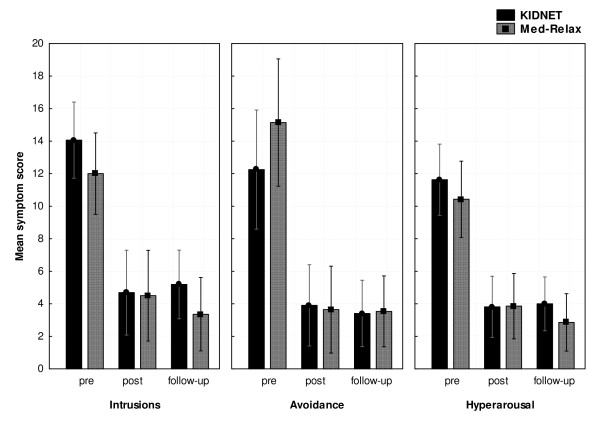
- PTSD symptoms decreased significantly in both groups: repeated-measures ANOVA showed a significant main effect of Time, F(2,56) = 54.15, p < 0.001, with no significant Time × Treatment interaction (p = 0.9).
- At 6-month follow-up, recovery rates were 81% for KIDNET and 71% for MED-RELAX; differences between groups were non-significant.
- Functioning problems also improved significantly across both conditions, F(2,54) = 19.54, p < 0.001; physical complaints showed only a slight improvement that did not reach significance, F(2,56) = 2.47, p = 0.09.
- Within-group effect sizes were large and similar: KIDNET d = 1.76 at post-test and 1.96 at follow-up; MED-RELAX d = 1.83 at post-test and 2.20 at follow-up.
Methods
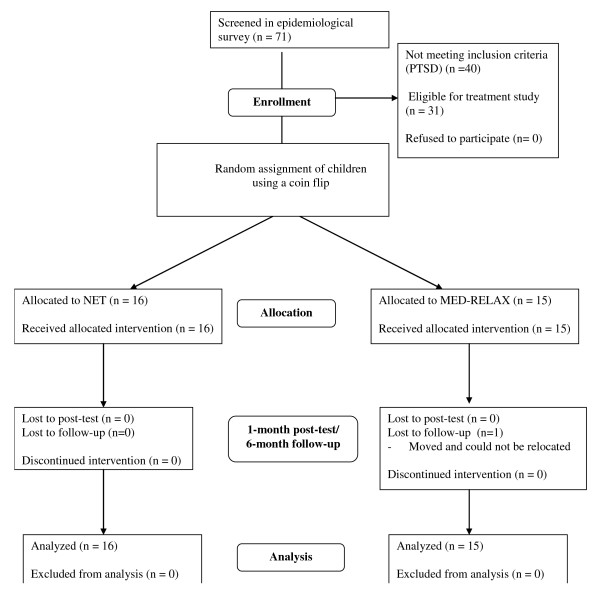
- Randomized treatment comparison in two provisional refugee camps in Manadkadu, northern Sri Lanka; 31 children aged 8–14 with preliminary PTSD were randomly assigned by coin flip to six sessions of KIDNET (n = 16) or MED-RELAX (n = 15), each 60–90 minutes over about two weeks.
- Treatments were delivered by six trained female local counselors; interviewers at post-test and follow-up were blind to treatment condition.
- Outcomes included UCLA PTSD Index for DSM-IV (UPID) total and subscale scores, PTSD diagnosis, a five-item functioning-problems scale, and five physical complaints, assessed at pre-test, 1-month post-test, and 6-month follow-up using repeated-measures ANOVA and χ² tests.
Limitations
- The paper states that the major limitation was the lack of a non-treated control or waiting-list group, due to ethical and logistical concerns, so spontaneous remission could not be controlled.
- The paper also states that planned 1-year follow-up interviews could not be carried out because of increasing violence and political insecurity in Sri Lanka’s North-Eastern provinces.
- Evident from the text: the sample was small (31 children; 16 KIDNET, 15 MED-RELAX), limiting statistical power to detect between-group differences, and the diagnosis was preliminary because the DSM-IV time criterion could not yet be applied.
Model-written summary. Check it against the paper before relying on it.
Integrity signals
Registry
Cites
Statistics
Figures
Verification
Claims the paper makes
26 Not checked yet · 23 Own result · 19 Own method · 9 Own interpretation · 2 Supported so far · 1 Partly supported · 1 No basis given · accuracy not yet measured
The sources with a verdict support this claim; the rest weren’t checked yet, have no full text we could read, or their verdicts aren’t rated yet.
In the paper
“KIDNET, a version of NET adapted for the treatment of children [18], has been tested in a pilot study in an Ugandan refugee camp with Somali refugee children diagnosed with PTSD [19,20] with promising results.”
§ Treating children traumatized by war and Tsunami: A comparison between exposure therapy and meditation-relaxation in North-East Sri Lanka > Background
What the sources say
- Supportedcites [18] Neuner F, Catani C, Ruf M, Schauer E, Schauer M, Elbert T: Narrative Exposure Therapy for the treatment of child and adolescent war victims: From neurobiology to field intervention. Child and Adolescent Psychiatric Clinics of North America. 2008, 17: 641-664. 10.1016/j.chc.2008.03.001. source
Citation [18] is attached to the identification of KidNET as NET adapted for children, not to the subsequent Ugandan pilot-study claim, which cites [19,20]. The paper’s title identifies KidNET as narrative exposure therapy for children and adolescents, and its “Consequences for treatment” section describes its application to children and adolescents. No page number is available in our copy. (LLM, conf=0.92)
- Supportedcites [19] Onyut LP, Neuner F, Schauer E, Ertl V, Odenwald M, Schauer M, Elbert T: Narrative Exposure Therapy as a treatment for child war survivors with posttraumatic stress disorder: two case reports and a pilot study in an African refugee settlement. BMC Psychiatry. 2005, 5: 7-10.1186/1471-244X-5-7. source
The Methods describe a pilot study in a Ugandan refugee settlement involving six Somali children aged 12–17 with PTSD who received KIDNET. The Discussion reports reduced posttraumatic symptoms while cautioning that the small pilot study cannot establish that treatment caused the improvement; this supports the claim’s qualified description of the results as promising. (LLM, conf=0.94)
- Not checked yetcites [20] Schauer E, Neuner F, Elbert T, Ertl V, Onyut LP, Odenwald M, Schauer M: Narrative Exposure Therapy in Children: a Case Study. Intervention. 2004, 2 (1): 18-32.
plain- Asserted: passes — The authors put it forward as true.
- Checkable: passes — It can be checked against evidence.
- Load-bearing: unclear — It is unclear whether the paper’s conclusions depend on it.
- Based: passes — The paper gives a reason why it holds.
- Supported
The cited sources support only part of this claim — read each source’s verdict below.
In the paper
“Consequently, the diagnosis of PTSD applied here was still tentative although a preliminary PTSD diagnosis including all DSM-IV criteria except the time criterion is a strong predictor for the development of chronic PTSD in children [24].”
§ Treating children traumatized by war and Tsunami: A comparison between exposure therapy and meditation-relaxation in North-East Sri Lanka > Methods > Participants
What the sources say
- Partly supportedcites [24] Meiser-Stedman R, Yule W, Smith P, Glucksman E, Dalgleish T: Acute stress disorder and posttraumatic stress disorder in children and adolescents involved in assaults or motor vehicle accidents. Am J Psychiatry. 2005, 162 (7): 1381-1383. 10.1176/appi.ajp.162.7.1381. sourceExperimental — accuracy not yet measured
The Method defines early PTSD as PTSD without the duration criterion, and the Discussion says early PTSD was as effective as acute stress disorder at predicting later PTSD. The outcome was PTSD assessed at six months in children and adolescents aged 10–16; the paper does not establish that those cases were chronic PTSD. (LLM, conf=0.82)
boostedcorrelational- Asserted: passes — The authors put it forward as true.
- Checkable: passes — It can be checked against evidence.
- Load-bearing: passes — The paper’s conclusions depend on it.
- Based: passes — The paper gives a reason why it holds.
- Partly supported
The sources with a verdict support this claim; the rest weren’t checked yet, have no full text we could read, or their verdicts aren’t rated yet.
In the paper
“Retrospective [32] and longitudinal [33] studies revealed that children's preexisting levels of anxiety and psychological maladjustment are among the main predictors of an adverse trajectory of the disorder.”
§ Treating children traumatized by war and Tsunami: A comparison between exposure therapy and meditation-relaxation in North-East Sri Lanka > Discussion
What the sources say
- Supportedcites [32] Udwin O, Boyle S, Yule W, Bolton D, O'Ryan D: Risk factors for long-term psychological effects of a disaster experienced in adolescence: predictors of post traumatic stress disorder. J Child Psychol Psychiatry. 2000, 41 (8): 969-979. 10.1111/1469-7610.00685. source
The Discussion (page unavailable) identifies childhood separation anxiety and pre-disaster social and psychological difficulties among predictors of PTSD severity or duration in survivors who developed the disorder. It also identifies depression measured five months after the disaster and school-based support as predictors; the claim does not say preexisting factors were the only ones. (LLM, conf=0.87)
- Not checked yetcites [33] La Greca A, Silverman WK, Vernberg EM, Prinstein MJ: Symptoms of posttraumatic stress in children after Hurricane Andrew: a prospective study. J Consult Clin Psychol. 1996, 64 (4): 712-723. 10.1037/0022-006X.64.4.712. source
plaincorrelational- Asserted: passes — The authors put it forward as true.
- Checkable: passes — It can be checked against evidence.
- Load-bearing: passes — The paper’s conclusions depend on it.
- Based: passes — The paper gives a reason why it holds.
- Supported
A result the paper reports from its own data — it cites no other source for it, so there is none to check. The quote shows it is in the paper.
In the paper
“While no respondent met the exclusion criteria of mental retardation, psychosis or any neurological disorder, 31 children met the diagnostic criteria of preliminary PTSD and were informed about the randomized trial.”
§ Treating children traumatized by war and Tsunami: A comparison between exposure therapy and meditation-relaxation in North-East Sri Lanka > Methods > Participants
plainn = 31- Asserted: passes — The authors put it forward as true.
- Checkable: passes — It can be checked against evidence.
- Load-bearing: passes — The paper’s conclusions depend on it.
- Based: passes — The paper gives a reason why it holds.
A result the paper reports from its own data — it cites no other source for it, so there is none to check. The quote shows it is in the paper.
In the paper
“Effect sizes at post-test and 6-month follow up were similarly high in both groups.”
§ Treating children traumatized by war and Tsunami: A comparison between exposure therapy and meditation-relaxation in North-East Sri Lanka > Discussion
plain- Asserted: passes — The authors put it forward as true.
- Checkable: passes — It can be checked against evidence.
- Load-bearing: passes — The paper’s conclusions depend on it.
- Based: passes — The paper gives a reason why it holds.
A result the paper reports from its own data — it cites no other source for it, so there is none to check. The quote shows it is in the paper.
In the paper
“In fact, within this study, not all of the children did consider the Tsunami as the worst experience”
§ Treating children traumatized by war and Tsunami: A comparison between exposure therapy and meditation-relaxation in North-East Sri Lanka > Discussion
plain- Asserted: passes — The authors put it forward as true.
- Checkable: passes — It can be checked against evidence.
- Load-bearing: passes — The paper’s conclusions depend on it.
- Based: passes — The paper gives a reason why it holds.
The paper states this without a source or data behind it here, so there is nothing to check it against. The quote shows it is in the paper.
In the paper
“On average, the Tamil children had experienced three distinctly different types of traumatic events in addition to the Tsunami”
§ Treating children traumatized by war and Tsunami: A comparison between exposure therapy and meditation-relaxation in North-East Sri Lanka > Discussion
plain- Asserted: passes — The authors put it forward as true.
- Checkable: passes — It can be checked against evidence.
- Load-bearing: passes — The paper’s conclusions depend on it.
- Based: passes — The paper gives a reason why it holds.
A result the paper reports from its own data — it cites no other source for it, so there is none to check. The quote shows it is in the paper.
In the paper
“No significant differences between groups were found.”
§ Treating children traumatized by war and Tsunami: A comparison between exposure therapy and meditation-relaxation in North-East Sri Lanka > Results > PTSD Symptom Score
plain- Asserted: passes — The authors put it forward as true.
- Checkable: passes — It can be checked against evidence.
- Load-bearing: passes — The paper’s conclusions depend on it.
- Based: passes — The paper gives a reason why it holds.
A result the paper reports from its own data — it cites no other source for it, so there is none to check. The quote shows it is in the paper.
In the paper
“At 6 months follow-up, recovery rates were 81% for the children in the KIDNET group and 71% for those in the MED-RELAX group.”
§ Treating children traumatized by war and Tsunami: A comparison between exposure therapy and meditation-relaxation in North-East Sri Lanka > Abstract > Results
plain- Asserted: passes — The authors put it forward as true.
- Checkable: passes — It can be checked against evidence.
- Load-bearing: unclear — It is unclear whether the paper’s conclusions depend on it.
- Based: passes — The paper gives a reason why it holds.
A result the paper reports from its own data — it cites no other source for it, so there is none to check. The quote shows it is in the paper.
In the paper
“With this study we could also show that local counselors with a relatively short training are able to carry out psychological interventions, including trauma exposure and meditation-relaxation.”
§ Treating children traumatized by war and Tsunami: A comparison between exposure therapy and meditation-relaxation in North-East Sri Lanka > Discussion
hedgeddirect- Asserted: passes — The authors put it forward as true.
- Checkable: passes — It can be checked against evidence.
- Load-bearing: passes — The paper’s conclusions depend on it.
- Based: passes — The paper gives a reason why it holds.
- It may state two separate claims as one. 15
- Probably not a substantial claim. 28
A result the paper reports from its own data — it cites no other source for it, so there is none to check. The quote shows it is in the paper.
In the paper
“Results showed that in both treatment conditions, PTSD symptoms were significantly reduced at 1 month post-test and remained stable over time.”
§ Treating children traumatized by war and Tsunami: A comparison between exposure therapy and meditation-relaxation in North-East Sri Lanka > Discussion
plaindirect- Asserted: passes — The authors put it forward as true.
- Checkable: passes — It can be checked against evidence.
- Load-bearing: passes — The paper’s conclusions depend on it.
- Based: passes — The paper gives a reason why it holds.
It may state two separate claims as one.
A result the paper reports from its own data — it cites no other source for it, so there is none to check. The quote shows it is in the paper.
In the paper
“In both treatment conditions, PTSD symptoms and impairment in functioning were significantly reduced at one month post-test and remained stable over time.”
§ Treating children traumatized by war and Tsunami: A comparison between exposure therapy and meditation-relaxation in North-East Sri Lanka > Abstract > Results
plaindirect- Asserted: passes — The authors put it forward as true.
- Checkable: passes — It can be checked against evidence.
- Load-bearing: passes — The paper’s conclusions depend on it.
- Based: passes — The paper gives a reason why it holds.
It may state two separate claims as one.
A result the paper reports from its own data — it cites no other source for it, so there is none to check. The quote shows it is in the paper.
In the paper
“With respect to impairments in functioning, the ANOVA resulted in a significant main effect Time (F(2,54) = 19.54; p < 0.001) with no significant Time × Treatment interaction.”
- Also stated in: § Discussion · plain
“In addition to the reduction of psychopathology, we also found a decrease in impairments in psychosocial functioning.”
§ Treating children traumatized by war and Tsunami: A comparison between exposure therapy and meditation-relaxation in North-East Sri Lanka > Results > Functional impairment and physical problems
plain- Asserted: passes — The authors put it forward as true.
- Checkable: passes — It can be checked against evidence.
- Load-bearing: passes — The paper’s conclusions depend on it.
- Based: passes — The paper gives a reason why it holds.
It may state two separate claims as one.
- Also stated in: § Discussion · plain
A result the paper reports from its own data — it cites no other source for it, so there is none to check. The quote shows it is in the paper.
In the paper
“Across both conditions, a slight improvement for physical problems was visible after treatment. However, the Time effect did not reach significance (F (2,56) = 2.47; p = 0.09).”
- Also stated in: § Discussion · hedged
“We could also show, at least on a statistical trend level, that physical health improved through both therapeutic approaches.”
§ Treating children traumatized by war and Tsunami: A comparison between exposure therapy and meditation-relaxation in North-East Sri Lanka > Results > Functional impairment and physical problems
plain- Asserted: passes — The authors put it forward as true.
- Checkable: passes — It can be checked against evidence.
- Load-bearing: unclear — It is unclear whether the paper’s conclusions depend on it.
- Based: passes — The paper gives a reason why it holds.
It may state two separate claims as one.
- Also stated in: § Discussion · hedged
In the paper
“Therapists and interviewers were recruited from a group of school teachers who had previously (prior to the Tsunami) been trained as master counselors [25] to assist children with war-related trauma (cooperation between the Zonal Department of Education Vallikamam; Shantiham counseling centre, the German Technical Cooperation – GTZ, and the NGO vivo).”
§ Treating children traumatized by war and Tsunami: A comparison between exposure therapy and meditation-relaxation in North-East Sri Lanka > Methods > Local team of interviewers and therapists
What the sources say
- Not checked yetcites [25] Schauer E, Kohiladevy M, Catani C, Onyut P, Schauer M, Neuner F, Elbert T: Building local capacity for mental health service provision in the face of large-scale traumatisation: a cascade-model from Sri Lanka. Annual Meeting of the European Society of Traumatic Stress Studies: 2005; Stockholm, Sweden. 2005
plain- Asserted: passes — The authors put it forward as true.
- Checkable: passes — It can be checked against evidence.
- Load-bearing: fails — The paper’s conclusions may not depend on it.
- Based: passes — The paper gives a reason why it holds.
Probably not a substantial claim. The paper’s conclusions may not depend on it.
None of the sources cited for this claim have been checked yet.
In the paper
“For example, meditation has been tried with Vietnam veterans [21] and war-traumatized adolescents in Kosovo [22].”
§ Treating children traumatized by war and Tsunami: A comparison between exposure therapy and meditation-relaxation in North-East Sri Lanka > Background
What the sources say
- Not checked yetcites [21] Brooks J, Scarano H: Transcendental meditation in the treatment of post-Vietnam adjustment. Journal of Counseling and Development. 1990, 64: 212-215. source
- Not checked yetcites [22] Gordon JS, Staples JK, Blyta A, Bytyqi M: Treatment of posttraumatic stress disorder in postwar Kosovo high school students using mind-body skills groups: a pilot study. J Trauma Stress. 2004, 17 (2): 143-147. 10.1023/B:JOTS.0000022620.13209.a0. source
plain- Asserted: passes — The authors put it forward as true.
- Checkable: passes — It can be checked against evidence.
- Load-bearing: fails — The paper’s conclusions may not depend on it.
- Based: passes — The paper gives a reason why it holds.
Probably not a substantial claim. The paper’s conclusions may not depend on it. It may state two separate claims as one.
In the paper
“Mindful meditation interventions have been suggested as a useful tool to decrease avoidance in traumatized patients [23].”
§ Treating children traumatized by war and Tsunami: A comparison between exposure therapy and meditation-relaxation in North-East Sri Lanka > Background
What the sources say
- Not checked yetcites [23] Follette F, Palm KM, Pearson AN: Mindfulness and Trauma: Implications for Treatment. Journal of Rational-Emotive & Cognitive-Behavior Therapy. 2006, 24 (1): 45-61. 10.1007/s10942-006-0025-2. source
hedgedconditional- Asserted: passes — The authors put it forward as true.
- Checkable: passes — It can be checked against evidence.
- Load-bearing: passes — The paper’s conclusions depend on it.
- Based: passes — The paper gives a reason why it holds.
Probably not a substantial claim.
None of the sources cited for this claim have been checked yet.
In the paper
“Epidemiological studies have found epidemic rates of psychological disorders, particularly posttraumatic stress disorder (PTSD), in children who have been affected by war [1], natural disaster [2], and natural disaster and war combined [3,4].”
§ Treating children traumatized by war and Tsunami: A comparison between exposure therapy and meditation-relaxation in North-East Sri Lanka > Background
What the sources say
- Not checked yetcites [1] Saigh PA: The development of posttraumatic stress disorder following four different types of traumatization. Behav Res Ther. 1991, 29 (3): 213-216. 10.1016/0005-7967(91)90110-O. source
- Not checked yetcites [2] Goenjian AK, Molina L, Steinberg AM, Fairbanks LA, Alvarez ML, Goenjian HA, Pynoos RS: Posttraumatic stress and depressive reactions among Nicaraguan adolescents after hurricane Mitch. Am J Psychiatry. 2001, 158 (5): 788-794. 10.1176/appi.ajp.158.5.788. source
- Not checked yetcites [3] Goenjian AK, Steinberg AM, Najarian LM, Fairbanks LA, Tashjian M, Pynoos RS: Prospective study of posttraumatic stress, anxiety, and depressive reactions after earthquake and political violence. Am J Psychiatry. 2000, 157 (6): 911-916. 10.1176/appi.ajp.157.6.911. source
- Not checked yetcites [4] Neuner F, Schauer E, Catani C, Ruf M, Elbert T: Post-tsunami stress: a study of posttraumatic stress disorder in children living in three severely affected regions in Sri Lanka. J Trauma Stress. 2006, 19 (3): 339-347. 10.1002/jts.20121. source
boostedcorrelational- Asserted: passes — The authors put it forward as true.
- Checkable: passes — It can be checked against evidence.
- Load-bearing: fails — The paper’s conclusions may not depend on it.
- Based: passes — The paper gives a reason why it holds.
Probably not a substantial claim. The paper’s conclusions may not depend on it.
What the paper did — it cites no source for this, so there is none to check. The quote shows it is in the paper.
In the paper
“The study was approved by the Ethical Review Board of the University of Konstanz and by the Ministry of Education of Sri Lanka.”
§ Treating children traumatized by war and Tsunami: A comparison between exposure therapy and meditation-relaxation in North-East Sri Lanka > Methods > Participants
plain- Asserted: passes — The authors put it forward as true.
- Checkable: passes — It can be checked against evidence.
- Load-bearing: fails — The paper’s conclusions may not depend on it.
- Based: passes — The paper gives a reason why it holds.
Probably not a substantial claim. The paper’s conclusions may not depend on it. It may state two separate claims as one.
In the paper
“We had to expect that the majority of the Tsunami affected children had already been victimized by the civil war or other traumatic events [4].”
§ Treating children traumatized by war and Tsunami: A comparison between exposure therapy and meditation-relaxation in North-East Sri Lanka > Background
What the sources say
- Not checked yetcites [4] Neuner F, Schauer E, Catani C, Ruf M, Elbert T: Post-tsunami stress: a study of posttraumatic stress disorder in children living in three severely affected regions in Sri Lanka. J Trauma Stress. 2006, 19 (3): 339-347. 10.1002/jts.20121. source
hedged- Asserted: passes — The authors put it forward as true.
- Checkable: passes — It can be checked against evidence.
- Load-bearing: fails — The paper’s conclusions may not depend on it.
- Based: passes — The paper gives a reason why it holds.
Probably not a substantial claim. The paper’s conclusions may not depend on it.
What the paper did — it cites no source for this, so there is none to check. The quote shows it is in the paper.
In the paper
“All of them were willing to participate and gave their written informed consent. In addition, informed consent was obtained from one of the primary caregivers or parents of each child.”
§ Treating children traumatized by war and Tsunami: A comparison between exposure therapy and meditation-relaxation in North-East Sri Lanka > Methods > Participants
plainn = 31- Asserted: passes — The authors put it forward as true.
- Checkable: passes — It can be checked against evidence.
- Load-bearing: passes — The paper’s conclusions depend on it.
- Based: passes — The paper gives a reason why it holds.
Probably not a substantial claim. It may state two separate claims as one.
In the paper
“In theory, a more complex traumatization involving multiple event types leads to a more severe pathology and may be more difficult to treat [18].”
§ Treating children traumatized by war and Tsunami: A comparison between exposure therapy and meditation-relaxation in North-East Sri Lanka > Background
What the sources say
- Not checked yetcites [18] Neuner F, Catani C, Ruf M, Schauer E, Schauer M, Elbert T: Narrative Exposure Therapy for the treatment of child and adolescent war victims: From neurobiology to field intervention. Child and Adolescent Psychiatric Clinics of North America. 2008, 17: 641-664. 10.1016/j.chc.2008.03.001. source
hedgedconditional- Asserted: passes — The authors put it forward as true.
- Checkable: passes — It can be checked against evidence.
- Load-bearing: fails — The paper’s conclusions may not depend on it.
- Based: passes — The paper gives a reason why it holds.
Probably not a substantial claim. The paper’s conclusions may not depend on it. It may state two separate claims as one.
What the paper did — it cites no source for this, so there is none to check. The quote shows it is in the paper.
In the paper
“The counselors who participated in this study had not previously worked in the schools of Manadkadu and were, therefore, not known beforehand to any of the children receiving therapies.”
§ Treating children traumatized by war and Tsunami: A comparison between exposure therapy and meditation-relaxation in North-East Sri Lanka > Methods > Local team of interviewers and therapists
plain- Asserted: passes — The authors put it forward as true.
- Checkable: passes — It can be checked against evidence.
- Load-bearing: fails — The paper’s conclusions may not depend on it.
- Based: passes — The paper gives a reason why it holds.
Probably not a substantial claim. The paper’s conclusions may not depend on it. It may state two separate claims as one.
In the paper
“out of which 30% had not even been affected by the Tsunami [29]”
§ Treating children traumatized by war and Tsunami: A comparison between exposure therapy and meditation-relaxation in North-East Sri Lanka > Discussion
What the sources say
- Not checked yetcites [29] Catani C, Jacob N, Schauer E, Kohila M, Neuner F: Family violence, war, and natural disasters: a study of the effect of extreme stress on children's mental health in Sri Lanka. BMC Psychiatry. 2008, 8: 33-10.1186/1471-244X-8-33. source
plain- Asserted: passes — The authors put it forward as true.
- Checkable: passes — It can be checked against evidence.
- Load-bearing: fails — The paper’s conclusions may not depend on it.
- Based: passes — The paper gives a reason why it holds.
Probably not a substantial claim. The paper’s conclusions may not depend on it.
In the paper
“This result is in contrast with research on adult trauma treatment that shows a clear advantage of trauma-focused procedures that contain trauma exposure [35], also in the immediate aftermath of the event.”
§ Treating children traumatized by war and Tsunami: A comparison between exposure therapy and meditation-relaxation in North-East Sri Lanka > Discussion
What the sources say
- Not checked yetcites [35] Bisson JI, Ehlers A, Matthews R, Pilling S, Richards D, Turner S: Psychological treatments for chronic post-traumatic stress disorder. Systematic review and meta-analysis. Br J Psychiatry. 2007, 190: 97-104. 10.1192/bjp.bp.106.021402. source
boosteddirect- Asserted: passes — The authors put it forward as true.
- Checkable: passes — It can be checked against evidence.
- Load-bearing: passes — The paper’s conclusions depend on it.
- Based: passes — The paper gives a reason why it holds.
Probably not a substantial claim.
What the paper did — it cites no source for this, so there is none to check. The quote shows it is in the paper.
In the paper
“All children agreed to participate, and all of them completed the full treatment.”
§ Treating children traumatized by war and Tsunami: A comparison between exposure therapy and meditation-relaxation in North-East Sri Lanka > Results
plainn = 31- Asserted: passes — The authors put it forward as true.
- Checkable: passes — It can be checked against evidence.
- Load-bearing: unclear — It is unclear whether the paper’s conclusions depend on it.
- Based: passes — The paper gives a reason why it holds.
It may state two separate claims as one.
In the paper
“but 49% reported war experiences that had occurred in the past year.”
§ Treating children traumatized by war and Tsunami: A comparison between exposure therapy and meditation-relaxation in North-East Sri Lanka > Discussion
What the sources say
- Not checked yetcites [29] Catani C, Jacob N, Schauer E, Kohila M, Neuner F: Family violence, war, and natural disasters: a study of the effect of extreme stress on children's mental health in Sri Lanka. BMC Psychiatry. 2008, 8: 33-10.1186/1471-244X-8-33. source
plain- Asserted: passes — The authors put it forward as true.
- Checkable: passes — It can be checked against evidence.
- Load-bearing: fails — The paper’s conclusions may not depend on it.
- Based: passes — The paper gives a reason why it holds.
Probably not a substantial claim. The paper’s conclusions may not depend on it.
In the paper
“DSM-IV diagnosis and severity of PTSD were assessed with the UCLA PTSD Index for DSM-IV (UPID) [27] used in interview form.”
§ Treating children traumatized by war and Tsunami: A comparison between exposure therapy and meditation-relaxation in North-East Sri Lanka > Methods > Instruments
What the sources say
- Not checked yetcites [27] Pynoos RS, Rodriguez N, Steinberg A, Stuber ML, Frederick C: UCLA PTSD Index for DSM-IV. 1998
plain- Asserted: passes — The authors put it forward as true.
- Checkable: passes — It can be checked against evidence.
- Load-bearing: passes — The paper’s conclusions depend on it.
- Based: passes — The paper gives a reason why it holds.
Probably not a substantial claim.
In the paper
“This is in agreement with a previous study using NET with an adult refugee population, where an improvement of physical symptoms was found even several months after the intervention [34].”
§ Treating children traumatized by war and Tsunami: A comparison between exposure therapy and meditation-relaxation in North-East Sri Lanka > Discussion
What the sources say
- Not checked yetcites [34] Neuner F, Onyut PL, Ertl V, Odenwald M, Schauer E, Elbert T: Treatment of posttraumatic stress disorder by trained lay counselors in an African refugee settlement: a randomized controlled trial. J Consult Clin Psychol. 2008, 76 (4): 686-694. 10.1037/0022-006X.76.4.686. source
plaindirect- Asserted: passes — The authors put it forward as true.
- Checkable: passes — It can be checked against evidence.
- Load-bearing: fails — The paper’s conclusions may not depend on it.
- Based: passes — The paper gives a reason why it holds.
Probably not a substantial claim. The paper’s conclusions may not depend on it.
What the paper did — it cites no source for this, so there is none to check. The quote shows it is in the paper.
In the paper
“One child moved to an unknown place and could not be located for the 6-months follow up.”
§ Treating children traumatized by war and Tsunami: A comparison between exposure therapy and meditation-relaxation in North-East Sri Lanka > Results
plainSingle case- Asserted: passes — The authors put it forward as true.
- Checkable: passes — It can be checked against evidence.
- Load-bearing: fails — The paper’s conclusions may not depend on it.
- Based: passes — The paper gives a reason why it holds.
Probably not a substantial claim. The paper’s conclusions may not depend on it.
In the paper
“To estimate the severity of Tsunami exposure in the two post-Tsunami samples, five questions related to the Tsunami experience were added [29].”
§ Treating children traumatized by war and Tsunami: A comparison between exposure therapy and meditation-relaxation in North-East Sri Lanka > Methods > Instruments
What the sources say
- Not checked yetcites [29] Catani C, Jacob N, Schauer E, Kohila M, Neuner F: Family violence, war, and natural disasters: a study of the effect of extreme stress on children's mental health in Sri Lanka. BMC Psychiatry. 2008, 8: 33-10.1186/1471-244X-8-33. source
plainn = 2- Asserted: passes — The authors put it forward as true.
- Checkable: passes — It can be checked against evidence.
- Load-bearing: fails — The paper’s conclusions may not depend on it.
- Based: passes — The paper gives a reason why it holds.
Probably not a substantial claim. The paper’s conclusions may not depend on it.
A conclusion the paper draws from its own results — it cites no other source for it, so there is none to check. The quote shows it is in the paper.
In the paper
“However, as outlined above, even taking into account natural recovery rates, we have reason to conclude that the PTSD symptom remission obtained in the present trial supports the beneficial effect of both, KIDNET and a meditation-relaxation protocol applied in the immediate aftermath of a natural disaster.”
§ Treating children traumatized by war and Tsunami: A comparison between exposure therapy and meditation-relaxation in North-East Sri Lanka > Discussion
hedgeddirect- Asserted: passes — The authors put it forward as true.
- Checkable: passes — It can be checked against evidence.
- Load-bearing: passes — The paper’s conclusions depend on it.
- Based: passes — The paper gives a reason why it holds.
It may state two separate claims as one.
- The authors state this as an assumption: The context of a humanitarian emergency after a mass disaster in a country with limited resources probably interfered with recovery.
What the paper did — it cites no source for this, so there is none to check. The quote shows it is in the paper.
In the paper
“However, as only a single case was missing, there was no difference in results between analysis strategies.”
§ Treating children traumatized by war and Tsunami: A comparison between exposure therapy and meditation-relaxation in North-East Sri Lanka > Results
plain- Asserted: passes — The authors put it forward as true.
- Checkable: passes — It can be checked against evidence.
- Load-bearing: fails — The paper’s conclusions may not depend on it.
- Based: passes — The paper gives a reason why it holds.
Probably not a substantial claim. The paper’s conclusions may not depend on it.
In the paper
“A recent study with child victims of accidents in London has found a 50% rate of spontaneous recovery in the first six months [24].”
§ Treating children traumatized by war and Tsunami: A comparison between exposure therapy and meditation-relaxation in North-East Sri Lanka > Discussion
What the sources say
- Not checked yetcites [24] Meiser-Stedman R, Yule W, Smith P, Glucksman E, Dalgleish T: Acute stress disorder and posttraumatic stress disorder in children and adolescents involved in assaults or motor vehicle accidents. Am J Psychiatry. 2005, 162 (7): 1381-1383. 10.1176/appi.ajp.162.7.1381. source
plain- Asserted: passes — The authors put it forward as true.
- Checkable: passes — It can be checked against evidence.
- Load-bearing: fails — The paper’s conclusions may not depend on it.
- Based: passes — The paper gives a reason why it holds.
Probably not a substantial claim. The paper’s conclusions may not depend on it.
What the paper did — it cites no source for this, so there is none to check. The quote shows it is in the paper.
In the paper
“Four to five weeks after the last treatment session, post-test including the same instruments as used in the pre-test were carried out by a group of local counselors who were blind for the individual participant's treatment condition.”
§ Treating children traumatized by war and Tsunami: A comparison between exposure therapy and meditation-relaxation in North-East Sri Lanka > Methods > Procedure
plain- Asserted: passes — The authors put it forward as true.
- Checkable: passes — It can be checked against evidence.
- Load-bearing: passes — The paper’s conclusions depend on it.
- Based: passes — The paper gives a reason why it holds.
Probably not a substantial claim.
What the paper did — it cites no source for this, so there is none to check. The quote shows it is in the paper.
In the paper
“Each child who fulfilled eligibility criteria and who was willing to participate was randomly assigned (using a coin flip) either to Narrative Exposure Therapy for children (KIDNET) or meditation-relaxation.”
§ Treating children traumatized by war and Tsunami: A comparison between exposure therapy and meditation-relaxation in North-East Sri Lanka > Methods > Procedure
plain- Asserted: passes — The authors put it forward as true.
- Checkable: passes — It can be checked against evidence.
- Load-bearing: passes — The paper’s conclusions depend on it.
- Based: passes — The paper gives a reason why it holds.
Probably not a substantial claim.
In the paper
“a survey conducted one year after the Tsunami in the North-East of Sri Lanka showed a PTSD prevalence of 30.4% in a sample of school children”
§ Treating children traumatized by war and Tsunami: A comparison between exposure therapy and meditation-relaxation in North-East Sri Lanka > Discussion
What the sources say
- Not checked yetcites [29] Catani C, Jacob N, Schauer E, Kohila M, Neuner F: Family violence, war, and natural disasters: a study of the effect of extreme stress on children's mental health in Sri Lanka. BMC Psychiatry. 2008, 8: 33-10.1186/1471-244X-8-33. source
plain- Asserted: passes — The authors put it forward as true.
- Checkable: passes — It can be checked against evidence.
- Load-bearing: fails — The paper’s conclusions may not depend on it.
- Based: passes — The paper gives a reason why it holds.
Probably not a substantial claim. The paper’s conclusions may not depend on it.
What the paper did — it cites no source for this, so there is none to check. The quote shows it is in the paper.
In the paper
“The master counselor training consisted of 76 training days of approximately 10 hours each, usually spreading over a total period of 6–12 months.”
- Also stated in: § Local team of interviewers and therapists · plain
“Training topics were basic counseling skills, mental health diagnosis, and trauma treatment with a focus on Narrative Exposure Therapy, as well as a meditation-relaxation protocol that had been developed by the local team of clinical experts.”
§ Treating children traumatized by war and Tsunami: A comparison between exposure therapy and meditation-relaxation in North-East Sri Lanka > Methods > Local team of interviewers and therapists
plain- Asserted: passes — The authors put it forward as true.
- Checkable: passes — It can be checked against evidence.
- Load-bearing: fails — The paper’s conclusions may not depend on it.
- Based: passes — The paper gives a reason why it holds.
Probably not a substantial claim. The paper’s conclusions may not depend on it.
- Also stated in: § Local team of interviewers and therapists · plain
None of the sources cited for this claim have been checked yet.
In the paper
“In contrast, the efficacy of NET has already been shown across cultures in Europe, Africa and Asia [15,16,18].”
§ Treating children traumatized by war and Tsunami: A comparison between exposure therapy and meditation-relaxation in North-East Sri Lanka > Discussion
What the sources say
- Not checked yetcites [15] Bichescu D, Neuner F, Schauer M, Elbert T: Narrative exposure therapy for political imprisonment-related chronic posttraumatic stress disorder and depression. Behav Res Ther. 2007, 45 (9): 2212-2220. 10.1016/j.brat.2006.12.006. source
- Not checked yetcites [16] Neuner F, Schauer M, Klaschik C, Karunakara U, Elbert T: A comparison of narrative exposure therapy, supportive counseling, and psychoeducation for treating posttraumatic stress disorder in an african refugee settlement. J Consult Clin Psychol. 2004, 72 (4): 579-587. 10.1037/0022-006X.72.4.579. source
- Not checked yetcites [18] Neuner F, Catani C, Ruf M, Schauer E, Schauer M, Elbert T: Narrative Exposure Therapy for the treatment of child and adolescent war victims: From neurobiology to field intervention. Child and Adolescent Psychiatric Clinics of North America. 2008, 17: 641-664. 10.1016/j.chc.2008.03.001. source
plaindirect- Asserted: passes — The authors put it forward as true.
- Checkable: passes — It can be checked against evidence.
- Load-bearing: fails — The paper’s conclusions may not depend on it.
- Based: passes — The paper gives a reason why it holds.
Probably not a substantial claim. The paper’s conclusions may not depend on it.
What the paper did — it cites no source for this, so there is none to check. The quote shows it is in the paper.
In the paper
“To rule out a possible therapist effect, each therapist provided approximately the same number of treatments in both conditions.”
§ Treating children traumatized by war and Tsunami: A comparison between exposure therapy and meditation-relaxation in North-East Sri Lanka > Methods > Treatments
plain- Asserted: passes — The authors put it forward as true.
- Checkable: passes — It can be checked against evidence.
- Load-bearing: passes — The paper’s conclusions depend on it.
- Based: passes — The paper gives a reason why it holds.
Probably not a substantial claim.
What the paper did — it cites no source for this, so there is none to check. The quote shows it is in the paper.
In the paper
“All interviews were supervised by the local supervisor and by one clinical psychologist from Konstanz University.”
§ Treating children traumatized by war and Tsunami: A comparison between exposure therapy and meditation-relaxation in North-East Sri Lanka > Methods > Procedure
plain- Asserted: passes — The authors put it forward as true.
- Checkable: passes — It can be checked against evidence.
- Load-bearing: fails — The paper’s conclusions may not depend on it.
- Based: passes — The paper gives a reason why it holds.
Probably not a substantial claim. The paper’s conclusions may not depend on it.
What the paper did — it cites no source for this, so there is none to check. The quote shows it is in the paper.
In the paper
“Treatment adherence and quality was monitored by requesting therapists to fill out a detailed protocol after each session. In addition, two clinical psychologists from the University of Konstanz, as well as the local clinical supervisor, carried out random observations of single therapy sessions. Throughout the entire treatment phase, regular supervision meetings were offered to the team of Therap”
§ Treating children traumatized by war and Tsunami: A comparison between exposure therapy and meditation-relaxation in North-East Sri Lanka > Methods > Treatments
plain- Asserted: passes — The authors put it forward as true.
- Checkable: passes — It can be checked against evidence.
- Load-bearing: unclear — It is unclear whether the paper’s conclusions depend on it.
- Based: passes — The paper gives a reason why it holds.
It may state two separate claims as one.
What the paper did — it cites no source for this, so there is none to check. The quote shows it is in the paper.
In the paper
“Results reported here are based on the analysis of all 31 children for the post-test, and the 30 children with complete data for the follow-up.”
§ Treating children traumatized by war and Tsunami: A comparison between exposure therapy and meditation-relaxation in North-East Sri Lanka > Results
plainn = 31- Asserted: passes — The authors put it forward as true.
- Checkable: passes — It can be checked against evidence.
- Load-bearing: fails — The paper’s conclusions may not depend on it.
- Based: passes — The paper gives a reason why it holds.
Probably not a substantial claim. The paper’s conclusions may not depend on it. It may state two separate claims as one.
In the paper
“In a previous study, this instrument had been translated into Tamil following standard principles of instrument translation and validation [28].”
§ Treating children traumatized by war and Tsunami: A comparison between exposure therapy and meditation-relaxation in North-East Sri Lanka > Methods > Instruments
What the sources say
- Not checked yetcites [28] Elbert T, Schauer M, Schauer E, Huschka B, Hirth M, Neuner F: Trauma-related impairment in children – a survey in Sri Lankan provinces affected by armed conflict. Child Abuse Negl. 2009, 33 (4): 238-246. 10.1016/j.chiabu.2008.02.008. source
plain- Asserted: passes — The authors put it forward as true.
- Checkable: passes — It can be checked against evidence.
- Load-bearing: fails — The paper’s conclusions may not depend on it.
- Based: passes — The paper gives a reason why it holds.
Probably not a substantial claim. The paper’s conclusions may not depend on it.
What the paper did — it cites no source for this, so there is none to check. The quote shows it is in the paper.
In the paper
“After randomization, 16 children were offered KIDNET, and 15 children were offered the meditation-relaxation therapy.”
§ Treating children traumatized by war and Tsunami: A comparison between exposure therapy and meditation-relaxation in North-East Sri Lanka > Results
plainn = 16- Asserted: passes — The authors put it forward as true.
- Checkable: passes — It can be checked against evidence.
- Load-bearing: fails — The paper’s conclusions may not depend on it.
- Based: passes — The paper gives a reason why it holds.
Probably not a substantial claim. The paper’s conclusions may not depend on it. It may state two separate claims as one.
A conclusion the paper draws from its own results — it cites no other source for it, so there is none to check. The quote shows it is in the paper.
In the paper
“In conclusion, we can state that this study provides preliminary support for the effectiveness of a KIDNET as well as a meditation-relaxation protocol when carried out with traumatized children in the acute stage of mass disaster.”
§ Treating children traumatized by war and Tsunami: A comparison between exposure therapy and meditation-relaxation in North-East Sri Lanka > Conclusion
hedgedconditional- Asserted: passes — The authors put it forward as true.
- Checkable: passes — It can be checked against evidence.
- Load-bearing: passes — The paper’s conclusions depend on it.
- Based: passes — The paper gives a reason why it holds.
It may state two separate claims as one.
- The authors state this as an assumption: The context of a humanitarian emergency after a mass disaster in a country with limited resources probably interfered with recovery.
The paper relies on this without support.
The expected rates of natural recovery are lower than the recovery rates observed in the treatment groups.
“As recovery rates in the treatment groups exceeded the expected rates of natural recovery, the study provides preliminary evidence for the effectiveness of NET as well as meditation-relaxation techniques when carried out by trained local counselors for the treatment of PTSD in children in the direct aftermath of mass disasters.”
The paper relies on this without support.
Meditation-relaxation techniques such as breathing exercise or mantra chanting are rooted in Tamil (Hindu) culture and are well known to both children and local counselors.
“Meditation-relaxation techniques such as breathing exercise or mantra chanting represent exercises that are rooted in the Tamil (Hindu) culture and are well known to both children and local counselors.”
The paper relies on this without support.
Resources for the provision of mental health assistance in mass disasters are usually very low despite high need.
“As most mass disasters strike low-income countries, and because emergency situations call for a variety of humanitarian aid beyond psychological interventions, resources for the provision of mental health assistance are usually very low despite the high need.”
The paper relies on this without support.
Most mass disasters strike low-income countries.
“As most mass disasters strike low-income countries, and because emergency situations call for a variety of humanitarian aid beyond psychological interventions, resources for the provision of mental health assistance are usually very low despite the high need.”
The paper relies on this without support.
Emergency situations call for a variety of humanitarian aid beyond psychological interventions.
“As most mass disasters strike low-income countries, and because emergency situations call for a variety of humanitarian aid beyond psychological interventions, resources for the provision of mental health assistance are usually very low despite the high need.”
The authors state this as an assumption.
The context of a humanitarian emergency after a mass disaster in a country with limited resources probably interfered with recovery.
“it is reasonable to assume that the context of a humanitarian emergency after a mass disaster in a country with limited resources has probably also interfered with recovery”
Claims other papers make about this one
Each is checked against this paper’s own text: does it say what the citing paper says it does?
The cited source says what the claim attributes to it.
In the citing paper
“Significant reductions in PTSD symptoms and improvements in functioning were also observed in a small trial of KidNET with war-affected children in Sri Lanka (KidNET performed similarly to meditation therapy).30”
From Interventions for Children Affected by War: An Ecological Perspective on Psychosocial Support and Mental Health Care (2013) · cites this paper as [30]
In the citing paper
“In a study in Germany, significant improvements in PTSD symptoms were demonstrated among eastern European refugee children enrolled in KidNET.30”
From Interventions for Children Affected by War: An Ecological Perspective on Psychosocial Support and Mental Health Care (2013) · cites this paper as [30]
In the citing paper
“In Sri Lanka, children aged 8–14 years who were randomly assigned to receive either narrative exposure therapy or a meditation-relaxation treatment showed similar improvements of mental health indicators in an RCT (PTSD, functioning)48 and in a cluster randomised trial (PTSD, depression, suicidality, functioning, and school grades).”
From Mental health and psychosocial support in humanitarian settings: linking practice and research (2011) · cites this paper as [48]
In the citing paper
“This approach has been used successfully in treating PTSD 187,188 .”
From Post‐traumatic stress disorder: a state‐of‐the‐art review of evidence and challenges (2019) · cites this paper as [187]
Self-check
Percentages, sums and reported differences re-computed from the paper’s own numbers.
Each contradiction between two passages listed here was confirmed by an independent check.
Rated minor: it would not touch a result — a value no result rests on, a p-value that stays on the same side of the significance level, or a conflict that is clerical, resolved elsewhere in the paper, or outside its own findings.
In the paper
§ Treating children traumatized by war and Tsunami: A comparison between exposure therapy and meditation-relaxation in North-East Sri Lanka > Methods > Participants
“| PTSD symptom score: M (SD) | 37.9 (14.8) | 36.7 (14.9) |”
§ Treating children traumatized by war and Tsunami: A comparison between exposure therapy and meditation-relaxation in North-East Sri Lanka > Results > PTSD Symptom Score
“| MED-RELAX | 36.58 (14.9) | 12.59 (11.06) | 9.75 (8.63) |”
Rated minor: it would not touch a result — a value no result rests on, a p-value that stays on the same side of the significance level, or a conflict that is clerical, resolved elsewhere in the paper, or outside its own findings.
In the paper
§ Treating children traumatized by war and Tsunami: A comparison between exposure therapy and meditation-relaxation in North-East Sri Lanka > Results > Functional impairment and physical problems
“With respect to impairments in functioning, the ANOVA resulted in a significant main effect Time (F(2,54) = 19.54; p < 0.001)”
§ Treating children traumatized by war and Tsunami: A comparison between exposure therapy and meditation-relaxation in North-East Sri Lanka > Results
“Results reported here are based on the analysis of all 31 children for the post-test, and the 30 children with complete data for the follow-up.”
Citations
Cites
A Multisite, Randomized Controlled Trial for Children With Sexual Abuse–Related PTSD Symptoms
Cohen, J. A., Deblinger, E., Mannarino, A. P., & Steer, R. A. (2004) · Journal of the American Academy of Child & Adolescent Psychiatry · doi:10.1097/00004583-200404000-00005 · Cited by 1,123 · cited 1×
“In particular, cognitive behavioral therapy (CBT) including trauma exposure techniques has proven to be effective for child victims of sexual abuse [ 8- 10 ] and other forms of violence [11,12].”
BackgroundBisson, J. I., Ehlers, A., Matthews, R., Pilling, S., Richards, D., & Turner, S. (2007) · British Journal of Psychiatry · doi:10.1192/bjp.bp.106.021402 · Cited by 900
A Mental Health Intervention for Schoolchildren Exposed to Violence: A Randomized Controlled Trial
Stein, B. D., Jaycox, L. H., Kataoka, S. H., Wong, M., Tu, W., Elliott, M. N., & Fink, A. (2003) · JAMA · doi:10.1001/jama.290.5.603 · Cited by 751 · cited 1×
“In particular, cognitive behavioral therapy (CBT) including trauma exposure techniques has proven to be effective for child victims of sexual abuse [810] and other forms of violence [11,12].”
BackgroundSymptoms of posttraumatic stress in children after Hurricane Andrew: A prospective study.
La Greca, A. M., Silverman, W. K., Vernberg, E. M., & Prinstein, M. J. (1996) · Journal of Consulting and Clinical Psychology · doi:10.1037/0022-006x.64.4.712 · Cited by 728
Functional brain mapping of the relaxation response and meditation
Lazar, S. W., Bush, G., Gollub, R. L., Fricchione, G. L., Khalsa, G., & Benson, H. (2000) · NeuroReport · doi:10.1097/00001756-200005150-00042 · Cited by 717
Single session debriefing after psychological trauma: a meta-analysis
van Emmerik, A. A., Kamphuis, J. H., Hulsbosch, A. M., & Emmelkamp, P. M. (2002) · The Lancet · doi:10.1016/s0140-6736(02)09897-5 · Cited by 644
Neuner, F., Schauer, M., Klaschik, C., Karunakara, U., & Elbert, T. (2004) · Journal of Consulting and Clinical Psychology · doi:10.1037/0022-006x.72.4.579 · Cited by 644
Self-citationCatani, C., Jacob, N., Schauer, E., Kohila, M., & Neuner, F. (2008) · BMC Psychiatry · doi:10.1186/1471-244x-8-33 · Cited by 423
Self-citationNeuner, F., Onyut, P. L., Ertl, V., Odenwald, M., Schauer, E., & Elbert, T. (2008) · Journal of Consulting and Clinical Psychology · doi:10.1037/0022-006x.76.4.686 · Cited by 395
Self-citationOutcome of psychotherapy among early adolescents after trauma
(1997) · American Journal of Psychiatry · doi:10.1176/ajp.154.4.536 · Cited by 381 · cited 1×
“The findings of a study on the effectiveness of brief trauma/grief-focused psychotherapy that has been carried out after an earthquake in Armenia [13] suggest that CBT-like methods can also be promising interventions in the context of mass disasters.”
Background
Research works printed but not linked: 3
- Schauer E, Kohiladevy M, Catani C, Onyut P, Schauer M, Neuner F, Elbert T: Building local capacity for mental health service provision in the face of large-scale traumatisation: a cascade-model from Sri Lanka. Annual Meeting of the European Society of Traumatic Stress Studies: 2005; Stockholm, Sweden. 2005
- Sivajokan S, Mahendrarajah K, Somasundaram D: Child Mental Health: Teacher's handbook to help primary school children. 2003, Shanthiham, Jaffna: GTZ/BECARE, Vavuniya
- Pynoos RS, Rodriguez N, Steinberg A, Stuber ML, Frederick C: UCLA PTSD Index for DSM-IV. 1998
Cited by
Sorted by citations
Evidence-Based Psychosocial Treatments for Children and Adolescents Exposed to Traumatic Events
Silverman, W. K., Ortiz, C. D., Viswesvaran, C., Burns, B. J., Kolko, D. J., Putnam, F. W., & Amaya-Jackson, L. M. (2008) · Journal of Clinical Child & Adolescent Psychology · doi:10.1080/15374410701818293 · Cited by 689
Meta-analysis of dropout in treatments for posttraumatic stress disorder
Imel, Z. E., Laska, K., Jakupcak, M., & Simpson, T. L. (2013) · Journal of Consulting and Clinical Psychology · doi:10.1037/a0031474 · Cited by 633
Mental health and psychosocial support in humanitarian settings: linking practice and research
Tol, W. A., Barbui, C., Galappatti, A., Silove, D., Betancourt, T. S., Souza, R., Golaz, A., & van Ommeren, M. (2011) · The Lancet · doi:10.1016/s0140-6736(11)61094-5 · Cited by 625
van Ginneken, N., Tharyan, P., Lewin, S., Rao, G. N., Meera, S., Pian, J., Chandrashekar, S., & Patel, V. (2013) · Cochrane Database of Systematic Reviews · doi:10.1002/14651858.cd009149.pub2 · Cited by 575
Post‐traumatic stress disorder: a state‐of‐the‐art review of evidence and challenges
Bryant, R. A. (2019) · World Psychiatry · doi:10.1002/wps.20656 · Cited by 528
Nurturing Mindfulness in Children and Youth: Current State of Research
Greenberg, M. T., & Harris, A. R. (2012) · Child Development Perspectives · doi:10.1111/j.1750-8606.2011.00215.x · Cited by 480
Tyrer, R. A., & Fazel, M. S. (2014) · PLoS ONE · doi:10.1371/journal.pone.0089359 · Cited by 461
Resilience in Development: Progress and Transformation
Masten, A. S., & Cicchetti, D. (2016) · Developmental Psychopathology · doi:10.1002/9781119125556.devpsy406 · Cited by 416
Boyd, J. E., Lanius, R. A., & McKinnon, M. C. (2018) · Journal of Psychiatry and Neuroscience · doi:10.1503/jpn.170021 · Cited by 407
The emerging evidence for Narrative Exposure Therapy: A review
Robjant, K., & Fazel, M. (2010) · Clinical Psychology Review · doi:10.1016/j.cpr.2010.07.004 · Cited by 397
Mental health interventions in schools in low-income and middle-income countries
Fazel, M. S., Patel, V., Thomas, S., & Tol, W. A. (2014) · The Lancet Psychiatry · doi:10.1016/s2215-0366(14)70357-8 · Cited by 401
Betancourt, T. S., Meyers-Ohki, S. E., Charrow, A. P., & Tol, W. A. (2013) · Harvard Review of Psychiatry · doi:10.1097/hrp.0b013e318283bf8f · Cited by 326
Community-Implemented Trauma Therapy for Former Child Soldiers in Northern Uganda
Ertl, V., Pfeiffer, A., Schauer, E., Elbert, T. R., & Neuner, F. (2011) · JAMA · doi:10.1001/jama.2011.1060 · Cited by 343
Self-citationMindfulness-based interventions with youth: A comprehensive meta-analysis of group-design studies
Klingbeil, D. A., Renshaw, T. L., Willenbrink, J. B., Copek, R. A., Chan, K. T., Haddock, A., Yassine, J., & Clifton, J. (2017) · Journal of School Psychology · doi:10.1016/j.jsp.2017.03.006 · Cited by 312
Dorsey, S., McLaughlin, K. A., Kerns, S. E. U., Harrison, J. P., Lambert, H. K., Briggs, E. C., Revillion Cox, J., & Amaya-Jackson, L. (2017) · Journal of Clinical Child & Adolescent Psychology · doi:10.1080/15374416.2016.1220309 · Cited by 296
Assessment and Treatment of Anxiety Disorders in Children and Adolescents
Wehry, A. M., Beesdo‐Baum, K., Hennelly, M. M., Connolly, S. D., & Strawn, J. R. (2015) · Current Psychiatry Reports · doi:10.1007/s11920-015-0591-z · Cited by 324
Kallapiran, K., Koo, S., Kirubakaran, R., & Hancock, K. (2015) · Child and Adolescent Mental Health · doi:10.1111/camh.12113 · Cited by 326
Ruf, M., Schauer, M., Neuner, F., Catani, C., Schauer, E., & Elbert, T. (2010) · Journal of Traumatic Stress · doi:10.1002/jts.20548 · Cited by 274
Self-citationMindfulness in sustainability science, practice, and teaching
Christine Wamsler, B., Brossmann, J., Hendersson, H., Kristjansdottir, R., McDonald, C., & Scarampi, P. (2017) · Sustainability Science · doi:10.1007/s11625-017-0428-2 · Cited by 313
Crumlish, N., & O'Rourke, K. (2010) · Journal of Nervous & Mental Disease · doi:10.1097/nmd.0b013e3181d61258 · Cited by 264
Morina, N., Koerssen, R., & Pollet, T. V. (2016) · Clinical Psychology Review · doi:10.1016/j.cpr.2016.05.006 · Cited by 256
Gillies, D., Taylor, F., Gray, C., O'Brien, L., & D'Abrew, N. (2012) · Cochrane Database of Systematic Reviews · doi:10.1002/14651858.cd006726.pub2 · Cited by 239
Resilience of children with refugee statuses: A research review
Pieloch, K. A., McCullough, M. B., & Marks, A. K. (2016) · Canadian Psychology/Psychologie canadienne · doi:10.1037/cap0000073 · Cited by 228
Öst, L., & Ollendick, T. H. (2017) · Behaviour Research and Therapy · doi:10.1016/j.brat.2017.07.008 · Cited by 207
Brown, R. C., Witt, A., Fegert, J. M., Keller, F., Rassenhofer, M., & Plener, P. L. (2017) · Psychological Medicine · doi:10.1017/s0033291717000496 · Cited by 192
Neuner, F., Kurreck, S., Ruf, M., Odenwald, M. G., Elbert, T. R., & Schauer, M. (2009) · Cognitive Behaviour Therapy · doi:10.1080/16506070903121042 · Cited by 191
Self-citationHarnett, P. H., & Dawe, S. (2012) · Child and Adolescent Mental Health · doi:10.1111/j.1475-3588.2011.00643.x · Cited by 176
Hopwood, T. L., & Schutte, N. S. (2017) · Clinical Psychology Review · doi:10.1016/j.cpr.2017.08.002 · Cited by 167
de Roos, C., Greenwald, R., den Hollander-Gijsman, M., Noorthoorn, E., van Buuren, S., & de Jongh, A. (2011) · European Journal of Psychotraumatology · doi:10.3402/ejpt.v2i0.5694 · Cited by 155
Mind-Body Practices for Posttraumatic Stress Disorder
Kim, S. H., Schneider, S. M., Kravitz, L. R., Mermier, C. M., & Burge, M. R. (2013) · Journal of Investigative Medicine · doi:10.2310/jim.0b013e3182906862 · Cited by 161
Gillies, D. M., Taylor, F., Gray, C., O’Brien, L., & D’Abrew, N. (2013) · Evidence-Based Child Health A Cochrane Review Journal · doi:10.1002/ebch.1916 · Cited by 177
Gwozdziewycz, N., & Mehl-Madrona, L. (2013) · The Permanente Journal · doi:10.7812/tpp/12-058 · Cited by 149
Psychological therapies for children and adolescents exposed to trauma
Gillies, D., Maiocchi, L., Bhandari, A. P., Taylor, F., Gray, C., & O'Brien, L. (2016) · Cochrane Database of Systematic Reviews · doi:10.1002/14651858.cd012371 · Cited by 143
Klasen, H., & Crombag, A.-C. (2012) · Social Psychiatry and Psychiatric Epidemiology · doi:10.1007/s00127-012-0566-x · Cited by 144
Meditation and mindfulness in clinical practice
Simkin, D. R., & Black, N. B. (2014) · Child and Adolescent Psychiatric Clinics of North America · doi:10.1016/j.chc.2014.03.002 · Cited by 140
Stenmark, H. I., Catani, C., Neuner, F., Elbert, T. R., & Holen, A. (2013) · Behaviour Research and Therapy · doi:10.1016/j.brat.2013.07.002 · Cited by 131
Self-citationThe Psychological Impact of Child Soldiering
Schauer, E., & Elbert, T. R. (2010) · Springer eBooks · doi:10.1007/978-1-4419-5722-1_14 · Cited by 119
Self-citationManaging Mental Health Disorders Resulting from Trauma through Yoga: A Review
Telles, S., Singh, N., & Balkrishna, A. (2012) · Depression Research and Treatment · doi:10.1155/2012/401513 · Cited by 142
Mindfulness-Based Interventions for Youth With Anxiety: A Systematic Review and Meta-Analysis
Borquist-Conlon, D. S., Maynard, B. R., Brendel, K. E., & Farina, A. S. J. (2019) · Research on Social Work Practice · doi:10.1177/1049731516684961 · Cited by 111
Mind the gap: The role of mindfulness in adapting to increasing risk and climate change
Christine Wamsler, B. (2018) · Sustainability Science · doi:10.1007/s11625-017-0524-3 · Cited by 135
Refugee Children: Mental Health and Effective Interventions
Pacione, L. R., Measham, T., & Rousseau, C. (2013) · Current Psychiatry Reports · doi:10.1007/s11920-012-0341-4 · Cited by 121
Practitioner Review: Mental health problems of refugee children and adolescents and their management
Hodes, M., & Vostanis, P. (2018) · Journal of Child Psychology and Psychiatry · doi:10.1111/jcpp.13002 · Cited by 114
Brown, F. L., de Graaff, A. M., Annan, J. R., & Betancourt, T. S. (2016) · Journal of Child Psychology and Psychiatry · doi:10.1111/jcpp.12671 · Cited by 117
Singla, D. R., Waqas, A., Hamdani, S. U., Suleman, N., Zafar, S. W., Zill-e-Huma, Saeed, K., Servili, C., & Rahman, A. (2020) · Behaviour Research and Therapy · doi:10.1016/j.brat.2019.04.010 · Cited by 101
Adenauer, H., Catani, C., Gola, H., KEIL, J. E., Ruf, M., Schauer, M., & Neuner, F. (2011) · BMC Neuroscience · doi:10.1186/1471-2202-12-127 · Cited by 104
Self-citationMasten, A. S., Narayan, A. J., Silverman, W. K., & Osofsky, J. D. (2015) · Wiley eBooks · doi:10.1002/9781118963418.childpsy418 · Cited by 101
Extreme weather-driven disasters and children's health
Garcia, D. M., & Sheehan, M. C. (2016) · International Journal of Health Services · doi:10.1177/0020731415625254 · Cited by 98
El-Khodary, B., & Samara, M. M. (2019) · European Child & Adolescent Psychiatry · doi:10.1007/s00787-019-01376-8 · Cited by 108
DeLuca, S. M., Kelman, A. R., & Waelde, L. C. (2018) · Psychological Studies · doi:10.1007/s12646-018-0452-z · Cited by 95
Newman, E., Pfefferbaum, B. J., Kirlić, N., Tett, R. P., Nelson, S. D., & Liles, B. D. (2014) · Current Psychiatry Reports · doi:10.1007/s11920-014-0462-z · Cited by 93
Nexhmedin Morina, B., Malek, M., Nickerson, A., & Bryant, R. A. (2017) · The British Journal of Psychiatry · doi:10.1192/bjp.bp.115.180265 · Cited by 97
A comparison of Narrative Exposure Therapy and Prolonged Exposure therapy for PTSD
Mørkved, N., Hartmann, K., Aarsheim, L. M., Holen, D., Milde, A. M., Bomyea, J. A., & Thorp, S. R. (2014) · Clinical Psychology Review · doi:10.1016/j.cpr.2014.06.005 · Cited by 91
Siehl, S., Robjant, K., & Crombach, A. (2020) · Psychotherapy Research · doi:10.1080/10503307.2020.1847345 · Cited by 100
Kramer, D. N., & Landolt, M. A. (2011) · European Journal of Psychotraumatology · doi:10.3402/ejpt.v2i0.7858 · Cited by 89
Rasmussen, A., Keatley, E., & Joscelyne, A. (2014) · Social Science & Medicine · doi:10.1016/j.socscimed.2014.03.015 · Cited by 87
Narrative Exposure Therapy for Children and Adolescents (KIDNET)
Schauer, M., Neuner, F., & Elbert, T. R. (2017) · Springer eBooks · doi:10.1007/978-3-319-46138-0_11 · Cited by 91
Self-citationPsychological and psychosocial interventions for refugee children resettled in high-income countries
Fazel, M. S. (2017) · Epidemiology and Psychiatric Sciences · doi:10.1017/s2045796017000695 · Cited by 84
Can rigorous impact evaluations improve humanitarian assistance?
Puri, J., Aladysheva, A., Iversen, V., Ghorpade, Y., & Brück, T. (2017) · Journal of Development Effectiveness · doi:10.1080/19439342.2017.1388267 · Cited by 89
Ainamani, H., Elbert, T. R., Olema, D. K., & Hecker, T. (2020) · BMC Psychiatry · doi:10.1186/s12888-019-2420-0 · Cited by 94
Self-citationKip, A., Priebe, S., Holling, H., & Nexhmedin Morina, B. (2020) · Clinical Psychology & Psychotherapy · doi:10.1002/cpp.2446 · Cited by 92
Strategies for Delivering Mental Health Services in Response to Global Climate Change
Palinkas, L., O’Donnell, M., Lau, W., & Wong, M. (2020) · doi:10.20944/preprints202010.0150.v1 · Cited by 77
Mental Health Interventions for Children Exposed to Disasters and Terrorism
Pfefferbaum, B. J., Newman, E., & Nelson, S. D. (2014) · Journal of Child and Adolescent Psychopharmacology · doi:10.1089/cap.2013.0061 · Cited by 79
Systematic Review on Post-Traumatic Stress Disorder Among Survivors of the Wenchuan Earthquake
Hong, C., & Efferth, T. (2015) · Trauma Violence & Abuse · doi:10.1177/1524838015585313 · Cited by 81
Ruf, M., Schauer, M., & Elbert, T. R. (2010) · Zeitschrift für Klinische Psychologie und Psychotherapie · doi:10.1026/1616-3443/a000029 · Cited by 74
Self-citationPfefferbaum, B. J., Weems, C. F., Scott, B. G., Nitiéma, P., Noffsinger, M. A., Pfefferbaum, R. L., Varma, V., & Chakraburtty, A. (2013) · Child & Youth Care Forum · doi:10.1007/s10566-013-9211-4 · Cited by 80
Narrative Exposure Therapy (NET): Reorganizing Memories of Traumatic Stress, Fear, and Violence
Elbert, T. R., Schauer, M., & Neuner, F. (2015) · Springer eBooks · doi:10.1007/978-3-319-07109-1_12 · Cited by 76
Self-citationCatani, C. (2009) · Verhaltenstherapie · doi:10.1159/000261994 · Cited by 69
Self-citationDrury, J., & Williams, R. (2012) · Current Opinion in Psychiatry · doi:10.1097/yco.0b013e328353eea6 · Cited by 75
Parental care protects traumatized Sri Lankan children from internalizing behavior problems
Sriskandarajah, V., Neuner, F., & Catani, C. (2015) · BMC Psychiatry · doi:10.1186/s12888-015-0583-x · Cited by 73
Self-citationYeomans, P. D., Forman, E. M., Herbert, J. D., & Yuen, E. K. (2010) · Journal of Traumatic Stress · doi:10.1002/jts.20531 · Cited by 63
Peltonen, K., & Kangaslampi, S. (2019) · European Journal of Psychotraumatology · doi:10.1080/20008198.2018.1558708 · Cited by 61
“, 2010), one among former child soldiers in Uganda, including also young adults (Ertl, Pfeiffer, Schauer, Elbert, & Neuner, 2011), one among Sri Lankan adolescents affected by bothwar and a natural disaster (Catani et al., 2009), and one among Rwandan genocide orphans (Schaal, Elbert, & Neuner, 2009).”
BackgroundResultHoagwood, K., Jensen, P. S., Acri, M. C., Olin, S.-C. S., Lewandowski, R. E., & Herman, R. (2012) · Journal of the American Academy of Child & Adolescent Psychiatry · doi:10.1016/j.jaac.2012.09.004 · Cited by 65
Nocon, A., Eberle-Sejari, R., Unterhitzenberger, J., & Rosner, R. (2017) · European Journal of Psychotraumatology · doi:10.1080/20008198.2017.1388709 · Cited by 57
Dawson, K. S., Joscelyne, A., Meijer, C., Steel, Z., Silove, D. M., & Bryant, R. A. (2017) · Australian & New Zealand Journal of Psychiatry · doi:10.1177/0004867417714333 · Cited by 61
A stepped-care model of post-disaster child and adolescent mental health service provision
McDERMOTT, B. M., & Cobham, V. E. (2014) · European Journal of Psychotraumatology · doi:10.3402/ejpt.v5.24294 · Cited by 56
Practice Parameter on Disaster Preparedness
Pfefferbaum, B. J., & Shaw, J. A. (2013) · Journal of the American Academy of Child & Adolescent Psychiatry · doi:10.1016/j.jaac.2013.08.014 · Cited by 56
Unbegleitete minderjährige Flüchtlinge
Anders, M., & Christiansen, H. (2016) · Kindheit und Entwicklung · doi:10.1026/0942-5403/a000201 · Cited by 51
Neuner, F. (2010) · Social Science & Medicine · doi:10.1016/j.socscimed.2010.06.030 · Cited by 49
Self-citationSimmons, C., Meiser-Stedman, R., Baily, H., & Beazley, P. I. (2021) · European Journal of Psychotraumatology · doi:10.1080/20008198.2021.1947570 · Cited by 46
Gutermann, J., Schwartzkopff, L., & Steil, R. (2017) · Clinical Child and Family Psychology Review · doi:10.1007/s10567-017-0242-5 · Cited by 51
Grolnick, W. S., Schonfeld, D. J., Schreiber, M. D., Cohen, J. A., Cole, V. L., Jaycox, L. H., Lochman, J. E., Pfefferbaum, B. J., Ruggiero, K. J., Wells, K. B., et al. (2018) · American Psychologist · doi:10.1037/amp0000181 · Cited by 50
An update on Posttraumatic Stress Disorder in children and adolescents
Connor, D. F., Ford, J. D., Arnsten, A. F. T., & Greene, C. A. (2015) · Clinical Pediatrics · doi:10.1177/0009922814540793 · Cited by 46
The Impact of Psychological Interventions on Posttraumatic Stress Disorder and Pain Symptoms
Goldstein, E., McDonnell, C., Atchley, R., Dorado, K., Bedford, C. E., Brown, R., & Zgierska, A. E. (2019) · Clinical Journal of Pain · doi:10.1097/ajp.0000000000000730 · Cited by 46
Schauer, M., & Schauer, E. (2010) · Springer eBooks · doi:10.1007/978-1-4419-5722-1_16 · Cited by 46
Self-citationKoebach, A., Schaal, S., Hecker, T., & Elbert, T. R. (2015) · Clinical Psychology & Psychotherapy · doi:10.1002/cpp.1986 · Cited by 53
Self-citationDoes Narrative Exposure Therapy Reduce PTSD in Survivors of Mass Violence?
McPherson, J. (2011) · Research on Social Work Practice · doi:10.1177/1049731511414147 · Cited by 44
Comparing a trauma focused and non trauma focused intervention with war affected Congolese youth
O’Callaghan, P., McMullen, J. D., Shannon, C., & Rafferty, H. (2014) · Intervention · doi:10.1097/wtf.0000000000000054 · Cited by 43
Bangpan, M., Chiumento, A., Dickson, K., & Felix, L. M. (2017) · doi:10.21201/2017.8937 · Cited by 47
Fazel, M. S., Stratford, H. J., Rowsell, E., Chan, C., Griffiths, H., & Robjant, K. (2020) · Frontiers in Psychiatry · doi:10.3389/fpsyt.2020.00019 · Cited by 41
Schauer, M. (2015) · Elsevier eBooks · doi:10.1016/b978-0-08-097086-8.21058-1 · Cited by 46
The Use of Complementary and Alternative Medicine Among Refugees: A Systematic Review
MacDuff, S., Grodin, M. A., & Gardiner, P. M. (2010) · Journal of Immigrant and Minority Health · doi:10.1007/s10903-010-9318-8 · Cited by 37
Efficacy of Narrative Writing as an Intervention for PTSD: Does the Evidence Support Its Use?
Sloan, D. M., Sawyer, A. T., Lowmaster, S. E., Wernick, J. A., & Marx, B. P. (2015) · Journal of Contemporary Psychotherapy · doi:10.1007/s10879-014-9292-x · Cited by 38
de Haan, A., Meiser‐Stedman, R., Landolt, M. A., Kuhn, I. L., Black, M., Klaus, K., Patel, S. D., Fisher, D. J., Haag, C., Ukoumunne, O. C., et al. (2023) · The Lancet Child & Adolescent Health · doi:10.1016/s2352-4642(23)00253-5 · Cited by 37
Self-citationMetzner, F., Reher, C., Kindler, H., & Pawils, S. (2016) · Bundesgesundheitsblatt - Gesundheitsforschung - Gesundheitsschutz · doi:10.1007/s00103-016-2340-9 · Cited by 37
Rafferty, Y. (2017) · American Journal of Orthopsychiatry · doi:10.1037/ort0000268 · Cited by 37
Higher education as a space for promoting the psychosocial well-being of refugee students
Jack, O., Chase, E., & Warwick, I. (2018) · Health Education Journal · doi:10.1177/0017896918792588 · Cited by 37
Quiñones, N., Maquet, Y. G., Vélez, D. M. A., & López, M. A. (2015) · International Journal of Yoga Therapy · doi:10.17761/1531-2054-25.1.89 · Cited by 37
Comparative Effectiveness of Interventions for Children Exposed to Nonrelational Traumatic Events
Forman‐Hoffman, V. L., Zolotor, A. J., McKeeman, J. L., Blanco, R., Knauer, S., Lloyd, S., Fraser, J. G., & Viswanathan, M. (2013) · PEDIATRICS · doi:10.1542/peds.2012-3846 · Cited by 38
Ribeiro, W. S., Grande, A. J., Hoffmann, M. S., Ziebold, C., McDaid, D., Fry, A., Peixoto, C., de Miranda, C. T., King, D., Tomasi, C. D., et al. (2022) · Comprehensive Psychiatry · doi:10.1016/j.comppsych.2022.152358 · Cited by 46
Taylor, L. K., & Weems, C. F. (2011) · Behavior Therapy · doi:10.1016/j.beth.2010.09.001 · Cited by 34
Metadata
- Authors
- Catani, C., Kohiladevy, M., Ruf, M., Schauer, E., Elbert, T., & Neuner, F.
- Affiliations
- Bielefeld University (DE)
- University of Konstanz (DE)
- Corresponding author
- Catani, Claudia
- Venue
- BMC Psychiatry
- Published
- 2009-05-13
- Volume
- 9
- Issue
- 1
- Pages
- 22-22
- ISSN
- 1471-244X (ISSN-L)
- PMC
- PMC2685130
- OpenAlex
- W2022822901
- Semantic Scholar
- 9df26ab07ea597d3d37f74604fcf4ad5835467d7
- Cited by
- 290
- References
- 34
- Citations by year
- 2026: 7 · 2025: 12 · 2024: 17 · 2023: 19 · 2022: 18 · 2021: 14 · 2020: 14 · 2019: 18 · 2018: 13 · 2017: 25 · 2016: 17 · 2015: 25 · 2014: 20 · 2013: 23 · 2012: 15
- FWCI
- 16.58
- Type
- journal article
- Language
- en
- Open access
- gold
- doi.org
- Licence
- Locations
- BMC Psychiatry (publishedVersion, cc-by)
- PubMed Central (publishedVersion, cc-by)
- PubMed (publishedVersion)
- KOPS (University of Konstanz) (submittedVersion)
- DOAJ (DOAJ: Directory of Open Access Journals) (submittedVersion, cc-by-sa)
- PUB – Publications at Bielefeld University (Bielefeld University) (submittedVersion, other-oa)
- Publikationen an der Universität Bielefeld (Universität Bielefeld) (submittedVersion, other-oa)
- Funders
- Deutsche Forschungsgemeinschaft
- Topics
- Social Sciences › Psychology › Clinical Psychology › Posttraumatic Stress Disorder Research
- Social Sciences › Psychology › Clinical Psychology › Child Therapy and Development
- Social Sciences › Psychology › Clinical Psychology › Child Abuse and Trauma
- Keywords
- post-traumatic stress disorder, children, 2004 Indian Ocean tsunami, narrative exposure therapy, trauma treatment, disaster aftermath, refugee camps
- MeSH terms
- Adaptation, Psychological, Child, Disasters, Female, Humans, Implosive Therapy, Life Change Events, Male, Psychotherapy, Group, Surveys and Questionnaires, Relaxation Therapy, Sri Lanka, Stress Disorders, Post-Traumatic, Warfare, Treatment Outcome, Meditation, Tidal Waves
About these checks
Registry, retraction, Cites and statistics results are computed, not judged, with one exception: a printed reference that no index lists is read once by a model before it counts as a citation error. Claims are extracted by a model and kept only when their quote appears verbatim in the text; each cited source is then checked, with a model’s help, for whether it says what the claim relies on. Those verdicts can be wrong — read the claim’s quote and the cited source before relying on one.
A language model drew the claims from the paper on 2026-10-06, under version 3 of the claim definition (model deepseek-v4.1-flash, prompt extract-v3).
A second model labelled each claim on 2026-10-06 (model jev-1.13-20260917, definition revision gold-guideline-v0.2).
Cited sources are checked with a language model’s help (gpt-6-sol).
Statistics and arithmetic are recomputed, not judged.
Confidence bands are shown only for fields calibrated on our annotated test set. None is calibrated yet, so no band is shown.
What counts as a claim ›How we measure confidence ›How we check this ›
Are you an author, or do you see a problem with this page? Request a review
