

Does physical activity prevent cognitive decline and dementia?: A systematic review and meta-analysis of longitudinal studies
Open accessThe DOI matches its Crossref record; 85 of the 86 references it cites were found in a registry or an index, and 1 are not checked yet.
Abstract
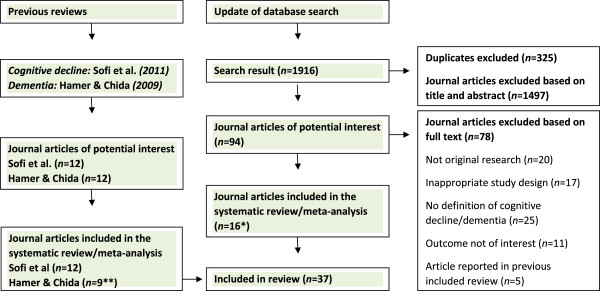
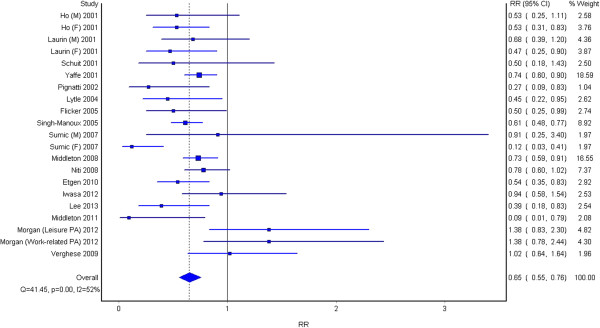
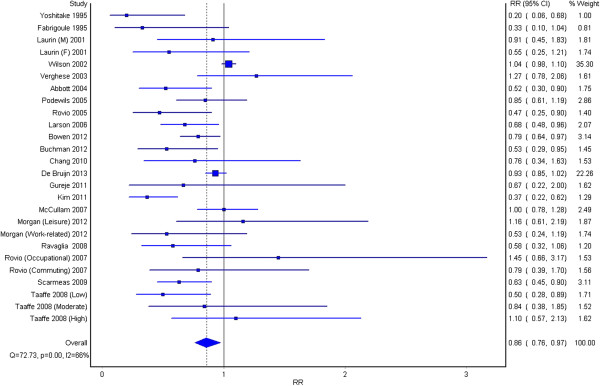
BACKGROUND: By 2050, it has been estimated that approximately one-fifth of the population will be made up of older adults (aged ≥60 years). Old age often comes with cognitive decline and dementia. Physical activity may prevent cognitive decline and dementia. METHODS: We reviewed and synthesised prospective studies into physical activity and cognitive decline, and physical activity and dementia, published until January 2014. Forty-seven cohorts, derived from two previous systematic reviews and an updated database search, were used in the meta-analyses. Included participants were aged ≥40 years, in good health and/or randomly selected from the community. Studies were assessed for methodological quality. RESULTS: Twenty-one cohorts on physical activity and cognitive decline and twenty-six cohorts on physical activity and dementia were included. Meta-analysis, using the quality-effects model, suggests that participants with higher levels of physical activity, when compared to those with lower levels, are at reduced risk of cognitive decline, RR 0.65, 95% CI 0.55-0.76, and dementia, RR 0.86, 95% CI 0.76-0.97. Sensitivity analyses revealed a more conservative estimate of the impact of physical activity on cognitive decline and dementia for high quality studies, studies reporting effect sizes as ORs, greater number of adjustments (≥10), and longer follow-up time (≥10 years). When one heavily weighted study was excluded, physical activity was associated with an 18% reduction in the risk of dementia (RR 0.82; 0.73-0.91). CONCLUSIONS: Longitudinal observational studies show an association between higher levels of physical activity and a reduced risk of cognitive decline and dementia. A case can be made for a causal interpretation. Future research should use objective measures of physical activity, adjust for the full range of confounders and have adequate follow-up length. Ideally, randomised controlled trials will be conducted. Regardless of any effect on cognition, physical activity should be encouraged, as it has been shown to be beneficial on numerous levels.
Overview
The claims and statistics of this paper haven’t been checked yet.
Free: it reads the open-access text and checks the first 5 claims that cite a source we can check. Create a free account to check every claim.
Integrity signals
Registry
Cites
Statistics
Figures
Verification
Claims the paper makes
The claims and statistics of this paper haven’t been checked yet.
Free: it reads the open-access text and checks the first 5 claims that cite a source we can check. Create a free account to check every claim.
Claims other papers make about this one
Each is checked against this paper’s own text: does it say what the citing paper says it does?
The source backs part of the claim, not all of it — or backs it for a different population, condition or comparison.
In the citing paper
“A meta-analysis of these studies concluded that physically active adults had a 35% lower risk of cognitive decline (relative risk, 0.65; 95% confidence interval, 0.55–0.76) compared with those who were physically inactive.93”
From Defining Optimal Brain Health in Adults: A Presidential Advisory From the American Heart Association/American Stroke Association (2017) · cites this paper as [93]
Experimental — accuracy not yet measuredThe cited source says what the claim attributes to it.
In the citing paper
“In contrast, physical activity appears to decrease risk. [119][120]0][121][122][123][124][125][126][127][128]”
From 2023 Alzheimer's disease facts and figures (2023) · cites this paper as [124]
Experimental — accuracy not yet measuredThe cited source says what the claim attributes to it.
In the citing paper
“Prospective observational studies have generally found a positive association between physical activity and cognitive health outcomes.”
From Defining Optimal Brain Health in Adults: A Presidential Advisory From the American Heart Association/American Stroke Association (2017) · cites this paper as [93]
Self-check
Percentages, sums and reported differences re-computed from the paper’s own numbers.
The self-check needs the paper’s full text.
Citations
Cites
Preferred Reporting Items for Systematic Reviews and Meta-Analyses: the PRISMA statement
Moher, D., Liberati, A., Tetzlaff, J., Altman, D. G., & for the PRISMA Group (2009) · BMJ · doi:10.1136/bmj.b2535 · Cited by 83,823
Preferred reporting items for systematic reviews and meta-analyses: the PRISMA Statement.
(2009) · PubMed Central · Cited by 44,859
Preferred reporting items for systematic reviews and meta-analyses: The PRISMA statement
Moher, D., Liberati, A., Tetzlaff, J., Altman, D. G., & the PRISMA Group* (2009) · Annals of Internal Medicine · doi:10.7326/0003-4819-151-4-200908180-00135 · Cited by 37,554
Preferred Reporting Items for Systematic Reviews and Meta-Analyses: The PRISMA Statement
Moher, D., Liberati, A., Tetzlaff, J., & Altman, D. G. (2009) · Journal of Clinical Epidemiology · doi:10.1016/j.jclinepi.2009.06.005 · Cited by 19,575
Lippa, N. C., & Sanderson, S. C. (2013) · Human Heredity · doi:10.1159/000353712 · Cited by 6,078
Diagnostic and Statistical Manual of Mental Disorders ( DSM ‐ IV ‐ TR )
Segal, D. L. (2010) · The Corsini Encyclopedia of Psychology · doi:10.1002/9780470479216.corpsy0271 · Cited by 4,666
Pate, R. R. (1995) · JAMA · doi:10.1001/jama.1995.03520290054029 · Cited by 4,606 · cited 1×
“A curvilinear relationship, with diminishing returns, seems the most likely association [72]; however, more research in this area is needed.”
BackgroundMACMAHON, S. (1990) · The Lancet · doi:10.1016/0140-6736(90)90878-9 · Cited by 4,253 · cited 1×
“Inaccuracies in measurement of physical activity, as outlined above, may lead to regression dilution bias, whereby imprecise measurement of the exposure variable may bias a result toward null [70].”
BackgroundInternational Encyclopedia of the Social Sciences.
Duncan, O. D., & Sills, D. L. (1968) · American Sociological Review · doi:10.2307/2092889 · Cited by 3,486
An active and socially integrated lifestyle in late life might protect against dementia
Fratiglioni, L., Paillard-Borg, S., & Winblad, B. (2004) · The Lancet Neurology · doi:10.1016/s1474-4422(04)00767-7 · Cited by 2,135 · cited 3×
“In the meantime, given that physical activity has been shown to be beneficial across multiple health domains, genders and ages, physical activity should be encouraged regardless of its relationship with cognitive decline and dementia [73].”
BackgroundInfluential
Research works printed but not linked: 1
- Rothman KJ Greenland S Lash TL Modern Epidemiology 2008 Philadelphia, PA: Lippincott Williams & Wilkins
Cited by
Items 401–500 of 1,000
The Potential of a Stratified Approach to Drug Repurposing in Alzheimer’s Disease
Anderson, C., Bucholc, M., McClean, P. L., & Zhang, S. (2023) · Biomolecules · doi:10.3390/biom14010011 · Cited by 16
Physical activity, brain tissue microstructure, and cognition in older adults
Dawe, R. J., Yu, L., Leurgans, S. E., James, B. D., Poole, V. N., Arfanakis, K., Schneider, J. A., Bennett, D. A., & Buchman, A. S. (2021) · PLoS ONE · doi:10.1371/journal.pone.0253484 · Cited by 13
“Notably, many observational studies have reported associations between habitual physical activity level and cognitive levels [3,4] and trajectories [5,6] among older adults.”
BackgroundThe relationship between aerobic capacity and cognitive/academic performance in medical students
Bayramlar, Z., Ankaralı, S., & Ankaralı, H. Ç. (2022) · General Physiology and Biophysics · doi:10.4149/gpb_2022031 · Cited by 15
Vancampfort, D., Lara, E., Stubbs, B., Swinnen, N., Probst, M., & Koyanagi, A. (2018) · Public Health · doi:10.1016/j.puhe.2017.12.002 · Cited by 14
Zapata-Diomedi, B., Both, A., Abbas, A., Woodcock, J., Kroen, A., Davern, M. T., & Gunn, L. (2023) · Journal of Transport & Health · doi:10.1016/j.jth.2023.101628 · Cited by 13
Katsipis, G., Tzekaki, E. E., Andreadou, E. G., Mouzakidis, C., Baldimtsi, E. N., Karathanasi, E. M., Hassandra, M., Galanis, E., Hatzigeorgiadis, A., Γούδας, Μ., et al. (2024) · Neuroscience Applied · doi:10.1016/j.nsa.2024.104085 · Cited by 13
“Though findings showed that P Е ameliorates cognitive decline and dementia (Blondell et al., 2014), the effect of Physical Exercise (PE) on AD hallmarks in human patients suffering from MCI or AD has not yet been examined in detail (Frederiksen et al., 2018; Huang et al., 2021; Jensen et al., 2015).”
Physical activity and hippocampal volume in young adults
Cherednichenko, A., Miró‐Padilla, A., Adrián‐Ventura, J., Monzonís‐Carda, I., Beltran‐Valls, M. R., Moliner‐Urdiales, D., & Ávila, C. (2024) · Brain Imaging and Behavior · doi:10.1007/s11682-024-00916-4 · Cited by 13
“Lifestyle behaviors tend to be established during young adulthood, forming patterns that may persist later in life, with consequential health benefits or risks (Grant et al., 2019 ). decline (Blondell et al., 2014 ).”
Accelerometer‐measured physical activity timing with incident dementia
Ning, Y., Chen, M., Yang, H., & Jia, J. (2025) · Alzheimer s & Dementia · doi:10.1002/alz.14452 · Cited by 13
Shadyab, A. H., Aslanyan, V., Jacobs, D. M., Salmon, D. P., Morrison, R. H., Katula, J. A., Jin, S., Thomas, R. G., LaCroix, A. Z., Pa, J., et al. (2025) · Alzheimer s & Dementia · doi:10.1002/alz.70118 · Cited by 13
Decaix, T., Bonnin, C., Götze, K., François, V., Petit, C., Rivière, C., Greffard, S., Cognat, E., Hugon, J., Paquet, C., et al. (2025) · The Journal of Frailty & Aging · doi:10.1016/j.tjfa.2025.100069 · Cited by 16
“Better cardiovascular and metabolic health through regular physical activity can simultaneously lower the risk of neurodegeneration, thereby reducing the likelihood of cognitive decline and dementia [7 – 9].”
Bagheri, N., Wangdi, K., Cherbuin, N., & Anstey, K. J. (2018) · The Journal of Prevention of Alzheimer s Disease · doi:10.14283/jpad.2017.33 · Cited by 12
“These tools are based on established dementia risk factors such as diabetes, hypertension, hypercholesterolemia, smoking, and obesity (24-27), and protective factors such as physical exercise, social engagements, and fish oil consumption (28, 29).”
Sariyska, R., & Montag, C. (2019) · Studies in neuroscience, psychology and behavioral economics · doi:10.1007/978-3-030-31620-4_4 · Cited by 13
Measuring activity engagement in old age: An exploratory factor analysis
Marr, C., Vaportzis, E., Niechcial, M. A., Dewar, M., & Gow, A. J. (2021) · PLoS ONE · doi:10.1371/journal.pone.0260996 · Cited by 12
Kato, G., Doi, T., Arai, H., & Shimada, H. (2022) · Physical Therapy Research · doi:10.1298/ptr.e10153 · Cited by 12
Scheffey, K., Avelis, J., Patel, M. S., Oon, A. L., Evans, C. N., & Glanz, K. (2022) · Health Promotion Practice · doi:10.1177/15248399221113863 · Cited by 13
Physical activity, memory function, and hippocampal volume in adults with Down syndrome
Peven, J. C., Handen, B. L., Laymon, C. M., Fleming, V., Piro‐Gambetti, B., Christian, B., Klunk, W. E., Cohen, A. D., Okonkwo, O. C., & Hartley, S. L. (2022) · Frontiers in Integrative Neuroscience · doi:10.3389/fnint.2022.919711 · Cited by 13
“, 2019) and reduced risk of dementia in neurotypical adults (Blondell et al., 2014; Xu et al., 2017).”
BackgroundAssociations between data-driven lifestyle profiles and cognitive function in the AusDiab study
Dingle, S. E., Bowe, S. J., Bujtor, M., Milte, C. M., Daly, R. M., Anstey, K. J., Shaw, J. E., & Torres, S. J. (2022) · BMC Public Health · doi:10.1186/s12889-022-14379-z · Cited by 12
Zheng, L., Eramudugolla, R., Cherbuin, N., Drouin, S. M., Dixon, R. A., & Anstey, K. J. (2023) · Scientific Reports · doi:10.1038/s41598-023-34485-1 · Cited by 13
Yang, J. M., Lee, H. J., & Kim, J. (2023) · Preventive Medicine Reports · doi:10.1016/j.pmedr.2023.102261 · Cited by 12
Tabacu, L. M., Ledbetter, M. K., Leroux, A., Crainiceanu, C. M., & Smirnova, E. (2020) · Sensors · doi:10.3390/s21010004 · Cited by 14
Fungsi Kognitif dan Aktivitas Fisik pada Lansia Petani
Mubarroq, F. A. A., Putra, K. P., & Rayanti, R. E. (2022) · Jurnal Keperawatan Jiwa · doi:10.26714/jkj.10.1.2022.17-22 · Cited by 12
“Untuk menghambat penurunan fungsi kognitif lansia diperlukan pencegahan salah satunya dengan memperbanyak aktivitas fisik (Blondell et al., 2014).”
BackgroundGrassmann, V., Subramaniapillai, M., Duncan, M., Arbour‐Nicitopoulos, K. P., & Faulkner, G. (2017) · Brazilian Journal of Psychiatry · doi:10.1590/1516-4446-2016-2106 · Cited by 13
Behavioural change, weight loss and risk of dementia: A longitudinal study
Astell‐Burt, T., Navakatikyan, M., & Feng, X. (2020) · Preventive Medicine · doi:10.1016/j.ypmed.2020.106386 · Cited by 13
Briggs, R., Kennelly, S., & O’Neill, D. J. (2019) · Springer eBooks · doi:10.1007/978-3-030-06200-2_15 · Cited by 12
Callow, D. D., Spira, A. P., Zipunnikov, V., Lu, H., Wanigatunga, S., Rabinowitz, J. A., Albert, M., Bakker, A., & Soldan, A. (2024) · NeuroImage Clinical · doi:10.1016/j.nicl.2024.103621 · Cited by 13
“Greater engagement in physical activity (Blondell et al., 2014; Nuzum et al., 2020; Sewell et al., 2023a) and adequate sleep quality and duration (Sabia et al., 2021; Shi et al., 2018) are associated with a reduced rate of cognitive decline and a lower risk of dementia.”
Wang, J., Zhang, G., Lai, H., Li, Z., Shen, M., Li, C., Kwan, P., O'Brien, T. J., Wu, T., Yang, S., et al. (2024) · Journal of Alzheimer s Disease · doi:10.3233/jad-240597 · Cited by 12
Physical activity changes during midlife link to brain integrity and amyloid burden
Akinci, M., Dominguez, P. A., Palpatzis, E., Shekari, M., García-Prat, M., Deulofeu, C., Fauria, K., García‐Aymerich, J., Gispert, J. D., Suárez‐Calvet, M., et al. (2025) · Alzheimer s & Dementia · doi:10.1002/alz.70007 · Cited by 13
Chortane, O. G., Hammami, R., Amara, S., Chortane, S. G., Suzuki, K., Oliveira, R. F. S., & Nobarı, H. (2022) · Sustainability · doi:10.3390/su14074112 · Cited by 12
Schuhmacher, T. P., Andresen, M., & Fallahpour, M. (2022) · Scandinavian Journal of Occupational Therapy · doi:10.1080/11038128.2022.2112282 · Cited by 13
The effects of a mobile-based multi-domain intervention on cognitive function among older adults
Kim, J., Ko, M., Lee, J., & Kim, Y. (2023) · Preventive Medicine Reports · doi:10.1016/j.pmedr.2023.102165 · Cited by 14
“Researchers have also found evidence that physical activity/exercise programs can play an important role in improving the cognitive health of older adults and reducing their risk of dementia (Blondell et al., 2014; Guure et al., 2017; Rosness et al., 2014).”
BackgroundThe Feeling of Pleasure for Overweight Children during Different Types of Physical Activity
Hawani, A., Chikha, A. B., Souissi, M. A., Trabelsi, O., Mrayah, M., Souissi, N., Marsigliante, S., & Muscella, A. (2023) · Children · doi:10.3390/children10091526 · Cited by 12
“Conversely, the prevalence of physical activity correlates positively with good feelings and satisfaction and negatively with anxiety, depression [13], and cognitive decline [14].”
Miró‐Padilla, A., Adrián‐Ventura, J., Cherednichenko, A., Monzonís‐Carda, I., Beltran‐Valls, M. R., Moliner‐Urdiales, D., & Ávila, C. (2023) · Communications Biology · doi:10.1038/s42003-023-05423-8 · Cited by 13
“igh levels of daily physical activity (PA) has multiple bene fi ts for physical health and acts as a protector against psychological (e.g., depression and anxiety) and neuro-degenerative (e.g., Parkinson ’ s disease) illnesses 1,2 .”
Guo, Y., Yang, M., Yan, Y., Wang, L. Y., & Gong, J. (2018) · Scientific Reports · doi:10.1038/s41598-018-22475-7 · Cited by 13
“MMSE measured: (1) temporal and spatial orientation: 10 points; (2) immediate memory: 3 points; (3) recall: 3 points; (4) attention: 5 points and (5) language: 9 points.”
MethodKurose, S., Miyauchi, T., Yamashita, R., Tamaki, S., Imai, M., Nakashima, Y., Umeda, Y., Sato, S., Kimura, Y., & Masuda, I. (2019) · Journal of Cardiology · doi:10.1016/j.jjcc.2018.12.015 · Cited by 12
“A previous meta-analysis, using the qualityeffects model, suggested that participants with higher levels of physical activity are at reduced risk of cognitive decline and dementia than those with lower levels of physical activity [29].”
MethodAnnear, M. J., Lucas, P., WILKINSON, T. J., & Shimizu, Y. (2019) · Australian Journal of Primary Health · doi:10.1071/py18171 · Cited by 13
Transport-related walking among young adults: when and why?
Assemi, B., Zahnow, R., Zapata-Diomedi, B., Hickman, M. D., & Corcoran, J. (2020) · BMC Public Health · doi:10.1186/s12889-020-8338-0 · Cited by 11
Cognitive ability and metabolic physical health in first-episode psychosis
Whitson, S., O'Donoghue, B. N., Hester, R., Baldwin, L., Harrigan, S., Francey, S. M., Graham, J. R., Nelson, B., Ratheesh, A., Álvarez‐Jiménez, M., et al. (2021) · Schizophrenia Research Cognition · doi:10.1016/j.scog.2021.100194 · Cited by 13
“Conversely, physical activity is protective against cognitive decline, with the best evidence in the elderly (Blondell et al., 2014).”
BackgroundSitting Time, Physical Activity, and Cognitive Impairment in Midlife and Older Adults
Gafni, T., Shuval, K., Weinstein, G., Barlow, C. E., Gabriel, K. P., Willis, B. L., Leonard, D. S., Haskell, W. L., & DeFina, L. F. (2021) · Journal of Aging and Physical Activity · doi:10.1123/japa.2020-0473 · Cited by 12
Kim, D., Ko, Y., & Jung, A. (2022) · Frontiers in Public Health · doi:10.3389/fpubh.2022.1009775 · Cited by 12
Walk the Talk: Characterizing Mobility in Older Adults Living on Low Income
Chudyk, A. M., Sims‐Gould, J., Ashe, M. C., Winters, M., & McKay, H. A. (2017) · Canadian Journal on Aging / La Revue canadienne du vieillissement · doi:10.1017/s0714980817000046 · Cited by 15
Feng, X., Zhang, L., Hou, Y., Ma, W., Ma, J., Chang, X., & Yang, L. (2024) · The Journal of Prevention of Alzheimer s Disease · doi:10.14283/jpad.2024.30 · Cited by 11
Khalil, M. I. M., Shaala, R. S., Mousa, E. F. S., El‐Monshed, A. H., & Atta, M. H. R. (2024) · Geriatric Nursing · doi:10.1016/j.gerinurse.2024.12.022 · Cited by 11
van den Berg, F., Brouwer, J., Loerts, H., Knooihuizen, R., & Keijzer, M. C. J. (2025) · The Journals of Gerontology Series B · doi:10.1093/geronb/gbae200 · Cited by 10
“…and lifestyle factors have been suggested to augment cognitive reserve, including but not limited to a higher level of education (Meng and D’Arcy, 2012), physical activity (Blondell et al., 2014), and engagement in (complex) activities such as playing a musical instrument (Amer et al., 2013).”
Zhang, J., Wei, Y., Wang, L., Zhang, F., & Wu, Z. (2025) · Experimental Gerontology · doi:10.1016/j.exger.2025.112768 · Cited by 15
“…offer critical insights for developing personalized exercise prescriptions tailored to the specific cognitive needs of older adults. the cognitive benefits of exercise could play a pivotal role in alleviating the societal and economic burdens associated with dementia (Blondell et al., 2014).”
Khotbehsara, M. M., Soar, J., Lokuge, S., Khotbehsara, E. M., & Ip, W. K. (2025) · Journal of Clinical Medicine · doi:10.3390/jcm14155475 · Cited by 11
“…VR based interventions have shown promise in reducing depressive symptoms, lifestyle strategies such as regular physical activity, a healthy diet, and sufficient sleep have consistently provided stronger and more reliable benefits for mood and overall well-being in this population [13,14,17,19].”
Simplified Tai Chi 6-Form Apparatus for Balance in Elderly People with Alzheimer’s Disease
Lin, Y.-C., Hsu, W., Chen, C., Wang, C.-W., Wu, K. P.-H., & Wong, M. (2018) · Journal of Medical and Biological Engineering · doi:10.1007/s40846-018-0451-5 · Cited by 12
Exercise interventions for maintaining cognitive function in cognitively healthy people in mid life
Forbes, S. C., Forbes, D. A., Forbes, S. C., Blake, C. M., Chong, L. Y., Thiessen, E., Little, J. P., & Rutjes, A. W. (2015) · Cochrane Database of Systematic Reviews · doi:10.1002/14651858.cd011705 · Cited by 11
Hao, Z., Liu, K., Zhou, L., & Chen, P. (2023) · Frontiers in Physiology · doi:10.3389/fphys.2023.1193031 · Cited by 11
Ambrens, M., Macniven, R., Perram, A., Andrews, S. C., Hawley-Hague, H., Razee, H., Todd, C. J., Valenzuela, T., & Delbaere, K. (2024) · Journal of Applied Gerontology · doi:10.1177/07334648241238315 · Cited by 10
“The causal relationship between physical inactivity and a raft of physical and mental health conditions is well-established (Ahmed et al., 2012; Blondell et al., 2014; Lane, 2006; McTiernan, 2008; Strawbridge et al., 2002; Tuomilehto et al., 2001).”
Hu, C., Jiang, K., Sun, X., He, Y., Li, R., Chen, Y., Zhang, Y., Tao, Y., & Jin, L. (2024) · The Journals of Gerontology Series A · doi:10.1093/gerona/glae148 · Cited by 11
Smoking and Alcohol Consumption Following a New Dementia Diagnosis
Arora, K., & Bhagianadh, D. (2019) · The Journals of Gerontology Series B · doi:10.1093/geronb/gbz127 · Cited by 11
Relationship Between Sedentary Behavior and Physical Activity at Work and Cognition and Mood
Carter, S. E., Draijer, R., Thompson, A., Thijssen, D. H. J., & Hopkins, N. D. (2020) · Journal of Physical Activity and Health · doi:10.1123/jpah.2019-0632 · Cited by 10
Gafni, T., Gabriel, K. P., Shuval, K., Yaffe, K. S., Sidney, S., & Weinstein, G. (2022) · Preventive Medicine · doi:10.1016/j.ypmed.2022.107291 · Cited by 10
Lim, S., Yoo, E., Hong, I., & Park, J. (2023) · Epidemiology and Health · doi:10.4178/epih.e2023098 · Cited by 10
Ferro, D. A., Deijen, J. B., Koppes, L. L. J., van Mechelen, W., Twisk, J. W. R., & Drent, M. L. (2015) · Journal of Physical Activity and Health · doi:10.1123/jpah.2014-0594 · Cited by 14
Brain metabolites are associated with sleep architecture and cognitive functioning in older adults
Mueller, C., Nenert, R. E., Catiul, C., Pilkington, J., Szaflarski, J. P., & Amara, A. W. (2024) · Brain Communications · doi:10.1093/braincomms/fcae245 · Cited by 9
“9,10 Increasing evidence also points to sleep deprivation as a significant risk factor for cognitive decline and dementia in older age.”
BackgroundRostekova, A., Lampraki, C., Maurer, J., Meier, C., Wieczorek, M., & Ihle, A. (2025) · Scientific Reports · doi:10.1038/s41598-025-03727-9 · Cited by 9
“Firstly, an increase in physical activity and a decrease in loneliness are both factors known to be related to reduced risk and a slower rate of cognitive decline 23,24 Secondly, pet ownership has also been associated with increased social interaction 25 and reduced anxiety symptoms 26 .”
Pérez-Lasierra, J. L., Casajús, J. A., Casasnovas, J. A., Arbonés-Mainar, J. M., Lobo, A., Lobo, E., Moreno‐Franco, B., & González‐Agüero, A. (2021) · International Journal of Environmental Research and Public Health · doi:10.3390/ijerph18147238 · Cited by 9
“On the other hand, protective factors of CD have also been reported [12,14,26], including intellectual activity and lifestyles aspects such as social interaction and physical activity (PA) [27,28].”
BackgroundResultAcute and chronic physical activity improves spatial memory in an immersive virtual reality task
Butavand, D. R., Rodríguez, M. F., Cifuentes, M. V., Miranda, M., Bauza, C. G., Bekinschtein, P., & Ballarini, F. (2023) · iScience · doi:10.1016/j.isci.2023.106176 · Cited by 9
“We compared male and female performance and did not find significant differences between sexes [twoway ANOVA, short-distance: (control, n_F = 5, n_M = 5; acute, n_F = 4, n_M = 5; chronic, n_F = 2, n_M = 8) F(1,23) = 0.”
Siew, S. K. H., Yu, J., Teo, T. L., Chua, K. C., Mahendran, R., & Rawtaer, I. (2024) · PLoS ONE · doi:10.1371/journal.pone.0293340 · Cited by 9
Levinger, P., Fearn, M., Dreher, B. L., Bauman, A. E., Brusco, N. K., Gilbert, A. S., Soh, S., Burton, E., James, L., & Hill, K. (2024) · Archives of Public Health · doi:10.1186/s13690-024-01262-z · Cited by 9
“The health benefits of physical activity are well established, including reduced risk of chronic diseases, increased cognitive and functional capacities and improvement in mental health [51, 52].”
BackgroundZhao, Q., & Seow, W. J. (2024) · Environmental Research · doi:10.1016/j.envres.2024.119538 · Cited by 9
Dietary interventions for maintaining cognitive function in cognitively healthy people in mid life
Harrison, S. L., Birdi, R., Smart, C., Brittain, K., Rutjes, A. W., Siervo, M., & Stephan, B. C. M. (2015) · Cochrane Database of Systematic Reviews · doi:10.1002/14651858.cd011911 · Cited by 9
Abe, T., Fujii, K., Seol, J., Fujii, Y., Joho, K., Sato, A., Kim, M., & Okura, T. (2018) · Journal of Transport & Health · doi:10.1016/j.jth.2018.01.010 · Cited by 9
He, F., Lin, J., Li, F., Zhai, Y., Zhang, T., Gu, X. F., & Zhao, G. (2021) · Current Alzheimer Research · doi:10.2174/1567205018666211118100451 · Cited by 9
Lee, K. H., Lee, J. Y., & Kim, B. (2022) · Worldviews on Evidence-Based Nursing · doi:10.1111/wvn.12591 · Cited by 9
Martin, P., Gondo, Y., Lee, G., Woodard, J. L., Miller, L. S., & Poon, L. W. (2022) · Experimental Aging Research · doi:10.1080/0361073x.2022.2106717 · Cited by 12
Sewell, K. R., Rainey‐Smith, S. R., Peiffer, J. J., Sohrabi, H. R., Doecke, J. D., Frost, N. J., Markovic, S. J., Erickson, K. I., & Brown, B. M. (2023) · International Journal of Geriatric Psychiatry · doi:10.1002/gps.6016 · Cited by 9
“2,3 Exercise is a structured or planned form of physical activity, 4 the evidence for exercise interventions to modify cognitive function has been inconclusive and less consistent, compared to the observational physical activity literature.”
ResultLópez-Fontana, I., Castanier, C., Scanff, C. L., & Perrot, A. (2017) · Journal of Aging and Physical Activity · doi:10.1123/japa.2016-0362 · Cited by 12
Smith, L., & Argentina, V. (2019) · Research in Gerontological Nursing · doi:10.3928/19404921-20190930-04 · Cited by 9
Cognitive performance in relation to metabolic disturbances in patients with COPD
van Beers, M., Gosker, H. R., Janssen, D. J. A., Cleutjens, F. A. H. M., Franssen, F. M. E., van Boxtel, M. P. J., Wouters, E. F. �., Ponds, R., & Schols, A. M. W. J. (2020) · Clinical Nutrition · doi:10.1016/j.clnu.2020.09.029 · Cited by 10
Recent advances in the understanding of cognitive decline among the elderly
Gangolli, V. (2016) · Journal of Geriatric Mental Health · doi:10.4103/2348-9995.181914 · Cited by 39
Fitness and dementia risk: Further evidence of the heart-brain connection
Spartano, N. L., & Ngandu, T. (2018) · Neurology · doi:10.1212/wnl.0000000000005282 · Cited by 9
“Observational data suggest that better adherence to a healthy lifestyle is associated with lower dementia risk.(2,3) Evidence from randomized clinical trials demonstrating cognitive benefits of a lifestyle intervention is only starting to emerge.”
BackgroundWang, Y., Chen, Q., Liu, L., He, Q., Cheung, J. C., Wong, D. W., Liu, Y., & Lam, W. (2023) · iScience · doi:10.1016/j.isci.2023.107399 · Cited by 9
“55, respectively, to dementia and Alzheimer’s disease.(3) The World Health Organization (WHO) recommends older adults should perform regular muscle strengthening exercises and multi-component physical activity at moderate or greater intensity on three or more days a week, regardless of their level of mobility.”
Lifestyle Matters: Effects of Habitual Physical Activity on Driving Skills in Older Age
Gökçe, E., Stojan, R., Mack, M., Bock, O. L., & Voelcker‐Rehage, C. (2022) · Brain Sciences · doi:10.3390/brainsci12050608 · Cited by 10
“It was shown that, for example, daily activities involving physical exertion are associated with reduced cognitive loss in older adults [50] and engaging in physical activity attenuates the risk of progressive cognitive decline [51].”
BackgroundHall, A., Manning, F., & Goodwin, V. A. (2023) · BMJ Open · doi:10.1136/bmjopen-2023-072432 · Cited by 10
Zhang, J., Wu, Z., Tan, W., Liu, D., Cheng, G., Xu, L., Hu, F., & Zeng, Y. (2023) · Frontiers in Aging Neuroscience · doi:10.3389/fnagi.2023.1200671 · Cited by 12
Meernik, C., Eilat-Adar, S., Leonard, D., Barlow, C. E., Gerber, Y., Tesler, R., Shanks, C. B., Gabriel, K. P., Pavlovic, A., DeFina, L. F., et al. (2024) · International Journal of Behavioral Nutrition and Physical Activity · doi:10.1186/s12966-024-01663-x · Cited by 8
“Self-reported physical activity is associated with a lower risk of dementia [4, 25– 27], but it can be prone to measurement error [28] and is a worse predictor of morbidity than CRF [29].”
BackgroundMobility and Cognitive Decline in Older Adults with Cognitive Impairment
Ward, C., Touchet, E., Marfeo, E. E., & Ward, N. (2020) · Cambridge University Press eBooks · doi:10.1017/9781108552684.043 · Cited by 9
Park, K. S., Ganesh, A. B., Berry, N. T., Mobley, Y. P., Karper, W. B., Labban, J. D., Wahlheim, C. N., Williams, T. M., Wideman, L., & Etnier, J. L. (2020) · BMC Neurology · doi:10.1186/s12883-020-01732-1 · Cited by 10
Byeon, H. (2021) · Iranian Journal of Public Health · doi:10.18502/ijph.v50i2.5346 · Cited by 10
“However, previous studies in the past 20 yr have reported that it would be possible to prevent cognitive impairment in the old age such as dementia by altering risk factors such as health behaviors (3, 4).”
BackgroundBoyd, B., McAlister, C. B., Arrotta, K., & Schmitter‐Edgecombe, M. (2021) · Journal of Aging and Health · doi:10.1177/08982643211032483 · Cited by 10
“Although some studies have not found a relationship between physical activity and dementia, previous meta-analyses suggest that higher levels of physical activity likely reduce the risk of cognitive decline and dementia (Blondell et al., 2014).”
ResultSinclair, B., Steward, C., Venkatraman, V. K., Aljondi, R., Cox, K. L., Ellis, K. A., Ames, D. J., Masters, C. L., Phal, P. M., Sharman, M. J., et al. (2021) · Brain Imaging and Behavior · doi:10.1007/s11682-021-00577-7 · Cited by 8
“Meta-analyses of prospective studies in healthy cohorts found that baseline levels of PA are associated with a reduction in cognitive decline (Blondell et al., 2014; Sofi et al., 2011) and around a 30-40 % reduction in the relative risk of Alzheimer’s disease (AD) between most physically active and least physically ac…”
BackgroundKarjala, A., Pietiläinen, O. K., Salonsalmi, A., Lahti, J., Lallukka, T. M., & Rahkonen, O. (2022) · Scandinavian Journal of Medicine and Science in Sports · doi:10.1111/sms.14256 · Cited by 10
Liu, Z., Wang, C., Liu, G., & Najafi, B. (2022) · IEEE Transactions on Neural Systems and Rehabilitation Engineering · doi:10.1109/tnsre.2022.3228073 · Cited by 8
“, physical activity [7]), older adults with MCR are likely to develop major cognitive decline and dementia.”
BackgroundFallahnezhad, S., Ghorbani-Taherdehi, F., Sahebkar, A., Nadim, A., Kafashzadeh, M., Kafashzadeh, M., & Valokola, M. G. (2023) · Metabolic Brain Disease · doi:10.1007/s11011-023-01257-9 · Cited by 8
Li, Q., Guo, Z., Hu, F., Xiao, M., Zhang, Q., Wen, J., Ying, T., Zheng, D., Wang, Y., Song, Y., et al. (2023) · Frontiers in Public Health · doi:10.3389/fpubh.2023.1271319 · Cited by 10
Associations between physical inactivity and dementia prevalence: ecological study using global data
Lloyd-Hazlegreaves, P., Hayes, L., & Pearce, M. S. (2023) · Public Health · doi:10.1016/j.puhe.2023.10.011 · Cited by 8
Non-pharmacological motor-cognitive treatment to improve the mental health of elderly adults
Ponce, J., Latín, C., Leiva, V., Cortés-Roco, G., Rodríguez‐Rodríguez, F., & Jiménez, C. E. (2019) · Revista da Associação Médica Brasileira · doi:10.1590/1806-9282.65.3.394 · Cited by 11
Practical algorithms for managing patients with cognitive impairments
Захаров, В. В., & Васильевна, В. Н. (2019) · Meditsinskiy sovet = Medical Council · doi:10.21518/2079-701x-2019-6-27-33 · Cited by 8
The Use of Interactive Tables in Promoting Wellbeing in Specific User Groups
Good, A., Omisade, O., Ancient, C., & Andrikopoulou, E. (2019) · Lecture notes in computer science · doi:10.1007/978-3-030-22015-0_39 · Cited by 10
Active Travel and Mild Cognitive Impairment among Older Adults from Low- and Middle-Income Countries
Smith, L., Veronese, N., Sánchez, G. F. L., Yang, L., Pizzol, D., Butler, L., Barnett, Y., Félez-Nóbrega, M., Jacob, L., Shin, J. I., et al. (2021) · Journal of Clinical Medicine · doi:10.3390/jcm10061243 · Cited by 8
“First, participation in physical activity may increase or maintain cognitive reserve, through increased brain perfusion [9].”
BackgroundPereira, A. B. R., & Moraes, R. (2017) · Motor Control · doi:10.1123/mc.2017-0035 · Cited by 8
Wu, L., Wang, X., Ye, Y., & Liu, C. (2021) · Frontiers in Aging Neuroscience · doi:10.3389/fnagi.2021.664443 · Cited by 9
“For instance, patients with OA demonstrate a reduced level of physical activity, which has been reported to be associated with a higher risk of developing dementia and decline in volumes of several brain regions (Buchman et al., 2012; Blondell et al., 2014; Erickson et al., 2014).”
BackgroundLife course approach to understanding inequalities in health in later life
Bell, R., & Marmot, M. G. (2017) · Oxford University Press eBooks · doi:10.1093/med/9780198701590.003.0010 · Cited by 14
Levinger, P., Mcconaghy, R., Dreher, B. L., James, L., Fearn, M., McKenna, T., Hallissey, M., & Hill, K. (2025) · Journal of Population Ageing · doi:10.1007/s12062-024-09472-7 · Cited by 8
“Importantly, increasing physical activity has been shown to be safe and effective in improving physical and mental health outcomes in older people, including those with substantial health problems (Blondell et al. 2014; Cunha et al. 2024; Lachman et al. 2018; Singh et al. 2023).”
Davoudi, A., Donahue, P. T., Carlson, M. C., Dougherty, R. J., Wanigatunga, A. A., Freedman, V. A., & Schrack, J. A. (2025) · Medicine & Science in Sports & Exercise · doi:10.1249/mss.0000000000003656 · Cited by 9
Ergothioneine and exercise: A match made in (cognitive) heaven?
Wazny, V. K., Grgić, J., Valenzuela, P. L., Feng, L., & Maier, A. B. (2025) · Ageing Research Reviews · doi:10.1016/j.arr.2025.102993 · Cited by 7
Metadata
- Authors
- Blondell, S. J., Hammersley-Mather, R., & Veerman, J. L.
- Affiliations
- The University of Queensland (AU)
- ORCID
- Blondell, Sarah J
- Venue
- BMC Public Health
- Published
- 2014-05-27
- Volume
- 14
- Issue
- 1
- Pages
- 510-510
- ISSN
- 1471-2458 (ISSN-L)
- PMC
- PMC4064273
- OpenAlex
- W2105024128
- Semantic Scholar
- c6c3c6f306e2fb74a87a7a2cfc60ccd4ce9c5bc3
- Cited by
- 928
- References
- 86
- Citations by year
- 2026: 64 · 2025: 81 · 2024: 91 · 2023: 89 · 2022: 111 · 2021: 91 · 2020: 116 · 2019: 80 · 2018: 58 · 2017: 66 · 2016: 51 · 2015: 24 · 2014: 5
- FWCI
- 6.70
- Type
- journal article
- Language
- en
- Open access
- gold
- doi.org
- Licence
- Locations
- BMC Public Health (publishedVersion, cc-by)
- Europe PMC (PubMed Central) (publishedVersion, cc-by)
- PubMed Central (publishedVersion, cc-by)
- PubMed (publishedVersion)
- University of Southern Queensland ePrints (University of Southern Queensland) (acceptedVersion)
- Griffith Research Online (submittedVersion, cc-by)
- Topics
- Health Sciences › Medicine › Psychiatry and Mental health › Dementia and Cognitive Impairment Research
- Health Sciences › Medicine › Public Health, Environmental and Occupational Health › Physical Activity and Health
- Health Sciences › Medicine › Critical Care and Intensive Care Medicine › Intensive Care Unit Cognitive Disorders
- Keywords
- physical activity, cognitive decline, dementia, older adults, dementia prevention, cognitive aging, prospective cohort
- MeSH terms
- Aged, Aged, 80 and over, Dementia, Female, Humans, Longitudinal Studies, Male, Middle Aged, Motor Activity, Cohort Studies
About these checks
Registry, retraction, Cites and statistics results are computed, not judged, with one exception: a printed reference that no index lists is read once by a model before it counts as a citation error. Claims are extracted by a model and kept only when their quote appears verbatim in the text; each cited source is then checked, with a model’s help, for whether it says what the claim relies on. Those verdicts can be wrong — read the claim’s quote and the cited source before relying on one.
Statistics and arithmetic are recomputed, not judged.
Confidence bands are shown only for fields calibrated on our annotated test set. None is calibrated yet, so no band is shown.
What counts as a claim ›How we measure confidence ›How we check this ›
Are you an author, or do you see a problem with this page? Request a review
Data sources
Bibliographic data: Semantic Scholar, OpenAlex, Crossref.
Contains information from the Semantic Scholar Academic Graph Datasets, made available under the ODC Attribution License (ODC-BY 1.0).
Semantic Scholar’s data is described in: Kinney, R., et al. (2023). The Semantic Scholar Open Data Platform. arXiv:2301.10140.
