

Does physical activity prevent cognitive decline and dementia?: A systematic review and meta-analysis of longitudinal studies
Open accessThe DOI matches its Crossref record; 85 of the 86 references it cites were found in a registry or an index, and 1 are not checked yet.
Abstract
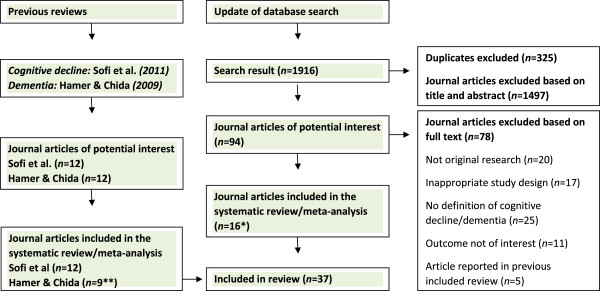
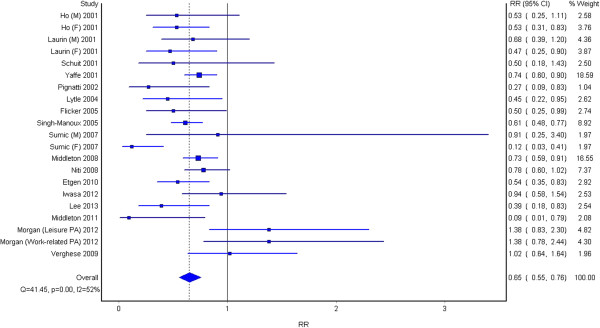
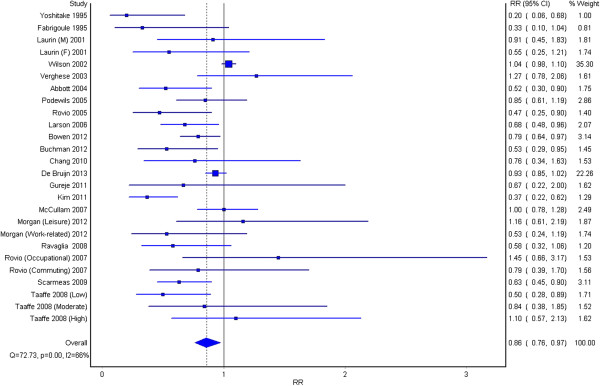
BACKGROUND: By 2050, it has been estimated that approximately one-fifth of the population will be made up of older adults (aged ≥60 years). Old age often comes with cognitive decline and dementia. Physical activity may prevent cognitive decline and dementia. METHODS: We reviewed and synthesised prospective studies into physical activity and cognitive decline, and physical activity and dementia, published until January 2014. Forty-seven cohorts, derived from two previous systematic reviews and an updated database search, were used in the meta-analyses. Included participants were aged ≥40 years, in good health and/or randomly selected from the community. Studies were assessed for methodological quality. RESULTS: Twenty-one cohorts on physical activity and cognitive decline and twenty-six cohorts on physical activity and dementia were included. Meta-analysis, using the quality-effects model, suggests that participants with higher levels of physical activity, when compared to those with lower levels, are at reduced risk of cognitive decline, RR 0.65, 95% CI 0.55-0.76, and dementia, RR 0.86, 95% CI 0.76-0.97. Sensitivity analyses revealed a more conservative estimate of the impact of physical activity on cognitive decline and dementia for high quality studies, studies reporting effect sizes as ORs, greater number of adjustments (≥10), and longer follow-up time (≥10 years). When one heavily weighted study was excluded, physical activity was associated with an 18% reduction in the risk of dementia (RR 0.82; 0.73-0.91). CONCLUSIONS: Longitudinal observational studies show an association between higher levels of physical activity and a reduced risk of cognitive decline and dementia. A case can be made for a causal interpretation. Future research should use objective measures of physical activity, adjust for the full range of confounders and have adequate follow-up length. Ideally, randomised controlled trials will be conducted. Regardless of any effect on cognition, physical activity should be encouraged, as it has been shown to be beneficial on numerous levels.
Overview
The claims and statistics of this paper haven’t been checked yet.
Free: it reads the open-access text and checks the first 5 claims that cite a source we can check. Create a free account to check every claim.
Integrity signals
Registry
Cites
Statistics
Figures
Verification
Claims the paper makes
The claims and statistics of this paper haven’t been checked yet.
Free: it reads the open-access text and checks the first 5 claims that cite a source we can check. Create a free account to check every claim.
Claims other papers make about this one
Each is checked against this paper’s own text: does it say what the citing paper says it does?
The source backs part of the claim, not all of it — or backs it for a different population, condition or comparison.
In the citing paper
“A meta-analysis of these studies concluded that physically active adults had a 35% lower risk of cognitive decline (relative risk, 0.65; 95% confidence interval, 0.55–0.76) compared with those who were physically inactive.93”
From Defining Optimal Brain Health in Adults: A Presidential Advisory From the American Heart Association/American Stroke Association (2017) · cites this paper as [93]
Experimental — accuracy not yet measuredThe cited source says what the claim attributes to it.
In the citing paper
“In contrast, physical activity appears to decrease risk. [119][120]0][121][122][123][124][125][126][127][128]”
From 2023 Alzheimer's disease facts and figures (2023) · cites this paper as [124]
Experimental — accuracy not yet measuredThe cited source says what the claim attributes to it.
In the citing paper
“Prospective observational studies have generally found a positive association between physical activity and cognitive health outcomes.”
From Defining Optimal Brain Health in Adults: A Presidential Advisory From the American Heart Association/American Stroke Association (2017) · cites this paper as [93]
Self-check
Percentages, sums and reported differences re-computed from the paper’s own numbers.
The self-check needs the paper’s full text.
Citations
Cites
Preferred Reporting Items for Systematic Reviews and Meta-Analyses: the PRISMA statement
Moher, D., Liberati, A., Tetzlaff, J., Altman, D. G., & for the PRISMA Group (2009) · BMJ · doi:10.1136/bmj.b2535 · Cited by 83,823
Preferred reporting items for systematic reviews and meta-analyses: the PRISMA Statement.
(2009) · PubMed Central · Cited by 44,859
Preferred reporting items for systematic reviews and meta-analyses: The PRISMA statement
Moher, D., Liberati, A., Tetzlaff, J., Altman, D. G., & the PRISMA Group* (2009) · Annals of Internal Medicine · doi:10.7326/0003-4819-151-4-200908180-00135 · Cited by 37,554
Preferred Reporting Items for Systematic Reviews and Meta-Analyses: The PRISMA Statement
Moher, D., Liberati, A., Tetzlaff, J., & Altman, D. G. (2009) · Journal of Clinical Epidemiology · doi:10.1016/j.jclinepi.2009.06.005 · Cited by 19,575
Lippa, N. C., & Sanderson, S. C. (2013) · Human Heredity · doi:10.1159/000353712 · Cited by 6,078
Diagnostic and Statistical Manual of Mental Disorders ( DSM ‐ IV ‐ TR )
Segal, D. L. (2010) · The Corsini Encyclopedia of Psychology · doi:10.1002/9780470479216.corpsy0271 · Cited by 4,666
Pate, R. R. (1995) · JAMA · doi:10.1001/jama.1995.03520290054029 · Cited by 4,606 · cited 1×
“A curvilinear relationship, with diminishing returns, seems the most likely association [72]; however, more research in this area is needed.”
BackgroundMACMAHON, S. (1990) · The Lancet · doi:10.1016/0140-6736(90)90878-9 · Cited by 4,253 · cited 1×
“Inaccuracies in measurement of physical activity, as outlined above, may lead to regression dilution bias, whereby imprecise measurement of the exposure variable may bias a result toward null [70].”
BackgroundInternational Encyclopedia of the Social Sciences.
Duncan, O. D., & Sills, D. L. (1968) · American Sociological Review · doi:10.2307/2092889 · Cited by 3,486
An active and socially integrated lifestyle in late life might protect against dementia
Fratiglioni, L., Paillard-Borg, S., & Winblad, B. (2004) · The Lancet Neurology · doi:10.1016/s1474-4422(04)00767-7 · Cited by 2,135 · cited 3×
“In the meantime, given that physical activity has been shown to be beneficial across multiple health domains, genders and ages, physical activity should be encouraged regardless of its relationship with cognitive decline and dementia [73].”
BackgroundInfluential
Research works printed but not linked: 1
- Rothman KJ Greenland S Lash TL Modern Epidemiology 2008 Philadelphia, PA: Lippincott Williams & Wilkins
Cited by
Items 701–800 of 1,000
Georges, D., Rakuša, E., Becher, H., Brandes, B., Brenner, H., Harth, V., Hebestreit, A., Heise, J.-K., Herbolsheimer, F., Keil, T., et al. (2026) · BMC Geriatrics · doi:10.1186/s12877-026-07357-2 · Cited by 1
“Physical inactivity may also involve reduced social contacts, social control and environmental influences, and stimulation, all linked to higher mortality risks [3, 16, 17, 28].”
Sun, Z., Feng, Q., Wang, J., Wu, Y., Wang, W., Xiao, C., Zhang, X., & Fan, C. (2026) · BMC Geriatrics · doi:10.1186/s12877-026-07651-z · Cited by 1
“…significantly improves executive function, attention, and processing speed [12], and regular PA is associated with a 28% reduction in dementia risk [13], with protective mechanisms involving increased hippocampal volume, upregulation of neurotrophic factors, and improvements in cerebral blood flow…”
Cognitive Trajectories and Subsequent Accelerometer-Measured Movement Behavior in Older Adults
Bloomberg, M., Brocklebank, L. A., Cavaillès, C., Doherty, A., Sabia, S., & Steptoe, A. (2026) · JAMA Network Open · doi:10.1001/jamanetworkopen.2026.13399 · Cited by 2
Yang, Y., Zhang, N., McGarrigle, L., Green, K. L., & Todd, C. J. (2026) · BMC Geriatrics · doi:10.1186/s12877-026-07660-y · Cited by 2
“PA also improves cognitive function and reduces the risk of dementia [3].”
Yang, Y., Du, R., Wu, C., Liao, S., Zhang, T., & Luo, J. (2026) · Journal of the International Society of Sports Nutrition · doi:10.1080/15502783.2026.2696421 · Cited by 2
“Higher PA levels are consistently associated with a reduced risk of cognitive decline and dementia [38].”
Exploring the relationship between physical activity and cognitive decline in older adults
Biswas, A., & Biswas, P. (2026) · Medical Research Journal · doi:10.5603/mrj.112027 · Cited by 1
Pavel, A. N., Matei, V. P., & Tudose, C. (2018) · Romanian Journal of Psychiatry & Psychotherapy · doi:10.37897/rjpp.2018.3.1 · Cited by 1
New insights on physical activity and amyotrophic lateral sclerosis
Ascherio, A., & O’Reilly, É. J. (2016) · European Journal of Epidemiology · doi:10.1007/s10654-016-0133-y · Cited by 1
Cognitive dysfunction after coronary artery bypass grafting
Argunova, Y. A., Pomeshkina, S. A., & Trubnikova, O. A. (2016) · S S Korsakov Journal of Neurology and Psychiatry · doi:10.17116/jnevro201611691111-115 · Cited by 1
Sind 10 000 Schritte pro Tag genug?
Kornhuber, J. (2017) · Fortschritte der Neurologie · Psychiatrie · doi:10.1055/s-0043-115565 · Cited by 1
Deslandes, A. C., & Santos, T. M. (2017) · Revista de Educação Física / Journal of Physical Education · doi:10.37310/ref.v86i2.231 · Cited by 1
An Exercise Prescription for Healthy Active Aging
LaBaze, D., Crasto, J. A., & Middleton, K. K. (2018) · Springer eBooks · doi:10.1007/978-3-319-16223-2_16 · Cited by 2
Shalim, C. P., Rahadian, J., & Turana, Y. (2017) · Majalah Kedokteran Neurosains Perhimpunan Dokter Spesialis Saraf Indonesia · doi:10.52386/neurona.v35i1.39 · Cited by 1
Vascular Risk Factors and Cognitive Function: The Effect of Aging Process
Mossello, E., & Marchionni, N. (2020) · Springer eBooks · doi:10.1007/978-3-319-90305-7_62-1 · Cited by 1
Hayakawa, Y., & Arao, T. (2017) · International Journal of Human Culture Studies · doi:10.9748/hcs.2017.47 · Cited by 1
“近年,これらのうつ病や認知 症などの精神疾患に対しても,運動・身体活動が 予防的効果を有するとの報告がなされるようにな ってきた [3] [4].”
Sinaga, I. M., Sari, M. I., & Ichwan, M. (2020) · JURNAL FARMASIMED (JFM) · doi:10.35451/jfm.v3i1.473 · Cited by 1
COVID-19-Related Stressors and the Role of Cognitive Assessment
Ma, F., Hashmi, A. Z., & Liu, C. Y. (2021) · Neurological Sciences and Neurosurgery · doi:10.47275/2692-093x-115 · Cited by 1
Nagata, K., Fujii, Y., Seol, J., Monma, T., & Okura, T. (2021) · 体力科學 · doi:10.7600/jspfsm.70.149 · Cited by 1
Cognitive stimulation program mediated by digital inclusion and walking practice
de Campos, L. W., da Silva, L. H., Kupske, J. W., Chicon, P. M. M., & Marchesan, M. (2019) · Journal of Neurology & Stroke · doi:10.15406/jnsk.2019.09.00379 · Cited by 1
The moderating effect of BDNF Val66Met polymorphism on inhibitory control in elderly individuals
Audiffren, M. F., André, N., Fagot, D., Chicherio, C., & Albinet, C. T. (2021) · Elsevier eBooks · doi:10.1016/b978-0-12-818000-6.00008-1 · Cited by 1
Exercise-Mediated Autophagy and Brain Aging
Kou, X., Zhang, H., Guo, Y. L., Kirberger, M., & Chen, N. (2021) · Springer eBooks · doi:10.1007/978-981-16-4525-9_6 · Cited by 1
Rolland, Y., & Barreto, P. D. S. (2022) · Wiley eBooks · doi:10.1002/9781119484288.ch67 · Cited by 1
Ismail, Y. T. (2022) · Journal of Urban Research /Journal of Urban Research · doi:10.21608/jur.2022.100761.1081 · Cited by 1
Meneghini, V., Barbosa, A. R., Lourenço, C. L. M., & Borgatto, A. F. (2022) · Ageing International · doi:10.1007/s12126-022-09491-9 · Cited by 2
“In this scenario, being engaged in physical training can prevent and delay the cognitive decline with the advancing of age (Blondell et al., 2014).”
Background‘Only through unity’: lessening the impact of cardiac diseases on cognitive function
Cowan, H. (2022) · British Journal of Cardiac Nursing · doi:10.12968/bjca.2022.0092 · Cited by 1
Christogianni, A. (2022) · Advances in healthcare information systems and administration book series · doi:10.4018/978-1-6684-6044-3.ch015 · Cited by 1
Stojanovic, M., Waters, A. B., Kiselica, A. M., & Benge, J. F. (2023) · Applied Neuropsychology Adult · doi:10.1080/23279095.2023.2247109 · Cited by 3
“…activity and exercise engagement have been associated with less cognitive decline over time (Sofi et al., 2011) and decreased risk of dementia (Blondell et al., 2014), although some studies failed to find the impact of exercise on longitudinal trajectories of cognitive functioning (e.g.,…”
Blasimme, A. (2020) · Berghahn Books · doi:10.1515/9781800734982-007 · Cited by 1
Associations of depressive symptoms with lower extremity function and balance in Korean older adults
Kim, B. J., Ha, K., Kim, H.-S., Bae, H.-R., & Son, M. (2024) · Epidemiology and Health · doi:10.4178/epih.e2024021 · Cited by 2
“Based on ICD-10 codes, these included cerebrovascular disease, ischemic heart disease, chronic obstructive pulmonary disease, and dementia [20-23].”
Lee, J., Kim, J., Woo, B., Pesola, A. J., & Tikkanen, O. (2024) · Psychogeriatrics · doi:10.1111/psyg.13114 · Cited by 1
Lin, L.-L. (2024) · Healthcare · doi:10.3390/healthcare12121177 · Cited by 1
“Lack of physical activity or a sedentary lifestyle are some of the causes of global mortality and disease [6,7], including dementia [8,9].”
BackgroundGöçmen, R., Pınar, Y., & Aktop, A. (2024) · Spor Eğitim Dergisi · doi:10.55238/seder.1569470 · Cited by 1
Saloner, R., Paolillo, E. W., VandeBunte, A. M., Cadwallader, C. J., Chen, C., Steffen, B. T., Bennett, D. A., Boeve, B. F., Rosen, H. J., Boxer, A. L., et al. (2024) · Alzheimer s & Dementia · doi:10.1002/alz.089188 · Cited by 2
Glassbrook, D. J., Chazot, P. L., & Hind, K. (2025) · Applied Neuropsychology Adult · doi:10.1080/23279095.2025.2464884 · Cited by 2
Bashir, Z., Asmat, U., Talat, A., Ali, S., Zafar, K., Sajid, M., & Haris, M. (2025) · Indus journal of bioscience research. · doi:10.70749/ijbr.v3i9.2293 · Cited by 1
The Influence of Physical Exercise on Cognitive Aging
Peven, J. C., Stillman, C. M., & Erickson, K. I. (2019) · Cambridge University Press eBooks · doi:10.1017/9781108554350.016 · Cited by 1
Lamont, R. A. (2015) · Kent Academic Repository (University of Kent) · Cited by 2
Buckley, C. M. O. (2019) · Digital Commons - URI (University of Rhode Island) · doi:10.23860/thesis-ogram-buckley-caitlin-2019 · Cited by 2
Long-term exposure to greenspace and healthy ageing
Keijzer, D., & Carmen (2019) · Repositori digital de la UPF (Universitat Pompeu Fabra) · Cited by 1
Bouranis, N. (2020) · doi:10.15760/etd.7337 · Cited by 2
Sontáková, L., Bártová, A., Daďová, K., Holmerová, I., & Šteffl, M. (2020) · Research Square · doi:10.21203/rs.3.rs-15634/v1 · Cited by 1
“Moreover, results from several prospective studies have shown that exercise and physical fitness seem to have a positive effect on brain health [5, 6].”
BackgroundSontáková, L., Bártová, A., Daďová, K., Holmerová, I., & Šteffl, M. (2020) · Research Square · doi:10.21203/rs.3.rs-15634/v3 · Cited by 1
Herold, F., Zou, L., Theobald, P., Manser, P., Falck, R. S., Yu, Q., Liu-Ambrose, T. Y. L., Hillman, C. H., Kramer, A. F., Erickson, K. I., et al. (2024) · Repository for Publications and Research Data (ETH Zurich) · doi:10.3929/ethz-b-000680621 · Cited by 4
Prise en charge masso-kinésithérapique de monsieur G. atteint de troubles cognitifs
Padilla, S. (2016) · Kinésithérapie la Revue · doi:10.1016/j.kine.2016.03.007
EFFECTS OF ACADEMIC AND ACTIVITY CLASS PARTICIPATION ON COGNITION IN YOUNG ADULTS
Simpson, E. N. (2015) · ScholarWorks at University of Montana
Dysfonction cérébrale postopératoire du sujet âgé : dépistage et prévention
Benhamou, D., & Brouquet, A. (2016) · Journal de Chirurgie Viscérale · doi:10.1016/j.jchirv.2016.09.010
Mountain, G. A., Gomersall, T., & Taylor, J. (2015) · Bradford Scholars (University of Bradford)
Walk the Talk : the association between older adult mobility and the built environment
Chudyk, A. M. (2017) · cIRcle (University of British Columbia) · doi:10.14288/1.0339983
Physical activity promotion for older adults with cognitive impairments
Harada, K., Lee, S., Lee, S., Bae, S., Harada, K., & Shimada, H. (2017) · Journal of Health Psychology Research · doi:10.11560/jhpr.160822050
Mawanda, F. (2015) · doi:10.17077/etd.tk9hh1d3
“46) after adjustment for age, sex, race, occurrence of death, and comorbidity (15).”
BackgroundPuente-González, A. S. (2014) · Gredos (University of Salamanca) · doi:10.14201/gredos.127852 · Cited by 3
The relationship between stress, physical activity and cognitive decline with age
Vendittelli, R. (2017) · UVic’s Research and Learning Repository (University of Victoria)
Porto, F. H. D. G. (2017) · Digital Library of Theses and Dissertations (Universidade de São Paulo) · doi:10.11606/t.5.2017.tde-27102017-100935
Research on Exercise Intervention on Health Promotion of the Elderly
Bao, J., Chen, S., & Liu, L. (2018) · International Conference on Contemporary Education, Social Sciences and Humanities (ICCESSH) · doi:10.2991/iccessh-18.2018.348
Do Myokines Have Potential as Exercise Mimetics?
Manabe, Y. (2018) · YAKUGAKU ZASSHI · doi:10.1248/yakushi.18-00091-5
Rezerwa poznawcza: jak się starzeć pomyślnie?
Szepietowska, E. M. (2019) · Annales Universitatis Mariae Curie-Skłodowska sectio J – Paedagogia-Psychologia · doi:10.17951/j.2018.31.3.299-311 · Cited by 1
Healthy Aging and Exercise: Preventing Disease and Disability
Wu, Y., Panza, G. A., Taylor, B. A., & Pescatello, L. S. (2019) · Springer eBooks · doi:10.1007/978-3-030-06200-2_20
Bosomworth, N. J. (2019) · Europe PMC (PubMed Central) · Cited by 2
Grobler, S. (2018) · SUNScholar (Stellenbosch University)
Evaluation of the ‘Live Active’ exercise referral scheme
Prior, F. (2019) · University of Salford Institutional Repository (University of Salford)
The effects of sitting on cerebrovascular and cognitive function
Carter, S. (2021) · Liverpool John Moores University · doi:10.24377/ljmu.t.00010348
Parents’ Perceptions of a University-based Children’s Physical Activity Program
Buote, R., McGowan, E. L., Loucks‐Atkinson, A., Yi, K. J., Cameron, E., Borduas, C., Patey, M. J., Sullivan, A., & Loeffler, T. (2019) · Revue phénEPS / PHEnex Journal
Increasing Physical Activity in Hispanic Adults to Reduce Complications of Type 2 Diabetes
Valenzuela, L. C. (2019) · ScholarWorks (Boise State University)
Risk factors for development of neurocognitive disorders
Gustavsson, A. (2019) · Lund University Publications (Lund University)
Factors Related with Cognitive Frailty in Korean Elderly
Kim, D. H., Lee, J. H., Arai, H., & Kim, S.-H. (2015) · 대한임상노인의학회지 · doi:10.15656/kjcg.2015.16.1.17
Singgih, N. A., Turana, Y., Handajani, Y. S., Widjaja, N. T., & Suryakusuma, L. (2020) · Majalah Kedokteran Neurosains Perhimpunan Dokter Spesialis Saraf Indonesia · doi:10.52386/neurona.v36i2.61
The regulation of brain-derived neurotrophic factor in cognitive ageing
Aarons, T. (2026) · e-space (Manchester Metropolitan University) · doi:10.83056/mmu.32479239 · Cited by 1
Dementia and Mild Cognitive Impairment: Epidemiologic Research of Risk Factors
George, K. M. (2019) · University of Minnesota Digital Conservancy (University of Minnesota)
Rodriguez, F. S., Ross, S. D., & Spilski, J. (2019) · Nervenheilkunde · doi:10.1055/a-0982-9317
“[39] Blondell SJ, Hammersley-Mather R, Veerman JL.”
BackgroundAn investigation of the association between physical activity and balance in older adults
McMullan, I. (2019) · Ulster University Research Portal (Ulster University)
Applying health psychology principles and practice to adoption and maintenance of physical activity
Wahlich, C. (2019) · City Research Online (City University London)
Close Relationship of Alzheimer's Disease (AD) and Glucose Dysregulation
Bando, H. (2019) · International Archives of Endocrinology Clinical Research · doi:10.23937/2572-407x.1510016
“In previous studies such as traditional Systematic Review (SR) and Meta-Analysis (MA), high physical activity has been shown to reduce the risk of dementia and cognitive decline [20].”
BackgroundSewell, K. R. (2019) · Murdoch University Research Portal
Stress and health habits among college students
Farmer, S. K. (2020)
Buuck, S. (2020) · Schriften aus der Fakultät Humanwissenschaften der Otto-Friedrich-Universität Bamberg · doi:10.20378/irb-47638 · Cited by 2
“Meta-Analysen (u.a. Blondell et al. 2014) deuten darauf hin, dass ein höheres Maß an körperlicher Aktivität mit einem verringerten Risiko des kognitiven Rückgangs und einer auftretenden Demenz einhergeht.”
BackgroundBiosocial determinants of health outcomes: new approaches and evidence
Ding, X. (2018) · Oxford University Research Archive (ORA) (University of Oxford) · doi:10.5287/ora-azrb2ayp8
Higher Level of Cognitive Reserve Reduces the Risk of Cognitive Difficulties in Healthy Adults
Szepietowska, E. M., & Kuzaka, A. (2020) · Psihologijske teme · doi:10.31820/pt.29.2.2
“, 2013), intellectual and physical activity (Blondell et al., 2014; Cheng, 2016), community involvement (Amieva et al.”
BackgroundScaling up cost-effective physical activity interventions in a culturally diverse setting
Mattli, R. (2020) · edoc (University of Basel) · doi:10.5451/unibas-007218434
“physical inactivity is also related to musculoskeletal and mental health problems [4-6], which”
BackgroundProcesses that enable public health professionals to organize preventive care support groups
Oichi, M., Kamishima, T., & Hirano, M. (2020) · Public Health Nursing · doi:10.1111/phn.12806
Usage des médicaments anticholinergiques et fonctions cognitives « cohorte CONSTANCES »
Ziad, A. (2020) · theses.fr (ABES) · doi:10.70675/aef4b272z9b72z4696za9fczd7b60358a307 · Cited by 1
Gutiérrez, M. B. (2020) · LA Referencia (Red Federada de Repositorios Institucionales de Publicaciones Científicas) · Cited by 1
Rourk, Z. T. (2018) · University of Minnesota Digital Conservancy (University of Minnesota)
Sport ist Mord? Nein! Was Bewegung bewirkt
Kessler, J. (2020) · Springer eBooks · doi:10.1007/978-3-662-60606-3_11
Sontáková, L., Bártová, A., Daďová, K., Holmerová, I., & Šteffl, M. (2020) · Research Square · doi:10.21203/rs.3.rs-15634/v2
“Moreover, results from several prospective studies have shown that exercise and physical fitness seem to have a positive effect on brain health [5, 6].”
BackgroundDestination accessibility and walking for different purposes in older adults
Boakye-Dankwa, E. (2019) · Research Bank (Australian Catholic University) · doi:10.26199/r6az-7x34 · Cited by 2
Heegers, A. (2020) · Utrecht University Repository (Utrecht University)
Osteocalcin Hormone is a New Important Concern for the Aging Population
Balch, Y. G. (2020) · Research and Reviews on Healthcare Open Access Journal · doi:10.32474/rrhoaj.2020.05.000218
“The information is about healthy bone-supporting nutrients that will play an important role in bone health [7].”
BackgroundHeemstra, L. (2020) · Utrecht University Repository (Utrecht University) · Cited by 1
The Interplay of Progestins, Matrix Metalloproteinases, and the Aging Brain
Porter, K. N. (2020) · The Research Repository @ WVU (West Virginia University) · doi:10.33915/etd.7973
Fine Particulate Matter, Neuropathologies, & Dementia
Shaffer, R. M. (2020) · ResearchWorks at the University of Washington (University of Washington)
Effects of physical exercise on cognitively impaired older adults: a systematic review
Sontáková, L., Bártová, A., Daďová, K., Holmerová, I., & Šteffl, M. (2021) · AUC KINANTHROPOLOGICA · doi:10.14712/23366052.2021.5
Quigley, A. (2021) · DalSpace (Dalhousie University)
Gesturing at Encoding Enhances Episodic Memory Recall for Older Adults.
Simhairi, V. S. (2021) · Columbia Academic Commons (Columbia University) · doi:10.7916/d8-0qqr-pp98
The Epidemiology of Cognitive Function In a Community Based Population. The EPIC-Norfolk Study
Hayat, S. A. (2020) · Apollo (University of Cambridge) · doi:10.17863/cam.59875
Neves, G. C. D. S. (2021) · Portuguese National Funding Agency for Science, Research and Technology (RCAAP Project by FCT)
Stockwell, S. (2021) · Anglia Ruskin Research Online (Anglia Ruskin University) · Cited by 1
Katayama, O., Lee, S., Bae, S., Makino, K., Shinkai, Y., Chiba, I., Harada, K., & Shimada, H. (2020) · Research Square · doi:10.21203/rs.3.rs-15861/v1
“After adjusting for age, sex, education history, heart disease, pulmonary disease, hypertension, diabetes mellitus, walking speed, MMSE, and GDS. Class 1 (OR: 4.20; 95% CI: 1.34–13.15) had significantly greater odds of being reverters.”
BackgroundMethodInfluentialPhysical activity and facial affect recognition in older adults versus younger adults
DuBois, S. L. (2020) · NC Digital Online Collection of Knowledge and Scholarship (The University of North Carolina at Greensboro)
Metadata
- Authors
- Blondell, S. J., Hammersley-Mather, R., & Veerman, J. L.
- Affiliations
- The University of Queensland (AU)
- ORCID
- Blondell, Sarah J
- Venue
- BMC Public Health
- Published
- 2014-05-27
- Volume
- 14
- Issue
- 1
- Pages
- 510-510
- ISSN
- 1471-2458 (ISSN-L)
- PMC
- PMC4064273
- OpenAlex
- W2105024128
- Semantic Scholar
- c6c3c6f306e2fb74a87a7a2cfc60ccd4ce9c5bc3
- Cited by
- 928
- References
- 86
- Citations by year
- 2026: 64 · 2025: 81 · 2024: 91 · 2023: 89 · 2022: 111 · 2021: 91 · 2020: 116 · 2019: 80 · 2018: 58 · 2017: 66 · 2016: 51 · 2015: 24 · 2014: 5
- FWCI
- 6.70
- Type
- journal article
- Language
- en
- Open access
- gold
- doi.org
- Licence
- Locations
- BMC Public Health (publishedVersion, cc-by)
- Europe PMC (PubMed Central) (publishedVersion, cc-by)
- PubMed Central (publishedVersion, cc-by)
- PubMed (publishedVersion)
- University of Southern Queensland ePrints (University of Southern Queensland) (acceptedVersion)
- Griffith Research Online (submittedVersion, cc-by)
- Topics
- Health Sciences › Medicine › Psychiatry and Mental health › Dementia and Cognitive Impairment Research
- Health Sciences › Medicine › Public Health, Environmental and Occupational Health › Physical Activity and Health
- Health Sciences › Medicine › Critical Care and Intensive Care Medicine › Intensive Care Unit Cognitive Disorders
- Keywords
- physical activity, cognitive decline, dementia, older adults, dementia prevention, cognitive aging, prospective cohort
- MeSH terms
- Aged, Aged, 80 and over, Dementia, Female, Humans, Longitudinal Studies, Male, Middle Aged, Motor Activity, Cohort Studies
About these checks
Registry, retraction, Cites and statistics results are computed, not judged, with one exception: a printed reference that no index lists is read once by a model before it counts as a citation error. Claims are extracted by a model and kept only when their quote appears verbatim in the text; each cited source is then checked, with a model’s help, for whether it says what the claim relies on. Those verdicts can be wrong — read the claim’s quote and the cited source before relying on one.
Statistics and arithmetic are recomputed, not judged.
Confidence bands are shown only for fields calibrated on our annotated test set. None is calibrated yet, so no band is shown.
What counts as a claim ›How we measure confidence ›How we check this ›
Are you an author, or do you see a problem with this page? Request a review
Data sources
Bibliographic data: Semantic Scholar, OpenAlex, Crossref.
Contains information from the Semantic Scholar Academic Graph Datasets, made available under the ODC Attribution License (ODC-BY 1.0).
Semantic Scholar’s data is described in: Kinney, R., et al. (2023). The Semantic Scholar Open Data Platform. arXiv:2301.10140.
