

Does physical activity prevent cognitive decline and dementia?: A systematic review and meta-analysis of longitudinal studies
Open accessThe DOI matches its Crossref record; 85 of the 86 references it cites were found in a registry or an index, and 1 are not checked yet.
Abstract
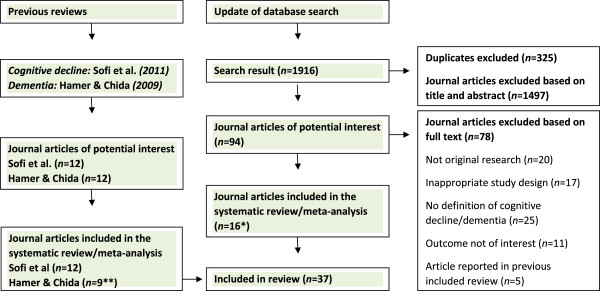
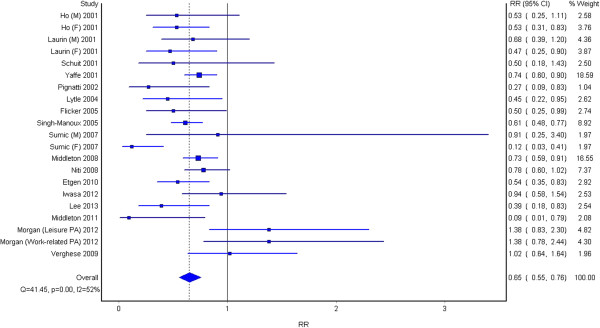
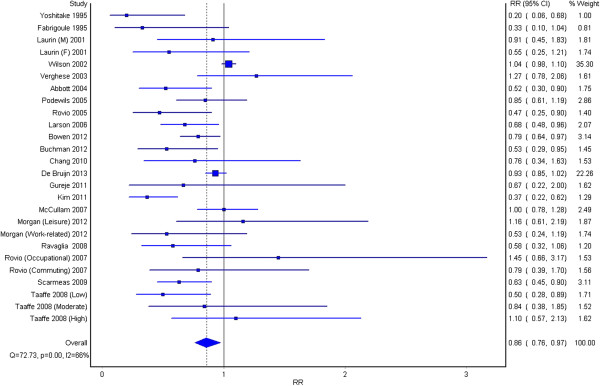
BACKGROUND: By 2050, it has been estimated that approximately one-fifth of the population will be made up of older adults (aged ≥60 years). Old age often comes with cognitive decline and dementia. Physical activity may prevent cognitive decline and dementia. METHODS: We reviewed and synthesised prospective studies into physical activity and cognitive decline, and physical activity and dementia, published until January 2014. Forty-seven cohorts, derived from two previous systematic reviews and an updated database search, were used in the meta-analyses. Included participants were aged ≥40 years, in good health and/or randomly selected from the community. Studies were assessed for methodological quality. RESULTS: Twenty-one cohorts on physical activity and cognitive decline and twenty-six cohorts on physical activity and dementia were included. Meta-analysis, using the quality-effects model, suggests that participants with higher levels of physical activity, when compared to those with lower levels, are at reduced risk of cognitive decline, RR 0.65, 95% CI 0.55-0.76, and dementia, RR 0.86, 95% CI 0.76-0.97. Sensitivity analyses revealed a more conservative estimate of the impact of physical activity on cognitive decline and dementia for high quality studies, studies reporting effect sizes as ORs, greater number of adjustments (≥10), and longer follow-up time (≥10 years). When one heavily weighted study was excluded, physical activity was associated with an 18% reduction in the risk of dementia (RR 0.82; 0.73-0.91). CONCLUSIONS: Longitudinal observational studies show an association between higher levels of physical activity and a reduced risk of cognitive decline and dementia. A case can be made for a causal interpretation. Future research should use objective measures of physical activity, adjust for the full range of confounders and have adequate follow-up length. Ideally, randomised controlled trials will be conducted. Regardless of any effect on cognition, physical activity should be encouraged, as it has been shown to be beneficial on numerous levels.
Overview
The claims and statistics of this paper haven’t been checked yet.
Free: it reads the open-access text and checks the first 5 claims that cite a source we can check. Create a free account to check every claim.
Integrity signals
Registry
Cites
Statistics
Figures
Verification
Claims the paper makes
The claims and statistics of this paper haven’t been checked yet.
Free: it reads the open-access text and checks the first 5 claims that cite a source we can check. Create a free account to check every claim.
Claims other papers make about this one
Each is checked against this paper’s own text: does it say what the citing paper says it does?
The source backs part of the claim, not all of it — or backs it for a different population, condition or comparison.
In the citing paper
“A meta-analysis of these studies concluded that physically active adults had a 35% lower risk of cognitive decline (relative risk, 0.65; 95% confidence interval, 0.55–0.76) compared with those who were physically inactive.93”
From Defining Optimal Brain Health in Adults: A Presidential Advisory From the American Heart Association/American Stroke Association (2017) · cites this paper as [93]
Experimental — accuracy not yet measuredThe cited source says what the claim attributes to it.
In the citing paper
“In contrast, physical activity appears to decrease risk. [119][120]0][121][122][123][124][125][126][127][128]”
From 2023 Alzheimer's disease facts and figures (2023) · cites this paper as [124]
Experimental — accuracy not yet measuredThe cited source says what the claim attributes to it.
In the citing paper
“Prospective observational studies have generally found a positive association between physical activity and cognitive health outcomes.”
From Defining Optimal Brain Health in Adults: A Presidential Advisory From the American Heart Association/American Stroke Association (2017) · cites this paper as [93]
Self-check
Percentages, sums and reported differences re-computed from the paper’s own numbers.
The self-check needs the paper’s full text.
Citations
Cites
Preferred Reporting Items for Systematic Reviews and Meta-Analyses: the PRISMA statement
Moher, D., Liberati, A., Tetzlaff, J., Altman, D. G., & for the PRISMA Group (2009) · BMJ · doi:10.1136/bmj.b2535 · Cited by 83,823
Preferred reporting items for systematic reviews and meta-analyses: the PRISMA Statement.
(2009) · PubMed Central · Cited by 44,859
Preferred reporting items for systematic reviews and meta-analyses: The PRISMA statement
Moher, D., Liberati, A., Tetzlaff, J., Altman, D. G., & the PRISMA Group* (2009) · Annals of Internal Medicine · doi:10.7326/0003-4819-151-4-200908180-00135 · Cited by 37,554
Preferred Reporting Items for Systematic Reviews and Meta-Analyses: The PRISMA Statement
Moher, D., Liberati, A., Tetzlaff, J., & Altman, D. G. (2009) · Journal of Clinical Epidemiology · doi:10.1016/j.jclinepi.2009.06.005 · Cited by 19,575
Lippa, N. C., & Sanderson, S. C. (2013) · Human Heredity · doi:10.1159/000353712 · Cited by 6,078
Diagnostic and Statistical Manual of Mental Disorders ( DSM ‐ IV ‐ TR )
Segal, D. L. (2010) · The Corsini Encyclopedia of Psychology · doi:10.1002/9780470479216.corpsy0271 · Cited by 4,666
Pate, R. R. (1995) · JAMA · doi:10.1001/jama.1995.03520290054029 · Cited by 4,606 · cited 1×
“A curvilinear relationship, with diminishing returns, seems the most likely association [72]; however, more research in this area is needed.”
BackgroundMACMAHON, S. (1990) · The Lancet · doi:10.1016/0140-6736(90)90878-9 · Cited by 4,253 · cited 1×
“Inaccuracies in measurement of physical activity, as outlined above, may lead to regression dilution bias, whereby imprecise measurement of the exposure variable may bias a result toward null [70].”
BackgroundInternational Encyclopedia of the Social Sciences.
Duncan, O. D., & Sills, D. L. (1968) · American Sociological Review · doi:10.2307/2092889 · Cited by 3,486
An active and socially integrated lifestyle in late life might protect against dementia
Fratiglioni, L., Paillard-Borg, S., & Winblad, B. (2004) · The Lancet Neurology · doi:10.1016/s1474-4422(04)00767-7 · Cited by 2,135 · cited 3×
“In the meantime, given that physical activity has been shown to be beneficial across multiple health domains, genders and ages, physical activity should be encouraged regardless of its relationship with cognitive decline and dementia [73].”
BackgroundInfluential
Research works printed but not linked: 1
- Rothman KJ Greenland S Lash TL Modern Epidemiology 2008 Philadelphia, PA: Lippincott Williams & Wilkins
Cited by
Items 201–300 of 1,000
Genetic insights into the causal relationship between physical activity and cognitive functioning
Cheval, B., Darrous, L., Choi, K. W., Klimentidis, Y. C., Raichlen, D. A., Alexander, G. E., Cullati, S., Kutalik, Z., & Boisgontier, M. P. (2023) · Scientific Reports · doi:10.1038/s41598-023-32150-1 · Cited by 45
“However, the evidence of causality of this relationship remains unclear Previous results have shown that physical activity can improve cognitive functioning (Angevaren et al., 2008; Baumgart et al., 2015; Blondell et al., 2014; Colcombe & Kramer, 2003; Hamer et al., 2018; Morgan et al., 2012; Sofi et al., 2011), but r…”
ResultWu, Z.-J., Wang, Z.-Y., Hu, B.-Q., Zhang, X.-H., Zhang, F., Wang, H.-L., & Li, F.-H. (2020) · BMC Geriatrics · doi:10.1186/s12877-020-01521-y · Cited by 44
Lee, A. T. C., Richards, M., Chan, W. C., Chiu, H. F. K., Lee, R. S. Y., & LAM, L. C. W. (2015) · Journal of the American Medical Directors Association · doi:10.1016/j.jamda.2015.07.012 · Cited by 48
Koyanagi, A., Stubbs, B., Smith, L., Gardner, B., & Vancampfort, D. (2017) · PLoS ONE · doi:10.1371/journal.pone.0186992 · Cited by 45
“Adults aged 50 years are at a higher risk for cardiovascular disease, diabetes [3], cognitive decline and dementia [4].”
BackgroundMetabolic determinants of Alzheimer’s disease: A focus on thermoregulation
Tournissac, M., Leclerc, M., Valentin‐Escalera, J., Vandal, M., Bosoi, C. R., Planel, E., & Calon, F. (2021) · Ageing Research Reviews · doi:10.1016/j.arr.2021.101462 · Cited by 46
Yu, F., Salisbury, D., & Mathiason, M. A. (2021) · Journal of Sport and Health Science · doi:10.1016/j.jshs.2020.05.007 · Cited by 40
Interplay between hormones and exercise on hippocampal plasticity across the lifespan
Bettio, L. E. B., Thacker, J. S., Rodgers, S. P., Brocardo, P. S., Christie, B. R., & Gil-Mohapel, J. (2020) · Biochimica et Biophysica Acta (BBA) - Molecular Basis of Disease · doi:10.1016/j.bbadis.2020.165821 · Cited by 40
Li, C., Ma, Y., Hua, R., Zheng, F., & Xie, W. (2022) · Age and Ageing · doi:10.1093/ageing/afac071 · Cited by 48
Al-Amri, A., Abdulaziz, S., Bashir, S., Ahsan, M., & Abualait, T. (2023) · Frontiers in Psychology · doi:10.3389/fpsyg.2023.1182749 · Cited by 49
Bowling, A., Pikhartova, J., & Dodgeon, B. (2016) · BMC Psychology · doi:10.1186/s40359-016-0164-x · Cited by 44
Amagasa, S., Inoue, S., Murayama, H., Fujiwara, T., Kikuchi, H., Fukushima, N., Machida, M., CHASTIN, S. F. M., Owen, N. G., & Shobugawa, Y. (2019) · Journal of Epidemiology · doi:10.2188/jea.je20190141 · Cited by 45
Thapa, N., Kim, B., Yang, J., Park, H.-J., Jang, M., Son, H., Kim, G.-M., & Park, H. (2020) · International Journal of Environmental Research and Public Health · doi:10.3390/ijerph17103701 · Cited by 44
“A systematic review and meta-analysis of longitudinal studies shows that higher levels of physical activity reduce cognitive decline as well as the risk of dementia [21].”
BackgroundGreener neighbourhoods, better memory? A longitudinal study
Astell‐Burt, T., & Feng, X. (2020) · Health & Place · doi:10.1016/j.healthplace.2020.102393 · Cited by 42
Yang, J. J., Keohane, L. M., Pan, X.-F., Qu, R., Shu, X.-O., Lipworth, L., Braun, K., Steinwandel, M. D., Dai, Q., Shrubsole, M., et al. (2022) · Neurology · doi:10.1212/wnl.0000000000200774 · Cited by 39
Lin, M., Ma, C., Zhu, J., Gao, J., Huang, L. C., Huang, J., Liu, Z., Tao, J., & Chen, L. (2022) · Ageing Research Reviews · doi:10.1016/j.arr.2022.101776 · Cited by 41
Xu, Y., Zhang, C., Pan, B., Yuan, Q., & Zhang, X. (2024) · npj Digital Medicine · doi:10.1038/s41746-024-01206-5 · Cited by 50
Thøgersen‐Ntoumani, C., Loughren, E. A., Taylor, I. M., Duda, J. L., & Fox, K. R. (2014) · Mental health and physical activity · doi:10.1016/j.mhpa.2014.06.004 · Cited by 45
Physical activity modifies the association between depression and cognitive function in older adults
Hu, L., Smith, L., Imm, K. R., Jackson, S. E., & Yang, L. (2019) · Journal of Affective Disorders · doi:10.1016/j.jad.2019.01.008 · Cited by 45
Amagasa, S., Inoue, S., Fukushima, N., Kikuchi, H., Nakaya, T., Hanibuchi, T., Sallis, J. F., & Owen, N. G. (2019) · Geriatrics and gerontology international/Geriatrics & gerontology international · doi:10.1111/ggi.13730 · Cited by 39
Dorsman, K. A., Weiner‐Light, S., Staffaroni, A. M., Brown, J. A., Wolf, A. A., Cobigo, Y., Walters, S. M., Kramer, J. H., & Casaletto, K. B. (2020) · Frontiers in Aging Neuroscience · doi:10.3389/fnagi.2020.00104 · Cited by 40
Manser, P., & de Bruin, E. D. (2021) · Frontiers in Aging Neuroscience · doi:10.3389/fnagi.2021.734012 · Cited by 41
“…activity and/or reduce vascular risk factors are powerful protectors for brain atrophy and cognitive decline (Erickson et al., 2010; Sofi et al., 2011; Beydoun et al., 2014; Blondell et al., 2014; Carvalho et al., 2014; Beckett et al., 2015; Guure et al., 2017; Lee, 2018; Cunningham et al., 2020).”
Krell‐Roesch, J., Pink, A., Roberts, R. O., Stokin, G. B., Mielke, M. M., Spangehl, K. A., Bartley, M. M., Knopman, D. S., Christianson, T. J. H., Petersen, R. C., et al. (2016) · Journal of the American Geriatrics Society · doi:10.1111/jgs.14402 · Cited by 42
Mansoor, M. A., Ibrahim, A., Hamide, A., Tran, T., Candreva, E., & Baltaji, J. (2025) · Physiologia · doi:10.3390/physiologia5020013 · Cited by 44
“The convergence of these mechanisms on common cellular processes, including protein homeostasis, redox balance, and energy metabolism, suggests that exercise enhances fundamental cellular resilience mechanisms.”
Edmunds, K., Tuffaha, H., Scuffham, P., Galvao, D. A., & Newton, R. U. (2020) · Supportive Care in Cancer · doi:10.1007/s00520-020-05637-0 · Cited by 41
“physical activity in adults ≥40 years, with prevention of cognitive decline and dementia as the focus, concluded there was a case for causality [64].”
BackgroundIoT-Based Unobtrusive Physical Activity Monitoring System for Predicting Dementia
Kim, J., Cheon, S.-H., & Lim, J. (2022) · IEEE Access · doi:10.1109/access.2022.3156607 · Cited by 41
“Physical activity is defined as movement of skeletal muscles resulting in energy expenditure exceeding that of the resting state [33].”
BackgroundOchi, G., Kuwamizu, R., Fujimoto, T., Ikarashi, K., Yamashiro, K., & Sato, D. (2022) · JMIR Serious Games · doi:10.2196/38200 · Cited by 46
“Physical activity has been shown to decrease the risk of noncommunicable diseases, such as cardiovascular disease and type 2 diabetes [1], and to improve mental health [2,3].”
BackgroundPhysical activity as an adjunct treatment for erectile dysfunction
Allen, M. S. (2019) · Nature Reviews Urology · doi:10.1038/s41585-019-0210-6 · Cited by 42
Longitudinal assessment of physical activity and cognitive outcomes among women at midlife
Greendale, G. A., Han, W., Huang, M., Upchurch, D. M., Karvonen-Gutierrez, C., Avis, N. E., & Karlamangla, A. S. (2021) · JAMA Network Open · doi:10.1001/jamanetworkopen.2021.3227 · Cited by 37
Entorhinal cortex–hippocampal circuit connectivity in health and disease
Hernández‐Frausto, M., & Vivar, C. (2024) · Frontiers in Human Neuroscience · doi:10.3389/fnhum.2024.1448791 · Cited by 46
“…from systematic reviews and meta-analyses supports the beneficial effects of physical exercise (PE) on cognitive functions in healthy young adults and old subjects with or without cognitive impairment (Blondell et al., 2014; Kelly et al., 2014; Ludyga et al., 2016; Gomes-Osman et al., 2018).”
BackgroundPhysical Activity from Childhood to Adulthood and Cognitive Performance in Midlife
HAKALA, J. O., ROVIO, S. P., PAHKALA, K., NEVALAINEN, J., JUONALA, M., HUTRI-KÄHÖNEN, N., HEINONEN, O. J., HIRVENSALO, M., TELAMA, R., VIIKARI, J. S. A., et al. (2019) · Medicine & Science in Sports & Exercise · doi:10.1249/mss.0000000000001862 · Cited by 36
Mitchell, J. J., Blodgett, J. M., CHASTIN, S. F. M., Jefferis, B. J. M. H., Wannamethee, S. G., & Hamer, M. (2023) · Journal of Epidemiology & Community Health · doi:10.1136/jech-2022-219829 · Cited by 40
A perspective on the future role of brain pet imaging in exercise science
Boecker, H., & Drzezga, A. E. (2015) · NeuroImage · doi:10.1016/j.neuroimage.2015.10.021 · Cited by 41
“…that sedentary behavior is associated with elevated risks for developing dementia (Jedrziewski et al., 2010; Le Goff et al., 2009): a meta-analysis of prospective longitudinal studies (Blondell et al., 2014) shows a reduced relative risk of cognitive decline (−35%), and development of dementia (−18”
Bidirectional Associations Between Self-Perceptions of Aging and Processing Speed Across 3 Years
Seidler, A. L., & Wolff, J. K. (2017) · GeroPsych · doi:10.1024/1662-9647/a000165 · Cited by 45
Park, S., Jeon, S. M., Jung, S., Hwang, J., & Kwon, J. (2019) · BMJ Open · doi:10.1136/bmjopen-2018-021739 · Cited by 42
Physical activity and risk of Alzheimer disease: A 2-sample mendelian randomization study
Baumeister, S. E., Karch, A., Bahls, M., Teumer, A., Leitzmann, M. F., & Baurecht, H. (2020) · Neurology · doi:10.1212/wnl.0000000000010013 · Cited by 40
Katayama, O., Lee, S., Bae, S., Makino, K., Shinkai, Y., Chiba, I., Harada, K., & Shimada, H. (2021) · Archives of Gerontology and Geriatrics · doi:10.1016/j.archger.2021.104376 · Cited by 38
Herold, F., Zou, L., Theobald, P., Manser, P., Falck, R. S., Yu, Q., Liu-Ambrose, T. Y. L., Hillman, C. H., Kramer, A. F., Erickson, K. I., et al. (2025) · European Journal of Applied Physiology · doi:10.1007/s00421-025-05858-3 · Cited by 44
Durrani, R., Friedrich, M. G., Schulze, K. M., Awadalla, P., Balasubramanian, K., Black, S. E., Broët, P., Busseuil, D., Desai, D., Dummer, T., et al. (2021) · Neurology · doi:10.1212/wnl.0000000000012765 · Cited by 36
“Higher physical activity has been associated with lower risk for dementia (29) although the extent to which exercise programs prevent dementia is still unclear (30).”
BackgroundLevinger, P., Panisset, M. G., Dunn, J., Haines, T. P., Dow, B., Batchelor, F., Biddle, S., Duque, G., & Hill, K. (2019) · BMC Public Health · doi:10.1186/s12889-019-7125-2 · Cited by 40
Physical Activity for the Prevention of Cardiometabolic Disease
Bull, F., Goenka, S., Lambert, V., & Pratt, M. (2017) · World Bank, Washington, DC eBooks · doi:10.1596/978-1-4648-0518-9_ch5 · Cited by 49
Stenling, A., Sörman, D. E., Lindwall, M., Hansson, P., Ljungberg, J. K., & Machado, L. (2020) · Aging Neuropsychology and Cognition · doi:10.1080/13825585.2020.1779646 · Cited by 39
“Meta-analyses and systematic reviews indicate consistent patterns of prospective associations between engaging in more physical activity and reduced risk of cognitive decline and neurodegenerative diseases (e.g. Blondell et al., 2014; Hamer & Chida, 2009; Sofi et al., 2011).”
BackgroundManser, P., Thalmann, M., Adcock, M., Knols, R. H., & de Bruin, E. D. (2021) · Frontiers in Physiology · doi:10.3389/fphys.2021.686129 · Cited by 37
Physical Activity Rewires the Human Brain against Neurodegeneration
Santiago, J. A., Quinn, J. P., & Potashkin, J. A. (2022) · International Journal of Molecular Sciences · doi:10.3390/ijms23116223 · Cited by 38
“While the benefits of physical activity in mental health are supported by most epidemiological studies [2,5,6], the molecular mechanisms by which it improves cognition and confers neuroprotection remain largely unknown.”
BackgroundLiu, D., Chen, J., Wang, X.-Y., Xin, J., Cao, R., & Liu, Z. (2020) · Journal of Stroke and Cerebrovascular Diseases · doi:10.1016/j.jstrokecerebrovasdis.2020.104813 · Cited by 35
Sexton, C. E., Betts, J. F., Dennis, A., Doherty, A., Leeson, P., Holloway, C. J., Dall’Armellina, E., Winkler, A. M., Demnitz, N., Wassenaar, T. M., et al. (2020) · Physiology & Behavior · doi:10.1016/j.physbeh.2020.112923 · Cited by 36
Xiao, Q., Sampson, J. N., LaCroix, A. Z., Shadyab, A. H., Zeitzer, J. M., Ancoli‐Israel, S., Yaffe, K., Stone, K. L., & Osteoporotic Fractures in Men (MrOS) Study Group (2021) · The Journals of Gerontology Series A · doi:10.1093/gerona/glab275 · Cited by 40
Physical activity partly mediates the association between cognitive function and depressive symptoms
Csajbók, Z., Sieber, S., Cullati, S., Čermáková, P., & Cheval, B. (2022) · Translational Psychiatry · doi:10.1038/s41398-022-02191-7 · Cited by 35
Ding, H., Ho, K., Searls, E., Low, S., Li, Z., Rahman, S., Madan, S., Igwe, A., Popp, Z., Burk, A., et al. (2024) · JMIR Aging · doi:10.2196/60209 · Cited by 37
Risk of dementia and death in very-late-onset schizophrenia-like psychosis: A national cohort study
Kodesh, A., Goldberg, Y., Rotstein, A., Weinstein, G., Reichenberg, A., Sandin, S., & Levine, S. Z. (2020) · Schizophrenia Research · doi:10.1016/j.schres.2020.07.020 · Cited by 33
Patterns of Physical Activity Among Older Adults in New York City
Mooney, S. J., Joshi, S., Cerdá, M., Quinn, J. W., Beard, J., Kennedy, G. J., Benjamin, E. O., Ompad, D. C., & Rundle, A. (2015) · American Journal of Preventive Medicine · doi:10.1016/j.amepre.2015.02.015 · Cited by 40
Ding, Z., Leung, P.-Y., Lee, T.-L., & Chan, A. S. (2023) · Ageing Research Reviews · doi:10.1016/j.arr.2023.101886 · Cited by 31
Estimating the effect of physical activity on cognitive function within the UK Biobank cohort
Campbell, T., & Cullen, B. (2023) · International Journal of Epidemiology · doi:10.1093/ije/dyad009 · Cited by 32
Mobility performance predicts incident depression: A systematic review and meta-analysis
Chan, L. L. Y., Okubo, Y., Brodie, M. A. D., & Lord, S. R. (2020) · Experimental Gerontology · doi:10.1016/j.exger.2020.111116 · Cited by 34
NT‐proBNP and Risk of Dementia in a General Japanese Elderly Population: The Hisayama Study
Nagata, T., Ohara, T., Hata, J., Sakata, S., Furuta, Y., Yoshida, D., Honda, T., Hirakawa, Y., Ide, T., Kanba, S., et al. (2019) · Journal of the American Heart Association · doi:10.1161/jaha.118.011652 · Cited by 33
Gierc, M. S. H., Riazi, N. A., Fagan, M. J., Sebastiano, K. M. D., Kandola, M., Priebe, C. S., Weatherson, K. A., Wunderlich, K. B., & Faulkner, G. (2021) · Frontiers in Public Health · doi:10.3389/fpubh.2021.567552 · Cited by 34
“The benefits of physical activity have been observed across diverse psychiatric and neurological conditions, such as anxiety (8), post-traumatic stress disorder (9), attention-deficit hyperactivity disorder (10), and dementia (11, 12).”
BackgroundAalbers, T., Li, Q., Baars, M. A. E., de Lange, A. H., Kessels, R. P. C., & Rikkert, M. G. M. O. (2016) · Journal of Medical Internet Research · doi:10.2196/jmir.5269 · Cited by 31
“Physical activity, nutrition, adiposity, smoking, alcohol consumption, sleep, and stress have all been identified as modifiable lifestyle factors that are associated with cognitive aging [10-18].”
the COSYCONET study group, von Siemens, S. M., Perneczky, R., Vogelmeier, C. F., Behr, J., Kauffmann-Guerrero, D. E., Alter, P. J., Trudzinski, F. C., Bals, R., Grohé, C., et al. (2019) · Respiratory Research · doi:10.1186/s12931-019-1217-5 · Cited by 32
Lifestyle Affects Amyloid Burden and Cognition Differently in Men and Women
Bachmann, D., Roman, Z. J., Buchmann, A., Zuber, I., Studer, S. T., Saake, A., Rauen, K., Gruber, E., Nitsch, R. M., Höck, C., et al. (2022) · Annals of Neurology · doi:10.1002/ana.26417 · Cited by 31
Borges‐Machado, F., Ribeiro, Ó. M., Sampaio, A., Marques‐Aleixo, I., Meireles, J., & Carvalho, J. (2018) · American Journal of Alzheimer s Disease & Other Dementias® · doi:10.1177/1533317518813555 · Cited by 74
Reas, E. T., Laughlin, G. A., Bergstrom, J., Kritz‐Silverstein, D. C., & McEvoy, L. K. (2019) · Journal of Alzheimer s Disease · doi:10.3233/jad-190491 · Cited by 33
“Although some longitudinal investigations have found that better fitness or greater physical activity is associated with slower decline in global cognitive function, memory, verbal fluency, attention, and processing speed [11–15], a meta-analysis [1] recommended further high-quality investigation to resolve incongruen…”
Lo, K. K.-H., Liu, Q., Madsen, T., Rapp, S., Chen, J., Neuhouser, M. L., Shadyab, A. H., Pal, L., Lin, X., Shumaker, S. A., et al. (2019) · BMJ Open · doi:10.1136/bmjopen-2019-030052 · Cited by 35
Skeletal Muscle Density and Cognitive Function: A Cross-Sectional Study in Men
Sui, S. X., Williams, L. J., Holloway‐Kew, K. L., Hyde, N. K., Anderson, K. B., Tembo, M. C., Addinsall, A. B., Leach, S., & Pasco, J. A. (2020) · Calcified Tissue International · doi:10.1007/s00223-020-00759-3 · Cited by 31
Physical activity and depression in older adults with and without cognitive impairment
Yuenyongchaiwat, K., Pongpanit, K., & Hanmanop, S. (2018) · Dementia & Neuropsychologia · doi:10.1590/1980-57642018dn12-010002 · Cited by 32
Physical activity in later life and risk of dementia: Findings from a population-based cohort study
Feter, N., Mielke, G. I., Leite, J. S., Brown, W. J., Coombes, J. S., & Rombaldi, A. J. (2020) · Experimental Gerontology · doi:10.1016/j.exger.2020.111145 · Cited by 31
Chambonnière, C., Lambert, C., Tardieu, M., Fillon, A., Genin, P. M., Larras, B., Melsens, P., Baker, J., Pereira, B., Tremblay, A., et al. (2021) · Experimental Aging Research · doi:10.1080/0361073x.2021.1908750 · Cited by 32
Gamble, L. D., Clare, L., Opdebeeck, C., Martyr, A., Jones, R. W., Rusted, J. M., Pentecost, C., Thom, J. M., & Matthews, F. E. (2025) · Age and Ageing · doi:10.1093/ageing/afae284 · Cited by 34
“Physical activity also has a positive impact on delaying dementia [45], may itself promote cognitive reserve, and is also important for participation and engagement in leisure and social activities, so is an important aspect to investigate in future research.”
Levinger, P., & Hill, K. (2020) · Journal of Geriatric Physical Therapy · doi:10.1519/jpt.0000000000000291 · Cited by 34
Sewell, K. R., Rainey‐Smith, S. R., Villemagne, V. L., Peiffer, J. J., Sohrabi, H. R., Taddei, K., Ames, D. J., Doré, V., Maruff, P. T., Laws, S. M., et al. (2022) · Behavioural Brain Research · doi:10.1016/j.bbr.2022.114108 · Cited by 33
Shakersain, B., Rizzuto, D., Wang, H., Irving, G. F., Prinelli, F., Fratiglioni, L., & Xu, W. (2018) · Nutrients · doi:10.3390/nu10091297 · Cited by 29
“In a recent review of 17 prospective studies, higher participation in physical activity was associated with a 35% lower risk of decline in MMSE, relative to low participation in physical activity [27].”
BackgroundShepherd, A. L., Zhang, T. D., Zeleznikow-Johnston, A., Hannan, A. J., & Burrows, E. L. (2018) · Brain Plasticity · doi:10.3233/bpl-180076 · Cited by 32
“This finding mimics what is seen clinically – individuals that are physically and cognitively active have a later onset of disease [7, 175].”
ResultCallow, D. D., Won, J., Pena, G. S., Jordan, L. S., Arnold-Nedimala, N. A., Kommula, Y., Nielson, K. A., & Smith, J. C. (2021) · Frontiers in Aging Neuroscience · doi:10.3389/fnagi.2021.645258 · Cited by 27
Heras, B. D. L., Rodrigues, L., Cristini, J., Weiss, M., Prats‐Puig, A., & Roig, M. (2020) · The Neuroscientist · doi:10.1177/1073858420975712 · Cited by 28
Preez, A. D., Lefèvre‐Arbogast, S., Houghton, V., de Lucia, C., Low, D. Y., Helmer, C., Féart, C., Delcourt, C., Proust‐Lima, C., Pallàs, M., et al. (2021) · Alzheimer s & Dementia · doi:10.1002/alz.12428 · Cited by 28
“[7] Lefèvre-Arbogast S, Hejblum BP, Helmer C, Klose C, Manach C, Low DY, et al.”
BackgroundMidlife Physical Activity and Cognition Later in Life: A Prospective Twin Study
Iso‐Markku, P., Waller, K. L., Vuoksimaa, E., Heikkila, K. V., Rinne, J. O., Kaprio, J. A., & Kujala, U. M. (2016) · Journal of Alzheimer s Disease · doi:10.3233/jad-160377 · Cited by 32
Yang, M., Guo, Y., Gong, J., Deng, M., Yang, N., & Yan, Y. (2018) · BMJ Open · doi:10.1136/bmjopen-2017-020695 · Cited by 29
Coll‐Padrós, N., León, M., Valech, N., Ros, E., Vidal, J., Estruch, R., Fitó, M., Salas‐Salvadó, J., Corella, D., Molinuevo, J. L., et al. (2019) · European Review of Aging and Physical Activity · doi:10.1186/s11556-019-0229-y · Cited by 29
Folley, S., Zhou, A., Llewellyn, D. J., & Hyppönen, E. (2019) · Journal of Alzheimer’s Disease · doi:10.3233/jad-181132 · Cited by 25
Suzuki, K., Niimura, H., Kida, H., Eguchi, Y., Kitashima, C., Takayama, M., & Mimura, M. (2020) · Geriatrics and gerontology international/Geriatrics & gerontology international · doi:10.1111/ggi.13967 · Cited by 29
Shaffer, R. M., Li, G., Adar, S. D., Keene, C. D., Latimer, C. S., Crane, P. K., Larson, E. B., Kaufman, J. D., Carone, M., & Sheppard, L. A. (2021) · Journal of Alzheimer s Disease · doi:10.3233/jad-201005 · Cited by 29
“…death, educational degree [55, 56], neighborhood median household income [57]; model 3 (M3) (extended model): M2 + race [58–60], smoking pack years[61,62],regularexercise[63,64];model4(M4) (extended+mediationmodel):M3+BMI[65–67], diabetes[68–71],hypertension[72–74],andcardio-vasculardisease[75–77].”
Zapata-Diomedi, B., Gunn, L., Giles‐Corti, B., Shiell, A., & Veerman, L. J. (2017) · Preventive Medicine · doi:10.1016/j.ypmed.2017.11.009 · Cited by 30
Idowu, M. I., Szameitat, A. J., & Parton, A. D. (2024) · Frontiers in Aging Neuroscience · doi:10.3389/fnagi.2024.1334309 · Cited by 29
Aguiñaga, S., Kaushal, N., Balbim, G. M., Wilson, R. S., Wilbur, J., Hughes, S. L., Büchner, D. M., Berbaum, M. L., McAuley, E., Vásquez, P. M., et al. (2022) · Frontiers in Aging Neuroscience · doi:10.3389/fnagi.2022.755154 · Cited by 27
Physical Exercise and Cognitive Function
Pastor, D., Ballester-Ferrer, J. A., Carbonell-Hernández, L., Baladzhaeva, S., & Cervelló, E. M. (2022) · International Journal of Environmental Research and Public Health · doi:10.3390/ijerph19159564 · Cited by 33
“For example, both physical activity and exercise have been shown to attenuate it [9].”
BackgroundNakashima, D., Kimura, D., Watanabe, H., Goto, F., Kato, M., Fujii, K., Kasuya, E., Tomiyama, N., & Hasegawa, R. (2019) · Journal of Rural Medicine · doi:10.2185/jrm.3003 · Cited by 26
Resting heart rate variability as a possible marker of cognitive decline
Grässler, B., Hökelmann, A., & Cabral, R. H. (2020) · Kinesiology · doi:10.26582/k.52.1.9 · Cited by 27
Feter, N., Dumith, S. C., Smith, E. C., da Cunha, L. L., Cassuriaga, J., Leite, J. S., Alt, R., Coombes, J. S., & Rombaldi, A. J. (2021) · Journal of Psychiatric Research · doi:10.1016/j.jpsychires.2021.06.034 · Cited by 29
Li, W., Kim, K.-W. R., Zhang, D. “., Liu, B., Crish, S. D., Wen, M., Shi, L., Pan, X., Gu, Y., & Li, Y. (2023) · Alzheimer s Research & Therapy · doi:10.1186/s13195-023-01286-7 · Cited by 26
Effect of Cyber-Golfing on Balance Amongst the Elderly in Hong Kong: A Pilot Randomised Trial
Chow, D. H. K., & Mann, K. F. (2015) · Hong Kong Journal of Occupational Therapy · doi:10.1016/j.hkjot.2015.08.001 · Cited by 25
Kim, S., McMaster, M., Torres, S. J., Cox, K. L., Lautenschlager, N. T., Rebok, G. W., Pond, D. C., D’Este, C. A., McRae, I., Cherbuin, N., et al. (2018) · BMJ Open · doi:10.1136/bmjopen-2017-019329 · Cited by 25
Volders, E., Bolman, C. A. W., de Groot, R. H. M., & Lechner, L. (2019) · BMC Public Health · doi:10.1186/s12889-019-7517-3 · Cited by 27
“In the aging brain, sufficient PA correlates with a reduced risk for cognitive decline [22].”
BackgroundStojanovic, M., Jin, Y., Fagan, A. M., Benzinger, T. L. S., Hassenstab, J. J., Cruchaga, C., Morris, J. C., & Head, D. M. (2020) · Alzheimer Disease & Associated Disorders · doi:10.1097/wad.0000000000000385 · Cited by 29
Kleinke, F., Penndorf, P., Ulbricht, S., Dörr, M., Hoffmann, W. U., & van den Berg, N. (2020) · PLoS ONE · doi:10.1371/journal.pone.0237495 · Cited by 27
“Recent reviews showed that regular PA is also associated with a 18–28% reduced risk of developing dementia in older adults [6, 7] and is considered as one of the proxies of the concept of cognitive reserve [8].”
BackgroundDuprè, C., Helmer, C., Bongué, B., Dartigues, J., Roche, F., Berr, C., & Carrière, I. (2021) · PLoS ONE · doi:10.1371/journal.pone.0252500 · Cited by 25
“Although several studies suggest that PA could improve cognitive function and reduce cognitive decline [7], others found no evidence of a neuroprotective effect [8].”
BackgroundLeisure Activity Engagement as a Predictor for Quality of Life in Community-Dwelling Older Adults
Marufkhani, V., Mohammadi, F., Mirzadeh, M., Allen, K., & Motalebi, S. A. (2021) · Asian Journal of Social Health and Behavior · doi:10.4103/shb.shb_38_20 · Cited by 25
Domains of physical activity and brain volumes: A population-based study
Jochem, C., Baumeister, S. E., Wittfeld, K., Leitzmann, M. F., Bahls, M., Schminke, U., Markus, M. R. P., Felix, S. B., Völzke, H., Hegenscheid, K., et al. (2017) · NeuroImage · doi:10.1016/j.neuroimage.2017.05.020 · Cited by 24
“Findings from meta-analyses show that increased PA is associated with a reduced risk of cognitive decline and dementia (Bherer et al., 2013; Blondell et al., 2014) and with improved neurocognitive health (Stillman et al.”
Guell, C., Panter, J., Griffin, S. J., & Ogilvie, D. (2018) · Health Expectations · doi:10.1111/hex.12686 · Cited by 27
Seino, S., Kitamura, A., Nishi, M., Tomine, Y., Tanaka, I., Taniguchi, Y., Yokoyama, Y., Amano, H., Narita, M., Ikeuchi, T., et al. (2018) · International Journal of Behavioral Nutrition and Physical Activity · doi:10.1186/s12966-018-0679-z · Cited by 26
Sol, K., Zaheed, A. B., Kraal, A. Z., Sharifian, N., Rentería, M. A., & Zahodne, L. B. (2019) · International Journal of Geriatric Psychiatry · doi:10.1002/gps.5236 · Cited by 25
“Depressive symptoms have been related to lower activity engagement,(8) and engagement in activities such as physical exercise and cognitively stimulating hobbies may be beneficial for memory among older adults.(17,34) The finding that greater perceived control was independently related to better baseline memory perfor…”
BackgroundResultObjectively measured physical activity profile and cognition in Finnish elderly twins
Iso‐Markku, P., Waller, K. L., Vuoksimaa, E., Vähä‐Ypyä, H., Lindgrén, N., Heikkila, K. V., Sievänen, H. T., Rinne, J. O., Kaprio, J. A., & Kujala, U. M. (2018) · Alzheimer s & Dementia Translational Research & Clinical Interventions · doi:10.1016/j.trci.2018.06.007 · Cited by 25
“The evidence from epidemiologic studies showing that PA protects subjects from dementia and cognitive decline and showing that this negative association is low to moderate [9] may in fact be inflated due to hidden genetic and environmental selection.”
BackgroundLuchesi, B. M., Melo, B. R. D. S., Balderrama, P., Gratão, A. C. M., Chagas, M. H. N., Pavarini, S. C. I., & Martins, T. C. R. (2021) · Dementia & Neuropsychologia · doi:10.1590/1980-57642021dn15-020012 · Cited by 29
Metadata
- Authors
- Blondell, S. J., Hammersley-Mather, R., & Veerman, J. L.
- Affiliations
- The University of Queensland (AU)
- ORCID
- Blondell, Sarah J
- Venue
- BMC Public Health
- Published
- 2014-05-27
- Volume
- 14
- Issue
- 1
- Pages
- 510-510
- ISSN
- 1471-2458 (ISSN-L)
- PMC
- PMC4064273
- OpenAlex
- W2105024128
- Semantic Scholar
- c6c3c6f306e2fb74a87a7a2cfc60ccd4ce9c5bc3
- Cited by
- 928
- References
- 86
- Citations by year
- 2026: 64 · 2025: 81 · 2024: 91 · 2023: 89 · 2022: 111 · 2021: 91 · 2020: 116 · 2019: 80 · 2018: 58 · 2017: 66 · 2016: 51 · 2015: 24 · 2014: 5
- FWCI
- 6.70
- Type
- journal article
- Language
- en
- Open access
- gold
- doi.org
- Licence
- Locations
- BMC Public Health (publishedVersion, cc-by)
- Europe PMC (PubMed Central) (publishedVersion, cc-by)
- PubMed Central (publishedVersion, cc-by)
- PubMed (publishedVersion)
- University of Southern Queensland ePrints (University of Southern Queensland) (acceptedVersion)
- Griffith Research Online (submittedVersion, cc-by)
- Topics
- Health Sciences › Medicine › Psychiatry and Mental health › Dementia and Cognitive Impairment Research
- Health Sciences › Medicine › Public Health, Environmental and Occupational Health › Physical Activity and Health
- Health Sciences › Medicine › Critical Care and Intensive Care Medicine › Intensive Care Unit Cognitive Disorders
- Keywords
- physical activity, cognitive decline, dementia, older adults, dementia prevention, cognitive aging, prospective cohort
- MeSH terms
- Aged, Aged, 80 and over, Dementia, Female, Humans, Longitudinal Studies, Male, Middle Aged, Motor Activity, Cohort Studies
About these checks
Registry, retraction, Cites and statistics results are computed, not judged, with one exception: a printed reference that no index lists is read once by a model before it counts as a citation error. Claims are extracted by a model and kept only when their quote appears verbatim in the text; each cited source is then checked, with a model’s help, for whether it says what the claim relies on. Those verdicts can be wrong — read the claim’s quote and the cited source before relying on one.
Statistics and arithmetic are recomputed, not judged.
Confidence bands are shown only for fields calibrated on our annotated test set. None is calibrated yet, so no band is shown.
What counts as a claim ›How we measure confidence ›How we check this ›
Are you an author, or do you see a problem with this page? Request a review
Data sources
Bibliographic data: Semantic Scholar, OpenAlex, Crossref.
Contains information from the Semantic Scholar Academic Graph Datasets, made available under the ODC Attribution License (ODC-BY 1.0).
Semantic Scholar’s data is described in: Kinney, R., et al. (2023). The Semantic Scholar Open Data Platform. arXiv:2301.10140.
