

Does physical activity prevent cognitive decline and dementia?: A systematic review and meta-analysis of longitudinal studies
Open accessThe DOI matches its Crossref record; 85 of the 86 references it cites were found in a registry or an index, and 1 are not checked yet.
Abstract
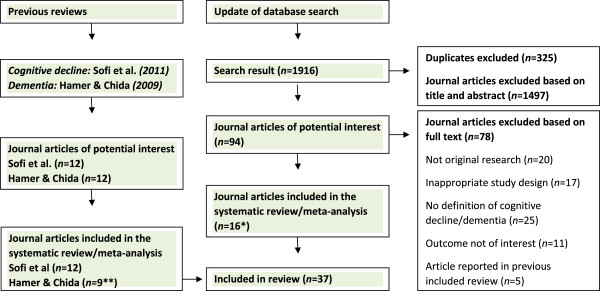
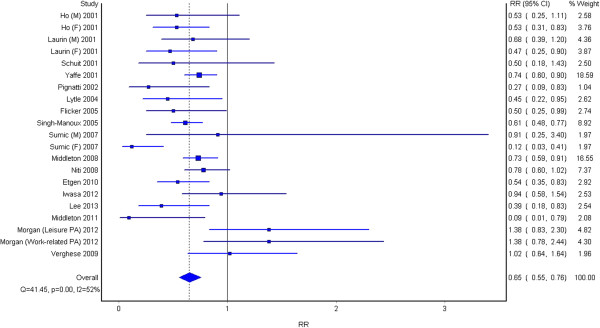
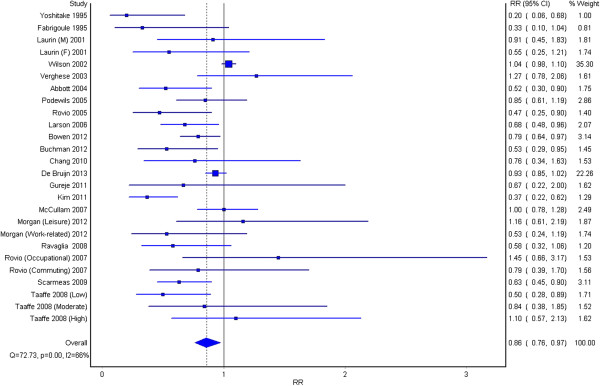
BACKGROUND: By 2050, it has been estimated that approximately one-fifth of the population will be made up of older adults (aged ≥60 years). Old age often comes with cognitive decline and dementia. Physical activity may prevent cognitive decline and dementia. METHODS: We reviewed and synthesised prospective studies into physical activity and cognitive decline, and physical activity and dementia, published until January 2014. Forty-seven cohorts, derived from two previous systematic reviews and an updated database search, were used in the meta-analyses. Included participants were aged ≥40 years, in good health and/or randomly selected from the community. Studies were assessed for methodological quality. RESULTS: Twenty-one cohorts on physical activity and cognitive decline and twenty-six cohorts on physical activity and dementia were included. Meta-analysis, using the quality-effects model, suggests that participants with higher levels of physical activity, when compared to those with lower levels, are at reduced risk of cognitive decline, RR 0.65, 95% CI 0.55-0.76, and dementia, RR 0.86, 95% CI 0.76-0.97. Sensitivity analyses revealed a more conservative estimate of the impact of physical activity on cognitive decline and dementia for high quality studies, studies reporting effect sizes as ORs, greater number of adjustments (≥10), and longer follow-up time (≥10 years). When one heavily weighted study was excluded, physical activity was associated with an 18% reduction in the risk of dementia (RR 0.82; 0.73-0.91). CONCLUSIONS: Longitudinal observational studies show an association between higher levels of physical activity and a reduced risk of cognitive decline and dementia. A case can be made for a causal interpretation. Future research should use objective measures of physical activity, adjust for the full range of confounders and have adequate follow-up length. Ideally, randomised controlled trials will be conducted. Regardless of any effect on cognition, physical activity should be encouraged, as it has been shown to be beneficial on numerous levels.
Overview
The claims and statistics of this paper haven’t been checked yet.
Free: it reads the open-access text and checks the first 5 claims that cite a source we can check. Create a free account to check every claim.
Integrity signals
Registry
Cites
Statistics
Figures
Verification
Claims the paper makes
The claims and statistics of this paper haven’t been checked yet.
Free: it reads the open-access text and checks the first 5 claims that cite a source we can check. Create a free account to check every claim.
Claims other papers make about this one
Each is checked against this paper’s own text: does it say what the citing paper says it does?
The source backs part of the claim, not all of it — or backs it for a different population, condition or comparison.
In the citing paper
“A meta-analysis of these studies concluded that physically active adults had a 35% lower risk of cognitive decline (relative risk, 0.65; 95% confidence interval, 0.55–0.76) compared with those who were physically inactive.93”
From Defining Optimal Brain Health in Adults: A Presidential Advisory From the American Heart Association/American Stroke Association (2017) · cites this paper as [93]
Experimental — accuracy not yet measuredThe cited source says what the claim attributes to it.
In the citing paper
“In contrast, physical activity appears to decrease risk. [119][120]0][121][122][123][124][125][126][127][128]”
From 2023 Alzheimer's disease facts and figures (2023) · cites this paper as [124]
Experimental — accuracy not yet measuredThe cited source says what the claim attributes to it.
In the citing paper
“Prospective observational studies have generally found a positive association between physical activity and cognitive health outcomes.”
From Defining Optimal Brain Health in Adults: A Presidential Advisory From the American Heart Association/American Stroke Association (2017) · cites this paper as [93]
Self-check
Percentages, sums and reported differences re-computed from the paper’s own numbers.
The self-check needs the paper’s full text.
Citations
Cites
Preferred Reporting Items for Systematic Reviews and Meta-Analyses: the PRISMA statement
Moher, D., Liberati, A., Tetzlaff, J., Altman, D. G., & for the PRISMA Group (2009) · BMJ · doi:10.1136/bmj.b2535 · Cited by 83,823
Preferred reporting items for systematic reviews and meta-analyses: the PRISMA Statement.
(2009) · PubMed Central · Cited by 44,859
Preferred reporting items for systematic reviews and meta-analyses: The PRISMA statement
Moher, D., Liberati, A., Tetzlaff, J., Altman, D. G., & the PRISMA Group* (2009) · Annals of Internal Medicine · doi:10.7326/0003-4819-151-4-200908180-00135 · Cited by 37,554
Preferred Reporting Items for Systematic Reviews and Meta-Analyses: The PRISMA Statement
Moher, D., Liberati, A., Tetzlaff, J., & Altman, D. G. (2009) · Journal of Clinical Epidemiology · doi:10.1016/j.jclinepi.2009.06.005 · Cited by 19,575
Lippa, N. C., & Sanderson, S. C. (2013) · Human Heredity · doi:10.1159/000353712 · Cited by 6,078
Diagnostic and Statistical Manual of Mental Disorders ( DSM ‐ IV ‐ TR )
Segal, D. L. (2010) · The Corsini Encyclopedia of Psychology · doi:10.1002/9780470479216.corpsy0271 · Cited by 4,666
Pate, R. R. (1995) · JAMA · doi:10.1001/jama.1995.03520290054029 · Cited by 4,606 · cited 1×
“A curvilinear relationship, with diminishing returns, seems the most likely association [72]; however, more research in this area is needed.”
BackgroundMACMAHON, S. (1990) · The Lancet · doi:10.1016/0140-6736(90)90878-9 · Cited by 4,253 · cited 1×
“Inaccuracies in measurement of physical activity, as outlined above, may lead to regression dilution bias, whereby imprecise measurement of the exposure variable may bias a result toward null [70].”
BackgroundInternational Encyclopedia of the Social Sciences.
Duncan, O. D., & Sills, D. L. (1968) · American Sociological Review · doi:10.2307/2092889 · Cited by 3,486
An active and socially integrated lifestyle in late life might protect against dementia
Fratiglioni, L., Paillard-Borg, S., & Winblad, B. (2004) · The Lancet Neurology · doi:10.1016/s1474-4422(04)00767-7 · Cited by 2,135 · cited 3×
“In the meantime, given that physical activity has been shown to be beneficial across multiple health domains, genders and ages, physical activity should be encouraged regardless of its relationship with cognitive decline and dementia [73].”
BackgroundInfluential
Research works printed but not linked: 1
- Rothman KJ Greenland S Lash TL Modern Epidemiology 2008 Philadelphia, PA: Lippincott Williams & Wilkins
Cited by
Items 601–700 of 1,000
Mohr, W., Rädke, A., Afi, A., Weber, N., Platen, M., Mühlichen, F., Scharf, A., Michalowsky, B., & Hoffmann, W. U. (2022) · Journal of Alzheimer s Disease · doi:10.3233/jad-220753 · Cited by 3
“[68] found an association between higher levels of physical activity and a reduced risk of cognitive decline and dementia.”
BackgroundSchroeder, M. W., Waring, M. E., Fowler, N. R., Mace, R. A., & Pagoto, S. (2024) · American Journal of Health Promotion · doi:10.1177/08901171231224517 · Cited by 3
“18 19-22 A cross-sectional study among community-dwelling older adults found that 150 minutes of moderate to vigorous physical activity were associated with lower subjective cognitive complaints.”
BackgroundRen, Z., Cui, L., Liu, Y., He, M., Li, W., Chen, Z., Zhang, W., Wei, Y., Chen, Y., Li, R., et al. (2024) · Current Psychology · doi:10.1007/s12144-024-06207-x · Cited by 3
“…on brain structure, such as increasing oxidative damage, reducing antithrombotic, anti-inflammatory effects, and cerebral blood flow (Anstey et al., 2009; Blondell et al., 2014; Lourida et al., 2019), hence resulting in the decline of cognitive ability and even cognitive impairment of the elderly.”
Hunter, R. F., Cleland, C., Trott, M., O’Neill, S., Küçükali, H., Mullineaux, S. T., Kee, F., McKinley, J. M., Neville, C. E., O’Hara, L., et al. (2024) · BMJ Open · doi:10.1136/bmjopen-2024-085318 · Cited by 3
Kooncumchoo, P., Meekum, S., Harnmanop, S., Luangpon, N., & Yuenyongchaiwat, K. (2025) · Life · doi:10.3390/life15081195 · Cited by 5
“Ad-ditionally, physical exercise can improve cognitive function in healthy older individuals with cognitive impairment [20,21].”
Zhao, Q., Feng, Q., Hilal, S., & Seow, W. J. (2025) · The Journals of Gerontology Series A · doi:10.1093/gerona/glaf171 · Cited by 3
Ferrari-Díaz, M., Kammar‐García, A., Silva‐Pereyra, J., & García‐Peña, C. (2025) · PLoS ONE · doi:10.1371/journal.pone.0338596 · Cited by 4
“A systematic review and meta-analysis on physical activities and the prevention of cognitive decline and dementia found that studies adjusting for more confounders reported smaller effects [34].”
Levinger, P., Fearn, M., Dreher, B. L., Bauman, A. E., Soh, S., Brusco, N. K., Gilbert, A. S., Muoio, R., Burton, E., & Hill, K. (2025) · BMC Public Health · doi:10.1186/s12889-025-25634-4 · Cited by 3
“Ageing is associated with complex health challenges, but regular physical activity is recognised as important for reducing chronic disease risk and maintaining functional capacity [2, 3].”
Chen, H., Hung, C.-S., Wu, T.-T., Ren, F.-F., Chang, Y., & Chen, F. (2024) · Psychology Research and Behavior Management · doi:10.2147/prbm.s486089 · Cited by 3
“16,17 Importantly, current systematic reviews found that PA positively impacts several facets of EF in adults over 50, 18,19 suggesting that PA benefits multiple EFs in the older population.”
Li, F., Harmer, P., Eckstrom, E., & Winters‐Stone, K. M. (2024) · JAMA Network Open · doi:10.1001/jamanetworkopen.2024.50457 · Cited by 4
Hearing loss and subjective cognitive decline in American Indian and Alaska Native adults
Li, L., Yang, M., Fan, W., Manson, S. M., O’Connell, J., & Jiang, L. (2025) · Alzheimer s & Dementia Behavior & Socioeconomics of Aging · doi:10.1002/bsa3.70019 · Cited by 3
Minimum physical activities protective against Alzheimer’s disease in late life: a systematic review
Sakazaki, A., Lui, A., Muhammad, H., Vu, C., le Roux, A., Lacayo, P., & Murakami, S. (2025) · Journal of Osteopathic Medicine · doi:10.1515/jom-2025-0065 · Cited by 3
Hamm, J. M., Lachman, M. E., McGrath, R. P., Duggan, K. A., & Parker, K. R. B. (2025) · Annals of Behavioral Medicine · doi:10.1093/abm/kaaf064 · Cited by 3
“7 Early research by Laurin et al 19 found that higher levels of light PA predicted reduced risk of 5-year cognitive impairment in a national sample of older Canadians when controlling moderate-to-vigorous PA. 23 Recent research based on a national US sample extended this work by showing that light PA predicted slower…”
InfluentialNeurodegenerative Dementias: Improving Brain Health to Decrease Risk
Bateman, J. R., Hurley, R. A., & Taber, K. H. (2019) · Journal of Neuropsychiatry · doi:10.1176/appi.neuropsych.18110287 · Cited by 3
Hayat, S. A., Luben, R., Wareham, N. J., Khaw, K., & Brayne, C. (2020) · International Journal of Epidemiology · doi:10.1093/ije/dyaa067 · Cited by 3
Multiple Causes of Dementia as Engineered Senescence
Garrett, M. D. (2020) · European Journal of Medical and Health Sciences · doi:10.24018/ejmed.2020.2.2.227 · Cited by 4
“Exercise also enriches the blood flow to the brain which could be the reason why the risk for dementia and AD decline with exercise [200].”
BackgroundNutrition, aging, and requirements in the elderly
Elmadfa, I., & Meyer, A. L. (2020) · Elsevier eBooks · doi:10.1016/b978-0-12-818460-8.00005-8 · Cited by 3
Harna, H., Arianti, J., & Nuzrina, R. (2020) · Media Gizi Mikro Indonesia · doi:10.22435/mgmi.v11i2.2501 · Cited by 6
Freitas, L. T. D., Pain, T., & Barnett, F. (2021) · Australian Journal on Ageing · doi:10.1111/ajag.12908 · Cited by 4
Hays, C. C., Moore, A. A., Allison, M., Patrick, K., Bondi, M. W., Nebeker, C., Liu, T. T., Wing, D., Higgins, M., Hartman, S. J., et al. (2023) · JMIR Research Protocols · doi:10.2196/42980 · Cited by 5
“For example, higher PA is associated with 14% lower risk of dementia when compared with those with lower levels of PA [7], whereas, compared with sedentary individuals, even low-to-moderate PA has been associated with a 35% reduction of risk for cognitive decline [8].”
BackgroundSzepietowska, E. M., & Dąbal, A. (2023) · Kwartalnik Naukowy Fides et Ratio · doi:10.34766/fetr.v53i1.1024 · Cited by 3
Spartano, N. L., Wang, R., Yang, Q., Chernofsky, A., Murabito, J. M., Levy, D. A., Vasan, R. S., DeCarli, C. S., Maillard, P., Seshadri, S. S., et al. (2023) · Journal of Alzheimer s Disease · doi:10.3233/jad-230289 · Cited by 5
Jongbae, K., Mokhtari, M., Aloulou, H., Abdulrazak, B., & Seungbok, L. (2023) · Lecture notes in computer science · doi:10.1007/978-3-031-43950-6 · Cited by 3
Parekh, N., Merota, V., Joshi, R., Kaur, G., Tuli, H. S., & Buttar, H. S. (2023) · Scripta Medica · doi:10.5937/scriptamed54-46932 · Cited by 4
Correlation between Physical Activity and Depression in Community-Dwelling Older Adult Palestinians
Halaweh, H., Al-Khateeb, A., Rasheed, A., Tomeze, L., Sultan, M., & Alqaissi, I. (2023) · Medical Principles and Practice · doi:10.1159/000535950 · Cited by 4
Active Aging: Perceptions and Experiences of Older Adults who Attend a Seniors Gym
Thomas, Y. (2023) · American Journal of Biomedical Science & Research · doi:10.34297/ajbsr.2023.19.002654 · Cited by 3
Moroń, M., Mengel‐From, J., & Semkovska, M. (2024) · Journal of Psychiatric Research · doi:10.1016/j.jpsychires.2024.07.037 · Cited by 4
Hassani, S., & Gorelick, P. B. (2024) · Cerebral Circulation - Cognition and Behavior · doi:10.1016/j.cccb.2024.100367 · Cited by 4
“One meta-analysis by Blondell et al. showed negative associations of physical activity with both cognitive decline and dementia, with overall effects of RR 0.65, 95 % CI 0.55 – 0.76 and RR 0.86, 95 % CI 0.76 – 0.97, respectively [112].”
ResultInfluentialAssessment of sensory impairment in older adults with dementia
Gottfriedová, N., Kovaľová, M., Mrázková, E., Machaczka, O., Koutná, V., Janout, V., & Janoutová, J. (2024) · Journal of Otology · doi:10.1016/j.joto.2024.11.001 · Cited by 3
Physical Activity Recommendations for the Aging Brain: A Clinician-Patient Guide
Heyn, P. C., Hirsch, M. A., York, M. K., & Backus, D. A. (2016) · Archives of Physical Medicine and Rehabilitation · doi:10.1016/j.apmr.2016.02.003 · Cited by 3
Wianto, E., Chen, C., Chen, C.-C., & Lin, C. (2021) · Lecture notes in networks and systems · doi:10.1007/978-3-030-80744-3_48 · Cited by 3
Hryb, V. A., Герасимчук, В. Р., Uwa-Agbonikhena, I. F., Н.П., Т., Дорошенко, О. О., & Генык, С. И. (2021) · Український медичний часопис · doi:10.32471/umj.1680-3051.142.204897 · Cited by 3
Association of mild cognitive impairment and physical activity level in older persons in Chile
Olivares-Tirado, P., & Garrido, F. A. S. (2022) · Aging and Health Research · doi:10.1016/j.ahr.2022.100107 · Cited by 4
Controversies Surrounding Exercise in Genetic Cardiomyopathies
Atteya, G. A., & Lampert, R. J. (2018) · Heart Failure Clinics · doi:10.1016/j.hfc.2017.12.008 · Cited by 2
Nam, S., Hong, I., & Baek, M. S. (2024) · PLoS ONE · doi:10.1371/journal.pone.0301035 · Cited by 2
Son, H. J., Kim, J. S., Bateman, R. J., Kim, S., Llibre‐Guerra, J. J., Day, G. S., Chhatwal, J. P., Berman, S., Schofield, P. R., Jucker, M., et al. (2024) · Neurology · doi:10.1212/wnl.0000000000209766 · Cited by 2
Niu, J., Liu, X., Wang, X., Gao, F., Yu, P., Zhou, Q., & Wang, Q. (2025) · BMC Anesthesiology · doi:10.1186/s12871-025-02968-5 · Cited by 2
“Habitual physical activity has been associated with a 14% reduction in the risk of dementia and a 35% reduction in the risk of cognitive decline [10].”
Karim, M. A., & Venkatachalam, J. (2025) · Ageing International · doi:10.1007/s12126-025-09607-x · Cited by 2
“Further, a large amount of psychosocial and behavioral risk factors evidenced on association with cognitive impairment such as physical activity (Blondell et al., 2014; Costa et al., 2014; Kobayashi et al., 2016; Koyanagi et al., 2018; Vancampfort et al., 2017; Weinstein et al., 2012), smoking (Jia…”
Longitudinal associations between self‐reported exercise levels and cognition in ADAD
Sewell, K. R., Doecke, J. D., Martins, R. N., Rainey‐Smith, S. R., Peiffer, J. J., Gardener, S. L., Sohrabi, H. R., Erickson, K. I., Brown, B. M., & The Dominantly Inherited Alzheimer Network (DIAN) (2025) · Alzheimer s & Dementia · doi:10.1002/alz.70383 · Cited by 2
Physical activity mediates age differences in cognition among Tsimane forager-horticulturalists
Imms, P. E., Chaudhari, N. N., Cummings, D. K., Rodríguez, D. E., Barisano, G., Hooper, P. L., Sayre, M. K., Seabright, E., Thompson, R. C., Sutherland, M. L., et al. (2025) · The Journals of Gerontology Series A · doi:10.1093/gerona/glaf163 · Cited by 2
Citizen science in psychology: Challenges, opportunities, and recommendations
den Bussche, E. V., Verhaegen, K. A., Reynvoet, B., & Hughes, G. (2026) · Behavior Research Methods · doi:10.3758/s13428-026-03019-8 · Cited by 3
Wallenwein, L. A., Schmidt, S. N. L., Barzyk, P., Bieleke, M., Schüler, J., Grüber, M., & Mier, D. U. (2025) · Cerebral Cortex · doi:10.1093/cercor/bhaf228 · Cited by 2
Yaşlanmanın Fizyolojik Temelleri: Vücudun Zamanla Değişen Dengesi
Şimşek, H., & Çakar, F. (2025) · Bingöl Üniversitesi Sağlık Dergisi · doi:10.58605/bingolsaglik.1717558 · Cited by 3
Bravo, E. J. C., & Tauda, M. T. (2026) · Retos · doi:10.47197/retos.v74.117489 · Cited by 2
Other Approaches: From Neurofeedback to Cognitive-Enhancing Drugs
Jaušovec, N., & Pahor, A. (2017) · Elsevier eBooks · doi:10.1016/b978-0-12-809407-5.00005-1 · Cited by 2
Brunet, J., Guérin, E., & Speranzini, N. (2017) · Journal of Aging and Physical Activity · doi:10.1123/japa.2016-0342 · Cited by 2
Risk Factors and Prevention in Light of Atherosclerosis Being a Microvascular Disease
Haverich, A., & Boyle, E. C. (2019) · Springer eBooks · doi:10.1007/978-3-030-20245-3_5 · Cited by 2
Sannino, G., Falco, I. D., Pietro, G. D., & Stranges, S. (2020) · Frontiers in Human Neuroscience · doi:10.3389/fnhum.2020.00312 · Cited by 2
RetractedIlinca, S., & Suzuki, E. M. (2021) · Elsevier eBooks · doi:10.1016/b978-0-12-819344-0.00004-1 · Cited by 2
Gu, S., Zhang, L., Wang, C.-X., Qu, Y.-J., Ma, J., Zhen, R.-R., Gu, C., & Yuan, C. (2021) · Medicine · doi:10.1097/md.0000000000027323 · Cited by 2
Exercise Concepts for Fall Prevention
Mattle, M., & Theiler, R. (2022) · Springer eBooks · doi:10.1007/978-3-030-91483-7_8 · Cited by 2
Alzheimer’s Disease: A Washing Machine on the Fritz
Gregory, J. M. (2022) · Journal of Behavioral and Brain Science · doi:10.4236/jbbs.2022.124008 · Cited by 2
da Silva, L. H., de Campos, L. W., Chicon, P. M. M., Garcês, S. B. B., Krug, M. D. R., Xavier, A. J., & Krug, R. D. R. (2022) · PAJAR - Pan-American Journal of Aging Research · doi:10.15448/2357-9641.2022.1.43154 · Cited by 4
Feter, N., Caputo, E. L., Leite, J. S., Delpino, F. M., Cassuriaga, J., da Silva, C. N., da Silva, M. C., Reichert, F. F., & Rombaldi, A. J. (2023) · Dementia & Neuropsychologia · doi:10.1590/1980-5764-dn-2022-0072 · Cited by 3
Preventing Dementia? Critical Perspectives on a New Paradigm of Preparing for Old Age
Leibing, A., Schicktanz, S., & SSHRC (Social Sciences and Humanities Council of Canada) (2020) · Berghahn Books · doi:10.1515/9781800734982 · Cited by 2
Santos, F. H., Sood, P., Gan, D. R. Y., Lansang, N. M., Devos, H., & Heyn, P. C. (2023) · Archives of Physical Medicine and Rehabilitation · doi:10.1016/j.apmr.2023.05.017 · Cited by 2
Liu, J., Pan, M. C., Sun, M., Shi, H., & Feng, R. (2024) · Nutrients · doi:10.3390/nu16020203 · Cited by 3
“Recent meta-analyses on both longitudinal studies [25] and randomized clinical trials (RCTs) [26] also highlighted reduced cognitive decline risks and improved cognitive function.”
BackgroundThe relationship between atherosclerosis and dementia
Janoutová, J., Machaczka, O., Kovaľová, M., Zatloukalová, A., Ambrož, P., Koutná, V., Mrázková, E., Bar, M., Roubec, M., Bártová, P., et al. (2024) · Central European Journal of Public Health · doi:10.21101/cejph.a7848 · Cited by 2
Jamka, M., Kurek, S., Makarewicz-Bukowska, A., Miśkiewicz-Chotnicka, A., Wasiewicz-Gajdzis, M., & Walkowiak, J. (2024) · Metabolites · doi:10.3390/metabo14050271 · Cited by 3
“…although physical activity was not independently associated with MCI in our multivariate regression analysis, its protective role in cognitive health, as confirmed in several studies [72–74], suggests that increasing physical activity could be a beneficial strategy to prevent cognitive decline.”
BackgroundResultHow will physical activity change in an autonomous future?
Booth, L., Farrar, V., Thompson, J., Vidanaarachchi, R., Godic, B., Brown, J. K., Karl, C., & Pettigrew, S. (2024) · Journal of Transport & Health · doi:10.1016/j.jth.2024.101924 · Cited by 2
Bai, Y., Liu, M., Fang, Y., & Zhan, R. (2024) · Frontiers in Psychology · doi:10.3389/fpsyg.2024.1407846 · Cited by 4
Walbaum, M., Aguzzoli, E., Castro‐Aldrete, L., Cyhlarova, E., Chadha, A. S., & Knapp, M. R. J. (2025) · International Journal of Geriatric Psychiatry · doi:10.1002/gps.70067 · Cited by 2
Neudorf, B., Koblinsky, N. D., Power, K. A., Binns, M. A., Fiocco, A. J., Rotenberg, S., Marzolini, S., OH, P. I., Thornton, J. S., Ajwani, F., et al. (2025) · Pilot and Feasibility Studies · doi:10.1186/s40814-025-01626-4 · Cited by 2
“%) in longitudinal studies [12–15] and appear to have the most consistent influence on executive function [16–18].”
Ding, H., Brown, S., Paquette, D. R., Orwig, T. A., Spartano, N. L., & Lin, H. (2025) · Journal of Medical Internet Research · doi:10.2196/72946 · Cited by 3
Lee, J., Kim, Y., Kim, W., Cho, S., Kim, J. H., Kim, Y. S., & Kang, S. Y. (2025) · Journal of Alzheimer s Disease · doi:10.1177/13872877251386889 · Cited by 2
“34 Regular physical activity enhances neurogenesis, increases brain-derived neurotrophic factor levels, and reduces neuroin fl ammation, all of which contribute to protecting brain health.”
DesRuisseaux, L. A., & Suchy, Y. (2025) · The Clinical Neuropsychologist · doi:10.1080/13854046.2025.2589273 · Cited by 3
“…of lifestyle modifications, such as Mediterranean-DASH Intervention for Neurodegenerative Delay (MIND) diet and exercise (Agarwal et al., 2023; Blondell et al., 2014; Erickson et al., 2019; Melo van Lent et al., 2021; Sofi et al., 2011), which may delay or even reduce the risk of…”
Low, L., Parker, H. M., Dovey, K., & Yan, A. F. (2020) · Elsevier eBooks · doi:10.1016/b978-0-12-815854-8.00046-x · Cited by 2
Davey, D. A. (2016) · Journal of Neurology and Neuroscience · doi:10.21767/2171-6625.100097 · Cited by 2
“97) [58].”
George, A. S., Kite, J., Hector, D., Pedišić, Ž., Bellew, W., & Bauman, A. E. (2014) · Victoria University Research Repository (Victoria University) · Cited by 5
Neupane, A., & Kuma, S. N. (2018) · Asian Pacific Journal of Health Sciences · doi:10.21276/apjhs.2018.5.3.30 · Cited by 2
Bosomworth, N. J. (2019) · Europe PMC (PubMed Central) · Cited by 3
Environmental and genetic risk factors for dementia
Bellou, V., Belbasis, L., & Εvangelou, Ε. (2020) · Elsevier eBooks · doi:10.1016/b978-0-12-815854-8.00011-2 · Cited by 3
Physical Activity, Sport, and Health in Japan
Inoue, S., Kikuchi, H., & Amagasa, S. (2020) · Oxford University Press eBooks · doi:10.1093/oso/9780198848134.003.0013 · Cited by 2
Bernstein, J. P. K., Noland, M., Dorociak, K. E., Leese, M. I., Lee, S. Y., & Hughes, A. M. (2021) · Aging Neuropsychology and Cognition · doi:10.1080/13825585.2021.1982857 · Cited by 2
Geriatric Medicine and Healthy Aging
Gouveia, É. R., de Gouveia, B. R. F. O., Marques, A., & Ihle, A. (2022) · IntechOpen eBooks · doi:10.5772/intechopen.98018 · Cited by 2
Sariyska, R., & Montag, C. (2022) · Studies in neuroscience, psychology and behavioral economics · doi:10.1007/978-3-030-98546-2_5 · Cited by 3
Effect of the ACTN-3 gene polymorphism on functional fitness and executive function of elderly
Henrique, J. S., Braga, P. L. G., de Almeida, S. S., Petraconi, N., Benfato, I. D., Arida, R. M., de Oliveira, C. A. M., & da Silva, S. G. (2022) · Frontiers in Aging Neuroscience · doi:10.3389/fnagi.2022.943934 · Cited by 5
“One of the most commonly used tools to ensure cognitive integrity is physical activity (Blondell et al., 2014; Schlosser Covell et al., 2015; Veronese et al., 2016).”
MethodCai, H., Cui, Y., Cravens, L., Yang, G., Yu, D., Gao, Y., Zheng, W., & Shu, X. (2022) · Archives of Gerontology and Geriatrics · doi:10.1016/j.archger.2022.104848 · Cited by 2
Krtalić, S., Bukal, D., & Milanović, S. M. (2022) · Croatian Journal of Education - Hrvatski časopis za odgoj i obrazovanje · doi:10.15516/cje.v23i4.4509 · Cited by 2
“Additionally, engagement in high levels of PA decreases the risk of dementia by 18 % (Blondell et al., 2014) and asthma by 12 % (Eijkemans et al.”
BackgroundKim, J., Lee, J., Rodriguez, M. J., Han, A., & Ju, H. J. (2023) · American Journal of Health Behavior · doi:10.5993/ajhb.47.4.2 · Cited by 2
Burton, N. W. (2016) · Springer eBooks · doi:10.1007/978-981-287-080-3_348-1 · Cited by 2
Loughrey, D. G. (2018) · Arrow@dit (Dublin Institute of Technology) · Cited by 5
Liu, Y., Feng, W., Hu, P., Zhai, S., Zhang, R., Li, Q., Marsahall, C., Xiao, M., & Wu, T. (2020) · Research Square · doi:10.21203/rs.3.rs-108136/v1 · Cited by 2
Burton, N. W. (2017) · Springer eBooks · doi:10.1007/978-981-287-082-7_348 · Cited by 2
Dementia and Cognitive Impairment
Chong, Y. F. V., & Tang, S. (2024) · Elsevier eBooks · doi:10.1016/b978-0-323-99967-0.00134-4 · Cited by 2
What Could Aid in Slowing Down Cognitive Function?
Ilhan, A., Varlı, M., & Bilgiç, P. (2021) · Galician Medical Journal · doi:10.21802/gmj.2021.2.4 · Cited by 1
“In a meta-analysis study on the relationship between the prevention of cognitive decline, dementia and physical activity, dementia was found to be correlated [13].”
BackgroundAKTIFITAS FISIK MEMPENGARUHI DAYA INGAT LANSIA
Nuraini, N., Putri, P. M. J., & Batlajeri, Y. (2023) · Jurnal Fisioterapi dan Kesehatan Indonesia · doi:10.59946/jfki.2023.255 · Cited by 1
Schmitter, M., & Vrijsen, J. N. (2024) · Current topics in behavioral neurosciences · doi:10.1007/7854_2024_495 · Cited by 1
Ocktavia, L., Rivarti, A. W., Harahap, H. S., Nurhidayati, N., Suryani, D., Stephen, M. E., Prawiro, A. W., Wulandari, I., Muttaqin, S., Ristia, O. I., et al. (2024) · Jurnal Abdi Insani · doi:10.29303/abdiinsani.v11i3.1743 · Cited by 2
Physical activity: a neglected therapy for dementia
Feter, N., Feter, J., Silva, G. S., Schmidt, M. I., & Rombaldi, A. J. (2024) · Cadernos de Saúde Pública · doi:10.1590/0102-311xen216123 · Cited by 1
“A robust body of literature has established an association between physical activity and reduced risk of cognitive decline and dementia 9,10,11,12,13,14,15 .”
BackgroundSatomi, E., Apolinário, D., Magaldi, R. M., Busse, A. L., Gomes, G. C. V., Ribeiro, E. S., Genta, P. R., Piovezan, R. D., Poyares, D. R., Filho, W. J., et al. (2024) · Neurobiology of Sleep and Circadian Rhythms · doi:10.1016/j.nbscr.2024.100110 · Cited by 2
Bishop, N. J., Botoseneanu, A., Newsom, J. T., Allore, H. G., Nagel, C., Markwardt, S., Samper‐Ternent, R., & Quiñones, A. R. (2025) · Journal of global ageing. · doi:10.1332/29767202y2024d000000019 · Cited by 1
Ibekaku, M. C., Adebusoye, L. A., Weeks, L. E., Ghanouni, P., Nasiri, N., Onyekere, C. P., & McArthur, C. (2025) · JBI Evidence Synthesis · doi:10.11124/jbies-24-00504 · Cited by 1
Levinger, P., Hall, J., & Hill, K. (2025) · Archives of Public Health · doi:10.1186/s13690-025-01668-3 · Cited by 1
The 24-Hour Movement Behavior Composition and the Risk of Dementia
Liubetskaya, M., Lopes, M. V. V., & Janssen, I. (2025) · Sage Open Aging · doi:10.1177/30495334251361293 · Cited by 1
“Systematic reviews have reported that insufficient ( < 6 hr/day) and excessive ( > 9 hr/day) sleep, high SED, and low MVPA are associated with an increased risk of dementia (Blondell et al., 2014; Sabia et al., 2021; Yan et al., 2020).”
Stauder, M. J., Horn, O., & Hayes, S. M. (2025) · Journal of the International Neuropsychological Society · doi:10.1017/s1355617725101446 · Cited by 2
“Longitudinal observational research has shown that middle-aged and older adults who self-report engaging in greater amounts of physical activity are at a reduced risk of future cognitive decline and dementia (Blondell et al., 2014).”
Bakken, J., Brissach, D. E., Ingeström, E., Midttun, S., Walker, T. L., Stensvold, D., & Tari, A. R. (2025) · Sports Medicine - Open · doi:10.1186/s40798-025-00956-0 · Cited by 1
“Observational studies indicate that PA could delay the decline in cognitive function in individuals at risk of, or diagnosed with, dementia [8–10], with aerobic exercise training that increases cardiorespiratory fitness (CRF) potentially exerting the most favorable effect [11].”
Zhang, Y., & Xu, W. (2026) · Frontiers in Public Health · doi:10.3389/fpubh.2025.1695462 · Cited by 1
“However, several longitudinal studies have also found that physical activity does not effectively reduce the risk of incident dementia (5–7), and systematic reviews have concluded that the heterogeneity in the effect size of physical activity on dementia risk among studies is high (8).”
O’Donoghue, C., Long-Smith, C. M., Janas, H., Clarke, G. A., Timmons, S., Grabrucker, S., & Nolan, Y. M. (2026) · Nutrition and Health · doi:10.1177/02601060261420675 · Cited by 2
The active ingredients: physical activity features linked to healthy brain aging
Cadwallader, C. J., Pinheiro‐Chagas, P., Saloner, R., Fenton, L. E., VandeBunte, A. M., Lin, M., Pham, A., Chen, C., Diaz, V. E., Olzinski, M., et al. (2026) · Alzheimer s Research & Therapy · doi:10.1186/s13195-026-01998-6 · Cited by 1
“Observational studies have linked greater physical activity engagement with reduced dementia risk, better cognitive performance, and preserved brain structure in older adults [1, 2].”
Metadata
- Authors
- Blondell, S. J., Hammersley-Mather, R., & Veerman, J. L.
- Affiliations
- The University of Queensland (AU)
- ORCID
- Blondell, Sarah J
- Venue
- BMC Public Health
- Published
- 2014-05-27
- Volume
- 14
- Issue
- 1
- Pages
- 510-510
- ISSN
- 1471-2458 (ISSN-L)
- PMC
- PMC4064273
- OpenAlex
- W2105024128
- Semantic Scholar
- c6c3c6f306e2fb74a87a7a2cfc60ccd4ce9c5bc3
- Cited by
- 928
- References
- 86
- Citations by year
- 2026: 64 · 2025: 81 · 2024: 91 · 2023: 89 · 2022: 111 · 2021: 91 · 2020: 116 · 2019: 80 · 2018: 58 · 2017: 66 · 2016: 51 · 2015: 24 · 2014: 5
- FWCI
- 6.70
- Type
- journal article
- Language
- en
- Open access
- gold
- doi.org
- Licence
- Locations
- BMC Public Health (publishedVersion, cc-by)
- Europe PMC (PubMed Central) (publishedVersion, cc-by)
- PubMed Central (publishedVersion, cc-by)
- PubMed (publishedVersion)
- University of Southern Queensland ePrints (University of Southern Queensland) (acceptedVersion)
- Griffith Research Online (submittedVersion, cc-by)
- Topics
- Health Sciences › Medicine › Psychiatry and Mental health › Dementia and Cognitive Impairment Research
- Health Sciences › Medicine › Public Health, Environmental and Occupational Health › Physical Activity and Health
- Health Sciences › Medicine › Critical Care and Intensive Care Medicine › Intensive Care Unit Cognitive Disorders
- Keywords
- physical activity, cognitive decline, dementia, older adults, dementia prevention, cognitive aging, prospective cohort
- MeSH terms
- Aged, Aged, 80 and over, Dementia, Female, Humans, Longitudinal Studies, Male, Middle Aged, Motor Activity, Cohort Studies
About these checks
Registry, retraction, Cites and statistics results are computed, not judged, with one exception: a printed reference that no index lists is read once by a model before it counts as a citation error. Claims are extracted by a model and kept only when their quote appears verbatim in the text; each cited source is then checked, with a model’s help, for whether it says what the claim relies on. Those verdicts can be wrong — read the claim’s quote and the cited source before relying on one.
Statistics and arithmetic are recomputed, not judged.
Confidence bands are shown only for fields calibrated on our annotated test set. None is calibrated yet, so no band is shown.
What counts as a claim ›How we measure confidence ›How we check this ›
Are you an author, or do you see a problem with this page? Request a review
Data sources
Bibliographic data: Semantic Scholar, OpenAlex, Crossref.
Contains information from the Semantic Scholar Academic Graph Datasets, made available under the ODC Attribution License (ODC-BY 1.0).
Semantic Scholar’s data is described in: Kinney, R., et al. (2023). The Semantic Scholar Open Data Platform. arXiv:2301.10140.
