

Does physical activity prevent cognitive decline and dementia?: A systematic review and meta-analysis of longitudinal studies
Open accessThe DOI matches its Crossref record; 85 of the 86 references it cites were found in a registry or an index, and 1 are not checked yet.
Abstract
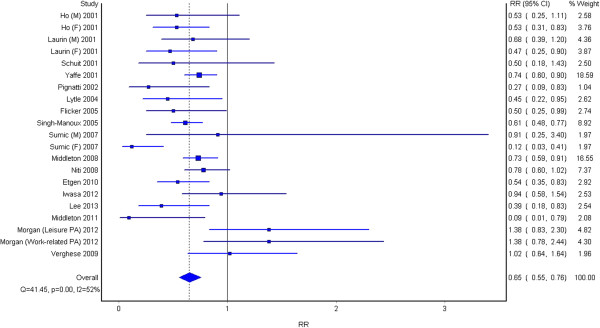
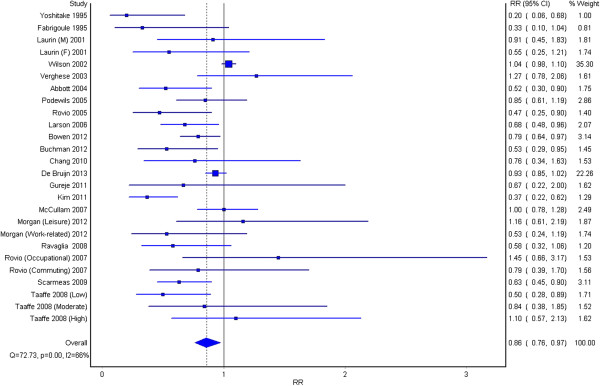
BACKGROUND: By 2050, it has been estimated that approximately one-fifth of the population will be made up of older adults (aged ≥60 years). Old age often comes with cognitive decline and dementia. Physical activity may prevent cognitive decline and dementia. METHODS: We reviewed and synthesised prospective studies into physical activity and cognitive decline, and physical activity and dementia, published until January 2014. Forty-seven cohorts, derived from two previous systematic reviews and an updated database search, were used in the meta-analyses. Included participants were aged ≥40 years, in good health and/or randomly selected from the community. Studies were assessed for methodological quality. RESULTS: Twenty-one cohorts on physical activity and cognitive decline and twenty-six cohorts on physical activity and dementia were included. Meta-analysis, using the quality-effects model, suggests that participants with higher levels of physical activity, when compared to those with lower levels, are at reduced risk of cognitive decline, RR 0.65, 95% CI 0.55-0.76, and dementia, RR 0.86, 95% CI 0.76-0.97. Sensitivity analyses revealed a more conservative estimate of the impact of physical activity on cognitive decline and dementia for high quality studies, studies reporting effect sizes as ORs, greater number of adjustments (≥10), and longer follow-up time (≥10 years). When one heavily weighted study was excluded, physical activity was associated with an 18% reduction in the risk of dementia (RR 0.82; 0.73-0.91). CONCLUSIONS: Longitudinal observational studies show an association between higher levels of physical activity and a reduced risk of cognitive decline and dementia. A case can be made for a causal interpretation. Future research should use objective measures of physical activity, adjust for the full range of confounders and have adequate follow-up length. Ideally, randomised controlled trials will be conducted. Regardless of any effect on cognition, physical activity should be encouraged, as it has been shown to be beneficial on numerous levels.
Overview
The claims and statistics of this paper haven’t been checked yet.
Free: it reads the open-access text and checks the first 5 claims that cite a source we can check. Create a free account to check every claim.
Integrity signals
Registry
Cites
Statistics
Figures
Verification
Claims the paper makes
The claims and statistics of this paper haven’t been checked yet.
Free: it reads the open-access text and checks the first 5 claims that cite a source we can check. Create a free account to check every claim.
Claims other papers make about this one
Each is checked against this paper’s own text: does it say what the citing paper says it does?
The source backs part of the claim, not all of it — or backs it for a different population, condition or comparison.
In the citing paper
“A meta-analysis of these studies concluded that physically active adults had a 35% lower risk of cognitive decline (relative risk, 0.65; 95% confidence interval, 0.55–0.76) compared with those who were physically inactive.93”
From Defining Optimal Brain Health in Adults: A Presidential Advisory From the American Heart Association/American Stroke Association (2017) · cites this paper as [93]
Experimental — accuracy not yet measuredThe cited source says what the claim attributes to it.
In the citing paper
“In contrast, physical activity appears to decrease risk. [119][120]0][121][122][123][124][125][126][127][128]”
From 2023 Alzheimer's disease facts and figures (2023) · cites this paper as [124]
Experimental — accuracy not yet measuredThe cited source says what the claim attributes to it.
In the citing paper
“Prospective observational studies have generally found a positive association between physical activity and cognitive health outcomes.”
From Defining Optimal Brain Health in Adults: A Presidential Advisory From the American Heart Association/American Stroke Association (2017) · cites this paper as [93]
Self-check
Percentages, sums and reported differences re-computed from the paper’s own numbers.
The self-check needs the paper’s full text.
Citations
Cites
Preferred Reporting Items for Systematic Reviews and Meta-Analyses: the PRISMA statement
Moher, D., Liberati, A., Tetzlaff, J., Altman, D. G., & for the PRISMA Group (2009) · BMJ · doi:10.1136/bmj.b2535 · Cited by 83,823
Preferred reporting items for systematic reviews and meta-analyses: the PRISMA Statement.
(2009) · PubMed Central · Cited by 44,859
Preferred reporting items for systematic reviews and meta-analyses: The PRISMA statement
Moher, D., Liberati, A., Tetzlaff, J., Altman, D. G., & the PRISMA Group* (2009) · Annals of Internal Medicine · doi:10.7326/0003-4819-151-4-200908180-00135 · Cited by 37,554
Preferred Reporting Items for Systematic Reviews and Meta-Analyses: The PRISMA Statement
Moher, D., Liberati, A., Tetzlaff, J., & Altman, D. G. (2009) · Journal of Clinical Epidemiology · doi:10.1016/j.jclinepi.2009.06.005 · Cited by 19,575
Lippa, N. C., & Sanderson, S. C. (2013) · Human Heredity · doi:10.1159/000353712 · Cited by 6,078
Diagnostic and Statistical Manual of Mental Disorders ( DSM ‐ IV ‐ TR )
Segal, D. L. (2010) · The Corsini Encyclopedia of Psychology · doi:10.1002/9780470479216.corpsy0271 · Cited by 4,666
Pate, R. R. (1995) · JAMA · doi:10.1001/jama.1995.03520290054029 · Cited by 4,606 · cited 1×
“A curvilinear relationship, with diminishing returns, seems the most likely association [72]; however, more research in this area is needed.”
BackgroundMACMAHON, S. (1990) · The Lancet · doi:10.1016/0140-6736(90)90878-9 · Cited by 4,253 · cited 1×
“Inaccuracies in measurement of physical activity, as outlined above, may lead to regression dilution bias, whereby imprecise measurement of the exposure variable may bias a result toward null [70].”
BackgroundInternational Encyclopedia of the Social Sciences.
Duncan, O. D., & Sills, D. L. (1968) · American Sociological Review · doi:10.2307/2092889 · Cited by 3,486
An active and socially integrated lifestyle in late life might protect against dementia
Fratiglioni, L., Paillard-Borg, S., & Winblad, B. (2004) · The Lancet Neurology · doi:10.1016/s1474-4422(04)00767-7 · Cited by 2,135 · cited 3×
“In the meantime, given that physical activity has been shown to be beneficial across multiple health domains, genders and ages, physical activity should be encouraged regardless of its relationship with cognitive decline and dementia [73].”
BackgroundInfluential
Research works printed but not linked: 1
- Rothman KJ Greenland S Lash TL Modern Epidemiology 2008 Philadelphia, PA: Lippincott Williams & Wilkins
Cited by
Items 501–600 of 1,000
Li, Z., Zhang, Y. E., Wu, M., & Yang, J. (2024) · Geriatric Nursing · doi:10.1016/j.gerinurse.2024.08.035 · Cited by 8
Moroń, M., Mengel‐From, J., Zhang, D., Hjelmborg, J., & Semkovska, M. (2024) · Journal of Affective Disorders · doi:10.1016/j.jad.2024.09.089 · Cited by 8
Grasset, L., Bis, J. C., Frenzel, S., Kojis, D. J., Simino, J. M., Yaqub, A., Beiser, A., Berr, C., Bressler, J., Bülow, R., et al. (2025) · Alzheimer s & Dementia · doi:10.1002/alz.70148 · Cited by 8
Physical activity and incident dementia in older Japanese adults: The Okayama study
Liu, Y., Mitsuhashi, T., Yamakawa, M., Sasai, M., Tsuda, T., Doi, H., & Hamada, J. (2019) · International Journal of Geriatric Psychiatry · doi:10.1002/gps.5135 · Cited by 7
Nagakura, Y., Hayashi, M., & Kajioka, S. (2023) · Scandinavian Journal of Pain · doi:10.1515/sjpain-2023-0010 · Cited by 7
Health benefits of physical activity: What role does skeletal muscle-organ crosstalk play?
Powers, S. K., Goldstein, E. R., Lategan-Potgieter, R., Schrager, M. A., Skelton, M., & Demirel, H. A. (2025) · Sports Medicine and Health Science · doi:10.1016/j.smhs.2025.02.010 · Cited by 9
“88 Speci fi cally, muscle-derived IL-6 acts with soluble IL-6 receptor (sIL-6R) and soluble glycoprotein 130 (sgp 130) receptors locally and systemically, enabling muscle-organ cross-talk.”
Harada, K., Lee, S., Bae, S., Bae, S., Anan, Y., Harada, K., & Shimada, H. (2017) · Journal of Aging and Physical Activity · doi:10.1123/japa.2016-0183 · Cited by 8
“Previous studies have found that physical activity could minimize the risk of dementia (Aarsland et al., 2010; Beckett et al., 2015; Beydou et al., 2014; Blondell et al., 2014; Larson et al., 2006; Laurin et al., 2001; Scarmeas et al., 2009).”
Kang, Y., Whang, S. A., & Park, K. (2015) · Korean Journal of Adult Nursing · doi:10.7475/kjan.2015.27.6.656 · Cited by 8
“분석 결과 높은 수준의 신체적 활동은 인지기능의 감퇴를 보 , 호한다는결과와 관련하여 경도인지장애 노인의 인지기능 [22]”
Diet, Obesity, and Physical Inactivity
Espeland, M. A., Small, D. M., & Stoeckel, L. E. (2018) · Elsevier eBooks · doi:10.1016/b978-0-12-809454-9.00007-x · Cited by 9
Study protocol of the self‐monitoring activity program: Effects of activity on incident dementia
Shimada, H., Lee, S., Doi, T., Bae, S., Makino, K., Chiba, I., & Arai, H. (2019) · Alzheimer s & Dementia Translational Research & Clinical Interventions · doi:10.1016/j.trci.2019.05.009 · Cited by 8
Sapkota, S., Maillard, P., Stickel, A. M., Tarraf, W., González, K. A., Ivanović, V., Paredes, A. M., Cai, J., Isasi, C. R., Lipton, R. B., et al. (2025) · Stroke · doi:10.1161/strokeaha.124.049904 · Cited by 6
“17 been linked to a lower rate of WMH change over time, and this may be considerably impactful at a younger age to maintain a healthy brain over older adulthood.”
Wang, L., Chen, P., Jiang, A., Zhang, F., & Wu, Z. (2025) · Frontiers in Public Health · doi:10.3389/fpubh.2025.1539369 · Cited by 6
Su, X., Zheng, Z., Yu, F., Liu, C., Wang, S., & Zhu, F. (2025) · Journal of Neurology · doi:10.1007/s00415-025-13465-7 · Cited by 7
“Systematic reviews and meta-analyses of longitudinal research suggest that older adults participating in exercise training interventions may prevent declines in executive function [90].”
The potential of low traffic measures for healthy active ageing
Macniven, L., Dickson, A., & Gow, A. J. (2024) · Urban Planning and Transport Research · doi:10.1080/21650020.2024.2329202 · Cited by 6
Performance Under Fire: Older Adult Cognitive Risks and Protections Under Heat Strain
Shin, S. H., Walker, S. L., Ji, H., & Lee, H. Y. (2024) · The Gerontologist · doi:10.1093/geront/gnae116 · Cited by 6
“Our findings confirm that PA has protective effects on the cognitive ability of older adults (Blondell et al., 2014; Stephen et al., 2017; Tan et al., 2017).”
BackgroundRibeiro, T., Carvalho, H., Gouveia, É. R., Nascimento, M. D. M., Peralta, M., & Marques, A. (2024) · Journal of Aging & Social Policy · doi:10.1080/08959420.2024.2384179 · Cited by 7
“There are diseases that are highly related to physical inactivity in the elderly, such as sarcopenia, osteoporosis, and dementia, which can be mitigated or prevented with the practice of physical activity (Blondell et al., 2014; Pinheiro et al., 2020; Shen et al., 2023; Steffl et al., 2017).”
Longitudinal associations between exercise and biomarkers in autosomal dominant Alzheimer's disease
Sewell, K. R., Doecke, J. D., Xiong, C., Benzinger, T. L. S., Masters, C. L., Laske, C., Jucker, M., Lopera, F. J., Gordon, B. A., Llibre‐Guerra, J. J., et al. (2024) · Alzheimer s & Dementia · doi:10.1002/alz.14270 · Cited by 6
How age and culture influence cognition: A lifespan developmental perspective
Cho, I., & Gutchess, A. H. (2024) · Developmental Review · doi:10.1016/j.dr.2024.101169 · Cited by 7
Forecasting Subjective Cognitive Decline: AI Approach Using Dynamic Bayesian Networks
Etholén, A., Roos, T., Hänninen, M., Bouri, I., Kulmala, J., Rahkonen, O., Kouvonen, A. M., & Lallukka, T. M. (2025) · Journal of Medical Internet Research · doi:10.2196/65028 · Cited by 6
“This finding aligns with the well-documented benefits of LTPA on cognitive function [41,42].”
Dainy, N. C., Kusharto, C. M., Madanijah, S., Nasrun, M. W. S., & Turana, Y. (2018) · Jurnal Gizi dan Pangan · doi:10.25182/jgp.2018.13.3.117-122 · Cited by 7
“Moreover, a study of Blondell et al. (2014) showed that physical activity had neuroprotective properties, thereby preventing a decline in cognitive function and delaying the onset of dementia symptoms. Nutritional status is also important in determining the cognitive state of the elderly and preventing the potential d…”
BackgroundTwin studies on the association of physical activity with cognitive and cerebral outcomes
Iso‐Markku, P., Waller, K. L., Hautasaari, P., Kaprio, J. A., Kujala, U. M., & Tarkka, I. M. (2020) · Neuroscience & Biobehavioral Reviews · doi:10.1016/j.neubiorev.2020.04.015 · Cited by 6
Koyama, K., Wada, K., Kumagai, G., Kudo, H., Tanaka, S., Asari, T., Jung, S., Ando, M., & Ishibashi, Y. (2021) · PLoS ONE · doi:10.1371/journal.pone.0258852 · Cited by 8
“There was a report that high-level physical activity reduced cognitive decline [34], while Sabia showed that exercise did not associate with cognitive decline in a longitudinal study [35].”
BackgroundKonwar, S., Manca, R., Marco, M. D., Soininen, H. S., & Venneri, A. (2023) · Frontiers in Aging Neuroscience · doi:10.3389/fnagi.2023.1096798 · Cited by 7
“However, caution is needed when interpreting the longitudinal beneficial effects of physical activity on the risk of cognitive decline and dementia since several studies have found that when longer follow ups (over 10 years) are carried out, the protective effect of physical activity diminishes and becomes weak or non…”
BackgroundGavett, B. E., Widaman, K. F., McKenzie, C., Leon, F. S. D., Fletcher, E. M., Farias, S. T., & Mungas, D. (2023) · Journal of the International Neuropsychological Society · doi:10.1017/s1355617723000553 · Cited by 8
“…higher baseline physical activity is associated with reduced risk of cognitive decline and dementia over follow-ups ranging from 1 to 27 years (Blondell et al., 2014), and higher physical activity in people over 65 is associated with reduced risk of dementia due to Alzheimer ’ s disease…”
BackgroundSalisbury, D. L., Warry, Fergen, Cruikshank, Soderlund, & Jacklin, K. M. (2023) · Rural and Remote Health · doi:10.22605/rrh8351 · Cited by 8
Dingle, S. E., Milte, C. M., Daly, R. M., & Torres, S. J. (2023) · Journal of Alzheimer s Disease · doi:10.3233/jad-230176 · Cited by 6
Associations of Physical Activity Engagement with Cerebral Amyloid-β and Tau from Midlife
Gonzales, M. M., Kojis, D. J., Spartano, N. L., Thibault, E. G., DeCarli, C. S., Fakhri, G. E., Johnson, K. A., Beiser, A., & Seshadri, S. S. (2024) · Journal of Alzheimer s Disease · doi:10.3233/jad-240322 · Cited by 7
Kaur, S., Cherukuri, S. H. S., Murshed, S. M., Purev-Ochir, A., Abdelmassih, E., & Hanna, F. S. (2024) · Geriatrics · doi:10.3390/geriatrics9040098 · Cited by 8
“Rigorous studies with large sample sizes may be needed to confirm some of the findings in this systematic scoping review.”
BackgroundShaw, C., Mizdrak, A., Gage, R., McLeod, M., Jones, R., Woodward, A. J., & Cobiac, L. J. (2024) · The Lancet Planetary Health · doi:10.1016/s2542-5196(24)00171-2 · Cited by 8
Nilsson, J., Jiang, Y., Johannesson, M., Moberg, M., Wang, R., Fabre, S. F., Lövdén, M., Ekblom, Ö. B., & Ekblom, M. (2024) · Scientific Reports · doi:10.1038/s41598-024-72806-0 · Cited by 6
Monma, T., Takeda, F., Tsunoda, K., Kitano, N., Hotoge, S., Asanuma, T., & Okura, T. (2015) · Japanese Journal of Health and Human Ecology · doi:10.3861/jshhe.81.159 · Cited by 6
ANALYTICAL REVIEW OF HEALTHY AGEING IN THE WHO EUROPEAN REGION COUNTRIES AND RUSSIAN FEDERATION
Vorobyev, R. V., & Владимировна, К. А. (2016) · Social Aspects of Population Health · doi:10.21045/2071-5021-2016-51-5-3 · Cited by 8
A cross-sectional study on the factors related to cognitive decline in community-dwelling elderly
Nemoto, Y., Sato, S., Takahashi, M., Takeda, N., Matsushita, M., Kitabatake, Y., & Arao, T. (2017) · Nippon Ronen Igakkai Zasshi Japanese Journal of Geriatrics · doi:10.3143/geriatrics.54.143 · Cited by 8
Liikkumisen kannustimet muistisairauksien riskiryhmään kuuluvilla ikääntyneillä
Anttila, P., Ngandu, T., HÄKKINEN, A. H., Lehtisalo, J., Kivipelto, M., & Kulmala, J. (2022) · Gerontologia · doi:10.23989/gerontologia.108980 · Cited by 6
Cox, A. C., & Rhodes, R. E. (2023) · Journal of Aging and Physical Activity · doi:10.1123/japa.2022-0285 · Cited by 7
Junger, A. L., Romeiro, A. M. D. S., Noll, M. A., de Oliveira, C. M., & Silveira, É. A. (2023) · BMJ Open · doi:10.1136/bmjopen-2023-074420 · Cited by 6
Maintaining Brain Health: An Imperative for Successful Aging and Business Performance
Imboden, M. T. (2024) · American Journal of Health Promotion · doi:10.1177/08901171241232042 · Cited by 6
Boessen, A., Vermeulen, J., & de Witte, L. (2017) · Patient Preference and Adherence · doi:10.2147/ppa.s135022 · Cited by 6
Cho, M.-S., & Kim, J.-Y. (2019) · Journal of Exercise Rehabilitation · doi:10.12965/jer.1836632.316 · Cited by 7
“of joints, and the progression of dementia occurs rapidly (Blondell et al., 2014).”
BackgroundInfluentialFukushima, N., Amagasa, S., Kikuchi, H., Kataoka, A., Takamiya, T., Odagiri, Y., Machida, M., Oka, K., Owen, N. G., & Inoue, S. (2020) · Archives of Gerontology and Geriatrics · doi:10.1016/j.archger.2020.104276 · Cited by 6
Nagata, K., Tsunoda, K., Fujii, Y., Tsuji, T., & Okura, T. (2022) · Journal of Alzheimer s Disease · doi:10.3233/jad-220104 · Cited by 6
Chen, C.-A., Lai, M., Huang, H., & Wu, C.-E. R. (2022) · International Journal of Environmental Research and Public Health · doi:10.3390/ijerph19137869 · Cited by 6
“Exercise causes the muscles to contract, stimulates brain activity, and prevents dementia [24].”
BackgroundBLE RSSI Database for Analyzing Routines of Community-Dwelling Older Adults
Plaza, S. L., Montoliu, R., Jiménez-Martín, A., Carrizo, J. M. V., Sansano‐Sansano, E., & Dominguez, J. J. G. (2022) · International Congress on Ultra Modern Telecommunications and Control Systems and Workshops (ICUMT) · doi:10.1109/icumt57764.2022.9943410 · Cited by 6
“This information may be of interest to medical staff, as early action may slow down or even reverse that impairment [2].”
BackgroundStep it up: Advancing physical activity research to promote healthy aging in China
Ding, D., Fu, H., & Bauman, A. E. (2016) · Journal of sport and health science/Journal of Sport and Health Science · doi:10.1016/j.jshs.2016.06.003 · Cited by 6
“More research in China should explore the comprehensive outcomes of PA with a particular focus on the areas where evidence is still accumulating, such as mental health(13) and cognitive function.(14) Furthermore, beyond disease prevention, PA could promote positive mood, well-being, quality of life, and have positive…”
Background한진희, Kang, H., 이상희, 이재은, & 박정환 (2014) · Exercise Science · doi:10.15857/ksep.2014.23.4.375 · Cited by 7
Genetic insights into the causal relationship between physical activity and cognitive functioningPreprint
Cheval, B., Darrous, L., Choi, K. W., Klimentidis, Y. C., Raichlen, D. A., Alexander, G. E., Cullati, S., Kutalik, Z., & Boisgontier, M. P. (2020) · bioRxiv (Cold Spring Harbor Laboratory) · doi:10.1101/2020.10.16.342675 · Cited by 6
Memory screening in the community: Facilitating earlier dementia diagnosis and care—Preliminary data
Yang, K. L., Kelble, L. M., Felten, K. M., Carlsson, C. M., & Clark, L. R. (2024) · Journal of the American Geriatrics Society · doi:10.1111/jgs.19302 · Cited by 5
Dhakal, U., McLaughlin, S. J., Kim, S., Vivoda, J. M., Roberts, A. R., & Brown, J. S. (2025) · Journal of Applied Gerontology · doi:10.1177/07334648251316955 · Cited by 7
“While Blondell et al. (2014) reported more pronounced effects with higher intensity physical activity, a recent review by Demurtas and colleagues (2020) suggested that although physical activity/ exercise positively impacts cognitive outcomes among people living with MCI, the strength of the…”
Azami, M., Afraie, M., Mohammadzadeh, P., Moradkhani, A., Shanazari, M., Soltanian, D., & Moradi, Y. (2025) · Cognitive Neuropsychiatry · doi:10.1080/13546805.2025.2503445 · Cited by 6
Palazuelos‐González, R., Voshaar, R. C. O., Smidt, N., & Liefbroer, A. C. (2025) · The journal of nutrition health & aging · doi:10.1016/j.jnha.2025.100619 · Cited by 6
Li, G., Liu, Y., Liu, C., Li, H., Tang, W., & Chen, A. (2025) · Trends in Neuroscience and Education · doi:10.1016/j.tine.2025.100274 · Cited by 5
Yang, Y., Huang, L., Mott, L., Green, K. L., Zhang, N., McGarrigle, L., & Todd, C. J. (2025) · European Review of Aging and Physical Activity · doi:10.1186/s11556-025-00388-5 · Cited by 6
Environmental Factors and Risk of Early-Onset Dementia: A Population-Based Case-Control Study
Soncini, C., Chiari, A., Rothman, K. J., Martini, N., Cherubini, A., Despini, F., Costanzini, S., Girolamo, G. D., Tondelli, M., Vinceti, G., et al. (2025) · Neuroepidemiology · doi:10.1159/000549445 · Cited by 5
Efectos de la actividad física sobre la salud mental: una revisión paraguas de carácter integral
Tristancho-Celis, M. C., Parra-Jaramillo, L., Quiceno-Florez, C., Sandberg, T., Franco, A. M., Salazar-Tamayo, D., Vargas-Galeano, M., & Aguirre-Loaiza, H. (2025) · Revista de Psicología Aplicada al Deporte y el Ejercicio Físico · doi:10.5093/rpadef2025a16 · Cited by 5
Nanjari, G. C., Oliveira, J. S., Pinheiro, M. B., Tiedemann, A., Sherrington, C., Pivotto, L. R., Khalatbari‐Soltani, S., Sharma, S., & Costa, N. (2023) · Journal of Physical Activity and Health · doi:10.1123/jpah.2022-0508 · Cited by 6
Gilmour, A.-M., MacDonald, M. J., Cox, A., Fairclough, S. J., & Tyler, R. (2023) · International Journal of Environmental Research and Public Health · doi:10.3390/ijerph20206944 · Cited by 5
“In addition, while previous results demonstrate the benefits of PA on cognitive performance [94,95], executive capacities function parallel to the frontal lobe of the brain [96], so it is unsurprising that the difference in EF between those who meet the PA guidelines and those who do not may be…”
ResultGardening and cognitive ageing: Longitudinal findings from the Lothian Birth Cohort of 1921
Corley, J., Pattie, A., Deary, I. J., & Cox, S. R. (2024) · Journal of Environmental Psychology · doi:10.1016/j.jenvp.2024.102361 · Cited by 5
James, S., Sudre, C. H., Barnes, J., Cash, D. M., Chiou, Y., Coath, W., Keshavan, A., Lu, K., Malone, I. B., Murray‐Smith, H., et al. (2024) · Brain Communications · doi:10.1093/braincomms/fcae431 · Cited by 6
User Centred Design of a Smartphone-based Cognitive Fatigue Assessment Application
Price, E., Moore, G., Galway, L., & Linden, M. (2016) · International Conference on Advances in Mobile Computing and Multimedia (MoMM) · doi:10.1145/3007120.3007122 · Cited by 6
“Not only can activity aid rehabilitation, it can also prevent cognitive decline and cognitive fatigue in the long term after an ABI [23], [24].”
BackgroundSari, Y. M., Burton, E., Lee, D. A., & Hill, K. (2021) · Physiotherapy Research International · doi:10.1002/pri.1931 · Cited by 6
Iron, Zinc and Copper from Cereal Food Sources and Cognitive Performance in Older Adults in China
Wang, Y., Sun, X., Ma, H., Qu, X., & Wang, H. (2021) · Iranian Journal of Public Health · doi:10.18502/ijph.v50i12.7937 · Cited by 5
“ventions to prevent cognitive decline or impairment with aging (5-7).”
BackgroundScarapicchia, V., MacDonald, S. W. S., & Gawryluk, J. R. (2022) · Aging Brain · doi:10.1016/j.nbas.2022.100033 · Cited by 6
“Conversely, findings from several longitudinal studies have shown that engaging in regular physical activity, and particularly cardiovascular exercise, may be a protective factor associated with a decreased risk of cognitive decline with age [3,5].”
BackgroundSekher, T. V., & Muhammad, T. (2023) · Springer eBooks · doi:10.1007/978-981-16-1914-4_162-1 · Cited by 6
Tzekaki, E. E., Katsipis, G., Andreadou, E. G., Mouzakidis, C., Baldimtsi, E. N., Karathanasi, E. M., Hassandra, M., Galanis, E., Hatzigeorgiadis, A., Γούδας, Μ., et al. (2023) · Brain Disorders · doi:10.1016/j.dscb.2023.100090 · Cited by 5
The effect of acute exercise on objectively measured sleep and cognition in older adults
Sewell, K. R., Smith, N. D. W., Rainey‐Smith, S. R., Peiffer, J. J., Sohrabi, H. R., Erickson, K. I., & Brown, B. M. (2023) · Frontiers in Psychology · doi:10.3389/fpsyg.2023.1207199 · Cited by 4
Nazari, Y., Nikbakht, M., Habibi, A., & Shakeryan, S. (2016) · Annals of Military and Health Sciences Research · doi:10.5812/amh.13037 · Cited by 5
“Regular physical activities are also beneficial to ones health as they prevent various diseases such as cancer, cardiovascular diseases, diabetes, obesity, and cognitive diseases (4-6).”
BackgroundPrice, E., Moore, G., Galway, L., & Linden, M. (2019) · IEEE Access · doi:10.1109/access.2019.2935540 · Cited by 6
“Moreover, physical activity has not only been shown to aid rehabilitation but can also prevent cognitive decline and cognitive fatigue in the long-term [48], [49].”
BackgroundHajek, A., Buczak‐Stec, E., Riedel-Heller, S. G., & König, H. (2020) · Archives of Gerontology and Geriatrics · doi:10.1016/j.archger.2020.104072 · Cited by 5
Boongird, P., Chamnan, P., Laptikultham, S., Krittayapoositpot, P., Nitiyanant, W., Aekplakorn, W., Mangklabruks, A., & HCUR investigators (2020) · European Journal of Neurology · doi:10.1111/ene.14354 · Cited by 6
Well-being, social and economic value of aquatic and leisure centres: a holistic model
Stanway, A. R., Powell, R. J., Fradd, L., & Sibson, R. (2020) · Annals of Leisure Research · doi:10.1080/11745398.2020.1787183 · Cited by 5
“…has been linked to a reduced risk of developing a number of chronic diseases, such as cardiovascular disease (AIHW 2018), breast cancer (AIHW, 2018; Brenner 2014), bowel cancer (AIHW 2018), type II diabetes (Al Tunaiji et al. 2014) and dementia (Blondell, Hammersley-Mather, and Veerman 2014).”
BackgroundPaim, T., Choy, N. L., Dorsch, S., & Kuys, S. S. (2020) · Disability and Rehabilitation · doi:10.1080/09638288.2020.1805644 · Cited by 5
“[2], improves cognition [3,4], prevents falls [5,6] and improves”
BackgroundNemoto, Y., & Suzuki, K. (2018) · Archives of Physical Health and Sports Medicine · doi:10.22259/2639-1805.0101006 · Cited by 5
Zsuffa, J. A., Katz, S., Koszovácz, V., Berente, D. B., Kamondi, A., Csukly, G., Mangialasche, F., Rocha, A. S. L., Kivipelto, M., & Horvath, A. A. (2024) · Scientific Reports · doi:10.1038/s41598-024-52856-0 · Cited by 6
“These findings highlight the importance of physical activity and close social relationships as a key aspect of healthy brain ageing that is usually overlooked, although many studies have demonstrated their importance 24,57,58 .”
BackgroundWorld Report on Ageing and Health
Eendebak, R. J. A. H. (2015) · Research Explorer (The University of Manchester) · Cited by 10
Meekum, S., Yuenyongchaiwat, K., Luangpon, N., Keawutan, P., & Kooncumchoo, P. (2025) · Life · doi:10.3390/life15030420 · Cited by 5
Research progress on platelet factor 4 in improving cognition
Zhuo, H., Chen, N., Hu, X., & Liu, Z. (2025) · Experimental Neurology · doi:10.1016/j.expneurol.2025.115403 · Cited by 4
Sensorimotor Impairment and Incident Dementia in the US Medicare Beneficiaries
Davoudi, A., Dougherty, R. J., Wanigatunga, A. A., Agrawal, Y., Reed, N. S., Ehrlich, J. R., Gross, A. L., & Schrack, J. A. (2026) · Journal of the American Geriatrics Society · doi:10.1111/jgs.70250 · Cited by 6
Shan, J., Tay, J. H., Ye, K. X., Guo, J., Cao, L., Zeng, Y., Lee, T.-S., Kua, E. H., Kennedy, B. K., Maier, A. B., et al. (2026) · The Journal of Prevention of Alzheimer s Disease · doi:10.1016/j.tjpad.2026.100522 · Cited by 4
“Regular engagement in cognitive activities slows cognitive decline and lowers dementia risk [6].”
Oye-Somefun, A., Mirzadeh, P., Gao-Kang, J., Rotondi, M. A., Kuk, J. L., Tamim, H., & Ardern, C. I. (2026) · PLoS ONE · doi:10.1371/journal.pone.0343621 · Cited by 8
“Indeed, building on previous meta-analyses with incident dementia [36,111,115], more studies with mid-life changes in physical activity, sedentary time, and sleep, and longer follow-ups are needed to ascertain the effects of changes in physical activity and sleep on dementia.”
Association of Night Shifts and Lifestyle Risks With Incident Dementia
Ren, J., Zhang, P., Li, Z., Zhang, X., Zhong, W.-F., Chen, P., Huang, Q., Wang, X., Gao, P., & Mao, C. (2023) · The Journals of Gerontology Series A · doi:10.1093/gerona/glad116 · Cited by 5
Randolph, J. J., Lacritz, L. H., Colvin, M. K., Espe‐Pfeifer, P., Carter, K. R., Arnett, P. A., Fox‐Fuller, J. T., Aduen, P. A., Cullum, C. M., & Sperling, S. A. (2023) · Archives of Clinical Neuropsychology · doi:10.1093/arclin/acad078 · Cited by 4
Carr, S., Atkin, A. J., Jones, A., & Milton, K. E. (2023) · Preventive Medicine · doi:10.1016/j.ypmed.2023.107754 · Cited by 4
Huang, R., Zou, H., Yan, Z., Wu, W., & Zhuo, L.-B. (2025) · Journal of Affective Disorders · doi:10.1016/j.jad.2025.04.051 · Cited by 4
Physical fitness and incident mild cognitive impairment: a systematic review
Bergmann, M. R., Geda, Y. E., Boes, K., Wöll, A., & Krell‐Roesch, J. (2025) · European Review of Aging and Physical Activity · doi:10.1186/s11556-025-00376-9 · Cited by 3
Bornschlegl, M., Fischer, R. A., & Petermann, F. (2016) · Zeitschrift für Neuropsychologie · doi:10.1024/1016-264x/a000184 · Cited by 5
Essery, R., Pollet, S., Bradbury, K. J., Western, M. J., Grey, E., Denison‐Day, J., Smith, K. A., Hayter, V., Kelly, J., Somerville, J., et al. (2022) · Frontiers in Public Health · doi:10.3389/fpubh.2022.962873 · Cited by 4
Alzheimer’s Disease: An Analysis of Gender Effects
Gregory, J. M. (2022) · Journal of Behavioral and Brain Science · doi:10.4236/jbbs.2022.1210026 · Cited by 5
Lin, L.-L., & Liu, C.-C. (2023) · Gerontology and Geriatric Medicine · doi:10.1177/23337214231184127 · Cited by 4
“, 2020), and this includes dementia (Blondell et al., 2014; Nuzum et al., 2020).”
BackgroundEffects of an acute bout of cycling on different domains of cognitive function
Kim, J., Keye, S. A., Pascual-Abreu, M., & Khan, N. A. (2024) · Progress in brain research · doi:10.1016/bs.pbr.2024.01.005 · Cited by 6
Amián, J. G., Fernández-Portero, C., de la Bella, R., Villalba, M. J. A., López‐Lluch, G., & Alarcón, D. (2024) · Perceptual and Motor Skills · doi:10.1177/00315125241241358 · Cited by 6
“Some previous investigators (Blondell et al., 2014; L¨ovd´en et al., 2020; So fi et al., 2011) proposed that the compensatory effect of education and PA on CD can be differentially explained.”
BackgroundJeong, W., Jeong, W., & Kim, S. J. (2025) · Health Science Reports · doi:10.1002/hsr2.70929 · Cited by 5
“A systematic review of 47 cohort studies found that individuals with higher levels of physical activity had a reduced risk of cognitive decline and dementia compared to those with lower activity levels [14].”
Jeong, S., & Jang, J. Y. (2017) · Exercise Medicine · doi:10.26644/em.2017.003 · Cited by 4
“Moreover, another systematic review and meta-analysis reported a longitudinal association of physical activity and changes in cognitive abilities [19].”
Henstra, M. J., Giltay, E. J., van der Mast, R. C., van der Velde, N., Rhebergen, D., & Ottenheim, N. R. (2021) · Journal of Geriatric Psychiatry and Neurology · doi:10.1177/08919887211002658 · Cited by 4
Górniak, M., Rybakowski, F., Jaracz, J., & RYBAKOWSKI, J. K. (2021) · Postępy Psychiatrii i Neurologii · doi:10.5114/ppn.2021.110779 · Cited by 6
“The results of other meta-analyses [9-11] also question the importance of the protective effect of PA.”
ResultHammond, N. G., & Stinchcombe, A. (2022) · Research on Aging · doi:10.1177/01640275211070001 · Cited by 6
“As expected, our observation of some prospective, protective associations between physical activity and memory aligns with existing review evidence from cohort studies suggesting that overall physical activity is beneficial (Beckett et al., 2015; Beydoun et al., 2014; Blondell et al., 2014; Erickson et al., 2019).”
BackgroundResultInfluentialExercise Effects on Cognition in Older African Americans: A Pilot Randomized Trial
Gwizdala, K. L., Brouillete, R., Beyl, R. A., Johnson, W. D., Hebert, C., Carter, L., Harris, M. N., Newton, R. L., & Carmichael, O. T. (2022) · Frontiers in Aging Neuroscience · doi:10.3389/fnagi.2022.921978 · Cited by 6
Feter, N., Mielke, G. I., da Cunha, L. L., Leite, J. S., Dumith, S. C., & Rombaldi, A. J. (2022) · Psychiatry Research · doi:10.1016/j.psychres.2022.114865 · Cited by 4
Physical Activity and Brain Health: Integrating the Evidence Base into Workplace Health Promotion
Whitsel, L. P., Ablah, E. A., Pronk, N. P., Anderson, R. E., Imboden, M. T., & Hosking, M. (2024) · American Journal of Health Promotion · doi:10.1177/08901171241232042d · Cited by 4
“20 Iso-Markku and colleagues demonstrated a 20% reduction in dementia risk among middle-aged individuals for those who engaged in “ high ” physical activity levels compared to those who engaged in “ low ” levels of activity.”
BackgroundGill, S. (2015) · Libraries and Cultural Resources (University of Calgary) · doi:10.11575/prism/25034 · Cited by 6
Association Between Healthy Lifestyle and Cognitive Function in Middle-Aged and Older Adults
Naaman, R. K., Alashmali, S., Bakhsh, M. A., Alneami, S. A., Algamdi, E. S., Al-Ghamdi, G. A., & Alqarni, S. M. (2025) · Healthcare · doi:10.3390/healthcare13101140 · Cited by 3
“…of longitudinal studies highlighted that performing physical activity was associated with a lower risk of deteriorated cognition and dementia across various populations, emphasizing the importance of encouraging physical activity regardless of its direct relationship with cognitive outcomes [55].”
Metadata
- Authors
- Blondell, S. J., Hammersley-Mather, R., & Veerman, J. L.
- Affiliations
- The University of Queensland (AU)
- ORCID
- Blondell, Sarah J
- Venue
- BMC Public Health
- Published
- 2014-05-27
- Volume
- 14
- Issue
- 1
- Pages
- 510-510
- ISSN
- 1471-2458 (ISSN-L)
- PMC
- PMC4064273
- OpenAlex
- W2105024128
- Semantic Scholar
- c6c3c6f306e2fb74a87a7a2cfc60ccd4ce9c5bc3
- Cited by
- 928
- References
- 86
- Citations by year
- 2026: 64 · 2025: 81 · 2024: 91 · 2023: 89 · 2022: 111 · 2021: 91 · 2020: 116 · 2019: 80 · 2018: 58 · 2017: 66 · 2016: 51 · 2015: 24 · 2014: 5
- FWCI
- 6.70
- Type
- journal article
- Language
- en
- Open access
- gold
- doi.org
- Licence
- Locations
- BMC Public Health (publishedVersion, cc-by)
- Europe PMC (PubMed Central) (publishedVersion, cc-by)
- PubMed Central (publishedVersion, cc-by)
- PubMed (publishedVersion)
- University of Southern Queensland ePrints (University of Southern Queensland) (acceptedVersion)
- Griffith Research Online (submittedVersion, cc-by)
- Topics
- Health Sciences › Medicine › Psychiatry and Mental health › Dementia and Cognitive Impairment Research
- Health Sciences › Medicine › Public Health, Environmental and Occupational Health › Physical Activity and Health
- Health Sciences › Medicine › Critical Care and Intensive Care Medicine › Intensive Care Unit Cognitive Disorders
- Keywords
- physical activity, cognitive decline, dementia, older adults, dementia prevention, cognitive aging, prospective cohort
- MeSH terms
- Aged, Aged, 80 and over, Dementia, Female, Humans, Longitudinal Studies, Male, Middle Aged, Motor Activity, Cohort Studies
About these checks
Registry, retraction, Cites and statistics results are computed, not judged, with one exception: a printed reference that no index lists is read once by a model before it counts as a citation error. Claims are extracted by a model and kept only when their quote appears verbatim in the text; each cited source is then checked, with a model’s help, for whether it says what the claim relies on. Those verdicts can be wrong — read the claim’s quote and the cited source before relying on one.
Statistics and arithmetic are recomputed, not judged.
Confidence bands are shown only for fields calibrated on our annotated test set. None is calibrated yet, so no band is shown.
What counts as a claim ›How we measure confidence ›How we check this ›
Are you an author, or do you see a problem with this page? Request a review
Data sources
Bibliographic data: Semantic Scholar, OpenAlex, Crossref.
Contains information from the Semantic Scholar Academic Graph Datasets, made available under the ODC Attribution License (ODC-BY 1.0).
Semantic Scholar’s data is described in: Kinney, R., et al. (2023). The Semantic Scholar Open Data Platform. arXiv:2301.10140.
