

Does physical activity prevent cognitive decline and dementia?: A systematic review and meta-analysis of longitudinal studies
Open accessThe DOI matches its Crossref record; 85 of the 86 references it cites were found in a registry or an index, and 1 are not checked yet.
Abstract
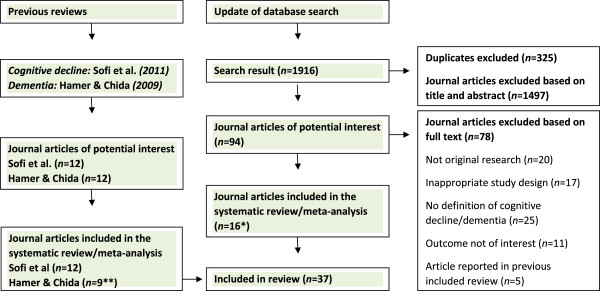
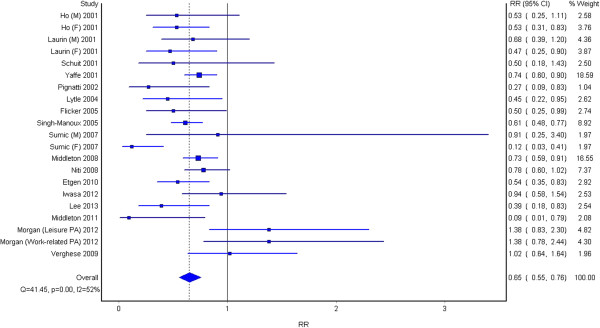
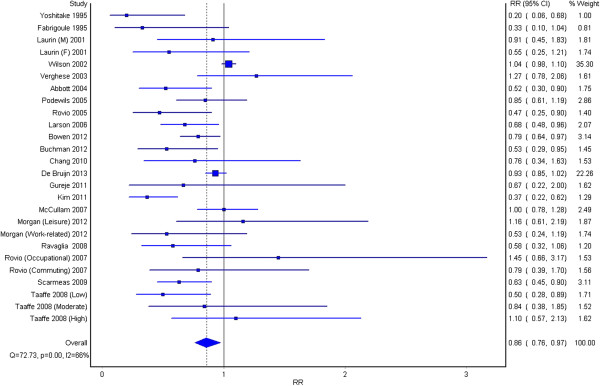
BACKGROUND: By 2050, it has been estimated that approximately one-fifth of the population will be made up of older adults (aged ≥60 years). Old age often comes with cognitive decline and dementia. Physical activity may prevent cognitive decline and dementia. METHODS: We reviewed and synthesised prospective studies into physical activity and cognitive decline, and physical activity and dementia, published until January 2014. Forty-seven cohorts, derived from two previous systematic reviews and an updated database search, were used in the meta-analyses. Included participants were aged ≥40 years, in good health and/or randomly selected from the community. Studies were assessed for methodological quality. RESULTS: Twenty-one cohorts on physical activity and cognitive decline and twenty-six cohorts on physical activity and dementia were included. Meta-analysis, using the quality-effects model, suggests that participants with higher levels of physical activity, when compared to those with lower levels, are at reduced risk of cognitive decline, RR 0.65, 95% CI 0.55-0.76, and dementia, RR 0.86, 95% CI 0.76-0.97. Sensitivity analyses revealed a more conservative estimate of the impact of physical activity on cognitive decline and dementia for high quality studies, studies reporting effect sizes as ORs, greater number of adjustments (≥10), and longer follow-up time (≥10 years). When one heavily weighted study was excluded, physical activity was associated with an 18% reduction in the risk of dementia (RR 0.82; 0.73-0.91). CONCLUSIONS: Longitudinal observational studies show an association between higher levels of physical activity and a reduced risk of cognitive decline and dementia. A case can be made for a causal interpretation. Future research should use objective measures of physical activity, adjust for the full range of confounders and have adequate follow-up length. Ideally, randomised controlled trials will be conducted. Regardless of any effect on cognition, physical activity should be encouraged, as it has been shown to be beneficial on numerous levels.
Overview
The claims and statistics of this paper haven’t been checked yet.
Free: it reads the open-access text and checks the first 5 claims that cite a source we can check. Create a free account to check every claim.
Integrity signals
Registry
Cites
Statistics
Figures
Verification
Claims the paper makes
The claims and statistics of this paper haven’t been checked yet.
Free: it reads the open-access text and checks the first 5 claims that cite a source we can check. Create a free account to check every claim.
Claims other papers make about this one
Each is checked against this paper’s own text: does it say what the citing paper says it does?
The source backs part of the claim, not all of it — or backs it for a different population, condition or comparison.
In the citing paper
“A meta-analysis of these studies concluded that physically active adults had a 35% lower risk of cognitive decline (relative risk, 0.65; 95% confidence interval, 0.55–0.76) compared with those who were physically inactive.93”
From Defining Optimal Brain Health in Adults: A Presidential Advisory From the American Heart Association/American Stroke Association (2017) · cites this paper as [93]
Experimental — accuracy not yet measuredThe cited source says what the claim attributes to it.
In the citing paper
“In contrast, physical activity appears to decrease risk. [119][120]0][121][122][123][124][125][126][127][128]”
From 2023 Alzheimer's disease facts and figures (2023) · cites this paper as [124]
Experimental — accuracy not yet measuredThe cited source says what the claim attributes to it.
In the citing paper
“Prospective observational studies have generally found a positive association between physical activity and cognitive health outcomes.”
From Defining Optimal Brain Health in Adults: A Presidential Advisory From the American Heart Association/American Stroke Association (2017) · cites this paper as [93]
Self-check
Percentages, sums and reported differences re-computed from the paper’s own numbers.
The self-check needs the paper’s full text.
Citations
Cites
Preferred Reporting Items for Systematic Reviews and Meta-Analyses: the PRISMA statement
Moher, D., Liberati, A., Tetzlaff, J., Altman, D. G., & for the PRISMA Group (2009) · BMJ · doi:10.1136/bmj.b2535 · Cited by 83,823
Preferred reporting items for systematic reviews and meta-analyses: the PRISMA Statement.
(2009) · PubMed Central · Cited by 44,859
Preferred reporting items for systematic reviews and meta-analyses: The PRISMA statement
Moher, D., Liberati, A., Tetzlaff, J., Altman, D. G., & the PRISMA Group* (2009) · Annals of Internal Medicine · doi:10.7326/0003-4819-151-4-200908180-00135 · Cited by 37,554
Preferred Reporting Items for Systematic Reviews and Meta-Analyses: The PRISMA Statement
Moher, D., Liberati, A., Tetzlaff, J., & Altman, D. G. (2009) · Journal of Clinical Epidemiology · doi:10.1016/j.jclinepi.2009.06.005 · Cited by 19,575
Lippa, N. C., & Sanderson, S. C. (2013) · Human Heredity · doi:10.1159/000353712 · Cited by 6,078
Diagnostic and Statistical Manual of Mental Disorders ( DSM ‐ IV ‐ TR )
Segal, D. L. (2010) · The Corsini Encyclopedia of Psychology · doi:10.1002/9780470479216.corpsy0271 · Cited by 4,666
Pate, R. R. (1995) · JAMA · doi:10.1001/jama.1995.03520290054029 · Cited by 4,606 · cited 1×
“A curvilinear relationship, with diminishing returns, seems the most likely association [72]; however, more research in this area is needed.”
BackgroundMACMAHON, S. (1990) · The Lancet · doi:10.1016/0140-6736(90)90878-9 · Cited by 4,253 · cited 1×
“Inaccuracies in measurement of physical activity, as outlined above, may lead to regression dilution bias, whereby imprecise measurement of the exposure variable may bias a result toward null [70].”
BackgroundInternational Encyclopedia of the Social Sciences.
Duncan, O. D., & Sills, D. L. (1968) · American Sociological Review · doi:10.2307/2092889 · Cited by 3,486
An active and socially integrated lifestyle in late life might protect against dementia
Fratiglioni, L., Paillard-Borg, S., & Winblad, B. (2004) · The Lancet Neurology · doi:10.1016/s1474-4422(04)00767-7 · Cited by 2,135 · cited 3×
“In the meantime, given that physical activity has been shown to be beneficial across multiple health domains, genders and ages, physical activity should be encouraged regardless of its relationship with cognitive decline and dementia [73].”
BackgroundInfluential
Research works printed but not linked: 1
- Rothman KJ Greenland S Lash TL Modern Epidemiology 2008 Philadelphia, PA: Lippincott Williams & Wilkins
Cited by
2023 Alzheimer's disease facts and figures
(2023) · Alzheimer's & Dementia · doi:10.1002/alz.13016 · Cited by 3,212
2024 Alzheimer's disease facts and figures
(2024) · Alzheimer's & Dementia · doi:10.1002/alz.13809 · Cited by 2,536
2019 Alzheimer’s disease facts and figures.
Alzheimer's Association (2019) · Alzheimer's & Dementia · doi:10.1016/j.jalz.2019.01.010 · Cited by 2,461
2022 Alzheimer's disease facts and figures
(2022) · Alzheimer's & Dementia · doi:10.1002/alz.12638 · Cited by 2,341
2020 Alzheimer's disease facts and figures
(2020) · Alzheimer's & Dementia · doi:10.1002/alz.12068 · Cited by 2,353
2021 Alzheimer's disease facts and figures
(2021) · Alzheimer's & Dementia · doi:10.1002/alz.12328 · Cited by 2,201
2018 Alzheimer's disease facts and figures
Alzheimer's Association (2018) · Alzheimer's & Dementia · doi:10.1016/j.jalz.2018.02.001 · Cited by 1,912
Defeating Alzheimer's disease and other dementias: a priority for European science and society
Winblad, B., Amouyel, P., Andrieu, S., Ballard, C., Brayne, C., Brodaty, H., Cedazo-Minguez, A., Dubois, B., Edvardsson, D., Feldman, H., et al. (2016) · The Lancet Neurology · doi:10.1016/s1474-4422(16)00062-4 · Cited by 1,676
Baumgart, M., Snyder, H. M., Carrillo, M. C., Fazio, S., Kim, H., & Johns, H. (2015) · Alzheimer's & Dementia · doi:10.1016/j.jalz.2015.05.016 · Cited by 1,660
Education and cognitive functioning across the life span
Lövdén, M., Fratiglioni, L., Glymour, M. M., Lindenberger, U., & Tucker-Drob, E. M. (2020) · Psychological Science in the Public Interest · doi:10.1177/1529100620920576 · Cited by 1,224
Lifestyle interventions to prevent cognitive impairment, dementia and Alzheimer disease
Kivipelto, M., Mangialasche, F., & Ngandu, T. (2018) · Nature Reviews Neurology · doi:10.1038/s41582-018-0070-3 · Cited by 1,173
Cunningham, C., O' Sullivan, R., Caserotti, P., & Tully, M. A. (2020) · Scandinavian Journal of Medicine & Science in Sports · doi:10.1111/sms.13616 · Cited by 1,154
Progress in physical activity over the Olympic quadrennium
Sallis, J. F., Bull, F., Guthold, R., Heath, G. W., Inoue, S., Kelly, P., Oyeyemi, A. L., Perez, L. G., Richards, J., & Hallal, P. C. (2016) · The Lancet · doi:10.1016/s0140-6736(16)30581-5 · Cited by 935
Association of Lifestyle and Genetic Risk With Incidence of Dementia
Lourida, I., Hannon, E., Littlejohns, T. J., Langa, K. M., Hyppönen, E., Kuzma, E., & Llewellyn, D. J. (2019) · JAMA · doi:10.1001/jama.2019.9879 · Cited by 881
Bauman, A., Merom, D., Bull, F. C., Buchner, D. M., & Fiatarone Singh, M. A. (2016) · The Gerontologist · doi:10.1093/geront/gnw031 · Cited by 679
2025 Alzheimer's disease facts and figures
(2025) · Alzheimer's & Dementia · doi:10.1002/alz.70235 · Cited by 474
Sabia, S., Dugravot, A., Dartigues, J.-F., Abell, J., Elbaz, A., Kivimäki, M., & Singh-Manoux, A. (2017) · BMJ · doi:10.1136/bmj.j2709 · Cited by 440
Ashdown-Franks, G., Firth, J., Carney, R., Carvalho, A. F., Hallgren, M., Koyanagi, A., Rosenbaum, S., Schuch, F. B., Smith, L., Solmi, M., et al. (2020) · Sports Medicine · doi:10.1007/s40279-019-01187-6 · Cited by 460
Iso-Markku, P., Kujala, U. M., Knittle, K., Polet, J., Vuoksimaa, E., & Waller, K. (2022) · British Journal of Sports Medicine · doi:10.1136/bjsports-2021-104981 · Cited by 423
Gorelick, P. B., Furie, K. L., Iadecola, C., Smith, E. E., Waddy, S. P., Lloyd-Jones, D. M., Bae, H.-J., Bauman, M. A., Dichgans, M., Duncan, P. W., et al. (2017) · Stroke · doi:10.1161/str.0000000000000148 · Cited by 411
“93 In another recent systematic review, 21 of 24 prospective studies showed a positive association between physical activity and cognitive outcomes.”
Rosenberg, A., Mangialasche, F., Ngandu, T., Solomon, A., & Kivipelto, M. (2020) · The Journal of Prevention of Alzheimer's Disease · doi:10.14283/jpad.2019.41 · Cited by 316
Herold, F., Hamacher, D., Schega, L., & Müller, N. G. (2018) · Frontiers in Aging Neuroscience · doi:10.3389/fnagi.2018.00228 · Cited by 285
Zheng, G., Xia, R., Zhou, W., Tao, J., & Chen, L. (2016) · British Journal of Sports Medicine · doi:10.1136/bjsports-2015-095699 · Cited by 290
Guure, C. B., Ibrahim, N. A., Adam, M. B., & Said, S. M. (2017) · BioMed Research International · doi:10.1155/2017/9016924 · Cited by 298
“A similar meta-analysis conducted by Hamer and Chida [27] and Blondell et al. [28] revealed 28% higher and 16% lower benefit, respectively, in relation to high PA for dementia as compared to the findings in this current research.”
Bellou, V., Belbasis, L., Tzoulaki, I., Middleton, L. T., Ioannidis, J. P. A., & Evangelou, E. (2017) · Alzheimer's & Dementia · doi:10.1016/j.jalz.2016.07.152 · Cited by 287
“Blondell, 2014 [59] Physical activity High level vs.”
BackgroundPotential Benefits of Physical Activity in MCI and Dementia
Nuzum, H., Stickel, A., Corona, M., Zeller, M., Melrose, R. J., & Wilkins, S. S. (2020) · Behavioural Neurology · doi:10.1155/2020/7807856 · Cited by 247
“Further, there is evidence from longitudinal studies that physical activity may prevent cognitive decline and dementia and that people with higher levels of physical activity are at reduced risk compared to those with lower levels [27].”
BackgroundChen, F.-T., Etnier, J. L., Chan, K.-H., Chiu, P.-K., Hung, T.-M., & Chang, Y.-K. (2020) · Sports Medicine · doi:10.1007/s40279-020-01292-x · Cited by 258
Brasure, M., Desai, P., Davila, H., Nelson, V. A., Calvert, C., Jutkowitz, E., Butler, M., Fink, H. A., Ratner, E., Hemmy, L. S., et al. (2018) · Annals of Internal Medicine · doi:10.7326/m17-1528 · Cited by 280
Fernández-Calle, R., Konings, S. C., Frontiñán-Rubio, J., García-Revilla, J., Camprubí-Ferrer, L., Svensson, M., Martinson, I., Boza-Serrano, A., Venero, J. L., Nielsen, H. M., et al. (2022) · Molecular Neurodegeneration · doi:10.1186/s13024-022-00566-4 · Cited by 278
Physical Activity and Alzheimer’s Disease: A Systematic Review
Stephen, R., Hongisto, K., Solomon, A., & Lönnroos, E. (2017) · The Journals of Gerontology Series A: Biological Sciences and Medical Sciences · doi:10.1093/gerona/glw251 · Cited by 262
The Evolution of Technology and Physical Inactivity: The Good, the Bad, and the Way Forward
Woessner, M. N., Tacey, A., Levinger-Limor, A., Parker, A. G., Levinger, P., & Levinger, I. (2021) · Frontiers in Public Health · doi:10.3389/fpubh.2021.655491 · Cited by 203
Exercise and Hippocampal Memory Systems
Voss, M. W., Soto, C., Yoo, S., Sodoma, M., Vivar, C., & van Praag, H. (2019) · Trends in Cognitive Sciences · doi:10.1016/j.tics.2019.01.006 · Cited by 235
“The National Academies [4] and the National Academy of Medicine [7] reports point out that long-term prospective studies consistently show that PA reduces cognitive decline and dementia risk [8, 9].”
BackgroundSkeletal Muscle Health and Cognitive Function: A Narrative Review
Sui, S. X., Williams, L. J., Holloway-Kew, K. L., Hyde, N. K., & Pasco, J. A. (2020) · International Journal of Molecular Sciences · doi:10.3390/ijms22010255 · Cited by 213
Physical Activity and Cognitive Decline Among Older Adults: A Systematic Review and Meta-Analysis
Iso-Markku, P., Aaltonen, S., Kujala, U. M., Halme, H.-L., Phipps, D., Knittle, K., Vuoksimaa, E., & Waller, K. (2024) · JAMA Network Open · doi:10.1001/jamanetworkopen.2023.54285 · Cited by 227
The 2017 Dutch Physical Activity Guidelines
Committee Dutch Physical Activity Guidelines 2017, Weggemans, R. M., Backx, F. J. G., Borghouts, L., Chinapaw, M., Hopman, M. T. E., Koster, A., Kremers, S., van Loon, L. J. C., May, A., et al. (2018) · International Journal of Behavioral Nutrition and Physical Activity · doi:10.1186/s12966-018-0661-9 · Cited by 227
“As shown by cohort studies [52, 53], it is also plausible that higher levels of physical activity in older persons are associated with a lower risk of cognitive decline, dementia and Alzheimer's disease.”
BackgroundLong-Term Green Space Exposure and Cognition Across the Life Course: a Systematic Review
de Keijzer, C., Gascon, M., Nieuwenhuijsen, M. J., & Dadvand, P. (2016) · Current Environmental Health Reports · doi:10.1007/s40572-016-0116-x · Cited by 204
Cox, E. P., O’Dwyer, N., Cook, R., Vetter, M., Cheng, H. L., Rooney, K., & O’Connor, H. (2016) · Journal of Science and Medicine in Sport · doi:10.1016/j.jsams.2015.09.003 · Cited by 187
Peters, R., Ee, N., Peters, J., Beckett, N., Booth, A., Rockwood, K., & Anstey, K. J. (2019) · Therapeutic Advances in Chronic Disease · doi:10.1177/2040622319880392 · Cited by 213
Physical Activity, Brain Volume, and Dementia Risk: The Framingham Study
Tan, Z. S., Spartano, N. L., Beiser, A. S., DeCarli, C., Auerbach, S. H., Vasan, R. S., & Seshadri, S. (2016) · The Journals of Gerontology Series A: Biological Sciences and Medical Sciences · doi:10.1093/gerona/glw130 · Cited by 212
“This observation was consistent with a recent systematic review suggesting a weaker protective effect of physical activity in studies with follow-up time longer than a decade (15).”
BackgroundResultInfluentialRoberts, C. E., Phillips, L. H., Cooper, C. L., Gray, S., & Allan, J. L. (2017) · Journal of Aging and Physical Activity · doi:10.1123/japa.2016-0201 · Cited by 191
Mental health rescue effects of women's outdoor tourism: A role in COVID-19 recovery
Buckley, R., & Westaway, D. (2020) · Annals of Tourism Research · doi:10.1016/j.annals.2020.103041 · Cited by 185
“…and clarity, whilst not reported previously for hiking, have been identified for highly active outdoor pursuits, including extreme sports (Booth, 2018; Buckley, 2018a; Collins & Brymer, 2018; Holmbom et al., 2017; Houge Mackenzie & Brymer, 2018; Morris & Scott, 2019; Roberts et al.,…”
BackgroundKennedy, G., Hardman, R. J., Macpherson, H., Scholey, A. B., & Pipingas, A. (2016) · Journal of Alzheimer's Disease · doi:10.3233/jad-160665 · Cited by 185
“A recent systematic and meta-analytic review of 37 longitudinal studies, found that there was a negative relationship between physical activity and both dementia and cognitive decline [37].”
Relationships between physical activity, sleep and cognitive function: A narrative review
Sewell, K. R., Erickson, K. I., Rainey-Smith, S. R., Peiffer, J. J., Sohrabi, H. R., & Brown, B. M. (2021) · Neuroscience & Biobehavioral Reviews · doi:10.1016/j.neubiorev.2021.09.003 · Cited by 172
Biazus-Sehn, L. F., Schuch, F. B., Firth, J., & Stigger, F. D. S. (2020) · Archives of Gerontology and Geriatrics · doi:10.1016/j.archger.2020.104048 · Cited by 194
Midlife cardiovascular fitness and dementia: A 44-year longitudinal population study in women
Hörder, H., Johansson, L., Guo, X., Grimby, G., Kern, S., Östling, S., & Skoog, I. (2018) · Neurology · doi:10.1212/wnl.0000000000005290 · Cited by 188
“High fitness (n = 40) 2 (5) 0 (0) 33 (2) 90 (3)”
MethodAnstey, K. J., Ee, N., Eramudugolla, R., Jagger, C., & Peters, R. (2019) · Journal of Alzheimer’s Disease · doi:10.3233/jad-190181 · Cited by 187
The Contribution of Physical Exercise to Brain Resilience
Arida, R. M., & Teixeira-Machado, L. (2021) · Frontiers in Behavioral Neuroscience · doi:10.3389/fnbeh.2020.626769 · Cited by 150
“For instance, individuals aged ≥40 years with better levels of physical activity presented lower risk of cognitive decline and dementia (Blondell et al., 2014).”
BackgroundAgeing without dementia: can stimulating psychosocial and lifestyle experiences make a difference?
Fratiglioni, L., Marseglia, A., & Dekhtyar, S. (2020) · The Lancet Neurology · doi:10.1016/s1474-4422(20)30039-9 · Cited by 154
Radd-Vagenas, S., Duffy, S. L., Naismith, S. L., Brew, B. J., Flood, V. M., & Fiatarone Singh, M. A. (2018) · The American Journal of Clinical Nutrition · doi:10.1093/ajcn/nqx070 · Cited by 176
Chen, C., & Nakagawa, S. (2023) · Ageing Research Reviews · doi:10.1016/j.arr.2023.101868 · Cited by 194
Menai, M., van Hees, V. T., Elbaz, A., Kivimaki, M., Singh-Manoux, A., & Sabia, S. (2017) · Scientific Reports · doi:10.1038/srep45772 · Cited by 159
Sarcopenia and Cognitive Decline in Older Adults: Targeting the Muscle–Brain Axis
Arosio, B., Calvani, R., Ferri, E., Coelho-Junior, H. J., Carandina, A., Campanelli, F., Ghiglieri, V., Marzetti, E., & Picca, A. (2023) · Nutrients · doi:10.3390/nu15081853 · Cited by 165
“Longitudinal observational studies indicated a lower risk of cognitive decline and dementia in physically active older people [124].”
BackgroundDhana, K., Franco, O. H., Ritz, E. M., Ford, C. N., Desai, P., Krueger, K. R., Holland, T. M., Dhana, A., Liu, X., Aggarwal, N. T., et al. (2022) · BMJ · doi:10.1136/bmj-2021-068390 · Cited by 164
Age dependency of risk factors for cognitive decline
Legdeur, N., Heymans, M. W., Comijs, H. C., Huisman, M., Maier, A. B., & Visser, P. J. (2018) · BMC Geriatrics · doi:10.1186/s12877-018-0876-2 · Cited by 143
Sarcopenia and Cognitive Function: Role of Myokines in Muscle Brain Cross-Talk
Scisciola, L., Fontanella, R. A., Surina, S., Cataldo, V., Paolisso, G., & Barbieri, M. (2021) · Life · doi:10.3390/life11020173 · Cited by 179
Physical activity and neurocognitive functioning in aging - a condensed updated review
Gajewski, P. D., & Falkenstein, M. (2016) · European Review of Aging and Physical Activity · doi:10.1186/s11556-016-0161-3 · Cited by 127
de Keijzer, C., Tonne, C., Basagaña, X., Valentín, A., Singh-Manoux, A., Alonso, J., Antó, J. M., Nieuwenhuijsen, M. J., Sunyer, J., & Dadvand, P. (2018) · Environmental Health Perspectives · doi:10.1289/ehp2875 · Cited by 138
“…higher levels of physical activity have been demonstrated in older adults with higher greenness in their residential surroundings (Gong et al. 2014), while higher physical activity has been associated with a lower risk for cognitive decline and dementia in previous research (Blondell et al. 2014).”
Spartano, N. L., Davis-Plourde, K. L., Himali, J. J., Andersson, C., Pase, M. P., Maillard, P., DeCarli, C., Murabito, J. M., Beiser, A. S., Vasan, R. S., et al. (2019) · JAMA Network Open · doi:10.1001/jamanetworkopen.2019.2745 · Cited by 131
Knight, A., Bryan, J., & Murphy, K. J. (2015) · Ageing Research Reviews · doi:10.1016/j.arr.2015.10.005 · Cited by 145
Merom, D., Grunseit, A. C., Eramudugolla, R., Jefferis, B. J. M. H., McNeill, J., & Anstey, K. J. (2016) · Frontiers in Aging Neuroscience · doi:10.3389/fnagi.2016.00026 · Cited by 149
“Consistent evidence from population-based cohort studies suggests that a physically active lifestyle in late life can attenuate cognitive decline and reduce the risk of developing dementia (Fratiglioni et al., 2004; Hamer and Chida, 2009; Blondell et al., 2014).”
Leiter, O., Brici, D., Fletcher, S. J., Yong, X. L. H., Widagdo, J., Matigian, N., Schroer, A. B., Bieri, G., Blackmore, D. G., Bartlett, P. F., et al. (2023) · Nature Communications · doi:10.1038/s41467-023-39873-9 · Cited by 145
Cunningham, J. C., Broglio, S. P., O’Grady, M., & Wilson, F. (2020) · Journal of Athletic Training · doi:10.4085/1062-6050-297-18 · Cited by 144
Kwan, R. Y., Lee, D., Lee, P. H., Tse, M., Cheung, D. S., Thiamwong, L., & Choi, K.-S. (2020) · JMIR mHealth and uHealth · doi:10.2196/16596 · Cited by 122
“Longitudinal observational studies have shown that there is a significant association between high levels of physical activity and reduced risks of cognitive decline in older people [68].”
BackgroundIs personality associated with dementia risk? A meta-analytic investigation
Aschwanden, D., Strickhouser, J. E., Luchetti, M., Stéphan, Y., Sutin, A. R., & Terracciano, A. (2021) · Ageing Research Reviews · doi:10.1016/j.arr.2021.101269 · Cited by 139
Jensen, C. S., Bahl, J. M., Østergaard, L. B., Høgh, P., Wermuth, L., Heslegrave, A., Zetterberg, H., Heegaard, N. H. H., Hasselbalch, S. G., & Simonsen, A. H. (2019) · Experimental Gerontology · doi:10.1016/j.exger.2019.04.003 · Cited by 121
“Whereas longitudinal cohort studies show an association between higher levels of PA and a reduced risk of cognitive decline and dementia (Blondell et al., 2014), there is limited evidence for an effect of PA on AD biomarkers (Jensen et al.”
Are the neuroprotective effects of exercise training systemically mediated?
Tari, A. R., Norevik, C. S., Scrimgeour, N. R., Kobro-Flatmoen, A., Storm-Mathisen, J., Bergersen, L. H., Wrann, C. D., Selbæk, G., Kivipelto, M., Moreira, J. B. N., et al. (2019) · Progress in Cardiovascular Diseases · doi:10.1016/j.pcad.2019.02.003 · Cited by 115
“Current conventional therapies are far from optimal, however, a large body of literature documents significant benefits of PA on cognition, dementia risk and dementia progression, as reviewed elsewhere.(17,18) These studies provide the basis for the hypothesis that regular PA may act as a prophylactic as well as a dis…”
BackgroundExercise and dementia prevention
Alty, J., Farrow, M., & Lawler, K. (2020) · Practical Neurology · doi:10.1136/practneurol-2019-002335 · Cited by 113
Zhou, S., Chen, S., Liu, X., Zhang, Y., Zhao, M., & Li, W. (2022) · International Journal of Environmental Research and Public Health · doi:10.3390/ijerph19031216 · Cited by 137
“, aerobic and anaerobic exercise) was associated with a reduced risk of cognitive decline in dementia [14].”
BackgroundBriguglio, M., Vitale, J. A., Galentino, R., Banfi, G., Dina, C. Z., Bona, A. R., Panzica, G., Porta, M., Dell’Osso, B. M., & Glick, I. D. (2020) · Neuropsychiatric Disease and Treatment · doi:10.2147/ndt.s229206 · Cited by 131
“exposed to a higher risk of anxiety and depressive disorders,(67,68) cognitive decline and dementia.(69) Other”
BackgroundKawano, T., Eguchi, S., Iwata, H., Tamura, T., Kumagai, N., & Yokoyama, M. (2015) · Anesthesiology · doi:10.1097/aln.0000000000000697 · Cited by 125
Borges-Machado, F., Barros, D., Ribeiro, Ó., & Carvalho, J. (2020) · American Journal of Alzheimer's Disease & Other Dementias® · doi:10.1177/1533317520976720 · Cited by 116
“Despite the multifactorial etiology of NCD, sedentary lifestyle, inactivity and low fitness have been described as determinant risk factors for NCD onset and its progression.(37,38) Regarding ADL, individuals significantly declined their independence levels.”
BackgroundKwon, J. H., Moon, K. M., & Min, K.-W. (2020) · Healthcare · doi:10.3390/healthcare8040378 · Cited by 116
“Physical exercise enhances immunity and improves memory, which is beneficial in Alzheimer’s disease [267,268].”
BackgroundObesity-induced cognitive impairment in older adults: a microvascular perspective
Balasubramanian, P., Kiss, T., Tarantini, S., Nyúl-Tóth, Á., Ahire, C., Yabluchanskiy, A., Csipo, T., Lipecz, A., Tabak, A., Institoris, A., et al. (2021) · American Journal of Physiology-Heart and Circulatory Physiology · doi:10.1152/ajpheart.00736.2020 · Cited by 115
Quigley, A., MacKay-Lyons, M. J., & Eskes, G. A. (2020) · Journal of Aging Research · doi:10.1155/2020/1407896 · Cited by 130
“A later meta-analytic review of 21 longitudinal studies of 89,205 adults over the age of 40 also found that higher levels of physical activity was associated with reduced risk of cognitive decline and dementia [12].”
BackgroundLorito, C. D., Bosco, A., Booth, V., Goldberg, S. E., Harwood, R., & van der Wardt, V. (2020) · Preventive Medicine Reports · doi:10.1016/j.pmedr.2020.101139 · Cited by 134
Regular group exercise contributes to balanced health in older adults in Japan: a qualitative study
Komatsu, H., Yagasaki, K., Saito, Y., & Oguma, Y. (2017) · BMC Geriatrics · doi:10.1186/s12877-017-0584-3 · Cited by 124
Physical activity and trajectories in cognitive function: English Longitudinal Study of Ageing
Hamer, M., Terrera, G. M., & Demakakos, P. (2018) · Journal of Epidemiology & Community Health · doi:10.1136/jech-2017-210228 · Cited by 123
“preventing neurodegenerative diseases [1-4].”
BackgroundUrban green space, tree canopy and 11-year risk of dementia in a cohort of 109,688 Australians
Astell‐Burt, T., Navakatikyan, M., & Feng, X. (2020) · Environment International · doi:10.1016/j.envint.2020.106102 · Cited by 120
A Primary Care Agenda for Brain Health: A Scientific Statement From the American Heart Association
Lazar, R. M., Howard, V. J., Kernan, W. N., Aparicio, H. J., Levine, D. A., Viera, A. J., Jordan, L. C., Nyenhuis, D. L., Possin, K. L., Sorond, F. A., et al. (2021) · Stroke · doi:10.1161/str.0000000000000367 · Cited by 109
Veronese, N., Stubbs, B., Trevisan, C., Bolzetta, F., De Rui, M., Solmi, M., Sartori, L., Musacchio, E., Zambon, S., Perissinotto, E., et al. (2016) · Experimental Gerontology · doi:10.1016/j.exger.2016.05.008 · Cited by 99
Redox proteomics and amyloid β-peptide: Insights into Alzheimer disease
Butterfield, D. A., & Boyd‐Kimball, D. (2019) · Journal of Neurochemistry · doi:10.1111/jnc.14589 · Cited by 105
Chen, F., Hopman, R. J., Huang, C., Chu, C., Hillman, C. H., Hung, T., & Chang, Y. (2020) · Journal of Clinical Medicine · doi:10.3390/jcm9040914 · Cited by 111
Brown, V., Zapata-Diomedi, B., Moodie, M., Veerman, L. J., & Carter, R. (2015) · Transport Policy · doi:10.1016/j.tranpol.2015.10.003 · Cited by 119
Association of objectively measured physical activity with brain structure: UK Biobank study
Hamer, M., Sharma, N., & Batty, G. D. (2018) · Journal of Internal Medicine · doi:10.1111/joim.12772 · Cited by 101
“Meta-analyses of cohort studies have demonstrated favourable associations between physical activity and cognitive outcomes [2,3].”
BackgroundHuang, K.-T. (2020) · Cyberpsychology Behavior and Social Networking · doi:10.1089/cyber.2019.0269 · Cited by 98
Alvarez‐Bueno, C., Cunha, P. G., Martinez‐Vizcaino, V., Pozuelo‐Carrascosa, D. P., Visier‐Alfonso, M. E., Jimenez‐Lopez, E., & Cavero‐Redondo, I. (2020) · Journal of the American Heart Association · doi:10.1161/jaha.119.014621 · Cited by 93
Relationship between physical activity and cognitive functioning among older Indian adults
Kumar, M., Srivastava, S., & Muhammad, T. (2022) · Scientific Reports · doi:10.1038/s41598-022-06725-3 · Cited by 123
Stubbs, B., Chen, L.-J., Chang, C.-Y., Sun, W.-J., & Ku, P.-W. (2017) · Experimental Gerontology · doi:10.1016/j.exger.2017.03.003 · Cited by 93
“The authors (Blondell et al., 2014) only identified one study capturing physical activity utilizing an objective measurement of physical activity (Buchman et al.”
InfluentialDissecting the Fornix in Basic Memory Processes and Neuropsychiatric Disease: A Review
Benear, S. L., Ngo, C. T., & Olson, I. R. (2020) · Brain Connectivity · doi:10.1089/brain.2020.0749 · Cited by 101
“In contrast, socializing and aerobic exercise improve episodic memory, especially in aged populations (Blondell et al., 2014; James et al., 2011; but see also Sabia et al., 2017).”
Cognitive impairment in COPD: should cognitive evaluation be part of respiratory assessment?
Andrianopoulos, V., Gloeckl, R., Vogiatzis, I., & Kenn, K. (2017) · Breathe · doi:10.1183/20734735.001417 · Cited by 103
“According to the literature there are some modifiable factors, such as physical activity [71, 72], balanced diet [73], cognitive training [74] and social engagement [75], that can be improved to provide beneficial effects to patients with COPD who have presented evidence of cognitive impairment.”
BackgroundDietary Patterns, Physical Activity, Sleep, and Risk for Dementia and Cognitive Decline
Zhao, C., Noble, J. M., Marder, K. S., Hartman, J. S., Gu, Y., & Scarmeas, N. (2018) · Current Nutrition Reports · doi:10.1007/s13668-018-0247-9 · Cited by 107
Bisbe, M., Fuente-Vidal, A., López, E., Moreno, M., Naya, M., de Benetti, C., Milà, R., Bruna, O., Boada, M., & Alegret, M. (2020) · Journal of Alzheimer’s Disease · doi:10.3233/jad-190552 · Cited by 78
Randomized Controlled Trial of Exercise in CKD—The RENEXC Study
Hellberg, M., Höglund, P., Svensson, P., & Clyne, N. (2019) · Kidney International Reports · doi:10.1016/j.ekir.2019.04.001 · Cited by 101
“Previous observational studies in patients without CKD have shown that higher levels of physical activity were associated with reduced risk of both cognitive decline and occurrence of dementia.(40) We did not analyze cognitive ability in RENEXC, but the registered improvement in fine motor skills may be due to a”
BackgroundBody mass index, diet, physical inactivity, and the incidence of dementia in 1 million UK women
Floud, S., Simpson, R. F., Balkwill, A., Brown, A., Goodill, A., Gallacher, J., Sudlow, C., Harris, P., Hofman, A., Parish, S., et al. (2020) · Neurology · doi:10.1212/wnl.0000000000008779 · Cited by 85
Seet, D., Allameen, N. A., Tay, S. H., Cho, J., & Mak, A. (2021) · Rheumatology and Therapy · doi:10.1007/s40744-021-00312-0 · Cited by 94
“found that severity of depression was the only clinical factor that significantly predicted CD in SLE patients, highlighting the importance of assessing and treating depression in these patients [123].”
BackgroundMidlife physical activity, psychological distress, and dementia risk: the HUNT study
Zotcheva, E., Bergh, S., Selbæk, G., Krokstad, S., Håberg, A. K., Strand, B. H., & Ernstsen, L. (2018) · Journal of Alzheimer's Disease · doi:10.3233/jad-180768 · Cited by 87
“A large body of research suggests that PA may reduce the risk of cognitive decline and dementia [4, 5], and a recent meta-analysis demonstrated a dose-response relationship with a 10% reduction in risk of all-cause dementia per each 10 additional metabolic equivalent task-hours per week [6].”
Cohn‐Schwartz, E. (2020) · Innovation in Aging · doi:10.1093/geroni/igaa015 · Cited by 95
de Souto Barreto, P., Demougeot, L., Vellas, B., & Rolland, Y. (2018) · The Journals of Gerontology: Series A · doi:10.1093/gerona/glx234 · Cited by 85
Sex on the brain! Associations between sexual activity and cognitive function in older age
Wright, H., & Jenks, R. A. (2016) · Age and Ageing · doi:10.1093/ageing/afv197 · Cited by 90
“Cognitive function has been associated with a number of physical, psychological and emotional factors in older adults, such as cognitive lifestyle [1], psychological factors of quality of life [2], loneliness [3] and mood [4] and physical activity [5, 6].”
BackgroundRelationship between decline in cognitive resources and physical activity.
Cheval, B., Orsholits, D., Sieber, S., Courvoisier, D. S., Cullati, S., & Boisgontier, M. P. (2020) · Health Psychology · doi:10.1037/hea0000857 · Cited by 90
“This result is consistent with previous studies suggesting that physical activity is a determinant of cognitive functioning (Blondell et al., 2014; Colcombe & Kramer, 2003; Hamer et al., 2018), although most recent studies and those with a long follow-up (i.e., less prone to reverse causation…”
Result
Metadata
- Authors
- Blondell, S. J., Hammersley-Mather, R., & Veerman, J. L.
- Affiliations
- The University of Queensland (AU)
- ORCID
- Blondell, Sarah J
- Venue
- BMC Public Health
- Published
- 2014-05-27
- Volume
- 14
- Issue
- 1
- Pages
- 510-510
- ISSN
- 1471-2458 (ISSN-L)
- PMC
- PMC4064273
- OpenAlex
- W2105024128
- Cited by
- 928
- References
- 86
- Citations by year
- 2026: 64 · 2025: 81 · 2024: 91 · 2023: 89 · 2022: 111 · 2021: 91 · 2020: 116 · 2019: 80 · 2018: 58 · 2017: 66 · 2016: 51 · 2015: 24 · 2014: 5
- FWCI
- 6.70
- Type
- journal article
- Language
- en
- Open access
- gold
- doi.org
- Licence
- Locations
- BMC Public Health (publishedVersion, cc-by)
- Europe PMC (PubMed Central) (publishedVersion, cc-by)
- PubMed Central (publishedVersion, cc-by)
- PubMed (publishedVersion)
- University of Southern Queensland ePrints (University of Southern Queensland) (acceptedVersion)
- Griffith Research Online (submittedVersion, cc-by)
- Topics
- Health Sciences › Medicine › Psychiatry and Mental health › Dementia and Cognitive Impairment Research
- Health Sciences › Medicine › Public Health, Environmental and Occupational Health › Physical Activity and Health
- Health Sciences › Medicine › Critical Care and Intensive Care Medicine › Intensive Care Unit Cognitive Disorders
- Keywords
- physical activity, cognitive decline, dementia, older adults, dementia prevention, cognitive aging, prospective cohort
- MeSH terms
- Aged, Aged, 80 and over, Dementia, Female, Humans, Longitudinal Studies, Male, Middle Aged, Motor Activity, Cohort Studies
About these checks
Registry, retraction, Cites and statistics results are computed, not judged, with one exception: a printed reference that no index lists is read once by a model before it counts as a citation error. Claims are extracted by a model and kept only when their quote appears verbatim in the text; each cited source is then checked, with a model’s help, for whether it says what the claim relies on. Those verdicts can be wrong — read the claim’s quote and the cited source before relying on one.
Statistics and arithmetic are recomputed, not judged.
Confidence bands are shown only for fields calibrated on our annotated test set. None is calibrated yet, so no band is shown.
What counts as a claim ›How we measure confidence ›How we check this ›
Are you an author, or do you see a problem with this page? Request a review
Data sources
Bibliographic data: Semantic Scholar, OpenAlex, Crossref.
Contains information from the Semantic Scholar Academic Graph Datasets, made available under the ODC Attribution License (ODC-BY 1.0).
Semantic Scholar’s data is described in: Kinney, R., et al. (2023). The Semantic Scholar Open Data Platform. arXiv:2301.10140.
