

Does physical activity prevent cognitive decline and dementia?: A systematic review and meta-analysis of longitudinal studies
Open accessThe DOI matches its Crossref record; 85 of the 86 references it cites were found in a registry or an index, and 1 are not checked yet.
Abstract
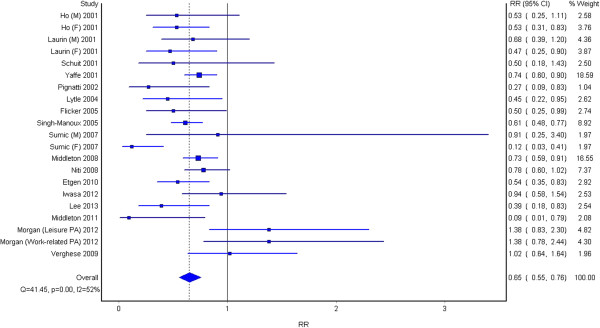
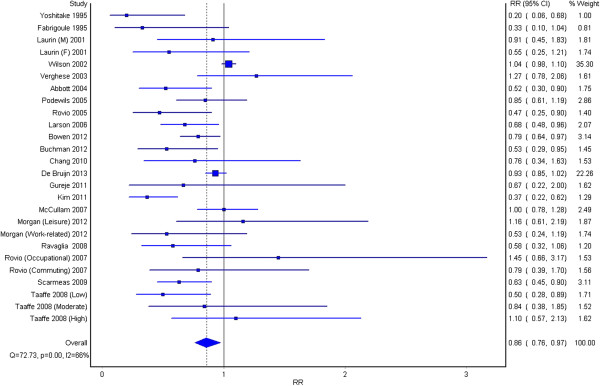
BACKGROUND: By 2050, it has been estimated that approximately one-fifth of the population will be made up of older adults (aged ≥60 years). Old age often comes with cognitive decline and dementia. Physical activity may prevent cognitive decline and dementia. METHODS: We reviewed and synthesised prospective studies into physical activity and cognitive decline, and physical activity and dementia, published until January 2014. Forty-seven cohorts, derived from two previous systematic reviews and an updated database search, were used in the meta-analyses. Included participants were aged ≥40 years, in good health and/or randomly selected from the community. Studies were assessed for methodological quality. RESULTS: Twenty-one cohorts on physical activity and cognitive decline and twenty-six cohorts on physical activity and dementia were included. Meta-analysis, using the quality-effects model, suggests that participants with higher levels of physical activity, when compared to those with lower levels, are at reduced risk of cognitive decline, RR 0.65, 95% CI 0.55-0.76, and dementia, RR 0.86, 95% CI 0.76-0.97. Sensitivity analyses revealed a more conservative estimate of the impact of physical activity on cognitive decline and dementia for high quality studies, studies reporting effect sizes as ORs, greater number of adjustments (≥10), and longer follow-up time (≥10 years). When one heavily weighted study was excluded, physical activity was associated with an 18% reduction in the risk of dementia (RR 0.82; 0.73-0.91). CONCLUSIONS: Longitudinal observational studies show an association between higher levels of physical activity and a reduced risk of cognitive decline and dementia. A case can be made for a causal interpretation. Future research should use objective measures of physical activity, adjust for the full range of confounders and have adequate follow-up length. Ideally, randomised controlled trials will be conducted. Regardless of any effect on cognition, physical activity should be encouraged, as it has been shown to be beneficial on numerous levels.
Overview
The claims and statistics of this paper haven’t been checked yet.
Free: it reads the open-access text and checks the first 5 claims that cite a source we can check. Create a free account to check every claim.
Integrity signals
Registry
Cites
Statistics
Figures
Verification
Claims the paper makes
The claims and statistics of this paper haven’t been checked yet.
Free: it reads the open-access text and checks the first 5 claims that cite a source we can check. Create a free account to check every claim.
Claims other papers make about this one
Each is checked against this paper’s own text: does it say what the citing paper says it does?
The source backs part of the claim, not all of it — or backs it for a different population, condition or comparison.
In the citing paper
“A meta-analysis of these studies concluded that physically active adults had a 35% lower risk of cognitive decline (relative risk, 0.65; 95% confidence interval, 0.55–0.76) compared with those who were physically inactive.93”
From Defining Optimal Brain Health in Adults: A Presidential Advisory From the American Heart Association/American Stroke Association (2017) · cites this paper as [93]
Experimental — accuracy not yet measuredThe cited source says what the claim attributes to it.
In the citing paper
“In contrast, physical activity appears to decrease risk. [119][120]0][121][122][123][124][125][126][127][128]”
From 2023 Alzheimer's disease facts and figures (2023) · cites this paper as [124]
Experimental — accuracy not yet measuredThe cited source says what the claim attributes to it.
In the citing paper
“Prospective observational studies have generally found a positive association between physical activity and cognitive health outcomes.”
From Defining Optimal Brain Health in Adults: A Presidential Advisory From the American Heart Association/American Stroke Association (2017) · cites this paper as [93]
Self-check
Percentages, sums and reported differences re-computed from the paper’s own numbers.
The self-check needs the paper’s full text.
Citations
Cites
Preferred Reporting Items for Systematic Reviews and Meta-Analyses: the PRISMA statement
Moher, D., Liberati, A., Tetzlaff, J., Altman, D. G., & for the PRISMA Group (2009) · BMJ · doi:10.1136/bmj.b2535 · Cited by 83,823
Preferred reporting items for systematic reviews and meta-analyses: the PRISMA Statement.
(2009) · PubMed Central · Cited by 44,859
Preferred reporting items for systematic reviews and meta-analyses: The PRISMA statement
Moher, D., Liberati, A., Tetzlaff, J., Altman, D. G., & the PRISMA Group* (2009) · Annals of Internal Medicine · doi:10.7326/0003-4819-151-4-200908180-00135 · Cited by 37,554
Preferred Reporting Items for Systematic Reviews and Meta-Analyses: The PRISMA Statement
Moher, D., Liberati, A., Tetzlaff, J., & Altman, D. G. (2009) · Journal of Clinical Epidemiology · doi:10.1016/j.jclinepi.2009.06.005 · Cited by 19,575
Lippa, N. C., & Sanderson, S. C. (2013) · Human Heredity · doi:10.1159/000353712 · Cited by 6,078
Diagnostic and Statistical Manual of Mental Disorders ( DSM ‐ IV ‐ TR )
Segal, D. L. (2010) · The Corsini Encyclopedia of Psychology · doi:10.1002/9780470479216.corpsy0271 · Cited by 4,666
Pate, R. R. (1995) · JAMA · doi:10.1001/jama.1995.03520290054029 · Cited by 4,606 · cited 1×
“A curvilinear relationship, with diminishing returns, seems the most likely association [72]; however, more research in this area is needed.”
BackgroundMACMAHON, S. (1990) · The Lancet · doi:10.1016/0140-6736(90)90878-9 · Cited by 4,253 · cited 1×
“Inaccuracies in measurement of physical activity, as outlined above, may lead to regression dilution bias, whereby imprecise measurement of the exposure variable may bias a result toward null [70].”
BackgroundInternational Encyclopedia of the Social Sciences.
Duncan, O. D., & Sills, D. L. (1968) · American Sociological Review · doi:10.2307/2092889 · Cited by 3,486
An active and socially integrated lifestyle in late life might protect against dementia
Fratiglioni, L., Paillard-Borg, S., & Winblad, B. (2004) · The Lancet Neurology · doi:10.1016/s1474-4422(04)00767-7 · Cited by 2,135 · cited 3×
“In the meantime, given that physical activity has been shown to be beneficial across multiple health domains, genders and ages, physical activity should be encouraged regardless of its relationship with cognitive decline and dementia [73].”
BackgroundInfluential
Research works printed but not linked: 1
- Rothman KJ Greenland S Lash TL Modern Epidemiology 2008 Philadelphia, PA: Lippincott Williams & Wilkins
Cited by
Items 101–200 of 1,000
Dalton, A. M., Wareham, N. J., Griffin, S. J., & Jones, A. (2016) · SSM - Population Health · doi:10.1016/j.ssmph.2016.09.006 · Cited by 87
Miyachi, M., Tripette, J., Kawakami, R., & Murakami, H. (2015) · Journal of Nutritional Science and Vitaminology · doi:10.3177/jnsv.61.s7 · Cited by 94
Physical Activity and Cognitive Functioning
Latino, F., & Tafuri, F. (2024) · Medicina · doi:10.3390/medicina60020216 · Cited by 92
“The improvement of physical performance has a protective effect against cognitive decline in the course of aging [15].”
BackgroundBiological Sex: A Potential Moderator of Physical Activity Efficacy on Brain Health
Barha, C. K., Hsu, C. L., ten Brinke, L., & Liu-Ambrose, T. Y. L. (2019) · Frontiers in Aging Neuroscience · doi:10.3389/fnagi.2019.00329 · Cited by 89
“…of the literature has focused on the effects of AT on cognitive health in older adults, although in more recent years the efficacy of RT has been shown (for examples see Cassilhas et al., 2007; Liu-Ambrose et al., 2010, 2012; Nagamatsu et al., 2012; Best et al., 2015; Bolandzadeh et al., 2015).”
BackgroundBorges‐Machado, F., Silva, N., Farinatti, P., Poton, R., Ribeiro, Ó. M., & Carvalho, J. (2020) · The Gerontologist · doi:10.1093/geront/gnaa091 · Cited by 84
Hüttenrauch, M., Brauß, A., Kurdakova, A., Borgers, H., Klinker, F., Liebetanz, D., Salinas-Riester, G., Wiltfang, J., Klafki, H. W., & Wirths, O. (2016) · Translational Psychiatry · doi:10.1038/tp.2016.65 · Cited by 78
van Beers, M., Janssen, D. J. A., Gosker, H. R., & Schols, A. M. W. J. (2018) · Expert Review of Respiratory Medicine · doi:10.1080/17476348.2018.1533405 · Cited by 77
Alcazar, J., Rodriguez-Lopez, C., Ara, I., Alfaro-Acha, A., Rodríguez-Gómez, I., Navarro-Cruz, R., Losa-Reyna, J., García-García, F. J., & Alegre, L. M. (2018) · Experimental Gerontology · doi:10.1016/j.exger.2018.03.015 · Cited by 77
“, 2010), and in the opposite direction, a reduced physical activity might also lead to a deteriorated cognitive status (Blondell et al., 2014).”
BackgroundGlobal aging and health determinants in a changing world
Padeiro, M., Santana, P., & Grant, M. (2022) · Elsevier eBooks · doi:10.1016/b978-0-12-823761-8.00021-5 · Cited by 102
Wittfeld, K., Jochem, C., Dörr, M., Schminke, U., Gläser, S., Bahls, M., Markus, M. R. P., Felix, S. B., Leitzmann, M. F., Ewert, R., et al. (2020) · Mayo Clinic Proceedings · doi:10.1016/j.mayocp.2019.05.030 · Cited by 79
van Santen, J., Dröes, R., Twisk, J. W. R., Henkemans, O. B., van Straten, A., & Meiland, F. J. M. (2020) · Journal of the American Medical Directors Association · doi:10.1016/j.jamda.2020.04.018 · Cited by 79
Daimiel, L., Martínez‐González, M. Á., Corella, D., Salas‐Salvadó, J., Schröder, H., Vioqué, J., Romaguera, D., Martínez, J. A., Wärnberǵ, J., López‐Miranda, J., et al. (2020) · Scientific Reports · doi:10.1038/s41598-020-59458-6 · Cited by 80
Gill, S. J., Friedenreich, C. M., Sajobi, T. T., Longman, R. S., Drogos, L. L., Davenport, M. H., Tyndall, A. V., Eskes, G. A., Hogan, D. B., Hill, M. D., et al. (2015) · Journal of the International Neuropsychological Society · doi:10.1017/s1355617715000880 · Cited by 82
“Our finding that increased PA during lifetime is associated with greater cognitive functioning in middle-aged and older adults accords with findings from a recent systematic review andmeta-analysis by Blondell et al. (2014).”
ResultPhysical activity and cognitive function among older adults in China: A systematic review
Lü, J., Fu, W., & Liu, Y. (2016) · Journal of sport and health science/Journal of Sport and Health Science · doi:10.1016/j.jshs.2016.07.003 · Cited by 81
“In fact, studies have shown that physical activity (PA) may be neuroprotective in preventing age-related cognitive decline, reducing the incidence of mild cognitive impairment (MCI) and delaying the onset of dementia.(8,9) An increasing number of studies also Peer review under responsibility of Shanghai University of…”
BackgroundFeeling Older and the Development of Cognitive Impairment and Dementia
Stéphan, Y., Sutin, A. R., Luchetti, M., & Terracciano, A. (2016) · The Journals of Gerontology Series B · doi:10.1093/geronb/gbw085 · Cited by 79
Okely, J. A., Corley, J., Welstead, M., Taylor, A. M., Page, D., Skarabela, B., Redmond, P., Cox, S. R., & Russ, T. C. (2020) · International Journal of Environmental Research and Public Health · doi:10.3390/ijerph18010210 · Cited by 66
Hoy, S., Östh, J., Pascoe, M. C., Kandola, A. A., & Hallgren, M. Å. (2021) · Complementary Therapies in Medicine · doi:10.1016/j.ctim.2021.102690 · Cited by 88
Xiao, M., Wu, T., Liu, Y., Hu, P., Zhai, S., Feng, W., Zhang, R., Li, Q., & Marshall, C. (2022) · Neural Regeneration Research · doi:10.4103/1673-5374.335169 · Cited by 75
“Discussion Epidemiological evidence suggests that regular exercise may reduce the risk or delay the onset of AD, yet clinical trials demonstrate no cognitive benefits of exercise therapy in patients with AD (Forbes et al., 2013; Blondell et al., 2014; Law et al., 2014, 2020; Zhang et al., 2018; de Oliveira Silva et al…”
BackgroundInfluentialAndrogen Deprivation Therapy and the Risk of Dementia in Patients With Prostate Cancer
Khosrow‐Khavar, F., Rej, S., Yin, H., Aprikian, A. G., & Azoulay, L. (2017) · Journal of Clinical Oncology · doi:10.1200/jco.2016.69.6203 · Cited by 71
Healthy cognitive ageing in the Lothian Birth Cohort studies: marginal gains not magic bullet
Corley, J., Cox, S. R., & Deary, I. J. (2018) · Psychological Medicine · doi:10.1017/s0033291717001489 · Cited by 71
“Our findings of better cognitive functioning with greater physical engagement supports the wider evidence that physical activity has a significant role in determining healthy cognitive ageing (Lee et al. 2010; Blondell et al. 2014; Carvalho et al. 2014; McKee & Schüz, 2015).”
BackgroundFormolo, D. A., Yu, J., Lin, K., Tsang, H. W. H., Ou, H., Kranz, G. S., & Yau, S. (2023) · Molecular Neurodegeneration · doi:10.1186/s13024-023-00618-3 · Cited by 78
Wang, S., Molassiotis, A., Guo, C., Leung, I. S. H., & Leung, A. Y. M. (2022) · Journal of the American Geriatrics Society · doi:10.1111/jgs.18094 · Cited by 73
Preventive and Therapeutic Potential of Physical Exercise in Neurodegenerative Diseases
Marques-Aleixo, I., Beleza, J., Sampaio, A., Stevanović, J., Coxito, P., Gonçalves, I., Ascensão, A., & Magalhães, J. (2021) · Antioxidants & Redox Signaling · doi:10.1089/ars.2020.8075 · Cited by 61
“(18) and Ojagbemi and Akin-Ojagbemi (137) in two meta-analyses comprising 47 and 18 longitudinal studies, respectively, and revealing a positive association between higher levels of physical activity, reduced risk of cognitive decline and dementia, and helpful effects on activities of daily life…”
The role of lifestyle factors in cognitive health and dementia in oldest-old: A systematic review
Ye, K. X., Sun, L., Wang, L., Khoo, A. L. Y., Lim, K. X., Lü, G., Yu, L., Li, C., Maier, A. B., & Feng, L. (2023) · Neuroscience & Biobehavioral Reviews · doi:10.1016/j.neubiorev.2023.105286 · Cited by 72
Yang, Z., Hotterbeex, P., Marent, P.-J., Cerin, E., Thomis, M. A., & van Uffelen, J. G. Z. (2024) · Ageing Research Reviews · doi:10.1016/j.arr.2024.102283 · Cited by 72
Zapata-Diomedi, B., Knibbs, L. D., Ware, R. S., Heesch, K. C., Tainio, M., Woodcock, J., & Veerman, L. J. (2017) · PLoS ONE · doi:10.1371/journal.pone.0184799 · Cited by 75
“There is growing evidence suggesting a causal association between PA, lung cancer, endometrial cancer and dementia [73, 74].”
BackgroundExercise Arrangement Is Associated with Physical and Mental Health in Older Adults
Seino, S., Kitamura, A., Tomine, Y., Tanaka, I., Nishi, M., Taniguchij, Y., Yokoyama, Y., Amano, H., Fujiwara, Y., & Shinkai, S. (2019) · Medicine & Science in Sports & Exercise · doi:10.1249/mss.0000000000001884 · Cited by 73
Levinger, P., Panisset, M. G., Dunn, J., Haines, T. P., Dow, B., Batchelor, F., Biddle, S., Duque, G., & Hill, K. (2020) · BMC Geriatrics · doi:10.1186/s12877-020-01824-0 · Cited by 70
Reitlo, L. S., Sandbakk, S. B., Viken, H., Aspvik, N. P., Ingebrigtsen, J. E., Tan, X., Wisløff, U., & Stensvold, D. (2018) · BMC Geriatrics · doi:10.1186/s12877-018-0900-6 · Cited by 71
Koblinsky, N. D., Power, K. A., Middleton, L. E., Ferland, G., & Anderson, N. D. (2022) · The Journals of Gerontology Series A · doi:10.1093/gerona/glac166 · Cited by 69
“Aerobic exercise throughout the life span is associated with better cognitive function and reduced dementia risk (63).”
BackgroundPhysical Activity and Cognitive Function in Middle-Aged and Older Adults
Barreto, P. D. S., Delrieu, J., Andrieu, S., Vellas, B. J., & Rolland, Y. (2016) · Mayo Clinic Proceedings · doi:10.1016/j.mayocp.2016.06.032 · Cited by 78
Vancampfort, D., Stubbs, B., Lara, E., Vandenbulcke, M., Swinnen, N., & Koyanagi, A. (2017) · Experimental Gerontology · doi:10.1016/j.exger.2017.10.028 · Cited by 70
“97]) in those with the highest versus lowest reported PA levels in each study (Blondell et al., 2014).”
InfluentialMovement-Based Priming: Clinical Applications and Neural Mechanisms
Stoykov, M. E., Corcos, D. M., & Madhavan, S. (2017) · Journal of Motor Behavior · doi:10.1080/00222895.2016.1250716 · Cited by 71
Mitchell, M., White, L., Lau, E. Y., Leahey, T. M., Adams, M. A., & Faulkner, G. (2018) · JMIR mhealth and uhealth · doi:10.2196/mhealth.9912 · Cited by 71
“Regular physical activity has also been shown to improve cognition [3], prevent and manage depression [4], and prevent or delay the onset of dementia [5].”
BackgroundLambertus, M., Øverberg, L. T., Andersson, K. A., Hjelden, M. S., Hadzic, A., Haugen, Ø. P., Storm‐Mathisen, J., Bergersen, L. H., Geiseler, S., & Morland, C. (2021) · Acta Physiologica · doi:10.1111/apha.13587 · Cited by 61
Physical exercise for individuals with dementia: potential benefits perceived by formal caregivers
Sampaio, A., Marques‐Aleixo, I., Seabra, A., Mota, J. A. P. S., & Carvalho, J. (2021) · BMC Geriatrics · doi:10.1186/s12877-020-01938-5 · Cited by 96
Primary prevention of dementia: from modifiable risk factors to a public brain health agenda?
Hussenoeder, F. S., & Riedel-Heller, S. G. (2018) · Social Psychiatry and Psychiatric Epidemiology · doi:10.1007/s00127-018-1598-7 · Cited by 70
Developmental Patterns of Cognitive Function and Associated Factors among the Elderly in Taiwan
Chen, T.-Y., & Chang, H.-Y. (2016) · Scientific Reports · doi:10.1038/srep33486 · Cited by 60
Wei, J.-K., Hou, R., Xie, L., Chandrasekar, E. K., Lu, H.-D., Wan, T.-S., Li, C.-W., & Xu, H.-Z. (2020) · Journal of Science and Medicine in Sport · doi:10.1016/j.jsams.2020.09.013 · Cited by 51
Physical exercise for late life depression: effects on cognition and disability
Neviani, F., Belvederi Murri, M., Mussi, C., Triolo, F., Toni, G., Simoncini, E., Tripi, F., Menchetti, M., Ferrari, S., Ceresini, G., et al. (2017) · International Psychogeriatrics · doi:10.1017/s1041610217000576 · Cited by 57
“Preliminary evidence suggest they may be cost-effective (Windle et al. , 2010) and have the advantage of preventing further cognitive deterioration (Blondell et al. , 2014), besides improving individual quality of life and overall health.”
Fuller, O. K., Whitham, M., Mathivanan, S., & Febbraio, M. A. (2020) · Cells · doi:10.3390/cells9102182 · Cited by 60
“In fact, it is already known that exercise can protect against age-related cognitive decline, Alzheimer’s disease (AD) and vascular dementia [4], with prospective studies indicating that higher levels of physical activity are associated with reduced risk of developing these conditions [5].”
BackgroundTully, M. A., Cunningham, C., Wright, A., McMullan, I., Doherty, J., Collins, D., Tudor-Locke, C. E., Morgan, J., Phair, G., Laventure, B., et al. (2019) · Public Health Research · doi:10.3310/phr07100 · Cited by 63
“Female 19 (79) 14 (54) 33 (66) Marital status Married 16 (67) 21 (80) 37 (74) Single 2 (8) 3 (12) 5 (10) Widowed 6 (25) 1 (4) 7 (14) Separated 0 (0) 1 (4) 1 (2) Employment status Retired 16 (67) 21 (80) 37 (74) Working full-time 6 (25) 3 (12) 9 (18) Working part-time 2 (8) 1 (4) 3 (6) Volunteer worker 0 (0) 1 (4) 1 (2)”
Hansson, O., Svensson, M., Gustavsson, A.-M., Andersson, E., Yang, Y., Nägga, K., Hållmarker, U., James, S., & Deierborg, T. (2019) · Alzheimer's Research & Therapy · doi:10.1186/s13195-019-0538-4 · Cited by 57
Recommendations for physical activity in the elderly population: A scoping review of guidelines
Nikitas, C., Kikidis, D., Bibas, A. G., Pavlou, M., Zachou, Z., & Bamiou, D. (2022) · Journal of Frailty Sarcopenia and Falls · doi:10.22540/jfsf-07-018 · Cited by 70
Relationship between physical activity and DNA methylation-predicted epigenetic clocks
You, Y., Chen, Y., Ding, H., Liu, Q., Wang, R., Xu, K., Wang, Q., Gašević, D., & Ma, X. (2025) · npj Aging · doi:10.1038/s41514-025-00217-0 · Cited by 69
Nemoto, Y., Saito, T., Kanamori, S., Tsuji, T., Shirai, K., Kikuchi, H., Maruo, K., Arao, T., & Kondo, K. (2017) · BMC Geriatrics · doi:10.1186/s12877-017-0688-9 · Cited by 67
Zapata-Diomedi, B., & Veerman, L. J. (2016) · BMC Public Health · doi:10.1186/s12889-016-3154-2 · Cited by 65
Relationships between physical activity and loneliness: A systematic review of intervention studies
Ahn, J., Falk, E. B., & Kang, Y. (2023) · Current Research in Behavioral Sciences · doi:10.1016/j.crbeha.2023.100141 · Cited by 67
Gerber, M., Cheval, B., Cody, R., Colledge, F., Hohberg, V., Klimentidis, Y. C., Lang, C., Looser, V. N., Ludyga, S., Stults‐Kolehmainen, M., et al. (2025) · Physiological Reviews · doi:10.1152/physrev.00021.2024 · Cited by 73
Leskinen, T., Stenholm, S., Aalto, V., Head, J. A., Kivimäki, M., & Vahtera, J. (2018) · Age and Ageing · doi:10.1093/ageing/afy016 · Cited by 66
Lifetime physical activity and late-life cognitive function: the Rancho Bernardo study
Reas, E. T., Laughlin, G. A., Bergstrom, J., Kritz‐Silverstein, D. C., Richard, E., Barrett-Connor, E. L., & McEvoy, L. K. (2019) · Age and Ageing · doi:10.1093/ageing/afy188 · Cited by 66
“Regular physical activity (PA) in older age has been associated with slower cognitive decline and lower rates of dementia [1, 2].”
BackgroundPolygenic predictors of age-related decline in cognitive ability
Ritchie, S. J., Hill, W. D., Marioni, R. E., Davies, G., Hagenaars, S. P., Harris, S. E., Cox, S. R., Taylor, A. M., Corley, J., Pattie, A., et al. (2019) · Molecular Psychiatry · doi:10.1038/s41380-019-0372-x · Cited by 63
Apóstolo, J., Holland, C., O’Connell, M. D. L., Feeney, J. C., Tabarés‐Seisdedos, R., Tadros, G., Campos, E. B., Santos, N. C., Robertson, D. A., Marcucci, M., et al. (2015) · Maturitas · doi:10.1016/j.maturitas.2015.10.008 · Cited by 70
“Meta-analyses of prospective studies have shown hat physical activity, in particular moderate activity, is associated ith a lower risk of cognitive decline [49,50].”
BackgroundNemoto, Y., Sato, S., Takahashi, M., Takeda, N., Matsushita, M., Kitabatake, Y., Maruo, K., & Arao, T. (2018) · PLoS ONE · doi:10.1371/journal.pone.0195384 · Cited by 58
Physical activity and dementia: Long-term follow-up study of adult twins
Iso-Markku, P., Waller, K., Kujala, U. M., & Kaprio, J. (2015) · Annals of Medicine · doi:10.3109/07853890.2014.994675 · Cited by 50
Is There a Link Between Cognitive Reserve and Cognitive Function in the Oldest-Old?
Lavrencic, L. M., Richardson, C. D., Harrison, S. L., Terrera, G. M., Keage, H. A. D., Brittain, K., Kirkwood, T. B. L., Jagger, C., Robinson, L. A., & Stephan, B. C. M. (2017) · The Journals of Gerontology Series A · doi:10.1093/gerona/glx140 · Cited by 60
“Factors such as increased education levels, occupational complexity, social participation and engagement in leisure activities, have been shown to be associated with decreased dementia risk and are thought to contribute to cognitive reserve (7-9).”
Physical activity pre- and post-dementia: English Longitudinal Study of Ageing
Soni, M., Orrell, M., Bandelow, S., Steptoe, A., Rafnsson, S., d'Orsi, E., Xavier, A., & Hogervorst, E. (2019) · Aging & Mental Health · doi:10.1080/13607863.2017.1390731 · Cited by 54
“Studies offering a followup of at least 10 years are few, leading to issues with reverse causality, where undiagnosed symptoms of dementia may lead to less physical activity rather than the opposite (Blondell et al., 2014).”
BackgroundMethodResultInfluentialSpiegel, R., Kalla, R., Mantokoudis, G., Maire, R., Mueller, H., Hoerr, R., & Ihl, R. (2018) · Clinical Interventions in Aging · doi:10.2147/cia.s157877 · Cited by 63
“42 45–47 Moreover, dizziness is not only associated with fear of falling, it also increases the risk of falling and the incidence of falling-related injuries, such as hip fractures.”
Bott, N. T., Hall, A., Madero, E. N., Glenn, J. M., Fuseya, N., Gills, J. L., & Gray, M. (2019) · Nutrients · doi:10.3390/nu11092258 · Cited by 56
Health impacts of bike-sharing systems in the U.S.
Clockston, R. L. M., & Rojas‐Rueda, D. (2021) · Environmental Research · doi:10.1016/j.envres.2021.111709 · Cited by 65
A scoping review of neurodegenerative manifestations in explainable digital phenotyping
Alfalahi, H., Dias, S. B., Khandoker, A. H., Chaudhuri, К. R., & Hadjileontiadis, L. J. (2023) · npj Parkinson's Disease · doi:10.1038/s41531-023-00494-0 · Cited by 67
“…technology in characterizing the phenotype can be viewed as (1) toxicity exposure and risk assessment and (2) explanations for the quantitative behavioral decline. and dementia 206 it is not only employed as a predictor for neurodegeneration but also as a modality to reinforce behavioral change.”
BackgroundPhysical activity and cognitive function: moment-to-moment and day-to-day associations
Kekäläinen, T., Luchetti, M., Terracciano, A., Gamaldo, A. A., Mogle, J. A., Lovett, H. H., Brown, J., Rantalainen, T., Sliwinski, M. J., & Sutin, A. R. (2023) · International Journal of Behavioral Nutrition and Physical Activity · doi:10.1186/s12966-023-01536-9 · Cited by 55
“There is a consistent positive association between physical activity and cognitive functioning: More physically active people have better cognitive functioning and less cognitive decline with age than less active people [1, 2].”
BackgroundPhysical activity and cognition: A narrative review of the evidence for older adults
Etnier, J. L., Drollette, E. S., & Slutsky, A. B. (2018) · Psychology of sport and exercise · doi:10.1016/j.psychsport.2018.12.006 · Cited by 61
“…and total (Halloway, Arfanakis, Wilbur, Schoeny, & Pressler, 2018; Hamer, Sharma, & Batty, 2018) and regional brain volume (Benedict et al., 2013; Boots et al., 2015; Floel et al., 2010; Gordon et al., 2008; Varma, Chuang, Harris, Tan, & Carlson, 2015; Verstynen et al., 2012; Weinstein et al.,…”
Zapata-Diomedi, B., Boulangé, C., Giles‐Corti, B., Phelan, K., Washington, S. P., Veerman, L. J., & Gunn, L. (2019) · International Journal of Behavioral Nutrition and Physical Activity · doi:10.1186/s12966-019-0775-8 · Cited by 59
Farič, N., Smith, L., Hon, A., POTTS, H. W. W., Newby, K. V., Steptoe, A., & Fisher, A. (2021) · Journal of Medical Internet Research · doi:10.2196/18161 · Cited by 63
Chen, R., Williams, D. R., Nishimi, K. M., Slopen, N. B., Kubzansky, L. D., & Weuve, J. (2022) · Social Science & Medicine · doi:10.1016/j.socscimed.2022.115448 · Cited by 56
“, insomnia and sleep apnea) that, in turn, lead to poor cognitive functioning and dementia (Blondell et al., 2014; Rusanen et al., 2011; Yaffe et al., 2014).”
BackgroundKlompmaker, J. O., Laden, F., Browning, M. H. E. M., Dominici, F., Jimenez, M. P., Ogletree, S. S., Rigolon, A., Zanobetti, A., Hart, J. E., & James, P. (2022) · JAMA Network Open · doi:10.1001/jamanetworkopen.2022.47664 · Cited by 56
Aktivitas Fisik Memengaruhi Fungsi Kognitif Lansia
Fakultas Ilmu Keperawatan Universitas Indonesia, D. I., Sauliyusta, M., Rekawati, E., & Fakultas Ilmu Keperawatan Universitas Indonesia, D. I. (2016) · Jurnal Keperawatan Indonesia · doi:10.7454/jki.v19i2.463 · Cited by 54
Mitchell, M., Lau, E. Y., White, L., & Faulkner, G. (2020) · International Journal of Behavioral Nutrition and Physical Activity · doi:10.1186/s12966-020-00926-7 · Cited by 60
Herold, F., Theobald, P., Gronwald, T., Kaushal, N., Zou, L., de Bruin, E. D., Bherer, L., & Müller, N. G. (2023) · Journal of sport and health science/Journal of Sport and Health Science · doi:10.1016/j.jshs.2023.01.004 · Cited by 62
Giannouli, E., Fillekes, M. P., Mellone, S., Weibel, R., Bock, O. L., & Zijlstra, W. (2019) · European Review of Aging and Physical Activity · doi:10.1186/s11556-019-0225-2 · Cited by 56
Lu, Z., Harris, T. B., Shiroma, E. J., Leung, J. C. S., & Kwok, T. C. Y. (2018) · Journal of Alzheimer s Disease · doi:10.3233/jad-180805 · Cited by 54
Aerobic Fitness and Habitual Physical Activity in Frail and Nonfrail Community-Dwelling Elderly
Bastone, A. D. C., Ferriolli, E., Teixeira, C. P., Dias, J. M. D., & Dias, R. C. (2014) · Journal of Physical Activity and Health · doi:10.1123/jpah.2014-0290 · Cited by 58
Zapata-Diomedi, B., Herrera, A. M. M., & Veerman, L. J. (2016) · Health & Place · doi:10.1016/j.healthplace.2016.08.010 · Cited by 54
Gaertner, B., Buttery, A. K., Finger, J. D., Wolfsgruber, S., Wagner, M., & Busch, M. A. (2017) · Journal of science and medicine in sport · doi:10.1016/j.jsams.2017.08.022 · Cited by 52
Relationship between Wine Consumption, Diet and Microbiome Modulation in Alzheimer’s Disease
Moreno-Arribas, M. V., Bartolomé, B., Peñalvo, J. L., Pérez‐Matute, P., & Motilva, M. (2020) · Nutrients · doi:10.3390/nu12103082 · Cited by 53
Duncan, M. J., Riazi, N. A., Faulkner, G., Gilchrist, J. D., Leatherdale, S. T., & Patte, K. A. (2022) · Mental health and physical activity · doi:10.1016/j.mhpa.2022.100473 · Cited by 56
Covell, G. E. S., Hoffman‐Snyder, C. R., Wellik, K. E., Woodruff, B. K., Geda, Y. E., Caselli, R. J., Demaerschalk, B. M., & Wingerchuk, D. M. (2015) · The Neurologist · doi:10.1097/nrl.0000000000000013 · Cited by 61
“Subsequent to the publication of this primary research study, a pair of systematic reviews and meta-analyses also concluded that physical activity reduces AD risk and of all the lifestyle factors considered, physical activity had the greatest magnitude of protective effect.(10,11) Using meta-analytic data, Norton and…”
ResultPark, H.-S., Cho, H.-S., & Kim, T.-W. (2017) · Metabolic Brain Disease · doi:10.1007/s11011-017-0160-8 · Cited by 51
Effect of curcumin on memory impairment: A systematic review
Sanei, M., & Saberi-Demneh, A. (2019) · Phytomedicine · doi:10.1016/j.phymed.2018.06.016 · Cited by 47
Köhncke, Y., Papenberg, G., Jonasson, L. S., Karalija, N., Wåhlin, A., Salami, A., Andersson, M., Axelsson, J., Nyberg, L. H., Riklund, K., et al. (2018) · NeuroImage · doi:10.1016/j.neuroimage.2018.07.036 · Cited by 52
Ng, T. P., Ling, L. H. A., Feng, L., Nyunt, M. S. Z., Feng, L., Niti, M., Tan, B. Y., Chan, G., Khoo, S. A., Chan, S. M., et al. (2017) · The Journals of Gerontology Series A · doi:10.1093/gerona/glx207 · Cited by 53
Liu, D., Chen, J., Jian, W., Zhang, G.-R., & Liu, Z.-R. (2019) · PubMed Central · doi:10.11909/j.issn.1671-5411.2019.03.006 · Cited by 45
Wang, S., Liu, H., Cheng, Y.-C., & Su, C.-H. (2021) · International Journal of Environmental Research and Public Health · doi:10.3390/ijerph182413331 · Cited by 57
“Epidemiological generational follow-up studies, case–control studies and systematic retrospective studies have all shown that the risk of Alzheimer’s disease, vascular dementia or overall dementia is reduced, regardless of the amount of physical activity, the amount of physical activity during leisure, the amount of t…”
BackgroundJames, S.-N., Chiou, Y.-J., Fatih, N., Needham, L. P., Schott, J. M., & Richards, M. (2023) · Journal of Neurology, Neurosurgery & Psychiatry · doi:10.1136/jnnp-2022-329955 · Cited by 46
Wilke, J., Vogel, O., & Ungricht, S. (2020) · Physical Therapy in Sport · doi:10.1016/j.ptsp.2020.02.016 · Cited by 50
Marital Status, Lifestyle and Dementia: A Nationwide Survey in Taiwan
Fan, L., Sun, Y., Lee, H.-J., Yang, S.-C., Chen, T., Lin, K.-N., Lin, C.-C., Wang, P., Tang, L.-Y., & Chiu, M. (2015) · PLoS ONE · doi:10.1371/journal.pone.0139154 · Cited by 52
“The results of this study showed that exercise is a significant association factor that decreases odds for dementia, which is consistent with other cross-sectional case-controlled or prospective cohort or meta-analysis studies in other countries.[11] Our study further noted that, after full adjustment of variable life…”
ResultVenegas‐Sanabria, L. C., Martínez‐Vizcaíno, V., Cavero‐Redondo, I., Chavarro‐Carvajal, D. A., Cano, C. A., & Álvarez‐Bueno, C. (2020) · Aging & Mental Health · doi:10.1080/13607863.2020.1839862 · Cited by 54
Reparaz-Escudero, I., Izquierdo, M., Bischoff-Ferrari, H. A., Martínez-Lage, P., & Sáez de Asteasu, M. L. (2024) · Ageing Research Reviews · doi:10.1016/j.arr.2024.102463 · Cited by 45
Age- and sex-specific modifiable risk factor profiles of dementia: evidence from the UK Biobank
Chen, H., Cao, Y., Ma, Y., Xu, W., Zong, G., & Yuan, C. (2023) · European Journal of Epidemiology · doi:10.1007/s10654-022-00952-8 · Cited by 50
The Intersection of Cognitive Ability and HIV: A Review of the State of the Nursing Science
Waldrop, D. G., Irwin, C., Nicholson, W. C., Lee, C. A., Webel, A. R., Fazeli, P. L., & Vance, D. E. (2021) · Journal of the Association of Nurses in AIDS Care · doi:10.1097/jnc.0000000000000232 · Cited by 47
Cheval, B., Csajbók, Z., Formánek, T., Sieber, S., Boisgontier, M. P., Cullati, S., & Čermáková, P. (2021) · Epidemiology and Psychiatric Sciences · doi:10.1017/s2045796021000688 · Cited by 49
Hashimoto, M., Araki, Y., Takashima, Y., Nogami, K., Uchino, A., Yuzuriha, T., & Yao, H. (2016) · Brain and Behavior · doi:10.1002/brb3.620 · Cited by 48
In the Long Run: Physical Activity in Early Life and Cognitive Aging
Greene, C., Lee, H. A., & Thuret, S. (2019) · Frontiers in Neuroscience · doi:10.3389/fnins.2019.00884 · Cited by 47
Loprinzi, P. D., Edwards, M. K., Crush, E. A., Ikuta, T., & Arco, A. D. (2017) · American Journal of Health Promotion · doi:10.1177/0890117116689732 · Cited by 50
de Lima, N. S., Sousa, R. A. L. D., Amorim, F. T., Gripp, F., Magalhães, C. O. D. E., Pinto, S. H., Dias‐Peixoto, M. F., Monteiro-Júnior, R. S., Bourbeau, K., & Cassilhas, R. C. (2021) · Metabolic Brain Disease · doi:10.1007/s11011-021-00859-5 · Cited by 52
“A growing body of evidence suggests that engaging in regular physical activity may be an effective strategy to improve cognitive function (Cassilhas et al. 2010; Blondell et al. 2014; Improta-Caria et al. 2020).”
BackgroundZotcheva, E., Håberg, A. K., Wisløff, U., Salvesen, Ø., Selbæk, G., Stensvold, D., & Ernstsen, L. (2022) · Sports Medicine · doi:10.1007/s40279-021-01608-5 · Cited by 43
“Observational studies have repeatedly linked physical activity and exercise to better cognitive function [3], and lower dementia risk [4, 5].”
BackgroundAnalysis of dynamic, bidirectional associations in older adult physical activity and sleep quality
Best, J. R., Falck, R. S., Landry, G. J., & Liu-Ambrose, T. Y. L. (2018) · Journal of Sleep Research · doi:10.1111/jsr.12769 · Cited by 47
Predictive value of olfactory impairment for cognitive decline among cognitively normal adults
Windon, M. J., Kim, S. J., Oh, E. S., & Lin, S. Y. (2019) · The Laryngoscope · doi:10.1002/lary.28166 · Cited by 46
Manser, P., Adcock, M., & de Bruin, E. D. (2023) · JMIR Serious Games · doi:10.2196/37616 · Cited by 47
“Consequently, changes in lifestyle that increase physical and cognitive activity and reduce vascular risk factors are protective against cognitive decline [27-35].”
Background
Metadata
- Authors
- Blondell, S. J., Hammersley-Mather, R., & Veerman, J. L.
- Affiliations
- The University of Queensland (AU)
- ORCID
- Blondell, Sarah J
- Venue
- BMC Public Health
- Published
- 2014-05-27
- Volume
- 14
- Issue
- 1
- Pages
- 510-510
- ISSN
- 1471-2458 (ISSN-L)
- PMC
- PMC4064273
- OpenAlex
- W2105024128
- Semantic Scholar
- c6c3c6f306e2fb74a87a7a2cfc60ccd4ce9c5bc3
- Cited by
- 928
- References
- 86
- Citations by year
- 2026: 64 · 2025: 81 · 2024: 91 · 2023: 89 · 2022: 111 · 2021: 91 · 2020: 116 · 2019: 80 · 2018: 58 · 2017: 66 · 2016: 51 · 2015: 24 · 2014: 5
- FWCI
- 6.70
- Type
- journal article
- Language
- en
- Open access
- gold
- doi.org
- Licence
- Locations
- BMC Public Health (publishedVersion, cc-by)
- Europe PMC (PubMed Central) (publishedVersion, cc-by)
- PubMed Central (publishedVersion, cc-by)
- PubMed (publishedVersion)
- University of Southern Queensland ePrints (University of Southern Queensland) (acceptedVersion)
- Griffith Research Online (submittedVersion, cc-by)
- Topics
- Health Sciences › Medicine › Psychiatry and Mental health › Dementia and Cognitive Impairment Research
- Health Sciences › Medicine › Public Health, Environmental and Occupational Health › Physical Activity and Health
- Health Sciences › Medicine › Critical Care and Intensive Care Medicine › Intensive Care Unit Cognitive Disorders
- Keywords
- physical activity, cognitive decline, dementia, older adults, dementia prevention, cognitive aging, prospective cohort
- MeSH terms
- Aged, Aged, 80 and over, Dementia, Female, Humans, Longitudinal Studies, Male, Middle Aged, Motor Activity, Cohort Studies
About these checks
Registry, retraction, Cites and statistics results are computed, not judged, with one exception: a printed reference that no index lists is read once by a model before it counts as a citation error. Claims are extracted by a model and kept only when their quote appears verbatim in the text; each cited source is then checked, with a model’s help, for whether it says what the claim relies on. Those verdicts can be wrong — read the claim’s quote and the cited source before relying on one.
Statistics and arithmetic are recomputed, not judged.
Confidence bands are shown only for fields calibrated on our annotated test set. None is calibrated yet, so no band is shown.
What counts as a claim ›How we measure confidence ›How we check this ›
Are you an author, or do you see a problem with this page? Request a review
Data sources
Bibliographic data: Semantic Scholar, OpenAlex, Crossref.
Contains information from the Semantic Scholar Academic Graph Datasets, made available under the ODC Attribution License (ODC-BY 1.0).
Semantic Scholar’s data is described in: Kinney, R., et al. (2023). The Semantic Scholar Open Data Platform. arXiv:2301.10140.
