

Does physical activity prevent cognitive decline and dementia?: A systematic review and meta-analysis of longitudinal studies
Open accessThe DOI matches its Crossref record; 85 of the 86 references it cites were found in a registry or an index, and 1 are not checked yet.
Abstract
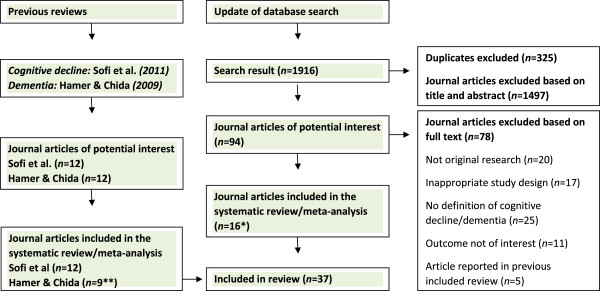
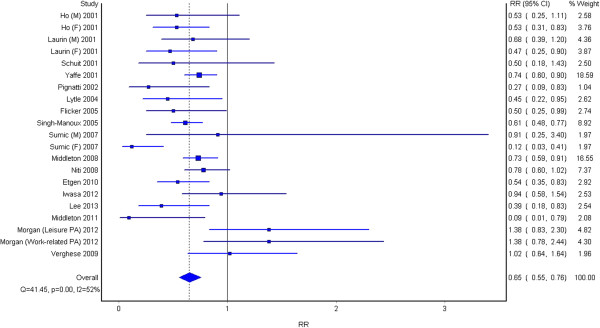
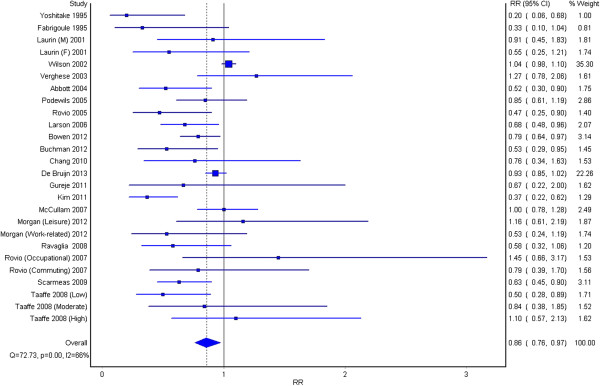
BACKGROUND: By 2050, it has been estimated that approximately one-fifth of the population will be made up of older adults (aged ≥60 years). Old age often comes with cognitive decline and dementia. Physical activity may prevent cognitive decline and dementia. METHODS: We reviewed and synthesised prospective studies into physical activity and cognitive decline, and physical activity and dementia, published until January 2014. Forty-seven cohorts, derived from two previous systematic reviews and an updated database search, were used in the meta-analyses. Included participants were aged ≥40 years, in good health and/or randomly selected from the community. Studies were assessed for methodological quality. RESULTS: Twenty-one cohorts on physical activity and cognitive decline and twenty-six cohorts on physical activity and dementia were included. Meta-analysis, using the quality-effects model, suggests that participants with higher levels of physical activity, when compared to those with lower levels, are at reduced risk of cognitive decline, RR 0.65, 95% CI 0.55-0.76, and dementia, RR 0.86, 95% CI 0.76-0.97. Sensitivity analyses revealed a more conservative estimate of the impact of physical activity on cognitive decline and dementia for high quality studies, studies reporting effect sizes as ORs, greater number of adjustments (≥10), and longer follow-up time (≥10 years). When one heavily weighted study was excluded, physical activity was associated with an 18% reduction in the risk of dementia (RR 0.82; 0.73-0.91). CONCLUSIONS: Longitudinal observational studies show an association between higher levels of physical activity and a reduced risk of cognitive decline and dementia. A case can be made for a causal interpretation. Future research should use objective measures of physical activity, adjust for the full range of confounders and have adequate follow-up length. Ideally, randomised controlled trials will be conducted. Regardless of any effect on cognition, physical activity should be encouraged, as it has been shown to be beneficial on numerous levels.
Overview
The claims and statistics of this paper haven’t been checked yet.
Free: it reads the open-access text and checks the first 5 claims that cite a source we can check. Create a free account to check every claim.
Integrity signals
Registry
Cites
Statistics
Figures
Verification
Claims the paper makes
The claims and statistics of this paper haven’t been checked yet.
Free: it reads the open-access text and checks the first 5 claims that cite a source we can check. Create a free account to check every claim.
Claims other papers make about this one
Each is checked against this paper’s own text: does it say what the citing paper says it does?
The source backs part of the claim, not all of it — or backs it for a different population, condition or comparison.
In the citing paper
“A meta-analysis of these studies concluded that physically active adults had a 35% lower risk of cognitive decline (relative risk, 0.65; 95% confidence interval, 0.55–0.76) compared with those who were physically inactive.93”
From Defining Optimal Brain Health in Adults: A Presidential Advisory From the American Heart Association/American Stroke Association (2017) · cites this paper as [93]
Experimental — accuracy not yet measuredThe cited source says what the claim attributes to it.
In the citing paper
“In contrast, physical activity appears to decrease risk. [119][120]0][121][122][123][124][125][126][127][128]”
From 2023 Alzheimer's disease facts and figures (2023) · cites this paper as [124]
Experimental — accuracy not yet measuredThe cited source says what the claim attributes to it.
In the citing paper
“Prospective observational studies have generally found a positive association between physical activity and cognitive health outcomes.”
From Defining Optimal Brain Health in Adults: A Presidential Advisory From the American Heart Association/American Stroke Association (2017) · cites this paper as [93]
Self-check
Percentages, sums and reported differences re-computed from the paper’s own numbers.
The self-check needs the paper’s full text.
Citations
Cites
Preferred Reporting Items for Systematic Reviews and Meta-Analyses: the PRISMA statement
Moher, D., Liberati, A., Tetzlaff, J., Altman, D. G., & for the PRISMA Group (2009) · BMJ · doi:10.1136/bmj.b2535 · Cited by 83,823
Preferred reporting items for systematic reviews and meta-analyses: the PRISMA Statement.
(2009) · PubMed Central · Cited by 44,859
Preferred reporting items for systematic reviews and meta-analyses: The PRISMA statement
Moher, D., Liberati, A., Tetzlaff, J., Altman, D. G., & the PRISMA Group* (2009) · Annals of Internal Medicine · doi:10.7326/0003-4819-151-4-200908180-00135 · Cited by 37,554
Preferred Reporting Items for Systematic Reviews and Meta-Analyses: The PRISMA Statement
Moher, D., Liberati, A., Tetzlaff, J., & Altman, D. G. (2009) · Journal of Clinical Epidemiology · doi:10.1016/j.jclinepi.2009.06.005 · Cited by 19,575
Lippa, N. C., & Sanderson, S. C. (2013) · Human Heredity · doi:10.1159/000353712 · Cited by 6,078
Diagnostic and Statistical Manual of Mental Disorders ( DSM ‐ IV ‐ TR )
Segal, D. L. (2010) · The Corsini Encyclopedia of Psychology · doi:10.1002/9780470479216.corpsy0271 · Cited by 4,666
Pate, R. R. (1995) · JAMA · doi:10.1001/jama.1995.03520290054029 · Cited by 4,606 · cited 1×
“A curvilinear relationship, with diminishing returns, seems the most likely association [72]; however, more research in this area is needed.”
BackgroundMACMAHON, S. (1990) · The Lancet · doi:10.1016/0140-6736(90)90878-9 · Cited by 4,253 · cited 1×
“Inaccuracies in measurement of physical activity, as outlined above, may lead to regression dilution bias, whereby imprecise measurement of the exposure variable may bias a result toward null [70].”
BackgroundInternational Encyclopedia of the Social Sciences.
Duncan, O. D., & Sills, D. L. (1968) · American Sociological Review · doi:10.2307/2092889 · Cited by 3,486
An active and socially integrated lifestyle in late life might protect against dementia
Fratiglioni, L., Paillard-Borg, S., & Winblad, B. (2004) · The Lancet Neurology · doi:10.1016/s1474-4422(04)00767-7 · Cited by 2,135 · cited 3×
“In the meantime, given that physical activity has been shown to be beneficial across multiple health domains, genders and ages, physical activity should be encouraged regardless of its relationship with cognitive decline and dementia [73].”
BackgroundInfluential
Research works printed but not linked: 1
- Rothman KJ Greenland S Lash TL Modern Epidemiology 2008 Philadelphia, PA: Lippincott Williams & Wilkins
Cited by
Items 801–900 of 1,000
Physical Activity, Exercise, and Physical Rehabilitation
Lima, C. A., dos Santos, R. B., & Perracini, M. R. (2021) · Perspectives in nursing management and care for older adults · doi:10.1007/978-3-030-63892-4_14
Effectiveness of Thai hermit exercise (ruesi datton) on mild cognitive impairment's patients
Kongart, C. (2018) · Chula Digiverse · doi:10.58837/chula.the.2018.494
Barua, N. (2021) · UEF eRepo (University of Eastern Finland)
Be active: a food-based dietary guideline for elderly South Africans
Saha, S., Oldewage-Theron, W. H., & Napier, C. E. (2021) · South African Journal of Clinical Nutrition · doi:10.1080/16070658.2021.1947038 · Cited by 1
Dementia and Women—Global Concerns
Sousa, A. D., & Shah, B. (2021) · Springer eBooks · doi:10.1007/978-981-16-4605-8_13
Weerasinghe, W., Thunpaththu, T. M. S. R., Weerasinghe, W., Weerasinghe, W., Walpola, P., Dissanayaka, D., & Karunaratne, A. (2021) · Health · doi:10.4236/health.2021.1310085
“Physical activity also appears to preserve, and may even improve, cognitive function in people without dementia [10] [12], reducing cognitive decline by approximately one-third [13].”
BackgroundRukkwamsuk, T., Kruip, T. A. M., & Wensing, T. (2000) · Magyar Állatorvosok Lapja · Cited by 1
Prevención de la demencia: beneficios de la actividad física
Terrón, C., & Palomo, M. S. M. (2025) · Kranion · doi:10.24875/kranion.m21000008
Functional Fitness and Cognition in Older Adults: A Mediation Model
Ferreira, S. A., Vieira, E. R., Queiróga, M. R., Cavazzotto, T. G., Probst, V. S., Costa, V. D. S. P., & Teixeira, D. D. C. (2021) · Physical & Occupational Therapy In Geriatrics · doi:10.1080/02703181.2021.2015518
Improving cognition and healthy lifestyle behavior in chronic obstructive pulmonary disease
van Beers, M. C. M. (2021) · Research Publications (Maastricht University) · doi:10.26481/dis.20210421mb
ALZHEIMER’S DISEASE, CEREBROVASCULAR DISEASE AND DEMENTIA: THEIR ASSOCIATION AND PREVENTION
Davey, D. A. (2016) · Journal of Aging Research and Lifestyle · doi:10.14283/jarcp.2016.96
Wan, A. H. Y., & Chiu, T. T. W. (2021) · Springer eBooks · doi:10.1007/978-3-030-22009-9_870
da Silva, S. P., Rolo, J., & von Humboldt, S. (2021) · Springer eBooks · doi:10.1007/978-3-030-22009-9_83
Butavand, D. R., Rodríguez, M. F., Cifuentes, M. V., Miranda, M., Bauza, C. G., Bekinschtein, P., & Ballarini, F. (2022) · SSRN Electronic Journal · doi:10.2139/ssrn.4022703
Vascular Risk Factors and Cognitive Function: The Effect of Aging Process
Mossello, E., & Marchionni, N. (2020) · Springer eBooks · doi:10.1007/978-3-030-28008-6_62
Diagnosis and Epidemiology of Dementia
Kreisl, W. C., & Reitz, C. (2017) · Oxford University Press eBooks · doi:10.1093/med/9780190681425.003.0050
Wan, A. H. Y., & Chiu, T. T. W. (2019) · Springer eBooks · doi:10.1007/978-3-319-69892-2_870-1
(2016) · Elsevier eBooks · doi:10.1016/b978-0-12-804538-1.00036-5
da Silva, S. P., Rolo, J., & von Humboldt, S. (2020) · Springer eBooks · doi:10.1007/978-3-319-69892-2_83-2
da Silva, S. P., Rolo, J., & von Humboldt, S. (2019) · Springer eBooks · doi:10.1007/978-3-319-69892-2_83-1
Physical inactivity and dementia in Brazil: a call to action
Feter, N., & Leite, J. S. (2022) · Dementia & Neuropsychologia · doi:10.1590/1980-5764-dn-2022-0014
Werneck, A. O., Stubbs, B., Kandola, A. A., Oyeyemi, A. L., Schuch, F. B., Hamer, M., Vancampfort, D., & da Silva, D. R. P. (2022) · Psychosomatic Medicine · doi:10.1097/psy.0000000000001139
Quantitative Analysen hippocampaler Interneuronen in zwei transgenen Alzheimer Mausmodellen
Giesers, N. K. (2022) · eDiss (Georg-August-Universität Göttingen) · doi:10.53846/goediss-9447
Zheng, J. (2022) · Biomedical Journal of Scientific & Technical Research · doi:10.26717/bjstr.2022.46.007378
Gouveia, É. R., de Gouveia, B. R. F. O., Marques, A., Marconcin, P., & Ihle, A. (2023) · IntechOpen eBooks · doi:10.5772/intechopen.108188 · Cited by 1
Can our life resources support successful aging?
Szepietowska, E. M. (2022) · Kwartalnik Naukowy Fides et Ratio · doi:10.34766/fetr.v4i52.1141
de Almeida, M. L. (2021) · Digital Library of Theses and Dissertations (Universidade de São Paulo) · doi:10.11606/t.83.2021.tde-13052022-115055
Jeong, S., Suzuki, T., Miura, K., & Sakurai, T. (2023) · Journal of Psychiatry and Psychiatric Disorders · doi:10.26502/jppd.2572-519x0183 · Cited by 1
“…with variables that are considered risk factors for cognitive decline and dementia (lifestyle risk factors, such as current smoking[23], alcohol consumption[24], physical inactivity[25], and sleep disturbances[26]), but did not observe any associations between these variables and missing events.”
BackgroundVandercappellen, E. J. (2023) · Research Publications (Maastricht University) · doi:10.26481/dis.20230703ev
Risikofaktoren und Prävention im Licht der Atherosklerose als Mikrozirkulationskrankheit
Haverich, A., & Boyle, E. C. (2023) · Springer eBooks · doi:10.1007/978-3-031-31766-8_5
FMUPorto - Summaries and comments July 2023
Saúde, A. A. U. C., Felgueiras, A., Maia, B. V., da Estrela, A. C. D. B. U., Cordeiro, D. O., & Pereira, G. M. (2023) · Revista de Medicina Desportiva informa · doi:10.23911/fmup_2023_jul
Exercise and Cognition in Elderly
Akram, M., Chishti, M. A., & Ali, S. S. (2023) · Journal of Datta Meghe Institute of Medical Sciences University · doi:10.4103/jdmimsu.jdmimsu_515_22
Yang, S., & Kim, J. (2023) · Lecture notes in computer science · doi:10.1007/978-3-031-43950-6_21
Korelasi antara Massa Otot dan Fungsi Kognitif pada Mahasiswi Kedokteran
Fazriani, A., Bustamam, N., Tjang, Y. S., & Heristyorini, A. (2023) · Jurnal Kedokteran Meditek · doi:10.36452/jkdoktmeditek.v29i3.2846 · Cited by 2
“876 lansia berusia >60 tahun yang mendapatkan skor fungsi kognitif 69,3 (51,2-82,7) pada dewasa muda dan 48,2 (38,8-66,8) pada lansia.”
BackgroundWoitas-Ślubowska, D., Żyżniewska‐Banaszak, E., & Skarpańska-Stejnborn, A. (2016) · Journal of Education, Health and Sport (Kazimierz Wielki University in Bydgoszcz) · doi:10.5281/zenodo.231804
Internet Use and Psychological Well-Being Among Children and Adolescents
(2024) · Frontiers research topics · doi:10.3389/978-2-8325-4323-8
Kuhn, E. (2021) · theses.fr (ABES) · doi:10.70675/f512c555z2f42z4843zae6cz4596f448ab10
Association entre produits laitiers, volume cérébral et fonctions cognitives chez le sujet âgé
Pellay, H. (2022) · theses.fr (ABES) · doi:10.70675/e62e6e48zfe70z459bz869bz45130bcc6ad7
Effets des troubles du sommeil sur la démence : une approche épidémiologique
Cavaillès, C. (2022) · theses.fr (ABES) · doi:10.70675/b52557d6zaca4z4316zab9ez1224634b5ae0
Withdrawn: 3D Virtual Reality Motionless Imagery Exercise through Avatar in Older PeoplePreprint
Lee, M. C., Chang Hoon, P. A. R. K., & Han, K. H. (2024) · Preprints.org · doi:10.20944/preprints202403.1114.v1
Sprague, B. N., Tu, W., Unverzagt, F. W., Moser, L. R., Adams, M., Carter, A., Dawkins, E. J., Keith, N. R., Reinoso, D. R., & Clark, D. O. (2024) · Contemporary Clinical Trials · doi:10.1016/j.cct.2024.107533
Schmitter‐Edgecombe, M., & Boyd, B. (2024) · Journal of Geriatric Medicine · doi:10.30564/jgm.v6i1.6303
“Factors were selected based on prior research indicating a relationship between these factors and risk for dementia [11, 12, 13, 14, 15, 16] .”
MethodBlackwell, J., & Ray, M. (2024) · Journal of Aging and Physical Activity · doi:10.1123/japa.2023-0195
Norris, T., Mitchell, J. J., Blodgett, J. M., Hamer, M., & Pereira, S. M. P. (2024) · PLoS ONE · doi:10.1371/journal.pone.0295092
Midlife is good for more than a crisis: Exercise for dementia prevention
Fenton, L. E., & Pa, J. (2024) · Journal of the American Geriatrics Society · doi:10.1111/jgs.19207
“6 Data from RCTs have also reported favorable outcomes, including a pivotal study conducted in participants with subjective memory problems aged 50 and above, which reported an improvement in cognition (as measured by the Alzheimer Disease Assessment Scale-Cognitive Subscale) after a 6-month…”
Yu, F., Pituch, K. A., Maxfield, M., Joseph, R. P., Pruzin, J. J., Ashish, D., Coon, D. W., Shaibi, G. Q., & _, _. (2024) · Journal of Aging and Physical Activity · doi:10.1123/japa.2023-0353
Mental Health Disorders: An Overlooked Aspect of Chronic Kidney Disease in Older Adults
Corona, A. G. D. L., Wang, L. G., & Brogan, M. E. (2024) · Springer eBooks · doi:10.1007/978-3-031-68460-9_4
Gomes, I. C. (2025) · Brazilian Journal of Health Review · doi:10.34119/bjhrv8n1-130
Filho, J. M. S., de Lima, D. N., Rabêlo, L. S., Almeida, A. T. D. S., da Costa, R. M. A., Maia, D. F., & Nascimento, M. A. M. D. (2025) · STUDIES IN HEALTH SCIENCES · doi:10.54022/shsv6n1-020
Diagnosis and Epidemiology of Dementia
Kreisl, W. C., & Reitz, C. (2025) · Oxford University Press eBooks · doi:10.1093/med/9780197640654.003.0052
Kim, E., Oh, J., Gim, J., & Huh, I. (2025) · Frontiers in Public Health · doi:10.3389/fpubh.2025.1547575 · Cited by 1
Remédiation olfactive connectée : impact sur la cognition et le bien-être
Moussy, E. (2024) · theses.fr (ABES) · doi:10.70675/8ce5b314zf997z4711zae4ezcbb8dad6e425
Sleep in the elderly: Healthy sleep for healthy aging
Hrnčić, D., Šutulović, N., Mladenović, D. R., Vesković, M. N., Djuric, E., Rašić-Marković, A., & Stanojlović, O. P. (2024) · Medicinski podmladak · doi:10.5937/mp75-54248 · Cited by 1
A life course approach to healthy longevity
Beard, J., Zhang, Y. S., & Aiello, A. E. (2025) · Oxford University Press eBooks · doi:10.1093/oso/9780198895961.003.0020 · Cited by 2
Waterhouse, H., Squire, I., & Singh, S. (2025) · British Journal of Cardiology · doi:10.5837/bjc.2025.025
Physical Activity Among Belizean Older Adults: A National Study
Borzekowski, D. L. G., Husaini, D. C., Powell, E. A., Chang, C.-S., Bernardez, V. M., & Reneau, K. (2025) · Activities Adaptation & Aging · doi:10.1080/01924788.2025.2518674 · Cited by 1
“In contrast, healthy aging as defined by the WHO is “the process of developing and maintaining the functional ability that enables wellbeing in older age” (WHO, 2020, 2022). adults experience cognitive changes (Blondell et al., 2014; Gallegos-Carrillo et al., 2013).”
Pau, M., Asoni, G., Viale, D., & Putzu, V. (2025) · Journal of Gerontology and Geriatrics · doi:10.36150/2499-6564-n872
Abernethy, D. A. (2025) · Queensland University of Technology · doi:10.5204/thesis.eprints.259592
Moscha, D., Giannitsopoulou, E., Lola, A. C., Tzetzis, G. C., & Zisi, V. Z. (2025) · Journal of Aging and Physical Activity · doi:10.1123/japa.2024-0309
Yi, F., Zhao, L., Avalos Carlos, R., Lee, J., & Yang, C. (2025) · Journal of Aging and Health · doi:10.1177/08982643251373040
“Existing studies that seek to characterize the associations between PA and cognition often applied different cognitive measurement tools or only captured a single cognitive domain (Blondell et al., 2014; Volders et al., 2021).”
Sekher, T. V., & Muhammad, T. (2025) · Springer eBooks · doi:10.1007/978-981-99-7842-7_162
Yook, V., Jung, J.-H., Han, K., Kim, H., & Jeon, H. J. (2025) · Psychiatry Investigation · doi:10.30773/pi.2025.0085
“13 In examining the effect of PA on dementia symptoms among clinically depressed populations, PA was associated with improved cog-ORIGINAL nitive functioning, including memory, executive functioning, verbal fluency, and psychomotor speed.”
van den Berg, F., Buurke, R. S. S. J., Brouwer, J., Loerts, H., Knooihuizen, R., Bartelds, M., Wieling, M. B., & Keijzer, M. C. J. (2025) · Bilingualism Language and Cognition · doi:10.1017/s136672892510062x
Birinci Basamakta Demansın Erken Tanısı
Köseoğlu, H. (2025) · Özgür Yayınları eBooks · doi:10.58830/ozgur.pub891.c3672
Palyatif Bakımda Çocuk Gelişimi ve Yaşam Kalitesi
Aydın, S., & Özyazıcı, K. (2025) · Özgür Yayınları eBooks · doi:10.58830/ozgur.pub891.c3667
Phoenixin Hormonu: Yapısı, Dağılımı ve Fizyolojik Etkileri
Arkalı, G., Koçyiğit, F. B., & Çay, M. (2025) · Özgür Yayınları eBooks · doi:10.58830/ozgur.pub891.c3666
Alhassan, G. N. (2025) · Özgür Yayınları eBooks · doi:10.58830/ozgur.pub891.c3668
Ortodontide Biyomekanik Yenilikler: Mini-İmplantlar
Sarı, Ö. F. (2025) · Özgür Yayınları eBooks · doi:10.58830/ozgur.pub891.c3670
Çok Disiplinli Sağlık Bilimlerinde Özel Güncel Konular
BİLGİLİ, A., Canbey, İ., Arkalı, G., Koçyiğit, F. B., Çay, M., Aydın, S., Özyazıcı, K., Alhassan, G. N., Çapkan, D. Ü., Sarı, Ö. F., et al. (2025) · Özgür Yayınları eBooks · doi:10.58830/ozgur.pub891
Pediatrik Radyolojide Radyasyon Güvenliği: Güncel Yaklaşımlar ve Stratejiler
Çapkan, D. Ü. (2025) · Özgür Yayınları eBooks · doi:10.58830/ozgur.pub891.c3669
The Effect of Multimodal Sensory Feedback in Tai Chi on Cognitive Function in Older Adults
Wang, Y., Xin, B., & Wang, T. (2025) · Journal of Aging and Physical Activity · doi:10.1123/japa.2025-0029
Jahr, E., Ihle, T., Finkhäuser, M., Schmidt, S., & Muehlan, H. (2025) · Sustainability · doi:10.3390/su17219841
Exercise and cognitive function in aging
Kabeer, D. A., Singh, P., Bhat, Z. U. H., Cherappurath, N., Ahmed, T., & Hassan, S. (2025) · Elsevier eBooks · doi:10.1016/b978-0-443-36295-8.00007-9
Li, G., Zhu, L., Li, X., Wu, B., & Chen, J. (2025) · Global Health & Medicine · doi:10.35772/ghm.2025.01092
Fountain, S. M., Walters, G. W. M., Williams, R. A., Sunderland, C. D., Cooper, S. B., & Dring, K. J. (2025) · Healthcare · doi:10.3390/healthcare13243186
“Physical inactivity in children and their parents is associated with increased risk factors for cardiometabolic diseases [7] and impaired cognitive function [8–10].”
Li, W., Kim, K.-W. R., Zhang, D., Liu, B., Dengler-Crish, C. M., Wen, M., Shi, L., Pan, X., Gu, Y., & Li, Y. (2024) · Figshare · doi:10.6084/m9.figshare.26619484
Meernik, C., Eilat-Adar, S., Leonard, D., Barlow, C. E., Gerber, Y., Tesler, R., Shanks, C. B., Gabriel, K. K. P., Pavlovic, A., DeFina, L. F., et al. (2024) · Figshare · doi:10.6084/m9.figshare.27124001
Polk, S. E. (2023) · Refubium (Universitätsbibliothek der Freien Universität Berlin) · doi:10.17169/refubium-36742
Grasset, L., Proust-Lima, C., Mangin, J.-F., Habert, M.-O., Dubois, B., Paquet, C., Hanon, O., Gabelle, A., Ceccaldi, M., Annweiler, C., et al. (2022) · Figshare · doi:10.6084/m9.figshare.19793151
Grasset, L., Proust-Lima, C., Mangin, J.-F., Habert, M.-O., Dubois, B., Paquet, C., Hanon, O., Gabelle, A., Ceccaldi, M., Annweiler, C., et al. (2022) · Figshare · doi:10.6084/m9.figshare.19793133
Grasset, L., Proust-Lima, C., Mangin, J.-F., Habert, M.-O., Dubois, B., Paquet, C., Hanon, O., Gabelle, A., Ceccaldi, M., Annweiler, C., et al. (2022) · Figshare · doi:10.6084/m9.figshare.19793130
Meernik, C., Eilat-Adar, S., Leonard, D., Barlow, C. E., Gerber, Y., Tesler, R., Shanks, C. B., Gabriel, K. K. P., Pavlovic, A., DeFina, L. F., et al. (2024) · Figshare · doi:10.6084/m9.figshare.27123998
Grasset, L., Proust-Lima, C., Mangin, J.-F., Habert, M.-O., Dubois, B., Paquet, C., Hanon, O., Gabelle, A., Ceccaldi, M., Annweiler, C., et al. (2022) · Figshare · doi:10.6084/m9.figshare.19793145
Li, W., Kim, K.-W. R., Zhang, D., Liu, B., Dengler-Crish, C. M., Wen, M., Shi, L., Pan, X., Gu, Y., & Li, Y. (2024) · Figshare · doi:10.6084/m9.figshare.26619487
Rizzo, I. (2023) · BIROn (Birkbeck, University of London) · doi:10.18743/pub.00051569
Talamonti, D., Gagnon, C., Vincent, T. L., Nigam, A., Lesage, F., Bherer, L., & Fraser, S. (2022) · Figshare · doi:10.6084/m9.figshare.20454509
Kekäläinen, T., Luchetti, M., Terracciano, A., Gamaldo, A. A., Mogle, J. A., Lovett, H. H., Brown, J., Rantalainen, T., Sliwinski, M. J., & Sutin, A. R. (2023) · Figshare · doi:10.6084/m9.figshare.24628094
Grasset, L., Proust-Lima, C., Mangin, J.-F., Habert, M.-O., Dubois, B., Paquet, C., Hanon, O., Gabelle, A., Ceccaldi, M., Annweiler, C., et al. (2022) · Figshare · doi:10.6084/m9.figshare.19793139
Kekäläinen, T., Luchetti, M., Terracciano, A., Gamaldo, A. A., Mogle, J. A., Lovett, H. H., Brown, J., Rantalainen, T., Sliwinski, M. J., & Sutin, A. R. (2024) · Figshare · doi:10.6084/m9.figshare.24628182
Kekäläinen, T., Luchetti, M., Terracciano, A., Gamaldo, A. A., Mogle, J. A., Lovett, H. H., Brown, J., Rantalainen, T., Sliwinski, M. J., & Sutin, A. R. (2024) · Figshare · doi:10.6084/m9.figshare.26643943
Metadata
- Authors
- Blondell, S. J., Hammersley-Mather, R., & Veerman, J. L.
- Affiliations
- The University of Queensland (AU)
- ORCID
- Blondell, Sarah J
- Venue
- BMC Public Health
- Published
- 2014-05-27
- Volume
- 14
- Issue
- 1
- Pages
- 510-510
- ISSN
- 1471-2458 (ISSN-L)
- PMC
- PMC4064273
- OpenAlex
- W2105024128
- Semantic Scholar
- c6c3c6f306e2fb74a87a7a2cfc60ccd4ce9c5bc3
- Cited by
- 928
- References
- 86
- Citations by year
- 2026: 64 · 2025: 81 · 2024: 91 · 2023: 89 · 2022: 111 · 2021: 91 · 2020: 116 · 2019: 80 · 2018: 58 · 2017: 66 · 2016: 51 · 2015: 24 · 2014: 5
- FWCI
- 6.70
- Type
- journal article
- Language
- en
- Open access
- gold
- doi.org
- Licence
- Locations
- BMC Public Health (publishedVersion, cc-by)
- Europe PMC (PubMed Central) (publishedVersion, cc-by)
- PubMed Central (publishedVersion, cc-by)
- PubMed (publishedVersion)
- University of Southern Queensland ePrints (University of Southern Queensland) (acceptedVersion)
- Griffith Research Online (submittedVersion, cc-by)
- Topics
- Health Sciences › Medicine › Psychiatry and Mental health › Dementia and Cognitive Impairment Research
- Health Sciences › Medicine › Public Health, Environmental and Occupational Health › Physical Activity and Health
- Health Sciences › Medicine › Critical Care and Intensive Care Medicine › Intensive Care Unit Cognitive Disorders
- Keywords
- physical activity, cognitive decline, dementia, older adults, dementia prevention, cognitive aging, prospective cohort
- MeSH terms
- Aged, Aged, 80 and over, Dementia, Female, Humans, Longitudinal Studies, Male, Middle Aged, Motor Activity, Cohort Studies
About these checks
Registry, retraction, Cites and statistics results are computed, not judged, with one exception: a printed reference that no index lists is read once by a model before it counts as a citation error. Claims are extracted by a model and kept only when their quote appears verbatim in the text; each cited source is then checked, with a model’s help, for whether it says what the claim relies on. Those verdicts can be wrong — read the claim’s quote and the cited source before relying on one.
Statistics and arithmetic are recomputed, not judged.
Confidence bands are shown only for fields calibrated on our annotated test set. None is calibrated yet, so no band is shown.
What counts as a claim ›How we measure confidence ›How we check this ›
Are you an author, or do you see a problem with this page? Request a review
Data sources
Bibliographic data: Semantic Scholar, OpenAlex, Crossref.
Contains information from the Semantic Scholar Academic Graph Datasets, made available under the ODC Attribution License (ODC-BY 1.0).
Semantic Scholar’s data is described in: Kinney, R., et al. (2023). The Semantic Scholar Open Data Platform. arXiv:2301.10140.
