

Does physical activity prevent cognitive decline and dementia?: A systematic review and meta-analysis of longitudinal studies
Open accessThe DOI matches its Crossref record; 85 of the 86 references it cites were found in a registry or an index, and 1 are not checked yet.
Abstract
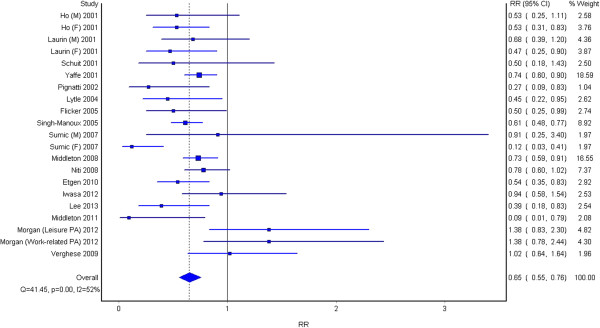
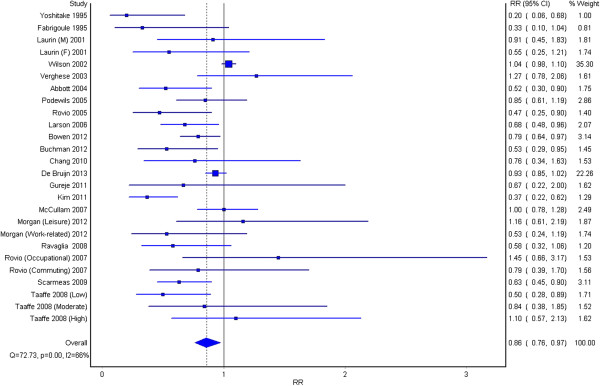
BACKGROUND: By 2050, it has been estimated that approximately one-fifth of the population will be made up of older adults (aged ≥60 years). Old age often comes with cognitive decline and dementia. Physical activity may prevent cognitive decline and dementia. METHODS: We reviewed and synthesised prospective studies into physical activity and cognitive decline, and physical activity and dementia, published until January 2014. Forty-seven cohorts, derived from two previous systematic reviews and an updated database search, were used in the meta-analyses. Included participants were aged ≥40 years, in good health and/or randomly selected from the community. Studies were assessed for methodological quality. RESULTS: Twenty-one cohorts on physical activity and cognitive decline and twenty-six cohorts on physical activity and dementia were included. Meta-analysis, using the quality-effects model, suggests that participants with higher levels of physical activity, when compared to those with lower levels, are at reduced risk of cognitive decline, RR 0.65, 95% CI 0.55-0.76, and dementia, RR 0.86, 95% CI 0.76-0.97. Sensitivity analyses revealed a more conservative estimate of the impact of physical activity on cognitive decline and dementia for high quality studies, studies reporting effect sizes as ORs, greater number of adjustments (≥10), and longer follow-up time (≥10 years). When one heavily weighted study was excluded, physical activity was associated with an 18% reduction in the risk of dementia (RR 0.82; 0.73-0.91). CONCLUSIONS: Longitudinal observational studies show an association between higher levels of physical activity and a reduced risk of cognitive decline and dementia. A case can be made for a causal interpretation. Future research should use objective measures of physical activity, adjust for the full range of confounders and have adequate follow-up length. Ideally, randomised controlled trials will be conducted. Regardless of any effect on cognition, physical activity should be encouraged, as it has been shown to be beneficial on numerous levels.
Overview
The claims and statistics of this paper haven’t been checked yet.
Free: it reads the open-access text and checks the first 5 claims that cite a source we can check. Create a free account to check every claim.
Integrity signals
Registry
Cites
Statistics
Figures
Verification
Claims the paper makes
The claims and statistics of this paper haven’t been checked yet.
Free: it reads the open-access text and checks the first 5 claims that cite a source we can check. Create a free account to check every claim.
Claims other papers make about this one
Each is checked against this paper’s own text: does it say what the citing paper says it does?
The source backs part of the claim, not all of it — or backs it for a different population, condition or comparison.
In the citing paper
“A meta-analysis of these studies concluded that physically active adults had a 35% lower risk of cognitive decline (relative risk, 0.65; 95% confidence interval, 0.55–0.76) compared with those who were physically inactive.93”
From Defining Optimal Brain Health in Adults: A Presidential Advisory From the American Heart Association/American Stroke Association (2017) · cites this paper as [93]
Experimental — accuracy not yet measuredThe cited source says what the claim attributes to it.
In the citing paper
“In contrast, physical activity appears to decrease risk. [119][120]0][121][122][123][124][125][126][127][128]”
From 2023 Alzheimer's disease facts and figures (2023) · cites this paper as [124]
Experimental — accuracy not yet measuredThe cited source says what the claim attributes to it.
In the citing paper
“Prospective observational studies have generally found a positive association between physical activity and cognitive health outcomes.”
From Defining Optimal Brain Health in Adults: A Presidential Advisory From the American Heart Association/American Stroke Association (2017) · cites this paper as [93]
Self-check
Percentages, sums and reported differences re-computed from the paper’s own numbers.
The self-check needs the paper’s full text.
Citations
Cites
Preferred Reporting Items for Systematic Reviews and Meta-Analyses: the PRISMA statement
Moher, D., Liberati, A., Tetzlaff, J., Altman, D. G., & for the PRISMA Group (2009) · BMJ · doi:10.1136/bmj.b2535 · Cited by 83,823
Preferred reporting items for systematic reviews and meta-analyses: the PRISMA Statement.
(2009) · PubMed Central · Cited by 44,859
Preferred reporting items for systematic reviews and meta-analyses: The PRISMA statement
Moher, D., Liberati, A., Tetzlaff, J., Altman, D. G., & the PRISMA Group* (2009) · Annals of Internal Medicine · doi:10.7326/0003-4819-151-4-200908180-00135 · Cited by 37,554
Preferred Reporting Items for Systematic Reviews and Meta-Analyses: The PRISMA Statement
Moher, D., Liberati, A., Tetzlaff, J., & Altman, D. G. (2009) · Journal of Clinical Epidemiology · doi:10.1016/j.jclinepi.2009.06.005 · Cited by 19,575
Lippa, N. C., & Sanderson, S. C. (2013) · Human Heredity · doi:10.1159/000353712 · Cited by 6,078
Diagnostic and Statistical Manual of Mental Disorders ( DSM ‐ IV ‐ TR )
Segal, D. L. (2010) · The Corsini Encyclopedia of Psychology · doi:10.1002/9780470479216.corpsy0271 · Cited by 4,666
Pate, R. R. (1995) · JAMA · doi:10.1001/jama.1995.03520290054029 · Cited by 4,606 · cited 1×
“A curvilinear relationship, with diminishing returns, seems the most likely association [72]; however, more research in this area is needed.”
BackgroundMACMAHON, S. (1990) · The Lancet · doi:10.1016/0140-6736(90)90878-9 · Cited by 4,253 · cited 1×
“Inaccuracies in measurement of physical activity, as outlined above, may lead to regression dilution bias, whereby imprecise measurement of the exposure variable may bias a result toward null [70].”
BackgroundInternational Encyclopedia of the Social Sciences.
Duncan, O. D., & Sills, D. L. (1968) · American Sociological Review · doi:10.2307/2092889 · Cited by 3,486
An active and socially integrated lifestyle in late life might protect against dementia
Fratiglioni, L., Paillard-Borg, S., & Winblad, B. (2004) · The Lancet Neurology · doi:10.1016/s1474-4422(04)00767-7 · Cited by 2,135 · cited 3×
“In the meantime, given that physical activity has been shown to be beneficial across multiple health domains, genders and ages, physical activity should be encouraged regardless of its relationship with cognitive decline and dementia [73].”
BackgroundInfluentialExercise enhances learning and hippocampal neurogenesis in aged mice
van Praag, H., Shubert, T., Zhao, C., & Gage, F. H. (2005) · The Journal of Neuroscience · doi:10.1523/jneurosci.1731-05.2005 · Cited by 2,078
Leisure Activities and the Risk of Dementia in the Elderly
Verghese, J., Lipton, R. B., Katz, M. J., Hall, C. B., Derby, C. A., Kuslansky, G., Ambrose, A. F., Sliwinski, M., & Buschke, H. (2003) · New England Journal of Medicine · doi:10.1056/nejmoa022252 · Cited by 1,961
Dementia: a public health priority
Acosta, D. M., Krishnamoorthy, E. S., Wortmann, M., Prince, M. J., & Saxena, S. (2012) · Cited by 1,955
Livingston, J. D., & Boyd, J. E. (2010) · Social Science & Medicine · doi:10.1016/j.socscimed.2010.09.030 · Cited by 1,677 · cited 2×
“Publication bias refers to the under-reporting of results that fail to find significant positive associations [46].”
BackgroundMethodPhysical activity and risk of cognitive impairment and dementia in elderly persons
Laurin, D., Verreault, R., Lindsay, J., MacPherson, K., & Rockwood, K. (2001) · Archives of Neurology · doi:10.1001/archneur.58.3.498 · Cited by 1,561 · cited 5×
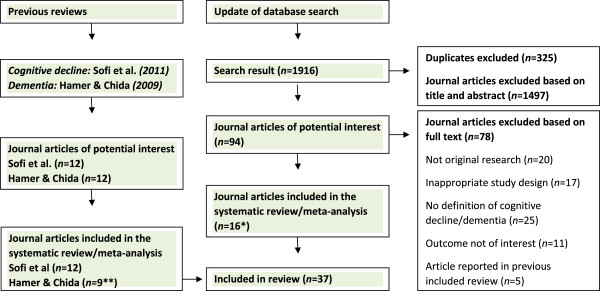
“Twelve prospective studies (15 cohorts) [22-33] were obtained from the Sofi et al.”
BackgroundMethodInfluentialLarson, E. B., Wang, L., Bowen, J. D., McCormick, W. C., Teri, L., Crane, P., & Kukull, W. (2006) · Annals of Internal Medicine · doi:10.7326/0003-4819-144-2-200601170-00004 · Cited by 1,463 · cited 3×
“Included as part of the meta-analyses were nine studies on dementia and AD (10 cohorts), published up until 2007 [23,35-42].”
MethodPhysical activity and risk of cognitive decline: a meta-analysis of prospective studies
Sofi, F., Valecchi, D., Bacci, D., Abbate, R., Gensini, G. F., Casini, A., & Macchi, C. (2011) · Journal of Internal Medicine · doi:10.1111/j.1365-2796.2010.02281.x · Cited by 1,210 · cited 12×
“Sofi et al. 2011 [20] undertook a systematic review and meta-analysis of prospective studies exploring physical activity and risk of cognitive decline in non-demented individuals.”
BackgroundResultInfluentialAngevaren, M., Aufdemkampe, G., Verhaar, H., Aleman, A., & Vanhees, L. (2008) · Cochrane Database of Systematic Reviews · doi:10.1002/14651858.cd005381.pub3 · Cited by 1,130
Leisure-time physical activity at midlife and the risk of dementia and Alzheimer's disease
Rovio, S., Kåreholt, I., Helkala, E.-L., Viitanen, M., Winblad, B., Tuomilehto, J., Soininen, H., Nissinen, A., & Kivipelto, M. (2005) · The Lancet Neurology · doi:10.1016/s1474-4422(05)70198-8 · Cited by 1,054 · cited 3×
“Included as part of the meta-analyses were nine studies on dementia and AD (10 cohorts), published up until 2007 [23,35-42].”
BackgroundMethodPhysical activity and risk of neurodegenerative disease: a systematic review of prospective evidence
Hamer, M., & Chida, Y. (2009) · Psychological Medicine · doi:10.1017/s0033291708003681 · Cited by 988 · cited 9×
“by Hamer & Chida 2009 [34] on physical activity and neurodegenerative diseases (including dementia).”
BackgroundMethodResultInfluentialA Prospective Study of Physical Activity and Cognitive Decline in Elderly Women: Women Who Walk
Yaffe, K., Barnes, D., Nevitt, M., Lui, L.-Y., & Covinsky, K. (2001) · Archives of Internal Medicine · doi:10.1001/archinte.161.14.1703 · Cited by 921 · cited 2×
“Included as part of the meta-analyses were 12 prospective studies (15 cohorts) published up until January 2010 [22-33].”
BackgroundMethodPhysical Activity, Diet, and Risk of Alzheimer Disease
Scarmeas, N. (2009) · JAMA · doi:10.1001/jama.2009.1144 · Cited by 916 · cited 3×
“2009 [60] identify and control for a comprehensive list of variables in their study; however, a number of other studies included in the current review failed to adequately adjust their data for known confounders.”
BackgroundPhysical Exercise as a Preventive or Disease-Modifying Treatment of Dementia and Brain Aging
Ahlskog, J. E., Geda, Y. E., Graff-Radford, N. R., & Petersen, R. C. (2011) · Mayo Clinic Proceedings · doi:10.4065/mcp.2011.0252 · Cited by 885 · cited 2×
“Physical activity is noted as being beneficial across many domains, including cardiovascular disease, cancer and depression [5].”
BackgroundYoshitake, T., Kiyohara, Y., Kato, I., Ohmura, T., Iwamoto, H., Nakayama, K., Ohmori, S., Nomiyama, K., Kawano, H., Ueda, K., et al. (1995) · Neurology · doi:10.1212/wnl.45.6.1161 · Cited by 829
Walking and Dementia in Physically Capable Elderly Men
Abbott, R. D. (2004) · JAMA · doi:10.1001/jama.292.12.1447 · Cited by 743 · cited 2×
“Included as part of the meta-analyses were nine studies on dementia and AD (10 cohorts), published up until 2007 [23,35-42].”
MethodTotal daily physical activity and the risk of AD and cognitive decline in older adults
Buchman, A. S., Boyle, P. A., Yu, L., Shah, R. C., Wilson, R. S., & Bennett, D. A. (2012) · Neurology · doi:10.1212/wnl.0b013e3182535d35 · Cited by 730
Plassman, B. L., Williams, J. W., Burke, J. R., Holsinger, T., & Benjamin, S. (2010) · Annals of Internal Medicine · doi:10.7326/0003-4819-153-3-201008030-00258 · Cited by 681 · cited 4×
“So, too, it has been noted that physical activity is a somewhat ill-defined term [7].”
BackgroundInfluentialPodewils, L. J. (2005) · American Journal of Epidemiology · doi:10.1093/aje/kwi092 · Cited by 675 · cited 2×
“Included as part of the meta-analyses were nine studies on dementia and AD (10 cohorts), published up until 2007 [23,35-42].”
MethodSingh, A. (2012) · Archives of Pediatrics & Adolescent Medicine · doi:10.1001/archpediatrics.2011.716 · Cited by 604
Epidemiology of Dementias and Alzheimer’s Disease
Sosa-Ortiz, A. L., Acosta-Castillo, I., & Prince, M. J. (2012) · Archives of Medical Research · doi:10.1016/j.arcmed.2012.11.003 · Cited by 553
Cognitive activity and incident AD in a population-based sample of older persons
Wilson, R. S., Bennett, D. A., Bienias, J. L., Aggarwal, N. T., Mendes de Leon, C. F., Morris, M. C., Schneider, J. A., & Evans, D. A. (2002) · Neurology · doi:10.1212/01.wnl.0000036905.59156.a1 · Cited by 456 · cited 7×
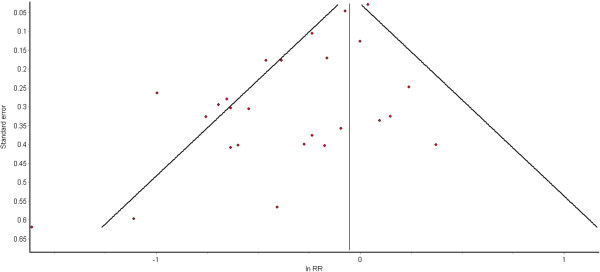
“one small study [37] that was weighted heavily in the quality effects model due to its small confidence intervals.”
BackgroundMethodResultInfluentialAngevaren, M., Aufdemkampe, G., Verhaar, H. J. J., Alemán, A., & Vanhees, L. (2008) · Cochrane Database of Systematic Reviews · doi:10.1002/14651858.cd005381.pub2 · Cited by 432
Social and Leisure Activities and Risk of Dementia: A Prospective Longitudinal Study
Fabrigoule, C., Letenneur, L., Dartigues, J. F., Zarrouk, M., Commenges, D., & Barberger‐Gateau, P. (1995) · Journal of the American Geriatrics Society · doi:10.1111/j.1532-5415.1995.tb06093.x · Cited by 418 · cited 2×
“Included as part of the meta-analyses were nine studies on dementia and AD (10 cohorts), published up until 2007 [23,35-42].”
MethodMild cognitive impairment: conceptual basis and current nosological status
Ritchie, K., & Touchon, J. (2000) · The Lancet · doi:10.1016/s0140-6736(99)06155-3 · Cited by 392 · cited 2×
“The screening/assessment of cognitive decline using tests designed to screen for dementia is, however, noted as potentially biasing persons with cognitive decline toward sub-clinical dementia [8].”
BackgroundMethodThe Bradford Hill considerations on causality: a counterfactual perspective
Höfler, M. (2005) · Emerging Themes in Epidemiology · doi:10.1186/1742-7622-2-11 · Cited by 340
McDowell, I., Kristjansson, B., Hill, G. B., & Hébert, R. (1997) · Journal of Clinical Epidemiology · doi:10.1016/s0895-4356(97)00060-7 · Cited by 307 · cited 2×
“The 3MS is noted as having slightly greater validity and reliability than the MMSE [69].”
BackgroundPhysical Activity, Brain Plasticity, and Alzheimer's Disease
Erickson, K. I., Weinstein, A. M., & Lopez, O. L. (2012) · Archives of Medical Research · doi:10.1016/j.arcmed.2012.09.008 · Cited by 288
A Quality-Effects Model for Meta-Analysis
Doi, S. A. R., & Thalib, L. (2008) · Epidemiology · doi:10.1097/ede.0b013e31815c24e7 · Cited by 271 · cited 2×
“The quality effects model is used when studies differ in relation to study design [43].”
MethodPhysical activity and cognitive decline, the role of the apolipoprotein e4 allele
SCHUIT, A. J., M. FESKENS, E. J., LAUNER, L. J., & KROMHOUT, D. (2001) · Medicine & Science in Sports & Exercise · doi:10.1097/00005768-200105000-00015 · Cited by 261 · cited 2×
“Included as part of the meta-analyses were 12 prospective studies (15 cohorts) published up until January 2010 [22-33].”
BackgroundMethodPhysical Activity and Incident Cognitive Impairment in Elderly Persons: The INVADE Study
Etgen, T. (2010) · Archives of Internal Medicine · doi:10.1001/archinternmed.2009.498 · Cited by 252 · cited 2×
“Included as part of the meta-analyses were 12 prospective studies (15 cohorts) published up until January 2010 [22-33].”
BackgroundMethodTest-retest reliable coefficients and 5-year change scores for the MMSE and 3MS
TOMBAUGH, T. (2005) · Archives of Clinical Neuropsychology · doi:10.1016/j.acn.2004.11.004 · Cited by 223 · cited 1×
“studies in the review [68].”
Chang, M., Jonsson, P. V., Snaedal, J., Bjornsson, S., Saczynski, J. S., Aspelund, T., Eiriksdottir, G., Jonsdottir, M. K., Lopez, O. L., Harris, T. B., et al. (2010) · The Journals of Gerontology: Series A · doi:10.1093/gerona/glq152 · Cited by 212 · cited 3×
“Sixteen studies met the inclusion criteria and are included in the review [21,47-61].”
BackgroundEssential Epidemiology: An Introduction for Students and Health Professionals
Webb, P. M., & Bain, C. (2012) · Cited by 209
Exercise Level and Cognitive Decline: The MoVIES Project
Lytle, M. E., Vander Bilt, J., Pandav, R. S., Dodge, H. H., & Ganguli, M. (2004) · Alzheimer Disease & Associated Disorders · doi:10.1097/01.wad.0000126614.87955.79 · Cited by 200 · cited 2×
“Included as part of the meta-analyses were 12 prospective studies (15 cohorts) published up until January 2010 [22-33].”
BackgroundMethodThe influence of exercise on brain aging and dementia
Lautenschlager, N. T., Cox, K. L., & Cyarto, E. (2011) · Biochimica et Biophysica Acta (BBA) - Molecular Basis of Disease · doi:10.1016/j.bbadis.2011.07.010 · Cited by 200
Niti, M., Yap, K.-B., Kua, E.-H., Tan, C.-H., & Ng, T.-P. (2007) · International Psychogeriatrics · doi:10.1017/s1041610207006655 · Cited by 198 · cited 2×
“Included as part of the meta-analyses were 12 prospective studies (15 cohorts) published up until January 2010 [22-33].”
BackgroundMethodIs physical activity a potential preventive factor for vascular dementia? A systematic review
Aarsland, D., Sardahaee, F. S., Anderssen, S., Ballard, C., & the Alzheimer's Society Systematic Review group (2010) · Aging & Mental Health · doi:10.1080/13607860903586136 · Cited by 195
Physical activity and dementia risk in the elderly: Findings from a prospective Italian study
Ravaglia, G., Forti, P., Lucicesare, A., Pisacane, N., Rietti, E., Bianchin, M., & Dalmonte, E. (2008) · Neurology · doi:10.1212/01.wnl.0000296276.50595.86 · Cited by 191
Singh-Manoux, A., Hillsdon, M., Brunner, E., & Marmot, M. (2005) · American Journal of Public Health · doi:10.2105/ajph.2004.055574 · Cited by 186 · cited 2×
“Included as part of the meta-analyses were 12 prospective studies (15 cohorts) published up until January 2010 [22-33].”
BackgroundMethodAssociation between physical activity and brain health in older adults
Benedict, C., Brooks, S. J., Kullberg, J., Nordenskjöld, R., Burgos, J., Grevès, M. L., Kilander, L., Larsson, E., Johansson, L. O. M., Ahlström, H. K., et al. (2012) · Neurobiology of Aging · doi:10.1016/j.neurobiolaging.2012.04.013 · Cited by 181 · cited 1×
“One can be physically active without necessarily having high aerobic fitness [19].”
BackgroundMeasuring the impact of exercise on cognitive aging: methodological issues
Miller, D. I., Taler, V., Davidson, P. S. R., & Messier, C. (2011) · Neurobiology of Aging · doi:10.1016/j.neurobiolaging.2011.02.020 · Cited by 175 · cited 4×
“Potential confounders to be controlled for include age, sex, educational level, alcohol consumption, smoking status, depression score, stress, anxiety and cardiovascular disease [4,16].”
BackgroundInfluentialActivity Energy Expenditure and Incident Cognitive Impairment in Older Adults
Middleton, L. E. (2011) · Archives of Internal Medicine · doi:10.1001/archinternmed.2011.277 · Cited by 161 · cited 5×
“Assessment of physical activity was undertaken via the use of questionnaires, with the exception of one study that used doubly-labelled water and indirect calorimetry [49].”
BackgroundMethodInfluentialThe association between physical activity and dementia in an elderly population: the Rotterdam Study
de Bruijn, R. F. A. G., Schrijvers, E. M. C., de Groot, K. A., Witteman, J. C. M., Hofman, A., Franco, O. H., Koudstaal, P. J., & Ikram, M. A. (2013) · European Journal of Epidemiology · doi:10.1007/s10654-013-9773-3 · Cited by 160 · cited 2×
“Sixteen studies met the inclusion criteria and are included in the review [21,47-61].”
BackgroundNeuropsychological testing and assessment for dementia
Jacova, C., Kertesz, A., Blair, M., Fisk, J. D., & Feldman, H. H. (2007) · Alzheimer's & Dementia · doi:10.1016/j.jalz.2007.07.011 · Cited by 143 · cited 1×
“However, the use of this test is increasingly being challenged, as it is considered to have insufficient scope, and, therefore sensitivity, to identify mild forms of cognitive decline [67].”
BackgroundThe effects of physical activity, education, and body mass index on the aging brain
Ho, A. J., Raji, C. A., Becker, J. T., Lopez, O. L., Kuller, L. H., Hua, X., Dinov, I. D., Stein, J. L., Rosano, C., Toga, A. W., et al. (2011) · Human Brain Mapping · doi:10.1002/hbm.21113 · Cited by 142 · cited 2×
“5 per cent increase, per physical activity quintile) [74].”
BackgroundIwasa, H., Yoshida, Y., Kai, I., Suzuki, T., Kim, H., & Yoshida, H. (2011) · Journal of Psychosomatic Research · doi:10.1016/j.jpsychores.2011.10.002 · Cited by 121 · cited 2×
“review paper [20] and 5 additional studies identified in the database search [47-51], on physical activity and cognitive decline, see Additional file 1: Table S1.”
BackgroundThe role of causal criteria in causal inferences: Bradford Hill's "aspects of association"
Ward, A. C. (2009) · Epidemiologic Perspectives & Innovations · doi:10.1186/1742-5573-6-2 · Cited by 120 · cited 1×
“Austin Bradford Hill first established guidelines for causality, which is today often considered the leading method for identifying a causal relationship [63].”
MethodTaaffe, D. R., Irie, F., Masaki, K. H., Abbott, R. D., Petrovitch, H., Ross, G. W., & White, L. R. (2008) · The Journals of Gerontology Series A: Biological Sciences and Medical Sciences · doi:10.1093/gerona/63.5.529 · Cited by 119 · cited 2×
“Sixteen studies met the inclusion criteria and are included in the review [21,47-61].”
BackgroundMild cognitive impairment and cognitive impairment, no dementia: Part A, concept and diagnosis
Chertkow, H., Nasreddine, Z., Joanette, Y., Drolet, V., Kirk, J., Massoud, F., Belleville, S., & Bergman, H. (2007) · Alzheimer's & Dementia · doi:10.1016/j.jalz.2007.07.013 · Cited by 116 · cited 7×
“Neuroimaging of people with MCI has shown early structural changes that are in keeping with what would be expected of AD sufferers [10].”
BackgroundInfluentialPhysical Activity and the Risk of Dementia in Oldest Old
Sumic, A., Michael, Y. L., Carlson, N. E., Howieson, D. B., & Kaye, J. A. (2007) · Journal of Aging and Health · doi:10.1177/0898264307299299 · Cited by 109 · cited 2×
“Included as part of the meta-analyses were 12 prospective studies (15 cohorts) published up until January 2010 [22-33].”
BackgroundMethodThe Effectiveness of Exercise on Improving Cognitive Function in Older People: A Systematic Review
Tseng, C.-N., Gau, B.-S., & Lou, M.-F. (2011) · Journal of Nursing Research · doi:10.1097/jnr.0b013e3182198837 · Cited by 105 · cited 1×
“Physical activity, which encompasses exercise, is different from physical fitness [18].”
BackgroundIncidence of and Risk Factors for Dementia in the Ibadan Study of Aging
Gureje, O., Ogunniyi, A., Kola, L., & Abiona, T. (2011) · Journal of the American Geriatrics Society · doi:10.1111/j.1532-5415.2011.03374.x · Cited by 102 · cited 2×
“Sixteen studies met the inclusion criteria and are included in the review [21,47-61].”
BackgroundHo, S. C., Woo, J., Sham, A., Chan, S. G., & Yu, A. L. (2001) · International Journal of Epidemiology · doi:10.1093/ije/30.6.1389 · Cited by 100 · cited 2×
“Included as part of the meta-analyses were 12 prospective studies (15 cohorts) published up until January 2010 [22-33].”
BackgroundMethodPrevention of CIND by physical activity: Different impact on VCI-ND compared with MCI
Middleton, L. E., Kirkland, S., & Rockwood, K. J. (2008) · Journal of the Neurological Sciences · doi:10.1016/j.jns.2007.04.054 · Cited by 96 · cited 2×
“Included as part of the meta-analyses were 12 prospective studies (15 cohorts) published up until January 2010 [22-33].”
BackgroundMethodWork‐related physical activity and the risk of dementia and Alzheimer's disease
Rovio, S., Kåreholt, I., Viitanen, M., Winblad, B., Tuomilehto, J., Soininen, H., Nissinen, A., & Kivipelto, M. (2007) · International Journal of Geriatric Psychiatry · doi:10.1002/gps.1755 · Cited by 94 · cited 2×
“Sixteen studies met the inclusion criteria and are included in the review [21,47-61].”
BackgroundA Clinical Approach to Mild Cognitive Impairment
Rosenberg, P. B., Johnston, D. M., & Lyketsos, C. G. (2006) · American Journal of Psychiatry · doi:10.1176/ajp.2006.163.11.1884 · Cited by 88
Woodard, J. L., Sugarman, M. A., Nielson, K. A., Smith, J. C., Seidenberg, M., Durgerian, S., Butts, A., Hantke, N., Lancaster, M., & Matthews, M. A. (2012) · Current Alzheimer Research · doi:10.2174/156720512800492477 · Cited by 87
Sattler, C., Erickson, K. I., Toro, P., & Schröder, J. (2011) · Journal of Alzheimer’s Disease · doi:10.3233/jad-2011-110548 · Cited by 86 · cited 2×
“[4,62].”
Morgan, G. S., Gallacher, J., Bayer, A., Fish, M., Ebrahim, S., & Ben-Shlomo, Y. (2012) · Journal of Alzheimer's Disease · doi:10.3233/jad-2012-112171 · Cited by 86 · cited 4×
“review paper [20] and 5 additional studies identified in the database search [47-51], on physical activity and cognitive decline, see Additional file 1: Table S1.”
BackgroundInfluentialLeisure Activities and Risk of Vascular Cognitive Impairment in Older Adults
Verghese, J., Wang, C., Katz, M. J., Sanders, A., & Lipton, R. B. (2009) · Journal of Geriatric Psychiatry and Neurology · doi:10.1177/0891988709332938 · Cited by 82 · cited 2×
“review paper [20] and 5 additional studies identified in the database search [47-51], on physical activity and cognitive decline, see Additional file 1: Table S1.”
BackgroundKim, J., Stewart, R. J., Bae, K., Kim, S., Yang, S., Park, K.-H., Shin, I., & Yoon, J. (2010) · Neurobiology of Aging · doi:10.1016/j.neurobiolaging.2010.01.018 · Cited by 68 · cited 2×
“Sixteen studies met the inclusion criteria and are included in the review [21,47-61].”
BackgroundBowen, M. E. (2012) · American Journal of Health Promotion · doi:10.4278/ajhp.110311-quan-115 · Cited by 63 · cited 3×
“Results from prospective studies have shown mixed results [20,21].”
BackgroundResultPhysical Activity and Cognitive Decline in Elderly Persons
Pignatti, F., Rozzini, R., & Trabucchi, M. (2002) · Archives of Internal Medicine · doi:10.1001/archinte.162.3.361 · Cited by 50 · cited 2×
“Included as part of the meta-analyses were 12 prospective studies (15 cohorts) published up until January 2010 [22-33].”
BackgroundMethodCyarto, E. V., Lautenschlager, N. T., Desmond, P. M., Ames, D., Szoeke, C., Salvado, O., Sharman, M. J., Ellis, K. A., Phal, P. M., Masters, C. L., et al. (2012) · BMC Psychiatry · doi:10.1186/1471-244x-12-167 · Cited by 46 · cited 2×
“Cardiovascular risk factors, including hypertension, diabetes, the metabolic syndrome, obesity and smoking are considered as risk factors for both cognitive decline and dementia [1,11,15].”
BackgroundMental disorder prevention and physical activity in Iranian elderly.
Mortazavi, S. S., Mohammad, K., Ardebili, H. E., Beni, R. D., Mahmoodi, M. S., & Keshteli, A. H. (2012) · PubMed Central · Cited by 44
Lee, S., Yuki, A., Nishita, Y., Tange, C., Kim, H., Kozakai, R., Ando, F., & Shimokata, H. (2013) · Journal of the American Geriatrics Society · doi:10.1111/jgs.12119 · Cited by 38 · cited 2×
“review paper [20] and 5 additional studies identified in the database search [47-51], on physical activity and cognitive decline, see Additional file 1: Table S1.”
BackgroundMcCALLUM, J., SIMONS, L. A., SIMONS, J., & FRIEDLANDER, Y. (2007) · Annals of the New York Academy of Sciences · doi:10.1196/annals.1396.049 · Cited by 35 · cited 2×
“Sixteen studies met the inclusion criteria and are included in the review [21,47-61].”
BackgroundFlicker, L., Almeida, O. P., Acres, J., Le, M. T. Q., Tuohy, R. J., Jamrozik, K., Hankey, G., & Norman, P. (2005) · Age and Ageing · doi:10.1093/ageing/afh235 · Cited by 34 · cited 2×
“Included as part of the meta-analyses were 12 prospective studies (15 cohorts) published up until January 2010 [22-33].”
BackgroundMethodFuchs, R. (2015) · Elsevier eBooks · doi:10.1016/b978-0-08-097086-8.14115-7 · Cited by 31
Effect of leisure activities on inflammation and cognitive function in an aging sample
Lin, F., Friedman, E., Quinn, J., Chen, D.-G. (., & Mapstone, M. (2012) · Archives of Gerontology and Geriatrics · doi:10.1016/j.archger.2012.02.002 · Cited by 26 · cited 2×
“6 million, with AD and VaD accounting for 80 per cent of all clinically diagnosed dementia cases [1,14].”
BackgroundWebb, P. M., & Bain, C. (2010) · Cambridge University Press eBooks · doi:10.1017/cbo9780511997303 · Cited by 26
From mild cognitive impairment to prodromal Alzheimer disease: A nosological evolution
Molinuevo, J. L., Valls‐Pedret, C., & Rami, L. (2010) · European Geriatric Medicine · doi:10.1016/j.eurger.2010.05.003 · Cited by 19 · cited 3×
“Cardiovascular risk factors, including hypertension, diabetes, the metabolic syndrome, obesity and smoking are considered as risk factors for both cognitive decline and dementia [1,11,15].”
BackgroundA Clinical Approach to Mild Cognitive Impairment
Rosenberg, P. B. (2006) · American Journal of Psychiatry · doi:10.1176/appi.ajp.163.11.1884 · Cited by 18
Fuchs, R. (2001) · Elsevier eBooks · doi:10.1016/b0-08-043076-7/03875-4 · Cited by 14
de Bruijn, R. F. A. G., Schrijvers, E. M. C., de Groot, K. A., Witteman, J. C. M., Albert Hofman, D., Franco, O. H., Koudstaal, P. J., & Ikram, M. A. (2013) · European Journal of Epidemiology · doi:10.1007/s10654-013-9810-2 · Cited by 5
Angevaren, M., Aufdemkampe, G., Verhaar, H. J. J., Aleman, A., & Vanhees, L. (2008) · Parkinsonism & Related Disorders · doi:10.1016/s1353-8020(08)70231-1 · Cited by 5 · cited 1×
“Research suggests that cognitive decline is associated with the aging process, particularly from age ≥50 years [3].”
Background
Research works printed but not linked: 1
- Rothman KJ Greenland S Lash TL Modern Epidemiology 2008 Philadelphia, PA: Lippincott Williams & Wilkins
Cited by
2023 Alzheimer's disease facts and figures
(2023) · Alzheimer's & Dementia · doi:10.1002/alz.13016 · Cited by 3,212
2024 Alzheimer's disease facts and figures
(2024) · Alzheimer's & Dementia · doi:10.1002/alz.13809 · Cited by 2,536
2019 Alzheimer’s disease facts and figures.
Alzheimer's Association (2019) · Alzheimer's & Dementia · doi:10.1016/j.jalz.2019.01.010 · Cited by 2,461
2022 Alzheimer's disease facts and figures
(2022) · Alzheimer's & Dementia · doi:10.1002/alz.12638 · Cited by 2,341
2020 Alzheimer's disease facts and figures
(2020) · Alzheimer's & Dementia · doi:10.1002/alz.12068 · Cited by 2,353
Metadata
- Authors
- Blondell, S. J., Hammersley-Mather, R., & Veerman, J. L.
- Affiliations
- The University of Queensland (AU)
- ORCID
- Blondell, Sarah J
- Venue
- BMC Public Health
- Published
- 2014-05-27
- Volume
- 14
- Issue
- 1
- Pages
- 510-510
- ISSN
- 1471-2458 (ISSN-L)
- PMC
- PMC4064273
- OpenAlex
- W2105024128
- Cited by
- 928
- References
- 86
- Citations by year
- 2026: 64 · 2025: 81 · 2024: 91 · 2023: 89 · 2022: 111 · 2021: 91 · 2020: 116 · 2019: 80 · 2018: 58 · 2017: 66 · 2016: 51 · 2015: 24 · 2014: 5
- FWCI
- 6.70
- Type
- journal article
- Language
- en
- Open access
- gold
- doi.org
- Licence
- Locations
- BMC Public Health (publishedVersion, cc-by)
- Europe PMC (PubMed Central) (publishedVersion, cc-by)
- PubMed Central (publishedVersion, cc-by)
- PubMed (publishedVersion)
- University of Southern Queensland ePrints (University of Southern Queensland) (acceptedVersion)
- Griffith Research Online (submittedVersion, cc-by)
- Topics
- Health Sciences › Medicine › Psychiatry and Mental health › Dementia and Cognitive Impairment Research
- Health Sciences › Medicine › Public Health, Environmental and Occupational Health › Physical Activity and Health
- Health Sciences › Medicine › Critical Care and Intensive Care Medicine › Intensive Care Unit Cognitive Disorders
- Keywords
- physical activity, cognitive decline, dementia, older adults, dementia prevention, cognitive aging, prospective cohort
- MeSH terms
- Aged, Aged, 80 and over, Dementia, Female, Humans, Longitudinal Studies, Male, Middle Aged, Motor Activity, Cohort Studies
About these checks
Registry, retraction, Cites and statistics results are computed, not judged, with one exception: a printed reference that no index lists is read once by a model before it counts as a citation error. Claims are extracted by a model and kept only when their quote appears verbatim in the text; each cited source is then checked, with a model’s help, for whether it says what the claim relies on. Those verdicts can be wrong — read the claim’s quote and the cited source before relying on one.
Statistics and arithmetic are recomputed, not judged.
Confidence bands are shown only for fields calibrated on our annotated test set. None is calibrated yet, so no band is shown.
What counts as a claim ›How we measure confidence ›How we check this ›
Are you an author, or do you see a problem with this page? Request a review
Data sources
Bibliographic data: Semantic Scholar, OpenAlex, Crossref.
Contains information from the Semantic Scholar Academic Graph Datasets, made available under the ODC Attribution License (ODC-BY 1.0).
Semantic Scholar’s data is described in: Kinney, R., et al. (2023). The Semantic Scholar Open Data Platform. arXiv:2301.10140.
