

Healthier side dishes at restaurants: an analysis of children's perspectives, menu content, and energy impacts
Open accessThe DOI matches its Crossref record; 43 of the 48 references it cites were found in a registry or an index; 24 of the 64 sources its claims cite were checked for support.
Abstract
BACKGROUND: Children consume restaurant-prepared foods at high rates, suggesting that interventions and policies targeting consumption of these foods have the potential to improve diet quality and attenuate excess energy intake. One approach to encouraging healthier dietary intake in restaurants is to offer fruits and vegetables (FV) as side dishes, as opposed to traditional, energy-dense accompaniments like French fries. The aims of the current study were to examine: children's views about healthier side dishes at restaurants; current side dish offerings on children's menus at leading restaurants; and potential energy reductions when substituting FV side dishes in place of French fries. METHODS: To investigate children's attitudes, a survey was administered to a nationally representative sample of U.S. 8- to 18-year-olds (n = 1178). To examine current side dish offerings, children's menus from leading quick service (QSR; n = 10) and full service restaurant chains (FSR; n = 10) were analyzed. Energy reductions that could result from substituting commonly-offered FV side dishes for French fries were estimated using nutrition information corresponding to the children's menu items. RESULTS: Two-thirds of children reported that they would not feel negatively about receiving FV sides instead of French fries with kids' meals. Liking/taste was the most common reason that children gave to explain their attitudes about FV side dishes. Nearly all restaurants offered at least 1 FV side dish option, but at most restaurants (60% of QSR; 70% of FSR), FV sides were never served by default. Substituting FV side dishes for French fries yielded an average estimated energy reduction of at least 170 calories. CONCLUSIONS: Results highlight some healthy trends in the restaurant context, including the majority of children reporting non-negative attitudes about FV side dishes and the consistent availability of FV side dish options at leading QSR and FSR. Yet the minority of restaurants offer these FV sides by default. Promoting creative, appealing FV side dishes can result in healthier, less energy-dense meals for children. Substituting or displacing energy-dense default side dishes with such FV dishes show promise as part of continued, comprehensive efforts to increase the healthfulness of meals consumed by children in restaurant settings.
Overview
CoChat Summary
TL;DR
This study combined a nationally representative survey of U.S. 8- to 18-year-olds with an analysis of children’s menus at 20 leading restaurant chains and found that most children reported non-negative attitudes about fruit/vegetable (FV) side dishes, though FV sides were rarely the default. Substituting common FV sides for French fries yielded average estimated energy reductions of at least 170 calories.
Key findings
- Among children who ordered kids’ meals, 32.8% would be somewhat/very unhappy, 34.9% neither happy nor unhappy, and 32.3% somewhat/very happy if their meal came with a vegetable or fruit but not French fries; two-thirds reported non-negative attitudes. More than half were somewhat/very likely to order a vegetable side (56.2% tweens; 54.8% teens) or fruit side (78.9% tweens; 73.0% teens), while 89.8% of tweens and 86.7% of teens were likely to order French fries.
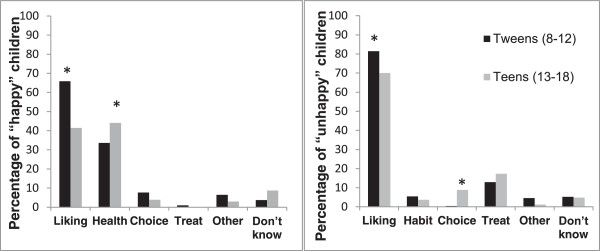
- In open-ended responses, the most common reason for being happy about FV instead of fries was liking/taste (57.1%), followed by health (41.9%); the most common reason for being unhappy was liking/taste of French fries (77.4%).
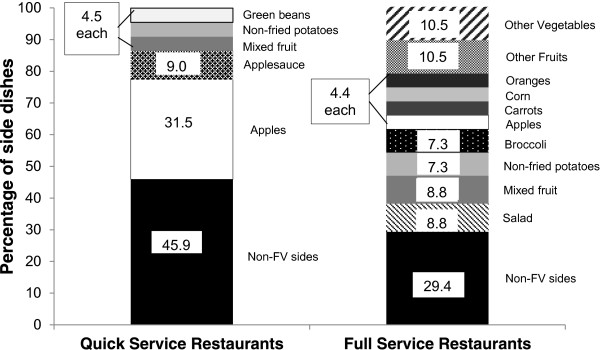
- Nearly all menus had at least one FV side available (95% overall; 90% QSR; 100% FSR), but FV was never the default at 60% of QSR and 70% of FSR; FV was always default at 40% of QSR and 20% of FSR.
- Among 11 restaurants offering French fries and at least one common FV side, fries averaged 277 kcal (SD = 105; range 100–440). Substituting FV sides for fries yielded average reductions of at least 170 calories: apple slices 171 ± 74 kcal, applesauce 300 ± 71 kcal, broccoli 283 ± 128 kcal, mashed potatoes 180 ± 156 kcal, and salad 242 ± 148 kcal.
Methods
- A nationally representative online survey of U.S. 8- to 18-year-olds (n = 1178) was fielded in September 2010; sampling weights incorporated age, sex, race/ethnicity, parental education, urbanicity, and region. Analyses used SAS 9.2, with frequencies, ordinary least squares regressions, and logistic regressions.
- Children’s menus from the top 10 quick service (QSR) and top 10 full service restaurant (FSR) chains by sales were accessed in April 2013 and coded for FV side availability, percent of sides that were FV, default status, and specific FV items; nutrition information was collected from restaurant websites when available (n = 19 of 20).
- Energy reductions were estimated in 11 restaurants offering French fries and at least one of five common FV sides (apple slices, applesauce, mashed potatoes, broccoli, or salad) by subtracting each FV side’s energy content from that restaurant’s French fries energy content and averaging across restaurants.
Limitations
- The paper states potential social desirability in children’s reports, lower reported restaurant frequency than other national data, possible lack of representativeness in restaurant patronage, lack of a priori measurement work on the survey, and that public menus and stated nutrition information may not fully reflect children’s restaurant experiences or actual energy content.
- The paper also states that substituting FV for fries would produce a net energy decrease only if patrons do not compensate through other meal components, and that actual consumption impacts remain undetermined.
- Evident from the text: the survey and menu analysis are cross-sectional snapshots, so causal claims cannot be made; open-ended analyses excluded neutral children and 8 contradictory responses; energy estimates rely on restaurant-stated nutrition and do not measure what children actually ate.
Model-written summary. Check it against the paper before relying on it.
Integrity signals
Registry
Cites
Statistics
Figures
Verification
Claims the paper makes
14 Valid · 2 Not valid · 23 Not checked · 91 Own results and interpretations
The cited sources support only part of this claim — read each source’s verdict below.
In the paper
“Consistent with past research, taste emerged as a key factor influencing children's food preferences [32,33,38]; this was true for both children who would be happy and those who would be unhappy about the substitution.”
§ Healthier side dishes at restaurants: an analysis of children’s perspectives, menu content, and energy impacts > Discussion
What the sources say
- Could not verifycites [32] 32. Bassett R Chapman G Beagan B Autonomy and control: The co-construction of adolescent food choice Appetite 2008 50 2–3 325 332 17936413 10.1016/j.appet.2007.08.009 sourceExperimental — accuracy not yet measured
Two searches within Bassett, Chapman and Beagan’s “Autonomy and control: The co-construction of adolescent food choice” returned no full-text snippets, so its support for the claim could not be checked directly. The verbatim passage appears instead in “Healthier side dishes at restaurants: an analysis of children’s perspectives, menu content, and energy impacts” (unscoped score 0.789). That paper presents the happy-versus-unhappy substitution finding as its own result while citing past research for the broader point about taste. The match therefore does not establish misattribution: Bassett et al. may support the broader taste point, but support for the specific substitution finding is unverified. (LLM, conf=0.72)
- Could not verifycites [33] 33. Birch LL Preschool children's food preferences and consumption patterns J Nutr Educ 1979 11 4 189 192 10.1016/S0022-3182(79)80025-4 sourceExperimental — accuracy not yet measured
The 1979 Birch paper has no accessible full text here, and two paper-scoped searches returned no snippets establishing the substitution finding. An unscoped match (score 0.847) places the wording in “Healthier side dishes at restaurants,” whose authors describe the happy and unhappy groups as results of their own study. That sentence cites earlier research for the broader point that taste influences food preferences; the match therefore does not establish that the Birch citation is wrong, but it cannot verify the group-specific claim in Birch. (LLM, conf=0.76)
- Supportedcites [38] 38. Drewnowski A Taste preferences and food intake Ann Rev Nutr 1997 17 1 237 253 10.1146/annurev.nutr.17.1.237 9240927 sourceExperimental — accuracy not yet measured
Drewnowski’s 1997 review, “Taste Preferences and Food Intake,” is a reasonable citation for the general point that taste influences food preferences, though no paper-scoped full-text snippets were available to verify its wording. A Semantic Scholar match (score 0.776) reproduces the citing paper’s sentence and shows that the happy-versus-unhappy comparison comes from that paper’s own analysis of children’s responses. The citation supports the background claim, not the specific substitution finding. (LLM, conf=0.72)
plainstates an association- Asserted: passes — The authors put it forward as true.
- Checkable: passes — It can be checked against evidence.
- Load-bearing: passes — The paper’s conclusions depend on it.
- Based: passes — The paper gives a reason why it holds.
- Could not verify
Every source the paper cites for this claim was checked and supports it.
In the paper
“children's intake of vegetables is further from dietary recommendations compared to fruits [41]”
§ Healthier side dishes at restaurants: an analysis of children’s perspectives, menu content, and energy impacts > Discussion
What the sources say
- Supportedcites [41] 41. Krebs-Smith SM Guenther PM Subar AF Kirkpatrick SI Dodd KW Americans do not meet federal dietary recommendations J Nutr 2010 140 10 1832 1838 10.3945/jn.110.124826 20702750 PMC2937576 source
Table 2 (reproduced in the Discussion; page not provided) shows that, in every child sex-age group, a higher percentage fell below the recommendation for total vegetables than for total fruits. For children aged 2–3, the figures are 80.3% for vegetables and 31.5% for fruits. (LLM, conf=0.90)
plain- Asserted: passes — The authors put it forward as true.
- Checkable: passes — It can be checked against evidence.
- Load-bearing: passes — The paper’s conclusions depend on it.
- Based: passes — The paper gives a reason why it holds.
- Supported
A result the paper reports from its own data — it cites no other source for it, so there is none to check. The quote shows it is in the paper.
In the paper
“Fifty-nine percent of children reported ordering kids’ meals.”
§ Healthier side dishes at restaurants: an analysis of children’s perspectives, menu content, and energy impacts > Results > Child demographics and frequency of eating at restaurants
plain- Asserted: passes — The authors put it forward as true.
- Checkable: passes — It can be checked against evidence.
- Load-bearing: unclear — It is unclear whether the paper’s conclusions depend on it.
- Based: passes — The paper gives a reason why it holds.
A result the paper reports from its own data — it cites no other source for it, so there is none to check. The quote shows it is in the paper.
In the paper
“there were 19 different FV side dish items offered across children's menus at the 20 restaurants.”
§ Healthier side dishes at restaurants: an analysis of children’s perspectives, menu content, and energy impacts > Results > Current availability of fruits and vegetables as side dishes on children’s menus
plain- Asserted: passes — The authors put it forward as true.
- Checkable: passes — It can be checked against evidence.
- Load-bearing: unclear — It is unclear whether the paper’s conclusions depend on it.
- Based: passes — The paper gives a reason why it holds.
A result the paper reports from its own data — it cites no other source for it, so there is none to check. The quote shows it is in the paper.
In the paper
“The most commonly available FV side dishes, and corresponding frequencies, were: apples (10), mixed fruit (7), non-fried potatoes (6), salad (6), broccoli (5), and applesauce (4).”
§ Healthier side dishes at restaurants: an analysis of children’s perspectives, menu content, and energy impacts > Results > Current availability of fruits and vegetables as side dishes on children’s menus
plain- Asserted: passes — The authors put it forward as true.
- Checkable: passes — It can be checked against evidence.
- Load-bearing: unclear — It is unclear whether the paper’s conclusions depend on it.
- Based: passes — The paper gives a reason why it holds.
59 more claims
Create a free account to see all 130 claims and every source verdict.
- Probably not a substantial claim. 28
- It may state two separate claims as one. 47
- The quote only partly states this claim. 1
Claims other papers make about this one
Each is checked against this paper’s own text: does it say what the citing paper says it does?
The source backs part of the claim, not all of it — or backs it for a different population, condition or comparison.
In the citing paper
“Many kids’ meals at leading restaurant chains do not provide healthy side dishes like fruits and vegetables by default, making it difficult to meet recommended calorie, fat, saturated fat, and sodium limits for restaurant kids’ meals [11, 12].”
From Child and parent perspectives on healthier side dishes and beverages in restaurant kids’ meals: results from a national survey in the United States (2018) · cites this paper as [11]
Experimental — accuracy not yet measuredThe cited source says what the claim attributes to it.
In the citing paper
“Many kids’ meals at leading restaurant chains do not provide healthy side dishes like fruits and vegetables by default, making it difficult to meet recommended calorie, fat, saturated fat, and sodium limits for restaurant kids’ meals [11, 12].”
From Child and parent perspectives on healthier side dishes and beverages in restaurant kids’ meals: results from a national survey in the United States (2018) · cites this paper as [11]
The cited source says what the claim attributes to it.
In the citing paper
“In a national survey of 8- to 12-year old children conducted in 2010, a majority of children reported that they would accept a fruit or vegetable side dish instead of French fries with their restaurant meal [11].”
From Child and parent perspectives on healthier side dishes and beverages in restaurant kids’ meals: results from a national survey in the United States (2018) · cites this paper as [11]
Experimental — accuracy not yet measured
Self-check
Percentages, sums and reported differences re-computed from the paper’s own numbers.
Rated minor: it would not touch a result — a value no result rests on, a p-value that stays on the same side of the significance level, or a conflict that is clerical, resolved elsewhere in the paper, or outside its own findings.
In the paper
“| Apple sauce | 2 | 70 ± 28 | 40-90 | 300 ± 71 | 250-350 |”
§ Healthier side dishes at restaurants: an analysis of children’s perspectives, menu content, and energy impacts > Results > Current availability of fruits and vegetables as side dishes on children’s menus
Reported 70 · recomputed 65
Citations
Cites
Dietary Guidelines for Americans, 2010
(2011) · Choice Reviews Online · doi:10.5860/choice.49-0615 · Cited by 1,553
TASTE PREFERENCES AND FOOD INTAKE
Drewnowski, A. (1997) · Annual Review of Nutrition · doi:10.1146/annurev.nutr.17.1.237 · Cited by 1,045 · cited 1×
“Consistent with past research, taste emerged as a key factor influencing children's food preferences [32,33,38]; this was true for both children who would be happy and those who would be unhappy about the substitution.”
BackgroundMcGuire, S. (2011) · Advances in Nutrition · doi:10.3945/an.111.000430 · Cited by 1,028
Priming effects of television food advertising on eating behavior.
Harris, J. L., Bargh, J. A., & Brownell, K. D. (2009) · Health Psychology · doi:10.1037/a0014399 · Cited by 945 · cited 1×
“Both of these approaches address consumers’ access to information about food, and thus far, there are mixed results in terms of the potential impacts of these strategies on eating behavior [10-23].”
BackgroundCan “Low-Fat” Nutrition Labels Lead to Obesity?
Wansink, B., & Chandon, P. (2006) · Journal of Marketing Research · doi:10.1509/jmkr.43.4.605 · Cited by 734 · cited 1×
“On the other hand, it could be argued that substituting FV for French fries is a more salient shift than those represented by the conditions in energy density experiments, and perceiving side dishes as healthy may lead to overeating [45]: for example, the child and/or parent may choose to order an energydense dessert…”
BackgroundFood Advertising and Marketing Directed at Children and Adolescents in the US
Story, M., & French, S. (2004) · International Journal of Behavioral Nutrition and Physical Activity · doi:10.1186/1479-5868-1-3 · Cited by 725
Americans Do Not Meet Federal Dietary Recommendations
Krebs-Smith, S. M., Guenther, P. M., Subar, A. F., Kirkpatrick, S. I., & Dodd, K. W. (2010) · The Journal of Nutrition · doi:10.3945/jn.110.124826 · Cited by 711 · cited 1×
“It could also be particularly important for increasing acceptance and consumption of vegetables, given that children's intake of vegetables is further from dietary recommendations compared to fruits [41], and given the dearth of default vegetable offerings on children's menus.”
BackgroundCairns, G., Angus, K., Hastings, G., & Caraher, M. (2013) · Appetite · doi:10.1016/j.appet.2012.04.017 · Cited by 680 · cited 1×
“Both of these approaches address consumers’ access to information about food, and thus far, there are mixed results in terms of the potential impacts of these strategies on eating behavior [10-23].”
BackgroundHarris, J. L., Pomeranz, J. L., Lobstein, T., & Brownell, K. D. (2009) · Annual Review of Public Health · doi:10.1146/annurev.publhealth.031308.100304 · Cited by 549 · cited 1×
“Both of these approaches address consumers’ access to information about food, and thus far, there are mixed results in terms of the potential impacts of these strategies on eating behavior [10-23].”
BackgroundThe relationship between dietary energy density and energy intake
Rolls, B. J. (2009) · Physiology & Behavior · doi:10.1016/j.physbeh.2009.03.011 · Cited by 484 · cited 1×
“On one hand, experimental research on energy density suggests that children consume a consistent weight of food, and thus, it follows that substituting less energy-dense foods for more energy-dense foods should decrease total energy intake [43,44].”
Cognitive Lock-In and the Power Law of Practice
Johnson, E. J., Bellman, S., & Lohse, G. L. (2003) · Journal of Marketing · doi:10.1509/jmkg.67.2.62.18615 · Cited by 389 · cited 1×
“Behavioral economics research has demonstrated that individuals are more likely to accept the default option for organ donation, savings plans, car insurance, and email subscriptions [25-28].”
BackgroundDefaults, Framing and Privacy: Why Opting In-Opting Out1
Johnson, E. J., Bellman, S., & Lohse, G. L. (2002) · Marketing Letters · doi:10.1023/a:1015044207315 · Cited by 388
Andreyeva, T., Kelly, I. R., & Harris, J. L. (2011) · Economics & Human Biology · doi:10.1016/j.ehb.2011.02.004 · Cited by 378 · cited 1×
“Both of these approaches address consumers’ access to information about food, and thus far, there are mixed results in terms of the potential impacts of these strategies on eating behavior [10-23].”
BackgroundStrategies for Promoting Healthier Food Choices
Downs, J. S., Loewenstein, G., & Wisdom, J. (2009) · American Economic Review · doi:10.1257/aer.99.2.159 · Cited by 363 · cited 1×
“This potential shift involves making the healthier choice the easy choice, by making it more explicit or prominent, or by making it the default option [24].”
BackgroundDixon, H. G., Scully, M. L., Wakefield, M. A., White, V. M., & Crawford, D. A. (2007) · Social Science & Medicine · doi:10.1016/j.socscimed.2007.05.011 · Cited by 362 · cited 2×
“Both of these approaches address consumers’ access to information about food, and thus far, there are mixed results in terms of the potential impacts of these strategies on eating behavior [10-23].”
BackgroundTrends in Energy Intake among US Children by Eating Location and Food Source, 1977-2006
Poti, J. M., & Popkin, B. M. (2011) · Journal of the American Dietetic Association · doi:10.1016/j.jada.2011.05.007 · Cited by 350 · cited 1×
“children's eating patterns have shifted, including an increased contribution of foods prepared away from home to children's overall dietary intake [1].”
BackgroundPowell, L. M., & Nguyen, B. T. (2013) · JAMA Pediatrics · doi:10.1001/jamapediatrics.2013.417 · Cited by 346 · cited 1×
“Restaurant-prepared foods tend to be higher in energy and fat and lower in nutritional quality compared to foods prepared at home [3], and accordingly, consumption of foods from QSR and FSR has been associated with higher energy intake and lower diet quality in nationally representative samples of children [4].”
BackgroundFood reinforcement, delay discounting and obesity
Epstein, L. H., Salvy, S. J., Carr, K. A., Dearing, K. K., & Bickel, W. K. (2010) · Physiology & Behavior · doi:10.1016/j.physbeh.2010.04.029 · Cited by 334 · cited 1×
“importance in the younger children who were more likely to order kids' meals, and evidence showing that shortterm rewards like taste often outweigh long-term rewards like health in decision making, particularly in those who find palatable foods to be highly reinforcing [39].”
BackgroundPark, C. W., Jun, S. Y., & Macinnis, D. J. (2000) · Journal of Marketing Research · doi:10.1509/jmkr.37.2.187.18731 · Cited by 316 · cited 1×
“Behavioral economics research has demonstrated that individuals are more likely to accept the default option for organ donation, savings plans, car insurance, and email subscriptions [25-28].”
BackgroundEvidence of a possible link between obesogenic food advertising and child overweight
Lobstein, T., & Dibb, S. (2005) · Obesity Reviews · doi:10.1111/j.1467-789x.2005.00191.x · Cited by 296 · cited 1×
“Both of these approaches address consumers’ access to information about food, and thus far, there are mixed results in terms of the potential impacts of these strategies on eating behavior [10-23].”
BackgroundPreschool children's food preferences and consumption patterns
Birch, L. L. (1979) · Journal of Nutrition Education · doi:10.1016/s0022-3182(79)80025-4 · Cited by 289 · cited 2×
“Traditionally, research has indicated that children and adolescents select and consume foods based on taste, appearance, and familiarity [32,33].”
Background(2002) · PubMed · Cited by 278
Behavioral Evidence of the Effects of Televised Food Messages on Children
Gorn, G. J., & Goldberg, M. E. (1982) · Journal of Consumer Research · doi:10.1086/208913 · Cited by 266 · cited 1×
“Both of these approaches address consumers’ access to information about food, and thus far, there are mixed results in terms of the potential impacts of these strategies on eating behavior [10-23].”
BackgroundAutonomy and control: The co-construction of adolescent food choice
Bassett, R., Chapman, G. E., & Beagan, B. L. (2008) · Appetite · doi:10.1016/j.appet.2007.08.009 · Cited by 249 · cited 2×
“Traditionally, research has indicated that children and adolescents select and consume foods based on taste, appearance, and familiarity [32,33].”
BackgroundChild and adolescent fast-food choice and the influence of calorie labeling: a natural experiment
Elbel, B., Gyamfi, J., & Kersh, R. (2011) · International Journal of Obesity · doi:10.1038/ijo.2011.4 · Cited by 236 · cited 1×
“Both of these approaches address consumers’ access to information about food, and thus far, there are mixed results in terms of the potential impacts of these strategies on eating behavior [10-23].”
BackgroundDefaults and Donation Decisions
Johnson, E. J., & Goldstein, D. G. (2004) · Transplantation · doi:10.1097/01.tp.0000149788.10382.b2 · Cited by 209 · cited 1×
“Behavioral economics research has demonstrated that individuals are more likely to accept the default option for organ donation, savings plans, car insurance, and email subscriptions [25-28].”
BackgroundBirch, L. L., & Anzman, S. L. (2010) · Child Development Perspectives · doi:10.1111/j.1750-8606.2010.00132.x · Cited by 176
Baranowski, T., Domel, S., Gould, R., Baranowski, J., Leonard, S., Treiber, F., & Mullis, R. (1993) · Journal of Nutrition Education · doi:10.1016/s0022-3182(12)80567-x · Cited by 166 · cited 1×
“Eating food from restaurants may be perceived as a special occasion [36,37], so nutrition may not be a main concern of families in these contexts; yet, this view may not be warranted when children consume restaurant foods frequently.”
BackgroundKirby, S. D., Baranowski, T., Reynolds, K. D., Taylor, G., & Binkley, D. (1995) · Journal of Nutrition Education · doi:10.1016/s0022-3182(12)80794-1 · Cited by 157 · cited 1×
“Eating food from restaurants may be perceived as a special occasion [36,37], so nutrition may not be a main concern of families in these contexts; yet, this view may not be warranted when children consume restaurant foods frequently.”
BackgroundNutrition Menu Labeling May Lead to Lower-Calorie Restaurant Meal Choices for Children
Tandon, P. S., Wright, J., Zhou, C., Rogers, C. B., & Christakis, D. A. (2010) · Pediatrics · doi:10.1542/peds.2009-1117 · Cited by 155 · cited 1×
“Both of these approaches address consumers’ access to information about food, and thus far, there are mixed results in terms of the potential impacts of these strategies on eating behavior [10-23].”
BackgroundEnergy Intake from Restaurants
Powell, L. M., Nguyen, B. T., & Han, E. (2012) · American Journal of Preventive Medicine · doi:10.1016/j.amepre.2012.07.041 · Cited by 154 · cited 2×
“Lower reported frequencies of eating food from restaurants, compared to other national data [2], suggest that this may have occurred, although it is also possible that these differences emerged for reasons besides social desirability.”
BackgroundResultThe Impact of Menu Labeling on Fast-Food Purchases for Children and Parents
Tandon, P. S., Zhou, C., Chan, N. L., Lozano, P., Couch, S. C., Glanz, K., Krieger, J., & Saelens, B. E. (2011) · American Journal of Preventive Medicine · doi:10.1016/j.amepre.2011.06.033 · Cited by 146 · cited 1×
“Both of these approaches address consumers’ access to information about food, and thus far, there are mixed results in terms of the potential impacts of these strategies on eating behavior [10-23].”
BackgroundReducing the energy density of multiple meals decreases the energy intake of preschool-age children
Leahy, K. E., Birch, L. L., & Rolls, B. J. (2008) · The American Journal of Clinical Nutrition · doi:10.3945/ajcn.2008.26522 · Cited by 124 · cited 1×
“On one hand, experimental research on energy density suggests that children consume a consistent weight of food, and thus, it follows that substituting less energy-dense foods for more energy-dense foods should decrease total energy intake [43,44].”
BackgroundFast-food menu offerings vary in dietary quality, but are consistently poor
Kirkpatrick, S. I., Reedy, J., Kahle, L. L., Harris, J. L., Ohri-Vachaspati, P., & Krebs-Smith, S. M. (2014) · Public Health Nutrition · doi:10.1017/s1368980012005563 · Cited by 90
2012 – starting with overweight and obesity
Yngve, A., Tseng, M., McNeill, C., Haapala, I., & Hodge, A. M. (2011) · Public Health Nutrition · doi:10.1017/s1368980011003144 · Cited by 71
Nutritional Quality at Eight U.S. Fast-Food Chains
Hearst, M. O., Harnack, L. J., Bauer, K. W., Earnest, A. A., French, S. A., & Michael Oakes, J. (2013) · American Journal of Preventive Medicine · doi:10.1016/j.amepre.2013.01.028 · Cited by 70 · cited 2×
“Making FV side dishes more prevalent and automatic and evaluating the impact of such changes could increase the momentum following initial, positive changes that restaurants have made in recent years [5].”
BackgroundThe Accuracy of Stated Energy Contents of Reduced-Energy, Commercially Prepared Foods
Urban, L. E., Dallal, G. E., Robinson, L. M., Ausman, L. M., Saltzman, E., & Roberts, S. B. (2010) · Journal of the American Dietetic Association · doi:10.1016/j.jada.2009.10.003 · Cited by 65 · cited 2×
“As mentioned, stated energy content does not always match actual energy content [42].”
BackgroundPoor Nutrition on the Menu: Children’s Meals at America’s Top Chain Restaurants
Batada, A., Bruening, M., Marchlewicz, E. H., Story, M., & Wootan (2012) · Childhood Obesity · doi:10.1089/chi.2012.0016 · Cited by 61
Calorie reductions and within‐meal calorie compensation in children's meal combos
Wansink, B., & Hanks, A. S. (2014) · Obesity · doi:10.1002/oby.20668 · Cited by 48 · cited 1×
“Additionally, recent research revealed that the energy content of children’s meal orders decreased following the implementation of a displacement strategy, in which the portion size of French fries was decreased and a serving of apples was included with all children’s meals by default [31].”
BackgroundComparison of Fast-Food and Non-Fast-Food Children's Menu Items
Serrano, E. L., & Jedda, V. B. (2009) · Journal of Nutrition Education and Behavior · doi:10.1016/j.jneb.2008.02.005 · Cited by 37 · cited 1×
“Evaluations of children’s menus at select restaurants have revealed the ubiquity of French fries as a side dish [6] and low overall diet quality scores, driven in part by low availability of dark green and orange vegetables, legumes, and whole grains [7].”
BackgroundImpact of Commercials on Food Preferences of Low-income, Minority Preschoolers
Nicklas, T. A., Goh, E. T., Suzanne Goodell, L., Acuff, D. S., Reiher, R., Buday, R., & Ottenbacher, A. (2011) · Journal of Nutrition Education and Behavior · doi:10.1016/j.jneb.2009.11.007 · Cited by 34 · cited 1×
“Both of these approaches address consumers’ access to information about food, and thus far, there are mixed results in terms of the potential impacts of these strategies on eating behavior [10-23].”
BackgroundChildren's Meals in Restaurants: Families Need More Help To Make Healthy Choices
Wootan, M. G. (2012) · Childhood Obesity · doi:10.1089/chi.2011.0111 · Cited by 26 · cited 2×
“Other meal components that could contribute excess energy include, but are not limited to, sugar-sweetened beverages, desserts, and main dishes [29].”
BackgroundFrom Default to Choice: Adding Healthy Options to Kids’ Menus
McCluskey, J. J., Mittelhammer, R. C., & Asiseh, F. (2012) · American Journal of Agricultural Economics · doi:10.1093/ajae/aar106 · Cited by 23
Research works printed but not linked: 2
- 22. Robert Wood Johnson Foundation Impact of menu labeling on consumer behavior: A 2008–2012 update Available at: http://www.rwjf.org/content/dam/farm/reports/reports/2013/rwjf406357. Accessed September 15, 2013
- 46. Hudson Institute Lower-calorie foods 2013 It's just good business Available at: http://www.rwjf.org/content/dam/farm/reports/reports/2013/rwjf404136. Accessed September 15, 2013
Cited by
Anzman-Frasca, S., Mueller, M. P., Sliwa, S., Dolan, P. R., Harelick, L., Roberts, S. B., Washburn, K., & Economos, C. D. (2015) · Obesity · doi:10.1002/oby.21061 · Cited by 99
“Children who visit restaurants infrequently may be less receptive to "giving up" treats like French fries (12).”
BackgroundResultSelf-citationUsing Healthy Defaults in Walt Disney World Restaurants to Improve Nutritional Choices
Peters, J., Beck, J., Lande, J., Pan, Z., Cardel, M., Ayoob, K., & Hill, J. O. (2016) · Journal of the Association for Consumer Research · doi:10.1086/684364 · Cited by 90
Labarthe, D. R., Goldstein, L. B., Antman, E. M., Arnett, D. K., Fonarow, G. C., Alberts, M. J., Hayman, L. L., Khera, A., Sallis, J. F., Daniels, S. R., et al. (2016) · Circulation · doi:10.1161/cir.0000000000000410 · Cited by 49
“Other initiatives have shown similar success.(172,173) However, few such intervention studies have been published.”
Anzman‐Frasca, S., Folta, S. C., Glenn, M. E., Jones-Mueller, A., Lynskey, V. M., Patel, A. A., Tse, L. L., & Lopez, N. V. (2017) · Journal of Nutrition Education and Behavior · doi:10.1016/j.jneb.2016.11.009 · Cited by 50
Self-citationHalim, J. M., Bouzari, A., Felder, D., & Guinard, J. (2020) · Journal of Food Science · doi:10.1111/1750-3841.15354 · Cited by 54
“We found some use of the measure in the literature (Anzman-Frasca et al., 2014; McCall & Lynn, 2008).”
Method
Metadata
- Authors
- Anzman-Frasca, S., Dawes, F., Sliwa, S., Dolan, P. R., Nelson, M. E., Washburn, K., & Economos, C. D.
- Affiliations
- Tufts University (US)
- Venue
- International Journal of Behavioral Nutrition and Physical Activity
- Published
- 2014-07-04
- Volume
- 11
- Issue
- 1
- Pages
- 81-81
- ISSN
- 1479-5868 (ISSN-L)
- PMC
- PMC4102063
- OpenAlex
- W2133016612
- Cited by
- 48
- References
- 48
- Citations by year
- 2025: 4 · 2024: 4 · 2023: 2 · 2022: 2 · 2021: 5 · 2020: 6 · 2019: 3 · 2018: 6 · 2017: 5 · 2016: 7 · 2015: 2 · 2014: 1
- FWCI
- 4.26
- Type
- journal article
- Language
- en
- Open access
- gold
- doi.org
- Licence
- cc-by
- Locations
- International Journal of Behavioral Nutrition and Physical Activity (publishedVersion, cc-by)
- Europe PMC (PubMed Central) (publishedVersion, cc-by)
- PubMed Central (publishedVersion, cc-by)
- PubMed (publishedVersion)
- Funders
- Robert Wood Johnson Foundation
- JPB Foundation
- Topics
- Health Sciences › Nursing › Nutrition and Dietetics › Nutrition, Health and Food Behavior
- Health Sciences › Medicine › Public Health, Environmental and Occupational Health › Obesity, Physical Activity, Diet
- Health Sciences › Medicine › Public Health, Environmental and Occupational Health › Consumer Attitudes and Food Labeling
- Keywords
- side dishes, fruits and vegetables, French fries, energy intake, children's food preferences, fast food restaurants, full-service restaurants, children's meals
- MeSH terms
- Adolescent, Energy Intake, Child, Diet, Ethnicity, Feeding Behavior, Female, Fruit, Health Surveys, Humans, Health Knowledge, Attitudes, Practice, Male, Restaurants, United States, Vegetables, Food, Organic, Meals
About these checks
Registry, retraction, Cites and statistics results are computed, not judged, with one exception: a printed reference that no index lists is read once by a model before it counts as a citation error. Claims are extracted by a model and kept only when their quote appears verbatim in the text; each cited source is then checked, with a model’s help, for whether it says what the claim relies on. Those verdicts can be wrong — read the claim’s quote and the cited source before relying on one.
The claim verdicts this report counts are experimental: their accuracy is not yet measured.
A language model drew the claims from the paper on 2026-09-30, under version 3 of the claim definition (model deepseek-v4.1-flash, prompt extract-v3).
A second model labelled each claim on 2026-09-30 (model jev-1.13-20260917, definition revision gold-guideline-v0.2).
Cited sources are checked with a language model’s help (gpt-6-sol).
Statistics and arithmetic are recomputed, not judged.
Confidence bands are shown only for fields calibrated on our annotated test set. None is calibrated yet, so no band is shown.
What counts as a claim ›How we measure confidence ›How we check this ›
Are you an author, or do you see a problem with this page? Request a review
Data sources
Bibliographic data: Semantic Scholar, OpenAlex, Crossref.
Contains information from the Semantic Scholar Academic Graph Datasets, made available under the ODC Attribution License (ODC-BY 1.0).
Semantic Scholar’s data is described in: Kinney, R., et al. (2023). The Semantic Scholar Open Data Platform. arXiv:2301.10140.
