

Myofibrillar protein synthesis following ingestion of soy protein isolate at rest and after resistance exercise in elderly men
Open accessThe DOI matches its Crossref record; 40 of the 42 references it cites were found in a registry or an index.
Abstract
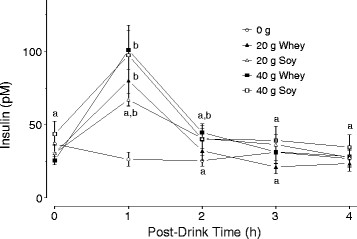
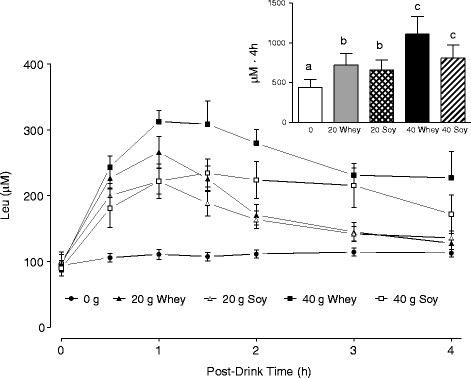
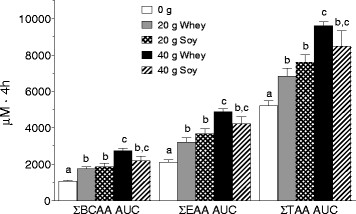
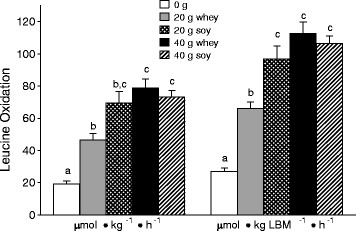
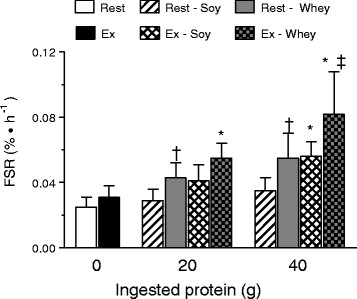
Background: Increased amino acid availability stimulates muscle protein synthesis, however, aged muscle appears less responsive to the anabolic effects of amino acids when compared to the young. We aimed to compare changes in myofibrillar protein synthesis (MPS) in elderly men at rest and after resistance exercise following ingestion of different doses of soy protein and compare the responses to those we previously observed with ingestion of whey protein isolate. Methods: Thirty elderly men (age 71 ± 5 y) completed a bout of unilateral knee-extensor resistance exercise prior to ingesting no protein (0 g), or either 20 g or 40 g of soy protein isolate (0, S20, and S40 respectively). We compared these responses to previous responses from similar aged men who had ingested 20 g and 40 g of whey protein isolate (W20 and W40). A primed constant infusion of L-[1- 13 C]leucine and L-[ ring - 13 C 6 ]phenylalanine and skeletal muscle biopsies were used to measure whole-body leucine oxidation and MPS over 4 h post-protein consumption in both exercised and non-exercised legs. Results: Whole-body leucine oxidation increased with protein ingestion and was significantly greater for S20 vs. W20 ( P = 0.003). Rates of MPS for S20 were less than W20 ( P = 0.02) and not different from 0 g ( P = 0.41) in both exercised and non-exercised leg muscles. For S40, MPS was also reduced compared with W40 under both rested and post-exercise conditions (both P < 0.005); however S40 increased MPS greater than 0 g under post-exercise conditions ( P = 0.04). Conclusions: The relationship between protein intake and MPS is both dose and protein source-dependent, with isolated soy showing a reduced ability, as compared to isolated whey protein, to stimulate MPS under both rested and post-exercise conditions. These differences may relate to the lower postprandial leucinemia and greater rates of amino acid oxidation following ingestion of soy versus whey protein.
Overview
The claims and statistics of this paper haven’t been checked yet.
Free: it reads the open-access text and checks the first 5 claims that cite a source we can check. Create a free account to check every claim.
Integrity signals
Registry
Cites
Statistics
Figures
Verification
Claims the paper makes
The claims and statistics of this paper haven’t been checked yet.
Free: it reads the open-access text and checks the first 5 claims that cite a source we can check. Create a free account to check every claim.
Claims other papers make about this one
Each is checked against this paper’s own text: does it say what the citing paper says it does?
The cited source says what the claim attributes to it.
In the citing paper
“In what is still an emerging area of research, various plant sources of protein have been examined for their ability to stimulate increases in muscle protein synthesis [77, 97] and promote exercise training adaptations [98].”
From ISSN exercise & sports nutrition review update: research & recommendations (2018) · cites this paper as [97]
The cited source says what the claim attributes to it.
In the citing paper
“Studies comparing the MPS response following wheat or soy protein ingestion to animal-based sources support the above narrative [[84], [85], [86]].”
From Nutritional Considerations for the Vegan Athlete (2023) · cites this paper as [86]
The cited source says what the claim attributes to it.
In the citing paper
“However, consumption of soy protein does not stimulate acute post-exercise muscle synthesis to the same magnitude as whey or milk protein when compared on an isonitrogenous basis [18,28,29]”
In the citing paper
“An increase in dietary protein intake may alleviate inactivityinduced muscle loss (9,10).”
In the citing paper
“An emerging theme is that differences between animal- and plant- based sources are absent when higher doses of protein (presumably obviating any individual amino acid deficiencies) are compared (∼30 g protein), though this is not always the case [53,86].”
From Nutritional Considerations for the Vegan Athlete (2023) · cites this paper as [86]
4 more claims about this paper
Create a free account to see every claim other papers make about this one.
Self-check
Percentages, sums and reported differences re-computed from the paper’s own numbers.
The self-check needs the paper’s full text.
Citations
Cites
Slow and fast dietary proteins differently modulate postprandial protein accretion
Boirie, Y., Dangin, M., Gachon, P., Vasson, M.-P., Maubois, J.-L., & Beaufrère, B. (1997) · Proceedings of the National Academy of Sciences · doi:10.1073/pnas.94.26.14930 · Cited by 1,453
Anabolic signaling deficits underlie amino acid resistance of wasting, aging muscle
Cuthbertson, D., Smith, K., Babraj, J., Leese, G., Waddell, T., Atherton, P., Wackerhage, H., Taylor, P. M., & Rennie, M. J. (2005) · The FASEB Journal · doi:10.1096/fj.04-2640fje · Cited by 1,211
Tang, J. E., Moore, D. R., Kujbida, G. W., Tarnopolsky, M. A., & Phillips, S. M. (2009) · Journal of Applied Physiology · doi:10.1152/japplphysiol.00076.2009 · Cited by 998
Self-citationMoore, D. R., Robinson, M. J., Fry, J. L., Tang, J. E., Glover, E. I., Wilkinson, S. B., Prior, T., Tarnopolsky, M. A., & Phillips, S. M. (2009) · The American Journal of Clinical Nutrition · doi:10.3945/ajcn.2008.26401 · Cited by 973 · cited 8×
“Further, our results confirm that the elderly benefit from significantly greater doses of protein after exercise [6,12] than do the young, who we have shown mount a maximal MPS response with ingestion of ~20 g protein [5] or ~10 g EAA [2].”
BackgroundMethodResultInfluentialSelf-citationKatsanos, C. S., Kobayashi, H., Sheffield-Moore, M., Aarsland, A., & Wolfe, R. R. (2006) · American Journal of Physiology-Endocrinology and Metabolism · doi:10.1152/ajpendo.00488.2005 · Cited by 923 · cited 3×
“For example, Katsanos and colleagues [13] reported that while 6.”
BackgroundResultAnthony, J. C., Yoshizawa, F., Anthony, T. G., Vary, T. C., Jefferson, L. S., & Kimball, S. R. (2000) · The Journal of Nutrition · doi:10.1093/jn/130.10.2413 · Cited by 801
Sarcopenia: origins and clinical relevance
Rosenberg, I. H. (2011) · Clinics in Geriatric Medicine · doi:10.1016/j.cger.2011.03.003 · Cited by 786 · cited 1×
“Ageing is associated with sarcopenia [1] that ultimately results from an imbalance between rates of muscle protein synthesis and breakdown.”
BackgroundKumar, V., Selby, A., Rankin, D., Patel, R., Atherton, P., Hildebrandt, W., Williams, J., Smith, K., Seynnes, O., Hiscock, N., et al. (2009) · The Journal of Physiology · doi:10.1113/jphysiol.2008.164483 · Cited by 740 · cited 1×
“; licensee BioMed Central Lt Commons Attribution License (http://creativec reproduction in any medium, provided the or (MPS) in response to amino acids [2,3] and resistance exercise [4] is attenuated compared to that seen in the young; a phenomenon termed ‘anabolic resistance’ [2].”
BackgroundPennings, B., Boirie, Y., Senden, J. M., Gijsen, A. P., Kuipers, H., & van Loon, L. J. (2011) · The American Journal of Clinical Nutrition · doi:10.3945/ajcn.110.008102 · Cited by 656 · cited 5×
“Whey protein [7,9,10] and bovine milk [8] (~20% whey protein) appear to stimulate greater rates of muscle protein synthesis than do proteins such as micellar casein or soy both at rest and following resistance exercise.”
BackgroundInfluentialThe digestion rate of protein is an independent regulating factor of postprandial protein retention
Dangin, M., Boirie, Y., Garcia-Rodenas, C., Gachon, P., Fauquant, J., Callier, P., Ballèvre, O., & Beaufrère, B. (2001) · American Journal of Physiology-Endocrinology and Metabolism · doi:10.1152/ajpendo.2001.280.2.e340 · Cited by 572
Cited by
Items 201–285 of 285
Nutritional Considerations for the Female Vegan Athlete
Schoenfeld, M. L. (2018) · Strength and conditioning journal · doi:10.1519/ssc.0000000000000405 · Cited by 9
“(61) found that after resistance exercise and at rest, elderly men (average age 71 years) experienced no greater muscle protein synthesis after ingesting 20 g of soy protein isolate than with no protein supplementation.”
BackgroundDavies, R. W., Lynch, A. E., Kumar, U., & Jakeman, P. M. (2024) · Translational Sports Medicine · doi:10.1155/2024/3184356 · Cited by 7
Ashtary‐Larky, D. (2025) · Nutrition · doi:10.1016/j.nut.2025.112742 · Cited by 7
Homolak, J., Perhoč, A. B., Virag, D., Knezović, A., Barilar, J. O., & Šalković‐Petrišić, M. (2023) · BioEssays · doi:10.1002/bies.202300061 · Cited by 7
Evaluación de la ingesta proteica y la actividad física asociadas con la sarcopenia del adulto mayor
Peña-Ordónez, G. G., Bustamante-Montes, L. P., Ramírez‐Durán, N., Halley-Castillo, E., & García-Cáceres, L. (2015) · Revista Española de Nutrición Humana y Dietética · doi:10.14306/renhyd.20.1.178 · Cited by 9
Alrefai, W., Keenan, S. J., CAMERA, D. M., & Cooke, M. B. (2025) · Nutrients · doi:10.3390/nu17071142 · Cited by 7
“In older adults aged in their early 70s, whey protein isolate in 20 g and 40 g amounts similarly induced significantly higher MPS responses compared to the same respective amounts of soy protein isolate in both a rested state and after a single bout of resistance exercise [54].”
Is There an Optimal Time for Warfighters to Supplement with Protein?
Atherton, P. J. (2013) · Journal of Nutrition · doi:10.3945/jn.113.175984 · Cited by 7
Langer, H. T., & Carlsohn, A. (2014) · Strength and conditioning journal · doi:10.1519/ssc.0000000000000057 · Cited by 8
“Starting early enough with this could be particularly important, as humans have been reported to become resistant to anabolic stimuli during aging (10,33,36,65).”
BackgroundConsistency Is Key When Setting a New World Record for Running 10 Marathons in 10 Days
BERGER, N. J. A., Cooley, D., Graham, M., Harrison, C., Campbell, G., & Best, R. (2021) · International Journal of Environmental Research and Public Health · doi:10.3390/ijerph182212066 · Cited by 8
Nutrition for master athletes: from challenges to optimisation strategies
Louis, J. B., Vercruyssen, F., Dupuy, O., & Bernard, T. (2019) · Movement & Sport Sciences - Science & Motricité · doi:10.1051/sm/2019019 · Cited by 8
Nutrition, Protein Turnover and Muscle Mass
Walrand, S., Guillet, C., & Boirie, Y. (2012) · Wiley eBooks · doi:10.1002/9781118338032.ch5 · Cited by 6
Nutrition, Protein Turnover and Muscle Mass
Walrand, S., Guillet, C., & Boirie, Y. (2021) · Wiley eBooks · doi:10.1002/9781119597896.ch5 · Cited by 6
Vilela, D. L. D. S., Silva, A., Pinto, S. L., & Bressan, J. (2023) · Obesity Surgery · doi:10.1007/s11695-023-06539-w · Cited by 4
“Consistent with this, a study examining hypertrophy after isoenergetic consumption of different protein sources indicated that whey protein promoted more significant lean mass gain than soy protein isolate [30].”
ResultMuscle Growth, Repair and Preservation
Erskine, R. M., & Degens, H. (2013) · Elsevier eBooks · doi:10.1016/b978-0-12-396454-0.00025-4 · Cited by 4
“Finally, the type and quality of the ingested protein appears to be important when it comes to MPS (Tang et al., 2009; Yang et al., 2012b).”
BackgroundInfluentialSarcopenia: Causes, Consequences, Prevention and Treatment
Chew, S. T. H. (2018) · The Singapore Family Physician · doi:10.33591/sfp.44.5.u2 · Cited by 7
Particularidades da abordagem nutricional no atleta vegetariano
Monteiro, M. I., Trigueiro, H., & Gonçalves, M. R. (2020) · Acta Portuguesa de Nutrição · doi:10.21011/apn.2020.2006 · Cited by 9
Basal protein synthesis rates differ between vastus lateralis and rectus abdominis muscle
Smeets, J. S. J., Horstman, A. M. H., van Dijk, D. P. J., van Boxtel, A. G. M., Woorst, J. T., Damink, S. W. M. O., Schijns, O. E. M. G., & van Loon, L. J. C. (2021) · Journal of Cachexia Sarcopenia and Muscle · doi:10.1002/jcsm.12701 · Cited by 4
Ergogenic Aids and the Female Athlete
Jordan, S. L., Naclerio, F., & Morales, J. B. (2023) · Springer eBooks · doi:10.1007/978-3-031-15485-0_23 · Cited by 2
Kristiansen, J. B., Vissing, K., & Nielsen, J. L. (2026) · Frontiers in Physiology · doi:10.3389/fphys.2026.1740284 · Cited by 2
da Silva, S. M. M., Carminati, B., Santos-Junior, V. D. A., & Lollo, P. C. B. (2019) · Journal of Health Sciences · doi:10.17921/2447-8938.2019v21n4p397-403 · Cited by 4
Zhuang, K., Meng, W., Shu, X., Liang, D., Wang, L., & Zhang, D. (2023) · European Journal of Nutrition · doi:10.1007/s00394-023-03168-y · Cited by 4
“In contrast, plant proteins are low in essential amino acids, especially methionine and lysine [4].”
BackgroundProtein Metabolism in the Elderly
Dillon, E. L. (2016) · Elsevier eBooks · doi:10.1016/b978-0-12-802167-5.00007-4 · Cited by 3
Saboori, S., Falahi, E., Rad, E. Y., Asbaghi, O., Khosroshahi, M. Z., Clark, C. C. T., & Jafarnejad, S. (2019) · Obesity Medicine · doi:10.1016/j.obmed.2019.02.002 · Cited by 3
“The protein 29 content of the soy bean comprises approximately 40% of its dried weight[6]; for this reason, soy 30 protein is one of the most popular supplements, alongside whey protein, for active and exercising 31 adults, and is used to facilitate a higher protein intake for the improvement of body composition 32 in…”
Nutrition and Exercise to Maintain Physical Functioning During Ageing
Grootswagers, P., Mensink, M., & de Groot, C. P. G. M. (2021) · Healthy ageing and longevity · doi:10.1007/978-3-030-83017-5_14 · Cited by 2
Egg Protein in Sports Nutrition
Martinez, I. G., McKenna, C. F., & Burd, N. A. (2019) · Royal Society of Chemistry eBooks · doi:10.1039/9781788013833-00102 · Cited by 3
Self-citationBiochemical Controversies Regarding the Use of Vegetal Proteins in Performance Athletes
Bătrînu, M.-G., Tero-Vescan, A., & Miklos, A. (2020) · Acta Biologica Marisiensis · doi:10.2478/abmj-2020-0006 · Cited by 3
“So, it can be concluded that plant proteins are directed more towards oxidation processes than towards protein synthesis (Yang et al., 2012; van Vliet et al., 2015).”
BackgroundStupin, A., Perić, L., Jukić, I., Boris, A., Stanojević, L., & Drenjančević, I. (2025) · Life · doi:10.3390/life15030458 · Cited by 1
“Changes in muscle protein synthesis rates are key factors influencing muscle mass changes over time, and both exercise and diet play significant roles in them [3].”
Wijnhoven, H. A. H., Niskanen, R. T., Reinders, I., Suominen, M. H., Jyväkorpi, S. K., Brouwer, I. A., Olthof, M. R., & Visser, M. (2025) · Clinical Nutrition Open Science · doi:10.1016/j.nutos.2025.05.008 · Cited by 1
Santini, M. H., Leitão, A. E., Mazzolani, B. C., Smaira, F. I., de Souza, M. A., Santamaria, A., Gualano, B., & Roschel, H. (2025) · Journal of the International Society of Sports Nutrition · doi:10.1080/15502783.2025.2568047 · Cited by 2
“The majority of these studies have observed superior MPS after the ingestion of animal-compared to plant-based proteins [3,5,12].”
Boot, N., Hermans, W. J. H., Warnke, I., Overman, A., van Kranenburg, J. M. X., Senden, J. M., Verdijk, L. B., & van Loon, L. J. C. (2025) · Amino Acids · doi:10.1007/s00726-025-03482-1 · Cited by 1
“…increased interest in plant-derived proteins, a number of recent studies have compared the postprandial plasma amino acid profiles following ingestion of various plant-versus animal-derived proteins (Gorissen et al. 2016; Tang et al. 2009; Yang et al. 2012; Pinckaers et al. 2022, 2023, 2024a , b).”
Domić, J., Grootswagers, P., Pinckaers, P. J., Groenendijk, I., Rubert, J., van Loon, L. J. C., & de Groot, C. P. G. M. (2025) · BMC Geriatrics · doi:10.1186/s12877-025-06708-9 · Cited by 2
“Previous studies have assessed the acute effects of the consumption of plant-based protein isolates [20, 50, 51], a vegan meal [26] and a vegan diet [23, 24] on MPS in older individuals in highly controlled settings.”
Sustaining Muscle, Cardiovascular Health, and the Environment: Is Plant-Based Protein the Key?
Cannito, T., Ivetac, A., Fiotti, N., Mearelli, F., Bella, S. D., Girolamo, F. G. D., & Biolo, G. (2026) · Nutrients · doi:10.3390/nu18091446 · Cited by 1
“Although increasing the soy protein dose to 40 g partially attenuated this difference, it did not fully restore equivalence [72].”
Domić, J., Grootswagers, P., Pinckaers, P. J., Melchers, M., van Loon, L. J. C., & de Groot, C. P. G. M. (2026) · American Journal of Clinical Nutrition · doi:10.1016/j.ajcnut.2026.101416 · Cited by 3
How to Increase Muscle Mass: What Does Science Tell Us?
Volpe, S. L. (2013) · ACSMʼs Health & Fitness Journal · doi:10.1249/fit.0b013e3182a05fe7 · Cited by 1
“(7) examined whether different types and doses of protein similarly would affect myofibrillar protein synthe-”
BackgroundDairy foods and maintenance of muscle mass in the elderly
Breen, L., & Smeuninx, B. (2020) · Elsevier eBooks · doi:10.1016/b978-0-12-815603-2.00014-0 · Cited by 3
Self-citationCárdenas, L. H. (2019) · Cited by 1
Optimising protein intake in older people to maintain their musculoskeletal health
Reid, K., & Reeves, S. (2021) · Nursing Standard · doi:10.7748/ns.2021.e11786 · Cited by 1
Dietary approaches to maintaining muscle mass
Alamilla, R. A., Paulussen, K. J. M., Askow, A. T., & Burd, N. A. (2021) · Elsevier eBooks · doi:10.1016/b978-0-12-822146-4.00003-x · Cited by 1
Self-citationBarry, D. (2020) · Elsevier eBooks · doi:10.1016/b978-0-323-43044-9.00217-x · Cited by 2
Foods of Animal Origin: A Prescription for Global Health
(2019) · Animal Frontiers · doi:10.1093/af/vfz042 · Cited by 1
Quaresma, M. V. L. D. S., de Melo, C. M., & Ribeiro, S. M. L. (2022) · Clinical Nutrition ESPEN · doi:10.1016/j.clnesp.2022.07.001 · Cited by 1
Supplements and high-protein foods in weight training: How do they affect maximum muscle strength?
Fardi, A., Sin, T. H., Pratama, A. O., & Mario, D. T. (2022) · JOURNAL SPORT AREA · doi:10.25299/sportarea.2022.vol7(2).9528 · Cited by 1
“Several studies have consistently demonstrated lower anabolic responses to plant protein (soy or wheat) than animal protein (whey or milk), under protein-matching conditions combined or not with weight training (Yang et al., 2012).”
BackgroundVejetaryen Sporcu Olmak; Besin Tüketimi Nasıl Şekillenmeli?
Zeynep, M. E. T. E., Ersoy, N., & Ersoy, G. (2022) · Sağlık Bilimlerinde Değer · doi:10.33631/sabd.1063256 · Cited by 2
Activité physique, sport et alimentation durable(s)
Goncalves, A., & Feillet‐Coudray, C. (2024) · Cahiers de Nutrition et de Diététique · doi:10.1016/j.cnd.2024.05.003 · Cited by 1
Muscle Metabolism, Nutrition, and Functional Status in Older Adults
Paddon‐Jones, D., & Russell, A. P. (2014) · Springer eBooks · doi:10.1007/978-1-4939-1929-1_7 · Cited by 2
Lorenzetti, R. L. (2021) · ERA: Education and Research Archive (University of Alberta) · doi:10.7939/r3-8phw-q520 · Cited by 3
Proteinsupplementering i samband med styrketräning : En litteraturstudie
Horwath, O., & Löfgren, M. (2013) · Hogskolan Ihalmstad (Halmstad University)
Churchward‐Venne, T. A. (2014) · MacSphere (McMaster University) · doi:10.71548/9052
Self-citationEffectiveness of Whey Protein Supplement in Resistance Trained
AlKhatib, A. H., & Jiménez, A. (2013)
Collins, J. (2015) · Wintec Research Archive (Waikato Institute of Technology)
de Andrade, I. T., Herbert, A., Junior, L., de Campos, P. L., Aplicadas, F. D. C., de Campos‐Ferraz, P. L., & Moraes, M. (2015)
SOY PROTEIN AND MUSCLE PROTEIN SYNTHESIS
Dickinson, J. M. (2015)
Dietary factors modulating postprandial protein handling
Gorissen, S. H. M. (2016) · Research Publications (Maastricht University) · doi:10.26481/dis.20160623sg · Cited by 1
15: Dietary Protein and Physical Training Effects on Body Composition and Performance
Devries, M. C., Oikawa, S. Y., & Phillips, S. M. (2017) · CRC Press eBooks · doi:10.1201/9781351260008-15
Self-citationChronic Obstructive Pulmonary Disease and Protein Consumption: What is the Connection
Zanella, P. B. (2019) · International Journal of Food Science Nutrition and Dietetics · doi:10.19070/2326-3350-1900072
Nutritional Interventions in Elderly Pre-dialysis Patients
Sato, H., & Suzuki, Y. (2020) · Springer eBooks · doi:10.1007/978-981-15-2365-6_9
Lelyana, R. (2020) · Acta Scientific Women s Health · doi:10.31080/aswh.2020.02.0135
Examining the Role of L-Type Amino Acid Transporter 1 (SLC7A5) in Myoblasts
Akohene-Mensah, P. (2020) · uO Research (University of Ottawa) · doi:10.20381/ruor-25260
“(53) and its downstream targets, S6K1 and 4E-BP1 (41).”
BackgroundQian, C. (2021) · Undergraduate Research in Natural and Clinical Science and Technology (URNCST) Journal · doi:10.26685/urncst.226
“In the study conducted by the same authors using soy protein, 40g was also found to stimulate significantly increased MPS [49].”
BackgroundInfluentialThe anabolic role of plant-based proteins in response to chronic resistance exercise
SANTOS, C. D. S., Júnior, E. S. O., de Sá, M. J. L., & Esteves, E. A. (2021) · REVISTA CIÊNCIAS EM SAÚDE · doi:10.21876/rcshci.v11i3.1135
Optimizing protein delivery to promote skeletal muscle protein synthesis
Areta, J. L. (2014) · RMIT Research Repository (RMIT University Library) · doi:10.25439/rmt.27351192
Thissen, J. (2016) · Springer eBooks · doi:10.1007/978-3-319-27687-8_5
15: Dietary Protein and Physical Training Effects on Body Composition and Performance
Devries, M. C., Oikawa, S. Y., & Phillips, S. M. (2017) · CRC Press eBooks · doi:10.1201/9781351260008-20
Self-citationMuscle Growth, Repair, and Preservation
Erskine, R. M., & Degens, H. (2018) · Elsevier eBooks · doi:10.1016/b978-0-12-813922-6.00025-4 · Cited by 1
Nutritional strategies to improve muscle quality during ageing
Grootswagers, P. (2020) · doi:10.18174/530397
Pflanzliche Ernährung und ausreichende Proteinzufuhr für ein gesundes Altern
Haß, U., & Norman, K. (2023) · Aktuelle Kardiologie · doi:10.1055/a-1981-6339
“2 31340 [20] Yang Y, Churchward-Venne TA, Burd NA et al.”
BackgroundPonomarenko, S. V. (2023) · Health Food & Biotechnology · doi:10.36107/hfb.2023.i1.s162
Li, J., Li, X., Di, T., & Pang, X. (2023) · Royal Society of Chemistry eBooks · doi:10.1039/9781839165047-00150
The anabolic properties of plant-derived proteins
Pinckaers, P. J. (2024) · Research Publications (Maastricht University) · doi:10.26481/dis.20240410pp
Cao, X., Liu, H., Yang, M., Mao, K., Wang, X., Chen, Z., Ran, M., & Hao, L. (2024) · SSRN Electronic Journal · doi:10.2139/ssrn.4806873
Coelho‐Júnior, H. J., & Marzetti, E. (2024) · Springer eBooks · doi:10.1007/978-3-031-57361-3_28
Top 5 Dietary Supplements for Bodybuilders
Haubenstricker, J. E., & Roberts, B. M. (2025) · Strength and conditioning journal · doi:10.1519/ssc.0000000000000925
Boot, N., Hermans, W. J. H., Kuin, L. M. E., Malowany, J. M., Hendriks, F. K., Warnke, I., Senden, J. M., Overman, A., Goessens, J. P. B., Zorenc, A. H. G., et al. (2025) · Journal of Nutrition · doi:10.1016/j.tjnut.2025.10.018 · Cited by 1
“…similarities to previous reports of an attenuated rise in circulating amino acids following the ingestion of various plant-derived proteins, such as soy [17,18], wheat [10], potato [36], corn [42], and pea [43] protein when compared with the ingestion of equivalent doses of animal-derived proteins.”
Berrazaga, I. (2018) · theses.fr (ABES) · doi:10.70675/2d3c7d63z64d1z415bz88bfzde635f1bd01d · Cited by 3
Lee, S., Kang, M. K., Lee, S., Kim, J., & Oh, S. (2026) · Journal of Dairy Science and Biotechnology · doi:10.22424/jdsb.2026.44.1.1
Nutritional support for athletes: an overview of current principles and practical recommendations
Халитовна, Б. И., Maksimov, M. L., Kizlik, О. О., & Sidorova, A. D. (2026) · Glavvrač (Chief Medical Officer) · doi:10.33920/med-03-2606-08
Dietary Protein, DIAAS, Anabolism, and Cardiometabolic Health: A Review and Future Perspectives
Nielsen, R. D., Hodgkinson, S. M., Kruger, R., Montoya, C. A., & ROWLANDS, D. S. (2026) · Nutrition Reviews · doi:10.1093/nutrit/nuag101 · Cited by 1
Kuin, L. M. E., Hermans, W. J. H., Boot, N., Fuchs, C. J., Senden, J. M., Zorenc, A. H. G., Overman, A., van Kranenburg, J. M. X., Goessens, J. P. B., Verdijk, L. B., et al. (2026) · Journal of Nutrition · doi:10.1016/j.tjnut.2026.101789
Physiological Adaptation to Plant-Based Diets: A Homeostatic Framework for Sustained Dietary Change
López‐Moreno, M., Nagra, M., Jiménez, M. D. C. F.-F., Gomez-Herrera, G. P., & Kahleová, H. (2026) · Biology · doi:10.3390/biology15171520
“However, subsequent studies demonstrated that these differences become substantially attenuated, and in some experimental settings disappear altogether, when the total protein intake is sufficient, complementary protein sources are consumed, or adequate leucine intake is achieved [83–87].”
Wen, W., Estribillo, A. G., Thomas, L., Wang, Y., Villarino, C. B., & Tocmo, R. (2026) · Research Square · doi:10.21203/rs.3.rs-10975290/v1
Lim, C., Lees, M. J., Janssen, T., McKendry, J., Smith, C., Ho, M., Sutoski, A., Wu, Y., Greaves, E., da Costa, F. P., et al. (2026) · Journal of Nutrition · doi:10.1016/j.tjnut.2026.101895
Self-citationPatterns of protein consumption throughout adulthood and physical capability in later life
Munro, C. A. (2014) · Cited by 1
Metadata
- Authors
- Yang, Y., Churchward-Venne, T. A., Burd, N. A., Breen, L., Tarnopolsky, M. A., & Phillips, S. M.
- Affiliations
- McMaster University (CA)
- Corresponding author
- Phillips, Stuart M
- Venue
- Nutrition & Metabolism
- Published
- 2012-06-14
- Volume
- 9
- Issue
- 1
- Pages
- 57-57
- ISSN
- 1743-7075 (ISSN-L)
- PMC
- PMC3478988
- OpenAlex
- W2150738098
- Cited by
- 286
- References
- 42
- Citations by year
- 2026: 10 · 2025: 13 · 2024: 25 · 2023: 22 · 2022: 25 · 2021: 25 · 2020: 28 · 2019: 23 · 2018: 24 · 2017: 14 · 2016: 25 · 2015: 18 · 2014: 14 · 2013: 17 · 2012: 3
- FWCI
- 7.87
- Type
- journal article
- Language
- en
- Open access
- gold
- doi.org
- Licence
- cc-by
- Locations
- Nutrition & Metabolism (publishedVersion, cc-by)
- Europe PMC (PubMed Central) (publishedVersion, cc-by)
- PubMed Central (publishedVersion, cc-by)
- PubMed (publishedVersion)
- DOAJ (DOAJ: Directory of Open Access Journals) (submittedVersion, cc-by-sa)
- University of Birmingham Research Portal (University of Birmingham) (submittedVersion, other-oa)
- Funders
- Canadian Institutes of Health Research
- Natural Sciences and Engineering Research Council of Canada
- Topics
- Health Sciences › Nursing › Nutrition and Dietetics › Muscle metabolism and nutrition
- Life Sciences › Biochemistry, Genetics and Molecular Biology › Molecular Biology › Muscle Physiology and Disorders
- Health Sciences › Medicine › Physiology (medical) › Nutrition and Health in Aging
- Keywords
- myofibrillar protein synthesis, soy protein isolate, whey protein isolate, resistance training, older men, leucine oxidation, amino acid oxidation, protein dose, protein sources, skeletal muscle
About these checks
Registry, retraction, Cites and statistics results are computed, not judged, with one exception: a printed reference that no index lists is read once by a model before it counts as a citation error. Claims are extracted by a model and kept only when their quote appears verbatim in the text; each cited source is then checked, with a model’s help, for whether it says what the claim relies on. Those verdicts can be wrong — read the claim’s quote and the cited source before relying on one.
Statistics and arithmetic are recomputed, not judged.
Confidence bands are shown only for fields calibrated on our annotated test set. None is calibrated yet, so no band is shown.
What counts as a claim ›How we measure confidence ›How we check this ›
Are you an author, or do you see a problem with this page? Request a review
Data sources
Bibliographic data: Semantic Scholar, OpenAlex, Crossref.
Contains information from the Semantic Scholar Academic Graph Datasets, made available under the ODC Attribution License (ODC-BY 1.0).
Semantic Scholar’s data is described in: Kinney, R., et al. (2023). The Semantic Scholar Open Data Platform. arXiv:2301.10140.
