

Myofibrillar protein synthesis following ingestion of soy protein isolate at rest and after resistance exercise in elderly men
Open accessThe DOI matches its Crossref record; 41 of the 42 references it cites were found in a registry or an index.
Abstract
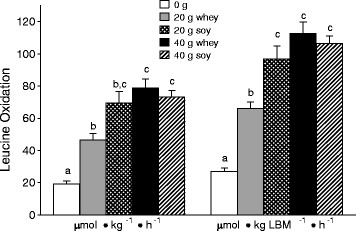
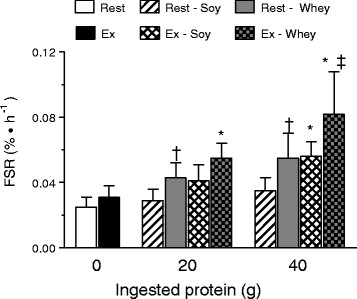
Background: Increased amino acid availability stimulates muscle protein synthesis, however, aged muscle appears less responsive to the anabolic effects of amino acids when compared to the young. We aimed to compare changes in myofibrillar protein synthesis (MPS) in elderly men at rest and after resistance exercise following ingestion of different doses of soy protein and compare the responses to those we previously observed with ingestion of whey protein isolate. Methods: Thirty elderly men (age 71 ± 5 y) completed a bout of unilateral knee-extensor resistance exercise prior to ingesting no protein (0 g), or either 20 g or 40 g of soy protein isolate (0, S20, and S40 respectively). We compared these responses to previous responses from similar aged men who had ingested 20 g and 40 g of whey protein isolate (W20 and W40). A primed constant infusion of L-[1- 13 C]leucine and L-[ ring - 13 C 6 ]phenylalanine and skeletal muscle biopsies were used to measure whole-body leucine oxidation and MPS over 4 h post-protein consumption in both exercised and non-exercised legs. Results: Whole-body leucine oxidation increased with protein ingestion and was significantly greater for S20 vs. W20 ( P = 0.003). Rates of MPS for S20 were less than W20 ( P = 0.02) and not different from 0 g ( P = 0.41) in both exercised and non-exercised leg muscles. For S40, MPS was also reduced compared with W40 under both rested and post-exercise conditions (both P < 0.005); however S40 increased MPS greater than 0 g under post-exercise conditions ( P = 0.04). Conclusions: The relationship between protein intake and MPS is both dose and protein source-dependent, with isolated soy showing a reduced ability, as compared to isolated whey protein, to stimulate MPS under both rested and post-exercise conditions. These differences may relate to the lower postprandial leucinemia and greater rates of amino acid oxidation following ingestion of soy versus whey protein.
Overview
The claims and statistics of this paper haven’t been checked yet.
Free: it reads the open-access text and checks the first 5 claims that cite a source we can check. Create a free account to check every claim.
Integrity signals
Registry
Cites
Statistics
Figures
Verification
Claims the paper makes
The claims and statistics of this paper haven’t been checked yet.
Free: it reads the open-access text and checks the first 5 claims that cite a source we can check. Create a free account to check every claim.
Claims other papers make about this one
Each is checked against this paper’s own text: does it say what the citing paper says it does?
The cited source says what the claim attributes to it.
In the citing paper
“In what is still an emerging area of research, various plant sources of protein have been examined for their ability to stimulate increases in muscle protein synthesis [77, 97] and promote exercise training adaptations [98].”
From ISSN exercise & sports nutrition review update: research & recommendations (2018) · cites this paper as [97]
The cited source says what the claim attributes to it.
In the citing paper
“Studies comparing the MPS response following wheat or soy protein ingestion to animal-based sources support the above narrative [[84], [85], [86]].”
From Nutritional Considerations for the Vegan Athlete (2023) · cites this paper as [86]
The cited source says what the claim attributes to it.
In the citing paper
“However, consumption of soy protein does not stimulate acute post-exercise muscle synthesis to the same magnitude as whey or milk protein when compared on an isonitrogenous basis [18,28,29]”
In the citing paper
“An increase in dietary protein intake may alleviate inactivityinduced muscle loss (9,10).”
In the citing paper
“An emerging theme is that differences between animal- and plant- based sources are absent when higher doses of protein (presumably obviating any individual amino acid deficiencies) are compared (∼30 g protein), though this is not always the case [53,86].”
From Nutritional Considerations for the Vegan Athlete (2023) · cites this paper as [86]
4 more claims about this paper
Create a free account to see every claim other papers make about this one.
Self-check
Percentages, sums and reported differences re-computed from the paper’s own numbers.
The self-check needs the paper’s full text.
Citations
Cites
Slow and fast dietary proteins differently modulate postprandial protein accretion
Boirie, Y., Dangin, M., Gachon, P., Vasson, M.-P., Maubois, J.-L., & Beaufrère, B. (1997) · Proceedings of the National Academy of Sciences · doi:10.1073/pnas.94.26.14930 · Cited by 1,453
Anabolic signaling deficits underlie amino acid resistance of wasting, aging muscle
Cuthbertson, D., Smith, K., Babraj, J., Leese, G., Waddell, T., Atherton, P., Wackerhage, H., Taylor, P. M., & Rennie, M. J. (2005) · The FASEB Journal · doi:10.1096/fj.04-2640fje · Cited by 1,211
Tang, J. E., Moore, D. R., Kujbida, G. W., Tarnopolsky, M. A., & Phillips, S. M. (2009) · Journal of Applied Physiology · doi:10.1152/japplphysiol.00076.2009 · Cited by 998
Self-citationMoore, D. R., Robinson, M. J., Fry, J. L., Tang, J. E., Glover, E. I., Wilkinson, S. B., Prior, T., Tarnopolsky, M. A., & Phillips, S. M. (2009) · The American Journal of Clinical Nutrition · doi:10.3945/ajcn.2008.26401 · Cited by 973 · cited 8×
“Further, our results confirm that the elderly benefit from significantly greater doses of protein after exercise [6,12] than do the young, who we have shown mount a maximal MPS response with ingestion of ~20 g protein [5] or ~10 g EAA [2].”
BackgroundMethodResultInfluentialSelf-citationKatsanos, C. S., Kobayashi, H., Sheffield-Moore, M., Aarsland, A., & Wolfe, R. R. (2006) · American Journal of Physiology-Endocrinology and Metabolism · doi:10.1152/ajpendo.00488.2005 · Cited by 923 · cited 3×
“For example, Katsanos and colleagues [13] reported that while 6.”
BackgroundResultAnthony, J. C., Yoshizawa, F., Anthony, T. G., Vary, T. C., Jefferson, L. S., & Kimball, S. R. (2000) · The Journal of Nutrition · doi:10.1093/jn/130.10.2413 · Cited by 801
Sarcopenia: origins and clinical relevance
Rosenberg, I. H. (2011) · Clinics in Geriatric Medicine · doi:10.1016/j.cger.2011.03.003 · Cited by 786 · cited 1×
“Ageing is associated with sarcopenia [1] that ultimately results from an imbalance between rates of muscle protein synthesis and breakdown.”
BackgroundKumar, V., Selby, A., Rankin, D., Patel, R., Atherton, P., Hildebrandt, W., Williams, J., Smith, K., Seynnes, O., Hiscock, N., et al. (2009) · The Journal of Physiology · doi:10.1113/jphysiol.2008.164483 · Cited by 740 · cited 1×
“; licensee BioMed Central Lt Commons Attribution License (http://creativec reproduction in any medium, provided the or (MPS) in response to amino acids [2,3] and resistance exercise [4] is attenuated compared to that seen in the young; a phenomenon termed ‘anabolic resistance’ [2].”
BackgroundPennings, B., Boirie, Y., Senden, J. M., Gijsen, A. P., Kuipers, H., & van Loon, L. J. (2011) · The American Journal of Clinical Nutrition · doi:10.3945/ajcn.110.008102 · Cited by 656 · cited 5×
“Whey protein [7,9,10] and bovine milk [8] (~20% whey protein) appear to stimulate greater rates of muscle protein synthesis than do proteins such as micellar casein or soy both at rest and following resistance exercise.”
BackgroundInfluentialThe digestion rate of protein is an independent regulating factor of postprandial protein retention
Dangin, M., Boirie, Y., Garcia-Rodenas, C., Gachon, P., Fauquant, J., Callier, P., Ballèvre, O., & Beaufrère, B. (2001) · American Journal of Physiology-Endocrinology and Metabolism · doi:10.1152/ajpendo.2001.280.2.e340 · Cited by 572
Cited by
Bauer, J., Biolo, G., Cederholm, T., Cesari, M., Cruz-Jentoft, A. J., Morley, J. E., Phillips, S., Sieber, C., Stehle, P., Teta, D., et al. (2013) · Journal of the American Medical Directors Association · doi:10.1016/j.jamda.2013.05.021 · Cited by 2,553
Self-citationProtein content and amino acid composition of commercially available plant-based protein isolates
Gorissen, S. H. M., Crombag, J. J. R., Senden, J. M. G., Waterval, W. A. H., Bierau, J., Verdijk, L. B., & van Loon, L. J. C. (2018) · Amino Acids · doi:10.1007/s00726-018-2640-5 · Cited by 1,169
ISSN exercise & sports nutrition review update: research & recommendations
Kerksick, C. M., Wilborn, C. D., Roberts, M. D., Smith-Ryan, A., Kleiner, S. M., Jäger, R., Collins, R., Cooke, M., Davis, J. N., Galvan, E., et al. (2018) · Journal of the International Society of Sports Nutrition · doi:10.1186/s12970-018-0242-y · Cited by 945
Moore, D. R., Churchward-Venne, T. A., Witard, O., Breen, L., Burd, N. A., Tipton, K. D., & Phillips, S. M. (2015) · The Journals of Gerontology: Series A · doi:10.1093/gerona/glu103 · Cited by 770
Self-citationThe Skeletal Muscle Anabolic Response to Plant- versus Animal-Based Protein Consumption
van Vliet, S., Burd, N. A., & van Loon, L. J. (2015) · The Journal of Nutrition · doi:10.3945/jn.114.204305 · Cited by 651
“In older individuals, maximal stimulation of postprandial MPS tends to be achieved with the ingestion of greater amounts of high-quality, animal-based protein (>35–40 g) (21, 23, 28).”
BackgroundInfluentialSelf-citationWitard, O. C., Jackman, S. R., Breen, L., Smith, K., Selby, A., & Tipton, K. D. (2014) · The American Journal of Clinical Nutrition · doi:10.3945/ajcn.112.055517 · Cited by 517
“protein (9) stimulated a greater postexercise response of MPS than did 20 g protein.”
BackgroundSelf-citationBerrazaga, I., Micard, V., Gueugneau, M., & Walrand, S. (2019) · Nutrients · doi:10.3390/nu11081825 · Cited by 477
“Nevertheless, at similar protein intakes, most studies have reported a lower ability of plant-based protein sources to stimulate protein synthesis at the skeletal muscle level and induce muscle mass gain compared to animal-based protein sources, especially in older people [28,37,40,42,44,75].”
BackgroundInfluentialPlant Proteins for Future Foods: A Roadmap
Sim, S. Y. J., SRV, A., Chiang, J. H., & Henry, C. J. (2021) · Foods · doi:10.3390/foods10081967 · Cited by 352
“However, in another study, the rate of postprandial muscle protein synthesis of soy proteins did not rise as much as it did after consuming whey proteins [263] which could be related to amino acid composition, i.”
BackgroundSupplemental Protein in Support of Muscle Mass and Health: Advantage Whey
Devries, M. C., & Phillips, S. M. (2015) · Journal of Food Science · doi:10.1111/1750-3841.12802 · Cited by 330
Self-citationA Brief Review of Critical Processes in Exercise-Induced Muscular Hypertrophy
Phillips, S. M. (2014) · Sports Medicine · doi:10.1007/s40279-014-0152-3 · Cited by 281
“Interestingly, the same result was found in older men [42].”
ResultSelf-citationPaddon-Jones, D., Campbell, W. W., Jacques, P. F., Kritchevsky, S. B., Moore, L. L., Rodriguez, N. R., & van Loon, L. J. (2015) · The American Journal of Clinical Nutrition · doi:10.3945/ajcn.114.084061 · Cited by 266
“(55) reported a reduced ability of soy protein isolate to stimulate myofibrillar protein synthesis both at rest and after resistance exercise compared with whey protein isolate in older men (aged 71 y) fed a 20-g dose of protein.”
Verreijen, A. M., Verlaan, S., Engberink, M. F., Swinkels, S., de Vogel-van den Bosch, J., & Weijs, P. J. (2015) · The American Journal of Clinical Nutrition · doi:10.3945/ajcn.114.090290 · Cited by 237
“Whey protein is a highquality protein that has shown superiority in enhancing muscle protein synthesis compared with other protein sources in older adults (13, 14).”
Advances in muscle health and nutrition: A toolkit for healthcare professionals
Prado, C. M., Landi, F., Chew, S. T. H., Atherton, P. J., Molinger, J., Ruck, T., & Gonzalez, M. C. (2022) · Clinical Nutrition · doi:10.1016/j.clnu.2022.07.041 · Cited by 237
“Consequently, studies have shown greater anabolic effect of animal-based protein on MPS than plant-based proteins at both rest and after exercise conditions [168 e 170].”
BackgroundTraylor, D. A., Gorissen, S. H. M., & Phillips, S. M. (2018) · Advances in Nutrition · doi:10.1093/advances/nmy003 · Cited by 225
Self-citationGorissen, S. H. M., & Witard, O. C. (2018) · Proceedings of the Nutrition Society · doi:10.1017/s002966511700194x · Cited by 221
“The assumption that plant-based proteins exhibit inferior muscle anabolic potential compared with animal proteins is essentially based on data obtained from acute metabolic studies that assessed the postprandial muscle protein synthetic response to ingested soya and wheat protein((10,27,38,39,47,49)).”
BackgroundResultInfluentialGorissen, S. H., Horstman, A. M., Franssen, R., Crombag, J. J., Langer, H., Bierau, J., Respondek, F., & van Loon, L. J. (2016) · The Journal of Nutrition · doi:10.3945/jn.116.231340 · Cited by 221
Protein Intake and Muscle Health in Old Age: From Biological Plausibility to Clinical Evidence
Landi, F., Calvani, R., Tosato, M., Martone, A., Ortolani, E., Savera, G., D’Angelo, E., Sisto, A., & Marzetti, E. (2016) · Nutrients · doi:10.3390/nu8050295 · Cited by 218
“However, recent findings in elderly men indicate that the consumption of large amounts of plant-based proteins, as a strategy to ameliorate muscle protein synthesis, may not be as effective as expected [22].”
BackgroundPlant-Based Meats, Human Health, and Climate Change
van Vliet, S., Kronberg, S. L., & Provenza, F. D. (2020) · Frontiers in Sustainable Food Systems · doi:10.3389/fsufs.2020.00128 · Cited by 202
Bo, Y., Liu, C., Ji, Z., Yang, R., An, Q., Zhang, X., You, J., Duan, D., Sun, Y., Zhu, Y., et al. (2019) · Clinical Nutrition · doi:10.1016/j.clnu.2017.12.020 · Cited by 184
Strategies to Prevent Sarcopenia in the Aging Process: Role of Protein Intake and Exercise
Rogeri, P. S., Zanella, R., Martins, G. L., Garcia, M. D. A., Leite, G., Lugaresi, R., Gasparini, S. O., Sperandio, G. A., Ferreira, L. H. B., Souza-Junior, T. P., et al. (2021) · Nutrients · doi:10.3390/nu14010052 · Cited by 181
“While younger individuals present a saturable dose of protein that maximally stimulates MPS around 20 g [7,135], older people seem to need higher amounts [136,137].”
BackgroundProtein blend ingestion following resistance exercise promotes human muscle protein synthesis
Reidy, P. T., Walker, D. K., Dickinson, J. M., Gundermann, D. M., Drummond, M. J., Timmerman, K. L., Fry, C. S., Borack, M. S., Cope, M. B., Mukherjea, R., et al. (2013) · The Journal of Nutrition · doi:10.3945/jn.112.168021 · Cited by 178
“Compared with other high-quality protein sources following RE, whey has been suggested to be superior to isolated soy protein (11,13) and micellar casein (11,44), which is the least soluble, most slowly digested form of casein (51).”
BackgroundChurch, D. D., Hirsch, K. R., Park, S., Kim, I.-Y., Gwin, J. A., Pasiakos, S. M., Wolfe, R. R., & Ferrando, A. A. (2020) · Nutrients · doi:10.3390/nu12123717 · Cited by 178
Hirsch, K. R., Wolfe, R. R., & Ferrando, A. A. (2021) · Nutrients · doi:10.3390/nu13051675 · Cited by 159
“This can be overcome by consuming a greater quantity of protein (40g) and/or consuming a blend of plant-based proteins, a strategy intended to improve the EAA concentration and profile [58,59].”
BackgroundThe anabolic response to plant-based protein ingestion
Pinckaers, P. J. M., Trommelen, J., Snijders, T., & van Loon, L. J. C. (2021) · Sports Medicine · doi:10.1007/s40279-021-01540-8 · Cited by 170
The impact of protein quality on the promotion of resistance exercise-induced changes in muscle mass
Phillips, S. M. (2016) · Nutrition & Metabolism · doi:10.1186/s12986-016-0124-8 · Cited by 168
“1), it appears that the elderly have a greater leucine threshold and thus require greater levels of protein/leucine to stimulate MPS both at rest [42, 51] and following resistance exercise [52, 53].”
BackgroundSelf-citationAthletes’ nutritional demands: a narrative review of nutritional requirements
Amawi, A., AlKasasbeh, W., Jaradat, M., Almasri, A., Alobaidi, S., Hammad, A. A., Bishtawi, T., Fataftah, B., Turk, N., Saoud, H. A., et al. (2024) · Frontiers in Nutrition · doi:10.3389/fnut.2023.1331854 · Cited by 154
Current Concepts and Unresolved Questions in Dietary Protein Requirements and Supplements in Adults
Phillips, S. M. (2017) · Frontiers in Nutrition · doi:10.3389/fnut.2017.00013 · Cited by 145
Self-citationNutritional Supplements in Support of Resistance Exercise to Counter Age-Related Sarcopenia
Phillips, S. M. (2015) · Advances in Nutrition · doi:10.3945/an.115.008367 · Cited by 144
“In addition, milk proteins, particularly whey protein, have been shown to be superior to other types of protein at stimulating MPS in older men (50, 51).”
BackgroundSelf-citationThe Impact of Step Reduction on Muscle Health in Aging: Protein and Exercise as Countermeasures
Oikawa, S. Y., Holloway, T. M., & Phillips, S. M. (2019) · Frontiers in Nutrition · doi:10.3389/fnut.2019.00075 · Cited by 141
“The Role for Nutrition in Attenuating LBM Losses With Disuse The term anabolic resistance describes the reduction in MPS in response to a given protein dose (64) (and subsequent hyperaminoacidemia) and to a bout of resistance exercise with age (65, 66) and is a negative consequence induced by disuse (31).”
BackgroundSelf-citationProtein Intake and Frailty: A Matter of Quantity, Quality, and Timing
Coelho-Junior, H. J., Marzetti, E., Picca, A., Cesari, M., Uchida, M. C., & Calvani, R. (2020) · Nutrients · doi:10.3390/nu12102915 · Cited by 139
“[88] reported that neither 20 g nor 40 g of SP stimulated MPS under resting conditions, while myofibrillar MPS was significantly increased after ingestion of the same doses of WP.”
BackgroundExercise and Protein Intake: A Synergistic Approach against Sarcopenia
Martone, A. M., Marzetti, E., Calvani, R., Picca, A., Tosato, M., Santoro, L., Di Giorgio, A., Nesci, A., Sisto, A., Santoliquido, A., et al. (2017) · BioMed Research International · doi:10.1155/2017/2672435 · Cited by 135
“Recently, the consumption of large amounts of soy proteins, as a strategy to overcome their lower anabolic potency, has been shown to stimulate muscle protein synthesis in older men to a smaller degree than isolated whey proteins, both at rest and following exercise [23].”
BackgroundProtein Considerations for Optimising Skeletal Muscle Mass in Healthy Young and Older Adults
Witard, O., Wardle, S., Macnaughton, L., Hodgson, A., & Tipton, K. (2016) · Nutrients · doi:10.3390/nu8040181 · Cited by 132
“Several acute metabolic dose-response studies have been designed to characterise the optimum dose of amino acids/protein contained in a single serving for the maximal stimulation of MPS [10,47,55–58].”
BackgroundInfluentialHevia-Larraín, V., Gualano, B., Longobardi, I., Gil, S., Fernandes, A. L., Costa, L. A. R., Pereira, R. M. R., Artioli, G. G., Phillips, S. M., & Roschel, H. (2021) · Sports Medicine · doi:10.1007/s40279-021-01434-9 · Cited by 132
“These differences in MPS efficiency are thought to be related to digestibility and EAA content [14, 15, 45], particularly Fig.”
BackgroundSelf-citationGorissen, S. H., Trommelen, J., Kouw, I. W., Kouw, I. W., Pennings, B., Pennings, B., Wall, B. T., Churchward-Venne, T. A., Horstman, A. M., Koopman, R., et al. (2020) · The Journal of Nutrition · doi:10.1093/jn/nxaa024 · Cited by 131
Self-citationReidy, P. T., & Rasmussen, B. B. (2016) · The Journal of Nutrition · doi:10.3945/jn.114.203208 · Cited by 128
“A fast, rapidly digested source causes a rapid and maximal increase in MPS (58, 73, 80, 122, 132, 133), whereas a slowly digested source is more likely to cause a delayed, more prolonged response (37, 81), at least in the exercised condition.”
BackgroundShad, B. J., Thompson, J. L., & Breen, L. (2016) · American Journal of Physiology-Endocrinology and Metabolism · doi:10.1152/ajpendo.00213.2016 · Cited by 125
“The provision of amino acid-based nutrition is a potent stimulus for MPS in young and older individuals (27, 82, 116), primarily through the action of constituent EAAs (96, 103).”
BackgroundSelf-citationMessina, M., Lynch, H., Dickinson, J. M., & Reed, K. E. (2018) · International Journal of Sport Nutrition and Exercise Metabolism · doi:10.1123/ijsnem.2018-0071 · Cited by 120
Diet, exercise, and pharmacotherapy for sarcopenia in people with diabetes
Hashimoto, Y., Takahashi, F., Okamura, T., Hamaguchi, M., & Fukui, M. (2023) · Metabolism · doi:10.1016/j.metabol.2023.155585 · Cited by 132
Churchward‐Venne, T. A., Breen, L., & Phillips, S. M. (2014) · BioFactors · doi:10.1002/biof.1138 · Cited by 117
“Consequently, anabolic resistance may be an expected [9,28,29], but perhaps not requisite [33,52–54], feature of biological aging.”
BackgroundResultInfluentialSelf-citationBell, K. E., Séguin, C., Parise, G., Baker, S. K., & Phillips, S. M. (2015) · The Journals of Gerontology Series A: Biological Sciences and Medical Sciences · doi:10.1093/gerona/glu313 · Cited by 118
Self-citationPre-Sleep Protein Ingestion to Improve the Skeletal Muscle Adaptive Response to Exercise Training
Trommelen, J., & Van Loon, L. (2016) · Nutrients · doi:10.3390/nu8120763 · Cited by 116
Messina, M. J., Sievenpiper, J. L., Williamson, P., Kiel, J., & Erdman, J. W. (2022) · Advances in Nutrition · doi:10.1093/advances/nmac026 · Cited by 127
Dimina, L., Rémond, D., Huneau, J., & Mariotti, F. (2022) · Frontiers in Nutrition · doi:10.3389/fnut.2021.809685 · Cited by 139
“For instance, despite having the same PDCAAS value, soy protein isolate and whey protein differentially stimulate muscle protein synthesis in older humans (5) at rest and following exercise (6).”
BackgroundInfluentialMonteyne, A. J., Coelho, M. O., Porter, C., Abdelrahman, D. R., Jameson, T. S., Jackman, S. R., Blackwell, J. R., Finnigan, T. J., Stephens, F. B., Dirks, M. L., et al. (2020) · The American Journal of Clinical Nutrition · doi:10.1093/ajcn/nqaa092 · Cited by 110
Givens, D. I. (2020) · Journal of Dairy Science · doi:10.3168/jds.2020-18296 · Cited by 143
Thomas, D. K., Quinn, M. A., Saunders, D. H., & Greig, C. A. (2016) · Journal of the American Medical Directors Association · doi:10.1016/j.jamda.2016.07.002 · Cited by 108
DIETARY PROTEIN TO MAINTAIN MUSCLE MASS IN AGING: A CASE FOR PER-MEAL PROTEIN RECOMMENDATIONS
MURPHY, C. H., OIKAWA, S. Y., & PHILLIPS, S. M. (2016) · The Journal of Frailty & Aging · doi:10.14283/jfa.2016.80 · Cited by 14
Self-citationHermans, W. J., Senden, J. M., Churchward-Venne, T. A., Paulussen, K. J., Fuchs, C. J., Smeets, J. S., van Loon, J. J., Verdijk, L. B., & van Loon, L. J. (2021) · The American Journal of Clinical Nutrition · doi:10.1093/ajcn/nqab115 · Cited by 103
“have reported a lesser increase in muscle protein synthesis rates after ingestion of wheat (15) and soy (10, 12, 16, 17) protein than after dairy protein.”
BackgroundSelf-citationDomić, J., Grootswagers, P., van Loon, L. J. C., & de Groot, C. P. G. M. (2022) · Advances in Nutrition · doi:10.1093/advances/nmac009 · Cited by 109
“As discussed in detail previously, the high quality of animal protein and its effects on muscle mass has been well established (46, 53, 56, 103, 104).”
InfluentialKeeping older muscle “young” through dietary protein and physical activity
Moore, D. R. (2014) · Advances in Nutrition · doi:10.3945/an.113.005405 · Cited by 80
“For example, whey protein (~11% leucine) was shown to elicit a greater increase in postprandial muscle protein synthesis in older adults than both soy (~8% leucine) (59) and casein (~8% leucine) (60,61).”
BackgroundHuman Skeletal Muscle Protein Metabolism Responses to Amino Acid Nutrition
Mitchell, W. K., Wilkinson, D. J., Phillips, B. E., Lund, J. N., Smith, K., & Atherton, P. J. (2016) · Advances in Nutrition · doi:10.3945/an.115.011650 · Cited by 116
“This return to baseline of circulating AAs also appears to be dose-dependent, with higher doses requiring greater time for excess AAs to be utilized (28, 29).”
BackgroundGrowing older with health and vitality: a nexus of physical activity, exercise and nutrition
Witard, O. C., McGlory, C., Hamilton, D. L., & Phillips, S. M. (2016) · Biogerontology · doi:10.1007/s10522-016-9637-9 · Cited by 91
“…both young and older adults, that characterised the relationship between ingesting a single dose of protein and the postprandial stimulation of MPS (Cuthbertson et al. 2005; Moore et al. 2009; Pennings et al. 2012; Robinson et al. 2013; Symons et al. 2009; Witard et al. 2014; Yang et al. 2012a, b).”
Self-citationChurchward-Venne, T. A., Murphy, C. H., Longland, T. M., & Phillips, S. M. (2013) · Amino Acids · doi:10.1007/s00726-013-1506-0 · Cited by 90
Self-citationThe muscle protein synthetic response to food ingestion
Gorissen, S. H. M., Rémond, D., & van Loon, L. J. C. (2015) · Meat Science · doi:10.1016/j.meatsci.2015.05.009 · Cited by 105
Holwerda, A. M., Paulussen, K. J. M., Overkamp, M., Goessens, J. P. B., Kramer, I. F., Wodzig, W. K. W. H., Verdijk, L. B., & van Loon, L. J. C. (2019) · The Journal of Nutrition · doi:10.1093/jn/nxy263 · Cited by 90
“Previous work has demonstrated that the ingestion of a low protein dose (< 20 g) following resistance-type exercise does not further stimulate an increase in muscle protein synthesis rates in older individuals (47, 48).”
BackgroundInfluentialGwin, J. A., Church, D. D., Wolfe, R. R., Ferrando, A. A., & Pasiakos, S. M. (2020) · Nutrients · doi:10.3390/nu12082457 · Cited by 88
Mitchell, C., McGregor, R., D’Souza, R., Thorstensen, E., Markworth, J., Fanning, A., Poppitt, S., & Cameron-Smith, D. (2015) · Nutrients · doi:10.3390/nu7105420 · Cited by 87
“Dairy protein represents a source of high quality protein which has repeatedly been shown to stimulate MPS in both young [45] and older adults [13].”
BackgroundResultProtein quality as a complementary functional unit in life cycle assessment (LCA)
McAuliffe, G. A., Takahashi, T., Beal, T., Huppertz, T., Leroy, F., Buttriss, J. L., Collins, A. L., Drewnowski, A., McLaren, S. J., Ortenzi, F., et al. (2022) · The International Journal of Life Cycle Assessment · doi:10.1007/s11367-022-02123-z · Cited by 109
“, those present at a low concentration in dietary protein relative to human requirements) result in suboptimal postprandial protein synthesis rates (Yang et al. 2012), if these amino acids are not provided in sufficient quantities by complementary protein sources (e.”
BackgroundProtein intake and physical function in older adults: A systematic review and meta-analysis
Coelho-Júnior, H. J., Calvani, R., Tosato, M., Landi, F., Picca, A., & Marzetti, E. (2022) · Ageing Research Reviews · doi:10.1016/j.arr.2022.101731 · Cited by 86
Update on maximal anabolic response to dietary protein
Kim, I.-Y., Deutz, N. E. P., & Wolfe, R. R. (2018) · Clinical Nutrition · doi:10.1016/j.clnu.2017.05.029 · Cited by 84
Inclusion of red meat in healthful dietary patterns
McNeill, S. H. (2014) · Meat Science · doi:10.1016/j.meatsci.2014.06.028 · Cited by 110
Protein Source and Muscle Health in Older Adults: A Literature Review
Putra, C., Konow, N., Gage, M. J., York, C., & Mangano, K. M. (2021) · Nutrients · doi:10.3390/nu13030743 · Cited by 104
Interactions between exercise and nutrition to prevent muscle waste during ageing
Breen, L., & Phillips, S. M. (2013) · British Journal of Clinical Pharmacology · doi:10.1111/j.1365-2125.2012.04456.x · Cited by 82
Self-citationSupplements with purported effects on muscle mass and strength
Valenzuela, P. L., Morales, J. S., Emanuele, E., Pareja-Galeano, H., & Lucia, A. (2019) · European Journal of Nutrition · doi:10.1007/s00394-018-1882-z · Cited by 92
Pinckaers, P. J. M., Kouw, I. W. K., Hendriks, F. K., van Kranenburg, J. M. X., de Groot, L. C. P. G. M., Verdijk, L. B., Snijders, T., & van Loon, L. J. C. (2021) · British Journal Of Nutrition · doi:10.1017/s0007114521000635 · Cited by 76
“studies have assessed the muscle protein synthetic response to the ingestion of plant-derived proteins in vivo in humans (14, 19-21) .”
Oikawa, S. Y., McGlory, C., D'Souza, L. K., Morgan, A. K., Saddler, N. I., Baker, S. K., Parise, G., & Phillips, S. M. (2018) · The American Journal of Clinical Nutrition · doi:10.1093/ajcn/nqy193 · Cited by 76
“An increase in dietary protein intake may alleviate inactivityinduced muscle loss (9, 10).”
BackgroundSelf-citationKim, I.-Y., Schutzler, S., Schrader, A. M., Spencer, H. J., Azhar, G., Wolfe, R. R., & Ferrando, A. A. (2018) · Clinical Nutrition · doi:10.1016/j.clnu.2017.02.020 · Cited by 76
The importance of protein sources to support muscle anabolism in cancer: An expert group opinion
Ford, K. L., Arends, J., Atherton, P. J., Engelen, M. P. K. J., Gonçalves, T. J. M., Laviano, A., Lobo, D. N., Phillips, S. M., Ravasco, P., Deutz, N. E. P., et al. (2022) · Clinical Nutrition · doi:10.1016/j.clnu.2021.11.032 · Cited by 76
Self-citationIspoglou, T., White, H., Preston, T., McElhone, S., McKenna, J., & Hind, K. (2016) · European Journal of Clinical Nutrition · doi:10.1038/ejcn.2015.91 · Cited by 75
The health effects of soy: A reference guide for health professionals
Messina, M. J., Duncan, A. M., Messina, V., Lynch, H. M., Kiel, J., & Erdman, J. W. (2022) · Frontiers in Nutrition · doi:10.3389/fnut.2022.970364 · Cited by 95
Churchward-Venne, T. A., Holwerda, A. M., Phillips, S. M., & van Loon, L. J. C. (2016) · Sports Medicine · doi:10.1007/s40279-016-0504-2 · Cited by 71
“Collectively, these studies yielded similar findings in that ingestion of *40 g protein during recovery from resistance-type exercise stimulated a greater muscle protein synthetic response post-exercise when compared with the ingestion of 20 g protein, regardless of whether the ingested protein source was whey [11], s…”
ResultSelf-citationMassini, G., Caldiroli, L., Molinari, P., Carminati, F. M. I., Castellano, G., & Vettoretti, S. (2023) · Nutrients · doi:10.3390/nu15143107 · Cited by 76
Prospective views for whey protein and/or resistance training against age-related sarcopenia
Liao, Y., Peng, Z., Chen, L., Zhang, Y., Cheng, Q., Nüssler, A. K., Bao, W., Liu, L., & Yang, W. (2019) · Aging and Disease · doi:10.14336/ad.2018.0325 · Cited by 68
Plant protein for food: opportunities and bottlenecks
Chardigny, J., & Walrand, S. (2016) · OCL · doi:10.1051/ocl/2016019 · Cited by 86
“For example, it has been well established that the ingestion of soy protein results in lower postprandial anabolic rates than does the ingestion of beef (Phillips, 2012), whey (Tang et al., 2009; Yang et al., 2012), or milk (Wilkinson et al.”
BackgroundEffects of Whey, Caseinate, or Milk Protein Ingestion on Muscle Protein Synthesis after Exercise
Kanda, A., Nakayama, K., Sanbongi, C., Nagata, M., Ikegami, S., & Itoh, H. (2016) · Nutrients · doi:10.3390/nu8060339 · Cited by 68
“For these reasons, it has been suggested that WP is superior to other protein sources [19,20].”
BackgroundSnijders, T., Trommelen, J., Kouw, I. W. K., Holwerda, A. M., Verdijk, L. B., & van Loon, L. J. C. (2019) · Frontiers in Nutrition · doi:10.3389/fnut.2019.00017 · Cited by 67
Reidy, P. T., Borack, M. S., Markofski, M. M., Dickinson, J. M., Deer, R. R., Husaini, S. H., Walker, D. K., Igbinigie, S., Robertson, S. M., Cope, M. B., et al. (2016) · The Journal of Nutrition · doi:10.3945/jn.116.231803 · Cited by 67
“WP 3 (29, 16) 13 (21, 26) MDP 1 (211, 14) 3 (210, 17)”
InfluentialNutritionally essential amino acids and metabolic signaling in aging
Dillon, E. L. (2013) · Amino Acids · doi:10.1007/s00726-012-1438-0 · Cited by 67
“…in older adults Symons et al. (2007, 2009) 68 ± 2 NR 340 g Beef (90 g protein, 30 g EAA) 5.9 NR Yes – – 113 g Beef (30 g protein, 10 g EAA) 2.0 330 Yes Yang et al. (2012) 70 ± 4 1.03 40 g Whey (12 % Leu) 4.8 c 300 e,v Yes – – 70 ± 5 1.04 40 g Soy (8 % Leu) 3.2 c 225 e,v No 72 ± 5 1.04 20 g Whey…”
BackgroundInfluentialHolwerda, A. M., Kouw, I. W., Trommelen, J., Halson, S. L., Wodzig, W. K., Verdijk, L. B., & van Loon, L. J. (2016) · The Journal of Nutrition · doi:10.3945/jn.116.230086 · Cited by 67
“Moreover, physical activity augments the postprandial muscle protein synthetic response to protein feeding, thereby compensating for anabolic resistance (9, 10, 22).”
BackgroundDamanti, S., Azzolino, D., Roncaglione, C., Arosio, B., Rossi, P. D., & Cesari, M. (2019) · Nutrients · doi:10.3390/nu11091991 · Cited by 91
Monteyne, A. J., Coelho, M. O. C., Murton, A. J., Abdelrahman, D. R., Blackwell, J. R., Koscien, C. P., Knapp, K. M., Fulford, J., Finnigan, T. J. A., Dirks, M. L., et al. (2023) · The Journal of Nutrition · doi:10.1016/j.tjnut.2023.02.023 · Cited by 64
“1691 (that is, refined/isolated) plant-based proteins for their capacity to stimulate hourly (post-exercise) MyoPS rates [15,56].”
BackgroundEly, I. A., Phillips, B. E., Smith, K., Wilkinson, D. J., Piasecki, M., Breen, L., Larsen, M. S., & Atherton, P. J. (2023) · Clinical Nutrition · doi:10.1016/j.clnu.2023.08.010 · Cited by 64
Self-citationLi, M.-L., Zhang, F., Luo, H.-Y., Quan, Z.-W., Wang, Y.-F., Huang, L.-T., & Wang, J.-H. (2024) · The Journal of nutrition, health and aging · doi:10.1016/j.jnha.2024.100184 · Cited by 62
Holwerda, A. M., Overkamp, M., Paulussen, K. J. M., Smeets, J. S. J., van Kranenburg, J., Backx, E. M. P., Gijsen, A. P., Goessens, J. P. B., Verdijk, L. B., & van Loon, L. J. C. (2018) · The Journal of Nutrition · doi:10.1093/jn/nxy169 · Cited by 59
“Our findings seem to be in contrast with observations of higher muscle protein synthesis rates during recovery from a single bout of exercise when whey protein (20, 23, 24), leucine (34, 35, 53, 54), or leucine-enriched protein (55) are ingested.”
ResultMilk proteins: Processing, gastric coagulation, amino acid availability and muscle protein synthesis
Horstman, A. M. H., & Huppertz, T. (2022) · Critical Reviews in Food Science and Nutrition · doi:10.1080/10408398.2022.2078782 · Cited by 68
“…of protein ingested (Cuthbertson et al. 2005; Moore et al. 2015; Moore et al. 2009; Pennings et al. 2012; Robinson et al. 2013; Witard et al. 2014; Yang, Breen, et al. 2012; Yang, Churchward-Venne et al. 2012; Gorissen et al. 2020), the source of dietary protein (Burd et al. 2012; Pennings et al.…”
BackgroundChurchward-Venne, T. A., Cotie, L. M., MacDonald, M. J., Mitchell, C. J., Prior, T., Baker, S. K., & Phillips, S. M. (2014) · American Journal of Physiology-Endocrinology and Metabolism · doi:10.1152/ajpendo.00096.2014 · Cited by 58
Self-citationMonteyne, A. J., Dunlop, M. V., Machin, D. J., Coelho, M. O. C., Pavis, G. F., Porter, C., Murton, A. J., Abdelrahman, D. R., Dirks, M. L., Stephens, F. B., et al. (2021) · British Journal of Nutrition · doi:10.1017/s0007114520004481 · Cited by 58
PINCKAERS, P. J. M., HENDRIKS, F. K., HERMANS, W. J. H., GOESSENS, J. P. B., SENDEN, J. M., VAN KRANENBURG, J. M. X., WODZIG, W. K. H. W., SNIJDERS, T., & VAN LOON, L. J. C. (2022) · Medicine & Science in Sports & Exercise · doi:10.1249/mss.0000000000002937 · Cited by 58
“Lesser anabolic properties have been reported after soy (15,23,24) and wheat (25) protein ingestion when compared with dairy protein both at rest and/or during recovery from exercise.”
BackgroundResultPinckaers, P. J., Domić, J., Petrick, H. L., Holwerda, A. M., Trommelen, J., Hendriks, F. K., Houben, L. H. P., Goessens, J. P. B., van Kranenburg, J. M. X., Senden, J. M., et al. (2023) · Journal of Nutrition · doi:10.1016/j.tjnut.2023.11.004 · Cited by 71
Sexual dimorphism in skeletal muscle protein turnover
Smith, G. I., & Mittendorfer, B. (2016) · Journal of Applied Physiology · doi:10.1152/japplphysiol.00625.2015 · Cited by 57
“043%/h) (24, 61, 80, 126, 127) and young men and women (0.”
ResultDietary protein considerations to support active aging
Wall, B. T., Cermak, N. M., & van Loon, L. J. C. (2014) · Sports Medicine · doi:10.1007/s40279-014-0258-7 · Cited by 56
“A dietary protein exhibiting rapid digestion and subsequent absorption kinetics, such as whey protein, has been shown to elicit a greater muscle protein synthetic response compared with ‘slower’ proteins such as soy [92, 108] or casein [51, 92] in young and older men.”
ResultLynch, H. M., Buman, M. P., Dickinson, J. M., Ransdell, L. B., Johnston, C. S., & Wharton, C. M. (2020) · International Journal of Environmental Research and Public Health · doi:10.3390/ijerph17113871 · Cited by 56
“However, consumption of soy protein does not stimulate acute post-exercise muscle synthesis to the same magnitude as whey or milk protein when compared on an isonitrogenous basis [18,28,29].”
BackgroundOptimizing the Benefits of Exercise on Physical Function in Older Adults
Buford, T. W., Anton, S. D., Clark, D. J., Higgins, T. J., & Cooke, M. B. (2013) · PM&R · doi:10.1016/j.pmrj.2013.11.009 · Cited by 68
“Recently, Yang et al [91] reported that postexercise rates of muscle protein synthesis were maximized in young adults by consuming approximately 20 g of whey protein immediately after exercise.”
BackgroundDietary protein supplementation in the elderly for limiting muscle mass loss
Lancha, A. H., Zanella, R., Tanabe, S. G. O., Andriamihaja, M., & Blachier, F. (2016) · Amino Acids · doi:10.1007/s00726-016-2355-4 · Cited by 71
“…that only ~1 g of leucine (about 10 g of whey protein) is necessary to stimulate MPS above basal levels in young individual muscles at rest, while Yang et al. (2012a) concluded that a minimum amount of ~2 g of leucine (about 20 g of whey protein) are required to rise MPS above basal rates in the…”
BackgroundInfluentialMorgan, P. T., Harris, D. O., Marshall, R. N., Quinlan, J. I., Edwards, S. J., Allen, S. L., & Breen, L. (2021) · The Journal of Nutrition · doi:10.1093/jn/nxab055 · Cited by 53
“Five studies used a unilateral limb model in which 1 leg was exercised and the other was rested and, in these cases, could then be included in both model 1 and model 2 (43, 51, 54, 55, 58).”
MethodSelf-citationChurchward‐Venne, T. A., Snijders, T., Linkens, A. M. A., Hamer, H. M., van Kranenburg, J. M. X., & van Loon, L. J. C. (2015) · Journal of Nutrition · doi:10.3945/jn.115.213710 · Cited by 65
Self-citationChurchward-Venne, T. A., Pinckaers, P. J. M., Smeets, J. S. J., Peeters, W. M., Zorenc, A. H., Schierbeek, H., Rollo, I., Verdijk, L. B., & van Loon, L. J. C. (2019) · The Journal of Nutrition · doi:10.1093/jn/nxy251 · Cited by 51
“Although soy is generally considered a high-quality source of dietary protein, it has been reported to be less effective than whey protein (12, 16) and bovine milk (13) in its capacity to increase MPS rates during recovery from a single bout of resistance-type exercise.”
InfluentialSelf-citationCoffey, A. A., Lillywhite, R., & Oyebode, O. O. (2023) · Journal of Human Nutrition and Dietetics · doi:10.1111/jhn.13219 · Cited by 60
Dietary Protein for Muscle Hypertrophy
Tipton, K. D., & Phillips, S. M. (2013) · Nestlé Nutrition Institute Workshop Series · doi:10.1159/000350259 · Cited by 49
Self-citationMitchell, C. J., Della Gatta, P. A., Petersen, A. C., Cameron-Smith, D., & Markworth, J. F. (2015) · Journal of the International Society of Sports Nutrition · doi:10.1186/s12970-015-0070-2 · Cited by 49
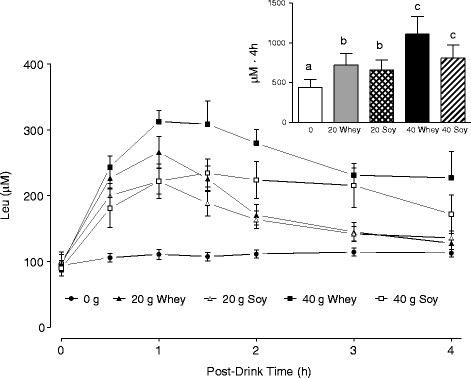
“Although not directly measured in this study it is likely that the different leucine content of whey and soy protein resulted in a greater peak concentration of leucine in the blood and a more prolonged elevation in leucine levels [17-19].”
Background
Metadata
- Authors
- Yang, Y., Churchward-Venne, T. A., Burd, N. A., Breen, L., Tarnopolsky, M. A., & Phillips, S. M.
- Affiliations
- McMaster University (CA)
- Corresponding author
- Phillips, Stuart M
- Venue
- Nutrition & Metabolism
- Published
- 2012-06-14
- Volume
- 9
- Issue
- 1
- Pages
- 57-57
- ISSN
- 1743-7075 (ISSN-L)
- PMC
- PMC3478988
- OpenAlex
- W2150738098
- Cited by
- 286
- References
- 42
- Citations by year
- 2026: 10 · 2025: 13 · 2024: 25 · 2023: 22 · 2022: 25 · 2021: 25 · 2020: 28 · 2019: 23 · 2018: 24 · 2017: 14 · 2016: 25 · 2015: 18 · 2014: 14 · 2013: 17 · 2012: 3
- FWCI
- 7.87
- Type
- journal article
- Language
- en
- Open access
- gold
- doi.org
- Licence
- cc-by
- Locations
- Nutrition & Metabolism (publishedVersion, cc-by)
- Europe PMC (PubMed Central) (publishedVersion, cc-by)
- PubMed Central (publishedVersion, cc-by)
- PubMed (publishedVersion)
- DOAJ (DOAJ: Directory of Open Access Journals) (submittedVersion, cc-by-sa)
- University of Birmingham Research Portal (University of Birmingham) (submittedVersion, other-oa)
- Funders
- Canadian Institutes of Health Research
- Natural Sciences and Engineering Research Council of Canada
- Topics
- Health Sciences › Nursing › Nutrition and Dietetics › Muscle metabolism and nutrition
- Life Sciences › Biochemistry, Genetics and Molecular Biology › Molecular Biology › Muscle Physiology and Disorders
- Health Sciences › Medicine › Physiology (medical) › Nutrition and Health in Aging
- Keywords
- myofibrillar protein synthesis, soy protein isolate, whey protein isolate, resistance training, older men, leucine oxidation, amino acid oxidation, protein dose, protein sources, skeletal muscle
About these checks
Registry, retraction, Cites and statistics results are computed, not judged, with one exception: a printed reference that no index lists is read once by a model before it counts as a citation error. Claims are extracted by a model and kept only when their quote appears verbatim in the text; each cited source is then checked, with a model’s help, for whether it says what the claim relies on. Those verdicts can be wrong — read the claim’s quote and the cited source before relying on one.
Statistics and arithmetic are recomputed, not judged.
Confidence bands are shown only for fields calibrated on our annotated test set. None is calibrated yet, so no band is shown.
What counts as a claim ›How we measure confidence ›How we check this ›
Are you an author, or do you see a problem with this page? Request a review
Data sources
Bibliographic data: Semantic Scholar, OpenAlex, Crossref.
Contains information from the Semantic Scholar Academic Graph Datasets, made available under the ODC Attribution License (ODC-BY 1.0).
Semantic Scholar’s data is described in: Kinney, R., et al. (2023). The Semantic Scholar Open Data Platform. arXiv:2301.10140.
