

Efficacy of a hybrid online training for panic symptoms and agoraphobia: study protocol for a randomized controlled trial.
Open accessThe DOI matches its Crossref record; 86 of the 89 references it cites were found in a registry or an index; 16 of the 42 sources its claims cite were checked for support.
Abstract
Background: Recently, internet-based interventions have been proposed as effective treatments for people with panic disorder (PD). However, little is known about the clinical effects of integrating mobile technology into these interventions. Because users carry their smartphones with them throughout the day, we hypothesize that this technology can be used to significantly support individuals with monitoring and overcoming their PD symptoms. The aim of the present study is to evaluate the efficacy and cost-effectiveness of a newly developed hybrid intervention that combines internet/PC with smartphone delivery to treat the symptoms of PD. The intervention is based on cognitive behavioral therapy and consists of six modules over a total of six weeks.Methods/design: A two-arm randomized controlled trial (RCT) will be conducted to evaluate the effects of a hybrid online training module for PD. Based on a power calculation (d =0.60; 1-β of 80%; α =0.05), 90 participants with mild to moderate panic symptoms with or without agoraphobia (as assessed by the Panic and Agoraphobia Scale) will be recruited from the general population and randomly assigned to either the intervention group or a six-month waitlist control group. The primary outcome measure will be the severity of panic symptoms. Secondary outcomes will include depression, quality of life, and an observer-based rating of panic severity. Furthermore, data regarding acceptance and the usability of the smartphone app will be assessed. Assessments will take place at baseline as well as eight weeks, three months, and six months after randomization. Moreover, a cost-effectiveness analysis will be performed from a societal perspective. Data will be analyzed on an intention-to-treat basis and per protocol.Discussion: To our knowledge, this RCT is one of the first to examine the efficacy of a hybrid online training for adult PD. This study seeks to contribute to the emerging field of hybrid online training. If the intervention is efficacious, then research on this hybrid online training should be extended. The cost-effectiveness analysis will also indicate whether online training is an economical tool for treating PD among adults.Trial Registration: German Clinical Trial Register: DRKS00005223 (registered on 15 August 2013).
Overview
CoChat Summary
## TL;DR
This is a study protocol for a two-arm randomized controlled trial testing GET.ON PANIC, a six-week hybrid internet- and smartphone-based CBT self-help intervention for adults with mild to moderate panic symptoms, with or without agoraphobia. The trial will assess panic severity, secondary clinical outcomes, usability/acceptance, and cost-effectiveness against a six-month waitlist control.
## Key findings
- The planned sample size is 90 participants: 45 per group, based on an assumed effect size of d = 0.60, 80% power, and α = 0.05.
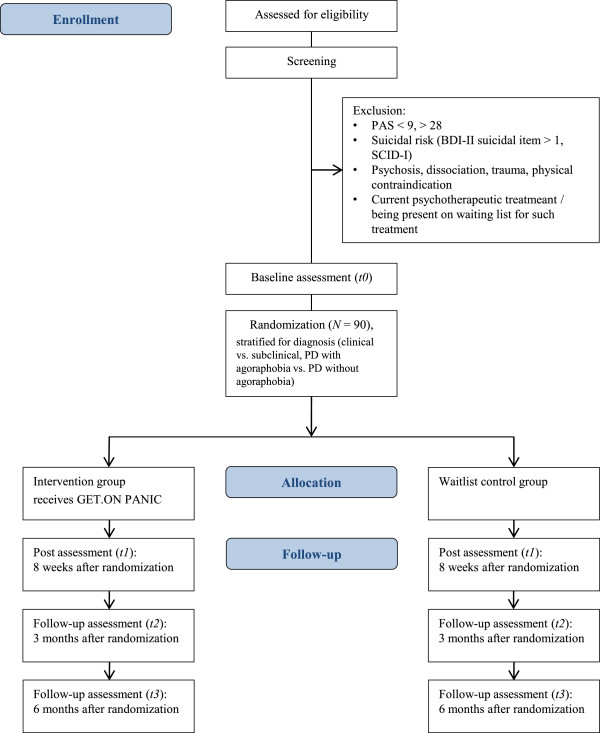
- Participants will be adults from the general population with mild to moderate panic symptoms (PAS score 9–28), randomized to GET.ON PANIC or a six-month waitlist.
- The primary outcome is panic severity measured by the Panic and Agoraphobia Scale (PAS); the PAS total score ranges from 0 to 52.
- Secondary outcomes include depression, quality of life, observer-rated anxiety severity, acceptance/usability of the app, and economic outcomes; analyses will include intention-to-treat, per-protocol, and mixed-model regressions for follow-up effects.
## Methods
- Design: Two-arm randomized controlled trial of a hybrid online self-help intervention (internet/PC plus smartphone app) versus a waitlist control that receives the intervention after six months.
- Sample/data: Community sample recruited from the general population; inclusion required age 18+, panic as the primary help-seeking concern, internet and smartphone access, and PAS 9–28. Assessments occur at baseline, 8 weeks, 3 months, and 6 months.
- Analysis: Primary analysis uses between-group ANCOVA on PAS at 8 weeks, adjusted for baseline PAS, sex, age, and socioeconomic status; the study also plans clinical significance analyses, mixed-model regressions for longer-term outcomes, and cost-effectiveness/cost-utility analyses from a societal perspective.
## Limitations
- The paper states that no active control group is included, so it cannot clarify mechanisms of change or compare the intervention against a dismantled/mobile-component variant.
- The paper states that a waitlist control does not allow comparison with the current gold standard (face-to-face CBT).
- The paper states that the study is not designed to test long-term efficacy; with follow-up only to 6 months, it cannot support conclusions beyond a relatively short period.
Model-written summary. Check it against the paper before relying on it.
Integrity signals
Registry
Cites
Statistics
Figures
Verification
Claims the paper makes
11 Valid · 1 Not valid · 10 Not checked · 14 Own results and interpretations
Every source the paper cites for this claim was checked and supports it.
In the paper
“However, only 16.7% of people who suffer from anxiety disorders seek help from a mental health professional, and of these individuals, only 21.3% receive CBT, which is arguably the most effective treatment [8].”
§ Efficacy of a hybrid online training for panic symptoms and agoraphobia: study protocol for a randomized controlled trial > Background
What the sources say
- Supportedcites [8] Andrews G Shortfall in mental health service utilisation Br J Psychiatry 2001 179 417 425 10.1192/bjp.179.5.417 11689399 source
Table 3 reports that 16.7% of respondents whose current principal disorder was an anxiety disorder consulted a mental health professional. The figure concerns current cases in the survey, rather than every person who has ever had an anxiety disorder. (LLM, conf=0.90)
plain- Asserted: passes — The authors put it forward as true.
- Checkable: passes — It can be checked against evidence.
- Load-bearing: passes — The paper’s conclusions depend on it.
- Based: passes — The paper gives a reason why it holds.
- Supported
The cited sources support only part of this claim — read each source’s verdict below.
In the paper
“Studies that evaluate online trainings with self-exposure elements consistently report particularly high dropout rates [17, 18].”
§ Efficacy of a hybrid online training for panic symptoms and agoraphobia: study protocol for a randomized controlled trial > Background
What the sources say
- Not checked — no full text of the sourcecites [17] Marks IM Kenwright M McDonough M Whittaker M Mataix-Cols D Saving clinicians’ time by delegating routine aspects of therapy to a computer: a randomized controlled trial in phobia/panic disorder Psychol Med 2004 34 9 18 10.1017/S003329170300878X 14971623 source
- Partly supportedcites [18] van Ballegooijen W Riper H Klein B Ebert DD Kramer J Meulenbeek P Cuijpers P An Internet-based guided self-help intervention for panic symptoms: randomized controlled trial J Med Internet Res 2013 15 e154 10.2196/jmir.2362 23896222 PMC3742403 sourceExperimental — accuracy not yet measured
The Results (Intervention Adherence; Study Dropout, pages unavailable) document substantial noncompletion in this online trial: only 5 of 63 intervention participants finished all six modules, and 53 of 126 participants were lost to posttreatment follow-up. But the Methods (Intervention, page unavailable) do not establish that the course included self-exposure, and the Discussion (Comparison With the Literature, page unavailable) says low adherence was not found in previous comparable studies, which reported 79%–95% adherence. This paper therefore does not support the claim that studies of trainings with self-exposure elements consistently report particularly high dropout. (LLM, conf=0.84)
plainstates an association- Asserted: passes — The authors put it forward as true.
- Checkable: passes — It can be checked against evidence.
- Load-bearing: passes — The paper’s conclusions depend on it.
- Based: passes — The paper gives a reason why it holds.
The sources with a verdict support this claim; the rest weren’t checked yet, have no full text we could read, or their verdicts aren’t rated yet.
In the paper
“Although internet-based interventions based on CBT are effective at treating adult PD [13–16], one drawback of this method (compared with traditional face-to-face treatments) is the lack of direct support from a therapist throughout the course of treatment, particularly during exposure exercises.”
§ Efficacy of a hybrid online training for panic symptoms and agoraphobia: study protocol for a randomized controlled trial > Background
What the sources say
- Not checked — no full text of the sourcecites [13] Haug T Nordgreen T Öst LG Havik OE Self-help treatment of anxiety disorders: a meta-analysis and meta-regression of effects and potential moderators Clin Psychol Rev 2012 32 425 445 10.1016/j.cpr.2012.04.002 22681915 source
- Supportedcites [14] Andrews G Cuijpers P Craske MG McEvoy P Titov N Baune BT Computer therapy for the anxiety and depressive disorders is effective, acceptable and practical health care: a meta-analysis PLoS One 2010 5 e13196 10.1371/journal.pone.0013196 20967242 PMC2954140 source
The Results (page not supplied) report that computerized CBT was superior to control conditions for panic disorder (Hedges’ g = 0.83, 95% CI 0.45–1.21). The Introduction identifies internet-delivered CBT as one of the computerized formats studied, and the Discussion describes the treatment as efficacious. (LLM, conf=0.92)
- Not checked — no full text of the sourcecites [15] Cuijpers P Donker T van Straten A Li J Andersson G Is guided self-help as effective as face-to-face psychotherapy for depression and anxiety disorders? A systematic review and meta-analysis of comparative outcome studies Psychol Med 2010 40 1943 1957 10.1017/S0033291710000772 20406528 source
- Supportedcites [16] Mewton L Smith J Rossouw P Andrews G Current perspectives on Internet delivered cognitive behavioral therapy for adults with anxiety and related disorders PRBM 2014 7 37 46 10.2147/PRBM.S40879 PMC3913603 24511246 source
The Efficacy of iCBT for anxiety disorders section (page not provided) identifies multiple trials for panic disorder and reports that iCBT generally reduced anxiety symptoms compared with controls. The Internet versus face-to-face delivery section (page not provided) also reports comparable treatment outcomes for panic disorder. This supports the cited clause about effectiveness; the separate claim about lack of therapist support is not attributed to this citation. (LLM, conf=0.92)
plainstates a cause- Asserted: passes — The authors put it forward as true.
- Checkable: passes — It can be checked against evidence.
- Load-bearing: passes — The paper’s conclusions depend on it.
- Based: passes — The paper gives a reason why it holds.
The cited sources support only part of this claim — read each source’s verdict below.
In the paper
“However, only 16.7% of people who suffer from anxiety disorders seek help from a mental health professional, and of these individuals, only 21.3% receive CBT, which is arguably the most effective treatment [8].”
§ Efficacy of a hybrid online training for panic symptoms and agoraphobia: study protocol for a randomized controlled trial > Background
What the sources say
- Partly supportedcites [8] Andrews G Shortfall in mental health service utilisation Br J Psychiatry 2001 179 417 425 10.1192/bjp.179.5.417 11689399 sourceExperimental — accuracy not yet measured
Table 3 reports that 16.7% of people with a current anxiety disorder consulted a mental health professional and that 21.3% of those who sought help received cognitive–behavioural therapy. But Table 3, footnote 7 defines the denominator for the therapy figure as people who consulted any health professional for a mental health problem, not just a mental health professional. (LLM, conf=0.94)
plain- Asserted: passes — The authors put it forward as true.
- Checkable: passes — It can be checked against evidence.
- Load-bearing: passes — The paper’s conclusions depend on it.
- Based: passes — The paper gives a reason why it holds.
- Partly supported
The sources with a verdict support this claim; the rest weren’t checked yet, have no full text we could read, or their verdicts aren’t rated yet.
In the paper
“In contrast, a mobile-based PD intervention tool can be used to assess the symptoms of PD in real-time through ecological momentary assessment (EMA) approaches [29–33].”
§ Efficacy of a hybrid online training for panic symptoms and agoraphobia: study protocol for a randomized controlled trial > Background
What the sources say
- Not checked — no full text of the sourcecites [29] Alpers GW Ambulatory assessment in panic disorder and specific phobia Psychol Assess 2009 21 476 485 10.1037/a0017489 19947782 source
- Not checked — no full text of the sourcecites [30] Myin-Germeys I Oorschot M Collip D Lataster J Delespaul P van Os J Experience sampling research in psychopathology: opening the black box of daily life Psychol Med 2009 39 1533 1547 10.1017/S0033291708004947 19215626 source
- Not checked — no full text of the sourcecites [31] Moskowitz DS Russell JJ Sadikaj G Sutton R Measuring people intensively Can Psychol 2009 50 131 140 10.1037/a0016625 source
- Not checked — no full text of the sourcecites [32] Helbig S Lang T Swendsen J Hoyer J Wittchen H Implementierung, Akzeptanz und Informationsgehalt eines Ecological Momentary Assessment (EMA)-Ansatzes bei Patienten mit Panikstörung und Agoraphobie Z Kl Psych Psychoth 2009 38 108 117 10.1026/1616-3443.38.2.108 source
- Supportedcites [33] Trull TJ Ebner-Priemer UW Using experience sampling methods/ecological momentary assessment (ESM/EMA) in clinical assessment and clinical research: introduction to the special section Psychol Assess 2009 21 457 462 10.1037/a0017653 19947780 PMC4255457 source
The ‘Importance of Real-Time Assessment’ section says EMA captures momentary symptoms. ‘Articles in This Special Section’ discusses ambulatory assessment of panic episodes and electronic diaries used to monitor and administer treatment, while ‘Prospects and Challenges’ identifies smartphones as near-real-time assessment devices. Together, these passages support the stated capability; the paper does not claim to evaluate a particular mobile panic-disorder tool. (LLM, conf=0.87)
plainstates a cause- Asserted: passes — The authors put it forward as true.
- Checkable: passes — It can be checked against evidence.
- Load-bearing: passes — The paper’s conclusions depend on it.
- Based: passes — The paper gives a reason why it holds.
10 more claims · 3 with their cited sources checked
Create a free account to see all 36 claims and every source verdict.
- Probably not a substantial claim. 17
- It may state two separate claims as one. 9
Claims other papers make about this one
Each is checked against this paper’s own text: does it say what the citing paper says it does?
The cited source says what the claim attributes to it.
In the citing paper
“Interested individuals were screened at the beginning of the study according to in- and exclusion criteria identical to those described in the study protocol of the planned RCT (Ebenfeld et al., 2014).”
From A mobile application for panic disorder and agoraphobia: Insights from a multi-methods feasibility study (2020) · cites this paper as Ebenfeld et al., 2014
Citations
Cites
Diagnostic and Statistical Manual of Mental Disorders
American Psychiatric Association (2013) · doi:10.1176/appi.books.9780890425596 · Cited by 116,369
Statistical Power Analysis for the Behavioral Sciences
Muller, K. (1989) · Technometrics · doi:10.1080/00401706.1989.10488618 · Cited by 99,167
Statistical power analysis for the behavioral sciences
(1990) · Computers, Environment and Urban Systems · doi:10.1016/0198-9715(90)90050-4 · Cited by 65,269
The CES-D Scale: A Self-Report Depression Scale for Research in the General Population
Radloff, L. S. (1977) · Applied Psychological Measurement · doi:10.1177/014662167700100306 · Cited by 53,267
User Acceptance of Computer Technology: A Comparison of Two Theoretical Models
Davis, F. D., Bagozzi, R. P., & Warshaw, P. R. (1989) · Management Science · doi:10.1287/mnsc.35.8.982 · Cited by 25,709 · cited 1×
“We will also collect data concerning technology acceptance (via a questionnaire based on the technology acceptance model; TAM) [61,62], the usability of the smartphone app GET.”
MethodA Theoretical Extension of the Technology Acceptance Model: Four Longitudinal Field Studies
Venkatesh, V., & Davis, F. D. (2000) · Management Science · doi:10.1287/mnsc.46.2.186.11926 · Cited by 23,066 · cited 1×
“We will also collect data concerning technology acceptance (via a questionnaire based on the technology acceptance model; TAM) [61,62], the usability of the smartphone app GET.”
MethodWARE, J. E., KOSINSKI, M., & KELLER, S. D. (1996) · Medical Care · doi:10.1097/00005650-199603000-00003 · Cited by 17,392 · cited 3×
“The SF-12 generates two summary scores: physical health and mental health.”
MethodStatistical Analysis With Missing Data
Lahiff, M., Little, R. J. A., & Rubin, D. B. (1989) · Journal of the American Statistical Association · doi:10.2307/2289883 · Cited by 17,265
EuroQol: a new facility for the measurement of health-related quality of life
(1990) · Health Policy · doi:10.1016/0168-8510(90)90421-9 · Cited by 15,736 · cited 1×
“Quality of life will be measured using the EuroQol (EQ-5D) [52] and the Short Form 12 (SF-12) [53].”
MethodThe assessment of anxiety states by rating
HAMILTON, M. (1959) · British Journal of Medical Psychology · doi:10.1111/j.2044-8341.1959.tb00467.x · Cited by 11,455 · cited 5×
“In addition, the secondary outcome measures will include the observer-rated HAM-A [43,58] to obtain a more detailed understanding of symptom severity.”
BackgroundMethodInfluentialDiagnostic and Statistical Manual of Mental Disorders(DSM)
(2008) · Encyclopedia of Counseling · doi:10.4135/9781412963978.n182 · Cited by 10,830
SUS: A 'Quick and Dirty' Usability Scale
(1996) · Usability Evaluation In Industry · doi:10.1201/9781498710411-35 · Cited by 8,989
Jacobson, N. S., & Truax, P. (1991) · Journal of Consulting and Clinical Psychology · doi:10.1037/0022-006x.59.1.12 · Cited by 7,770 · cited 2×
“We will also conduct clinical significance change analyses as described by Jacobson and Truax [72].”
BackgroundMethodBeck, A. T., Steer, R. A., & Brown, G. (2011) · PsycTESTS Dataset · doi:10.1037/t00742-000 · Cited by 7,535
Analysis of Incomplete Multivariate Data
Booth, D. E. (2000) · Technometrics · doi:10.1080/00401706.2000.10486013 · Cited by 5,627
An Empirical Evaluation of the System Usability Scale
Bangor, A., Kortum, P. T., & Miller, J. T. (2008) · International Journal of Human–Computer Interaction · doi:10.1080/10447310802205776 · Cited by 5,181 · cited 2×
“ON PANIC APP (via the System Usability Scale; SUS) [63,64], user satisfaction of the on-line training (a self-designed questionnaire based on the German version of the Client Satisfaction Questionnaire [65,66], and the adverse effects of psychotherapy [67].”
MethodUsability Evaluation In Industry
(1996) · CRC Press eBooks · doi:10.1201/9781498710411 · Cited by 4,354
The size and burden of mental disorders and other disorders of the brain in Europe 2010
Wittchen, H. U., Jacobi, F., Rehm, J., Gustavsson, A., Svensson, M., Jönsson, B., Olesen, J., Allgulander, C., Alonso, J., Faravelli, C., et al. (2011) · European Neuropsychopharmacology · doi:10.1016/j.euroneuro.2011.07.018 · Cited by 3,754
Eysenbach, G., & CONSORT-EHEALTH Group (2011) · Journal of Medical Internet Research · doi:10.2196/jmir.1923 · Cited by 1,863 · cited 1×
“The analyses will be performed based on the Consolidated Standards of Reporting Trials (CONSORT) statement regarding eHealth [68].”
MethodWiley Series in Probability and Statistics
(2007) · Wiley Series in Probability and Statistics · doi:10.1002/9780470186466.scard · Cited by 1,856
The client satisfaction questionnaire
Attkisson, C. C., & Zwick, R. (1982) · Evaluation and Program Planning · doi:10.1016/0149-7189(82)90074-x · Cited by 1,743 · cited 2×
“ON PANIC APP (via the System Usability Scale; SUS) [63,64], user satisfaction of the on-line training (a self-designed questionnaire based on the German version of the Client Satisfaction Questionnaire [65,66], and the adverse effects of psychotherapy [67].”
MethodAndrews, G., Cuijpers, P., Craske, M. G., McEvoy, P., & Titov, N. (2010) · PLoS ONE · doi:10.1371/journal.pone.0013196 · Cited by 1,311 · cited 1×
“Although internet-based interventions based on CBT are effective at treating adult PD [13-16], one drawback of this method (compared with traditional face-toface treatments) is the lack of direct support from a therapist throughout the course of treatment, particularly during exposure exercises.”
Persuasive System Design Does Matter: a Systematic Review of Adherence to Web-based Interventions
Kelders, S. M., Kok, R. N., Ossebaard, H. C., & Van Gemert-Pijnen, J. E. (2012) · Journal of Medical Internet Research · doi:10.2196/jmir.2104 · Cited by 1,308 · cited 1×
“In contrast, clients often carry their smartphones with them in almost any situation, and they might support clients in successfully completing the intended exposure exercise [19-21].”
BackgroundChambless, D. L., Caputo, G. C., Bright, P., & Gallagher, R. (1984) · Journal of Consulting and Clinical Psychology · doi:10.1037/0022-006x.52.6.1090 · Cited by 1,247 · cited 6×
“The Mobility Inventory (MI) [54,55] measures agoraphobic avoidance.”
BackgroundMethodInfluentialSmartphones for smarter delivery of mental health programs: A systematic review
Donker, T., Petrie, K., Proudfoot, J., Clarke, J., Birch, M.-R., & Christensen, H. (2013) · Journal of Medical Internet Research · doi:10.2196/jmir.2791 · Cited by 1,136 · cited 1×
“Discussion Given the availability and the daily use of smartphones, mobile-based health interventions have become increasingly popular [73-78].”
BackgroundMünster, R. D. (1999) · Zeitschrift für Klinische Psychologie und Psychotherapie · doi:10.1026//0084-5345.28.1.68 · Cited by 1,010
Barriers to mental health treatment: results from the National Comorbidity Survey Replication
Mojtabai, R., Olfson, M., Sampson, N. A., Jin, R., Druss, B., Wang, P. S., Wells, K. B., Pincus, H. A., & Kessler, R. C. (2011) · Psychological Medicine · doi:10.1017/s0033291710002291 · Cited by 951 · cited 1×
“The reasons for this low endorsement of effective PD treatments include a lack of psychoeducation, a fear of stigmatization, and structural barriers such as a lack of access to adequate treatments [9,10].”
BackgroundCuijpers, P., Donker, T., van Straten, A., Li, J., & Andersson, G. (2010) · Psychological Medicine · doi:10.1017/s0033291710000772 · Cited by 832 · cited 1×
“Although internet-based interventions based on CBT are effective at treating adult PD [13-16], one drawback of this method (compared with traditional face-toface treatments) is the lack of direct support from a therapist throughout the course of treatment, particularly during exposure exercises.”
Experience sampling research in psychopathology: opening the black box of daily life
Myin-Germeys, I., Oorschot, M., Collip, D., Lataster, J., Delespaul, P., & van Os, J. (2009) · Psychological Medicine · doi:10.1017/s0033291708004947 · Cited by 817 · cited 1×
“In contrast, a mobile-based PD intervention tool can be used to assess the symptoms of PD in real-time through ecological momentary assessment (EMA) approaches [29-33].”
BackgroundThe Institute of Electrical and Electronics Engineers
(1963) · Nature · doi:10.1038/200118c0 · Cited by 790
The Mobility Inventory for Agoraphobia
Chambless, D. L., Caputo, G. C., Jasin, S. E., Gracely, E. J., & Williams, C. (1985) · Behaviour Research and Therapy · doi:10.1016/0005-7967(85)90140-8 · Cited by 775 · cited 1×
“The internal consistencies are α =0.94 (alone) and α =0.91 (accompanied) [57].”
BackgroundInfluentialTrull, T. J., & Ebner-Priemer, U. W. (2009) · Psychological Assessment · doi:10.1037/a0017653 · Cited by 550 · cited 1×
“In contrast, a mobile-based PD intervention tool can be used to assess the symptoms of PD in real-time through ecological momentary assessment (EMA) approaches [29-33].”
BackgroundEcological momentary assessment of mood disorders and mood dysregulation
Ebner-Priemer, U. W., & Trull, T. J. (2009) · Psychological Assessment · doi:10.1037/a0017075 · Cited by 530 · cited 1×
“Moreover, when desktop PCs or laptops are used to monitor symptoms of PD to identify factors that cue panic attacks and avoidance, clients typically use daily or weekly electronic diary entries, which are likely biased by memory effects because clients must complete these diaries retrospectively and not in real-time […”
BackgroundComparability of telephone and face-to-face interviews in assessing axis I and II disorders
Rohde, P., Lewinsohn, P. M., & Seeley, J. R. (1997) · American Journal of Psychiatry · doi:10.1176/ajp.154.11.1593 · Cited by 522 · cited 2×
“The first is for a trained interviewer to conduct a diagnostic interview (SCID-I) to provide a detailed sample description [41,42].”
BackgroundIrvine, A., Drew, P., & Sainsbury, R. (2013) · Qualitative Research · doi:10.1177/1468794112439086 · Cited by 497 · cited 2×
“The first is for a trained interviewer to conduct a diagnostic interview (SCID-I) to provide a detailed sample description [41,42].”
BackgroundFeasibility, Acceptability, and Preliminary Efficacy of a Smartphone Intervention for Schizophrenia
Ben-Zeev, D., Brenner, C. J., Begale, M., Duffecy, J., Mohr, D. C., & Mueser, K. T. (2014) · Schizophrenia Bulletin · doi:10.1093/schbul/sbu033 · Cited by 493 · cited 2×
“Moreover, when desktop PCs or laptops are used to monitor symptoms of PD to identify factors that cue panic attacks and avoidance, clients typically use daily or weekly electronic diary entries, which are likely biased by memory effects because clients must complete these diaries retrospectively and not in real-time […”
BackgroundShear, M. K., Vander Bilt, J., Rucci, P., Endicott, J., Lydiard, B., Otto, M. W., Pollack, M. H., Chandler, L., Williams, J., Ali, A., et al. (2001) · Depression and Anxiety · doi:10.1002/da.1033 · Cited by 483 · cited 1×
“Thus, we will use the structured interview guide for the HAM-A (SIGH-A) [59].”
MethodShear, M. K., Vander Bilt, J., Rucci, P., Endicott, J., Lydiard, B., Otto, M. W., Pollack, M. H., Chandler, L., Williams, J., Ali, A., et al. (2001) · Depression and Anxiety · doi:10.1002/da.1033.abs · Cited by 483
Shortfall in mental health service utilisation
Andrews, G., Issakidis, C., & Carter, G. (2001) · British Journal of Psychiatry · doi:10.1192/bjp.179.5.417 · Cited by 420 · cited 1×
“3% receive CBT, which is arguably the most effective treatment [8].”
Background(1993) · Beltz eBooks · Cited by 409
Solhan, M. B., Trull, T. J., Jahng, S., & Wood, P. K. (2009) · Psychological Assessment · doi:10.1037/a0016869 · Cited by 362 · cited 1×
“Moreover, when desktop PCs or laptops are used to monitor symptoms of PD to identify factors that cue panic attacks and avoidance, clients typically use daily or weekly electronic diary entries, which are likely biased by memory effects because clients must complete these diaries retrospectively and not in real-time […”
BackgroundAmbulatory Assessment - Monitoring Behavior in Daily Life Settings
Fahrenberg, J., Myrtek, M., Pawlik, K., & Perrez, M. (2007) · European Journal of Psychological Assessment · doi:10.1027/1015-5759.23.4.206 · Cited by 317
Bandelow, B. (1995) · International Clinical Psychopharmacology · doi:10.1097/00004850-199506000-00003 · Cited by 314 · cited 3×
“The preliminary screening will collect demographic data from participants, including their age, gender, education, therapeutic experience, and medication use, and the PAS will be administered (for a detailed description see the section regarding the primary outcome measure) [34,35].”
MethodQuality of life impairment in generalized anxiety disorder, social phobia, and panic disorder
Barrera, T. L., & Norton, P. J. (2009) · Journal of Anxiety Disorders · doi:10.1016/j.janxdis.2009.07.011 · Cited by 308 · cited 1×
“PD (with or without agoraphobia) is associated with a high psychiatric comorbidity, lower quality of life, and severe work impairment [4,5], and also places a significant burden on healthcare systems [2,6].”
Background(1989) · PubMed · Cited by 298
Psychological treatment of panic disorder with or without agoraphobia: A meta-analysis
Sánchez-Meca, J., Rosa-Alcázar, A. I., Marín-Martínez, F., & Gómez-Conesa, A. (2010) · Clinical Psychology Review · doi:10.1016/j.cpr.2009.08.011 · Cited by 291
Diagnostic and Statistical Manual of Mental Disorders: DSM-5 (5th edition)
(2014) · Reference Reviews · doi:10.1108/rr-10-2013-0256 · Cited by 276
Carlbring, P., Bohman, S., Brunt, S., Buhrman, M., Westling, B. E., Ekselius, L., & Andersson, G. (2006) · American Journal of Psychiatry · doi:10.1176/ajp.2006.163.12.2119 · Cited by 262 · cited 1×
“ON PANIC is a hybrid internet-based self-help intervention with minimal therapeutic guidance based on CBT principles [18,44-46].”
BackgroundThe epidemiology of panic disorder and agoraphobia in Europe
Goodwin, R. D., Faravelli, C., Rosi, S., Cosci, F., Truglia, E., de Graaf, R., & Wittchen, H. U. (2005) · European Neuropsychopharmacology · doi:10.1016/j.euroneuro.2005.04.006 · Cited by 243 · cited 1×
“In addition, sub-threshold cases have been estimated to be even more prevalent, with between 10 and 16% of the population experiencing a panic attack at some point during their lifetimes [3].”
BackgroundEfficacy of internet therapy for panic disorder
Klein, B., Richards, J. C., & Austin, D. W. (2006) · Journal of Behavior Therapy and Experimental Psychiatry · doi:10.1016/j.jbtep.2005.07.001 · Cited by 236 · cited 1×
“ON PANIC is a hybrid internet-based self-help intervention with minimal therapeutic guidance based on CBT principles [18,44-46].”
BackgroundReger, M. A., & Gahm, G. A. (2009) · Journal of Clinical Psychology · doi:10.1002/jclp.20536 · Cited by 234 · cited 1×
“Discussion Given the availability and the daily use of smartphones, mobile-based health interventions have become increasingly popular [73-78].”
BackgroundMARKS, I. M., KENWRIGHT, M., McDONOUGH, M., WHITTAKER, M., & MATAIX-COLS, D. (2004) · Psychological Medicine · doi:10.1017/s003329170300878x · Cited by 226
Coles, M. E., & Coleman, S. L. (2010) · Depression and Anxiety · doi:10.1002/da.20620 · Cited by 204 · cited 1×
“The reasons for this low endorsement of effective PD treatments include a lack of psychoeducation, a fear of stigmatization, and structural barriers such as a lack of access to adequate treatments [9,10].”
BackgroundGloster, A. T., Wittchen, H.-U., Einsle, F., Lang, T., Helbig-Lang, S., Fydrich, T., Fehm, L., Hamm, A. O., Richter, J., Alpers, G. W., et al. (2011) · Journal of Consulting and Clinical Psychology · doi:10.1037/a0023584 · Cited by 203 · cited 1×
“In contrast, clients often carry their smartphones with them in almost any situation, and they might support clients in successfully completing the intended exposure exercise [19-21].”
BackgroundBeck-Depressions-Inventar Revision (BDI–II)
Wintjen, L., & Petermann, F. (2010) · Zeitschrift für Psychiatrie, Psychologie und Psychotherapie · doi:10.1024/1661-4747.a000033 · Cited by 198
Hands-on Help: computer-aided Psychotherapy
Marks, I. M., Cavanagh, K., & Gega, L. (2007) · doi:10.25405/ncl.34083078 · Cited by 182
Internationale Skalen für Psychiatrie
Weyer, G. (2005) · Cited by 169
The SmartCAT: An m-Health Platform for Ecological Momentary Intervention in Child Anxiety Treatment
Pramana, G., Parmanto, B., Kendall, P. C., & Silk, J. S. (2014) · Telemedicine and e-Health · doi:10.1089/tmj.2013.0214 · Cited by 162
Real-Time Data Collection for Pain: Appraisal and Current Status
Stone, A. A., & Broderick, J. E. (2007) · Pain Medicine · doi:10.1111/j.1526-4637.2007.00372.x · Cited by 140 · cited 1×
“Moreover, when desktop PCs or laptops are used to monitor symptoms of PD to identify factors that cue panic attacks and avoidance, clients typically use daily or weekly electronic diary entries, which are likely biased by memory effects because clients must complete these diaries retrospectively and not in real-time […”
BackgroundEconomic costs of full-blown and subthreshold panic disorder
Batelaan, N. M., Smit, F., de Graaf, R., van Balkom, A. J. L. M., Vollebergh, W., & Beekman, A. T. F. (2007) · Journal of Affective Disorders · doi:10.1016/j.jad.2007.03.013 · Cited by 139 · cited 1×
“PD (with or without agoraphobia) is associated with a high psychiatric comorbidity, lower quality of life, and severe work impairment [4,5], and also places a significant burden on healthcare systems [2,6].”
BackgroundAntypas, K., & Wangberg, S. C. (2014) · Journal of Medical Internet Research · doi:10.2196/jmir.3132 · Cited by 136
Ebner-Priemer, U. W., Kuo, J., Welch, S. S., Thielgen, T., Witte, S., Bohus, M., & Linehan, M. M. (2006) · Journal of Nervous & Mental Disease · doi:10.1097/01.nmd.0000239900.46595.72 · Cited by 133 · cited 1×
“Moreover, when desktop PCs or laptops are used to monitor symptoms of PD to identify factors that cue panic attacks and avoidance, clients typically use daily or weekly electronic diary entries, which are likely biased by memory effects because clients must complete these diaries retrospectively and not in real-time […”
BackgroundHaug, T., Nordgreen, T., Öst, L. G., & Havik, O. E. (2012) · Clinical Psychology Review · doi:10.1016/j.cpr.2012.04.002 · Cited by 128 · cited 1×
“Although internet-based interventions based on CBT are effective at treating adult PD [13-16], one drawback of this method (compared with traditional face-toface treatments) is the lack of direct support from a therapist throughout the course of treatment, particularly during exposure exercises.”
Proudfoot, J. (2013) · Australian & New Zealand Journal of Psychiatry · doi:10.1177/0004867412471441 · Cited by 126 · cited 1×
“Discussion Given the availability and the daily use of smartphones, mobile-based health interventions have become increasingly popular [73-78].”
BackgroundThe use of mobile telephones as adjuncts to cognitive behavioral psychotherapy.
Boschen, M. J., & Casey, L. M. (2008) · Professional Psychology: Research and Practice · doi:10.1037/0735-7028.39.5.546 · Cited by 125
Moskowitz, D. S., Russell, J. J., Sadikaj, G., & Sutton, R. (2009) · Canadian Psychology / Psychologie canadienne · doi:10.1037/a0016625 · Cited by 103 · cited 1×
“In contrast, a mobile-based PD intervention tool can be used to assess the symptoms of PD in real-time through ecological momentary assessment (EMA) approaches [29-33].”
BackgroundPros and cons of online cognitive–behavioural therapy
Andersson, G., & Cuijpers, P. (2008) · British Journal of Psychiatry · doi:10.1192/bjp.bp.108.054080 · Cited by 101 · cited 1×
“Interventions delivered via the internet have been proposed as a helpful method to overcome such barriers and facilitate access to empirically validated treatments [11,12].”
MethodFragebogen zu körperbezogenen Ängsten, Kognitionen und Vermeidung AKV
Ehlers, A., & Margraf, J. (2001) · Cited by 90
Wiley Series in Probability and Statistics
Seber, G. A. F., & Lee, A. J. (2003) · Wiley series in probability and statistics · doi:10.1002/9780471722199.scard · Cited by 69
Mobility, cognitions, and panic
Craske, M. G., Rachman, S. J., & Tallman, K. (1986) · Journal of Psychopathology and Behavioral Assessment · doi:10.1007/bf00959832 · Cited by 64 · cited 1×
“80 [56].”
Clinical and subthreshold panic disorder
Bystritsky, A., Kerwin, L., Niv, N., Natoli, J. L., Abrahami, N., Klap, R., Wells, K., & Young, A. S. (2010) · Depression and Anxiety · doi:10.1002/da.20622 · Cited by 60 · cited 1×
“PD (with or without agoraphobia) is associated with a high psychiatric comorbidity, lower quality of life, and severe work impairment [4,5], and also places a significant burden on healthcare systems [2,6].”
BackgroundMewton, L., Smith, J., Rossouw, P., & Andrews, G. (2014) · Psychology Research and Behavior Management · doi:10.2147/prbm.s40879 · Cited by 57
An internet-based guided self-help intervention for panic symptoms: randomized controlled trial
van Ballegooijen, W., Riper, H., Klein, B., Ebert, D. D., Kramer, J., Meulenbeek, P., & Cuijpers, P. (2013) · Journal of Medical Internet Research · doi:10.2196/jmir.2362 · Cited by 56
Self-citationEhrenreich, B., Righter, B., Rocke, D. A., Dixon, L., & Himelhoch, S. (2011) · Journal of Nervous & Mental Disease · doi:10.1097/nmd.0b013e3182349e90 · Cited by 53
The Use of the Panic and Agoraphobia Scale (P & A) in a controlled clinical trial1
Bandelow, B., Broocks, A., Pekrun, G., George, A., Meyer, T., Pralle, L., Bartmann, U., Hillmer-Vogel, U., & Rüther, E. (2000) · Pharmacopsychiatry · doi:10.1055/s-2000-12982 · Cited by 53 · cited 1×
“The primary outcome will be the severity of panic and agoraphobia symptoms as assessed by the total PAS score [34,35,48].”
MethodAmbulatory assessment in panic disorder and specific phobia.
Alpers, G. W. (2009) · Psychological Assessment · doi:10.1037/a0017489 · Cited by 40 · cited 1×
“In contrast, a mobile-based PD intervention tool can be used to assess the symptoms of PD in real-time through ecological momentary assessment (EMA) approaches [29-33].”
BackgroundUsing everyday technology to enhance evidence-based treatments.
Eonta, A. M., Christon, L. M., Hourigan, S. E., Ravindran, N., Vrana, S. R., & Southam-Gerow, M. A. (2011) · Professional Psychology: Research and Practice · doi:10.1037/a0025825 · Cited by 40 · cited 1×
“Discussion Given the availability and the daily use of smartphones, mobile-based health interventions have become increasingly popular [73-78].”
BackgroundLindner, P., Ivanova, E., Ly, K. H., Andersson, G., & Carlbring, P. (2013) · Trials · doi:10.1186/1745-6215-14-437 · Cited by 39 · cited 1×
“ON PANIC is a hybrid internet-based self-help intervention with minimal therapeutic guidance based on CBT principles [18,44-46].”
BackgroundAssessing the efficacy of treatments for panic disorder and agoraphobia. I. Methodological problems
Bandelow, B., Hajak, G., Holzrichter, S., Kunert, H. J., & Rüther, E. (1995) · International Clinical Psychopharmacology · doi:10.1097/00004850-199506000-00004 · Cited by 35 · cited 1×
“A score of between 0 and 8 indicates no clinically relevant symptoms, scores of between 9 and 28 indicate moderate symptoms, and a score of 29 or higher indicates a severe level of symptoms [49].”
BackgroundPanik- und Agoraphobie-Skala (PAS)
Petermann, F. (2016) · Zeitschrift für Psychiatrie Psychologie und Psychotherapie · doi:10.1024/1661-4747/a000281 · Cited by 34
Lind, C., Boschen, M. J., & Morrissey, S. (2013) · Journal of Anxiety Disorders · doi:10.1016/j.janxdis.2012.09.004 · Cited by 33 · cited 1×
“In contrast, clients often carry their smartphones with them in almost any situation, and they might support clients in successfully completing the intended exposure exercise [19-21].”
BackgroundRisiken und Nebenwirkungen von Psychotherapie: Erfassung, Bewältigung, Risikovermeidung
(2013) · PSYCH up2date · doi:10.1055/s-0033-1336855 · Cited by 32
Risiken und Nebenwirkungen von Psychotherapie
Strauss, B. M., & Linden, M. (2018) · PPmP - Psychotherapie · Psychosomatik · Medizinische Psychologie · doi:10.1055/a-0630-3297 · Cited by 30
Wiley Series in Probability and Statistics
Little, R. J. A., & Rubin, D. B. (2002) · Wiley series in probability and statistics · doi:10.1002/9781119013563.scard · Cited by 22
Helbig, S., Lang, T., Swendsen, J., Hoyer, J., & Wittchen, H.-U. (2009) · Zeitschrift für Klinische Psychologie und Psychotherapie · doi:10.1026/1616-3443.38.2.108 · Cited by 12
Stegemann, S. K., Ebenfeld, L., Lehr, D., Berking, M., & Funk, B. (2013) · Annals of Computer Science and Information Systems · Cited by 11
Self-citationEbner‐Priemer, U., Bohus, M., & Kuo, J. R. (2007) · Cited by 5
Research works printed but not linked: 5
- Bandelow B Panik- und Agoraphobieskala (PAS) 1997 Göttingen/Bern/Toronto/Seattle Hogrefe
- Schneider S Margraf J Schulte D Hahlweg K Margraf J Vaitl D Agoraphobie und Panikstörung Fortschritte der Psychotherapie, Volume 3 1998 Göttingen Hogrefe
- Wittchen HU Zaudig M Fydich T Strukturiertes Klinisches Interview für DSM-IV Achse I und II [Structured Clinical Interview for DSM-IV Axis I and II] 1997 Göttingen Hogrefe
- DatInf GmbH DatInf RandList Version 1.2 2007 Tübingen DatInf GmbH
- Hakkaart-van Roijen L Manual Trimbos/iMTA Questionnaire for Costs Associated with Psychiatric Illness (in Dutch) 2002 Rotterdam Institute for Medical Technology Assessment
Cited by
Smartphone Apps for the Treatment of Mental Disorders: Systematic Review
Miralles, I., Granell, C., Díaz-Sanahuja, L., Van Woensel, W., Bretón-López, J., Mira, A., Castilla, D., & Casteleyn, S. (2020) · JMIR mHealth and uHealth · doi:10.2196/14897 · Cited by 188
“ON PAPP [131,132], N/A [133-139] Anxiety disorders”
Mäder, M., Timpel, P., Schönfelder, T., Militzer-Horstmann, C., Scheibe, S., Heinrich, R., & Häckl, D. (2023) · BMC Health Services Research · doi:10.1186/s12913-023-09287-w · Cited by 65
“…health 0 6 0 Elevida [19] nervous system 1 0 0 Hello Better Diabetes and Depression [20, 21] hormones and metabolism 2 0 0 Hello Better Panik [22, 23] mental health 0 1 1 Hello Better Stress and Burnout [24, 25] mental health 1 0 0 Hello Better Vaginismus Plus [26, 27] mental health 0 2 0…”
BackgroundQuality of Smartphone Apps Related to Panic Disorder
Van Singer, M., Chatton, A., & Khazaal, Y. (2015) · Frontiers in Psychiatry · doi:10.3389/fpsyt.2015.00096 · Cited by 43
Bolinski, F., Kleiboer, A., Karyotaki, E., Bosmans, J. E., Zarski, A.-C., Weisel, K. K., Ebert, D. D., Jacobi, C., Cuijpers, P., & Riper, H. (2018) · Trials · doi:10.1186/s13063-018-2477-y · Cited by 31
Self-citationEbenfeld, L., Lehr, D., Ebert, D. D., Stegemann, S. K., Riper, H. M., Funk, B., & Berking, M. (2021) · Journal of Medical Internet Research · doi:10.2196/20829 · Cited by 33
“ON Panic treatment, which is a hybrid (ie, desktop-based and smartphone-based), iCBT-based self-help intervention for treating symptoms of panic disorder [45].”
BackgroundMethodSelf-citation
Metadata
- Authors
- Ebenfeld, L., Kleine Stegemann, S., Lehr, D., Ebert, D. D., Jazaieri, H., van Ballegooijen, W., Funk, B., Riper, H., & Berking, M.
- Affiliations
- Leuphana University of Lüneburg (DE)
- University of California, Berkeley (US)
- Corresponding author
- Ebenfeld, Lara
- ORCID
- Venue
- Trials
- Published
- 2014-11-04
- Volume
- 15
- Issue
- 1
- Pages
- 427-427
- ISSN
- 1745-6215 (ISSN-L)
- PMC
- PMC4233107
- OpenAlex
- W2110392283
- Cited by
- 20
- References
- 89
- Citations by year
- 2025: 1 · 2024: 1 · 2023: 2 · 2022: 4 · 2021: 2 · 2020: 3 · 2019: 2 · 2018: 2 · 2017: 1 · 2016: 1 · 2015: 1
- FWCI
- 1.55
- Type
- journal article
- Language
- en
- Open access
- gold
- doi.org
- Licence
- Locations
- Trials (publishedVersion, cc-by)
- Europe PMC (PubMed Central) (publishedVersion, cc-by)
- PubMed Central (publishedVersion, cc-by)
- PubMed (publishedVersion)
- Pure Amsterdam UMC (publishedVersion)
- Amsterdam UMC (VU Amsterdam) - Institutional Repository (publishedVersion)
- Multilingual Matters (Channel View Publications) (publishedVersion, cc-by)
- VU Research Portal (publishedVersion, other-oa)
- OPUS FAU (Kooperativer Bibliotheksverbund Berlin-Brandenburg (KOBV), on behalf of the Universitätsbibliothek Erlangen-Nürnberg) (submittedVersion)
- Data Archiving and Networked Services (DANS) (submittedVersion, other-oa)
- Data Archiving and Networked Services (DANS) (submittedVersion)
- Funders
- European Commission (2007DE161PR001, CCI 2007DE161PR001)
- European Regional Development Fund (CCI 2007DE161PR001, 2007DE161PR001)
- Topics
- Social Sciences › Psychology › Applied Psychology › Digital Mental Health Interventions
- Social Sciences › Psychology › Experimental and Cognitive Psychology › Anxiety, Depression, Psychometrics, Treatment, Cognitive Processes
- Social Sciences › Psychology › Experimental and Cognitive Psychology › Mental Health Research Topics
- Keywords
- panic disorder, agoraphobia, mobile application, online intervention, cognitive behavioral therapy, mobile health, cost-effectiveness, depression, quality of life
- MeSH terms
- Agoraphobia, Clinical Protocols, Cost-Benefit Analysis, Humans, Psychiatric Status Rating Scales, Quality of Life, Research Design, Severity of Illness Index, Therapy, Computer-Assisted, Time Factors, Cognitive Behavioral Therapy, Panic Disorder, Treatment Outcome, Health Care Costs, Internet, Cell Phone
About these checks
Registry, retraction, Cites and statistics results are computed, not judged, with one exception: a printed reference that no index lists is read once by a model before it counts as a citation error. Claims are extracted by a model and kept only when their quote appears verbatim in the text; each cited source is then checked, with a model’s help, for whether it says what the claim relies on. Those verdicts can be wrong — read the claim’s quote and the cited source before relying on one.
The claim verdicts this report counts are experimental: their accuracy is not yet measured.
A language model drew the claims from the paper on 2026-10-11, under version 3 of the claim definition (model deepseek-v4.1-flash, prompt extract-v3).
A second model labelled each claim on 2026-10-11 (model jev-1.13-20260917, definition revision gold-guideline-v0.2).
Cited sources are checked with a language model’s help (gpt-6-sol).
Statistics and arithmetic are recomputed, not judged.
Confidence bands are shown only for fields calibrated on our annotated test set. None is calibrated yet, so no band is shown.
What counts as a claim ›How we measure confidence ›How we check this ›
Are you an author, or do you see a problem with this page? Request a review
Data sources
Bibliographic data: Semantic Scholar, OpenAlex, Crossref.
Contains information from the Semantic Scholar Academic Graph Datasets, made available under the ODC Attribution License (ODC-BY 1.0).
Semantic Scholar’s data is described in: Kinney, R., et al. (2023). The Semantic Scholar Open Data Platform. arXiv:2301.10140.
