

Evaluating the successful implementation of evidence into practice using the PARiHS framework: theoretical and practical challenges
Open accessThe DOI matches its Crossref record; 54 of the 54 references it cites were found in a registry or an index.
Abstract
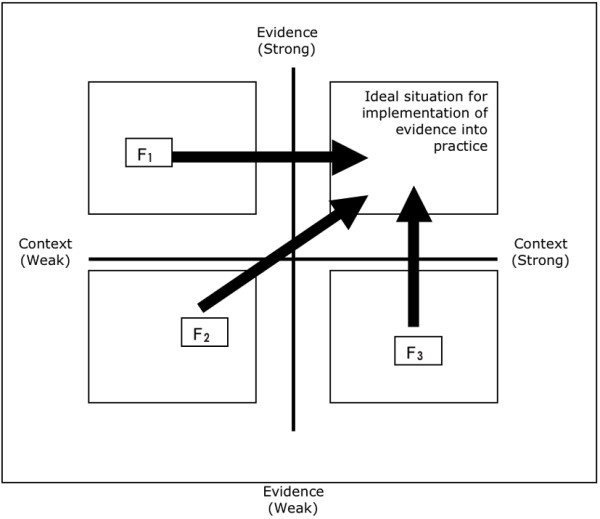
BACKGROUND: The PARiHS framework (Promoting Action on Research Implementation in Health Services) has proved to be a useful practical and conceptual heuristic for many researchers and practitioners in framing their research or knowledge translation endeavours. However, as a conceptual framework it still remains untested and therefore its contribution to the overall development and testing of theory in the field of implementation science is largely unquantified. DISCUSSION: This being the case, the paper provides an integrated summary of our conceptual and theoretical thinking so far and introduces a typology (derived from social policy analysis) used to distinguish between the terms conceptual framework, theory and model - important definitional and conceptual issues in trying to refine theoretical and methodological approaches to knowledge translation. Secondly, the paper describes the next phase of our work, in particular concentrating on the conceptual thinking and mapping that has led to the generation of the hypothesis that the PARiHS framework is best utilised as a two-stage process: as a preliminary (diagnostic and evaluative) measure of the elements and sub-elements of evidence (E) and context (C), and then using the aggregated data from these measures to determine the most appropriate facilitation method. The exact nature of the intervention is thus determined by the specific actors in the specific context at a specific time and place. In the process of refining this next phase of our work, we have had to consider the wider issues around the use of theories to inform and shape our research activity; the ongoing challenges of developing robust and sensitive measures; facilitation as an intervention for getting research into practice; and finally to note how the current debates around evidence into practice are adopting wider notions that fit innovations more generally. SUMMARY: The paper concludes by suggesting that the future direction of the work on the PARiHS framework is to develop a two-stage diagnostic and evaluative approach, where the intervention is shaped and moulded by the information gathered about the specific situation and from participating stakeholders. In order to expedite the generation of new evidence and testing of emerging theories, we suggest the formation of an international research implementation science collaborative that can systematically collect and analyse experiences of using and testing the PARiHS framework and similar conceptual and theoretical approaches. We also recommend further refinement of the definitions around conceptual framework, theory, and model, suggesting a wider discussion that embraces multiple epistemological and ontological perspectives.
Overview
The claims and statistics of this paper haven’t been checked yet.
Free: it reads the open-access text and checks the first 5 claims that cite a source we can check. Create a free account to check every claim.
Integrity signals
Registry
Cites
Statistics
Figures
Verification
Claims the paper makes
The claims and statistics of this paper haven’t been checked yet.
Free: it reads the open-access text and checks the first 5 claims that cite a source we can check. Create a free account to check every claim.
Claims other papers make about this one
Each is checked against this paper’s own text: does it say what the citing paper says it does?
The source backs part of the claim, not all of it — or backs it for a different population, condition or comparison.
In the citing paper
“This framework is based on the available evidence (Phase 1) where the relevant components and processes were identified, such as methodological steps and program planning [20, 28–30], identification of vulnerable groups [30, 34], the identification of barriers and facilitators [21, 33, 34], the design of implementation programs and tools [30, 32, 33] and monitoring and evaluation of implementation”
From Conceptual framework of equity-focused implementation research for health programs (EquIR) (2019) · cites this paper as [20]
Experimental — accuracy not yet measuredThe cited source says what the claim attributes to it.
In the citing paper
“The PARIHS conceptual framework was developed in an attempt to represent the dynamic and multi-faceted nature of implementation in healthcare.”
From PARIHS revisited: from heuristic to integrated framework for the successful implementation of knowledge into practice (2015) · cites this paper as [1]
In the citing paper
“Others have published stage or phase models of implementation.”
From Writing implementation research grant proposals: ten key ingredients (2012) · cites this paper as [47]
In the citing paper
“Raghavan et al.[119] discuss the policy ecology of implementation, and emphasize that greater attention should be paid to marginal costs associated with implementing evidence-based treatments, including expenses for provider training, supervision, and consultation.”
From Writing implementation research grant proposals: ten key ingredients (2012) · cites this paper as [119]
In the citing paper
“Although theories, models and frameworks are distinct concepts, the terms are sometimes used interchangeably in implementation science [9,14,39].”
From Making sense of implementation theories, models and frameworks (2015) · cites this paper as [39]
4 more claims about this paper
Create a free account to see every claim other papers make about this one.
Self-check
Percentages, sums and reported differences re-computed from the paper’s own numbers.
The self-check needs the paper’s full text.
Citations
Cites
Rogers, E. M., Singhal, A., & Quinlan, M. M. (2019) · An Integrated Approach to Communication Theory and Research · doi:10.4324/9780203710753-35 · Cited by 37,322
The Structure of Scientific Revolutions
Kuhn, T. S., & Schlegel, R. (1963) · Physics Today · doi:10.1063/1.3050879 · Cited by 35,538
Valente, T. W. (2003) · Genetics in Medicine · doi:10.1097/01.gim.0000061743.67794.c4 · Cited by 13,723
The Structure of Scientific Revolutions.
Bohm, D., & Kuhn, T. S. (1964) · The Philosophical Quarterly · doi:10.2307/2217783 · Cited by 9,130
The Transtheoretical Model of Health Behavior Change.
Prochaska, J. O., & Velicer, W. F. (1997) · American Journal of Health Promotion · doi:10.4278/0890-1171-12.1.38 · Cited by 7,782
Diffusion of Innovations in Service Organizations: Systematic Review and Recommendations
GREENHALGH, T., ROBERT, G., MACFARLANE, F., BATE, P., & KYRIAKIDOU, O. (2004) · The Milbank Quarterly · doi:10.1111/j.0887-378x.2004.00325.x · Cited by 7,448
Lost in knowledge translation: Time for a map?
Graham, I. D., Logan, J., Harrison, M. B., Straus, S. E., Tetroe, J., Caswell, W., & Robinson, N. (2006) · Journal of Continuing Education in the Health Professions · doi:10.1002/chp.47 · Cited by 4,705
Theories of the Policy Process
Sabatier, P. (2019) · Routledge eBooks · doi:10.4324/9780367274689 · Cited by 3,490
Realist review - a new method of systematic review designed for complex policy interventions
Pawson, R., Greenhalgh, T., Harvey, G., & Walshe, K. (2005) · Journal of Health Services Research & Policy · doi:10.1258/1355819054308530 · Cited by 3,190 · cited 2×
“Looking to other methodologies that are less concerned with causation and more focused on explanatory understanding and action (such as realist evaluation) [33] may limit reductionism, and provide enlightening findings about the interactions and complexities involved in knowledge translation activity [23].”
BackgroundSelf-citationBero, L. A., Grilli, R., Grimshaw, J. M., Harvey, E., Oxman, A. D., & Thomson, M. A. (1998) · BMJ · doi:10.1136/bmj.317.7156.465 · Cited by 2,396
Research works printed but not linked: 5
- Dopson S Fitzgerald L (Eds) Knowledge to Action? Evidence-based health care in context 2005 Oxford: Oxford University Press
- Oxman A No Magic Bullets: A Systematic Review of 102 Trials of Interventions to help Care Professionals Deliver Services More Effectively and Efficiently North East Thames Regional Health Authority London 1994
- Loftus-Hills A Harvey G A review of the role of the facilitator in changing professional healthcare practice 2000 RCN Institute. Oxford
- Royal College of Nursing Becoming an RCN Accredited Facilitator 2004 Royal College of Nursing. London
- Manley K Hardy S Titchen A Garbett R McCormack B Changing Patients' Worlds through Nursing Practice Expertise: A Research Report 2005 London: Royal College of Nursing
Cited by
Damschroder, L. J., Aron, D. C., Keith, R. E., Kirsh, S. R., Alexander, J. A., & Lowery, J. C. (2009) · Implementation Science · doi:10.1186/1748-5908-4-50 · Cited by 14,496
“[and] need not specify the direction of relationships or identify critical hypotheses' [12].”
BackgroundPowell, B. J., Waltz, T. J., Chinman, M. J., Damschroder, L. J., Smith, J. L., Matthieu, M. M., Proctor, E. K., & Kirchner, J. E. (2015) · Implementation Science · doi:10.1186/s13012-015-0209-1 · Cited by 4,963
Making sense of implementation theories, models and frameworks
Nilsen, P. (2015) · Implementation Science · doi:10.1186/s13012-015-0242-0 · Cited by 4,447
Implementation strategies: recommendations for specifying and reporting
Proctor, E. K., Powell, B. J., & McMillen, J. C. (2013) · Implementation Science · doi:10.1186/1748-5908-8-139 · Cited by 2,585
An introduction to implementation science for the non-specialist
Bauer, M. S., Damschroder, L., Hagedorn, H., Smith, J., & Kilbourne, A. M. (2015) · BMC Psychology · doi:10.1186/s40359-015-0089-9 · Cited by 1,611
A systematic review of the use of the Consolidated Framework for Implementation Research
Kirk, M. A., Kelley, C., Yankey, N., Birken, S. A., Abadie, B., & Damschroder, L. (2015) · Implementation Science · doi:10.1186/s13012-016-0437-z · Cited by 1,496
Bridging Research and Practice
Tabak, R. G., Khoong, E. C., Chambers, D. A., & Brownson, R. C. (2012) · American Journal of Preventive Medicine · doi:10.1016/j.amepre.2012.05.024 · Cited by 1,386
Harvey, G., & Kitson, A. (2015) · Implementation Science · doi:10.1186/s13012-016-0398-2 · Cited by 1,271
“Included in this mix are theories related to complexity [72, 73], absorptive capacity [74] and learning organisations [75] as well as theories related to leadership and organisational culture [76]. Other theories relate to how innovation and change can be sustained in a system. Again, there are a number of theories th…”
BackgroundInfluentialSelf-citationTorous, J., Bucci, S., Bell, I. H., Kessing, L. V., Faurholt‐Jepsen, M., Whelan, P., Carvalho, A. F., Keshavan, M., Linardon, J., & Firth, J. (2021) · World Psychiatry · doi:10.1002/wps.20883 · Cited by 1,199
Flottorp, S. A., Oxman, A. D., Krause, J., Musila, N. R., Wensing, M., Godycki-Cwirko, M., Baker, R., & Eccles, M. P. (2013) · Implementation Science · doi:10.1186/1748-5908-8-35 · Cited by 1,138
Pfadenhauer, L. M., Gerhardus, A., Mozygemba, K., Lysdahl, K. B., Booth, A., Hofmann, B., Wahlster, P., Polus, S., Burns, J., Brereton, L., et al. (2017) · Implementation Science · doi:10.1186/s13012-017-0552-5 · Cited by 1,016
“ordinate role; where it is considered explicitly, it is usually restricted to an organisational context [27, 44, 91].”
BackgroundMethodMethods to Improve the Selection and Tailoring of Implementation Strategies
Powell, B. J., Beidas, R. S., Lewis, C. C., Aarons, G. A., McMillen, J. C., Proctor, E. K., & Mandell, D. S. (2017) · The Journal of Behavioral Health Services & Research · doi:10.1007/s11414-015-9475-6 · Cited by 967
Braithwaite, J., Churruca, K., Long, J. C., Ellis, L. A., & Herkes, J. (2018) · BMC Medicine · doi:10.1186/s12916-018-1057-z · Cited by 845
Kontos, P. C., & Poland, B. D. (2009) · Implementation Science · doi:10.1186/1748-5908-4-1 · Cited by 760
Helfrich, C. D., Li, Y.-F., Sharp, N. D., & Sales, A. E. (2009) · Implementation Science · doi:10.1186/1748-5908-4-38 · Cited by 564
Developing a Framework for Transferring Knowledge Into Action: A Thematic Analysis of the Literature
Ward, V., House, A., & Hamer, S. (2009) · Journal of Health Services Research & Policy · doi:10.1258/jhsrp.2009.008120 · Cited by 511
Francis, J. J., O’Connor, D., & Curran, J. (2012) · Implementation Science · doi:10.1186/1748-5908-7-35 · Cited by 484
“For example, Kitson and colleagues [29] called for the integration of theoretical perspectives into the Promoting Action on Research in Health Services (PARiHS) framework.”
Michie, S., Carey, R. N., Johnston, M., Rothman, A. J., de Bruin, M., Kelly, M. P., & Connell, L. E. (2018) · Annals of Behavioral Medicine · doi:10.1007/s12160-016-9816-6 · Cited by 475
Using the Knowledge to Action Framework in practice: a citation analysis and systematic review
Field, B., Booth, A., Ilott, I., & Gerrish, K. (2014) · Implementation Science · doi:10.1186/s13012-014-0172-2 · Cited by 454
“The importance of organisational or external factors and the ability to influence them is well recognised [1,3,33-35].”
A Guide for applying a revised version of the PARIHS framework for implementation
Stetler, C. B., Damschroder, L. J., Helfrich, C. D., & Hagedorn, H. J. (2011) · Implementation Science · doi:10.1186/1748-5908-6-99 · Cited by 402
E-learning for health professionals
Vaona, A., Banzi, R., Kwag, K. H., Rigon, G., Cereda, D., Pecoraro, V., Tramacere, I., & Moja, L. (2018) · Cochrane Database of Systematic Reviews · doi:10.1002/14651858.cd011736.pub2 · Cited by 397
Antunes, B., Harding, R., Higginson, I. J., & EUROIMPACT, O. B. O. (2014) · Palliative Medicine · doi:10.1177/0269216313491619 · Cited by 396
Moullin, J. C., Sabater-Hernández, D., Fernandez-Llimos, F., & Benrimoj, S. I. (2015) · Health Research Policy and Systems · doi:10.1186/s12961-015-0005-z · Cited by 392
“– Framework was defined as a graphical or narrative representation of the key factors, concepts, or variables to explain the phenomenon of implementation [27-30], and as a minimum needed to include the steps or strategies for implementation.”
Nilsen, P., Ståhl, C., Roback, K., & Cairney, P. (2013) · Implementation Science · doi:10.1186/1748-5908-8-63 · Cited by 346
Gitlin, L. N., Marx, K., Stanley, I. H., & Hodgson, N. (2015) · The Gerontologist · doi:10.1093/geront/gnu123 · Cited by 336
Making Sense of Implementation Theories, Models, and Frameworks
Nilsen, P. (2020) · Implementation Science 3.0 · doi:10.1007/978-3-030-03874-8_3 · Cited by 322
A randomized controlled trial evaluating the impact of knowledge translation and exchange strategies
Dobbins, M., Hanna, S. E., Ciliska, D., Manske, S., Cameron, R., Mercer, S. L., O'Mara, L., DeCorby, K., & Robeson, P. (2009) · Implementation Science · doi:10.1186/1748-5908-4-61 · Cited by 318
How to study improvement interventions: a brief overview of possible study types
Portela, M. C., Pronovost, P. J., Woodcock, T., Carter, P., & Dixon-Woods, M. (2015) · BMJ Quality & Safety · doi:10.1136/bmjqs-2014-003620 · Cited by 315
Helfrich, C. D., Damschroder, L. J., Hagedorn, H. J., Daggett, G. S., Sahay, A., Ritchie, M., Damush, T., Guihan, M., Ullrich, P. M., & Stetler, C. B. (2010) · Implementation Science · doi:10.1186/1748-5908-5-82 · Cited by 306
Rycroft-Malone, J., Seers, K., Chandler, J., Hawkes, C. A., Crichton, N., Allen, C., Bullock, I., & Strunin, L. (2013) · Implementation Science · doi:10.1186/1748-5908-8-28 · Cited by 303
“A logic model can (although does not have to) encourage a linear and deductive approach to the identification of inputs, processes and outcomes, which does not fit well with the underlying premise of PARIHS, which acknowledges dynamism and the potential for inductive explanation [36].”
BackgroundSelf-citationBarriers to evidence‐based medicine: a systematic review
Sadeghi‐Bazargani, H., Tabrizi, J. S., & Azami‐Aghdash, S. (2014) · Journal of Evaluation in Clinical Practice · doi:10.1111/jep.12222 · Cited by 292
Using realist evaluation to open the black box of knowledge translation: a state-of-the-art review
Salter, K. L., & Kothari, A. (2014) · Implementation Science · doi:10.1186/s13012-014-0115-y · Cited by 279
Theory of reasoned action application for green information technology acceptance
Mishra, D., Akman, I., & Mishra, A. (2014) · Computers in Human Behavior · doi:10.1016/j.chb.2014.03.030 · Cited by 275
A Systematic Review of Strategies for Implementing Empirically Supported Mental Health Interventions
Powell, B. J., Proctor, E. K., & Glass, J. E. (2014) · Research on Social Work Practice · doi:10.1177/1049731513505778 · Cited by 268
Ogrinc, G., Armstrong, G. E., Dolansky, M. A., Singh, M. K., & Davies, L. (2019) · Academic Medicine · doi:10.1097/acm.0000000000002750 · Cited by 263
Resistance, motivations, trust and intention to use mobile financial services
Chemingui, H., & Ben lallouna, H. (2013) · International Journal of Bank Marketing · doi:10.1108/ijbm-12-2012-0124 · Cited by 243
Leeman, J., Calancie, L., Hartman, M. A., Escoffery, C. T., Herrmann, A. K., Tague, L. E., Moore, A. A., Wilson, K. M., Schreiner, M., & Samuel-Hodge, C. (2015) · Implementation Science · doi:10.1186/s13012-015-0272-7 · Cited by 217
The need for systems change: reflections on knowledge translation and organizational change
Kitson, A. L. (2009) · Journal of Advanced Nursing · doi:10.1111/j.1365-2648.2008.04864.x · Cited by 214
Self-citationUsing Stake’s Qualitative Case Study Approach to Explore Implementation of Evidence-Based Practice
Boblin, S. L., Ireland, S., Kirkpatrick, H., & Robertson, K. (2013) · Qualitative Health Research · doi:10.1177/1049732313502128 · Cited by 212
Mazza, D., Chapman, A., & Michie, S. (2013) · BMC Health Services Research · doi:10.1186/1472-6963-13-36 · Cited by 208
Using Complexity and Network Concepts to Inform Healthcare Knowledge Translation
Kitson, A., Brook, A., Harvey, G., Jordan, Z., Marshall, R., O’Shea, R., & Wilson, D. (2017) · International Journal of Health Policy and Management · doi:10.15171/ijhpm.2017.79 · Cited by 203
Self-citationExpert recommendations for implementing change (ERIC): protocol for a mixed methods study
Waltz, T. J., Powell, B. J., Chinman, M. J., Smith, J. L., Matthieu, M. M., Proctor, E. K., Damschroder, L. J., & Kirchner, J. E. (2014) · Implementation Science · doi:10.1186/1748-5908-9-39 · Cited by 202
Cranley, L. A., Cummings, G. G., Profetto-McGrath, J., Toth, F., & Estabrooks, C. A. (2017) · BMJ Open · doi:10.1136/bmjopen-2016-014384 · Cited by 193
Bergström, A., Ehrenberg, A., Eldh, A. C., Graham, I. D., Gustafsson, K., Harvey, G., Hunter, S. C., Kitson, A. A., Rycroft‐Malone, J., & Wallin, L. (2020) · Implementation Science · doi:10.1186/s13012-020-01003-0 · Cited by 191
Self-citationElwy, A. R., Wasan, A. D., Gillman, A. G., Johnston, K. L., Dodds, N. E., McFarland, C. E., & Greco, C. M. (2019) · Psychiatry Research · doi:10.1016/j.psychres.2019.112532 · Cited by 185
Santos, O. P. D., Melly, P., Hilfiker, R., Giacomino, K., Perruchoud, É., Verloo, H., & Pereira, F. (2022) · Healthcare · doi:10.3390/healthcare10112204 · Cited by 183
Hawk, K. F., D’Onofrio, G., Chawarski, M. C., O’Connor, P. G., Cowan, E., Lyons, M. S., Richardson, L., Rothman, R. E., Whiteside, L. K., Owens, P. H., et al. (2020) · JAMA Network Open · doi:10.1001/jamanetworkopen.2020.4561 · Cited by 182
Gramlich, L. M., Sheppard, C. E., Wasylak, T., Gilmour, L. E., Ljungqvist, O., Basualdo-Hammond, C., & Nelson, G. (2017) · Implementation Science · doi:10.1186/s13012-017-0597-5 · Cited by 182
Taylor, S. L., Dy, S., Foy, R., Hempel, S., McDonald, K. M., Øvretveit, J., Pronovost, P. J., Rubenstein, L. V., Wachter, R. M., & Shekelle, P. G. (2011) · BMJ Quality & Safety · doi:10.1136/bmjqs.2010.049379 · Cited by 178
WALSH, S. L., El‐Bassel, N., Jackson, R. D., Samet, J. H., Aggarwal, M., Aldridge, A., Baker, T. J., Barbosa, C., Barocas, J. A., Battaglia, T. A., et al. (2020) · Drug and Alcohol Dependence · doi:10.1016/j.drugalcdep.2020.108335 · Cited by 177
Nazi, K. M. (2013) · Journal of Medical Internet Research · doi:10.2196/jmir.2443 · Cited by 176
Mathieson, A., Grande, G., & Luker, K. (2019) · Primary Health Care Research & Development · doi:10.1017/s1463423618000488 · Cited by 176
O’Reilly, P., Lee, S. H., O’Sullivan, M., Cullen, W., Kennedy, C. M., & MacFarlane, A. E. (2017) · PLoS ONE · doi:10.1371/journal.pone.0177026 · Cited by 173
Melnyk, B. M., Fineout-Overholt, E., Giggleman, M., & Cruz, R. (2010) · Nursing Outlook · doi:10.1016/j.outlook.2010.06.002 · Cited by 173
Implementation science in resource-poor countries and communities
Yapa, H. M., & Bärnighausen, T. (2018) · Implementation Science · doi:10.1186/s13012-018-0847-1 · Cited by 171
Factors influencing the development of evidence-based practice among nurses: a self-report survey
Dalheim, A., Harthug, S., Nilsen, R. M., & Nortvedt, M. W. (2012) · BMC Health Services Research · doi:10.1186/1472-6963-12-367 · Cited by 170
Writing implementation research grant proposals: ten key ingredients
Proctor, E. K., Powell, B. J., Baumann, A. A., Hamilton, A. M., & Santens, R. L. (2012) · Implementation Science · doi:10.1186/1748-5908-7-96 · Cited by 169
Evidence-based practice models and frameworks in the healthcare setting: a scoping review
Dusin, J., Melanson, A., & Lawson, L. M. (2023) · BMJ Open · doi:10.1136/bmjopen-2022-071188 · Cited by 169
Methods to Succeed in Effective Knowledge Translation in Clinical Practice
Kitson, A. L., & Harvey, G. (2016) · Journal of Nursing Scholarship · doi:10.1111/jnu.12206 · Cited by 166
Self-citationEsponda, G. M., Hartman, S., Qureshi, O., Sadler, E., Cohen, A., & Kakuma, R. (2020) · The Lancet Psychiatry · doi:10.1016/s2215-0366(19)30125-7 · Cited by 165
Williams, N. J. (2016) · Administration and Policy in Mental Health and Mental Health Services Research · doi:10.1007/s10488-015-0693-2 · Cited by 164
Effective workplace culture: the attributes, enabling factors and consequences of a new concept
Manley, K., Sanders, K., Cardiff, S., & Webster, J. (2011) · Cited by 164
Ellen, M., Léon, G., Bouchard, G., Ouimet, M., Grimshaw, J., & Lavis, J. N. (2014) · Implementation Science · doi:10.1186/s13012-014-0179-8 · Cited by 161
Conceptual framework of equity-focused implementation research for health programs (EquIR)
Eslava-Schmalbach, J., Garzón-Orjuela, N., Elias, V., Reveiz, L., Tran, N., & Langlois, E. V. (2019) · International Journal for Equity in Health · doi:10.1186/s12939-019-0984-4 · Cited by 160
“Promoting Action on Research Implementation in Health Services (PARISH) [20] Race/Ethnic • Program Planning: A diagnostic and evaluative measure of evidence and context elements.”
BackgroundMethodApplications and applicability of Social Cognitive Theory in information science research
Middleton, L., Hall, H., & Raeside, R. (2018) · Journal of Librarianship and Information Science · doi:10.1177/0961000618769985 · Cited by 160
Tuti, T., Nzinga, J., Njoroge, M., Brown, B., Peek, N., English, M., Paton, C., & van der Veer, S. N. (2017) · Implementation Science · doi:10.1186/s13012-017-0590-z · Cited by 159
Strengthening health systems through embedded research
Ghaffar, A., Langlois, É. V., Rasanathan, K., Peterson, S. S., Adedokun, L., & Tran, N. T. (2017) · Bulletin of the World Health Organization · doi:10.2471/blt.16.189126 · Cited by 157
Narrative review of frameworks for translating research evidence into policy and practice
Milat, A., & Li, B. (2017) · Public Health Research & Practice · doi:10.17061/phrp2711704 · Cited by 155
Dogherty, E. J., Harrison, M. B., Graham, I. D., Vandyk, A. D., & Keeping‐Burke, L. (2013) · Worldviews on Evidence-Based Nursing · doi:10.1111/wvn.12009 · Cited by 152
Children's Sleep Needs: Is There Sufficient Evidence to Recommend Optimal Sleep for Children?
Matricciani, L., Blunden, S., Rigney, G., Williams, M. T., & Olds, T. S. (2013) · Sleep · doi:10.5665/sleep.2538 · Cited by 149
McCormack, B., Rycroft-Malone, J., DeCorby, K., Hutchinson, A. M., Bucknall, T., Kent, B., Schultz, A., Snelgrove-Clarke, E., Stetler, C., Titler, M., et al. (2013) · Implementation Science · doi:10.1186/1748-5908-8-107 · Cited by 147
Self-citationEngagement in research: an innovative three-stage review of the benefits for health-care performance
Hanney, S. R., Boaz, A., Jones, T. H., & Soper, B. (2013) · Health Services and Delivery Research · doi:10.3310/hsdr01080 · Cited by 147
Duncan, E. M., Francis, J. J., Johnston, M., Davey, P., Maxwell, S., McKay, G. A., McLay, J., Ross, S., Ryan, C., Webb, D. J., et al. (2012) · Implementation Science · doi:10.1186/1748-5908-7-86 · Cited by 146
Redman, S., Turner, T., Davies, H. T. O., Williamson, A. B., Haynes, A. S., Brennan, S., Milat, A., O’Connor, D. A., Blyth, F., Jorm, L. R., et al. (2015) · Social Science & Medicine · doi:10.1016/j.socscimed.2015.05.009 · Cited by 145
What supports physiotherapists’ use of research in clinical practice? A qualitative study in Sweden
Dannapfel, P., Peolsson, A. L. C., & Nilsén, P. (2013) · Implementation Science · doi:10.1186/1748-5908-8-31 · Cited by 141
Coles, E., Wells, M., Maxwell, M., Harris, F., Anderson, J. M., Gray, N. M., Milner, G., & MacGillivray, S. A. (2017) · Systematic Reviews · doi:10.1186/s13643-017-0566-8 · Cited by 139
A thematic analysis of theoretical models for translational science in nursing: Mapping the field
Mitchell, S. A., Fisher, C. A., Hastings, C. E., Silverman, L. B., & Wallen, G. R. (2010) · Nursing Outlook · doi:10.1016/j.outlook.2010.07.001 · Cited by 138
“The conceptual model selected to guide a specific knowledge translation initiative substantially influences the aims, design, methods, and evaluation of outcomes.(1,21,121) Science leaders should carefully examine”
MethodBehavioural design: A process for integrating behaviour change and design
Cash, P. J., Hartlev, C. G., & Durazo, C. B. (2016) · Design Studies · doi:10.1016/j.destud.2016.10.001 · Cited by 137
Contribution mapping: a method for mapping the contribution of research to enhance its impact
Kok, M. O., & Schuit, A. J. (2012) · Health Research Policy and Systems · doi:10.1186/1478-4505-10-21 · Cited by 135
Squires, J. E., Aloisio, L. D., Grimshaw, J., Bashir, K., Dorrance, K., Coughlin, M., Hutchinson, A. M., Francis, J., Michie, S., Sales, A. E., et al. (2019) · Implementation Science · doi:10.1186/s13012-019-0900-8 · Cited by 133
Carlfjord, S., Lindberg, M., Bendtsen, P., Nilsen, P., & Andersson, A. (2010) · BMC Family Practice · doi:10.1186/1471-2296-11-60 · Cited by 133
Oborn, E., Barrett, M. I., & Racko, G. (2013) · Journal of Health Organization and Management · doi:10.1108/jhom-01-2012-0004 · Cited by 133
Rycroft-Malone, J., Wilkinson, J. E., Burton, C. R., Andrews, G., Ariss, S., Baker, R., Dopson, S., Graham, I., Harvey, G., Martin, G., et al. (2011) · Implementation Science · doi:10.1186/1748-5908-6-74 · Cited by 132
Self-citationKilbourne, A. M., Almirall, D., Eisenberg, D., Waxmonsky, J., Goodrich, D. E., Fortney, J. C., Kirchner, J. E., Solberg, L. I., Main, D., Bauer, M. S., et al. (2014) · Implementation Science · doi:10.1186/s13012-014-0132-x · Cited by 130
“Based on the Promoting Action on Research Implementation in Health Services (PARiHS) Framework [70-74], facilitation is defined as the process of interactive problem solving and support that occurs in the context of a recognized need for improvement and a supportive interpersonal relationship [41,74].”
MethodKnowledge translation within a population health study: how do you do it?
Kitson, A. A., Powell, K., Hoon, E. A., Newbury, J., Wilson, A., & Beilby, J. (2013) · Implementation Science · doi:10.1186/1748-5908-8-54 · Cited by 128
Self-citationFigtree, G. A., Vernon, S. T., Harmer, J. A., Gray, M. P., Arnott, C. G., Bachour, E., Barsha, G., Brieger, D. B., Brown, A. D. H., Celermajer, D. S., et al. (2023) · Journal of the American College of Cardiology · doi:10.1016/j.jacc.2023.06.045 · Cited by 128
Conklin, J., Lusk, E., Harris, M., & Stolee, P. (2013) · Implementation Science · doi:10.1186/1748-5908-8-7 · Cited by 127
Development and Testing of the Context Assessment Index (CAI)
McCormack, B., McCarthy, G., Wright, J., & Coffey, A. (2009) · Worldviews on Evidence-Based Nursing · doi:10.1111/j.1741-6787.2008.00130.x · Cited by 126
Self-citationEldh, A. C., Almost, J., DeCorby-Watson, K., Gifford, W., Harvey, G., Hasson, H., Kenny, D. J., Moodie, S., Wallin, L., & Yost, J. (2017) · BMC Health Services Research · doi:10.1186/s12913-016-1958-5 · Cited by 126
Self-citationEllen, M., Léon, G., Bouchard, G., Lavis, J. N., Ouimet, M., & Grimshaw, J. (2013) · Implementation Science · doi:10.1186/1748-5908-8-84 · Cited by 126
Watts, B. V., Shiner, B., Zubkoff, L., Carpenter-Song, E., Ronconi, J. M., & Coldwell, C. M. (2014) · Psychiatric Services · doi:10.1176/appi.ps.201300176 · Cited by 125
Wadensten, B., Fröjd, C., Swenne, C. L., Gordh, T., & Gunningberg, L. (2011) · Journal of Clinical Nursing · doi:10.1111/j.1365-2702.2010.03482.x · Cited by 124
A Scoping Review of the Use of Theory in Studies of Knowledge Translation
Colquhoun, H. L., Letts, L. J., Law, M., MacDermid, J. C., & Missiuna, C. A. (2010) · Canadian Journal of Occupational Therapy · doi:10.2182/cjot.2010.77.5.3 · Cited by 123
Estabrooks, C. A., Squires, J. E., Hayduk, L. A., Cummings, G. G., & Norton, P. (2011) · BMC Medical Research Methodology · doi:10.1186/1471-2288-11-107 · Cited by 122
Payne, A. A., & Eckert, R. (2009) · Prevention Science · doi:10.1007/s11121-009-0157-6 · Cited by 120
Leadership facilitation strategies to establish evidence‐based practice in an acute care hospital
Hauck, S. L., Winsett, R. P., & Kuric, J. (2012) · Journal of Advanced Nursing · doi:10.1111/j.1365-2648.2012.06053.x · Cited by 119
Ocloo, J. E., Goodrich, J., Tanaka, H., Birchall-Searle, J., Dawson, D., & Farr, M. (2020) · Health Research Policy and Systems · doi:10.1186/s12961-019-0487-1 · Cited by 119
Haynes, A. S., Rowbotham, S. J., Redman, S., Brennan, S., Williamson, A. B., & Moore, G. (2018) · Health Research Policy and Systems · doi:10.1186/s12961-018-0277-1 · Cited by 118
Stevens, B., Yamada, J., Estabrooks, C. A., Stinson, J., Campbell, F. A., Scott, S. D., & Cummings, G. G. (2013) · Pain · doi:10.1016/j.pain.2013.09.007 · Cited by 118
Wangensteen, S., Johansson, I. S., Björkström, M. E., & Nordström, G. M. (2011) · Journal of Clinical Nursing · doi:10.1111/j.1365-2702.2010.03629.x · Cited by 117
Metadata
- Authors
- Kitson, A. L., Rycroft-Malone, J., Harvey, G., McCormack, B., Seers, K., & Titchen, A.
- Affiliations
- University of Manchester (GB)
- University of Ulster (GB)
- University of Warwick (GB)
- Fontys University of Applied Sciences (NL)
- Venue
- Implementation Science
- Published
- 2008-01-07
- Volume
- 3
- Issue
- 1
- Pages
- 1-1
- ISSN
- 1748-5908 (ISSN-L)
- PMC
- PMC2235887
- OpenAlex
- W1989529511
- Cited by
- 1,314
- References
- 54
- Citations by year
- 2026: 22 · 2025: 51 · 2024: 42 · 2023: 62 · 2022: 68 · 2021: 81 · 2020: 94 · 2019: 82 · 2018: 87 · 2017: 91 · 2016: 108 · 2015: 109 · 2014: 80 · 2013: 102 · 2012: 79
- FWCI
- 99.28
- Type
- journal article
- Language
- en
- Open access
- gold
- doi.org
- Licence
- Locations
- Implementation Science (publishedVersion, cc-by)
- PubMed Central (publishedVersion, cc-by)
- PubMed (publishedVersion)
- Warwick Research Archive Portal (University of Warwick) (acceptedVersion)
- Adelaide Research & Scholarship (AR&S) (University of Adelaide) (submittedVersion, cc-by)
- DOAJ (DOAJ: Directory of Open Access Journals) (submittedVersion, cc-by-sa)
- Lancaster EPrints (Lancaster University) (submittedVersion)
- Queen Margaret University Publications Repository (Queen Margaret University) (submittedVersion)
- Research Explorer (The University of Manchester) (submittedVersion)
- Topics
- Health Sciences › Health Professions › General Health Professions › Health Policy Implementation Science
- Health Sciences › Health Professions › General Health Professions › Health Sciences Research and Education
- Health Sciences › Medicine › Public Health, Environmental and Occupational Health › Clinical practice guidelines implementation
- Keywords
- PARIHS framework, knowledge translation, conceptual framework, facilitation techniques, stakeholder engagement
About these checks
Registry, retraction, Cites and statistics results are computed, not judged, with one exception: a printed reference that no index lists is read once by a model before it counts as a citation error. Claims are extracted by a model and kept only when their quote appears verbatim in the text; each cited source is then checked, with a model’s help, for whether it says what the claim relies on. Those verdicts can be wrong — read the claim’s quote and the cited source before relying on one.
Statistics and arithmetic are recomputed, not judged.
Confidence bands are shown only for fields calibrated on our annotated test set. None is calibrated yet, so no band is shown.
What counts as a claim ›How we measure confidence ›How we check this ›
Are you an author, or do you see a problem with this page? Request a review
Data sources
Bibliographic data: Semantic Scholar, OpenAlex, Crossref.
Contains information from the Semantic Scholar Academic Graph Datasets, made available under the ODC Attribution License (ODC-BY 1.0).
Semantic Scholar’s data is described in: Kinney, R., et al. (2023). The Semantic Scholar Open Data Platform. arXiv:2301.10140.
