

The DOI matches its Crossref record; 119 of the 122 references it cites were found in a registry or an index; 11 of the 163 sources its claims cite were checked for support.
Rationality versus reality: the challenges of evidence-based decision making for health policy makers
Open accessAbstract
BACKGROUND: Current healthcare systems have extended the evidence-based medicine (EBM) approach to health policy and delivery decisions, such as access-to-care, healthcare funding and health program continuance, through attempts to integrate valid and reliable evidence into the decision making process. These policy decisions have major impacts on society and have high personal and financial costs associated with those decisions. Decision models such as these function under a shared assumption of rational choice and utility maximization in the decision-making process. DISCUSSION: We contend that health policy decision makers are generally unable to attain the basic goals of evidence-based decision making (EBDM) and evidence-based policy making (EBPM) because humans make decisions with their naturally limited, faulty, and biased decision-making processes. A cognitive information processing framework is presented to support this argument, and subtle cognitive processing mechanisms are introduced to support the focal thesis: health policy makers' decisions are influenced by the subjective manner in which they individually process decision-relevant information rather than on the objective merits of the evidence alone. As such, subsequent health policy decisions do not necessarily achieve the goals of evidence-based policy making, such as maximizing health outcomes for society based on valid and reliable research evidence. SUMMARY: In this era of increasing adoption of evidence-based healthcare models, the rational choice, utility maximizing assumptions in EBDM and EBPM, must be critically evaluated to ensure effective and high-quality health policy decisions. The cognitive information processing framework presented here will aid health policy decision makers by identifying how their decisions might be subtly influenced by non-rational factors. In this paper, we identify some of the biases and potential intervention points and provide some initial suggestions about how the EBDM/EBPM process can be improved.
Overview
AI snapshot
Written from the paper’s full text.
TL;DR
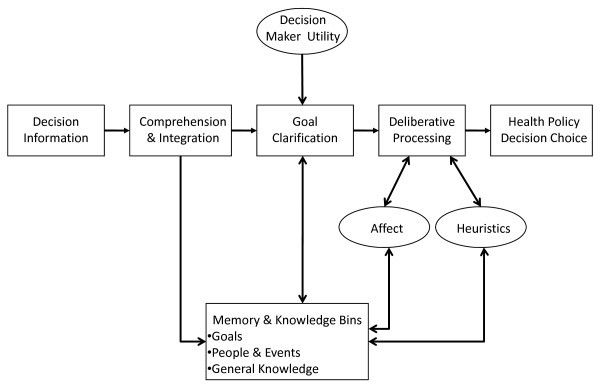
This conceptual paper argues that evidence-based decision making (EBDM) and evidence-based policy making (EBPM) rest on rational-choice assumptions that are undermined by limited, biased cognitive information processing. It presents a cognitive framework in which decision maker utility, affect, and heuristics subtly shape how health policy makers interpret and use evidence.
Key findings
- The paper argues that health policy makers generally cannot meet EBDM/EBPM’s rational goals because decision making is influenced by subjective cognitive processing rather than objective evidence alone; bounded rationality and “satisficing” lead decision makers to choose alternatives that meet minimum criteria rather than optimize.
- It identifies three major cognitively generated influences on evidence processing: decision maker utility, affect, and heuristics (availability, representativeness, and anchoring and adjustment).
- It offers propositions: policy decisions may reflect individual rather than societal utility and are more likely supported when linked to decision makers’ experience (1a, 1b); trait affect influences risk tolerance and uncertainty in supporting policies (2); and policy makers facing difficult information will use available relevant heuristics to support a policy (3).
- As context, the paper reports 2008 US national health expenditures of $2.3 trillion, or $7,681 per person, accounting for 16.2% of GDP, projected to reach 19.3% of GDP by 2019, approximately $4.5 trillion.
Methods
- Design: conceptual/theoretical paper, not an empirical study; it synthesizes decision-making and policy literature and presents a cognitive information processing framework based on Wyer and Srull.
- Data or sample: no empirical data, sample, or formal analysis are reported.
- Main analysis: narrative development of a framework and propositions linking utility, affect, and heuristics to health policy decision making, followed by suggested improvements for EBDM/EBPM.
Limitations
- Stated: the paper notes that empirical studies could be designed to test the degree to which these issues impact health policy decisions, indicating its propositions are not empirically tested; it also states that group decision making is outside the focus of the paper.
- Evident: there is no formal limitations section, no empirical sample, and no tested outcomes; the framework is conceptual and its proposed relationships remain untested in the paper itself.
Model-written summary. Check it against the paper before relying on it.
Integrity signals
Registry
Cites
Statistics
Figures

Verification
Claims the paper makes
40 Own interpretation · 29 Not checked yet · 10 No full text of the sources · 6 Partly supported · 2 Supported so far · 2 Sources not found · 1 No basis given · accuracy not yet measured
The cited sources support only part of this claim — read each source’s verdict below.
In the paper
“However, decision-making research has shown that decision makers, even if they have access to required information and have relevant expertise, may not engage in complex cognitive information processing when making decisions [13,15,44,46-50].”
§ Rationality versus reality: the challenges of evidence-based decision making for health policy makers > Discussion > EBDM: The challenges of rational choice
What the sources say
- Not checked — no full text of the sourcecites [13] Nutley SM, Walter I, Davies HTO: Using Evidence: How Research Can Inform Public Services. 2007, The Policy Press source
- Partly supportedcites [15] Soumerai SB, Ross-Degnan D, Fortress EE, Walser BL: Determinants of Change in Medicaid Pharmaceutical Cost Sharing: Does Evidence Affect Policy?. The Milbank Quarterly. 1997, 75: 11-34. 10.1111/1468-0009.00043. sourceExperimental — accuracy not yet measured
The Discussion (page unavailable) says Medicaid managers sometimes knew of relevant research and policy risks, yet political pressure for quick budget fixes often prevailed. This supports the point that access to information need not produce an evidence-based decision. The paper does not establish that decision makers with relevant expertise declined to engage in complex cognitive processing; it instead emphasizes political constraints and, in the ‘Lack of Infrastructure for Policy Formulation and Evaluation’ section, gaps in analytic skills. (LLM, conf=0.78)
- Not checked — no full text of the sourcecites [44] Simon HA: A Behavioral Model of Rational Choice. Quarterly Journal of Economics. 1955, 69: 99-118. 10.2307/1884852. source
- Not checked — no full text of the sourcecites [46] Simon HA: Bounded Rationality and Organizational Learning. Organization Science. 1991, 2: 125-135. 10.1287/orsc.2.1.125. source
- Not checked — no full text of the sourcecites [47] Kahneman D, Tversky A: Prospect Theory: An Analysis of Decision Under Risk. Econometrica. 1979, 47: 263-291. 10.2307/1914185. source
- Not checked yetcites [48] Zey M: Criticisms of Rational Choice Models. Decision Making: Alternatives to Rational Choice Models. Edited by: Zey M. 1992, Newbury Park: Sage Publications, 10-31.
- Not checked — no full text of the sourcecites [49] Fernandes R, Simon HA: A Study of How Individuals Solve Complex and Ill-Structured Problems. Policy Sciences. 1999, 32: 225-245. 10.1023/A:1004668303848. source
- Not checked — no full text of the sourcecites [50] Agosto DE: Bounded Rationality and Satisficing in Young Peoples' Web-Based Decision Making. Journal of the American Society for Information Science and Technology. 2001, 53: 16-27. 10.1002/asi.10024. source
hedgedconditional- Asserted: passes — The authors put it forward as true.
- Checkable: passes — It can be checked against evidence.
- Load-bearing: passes — The paper’s conclusions depend on it.
- Based: passes — The paper gives a reason why it holds.
The sources with a verdict support this claim; the rest weren’t checked yet, have no full text we could read, or their verdicts aren’t rated yet.
In the paper
“Research investigating individual decision making has identified cognitive information processing as a key factor in the decision-making process [6-8].”
§ Rationality versus reality: the challenges of evidence-based decision making for health policy makers > Background
What the sources say
- Not checked yetcites [6] Isen AM: Positive Affect and Decision Making. Handbook of Emotions. Edited by: Lewis M, Haviland-Jones JM. 2000, New York: The Guilford Press, 417-435. 2
- Supportedcites [7] Kuvaas B, Selart M: Effects of Attribute Framing on Cognitive Processing and Evaluation. Organizational Behavior and Human Decision Processes. 2004, 95: 198-207. 10.1016/j.obhdp.2004.08.001. source
The Theory and hypotheses section (page not provided) describes individual information-processing models and explains how the thoroughness of cognitive processing varies as decision makers evaluate information. The paper thus treats cognitive information processing as an important part of individual decision making, consistent with the broad claim. (LLM, conf=0.88)
- Not checked — no full text of the sourcecites [8] Simon AF, Fagley NS, Halleran JG: Decision Framing: Moderating Effects of Differences and Cognitive Processing. Journal of Behavioral Decision Making. 2004, 17: 77-93. 10.1002/bdm.463. source
plaincorrelational- Asserted: passes — The authors put it forward as true.
- Checkable: passes — It can be checked against evidence.
- Load-bearing: passes — The paper’s conclusions depend on it.
- Based: passes — The paper gives a reason why it holds.
None of the sources cited for this claim have been checked yet.
In the paper
“For example, cognitive processing research has identified both bounded rationality and 'satisficing' as limitations to complex cognitive processing [2,15,44,46-50].”
§ Rationality versus reality: the challenges of evidence-based decision making for health policy makers > Discussion > EBDM: The challenges of rational choice
What the sources say
- Not checked — no full text of the sourcecites [2] Redd SB: The Influence of Advisors on Foreign Policy Decision Making. Journal of Conflict Resolution. 2002, 46: 335-364. 10.1177/0022002702046003002. source
- Could not verifycites [15] Soumerai SB, Ross-Degnan D, Fortress EE, Walser BL: Determinants of Change in Medicaid Pharmaceutical Cost Sharing: Does Evidence Affect Policy?. The Milbank Quarterly. 1997, 75: 11-34. 10.1111/1468-0009.00043. sourceExperimental — accuracy not yet measured
The 'Lack of Infrastructure for Policy Formulation and Evaluation' section (page unavailable) describes limited analytic skills and subjective Medicaid policy decisions, but does not identify bounded rationality or satisficing as cognitive-processing limitations. Searches for both terms found no passage in our copy addressing that claim. (LLM, conf=0.76)
- Not checked — no full text of the sourcecites [44] Simon HA: A Behavioral Model of Rational Choice. Quarterly Journal of Economics. 1955, 69: 99-118. 10.2307/1884852. source
- Not checked — no full text of the sourcecites [46] Simon HA: Bounded Rationality and Organizational Learning. Organization Science. 1991, 2: 125-135. 10.1287/orsc.2.1.125. source
- Not checked — no full text of the sourcecites [47] Kahneman D, Tversky A: Prospect Theory: An Analysis of Decision Under Risk. Econometrica. 1979, 47: 263-291. 10.2307/1914185. source
- Not checked yetcites [48] Zey M: Criticisms of Rational Choice Models. Decision Making: Alternatives to Rational Choice Models. Edited by: Zey M. 1992, Newbury Park: Sage Publications, 10-31.
- Not checked — no full text of the sourcecites [49] Fernandes R, Simon HA: A Study of How Individuals Solve Complex and Ill-Structured Problems. Policy Sciences. 1999, 32: 225-245. 10.1023/A:1004668303848. source
- Not checked — no full text of the sourcecites [50] Agosto DE: Bounded Rationality and Satisficing in Young Peoples' Web-Based Decision Making. Journal of the American Society for Information Science and Technology. 2001, 53: 16-27. 10.1002/asi.10024. source
plaindirect- Asserted: passes — The authors put it forward as true.
- Checkable: passes — It can be checked against evidence.
- Load-bearing: passes — The paper’s conclusions depend on it.
- Based: passes — The paper gives a reason why it holds.
The cited sources support only part of this claim — read each source’s verdict below.
In the paper
“Therefore, despite the positive intent of EBDM, health policy outcomes may actually be, to a varying extent, subjectively derived [22,23,33,40,45,61].”
§ Rationality versus reality: the challenges of evidence-based decision making for health policy makers > Discussion > EBDM: The challenges of rational choice
What the sources say
- Supportedcites [22] Lavis JN, Ross SE, Hurley JE, Stoddart GL, Woodward C, Abelson J, Giacomini M: Examining the Role of Health Services Research in Public Policymaking. The Milbank Quarterly. 2002, 80: 125-154. 10.1111/1468-0009.00005. source
In “Finding Patterns in When Research is Used and Not Used,” the paper identifies policymakers’ values, interests, and perceptions as influences alongside research. In “Reflections on What to Look for When Looking for Research Use,” it reports that one policy using research was among the least well informed. These passages support the qualified claim that health policy decisions may reflect subjective factors despite efforts to use evidence. (LLM, conf=0.86)
- Supportedcites [23] Lavis JN, Robertson D, Woodside JM, McLeod CB, Abelson J, Knowledge Transfer Study Group: How Can Research Organizations More Effectively Transfer Research Knowledge to Decision Makers?. The Milbank Quarterly. 2003, 81: 221-245. 10.1111/1468-0009.t01-1-00052. source
In “To Whom Should Research Knowledge Be Transferred?” (page not available), the paper says policy decisions are influenced not only by research knowledge but also by political factors, values, opinions, and interests. That supports the hedged claim that health policy outcomes may be shaped to varying degrees by subjective considerations despite evidence-based decision-making efforts. (LLM, conf=0.88)
- Not checked — no full text of the sourcecites [33] Mulrow CD, Lohr KN: Proof and Policy From Medical Research Evidence. Journal of Health Politics, Policy, and Law. 2001, 26: 249-266. 10.1215/03616878-26-2-249. source
- Partly supportedcites [40] Walshe K, Rundall TG: Evidence-Based Management: From Theory to Practice in Health Care. The Milbank Quarterly. 2001, 79: 429-457. 10.1111/1468-0009.00214. sourceExperimental — accuracy not yet measured
In “Research and Evidence,” the paper says managers may view research findings as subjective and context-dependent. “How Decisions Are Made” says managerial decisions can be shaped by stakeholders’ interests and political constraints, while the discussion on p. 429 extends the concern about evidence-based practice to health policy. These passages support the possibility of subjective influences on decisions, but do not establish that health policy outcomes themselves are subjectively derived. (LLM, conf=0.84)
- Not checked — no full text of the sourcecites [45] Maynard RA: Presidential Address - Evidence-Based Decision Making: What Will it Take for the Decision Makers to Care?. Journal of Policy Analysis and Management. 2006, 25: 249-265. 10.1002/pam.20169. source
- Not checked — no full text of the sourcecites [61] Spitz B, Abramson J: When Health Policy is the Problem: A Report From the Field. Journal of Health Politics, Policy, and Law. 2005, 30: 327-365. 10.1215/03616878-30-3-327. source
hedgedconditional- Asserted: passes — The authors put it forward as true.
- Checkable: passes — It can be checked against evidence.
- Load-bearing: passes — The paper’s conclusions depend on it.
- Based: passes — The paper gives a reason why it holds.
- Supported
The cited sources support only part of this claim — read each source’s verdict below.
In the paper
“Decision-making research has demonstrated that a decision maker's utility is highly subjective and may include variables, such as personal gain, risk tolerance, relevance to related events, and value of a decision to the organization [22,28,44,46,47,54].”
§ Rationality versus reality: the challenges of evidence-based decision making for health policy makers > Discussion > EBDM: The challenges of rational choice
What the sources say
- Partly supportedcites [22] Lavis JN, Ross SE, Hurley JE, Stoddart GL, Woodward C, Abelson J, Giacomini M: Examining the Role of Health Services Research in Public Policymaking. The Milbank Quarterly. 2002, 80: 125-154. 10.1111/1468-0009.00005. sourceExperimental — accuracy not yet measured
In “Finding Patterns in When Research is Used and Not Used” (page unavailable), the paper identifies policymakers’ values and interests, including perceptions of who benefits or is harmed, as influences on policy decisions. “What Conditions We Found That Appear to Favor Research Use” also describes policy legacies and the credibility of another initiative as influences. The copy does not characterize these influences as a decision maker’s subjective utility or identify risk tolerance among its variables. (LLM, conf=0.79)
- Not checked — no full text of the sourcecites [28] Tversky A, Kahneman D: The Framing of Decisions and the Psychology of Choice. Science. 1981, 211: 453-458. 10.1126/science.7455683. source
- Not checked — no full text of the sourcecites [44] Simon HA: A Behavioral Model of Rational Choice. Quarterly Journal of Economics. 1955, 69: 99-118. 10.2307/1884852. source
- Not checked — no full text of the sourcecites [46] Simon HA: Bounded Rationality and Organizational Learning. Organization Science. 1991, 2: 125-135. 10.1287/orsc.2.1.125. source
- Not checked — no full text of the sourcecites [47] Kahneman D, Tversky A: Prospect Theory: An Analysis of Decision Under Risk. Econometrica. 1979, 47: 263-291. 10.2307/1914185. source
- Not checked yetcites [54] Jones BD: Reconceiving Decision-Making in Democratic Politics: Attention, Choice, and Public Policy. 1994, Chicago: University of Chicago Press
boostedcorrelational- Asserted: passes — The authors put it forward as true.
- Checkable: passes — It can be checked against evidence.
- Load-bearing: passes — The paper’s conclusions depend on it.
- Based: passes — The paper gives a reason why it holds.
- Partly supported
The cited sources support only part of this claim — read each source’s verdict below.
In the paper
“Furthermore, policy makers in healthcare have been found to incorporate their self-interests (their personal utility) when prioritizing and developing policy [22].”
§ Rationality versus reality: the challenges of evidence-based decision making for health policy makers > Discussion > Decision maker utility
What the sources say
- Partly supportedcites [22] Lavis JN, Ross SE, Hurley JE, Stoddart GL, Woodward C, Abelson J, Giacomini M: Examining the Role of Health Services Research in Public Policymaking. The Milbank Quarterly. 2002, 80: 125-154. 10.1111/1468-0009.00005. sourceExperimental — accuracy not yet measured
In “What Conditions We Found That Appear to Favor Research Use” (page unavailable), the paper says policymakers’ interests often influenced prioritization. Its summary in “Additional information” (page unavailable) also identifies legislators’ and policy advisers’ interests as a major influence in one of eight policy-development cases. But the paper describes policy objectives and government interests, not policymakers’ personal utility; it also says stakeholders’ interests more often drove development. (LLM, conf=0.86)
plaindirect- Asserted: passes — The authors put it forward as true.
- Checkable: passes — It can be checked against evidence.
- Load-bearing: passes — The paper’s conclusions depend on it.
- Based: passes — The paper gives a reason why it holds.
- Partly supported
The cited sources support only part of this claim — read each source’s verdict below.
In the paper
“Consistently, the majority of participants will select their program choices based on how the information regarding lives saved/fatalities rates is framed [28,70,72-74].”
§ Rationality versus reality: the challenges of evidence-based decision making for health policy makers > Discussion > Decision maker utility
What the sources say
- Not checked — no full text of the sourcecites [28] Tversky A, Kahneman D: The Framing of Decisions and the Psychology of Choice. Science. 1981, 211: 453-458. 10.1126/science.7455683. source
- Not checked — no full text of the sourcecites [70] Ubel PA, Baron J, Asch DA: Preference for Equity as a Framing Effect. Medical Decision Making. 2002, 21: 180-189. source
- Partly supportedcites [72] McElroy T, Seta JJ: Framing Effects: An Analytic-Holistic Perspective. Journal of Experimental Social Psychology. 2003, 39: 610-617. 10.1016/S0022-1031(03)00036-2. sourceExperimental — accuracy not yet measured
The Results and discussion of Experiment 1 (page not provided) report that gain/loss framing affected choices when the task had low relevance. The same section reports no framing effect when the task had high relevance, so the unqualified claim that the majority will choose based on framing overstates the paper's findings. (LLM, conf=0.86)
- Not checked — no full text of the sourcecites [73] Mittal V, Ross WT: The Impact of Positive and Negative Affect and Issue Framing on Issue Interpretation and Risk Taking. Organizational Behavior and Human Decision Processes. 1998, 76: 298-324. 10.1006/obhd.1998.2808. source
- Not checked — no full text of the sourcecites [74] Bless H, Betsch T, Franzen A: Framing the Framing Effect: The Impact of Context Cues on Solutions to the 'Asian Disease' Problem. European Journal of Social Psychology. 1999, 28: 287-291. 10.1002/(SICI)1099-0992(199803/04)28:2<287::AID-EJSP861>3.0.CO;2-U. source
boosteddirect- Asserted: passes — The authors put it forward as true.
- Checkable: passes — It can be checked against evidence.
- Load-bearing: passes — The paper’s conclusions depend on it.
- Based: passes — The paper gives a reason why it holds.
None of the sources cited for this claim have been checked yet.
In the paper
“Satisficing alternatives may be subject to a number of diverse influences, which support the position that policy makers can be subject to non-rational decision influences [13,25,41,47,51-53].”
§ Rationality versus reality: the challenges of evidence-based decision making for health policy makers > Discussion > EBDM: The challenges of rational choice
What the sources say
- Not checked — no full text of the sourcecites [13] Nutley SM, Walter I, Davies HTO: Using Evidence: How Research Can Inform Public Services. 2007, The Policy Press source
- Not checked — no full text of the sourcecites [25] Lin V, Gibson B: Evidence-Based Health Policy. 2003, Melbourne: Oxford University Press
- Not checked yetcites [41] Lin V: Competing Rationalities: Evidence-Based Health Policy?. Evidence-Based Health Policy. Edited by: Lin V, Gibson B. 2003, Melbourne: Oxford University Press, 3-17.
- Not checked — no full text of the sourcecites [47] Kahneman D, Tversky A: Prospect Theory: An Analysis of Decision Under Risk. Econometrica. 1979, 47: 263-291. 10.2307/1914185. source
- Not checked — no full text of the sourcecites [51] Gupta M: A Critical Appraisal of Evidence-Based Medicine: Some Ethical Considerations. Journal of Evaluation in Clinical Practice. 2003, 9: 111-121. 10.1046/j.1365-2753.2003.00382.x. source
- Not checked — no full text of the sourcecites [52] Norman G: Examining the Assumptions of Evidence-Based Medicine. Journal of Evaluation in Clinical Practice. 1999, 5: 139-147. 10.1046/j.1365-2753.1999.00197.x. source
- Not checked yetcites [53] Estabrooks CA: Research Utilization and Qualitative Research. The Nature of Qualitative Evidence. Edited by: Morse JM, Swanson J, Kuzel AF. 2001, Thousand Oaks: Sage Publications, 275-298.
plainconditional- Asserted: passes — The authors put it forward as true.
- Checkable: passes — It can be checked against evidence.
- Load-bearing: passes — The paper’s conclusions depend on it.
- Based: passes — The paper gives a reason why it holds.
A conclusion the paper draws from its own results — it cites no other source for it, so there is none to check. The quote shows it is in the paper.
In the paper
“Thus, the decision-making process is substantially more complex than suggested by assumptions governing evidence-based rational choice decision models.”
§ Rationality versus reality: the challenges of evidence-based decision making for health policy makers > Discussion > Cognitive information processing framework
plain- Asserted: passes — The authors put it forward as true.
- Checkable: unclear — It is unclear whether it could be checked against evidence.
- Load-bearing: passes — The paper’s conclusions depend on it.
- Based: passes — The paper gives a reason why it holds.
None of the sources cited for this claim have been checked yet.
In the paper
“Research into cognitive processing has identified three major sources of influence on how information is processed and evaluated: decision maker utility, affect, and heuristics [66-69].”
§ Rationality versus reality: the challenges of evidence-based decision making for health policy makers > Discussion > Cognitively generated decision-making influences
What the sources say
- Not checked yetcites [66] Bazerman MH: Judgment in Managerial Decision Making. 1998, New York: John Wiley and Sons, 4
- Not checked yetcites [67] Slovic P, Monahan J: Probability, Danger, and Coercion: A Study of Risk Perception and Decision Making in Mental Health Law. The Perception of Risk. Edited by: Slovic, P. 2000, Sterling: Earthscan Publications Ltd, 347-36.
- Not checked — no full text of the sourcecites [68] Williams S, Zainuba M, Jackson R: Affective Influences on Risk Perceptions and Risk Intentions. Journal of Managerial Psychology. 2003, 18: 126-137. 10.1108/02683940310465027. source
- Not checked — no full text of the sourcecites [69] Brief AP, Weiss HW: Organizational Behavior: Affect in the Workplace. Annual Review of Psychology. 2002, 53: 279-307. 10.1146/annurev.psych.53.100901.135156. source
plaindirect- Asserted: passes — The authors put it forward as true.
- Checkable: passes — It can be checked against evidence.
- Load-bearing: passes — The paper’s conclusions depend on it.
- Based: passes — The paper gives a reason why it holds.
- It may state two separate claims as one. 18
- Probably not a substantial claim. 21
The sources with a verdict support this claim; the rest weren’t checked yet, have no full text we could read, or their verdicts aren’t rated yet.
In the paper
“Prospect theory, however, demonstrates that a decision maker's perceived utility can be subjectively influenced by the manner in which the information is framed (as a loss/gain or risk/no risk), what reference is being used to evaluate the options, and the relationship/salience of the alternative to the decision maker [47,70-74].”
§ Rationality versus reality: the challenges of evidence-based decision making for health policy makers > Discussion > Decision maker utility
What the sources say
- Not checked — no full text of the sourcecites [47] Kahneman D, Tversky A: Prospect Theory: An Analysis of Decision Under Risk. Econometrica. 1979, 47: 263-291. 10.2307/1914185. source
- Not checked — no full text of the sourcecites [70] Ubel PA, Baron J, Asch DA: Preference for Equity as a Framing Effect. Medical Decision Making. 2002, 21: 180-189. source
- Not checked — no full text of the sourcecites [71] Levin IP, Schneider SL, Gaeth GJ: All Frames are not Created Equal: A Typology and Critical Analysis of Framing Effects. Organizational Behavior and Human Decision Processes. 1998, 76: 149-188. 10.1006/obhd.1998.2804. source
- Supportedcites [72] McElroy T, Seta JJ: Framing Effects: An Analytic-Holistic Perspective. Journal of Experimental Social Psychology. 2003, 39: 610-617. 10.1016/S0022-1031(03)00036-2. source
The paper’s introductory discussion of prospect theory (indexed under Abstract; page unavailable) says options are coded as gains or losses relative to a neutral reference point, then evaluated using subjective values and weighted probabilities. Its Experiment 1 results report that gain/loss framing affected choices between risk-averse and risk-seeking options when the task was less personally relevant, supporting the claim’s point about relevance to the decision-maker. (LLM, conf=0.88)
- Not checked — no full text of the sourcecites [73] Mittal V, Ross WT: The Impact of Positive and Negative Affect and Issue Framing on Issue Interpretation and Risk Taking. Organizational Behavior and Human Decision Processes. 1998, 76: 298-324. 10.1006/obhd.1998.2808. source
- Not checked — no full text of the sourcecites [74] Bless H, Betsch T, Franzen A: Framing the Framing Effect: The Impact of Context Cues on Solutions to the 'Asian Disease' Problem. European Journal of Social Psychology. 1999, 28: 287-291. 10.1002/(SICI)1099-0992(199803/04)28:2<287::AID-EJSP861>3.0.CO;2-U. source
boosteddirect- Asserted: passes — The authors put it forward as true.
- Checkable: passes — It can be checked against evidence.
- Load-bearing: passes — The paper’s conclusions depend on it.
- Based: passes — The paper gives a reason why it holds.
It may state two separate claims as one.
The cited sources support only part of this claim — read each source’s verdict below.
In the paper
“many models guiding the policy making process assume policy makers are capable of accurately analyzing decision information, understanding the relevant evidence, are resistant to influences and biases, and seek to make decisions that maximize societal benefit [5,19,27,28].”
§ Rationality versus reality: the challenges of evidence-based decision making for health policy makers > Background
What the sources say
- Not checked — no full text of the sourcecites [5] Fox DM: Evidence of Evidence-Based Health Policy: The Politics of Systematic Reviews in Coverage Decisions. Health Affairs. 2005, 24: 114-122. 10.1377/hlthaff.24.1.114. source
- Not checked yetcites [19] Howlett M, Ramesh M: Studying Public Policy: Policy Choices and Policy Subsystems. 2003, Don Mills: Oxford University Press
- Partly supportedcites [27] Sanderson I: Evaluation, Policy Learning and Evidence-Based Policy Making. Public Administration. 2002, 80: 1-22. 10.1111/1467-9299.00292. sourceExperimental — accuracy not yet measured
The section “Rationalist Assumptions of Evidence-Based Policy Making and Management” describes a long-dominant rational model in which policy is based on careful assessment of alternatives. The discussion of instrumental rationality also describes an apolitical use of research and evaluation. But the paper does not say that these models assume policymakers are resistant to biases or seek to maximize societal benefit; it treats political influences as a challenge to the rational model. Page numbers were not available in our copy. (LLM, conf=0.84)
- Not checked — no full text of the sourcecites [28] Tversky A, Kahneman D: The Framing of Decisions and the Psychology of Choice. Science. 1981, 211: 453-458. 10.1126/science.7455683. source
plain- Asserted: passes — The authors put it forward as true.
- Checkable: passes — It can be checked against evidence.
- Load-bearing: passes — The paper’s conclusions depend on it.
- Based: passes — The paper gives a reason why it holds.
It may state two separate claims as one.
None of the sources cited for this claim have been checked yet.
In the paper
“Therefore, despite the expectation of rationality in policy decision making, policy makers' decisions can include individual and group utility factors and be a source of bias because decision information is rooted in individual cognitive processing [44-50,61].”
§ Rationality versus reality: the challenges of evidence-based decision making for health policy makers > Discussion > EBDM: The challenges of rational choice
What the sources say
- Not checked — no full text of the sourcecites [44] Simon HA: A Behavioral Model of Rational Choice. Quarterly Journal of Economics. 1955, 69: 99-118. 10.2307/1884852. source
- Not checked — no full text of the sourcecites [45] Maynard RA: Presidential Address - Evidence-Based Decision Making: What Will it Take for the Decision Makers to Care?. Journal of Policy Analysis and Management. 2006, 25: 249-265. 10.1002/pam.20169. source
- Not checked — no full text of the sourcecites [46] Simon HA: Bounded Rationality and Organizational Learning. Organization Science. 1991, 2: 125-135. 10.1287/orsc.2.1.125. source
- Not checked — no full text of the sourcecites [47] Kahneman D, Tversky A: Prospect Theory: An Analysis of Decision Under Risk. Econometrica. 1979, 47: 263-291. 10.2307/1914185. source
- Not checked yetcites [48] Zey M: Criticisms of Rational Choice Models. Decision Making: Alternatives to Rational Choice Models. Edited by: Zey M. 1992, Newbury Park: Sage Publications, 10-31.
- Not checked — no full text of the sourcecites [49] Fernandes R, Simon HA: A Study of How Individuals Solve Complex and Ill-Structured Problems. Policy Sciences. 1999, 32: 225-245. 10.1023/A:1004668303848. source
- Not checked — no full text of the sourcecites [50] Agosto DE: Bounded Rationality and Satisficing in Young Peoples' Web-Based Decision Making. Journal of the American Society for Information Science and Technology. 2001, 53: 16-27. 10.1002/asi.10024. source
- Not checked — no full text of the sourcecites [61] Spitz B, Abramson J: When Health Policy is the Problem: A Report From the Field. Journal of Health Politics, Policy, and Law. 2005, 30: 327-365. 10.1215/03616878-30-3-327. source
plaindirect- Asserted: passes — The authors put it forward as true.
- Checkable: passes — It can be checked against evidence.
- Load-bearing: passes — The paper’s conclusions depend on it.
- Based: passes — The paper gives a reason why it holds.
It may state two separate claims as one.
The paper states this without a source or data behind it here, so there is nothing to check it against. The quote shows it is in the paper.
In the paper
“Decision models such as these function under a shared assumption of rational choice and utility maximization in the decision-making process.”
§ Rationality versus reality: the challenges of evidence-based decision making for health policy makers > Abstract > Background
plain- Asserted: passes — The authors put it forward as true.
- Checkable: passes — It can be checked against evidence.
- Load-bearing: passes — The paper’s conclusions depend on it.
- Based: fails — The paper may give no reason why it holds.
Probably not a substantial claim. The paper may give no reason why it holds.
In the paper
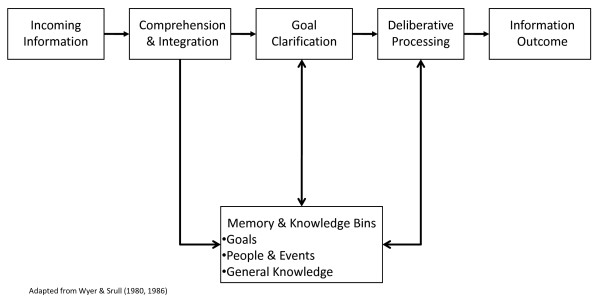
“The cognitive interaction between goal identification/clarification and deliberative processing is such that the information subsequently recalled and the resulting decision is directly reflective of the information processing objectives [9].”
§ Rationality versus reality: the challenges of evidence-based decision making for health policy makers > Discussion > Cognitive information processing framework
What the sources say
- Not checked yetcites [9] Wyer RS, Srull TK: The Processing of Social Stimulus Information: A Conceptual Integration. Person Memory: The Cognitive Basis of Social Perception. Edited by: Hastie R, Ostrom TM, Ebbesen EB, Wyer RS, Hamilton DL, Carlston DE. 1980, Hillsdale: Lawrence Erlbaum Associates, 227-300.
plaindirect- Asserted: passes — The authors put it forward as true.
- Checkable: passes — It can be checked against evidence.
- Load-bearing: fails — The paper’s conclusions may not depend on it.
- Based: passes — The paper gives a reason why it holds.
Probably not a substantial claim. The paper’s conclusions may not depend on it.
None of the sources cited for this claim have been checked yet.
In the paper
“A cognitive information-processing approach accounts for internally generated mechanisms by which relevant decision-making information is processed by individuals and individuals participating in group decision making [9,10].”
§ Rationality versus reality: the challenges of evidence-based decision making for health policy makers > Background
What the sources say
- Not checked yetcites [9] Wyer RS, Srull TK: The Processing of Social Stimulus Information: A Conceptual Integration. Person Memory: The Cognitive Basis of Social Perception. Edited by: Hastie R, Ostrom TM, Ebbesen EB, Wyer RS, Hamilton DL, Carlston DE. 1980, Hillsdale: Lawrence Erlbaum Associates, 227-300.
- Not checked — no full text of the sourcecites [10] Wyer RS, Srull TK: Human Cognition in its Social Context. Psychological Review. 1986, 93: 322-359. 10.1037/0033-295X.93.3.322. source
plaindirect- Asserted: passes — The authors put it forward as true.
- Checkable: passes — It can be checked against evidence.
- Load-bearing: passes — The paper’s conclusions depend on it.
- Based: passes — The paper gives a reason why it holds.
Probably not a substantial claim.
In the paper
“As such, it is posited that numerous individuals do not have the broad ranging expertise to adequately assess scientific information across health policy domains, thus they will satisfice their decision information needs and rely on secondary sources that summarize research results and translate the findings into 'lay' language.”
§ Rationality versus reality: the challenges of evidence-based decision making for health policy makers > Discussion > EBDM: The challenges of rational choice
What the sources say
- Not checked — no full text of the sourcecites [13] Nutley SM, Walter I, Davies HTO: Using Evidence: How Research Can Inform Public Services. 2007, The Policy Press source
hedgeddirect- Asserted: passes — The authors put it forward as true.
- Checkable: passes — It can be checked against evidence.
- Load-bearing: passes — The paper’s conclusions depend on it.
- Based: passes — The paper gives a reason why it holds.
It may state two separate claims as one.
A conclusion the paper draws from its own results — it cites no other source for it, so there is none to check. The quote shows it is in the paper.
In the paper
“The nature of goals as drivers of information processing suggests that goals filter information processing and determine what information is attained, retained, and utilized.”
§ Rationality versus reality: the challenges of evidence-based decision making for health policy makers > Discussion > Cognitive information processing framework
hedgeddirect- Asserted: passes — The authors put it forward as true.
- Checkable: passes — It can be checked against evidence.
- Load-bearing: passes — The paper’s conclusions depend on it.
- Based: passes — The paper gives a reason why it holds.
It may state two separate claims as one.
None of the sources cited for this claim have been checked yet.
In the paper
“However, these objectives and models collectively fail to consider the decision-making literature, which shows these assumptions are problematic, incomplete, and, in some cases, false [19,29-33].”
§ Rationality versus reality: the challenges of evidence-based decision making for health policy makers > Background
What the sources say
- Not checked yetcites [19] Howlett M, Ramesh M: Studying Public Policy: Policy Choices and Policy Subsystems. 2003, Don Mills: Oxford University Press
- Not checked yetcites [29] Weiss C, Bucuvalas MJ: Social Science Research and Decision Making. 1980, New York: Columbia University Press
- Not checked yetcites [30] Jones BD: Politics and the Architecture of Choice: Bounded Rationality and Governance. 2001, Chicago: University of Chicago Press
- Not checked yetcites [31] Sabatier PA: Fostering the Development of Policy Theory. Theories of the Policy Process. Edited by: Sabatier PA. 1999, Boulder: Westview Press, 3-17.
- Not checked yetcites [32] Simon HA: Decision Making and Problem Solving. Decision Making: Alternatives to Rational Choice. Edited by: Zey M. 1992, Newbury Park: Sage Publications, 32-53.
- Not checked — no full text of the sourcecites [33] Mulrow CD, Lohr KN: Proof and Policy From Medical Research Evidence. Journal of Health Politics, Policy, and Law. 2001, 26: 249-266. 10.1215/03616878-26-2-249. source
plain- Asserted: passes — The authors put it forward as true.
- Checkable: passes — It can be checked against evidence.
- Load-bearing: passes — The paper’s conclusions depend on it.
- Based: passes — The paper gives a reason why it holds.
It may state two separate claims as one.
A conclusion the paper draws from its own results — it cites no other source for it, so there is none to check. The quote shows it is in the paper.
In the paper
“The ability to ensure data, findings, and reports are expressed in commonly used language will aid decision makers to use the available evidence.”
§ Rationality versus reality: the challenges of evidence-based decision making for health policy makers > Conclusions
plaindirect- Asserted: passes — The authors put it forward as true.
- Checkable: fails — It may be too vague to check against evidence.
- Load-bearing: passes — The paper’s conclusions depend on it.
- Based: passes — The paper gives a reason why it holds.
Probably not a substantial claim. It may be too vague to check against evidence.
A conclusion the paper draws from its own results — it cites no other source for it, so there is none to check. The quote shows it is in the paper.
In the paper
“Availability of translatable data would expand the individual experience factor and become part of the information basis that influence decision making.”
§ Rationality versus reality: the challenges of evidence-based decision making for health policy makers > Conclusions
hedgeddirect- Asserted: passes — The authors put it forward as true.
- Checkable: fails — It may be too vague to check against evidence.
- Load-bearing: passes — The paper’s conclusions depend on it.
- Based: fails — The paper may give no reason why it holds.
Probably not a substantial claim. It may be too vague to check against evidence. The paper may give no reason why it holds. It may state two separate claims as one.
A conclusion the paper draws from its own results — it cites no other source for it, so there is none to check. The quote shows it is in the paper.
In the paper
“This EBM foundation privileges positivist science and diminishes research conducted outside the empirical, quantitative perspective to being of lesser value, an unfair and unfounded position.”
§ Rationality versus reality: the challenges of evidence-based decision making for health policy makers > Conclusions
plaindirect- Asserted: passes — The authors put it forward as true.
- Checkable: fails — It may be too vague to check against evidence.
- Load-bearing: passes — The paper’s conclusions depend on it.
- Based: passes — The paper gives a reason why it holds.
Probably not a substantial claim. It may be too vague to check against evidence. It may state two separate claims as one.
None of the sources cited for this claim have been checked yet.
In the paper
“Deriving from these various epistemologies, research is theorized, conducted, analyzed, and evaluated using many different methods [97,98].”
§ Rationality versus reality: the challenges of evidence-based decision making for health policy makers > Conclusions
What the sources say
- Not checked — no full text of the sourcecites [97] Kuhn TS: The Structure of Scientific Revolutions. 1996, Chicago: The University of Chicago Press, 3 source
- Not checked yetcites [98] Kuhn TS: The Nature and Necessity of Scientific Revolutions. Scientific Knowledge: Basic Issues in the Philosophy of Science. Edited by: Kourany JA. 1998, Belmont: Wadsworth Publishing Company, 316-326. 2
plain- Asserted: passes — The authors put it forward as true.
- Checkable: passes — It can be checked against evidence.
- Load-bearing: passes — The paper’s conclusions depend on it.
- Based: passes — The paper gives a reason why it holds.
Probably not a substantial claim.
- Rests on an assumption: Healthcare is a multi-sector industry that draws health services researchers from a wide variety of health and social science disciplines.
A conclusion the paper draws from its own results — it cites no other source for it, so there is none to check. The quote shows it is in the paper.
In the paper
“As noted, health services research, aggregated across studies and translated into reliable and valid findings, is a key to evidence-based decisions.”
§ Rationality versus reality: the challenges of evidence-based decision making for health policy makers > Conclusions
plaindirect- Asserted: passes — The authors put it forward as true.
- Checkable: fails — It may be too vague to check against evidence.
- Load-bearing: passes — The paper’s conclusions depend on it.
- Based: fails — The paper may give no reason why it holds.
Probably not a substantial claim. It may be too vague to check against evidence. The paper may give no reason why it holds.
A conclusion the paper draws from its own results — it cites no other source for it, so there is none to check. The quote shows it is in the paper.
In the paper
“Personal utility assessments often cloud relevant societal level assessments of policy alternatives and/or drive the overall assessment of decision options.”
§ Rationality versus reality: the challenges of evidence-based decision making for health policy makers > Discussion > Decision maker utility
plaindirect- Asserted: passes — The authors put it forward as true.
- Checkable: passes — It can be checked against evidence.
- Load-bearing: passes — The paper’s conclusions depend on it.
- Based: passes — The paper gives a reason why it holds.
It may state two separate claims as one.
A conclusion the paper draws from its own results — it cites no other source for it, so there is none to check. The quote shows it is in the paper.
In the paper
“This behavior has major implications for the rationality assumptions of EBDM.”
§ Rationality versus reality: the challenges of evidence-based decision making for health policy makers > Discussion > Heuristics
plaindirect- Asserted: passes — The authors put it forward as true.
- Checkable: fails — It may be too vague to check against evidence.
- Load-bearing: passes — The paper’s conclusions depend on it.
- Based: passes — The paper gives a reason why it holds.
Probably not a substantial claim. It may be too vague to check against evidence.
None of the sources cited for this claim have been checked yet.
In the paper
“In general, positive affect has been shown to trigger quicker, more flexible, and more efficient processing strategies. Conversely, negative affect tends to trigger slower, more systematic, and more analytical processing strategies [6,77,79,88-92].”
§ Rationality versus reality: the challenges of evidence-based decision making for health policy makers > Discussion > Affect
What the sources say
- Not checked yetcites [6] Isen AM: Positive Affect and Decision Making. Handbook of Emotions. Edited by: Lewis M, Haviland-Jones JM. 2000, New York: The Guilford Press, 417-435. 2
- Not checked yetcites [77] Forgas JP, Vargas PT: The Effects of Mood on Social Judgment and Reasoning. Handbook of Emotions. Edited by: Lewis M, Haviland-Jones JM. 2000, New York: The Guilford Press, 350-367. 2
- Not checked yetcites [79] Bower GH, Forgas JP: Mood and Social Memory. Handbook of Affect and Social Cognition. Edited by: Forgas JP. 2001, Mahwah: Lawrence Erlbaum Associates, Inc, 95-120.
- Not checked yetcites [88] Forgas JP: Affect and Information Processing Strategies: An Interactive Relationship. Feeling and Thinking: The Role of Affect in Social Cognition. Edited by: Forgas JP. 2000, New York: Cambridge University Press, 253-282.
- Not checked — no full text of the sourcecites [89] Forgas JP: Mood and Judgment: The Affect Infusion Model (AIM). Psychological Bulletin. 1995, 117: 39-66. 10.1037/0033-2909.117.1.39. source
- Not checked yetcites [90] Forgas JP: Affect, Cognition, and Interpersonal Behavior: The Mediating Role of Processing Strategies. Handbook of Affect and Social Cognition. Edited by: Forgas JP. 2001, Mahwah: Lawrence Erlbaum Associates, Inc, 293-318.
- Not checked — no full text of the sourcecites [91] Jundt DK, Hinsz VB: Influences of Positive and Negative Affect on Decisions Involving Judgmental Biases. Social Behavior and Personality. 2002, 30: 45-52. 10.2224/sbp.2002.30.1.45. source
- Not checked yetcites [92] Fiedler K: Affective Influences on Social Information Processing. Handbook of Affect and Social Cognition. Edited by: Forgas JP. 2001, Mahwah: Lawrence Erlbaum Associates, Inc, 163-185.
plaindirect- Asserted: passes — The authors put it forward as true.
- Checkable: passes — It can be checked against evidence.
- Load-bearing: unclear — It is unclear whether the paper’s conclusions depend on it.
- Based: passes — The paper gives a reason why it holds.
It may state two separate claims as one.
A conclusion the paper draws from its own results — it cites no other source for it, so there is none to check. The quote shows it is in the paper.
In the paper
“Thus, the above propositions suggest that the manner in which policy questions are framed and policy maker experience will influence decision utility assessments and subsequent choices regarding health policies.”
§ Rationality versus reality: the challenges of evidence-based decision making for health policy makers > Discussion > Decision maker utility
hedgeddirect- Asserted: passes — The authors put it forward as true.
- Checkable: passes — It can be checked against evidence.
- Load-bearing: passes — The paper’s conclusions depend on it.
- Based: passes — The paper gives a reason why it holds.
It may state two separate claims as one.
None of the sources cited for this claim have been checked yet.
In the paper
“With respect to decision making, the influence of affect on individuals has been shown to influence the manner in which individuals perceive situations, the motivation of decision behaviors, the degree of decision risk tolerance, and the level and type of information recall people exhibit [6,76-80].”
§ Rationality versus reality: the challenges of evidence-based decision making for health policy makers > Discussion > Affect
What the sources say
- Not checked yetcites [6] Isen AM: Positive Affect and Decision Making. Handbook of Emotions. Edited by: Lewis M, Haviland-Jones JM. 2000, New York: The Guilford Press, 417-435. 2
- Not checked — no full text of the sourcecites [76] Eich E, Schooler JW: Cognition/Emotion Interactions. Cognition and Emotion. Edited by: Eich E, Kihlstrom JF, Bower GH, Forgas JP, Niedenthal PM. 2000, New York: Oxford University Press, 87-168. source
- Not checked yetcites [77] Forgas JP, Vargas PT: The Effects of Mood on Social Judgment and Reasoning. Handbook of Emotions. Edited by: Lewis M, Haviland-Jones JM. 2000, New York: The Guilford Press, 350-367. 2
- Not checked yetcites [78] Johnson-Laird PN, Oatley K: Cognitive and Social Construction in Emotions. Handbook of Emotions. Edited by: Lewis M, Haviland-Jones JM. 2000, New York: The Guilford Press, 458-475. 2
- Not checked yetcites [79] Bower GH, Forgas JP: Mood and Social Memory. Handbook of Affect and Social Cognition. Edited by: Forgas JP. 2001, Mahwah: Lawrence Erlbaum Associates, Inc, 95-120.
- Not checked — no full text of the sourcecites [80] Clore GL, Gasper K, Garvin E: Affect as Information. Handbook of Affect and Social Cognition. Edited by: Forgas JP. 2001, Mahwah: Lawrence Erlbaum Associates, Inc, 121-144. source
plaindirect- Asserted: passes — The authors put it forward as true.
- Checkable: passes — It can be checked against evidence.
- Load-bearing: unclear — It is unclear whether the paper’s conclusions depend on it.
- Based: passes — The paper gives a reason why it holds.
It may state two separate claims as one.
None of the sources cited for this claim have been checked yet.
In the paper
“In complex decision situations, this automatic processing becomes a dominant force in information processing and results in cognitive shortcutting tactics.”
§ Rationality versus reality: the challenges of evidence-based decision making for health policy makers > Discussion > Heuristics
What the sources say
- Not checked — no full text of the sourcecites [64] Lord RG, Maher KJ: Cognitive Processes in Industrial and Organizational Psychology. International Review of Industrial and Organizational Psychology. Edited by: Cooper CL, Robertson IT. 1989, New York: John Wiley and Sons, 49-91.
- Not checked yetcites [65] Lord RG, Maher KJ: Leadership and Information Processing. 1991, Cambridge: Unwin Hyman Inc
- Not checked yetcites [66] Bazerman MH: Judgment in Managerial Decision Making. 1998, New York: John Wiley and Sons, 4
plaindirect- Asserted: passes — The authors put it forward as true.
- Checkable: passes — It can be checked against evidence.
- Load-bearing: passes — The paper’s conclusions depend on it.
- Based: passes — The paper gives a reason why it holds.
It may state two separate claims as one.
A conclusion the paper draws from its own results — it cites no other source for it, so there is none to check. The quote shows it is in the paper.
In the paper
“Decision processes involving numerous people are more likely to strike a balance among affect states, thereby minimizing a dominant affect influence and balance risk taking.”
§ Rationality versus reality: the challenges of evidence-based decision making for health policy makers > Conclusions
hedgedconditional- Asserted: passes — The authors put it forward as true.
- Checkable: passes — It can be checked against evidence.
- Load-bearing: passes — The paper’s conclusions depend on it.
- Based: fails — The paper may give no reason why it holds.
Probably not a substantial claim. The paper may give no reason why it holds. It may state two separate claims as one.
None of the sources cited for this claim have been checked yet.
In the paper
“Heuristics are cognitive processes where full information processing requirements are bypassed and mental shortcutting occurs [66,71,73,94].”
§ Rationality versus reality: the challenges of evidence-based decision making for health policy makers > Discussion > Heuristics
What the sources say
- Not checked yetcites [66] Bazerman MH: Judgment in Managerial Decision Making. 1998, New York: John Wiley and Sons, 4
- Not checked — no full text of the sourcecites [71] Levin IP, Schneider SL, Gaeth GJ: All Frames are not Created Equal: A Typology and Critical Analysis of Framing Effects. Organizational Behavior and Human Decision Processes. 1998, 76: 149-188. 10.1006/obhd.1998.2804. source
- Not checked — no full text of the sourcecites [73] Mittal V, Ross WT: The Impact of Positive and Negative Affect and Issue Framing on Issue Interpretation and Risk Taking. Organizational Behavior and Human Decision Processes. 1998, 76: 298-324. 10.1006/obhd.1998.2808. source
- Not checked — no full text of the sourcecites [94] Slattery JP, Ganster DC: Determinants of Risk Taking in a Dynamic Uncertain Context. Journal of Management. 2002, 28: 89-106. 10.1177/014920630202800106. source
plain- Asserted: passes — The authors put it forward as true.
- Checkable: passes — It can be checked against evidence.
- Load-bearing: passes — The paper’s conclusions depend on it.
- Based: passes — The paper gives a reason why it holds.
Probably not a substantial claim.
A conclusion the paper draws from its own results — it cites no other source for it, so there is none to check. The quote shows it is in the paper.
In the paper
“We argue that utility perceptions of decision makers are governed by goals retrieved during the goal-directed information processing stage and influence which information is retrieved and how it is evaluated.”
§ Rationality versus reality: the challenges of evidence-based decision making for health policy makers > Discussion > Decision maker utility
plaindirect- Asserted: passes — The authors put it forward as true.
- Checkable: passes — It can be checked against evidence.
- Load-bearing: passes — The paper’s conclusions depend on it.
- Based: passes — The paper gives a reason why it holds.
It may state two separate claims as one.
A conclusion the paper draws from its own results — it cites no other source for it, so there is none to check. The quote shows it is in the paper.
In the paper
“Expecting end-users to have a full comprehension of 'research speak' sets up the dissemination mode for ineffective translation as certainly as would it be if health services researchers were expected to have full comprehension of the language, jargon, and acronyms commonly used in 'med speak'.”
§ Rationality versus reality: the challenges of evidence-based decision making for health policy makers > Conclusions
boosteddirect- Asserted: passes — The authors put it forward as true.
- Checkable: fails — It may be too vague to check against evidence.
- Load-bearing: passes — The paper’s conclusions depend on it.
- Based: passes — The paper gives a reason why it holds.
Probably not a substantial claim. It may be too vague to check against evidence.
A conclusion the paper draws from its own results — it cites no other source for it, so there is none to check. The quote shows it is in the paper.
In the paper
“Additionally, this may help alleviate situations in which decision makers are attempting to utilize evidence with conflicting information and conclusions.”
§ Rationality versus reality: the challenges of evidence-based decision making for health policy makers > Conclusions
hedgedconditional- Asserted: passes — The authors put it forward as true.
- Checkable: fails — It may be too vague to check against evidence.
- Load-bearing: passes — The paper’s conclusions depend on it.
- Based: passes — The paper gives a reason why it holds.
Probably not a substantial claim. It may be too vague to check against evidence.
None of the sources cited for this claim have been checked yet.
In the paper
“Diverse groups are known to be more creative in their decision processes as a result of their diversity and tend to attain more creative solutions to issues being addressed [59,66].”
§ Rationality versus reality: the challenges of evidence-based decision making for health policy makers > Conclusions
What the sources say
- Not checked yetcites [59] Allison G, Zelikow P: Essence of Decision: Explaining the Cuban Missile Crisis. 1999, New York: Addison-WesleyEducational Publishers Inc
- Not checked yetcites [66] Bazerman MH: Judgment in Managerial Decision Making. 1998, New York: John Wiley and Sons, 4
boosteddirect- Asserted: passes — The authors put it forward as true.
- Checkable: passes — It can be checked against evidence.
- Load-bearing: passes — The paper’s conclusions depend on it.
- Based: passes — The paper gives a reason why it holds.
It may state two separate claims as one.
A conclusion the paper draws from its own results — it cites no other source for it, so there is none to check. The quote shows it is in the paper.
In the paper
“Increased recognition of the inherent biases and individual decision-making flaws is a first step of aligning policy goals with decision utilities.”
§ Rationality versus reality: the challenges of evidence-based decision making for health policy makers > Conclusions
plaindirect- Asserted: passes — The authors put it forward as true.
- Checkable: fails — It may be too vague to check against evidence.
- Load-bearing: passes — The paper’s conclusions depend on it.
- Based: fails — The paper may give no reason why it holds.
Probably not a substantial claim. It may be too vague to check against evidence. The paper may give no reason why it holds.
In the paper
“Evidence, as we know, is a major element of EBM (the precursor to EBDM), and the hierarchical evidence spectrum argued by Sackett and others highlight Randomized controlled trials (RCTs) and meta-analyses as the gold standard of evidence [100].”
§ Rationality versus reality: the challenges of evidence-based decision making for health policy makers > Conclusions
What the sources say
- Not checked — no full text of the sourcecites [100] Sackett DL, Rosenberg WMC, Gray JAM, Haynes RB, Richardson WS: Evidence-Based Medicine: What it is and What it isn't. British Medical Journal. 1996, 312: 71-72. source
boosted- Asserted: passes — The authors put it forward as true.
- Checkable: passes — It can be checked against evidence.
- Load-bearing: passes — The paper’s conclusions depend on it.
- Based: passes — The paper gives a reason why it holds.
Probably not a substantial claim.
A conclusion the paper draws from its own results — it cites no other source for it, so there is none to check. The quote shows it is in the paper.
In the paper
“The Asian disease example clearly demonstrates the influence of framing on decision alternative utility assessment and exemplifies how evidence is subjectively interpreted and used to make healthcare decisions.”
§ Rationality versus reality: the challenges of evidence-based decision making for health policy makers > Discussion > Decision maker utility
boosteddirect- Asserted: passes — The authors put it forward as true.
- Checkable: passes — It can be checked against evidence.
- Load-bearing: passes — The paper’s conclusions depend on it.
- Based: passes — The paper gives a reason why it holds.
It may state two separate claims as one.
A conclusion the paper draws from its own results — it cites no other source for it, so there is none to check. The quote shows it is in the paper.
In the paper
“Proposition 2: Policy makers' trait affect will influence the degree of risk tolerance and uncertainty they will allow in supporting/devising new policies. Those high in positive affect are more likely to support policies with high risk and high uncertainty, while those high in negative affect are more likely to support policies with minimal risk and minimal uncertainty.”
§ Rationality versus reality: the challenges of evidence-based decision making for health policy makers > Discussion > Affect
hedgeddirect- Asserted: passes — The authors put it forward as true.
- Checkable: passes — It can be checked against evidence.
- Load-bearing: passes — The paper’s conclusions depend on it.
- Based: fails — The paper may give no reason why it holds.
Probably not a substantial claim. The paper may give no reason why it holds.
A conclusion the paper draws from its own results — it cites no other source for it, so there is none to check. The quote shows it is in the paper.
In the paper
“Involving stakeholders to become part of the policy creation process naturally leads to their participation in the evaluation process.”
§ Rationality versus reality: the challenges of evidence-based decision making for health policy makers > Conclusions
plaindirect- Asserted: passes — The authors put it forward as true.
- Checkable: passes — It can be checked against evidence.
- Load-bearing: passes — The paper’s conclusions depend on it.
- Based: fails — The paper may give no reason why it holds.
Probably not a substantial claim. The paper may give no reason why it holds.
A conclusion the paper draws from its own results — it cites no other source for it, so there is none to check. The quote shows it is in the paper.
In the paper
“Furthermore, we argue that these considerations are globally relevant and that a comprehensive understanding of the mechanisms of cognitive processing aids decision makers in developing awareness of how they process relevant decision information and how they may be subtly influenced while discounting actual evidence.”
§ Rationality versus reality: the challenges of evidence-based decision making for health policy makers > Conclusions
plain- Asserted: passes — The authors put it forward as true.
- Checkable: fails — It may be too vague to check against evidence.
- Load-bearing: passes — The paper’s conclusions depend on it.
- Based: fails — The paper may give no reason why it holds.
Probably not a substantial claim. It may be too vague to check against evidence. The paper may give no reason why it holds.
A conclusion the paper draws from its own results — it cites no other source for it, so there is none to check. The quote shows it is in the paper.
In the paper
“The nature of decision maker utility is such that policy makers might experience differing utility perceptions when considering policy options, and thus be subject to varying, subtle influences.”
§ Rationality versus reality: the challenges of evidence-based decision making for health policy makers > Discussion > Decision maker utility
hedgedconditional- Asserted: passes — The authors put it forward as true.
- Checkable: passes — It can be checked against evidence.
- Load-bearing: passes — The paper’s conclusions depend on it.
- Based: passes — The paper gives a reason why it holds.
It may state two separate claims as one.
A conclusion the paper draws from its own results — it cites no other source for it, so there is none to check. The quote shows it is in the paper.
In the paper
“Identifying and better understanding these influences will empower both health policy makers and managers to enhance their decision-making.”
§ Rationality versus reality: the challenges of evidence-based decision making for health policy makers > Conclusions
plaindirect- Asserted: passes — The authors put it forward as true.
- Checkable: fails — It may be too vague to check against evidence.
- Load-bearing: passes — The paper’s conclusions depend on it.
- Based: passes — The paper gives a reason why it holds.
Probably not a substantial claim. It may be too vague to check against evidence.
A conclusion the paper draws from its own results — it cites no other source for it, so there is none to check. The quote shows it is in the paper.
In the paper
“Furthermore, we argue that these considerations are globally relevant and that a comprehensive understanding of the mechanisms of cognitive processing aids decision makers in developing awareness of how they process relevant decision information and how they may be subtly influenced while discounting actual evidence.”
§ Rationality versus reality: the challenges of evidence-based decision making for health policy makers > Conclusions
plaindirect- Asserted: passes — The authors put it forward as true.
- Checkable: fails — It may be too vague to check against evidence.
- Load-bearing: passes — The paper’s conclusions depend on it.
- Based: fails — The paper may give no reason why it holds.
Probably not a substantial claim. It may be too vague to check against evidence. The paper may give no reason why it holds.
A conclusion the paper draws from its own results — it cites no other source for it, so there is none to check. The quote shows it is in the paper.
In the paper
“We posit that a greater awareness of the reasons behind policy makers' actions will promote better and more informed decisions.”
§ Rationality versus reality: the challenges of evidence-based decision making for health policy makers > Conclusions
hedgeddirect- Asserted: passes — The authors put it forward as true.
- Checkable: fails — It may be too vague to check against evidence.
- Load-bearing: passes — The paper’s conclusions depend on it.
- Based: passes — The paper gives a reason why it holds.
Probably not a substantial claim. It may be too vague to check against evidence.
The paper relies on this without support.
The Wyer and Srull social information processing model is applicable to health policy decision makers.
“Wyer and Srull [10] have proposed one of most recognized information processing models, which will be used here to provide the structure for the basic cognitive information processing discussion (Figure 2).”
The paper relies on this without support.
Health policy decision makers process decision-relevant information in the same cognitive manner as individuals in the general decision-making literature.
“Utilizing health policy decision making as a basis, this article presents a theoretical decision-processing framework that supports the focal thesis: during the health policy process, decision makers are subjectively influenced by the manner in which they cognitively process information.”
The paper relies on this without support.
Most nations' health system challenges are complex.
“Given the complexity of most nations' health system challenges, cognitive shortcutting by policy makers is to be expected.”
The paper relies on this without support.
Individual goals play a role in how information is processed.
“Given consideration of the complexity of cognitive information processing and the role of individual goals in how information is being processed, it is not surprising that health policy makers would readily adopt cognitive processes that simplify decisions.”
The paper relies on this without support.
Policy making does not occur in isolation.
“Given that policy making does not occur in isolation, it is important to identify the components of the network that are relevant and require consideration”
The paper relies on this without support.
Healthcare is a multi-sector industry that draws health services researchers from a wide variety of health and social science disciplines.
“As healthcare is a multi-sector industry, it draws health services researchers from a wide variety of health and social science disciplines (e.g., management, economics, political science, sociology, nursing).”
The paper relies on this without support.
Decision-making processes within groups often involve either a process of inquiry or a process of advocacy.
“Decision-making processes within groups often involve either a process of inquiry (collaborative problem solving) or a process of advocacy (a function of persuasion and opinion influencing).”
Citations
Cites
Prospect Theory: An Analysis of Decision under Risk
Kahneman, D., & Tversky, A. (1979) · Econometrica · doi:10.2307/1914185 · Cited by 48,524
(1994) · Journal of the American Dietetic Association · doi:10.1016/0002-8223(94)92216-0 · Cited by 46,726
The Structure of Scientific Revolutions
Kuhn, T. S., & Schlegel, R. (1963) · Physics Today · doi:10.1063/1.3050879 · Cited by 35,538
Prospect theory: An analysis of decision under risk
Kahneman, D. J., & Tversky, A. (1988) · Cambridge University Press eBooks · doi:10.1017/cbo9780511609220.014 · Cited by 32,720
The Framing of Decisions and the Psychology of Choice
Tversky, A., & Kahneman, D. (1981) · Science · doi:10.1126/science.7455683 · Cited by 18,497 · cited 6×
“In addition, many models guiding the policy making process assume policy makers are capable of accurately analyzing decision information, understanding the relevant evidence, are resistant to influences and biases, and seek to make decisions that maximize societal benefit [5,19,27,28].”
BackgroundInfluentialA BEHAVIORAL MODEL OF RATIONAL CHOICE
Simon, H. A. (1955) · The Quarterly Journal of Economics · doi:10.2307/1884852 · Cited by 15,877
Evidence based medicine: what it is and what it isn't
Sackett, D. L., Rosenberg, W. M. C., Gray, J. A. M., Haynes, R. B., & Richardson, W. S. (1996) · BMJ · doi:10.1136/bmj.312.7023.71 · Cited by 15,769
Slovic, P. (1987) · Science · doi:10.1126/science.3563507 · Cited by 9,271
Diffusion of Innovations in Service Organizations: Systematic Review and Recommendations
GREENHALGH, T., ROBERT, G., MACFARLANE, F., BATE, P., & KYRIAKIDOU, O. (2004) · The Milbank Quarterly · doi:10.1111/j.0887-378x.2004.00325.x · Cited by 7,448
The Structure of Scientific Revolutions
Kuhn, T. S. (1996) · doi:10.7208/chicago/9780226458106.001.0001 · Cited by 7,281
Sociological Paradigms and Organizational Analysis.
Louis, M. R., Burrell, G., & Morgan, G. (1983) · Administrative Science Quarterly · doi:10.2307/2392394 · Cited by 5,576
Essence of Decision: Explaining the Cuban Missile Crisis
Holsti, O. R., & Allison, G. T. (1972) · The Western Political Quarterly · doi:10.2307/446741 · Cited by 3,662
Theories of the Policy Process
Sabatier, P. (2019) · Routledge eBooks · doi:10.4324/9780367274689 · Cited by 3,515
Mood and judgment: The affect infusion model (AIM).
Forgas, J. P. (1995) · Psychological Bulletin · doi:10.1037/0033-2909.117.1.39 · Cited by 3,470
Bounded rationality and organizational learning
Simon, H. A. (1991) · Organization Science · doi:10.1287/orsc.2.1.125 · Cited by 3,028
International Review of Industrial and Organizational Psychology
Cooper, C. L., & Robertson, I. T. (2003) · Wiley eBooks · doi:10.1002/0470013311.oth1 · Cited by 2,787
All Frames Are Not Created Equal: A Typology and Critical Analysis of Framing Effects
Levin, I. P., Schneider, S. L., & Gaeth, G. J. (1998) · Organizational Behavior and Human Decision Processes · doi:10.1006/obhd.1998.2804 · Cited by 2,592
Judgment in Managerial Decision Making
Bazerman, M. H. (1986) · Digital Commons - USU (Utah State University) · Cited by 2,250
Slovic, P. (2016) · Routledge eBooks · doi:10.4324/9781315661773 · Cited by 2,240
Bounded Rationality and Organizational Learning
Simon, H. A. (1999) · Reflections The SoL Journal · doi:10.1162/152417399570142 · Cited by 2,035
Handbook of Motivation and Cognition: Foundations of Social Behavior, Vol. 2.
Wagner, D. G., Higgins, E. T., & Sorrentino, R. M. (1991) · Contemporary Sociology A Journal of Reviews · doi:10.2307/2072281 · Cited by 1,970
Organizational Behavior: Affect in the Workplace
Brief, A. P., & Weiss, H. M. (2002) · Annual Review of Psychology · doi:10.1146/annurev.psych.53.100901.135156 · Cited by 1,797
Essence of Decision: Explaining the Cuban Missile Crisis
Long, D. F., & Allison, G. T. (1972) · Journal of American History · doi:10.2307/1888485 · Cited by 1,754
Academy of Management Proceedings
Epitropaki, O., Kark, R., Day, D., Lord, R. G., Murphy, S. E., & Stevens, N. (2016) · The Academy of Management · Cited by 1,609
Feeling and thinking: the role of affect in social cognition
(2000) · Choice Reviews Online · doi:10.5860/choice.37-5959 · Cited by 1,388
Using evidenceHow research can inform public services
Nutley, S., Walter, I., & Davies, H. T. O. (2007) · Policy Press eBooks · doi:10.1332/policypress/9781861346650.001.0001 · Cited by 1,355
International Review of Industrial and Organizational Psychology, 1987
Sandelands, L., Cooper, C. L., & Robertson, I. T. (1988) · Academy of Management Review · doi:10.2307/258385 · Cited by 1,345
A Group Process Model for Problem Identification and Program Planning
Delbecq, A. L., & de Ven, A. H. V. (1971) · The Journal of Applied Behavioral Science · doi:10.1177/002188637100700404 · Cited by 1,185
How Can Research Organizations More Effectively Transfer Research Knowledge to Decision Makers?
LAVIS, J. N., ROBERTSON, D., WOODSIDE, J. M., McLEOD, C. B., & ABELSON, J. (2003) · The Milbank Quarterly · doi:10.1111/1468-0009.t01-1-00052 · Cited by 1,176
Positive affect and decision making.
Isen, A. M. (1993) · Medical Entomology and Zoology · Cited by 1,135
Evaluation, Policy Learning and Evidence‐Based Policy Making
Sanderson, I. (2002) · Public Administration · doi:10.1111/1467-9299.00292 · Cited by 1,068
Essence of Decision: Explaining the Cuban Missile Crisis
Ikenberry, G. J., Allison, G. T., & ZELIKOW, P. D. (1999) · Foreign Affairs · doi:10.2307/20049293 · Cited by 1,050
Health policy-makers' perceptions of their use of evidence: a systematic review
Innvær, S., Vist, G., Trommald, M., & Oxman, A. (2002) · Journal of Health Services Research & Policy · doi:10.1258/135581902320432778 · Cited by 1,006
The Handbook of affect and social cognition
(2001) · Choice Reviews Online · doi:10.5860/choice.38-5270 · Cited by 996
State or trait: Effects of positive mood on prosocial behaviors at work.
George, J. M. (1991) · Journal of Applied Psychology · doi:10.1037/0021-9010.76.2.299 · Cited by 951
Forgas, J. P., & George, J. M. (2001) · Organizational Behavior and Human Decision Processes · doi:10.1006/obhd.2001.2971 · Cited by 898
Using evidence: How research can inform public services
Nutley, S. M., Walter, I., & Davies, H. T. O. (2007) · doi:10.2307/j.ctt9qgwt1 · Cited by 808
Human cognition in its social context.
Wyer, R. S., & Srull, T. K. (1986) · Psychological Review · doi:10.1037/0033-295x.93.3.322 · Cited by 708
Evidence based policy: proceed with careCommentary: research must be taken seriously
Black, N. A., & Donald, A. (2001) · BMJ · doi:10.1136/bmj.323.7307.275 · Cited by 588
Person Memory: The Cognitive Basis of Social Perception
Hastie, R. (1980) · Cited by 580
Decision Making and Problem Solving
Simon, H. A., Dantzig, G. B., Hogarth, R. M., Plott, C. R., Raiffa, H., Schelling, T. C., Shepsle, K. A., Thaler, R. H., Tversky, A., & Winter, S. G. (1987) · INFORMS Journal on Applied Analytics · doi:10.1287/inte.17.5.11 · Cited by 566
Handbook of Affect and Social Cognition
(2012) · Psychology Press eBooks · doi:10.4324/9781410606181 · Cited by 542
Social Science Research and Decision-Making.
Conklin, G. H., Weiss, C. H., & Bucuvalas, M. J. (1982) · Social Forces · doi:10.2307/2578408 · Cited by 540
Evidence‐based Management: From Theory to Practice in Health Care
Walshe, K., & Rundall, T. G. (2001) · The Milbank Quarterly · doi:10.1111/1468-0009.00214 · Cited by 532
Dispositional affectivity as a predictor of work attitudes and job performance
Cropanzano, R., James, K. E., & Konovsky, M. A. (1993) · Journal of Organizational Behavior · doi:10.1002/job.4030140609 · Cited by 488
Evidence-based health policy: context and utilisation
Dobrow, M., Goel, V., & Upshur, R. E. G. (2003) · Social Science & Medicine · doi:10.1016/s0277-9536(03)00166-7 · Cited by 477
Politics and the Architecture of Choice: Bounded Rationality and Governance
Jones, B. D. (2001) · Cited by 460
(2000) · doi:10.4324/9781410606181.ch6 · Cited by 441
Examining the Role of Health Services Research in Public Policymaking
Lavis, J. N., Ross, S. E., & Hurley, J. E. (2002) · The Milbank Quarterly · doi:10.1111/1468-0009.00005 · Cited by 402
The Nature of Qualitative Evidence
Morse, J. M., Swanson, J. M., & Kuzel, A. J. (2001) · Sage eBooks · doi:10.4135/9781412986236 · Cited by 370
The Impact of Positive and Negative Affect and Issue Framing on Issue Interpretation and Risk Taking
Mittal, V., & Ross, W. T. (1998) · Organizational Behavior and Human Decision Processes · doi:10.1006/obhd.1998.2808 · Cited by 356
George, J. M. (1989) · Journal of Applied Psychology · doi:10.1037/0021-9010.74.2.317 · Cited by 330
Capturing the Political Imagination: Think Tanks and the Policy Process
Stone, D. (1996) · Cited by 328
Maltzman, F. (1995) · Political Science Quarterly · doi:10.2307/2152577 · Cited by 254
Decision processes, rationality and adjustment to natural hazards
Slovic, P., Kunreuther, H., & White, G. F. (1974) · Scholars' Bank (University of Oregon) · Cited by 226
Framing effects: An analytic–holistic perspective
McElroy, T., & Seta, J. J. (2003) · Journal of Experimental Social Psychology · doi:10.1016/s0022-1031(03)00036-2 · Cited by 221
Bounded rationality and satisficing in young people's Web‐based decision making
Agosto, D. E. (2002) · Journal of the American Society for Information Science and Technology · doi:10.1002/asi.10024 · Cited by 202
Leadership and Information Processing
Lord, R. G. (2019) · Routledge eBooks · doi:10.4324/9781315269573-3 · Cited by 194
What you don't know about making decisions
Garvin, D. A., & Roberto, M. A. (2003) · IEEE Engineering Management Review · doi:10.1109/emr.2003.1207056 · Cited by 182
The processing of social stimulus information: A conceptual integration
Wyer, R. S., & Srull, T. K. (1980) · Cited by 170
Bower, G. H., & Forgas, J. P. (2000) · doi:10.4324/9781410606181.ch5 · Cited by 165
On Being a Good Listener: Setting Priorities for Applied Health Services Research
Lomas, J., Fulop, N., GAGNON, D., & Allen, P. W. (2003) · Milbank Quarterly · doi:10.1111/1468-0009.t01-1-00060 · Cited by 161
Evidence-Based Decision Making: Global Evidence, Local Decisions
Clancy, C. M., & Cronin, K. A. (2005) · Health Affairs · doi:10.1377/hlthaff.24.1.151 · Cited by 161
The role of chronic and temporary goals in social information processing
Wyer, R. S., & Srull, T. K. (1986) · Guilford Press eBooks · Cited by 161
Decision making : alternatives to rational choice models
Zey‐Ferrell, M. (1992) · Sage eBooks · Cited by 153
Decision framing: moderating effects of individual differences and cognitive processing
Simon, A. F., Fagley, N. S., & Halleran, J. G. (2004) · Journal of Behavioral Decision Making · doi:10.1002/bdm.463 · Cited by 150
Making Sense of ‘What Works’: Evidence Based Policy Making as Instrumental Rationality?
Sanderson, I. R. (2002) · Public Policy and Administration · doi:10.1177/095207670201700305 · Cited by 128
Affective Influences on Social Information Processing
Fiedler, K. (2000) · doi:10.4324/9781410606181.ch8 · Cited by 128
Public Policy in Canada: An Introduction
Brooks, S. (1998) · Medical Entomology and Zoology · Cited by 126
Consulting as a Strategy for Knowledge Transfer
Jacobson, N. A., Butterill, D., & Goering, P. N. (2005) · Milbank Quarterly · doi:10.1111/j.1468-0009.2005.00348.x · Cited by 126
Liang, N. (1994) · Academy of Management Review · doi:10.5465/amr.1994.9412271827 · Cited by 125
Toward a theoretical model of evaluation utilization
Johnson, R. B. (1998) · Evaluation and Program Planning · doi:10.1016/s0149-7189(97)00048-7 · Cited by 123
Evidence Of Evidence-Based Health Policy: The Politics Of Systematic Reviews In Coverage Decisions
Fox, D. M. (2005) · Health Affairs · doi:10.1377/hlthaff.24.1.114 · Cited by 123
A critical appraisal of evidence‐based medicine: some ethical considerations
Gupta, M. (2003) · Journal of Evaluation in Clinical Practice · doi:10.1046/j.1365-2753.2003.00382.x · Cited by 116
Leadership and Information Processing
Lord, R. G., & Maher, K. J. (2002) · Routledge eBooks · doi:10.4324/9780203423950 · Cited by 115
Komai, M., Stegeman, M., & Hermalin, B. E. (2007) · American Economic Review · doi:10.1257/aer.97.3.944 · Cited by 112
Slovic, P., & Monahan, J. T. (1995) · Law and Human Behavior · doi:10.1007/bf01499072 · Cited by 108
Baicker, K., & Chandra, A. (2017) · New England Journal of Medicine · doi:10.1056/nejmp1709816 · Cited by 107
The Politics of Evidence-Based Medicine
Rodwin, M. A. (2001) · Journal of Health Politics Policy and Law · doi:10.1215/03616878-26-2-439 · Cited by 98
Effects of attribute framing on cognitive processing and evaluation
Kuvaas, B., & Selart, M. (2004) · Organizational Behavior and Human Decision Processes · doi:10.1016/j.obhdp.2004.08.001 · Cited by 97
A study of how individuals solve complex and ill-structured problems
Fernandes, R., & Simon, H. A. (1999) · Policy Sciences · doi:10.1023/a:1004668303848 · Cited by 94
State and Trait Correlates of Job Performance: A Tale of Two Perspectives
Wright, T. A., Cropanzano, R., & Meyer, D. G. (2004) · Journal of Business and Psychology · doi:10.1023/b:jobu.0000016708.22925.72 · Cited by 85
Making Policy When The Evidence Is In Dispute
Atkins, D., Siegel, J., & Slutsky, J. (2005) · Health Affairs · doi:10.1377/hlthaff.24.1.102 · Cited by 81
Affect and information processing strategies: An interactive relationship.
Forgas, J. P. (2000) · Cited by 81
Examining the assumptions of evidence‐based medicine
Norman, G. R. (1999) · Journal of Evaluation in Clinical Practice · doi:10.1046/j.1365-2753.1999.00197.x · Cited by 80
The Influence of Advisers on Foreign Policy Decision Making: An Experimental Study
REDD, S. B. (2002) · Journal of Conflict Resolution · doi:10.1177/0022002702046003002 · Cited by 79
Scientific knowledge : basic issues in the philosophy of science
Kourany, J. A. (1987) · Cited by 71
Preference for Equity As a Framing Effect
Ubel, P. A., Baron, J., & Asch, D. A. (2001) · Medical Decision Making · doi:10.1177/02729890122062479 · Cited by 71
Information Exchange in Group Decision Making: The Hidden Profile Problem Reconsidered
Lightle, J. P., Kagel, J. H., & Arkes, H. R. (2009) · Management Science · doi:10.1287/mnsc.1080.0975 · Cited by 70
(2000) · doi:10.1093/oso/9780195113334.001.0001 · Cited by 69
Proof and Policy from Medical Research Evidence
Mulrow, C. D., & Lohr, K. N. (2001) · Journal of Health Politics, Policy and Law · doi:10.1215/03616878-26-2-249 · Cited by 67
Affective influences on risk perceptions and risk intention
Williams, S., Zainuba, M., & Jackson, R. (2003) · Journal of Managerial Psychology · doi:10.1108/02683940310465027 · Cited by 65
(2003) · Cited by 51
Determinants of Risk Taking in a Dynamic Uncertain Context
Slattery, J. P., & Ganster, D. C. (2002) · Journal of Management · doi:10.1177/014920630202800106 · Cited by 49
Maynard, R. A. (2006) · Journal of Policy Analysis and Management · doi:10.1002/pam.20169 · Cited by 47
Evidence-Based Medicine as an Instrument for Rational Health Policy
Biller-Andorno, N., Lie, R. K., & ter Meulen, R. (2002) · Health Care Analysis · doi:10.1023/a:1022947707243 · Cited by 44
The Changing US Health Care System: Challenges for Responsible Public Policy
Gold, M. (1999) · Milbank Quarterly · doi:10.1111/1468-0009.00123 · Cited by 43
Research Utilization and Qualitative Research
Estabrooks, C. A. (2001) · Sage eBooks · doi:10.4135/9781412986236.n12 · Cited by 43
Daniels, K. (1998) · British Journal of Management · doi:10.1111/1467-8551.00081 · Cited by 41
Courts and Health Policy: Judicial Policy Making and Publicly Funded Health Care in Canada
Manfredi, C. P., & Maioni, A. (2002) · Journal of Health Politics Policy and Law · doi:10.1215/03616878-27-2-213 · Cited by 39
Criticisms of Rational Choice Models
Zey, M. (1998) · Sage eBooks · doi:10.4135/9781483326863.n6 · Cited by 39
Harry and Louise and Health Care Reform: Romancing Public Opinion
Goldsteen, R. L., Goldsteen, K. S., Swan, J. H., et al. (2001) · Journal of Health Politics Policy and Law · doi:10.1215/03616878-26-6-1325 · Cited by 37
When Health Policy Is the Problem: A Report from the Field
Spitz, B., & Abramson, J. (2005) · Journal of Health Politics, Policy and Law · doi:10.1215/03616878-30-3-327 · Cited by 30
Zarkovich, E., & Upshur, R. E. G. (2002) · Theoretical Medicine and Bioethics · doi:10.1023/a:1021217908383 · Cited by 28
Evidence-Based Medicine and Power Shifts in Health Care Systems
Vos, R., Houtepen, R., & Horstman, K. (2002) · Health Care Analysis · doi:10.1023/a:1022908025898 · Cited by 26
(1989) · Durham Research Online (Durham University) · Cited by 24
INFLUENCES OF POSITIVE AND NEGATIVE AFFECT ON DECISIONS INVOLVING JUDGMENTAL BIASES
Jundt, D. K., & Hinsz, V. B. (2002) · Social Behavior and Personality: an international journal · doi:10.2224/sbp.2002.30.1.45 · Cited by 23
Determinants of Change in Medicaid Pharmaceutical Cost Sharing: Does Evidence Affect Policy?
Soumerai, S. B., Ross‐Degnan, D., Fortess, E. E., & Walser, B. L. (1997) · The Milbank Quarterly · doi:10.1111/1468-0009.00043 · Cited by 23
Cognition/Emotion Interactions
Eich, E., & Schooler, J. W. (2000) · doi:10.1093/oso/9780195113334.003.0001 · Cited by 23
Four Strong Winds: Understanding the Growing Challenges to Health Care
Decter, M. B. (2002) · Cited by 19
Effects of Attribute Framing on Cognitive Processing and EvaluationPreprint
Selart, M., & Kuvaas, B. (2003) · SSRN Electronic Journal · Cited by 18
Affect, Cognition, and Interpersonal Behavior: The Mediating Role of Processing Strategies
Forgas, J. P. (2000) · doi:10.4324/9781410606181.ch14 · Cited by 16
THE RELATION OF POSITIVE AND NEGATIVE AFFECTIVITY TO WORKPLACE ATTITUDES.
Czajka, J. M. (1990) · Academy of Management Proceedings · doi:10.5465/ambpp.1990.4978706 · Cited by 13
Four Strong Winds: Understanding the Growing Challenges to Health Care
Maund, R. (2000) · Healthcare Quarterly · doi:10.12927/hcq.2000.16775 · Cited by 11
(2003) · ANU Open Research (Australian National University) · Cited by 8
Peterson, M. (2001) · Journal of Health Politics Policy and Law · doi:10.1215/03616878-26-2-191 · Cited by 2
Evidence: its meanings in health care and in law. IOM and AHRQ workshop. 10 April 2000.
(2001) · PubMed · Cited by 1
(1993)
Research works printed but not linked: 6
- Flemming K, Fenton M: Making Sense of Research Evidence to Inform Decision-Making. Clinical Decision-Making and Judgment in Nursing. Edited by: Thompson C, Dowding D. 2002, Toronto: Harcourt Publishers, 110-129.
- Murnighan JK, Mowen JC: The Art of High-Stakes Decision Making. 2002, New York: John Wiley and Sons
- Howlett M, Ramesh M: Studying Public Policy: Policy Choices and Policy Subsystems. 2003, Don Mills: Oxford University Press
- Haddow R: Interest Representation and the Canadian State. Canadian Politics. Edited by: Bickerton J, Gagnon A. 1999, Peterborough: Broadview Press, 501-522.
- Johnson-Laird PN, Oatley K: Cognitive and Social Construction in Emotions. Handbook of Emotions. Edited by: Lewis M, Haviland-Jones JM. 2000, New York: The Guilford Press, 458-475. 2
- Kourany JA: The Validation of Scientific Knowledge. Scientific Knowledge: Basic Issues in the Philosophy of Science. Edited by: Kourany JA. 1998, Belmont: Wadsworth Publishing Company, 153-163. 2
Cited by
Sorted by citations
Storytelling and evidence-based policy: lessons from the grey literature
Davidson, B. (2017) · Palgrave Communications · doi:10.1057/palcomms.2017.93 · Cited by 186
“Examples of these are Shaxson et al. (2016) and McCaughey and Bruning (2010).”
BackgroundUbbink, D. T., Guyatt, G. H., & Vermeulen, H. (2013) · BMJ Open · doi:10.1136/bmjopen-2012-001881 · Cited by 195
Decision making under deep uncertainties: A review of the applicability of methods in practice
Stanton, M. C. B., & Roelich, K. E. (2021) · Technological Forecasting and Social Change · doi:10.1016/j.techfore.2021.120939 · Cited by 155
Moat, K. A., Lavis, J. N., & Abelson, J. (2013) · Milbank Quarterly · doi:10.1111/1468-0009.12026 · Cited by 146
van de Goor, I., Hämäläinen, R.-M., Syed, M. A., Lau, C. J., Sandu, P., Spitters, H., Karlsson, L. E., Dulf, D., Valente, A., Castellani, T., et al. (2017) · Health Policy · doi:10.1016/j.healthpol.2017.01.003 · Cited by 133
Metadata
- Authors
- McCaughey, D., & Bruning, N. S.
- Affiliations
- Pennsylvania State University (US)
- University of Manitoba (CA)
- Corresponding author
- McCaughey, Deirdre
- ORCID
- McCaughey, Deirdre
- Venue
- Implementation Science
- Published
- 2010-05-26
- Volume
- 5
- Issue
- 1
- Pages
- 39-39
- ISSN
- 1748-5908 (ISSN-L)
- PMC
- PMC2885987
- OpenAlex
- W2022170372
- Semantic Scholar
- 50abb1ebc6c386e36bbc1a80a5ecd0931ed379bb
- Cited by
- 160
- References
- 122
- Citations by year
- 2026: 7 · 2025: 6 · 2024: 4 · 2023: 2 · 2022: 9 · 2021: 4 · 2020: 5 · 2019: 9 · 2018: 9 · 2017: 6 · 2016: 4 · 2015: 5 · 2014: 5 · 2013: 73 · 2012: 8
- FWCI
- 18.71
- Type
- journal article
- Language
- en
- Open access
- gold
- doi.org
- Licence
- Locations
- Implementation Science (publishedVersion, cc-by)
- PubMed (publishedVersion)
- PubMed Central (submittedVersion, cc-by)
- DOAJ (DOAJ: Directory of Open Access Journals) (submittedVersion, cc-by-sa)
- Mspace (University of Manitoba) (submittedVersion)
- Topics
- Social Sciences › Decision Sciences › General Decision Sciences › Decision-Making and Behavioral Economics
- Health Sciences › Health Professions › General Health Professions › Health Sciences Research and Education
- Health Sciences › Health Professions › General Health Professions › Health Policy Implementation Science
- Keywords
- evidence-based decision making, evidence-based policy making, health policy decision-making, cognitive biases, bounded rationality, cognitive information processing, decision-making, health policy makers, health care financing, health care access
About these checks
Registry, retraction, Cites and statistics results are computed, not judged, with one exception: a printed reference that no index lists is read once by a model before it counts as a citation error. Claims are extracted by a model and kept only when their quote appears verbatim in the text; each cited source is then checked, with a model’s help, for whether it says what the claim relies on. Those verdicts can be wrong — read the claim’s quote and the cited source before relying on one.
A language model drew the claims from the paper on 2026-10-27, under version 3 of the claim definition (model deepseek-v4.1-flash, prompt extract-v3).
A second model labelled each claim on 2026-10-27 (model jev-1.13-20260917, definition revision gold-guideline-v0.2).
Cited sources are checked with a language model’s help (gpt-6-sol).
Statistics and arithmetic are recomputed, not judged.
Confidence bands are shown only for fields calibrated on our annotated test set. None is calibrated yet, so no band is shown.
What counts as a claim ›How we measure confidence ›How we check this ›
Are you an author, or do you see a problem with this page? Request a review
