

A scoping review on the conduct and reporting of scoping reviews
Open accessThe DOI matches its Crossref record; 25 of the 27 references it cites were found in a registry or an index.
Abstract
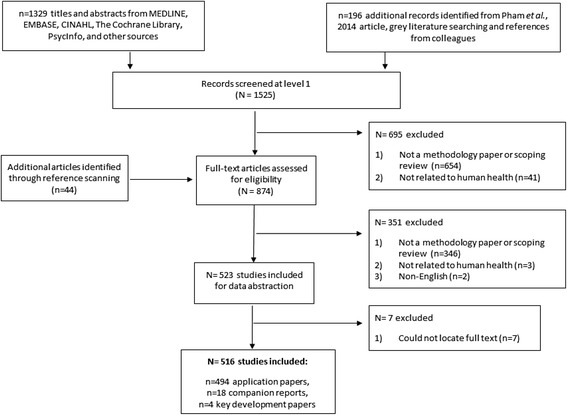
BACKGROUND: Scoping reviews are used to identify knowledge gaps, set research agendas, and identify implications for decision-making. The conduct and reporting of scoping reviews is inconsistent in the literature. We conducted a scoping review to identify: papers that utilized and/or described scoping review methods; guidelines for reporting scoping reviews; and studies that assessed the quality of reporting of scoping reviews. METHODS: We searched nine electronic databases for published and unpublished literature scoping review papers, scoping review methodology, and reporting guidance for scoping reviews. Two independent reviewers screened citations for inclusion. Data abstraction was performed by one reviewer and verified by a second reviewer. Quantitative (e.g. frequencies of methods) and qualitative (i.e. content analysis of the methods) syntheses were conducted. RESULTS: After searching 1525 citations and 874 full-text papers, 516 articles were included, of which 494 were scoping reviews. The 494 scoping reviews were disseminated between 1999 and 2014, with 45% published after 2012. Most of the scoping reviews were conducted in North America (53%) or Europe (38%), and reported a public source of funding (64%). The number of studies included in the scoping reviews ranged from 1 to 2600 (mean of 118). Using the Joanna Briggs Institute methodology guidance for scoping reviews, only 13% of the scoping reviews reported the use of a protocol, 36% used two reviewers for selecting citations for inclusion, 29% used two reviewers for full-text screening, 30% used two reviewers for data charting, and 43% used a pre-defined charting form. In most cases, the results of the scoping review were used to identify evidence gaps (85%), provide recommendations for future research (84%), or identify strengths and limitations (69%). We did not identify any guidelines for reporting scoping reviews or studies that assessed the quality of scoping review reporting. CONCLUSION: The number of scoping reviews conducted per year has steadily increased since 2012. Scoping reviews are used to inform research agendas and identify implications for policy or practice. As such, improvements in reporting and conduct are imperative. Further research on scoping review methodology is warranted, and in particular, there is need for a guideline to standardize reporting.
Overview
The claims and statistics of this paper haven’t been checked yet.
Free: it reads the open-access text and checks the first 5 claims that cite a source we can check. Create a free account to check every claim.
Integrity signals
Registry
Cites
Statistics
Figures
Verification
Claims the paper makes
The claims and statistics of this paper haven’t been checked yet.
Free: it reads the open-access text and checks the first 5 claims that cite a source we can check. Create a free account to check every claim.
Claims other papers make about this one
Each is checked against this paper’s own text: does it say what the citing paper says it does?
The cited source doesn’t support the claim as written.
In the citing paper
“The scoping review followed the guidelines outlined in the Preferred Reporting Items for Systematic Reviews and Meta-Analyses Extension (PRISMA-ScR) methodology (Munn et al., 2018; Tricco et al., 2016).”
From Sextortion: A Scoping Review (2025) · cites this paper as Tricco et al., 2016
Checked by a reasoning model — may be wrong.
Experimental — accuracy not yet measuredThe source backs part of the claim, not all of it — or backs it for a different population, condition or comparison.
In the citing paper
“A scoping review approach was considered appropriate for this purpose, given the authors’ understanding that the evidence base in this area is diverse in both research methodologies and disciplinary context (30).”
From Contributions of a time use perspective in community mental health practice: a scoping review (2024) · cites this paper as [30]
Experimental — accuracy not yet measuredThe source backs part of the claim, not all of it — or backs it for a different population, condition or comparison.
In the citing paper
“With the increasing popularity of scoping reviews, criticism of the rigour, transparency, and appropriateness of the methodology have been raised across multiple academic and clinical disciplines, including nursing and midwifery.”
From Undertaking a scoping review: A practical guide for nursing and midwifery students, clinicians, researchers, and academics (2021) · cites this paper as Tricco et al., 2016
Experimental — accuracy not yet measuredThe source backs part of the claim, not all of it — or backs it for a different population, condition or comparison.
In the citing paper
“Limitations of the scoping review methodology include the absence of methodological and risk of bias evaluations and the resultant inappropriateness of the review to be used as evidence for clinical guidelines, limitations, and recommendations (Arksey & O'Malley, 2005; Peters, Godfrey, et al., 2020; Tricco et al., 2016).”
From Undertaking a scoping review: A practical guide for nursing and midwifery students, clinicians, researchers, and academics (2021) · cites this paper as Tricco et al., 2016
Experimental — accuracy not yet measuredThe cited source says what the claim attributes to it.
In the citing paper
“while the number of scoping reviews in the literature is increasing steadily”
From PRISMA Extension for Scoping Reviews (PRISMA-ScR): Checklist and Explanation (2018) · cites this paper as [1]
13 more claims about this paper
Create a free account to see every claim other papers make about this one.
Self-check
Percentages, sums and reported differences re-computed from the paper’s own numbers.
The self-check needs the paper’s full text.
Citations
Cites
Preferred Reporting Items for Systematic Reviews and Meta-Analyses: the PRISMA statement
Moher, D., Liberati, A., Tetzlaff, J., Altman, D. G., & for the PRISMA Group (2009) · BMJ · doi:10.1136/bmj.b2535 · Cited by 83,823
Preferred reporting items for systematic reviews and meta-analyses: the PRISMA Statement.
(2009) · PubMed Central · Cited by 44,859
Scoping studies: towards a methodological framework
Arksey, H., & O'Malley, L. (2005) · International Journal of Social Research Methodology · doi:10.1080/1364557032000119616 · Cited by 36,742 · cited 15×
“Background Scoping reviews are used to map the concepts underpinning a research area and the main sources and types of evidence available [1].”
BackgroundMethodInfluentialPreferred Reporting Items for Systematic Reviews and Meta-Analyses: The PRISMA Statement
Moher, D., Liberati, A., Tetzlaff, J., & Altman, D. G. (2009) · Journal of Clinical Epidemiology · doi:10.1016/j.jclinepi.2009.06.005 · Cited by 19,575
Scoping studies: advancing the methodology
Levac, D., Colquhoun, H., & O'Brien, K. K. (2010) · Implementation Science · doi:10.1186/1748-5908-5-69 · Cited by 15,268 · cited 9×
“(2010) [2] modifications to the original framework of a scoping review [1] to guide this research.”
BackgroundMethodInfluentialSelf-citationGuidance for conducting systematic scoping reviews
Peters, M. D. J., Godfrey, C. M., Khalil, H., McInerney, P., Parker, D., & Soares, C. B. (2015) · International Journal of Evidence-Based Healthcare · doi:10.1097/xeb.0000000000000050 · Cited by 7,472 · cited 7×
“Our protocol was developed using the scoping review methodological framework proposed by Arksey and O’Malley (2005) [1] and further refined by the Joanna Briggs Institute [3].”
BackgroundMethodInfluentialSchulz (1995) · doi:10.1001/jama.1995.03520290060030 · Cited by 5,634 · cited 1×
“This is problematic because when different methods are applied to the same question, they may produce different results, undermining the utility and confidence in knowledge syntheses [5, 6].”
MethodA scoping review of scoping reviews: advancing the approach and enhancing the consistency
Pham, M. T., Rajić, A., Greig, J. D., Sargeant, J. M., Papadopoulos, A., & McEwen, S. A. (2014) · Research Synthesis Methods · doi:10.1002/jrsm.1123 · Cited by 3,078 · cited 2×
“We are aware of a previous scoping review of scoping reviews [16].”
BackgroundMethodScoping reviews: Time for clarity in definition, methods, and reporting
Colquhoun, H. L., Levac, D., O'Brien, K. K., Straus, S., Tricco, A. C., Perrier, L., Kastner, M., & Moher, D. (2014) · Journal of Clinical Epidemiology · doi:10.1016/j.jclinepi.2014.03.013 · Cited by 2,783 · cited 2×
“(2010) [2] and others [3], there is a lack of consistency in terminology and methods reported [4].”
BackgroundSelf-citationDaudt, H. M., van Mossel, C., & Scott, S. J. (2013) · BMC Medical Research Methodology · doi:10.1186/1471-2288-13-48 · Cited by 1,891 · cited 5×
“(2013) discussed the Arksey and O’Malley (2005) framework, and in particular, the team’s experiences using it, in order to develop the methodology further [10].”
BackgroundMethodInfluential
Research works printed but not linked: 2
- Colquhoun H, O’Brien K, Straus S, Moher D, Levac D. Gaps in scoping review methodologies J Clin Epidemiol. In press. 25034198
- Feinberg J Wordle 2014
Cited by
Items 901–1,000 of 1,005
Cannabis use among youth in Canada: a scoping review protocol
Kourgiantakis, T., Edwards, T., Lee, E., Logan, J. R., Vicknarajah, R., Craig, S. L., Simon-Tucker, M., & Williams, C. C. (2022) · BMJ Open · doi:10.1136/bmjopen-2022-061997 · Cited by 12
Hewitt, J. E., Alsaba, N., May, K., Noon, H. S., Rennie, C., & Marshall, A. P. (2022) · Australian Critical Care · doi:10.1016/j.aucc.2022.08.002 · Cited by 9
Parker, D. G., Zentner, D., Burack, J. A., & Wendt, D. C. (2023) · Drugs Education Prevention and Policy · doi:10.1080/09687637.2023.2181147 · Cited by 7
“This review was conducted using scoping review procedures, as outlined by the Joanna Briggs Institute (Peters et al., 2015) and the Preferred Reporting Items of Systematic Reviews and Meta-Analyses for Scoping Review (PRISMA-ScR) guidelines (Tricco et al., 2016).”
MethodCoadaptation Between Smart Technologies and Older Adults Over Time: Protocol for a Scoping Review
Kokorelias, K. M., Grigorovich, A., Harris, M. T., Rehman, U., Ritchie, L., Levy, A., Denecke, K., & McMurray, J. (2023) · JMIR Research Protocols · doi:10.2196/51129 · Cited by 9
“A scoping review was chosen as the systematic method for synthesizing knowledge [42-44] to comprehensively map the available evidence and provide a broad overview of the literature on the interaction between smart technologies and older adults, considering the diverse range of study designs,…”
MethodBakogiannis, A., Darling, J. C., Dimitrova, V. G., & Roberts, T. E. (2018) · International Journal of Educational Research · doi:10.1016/j.ijer.2018.11.001 · Cited by 9
Jones, A. S. K., Bidad, N., Horne, R., Stagg, H. R., Wurie, F. B., Kielmann, K., Karat, A. S., Kunst, H., Campbell, C., Darvell, M., et al. (2021) · The International Journal of Tuberculosis and Lung Disease · doi:10.5588/ijtld.21.0024 · Cited by 13
Updating the PRISMA reporting guideline for scoping reviews: a scoping review
Tricco, A. C., Robinson, E., Straus, S. E., Colquhoun, H., Godfrey, C. M., Moher, D., Munn, Z., Pollock, D., Logan, S., Elsman, E. B. M., et al. (2026) · Journal of Clinical Epidemiology · doi:10.1016/j.jclinepi.2026.112314 · Cited by 9
Self-citationThe Bobath concept (NDT) in adult neurorehabilitation: a scoping review of conceptual literature
Marques, S., Vaughan-Graham, J., Costa, R., & Figueiredo, D. (2025) · Disability and Rehabilitation · doi:10.1080/09638288.2024.2375054 · Cited by 8
“A scoping literature review is an iterative process of summarized literature in the field to identify the breadth and depth of a concept or issue [15,16].”
Ferreira, A. P., Nichele, C. D. S. T., de Jesus, J. G., Vianna, M. B., Cardoso, G. C. P., Salles, I. C. D. M., dos Santos, J. B., Silva, A. B., Girianelli, V. R., & Cotrim, D. F. (2022) · Research Society and Development · doi:10.33448/rsd-v11i10.32519 · Cited by 12
“It’s Your Word Against Mine”: A Case Study of Gender Negotiation in a Spanish School
Pereira-García, S., Devís‐Devís, J., Vivancos, F. V., & Taylor, Y. (2023) · Child and Adolescent Social Work Journal · doi:10.1007/s10560-023-00954-9 · Cited by 9
“The purpose of this scoping review was thus to present a broad overview of the evidence on trans students’ experiences at secondary schools and identify any gaps in the knowledge pertaining to this topic (Tricco et al., 2016).”
Preissner, C. E., Vilier, L., de Vries, H., & Oenema, A. (2024) · Health Psychology Review · doi:10.1080/17437199.2024.2310115 · Cited by 12
“In line with our broad research aims, scoping reviews are a fi tting method to provide an extensive overview of a topic and fi eld (Peters et al., 2015; Tricco et al., 2016).”
Agoriwo, M. W., Joseph, C., Franzén, E., & Unger, M. (2024) · Journal of Evaluation in Clinical Practice · doi:10.1111/jep.13999 · Cited by 10
Gulbransen, K., Thiessen, K. R., Ford, N., Phillips-Beck, W., Watson, H., & Gregory, P. (2024) · International Journal of Integrated Care · doi:10.5334/ijic.7589 · Cited by 13
“Accurate citation counts at each stage were recorded through the PRISMA flowchart– see Figure 1 [30].”
MethodSeverance, S., Miller, E. C. A., & Krajcik, J. S. (2024) · Studies in Science Education · doi:10.1080/03057267.2024.2397300 · Cited by 16
Hikmat, R., Suryani, S., Yosep, I., & Jeharsae, R. (2024) · BMC Public Health · doi:10.1186/s12889-024-20086-8 · Cited by 20
“The authors selected this method because it has a clear conceptual range to explore various research results [34].”
MethodRetractedDisaster Medicine Education for Medical Students: A Scoping Review
Rashid, H., Alexakis, L. C., & Pereira, I. M. A. (2024) · Cureus · doi:10.7759/cureus.75035 · Cited by 8
The quality of orthognathic surgery information on social media: A scoping review
Ngo, M. V., Jensen, E. D., & Meade, M. J. (2024) · International Orthodontics · doi:10.1016/j.ortho.2024.100959 · Cited by 9
Robinson, K., Afrouz, R., & Dunwoodie, K. (2025) · Journal of Family Violence · doi:10.1007/s10896-025-00823-2 · Cited by 11
van Essen, K., Akse, M., Pelgrim, T. C., Prick, A.-E. J. C., & Aalbers, S. (2025) · The Arts in Psychotherapy · doi:10.1016/j.aip.2025.102289 · Cited by 11
Chapman, H. K., Southall, A. E., & Grieshaber, S. (2025) · The Australian Educational Researcher · doi:10.1007/s13384-025-00838-0 · Cited by 16
“According to Arksey and O’Malley (2005), this is not needed if the initial five steps are sufficient to achieve the study’s objectives (Buus et al., 2022; Tricco et al., 2016).”
Otchere, G., Fusheini, A., Sullivan, T. A., Gauld, R. D. C., & Penno, E. (2025) · Health Science Reports · doi:10.1002/hsr2.70746 · Cited by 10
The Use of Clinical Pathways in Emergency Departments: A Scoping Review
Mudzingwa, I. T., Prior, S. J., Griffin, P., Tavender, E. J., & Tran, V. (2025) · Health Services Insights · doi:10.1177/11786329251328527 · Cited by 12
Neiders, I., Mežinska, S., & van Haren, N. E. M. (2025) · BMC Psychiatry · doi:10.1186/s12888-025-06949-3 · Cited by 12
“Scoping reviews, according to Munn et al. are “ideal tool to determine the scope of coverage of a body of literature on a given topic and give a clear indication of the volume of literature and studies available as well as an overview (broad or detailed) of its focus” [14].”
The challenges of expanding medical student numbers in the UK: A scoping review
Sassoon, E. C., Craig, R., & O’Brien, D. G. (2025) · Future Healthcare Journal · doi:10.1016/j.fhj.2025.100278 · Cited by 8
“14 This review follows methodology set out by Arksey and O’Malley, guidance from the Joanna Briggs Institute (JBI) for scoping reviews, and conducted in accordance with an a priori protocol which can be found in appendix A. 15 , 16 Identifying the research question The final research question agreed…”
Khalil, C. A., Saab, A., Rahme, J., Bouaud, J., & Séroussi, B. (2025) · BMC Nursing · doi:10.1186/s12912-025-03272-w · Cited by 15
Watts, N., & Brömdal, A. (2025) · The Australian Educational Researcher · doi:10.1007/s13384-025-00921-6 · Cited by 10
“This form of literature review allows researchers to determine possible gaps on a topic (Mak & Thomas, 2022; Peters et al., 2020) and can contribute to future research (Tricco et al., 2016).”
Career development and human resource management of older workers: A scoping review
Mok, I., Mackenzie, L. A., & Thomson, K. E. (2021) · Australian Journal of Career Development · doi:10.1177/10384162211069208 · Cited by 23
Hamzah, L. M., & Yusoff, W. M. W. (2021) · Asian Journal of University Education · doi:10.24191/ajue.v17i2.13386 · Cited by 8
Ahasan, R., Alam, M. S., Chakraborty, T., Ali, S. M. A., Alam, T. B., Islam, T., & Hossain, M. M. (2022) · Health Policy and Technology · doi:10.1016/j.hlpt.2022.100647 · Cited by 11
Nyoni, T., Evers, E. C., Pérez, M., Jeffe, D. B., Fritz, S. A., Colditz, G. A., & Burnham, J. P. (2023) · Journal of Telemedicine and Telecare · doi:10.1177/1357633x221149461 · Cited by 10
“16,18,19 Context-speci fi c pre-implementation research is needed to identify key factors in fl uencing tele-ID consult uptake.”
Corrin, T., Ayache, D., Baumeister, A., Young, K., Pussegoda, K., Ahmad, R., & Waddell, L. A. (2023) · Canada Communicable Disease Report · doi:10.14745/ccdr.v49i01a02 · Cited by 11
Bharat, R., Uzaina, U., Yadav, T., Niranjan, S., & Kurade, P. (2023) · Indian Pediatrics · doi:10.1007/s13312-023-2840-1 · Cited by 11
“A scoping review design based on Joanna Briggs Institute (JBI) methodology [20] for the conduction, and PRISMA extension (PRISMA-ScR) checklist and flow diagram [21] were utilized to guide procedures for identification, screening, eligibility, and inclusion of articles for review.”
MethodTeaching project management to primary school children: a scoping review
Delle-Vergini, S., Eacersall, D. C. F., Dann, C. E., Ally, M., & Chakraborty, S. (2023) · The Australian Educational Researcher · doi:10.1007/s13384-023-00627-7 · Cited by 13
“Finally, as the information presented in scoping reviews provides more breadth than depth, this review only sought to present the extent, range and nature of the literature rather than a detailed analysis (Tricco et al., 2016).”
Machine learning for semi-automated scoping reviews
Mozgai, S., Kaurloto, C., Winn, J. G., Leeds, A., Heylen, D., Hartholt, A., & Scherer, S. J. (2023) · Intelligent Systems with Applications · doi:10.1016/j.iswa.2023.200249 · Cited by 9
Atenção à saúde de pessoas em situação de rua no cotidiano da atenção primária: scoping review
Gontijo, L. A., da Silva, B. M., & Viegas, S. M. D. F. (2023) · Saúde em Debate · doi:10.1590/0103-1104202313722 · Cited by 9
“…como método capaz de gerar hipóteses e expandir a visão geral das evidências sobre determinado assunto, auxiliando o pesquisador na explora-ção das áreas emergentes, no esclarecimento de conceitos e na identificação de lacunas de conhecimento, além de recomendar a revisão sistemática futura 6 .”
BackgroundChikuta, O., Kupika, O. L., & Nthoi, O. U. (2024) · Frontiers in Sustainable Tourism · doi:10.3389/frsut.2023.1296959 · Cited by 12
Verret, M., Lam, N. H., Lalu, M. M., Nicholls, S. G., Turgeon, A. F., McIsaac, D. I., Hamtiaux, M., Le, J. B. P., Gilron, I., Yang, L., et al. (2024) · British Journal of Anaesthesia · doi:10.1016/j.bja.2024.01.006 · Cited by 10
“6 e 15,19,21 e 41 Furthermore, considering the heterogeneous and complex nature of intra-operative opioid minimisation strategies, 55 e 57 a scoping review serves as a valuable approach for assessing the extent, range, and nature of this field and provide insights for future research.”
BackgroundBreastfeeding and pre-pregnancy bariatric surgery: A scoping review
Mokhlesi, S., Vasilevski, V., & Sweet, L. P. (2024) · Women and Birth · doi:10.1016/j.wombi.2024.101600 · Cited by 9
Frentz, J., Brauckmann-Sajkiewicz, S., Bellibaş, M. Ş., Pashiardis, P., & Pietsch, M. (2025) · Leadership and Policy in Schools · doi:10.1080/15700763.2025.2471373 · Cited by 12
Compliant flooring to prevent fall-related injuries: a scoping review protocol
Lachance, C. C., Jurkowski, M. P., Dymarz, A., & Mackey, D. C. (2016) · BMJ Open · doi:10.1136/bmjopen-2016-011757 · Cited by 7
State of reporting of primary biomedical research: a scoping review protocol
Li, G., Mbuagbaw, L. C. E., Samaan, Z., Jin, Y., Nwosu, I., Levine, M., Adachi, J. D., & Thabane, L. (2017) · BMJ Open · doi:10.1136/bmjopen-2016-014749 · Cited by 8
Uso de heurísticos y error diagnóstico en Atención Primaria: revisión panorámica
Minué-Lorenzo, S., Fernández‐Aguilar, C., Martín‐Martín, J. J., & Fernández-Ajuria, A. (2019) · Atención Primaria · doi:10.1016/j.aprim.2018.11.003 · Cited by 15
Core competencies for physiotherapists working with refugees: a scoping review
McGowan, E., Beamish, N., Stokes, E., & Lowe, R. (2020) · Physiotherapy · doi:10.1016/j.physio.2020.04.004 · Cited by 8
Research Focused on Doctoral-Level Counselor Education: A Scoping Review
Litherland, G., & Schulthes, G. (2020) · The Professional Counselor · doi:10.15241/gl.10.4.414 · Cited by 12
Terapia ocupacional assistida por cães: uma revisão de escopo da literatura brasileira
Figueiredo, M. D. O., Alegretti, A. L., & Magalhães, L. (2021) · Cadernos Brasileiros de Terapia Ocupacional · doi:10.1590/2526-8910.ctoar2087 · Cited by 22
Sharma, N., Arahna, V. P., Saxena, S., Ateef, M., & Samuel, A. J. (2021) · Journal of Pediatric Surgery · doi:10.1016/j.jpedsurg.2021.11.012 · Cited by 9
A atividade de extensão na terapia ocupacional: revisão de escopo na literatura nacional
Figueiredo, M. D. O., Batistão, R., Silva, C. R., Martinez, C. M. S., & Roiz, R. G. (2022) · Cadernos Brasileiros de Terapia Ocupacional · doi:10.1590/2526-8910.ctoar21972908 · Cited by 8
Pharmaceutical Digital Marketing of Non-prescription Drugs: A Systematic Scoping Review
Anis, M. S., & Hassali, M. A. (2022) · Research Journal of Pharmacy and Technology · doi:10.52711/0974-360x.2022.00157 · Cited by 11
Kokorelias, K. M., Nelson, M. L. A., Cameron, J. I., Colquhoun, H. L., Munce, S., Hitzig, S. L., Salbach, N. M., Martyniuk, J., Gray, C. S., Tang, T., et al. (2022) · BMJ Open · doi:10.1136/bmjopen-2021-059017 · Cited by 8
Self-citationA systematic scoping review of tiger conservation in the Terai Arc Landscape and Himalayas
Yadav, P. K., Brownlee, M. T. J., & Kapoor, M. (2022) · Oryx · doi:10.1017/s0030605322001156 · Cited by 8
Choosing which in-hospital laboratory tests to target for intervention: a scoping review
Podolsky, E., Hudek, N., McCudden, C. R., Presseau, J., Yanikomeroglu, S., Brouwers, M. C., & Brehaut, J. (2022) · Clinical Chemistry and Laboratory Medicine (CCLM) · doi:10.1515/cclm-2022-0910 · Cited by 10
Angling tourism: A state-of-the-art review
Hannonen, O., & Hoogendoorn, G. (2022) · Matkailututkimus · doi:10.33351/mt.116555 · Cited by 8
“A scoping review differs from a systematic one as it offers an overview of the evidence relevant to a specific topic “in terms of the volume, nature, and characteristics of the primary research” (Pham et al., 2014, p. 371; Tricco et al., 2016).”
BackgroundMoloi, H., Daniels, K., Brooke‐Sumner, C., Cooper, S., Odendaal, W., Thorne, M., Akama, E., & Leon, N. (2023) · Cochrane Database of Systematic Reviews · doi:10.1002/14651858.cd013603.pub3 · Cited by 28
Interventions to Minimize Medication Error by Nurses in Intensive Care: A Scoping Review Protocol
Coelho, F., Furtado, L., Mendonça, N., Soares›, H., Duarte, H. M. S., Costeira, C. R. B., Santos, C., & Sousa, J. P. (2023) · Nursing Reports · doi:10.3390/nursrep13030091 · Cited by 11
“The choice to conduct a scoping review in this context is justified by its ability to explore the literature extensively and provide evidence summaries, making it an appropriate method for mapping the evidence, which may be extensive in this complex topic [44,45].”
MethodLiu, J., Smith, K., Riker, R. R., Craig, W. Y., McKelvy, D. J., Kemp, H., Nichols, S. D., & Fraser, G. L. (2021) · American Journal of Health-System Pharmacy · doi:10.1093/ajhp/zxab166 · Cited by 9
Zhu, S., Wu, T., Leese, J., LI, L. C., He, C., & Yang, L. (2022) · PLoS ONE · doi:10.1371/journal.pone.0278379 · Cited by 8
Night Shift Work and Sleep Disturbances in Women
Vasconcelos, S. P., Lemos, L. C., & Moreno, C. R. D. C. (2023) · Sleep Medicine Clinics · doi:10.1016/j.jsmc.2023.06.016 · Cited by 7
Unmet care needs of women who have undergone breast cancer surgery: A scoping review
Ke, Q., Timmins, F., Furlong, E., & Stokes, D. (2023) · Journal of Advanced Nursing · doi:10.1111/jan.15953 · Cited by 11
Vohra, R., Singh, R., & Shrivastava, R. (2024) · Journal of Ayurveda and Integrative Medicine · doi:10.1016/j.jaim.2023.100866 · Cited by 7
“…a research question, conducting a systematic review, selecting studies based on our inclusion and exclusion criteria, recording key findings of each study, qualitatively summarizing findings, and providing a conclusion on the extent of research evidence and the need for future research [81,82].”
BackgroundKaran, A., Hussain, S., Jensen, L. X., Buhl, A., Bearman, M., & ZODPEY, S. P. (2024) · BMC Public Health · doi:10.1186/s12889-024-18765-7 · Cited by 7
Kokorelias, K. M., Brown, P., Walmsley, S. L., Zhabokritsky, A., Su, E., & Sirisegaram, L. (2024) · PLoS ONE · doi:10.1371/journal.pone.0306225 · Cited by 7
The role of pets in the lives of people with dementia: a scoping review
Monks, S., & Clark, A. (2024) · Aging & Mental Health · doi:10.1080/13607863.2024.2372709 · Cited by 7
Enhanced recovery after surgery and intestinal obstruction: A scoping review
Buhl, M. S. A., Jaensch, C., & Madsen, A. H. (2024) · World Journal of Surgery · doi:10.1002/wjs.12310 · Cited by 10
Berger, E., Schol, C. M. A., Gunput, S. T. G., Kiers, D., Gommers, D. A. M. P. J., Rose, L., & van Mol, M. M. C. (2024) · Mayo Clinic Proceedings Digital Health · doi:10.1016/j.mcpdig.2024.11.006 · Cited by 20
“26 We followed the 6-stages framework proposed by Arksey and O ’ Malley, 27 advanced by Colquhoun et al 28 and further expanded by Tricco et al. 29 34 We adopted an iterative process and made choices according to new insights during the review process.”
Health Care Social Robots in the Age of Generative AI: Protocol for a Scoping Review
Lempe, P. N., Guinemer, C., Fürstenau, D., Dressler, C., Balzer, F., & Schaaf, T. (2025) · JMIR Research Protocols · doi:10.2196/63017 · Cited by 9
“In general, scoping reviews tend to be inherently limited by focusing on breadth rather than depth [131].”
Lakoud, M., Morales, E., Ruiz-Rodrigo, A., Feillou, I., Mathieu, S., & Routhier, F. (2024) · Frontiers in Rehabilitation Sciences · doi:10.3389/fresc.2024.1419446 · Cited by 7
Panesar, S., Rajabali, S., Kennedy, M., & Wagg, A. (2025) · BMJ Open · doi:10.1136/bmjopen-2024-091092 · Cited by 9
“27 28 If lower agreement is observed, reviewers will meet to review and refine the eligibility criteria.”
Yadav, R. L., Martin, J., & Galea, M. P. (2025) · Journal of Spinal Cord Medicine · doi:10.1080/10790268.2025.2485509 · Cited by 9
Governance and integrity challenges in esports: A scoping review
Candeo, A. L. D. S., Reyes, S. J., Haller, N., Richardson, A., Preuß, H., Souvignet, T. R., Könecke, T., & Schubert, M. (2025) · Performance Enhancement & Health · doi:10.1016/j.peh.2025.100352 · Cited by 13
Chishtie, J., Tea, J., Ester, M., Rasheed, G., Chua, N., Vaska, M. M., Teare, G. F., & Adhikari, K. (2025) · Journal of Medical Internet Research · doi:10.2196/73615 · Cited by 17
“We used established scoping review methods to summarize the extent and characteristics of evidence on the use of screening tools for SDOH and modifiable risk factors in the Epic EHR [22,23].”
A scoping review on microgravity medicine: Challenges and breakthroughs in space healthcare
Ray, A. S., Parvez, F. M. R., & Islam, M. M. (2025) · Space habitation. · doi:10.1016/j.spaceh.2025.100017 · Cited by 9
Villamizar, J. R., Ibarra-Enríquez, C. D., Galindo-Sánchez, J. S., Serrano, C., & Fernández‐Trujillo, L. (2025) · World Allergy Organization Journal · doi:10.1016/j.waojou.2025.101107 · Cited by 7
“7 To report this study, we followed the PRISMA Extension for Scoping Reviews (PRISMA-ScR).”
Bashir, S., & OETZEL, J. G. (2025) · Journal of Advanced Nursing · doi:10.1111/jan.70339 · Cited by 12
Agent-Based Modelling of food systems: A scoping review on incorporation of behavioural insights
Öttl, A., & Termansen, M. (2025) · Environmental Modelling & Software · doi:10.1016/j.envsoft.2025.106617 · Cited by 8
Schmid, M. J., Küttel, A., Charbonnet, B., Rivero, T., Schmid, J., Ronkainen, N. J., & Conzelmann, A. (2026) · International Review of Sport and Exercise Psychology · doi:10.1080/1750984x.2025.2610947 · Cited by 9
A scoping review of AI for sustainability and sustainable AI in higher education
Daniel, B. K., Podgorodnichenko, N., & Carr, S. (2026) · Discover Computing · doi:10.1007/s10791-025-09861-2 · Cited by 20
“The current review supports conceptual clarification and the identification of underex-plored intersections between AI and sustainability research in the context of higher education, thereby laying a foundation for future systematic reviews or empirical research [71, 104].”
Oyetunji, I. O., Duncan, A., Booley, S., & Harbron, J. (2021) · BMJ Open · doi:10.1136/bmjopen-2020-047314 · Cited by 8
Methods of Calculating the Marginal Cost of Incarceration: A Scoping Review
Wilson, S. J., & Lemoine, J. (2021) · Criminal Justice Policy Review · doi:10.1177/08874034211060336 · Cited by 9
“Consequently, the results of the scoping review are typically used by researchers to identify knowledge gaps, set research agendas, and identify implications for policy and practice (Tricco et al., 2016).”
BackgroundMapping precision public health definitions, terminology and applications: a scoping review protocol
Bosward, R., Braunack‐Mayer, A., Frost, E. K., & Carter, S. M. (2022) · BMJ Open · doi:10.1136/bmjopen-2021-058069 · Cited by 7
Physiotherapist performed Point of Care Ultrasonography (POCUS): a scoping review of 209 studies
Strike, K., Chan, A. K. C., Maly, M. R., Newman, A. N. L., & Solomon, P. E. (2022) · Physiotherapy · doi:10.1016/j.physio.2022.11.005 · Cited by 7
Reporting quality of scoping reviews in dental public health
Dotto, L., dos Santos, M. B. F., & Sarkis-Onofre, R. (2023) · BMC Medical Research Methodology · doi:10.1186/s12874-023-01863-2 · Cited by 7
“Previous studies have reported that a considerable number of studies is often poorly reported [9, 10], which might result in biased or invalidated conclusions leading to loss of time and resources.”
ResultThe Potential of Augmented Reality in Education: A Scoping Review
Kibat, S. A., Ngelambong, A., & Scott, N. (2023) · International Journal of Academic Research in Business and Social Sciences · doi:10.6007/ijarbss/v13-i5/17072 · Cited by 15
Privacy impact assessments in the wild: A scoping review
Iwaya, L. H., Alaqra, A. S., Hansen, M., & Fischer‐Hübner, S. (2024) · Array · doi:10.1016/j.array.2024.100356 · Cited by 16
Caetano, J., Rodrigues, L. M., & Alves, J. D. (2024) · Autoimmunity Reviews · doi:10.1016/j.autrev.2024.103540 · Cited by 7
Adaptive design trials in eating disorder research: A scoping review
Edney, L. C., & Pellizzer, M. L. (2024) · International Journal of Eating Disorders · doi:10.1002/eat.24198 · Cited by 11
Exploring physiological differences in injury response by skin tone: A scoping review
Avşar, P., Moore, Z. E. H., Patton, D., O’Connor, T., Bertelsen, L. S., Tobin, D. J., Brunetti, G., Carville, K., Iyer, V., & Wilson, H. J. E. (2025) · Journal of Tissue Viability · doi:10.1016/j.jtv.2025.100871 · Cited by 8
Mao, J., Yamakawa, M., Hu, X., Chikama, H., Swa, T., & Takeya, Y. (2025) · International Journal of Nursing Practice · doi:10.1111/ijn.70010 · Cited by 11
Conversational Agents to Support Pain Management: A Scoping Review
Souza, F. L., Bowman, H., Yang, F., Hesam‐Shariati, N., Linke, J., Gilanyi, Y. L., Jones, M. D., Z‐Pinto, R., McAuley, J. H., & Rizzo, R. R. N. (2025) · European Journal of Pain · doi:10.1002/ejp.70016 · Cited by 8
“The inclusion criteria were intentionally designed to comprehensively map the literature on CAs, reflecting the broader approach characteristic of scoping reviews (Tricco et al. 2016).”
Mostafavi-Pour-Manshadi, S. M. Y., Naderi, N., Barrecheguren, M., Dehghan, A., & Bourbeau, J. (2017) · BMJ Open · doi:10.1136/bmjopen-2017-018954 · Cited by 8
“This approach is consistent with scoping reviews of clinical topics.(27)”
Monsour, A., Mew, E. J., Szatmári, P., Patel, S. R., Saeed, L., Offringa, M., & Butcher, N. J. (2019) · BMJ Open · doi:10.1136/bmjopen-2018-024191 · Cited by 7
Lenton, E., & Fuller, K. (2019) · Journal of the Canadian Health Libraries Association / Journal de l Association de bilbiothèques de la santé du Canada · doi:10.29173/jchla29391 · Cited by 8
“Recent estimates indicate a three-fold increase in the number of published systematic reviews over the last decade [1], and that nearly half of all published scoping reviews have been published within the last six years alone [2].”
BackgroundCoenzyme Q10 supplementation in traumatic brain injury: a scoping review protocol
Allan, K., Hayes, K., Thomas, M., & Barnard, K. (2019) · The JBI Database of Systematic Reviews and Implementation Reports · doi:10.11124/jbisrir-2017-003984 · Cited by 9
Title analysis of (systematic) scoping review studies: Chaos or consistency?
Chrastina, J. (2020) · Nursing and Health Sciences · doi:10.1111/nhs.12694 · Cited by 10
de Paiva, C. C. N., Santos, D. L., Cotrim, D. F., Cabral, L. M. D. S., Cabral, S. C. D. S., & Esparis, I. M. (2021) · Research Society and Development · doi:10.33448/rsd-v10i3.12966 · Cited by 7
Ehlen, S., Rehaag, R., Fitschen, J., Okan, O., Pinheiro, P., & Bauer, U. (2021) · Prävention und Gesundheitsförderung · doi:10.1007/s11553-021-00850-z · Cited by 7
Adams, S. T., West, C. A., & Walsh, C. J. (2021) · Journal of Plastic Reconstructive & Aesthetic Surgery · doi:10.1016/j.bjps.2021.08.048 · Cited by 7
Entrepreneurship Studies in The Sultanate of Oman: A Scoping Review of 20 years publications
Al-Lawati, E. H., Kohar, U. H. A., & Suleiman, E. S. (2021) · Studies of Applied Economics · doi:10.25115/eea.v39i10.5974 · Cited by 8
Reporting Modifications in Surgical Innovation: A Systematic Scoping Review Protocol
Hoffmann, C., Hossaini, S., Cousins, S., Blencowe, N., McNair, A., Blazeby, J. M., AVERY, K. N. L., Potter, S., & Macefield, R. C. (2021) · International Journal of Surgery Protocols · doi:10.29337/ijsp.167 · Cited by 9
SOCIAL MEDIA AND PARENTING SUPPORT: A SYSTEMATIC SCOPING REVIEW (2010-2019)
(2021) · IADIS INTERNATIONAL JOURNAL ON WWW/INTERNET · doi:10.33965/ijwi_202119201 · Cited by 6
“Scoping reviews represent a wide range of methodological rigor (Pham et al., 2014; Tricco et al., 2016), which has resulted in disagreement in the literature as to whether or not scoping reviews are a form of systematic literature review (Morris et al.”
BackgroundОбзор предметного поля как метод синтеза научных данных
Тихонова, Е. В., & Шленская, Н. М. (2021) · Хранение и переработка сельхозсырья · doi:10.36107/spfp.2021.257 · Cited by 12
Metadata
- Authors
- Tricco, A. C., Lillie, E., Zarin, W., O’Brien, K., Colquhoun, H., Kastner, M., Levac, D., Ng, C., Sharpe, J. P., Wilson, K., Kenny, M., Warren, R., Wilson, C., Stelfox, H. T., & Straus, S. E.
- Affiliations
- St. Michael's Hospital (CA)
- University of Toronto (CA)
- University of Ottawa (CA)
- University of Calgary (CA)
- Corresponding author
- Tricco, Andrea C.
- ORCID
- Venue
- BMC Medical Research Methodology
- Published
- 2016-02-09
- Volume
- 16
- Issue
- 1
- Pages
- 15-15
- ISSN
- 1471-2288 (ISSN-L)
- PMC
- PMC4746911
- OpenAlex
- W2261406464
- Semantic Scholar
- 91435675555c6bce345c14c4f31104353f325a49
- Cited by
- 2,250
- References
- 27
- Citations by year
- 2026: 261 · 2025: 369 · 2024: 352 · 2023: 341 · 2022: 304 · 2021: 257 · 2020: 135 · 2019: 102 · 2018: 76 · 2017: 42 · 2016: 9
- FWCI
- 70.87
- Type
- journal article
- Language
- en
- Open access
- gold
- doi.org
- Licence
- cc-by
- Locations
- BMC Medical Research Methodology (publishedVersion, cc-by)
- PubMed Central (publishedVersion, cc-by)
- PubMed (publishedVersion)
- TSpace (University of Toronto) (submittedVersion, cc-by)
- TSpace (University of Toronto) (submittedVersion)
- DOAJ (DOAJ: Directory of Open Access Journals) (submittedVersion, cc-by-sa)
- Funders
- Canadian Institutes of Health Research (KRS-138219)
- Canadian Agency for Drugs and Technologies in Health
- Topics
- Social Sciences › Decision Sciences › Statistics, Probability and Uncertainty › Meta-analysis and systematic reviews
- Social Sciences › Sociology and Political Science › Delphi Technique in Research
- Health Sciences › Medicine › Public Health, Environmental and Occupational Health › Clinical practice guidelines implementation
- Keywords
- scoping review, scoping review reporting, reporting guidelines, Joanna Briggs Institute, inter-rater reliability, evidence gaps, research agenda setting, reporting quality assessment
- MeSH terms
- Scoping Reviews as Topic, Humans, Publications, Quality Control, Databases, Bibliographic, Guidelines as Topic, Research Report
About these checks
Registry, retraction, Cites and statistics results are computed, not judged, with one exception: a printed reference that no index lists is read once by a model before it counts as a citation error. Claims are extracted by a model and kept only when their quote appears verbatim in the text; each cited source is then checked, with a model’s help, for whether it says what the claim relies on. Those verdicts can be wrong — read the claim’s quote and the cited source before relying on one.
Statistics and arithmetic are recomputed, not judged.
Confidence bands are shown only for fields calibrated on our annotated test set. None is calibrated yet, so no band is shown.
What counts as a claim ›How we measure confidence ›How we check this ›
Are you an author, or do you see a problem with this page? Request a review
Data sources
Bibliographic data: Semantic Scholar, OpenAlex, Crossref.
Contains information from the Semantic Scholar Academic Graph Datasets, made available under the ODC Attribution License (ODC-BY 1.0).
Semantic Scholar’s data is described in: Kinney, R., et al. (2023). The Semantic Scholar Open Data Platform. arXiv:2301.10140.
