

A scoping review on the conduct and reporting of scoping reviews
Open accessThe DOI matches its Crossref record; 25 of the 27 references it cites were found in a registry or an index.
Abstract
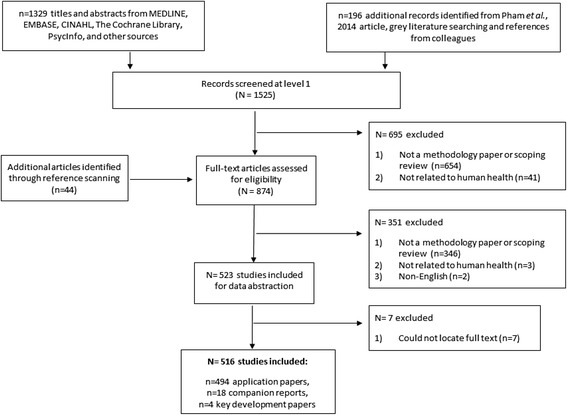
BACKGROUND: Scoping reviews are used to identify knowledge gaps, set research agendas, and identify implications for decision-making. The conduct and reporting of scoping reviews is inconsistent in the literature. We conducted a scoping review to identify: papers that utilized and/or described scoping review methods; guidelines for reporting scoping reviews; and studies that assessed the quality of reporting of scoping reviews. METHODS: We searched nine electronic databases for published and unpublished literature scoping review papers, scoping review methodology, and reporting guidance for scoping reviews. Two independent reviewers screened citations for inclusion. Data abstraction was performed by one reviewer and verified by a second reviewer. Quantitative (e.g. frequencies of methods) and qualitative (i.e. content analysis of the methods) syntheses were conducted. RESULTS: After searching 1525 citations and 874 full-text papers, 516 articles were included, of which 494 were scoping reviews. The 494 scoping reviews were disseminated between 1999 and 2014, with 45% published after 2012. Most of the scoping reviews were conducted in North America (53%) or Europe (38%), and reported a public source of funding (64%). The number of studies included in the scoping reviews ranged from 1 to 2600 (mean of 118). Using the Joanna Briggs Institute methodology guidance for scoping reviews, only 13% of the scoping reviews reported the use of a protocol, 36% used two reviewers for selecting citations for inclusion, 29% used two reviewers for full-text screening, 30% used two reviewers for data charting, and 43% used a pre-defined charting form. In most cases, the results of the scoping review were used to identify evidence gaps (85%), provide recommendations for future research (84%), or identify strengths and limitations (69%). We did not identify any guidelines for reporting scoping reviews or studies that assessed the quality of scoping review reporting. CONCLUSION: The number of scoping reviews conducted per year has steadily increased since 2012. Scoping reviews are used to inform research agendas and identify implications for policy or practice. As such, improvements in reporting and conduct are imperative. Further research on scoping review methodology is warranted, and in particular, there is need for a guideline to standardize reporting.
Overview
The claims and statistics of this paper haven’t been checked yet.
Free: it reads the open-access text and checks the first 5 claims that cite a source we can check. Create a free account to check every claim.
Integrity signals
Registry
Cites
Statistics
Figures
Verification
Claims the paper makes
The claims and statistics of this paper haven’t been checked yet.
Free: it reads the open-access text and checks the first 5 claims that cite a source we can check. Create a free account to check every claim.
Claims other papers make about this one
Each is checked against this paper’s own text: does it say what the citing paper says it does?
The cited source doesn’t support the claim as written.
In the citing paper
“The scoping review followed the guidelines outlined in the Preferred Reporting Items for Systematic Reviews and Meta-Analyses Extension (PRISMA-ScR) methodology (Munn et al., 2018; Tricco et al., 2016).”
From Sextortion: A Scoping Review (2025) · cites this paper as Tricco et al., 2016
Checked by a reasoning model — may be wrong.
Experimental — accuracy not yet measuredThe source backs part of the claim, not all of it — or backs it for a different population, condition or comparison.
In the citing paper
“A scoping review approach was considered appropriate for this purpose, given the authors’ understanding that the evidence base in this area is diverse in both research methodologies and disciplinary context (30).”
From Contributions of a time use perspective in community mental health practice: a scoping review (2024) · cites this paper as [30]
Experimental — accuracy not yet measuredThe source backs part of the claim, not all of it — or backs it for a different population, condition or comparison.
In the citing paper
“With the increasing popularity of scoping reviews, criticism of the rigour, transparency, and appropriateness of the methodology have been raised across multiple academic and clinical disciplines, including nursing and midwifery.”
From Undertaking a scoping review: A practical guide for nursing and midwifery students, clinicians, researchers, and academics (2021) · cites this paper as Tricco et al., 2016
Experimental — accuracy not yet measuredThe source backs part of the claim, not all of it — or backs it for a different population, condition or comparison.
In the citing paper
“Limitations of the scoping review methodology include the absence of methodological and risk of bias evaluations and the resultant inappropriateness of the review to be used as evidence for clinical guidelines, limitations, and recommendations (Arksey & O'Malley, 2005; Peters, Godfrey, et al., 2020; Tricco et al., 2016).”
From Undertaking a scoping review: A practical guide for nursing and midwifery students, clinicians, researchers, and academics (2021) · cites this paper as Tricco et al., 2016
Experimental — accuracy not yet measuredThe cited source says what the claim attributes to it.
In the citing paper
“while the number of scoping reviews in the literature is increasing steadily”
From PRISMA Extension for Scoping Reviews (PRISMA-ScR): Checklist and Explanation (2018) · cites this paper as [1]
13 more claims about this paper
Create a free account to see every claim other papers make about this one.
Self-check
Percentages, sums and reported differences re-computed from the paper’s own numbers.
The self-check needs the paper’s full text.
Citations
Cites
Preferred Reporting Items for Systematic Reviews and Meta-Analyses: the PRISMA statement
Moher, D., Liberati, A., Tetzlaff, J., Altman, D. G., & for the PRISMA Group (2009) · BMJ · doi:10.1136/bmj.b2535 · Cited by 83,823
Preferred reporting items for systematic reviews and meta-analyses: the PRISMA Statement.
(2009) · PubMed Central · Cited by 44,859
Scoping studies: towards a methodological framework
Arksey, H., & O'Malley, L. (2005) · International Journal of Social Research Methodology · doi:10.1080/1364557032000119616 · Cited by 36,742 · cited 15×
“Background Scoping reviews are used to map the concepts underpinning a research area and the main sources and types of evidence available [1].”
BackgroundMethodInfluentialPreferred Reporting Items for Systematic Reviews and Meta-Analyses: The PRISMA Statement
Moher, D., Liberati, A., Tetzlaff, J., & Altman, D. G. (2009) · Journal of Clinical Epidemiology · doi:10.1016/j.jclinepi.2009.06.005 · Cited by 19,575
Scoping studies: advancing the methodology
Levac, D., Colquhoun, H., & O'Brien, K. K. (2010) · Implementation Science · doi:10.1186/1748-5908-5-69 · Cited by 15,268 · cited 9×
“(2010) [2] modifications to the original framework of a scoping review [1] to guide this research.”
BackgroundMethodInfluentialSelf-citationGuidance for conducting systematic scoping reviews
Peters, M. D. J., Godfrey, C. M., Khalil, H., McInerney, P., Parker, D., & Soares, C. B. (2015) · International Journal of Evidence-Based Healthcare · doi:10.1097/xeb.0000000000000050 · Cited by 7,472 · cited 7×
“Our protocol was developed using the scoping review methodological framework proposed by Arksey and O’Malley (2005) [1] and further refined by the Joanna Briggs Institute [3].”
BackgroundMethodInfluentialSchulz (1995) · doi:10.1001/jama.1995.03520290060030 · Cited by 5,634 · cited 1×
“This is problematic because when different methods are applied to the same question, they may produce different results, undermining the utility and confidence in knowledge syntheses [5, 6].”
MethodA scoping review of scoping reviews: advancing the approach and enhancing the consistency
Pham, M. T., Rajić, A., Greig, J. D., Sargeant, J. M., Papadopoulos, A., & McEwen, S. A. (2014) · Research Synthesis Methods · doi:10.1002/jrsm.1123 · Cited by 3,078 · cited 2×
“We are aware of a previous scoping review of scoping reviews [16].”
BackgroundMethodScoping reviews: Time for clarity in definition, methods, and reporting
Colquhoun, H. L., Levac, D., O'Brien, K. K., Straus, S., Tricco, A. C., Perrier, L., Kastner, M., & Moher, D. (2014) · Journal of Clinical Epidemiology · doi:10.1016/j.jclinepi.2014.03.013 · Cited by 2,783 · cited 2×
“(2010) [2] and others [3], there is a lack of consistency in terminology and methods reported [4].”
BackgroundSelf-citationDaudt, H. M., van Mossel, C., & Scott, S. J. (2013) · BMC Medical Research Methodology · doi:10.1186/1471-2288-13-48 · Cited by 1,891 · cited 5×
“(2013) discussed the Arksey and O’Malley (2005) framework, and in particular, the team’s experiences using it, in order to develop the methodology further [10].”
BackgroundMethodInfluential
Research works printed but not linked: 2
- Colquhoun H, O’Brien K, Straus S, Moher D, Levac D. Gaps in scoping review methodologies J Clin Epidemiol. In press. 25034198
- Feinberg J Wordle 2014
Cited by
Items 401–500 of 1,005
Reche-Olmedo, L., Torres‐Collado, L., Gabucio, L. M. C., & de la Hera, M. G. (2021) · Children · doi:10.3390/children8111024 · Cited by 44
Jenkins, C. L., Imran, S., Mahmood, A., Bradbury, K. J., Murray, E., Stevenson, F. A., & Hamilton, F. L. (2022) · JMIR Research Protocols · doi:10.2196/32538 · Cited by 31
Interprofessional identity in clinicians: A scoping review
Wood, A., Copley, J., Hill, A. E., & Cottrell, N. (2022) · Journal of Interprofessional Care · doi:10.1080/13561820.2022.2086222 · Cited by 31
“A scoping review enabled comprehensive mapping and synthesis of IP identity as a key concept, and examination of the extent, range, and nature of existing research to identify gaps (Arksey & O’Malley, 2005; Tricco et al., 2016).”
Measuring patient engagement with HIV care in sub‐Saharan Africa: a scoping study
Keene, C., Ragunathan, A., Euvrard, J., English, M., McKnight, J., Orrell, C., & the InCARE Stakeholder Group (2022) · Journal of the International AIDS Society · doi:10.1002/jia2.26025 · Cited by 27
“A scoping study was selected to synthesize knowledge as there is a large volume of heterogeneous literature on this topic [34].”
BackgroundDiabetes self-management education (DSME) for older persons in Western countries: A scoping review
Plazas, P. C., Robertson, M. A., Alvarado, B., Paré, G. C., Costa, I. G., & Duhn, L. (2023) · PLoS ONE · doi:10.1371/journal.pone.0288797 · Cited by 48
“A general limitation of scoping reviews is the inclusion of articles irrespective of their quality [69]; notably, while the quality of”
BackgroundEvaluative reports on medical malpractice policies in obstetrics: a rapid scoping review
Cardoso, R., Zarin, W., Nincic, V., Barber, S. L., Gulmezoglu, A. M., Wilson, C., Wilson, K., McDonald, H., Kenny, M., Warren, R., et al. (2017) · Systematic Reviews · doi:10.1186/s13643-017-0569-5 · Cited by 26
“As per guidance on the conduct of scoping reviews [19], we did not appraise methodological quality of the included reports, which is consistent with scoping reviews on health-related topics [19, 20].”
BackgroundMethodSelf-citationDiscriminating between empirical studies and nonempirical works using automated text classification
Langlois, A., Nie, J., Thomas, J., Hong, Q. N., & Pluye, P. (2018) · Research Synthesis Methods · doi:10.1002/jrsm.1317 · Cited by 26
“Likewise, sensitivity is not an issue in nonsystematic scoping reviews 47 where reviewers seek a sample of the population of studies to address a large-scope (broad) question.”
Background‘Sustaining masculinity’: a scoping review of anabolic androgenic steroid use by older males
Hearne, E., Atkinson, A. M., Boardley, I. D., McVeigh, J., & Hout, M. C. V. (2022) · Drugs Education Prevention and Policy · doi:10.1080/09687637.2022.2132135 · Cited by 29
“…(in the case of this research, men who use AAS), summarise the findings of a large diverse body of knowledge, and propose health agendas for future policy, interventions and research (Arksey & O ’ Malley, 2005; Brandt et al., 2014; Daudt et al., 2013; Levac et al., 2010; Tricco et al., 2016).”
BackgroundExposure to Adversity and Trauma Among Students Who Experience School Discipline: A Scoping Review
Sanders, J. E., Joseph, A., Massey, M. D., Swiatek, E., Csiernik, B., & Igor, E. (2023) · Review of Educational Research · doi:10.3102/00346543231203674 · Cited by 38
“Moreover, with a scoping review, the research questions are typically broader, and the review may include multiple forms of evidence, particularly useful in emergent areas of research (Peters et al., 2021; Tricco et al., 2016).”
Berrueta, M., Ciapponi, A., Bardach, A., Cairoli, F. R., Castellano, F. J., Xiong, X., Stergachis, A. S., Zaraa, S., Meulen, A. S.-T., Buekens, P. M., et al. (2021) · BMC Pregnancy and Childbirth · doi:10.1186/s12884-021-03686-9 · Cited by 32
The Use of Standardized Intraoperative Language Tests in Awake Craniotomies: A Scoping Review
Papatzalas, C., Fountas, K. N., Kapsalaki, E. Z., & Papathanasiou, I. (2021) · Neuropsychology Review · doi:10.1007/s11065-021-09492-6 · Cited by 26
Nocivelli, B., Shepherd, V., Hood, K., Wallace, C. A., & Wood, F. (2023) · BMC Geriatrics · doi:10.1186/s12877-023-04126-3 · Cited by 33
“Following familiarisation with the barriers and facilitators identified in the included articles, as is usual with scoping review methodology [29], the themes and sub-themes were iteratively developed through discussion with the team.”
BackgroundMethodPalliative care research utilising intersectionality: a scoping review
Butler, H., Gott, M., Prebble, K., Fortune, D. S., & Robinson, D. J. (2023) · BMC Palliative Care · doi:10.1186/s12904-023-01310-5 · Cited by 34
“…of study, country and setting of study, study samples and participant characteristics, focus area of studies, researcher’s nterpretation of Intersectionality, investigation of intersectionality approach in studies and �ndings related to intersectionality, access and experience of palliative care.”
BackgroundMethodLow-value clinical practices in injury care: A scoping review and expert consultation survey
Moore, L., Lauzier, F., Tardif, P., Boukar, K. M., Farhat, I., Archambault, P. M., Mercier, É., Lamontagne, F., Chassé, M., Stelfox, H. T., et al. (2019) · The Journal of Trauma: Injury, Infection, and Critical Care · doi:10.1097/ta.0000000000002246 · Cited by 29
“Our study was conducted in six stages following published guidelines for scoping reviews and comprised a literature review followed by a Web-based survey consultation with clinical experts.(23,24) The protocol has been published previously.”
MethodSelf-citationStapley, E., Vainieri, I., Li, E. T., Merrick, H., Jeffery, M., Foreman, S., Casey, P., Ullman, R., & Cortina, M. A. (2021) · Frontiers in Psychology · doi:10.3389/fpsyg.2021.732899 · Cited by 46
Defining Teaching Out-of-Field: An Imperative for Research, Policy and Practice
Hobbs, L., Campbell, C., Delaney, S. W., Speldewinde, C., & Lai, J. (2022) · Springer eBooks · doi:10.1007/978-981-16-9328-1_2 · Cited by 30
Mahon, D. (2022) · Trauma Care · doi:10.3390/traumacare2010005 · Cited by 26
How to write a scoping review? – A comprehensive guide
Gupta, A., Singh, A., Aneja, K., Aggarwal, V., Wadhwa, J., & Abraham, D. (2023) · Endodontology · doi:10.4103/endo.endo_123_22 · Cited by 31
Guccione, L., Fullerton, S., Gough, K., Hyatt, A., Tew, M., Aranda, S. K., & Francis, J. (2023) · Frontiers in Oncology · doi:10.3389/fonc.2023.1040589 · Cited by 28
Implant-assisted removable partial dentures: Part I. a scoping review of clinical applications
Kuroshima, S., Ohta, Y., Uto, Y., Al‐Omari, F. A., Sasaki, M., & Sawase, T. (2023) · Journal of Prosthodontic Research · doi:10.2186/jpr.jpr_d_22_00252 · Cited by 30
Ristevski, E., McCook, F., Thompson, S., Duncan, Z., Lawler, B., & Broxham, C. (2024) · Journal of Applied Research in Intellectual Disabilities · doi:10.1111/jar.13238 · Cited by 34
Woods, L. S., Martin, P., Khor, J. S., Guthrie, L., & Sullivan, C. M. (2024) · BMC Health Services Research · doi:10.1186/s12913-024-11313-4 · Cited by 38
“Mapping and synthesis across sources in this scoping review aims to inform research agendas and identify implications for policy and practice [31].”
BackgroundEscobar, M. F., Benitez-Díaz, N., Blanco-Londoño, I., Cerón-Garcés, C., Peña-Zárate, E. E., Guevara-Calderón, L. A., Libreros‐Peña, L., & Galindo-Sánchez, J. S. (2024) · BMC Pregnancy and Childbirth · doi:10.1186/s12884-024-06796-2 · Cited by 40
“We conducted a scoping review study based on the methodological framework proposed by Arksey and O’Malley and refined by the Joanna Briggs Institute (JBI) [11, 12].”
MethodSurgical site infection prevention care bundles in colorectal surgery: a scoping review
Cunha, T. F. S., Miguel, S., Maciel, J., Zagalo, C., & Alves, P. J. P. (2024) · Journal of Hospital Infection · doi:10.1016/j.jhin.2024.10.010 · Cited by 33
Bell, J. S., Watson, D. P., Griffin, T., de Martell, S. C., Kay, E. S., Hawk, M. E., Ray, B. R., & Hudson, M. (2025) · Frontiers in Public Health · doi:10.3389/fpubh.2024.1515264 · Cited by 35
“Although assessments of quality are not a requirement of scoping investigations (85), a lack of quality assessment may have led to the inclusion of lower-quality studies that limited the strength of the conclusions drawn.”
Hobenu, K. A., Adefuye, A. O., Naab, F., & Nyoni, C. N. (2025) · PLoS ONE · doi:10.1371/journal.pone.0305789 · Cited by 46
“This review was conceptualised, implemented and reported according to the guidelines of the Pre-ferred Reporting Item for Systematic reviews and Meta-Analyses extension for Scoping Reviews (PRISMA-ScR) by Tricco et al. [24] and Aromatitis and Munn [25].”
The “Biology‐First” Hypothesis: Functional disorders may begin and end with biology—A scoping review
Enck, P., & Mazurak, N. (2018) · Neurogastroenterology & Motility · doi:10.1111/nmo.13394 · Cited by 26
Tricco, A. C., Rios, P. D. L., Zarin, W., Cardoso, R., Diaz, S., Nincic, V., Johnson, A. M., Jassemi, S., & Straus, S. E. (2018) · PLoS ONE · doi:10.1371/journal.pone.0201187 · Cited by 29
Self-citationGranner, J. R., & Ayoola, A. B. (2021) · Nursing Outlook · doi:10.1016/j.outlook.2021.06.012 · Cited by 25
James, A., Abback, P.-S., Pasquier, P., Ausset, S., Duranteau, J., Hoffmann, C., Gauss, T., Hamada, S., & for The Traumabase Group (2022) · European Journal of Trauma and Emergency Surgery · doi:10.1007/s00068-022-01998-9 · Cited by 34
“SAPS2 20 [12; 38] 55 [38; 73] 50 [36; 68] 52 [38; 70] 32 [47; 63] 50 [34; 68]”
A scoping review: the psychosocial barriers that exist for people with vulvodynia
Niedenfuehr, J. M., Edwards, M., & King, L. (2023) · The Journal of Sexual Medicine · doi:10.1093/jsxmed/qdad035 · Cited by 32
Criteria for the procedural fairness of health financing decisions: a scoping review
Dale, E. M., Peacocke, E. F., Movik, E., Voorhoeve, A., Ottersen, T., Kurowski, C., Evans, D., Norheim, O. F., & Gopinathan, U. (2023) · Health Policy and Planning · doi:10.1093/heapol/czad066 · Cited by 32
Knowledge Synthesis in Evidence-Based Medicine
Garritty, C., Stevens, A., Hamel, C., Golfam, M., Hutton, B., & Wolfe, D. M. (2019) · Seminars in Nuclear Medicine · doi:10.1053/j.semnuclmed.2018.11.006 · Cited by 30
Comprehensive overview of computer-based health information tailoring: a systematic scoping review
Ghalibaf, A. K., Nazari, E., Gholian‐Aval, M., & Tara, M. (2019) · BMJ Open · doi:10.1136/bmjopen-2017-021022 · Cited by 28
“A scoping review offers a feasible means for a comprehensive synthesis of the literature to map out the evidence and identify the knowledge gaps within the primary studies.(32) In this study, we have conducted a scoping review to explore the depth and the breadth of evidence in computer-tailoring considering both the…”
BackgroundMeat thermometer usage amongst European and north American consumers: a scoping review
Elshahat, S., Woodside, J. V., & McKinley, M. C. (2019) · Food Control · doi:10.1016/j.foodcont.2019.06.018 · Cited by 24
Yi, S. Y., & Kim, A. J. (2023) · International Journal of Environmental Research and Public Health · doi:10.3390/ijerph20032606 · Cited by 46
“A total of 14 studies reported outcomes on emotion and psychological measures, including 27 measurement tools, such as: the Patient Health Questionnaire scale (PHQ, n = 3) [30,54,64]; GDS [51,59]; HADS [41,42]; Depression Anxiety Stress Scale (DASS) [27,54]; UCLA Loneliness Scale Version [26,59]; Rosenberg Self-Esteem…”
BackgroundInfluentialIt’s getting personal: exploring our inner world in the regenerative paradigm shift
Taveras-Dalmau, V. (2024) · Tourism Geographies · doi:10.1080/14616688.2024.2386269 · Cited by 49
Jarrahi, A., Aflaki, A., Khakpour, M., & Esfandiari, M. (2024) · The Science of The Total Environment · doi:10.1016/j.scitotenv.2024.176631 · Cited by 28
“Storytelling and educational robotics: A scoping review (2004–2024)”
Palioura, M., & Sapounidis, T. (2024) · Computers & Education · doi:10.1016/j.compedu.2024.105186 · Cited by 33
Motevalli, M. S. (2025) · International Journal of Clinical Practice · doi:10.1155/ijcp/9929300 · Cited by 29
“Tis can inform future research agendas, policy development, and practice [27].”
Campbell, F., Sutton, A., Pollock, D., Garritty, C., Tricco, A. C., Schmidt, L., & Khalil, H. (2025) · BMJ Evidence-Based Medicine · doi:10.1136/bmjebm-2023-112389 · Cited by 43
Self-citationQuality and Misinformation About Health Conditions in Online Peer Support Groups: Scoping Review
Treadgold, B. M., Coulson, N., Campbell, J., Lambert, J. D., & Pitchforth, E. (2025) · Journal of Medical Internet Research · doi:10.2196/71140 · Cited by 41
“This scoping review was conducted in accordance with the Joanna Briggs Institute methodology for scoping reviews [35-37] and followed the PRISMA-ScR (Preferred Reporting Items for Systematic Reviews and”
Digital applications to support self-management of multimorbidity: A scoping review
Smith, L., Simpson, G., Holt, S., & Dambha‐Miller, H. (2025) · International Journal of Medical Informatics · doi:10.1016/j.ijmedinf.2025.105988 · Cited by 28
Epstein, I., Khanlou, N., Balaquiao, L., & Chang, K.-Y. (2018) · International Journal of Mental Health and Addiction · doi:10.1007/s11469-018-9987-4 · Cited by 33
Brunelle, K., Abdulle, S., & Gorey, K. M. (2019) · Child and Adolescent Social Work Journal · doi:10.1007/s10560-019-00631-w · Cited by 37
“Second, all the research on any social, behavioral or health, including mental health correlates of LD was first informally scoped (Arksey & O’Malley, 2005; Tricco et al., 2016).”
BackgroundMapping COVID-19 related research from Saudi Arabia, a scoping review: Between reality and dreams
AlMaghlouth, I. A., Islam, T., Alamro, N., Alsultan, A. S., Alfadda, A. A., Al‐Muhsen, S., Almasry, A., Almadi, M. A., Hersi, A. S., & BaHammam, A. S. (2020) · Saudi Medical Journal · doi:10.15537/smj.2020.8.25163 · Cited by 30
Söderlund, A., & Wågert, P. V. H. (2021) · Journal of Clinical Medicine · doi:10.3390/jcm10020303 · Cited by 31
Use of infographics as a health-related knowledge translation tool: protocol for a scoping review
Sween-Cadieux, E. M., Chabot, C., Fillol, A., Saha, T., & Dagenais, C. (2021) · BMJ Open · doi:10.1136/bmjopen-2020-046117 · Cited by 28
Teo, Y. H., Peh, T. Y., Abdurrahman, A. B. H. M., Lee, A. S. I., Chiam, M., Fong, W. W. S., Wijaya, L., & Krishna, L. K. R. (2021) · Singapore Medical Journal · doi:10.11622/smedj.2021224 · Cited by 26
“Use of an SSR in SEBA facilitates identification of available data, key characteristics and knowledge gaps in nurturing professionalism in the extant literature.((22,26-40)) The SEBA methodology facilitates a reproducible, accountable and transparent means”
MethodQuality indicators and performance measures for prison healthcare: a scoping review
Bellass, S., Canvin, K., McLintock, K., Wright, N. M. J., Farragher, T. M., Foy, R., & Sheard, L. (2022) · Health & Justice · doi:10.1186/s40352-022-00175-9 · Cited by 40
The search for scientific meaning in mindfulness research: Insights from a scoping review
Phan-Le, N. T., Brennan, L. L., & Parker, L. (2022) · PLoS ONE · doi:10.1371/journal.pone.0264924 · Cited by 33
“Scoping review is chosen for this study because scoping review is useful for the purposes of clarifying key concepts/definitions in the literature and of identifying key characteristics of factors related to a concept [64, 65].”
MethodCoelho, H. F., Price, A., Kiff, F., Trigg, L. A., Robinson, S., Coon, J. T., & Anderson, R. (2022) · Health and Social Care Delivery Research · doi:10.3310/xkwe8437 · Cited by 37
Evans, D., Burns, L., Mills, I. J., Bryce, M., & Hanks, S. (2023) · BDJ · doi:10.1038/s41415-022-5406-0 · Cited by 28
Features of High-Quality Online Courses in Higher Education: A Scoping Review
Wright, A., Carley, T. C., Alarakyia-Jivani, R., & Nizamuddin, S. (2023) · Online Learning · doi:10.24059/olj.v27i1.3411 · Cited by 49
Ehrt-Schäfer, Y., Rusmir, M., Vetter, J., Seifritz, E., Müller, M., & Kleim, B. (2023) · JMIR Mental Health · doi:10.2196/43882 · Cited by 24
Guidance to best tools and practices for systematic reviews1
Kolaski, K., Logan, L. R., & Ioannidis, J. P. A. (2023) · Journal of Pediatric Rehabilitation Medicine · doi:10.3233/prm-230019 · Cited by 52
The community pharmacist as an independent prescriber: A scoping review
Piraux, A., Bonnan, D., Ramond‐Roquin, A., & Faure, S. (2024) · Journal of the American Pharmacists Association · doi:10.1016/j.japh.2024.102192 · Cited by 29
“Moreover, scoping reviews are preferred to clarify key concepts and identify research gaps for new topics[19, 20].”
Sustainable Tourism and SDGs in the South Caucasus
Martins, F. P., Sitchinava, T., Keryan, T., Mitrofanenko, A., Stefanelli, N. O., & Guigoz, Y. (2025) · Sustainable Development · doi:10.1002/sd.3371 · Cited by 34
Exercise Instructors for Older Adult Fitness: A Review of the Literature
Harvey, K., & Griffin, M. (2019) · Canadian Journal on Aging / La Revue canadienne du vieillissement · doi:10.1017/s0714980819000436 · Cited by 32
“According to Tricco et al. (2016), “…scoping reviews have inherent limitations because the focus is to provide breadth rather than depth of information in a particular topic” (p. 9).”
Hamilton, D., Hancock, N., Scanlan, J. N., & Banfield, M. (2020) · Australian & New Zealand Journal of Psychiatry · doi:10.1177/0004867420967747 · Cited by 24
“Australian & New Zealand Journal of Psychiatry, 54(12) to consider implications for policy and practice (Tricco et al., 2016).”
BackgroundPolisena, J., Andellini, M., Salerno, P., Borsci, S., Pecchia, L., & Iadanza, E. (2021) · IEEE Access · doi:10.1109/access.2021.3076356 · Cited by 28
“Documents deemed to be eligible by both reviewers, with or without third-party adjudication, were included [11].”
BackgroundMethodClinical Study on Plant Galactagogue Worldwide in Promoting Women’s Lactation: a Scoping Review
Kwan, S. H., & Abdul‐Rahman, P. S. (2021) · Plant Foods for Human Nutrition · doi:10.1007/s11130-021-00901-y · Cited by 23
Doctors' attitudes to maintenance of professional competence: A scoping review
Wiese, A., Galvin, E., Korotchikova, I., & Bennett, D. M. (2021) · Medical Education · doi:10.1111/medu.14678 · Cited by 26
“the inclusion of various types of literature and methodological approaches, making it useful for reporting on the depth and breadth of literature on a topic.(28,29,32) The Preferred Reporting Items for”
BackgroundBrunner, M., Rietdijk, R., & Togher, L. (2022) · Journal of Medical Internet Research · doi:10.2196/35595 · Cited by 25
“The aims were well suited to a scoping review, which is ideal for reviewing a large and complex body of information across multiple sources not previously reviewed [50,51].”
BackgroundScoping reviews: una nueva forma de síntesis de la evidencia
Lopez-Cortes, O. D., Betancourt‐Núñez, A., Bernal-Orozco, M. F., & Vizmanos-Lamotte, B. (2022) · Investigación en Educación Médica · doi:10.22201/fm.20075057e.2022.44.22447 · Cited by 92
McLean, L. J., Paleg, G., & Livingstone, R. (2022) · Developmental Medicine & Child Neurology · doi:10.1111/dmcn.15435 · Cited by 23
“The Preferred Reporting Items for Systematic reviews and MetaAnalyses extension for Scoping Reviews (PRISMA- ScR) statement was followed.(24) An electronic database search was undertaken from database inception to May 2020 (updated on 21st February 2022) and included: EvidenceBased Medicine Reviews, CINAHL, MEDLINE, E…”
MethodTowards Nuts and Bolts of Conducting Literature Review: A Typology of Literature Review
Taherdoost, H. (2023) · Electronics · doi:10.3390/electronics12040800 · Cited by 56
Scoping Review: Innovations in Clinical Neurology Education
Zimmerman, W. D., Pergakis, M. B., Gorman, E. F., Motta, M., Jin, P. H., Salas, R. M. E., & Morris, N. A. (2023) · Neurology Education · doi:10.1212/ne9.0000000000200048 · Cited by 26
Barone, J., Butler, M. P., Ross, A. E., Patterson, A., Wagner-Schuman, M. L., & Eisenlohr-Moul, T. A. (2023) · Frontiers in Neuroendocrinology · doi:10.1016/j.yfrne.2023.101098 · Cited by 27
Marlina, N., Hassan, F., Chao, H., Latif, M. T., Yeh, C.-F., Horie, Y., Shiu, R.-F., Hsieh, Y.-K., & Jiang, J. (2024) · Chemosphere · doi:10.1016/j.chemosphere.2024.141874 · Cited by 26
A scoping review of the pharmaceutical care needs of people with sensory loss
Killick, K., Macaden, L., Smith, A., Kroll, T., Stoddart, K. M., & Watson, M. C. (2018) · International Journal of Pharmacy Practice · doi:10.1111/ijpp.12456 · Cited by 23
“This is consistent with scoping reviews as these include a wide range of study designs.([21]) It should be noted that the sample sizes of a number of studies were small.”
Do Robotics and Virtual Reality Add Real Progress to Mirror Therapy Rehabilitation? A Scoping Review
Darbois, N., Guillaud, A., & Pinsault, N. (2018) · Rehabilitation Research and Practice · doi:10.1155/2018/6412318 · Cited by 30
“The methods are based on literature-based guidelines [18, 19].”
Methoddos Santos, M. A. B., Dias, L. L. D. S., Santos-Pinto, C. D. B., da Silva, R. M., & Osorio-de-Castro, C. G. S. (2019) · Journal of Pharmaceutical Policy and Practice · doi:10.1186/s40545-019-0183-0 · Cited by 31
Occupational risk factors in child protection social work: A scoping review
Boonzaaier, E., Truter, E., & Fouché, A. (2020) · Children and Youth Services Review · doi:10.1016/j.childyouth.2020.105888 · Cited by 33
Existing models of interprofessional collaborative practice in primary healthcare: a scoping review
McNaughton, S. M., Flood, B., Morgan, C. J., & Saravanakumar, P. (2021) · Journal of Interprofessional Care · doi:10.1080/13561820.2020.1830048 · Cited by 38
Systematic Versus Rapid Versus Scoping Reviews
Bouck, Z., Straus, S. E., & Tricco, A. C. (2021) · Methods in molecular biology · doi:10.1007/978-1-0716-1566-9_6 · Cited by 27
Self-citationPractical guide to undertaking scoping reviews for pharmacy clinicians, researchers and policymakers
Khalil, H., McInerney, P. A., Pollock, D., Alexander, L., Munn, Z., Tricco, A. C., Godfrey, C. M., & Peters, M. D. J. (2021) · Journal of Clinical Pharmacy and Therapeutics · doi:10.1111/jcpt.13558 · Cited by 29
Self-citationHealth sciences librarians’ engagement in open science: a scoping review
Giustini, D., Read, K., Deardorff, A., Federer, L., & Rethlefsen, M. L. (2021) · Journal of the Medical Library Association JMLA · doi:10.5195/jmla.2021.1256 · Cited by 24
“Data extraction for a scoping review is referred to as “data charting” [28].”
MethodReporting of patient journey mapping in current literature: a scoping review protocol
Davies, E. L., Pollock, D., Graham, A., Laing, R. E., Langton, V., Bulto, L. N., & Kelly, J. (2021) · JBI Evidence Synthesis · doi:10.11124/jbies-21-00226 · Cited by 29
Lal, S., Halicki‐Asakawa, A., & Fauvelle, A. (2021) · Frontiers in Digital Health · doi:10.3389/fdgth.2021.782145 · Cited by 27
“We did not conduct a critical appraisal of the included studies given that this is not typically an objective of conducting a scoping review (33, 35, 36) and the large research design heterogeneity of the studies reviewed.”
MethodWhat does community resilience mean in the context of trauma‐informed communities? A scoping review
King, L., Zori, G., Collins, S. L., Lewis, C., Hack, G. O., Dixon, B. N., & Hart, M. W. (2022) · Journal of Community Psychology · doi:10.1002/jcop.22839 · Cited by 27
Collaboration between general practitioners and social workers: a scoping review
Löwe, C., Mark, P. B., Sommer, S., & Weltermann, B. (2022) · BMJ Open · doi:10.1136/bmjopen-2022-062144 · Cited by 28
Lopes‐Júnior, L. C., de Lima, R. A. G., Maia, E. B. S., Ribeiro, K. B., Fuentes-Alabí, S., Sullivan, C. E., Abraham, M., Weber, L. S., & Vásquez, L. (2022) · BMJ Open · doi:10.1136/bmjopen-2022-061853 · Cited by 22
Beaudin, J., Chouinard, M., Girard, A., Houle, J., Ellefsen, É., & Hudon, C. (2022) · BMC Nursing · doi:10.1186/s12912-022-01000-2 · Cited by 37
“Predetermined charting forms, that can be based on a theoretical model, were often used in previous scoping reviews [36].”
MethodPosthumanism for Sustainability: A Scoping Review
Dedeoğlu, Ç., & Zampaki, N. (2023) · Journal of Posthumanism · doi:10.33182/joph.v3i1.2761 · Cited by 55
Guidance to best tools and practices for systematic reviews
Kolaski, K., Logan, L. R., & Ioannidis, J. P. A. (2023) · British Journal of Pharmacology · doi:10.1111/bph.16100 · Cited by 33
“The popularity of these has been increasing in recent years (Elliott et al., 2017; Garritty et al., 2021; Pollock et al., 2022; Tricco et al., 2016).”
BackgroundFacilitators and barriers to community pharmacy PrEP delivery: a scoping review
Harrison, C., Family, H. E., Kesten, J. M., Denford, S., Scott, A., Dawson, S., Scott, J., Sabin, C. A., Copping, J., Harryman, L., et al. (2024) · Journal of the International AIDS Society · doi:10.1002/jia2.26232 · Cited by 20
“A scoping review was conducted following the methodological framework of scoping reviews [24], in accordance with the PRISMA (Preferred Reporting Items for Systematic Reviews and Meta Analyses) extension for scoping reviews [25].”
MethodYosep, I., Suryani, S., Mediani, H., Mardhiyah, A., Maulana, I., Hernawaty, T., & Hazmi, H. (2024) · Journal of Multidisciplinary Healthcare · doi:10.2147/jmdh.s460343 · Cited by 22
“32 The five steps carried out by the authors in this study were making research statements, determining research objectives and inclusion and exclusion criteria, selecting articles based on database search results, analyzing articles and then summarizing them in extraction tables, and compiling…”
BackgroundOblak, V. P., Campos, M. J., Lemos, S., Rocha, M., Ljubotina, P., Poteko, K., Kárpáti, O., Farkas, J., Perényi, S., Kustura, U., et al. (2023) · Healthcare · doi:10.3390/healthcare11162292 · Cited by 40
“This review was conducted using scoping review methods, as scoping reviews are often conducted to examine and clarify definitions used in the literature [33,34].”
MethodThe Impact of COVID-19 on Social Care and Social Work in the UK: A Scoping Review
Owens, J., Young, A. M., Allen, R. E., Pearson, A., Cartney, P., Robinson, C., McPhillips, R., Davies, S., & Regan, M. (2023) · The British Journal of Social Work · doi:10.1093/bjsw/bcad237 · Cited by 25
Chronic disease management models in nursing homes: a scoping review
Boscart, V., Crutchlow, L., Taucar, L. S., Johnson, K., Heyer, M., Davey, M., Costa, A. P., & Heckman, G. A. (2020) · BMJ Open · doi:10.1136/bmjopen-2019-032316 · Cited by 26
Cohousing as a model for social health: a scoping review
Warner, E., Sutton, E., & Andrews, F. J. (2020) · Cities & Health · doi:10.1080/23748834.2020.1838225 · Cited by 26
“…followed the steps for scoping reviews, beginning with the development of the research questions, followed by the identification of potential studies, the review of papers against the inclusion/exclusion criteria, data charting, and the generation of findings/ recommendations (e.g. Tricco et al .”
BackgroundThe F3 phenomenon: Early‐career training breaks in medical training. A scoping review
Church, H., & Agius, S. J. (2021) · Medical Education · doi:10.1111/medu.14543 · Cited by 21
Scoping Review Methodology: History, Theory and Practice
Николаевна, К. Е., Nastausheva, T. L., & Kondratjeva, I. V. (2021) · Вопросы современной педиатрии · doi:10.15690/vsp.v20i3/2271 · Cited by 31
Models of provider care in long-term care: A rapid scoping review
Hamel, C., Garritty, C., Hersi, M., Butler, C., Esmaeilisaraji, L., Rice, D. B., Straus, S. E., Skidmore, B., & Hutton, B. (2021) · PLoS ONE · doi:10.1371/journal.pone.0254527 · Cited by 24
“Scoping reviews are often conducted to: (1) Identify the types of available evidence in a given field; (2) Identify and analyze knowledge gaps; and (3) Inform future research, for example, as a precursor to a systematic review or to inform primary research where knowledge gaps exist [21, 22].”
BackgroundSelf-citationKaragiannopoulou, A., Tsertou, A., Tsimiklis, G., & Amditis, A. (2022) · Remote Sensing · doi:10.3390/rs14051263 · Cited by 31
“’s [47] and Arksey and O’Malley [48], to explore the current state of knowledge regarding the pre-determined research questions [49,50].”
BackgroundOshiro, M., Kamizato, M., & Jahana, S. (2022) · BMC Health Services Research · doi:10.1186/s12913-022-08205-w · Cited by 23
The clinical management of functional neurological disorder: A scoping review of the literature
Varley, D., Sweetman, J., Brabyn, S., Lagos, D., & Feltz-Cornelis, C. M. V. D. (2022) · Journal of Psychosomatic Research · doi:10.1016/j.jpsychores.2022.111121 · Cited by 29
“Reporting was informed by the Preferred Reporting Items for Systematic reviews and Meta-Analyses extension for Scoping Reviews [6] and the review protocol was registered with the Open Science Framework [8].”
Pham, T., Manapragada, C., Sun, Y., Bassett, R., & Aickelin, U. (2022) · Digital Chemical Engineering · doi:10.1016/j.dche.2022.100080 · Cited by 22
Markiewicz‐Kęszycka, M., Carter, A., O’Brien, D., Henchion, M. M., Mooney, S., & Hynds, P. D. (2022) · Renewable Agriculture and Food Systems · doi:10.1017/s1742170522000382 · Cited by 28
Metadata
- Authors
- Tricco, A. C., Lillie, E., Zarin, W., O’Brien, K., Colquhoun, H., Kastner, M., Levac, D., Ng, C., Sharpe, J. P., Wilson, K., Kenny, M., Warren, R., Wilson, C., Stelfox, H. T., & Straus, S. E.
- Affiliations
- St. Michael's Hospital (CA)
- University of Toronto (CA)
- University of Ottawa (CA)
- University of Calgary (CA)
- Corresponding author
- Tricco, Andrea C.
- ORCID
- Venue
- BMC Medical Research Methodology
- Published
- 2016-02-09
- Volume
- 16
- Issue
- 1
- Pages
- 15-15
- ISSN
- 1471-2288 (ISSN-L)
- PMC
- PMC4746911
- OpenAlex
- W2261406464
- Semantic Scholar
- 91435675555c6bce345c14c4f31104353f325a49
- Cited by
- 2,250
- References
- 27
- Citations by year
- 2026: 261 · 2025: 369 · 2024: 352 · 2023: 341 · 2022: 304 · 2021: 257 · 2020: 135 · 2019: 102 · 2018: 76 · 2017: 42 · 2016: 9
- FWCI
- 70.87
- Type
- journal article
- Language
- en
- Open access
- gold
- doi.org
- Licence
- cc-by
- Locations
- BMC Medical Research Methodology (publishedVersion, cc-by)
- PubMed Central (publishedVersion, cc-by)
- PubMed (publishedVersion)
- TSpace (University of Toronto) (submittedVersion, cc-by)
- TSpace (University of Toronto) (submittedVersion)
- DOAJ (DOAJ: Directory of Open Access Journals) (submittedVersion, cc-by-sa)
- Funders
- Canadian Institutes of Health Research (KRS-138219)
- Canadian Agency for Drugs and Technologies in Health
- Topics
- Social Sciences › Decision Sciences › Statistics, Probability and Uncertainty › Meta-analysis and systematic reviews
- Social Sciences › Sociology and Political Science › Delphi Technique in Research
- Health Sciences › Medicine › Public Health, Environmental and Occupational Health › Clinical practice guidelines implementation
- Keywords
- scoping review, scoping review reporting, reporting guidelines, Joanna Briggs Institute, inter-rater reliability, evidence gaps, research agenda setting, reporting quality assessment
- MeSH terms
- Scoping Reviews as Topic, Humans, Publications, Quality Control, Databases, Bibliographic, Guidelines as Topic, Research Report
About these checks
Registry, retraction, Cites and statistics results are computed, not judged, with one exception: a printed reference that no index lists is read once by a model before it counts as a citation error. Claims are extracted by a model and kept only when their quote appears verbatim in the text; each cited source is then checked, with a model’s help, for whether it says what the claim relies on. Those verdicts can be wrong — read the claim’s quote and the cited source before relying on one.
Statistics and arithmetic are recomputed, not judged.
Confidence bands are shown only for fields calibrated on our annotated test set. None is calibrated yet, so no band is shown.
What counts as a claim ›How we measure confidence ›How we check this ›
Are you an author, or do you see a problem with this page? Request a review
Data sources
Bibliographic data: Semantic Scholar, OpenAlex, Crossref.
Contains information from the Semantic Scholar Academic Graph Datasets, made available under the ODC Attribution License (ODC-BY 1.0).
Semantic Scholar’s data is described in: Kinney, R., et al. (2023). The Semantic Scholar Open Data Platform. arXiv:2301.10140.
