

A scoping review on the conduct and reporting of scoping reviews
Open accessThe DOI matches its Crossref record; 25 of the 27 references it cites were found in a registry or an index.
Abstract
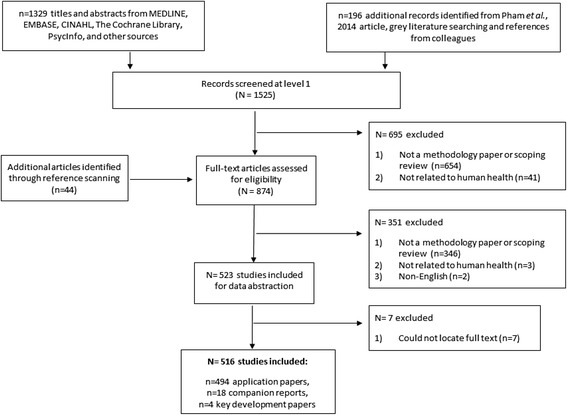
BACKGROUND: Scoping reviews are used to identify knowledge gaps, set research agendas, and identify implications for decision-making. The conduct and reporting of scoping reviews is inconsistent in the literature. We conducted a scoping review to identify: papers that utilized and/or described scoping review methods; guidelines for reporting scoping reviews; and studies that assessed the quality of reporting of scoping reviews. METHODS: We searched nine electronic databases for published and unpublished literature scoping review papers, scoping review methodology, and reporting guidance for scoping reviews. Two independent reviewers screened citations for inclusion. Data abstraction was performed by one reviewer and verified by a second reviewer. Quantitative (e.g. frequencies of methods) and qualitative (i.e. content analysis of the methods) syntheses were conducted. RESULTS: After searching 1525 citations and 874 full-text papers, 516 articles were included, of which 494 were scoping reviews. The 494 scoping reviews were disseminated between 1999 and 2014, with 45% published after 2012. Most of the scoping reviews were conducted in North America (53%) or Europe (38%), and reported a public source of funding (64%). The number of studies included in the scoping reviews ranged from 1 to 2600 (mean of 118). Using the Joanna Briggs Institute methodology guidance for scoping reviews, only 13% of the scoping reviews reported the use of a protocol, 36% used two reviewers for selecting citations for inclusion, 29% used two reviewers for full-text screening, 30% used two reviewers for data charting, and 43% used a pre-defined charting form. In most cases, the results of the scoping review were used to identify evidence gaps (85%), provide recommendations for future research (84%), or identify strengths and limitations (69%). We did not identify any guidelines for reporting scoping reviews or studies that assessed the quality of scoping review reporting. CONCLUSION: The number of scoping reviews conducted per year has steadily increased since 2012. Scoping reviews are used to inform research agendas and identify implications for policy or practice. As such, improvements in reporting and conduct are imperative. Further research on scoping review methodology is warranted, and in particular, there is need for a guideline to standardize reporting.
Overview
The claims and statistics of this paper haven’t been checked yet.
Free: it reads the open-access text and checks the first 5 claims that cite a source we can check. Create a free account to check every claim.
Integrity signals
Registry
Cites
Statistics
Figures
Verification
Claims the paper makes
The claims and statistics of this paper haven’t been checked yet.
Free: it reads the open-access text and checks the first 5 claims that cite a source we can check. Create a free account to check every claim.
Claims other papers make about this one
Each is checked against this paper’s own text: does it say what the citing paper says it does?
The cited source doesn’t support the claim as written.
In the citing paper
“The scoping review followed the guidelines outlined in the Preferred Reporting Items for Systematic Reviews and Meta-Analyses Extension (PRISMA-ScR) methodology (Munn et al., 2018; Tricco et al., 2016).”
From Sextortion: A Scoping Review (2025) · cites this paper as Tricco et al., 2016
Checked by a reasoning model — may be wrong.
Experimental — accuracy not yet measuredThe source backs part of the claim, not all of it — or backs it for a different population, condition or comparison.
In the citing paper
“A scoping review approach was considered appropriate for this purpose, given the authors’ understanding that the evidence base in this area is diverse in both research methodologies and disciplinary context (30).”
From Contributions of a time use perspective in community mental health practice: a scoping review (2024) · cites this paper as [30]
Experimental — accuracy not yet measuredThe source backs part of the claim, not all of it — or backs it for a different population, condition or comparison.
In the citing paper
“With the increasing popularity of scoping reviews, criticism of the rigour, transparency, and appropriateness of the methodology have been raised across multiple academic and clinical disciplines, including nursing and midwifery.”
From Undertaking a scoping review: A practical guide for nursing and midwifery students, clinicians, researchers, and academics (2021) · cites this paper as Tricco et al., 2016
Experimental — accuracy not yet measuredThe source backs part of the claim, not all of it — or backs it for a different population, condition or comparison.
In the citing paper
“Limitations of the scoping review methodology include the absence of methodological and risk of bias evaluations and the resultant inappropriateness of the review to be used as evidence for clinical guidelines, limitations, and recommendations (Arksey & O'Malley, 2005; Peters, Godfrey, et al., 2020; Tricco et al., 2016).”
From Undertaking a scoping review: A practical guide for nursing and midwifery students, clinicians, researchers, and academics (2021) · cites this paper as Tricco et al., 2016
Experimental — accuracy not yet measuredThe cited source says what the claim attributes to it.
In the citing paper
“while the number of scoping reviews in the literature is increasing steadily”
From PRISMA Extension for Scoping Reviews (PRISMA-ScR): Checklist and Explanation (2018) · cites this paper as [1]
13 more claims about this paper
Create a free account to see every claim other papers make about this one.
Self-check
Percentages, sums and reported differences re-computed from the paper’s own numbers.
The self-check needs the paper’s full text.
Citations
Cites
Preferred Reporting Items for Systematic Reviews and Meta-Analyses: the PRISMA statement
Moher, D., Liberati, A., Tetzlaff, J., Altman, D. G., & for the PRISMA Group (2009) · BMJ · doi:10.1136/bmj.b2535 · Cited by 83,823
Preferred reporting items for systematic reviews and meta-analyses: the PRISMA Statement.
(2009) · PubMed Central · Cited by 44,859
Scoping studies: towards a methodological framework
Arksey, H., & O'Malley, L. (2005) · International Journal of Social Research Methodology · doi:10.1080/1364557032000119616 · Cited by 36,742 · cited 15×
“Background Scoping reviews are used to map the concepts underpinning a research area and the main sources and types of evidence available [1].”
BackgroundMethodInfluentialPreferred Reporting Items for Systematic Reviews and Meta-Analyses: The PRISMA Statement
Moher, D., Liberati, A., Tetzlaff, J., & Altman, D. G. (2009) · Journal of Clinical Epidemiology · doi:10.1016/j.jclinepi.2009.06.005 · Cited by 19,575
Scoping studies: advancing the methodology
Levac, D., Colquhoun, H., & O'Brien, K. K. (2010) · Implementation Science · doi:10.1186/1748-5908-5-69 · Cited by 15,268 · cited 9×
“(2010) [2] modifications to the original framework of a scoping review [1] to guide this research.”
BackgroundMethodInfluentialSelf-citationGuidance for conducting systematic scoping reviews
Peters, M. D. J., Godfrey, C. M., Khalil, H., McInerney, P., Parker, D., & Soares, C. B. (2015) · International Journal of Evidence-Based Healthcare · doi:10.1097/xeb.0000000000000050 · Cited by 7,472 · cited 7×
“Our protocol was developed using the scoping review methodological framework proposed by Arksey and O’Malley (2005) [1] and further refined by the Joanna Briggs Institute [3].”
BackgroundMethodInfluentialSchulz (1995) · doi:10.1001/jama.1995.03520290060030 · Cited by 5,634 · cited 1×
“This is problematic because when different methods are applied to the same question, they may produce different results, undermining the utility and confidence in knowledge syntheses [5, 6].”
MethodA scoping review of scoping reviews: advancing the approach and enhancing the consistency
Pham, M. T., Rajić, A., Greig, J. D., Sargeant, J. M., Papadopoulos, A., & McEwen, S. A. (2014) · Research Synthesis Methods · doi:10.1002/jrsm.1123 · Cited by 3,078 · cited 2×
“We are aware of a previous scoping review of scoping reviews [16].”
BackgroundMethodScoping reviews: Time for clarity in definition, methods, and reporting
Colquhoun, H. L., Levac, D., O'Brien, K. K., Straus, S., Tricco, A. C., Perrier, L., Kastner, M., & Moher, D. (2014) · Journal of Clinical Epidemiology · doi:10.1016/j.jclinepi.2014.03.013 · Cited by 2,783 · cited 2×
“(2010) [2] and others [3], there is a lack of consistency in terminology and methods reported [4].”
BackgroundSelf-citationDaudt, H. M., van Mossel, C., & Scott, S. J. (2013) · BMC Medical Research Methodology · doi:10.1186/1471-2288-13-48 · Cited by 1,891 · cited 5×
“(2013) discussed the Arksey and O’Malley (2005) framework, and in particular, the team’s experiences using it, in order to develop the methodology further [10].”
BackgroundMethodInfluential
Research works printed but not linked: 2
- Colquhoun H, O’Brien K, Straus S, Moher D, Levac D. Gaps in scoping review methodologies J Clin Epidemiol. In press. 25034198
- Feinberg J Wordle 2014
Cited by
Items 601–700 of 1,005
Children’s Access to Non-School Destinations by Active or Independent Travel: A Scoping Review
Desjardins, É., Tavakoli, Z., Páez, A., & Waygood, E. O. D. (2022) · International Journal of Environmental Research and Public Health · doi:10.3390/ijerph191912345 · Cited by 28
“This is mainly because a systematic review would be limited to quantitative research for this type of review, whereas a scoping review follows a systematic review process while allowing for the inclusion of qualitative research [49].”
BackgroundAre adults influenced by the experience of mentoring youth? A scoping review
Anderson, A. J., & DuBois, D. L. (2022) · Journal of Community Psychology · doi:10.1002/jcop.22954 · Cited by 18
Bakır, E., Briggs, M., Mackintosh, C., Marshall, M., & Achaliwie, F. (2023) · Journal of Clinical Nursing · doi:10.1111/jocn.16655 · Cited by 16
The State of Play Between Managing Major Sports Events and Human Rights: a Scoping Review
Koenigstorfer, J., Yang, Y., Bocarro, J. N., Brittain, I., Lundberg, E., McGillivray, D., Misener, L., Chalip, L., & Duignan, M. B. (2023) · Event Management · doi:10.3727/152599522x16419948695323 · Cited by 20
REASSURED diagnostics at point-of-care in sub-Saharan Africa: A scoping review
Moetlhoa, B., Maluleke, K., Mathebula, E. M., Kgarosi, K., Nxele, S. R., Lenonyane, B., & Mashamba-Thompson, T. P. (2023) · PLOS Global Public Health · doi:10.1371/journal.pgph.0001443 · Cited by 22
“The results of the 94 scoping review are presented according to the Preferred Reporting Items for Systematic and 95 Meta-analysis Extension for Scoping Reviews (PRISMA-ScR) [11].”
MethodA scoping review of human pathogens detected in untreated human wastewater and sludge
Corrin, T., Rabeenthira, P., Young, K. M., Mathiyalagan, G., Baumeister, A., Pussegoda, K., & Waddell, L. A. (2024) · Journal of Water and Health · doi:10.2166/wh.2024.326 · Cited by 18
Vitiello, F., Bourgeois, D. M., Orilisi, G., Orsini, G., & Carrouel, F. (2024) · Children · doi:10.3390/children11020149 · Cited by 28
“Finally, it may be interesting to delve deeper into this topic, using the presented scoping review as a starting point to identify a more specific thematic area using a limited search strategy for a future systematic review [73,74].”
BackgroundRen, Y., Cui, G. W., Feng, K., Zhang, X., Yu, C., & Liu, P. (2024) · Frontiers in Psychiatry · doi:10.3389/fpsyt.2024.1282546 · Cited by 18
“Establishing standardized VFT approaches aligns with the aims of a scoping review, as described by Tricco et al. (44), emphasizing comprehensive evaluation and synthesis of research in this fi eld.”
MethodMartial Arts and Combat Sports for Youth: A 10-Year Scoping Review
Rodrigues, A. I. C., Marttinen, R. H. J., & Banville, D. (2024) · Journal of Teaching in Physical Education · doi:10.1123/jtpe.2023-0122 · Cited by 33
Medina‐Serrano, N., Hossaert‐McKey, M., Diallo, A., & McKey, D. (2024) · Biological reviews/Biological reviews of the Cambridge Philosophical Society · doi:10.1111/brv.13170 · Cited by 19
“Scoping reviews are useful for examining emerging evidence, for identifying and analysing gaps in the knowledge base (Munn et al ., 2018), and for generating hypotheses (Tricco et al ., 2016).”
Pedro, E., Leitão, J. C. C., & Alves, H. (2025) · Journal of Innovation & Knowledge · doi:10.1016/j.jik.2025.100664 · Cited by 24
Ramanathan, S. A., Reeves, P., Deeming, S., Bernhardt, J. A., Nilsson, M., Cadilhac, D. A.-M., Walker, F. R., Carey, L. M., Middleton, S., Lynch, E. A., et al. (2018) · Health Research Policy and Systems · doi:10.1186/s12961-018-0349-2 · Cited by 16
Systematic comparison of recommendations for safe messaging about suicide in public communications
Mishara, B. L., & Dargis, L. (2018) · Journal of Affective Disorders · doi:10.1016/j.jad.2018.09.031 · Cited by 21
Hout, M. C. V., Al-Afifi, M., Abushams, L., Kewley, S., Quigg, Z., Whitfield, M., McVeigh, J., & Wazaify, M. (2019) · International Journal of Mental Health and Addiction · doi:10.1007/s11469-019-00085-2 · Cited by 18
Fitzpatrick, B., Coad, J. E., Sell, D., & Rihtman, T. (2020) · International Journal of Language & Communication Disorders · doi:10.1111/1460-6984.12517 · Cited by 16
Kaiser, A., Chan, K., Pakosh, M. T., & Musselman, K. E. (2020) · BMJ Open · doi:10.1136/bmjopen-2020-040014 · Cited by 16
Sadeghi, M., Sasangohar, F., & McDonald, A. D. (2020) · JMIR Mental Health · doi:10.2196/16654 · Cited by 17
“The scoping review approach was selected because it is effective for knowledge evaluation and gap identification [13].”
A scoping review of the economics of multidisciplinary teams in oncology care
Edney, L. C., Gray, J., & Karnon, J. D. (2020) · Journal of Cancer Policy · doi:10.1016/j.jcpo.2020.100257 · Cited by 18
COVID-19: Are Non-Communicable Diseases Risk Factors for Its Severity?
Bello, B., & Useh, U. (2021) · American Journal of Health Promotion · doi:10.1177/0890117121990518 · Cited by 23
“A scoping review was conducted in accordance with Munn, Peters, Stern, Tufanaru, McArthur, Aromataris,6 as proposed by Tricco, Lillie, Zarin, O’Brien, Colquhoun, Kastner, Levac, Ng, Sharpe, Wilson.7”
MethodPatient and stakeholder involvement in resilient healthcare: an interactive research study protocol
Guise, V., Aase, K., Chambers, M. G. A., Canfield, C., & Wiig, S. (2021) · BMJ Open · doi:10.1136/bmjopen-2021-049116 · Cited by 20
Alrashdi, N. Z., Brown, L., Bell, M. M., & Ithurburn, M. P. (2021) · Physical Therapy · doi:10.1093/ptj/pzab185 · Cited by 17
Dubas‐Jakóbczyk, K., Kocot, E., Tambor, M., & Quentin, W. (2021) · Systematic Reviews · doi:10.1186/s13643-021-01778-3 · Cited by 24
MITCHELL, L. J., Campbell, C., Somerville, M., Cardell, E., & Williams, L. T. (2021) · Journal of Teaching and Learning for Graduate Employability · doi:10.21153/jtlge2021vol12no2art1003 · Cited by 17
There is room for improvement in the use of scoping reviews in dentistry
Zauza, D., Dotto, L., Moher, D., Tricco, A. C., Agostini, B. A., & Sarkis-Onofre, R. (2022) · Journal of Dentistry · doi:10.1016/j.jdent.2022.104161 · Cited by 16
Self-citationMoving Toward Excellence in Pediatric Physical Therapy Education: A Scoping Review
Anderson, D. K., Furze, J. A., & Moore, J. G. (2018) · Pediatric Physical Therapy · doi:10.1097/pep.0000000000000549 · Cited by 16
Farzad, M., MacDermid, J. C., Ring, D. C., & Shafiee, E. (2021) · Rehabilitation Research and Practice · doi:10.1155/2021/7211201 · Cited by 15
“Method According to accepted methodology, a scoping review was conducted: identifying the research question, identifying the relevant studies, selecting the studies, charting the data (data extraction), collating, summarizing, and reporting the results [9, 10].”
MethodLynam, A., Sweeney, M. R., Keenan, L., & McNally, S. (2024) · Autism & Developmental Language Impairments · doi:10.1177/23969415241258705 · Cited by 21
“The PRISMA guidelines for conducting and reporting scoping reviews (Tricco et al., 2016) were followed by the research team.”
The use of nonlinear analysis in understanding postural control: A scoping review
Veronez, S. D. O., Santo, C. C. D. E., Dantas, A. F. O. D. A., Pereira, N. D., & Ilha, J. (2024) · Human Movement Science · doi:10.1016/j.humov.2024.103246 · Cited by 24
Nejad, A. T., Vila, M. C., Paneiro, G. A., & Baptista, J. S. (2025) · Remote Sensing · doi:10.3390/rs17071207 · Cited by 19
Peddie, N., Hoegh, J., Rice, G., Shetty, S., Ure, A., & Cogan, N. A. (2025) · Nursing Reports · doi:10.3390/nursrep15040131 · Cited by 28
“This step involved reviewing the codes to ensure they accurately captured the data, a process informed by guidelines from Tricco et al. [63].”
Chan, R. C.-F., Zhou, J. H.-S., Cao, Y., Lo, K. K.-H., Ng, P. H. F., Shum, D., & Wong, A. Y. L. (2025) · JMIR Aging · doi:10.2196/70291 · Cited by 23
“Although quality assessment is optional for scoping reviews [31], this review included only randomized controlled trials to enhance study quality.”
From human-related to human-centric: A review of shop floor scheduling problem under Industry 5.0
Gao, Q., Liu, J., Liu, S., & Zhuang, C. (2025) · Journal of Manufacturing Systems · doi:10.1016/j.jmsy.2025.07.003 · Cited by 18
Nursing students′ clinical performance issues and the facilitator's perspective: A scoping review
Rojo, J., Ramjan, L. M., Hunt, L., & Salamonson, Y. (2020) · Nurse Education in Practice · doi:10.1016/j.nepr.2020.102890 · Cited by 15
Osborn, M., & Rajah, V. (2020) · Trauma Violence & Abuse · doi:10.1177/1524838020967348 · Cited by 24
“The technique has been increasingly employed over the course of the past decade, particularly in health and social science disciplines (Arskey & O’Malley, 2005; Tricco et al., 2016).”
MethodBabatunde, O. O., Dawson, S., Brammar, J., Parton, L., Dziedzic, K., & Adebajo, A. (2022) · BMC Rheumatology · doi:10.1186/s41927-022-00310-x · Cited by 16
“BMC Rheumatology (2022) 6:84 were only subjected to data extraction and not quality appraised [13].”
MethodDadswell, K., Mandicos, M., Flowers, E. P., & Hanlon, C. (2022) · Journal of Sport and Social Issues · doi:10.1177/01937235221134612 · Cited by 27
“Nonetheless, a scoping review remains an appropriate method as the purpose is to identify knowledge gaps (Tricco et al., 2016).”
MethodKamal, S., Kamaralzaman, S., Sharma, S., Jaafar, N. H., Chern, P. M., Hassan, N. I., Toran, H. B., Ismail, N. A. S., Yusri, G., & Hamzaid, N. H. (2022) · Nutrients · doi:10.3390/nu14245241 · Cited by 22
“Levac, Colquhoun, and O’Brien indicated that the search, screen, and report scoping review approach would be adjusted and implemented [25].”
BackgroundSöderlund, A., Blaževičienė, A., Elvén, M., Vaškelytė, A., Strods, R., Blese, I., Paakkonen, H. J., Fernandes, A. M., Cardoso, D., Kav, S., et al. (2023) · Discover Education · doi:10.1007/s44217-022-00022-x · Cited by 33
“The specific review questions were as follows: – What were the teaching and learning environments, digital teaching methods, and characteristics of the digital teaching activities? – What were the outcome measures and results of the digital teaching interventions? 2 Methods The recommendations for a scoping review [20…”
BackgroundReynen-Woodward, K., Round, P., & Subban, P. (2023) · Social Sciences & Humanities Open · doi:10.1016/j.ssaho.2023.100477 · Cited by 28
Mangrove ecosystem management in Indonesia: Review, limitation, gap, and knowledge
Kurniawansyah, A., Susiloningtyas, D., & Manessa, M. D. M. (2023) · Maritime Technology and Research · doi:10.33175/mtr.2023.262310 · Cited by 19
Pranjić, M., Hashemi, N., Arnett, A. B., & Thaut, M. H. (2023) · Brain Sciences · doi:10.3390/brainsci13050729 · Cited by 19
“The scoping review was conducted in accordance with the Joanna Briggs Institute methodological framework [36], using the Preferred Reporting Items for Systematic Reviews and Meta-Analyses Extension for Scoping Reviews (PRISMA-ScR) criteria: Checklist and Explanation guidelines [37].”
MethodWhat is the prevalence of chronic venous disease among health care workers? A scoping review
Benn, S., Moore, Z. E. H., Patton, D., O’Connor, T., Nugent, L., Harkin, D. W., & Avşar, P. (2023) · International Wound Journal · doi:10.1111/iwj.14222 · Cited by 15
Understanding the menopausal experiences of women with intellectual disabilities: A scoping review
Moore, K., Reidy, M., & Foran, S. (2023) · Journal of Intellectual Disabilities · doi:10.1177/17446295231182246 · Cited by 25
“While the employment of scoping reviews has become more popular across the disciplines, so too have the criticisms of the approach with some authors highlighting weaknesses in it ’ s use for synthesising evidence (Davis et al., 2009; Tricco et al., 2016).”
Leke, A. Z., Malherbe, H. L., Kalk, E., Mehta, U., Kisa, P., Botto, L. D., Ayede, I. A., Fairlie, L., Maboh, M. N., Orioli, I. M., et al. (2023) · PLOS Global Public Health · doi:10.1371/journal.pgph.0001850 · Cited by 23
Silaule, O., Casteleijn, D., Adams, F., & Nkosi, N. G. (2023) · Interactive Journal of Medical Research · doi:10.2196/48587 · Cited by 26
Use of adapted or modified methods with people with dementia in research: A scoping review
Conway, E., MacEachen, E., Middleton, L. E., & McAiney, C. A. (2023) · Dementia · doi:10.1177/14713012231205610 · Cited by 21
“The scoping review conforms to the reporting standard of the Preferred Reporting Items for Systematic Reviews and Meta-Analysis Extension for Scoping Reviews (PRISMA-ScR; Tricco et al., 2016).”
BackgroundMethodMooiweer, Y., Roling, L., Vugrin, M., Ansmann, L., Stevens, M. J., & Seeber, G. H. (2024) · EFORT Open Reviews · doi:10.1530/eor-23-0087 · Cited by 19
“To ensure that the reviewers’ agreement during study selection reached at least 75%, as per previous recommendations, a pilot screening was performed ( 8 , 18 , 19).”
MethodUrtubia-Herrera, V., Sánchez, M. V. N., Santos, A. M. P., Marcos, A. P., García-Gómez, A., Luís, E. O., & Bermejo‐Martins, E. (2024) · Frontiers in Public Health · doi:10.3389/fpubh.2024.1304310 · Cited by 24
“Furthermore, the exploratory nature of the scoping review (55) allowed us to capture a diverse range of evidence, thereby providing a more complete overview of the state of the literature to date.”
BackgroundAbdi, Z., Ravaghi, H., Sarkhosh, S., Nafar, H., Khani, S., & Letaief, M. (2024) · BMC Health Services Research · doi:10.1186/s12913-024-11198-3 · Cited by 25
“Scoping reviews are increasingly utilized to identify gaps in evidence, guide research priorities, and identify implications for policy or practice [19].”
BackgroundBerghi, O. N., Dumitru, M., Cergan, R., Musat, G. C., Serboiu, C. S., & Vrînceanu, D. (2024) · Life · doi:10.3390/life14080965 · Cited by 23
“…iterative team approach, (4) chart the data incorporating numerical summary and qualitative thematic analysis, (5) summarize and report the results, and (6) perform a consultation exercise, which is an optional step, but it helps in presenting the implications for policy, practice, or research [6].”
BackgroundAshraf, L., Zia, N., Vincenten, J. A., MacKay, J. M., Agrawal, P., Green, A., & Bachani, A. M. (2024) · Frontiers in Public Health · doi:10.3389/fpubh.2024.1467478 · Cited by 15
“Such reviews can also point to gaps in research and practice (14).”
Moriarty, J., Lipman, V., Norrie, C., Elaswarapu, R., & Manthorpe, J. (2017) · Ageing and Society · doi:10.1017/s0144686x17001301 · Cited by 19
Haynes, E. H., Brown, C. R., Wou, C., Vogliano, C., Guell, C., & Unwin, N. C. (2018) · Revista Panamericana de Salud Pública · doi:10.26633/rpsp.2018.176 · Cited by 16
Bragazzi, N. L., Dini, G., Parodi, V., Blasi, C., Linares, R., Mortara, V., Toletone, A., Bersi, F. M., D’Amico, B., Massa, E., et al. (2019) · BMJ Open · doi:10.1136/bmjopen-2018-023372 · Cited by 15
Parkinson’s Disease in Romania: A Scoping Review Protocol
Roşca, E. C., Tudor, R., Cornea, A., & Simu, M. A. (2021) · Brain Sciences · doi:10.3390/brainsci11020251 · Cited by 14
“The results of the search will be presented following the PRISMA-ScR recommendations [11,12].”
Student-Led Clinics in Aotearoa New Zealand: A Scoping Review with Stakeholder Consultation
Tokolahi, E., Broman, P., Longhurst, G., Pearce, A., Cook, C., Andersen, P., & Brownie, S. M. (2021) · Journal of Multidisciplinary Healthcare · doi:10.2147/jmdh.s308032 · Cited by 21
Mahon, D. (2022) · Mental Health and Social Inclusion · doi:10.1108/mhsi-12-2021-0085 · Cited by 16
Batten, M., Kosari, S., Koerner, J., Naunton, M., & Cargo, M. (2022) · Research in Social and Administrative Pharmacy · doi:10.1016/j.sapharm.2022.05.006 · Cited by 15
Nursing informatics and undergraduate nursing curricula: A scoping review protocol
Reid, L., Button, D., Breaden, K., & Brommeyer, M. (2022) · Nurse Education in Practice · doi:10.1016/j.nepr.2022.103476 · Cited by 17
Puce, L., Trabelsi, K., Ammar, A., Jabbour, G., Marinelli, L., Mori, L., Kong, J. D., Tsigalou, C., Cotellessa, F., Schenone, C., et al. (2022) · Frontiers in Physiology · doi:10.3389/fphys.2022.967661 · Cited by 19
Takahashi, B., Posse, C. G., Sergeeva, M., Salas, M. F., Wojczynski, S., Hartinger, S. M., & Yglesias-González, M. (2023) · The Lancet Regional Health - Americas · doi:10.1016/j.lana.2023.100603 · Cited by 18
Inmune-mediated inflammatory rheumatic diseases in transgender people: A scoping review
Salgado, E., Baurés, M. R., Beltrán, E., Naredo, E., Carreira, P. E., García-Vivar, M. L., Moreno-Muelas, J. V., Boteanu, A. L., Penadés, I. C., Sellas, A., et al. (2021) · Seminars in Arthritis and Rheumatism · doi:10.1016/j.semarthrit.2021.10.004 · Cited by 16
Bleicher, J., & Kumar, P. (2025) · Sustainable Cities and Society · doi:10.1016/j.scs.2025.106577 · Cited by 21
Guidance for reporting outcomes in clinical trials: scoping review protocol
Butcher, N. J., Mew, E. J., Saeed, L. H., Monsour, A., Chee-A-Tow, A., Chan, A., Moher, D., & Offringa, M. (2019) · BMJ Open · doi:10.1136/bmjopen-2018-023001 · Cited by 16
Kervin, L. M., Teo, K., Churchill, R., Riadi, I., & Cosco, T. D. (2021) · BMJ Open · doi:10.1136/bmjopen-2020-043876 · Cited by 14
Lundine, J. P., Ciccia, A., Koterba, C., & Guernon, A. (2022) · Brain Injury · doi:10.1080/02699052.2022.2051741 · Cited by 17
“A scoping review allows researchers to examine existing evidence to determine gaps in our knowledge and reasonable next steps for research (28,29).”
Almutairi, W. A., Seven, M., Poudel‐Tandukar, K., & VanKim, N. A. (2022) · Perspectives In Psychiatric Care · doi:10.1111/ppc.13088 · Cited by 16
Quality indicators for acute cardiovascular diseases: a scoping review
Kanaoka, K., Iwanaga, Y., Tsujimoto, Y., Shiroshita, A., Suzuki, T., Nakai, M., & Miyamoto, Y. (2022) · BMC Health Services Research · doi:10.1186/s12913-022-08239-0 · Cited by 17
Storman, D., Jemioło, P., Świerz, M. J., Sawiec, Z., Antonowicz, E., Prokop‐Dorner, A., Gotfryd-Burzyńska, M., & Bała, M. M. (2022) · JMIR Mental Health · doi:10.2196/36056 · Cited by 15
“We searched 4 databases and followed the reporting process provided by Tricco et al [54,55].”
MethodGispert, D. E., Yitmen, İ., Sadri, H., & Taheri, A. (2023) · Smart and Sustainable Built Environment · doi:10.1108/sasbe-07-2023-0170 · Cited by 27
Getacher, L., Ademe, B. W., & Belachew, T. (2023) · BMJ Open · doi:10.1136/bmjopen-2023-075600 · Cited by 14
“…characteristics or factors related to DBM as a precursor to a DBM systematic review, and identify and analyse knowledge gaps in the country’s DBM. 32 35–37 Although several studies on the DBM have been published, they have focused on evidence from either a specific population or subnational area.”
BackgroundEtowa, J. B., Beauchamp, S., Fseifes, M., Osandatuwa, G., Brenneman, P., Salam-Alada, K., Sulaiman, R., Okolie, E., Dinneh, I., Julmisse, S., et al. (2024) · Vaccines · doi:10.3390/vaccines12030269 · Cited by 19
Subtle or Covert Abuse Within Intimate Partner Relationships: A Scoping Review
Parkinson, R., Jong, S. T., & Hanson, S. (2024) · Trauma, Violence, & Abuse · doi:10.1177/15248380241268643 · Cited by 14
“Descriptive content analysis (Grbich, 2022; Tricco et al., 2016; Vaismoradi et al., 2013) was used to synthesize the descriptions of SCA.”
MethodThe process of student engagement in school health promotion: a scoping review
Kontak, J. C. H., Macrae, C., Caldwell, H. A. T., Feicht, R., Heath, S., Friesen, C. L. H., & Kirk, S. (2025) · BMC Public Health · doi:10.1186/s12889-025-22121-8 · Cited by 26
“A scoping review is ideal for this purpose as the main aim of a scoping review is to explore the breadth of the literature on a specific topic of inquiry, map the evidence and inform future research on a topic [27].”
McNamara, S. W. T., Townsley, M., & Hangauer, K. (2021) · Journal of School Leadership · doi:10.1177/1052684621990618 · Cited by 18
“Scoping reviews are a particularly useful research methodology when the literature on a certain topic is broad and heterogeneous as they allow for the wide-ranging exploration of a specific topic (Arksey & O’Malley, 2005; Tricco et al., 2016).”
BackgroundMethodInfluentialCosta, S., de Sousa, L. X. M., Luz, H., & Padeiro, M. (2022) · Journal of Applied Gerontology · doi:10.1177/07334648221116633 · Cited by 17
“Data are reported following the checklist of the PRISMA-ScR (Tricco et al., 2016).”
MethodSupporting the couple relationship following dementia diagnosis: A scoping review
Colloby, S., Whiting, S., & Warren, A. (2022) · Health & Social Care in the Community · doi:10.1111/hsc.14006 · Cited by 18
“Tyack et al. (2017) explored if arts- based interventions for couples experiencing dementia could be facilitated using a touch screen tablet.”
BackgroundMethodProfessional learning and development of postdoctoral scholars: a scoping review protocol
Nowell, L. S., Hayden, A., Berenson, C., Kenny, N., Chick, N. L., & Emery, C. A. (2018) · Systematic Reviews · doi:10.1186/s13643-018-0892-5 · Cited by 18
Miles, M., Rodrigues, A., Tajali, S., Xiong, Y., Orchanian‐Cheff, A., Reid, W. D., & Rozenberg, D. (2021) · Chronic Respiratory Disease · doi:10.1177/1479973121993494 · Cited by 16
“Methods This review utilizes the established guidelines for scoping studies, including identifying the research question, searching and selecting relevant studies, charting the data, and summarizing and reporting the results.(23) Protocol and registration This protocol was drafted using reported items for scoping revi…”
MethodGoodman, C. A., Witter, S., Hellowell, M., Allen, L., Srinivasan, S., Nixon, S., Burney, A., Bhattacharjee, D., Cocozza, A., Appleford, G., et al. (2024) · BMJ Global Health · doi:10.1136/bmjgh-2024-015771 · Cited by 27
“33 34”
Equitable access to digital higher education for students with disabilities in South Africa
Zongozzi, J., & Ngubane, S. (2025) · African Journal of Disability · doi:10.4102/ajod.v14i0.1525 · Cited by 15
“The review provided a comprehensive summary of the current body of knowledge (Peters et al. 2015), facilitated the synthesis and distribution of research findings, and offered suggestions for future study (Tricco et al. 2016).”
Male Survivors of Institutional Child Sexual Abuse: A Review
Wyles, P., O’Leary, P., Tsantefski, M., & Young, A. (2024) · Trauma Violence & Abuse · doi:10.1177/15248380241277272 · Cited by 20
The person-based approach to intervention development: A scoping review of methods and applications
Holt, L., Denford, S., Bowers, H. M., Kuberka, P., Müller, I., Amlôt, R., & Yardley, L. (2025) · Digital Health · doi:10.1177/20552076241305934 · Cited by 19
“26 Scoping reviews are concerned with broader concepts around a topic, such as identifying what kind of evidence is available, the de fi nitions of key concepts and terminology, or how a topic has been reported on, in order to fi nd knowledge gaps and precede further research.”
Potgieter, L., Filmalter, C. J., & Maree, C. (2025) · Nurse Education in Practice · doi:10.1016/j.nepr.2025.104417 · Cited by 25
Pellegrini, D., Grennan, L., Bhatnagar, N., McVey, G. L., & Couturier, J. L. (2022) · Journal of Eating Disorders · doi:10.1186/s40337-022-00616-8 · Cited by 17
Dantas, R. P. N. D. C., Silva, L. J. D. S., Simões, A. C. G., Pessoa, A. D. N., & Morgan, D. A. D. R. (2022) · Research Society and Development · doi:10.33448/rsd-v11i13.34389 · Cited by 13
Goyal, D., Dol, J., Leckey, M., Naraine, S., Dennis, C., Chan, E. K., & Basu, G. (2022) · Journal of Obstetric, Gynecologic & Neonatal Nursing · doi:10.1016/j.jogn.2022.11.003 · Cited by 15
Ethical, Legal, Organisational and Social Issues of Teleneurology: A Scoping Review
Torres‐Castaño, A., Sacks, A. A., Toledo‐Chávarri, A., Suárez-Herrera, J. C., Delgado, J., León‐Salas, B., González‐Hernández, Y., Carmona, M., & Serrano‐Aguilar, P. (2023) · International Journal of Environmental Research and Public Health · doi:10.3390/ijerph20043694 · Cited by 17
Sheel, H., Suárez, L., & Marsh, N. V. (2023) · Pediatric Reports · doi:10.3390/pediatric15010014 · Cited by 13
“This scoping review was completed using the PRISMA extension for scoping reviews and the Joanna Briggs Institute (JBI) Protocol for evidence synthesis (Appendix B) [57].”
MethodConsumer behavior research on traditional foods in Africa: A scoping review
Moyo, A., Amoah, F., & van Eyk, M. (2023) · Cogent Business & Management · doi:10.1080/23311975.2023.2213532 · Cited by 19
“The reporting of the scoping review was done in accordance with the Preferred Reporting Items for Systematic reviews and Meta-Analyses extension for Scoping Review (PRISMA-ScR) (Tricco et al., 2018).”
MethodIdentifying Industry 4.0 technologies enablers for knowledge management – a scoping review
Lista, A. P., Tortorella, G. L., Bouzon, M., Gao, S., & Chan, T. K. (2023) · The TQM Journal · doi:10.1108/tqm-05-2022-0173 · Cited by 16
Dixon, E. G., Rasool, S., Otaalo, B., Motee, A., Dear, J. W., Sloan, D. J., & Stagg, H. R. (2023) · British Journal of Clinical Pharmacology · doi:10.1111/bcp.15908 · Cited by 13
Louw, J., McCaul, M., English, R., Nyasulu, P. S., Davies, J. I., Fourie, C., Jassat, J., & Chu, K. (2023) · World Journal of Surgery · doi:10.1007/s00268-023-07183-2 · Cited by 22
“This scoping review used the Preferred Reporting Items for Systematic Reviews and Meta-analysis Extension for Scoping Reviews (PRISMA-ScR) [11] and the Arksey & O’Malley framework [12, 13].”
MethodA scoping review on the methodological and reporting quality of scoping reviews in China
Xue, X., Tang, X., Liu, S., Yu, T., Chen, Z., Chen, N., & Yu, J. (2024) · BMC Medical Research Methodology · doi:10.1186/s12874-024-02172-y · Cited by 13
“Scoping reviews have been widely conducted in various fields, including health, technology and social sciences over the past decades [7].”
BackgroundResultPsychosocial factors contributing to value creation in value-based healthcare: a scoping review
Marino, L., & Capone, V. (2024) · Frontiers in Psychology · doi:10.3389/fpsyg.2024.1323110 · Cited by 18
“In line with scoping review practice, the included studies have not been assessed in terms of quality (Tricco et al., 2016; Haan et al., 2021).”
BackgroundConlon, C., Zupan, B., & Preston, R. (2024) · Augmentative and Alternative Communication · doi:10.1080/07434618.2024.2333383 · Cited by 13
“While this type of review is still developing in terms of consistent methodology, it is becoming increasingly popular within the literature (Tricco et al., 2016).”
Alharbi, M., Du, H., Harris, D., Wood, G., Dodd, H. F., & Buckingham, G. (2024) · Journal of NeuroEngineering and Rehabilitation · doi:10.1186/s12984-024-01393-y · Cited by 17
“Taking into account the PRISMA-ScR reporting guidelines [43], this review was performed according to the JBI methodology for scoping reviews [44].”
BackgroundMethodMental illness and marketing: A 50‐year scoping review and future research framework
Farrell, J. R., Machin, J. E., Mirabito, A. M., Drenten, J. M., Chan-Park, C. Y., Crosby, E., & Adkins, N. R. (2024) · Psychology and Marketing · doi:10.1002/mar.22070 · Cited by 15
Perreault-Carranza, T., Ni, V., Savoie, J., Saucier, J., Frenette, J., & Jbilou, J. (2024) · International Journal of Environmental Research and Public Health · doi:10.3390/ijerph21091233 · Cited by 18
Music in cultural tourism: insights from a dual approach of scoping review and bibliometric analysis
Mazlan, C. A. N., Abdullah, M. H., Hashim, N. S. N., & Wahid, N. B. A. (2025) · Humanities and Social Sciences Communications · doi:10.1057/s41599-025-04847-3 · Cited by 45
“Thematic analysis been highlighted as a critical step for identifying recurring concepts and categorizing evidence in scoping (Finkelstein et al., 2021; Levac et al., 2010; Mazlan et al., 2023, 2025a, 2025b; Ramdan et al., 2024; Tricco et al., 2016; Yahaya et al., 2022).”
Metadata
- Authors
- Tricco, A. C., Lillie, E., Zarin, W., O’Brien, K., Colquhoun, H., Kastner, M., Levac, D., Ng, C., Sharpe, J. P., Wilson, K., Kenny, M., Warren, R., Wilson, C., Stelfox, H. T., & Straus, S. E.
- Affiliations
- St. Michael's Hospital (CA)
- University of Toronto (CA)
- University of Ottawa (CA)
- University of Calgary (CA)
- Corresponding author
- Tricco, Andrea C.
- ORCID
- Venue
- BMC Medical Research Methodology
- Published
- 2016-02-09
- Volume
- 16
- Issue
- 1
- Pages
- 15-15
- ISSN
- 1471-2288 (ISSN-L)
- PMC
- PMC4746911
- OpenAlex
- W2261406464
- Semantic Scholar
- 91435675555c6bce345c14c4f31104353f325a49
- Cited by
- 2,250
- References
- 27
- Citations by year
- 2026: 261 · 2025: 369 · 2024: 352 · 2023: 341 · 2022: 304 · 2021: 257 · 2020: 135 · 2019: 102 · 2018: 76 · 2017: 42 · 2016: 9
- FWCI
- 70.87
- Type
- journal article
- Language
- en
- Open access
- gold
- doi.org
- Licence
- cc-by
- Locations
- BMC Medical Research Methodology (publishedVersion, cc-by)
- PubMed Central (publishedVersion, cc-by)
- PubMed (publishedVersion)
- TSpace (University of Toronto) (submittedVersion, cc-by)
- TSpace (University of Toronto) (submittedVersion)
- DOAJ (DOAJ: Directory of Open Access Journals) (submittedVersion, cc-by-sa)
- Funders
- Canadian Institutes of Health Research (KRS-138219)
- Canadian Agency for Drugs and Technologies in Health
- Topics
- Social Sciences › Decision Sciences › Statistics, Probability and Uncertainty › Meta-analysis and systematic reviews
- Social Sciences › Sociology and Political Science › Delphi Technique in Research
- Health Sciences › Medicine › Public Health, Environmental and Occupational Health › Clinical practice guidelines implementation
- Keywords
- scoping review, scoping review reporting, reporting guidelines, Joanna Briggs Institute, inter-rater reliability, evidence gaps, research agenda setting, reporting quality assessment
- MeSH terms
- Scoping Reviews as Topic, Humans, Publications, Quality Control, Databases, Bibliographic, Guidelines as Topic, Research Report
About these checks
Registry, retraction, Cites and statistics results are computed, not judged, with one exception: a printed reference that no index lists is read once by a model before it counts as a citation error. Claims are extracted by a model and kept only when their quote appears verbatim in the text; each cited source is then checked, with a model’s help, for whether it says what the claim relies on. Those verdicts can be wrong — read the claim’s quote and the cited source before relying on one.
Statistics and arithmetic are recomputed, not judged.
Confidence bands are shown only for fields calibrated on our annotated test set. None is calibrated yet, so no band is shown.
What counts as a claim ›How we measure confidence ›How we check this ›
Are you an author, or do you see a problem with this page? Request a review
Data sources
Bibliographic data: Semantic Scholar, OpenAlex, Crossref.
Contains information from the Semantic Scholar Academic Graph Datasets, made available under the ODC Attribution License (ODC-BY 1.0).
Semantic Scholar’s data is described in: Kinney, R., et al. (2023). The Semantic Scholar Open Data Platform. arXiv:2301.10140.
