

A scoping review on the conduct and reporting of scoping reviews
Open accessThe DOI matches its Crossref record; 25 of the 27 references it cites were found in a registry or an index.
Abstract
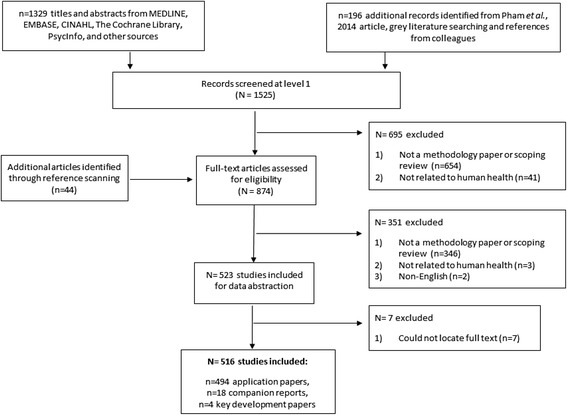
BACKGROUND: Scoping reviews are used to identify knowledge gaps, set research agendas, and identify implications for decision-making. The conduct and reporting of scoping reviews is inconsistent in the literature. We conducted a scoping review to identify: papers that utilized and/or described scoping review methods; guidelines for reporting scoping reviews; and studies that assessed the quality of reporting of scoping reviews. METHODS: We searched nine electronic databases for published and unpublished literature scoping review papers, scoping review methodology, and reporting guidance for scoping reviews. Two independent reviewers screened citations for inclusion. Data abstraction was performed by one reviewer and verified by a second reviewer. Quantitative (e.g. frequencies of methods) and qualitative (i.e. content analysis of the methods) syntheses were conducted. RESULTS: After searching 1525 citations and 874 full-text papers, 516 articles were included, of which 494 were scoping reviews. The 494 scoping reviews were disseminated between 1999 and 2014, with 45% published after 2012. Most of the scoping reviews were conducted in North America (53%) or Europe (38%), and reported a public source of funding (64%). The number of studies included in the scoping reviews ranged from 1 to 2600 (mean of 118). Using the Joanna Briggs Institute methodology guidance for scoping reviews, only 13% of the scoping reviews reported the use of a protocol, 36% used two reviewers for selecting citations for inclusion, 29% used two reviewers for full-text screening, 30% used two reviewers for data charting, and 43% used a pre-defined charting form. In most cases, the results of the scoping review were used to identify evidence gaps (85%), provide recommendations for future research (84%), or identify strengths and limitations (69%). We did not identify any guidelines for reporting scoping reviews or studies that assessed the quality of scoping review reporting. CONCLUSION: The number of scoping reviews conducted per year has steadily increased since 2012. Scoping reviews are used to inform research agendas and identify implications for policy or practice. As such, improvements in reporting and conduct are imperative. Further research on scoping review methodology is warranted, and in particular, there is need for a guideline to standardize reporting.
Overview
The claims and statistics of this paper haven’t been checked yet.
Free: it reads the open-access text and checks the first 5 claims that cite a source we can check. Create a free account to check every claim.
Integrity signals
Registry
Cites
Statistics
Figures
Verification
Claims the paper makes
The claims and statistics of this paper haven’t been checked yet.
Free: it reads the open-access text and checks the first 5 claims that cite a source we can check. Create a free account to check every claim.
Claims other papers make about this one
Each is checked against this paper’s own text: does it say what the citing paper says it does?
The cited source doesn’t support the claim as written.
In the citing paper
“The scoping review followed the guidelines outlined in the Preferred Reporting Items for Systematic Reviews and Meta-Analyses Extension (PRISMA-ScR) methodology (Munn et al., 2018; Tricco et al., 2016).”
From Sextortion: A Scoping Review (2025) · cites this paper as Tricco et al., 2016
Checked by a reasoning model — may be wrong.
Experimental — accuracy not yet measuredThe source backs part of the claim, not all of it — or backs it for a different population, condition or comparison.
In the citing paper
“A scoping review approach was considered appropriate for this purpose, given the authors’ understanding that the evidence base in this area is diverse in both research methodologies and disciplinary context (30).”
From Contributions of a time use perspective in community mental health practice: a scoping review (2024) · cites this paper as [30]
Experimental — accuracy not yet measuredThe source backs part of the claim, not all of it — or backs it for a different population, condition or comparison.
In the citing paper
“With the increasing popularity of scoping reviews, criticism of the rigour, transparency, and appropriateness of the methodology have been raised across multiple academic and clinical disciplines, including nursing and midwifery.”
From Undertaking a scoping review: A practical guide for nursing and midwifery students, clinicians, researchers, and academics (2021) · cites this paper as Tricco et al., 2016
Experimental — accuracy not yet measuredThe source backs part of the claim, not all of it — or backs it for a different population, condition or comparison.
In the citing paper
“Limitations of the scoping review methodology include the absence of methodological and risk of bias evaluations and the resultant inappropriateness of the review to be used as evidence for clinical guidelines, limitations, and recommendations (Arksey & O'Malley, 2005; Peters, Godfrey, et al., 2020; Tricco et al., 2016).”
From Undertaking a scoping review: A practical guide for nursing and midwifery students, clinicians, researchers, and academics (2021) · cites this paper as Tricco et al., 2016
Experimental — accuracy not yet measuredThe cited source says what the claim attributes to it.
In the citing paper
“while the number of scoping reviews in the literature is increasing steadily”
From PRISMA Extension for Scoping Reviews (PRISMA-ScR): Checklist and Explanation (2018) · cites this paper as [1]
13 more claims about this paper
Create a free account to see every claim other papers make about this one.
Self-check
Percentages, sums and reported differences re-computed from the paper’s own numbers.
The self-check needs the paper’s full text.
Citations
Cites
Preferred Reporting Items for Systematic Reviews and Meta-Analyses: the PRISMA statement
Moher, D., Liberati, A., Tetzlaff, J., Altman, D. G., & for the PRISMA Group (2009) · BMJ · doi:10.1136/bmj.b2535 · Cited by 83,823
Preferred reporting items for systematic reviews and meta-analyses: the PRISMA Statement.
(2009) · PubMed Central · Cited by 44,859
Scoping studies: towards a methodological framework
Arksey, H., & O'Malley, L. (2005) · International Journal of Social Research Methodology · doi:10.1080/1364557032000119616 · Cited by 36,742 · cited 15×
“Background Scoping reviews are used to map the concepts underpinning a research area and the main sources and types of evidence available [1].”
BackgroundMethodInfluentialPreferred Reporting Items for Systematic Reviews and Meta-Analyses: The PRISMA Statement
Moher, D., Liberati, A., Tetzlaff, J., & Altman, D. G. (2009) · Journal of Clinical Epidemiology · doi:10.1016/j.jclinepi.2009.06.005 · Cited by 19,575
Scoping studies: advancing the methodology
Levac, D., Colquhoun, H., & O'Brien, K. K. (2010) · Implementation Science · doi:10.1186/1748-5908-5-69 · Cited by 15,268 · cited 9×
“(2010) [2] modifications to the original framework of a scoping review [1] to guide this research.”
BackgroundMethodInfluentialSelf-citationGuidance for conducting systematic scoping reviews
Peters, M. D. J., Godfrey, C. M., Khalil, H., McInerney, P., Parker, D., & Soares, C. B. (2015) · International Journal of Evidence-Based Healthcare · doi:10.1097/xeb.0000000000000050 · Cited by 7,472 · cited 7×
“Our protocol was developed using the scoping review methodological framework proposed by Arksey and O’Malley (2005) [1] and further refined by the Joanna Briggs Institute [3].”
BackgroundMethodInfluentialSchulz (1995) · doi:10.1001/jama.1995.03520290060030 · Cited by 5,634 · cited 1×
“This is problematic because when different methods are applied to the same question, they may produce different results, undermining the utility and confidence in knowledge syntheses [5, 6].”
MethodA scoping review of scoping reviews: advancing the approach and enhancing the consistency
Pham, M. T., Rajić, A., Greig, J. D., Sargeant, J. M., Papadopoulos, A., & McEwen, S. A. (2014) · Research Synthesis Methods · doi:10.1002/jrsm.1123 · Cited by 3,078 · cited 2×
“We are aware of a previous scoping review of scoping reviews [16].”
BackgroundMethodScoping reviews: Time for clarity in definition, methods, and reporting
Colquhoun, H. L., Levac, D., O'Brien, K. K., Straus, S., Tricco, A. C., Perrier, L., Kastner, M., & Moher, D. (2014) · Journal of Clinical Epidemiology · doi:10.1016/j.jclinepi.2014.03.013 · Cited by 2,783 · cited 2×
“(2010) [2] and others [3], there is a lack of consistency in terminology and methods reported [4].”
BackgroundSelf-citationDaudt, H. M., van Mossel, C., & Scott, S. J. (2013) · BMC Medical Research Methodology · doi:10.1186/1471-2288-13-48 · Cited by 1,891 · cited 5×
“(2013) discussed the Arksey and O’Malley (2005) framework, and in particular, the team’s experiences using it, in order to develop the methodology further [10].”
BackgroundMethodInfluential
Research works printed but not linked: 2
- Colquhoun H, O’Brien K, Straus S, Moher D, Levac D. Gaps in scoping review methodologies J Clin Epidemiol. In press. 25034198
- Feinberg J Wordle 2014
Cited by
Items 301–400 of 1,005
A Scoping Review on Biopsychosocial Predictors of Mental Health among Older Adults
Murniati, N., Aufa, B. A., Kusuma, D., & Kamso, S. (2022) · International Journal of Environmental Research and Public Health · doi:10.3390/ijerph191710909 · Cited by 57
Agile Software Development in Healthcare: A Synthetic Scoping Review
Kokol, P. (2022) · Applied Sciences · doi:10.3390/app12199462 · Cited by 45
Basenach, L., Renneberg, B., Salbach, H., Dreier, M., & Wölfling, K. (2023) · Journal of Behavioral Addictions · doi:10.1556/2006.2022.00087 · Cited by 47
“The methodological-scientific procedure was designed in accordance with the PRISMA Extension Guideline ( PRISMA-ScR ; Page et al., 2021; Tricco et al., 2016; Tricco et al., 2018), and the checklist is provided in Figure S1 in Supplementary Material 1.”
Social Protection Interventions for TB-Affected Households: A Scoping Review
Todd, H., Hudson, M., Grolmusova, N., Kazibwe, J., Pearman, J., Skender, K., Tran, P. B., Boccia, D., Shete, P. B., & Wingfield, T. (2023) · American Journal of Tropical Medicine and Hygiene · doi:10.4269/ajtmh.22-0470 · Cited by 39
Al-Hail, M., Zguir, M. F., & Koç, M. (2023) · iScience · doi:10.1016/j.isci.2023.107322 · Cited by 73
Cabieses, B., V, Belo, K., Carreño, A., Rada, I., Rojas, K., Araoz, C., & Knipper, M. (2024) · The Lancet Regional Health - Americas · doi:10.1016/j.lana.2023.100660 · Cited by 63
“35 We aimed for a broad consideration of all papers explicitly addressing communication and narratives of speeches in the region that were related to the health of migrants.”
Sersli, S., DeVries, D. N., Gislason, M., Scott, N. A., & Winters, M. (2018) · Transportation Research Part A Policy and Practice · doi:10.1016/j.tra.2018.07.012 · Cited by 43
Burden of caregivers of patients with frontotemporal lobar degeneration – a scoping review
Karnatz, T., Monsees, J., Wucherer, D., Michalowsky, B., Zwingmann, I., Halek, M., Hoffmann, W. U., & Thyrian, J. R. (2019) · International Psychogeriatrics · doi:10.1017/s1041610219000176 · Cited by 39
“In contrast to a systematic review, no quality assessment or meta-analyses are performed (Tricco et al., 2016).”
BackgroundMethodEpstein, I., Khanlou, N., Ermel, R. E., Sherk, M., Simmonds, K. K., Balaquiao, L., & Chang, K. Y. (2019) · International Journal of Mental Health and Addiction · doi:10.1007/s11469-019-00129-7 · Cited by 42
Prediger, B., Mathes, T., Probst, C. P., & Pieper, D. (2020) · Systematic Reviews · doi:10.1186/s13643-020-01488-2 · Cited by 37
Rony, M. K. K., Islam, K., & Alamgir, H. M. (2022) · Journal of Nursing Management · doi:10.1111/jonm.13644 · Cited by 35
“Scoping reviews were used to uncover knowledge gaps, develop research agendas and determine decision-making implications (Tricco et al., 2016).”
BackgroundTools for assessing health research partnership outcomes and impacts: a systematic review
Mrklas, K., Boyd, J., Shergill, S., Merali, S., Khan, M., Nowell, L. S., Goertzen, A., Pfadenhauer, L. M., Paul, K., Sibley, K. M., et al. (2023) · Health Research Policy and Systems · doi:10.1186/s12961-022-00937-9 · Cited by 42
“Eligible papers were independently abstracted by KJM and independently validated (MK, SS, SM, KP) [45] using a predefined coding manual.”
MethodPotential Societal Biases of ChatGPT in Higher Education: A Scoping Review
Li, M., Enkhtur, A., Yamamoto, B. A., Cheng, F., & Chen, L. (2025) · Open Praxis · doi:10.55982/openpraxis.17.1.750 · Cited by 65
“A scoping review is a commonly used tool to identify research gaps, key issues in a nascent or considerably under-researched field, and to highlight implications for informed decision-making (Tricco et al., 2016).”
Brand advocacy: a scoping review and future research agenda
Shimul, A. S., Faroque, A. R., & Quader, E. (2025) · Journal of Product & Brand Management · doi:10.1108/jpbm-10-2024-5537 · Cited by 56
Kettlebell training in clinical practice: a scoping review
Meigh, N. J., Keogh, J., Schram, B. L., & Hing, W. A. (2019) · BMC Sports Science Medicine and Rehabilitation · doi:10.1186/s13102-019-0130-z · Cited by 45
“This framework includes the following steps: 1) Identify the research question by clarifying and linking the purpose and research question, 2) identify relevant studies by balancing feasibility with breadth and comprehensiveness, 3) select studies using an iterative team approach to study selection and data extraction…”
BackgroundMethodRadl-Karimi, C., Nicolaisen, A., Sodemann, M., Batalden, P. B., & von Plessen, C. (2020) · International Journal of Qualitative Studies on Health and Well-Being · doi:10.1080/17482631.2020.1838052 · Cited by 39
“The scoping review methodology is useful for systematically examining a broad range of evidence to underpin a certain research area and identify implications for policy and practice (Tricco et al., 2016), and was therefore particularly suitable for the purpose of this review study.”
Exploring the Social Networks’ Use in the Health-Care Industry: A Multi-Level Analysis
Pianese, T., & Belfiore, P. (2021) · International Journal of Environmental Research and Public Health · doi:10.3390/ijerph18147295 · Cited by 44
Technical–tactical skill assessments in small-sided soccer games: A scoping review
Klingner, F. C., Huijgen, B. C. H., Hartigh, R. J. R. D., & Kempe, M. (2021) · International Journal of Sports Science & Coaching · doi:10.1177/17479541211049532 · Cited by 34
Scoping Review of Telehealth for Musculoskeletal Disorders: Applications for the COVID-19 Pandemic
Bucki, F. M., Clay, M. B., Tobiczyk, H., & Green, B. N. (2021) · Journal of Manipulative and Physiological Therapeutics · doi:10.1016/j.jmpt.2021.12.003 · Cited by 41
Atkins, S. A., Heimo, L., Carter, D., Closa, M. R., Vanleeuw, L., Chenciner, L., Wambi, P., Annerstedt, K. S., Egere, U., Verkuijl, S. E., et al. (2022) · BMC Public Health · doi:10.1186/s12889-022-14579-7 · Cited by 53
“Scoping review methods We used scoping review methodology, useful when little is published on a topic, and when addressing questions relevant to policy and practice [13].”
MethodMcPhee, N., Nightingale, C. E., Harris, S. J., Segelov, E., & Ristevski, E. (2022) · Clinical Trials · doi:10.1177/17407745221090733 · Cited by 36
“Three primary research questions about rural cancer patients and clinical trials informed the review: (1) What is their participation rate? (2) What are the barriers and enablers for participation? (3) What initiatives have been tried to facilitate participation? A scoping review was deemed an appropriate methodology…”
BackgroundeHealth Technologies for Monitoring Pediatric Asthma at Home: Scoping Review
van der Kamp, M. R., Hengeveld, V., Brusse-Keizer, M. G. J., Thio, B., & Tabak, M. (2023) · Journal of Medical Internet Research · doi:10.2196/45896 · Cited by 46
“…scoping review question, there would have been a delay in providing information, and timely publication of scoping information may particularly be of great relevance in the current rapidly advancing field, allowing the identification of research gaps and future research opportunities [18,425].”
Doing systematic reviews in Psychology
Laher, S., & Hassem, T. (2020) · South African Journal of Psychology · doi:10.1177/0081246320956417 · Cited by 33
“…of the literature often to determine whether an SR would be in order, whether an SR has been done before, and whether the questions being asked require refinement to address the gaps in the literature within a particular field (Cherry & Dickson, 2017; Levac et al., 2010; Tricco et al., 2016).”
BackgroundTrudgill, D. I. N., Gorey, K. M., & Donnelly, E. A. (2020) · Humanities and Social Sciences Communications · doi:10.1057/s41599-020-00584-x · Cited by 42
“Second, all the worldwide research on PTSD among a continuum of first responders, pre- to hospital-based emergency, rescue and intensive care workers was first informally scoped (Ganann et al., 2010; Tricco et al., 2015, 2016).”
BackgroundMutono, N., Wright, J., Mutembei, H. M., Muema, J., Thomas, M., Mutunga, M., & Thumbi, S. M. (2021) · AAS Open Research · doi:10.12688/aasopenres.13225.1 · Cited by 33
Emergency remote education in foreign and second language teaching
Akbana, Y. E., Rathert, S., & Ağçam, R. (2021) · Turkish Journal of Education · doi:10.19128/turje.865344 · Cited by 52
“The procedures comprised of (a) the formulation of research questions covering the purpose of the document analysis, (b) the identification of relevant studies based on exclusion and inclusion criteria, (c) data extraction from the selected studies, (d) charting the data employing numerical summary and coding based on…”
MethodThe frail world of haemodialysis patients in the COVID-19 pandemic era: a systematic scoping review
Alfano, G., Ferrari, A., Magistroni, R., Fontana, F., Cappelli, G., & Basile, C. (2021) · Journal of Nephrology · doi:10.1007/s40620-021-01136-5 · Cited by 33
“• Which has been the magnitude of the impact of the COVID-19 pandemic on the frail world of the HD patients? • What strategies were implemented in the clinical practice for the prevention, mitigation and containment of the COVID-19 pandemic in HD centres? To address this broad topic of interest, we followed published…”
MethodAnalysis of the Concept of Obstetric Violence: Scoping Review Protocol
Ferrão, A. C., Sim-Sim, M., de Almeida, V. S. R., & Zangão, M. O. B. (2022) · Journal of Personalized Medicine · doi:10.3390/jpm12071090 · Cited by 61
“A scoping review or scoping study follows a systematic approach to map the main concepts about a given area of knowledge; examine their extent in research; identify knowledge gaps in existing research; and consequently, contribute an overview of the available evidence in the literature [40,41].”
BackgroundBody image concerns in patients with an implantable cardioverter defibrillator: a scoping review
Frydensberg, V. S., Skovbakke, S. J., Pedersen, S. S., & Kok, R. N. (2018) · Pacing and Clinical Electrophysiology · doi:10.1111/pace.13421 · Cited by 32
Fatigue and Sleep in Airline Cabin Crew: A Scoping Review
Wen, C. C. Y., Cherian, D., Schenker, M. T., & Jordan, A. S. (2023) · International Journal of Environmental Research and Public Health · doi:10.3390/ijerph20032652 · Cited by 52
Bridging the Divide: A Review on the Implementation of Personalized Cancer Medicine
Masucci, M. M., Ernberg, I., Karlsson, C., & Blomqvist, L. (2024) · Journal of Personalized Medicine · doi:10.3390/jpm14060561 · Cited by 42
“A scoping review approach was selected for this study, which is ideal for exploring new research fields [13].”
MethodCoelho, F., Furtado, L., Mendonça, N., Soares›, H., Duarte, H. M. S., Costeira, C. R. B., Santos, C., & Sousa, J. P. (2024) · Nursing Reports · doi:10.3390/nursrep14030117 · Cited by 50
“The review will specifically focus on the nursing role within ICUs, identifying strategies that can enhance safety and minimize errors in medication administration [12,13].”
BackgroundHumble, N. (2024) · International Journal of Educational Technology in Higher Education · doi:10.1186/s41239-024-00494-x · Cited by 59
“They are commonly used in research to identify implications for practices and policies, and to inform agendas for research (Tricco et al., 2016).”
Paramedic management of mental health related presentations: a scoping review
Emond, K., O'Meara, P. F., & Bish, M. (2018) · Journal of Mental Health · doi:10.1080/09638237.2018.1487534 · Cited by 34
“It has been suggested that scoping reviews may make recommendations on research agendas, and identify policy and practice implications (Tricco et al., 2016).”
BackgroundSeo, H., & Kim, S. (2018) · The Journal of Health Technology Assessment · doi:10.34161/johta.2018.6.1.003 · Cited by 35
Histopathological features of systemic sclerosis-associated myopathy: A scoping review
Lefèbvre, F., Giannini, M., Ellezam, B., Leclair, V., Troyanov, Y., Hoa, S. A.-T., Bourré‐Tessier, J., Satoh, M., Fritzler, M. J., Senécal, J., et al. (2021) · Autoimmunity Reviews · doi:10.1016/j.autrev.2021.102851 · Cited by 32
Anil, K., Freeman, J. A., Buckingham, S. A., Demain, S. H., Gunn, H., Jones, R. B., Logan, A., Marsden, J. F., Playford, E. D., Sein, K., et al. (2021) · BMJ Open · doi:10.1136/bmjopen-2021-049603 · Cited by 39
McVeigh, J., Hearne, E., Boardley, I. D., Bates, G., Hope, V. D., Ralphs, R., & Hout, M. C. V. (2021) · Harm Reduction Journal · doi:10.1186/s12954-021-00550-z · Cited by 39
“characteristics) of a specific topic, summarise the findings of a heterogeneous body of knowledge, and propose agendas for future policy and research [49, 52, 54, 55].”
BackgroundSeafood in Food Security: A Call for Bridging the Terrestrial-Aquatic Divide
Stetkiewicz, S., Norman, R., Allison, E. H., Andrew, N. L., Ara, G., Banner‐Stevens, G., Belton, B., Beveridge, M. C. M., Bogard, J., Bush, S. R., et al. (2022) · Frontiers in Sustainable Food Systems · doi:10.3389/fsufs.2021.703152 · Cited by 46
Kelleher, S., Murphy, M. F., & Su, X. (2022) · Psychology and Sexuality · doi:10.1080/19419899.2022.2057867 · Cited by 36
“Furthermore, scoping reviews aim to present evidence relevant to a topic irrespective of study quality (Tricco et al., 2016) and are considered useful when mapping an area of research that is novel and emerging.”
BackgroundInfluentialExploring the Impact of COVID-19 Pandemic on Food Choice Motives: A Systematic Review
Skalkos, D. C., & Kalyva, Z. C. (2023) · Sustainability · doi:10.3390/su15021606 · Cited by 49
Artificial intelligence addiction: exploring the emerging phenomenon of addiction in the AI age
Al-Obaydi, L. H., & Pikhart, M. (2026) · AI & SOCIETY · doi:10.1007/s00146-025-02535-z · Cited by 32
Abejas, A. G., Trullás, A. S., Sobral, M. A., Canelas, D., Costa, F. L., & Vergès, À. S. (2023) · Journal of Medical Internet Research · doi:10.2196/46259 · Cited by 33
“Scoping reviews [19] map the underlying concepts; therefore, defining methods is essential, as with other types of knowledge synthesis [20].”
A scoping review of the concept of resilience among African American women
Woods‐Giscombé, C. L., Williams, K. P., Conklin, J., Dodd, A., Bravo, L., Anderson, A. M., Frazier, T. A., Bey, G., Robinson, M. N., Warren, B. J., et al. (2023) · Archives of Psychiatric Nursing · doi:10.1016/j.apnu.2023.04.008 · Cited by 42
Outcomes of the 340B Drug Pricing Program
Knox, R. P., Wang, J., Feldman, W. B., Kesselheim, A. S., & Sarpatwari, A. (2023) · JAMA Health Forum · doi:10.1001/jamahealthforum.2023.3716 · Cited by 35
Jiang, Y. L., Cai, Y., Zhang, X., & Wang, C. (2024) · Medical Education Online · doi:10.1080/10872981.2024.2391631 · Cited by 55
“It should be noted that evaluating the methodological quality of the included studies is not obligatory in scope reviews [24,28], but this action can help us judge the distribution of high-quality evidence across interprofessional education interventions and provide more precise direction for…”
BackgroundRiis, C. L., Bechmann, T., Jensen, P. T., Coulter, A., & Steffensen, K. D. (2019) · Patient Related Outcome Measures · doi:10.2147/prom.s195296 · Cited by 34
“Scoping reviews are used to identify knowledge gaps, set research agendas, and identify implications for decision-making.(27,28)”
Sundown Syndrome in Older Persons: A Scoping Review
Boronat, A. C., Ferreira-Maia, A. P., & Wang, Y. (2019) · Journal of the American Medical Directors Association · doi:10.1016/j.jamda.2019.03.001 · Cited by 41
Strategies Used to Support Peer Provision in Mental Health: A Scoping Review
Zeng, G., & McNamara, B. A. (2021) · Administration and Policy in Mental Health and Mental Health Services Research · doi:10.1007/s10488-021-01118-6 · Cited by 32
Nambiema, A., Fouquet, J.-L., Guilloteau, J., & Descatha, A. (2021) · Archives des maladies professionnelles et de médecine du travail/Archives des maladies professionnelles et de l'environnement · doi:10.1016/j.admp.2021.03.004 · Cited by 86
Kaspersen, S. L., Kalseth, J., Stene‐Larsen, K., & Reneflot, A. (2022) · International Journal of Environmental Research and Public Health · doi:10.3390/ijerph191610016 · Cited by 39
“The JBI approach to conducting and reporting scoping reviews is congruent with the PRISMA Extension for Scoping Reviews checklist [29,33], which was used as a guide for reporting the results [34].”
MethodBrun, C., Zerhouni, O., Akinyemi, A., Houtin, L., Monvoisin, R., & Pinsault, N. (2022) · Journal of Evaluation in Clinical Practice · doi:10.1111/jep.13756 · Cited by 42
Bullying and Physical Education: A Scoping Review
Wei, M., & Graber, K. C. (2023) · Kinesiology Review · doi:10.1123/kr.2022-0031 · Cited by 57
Radionova, N., Ög, E., Wetzel, A.-J., Rieger, M. A., & Preiser, C. (2023) · Journal of Medical Internet Research · doi:10.2196/39219 · Cited by 39
“Reporting followed the PRISMA-ScR guidelines [31].”
Rural residents' perspectives on the rural ‘good death’: a scoping review
Rainsford, S., MacLeod, R., Glasgow, N., Wilson, D. M., Phillips, C. B., & Wiles, R. B. (2016) · Health & Social Care in the Community · doi:10.1111/hsc.12385 · Cited by 40
Territorial Intelligence, a Collective Challenge for Sustainable Development: A Scoping Review
García-Madurga, M.-Á., Grilló-Méndez, A.-J., & Navarro, M. Á. E. (2020) · Social Sciences · doi:10.3390/socsci9070126 · Cited by 64
“…precursors to systematic reviews (Anderson et al. 2008), helping to recognize evidences in a given field, clarifying key concepts in the literature (Munn et al. 2018), identifying the conceptual boundaries of a topic (Arksey and O’Malley 2005) and informing future researches (Tricco et al. 2016b).”
BackgroundInfluentialInformal Caregiving and Disaster Risk Reduction: A Scoping Review
Pickering, C. J., Dancey, M., Paik, K., & O’Sullivan, T. L. (2021) · International Journal of Disaster Risk Science · doi:10.1007/s13753-021-00328-8 · Cited by 40
Advanced Practice Nursing Titles and Roles in Cancer Care: A Scoping Review
Dowling, M., Pape, E., Geese, F., Hecke, A. V., Bryant‐Lukosius, D., Cerón, C., Fernández‐Ortega, P., Doren, F. M., Ward, A., Semple, C. J., et al. (2024) · Seminars in Oncology Nursing · doi:10.1016/j.soncn.2024.151627 · Cited by 52
Utility of social media and crowd-sourced data for pharmacovigilance: a scoping review protocol
Tricco, A. C., Zarin, W., Lillie, E., Pham, B., & Straus, S. E. (2017) · BMJ Open · doi:10.1136/bmjopen-2016-013474 · Cited by 34
Self-citationPhung, V., Asghar, Z. B., Matiti, M. R., & Siriwardena, A. N. (2020) · BMC Health Services Research · doi:10.1186/s12913-020-4987-z · Cited by 30
“This model has been endorsed by other researchers [15, 16].”
Mini-review: Robotic wheelchair taxonomy and readiness
Sivakanthan, S., Candiotti, J. L., Sundaram, S. A., Duvall, J. A., Sergeant, J. J. G., Cooper, R., Satpute, S. A., Turner, R. L., & Cooper, R. A. (2022) · Neuroscience Letters · doi:10.1016/j.neulet.2022.136482 · Cited by 33
“An internal protocol was developed using the Preferred Reporting Items for Systematic Reviews and Meta-analysis Scoping Review Checklist (PRISMA-ScR) [40] to ensure proper data collection and reporting of the review.”
MethodBaxendale, B., Evans, K., Cowley, A., Bramley, L., Miles, G., Ross, A. J., Dring, E., & Cooper, J. E. (2022) · BMC Medical Education · doi:10.1186/s12909-022-03490-9 · Cited by 30
The incomplete scope of scoping reviews: A framework for improving the quality of reporting
Bradbury‐Jones, C., & Aveyard, H. (2021) · Journal of Clinical Nursing · doi:10.1111/jocn.15998 · Cited by 32
Tricco, A. C., Zarin, W., Rios, P., Pham, B., Straus, S. E., & Langlois, E. V. (2016) · BMJ Open · doi:10.1136/bmjopen-2016-013929 · Cited by 29
“This is consistent with the Joanna Briggs Institute Manual(16) and scoping reviews on health-related topics.(17)”
MethodSelf-citationBearing Witness as a Process for Responding to Trauma Survivors: A Review
Wyles, P., O’Leary, P., & Tsantefski, M. (2022) · Trauma Violence & Abuse · doi:10.1177/15248380221124262 · Cited by 40
“The number of articles identified and then included and excluded through the search and analysis process followed the Preferred Reporting Items for Systematic Reviews and Meta-analyses (PRISMA) guidelines and the improved model for scoping reviews in Tricco et al. (2016), Figure 1.”
BackgroundMethodData visualisation in scoping reviews and evidence maps on health topics: a cross-sectional analysis
South, E., & Rodgers, M. (2023) · Systematic Reviews · doi:10.1186/s13643-023-02309-y · Cited by 36
“Results were “mapped graphically” in 29% of scoping reviews in any field in one 2014 publication [31] and 17% of healthcare scoping reviews in a 2016 article [6].”
BackgroundHowie, E. E., Ambler, O., Gunn, E., DIAS, R. D., Wigmore, S. J., Skipworth, R. J. E., & Yule, S. (2024) · Annals of Surgery · doi:10.1097/sla.0000000000006211 · Cited by 31
“86 Several limitations must be considered when interpreting the results of this review and future utilization of surgical sabermetrics.”
BackgroundScoping review search practices in the social sciences: A scoping review
Logan, J. R., Webb, J., Singh, N. K., Tanner, N., Barrett, K., Wall, M., Walsh, B., & Ayala, A. P. (2024) · Research Synthesis Methods · doi:10.1002/jrsm.1742 · Cited by 36
“This continues the upward trend that Tricco et al. 1 observed in scoping reviews published between 1999 and 2014.”
InfluentialTeaching and learning clinical reasoning skill in undergraduate medical students: A scoping review
Delavari, S., Barzkar, F., Rikers, R. M. J. P., Pourahmadi, M., Arabshahi, S. K. S., Keshtkar, A., Dargahi, H., Yaghmaei, M., & Monajemi, A. (2024) · PLoS ONE · doi:10.1371/journal.pone.0309606 · Cited by 48
Experiences of Living With Primary Progressive Aphasia: A Scoping Review of Qualitative Studies
Davies, K., & Howe, T. (2019) · American Journal of Alzheimer s Disease & Other Dementias® · doi:10.1177/1533317519886218 · Cited by 29
Fathers’ Views and Experiences of Creating a Smoke-Free Home: A Scoping Review
O’Donnell, R., Angus, K., McCulloch, P. G., Amos, A., Greaves, L., & Semple, S. E. (2019) · International Journal of Environmental Research and Public Health · doi:10.3390/ijerph16245164 · Cited by 30
“Scoping reviews are also used to identify gaps in the literature, and aid in the planning of future research [22,23], which also guided our choice of review method.”
MethodHearne, E., Wazaify, M., Hout, M. C. V., Atkinson, A. M., & McVeigh, J. (2020) · International Journal of Mental Health and Addiction · doi:10.1007/s11469-019-00217-8 · Cited by 35
Definitions, components and processes of data harmonisation in healthcare: a scoping review
Schmidt, B., Colvin, C. J., Hohlfeld, A., & Leon, N. (2020) · BMC Medical Informatics and Decision Making · doi:10.1186/s12911-020-01218-7 · Cited by 36
“A scoping review aims to map the literature on a particular topic rather than to provide an exhaustive explanation of a particular phenomenon of interest [19, 22].”
BackgroundResultMental health consequences of detaining children and families who seek asylum: a scoping review
Mares, S. P. (2020) · European Child & Adolescent Psychiatry · doi:10.1007/s00787-020-01629-x · Cited by 39
Optimising the process for conducting scoping reviews
Pawliuk, C., Brown, H. L., Widger, K., Dewan, T., Hermansen, A., Grégoire, M.-C., Steele, R., & Siden, H. B. (2020) · BMJ Evidence-Based Medicine · doi:10.1136/bmjebm-2020-111452 · Cited by 34
“[1,3] First, unlike a systematic review a scoping review does not usually involve an assessment of the quality of the primary studies.”
Ahad, A., Parry, Y., & Willis, E. (2021) · Child Abuse & Neglect · doi:10.1016/j.chiabu.2021.105052 · Cited by 38
Wister, A., Fyffe, I., & O’Dea, E. (2021) · Systematic Reviews · doi:10.1186/s13643-021-01775-6 · Cited by 37
“A scoping review methodology has been chosen over a systematic review methodology, since the former has a purpose that is consistent with the development of literature in this field [39].”
BackgroundMethodUrban Heritage Facility Management: A Scoping Review
Prabowo, B. N., Salaj, A. T., & Lohne, J. (2021) · Applied Sciences · doi:10.3390/app11209443 · Cited by 37
Domínguez-Lucio, S., Gabucio, L. M. C., Torres‐Collado, L., & de la Hera, M. G. (2022) · Journal of Autism and Developmental Disorders · doi:10.1007/s10803-022-05431-3 · Cited by 58
Evangelista, A. G., Danielski, G. M., Corrêa, J. A. F., Cavalari, C. M. D. A., Souza, I. R., Luciano, F. B., & de Macedo, R. E. F. (2022) · Critical Reviews in Food Science and Nutrition · doi:10.1080/10408398.2022.2038079 · Cited by 35
Implementing Trauma Informed Care in Human Services: An Ecological Scoping Review
Mahon, D. (2022) · Behavioral Sciences · doi:10.3390/bs12110431 · Cited by 61
Tourism routes: a scoping review
Pedrosa, A., Martins, F. M. C. P. F., & Breda, Z. M. D. J. (2022) · European Journal of Tourism Research · doi:10.54055/ejtr.v32i.2575 · Cited by 35
“The scoping review method was proposed by Arksey & O’Malley (2005) and its usage has been increasing ever since (Tricco et al., 2016).”
MethodAtuyambe, L. M., Arku, R. E., Naidoo, N., Kapwata, T., Asante, K. P., Cissé, G., Simane, B., Wright, C. Y., & Berhane, K. T. (2024) · Annals of Global Health · doi:10.5334/aogh.4527 · Cited by 28
“Our goal is to present a review of evidence to inform policy and practice and identify potential gaps in need of further research [21, 22].”
Cultural Adaptation of Promising, Evidence-Based, and Best Practices: a Scoping Literature Review
Thier, M., Martinez, C. R., Alresheed, F., Storie, S., Sasaki, A., Meline, M., Rochelle, J., Witherspoon, L., & Yim-Dockery, H. (2020) · Prevention Science · doi:10.1007/s11121-019-01042-0 · Cited by 28
“Needed now are systematic reviews to capitalize on our findings to more deeply interrogate potential gaps that are discipline-, intervention-, or population-specific (Tricco et al. 2016).”
BackgroundThenral, M., & Annamalai, A. (2020) · Indian Journal of Psychological Medicine · doi:10.1177/0253717620952160 · Cited by 33
Entrepreneurial culture in educational institutions: A scoping review
Al-Lawati, E. H., Kohar, U. H. A., & Suleiman, E. S. (2022) · Cogent Business & Management · doi:10.1080/23311975.2021.1997237 · Cited by 47
Frankowska, M., Błoński, K., Mańkowska, M., & Rzeczycki, A. (2022) · Energies · doi:10.3390/en15030866 · Cited by 31
“They are also used to inform about research plans and to identify implications for policy or practice regarding decision making [46].”
BackgroundYoung in pandemic times: a scoping review of COVID-19 social impacts on youth
Lundström, M. (2022) · International Journal of Adolescence and Youth · doi:10.1080/02673843.2022.2117637 · Cited by 38
Iddrisu, M., Poku, C. A., Mensah, E., Attafuah, P. Y. A., Dzansi, G., & Adjorlolo, S. (2023) · BMC Nursing · doi:10.1186/s12912-023-01368-9 · Cited by 49
“A scoping review is usually undertaken to establish the need for a systematic review and to guide future research [14].”
BackgroundKey interoperability Factors for patient portals and Electronic health Records: A scoping review
Fennelly, O., Moroney, D., Doyle, M., Eustace‐Cook, J., & Hughes, M. (2024) · International Journal of Medical Informatics · doi:10.1016/j.ijmedinf.2023.105335 · Cited by 45
Woo, B. F. Y., Tam, W. W. S., Williams, M. Y., Ow Yong, J. Q. Y., Cheong, Z. Y., Ong, Y. C., Poon, S. N., & Goh, Y. S. (2023) · Journal of Nursing Scholarship · doi:10.1111/jnu.12861 · Cited by 28
Nielsen, S. S., & Christensen, J. R. (2018) · Occupational Therapy International · doi:10.1155/2018/7412686 · Cited by 27
Designing for Hybrid Intelligence: A Taxonomy and Survey of Crowd-Machine Interaction
Correia, A., Grover, A., Schneider, D., Pimentel, A. P., Chaves, R., de Almeida, M. A., & Fonseca, B. (2023) · Applied Sciences · doi:10.3390/app13042198 · Cited by 35
Violência sexual contra homens no Brasil: subnotificação, prevalência e fatores associados
Ferreira, D. G., de Bortoli, M. C., Machado, P. P. A., Saggese, G. S. R., & Veras, M. A. D. S. M. (2023) · Revista de Saúde Pública · doi:10.11606/s1518-8787.2023057004523 · Cited by 41
Public awareness of the alcohol-cancer link in the EU and UK: a scoping review
Kokole, D., Ferreira‐Borges, C., Galea, G., Tran, A., Rehm, J. T., & Neufeld, M. (2023) · European Journal of Public Health · doi:10.1093/eurpub/ckad141 · Cited by 29
Navas-Martín, M. Á., Ovalle-Perandones, M.-A., López-Bueno, J. A., Díaz, J., Linares, C., & Martínez, G. S. (2023) · The Science of The Total Environment · doi:10.1016/j.scitotenv.2023.168441 · Cited by 36
“Scoping reviews inherently come with limitations because their primary aim is to provide a wide-ranging overview rather than a detailed exploration of a specific topic ((Tricco et al., 2016).”
Erstad, O., Hegna, K., Livingstone, S., Negru‐Subtirica, O., & Stoilova, M. (2024) · Families Relationships and Societies · doi:10.1332/20467435y2024d000000023 · Cited by 51
“A scoping review allows researchers to identify emerging debates, clarify key concepts, examine specific findings and evaluate significant gaps that suggest promising future directions (Tricco et al, 2016).”
BackgroundPrevention and conduct against the Extravasation of antineoplastic chemotherapy: a scoping review
Melo, J. M. A., de Oliveira, P. P., Souza, R. S., da Fonseca, D. F., Gontijo, T. F., & Rodrigues, A. B. (2020) · Revista Brasileira de Enfermagem · doi:10.1590/0034-7167-2019-0008 · Cited by 27
Nightingale, J. M., Fowler‐Davis, S., Grafton, K., Kelly, S., Langham, C., Lewis, R., Bianco, B., & Harrop, D. (2020) · Health Research Policy and Systems · doi:10.1186/s12961-020-00638-1 · Cited by 32
Assessment of body composition in spinal cord injury: A scoping review
van der Scheer, J. W., de Zepetnek, J. O. T., Blauwet, C. A., Brooke-Wavell, K. S. F., Graham-Paulson, T., Leonard, A. N., Webborn, N., & Goosey-Tolfrey, V. L. (2021) · PLoS ONE · doi:10.1371/journal.pone.0251142 · Cited by 36
Metadata
- Authors
- Tricco, A. C., Lillie, E., Zarin, W., O’Brien, K., Colquhoun, H., Kastner, M., Levac, D., Ng, C., Sharpe, J. P., Wilson, K., Kenny, M., Warren, R., Wilson, C., Stelfox, H. T., & Straus, S. E.
- Affiliations
- St. Michael's Hospital (CA)
- University of Toronto (CA)
- University of Ottawa (CA)
- University of Calgary (CA)
- Corresponding author
- Tricco, Andrea C.
- ORCID
- Venue
- BMC Medical Research Methodology
- Published
- 2016-02-09
- Volume
- 16
- Issue
- 1
- Pages
- 15-15
- ISSN
- 1471-2288 (ISSN-L)
- PMC
- PMC4746911
- OpenAlex
- W2261406464
- Semantic Scholar
- 91435675555c6bce345c14c4f31104353f325a49
- Cited by
- 2,250
- References
- 27
- Citations by year
- 2026: 261 · 2025: 369 · 2024: 352 · 2023: 341 · 2022: 304 · 2021: 257 · 2020: 135 · 2019: 102 · 2018: 76 · 2017: 42 · 2016: 9
- FWCI
- 70.87
- Type
- journal article
- Language
- en
- Open access
- gold
- doi.org
- Licence
- cc-by
- Locations
- BMC Medical Research Methodology (publishedVersion, cc-by)
- PubMed Central (publishedVersion, cc-by)
- PubMed (publishedVersion)
- TSpace (University of Toronto) (submittedVersion, cc-by)
- TSpace (University of Toronto) (submittedVersion)
- DOAJ (DOAJ: Directory of Open Access Journals) (submittedVersion, cc-by-sa)
- Funders
- Canadian Institutes of Health Research (KRS-138219)
- Canadian Agency for Drugs and Technologies in Health
- Topics
- Social Sciences › Decision Sciences › Statistics, Probability and Uncertainty › Meta-analysis and systematic reviews
- Social Sciences › Sociology and Political Science › Delphi Technique in Research
- Health Sciences › Medicine › Public Health, Environmental and Occupational Health › Clinical practice guidelines implementation
- Keywords
- scoping review, scoping review reporting, reporting guidelines, Joanna Briggs Institute, inter-rater reliability, evidence gaps, research agenda setting, reporting quality assessment
- MeSH terms
- Scoping Reviews as Topic, Humans, Publications, Quality Control, Databases, Bibliographic, Guidelines as Topic, Research Report
About these checks
Registry, retraction, Cites and statistics results are computed, not judged, with one exception: a printed reference that no index lists is read once by a model before it counts as a citation error. Claims are extracted by a model and kept only when their quote appears verbatim in the text; each cited source is then checked, with a model’s help, for whether it says what the claim relies on. Those verdicts can be wrong — read the claim’s quote and the cited source before relying on one.
Statistics and arithmetic are recomputed, not judged.
Confidence bands are shown only for fields calibrated on our annotated test set. None is calibrated yet, so no band is shown.
What counts as a claim ›How we measure confidence ›How we check this ›
Are you an author, or do you see a problem with this page? Request a review
Data sources
Bibliographic data: Semantic Scholar, OpenAlex, Crossref.
Contains information from the Semantic Scholar Academic Graph Datasets, made available under the ODC Attribution License (ODC-BY 1.0).
Semantic Scholar’s data is described in: Kinney, R., et al. (2023). The Semantic Scholar Open Data Platform. arXiv:2301.10140.
