

A scoping review on the conduct and reporting of scoping reviews
Open accessThe DOI matches its Crossref record; 25 of the 27 references it cites were found in a registry or an index.
Abstract
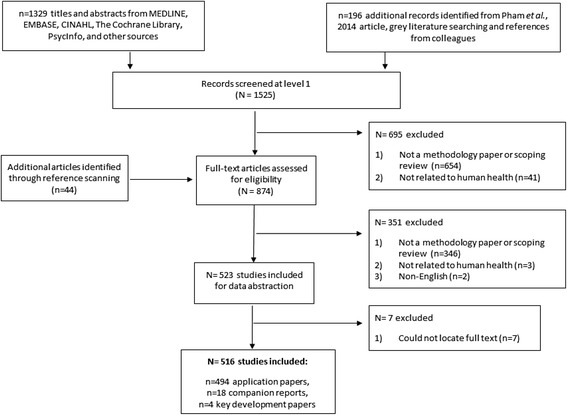
BACKGROUND: Scoping reviews are used to identify knowledge gaps, set research agendas, and identify implications for decision-making. The conduct and reporting of scoping reviews is inconsistent in the literature. We conducted a scoping review to identify: papers that utilized and/or described scoping review methods; guidelines for reporting scoping reviews; and studies that assessed the quality of reporting of scoping reviews. METHODS: We searched nine electronic databases for published and unpublished literature scoping review papers, scoping review methodology, and reporting guidance for scoping reviews. Two independent reviewers screened citations for inclusion. Data abstraction was performed by one reviewer and verified by a second reviewer. Quantitative (e.g. frequencies of methods) and qualitative (i.e. content analysis of the methods) syntheses were conducted. RESULTS: After searching 1525 citations and 874 full-text papers, 516 articles were included, of which 494 were scoping reviews. The 494 scoping reviews were disseminated between 1999 and 2014, with 45% published after 2012. Most of the scoping reviews were conducted in North America (53%) or Europe (38%), and reported a public source of funding (64%). The number of studies included in the scoping reviews ranged from 1 to 2600 (mean of 118). Using the Joanna Briggs Institute methodology guidance for scoping reviews, only 13% of the scoping reviews reported the use of a protocol, 36% used two reviewers for selecting citations for inclusion, 29% used two reviewers for full-text screening, 30% used two reviewers for data charting, and 43% used a pre-defined charting form. In most cases, the results of the scoping review were used to identify evidence gaps (85%), provide recommendations for future research (84%), or identify strengths and limitations (69%). We did not identify any guidelines for reporting scoping reviews or studies that assessed the quality of scoping review reporting. CONCLUSION: The number of scoping reviews conducted per year has steadily increased since 2012. Scoping reviews are used to inform research agendas and identify implications for policy or practice. As such, improvements in reporting and conduct are imperative. Further research on scoping review methodology is warranted, and in particular, there is need for a guideline to standardize reporting.
Overview
The claims and statistics of this paper haven’t been checked yet.
Free: it reads the open-access text and checks the first 5 claims that cite a source we can check. Create a free account to check every claim.
Integrity signals
Registry
Cites
Statistics
Figures
Verification
Claims the paper makes
The claims and statistics of this paper haven’t been checked yet.
Free: it reads the open-access text and checks the first 5 claims that cite a source we can check. Create a free account to check every claim.
Claims other papers make about this one
Each is checked against this paper’s own text: does it say what the citing paper says it does?
The cited source doesn’t support the claim as written.
In the citing paper
“The scoping review followed the guidelines outlined in the Preferred Reporting Items for Systematic Reviews and Meta-Analyses Extension (PRISMA-ScR) methodology (Munn et al., 2018; Tricco et al., 2016).”
From Sextortion: A Scoping Review (2025) · cites this paper as Tricco et al., 2016
Checked by a reasoning model — may be wrong.
Experimental — accuracy not yet measuredThe source backs part of the claim, not all of it — or backs it for a different population, condition or comparison.
In the citing paper
“A scoping review approach was considered appropriate for this purpose, given the authors’ understanding that the evidence base in this area is diverse in both research methodologies and disciplinary context (30).”
From Contributions of a time use perspective in community mental health practice: a scoping review (2024) · cites this paper as [30]
Experimental — accuracy not yet measuredThe source backs part of the claim, not all of it — or backs it for a different population, condition or comparison.
In the citing paper
“With the increasing popularity of scoping reviews, criticism of the rigour, transparency, and appropriateness of the methodology have been raised across multiple academic and clinical disciplines, including nursing and midwifery.”
From Undertaking a scoping review: A practical guide for nursing and midwifery students, clinicians, researchers, and academics (2021) · cites this paper as Tricco et al., 2016
Experimental — accuracy not yet measuredThe source backs part of the claim, not all of it — or backs it for a different population, condition or comparison.
In the citing paper
“Limitations of the scoping review methodology include the absence of methodological and risk of bias evaluations and the resultant inappropriateness of the review to be used as evidence for clinical guidelines, limitations, and recommendations (Arksey & O'Malley, 2005; Peters, Godfrey, et al., 2020; Tricco et al., 2016).”
From Undertaking a scoping review: A practical guide for nursing and midwifery students, clinicians, researchers, and academics (2021) · cites this paper as Tricco et al., 2016
Experimental — accuracy not yet measuredThe cited source says what the claim attributes to it.
In the citing paper
“while the number of scoping reviews in the literature is increasing steadily”
From PRISMA Extension for Scoping Reviews (PRISMA-ScR): Checklist and Explanation (2018) · cites this paper as [1]
13 more claims about this paper
Create a free account to see every claim other papers make about this one.
Self-check
Percentages, sums and reported differences re-computed from the paper’s own numbers.
The self-check needs the paper’s full text.
Citations
Cites
Preferred Reporting Items for Systematic Reviews and Meta-Analyses: the PRISMA statement
Moher, D., Liberati, A., Tetzlaff, J., Altman, D. G., & for the PRISMA Group (2009) · BMJ · doi:10.1136/bmj.b2535 · Cited by 83,823
Preferred reporting items for systematic reviews and meta-analyses: the PRISMA Statement.
(2009) · PubMed Central · Cited by 44,859
Scoping studies: towards a methodological framework
Arksey, H., & O'Malley, L. (2005) · International Journal of Social Research Methodology · doi:10.1080/1364557032000119616 · Cited by 36,742 · cited 15×
“Background Scoping reviews are used to map the concepts underpinning a research area and the main sources and types of evidence available [1].”
BackgroundMethodInfluentialPreferred Reporting Items for Systematic Reviews and Meta-Analyses: The PRISMA Statement
Moher, D., Liberati, A., Tetzlaff, J., & Altman, D. G. (2009) · Journal of Clinical Epidemiology · doi:10.1016/j.jclinepi.2009.06.005 · Cited by 19,575
Scoping studies: advancing the methodology
Levac, D., Colquhoun, H., & O'Brien, K. K. (2010) · Implementation Science · doi:10.1186/1748-5908-5-69 · Cited by 15,268 · cited 9×
“(2010) [2] modifications to the original framework of a scoping review [1] to guide this research.”
BackgroundMethodInfluentialSelf-citationGuidance for conducting systematic scoping reviews
Peters, M. D. J., Godfrey, C. M., Khalil, H., McInerney, P., Parker, D., & Soares, C. B. (2015) · International Journal of Evidence-Based Healthcare · doi:10.1097/xeb.0000000000000050 · Cited by 7,472 · cited 7×
“Our protocol was developed using the scoping review methodological framework proposed by Arksey and O’Malley (2005) [1] and further refined by the Joanna Briggs Institute [3].”
BackgroundMethodInfluentialSchulz (1995) · doi:10.1001/jama.1995.03520290060030 · Cited by 5,634 · cited 1×
“This is problematic because when different methods are applied to the same question, they may produce different results, undermining the utility and confidence in knowledge syntheses [5, 6].”
MethodA scoping review of scoping reviews: advancing the approach and enhancing the consistency
Pham, M. T., Rajić, A., Greig, J. D., Sargeant, J. M., Papadopoulos, A., & McEwen, S. A. (2014) · Research Synthesis Methods · doi:10.1002/jrsm.1123 · Cited by 3,078 · cited 2×
“We are aware of a previous scoping review of scoping reviews [16].”
BackgroundMethodScoping reviews: Time for clarity in definition, methods, and reporting
Colquhoun, H. L., Levac, D., O'Brien, K. K., Straus, S., Tricco, A. C., Perrier, L., Kastner, M., & Moher, D. (2014) · Journal of Clinical Epidemiology · doi:10.1016/j.jclinepi.2014.03.013 · Cited by 2,783 · cited 2×
“(2010) [2] and others [3], there is a lack of consistency in terminology and methods reported [4].”
BackgroundSelf-citationDaudt, H. M., van Mossel, C., & Scott, S. J. (2013) · BMC Medical Research Methodology · doi:10.1186/1471-2288-13-48 · Cited by 1,891 · cited 5×
“(2013) discussed the Arksey and O’Malley (2005) framework, and in particular, the team’s experiences using it, in order to develop the methodology further [10].”
BackgroundMethodInfluential
Research works printed but not linked: 2
- Colquhoun H, O’Brien K, Straus S, Moher D, Levac D. Gaps in scoping review methodologies J Clin Epidemiol. In press. 25034198
- Feinberg J Wordle 2014
Cited by
Items 701–800 of 1,005
Planetary health for health systems: A scoping review and content analysis of frameworks
Redvers, N., Wright, K., Hartmann‐Boyce, J., & Tonkin-Crine, S. K. (2025) · PLOS Global Public Health · doi:10.1371/journal.pgph.0004710 · Cited by 21
Measurement instruments for quantifying physical resilience in aging: a scoping review protocol
Peters, S., Cosco, T. D., Mackey, D. C., Sarohia, G. S., Leong, J., & Wister, A. (2019) · Systematic Reviews · doi:10.1186/s13643-019-0950-7 · Cited by 13
Caro-Sabido, E. A., & Larrosa‐Haro, A. (2019) · Revista de Gastroenterología de México · doi:10.1016/j.rgmx.2019.02.001 · Cited by 18
Swingwood, E. L., Stilma, W., Tume, L. N., Cramp, F. L., Paulus, F., Schultz, M. J., Reimer, W. J. M. S. O., & Rose, L. (2020) · Systematic Reviews · doi:10.1186/s13643-020-01547-8 · Cited by 13
Unbiased Approaches for Reviewing Entomology Literature: A Systematized Review
Oliveira, A. R. S., Cohnstaedt, L. W., & Cernicchiaro, N. (2021) · Annals of the Entomological Society of America · doi:10.1093/aesa/saaa058 · Cited by 15
Ethnography and Bush Kinder Research: A Review of the Literature
Speldewinde, C., Kilderry, A., & Campbell, C. (2021) · Australasian Journal of Early Childhood · doi:10.1177/18369391211011264 · Cited by 16
“To understand previous research focussing on forest schools, a scoping review (Munn et al., 2018; Tricco et al., 2016) was conducted.”
BackgroundMethodInfluentialGauthier, S., May, B., & Vasseur, L. (2021) · Climate · doi:10.3390/cli9060091 · Cited by 16
“This table was adapted from the PRISMA‐ScR guidelines [24].”
MethodInfluentialHodel, J., Stucki, G., & Prodinger, B. (2021) · Journal of Clinical Epidemiology · doi:10.1016/j.jclinepi.2021.07.015 · Cited by 17
Conforte, A. M., DeLeon, P. H., Engel, C. C., Ling, C. G., Bakalar, J. L., & Tanofsky‐Kraff, M. (2017) · Military Medicine · doi:10.7205/milmed-d-17-00002 · Cited by 17
“Research can play an important role in shaping decisionmaking by consolidating what is currently known and not known about a particular expertise area.(4) To date, there has been no consolidation of research regarding outcomes associated with military community support and the programs that currently exist to bolster…”
BackgroundDuijster, J. W., Doreleijers, S., Pilot, E., van der Hoek, W., Kommer, G. J., van der Sande, M. A. B., Krafft, T., & van Asten, L. C. H. I. (2019) · European Journal of Public Health · doi:10.1093/eurpub/ckz177 · Cited by 19
Gobernanza de la educación superior: el papel de las ideas en las políticas
Brunner, J. J., Labraña, J., Contreras, F. G., & Rodríguez-Ponce, E. (2020) · Revista Iberoamericana de Educación · doi:10.35362/rie8313866 · Cited by 71
“Con este objetivo, se procedió a la recopilación, selección y análisis crítico de información (primordialmente libros y artículos académicos) (Tricco et al., 2016).”
Morgado, L. C., & Beck, D. E. (2020) · International Conference of the Immersive Learning Research Network (iLRN) · doi:10.23919/ilrn47897.2020.9155093 · Cited by 16
Psychosocial risk factors of youth suicide in the Western Pacific: a scoping review
Morshidi, M. I., Chew, P. K. H., & Suárez, L. (2024) · Social Psychiatry and Psychiatric Epidemiology · doi:10.1007/s00127-023-02529-6 · Cited by 12
“The requirement of more than one reviewer in a scoping review, however, has been mixed [62].”
BackgroundBourke, S. L., Cooper, S., Lam, L., & McKenna, L. (2021) · Clinical Simulation in Nursing · doi:10.1016/j.ecns.2021.07.004 · Cited by 12
Bucyibaruta, J. B., Maidment, L., Heese, C., Peu, M. D., Bamford, L., van der Wath, A., Grobler, E., & Musekiwa, A. (2022) · Meta-Psychology · doi:10.15626/mp.2021.2923 · Cited by 13
Gitimoghaddam, M., Vanderloo, L. M., Hung, R., Ryce, A., McKellin, W. H., Miller, A. R., & Collet, J. (2021) · Brain Sciences · doi:10.3390/brainsci11020195 · Cited by 23
Norms in sport: a scoping review
Crozier, A., Carmichael, M. A., Townsend, J. R., Bingham, J. M., & Stenner, B. J. (2022) · International Review of Sport and Exercise Psychology · doi:10.1080/1750984x.2022.2051151 · Cited by 14
“A scoping review can be e ff ective in examining the extent (size), range (variety) and nature (characteristics) of research activity within a given topic, as well as identifying research gaps in the existing literature (Grant & Booth, 2009; Tricco et al., 2016).”
Tran, N. T., Bar‐Zeev, S., Zeck, W., & Schulte‐Hillen, C. (2022) · International Journal of Environmental Research and Public Health · doi:10.3390/ijerph19073765 · Cited by 15
“Our scoping review methods have limitations, many of which are inherent to the very nature of scoping reviews, as these concentrate on identifying knowledge gaps and implications for decision-making in addition to guiding future research [20].”
MethodQuality of life outcomes from aphasia telepractice: A scoping review
Gauch, M., Leinweber, J., Plath, A., Spelter, B., & Corsten, S. (2022) · Aphasiology · doi:10.1080/02687038.2022.2079604 · Cited by 15
“The chosen procedural framework is commonly used for scoping reviews (Tricco et al., 2016), which includes the mapping of key concepts of issues that are little researched to date Arksey & O’Malley, (2005).”
MethodBaptista, N., Alves, H., & Matos, N. (2022) · Sustainability · doi:10.3390/su142114475 · Cited by 16
“Although conducted for different purposes compared to systematic reviews, scoping reviews also require rigorous procedures to ensure that the results are trustworthy [29,30].”
BackgroundTransição do idoso do hospital para o domicílio na perspectiva do cuidador/idoso: revisão de escopo
Sousa, L. D. S., Pontes, M. D. L. D. F., Rabelo, R. S., Leite, M. A. P., Nova, F. A. D. L. V., & Monteiro, E. A. (2023) · Acta Paulista de Enfermagem · doi:10.37689/acta-ape/2023ar03631 · Cited by 15
Barnes, A. R., & Petkus, A. A. (2023) · Children and Youth Services Review · doi:10.1016/j.childyouth.2023.106878 · Cited by 33
Scoping Review of Multidisciplinary Care in Tourette Syndrome
Willford, S. L., & Deeb, W. (2023) · Movement Disorders Clinical Practice · doi:10.1002/mdc3.13731 · Cited by 12
“Some consideration was also given to other methods.(15,16) Please refer to the Preferred Reporting Items for Systematic Reviews and Meta-Analyses (PRISMA) scoping review checklist (Table S1).”
BackgroundAufa, B. A., Nurfikri, A., Mardiati, W., Sancoko, Yuliyanto, H., Nurmansyah, M. I., Arumsari, I., & Koire, I. I. (2023) · Digital Health · doi:10.1177/20552076231171236 · Cited by 20
“Scoping reviews have inherent limits due to their emphasis on providing breadth rather than depth of information about a certain subject.(27) Due to the research team’s capabilities, we limited the included studies to English-language publications; consequently, our findings are only applicable to English-language sco…”
BackgroundMethodIs this work? Revisiting the definition of work in the 21st century
van der Laan, L., Ormsby, G., Fergusson, L. C., & McIlveen, P. (2023) · Journal of Work-Applied Management · doi:10.1108/jwam-04-2023-0035 · Cited by 30
A scoping review of wrist-worn wearables in education
Schroeder, N. L., Romine, W. L., & Kemp, S. (2023) · Computers and Education Open · doi:10.1016/j.caeo.2023.100154 · Cited by 16
“A scoping review follows a systematic search and coding process, similar to a systematic review, but is aimed at answering broader questions than those addressed in a systematic review [59,60] and can help establish research questions in the area [61].”
Policy and regulatory frameworks for agritourism development in India: A scoping review
Dsouza, K. J., Shetty, A., Damodar, P., Dogra, J., & Gudi, N. (2023) · Cogent Social Sciences · doi:10.1080/23311886.2023.2283922 · Cited by 20
“Scoping review explores the vastness of the literature in the area, maps and summarizes the evidence, and paves the way for future research (Gudi et al., 2022; Tricco et al., 2016).”
Chan, H. M., Ho, K. H. M., Pang, R. C. K., & Chan, H. Y. L. (2023) · Dementia · doi:10.1177/14713012231220231 · Cited by 20
“Through this scoping review, we aimed to explore the breadth and extent of the literature, map and summarise the evidence, and gather information for future research (Arksey & O ’ Malley, 2005; Bradbury-Jones et al., 2022; Tricco et al., 2016).”
Dews, S.-A., Daley, R., Bansal, A., Preston, J., & Böhm, N. (2024) · Current Medical Research and Opinion · doi:10.1080/03007995.2023.2295984 · Cited by 18
“A scoping approach was chosen to synthesize the data and generate new insights beyond a summary of the findings 21–29 .”
BackgroundMethodMobile imaging trailers: A scoping review of CT and MRI modalities
Illemann, N. M., & Illemann, T. M. (2024) · Radiography · doi:10.1016/j.radi.2023.12.008 · Cited by 12
Addressing anti-Black racism within public health in North America: a scoping review
Rakotovao, L., Simeoni, M., Bennett-AbuAyyash, C. W., Walji, T., & Abdi, S. (2024) · International Journal for Equity in Health · doi:10.1186/s12939-024-02124-4 · Cited by 16
“A scoping review was selected to both identify knowledge gaps and implications for decision making and setting research agendas on dismantling ABR in the public health sector in North America [23].”
BackgroundNursing interventions for pediatric patients with cancer and their families: A scoping review
Rørbech, J. T., Dreyer, P., Enskär, K., Haslund‐Thomsen, H., & Jensen, C. S. (2024) · International Journal of Nursing Studies · doi:10.1016/j.ijnurstu.2024.104891 · Cited by 24
“As no review of nursing interventions was previously conducted in the fi eld of pediatric oncology (Tricco et al., 2016b), we adopted the JBI scoping review methodology (Peters et al., 2020) and used the Preferred Reporting Items for Systematic Reviews and Meta-Analyses extension for Scoping Reviews…”
Ramdhanie, G. G., Nurrohmah, A., Mulya, A. P., Mediani, . S., Sumarni, N., Mulyana, A. M., & Huda, M. H. (2024) · Journal of Multidisciplinary Healthcare · doi:10.2147/jmdh.s479107 · Cited by 13
Governance of urban informal settlements in Africa: A scoping review
Ewnetu, B. M., & Seo, B. K. (2025) · Heliyon · doi:10.1016/j.heliyon.2025.e43441 · Cited by 19
Distress in Caregivers Accompanying Patients to an Emergency Department: A Scoping Review
Ringer, T. J., Moller, D., & Mutsaers, A. (2017) · Journal of Emergency Medicine · doi:10.1016/j.jemermed.2017.03.028 · Cited by 12
Hoti, F., Perko, T., Thijssen, P., & Renn, O. (2020) · Journal of Radiological Protection · doi:10.1088/1361-6498/ab885f · Cited by 14
Sampa, M., Musukuma, M., Fisa, R., Musonda, P., & Young, T. (2021) · Frontiers in Education · doi:10.3389/feduc.2020.614297 · Cited by 19
“Scoping reviews are useful to examine the extent of research available, for identification of knowledge gaps, setting research agendas, and identifying implications for decision-making (Tricco, 2016).”
BackgroundRedman-MacLaren, M. L., Turner, N., Taylor, J., Laycock, A. F., Vine, K., Thompson, Q., Larkins, S., Carlisle, K., Thompson, S., Bailie, R. S., et al. (2021) · Frontiers in Public Health · doi:10.3389/fpubh.2021.630611 · Cited by 15
Exploratory Study on Modelling Agricultural Carbon Emissions in Ireland
Madden, S. M., Ryan, A., & Walsh, P. (2021) · Agriculture · doi:10.3390/agriculture12010034 · Cited by 12
Calidad de vida del personal de salud durante la pandemia de COVID-19: revisión exploratoria
Wauters, M., Berra, T. Z., Crispim, J. D. A., Arcêncio, R. A., & Cartagena-Ramos, D. (2022) · Revista Panamericana de Salud Pública · doi:10.26633/rpsp.2022.30 · Cited by 36
“La pregunta de investigación fue formulada mediante la estructura PCC; (P) población, (C) concepto y (C) contexto (11) y propuso analizar cómo es la calidad de vida laboral del personal de salud durante la pandemia por COVID-19 (12).”
BackgroundLee, C. N., Matthew, R. A., & Orpinas, P. (2022) · Journal of Community Psychology · doi:10.1002/jcop.22910 · Cited by 17
Burn Registries State of Affairs: A Scoping review
Gus, E. I., Brooks, S. G., Multani, I., Zhu, J., Zuccaro, J., & Singer, Y. M. (2022) · Journal of Burn Care & Research · doi:10.1093/jbcr/irac077 · Cited by 14
Evaluating Translational Methods for Personalized Medicine—A Scoping Review
Fosse, V., Oldoni, E., Gerardi, C., Banzi, R., Fratelli, M., Biétrix, F., Ussi, A. E., Andreu, A. L., McCormack, E., & the PERMIT Group (2022) · Journal of Personalized Medicine · doi:10.3390/jpm12071177 · Cited by 14
How social media data are being used to research the experience of mourning: A scoping review
Spiti, J. M., Davies, E., McLiesh, P., & Kelly, J. (2022) · PLoS ONE · doi:10.1371/journal.pone.0271034 · Cited by 20
Shih, Y.-J., Wang, J., Wang, Y., Shih, R.-R., & Yang, Y. (2022) · BMJ Open · doi:10.1136/bmjopen-2022-062654 · Cited by 14
Exoskeletons at your service: a multi-disciplinary structured literature review
Tarbit, J., Hartley, N., & Previte, J. (2022) · Journal of Services Marketing · doi:10.1108/jsm-02-2022-0045 · Cited by 13
Challenges and opportunities in country-specific research synthesis: a case study from Cameroon
Mbuagbaw, L. C. E., & Cockburn, L. (2017) · Systematic Reviews · doi:10.1186/s13643-017-0552-1 · Cited by 12
“Scoping reviews provide an alternative, and attempt to scope the state of the literature using much broader research questions [3].”
BackgroundJewett, L. R., Gumuchian, S. T., Pépin, M., Rice, D. B., Kolorz, F. M., Harrison, P., & Thombs, B. D. (2018) · Body Image · doi:10.1016/j.bodyim.2018.02.007 · Cited by 21
Defining and conceptualising data harmonisation: a scoping review protocol
Schmidt, B., Colvin, C. J., Hohlfeld, A., & Leon, N. (2018) · Systematic Reviews · doi:10.1186/s13643-018-0890-7 · Cited by 20
Revisiones panorámicas. Otra forma de revisión de la literatura
Ruíz-Pérez, I., & Petrova, D. (2019) · Medicina Clínica · doi:10.1016/j.medcli.2019.02.006 · Cited by 11
Chishtie, J., Babineau, J., Bielska, I. A., Cepoiu‐Martin, M., Irvine, M. A., Koval, A., Marchand, J.-S., Turcotte, L., Jeji, T., & Jaglal, S. B. (2019) · JMIR Research Protocols · doi:10.2196/14019 · Cited by 16
“As the number of health-related scoping reviews steadily rise each year, so does the need for protocols that address specific methodological challenges [32,33].”
BackgroundMonrouxe, L. V., Liu, G. R.-J., Yau, S., & Babovič, M. (2020) · Nursing Outlook · doi:10.1016/j.outlook.2020.02.004 · Cited by 13
Um panorama das práticas comunitárias da terapia ocupacional na América Latina
Vinzón, V., Allegretti, M., & Magalhães, L. (2020) · Cadernos Brasileiros de Terapia Ocupacional · doi:10.4322/2526-8910.ctoar1891 · Cited by 12
Measurement of the Effects of School Psychological Services: A Scoping Review
Müller, B., von Hagen, A., Vannini, N., & Büttner, G. (2021) · Frontiers in Psychology · doi:10.3389/fpsyg.2021.606228 · Cited by 12
“Thus, scoping reviews can be used to generate specific research questions and hypotheses for future systematic reviews (Tricco et al., 2016).”
BackgroundSmyth, D., Wilson, C., & Searby, A. (2021) · International Journal of Mental Health Nursing · doi:10.1111/inm.12923 · Cited by 11
Self-citationÖsterholm, J., Larsson Ranada, Å., & Nedlund, A.-C. (2023) · Health & Social Care in the Community · doi:10.1155/2023/8858773 · Cited by 11
“A scoping review has been carried out following the methodology proposed by Joanna Briggs Institute (JBI) [21], reported in accordance with the Preferred Reporting Items for Systematic Reviews and Meta-Analyses extension for Scoping Reviews (PRISMA-ScR) [21–23].”
MethodSponchiado-Júnior, E. C., Vieira, W. D. A., Frozoni, M., Herkrath, F. J., & de-Jesus-Soares, A. (2021) · Journal of Endodontics · doi:10.1016/j.joen.2021.07.017 · Cited by 11
A scoping review exploring carbon emissions in dentistry—a step towards sustainability
Chalotra, R., Shenoy, R., Bajaj, P. D., Rao, A., Pai, M. B., Jodalli, P. S., Avinash, B. R., Priya, H., & D’Souza, V. (2025) · BMC Oral Health · doi:10.1186/s12903-025-06952-w · Cited by 13
“This scoping review has been reported in alignment with PRISMA-ScR guidelines [21] with the checklist provided as supplementary file 1 and the review protocol was not registered prior to the review process.”
Lindahl, J. F., Mutua, F. K., & Grace, D. (2020) · Animal Health Research Reviews · doi:10.1017/s1466252320000146 · Cited by 13
“A scoping review was conducted in a systematic way following the PRISMA guidelines (Moher et al., 2009; Tricco et al., 2016).”
BackgroundMethodRajah, V., & Osborn, M. (2021) · Trauma Violence & Abuse · doi:10.1177/1524838021995941 · Cited by 15
“While being a relatively new technique, with the most commonly cited methodological guidelines published in 2005 (Arksey & O’Malley, 2005), the number of scoping reviews in health and social science literature has increased steadily since 2012 (Tricco et al., 2016).”
Newman, P. A., Reid, L., Lacombe‐Duncan, A., Tepjan, S., & Ramsundarsingh, S. (2022) · Sexual and Gender Diversity in Social Services · doi:10.1080/10538720.2022.2044424 · Cited by 14
“We did not evaluate methodological quality or risk of bias in each article reviewed as this is not recommended for scoping reviews (Peters et al., 2015, 2020; Tricco et al., 2016).”
MethodDementia of the ageing population in Malaysia: A scoping review of published research
Lai, W.-H., Hon, Y.-K., Pang, G. H. M., Chong, E. G. M., Nordin, N., Tiong, L.-L., Tan, S. H., Sapian, R. A., Lee, Y. F., & Rosli, N. (2022) · Aging and Health Research · doi:10.1016/j.ahr.2022.100077 · Cited by 19
Lara‐Mejía, V., Franco‐Lares, B., Lozada‐Tequeanes, A. L., Villanueva-Vázquez, C., & Hernández‐Cordero, S. (2022) · International Journal of Environmental Research and Public Health · doi:10.3390/ijerph19158951 · Cited by 18
“The format of a scoping review was chosen as the most appropriate method, since it is a type of systematic review that allows for the exploration of the breadth or extent of the literature, map and summarize the evidence, and inform future research [18].”
MethodMansor, M. B., Chong, M. C., Chui, P. L., Hamdan, M., & Choon, L. C. (2022) · Psychology Health & Medicine · doi:10.1080/13548506.2022.2124288 · Cited by 13
“Scoping review was conducted by authors for the purpose of identifying the types of available evidence and clarifying the key concepts and to explore the breadth or extent of the literature, map and summarize the evidence, and inform future research (Munn et al., 2018; Tricco et al., 2016).”
BackgroundMethodA scoping review of research on mental health conditions among young construction workers
Frimpong, S., Sunindijo, R. Y., Wang, C., Boadu, E. F., Dansoh, A., & Fagbenro, R. K. (2023) · Construction Innovation · doi:10.1108/ci-06-2023-0133 · Cited by 15
The potential of psilocybin use to enhance well-being in healthy individuals – A scoping review
Wiepking, L., de Bruin, E. J., & Ghiţă, A. (2023) · Journal of Psychedelic Studies · doi:10.1556/2054.2023.00244 · Cited by 14
“Hence, conducting a scoping review is appropriate, since its aim is to provide an overview of the currently available evidence, which can point towards the need to employ more in-depth conceptualizations, and identify general knowledge gaps in a speci fi c line of research (Tricco et al., 2016).”
BackgroundOral Health Assessment Tools for Elderly Adults: A Scoping Review
Yang, H., Xiao, J., Cui, S., Zhang, L., & Chen, L. (2023) · Journal of Multidisciplinary Healthcare · doi:10.2147/jmdh.s442439 · Cited by 15
“18,19 Unlike a systematic review, a scoping review does not focus on the quality of inclusion but rather supports the identification of a broader body of the literature.”
BackgroundGraves, B. D., & Fendrich, M. (2024) · Drug and Alcohol Dependence Reports · doi:10.1016/j.dadr.2024.100221 · Cited by 21
“Contrasting from a traditional literature review or systematic review, scoping reviews are especially useful for broad, complex, and under-researched areas (Haight et al., 2016; Tricco et al., 2016).”
BackgroundSorato, M. M., Davari, M., & Kebriaeezadeh, A. (2024) · The Journal of Medicine Access · doi:10.1177/27550834241236598 · Cited by 18
Crocker, J., Ogutu, E. A., Snyder, J. S., & Freeman, M. C. (2024) · International Journal of Hygiene and Environmental Health · doi:10.1016/j.ijheh.2024.114363 · Cited by 12
Integrating coding across the curriculum: a scoping review
Woo, K., & Falloon, G. (2024) · Computer Science Education · doi:10.1080/08993408.2024.2344402 · Cited by 16
“Unlike systematic reviews which seek to inform or provide guidelines and recommendations, scoping reviews are particularly suitable for examining emerging evidence when the body of literature is heterogeneous (Peters et al., 2020; Tricco et al., 2016).”
Harrison, C., Tay, C. T., Busby, M., Mousa, A., Teede, H. J., & Boivin, J. (2024) · Reproductive BioMedicine Online · doi:10.1016/j.rbmo.2024.104293 · Cited by 27
“The review was reported in accordance with the Preferred Reporting Items for Systematic Reviews and Meta-Analyses (PRISMA; Tricco et al., 2016 ) and Enhancing Transparency in Reporting the Synthesis of Qualitative Research (ENTREQ; Tong et al., 2012 ) guidelines.”
MethodMeasuring Active Ageing: A Scoping Review and the Applicability to the Situation in China
Xiao, J., Xu, D., Yang, H., & Mao, H. (2024) · Clinical Interventions in Aging · doi:10.2147/cia.s471000 · Cited by 12
“17 Adhering to the reporting specifications outlined in the Preferred Reporting Items for Systematic Reviews and Meta-Analyses Extension for Scoping Reviews (PRISMAR-ScR) in Supplementary File (Table S1), this study aimed to enhance the study’s precision.”
MethodEzell, J. M., Simek, E., Shetty, N., Pho, M. T., Bluthenthal, R. N., Goddard‐Eckrich, D., & Choi, S. (2024) · International Journal of Mental Health and Addiction · doi:10.1007/s11469-024-01373-2 · Cited by 18
“Scoping reviews can be leveraged to examine existing literature that has novel or ambiguous theoretical boundaries (Munn et al., 2018; Tricco et al., 2016), making this tool highly useful in contextualizing the presently amorphous contours of intervention strategies in racial/ethnic minority…”
Parents’ knowledge and practices of child eye health care: A scoping review
Ghani, N. D. H., Fadzil, N. M., Mohammed, Z., Rahman, M. H. A., & Din, N. C. (2024) · PLoS ONE · doi:10.1371/journal.pone.0313220 · Cited by 11
Jamaluddin, F., Razak, A. Z. A., & Rahim, S. S. A. (2024) · STEM Education · doi:10.3934/steme.2025004 · Cited by 28
Patients’ attitudes toward artificial intelligence (AI) in cancer care: A scoping review protocol
Hilbers, D., Nekain, N., Bates, A. T., & Nuñez, J.-J. (2025) · PLoS ONE · doi:10.1371/journal.pone.0317276 · Cited by 12
Brown, T., Gustafsson, L. A., McKinstry, C., & Robinson, L. (2025) · Australian Occupational Therapy Journal · doi:10.1111/1440-1630.70003 · Cited by 13
Driscoll, M., Dalton, D. B., Jenkins, P., Tinc, P. J., Murphy, D. J., Douphrate, D. I., Lundqvist, P., Pate, M. L., Lindahl, C., Meyerhoff, A., et al. (2020) · Journal of Agromedicine · doi:10.1080/1059924x.2020.1837703 · Cited by 11
Paracetamol: unconventional uses of a well-known drug
Bloukh, S., Wazaify, M., & Matheson, C. (2021) · International Journal of Pharmacy Practice · doi:10.1093/ijpp/riab058 · Cited by 19
Seleznova, Y., Alayli, A., Stock, S., & Müller, D. (2021) · BMC Public Health · doi:10.1186/s12889-021-12174-w · Cited by 13
“, population, intervention, outcome) [11].”
Practice nurses’ communication with people living with type 2 diabetes: A scoping review
Hills, S., Terry, D. R., Gazula, S., & Browning, C. J. (2022) · Patient Education and Counseling · doi:10.1016/j.pec.2022.03.024 · Cited by 17
Sai Krishnan, S., Iyer, S. S., & Sai Balaji, S. M. R. (2022) · Risk Management and Insurance Review · doi:10.1111/rmir.12205 · Cited by 11
From Digital Divide to Technostress during the COVID-19 Pandemic: A Scoping Review
Seberíni, A., Nour, M. M., & Tokovská, M. (2022) · Organizacija · doi:10.2478/orga-2022-0007 · Cited by 24
Training to Support ePortfolio Users During Clinical Placements: a Scoping Review
Ostaeyen, S. V., Embo, M. P. C., Schellens, T., & Valcke, M. (2022) · Medical Science Educator · doi:10.1007/s40670-022-01583-0 · Cited by 11
Kim, E., Nam, I., & Koo, Y. (2022) · International Journal of Environmental Research and Public Health · doi:10.3390/ijerph19159163 · Cited by 19
“(2016) [26] were referred to for each phase.”
BackgroundInfluentialZhang, K., Huang, S., Feng, D., Lang, X., Wang, Q., & Liu, Y. (2022) · International Journal of Environmental Research and Public Health · doi:10.3390/ijerph192416796 · Cited by 13
Inclusión social y cultural en la educación universitaria en Áncash (Perú)
Guerrero, F. C. J., Vargas, L. N., Menacho, K. M. C., & Gutiérrez, F. V. (2023) · Desde el Sur Revista de Ciencias Humanas y Sociales de la Universidad Científica del Sur · doi:10.21142/des-1502-2023-0030 · Cited by 11
Nursing Research Priorities based on the Nurse-sensitive Indicators: Scoping Review
Hakami, A., Hussain, F., Bakheet, A., Alghamdi, K., & AlAtrash, K. (2023) · The Open Nursing Journal · doi:10.2174/18744346-v17-e230508-2023-29 · Cited by 20
Wollscheid, S., Scholkmann, A., Capasso, M., & Olsen, D. S. (2023) · Springer eBooks · doi:10.1007/978-3-031-27758-0_10 · Cited by 15
Models of pre-registration student supervision in allied health: a scoping review
Pope, K., Barclay, L., Dixon, K., & Kent, F. (2023) · Focus on Health Professional Education A Multi-Professional Journal · doi:10.11157/fohpe.v24i2.559 · Cited by 11
“Another strength is the involvement of key stakeholders, which is considered best practice for scoping reviews (Maggio et al., 2021; Tricco et al., 2016).”
BackgroundUnveiling studies on self-healing practices for suicide loss survivors: A scoping review
Putri, A. K., Armstrong, G., Setiyawati, D., & Andriessen, K. (2024) · Death Studies · doi:10.1080/07481187.2024.2304773 · Cited by 18
“We adopted the percent agreement strategy to gauge inter-rater agreement, whereby the screening process proceeds once the inter-rater agreement exceeds 75% (Tricco et al., 2016).”
Neher, M., Nygårdh, A., Nilsén, P., Broström, A., & Johansson, P. (2019) · European Journal of Cardiovascular Nursing · doi:10.1177/1474515119833251 · Cited by 13
Nursing students’ experiences of patient safety incidents and reporting: A scoping review
Espin, S., Sears, N. A., Indar, A., Duhn, L., LeGrow, K., & Thapa, B. (2019) · Journal of Nursing Education and Practice · doi:10.5430/jnep.v10n4p26 · Cited by 13
A scoping Review of tools used to assess patient Complexity in rheumatic disease
Hawker, K., Barnabe, C. C. M., & Barber, C. E. H. (2021) · Health Expectations · doi:10.1111/hex.13200 · Cited by 13
Incentivising research data sharing: a scoping review
Woods, H. B., & Pinfield, S. (2021) · Wellcome Open Research · doi:10.12688/wellcomeopenres.17286.1 · Cited by 36
Ogunnaike, Y., Hyde, A., & Somanadhan, S. (2022) · International Journal of Nursing Studies Advances · doi:10.1016/j.ijnsa.2022.100109 · Cited by 10
“This evidence synthesis review was carried out following the framework initially outlined by Arksey and O ’ Malley (2005) and subsequently refined by Levac et al. (2010) and JBI (Tricco et al., 2016); (Peters et al., 2022).”
MethodTan, X. R., Wilson, I. M., Tay, P. K. C., Win, P. P. S., Song, C. F., & Wee, S.-L. (2024) · Archives of Gerontology and Geriatrics · doi:10.1016/j.archger.2024.105478 · Cited by 10
State-of-the-Art HCI for Dementia Care: A Scoping Review of Recent Technological Advances
Ma, Y., Zhang, Y., Nordberg, O. E., Rongve, A., Bachinski, M., & Fjeld, M. (2025) · Journal of dementia and Alzheimer's disease · doi:10.3390/jdad2040041 · Cited by 11
A scoping review of older empty nesters’ mental health and its contributors
Park, C., & Mendoza, N. (2022) · Mental Health Review Journal · doi:10.1108/mhrj-07-2021-0057 · Cited by 15
Metadata
- Authors
- Tricco, A. C., Lillie, E., Zarin, W., O’Brien, K., Colquhoun, H., Kastner, M., Levac, D., Ng, C., Sharpe, J. P., Wilson, K., Kenny, M., Warren, R., Wilson, C., Stelfox, H. T., & Straus, S. E.
- Affiliations
- St. Michael's Hospital (CA)
- University of Toronto (CA)
- University of Ottawa (CA)
- University of Calgary (CA)
- Corresponding author
- Tricco, Andrea C.
- ORCID
- Venue
- BMC Medical Research Methodology
- Published
- 2016-02-09
- Volume
- 16
- Issue
- 1
- Pages
- 15-15
- ISSN
- 1471-2288 (ISSN-L)
- PMC
- PMC4746911
- OpenAlex
- W2261406464
- Semantic Scholar
- 91435675555c6bce345c14c4f31104353f325a49
- Cited by
- 2,250
- References
- 27
- Citations by year
- 2026: 261 · 2025: 369 · 2024: 352 · 2023: 341 · 2022: 304 · 2021: 257 · 2020: 135 · 2019: 102 · 2018: 76 · 2017: 42 · 2016: 9
- FWCI
- 70.87
- Type
- journal article
- Language
- en
- Open access
- gold
- doi.org
- Licence
- cc-by
- Locations
- BMC Medical Research Methodology (publishedVersion, cc-by)
- PubMed Central (publishedVersion, cc-by)
- PubMed (publishedVersion)
- TSpace (University of Toronto) (submittedVersion, cc-by)
- TSpace (University of Toronto) (submittedVersion)
- DOAJ (DOAJ: Directory of Open Access Journals) (submittedVersion, cc-by-sa)
- Funders
- Canadian Institutes of Health Research (KRS-138219)
- Canadian Agency for Drugs and Technologies in Health
- Topics
- Social Sciences › Decision Sciences › Statistics, Probability and Uncertainty › Meta-analysis and systematic reviews
- Social Sciences › Sociology and Political Science › Delphi Technique in Research
- Health Sciences › Medicine › Public Health, Environmental and Occupational Health › Clinical practice guidelines implementation
- Keywords
- scoping review, scoping review reporting, reporting guidelines, Joanna Briggs Institute, inter-rater reliability, evidence gaps, research agenda setting, reporting quality assessment
- MeSH terms
- Scoping Reviews as Topic, Humans, Publications, Quality Control, Databases, Bibliographic, Guidelines as Topic, Research Report
About these checks
Registry, retraction, Cites and statistics results are computed, not judged, with one exception: a printed reference that no index lists is read once by a model before it counts as a citation error. Claims are extracted by a model and kept only when their quote appears verbatim in the text; each cited source is then checked, with a model’s help, for whether it says what the claim relies on. Those verdicts can be wrong — read the claim’s quote and the cited source before relying on one.
Statistics and arithmetic are recomputed, not judged.
Confidence bands are shown only for fields calibrated on our annotated test set. None is calibrated yet, so no band is shown.
What counts as a claim ›How we measure confidence ›How we check this ›
Are you an author, or do you see a problem with this page? Request a review
Data sources
Bibliographic data: Semantic Scholar, OpenAlex, Crossref.
Contains information from the Semantic Scholar Academic Graph Datasets, made available under the ODC Attribution License (ODC-BY 1.0).
Semantic Scholar’s data is described in: Kinney, R., et al. (2023). The Semantic Scholar Open Data Platform. arXiv:2301.10140.
