

A scoping review on the conduct and reporting of scoping reviews
Open accessThe DOI matches its Crossref record; 25 of the 27 references it cites were found in a registry or an index.
Abstract
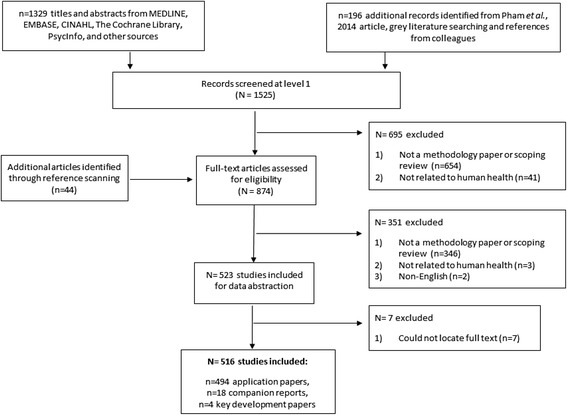
BACKGROUND: Scoping reviews are used to identify knowledge gaps, set research agendas, and identify implications for decision-making. The conduct and reporting of scoping reviews is inconsistent in the literature. We conducted a scoping review to identify: papers that utilized and/or described scoping review methods; guidelines for reporting scoping reviews; and studies that assessed the quality of reporting of scoping reviews. METHODS: We searched nine electronic databases for published and unpublished literature scoping review papers, scoping review methodology, and reporting guidance for scoping reviews. Two independent reviewers screened citations for inclusion. Data abstraction was performed by one reviewer and verified by a second reviewer. Quantitative (e.g. frequencies of methods) and qualitative (i.e. content analysis of the methods) syntheses were conducted. RESULTS: After searching 1525 citations and 874 full-text papers, 516 articles were included, of which 494 were scoping reviews. The 494 scoping reviews were disseminated between 1999 and 2014, with 45% published after 2012. Most of the scoping reviews were conducted in North America (53%) or Europe (38%), and reported a public source of funding (64%). The number of studies included in the scoping reviews ranged from 1 to 2600 (mean of 118). Using the Joanna Briggs Institute methodology guidance for scoping reviews, only 13% of the scoping reviews reported the use of a protocol, 36% used two reviewers for selecting citations for inclusion, 29% used two reviewers for full-text screening, 30% used two reviewers for data charting, and 43% used a pre-defined charting form. In most cases, the results of the scoping review were used to identify evidence gaps (85%), provide recommendations for future research (84%), or identify strengths and limitations (69%). We did not identify any guidelines for reporting scoping reviews or studies that assessed the quality of scoping review reporting. CONCLUSION: The number of scoping reviews conducted per year has steadily increased since 2012. Scoping reviews are used to inform research agendas and identify implications for policy or practice. As such, improvements in reporting and conduct are imperative. Further research on scoping review methodology is warranted, and in particular, there is need for a guideline to standardize reporting.
Overview
The claims and statistics of this paper haven’t been checked yet.
Free: it reads the open-access text and checks the first 5 claims that cite a source we can check. Create a free account to check every claim.
Integrity signals
Registry
Cites
Statistics
Figures
Verification
Claims the paper makes
The claims and statistics of this paper haven’t been checked yet.
Free: it reads the open-access text and checks the first 5 claims that cite a source we can check. Create a free account to check every claim.
Claims other papers make about this one
Each is checked against this paper’s own text: does it say what the citing paper says it does?
The cited source doesn’t support the claim as written.
In the citing paper
“The scoping review followed the guidelines outlined in the Preferred Reporting Items for Systematic Reviews and Meta-Analyses Extension (PRISMA-ScR) methodology (Munn et al., 2018; Tricco et al., 2016).”
From Sextortion: A Scoping Review (2025) · cites this paper as Tricco et al., 2016
Checked by a reasoning model — may be wrong.
Experimental — accuracy not yet measuredThe source backs part of the claim, not all of it — or backs it for a different population, condition or comparison.
In the citing paper
“A scoping review approach was considered appropriate for this purpose, given the authors’ understanding that the evidence base in this area is diverse in both research methodologies and disciplinary context (30).”
From Contributions of a time use perspective in community mental health practice: a scoping review (2024) · cites this paper as [30]
Experimental — accuracy not yet measuredThe source backs part of the claim, not all of it — or backs it for a different population, condition or comparison.
In the citing paper
“With the increasing popularity of scoping reviews, criticism of the rigour, transparency, and appropriateness of the methodology have been raised across multiple academic and clinical disciplines, including nursing and midwifery.”
From Undertaking a scoping review: A practical guide for nursing and midwifery students, clinicians, researchers, and academics (2021) · cites this paper as Tricco et al., 2016
Experimental — accuracy not yet measuredThe source backs part of the claim, not all of it — or backs it for a different population, condition or comparison.
In the citing paper
“Limitations of the scoping review methodology include the absence of methodological and risk of bias evaluations and the resultant inappropriateness of the review to be used as evidence for clinical guidelines, limitations, and recommendations (Arksey & O'Malley, 2005; Peters, Godfrey, et al., 2020; Tricco et al., 2016).”
From Undertaking a scoping review: A practical guide for nursing and midwifery students, clinicians, researchers, and academics (2021) · cites this paper as Tricco et al., 2016
Experimental — accuracy not yet measuredThe cited source says what the claim attributes to it.
In the citing paper
“while the number of scoping reviews in the literature is increasing steadily”
From PRISMA Extension for Scoping Reviews (PRISMA-ScR): Checklist and Explanation (2018) · cites this paper as [1]
13 more claims about this paper
Create a free account to see every claim other papers make about this one.
Self-check
Percentages, sums and reported differences re-computed from the paper’s own numbers.
The self-check needs the paper’s full text.
Citations
Cites
Preferred Reporting Items for Systematic Reviews and Meta-Analyses: the PRISMA statement
Moher, D., Liberati, A., Tetzlaff, J., Altman, D. G., & for the PRISMA Group (2009) · BMJ · doi:10.1136/bmj.b2535 · Cited by 83,823
Preferred reporting items for systematic reviews and meta-analyses: the PRISMA Statement.
(2009) · PubMed Central · Cited by 44,859
Scoping studies: towards a methodological framework
Arksey, H., & O'Malley, L. (2005) · International Journal of Social Research Methodology · doi:10.1080/1364557032000119616 · Cited by 36,742 · cited 15×
“Background Scoping reviews are used to map the concepts underpinning a research area and the main sources and types of evidence available [1].”
BackgroundMethodInfluentialPreferred Reporting Items for Systematic Reviews and Meta-Analyses: The PRISMA Statement
Moher, D., Liberati, A., Tetzlaff, J., & Altman, D. G. (2009) · Journal of Clinical Epidemiology · doi:10.1016/j.jclinepi.2009.06.005 · Cited by 19,575
Scoping studies: advancing the methodology
Levac, D., Colquhoun, H., & O'Brien, K. K. (2010) · Implementation Science · doi:10.1186/1748-5908-5-69 · Cited by 15,268 · cited 9×
“(2010) [2] modifications to the original framework of a scoping review [1] to guide this research.”
BackgroundMethodInfluentialSelf-citationGuidance for conducting systematic scoping reviews
Peters, M. D. J., Godfrey, C. M., Khalil, H., McInerney, P., Parker, D., & Soares, C. B. (2015) · International Journal of Evidence-Based Healthcare · doi:10.1097/xeb.0000000000000050 · Cited by 7,472 · cited 7×
“Our protocol was developed using the scoping review methodological framework proposed by Arksey and O’Malley (2005) [1] and further refined by the Joanna Briggs Institute [3].”
BackgroundMethodInfluentialSchulz (1995) · doi:10.1001/jama.1995.03520290060030 · Cited by 5,634 · cited 1×
“This is problematic because when different methods are applied to the same question, they may produce different results, undermining the utility and confidence in knowledge syntheses [5, 6].”
MethodA scoping review of scoping reviews: advancing the approach and enhancing the consistency
Pham, M. T., Rajić, A., Greig, J. D., Sargeant, J. M., Papadopoulos, A., & McEwen, S. A. (2014) · Research Synthesis Methods · doi:10.1002/jrsm.1123 · Cited by 3,078 · cited 2×
“We are aware of a previous scoping review of scoping reviews [16].”
BackgroundMethodScoping reviews: Time for clarity in definition, methods, and reporting
Colquhoun, H. L., Levac, D., O'Brien, K. K., Straus, S., Tricco, A. C., Perrier, L., Kastner, M., & Moher, D. (2014) · Journal of Clinical Epidemiology · doi:10.1016/j.jclinepi.2014.03.013 · Cited by 2,783 · cited 2×
“(2010) [2] and others [3], there is a lack of consistency in terminology and methods reported [4].”
BackgroundSelf-citationDaudt, H. M., van Mossel, C., & Scott, S. J. (2013) · BMC Medical Research Methodology · doi:10.1186/1471-2288-13-48 · Cited by 1,891 · cited 5×
“(2013) discussed the Arksey and O’Malley (2005) framework, and in particular, the team’s experiences using it, in order to develop the methodology further [10].”
BackgroundMethodInfluential
Research works printed but not linked: 2
- Colquhoun H, O’Brien K, Straus S, Moher D, Levac D. Gaps in scoping review methodologies J Clin Epidemiol. In press. 25034198
- Feinberg J Wordle 2014
Cited by
Items 101–200 of 1,005
Couturier, J., Pellegrini, D., Miller, C., Bhatnagar, N., Boachie, A., Bourret, K., Brouwers, M., Coelho, J. S., Dimitropoulos, G., Findlay, S., et al. (2021) · Journal of Eating Disorders · doi:10.1186/s40337-021-00394-9 · Cited by 86
Reproducibility of clinical research in critical care: a scoping review
Niven, D. J., McCormick, T. J., Straus, S. E., Hemmelgarn, B. R., Jeffs, L. P., Barnes, T., & Stelfox, H. T. (2018) · BMC Medicine · doi:10.1186/s12916-018-1018-6 · Cited by 100
Self-citationMassazza, A., Kienzler, H., Mitwalli, S., Tamimi, N., & Giacaman, R. (2022) · Journal of Mental Health · doi:10.1080/09638237.2021.2022620 · Cited by 114
“Furthermore, the exploratory nature of scoping reviews (Tricco et al., 2016) allowed us to capture a varied spectrum of evidence, therefore, providing a more comprehensive snapshot of the state of the literature to date.”
BackgroundGeza, W., Ngidi, M. S. C., Slotow, R., & Mabhaudhi, T. (2022) · Sustainability · doi:10.3390/su14095041 · Cited by 157
“The PRISMA flowchart (see Figure 2) and the conduct and reporting of scoping reviews [61,62] were used as a guideline for reporting the review results.”
MethodA scoping review of biopsychosocial risk factors and co-morbidities for common spinal disorders
Green, B. N., Johnson, C. D., Haldeman, S., Griffith, E. A., Clay, M. B., Kane, E. J., Castellote, J. M., Rajasekaran, S., Smuck, M. W., Hurwitz, E. L., et al. (2018) · PLoS ONE · doi:10.1371/journal.pone.0197987 · Cited by 100
“Scoping reviews are particularly useful when investigating topics that are complex and under-studied [12] as they help to discover gaps in the research literature and identify the types of evidence available in the field of study [13].”
BackgroundMethodInfluentialMalorni, A., Lea, C. H., III, Richards-Schuster, K. E., & Spencer, M. S. (2022) · Children and Youth Services Review · doi:10.1016/j.childyouth.2022.106399 · Cited by 114
Factors affecting healthcare workers burnout and their conceptual models: scoping review
Nagle, E., Griskevica, I., Rajevska, O., Ivanovs, A., Mihailova, S., & Skruzkalne, I. (2024) · BMC Psychology · doi:10.1186/s40359-024-02130-9 · Cited by 85
“A scoping review is a form of knowledge synthesis that identifies existing trends and highlights gaps in the existing knowledge base [64–66].”
BackgroundKent, E. E., Wheldon, C. W., Smith, A. W., Srinivasan, S., & Geiger, A. M. (2019) · Cancer · doi:10.1002/cncr.32388 · Cited by 83
“The scoping review design was chosen to identify broad topics previously covered with a variety of study designs on the experiences of care and health outcomes of SGM patients with cancer instead of seeking to focus on a well defined research question.(15,17) Although searches were systematically conducted, the goal w…”
MethodImplementation of robotic devices in nursing care. Barriers and facilitators: an integrative review
Servaty, R., Kersten, A., Brukamp, K., Möhler, R., & Müller, M. (2020) · BMJ Open · doi:10.1136/bmjopen-2020-038650 · Cited by 111
Schwartz, J. M., Moy, A. J., Rossetti, S. C., Elhadad, N., & Cato, K. D. (2021) · Journal of the American Medical Informatics Association · doi:10.1093/jamia/ocaa296 · Cited by 83
McNab, S., Dryer, S., Fitzgerald, L., Gomez, P., Bhatti, A. M., Kenyi, E. E., Somji, A., Khadka, N., & Stalls, S. (2022) · BMC Pregnancy and Childbirth · doi:10.1186/s12884-022-04589-z · Cited by 113
“This approach was chosen because it supports the identification of knowledge gaps by setting research agendas and informs decision-making while allowing for an iterative approach [10].”
MethodDigital agriculture services in low- and middle-income countries: A systematic scoping review
Porciello, J., Coggins, S., Mabaya, E., & Otunba-Payne, G. (2022) · Global Food Security · doi:10.1016/j.gfs.2022.100640 · Cited by 138
Preparing scoping reviews for publication using methodological guides and reporting standards
Lockwood, C. S., & Tricco, A. C. (2020) · Nursing and Health Sciences · doi:10.1111/nhs.12673 · Cited by 105
Self-citationHealth Promoting Schools: An Update
Lee, A., Lo, A. S. C., Li, Q., Keung, V. M. W., & Kwong, A. (2020) · Applied Health Economics and Health Policy · doi:10.1007/s40258-020-00575-8 · Cited by 115
“This update of HPS has taken reference from scoping reviews that are used to present a broad overview of the evidence related to the topic, irrespective of study quality, but useful to examine emerging areas to clarify concepts and identify gap [41, 42].”
MethodArksey and O′Malleyʼs consultation exercise in scoping reviews: A critical review
Buus, N., Nygaard, L., Berring, L. L., Hybholt, L., Kamionka, S. L., Rossen, C. B., Søndergaard, R., & Juel, A. (2022) · Journal of Advanced Nursing · doi:10.1111/jan.15265 · Cited by 108
“Further, as our general findings had substantial similarities with previous research (Pham et al., 2014; Tricco et al., 2016), we believe that our findings are relevant beyond the concrete analysis.”
BackgroundResultInfluentialHauser, L.-L., Harwood, C., Höner, O., O’Connor, D., & Wachsmuth, S. (2022) · International Review of Sport and Exercise Psychology · doi:10.1080/1750984x.2022.2129423 · Cited by 123
“Scoping reviews allow researchers to integrate qualitative, quantitative, and mixed-methods studies and to explore the extent of the existing literature, map the evidence, and identify key factors and research gaps related to a given fi eld (Munn et al., 2018; Tricco et al., 2016).”
Assessing the quality of mobile applications in chronic disease management: a scoping review
Agarwal, P., Gordon, D., Griffith, J., Kithulegoda, N., Witteman, H. O., Bhatia, R. S., Kushniruk, A. W., Borycki, E. M., Lamothe, L., Springall, E., et al. (2021) · npj Digital Medicine · doi:10.1038/s41746-021-00410-x · Cited by 93
Qiao, J., Xu, J., Li, L., & Ouyang, Y. (2021) · Nurse Education Today · doi:10.1016/j.nedt.2021.104773 · Cited by 91
Brandt, J., Bressi, J., Lê, M.-L., Neal, D., Cadogan, C., Witt-Doerring, J., Witt-Doerring, M., & Wright, S. (2024) · eClinicalMedicine · doi:10.1016/j.eclinm.2024.102507 · Cited by 77
Fatigue and recovery in shiftworking nurses: A scoping literature review
Gifkins, J., Johnston, A. N. B., Loudoun, R. J., & Troth, A. C. (2020) · International Journal of Nursing Studies · doi:10.1016/j.ijnurstu.2020.103710 · Cited by 93
Hierink, F., Okiro, E. A., Flahault, A., & Ray, N. (2021) · PLoS ONE · doi:10.1371/journal.pone.0244921 · Cited by 98
Nyasulu, P. S., Weyer, J., Tschopp, R., Mihret, A., Aseffa, A., Nuvor, S. V., Balogun, T., Tamuzi, J. L., Nyakarahuka, L., Helegbe, G. K., et al. (2021) · BMJ Open · doi:10.1136/bmjopen-2020-048551 · Cited by 90
Carr, P. J., Higgins, N. S., Cooke, M. L., Rippey, J., & Rickard, C. M. (2017) · Journal of Hospital Medicine · doi:10.12788/jhm.2836 · Cited by 77
A scoping review of published literature on chikungunya virus
Mascarenhas, M., Garasia, S., Berthiaume, P., Corrin, T., Greig, J. D., Ng, V., Young, I., & Waddell, L. A. (2018) · PLoS ONE · doi:10.1371/journal.pone.0207554 · Cited by 217
A scoping review of men, masculinities, and smoking behavior: The importance of settings
Kodriati, N., Pursell, L., & Hayati, E. N. (2018) · Global Health Action · doi:10.1080/16549716.2019.1589763 · Cited by 90
“used guide [42,43] for such reviews, and its use enabled mapping of the characteristics and quality of relevant published studies and identification of”
MethodGilhooly, D., Green, S. A., McCann, C., Black, N. A., & Moonesinghe, R. (2019) · Implementation Science · doi:10.1186/s13012-019-0894-2 · Cited by 88
“Given the heterogeneity of published studies as regards both methods and clinical area, a scoping review (rather than systematic review) was the preferred choice [13].”
MethodCommunication with patients in intensive care units: a scoping review
Karlsen, M. W., Ølnes, M. A., & Heyn, L. G. (2018) · Nursing in Critical Care · doi:10.1111/nicc.12377 · Cited by 104
Kim, S., Appelbaum, N., Baker, N. J., Bajwa, N. M., Chu, F., Pal, J. D., Cochran, N. E., & Bochatay, N. (2020) · Journal for Healthcare Quality · doi:10.1097/jhq.0000000000000257 · Cited by 86
“Methods We followed the established methodologies for conducting a scoping review to examine speakingup training programs.(41,42) An IRB approval was not sought because the study involved published articles.”
MethodHelp-seeking attitudes and behaviours among youth with eating disorders: a scoping review
Nicula, M., Pellegrini, D., Grennan, L., Bhatnagar, N., McVey, G. L., & Couturier, J. L. (2022) · Journal of Eating Disorders · doi:10.1186/s40337-022-00543-8 · Cited by 99
Teacher Educator Wellbeing, Stress and Burnout: A Scoping Review
Turner, K., & Garvis, S. (2023) · Education Sciences · doi:10.3390/educsci13040351 · Cited by 122
“Scoping studies are most frequently applied to map existing knowledge, identify gaps, and inform future research within a clearly defined field [41].”
BackgroundPeer support as a protective factor against suicide in trans populations: A scoping review
Kia, H., MacKinnon, K. R., Abramovich, A., & Bonato, S. (2021) · Social Science & Medicine · doi:10.1016/j.socscimed.2021.114026 · Cited by 74
The role of registered nurses in primary care and public health collaboration: A scoping review
Swanson, M., Wong, S. T., Martin‐Misener, R., & Browne, A. J. (2020) · Nursing Open · doi:10.1002/nop2.496 · Cited by 101
“The focus of scoping reviews is to provide breadth rather than depth of information; thus, a metaanalysis is generally not conducted (Tricco et al., 2016).”
BackgroundCurtis, L., Burford, J. H., England, G., & Freeman, S. L. (2019) · PLoS ONE · doi:10.1371/journal.pone.0219307 · Cited by 98
Bonar, E. E., Coughlin, L. N., Roche, J., Philyaw-Kotov, M. L., Bixler, E. A., Sinelnikov, S., Kolosh, A., Cihak, M. J., Cunningham, R. M., & Walton, M. A. (2020) · Preventive Medicine · doi:10.1016/j.ypmed.2019.105972 · Cited by 80
Nutritional Assessment in Adult Patients with Dysphagia: A Scoping Review
Ueshima, J., Momosaki, R., Shimizu, A., Motokawa, K., Sonoi, M., Shirai, Y., Uno, C., Kokura, Y., Shimizu, M., Nishiyama, A., et al. (2021) · Nutrients · doi:10.3390/nu13030778 · Cited by 96
“The most common reasons for conducting scope reviews are to explore the breadth and scope of the literature, map and summarize the evidence, and inform future research [28].”
BackgroundScoping reviews and rapid reviews
Sabiston, C. M., Vani, M., de Jonge, M., & Nesbitt, A. (2022) · International Review of Sport and Exercise Psychology · doi:10.1080/1750984x.2021.1964095 · Cited by 74
“It is possible that these stakeholder consultations are published separately (Tricco et al., 2016), however, we recommend integrating the reporting of the results and the consultation process in the same manuscript to improve the value and implications of the review.”
BackgroundUtility of social media and crowd-intelligence data for pharmacovigilance: a scoping review
Tricco, A. C., Zarin, W., Lillie, E., Jeblee, S., Warren, R., Khan, P. A., Robson, R., Pham, B., Hirst, G., & Straus, S. E. (2018) · BMC Medical Informatics and Decision Making · doi:10.1186/s12911-018-0621-y · Cited by 74
“Risk of bias or quality appraisal was not conducted, which is consistent with the Joanna Briggs Institute methods manual [9], and those documented in scoping reviews on health-related topics [17].”
MethodSelf-citationFinlay, A. K., Owens, M. D., Taylor, E. N., Nash, A., Capdarest‐Arest, N., Rosenthal, J., Blue‐Howells, J., Clark, S., & Timko, C. (2019) · Health & Justice · doi:10.1186/s40352-019-0086-9 · Cited by 90
Current tools available for investigating vaccine hesitancy: a scoping review protocol
Oduwole, E. O., Pienaar, E. D., Mahomed, H., & Wiysonge, C. S. (2019) · BMJ Open · doi:10.1136/bmjopen-2019-033245 · Cited by 79
Brennan, R., Wazaify, M., Shawabkeh, H., Boardley, I. D., McVeigh, J., & Hout, M. C. V. (2021) · Drug Safety · doi:10.1007/s40264-021-01085-9 · Cited by 103
Alteri, A., Cermisoni, G. C., Pozzoni, M., Gaeta, G., Cavoretto, P. I., & Viganò, P. (2023) · Human Reproduction Update · doi:10.1093/humupd/dmad001 · Cited by 80
“We followed the five stages of the updated scoping review protocol developed by Arksey and O’Malley (2005), Colquhoun et al. (2014), Levac et al. (2010), Peters et al. (2015), and Tricco et al. (2016).”
MethodFunds of Knowledge in STEM Education: A Scoping Review
Denton, M., & Borrego, M. (2021) · Studies in Engineering Education · doi:10.21061/see.19 · Cited by 72
“Despite the growing popularity of scoping reviews, methodologies used remain largely inconsistent (Tricco et al., 2016).”
BackgroundBias in algorithms of AI systems developed for COVID-19: A scoping review
Delgado, J., de Manuel, A., Parra, I., Moyano, C., Rueda, J., Guersenzvaig, A., Ausin, T., Cruz, M., Casacuberta, D., & Puyol, A. (2022) · Journal of Bioethical Inquiry · doi:10.1007/s11673-022-10200-z · Cited by 70
COVID-19 infodemic and adult and elderly mental health: a scoping review
Delgado, C. E., Silva, E. A., de Castro, E. A. B., Carbogim, F. D. C., Püschel, V. A. D. A., & Cavalcante, R. B. (2021) · Revista da Escola de Enfermagem da USP · doi:10.1590/1980-220x-reeusp-2021-0170 · Cited by 100
“Considering that the subject is emerging and that evidence on the subject is still being discovered (5,13) , the choice of methodology has a vast potential to explore the literature in a broad way, map and describe the evidence and inform future research (15) .”
BackgroundRay, A., & Henry, N. (2025) · Trauma, Violence, & Abuse · doi:10.1177/15248380241277271 · Cited by 76
“The scoping review followed the guidelines out-lined in the Preferred Reporting Items for Systematic Reviews and Meta-Analyses Extension (PRISMA-ScR) methodology (Munn et al., 2018; Tricco et al., 2016).”
Online and Blended Instruction in K–12 Physical Education: A Scoping Review
Killian, C. M., Kinder, C. J., & Woods, A. M. (2019) · Kinesiology Review · doi:10.1123/kr.2019-0003 · Cited by 84
Anderson, H. L. K., Kurtz, J. B., & West, D. C. (2021) · Academic Medicine · doi:10.1097/acm.0000000000004366 · Cited by 90
Anderson, P., Kokole, D., & Jané‐Llopis, E. (2021) · Nutrients · doi:10.3390/nu13093153 · Cited by 71
“The design was guided by the methodological framework of Arksey and O’Malley [12].”
MethodPalacios‐Ceña, D., Fernández‐Peña, R., López, Á. O., Fernández‐Feito, A., Villaécija, Ó. B., Pedrosa, O. R., Arnau-Sánchez, J., & Lizcano‐Álvarez, A. (2021) · International Journal of Environmental Research and Public Health · doi:10.3390/ijerph181910099 · Cited by 75
“, characteristics) of the evidence on a particular topic, summarise findings from a body of knowledge that is heterogeneous in terms of methods or discipline, or identify gaps in the literature to aid the planning of future research [22,23].”
BackgroundMethodMapping the effectiveness of integrating mental health in HIV programs: a scoping review
Conteh, N. K., Latona, A., & Mahomed, O. H. (2023) · BMC Health Services Research · doi:10.1186/s12913-023-09359-x · Cited by 92
“The method used to conduct the literature search was adapted from previously published scoping review literature[17, 18], which described using two separate reviewers to conduct article screening.”
MethodRanieri, V. F., Barratt, H., Fulop, N., & Rees, G. E. (2016) · BMJ Open · doi:10.1136/bmjopen-2016-013523 · Cited by 74
Health effects of wind turbines on humans in residential settings: Results of a scoping review
Freiberg, A., Schefter, C., Girbig, M., Murta, V. C., & Seidler, A. (2018) · Environmental Research · doi:10.1016/j.envres.2018.11.032 · Cited by 83
Tricco, A. C., Thomas, S. M., Antony, J., Rios, P. D. L., Robson, R. C., Pattani, R., Ghassemi, M., Sullivan, S., Selvaratnam, I., Tannenbaum, C., et al. (2017) · PLoS ONE · doi:10.1371/journal.pone.0169718 · Cited by 79
Self-citationEastern Equine Encephalitis Virus: A Scoping Review of the Global Evidence
Corrin, T., Ackford, R., Mascarenhas, M., Greig, J. D., & Waddell, L. A. (2020) · Vector-Borne and Zoonotic Diseases · doi:10.1089/vbz.2020.2671 · Cited by 74
The indicators and methods used for measuring urban liveability: a scoping review
Khorrami, Z., Ye, T., Sadatmoosavi, A., Mirzaee, M., Davarani, M. M. F., & Khanjani, N. (2020) · Reviews on Environmental Health · doi:10.1515/reveh-2020-0097 · Cited by 79
Chong, S. W., Lin, T. J., & Chen, Y. (2021) · Educational Research Review · doi:10.1016/j.edurev.2021.100426 · Cited by 117
Thomas, J., Keels, J., Calzone, K. A., Badzek, L., Dewell, S., Patch, C., Tonkin, E. T., & Dwyer, A. A. (2023) · Genes · doi:10.3390/genes14112013 · Cited by 80
“We conducted a comprehensive review of the literature (2012–2022) and utilized a rigorous dual review using a well-established framework to guide the process [17,18].”
MethodMayland, C. R., Ho, Q. M., Doughty, H. C., Rogers, S. N., Peddinti, P., Chada, P., Mason, S. R., Cooper, M., & Dey, P. (2020) · Palliative Medicine · doi:10.1177/0269216320963892 · Cited by 73
The Politics of LGBT+ Health Inequality: Conclusions from a UK Scoping Review
McDermott, E., Nelson, R., & Weeks, H. (2021) · International Journal of Environmental Research and Public Health · doi:10.3390/ijerph18020826 · Cited by 80
“This scoping review follows the five recommended steps in completing scoping reviews [17,18,20]: (a) identifying the research question; (b) identifying relevant studies; (c) study selection; (d) charting the data; (e) collating, summarising and reporting the results.”
MethodDyadic Psychosocial eHealth Interventions: Systematic Scoping Review
Shaffer, K. M., Tigershtrom, A., Badr, H., Benvengo, S., Hernandez, M., & Ritterband, L. M. (2020) · Journal of Medical Internet Research · doi:10.2196/15509 · Cited by 74
“Aims were well suited to a scoping review, which are ideal for reviewing a large and complex body of research that has not been previously reviewed [69,70].”
BackgroundChanging behaviour in pregnant women: A scoping review
Zinsser, L. A., Stoll, K. H., Wieber, F., Pehlke‐Milde, J., & Groß, M. M. (2020) · Midwifery · doi:10.1016/j.midw.2020.102680 · Cited by 77
Chilman, L. B., Kennedy‐Behr, A., Frakking, T. T., Swanepoel, L., & Verdonck, M. (2021) · International Journal of Environmental Research and Public Health · doi:10.3390/ijerph18179067 · Cited by 91
“[18] and the checklist from the PRISMA extension for scoping reviews [19].”
MethodRuwanza, S., Thondhlana, G., & Falayi, M. (2022) · Land · doi:10.3390/land11020159 · Cited by 73
“…impacts of drought on and responses by smallholder farmers in We adopted a scoping review approach because it enabled us to comprehensively synthesise, document knowledge gaps and identify policy implications on the impacts of and responses to drought on smallholder farmers in South Africa [38,39].”
BackgroundPatient safety culture in care homes for older people: a scoping review
Gartshore, E., Waring, J., & Timmons, S. (2017) · BMC Health Services Research · doi:10.1186/s12913-017-2713-2 · Cited by 64
A scoping review of the scientific evidence base for rewilding in Europe
Hart, E. E., Haigh, A., & Ciuti, S. (2023) · Biological Conservation · doi:10.1016/j.biocon.2023.110243 · Cited by 77
Nelson, M. L. A., McKellar, K. A., Yi, J., Kelloway, L., Munce, S., Cott, C. A., Hall, R., Fortin, M., Teasell, R. W., & Lyons, R. (2017) · Topics in Stroke Rehabilitation · doi:10.1080/10749357.2017.1282412 · Cited by 76
Khanlou, N., Khan, A., Vázquez, L. M., & Zangeneh, M. (2020) · Journal of Developmental and Physical Disabilities · doi:10.1007/s10882-020-09738-w · Cited by 84
Protective Factors for LGBTI+ Youth Wellbeing: A Scoping Review Underpinned by Recognition Theory
Ceatha, N., Koay, A. C. C., Buggy, C., James, O., Tully, L., Bustillo, M., & Crowley, D. (2021) · International Journal of Environmental Research and Public Health · doi:10.3390/ijerph182111682 · Cited by 72
The impact of COVID-19 on individual oral health: a scoping review
Dickson‐Swift, V., Kangutkar, T., Knevel, R. J. M., & Down, S. (2022) · BMC Oral Health · doi:10.1186/s12903-022-02463-0 · Cited by 72
“Consistent with the guidelines for the effective reporting of scoping reviews [42] and the JBI framework [37] the final stage of the review included a thematic analysis of the key findings of the included studies.”
MethodThe use and application of learning theory in learning analytics: a scoping review
Khalil, M., Prinsloo, P., & Slade, S. (2022) · Journal of Computing in Higher Education · doi:10.1007/s12528-022-09340-3 · Cited by 96
“In line with Tricco et al. (2016) who emphasized that scoping reviews focus on breadth rather than depth, the researchers opted not to search for specific learning theories which, as explained earlier, would be an impossible task due to the undefined nature of learning theories.”
BackgroundA scoping review of the changing landscape of doctoral education
McKenna, S., & Schalkwyk, S. C. V. (2023) · Compare A Journal of Comparative and International Education · doi:10.1080/03057925.2023.2168121 · Cited by 90
“Ultimately, 81 articles were included in the study (Step 3), this number falls within the norm for reviews of this nature (Tricco et al. 2016).”
Howe, D., Duffy, S. M., O’Shea, M., Hawkey, A., Wardle, J., Gerontakos, S., Steele, L. R., Gilbert, E., Owen, L., Ciccia, D., et al. (2023) · Healthcare · doi:10.3390/healthcare11222945 · Cited by 84
“This is common as scoping reviews are designed to provide an evidence map, irrespective of study quality, and given the wide range of materials included, from policy documents to more formal academic material, no standard measure for the quality of this information exists [21].”
BackgroundRapti, S., & Sapounidis, T. (2023) · Computers & Education · doi:10.1016/j.compedu.2023.104968 · Cited by 98
Large scoping reviews: managing volume and potential chaos in a pool of evidence sources
Alexander, L., Cooper, K., Peters, M. D. J., Tricco, A. C., Khalil, H., Evans, C., Munn, Z., Pieper, D., Godfrey, C. M., McInerney, P. A., et al. (2024) · Journal of Clinical Epidemiology · doi:10.1016/j.jclinepi.2024.111343 · Cited by 73
Self-citationMarcoux, V., Chouinard, M., Diadiou, F., Dufour, I., & Hudon, C. (2017) · PLoS ONE · doi:10.1371/journal.pone.0188663 · Cited by 63
Fray, L., Gore, J. M., Harris, J., & North, B. (2019) · The Australian Educational Researcher · doi:10.1007/s13384-019-00332-4 · Cited by 60
Precarity and Aging: A Scoping Review
Grenier, A. M., Hatzifilalithis, S., Rudman, D. L., Kobayashi, K. M., Marier, P., & Phillipson, C. (2019) · The Gerontologist · doi:10.1093/geront/gnz135 · Cited by 86
The knowledge and practice of pediatricians in children’s oral health: a scoping review
Dickson‐Swift, V., Kenny, A. J., Gussy, M. G., McCarthy, C., & Bracksley‐O’Grady, S. (2020) · BMC Oral Health · doi:10.1186/s12903-020-01198-0 · Cited by 81
Moon, S., Hogden, A., & Eljiz, K. (2022) · BMJ Open Quality · doi:10.1136/bmjoq-2022-002057 · Cited by 97
Abukari, A. S., & Schmollgruber, S. (2023) · Journal of Pediatric Nursing · doi:10.1016/j.pedn.2023.04.005 · Cited by 86
Ochs, C., Garrison, K., Saxena, P., Romme, K., & Sarkar, A. (2024) · The Science of The Total Environment · doi:10.1016/j.scitotenv.2024.171490 · Cited by 68
Wilkie, S., Townshend, T., Thompson, E. M., & Ling, J. (2018) · Cities & Health · doi:10.1080/23748834.2019.1574954 · Cited by 72
La revisión sistemática: pluralidad de enfoques y metodologías
Sobrido, M., & Prieto, J. M. R. (2018) · Enfermería Clínica · doi:10.1016/j.enfcli.2018.08.008 · Cited by 122
Cluley, V., Ziemann, A., Feeley, C., Olander, E. K., Shamah, S., & Stavropoulou, C. (2022) · Health Expectations · doi:10.1111/hex.13437 · Cited by 70
“We conducted the scoping review in accordance with Tricco et al.(14) A protocol was developed, following Peters et al.”
MethodVirtual Reality-Based Mindfulness for Chronic Pain Management: A Scoping Review
O’Connor, S., Mayne, A., & Hood, B. (2022) · Pain Management Nursing · doi:10.1016/j.pmn.2022.03.013 · Cited by 72
Environmental stewardship: A systematic scoping review
McLeod, L. J., Kitson, J., Dorner, Z., Tassell-Matamua, N., Brown, P. H., Milfont, T. L., & Hine, D. W. (2024) · PLoS ONE · doi:10.1371/journal.pone.0284255 · Cited by 89
“A scoping review is a useful tool for outlining the key concepts underpinning a research area, mapping the main sources and types of evidence available and identifying research gaps in the existing literature [35–37].”
MethodSocial capital and HIV/AIDS in the United States: Knowledge, gaps, and future directions
Ransome, Y., Thurber, K. A., Swen, M., Crawford, N. D., German, D., & Dean, L. T. (2018) · SSM - Population Health · doi:10.1016/j.ssmph.2018.05.007 · Cited by 64
Application of Optical Remote Sensing in Rubber Plantations: A Systematic Review
Azizan, F. A., Kiloes, A. M., Astuti, I. S., & Aziz, A. A. (2021) · Remote Sensing · doi:10.3390/rs13030429 · Cited by 67
The Academic Viewpoint on Patient Data Ownership in the Context of Big Data: Scoping Review
Mirchev, M., Mircheva, I. S., & Kerekovska, A. (2020) · Journal of Medical Internet Research · doi:10.2196/22214 · Cited by 66
“Although the terminology and methods for conducting a scoping review are still unclear and not well-described [75], they are constantly improving [76-78], and the use of scoping reviews keeps increasing.”
MethodFitzpatrick, J., Bianchi, L. A., Hayes, N., da Silva, T. M. H. R., & Harris, R. G. (2022) · International Journal of Older People Nursing · doi:10.1111/opn.12519 · Cited by 83
Yousef, Y., Lee, A., Asele, F. A., & Poenaru, D. (2018) · Journal of Pediatric Surgery · doi:10.1016/j.jpedsurg.2018.06.018 · Cited by 62
(EFSA), E. F. S. A., Devos, Y., Muñoz‐Guajardo, I., Álvarez, F., & Glanville, J. (2019) · EFSA Supporting Publications · doi:10.2903/sp.efsa.2019.en-1614 · Cited by 80
(EFSA), E. F. S. A., Devos, Y., Guajardo, I. M., Glanville, J., & Waigmann, E. (2017) · EFSA Supporting Publications · doi:10.2903/sp.efsa.2017.en-1207 · Cited by 58
Implications of the COVID-19 pandemic for people with bipolar disorders: A scoping review
Fornaro, M., Prisco, M. D., Billeci, M., Ermini, E., Young, A. H., Lafer, B., Soares, J. C., Vieta, E., Quevedo, J., de Bartolomeis, A., et al. (2021) · Journal of Affective Disorders · doi:10.1016/j.jad.2021.08.091 · Cited by 59
Storm, M., Husebø, A. M. L., Thomas, E. C., Elwyn, G. J., & Zisman‐Ilani, Y. (2019) · Administration and Policy in Mental Health and Mental Health Services Research · doi:10.1007/s10488-018-00918-7 · Cited by 66
Prescott, M., Labbé, D., Miller, W. C., Borisoff, J., Feick, R., & Mortenson, W. B. (2020) · Transport Reviews · doi:10.1080/01441647.2020.1748139 · Cited by 67
“explore a broad area of study that has received limited attention (Arksey & O’Malley, 2005; Tricco et al., 2016) and communicate the findings in a way that can promote improvements (Levac, Colquhoun, & O’Brien, 2010).”
BackgroundInclusion of students with special education needs in Nordic countries: a systematic scoping review
Keleş, S., ten Braak, D., & Munthe, E. (2022) · Scandinavian Journal of Educational Research · doi:10.1080/00313831.2022.2148277 · Cited by 89
“…a body of literature, to explore and identify the breadth and depth of the literature, to identify knowledge gaps, to clarify key concepts and de fi nitions, or to investigate research evidence to inform practice (Moher et al., 2015; Munn et al., 2018; Peters et al., 2020; Tricco et al., 2016).”
BackgroundOliveira, D., Sousa, L., & Orrell, M. (2019) · Clinical Interventions in Aging · doi:10.2147/cia.s190610 · Cited by 51
“Material and methods A scoping review method was adopted as it was aimed at exploring more broadly the potential benefits and research gaps to inform a future systematic review on this topic.(20) A transparent approach to data selection, collection, and analysis was used to produce a broad map of the literature.”
MethodMcNaughton, S. (2018) · Journal of Interprofessional Care · doi:10.1080/13561820.2017.1417239 · Cited by 52
“…overviews of all available literature to clarify its extent, range, and nature, or more systematic summaries answering more specific questions and identifying gaps in the literature (Levac, Colquhoun, & O’Brien, 2010; Peters et al., 2015; Rumrill, Fitzgerald, & Merchant, 2010; Tricco et al., 2016).”
BackgroundMethodInfluentialBaskin, C., Zijlstra, G., McGrath, M., Lee, C. Y., Duncan, F. H., Oliver, E. J., Osborn, D., Dykxhoorn, J. L., Kaner, E., Lafortune, L., et al. (2021) · BMJ Open · doi:10.1136/bmjopen-2020-041102 · Cited by 67
Metadata
- Authors
- Tricco, A. C., Lillie, E., Zarin, W., O’Brien, K., Colquhoun, H., Kastner, M., Levac, D., Ng, C., Sharpe, J. P., Wilson, K., Kenny, M., Warren, R., Wilson, C., Stelfox, H. T., & Straus, S. E.
- Affiliations
- St. Michael's Hospital (CA)
- University of Toronto (CA)
- University of Ottawa (CA)
- University of Calgary (CA)
- Corresponding author
- Tricco, Andrea C.
- ORCID
- Venue
- BMC Medical Research Methodology
- Published
- 2016-02-09
- Volume
- 16
- Issue
- 1
- Pages
- 15-15
- ISSN
- 1471-2288 (ISSN-L)
- PMC
- PMC4746911
- OpenAlex
- W2261406464
- Semantic Scholar
- 91435675555c6bce345c14c4f31104353f325a49
- Cited by
- 2,250
- References
- 27
- Citations by year
- 2026: 261 · 2025: 369 · 2024: 352 · 2023: 341 · 2022: 304 · 2021: 257 · 2020: 135 · 2019: 102 · 2018: 76 · 2017: 42 · 2016: 9
- FWCI
- 70.87
- Type
- journal article
- Language
- en
- Open access
- gold
- doi.org
- Licence
- cc-by
- Locations
- BMC Medical Research Methodology (publishedVersion, cc-by)
- PubMed Central (publishedVersion, cc-by)
- PubMed (publishedVersion)
- TSpace (University of Toronto) (submittedVersion, cc-by)
- TSpace (University of Toronto) (submittedVersion)
- DOAJ (DOAJ: Directory of Open Access Journals) (submittedVersion, cc-by-sa)
- Funders
- Canadian Institutes of Health Research (KRS-138219)
- Canadian Agency for Drugs and Technologies in Health
- Topics
- Social Sciences › Decision Sciences › Statistics, Probability and Uncertainty › Meta-analysis and systematic reviews
- Social Sciences › Sociology and Political Science › Delphi Technique in Research
- Health Sciences › Medicine › Public Health, Environmental and Occupational Health › Clinical practice guidelines implementation
- Keywords
- scoping review, scoping review reporting, reporting guidelines, Joanna Briggs Institute, inter-rater reliability, evidence gaps, research agenda setting, reporting quality assessment
- MeSH terms
- Scoping Reviews as Topic, Humans, Publications, Quality Control, Databases, Bibliographic, Guidelines as Topic, Research Report
About these checks
Registry, retraction, Cites and statistics results are computed, not judged, with one exception: a printed reference that no index lists is read once by a model before it counts as a citation error. Claims are extracted by a model and kept only when their quote appears verbatim in the text; each cited source is then checked, with a model’s help, for whether it says what the claim relies on. Those verdicts can be wrong — read the claim’s quote and the cited source before relying on one.
Statistics and arithmetic are recomputed, not judged.
Confidence bands are shown only for fields calibrated on our annotated test set. None is calibrated yet, so no band is shown.
What counts as a claim ›How we measure confidence ›How we check this ›
Are you an author, or do you see a problem with this page? Request a review
Data sources
Bibliographic data: Semantic Scholar, OpenAlex, Crossref.
Contains information from the Semantic Scholar Academic Graph Datasets, made available under the ODC Attribution License (ODC-BY 1.0).
Semantic Scholar’s data is described in: Kinney, R., et al. (2023). The Semantic Scholar Open Data Platform. arXiv:2301.10140.
