

A scoping review on the conduct and reporting of scoping reviews
Open accessThe DOI matches its Crossref record; 25 of the 27 references it cites were found in a registry or an index.
Abstract
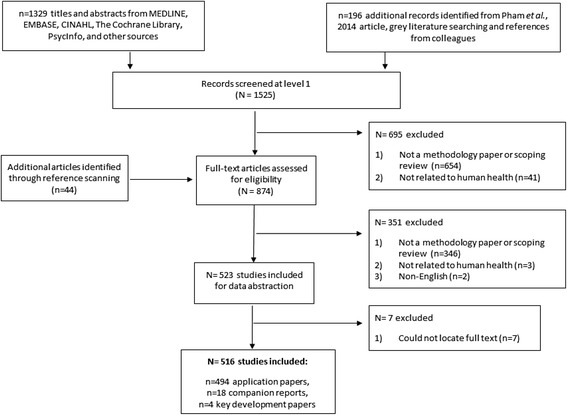
BACKGROUND: Scoping reviews are used to identify knowledge gaps, set research agendas, and identify implications for decision-making. The conduct and reporting of scoping reviews is inconsistent in the literature. We conducted a scoping review to identify: papers that utilized and/or described scoping review methods; guidelines for reporting scoping reviews; and studies that assessed the quality of reporting of scoping reviews. METHODS: We searched nine electronic databases for published and unpublished literature scoping review papers, scoping review methodology, and reporting guidance for scoping reviews. Two independent reviewers screened citations for inclusion. Data abstraction was performed by one reviewer and verified by a second reviewer. Quantitative (e.g. frequencies of methods) and qualitative (i.e. content analysis of the methods) syntheses were conducted. RESULTS: After searching 1525 citations and 874 full-text papers, 516 articles were included, of which 494 were scoping reviews. The 494 scoping reviews were disseminated between 1999 and 2014, with 45% published after 2012. Most of the scoping reviews were conducted in North America (53%) or Europe (38%), and reported a public source of funding (64%). The number of studies included in the scoping reviews ranged from 1 to 2600 (mean of 118). Using the Joanna Briggs Institute methodology guidance for scoping reviews, only 13% of the scoping reviews reported the use of a protocol, 36% used two reviewers for selecting citations for inclusion, 29% used two reviewers for full-text screening, 30% used two reviewers for data charting, and 43% used a pre-defined charting form. In most cases, the results of the scoping review were used to identify evidence gaps (85%), provide recommendations for future research (84%), or identify strengths and limitations (69%). We did not identify any guidelines for reporting scoping reviews or studies that assessed the quality of scoping review reporting. CONCLUSION: The number of scoping reviews conducted per year has steadily increased since 2012. Scoping reviews are used to inform research agendas and identify implications for policy or practice. As such, improvements in reporting and conduct are imperative. Further research on scoping review methodology is warranted, and in particular, there is need for a guideline to standardize reporting.
Overview
The claims and statistics of this paper haven’t been checked yet.
Free: it reads the open-access text and checks the first 5 claims that cite a source we can check. Create a free account to check every claim.
Integrity signals
Registry
Cites
Statistics
Figures
Verification
Claims the paper makes
The claims and statistics of this paper haven’t been checked yet.
Free: it reads the open-access text and checks the first 5 claims that cite a source we can check. Create a free account to check every claim.
Claims other papers make about this one
Each is checked against this paper’s own text: does it say what the citing paper says it does?
The cited source doesn’t support the claim as written.
In the citing paper
“The scoping review followed the guidelines outlined in the Preferred Reporting Items for Systematic Reviews and Meta-Analyses Extension (PRISMA-ScR) methodology (Munn et al., 2018; Tricco et al., 2016).”
From Sextortion: A Scoping Review (2025) · cites this paper as Tricco et al., 2016
Checked by a reasoning model — may be wrong.
Experimental — accuracy not yet measuredThe source backs part of the claim, not all of it — or backs it for a different population, condition or comparison.
In the citing paper
“A scoping review approach was considered appropriate for this purpose, given the authors’ understanding that the evidence base in this area is diverse in both research methodologies and disciplinary context (30).”
From Contributions of a time use perspective in community mental health practice: a scoping review (2024) · cites this paper as [30]
Experimental — accuracy not yet measuredThe source backs part of the claim, not all of it — or backs it for a different population, condition or comparison.
In the citing paper
“With the increasing popularity of scoping reviews, criticism of the rigour, transparency, and appropriateness of the methodology have been raised across multiple academic and clinical disciplines, including nursing and midwifery.”
From Undertaking a scoping review: A practical guide for nursing and midwifery students, clinicians, researchers, and academics (2021) · cites this paper as Tricco et al., 2016
Experimental — accuracy not yet measuredThe source backs part of the claim, not all of it — or backs it for a different population, condition or comparison.
In the citing paper
“Limitations of the scoping review methodology include the absence of methodological and risk of bias evaluations and the resultant inappropriateness of the review to be used as evidence for clinical guidelines, limitations, and recommendations (Arksey & O'Malley, 2005; Peters, Godfrey, et al., 2020; Tricco et al., 2016).”
From Undertaking a scoping review: A practical guide for nursing and midwifery students, clinicians, researchers, and academics (2021) · cites this paper as Tricco et al., 2016
Experimental — accuracy not yet measuredThe cited source says what the claim attributes to it.
In the citing paper
“while the number of scoping reviews in the literature is increasing steadily”
From PRISMA Extension for Scoping Reviews (PRISMA-ScR): Checklist and Explanation (2018) · cites this paper as [1]
13 more claims about this paper
Create a free account to see every claim other papers make about this one.
Self-check
Percentages, sums and reported differences re-computed from the paper’s own numbers.
The self-check needs the paper’s full text.
Citations
Cites
Preferred Reporting Items for Systematic Reviews and Meta-Analyses: the PRISMA statement
Moher, D., Liberati, A., Tetzlaff, J., Altman, D. G., & for the PRISMA Group (2009) · BMJ · doi:10.1136/bmj.b2535 · Cited by 83,823
Preferred reporting items for systematic reviews and meta-analyses: the PRISMA Statement.
(2009) · PubMed Central · Cited by 44,859
Scoping studies: towards a methodological framework
Arksey, H., & O'Malley, L. (2005) · International Journal of Social Research Methodology · doi:10.1080/1364557032000119616 · Cited by 36,742 · cited 15×
“Background Scoping reviews are used to map the concepts underpinning a research area and the main sources and types of evidence available [1].”
BackgroundMethodInfluentialPreferred Reporting Items for Systematic Reviews and Meta-Analyses: The PRISMA Statement
Moher, D., Liberati, A., Tetzlaff, J., & Altman, D. G. (2009) · Journal of Clinical Epidemiology · doi:10.1016/j.jclinepi.2009.06.005 · Cited by 19,575
Scoping studies: advancing the methodology
Levac, D., Colquhoun, H., & O'Brien, K. K. (2010) · Implementation Science · doi:10.1186/1748-5908-5-69 · Cited by 15,268 · cited 9×
“(2010) [2] modifications to the original framework of a scoping review [1] to guide this research.”
BackgroundMethodInfluentialSelf-citationGuidance for conducting systematic scoping reviews
Peters, M. D. J., Godfrey, C. M., Khalil, H., McInerney, P., Parker, D., & Soares, C. B. (2015) · International Journal of Evidence-Based Healthcare · doi:10.1097/xeb.0000000000000050 · Cited by 7,472 · cited 7×
“Our protocol was developed using the scoping review methodological framework proposed by Arksey and O’Malley (2005) [1] and further refined by the Joanna Briggs Institute [3].”
BackgroundMethodInfluentialSchulz (1995) · doi:10.1001/jama.1995.03520290060030 · Cited by 5,634 · cited 1×
“This is problematic because when different methods are applied to the same question, they may produce different results, undermining the utility and confidence in knowledge syntheses [5, 6].”
MethodA scoping review of scoping reviews: advancing the approach and enhancing the consistency
Pham, M. T., Rajić, A., Greig, J. D., Sargeant, J. M., Papadopoulos, A., & McEwen, S. A. (2014) · Research Synthesis Methods · doi:10.1002/jrsm.1123 · Cited by 3,078 · cited 2×
“We are aware of a previous scoping review of scoping reviews [16].”
BackgroundMethodScoping reviews: Time for clarity in definition, methods, and reporting
Colquhoun, H. L., Levac, D., O'Brien, K. K., Straus, S., Tricco, A. C., Perrier, L., Kastner, M., & Moher, D. (2014) · Journal of Clinical Epidemiology · doi:10.1016/j.jclinepi.2014.03.013 · Cited by 2,783 · cited 2×
“(2010) [2] and others [3], there is a lack of consistency in terminology and methods reported [4].”
BackgroundSelf-citationDaudt, H. M., van Mossel, C., & Scott, S. J. (2013) · BMC Medical Research Methodology · doi:10.1186/1471-2288-13-48 · Cited by 1,891 · cited 5×
“(2013) discussed the Arksey and O’Malley (2005) framework, and in particular, the team’s experiences using it, in order to develop the methodology further [10].”
BackgroundMethodInfluential
Research works printed but not linked: 2
- Colquhoun H, O’Brien K, Straus S, Moher D, Levac D. Gaps in scoping review methodologies J Clin Epidemiol. In press. 25034198
- Feinberg J Wordle 2014
Cited by
Items 501–600 of 1,005
A scoping review of professional skills development in engineering education from 1980–2020
Chadha, D., & Heng, J. Y. Y. (2024) · Cogent Education · doi:10.1080/2331186x.2024.2309738 · Cited by 34
“A fixed protocol is required for such reviews, to decrease the likelihood of bias or subjectivity, and to ensure transparency and rigour (Arksey & O ’ Malley, 2005; Munn et al., 2018; Tricco et al., 2016).”
Rawat, A., Witt, E. D. Q., Roumyeh, M. L., & Lill, I. (2024) · Buildings · doi:10.3390/buildings14113367 · Cited by 32
African cervical cancer prevention and control plans: A scoping review
Dutta, T., Meyerson, B. E., & Agley, J. D. (2018) · Journal of Cancer Policy · doi:10.1016/j.jcpo.2018.05.002 · Cited by 26
Mostafavi-Pour-Manshadi, S. M. Y., Naderi, N., Barrecheguren, M., Dehghan, A., & Bourbeau, J. (2018) · COPD Journal of Chronic Obstructive Pulmonary Disease · doi:10.1080/15412555.2018.1485637 · Cited by 21
“This approach is consistent with scoping reviews of clinical topics (37, 38).”
MethodThe systematic review: Plurality of approaches and methodologies
Sobrido, M., & Prieto, J. M. R. (2018) · Enfermería Clínica (English Edition) · doi:10.1016/j.enfcle.2018.08.004 · Cited by 27
Broadening the Concept of Value: A Scoping Review on the Option Value of Medical Technologies
Fornaro, G. A., Federici, C., Rognoni, C., & Ciani, O. (2021) · Value in Health · doi:10.1016/j.jval.2020.12.018 · Cited by 23
Smolarczyk, K., & Kröner, S. (2023) · Journal of Research on Technology in Education · doi:10.1080/15391523.2021.1974987 · Cited by 21
“Scoping reviews provide an opportunity to cover a wide range of studies relating to a broad research question and they may include qualitative and quantitative studies with varying levels of methodological rigor (Tricco et al., 2016).”
BackgroundChild protection and safeguarding in initial teacher education: A systematic scoping review
Walsh, K., Ey, L.-A., Hand, K., Smith, R., Howard, S., Fenton, A., Whiteford, C., Brown, M., Pinnock, R., & Rodier, L. (2023) · Children and Youth Services Review · doi:10.1016/j.childyouth.2023.106951 · Cited by 35
Teachers’ Humour Use in the Classroom: A Scoping Review
Robinson, H. L., Rose, S. E., Elliott, J. M., & Vivaldi, R. A. (2024) · Educational Psychology Review · doi:10.1007/s10648-024-09913-x · Cited by 32
“The JBI methodological framework (Arksey & O’Malley, 2005; Peters et al., 2020) and the PRISMA extension for Scoping Reviews checklist (Tricco et al., 2016) were followed, and the protocol was pre-registered on the Open Science Framework.”
Bouckley, T., Peiris, D., Nambiar, D., Mishra, S., Sood, T., Purwar, P., Elshaug, A. G., Landon, B. E., Pearson, S.-A., Huckel Schneider, C., et al. (2025) · International Journal for Equity in Health · doi:10.1186/s12939-025-02436-z · Cited by 22
“Through this process, overall agreement was brought up to close to 90 per cent amongst screening team members, above 75 per cent, a previously utilised benchmark of acceptable agreement [63, 64].”
Grønstad, A. (2025) · Review of Managerial Science · doi:10.1007/s11846-025-00901-1 · Cited by 35
“Furthermore, while scoping reviews can be conducted to generate hypotheses, systematic reviews can be used to test hypotheses (Tricco et al. 2016).”
Koivu, A. M., Hunter, P., Näsänen-Gilmore, P. K., Muthiani, Y., Isojärvi, J., Pörtfors, P., Ashorn, U., & Ashorn, P. (2021) · BMC Medical Research Methodology · doi:10.1186/s12874-021-01463-y · Cited by 28
“Appraisal A formal quality appraisal is a key part of the systematic review process whereas scoping reviews and rapid reviews tend to omit this step [32, 36].”
BackgroundNear Miss Research in the Healthcare System: A Scoping Review
Feng, T.-T., Zhang, X., Tan, L.-L., Liu, D., Dai, L.-C., & Liu, H.-P. (2022) · JONA The Journal of Nursing Administration · doi:10.1097/nna.0000000000001124 · Cited by 23
Tankwanchi, A. B. S., Jaca, A., Ndlambe, A. M., Zantsi, Z. P., Bowman, B., Garrison, M. M., Larson, H. J., Vermund, S. H., & Wiysonge, C. S. (2022) · Expert Review of Vaccines · doi:10.1080/14760584.2022.2084075 · Cited by 23
Khanlou, N., Vázquez, L. M., Khan, A., Orazietti, B. E., & Ross, G. (2022) · Nurse Education Today · doi:10.1016/j.nedt.2022.105440 · Cited by 36
Guidance to best tools and practices for systematic reviews
Kolaski, K., Logan, L. R., & Ioannidis, J. P. A. (2023) · BMC Infectious Diseases · doi:10.1186/s12879-023-08304-x · Cited by 27
Cabieses, B., Fernández, B. V., Blukacz, A., Farante, S. V., Bojórquez, I., & Mezones‐Holguín, E. (2023) · The Lancet Regional Health - Americas · doi:10.1016/j.lana.2023.100538 · Cited by 33
Braun, A. L., Höfler, M., & Auer, S. (2024) · The Journal of Prevention of Alzheimer s Disease · doi:10.14283/jpad.2024.12 · Cited by 20
“This scoping review followed in reporting the Extension for Scoping Reviews of the ‘Preferred Reporting Items for Systematic Reviews and Meta-Analysis’ (PRISMA-ScR) (45).”
McIntyre, L. J., Hellsten, L.-A. M., Bidonde, J., Boden, C., & Doi, C. (2017) · Systematic Reviews · doi:10.1186/s13643-017-0471-1 · Cited by 23
Jesus, T. S., Papadimitriou, C., Pinho, C. S., & Hoenig, H. (2017) · Archives of Physical Medicine and Rehabilitation · doi:10.1016/j.apmr.2017.08.491 · Cited by 19
Integrated Care Approaches Used for Transitions from Hospital to Community Care: A Scoping Review
Brown, C. L., & Menec, V. H. (2018) · Canadian Journal on Aging / La Revue canadienne du vieillissement · doi:10.1017/s0714980818000065 · Cited by 26
“Scoping reviews also identify gaps in research, including determining the feasibility of a systematic review on the topic (Tricco et al., 2016).”
BackgroundFilho, V. C. B., & Tricco, A. C. (2019) · Revista Brasileira de Atividade Física & Saúde · doi:10.12820/rbafs.24e0082 · Cited by 32
Self-citationSöderlund, A., Elvén, M., Sandborgh, M., & Fritz, J. (2020) · PAIN Reports · doi:10.1097/pr9.0000000000000844 · Cited by 35
“In addition, the PRISMA-ScR checklist was used when reporting the results of this scoping review.(54,55)”
MethodResilience of child protection social workers: a scoping review
Molakeng, M. H., Truter, E., & Fouché, A. (2021) · European Journal of Social Work · doi:10.1080/13691457.2021.1901660 · Cited by 33
“assessment for bias was not done (Grant & Booth, 2009; Tricco et al., 2016), since this is a scoping”
BackgroundMethodInfluentialHeise, T. L., Seidler, A., Girbig, M., Freiberg, A., Alayli, A., Fischer, M., Haß, W., & Zeeb, H. (2022) · BMC Medical Research Methodology · doi:10.1186/s12874-022-01821-4 · Cited by 20
“In stark contrast to a systematic review, some methodological aspects (four-eyes principle, quality assessment of included evidence sources) are often not defined as minimum requirements by (reporting) guidelines for reporting a rapid review or a scoping review (especially RRs), or in practice are simply not taken int…”
BackgroundOkoroafor, S. C., & Christmals, C. D. (2023) · BMC Health Services Research · doi:10.1186/s12913-023-09848-z · Cited by 26
“The reviews were reported using the Preferred Reporting Items for Systematic Reviews and Meta-Analyses guidelines Extension for Scoping Review reporting standards [23, 24].”
MethodGotti, D., Morales, E., Routhier, F., Riendeau, J., & Hassen, A. H. (2024) · Frontiers in Rehabilitation Sciences · doi:10.3389/fresc.2024.1305191 · Cited by 25
The intersection of substance use stigma and anti-Black racial stigma: A scoping review
Ghonasgi, R., Paschke, M., Winograd, R., Wright, C. M., Selph, E., & Banks, D. E. (2024) · International Journal of Drug Policy · doi:10.1016/j.drugpo.2024.104612 · Cited by 24
“The current scoping review was structured according to guidelines from the Preferred Reporting Items for Systematic reviews and Meta-Analyses extension for Scoping Reviews (PRISMA-ScR) (Tricco et al., 2016).”
Bayani, A., Ewane, L. P. E., dos Anjos, D. S. O., Mac-Seing, M., & Nikiema, J. N. (2025) · International Journal of Medical Informatics · doi:10.1016/j.ijmedinf.2025.106048 · Cited by 25
Kenanidis, E. I., Lund, B., & Christofilopoulos, P. (2020) · Knee Surgery Sports Traumatology Arthroscopy · doi:10.1007/s00167-020-06320-x · Cited by 19
“This scoping review was conducted according to the methodological framework proposed by the Joanna Briggs Institute [38].”
MethodRelationships between physical therapy intervention and opioid use: A scoping review
Brown, L., Beckner, A., Scaff, K. E., Fritz, J. M., Buys, M. J., Patel, S. A., Bayless, K. M., & Brooke, B. S. (2021) · PM&R · doi:10.1002/pmrj.12654 · Cited by 22
“This methodology for one reviewer with one verifier has been previously used for scoping reviews.(31,32) The specific 10% quality check was modeled on published work by Gonzalez-Seguel and colleagues.”
MethodLibraries, museums and cultural centers in foreign policy and cultural diplomacy: a scoping review
Mariano, R., & Vårheim, A. (2021) · Journal of Documentation · doi:10.1108/jd-05-2021-0103 · Cited by 32
Food and nutrition security in persons with disabilities. A scoping review
Moore, R., Dada, S., Emmambux, M. N., & Samuels, A. E. (2021) · Global Food Security · doi:10.1016/j.gfs.2021.100581 · Cited by 22
Expected Roles of PhD Graduated Nurses: A Scoping Review
Negarandeh, R., & Khoshkesht, S. (2022) · Florence Nightingale Journal of Nursing · doi:10.54614/fnjn.2022.21233 · Cited by 19
“Also, the objective of nursing education in China, which has been working on nursing education since 2003, is to educate future nurses in the domains of research and management (Wang et al., 2016).”
BackgroundKassim, S. A., Gartner, J., Labbé, L., Landa, P., Paquet, C., Bergeron, F., Lemaire, C., & Côté, A. (2022) · BMJ Open · doi:10.1136/bmjopen-2021-060357 · Cited by 26
Scoping Review (SR) via Text Data Mining on Water Scarcity and Climate Change
Aversa, D., Adamashvili, N., Fiore, M., & Spada, A. (2022) · Sustainability · doi:10.3390/su15010070 · Cited by 25
Exploring sustainable care pathways - a scoping review
Sather, E. W., Iversen, V. C., Svindseth, M. F., Crawford, P., & Vasset, F. (2022) · BMC Health Services Research · doi:10.1186/s12913-022-08863-w · Cited by 23
Processes and tools to improve teamwork and communication in surgical settings: a narrative review
Espin, S., Indar, A., Gross, M., Labricciosa, A., & D’Arpino, M. (2020) · BMJ Open Quality · doi:10.1136/bmjoq-2020-000937 · Cited by 20
van Eeden, S., & Stringer, H. (2020) · Journal of Communication Disorders · doi:10.1016/j.jcomdis.2020.106029 · Cited by 21
Weaver, B., Kirk‐Brown, A., Goodwin, D. M., & Oxley, J. A. (2022) · Journal of Safety Research · doi:10.1016/j.jsr.2022.10.006 · Cited by 27
Osman, M. A., Schick‐Makaroff, K., Thompson, S., Featherstone, R. M., Bialy, L. M., Kurzawa, J., Okpechi, I. G., Habib, S., Shojai, S., Jindal, K. K., et al. (2018) · BMJ Open · doi:10.1136/bmjopen-2018-022733 · Cited by 21
Scoping reviews and structured research synthesis in sport: methods, protocol and lessons learnt
Dowling, M., Leopkey, B., Inoue, Y., Berg, B. K., & Smith, L. (2020) · International Journal of Sport Policy and Politics · doi:10.1080/19406940.2020.1817126 · Cited by 27
“Scoping reviews have emerged as an increasingly popular form of knowledge synthesis (cf. Colquhoun et al. 2014; Tricco et al. 2016) that can be influential to policy and practice.”
BackgroundMethodNeighborhood Environment and Epigenetic Age: A Scoping Review
Jackson, P., Kempf, M.-C., Goodin, B. R., Hidalgo, B., & Aroke, E. N. (2023) · Western Journal of Nursing Research · doi:10.1177/01939459231208304 · Cited by 23
“74 In addition, scoping reviews can be helpful in the determination of the need for a subsequent systematic review.”
BackgroundPatient and family engagement interventions for hospitalized patient safety: A scoping review
Cai, Y., Liu, Y., Wang, C., Liu, S., Zhang, M., & Jiang, Y. (2024) · Journal of Clinical Nursing · doi:10.1111/jocn.17022 · Cited by 23
Aggarwal, M., Hutchison, B. G., Kokorelias, K. M., Bilgic, S., & Glazier, R. H. (2025) · BMC Family Practice · doi:10.1186/s12875-024-02653-5 · Cited by 36
Uncovering the Use of the Social Support Concept in Social Marketing Interventions for Health
Baptista, N., Alves, H., & Pinho, J. C. (2020) · Journal of Nonprofit & Public Sector Marketing · doi:10.1080/10495142.2020.1760999 · Cited by 28
Cimino, S. R., Vijayakumar, A., MacKay, C., Mayo, A. L., Hitzig, S. L., & Guilcher, S. J. T. (2021) · Disability and Rehabilitation · doi:10.1080/09638288.2021.1974106 · Cited by 25
Signorell, A., Saric, J., Appenzeller‐Herzog, C., Ewald, H., Burri, C., Goetz, M., & Gerold, J. (2021) · Trials · doi:10.1186/s13063-021-05866-6 · Cited by 25
Adynski, G., Sherwood, G. D., Ikharo, E., Tran, A., & Jones, C. B. (2022) · International Journal of Nursing Studies Advances · doi:10.1016/j.ijnsa.2022.100064 · Cited by 22
“In keeping with scoping review guidelines, no articles were eliminated based on the quality of studies included (Tricco et al., 2016).”
BackgroundCare ethics framework for midwifery practice: A scoping review
Buchanan, K., Newnham, E. C., Ireson, D., Davison, C., & Geraghty, S. (2022) · Nursing Ethics · doi:10.1177/09697330221073996 · Cited by 26
Tranexamic Acid for Postpartum Hemorrhage Treatment in Low-Resource Settings: A Rapid Scoping Review
Tran, N. T., Bar‐Zeev, S., Schulte‐Hillen, C., & Zeck, W. (2022) · International Journal of Environmental Research and Public Health · doi:10.3390/ijerph19127385 · Cited by 23
“There was no assessment of the methodological quality of the included papers, as per standards for conducting scoping reviews [17].”
MethodOrganisational Privacy Culture and Climate: A Scoping Review
Iwaya, L. H., Iwaya, G. H., Fischer‐Hübner, S., & Steil, A. V. (2022) · IEEE Access · doi:10.1109/access.2022.3190373 · Cited by 26
Cimino, S. R., Cadel, L., Guilcher, S. J. T., Wasilewski, M. B., & Hitzig, S. L. (2022) · Journal of Spinal Cord Medicine · doi:10.1080/10790268.2022.2129170 · Cited by 21
Workplace inclusion: A scoping review of the qualitative literature
Rezai, M., Lindsay, S., Ahmed, H., & Vijayakumar, A. (2023) · Work · doi:10.3233/wor-211343 · Cited by 18
“A scoping review was conducted to map the concepts underpinning workplace inclusion and the main groups contributing to the available evidence [38].”
Sandström, C., Ring, I., Olschewski, R., Simoncini, R., Albert, C., Acar, S., Adeishvili, M., Allard, C., Anker, Y., Arlettaz, R., et al. (2023) · Ecosystems and People · doi:10.1080/26395916.2022.2138553 · Cited by 21
“We performed a structured scoping review (Tricco et al. 2016), following an a priori developed protocol to collect and describe evidence.”
MethodPolanco-Roman, L. A., Ebrahimi, C. T., Mafnas, K. S. W., Hausmann‐Stabile, C., Meca, A., Mazzula, S. L., Duarte, C. S., & Lewis‐Fernández, R. (2023) · Social Psychiatry and Psychiatric Epidemiology · doi:10.1007/s00127-023-02494-0 · Cited by 18
Public health concerns for food contamination in Ghana: A scoping review
Botha, N. N., Ansah, E. W., Segbedzi, C. E., & Darkwa, S. (2023) · PLoS ONE · doi:10.1371/journal.pone.0288685 · Cited by 22
Bochi, A. A., Roberts, B. W. R., Sajid, W., Ghulam, Z., Weiler, M., Sharma, Y., Márquez-Chin, C., Pong, S. M., Vette, A. H., & Dutta, T. (2023) · Buildings · doi:10.3390/buildings13112779 · Cited by 25
Bellass, S., Scharf, T., Errington, L., Davies, K. A. B., Robinson, S. M., Runacres, A., Ventre, J. P., Witham, M. D., Sayer, A. A., & Cooper, R. (2024) · BMC Medicine · doi:10.1186/s12916-023-03220-y · Cited by 19
“In line with the core objectives of scoping reviews [27], we specifically aimed to address the following three research questions: (1) What is the nature, range and extent of published qualitative literature exploring hospital care experiences of people living with MLTC, informal caregivers and…”
BackgroundScoping review: The terminology used to describe major abdominal surgical procedures
Courtney, A., Clymo, J., Dorudi, Y., Moonesinghe, R., & Dorudi, S. (2024) · World Journal of Surgery · doi:10.1002/wjs.12084 · Cited by 30
Tsetseri, M.-N., Keene, D. J., Silman, A. J., & Dakin, S. G. (2024) · BMC Public Health · doi:10.1186/s12889-023-17542-2 · Cited by 22
“Because of the complexity of chronic pain and immigration and the heterogeneity among the studies, a scoping review was conducted [9, 10].”
BackgroundConnolly, A., Kirwan, M., & Matthews, A. (2024) · International Journal for Quality in Health Care · doi:10.1093/intqhc/mzae037 · Cited by 25
“The focus on breadth rather than depth of knowledge is an inherent limitation of scoping reviews [36]; however, this methodology was deemed suitable as it is appropriate for addressing broad research questions and mapping evidence from a variety of sources [37].”
BackgroundThe rise of checkbox AI ethics: a review
Kijewski, S., Ronchi, E., & Vayena, E. (2024) · AI and Ethics · doi:10.1007/s43681-024-00563-x · Cited by 32
“…is considered helpful for mapping and assessing the breadth and focus of a body of literature on a particular subject [23], to identify gaps and specific research questions in emerging fields [24, 25], and also to gather important insights into the ways, concepts or terms have been used [26].”
Gao, F., Chui, P. L., Che, C. C., Li, X., & Zhang, Q. (2024) · BMC Palliative Care · doi:10.1186/s12904-024-01583-4 · Cited by 26
“In this stage, we followed the scoping review framework proposed by Levac, Colquhoun [22], incorporating accepted methods for thematic synthesis as recommended by Tricco, Lillie [28].”
MethodThe Scholarship of Teaching and Learning: A Scoping Review Protocol
Chick, N. L., Nowell, L. S., & Lenart, B. A. (2019) · Teaching & Learning Inquiry The ISSOTL Journal · doi:10.20343/teachlearninqu.7.2.12 · Cited by 27
Older nurses and midwives in the workplace: A scoping review
Denton, J., Evans, D. J., & Xu, Q. (2020) · Collegian Journal of the Royal College of Nursing Australia · doi:10.1016/j.colegn.2020.06.004 · Cited by 20
Kamalakannan, S., Rushton, P. W., Giesbrecht, E., Rusaw, D. F., Bouziane, S.-A., Nadeau, M., McKee, J., Gowran, R. J., Kirby, R. L., Pedersen, J. P., et al. (2020) · Disability and Rehabilitation Assistive Technology · doi:10.1080/17483107.2020.1852325 · Cited by 18
“eligibility criteria will be reviewed [45].”
BackgroundMethodInfluentialScoping Review of Positive Mental Health Research for Students in Vocational Education and Training
Solberg, S., Laundal, Ø., & Garrels, V. (2023) · International Journal for Research in Vocational Education and Training · doi:10.13152/ijrvet.10.2.6 · Cited by 25
“Scoping reviews form an ideal tool to explore the coverage of a given research topic, and they provide a clear overview of the size and scope of studies that have been conducted in the field (Gessler & Siemer, 2020; Tricco et al., 2016).”
Plaatjie, M., Onyiche, T. E., Ramatla, T. A., Bezuidenhout, J. J., Legoabe, L. J., Nyembe, N., & Thekisoe, O. M. M. (2024) · Tropical Medicine and Health · doi:10.1186/s41182-023-00569-x · Cited by 33
Zheng, X., Yang, Z. Y., Liu, S., Li, Y., & Wang, A. (2024) · BMC Public Health · doi:10.1186/s12889-024-20871-5 · Cited by 26
Optimizing the performance of serial robots for milling tasks: A review
Gao, Y., Qiu, T., Song, C., Ma, S., Liu, Z., Liang, Z., & Wang, X. (2025) · Robotics and Computer-Integrated Manufacturing · doi:10.1016/j.rcim.2025.102977 · Cited by 18
Waller, D., Brooks, F. M., Perry, L., Kang, M. S., & Steinbeck, K. S. (2021) · Health Policy · doi:10.1016/j.healthpol.2021.05.017 · Cited by 17
Women's experiences of pregnancy and lactation after bariatric surgery: A scoping review
Sweet, L. P., & Vasilevski, V. (2022) · Midwifery · doi:10.1016/j.midw.2022.103338 · Cited by 18
An exploration of smartphone use by, and support for people with vision impairment: a scoping review
Tan, H. L., Aplin, T., McAuliffe, T., & Gullo, H. (2022) · Disability and Rehabilitation Assistive Technology · doi:10.1080/17483107.2022.2092223 · Cited by 27
“To ensure rigour in the reporting, The Preferred Reporting Items for Systematic reviews and Meta-Analysis extension for Scoping Reviews (PRISMA-ScR) reporting guideline was used in this paper [23].”
MethodMultiple Long-Term Conditions (MLTC) and the Environment: A Scoping Review
Dambha‐Miller, H., Cheema, S., Saunders, N., & Simpson, G. (2022) · International Journal of Environmental Research and Public Health · doi:10.3390/ijerph191811492 · Cited by 17
“The scoping review method allowed for a rapid mapping and assessment of key existing research and emerging evidence in this field [24].”
MethodAllice, I., Acai, A., Ferdossifard, A., Wekerle, C., & Kimber, M. (2022) · International Journal of Environmental Research and Public Health · doi:10.3390/ijerph192416967 · Cited by 21
“Scoping reviews are particularly useful for emerging areas of understanding and as a method to understand the full breadth of the available literature, clarify key concepts, and identifying gaps in research [35,36].”
BackgroundHagiya, H., & Otsuka, F. (2023) · American Journal of Infection Control · doi:10.1016/j.ajic.2023.01.018 · Cited by 17
Vitamin D and Multiple Myeloma: A Scoping Review
Mirhosseini, N. Z., Psihogios, A., McLaren, M. D., & Seely, D. (2023) · Current Oncology · doi:10.3390/curroncol30030248 · Cited by 20
What are green prescriptions? A scoping review
Stanhope, J., & Weinstein, P. (2023) · Journal of Primary Health Care · doi:10.1071/hc23007 · Cited by 23
Guidance to Best Tools and Practices for Systematic Reviews
Kolaski, K., Logan, L. R., & Ioannidis, J. P. A. (2023) · JBJS Reviews · doi:10.2106/jbjs.rvw.23.00077 · Cited by 28
Tao, D., Scully, R., Cole, A. M., Gao, Y., Ash, G. I., Gu, Y., Dutheil, F., Sun, Y., & Baker, J. S. (2023) · Frontiers in Public Health · doi:10.3389/fpubh.2023.1126244 · Cited by 22
“org This method was consistent with standard scoping review methodologies (17, 26).”
MethodMathematics intelligent tutoring systems with handwritten input: a scoping review
Rodrigues, L., Pereira, F. D., Marinho, M., Macario, V., Bittencourt, I. I., Isotani, S., Dermeval, D., & Mello, R. F. (2023) · Education and Information Technologies · doi:10.1007/s10639-023-12245-y · Cited by 21
“Furthermore, scoping reviews are used to inform research agendas and inform policy and practice (Tricco et al., 2016).”
InfluentialMac-Seing, M., Gidey, M., & Ruggiero, E. D. (2023) · International Journal for Equity in Health · doi:10.1186/s12939-023-02045-8 · Cited by 19
“We followed Arksey’s & O’Malley’s five-stage scoping review framework [32] and PRISMA Extension for Scoping Reviews (PRISMA-ScR) Checklist [33].”
MethodFactors associated with infant mortality in Nigeria: A scoping review
Nwanze, L. D., Siuliman, A., & Ibrahim, N. (2023) · PLoS ONE · doi:10.1371/journal.pone.0294434 · Cited by 28
“Additionally, the summary and reporting of this review were done using the checklist for the Preferred Reporting Items for Systematic Reviews and Meta-Analyses extension for Scoping Reviews (PRISMA-ScR) [19].”
MethodBrodie, T., Howard, N. J., Pearson, O. R., Canuto, K., & Brown, A. D. H. (2023) · Australian and New Zealand Journal of Public Health · doi:10.1016/j.anzjph.2023.100096 · Cited by 23
Silva, B., de Almeida, A. S., Sérgio, M. G. D. M., Gatto, T. C., Carasek, V. P., & Yamamura, M. (2023) · Revista Brasileira de Enfermagem · doi:10.1590/0034-7167-2022-0803 · Cited by 17
“Scoping reviews are useful for examining emerging evidence on a particular subject (15) .”
BackgroundResearch on women’s futsal: a scoping review
Barreira, J., da Silva, J. E. P., & de Souza, C. P. (2024) · Science and Medicine in Football · doi:10.1080/24733938.2024.2310503 · Cited by 23
“Choosing a scoping review allows different questions (qualitative and quantitative) to be answered in the same study (Levac et al. 2010; Tricco et al. 2016).”
Research Foundations for Evidence-Informed Early Childhood Intervention Performance Checklists
Dunst, C. J. (2017) · Education Sciences · doi:10.3390/educsci7040078 · Cited by 28
“The meta-review combines key features of both scoping reviews [101] and realist reviews [102].”
Implementation of maternal and perinatal death reviews: a scoping review protocol
Kinney, M. V., Walugembe, D. R., Wanduru, P., Waiswa, P., & George, A. S. (2019) · BMJ Open · doi:10.1136/bmjopen-2019-031328 · Cited by 18
Educational Podcasts in Kinesiology: A Scoping Review
McNamara, S. W. T., Shaw, M. P., Wilson, K., & Cox, A. (2021) · Kinesiology Review · doi:10.1123/kr.2020-0007 · Cited by 19
“Scoping reviews enable researchers to chart the foundational concepts underpinning a broad research topic “and the main sources and types of evidence available” (Tricco et al., 2016, p. 2).”
BackgroundMethodInfluentialSelf-citationA Scoping Review of the Evidence for the Medicinal Use of Natural Honey in Animals
Vogt, N. A., Vriezen, E. R., Nwosu, A., & Sargeant, J. M. (2021) · Frontiers in Veterinary Science · doi:10.3389/fvets.2020.618301 · Cited by 26
“Limitations One of the main limitations of our review is that the quality of the literature was not assessed, and although this is not considered a typical approach for a scoping review (27, 28), it is an important consideration for the interpretation of the data presented herein.”
BackgroundMutono, N., Wright, J., Mutembei, H. M., Muema, J., Thomas, M., Mutunga, M., & Thumbi, S. M. (2020) · AAS Open Research · doi:10.12688/aasopenres.13063.2 · Cited by 25
Rodger, D., Admani, A., & Thomas, M. (2024) · Evidence-Based Nursing · doi:10.1136/ebnurs-2024-103969 · Cited by 25
Evans, C., Hassanein, Z. M., Bains, M., Bennett, C. L., Bjerrum, M. B., Edgley, A., Edwards, D. J., Porritt, K. A., & Salmond, S. W. (2024) · JBI Evidence Synthesis · doi:10.11124/jbies-24-00025 · Cited by 28
Remor, E., Gabe, K. M., Teruya, K. I., & Schwartz, I. V. D. (2024) · Orphanet Journal of Rare Diseases · doi:10.1186/s13023-024-03422-4 · Cited by 15
Omari, S. A., McCall, S. J., Hneiny, L., & Sibai, A. M. (2024) · Conflict and Health · doi:10.1186/s13031-024-00626-0 · Cited by 25
“This scoping review followed the guidelines outlined by Arksey and O’Malley [22], Levac, Colquhoun and O’Brien [23] and the Joanna Briggs Institute [24].”
Lane, S., Ayeb‐Karlsson, S., & Shahvisi, A. (2020) · Global Public Health · doi:10.1080/17441692.2020.1840611 · Cited by 21
Learning objectives of cultural immersion programs: A scoping review
Buchanan, K., Velandia, M., Weckend, M., & Bayes, S. J. (2021) · Nurse Education Today · doi:10.1016/j.nedt.2021.104832 · Cited by 25
“A scoping review approach was chosen to appraise the literature because it is a useful method for answering broader questions, understanding the body of literature in an emerging field, clarifying key concepts and identify knowledge gaps (Arksey & O'Malley, 2005; Levac, Colquhoun, & O'Brien, 2010; Tricco et al., 2016).”
BackgroundMethodImplementation of nursing case management to improve community access to care: A scoping review
Putra, A. D. M., & Sandhi, A. (2021) · Belitung Nursing Journal · doi:10.33546/bnj.1449 · Cited by 34
“The data charting table was created to identify themes from research findings in accordance with the research questions and purpose (Tricco et al., 2016).”
MethodExploring research impact models: A systematic scoping review
Razmgir, M., Panahi, S., Ghalichi, L., Mousavi, S. A., & Sedghi, S. (2021) · Research Evaluation · doi:10.1093/reseval/rvab009 · Cited by 25
Metadata
- Authors
- Tricco, A. C., Lillie, E., Zarin, W., O’Brien, K., Colquhoun, H., Kastner, M., Levac, D., Ng, C., Sharpe, J. P., Wilson, K., Kenny, M., Warren, R., Wilson, C., Stelfox, H. T., & Straus, S. E.
- Affiliations
- St. Michael's Hospital (CA)
- University of Toronto (CA)
- University of Ottawa (CA)
- University of Calgary (CA)
- Corresponding author
- Tricco, Andrea C.
- ORCID
- Venue
- BMC Medical Research Methodology
- Published
- 2016-02-09
- Volume
- 16
- Issue
- 1
- Pages
- 15-15
- ISSN
- 1471-2288 (ISSN-L)
- PMC
- PMC4746911
- OpenAlex
- W2261406464
- Semantic Scholar
- 91435675555c6bce345c14c4f31104353f325a49
- Cited by
- 2,250
- References
- 27
- Citations by year
- 2026: 261 · 2025: 369 · 2024: 352 · 2023: 341 · 2022: 304 · 2021: 257 · 2020: 135 · 2019: 102 · 2018: 76 · 2017: 42 · 2016: 9
- FWCI
- 70.87
- Type
- journal article
- Language
- en
- Open access
- gold
- doi.org
- Licence
- cc-by
- Locations
- BMC Medical Research Methodology (publishedVersion, cc-by)
- PubMed Central (publishedVersion, cc-by)
- PubMed (publishedVersion)
- TSpace (University of Toronto) (submittedVersion, cc-by)
- TSpace (University of Toronto) (submittedVersion)
- DOAJ (DOAJ: Directory of Open Access Journals) (submittedVersion, cc-by-sa)
- Funders
- Canadian Institutes of Health Research (KRS-138219)
- Canadian Agency for Drugs and Technologies in Health
- Topics
- Social Sciences › Decision Sciences › Statistics, Probability and Uncertainty › Meta-analysis and systematic reviews
- Social Sciences › Sociology and Political Science › Delphi Technique in Research
- Health Sciences › Medicine › Public Health, Environmental and Occupational Health › Clinical practice guidelines implementation
- Keywords
- scoping review, scoping review reporting, reporting guidelines, Joanna Briggs Institute, inter-rater reliability, evidence gaps, research agenda setting, reporting quality assessment
- MeSH terms
- Scoping Reviews as Topic, Humans, Publications, Quality Control, Databases, Bibliographic, Guidelines as Topic, Research Report
About these checks
Registry, retraction, Cites and statistics results are computed, not judged, with one exception: a printed reference that no index lists is read once by a model before it counts as a citation error. Claims are extracted by a model and kept only when their quote appears verbatim in the text; each cited source is then checked, with a model’s help, for whether it says what the claim relies on. Those verdicts can be wrong — read the claim’s quote and the cited source before relying on one.
Statistics and arithmetic are recomputed, not judged.
Confidence bands are shown only for fields calibrated on our annotated test set. None is calibrated yet, so no band is shown.
What counts as a claim ›How we measure confidence ›How we check this ›
Are you an author, or do you see a problem with this page? Request a review
Data sources
Bibliographic data: Semantic Scholar, OpenAlex, Crossref.
Contains information from the Semantic Scholar Academic Graph Datasets, made available under the ODC Attribution License (ODC-BY 1.0).
Semantic Scholar’s data is described in: Kinney, R., et al. (2023). The Semantic Scholar Open Data Platform. arXiv:2301.10140.
