

A scoping review on the conduct and reporting of scoping reviews
Open accessThe DOI matches its Crossref record; 25 of the 27 references it cites were found in a registry or an index.
Abstract
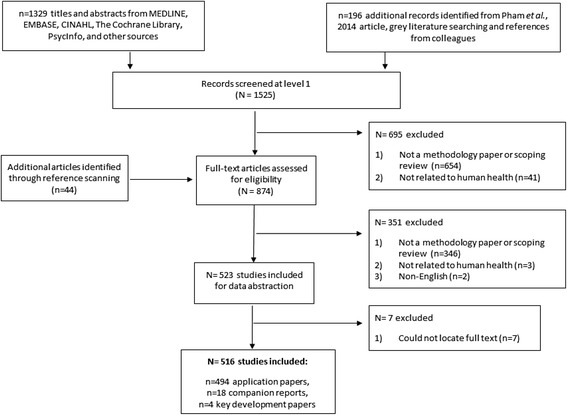
BACKGROUND: Scoping reviews are used to identify knowledge gaps, set research agendas, and identify implications for decision-making. The conduct and reporting of scoping reviews is inconsistent in the literature. We conducted a scoping review to identify: papers that utilized and/or described scoping review methods; guidelines for reporting scoping reviews; and studies that assessed the quality of reporting of scoping reviews. METHODS: We searched nine electronic databases for published and unpublished literature scoping review papers, scoping review methodology, and reporting guidance for scoping reviews. Two independent reviewers screened citations for inclusion. Data abstraction was performed by one reviewer and verified by a second reviewer. Quantitative (e.g. frequencies of methods) and qualitative (i.e. content analysis of the methods) syntheses were conducted. RESULTS: After searching 1525 citations and 874 full-text papers, 516 articles were included, of which 494 were scoping reviews. The 494 scoping reviews were disseminated between 1999 and 2014, with 45% published after 2012. Most of the scoping reviews were conducted in North America (53%) or Europe (38%), and reported a public source of funding (64%). The number of studies included in the scoping reviews ranged from 1 to 2600 (mean of 118). Using the Joanna Briggs Institute methodology guidance for scoping reviews, only 13% of the scoping reviews reported the use of a protocol, 36% used two reviewers for selecting citations for inclusion, 29% used two reviewers for full-text screening, 30% used two reviewers for data charting, and 43% used a pre-defined charting form. In most cases, the results of the scoping review were used to identify evidence gaps (85%), provide recommendations for future research (84%), or identify strengths and limitations (69%). We did not identify any guidelines for reporting scoping reviews or studies that assessed the quality of scoping review reporting. CONCLUSION: The number of scoping reviews conducted per year has steadily increased since 2012. Scoping reviews are used to inform research agendas and identify implications for policy or practice. As such, improvements in reporting and conduct are imperative. Further research on scoping review methodology is warranted, and in particular, there is need for a guideline to standardize reporting.
Overview
The claims and statistics of this paper haven’t been checked yet.
Free: it reads the open-access text and checks the first 5 claims that cite a source we can check. Create a free account to check every claim.
Integrity signals
Registry
Cites
Statistics
Figures
Verification
Claims the paper makes
The claims and statistics of this paper haven’t been checked yet.
Free: it reads the open-access text and checks the first 5 claims that cite a source we can check. Create a free account to check every claim.
Claims other papers make about this one
Each is checked against this paper’s own text: does it say what the citing paper says it does?
The cited source doesn’t support the claim as written.
In the citing paper
“The scoping review followed the guidelines outlined in the Preferred Reporting Items for Systematic Reviews and Meta-Analyses Extension (PRISMA-ScR) methodology (Munn et al., 2018; Tricco et al., 2016).”
From Sextortion: A Scoping Review (2025) · cites this paper as Tricco et al., 2016
Checked by a reasoning model — may be wrong.
Experimental — accuracy not yet measuredThe source backs part of the claim, not all of it — or backs it for a different population, condition or comparison.
In the citing paper
“A scoping review approach was considered appropriate for this purpose, given the authors’ understanding that the evidence base in this area is diverse in both research methodologies and disciplinary context (30).”
From Contributions of a time use perspective in community mental health practice: a scoping review (2024) · cites this paper as [30]
Experimental — accuracy not yet measuredThe source backs part of the claim, not all of it — or backs it for a different population, condition or comparison.
In the citing paper
“With the increasing popularity of scoping reviews, criticism of the rigour, transparency, and appropriateness of the methodology have been raised across multiple academic and clinical disciplines, including nursing and midwifery.”
From Undertaking a scoping review: A practical guide for nursing and midwifery students, clinicians, researchers, and academics (2021) · cites this paper as Tricco et al., 2016
Experimental — accuracy not yet measuredThe source backs part of the claim, not all of it — or backs it for a different population, condition or comparison.
In the citing paper
“Limitations of the scoping review methodology include the absence of methodological and risk of bias evaluations and the resultant inappropriateness of the review to be used as evidence for clinical guidelines, limitations, and recommendations (Arksey & O'Malley, 2005; Peters, Godfrey, et al., 2020; Tricco et al., 2016).”
From Undertaking a scoping review: A practical guide for nursing and midwifery students, clinicians, researchers, and academics (2021) · cites this paper as Tricco et al., 2016
Experimental — accuracy not yet measuredThe cited source says what the claim attributes to it.
In the citing paper
“while the number of scoping reviews in the literature is increasing steadily”
From PRISMA Extension for Scoping Reviews (PRISMA-ScR): Checklist and Explanation (2018) · cites this paper as [1]
13 more claims about this paper
Create a free account to see every claim other papers make about this one.
Self-check
Percentages, sums and reported differences re-computed from the paper’s own numbers.
The self-check needs the paper’s full text.
Citations
Cites
Preferred Reporting Items for Systematic Reviews and Meta-Analyses: the PRISMA statement
Moher, D., Liberati, A., Tetzlaff, J., Altman, D. G., & for the PRISMA Group (2009) · BMJ · doi:10.1136/bmj.b2535 · Cited by 83,823
Preferred reporting items for systematic reviews and meta-analyses: the PRISMA Statement.
(2009) · PubMed Central · Cited by 44,859
Scoping studies: towards a methodological framework
Arksey, H., & O'Malley, L. (2005) · International Journal of Social Research Methodology · doi:10.1080/1364557032000119616 · Cited by 36,742 · cited 15×
“Background Scoping reviews are used to map the concepts underpinning a research area and the main sources and types of evidence available [1].”
BackgroundMethodInfluentialPreferred Reporting Items for Systematic Reviews and Meta-Analyses: The PRISMA Statement
Moher, D., Liberati, A., Tetzlaff, J., & Altman, D. G. (2009) · Journal of Clinical Epidemiology · doi:10.1016/j.jclinepi.2009.06.005 · Cited by 19,575
Scoping studies: advancing the methodology
Levac, D., Colquhoun, H., & O'Brien, K. K. (2010) · Implementation Science · doi:10.1186/1748-5908-5-69 · Cited by 15,268 · cited 9×
“(2010) [2] modifications to the original framework of a scoping review [1] to guide this research.”
BackgroundMethodInfluentialSelf-citationGuidance for conducting systematic scoping reviews
Peters, M. D. J., Godfrey, C. M., Khalil, H., McInerney, P., Parker, D., & Soares, C. B. (2015) · International Journal of Evidence-Based Healthcare · doi:10.1097/xeb.0000000000000050 · Cited by 7,472 · cited 7×
“Our protocol was developed using the scoping review methodological framework proposed by Arksey and O’Malley (2005) [1] and further refined by the Joanna Briggs Institute [3].”
BackgroundMethodInfluentialSchulz (1995) · doi:10.1001/jama.1995.03520290060030 · Cited by 5,634 · cited 1×
“This is problematic because when different methods are applied to the same question, they may produce different results, undermining the utility and confidence in knowledge syntheses [5, 6].”
MethodA scoping review of scoping reviews: advancing the approach and enhancing the consistency
Pham, M. T., Rajić, A., Greig, J. D., Sargeant, J. M., Papadopoulos, A., & McEwen, S. A. (2014) · Research Synthesis Methods · doi:10.1002/jrsm.1123 · Cited by 3,078 · cited 2×
“We are aware of a previous scoping review of scoping reviews [16].”
BackgroundMethodScoping reviews: Time for clarity in definition, methods, and reporting
Colquhoun, H. L., Levac, D., O'Brien, K. K., Straus, S., Tricco, A. C., Perrier, L., Kastner, M., & Moher, D. (2014) · Journal of Clinical Epidemiology · doi:10.1016/j.jclinepi.2014.03.013 · Cited by 2,783 · cited 2×
“(2010) [2] and others [3], there is a lack of consistency in terminology and methods reported [4].”
BackgroundSelf-citationDaudt, H. M., van Mossel, C., & Scott, S. J. (2013) · BMC Medical Research Methodology · doi:10.1186/1471-2288-13-48 · Cited by 1,891 · cited 5×
“(2013) discussed the Arksey and O’Malley (2005) framework, and in particular, the team’s experiences using it, in order to develop the methodology further [10].”
BackgroundMethodInfluential
Research works printed but not linked: 2
- Colquhoun H, O’Brien K, Straus S, Moher D, Levac D. Gaps in scoping review methodologies J Clin Epidemiol. In press. 25034198
- Feinberg J Wordle 2014
Cited by
PRISMA Extension for Scoping Reviews (PRISMA-ScR): Checklist and Explanation
Tricco, A. C., Lillie, E., Zarin, W., O'Brien, K. K., Colquhoun, H., Levac, D., Moher, D., Peters, M. D. J., Horsley, T., Weeks, L., et al. (2018) · Annals of Internal Medicine · doi:10.7326/m18-0850 · Cited by 43,565
“A recent scoping review by members of our team showed that while the 131 number of scoping reviews in the literature is increasing steadily, evidence suggests 132 that both their methodological quality and reporting quality need to improve to facilitate 133 complete and transparent reporting (1).”
BackgroundMethodSelf-citationMunn, Z., Peters, M. D. J., Stern, C., Tufanaru, C., McArthur, A., & Aromataris, E. (2018) · BMC Medical Research Methodology · doi:10.1186/s12874-018-0611-x · Cited by 11,385
Updated methodological guidance for the conduct of scoping reviews
Peters, M. D. J., Marnie, C., Tricco, A. C., Pollock, D., Munn, Z., Alexander, L., McInerney, P., Godfrey, C. M., & Khalil, H. (2020) · JBI Evidence Synthesis · doi:10.11124/jbies-20-00167 · Cited by 9,046
“’’ Scoping reviews are conducted for several reasons, with the most common being to explore the breadth or depth of the literature, map and summarize the evidence, inform future research, and identify or address knowledge gaps.(19) Scoping reviews are particularly helpful when the literature is complex and heterogeneo…”
BackgroundSelf-citationRecommendations for the Extraction, Analysis, and Presentation of Results in Scoping Reviews
Pollock, D., Peters, M. D. J., Khalil, H., McInerney, P., Alexander, L., Tricco, A. C., Evans, C., de Moraes, É. B., Godfrey, C. M., Pieper, D., et al. (2023) · JBI Evidence Synthesis · doi:10.11124/jbies-22-00123 · Cited by 1,975
Self-citationUpdated methodological guidance for the conduct of scoping reviews
Peters, M. D. J., Marnie, C., Tricco, A. C., Pollock, D., Munn, Z., Alexander, L., McInerney, P., Godfrey, C. M., & Khalil, H. (2021) · JBI Evidence Implementation · doi:10.1097/xeb.0000000000000277 · Cited by 1,461
Self-citationBest practice guidance and reporting items for the development of scoping review protocols
Peters, M. D. J., Godfrey, C., McInerney, P., Khalil, H., Larsen, P., Marnie, C., Pollock, D., Tricco, A. C., & Munn, Z. (2022) · JBI Evidence Synthesis · doi:10.11124/jbies-21-00242 · Cited by 1,444
“As Tricco and colleagues 7 found in their 2016 scoping review, few scoping reviews (13”
Self-citationScoping reviews: reinforcing and advancing the methodology and application
Peters, M. D. J., Marnie, C., Colquhoun, H., Garritty, C. M., Hempel, S., Horsley, T., Langlois, E. V., Lillie, E., O’Brien, K. K., Tunçalp, Ӧ., et al. (2021) · Systematic Reviews · doi:10.1186/s13643-021-01821-3 · Cited by 887
Self-citationPollock, D., Davies, E. L., Peters, M. D. J., Tricco, A. C., Alexander, L., McInerney, P., Godfrey, C. M., Khalil, H., & Munn, Z. (2021) · Journal of Advanced Nursing · doi:10.1111/jan.14743 · Cited by 769
“As the popularity of scoping reviews has increased, so too have the criticisms of this methodological approach for synthesizing evidence (Davis et al., 2009; Tricco et al., 2016).”
BackgroundMethodInfluentialSelf-citationMunn, Z., Pollock, D., Khalil, H., Alexander, L., Mclnerney, P., Godfrey, C. M., Peters, M., & Tricco, A. C. (2022) · JBI Evidence Synthesis · doi:10.11124/jbies-21-00483 · Cited by 763
Self-citationMeeting the review family: exploring review types and associated information retrieval requirements
Sutton, A., Clowes, M., Preston, L., & Booth, A. (2019) · Health Information & Libraries Journal · doi:10.1111/hir.12276 · Cited by 570
Registration of systematic reviews in PROSPERO: 30,000 records and counting
Page, M. J., Shamseer, L., & Tricco, A. C. (2018) · Systematic Reviews · doi:10.1186/s13643-018-0699-4 · Cited by 509
“The field of knowledge synthesis is evolving to include other types of reviews, such as scoping reviews [37], living SRs [38] and rapid reviews [39].”
BackgroundSelf-citationTowards food supply chain resilience to environmental shocks
Davis, K. F., Downs, S., & Gephart, J. A. (2020) · Nature Food · doi:10.1038/s43016-020-00196-3 · Cited by 501
Reporting scoping reviews-PRISMA ScR extension
McGowan, J., Straus, S., Moher, D., Langlois, E. V., O'Brien, K. K., Horsley, T., Aldcroft, A., Zarin, W., Garitty, C. M., Hempel, S., et al. (2020) · Journal of Clinical Epidemiology · doi:10.1016/j.jclinepi.2020.03.016 · Cited by 494
Self-citationMueller, M., D’Addario, M., Egger, M., Cevallos, M., Dekkers, O., Mugglin, C., & Scott, P. (2018) · BMC Medical Research Methodology · doi:10.1186/s12874-018-0495-9 · Cited by 400
Scoping reviews: the PAGER framework for improving the quality of reporting
Bradbury-Jones, C., Aveyard, H., Herber, O. R., Isham, L., Taylor, J., & O’Malley, L. (2022) · International Journal of Social Research Methodology · doi:10.1080/13645579.2021.1899596 · Cited by 377
“This in turn can lead to questions about the rigour and transferability of scoping review findings (Pham et al., 2014), in addition to fatigue with the now ubiquitous finding that ‘more research is needed’ – a common conclusion drawn from scoping reviews (Tricco et al., 2016).”
BackgroundInfluentialFrom Therapeutic Factors to Mechanisms of Change in the Creative Arts Therapies: A Scoping Review
de Witte, M., Orkibi, H., Zarate, R., Karkou, V., Sajnani, N., Malhotra, B., Ho, R. T. H., Kaimal, G., Baker, F. A., & Koch, S. C. (2021) · Frontiers in Psychology · doi:10.3389/fpsyg.2021.678397 · Cited by 366
Panel, S. G. P. C., Hoekstra, F., Mrklas, K. J., Khan, M., McKay, R. C., Vis-Dunbar, M., Sibley, K. M., Nguyen, T., Graham, I. D., & Gainforth, H. L. (2020) · Health Research Policy and Systems · doi:10.1186/s12961-020-0544-9 · Cited by 343
Westphaln, K. K., Regoeczi, W., Masotya, M., Vazquez-Westphaln, B., Lounsbury, K., McDavid, L., Lee, H., Johnson, J., & Ronis, S. D. (2021) · MethodsX · doi:10.1016/j.mex.2021.101375 · Cited by 333
Conducting high quality scoping reviews-challenges and solutions
Khalil, H., Peters, M. D., Tricco, A. C., Pollock, D., Alexander, L., McInerney, P., Godfrey, C. M., & Munn, Z. (2021) · Journal of Clinical Epidemiology · doi:10.1016/j.jclinepi.2020.10.009 · Cited by 305
Self-citationMapping the Solastalgia Literature: A Scoping Review Study
Galway, L. P., Beery, T., Jones-Casey, K., & Tasala, K. (2019) · International Journal of Environmental Research and Public Health · doi:10.3390/ijerph16152662 · Cited by 295
“Also noteworthy, two independent reviewers assessed article eligibility (with very high agreement between reviewers) and data were extracted by one reviewer and verified by a second to minimize bias and enhance the robustness of our results [54].”
BackgroundCOVID-19 mortality and deprivation: pandemic, syndemic, and endemic health inequalities
McGowan, V. J., & Bambra, C. (2022) · The Lancet Public Health · doi:10.1016/s2468-2667(22)00223-7 · Cited by 292
“40 A process of charting the results was done, in which a descriptive summary of the study characteristics and findings pertaining to the Review topic were tabulated (appendix pp 8–47).”
O’Brien, K. K., Colquhoun, H., Levac, D., Baxter, L., Tricco, A. C., Straus, S., Wickerson, L., Nayar, A., Moher, D., & O’Malley, L. (2016) · BMC Health Services Research · doi:10.1186/s12913-016-1579-z · Cited by 282
“scoping studies published after 2012, demonstrating their growing potential to inform research agendas, and policy and practice recommendations [3].”
BackgroundSelf-citationElAlfy, A., Palaschuk, N., El-Bassiouny, D., Wilson, J., & Weber, O. (2020) · Sustainability · doi:10.3390/su12145544 · Cited by 281
“[42], scoping reviews are different from systematic reviews and literature reviews in that the former provides a focus on diverse bodies of literature pertaining to a broad topic while the latter two direct search queries around a focused research question.”
BackgroundSociotechnical Harms of Algorithmic Systems: Scoping a Taxonomy for Harm Reduction
Shelby, R., Rismani, S., Henne, K., Moon, A., Rostamzadeh, N., Nicholas, P., Yilla-Akbari, N., Gallegos, J., Smart, A., Garcia, E., et al. (2023) · Proceedings of the 2023 AAAI/ACM Conference on AI, Ethics, and Society · doi:10.1145/3600211.3604673 · Cited by 279
“They are especially appropriate when distilling and sharing research findings with practitioners [221], and are suited to identifying evidence on a topic and presenting it visually.”
BackgroundStrifler, L., Cardoso, R., McGowan, J., Cogo, E., Nincic, V., Khan, P. A., Scott, A., Ghassemi, M., MacDonald, H., Lai, Y., et al. (2018) · Journal of Clinical Epidemiology · doi:10.1016/j.jclinepi.2018.04.008 · Cited by 227
“We did not appraise the quality of the studies included in our scoping review, which is consistent with the Joanna Briggs Institute Reviewers’ Manual [19] as well as scoping reviews on clinical topics [31].”
MethodSelf-citationBabatunde, F., MacDermid, J., & MacIntyre, N. (2017) · BMC Health Services Research · doi:10.1186/s12913-017-2311-3 · Cited by 244
“Scoping reviews are used to answer broad questions, synthesise information from a heterogeneous data pool or assess whether the literature is amenable to systematic review [35, 36].”
BackgroundKnowledge Syntheses in Medical Education: Demystifying Scoping Reviews
Thomas, A., Lubarsky, S., Durning, S. J., & Young, M. E. (2017) · Academic Medicine · doi:10.1097/acm.0000000000001452 · Cited by 219
Benefits and Risks of AI in Health Care: Narrative Review
Chustecki, M. (2024) · Interactive Journal of Medical Research · doi:10.2196/53616 · Cited by 208
Hamal, M., Dieleman, M., De Brouwere, V., & de Cock Buning, T. (2020) · Public Health Reviews · doi:10.1186/s40985-020-00125-6 · Cited by 205
Understanding physical literacy in the context of health: a rapid scoping review
Cornish, K., Fox, G., Fyfe, T., Koopmans, E., Pousette, A., & Pelletier, C. A. (2020) · BMC Public Health · doi:10.1186/s12889-020-09583-8 · Cited by 199
Johnson, B. T., & Hennessy, E. A. (2019) · Social Science & Medicine · doi:10.1016/j.socscimed.2019.05.035 · Cited by 201
“For example, recent meta reviews demonstrate that as many as 20–30% of systematic reviews are prone to selective inclusion and reporting of outcomes (Kirkham et al., 2010a,b; Mckenzie, 2011; Page et al., 2013; Tricco et al., 2016).”
BackgroundA scoping review describes methods used to identify, prioritize and display gaps in health research
Nyanchoka, L., Tudur-Smith, C., Thu, V. N., Iversen, V., Tricco, A. C., & Porcher, R. (2019) · Journal of Clinical Epidemiology · doi:10.1016/j.jclinepi.2019.01.005 · Cited by 198
“We extracted the following data from articles: type of article, main objective of the study, main study methodology, definition of research gaps, and specific methods to identify research gaps, determine research priorities and display research gaps or priorities [12].”
BackgroundMethodInfluentialSelf-citationHerbal Teas and their Health Benefits: A Scoping Review
Poswal, F. S., Russell, G., Mackonochie, M., MacLennan, E., Adukwu, E. C., & Rolfe, V. (2019) · Plant Foods for Human Nutrition · doi:10.1007/s11130-019-00750-w · Cited by 183
Pollock, D., Alexander, L., Munn, Z., Peters, M. D. J., Khalil, H., Godfrey, C. M., McInerney, P., Synnot, A., & Tricco, A. C. (2022) · JBI Evidence Synthesis · doi:10.11124/jbies-21-00416 · Cited by 182
“A scoping review exploring the conduct and reporting of scoping reviews found that 14% (n1⁄484 documents) reported a process for including knowledge users in the conduct of scoping reviews.(8) There is a need to discuss the benefits, disadvantages, and process of knowledge user engagement within scoping reviews.”
BackgroundSelf-citationWinkler, P., Krupchanka, D., Roberts, T., Kondratova, L., Machů, V., Höschl, C., Sartorius, N., Van Voren, R., Aizberg, O., Bitter, I., et al. (2017) · The Lancet Psychiatry · doi:10.1016/s2215-0366(17)30135-9 · Cited by 171
How Are the Arts and Humanities Used in Medical Education? Results of a Scoping Review
Moniz, T., Golafshani, M., Gaspar, C. M., Adams, N. E., Haidet, P., Sukhera, J., Volpe, R. L., de Boer, C., & Lingard, L. (2021) · Academic Medicine · doi:10.1097/acm.0000000000004118 · Cited by 170
O’Donovan, J., O’Donovan, C., Kuhn, I., Sachs, S. E., & Winters, N. (2018) · BMJ Open · doi:10.1136/bmjopen-2017-021467 · Cited by 163
“Furthermore, we did not conduct an exhaustive search for grey literature sources due to the challenges in appraising these types of publications as well as the lack of standardised search guidelines for scoping reviews.(92) Finally, given the nature of scoping reviews, a critical appraisal of the studies included in t…”
MethodGuidance to best tools and practices for systematic reviews
Kolaski, K., Logan, L. R., & Ioannidis, J. P. A. (2023) · Systematic Reviews · doi:10.1186/s13643-023-02255-9 · Cited by 238
Varshavsky, J., Smith, A., Wang, A., Hom, E., Izano, M., Huang, H., Padula, A., & Woodruff, T. J. (2020) · Reproductive Toxicology · doi:10.1016/j.reprotox.2019.04.004 · Cited by 160
Bazargan, M., & Bazargan‐Hejazi, S. (2020) · American Journal of Hospice and Palliative Medicine® · doi:10.1177/1049909120966585 · Cited by 184
“We followed the scoping review methodological framework and guidelines proposed by Arksey and O’Malley (2005),(1) and the Joanna Briggs Institute (2015),(2) as well as suggestions offered by Tricco and colleagues (2016).(3) The draft of our protocol and manuscript was revised based on feedbacks from the 5 experts, inc…”
MethodTricco, A. C., Soobiah, C., Antony, J., Cogo, E., MacDonald, H., Lillie, E., Tran, J., D'Souza, J., Hui, W., Perrier, L., et al. (2016) · Journal of Clinical Epidemiology · doi:10.1016/j.jclinepi.2015.08.030 · Cited by 159
Self-citationEthical elements in priority setting in nursing care: A scoping review
Suhonen, R., Stolt, M., Habermann, M., Hjaltadóttir, I., Vryonides, S., Tønnessen, S., Halvorsen, K., Harvey, C. L., Toffoli, L., & Scott, P. A. (2018) · International Journal of Nursing Studies · doi:10.1016/j.ijnurstu.2018.08.006 · Cited by 197
Methodological quality, guidance, and tools in scoping reviews: a scoping review protocol
Pollock, D., Tricco, A. C., Peters, M. D. J., Mclnerney, P. A., Khalil, H., Godfrey, C. M., Alexander, L. A., & Munn, Z. (2022) · JBI Evidence Synthesis · doi:10.11124/jbies-20-00570 · Cited by 154
Self-citationChevrier, R., Foufi, V., Gaudet-Blavignac, C., Robert, A., & Lovis, C. (2019) · Journal of Medical Internet Research · doi:10.2196/13484 · Cited by 148
“Scoping reviews represent an increasingly popular type of review [24], which allows for the mapping of concepts in a field of interest.”
A Scoping Review of Psychosocial Risks to Health Workers during the Covid-19 Pandemic
Franklin, P., & Gkiouleka, A. (2021) · International Journal of Environmental Research and Public Health · doi:10.3390/ijerph18052453 · Cited by 147
“was well suited for the study, as it enabled us to identify types of existing evidence, to survey how research is conducted on this topic, to identifying key characteristics related to PSR in healthcare during the pandemic, and to identifying knowledge gaps [43].”
Scoping Reviews, Systematic Reviews, and Meta-Analysis: Applications in Veterinary Medicine
Sargeant, J. M., & O'Connor, A. M. C. (2020) · Frontiers in Veterinary Science · doi:10.3389/fvets.2020.00011 · Cited by 200
“There are two published “scoping reviews of scoping reviews” which provide details on how this methodology has been applied in the literature (14, 16) and a discussion of the issue is available by Colquhoun et al.”
MethodDigital technologies in architecture, engineering, and construction
Brozovsky, J. G., Labonnote, N., & Vigren, O. (2023) · Automation in Construction · doi:10.1016/j.autcon.2023.105212 · Cited by 222
Artificial intelligence and primary care research: a scoping review
Kueper, J. K., Terry, A. L., Zwarenstein, M., & Lizotte, D. J. (2020) · The Annals of Family Medicine · doi:10.1370/afm.2518 · Cited by 143
Dechsling, A., Orm, S., Kalandadze, T., Sütterlin, S., Øien, R. A., Shic, F., & Nordahl‐Hansen, A. (2021) · Journal of Autism and Developmental Disorders · doi:10.1007/s10803-021-05338-5 · Cited by 184
“Scoping reviews are useful when navigating a complex and heterogeneous literature and are commonly conducted to summarize and explore the breadth and depth of the literature, identify gaps, and inform future research (Peters et al., 2020; Tricco et al., 2016).”
BackgroundRohwer, E., Flöther, J.-C., Harth, V., & Mache, S. (2022) · International Journal of Environmental Research and Public Health · doi:10.3390/ijerph19063625 · Cited by 141
“However, remote work environments during the COVID-19 pandemic represent different circumstances that need to be distinguished from digital work outside the pandemic context [25].”
BackgroundInfluentialTeo, T. P., Unwin, S., Scherer, R., & Gardiner, V. (2021) · Computers & Education · doi:10.1016/j.compedu.2021.104223 · Cited by 215
Tricco, A. C., Ashoor, H. M., Cardoso, R., MacDonald, H., Cogo, E., Kastner, M., Perrier, L., McKibbon, A., Grimshaw, J. M., & Straus, S. E. (2015) · Implementation Science · doi:10.1186/s13012-016-0421-7 · Cited by 139
“Scoping reviews can be used to identify gaps in knowledge, establish research agendas, and discuss implications for decision-making” [25].”
BackgroundSelf-citationThe use of the environmental scan in health services delivery research: a scoping review protocol
Charlton, P., Doucet, S. A., Azar, R., Nagel, D. A., Boulos, L., Luke, A., Mears, K., Kelly, K. J., & Montelpare, W. J. (2019) · BMJ Open · doi:10.1136/bmjopen-2019-029805 · Cited by 157
“Our scoping review will be guided by the evidencebased methodology outlined by Khalil et al(71) which is based on the widely recognised frameworks and methodologies of Arksey and O’Malley,(74) Levac et al(76) and the Joanna Briggs Institute.(68) 72 77–79 The Khalil et al(71) methodology consists of a five-stage approa…”
MethodThomas, A., Lubarsky, S., Varpio, L., Durning, S. J., & Young, M. E. (2019) · Advances in Health Sciences Education · doi:10.1007/s10459-019-09932-2 · Cited by 181
Tricco, A. C., Zarin, W., Ghassemi, M., Nincic, V., Lillie, E., Page, M. J., Shamseer, L., Antony, J., Rios, P., Hwee, J., et al. (2018) · Journal of Clinical Epidemiology · doi:10.1016/j.jclinepi.2017.10.014 · Cited by 122
Self-citationExposure to outdoor air pollution and its human health outcomes: A scoping review
Sun, Z., & Zhu, D. (2019) · PLOS ONE · doi:10.1371/journal.pone.0216550 · Cited by 130
Mobile Health for Perinatal Depression and Anxiety: Scoping Review
Hussain-Shamsy, N., Shah, A., Vigod, S. N., Zaheer, J., & Seto, E. (2020) · Journal of Medical Internet Research · doi:10.2196/17011 · Cited by 119
“A scoping review was the most appropriate manner of assessing the breadth of the literature and identifying gaps and opportunities for further work in this field [33].”
BackgroundAn Evidence-Based Checklist for Improving Scoping Review Quality
Cooper, S., Cant, R., Kelly, M., Levett-Jones, T., McKenna, L., Seaton, P., & Bogossian, F. (2021) · Clinical Nursing Research · doi:10.1177/1054773819846024 · Cited by 102
“knowledge synthesis, literature review, synthesis method, reporting, scoping review methodology Cooper et al. 231 Tricco et al., 2016).”
BackgroundMethodGusenbauer, M., & Gauster, S. P. (2024) · Technological Forecasting and Social Change · doi:10.1016/j.techfore.2024.123833 · Cited by 227
Applied Behavior Analysis in Children and Youth with Autism Spectrum Disorders: A Scoping Review
Gitimoghaddam, M., Chichkine, N., McArthur, L., Sangha, S. S., & Symington, V. (2022) · Perspectives on Behavior Science · doi:10.1007/s40614-022-00338-x · Cited by 128
“Scoping reviews differ from systematic reviews in that they provide an overview of existing evidence regardless of the quality (Tricco et al., 2016), and may not formally assess study rigor (Arksey & O’Malley, 2005).”
BackgroundBieber, A., Nguyen, N., Meyer, G., & Stephan, A. (2019) · BMC Health Services Research · doi:10.1186/s12913-018-3825-z · Cited by 125
Use of Social Media to Promote Cancer Screening and Early Diagnosis: Scoping Review
Plackett, R., Kaushal, A., Kassianos, A. P., Cross, A., Lewins, D., Sheringham, J., Waller, J., & von Wagner, C. (2020) · Journal of Medical Internet Research · doi:10.2196/21582 · Cited by 123
“Therefore, a scoping review methodology was used to map the literature on the ways in which social media has been used to promote cancer screening and early diagnosis and how it was evaluated [27].”
MethodUnmet care needs of older people: A scoping review
Kohanová, D., Stolt, M., Scott, P. A., Papastavrou, E., Suhonen, R., & CA15208, O. B. O. T. R. C. A. (2020) · Nursing Ethics · doi:10.1177/0969733020948112 · Cited by 147
“The review was further strengthened by the independent work of three researchers and discussion leading to consensus about the inclusion of citations for full-text screening.(106) As the nature of the scoping review is to describe the status of the research in a specific topic, a quality appraisal of the included rese…”
BackgroundStadium Attendance Demand Research: A Scoping Review
Schreyer, D., & Ansari, P. (2021) · Journal of Sports Economics · doi:10.1177/15270025211000404 · Cited by 154
“In emerging research fields such as the economics of sports, conducting a scoping review is helpful in identifying, locating, and, then, synthesizing the existing knowledge (e.g., McKinstry et al., 2014; Tricco et al., 2016, 2018).”
BackgroundMisophonia: A scoping review of research
Potgieter, I., MacDonald, C., Partridge, L., Cima, R., Sheldrake, J., & Hoare, D. J. (2019) · Journal of Clinical Psychology · doi:10.1002/jclp.22771 · Cited by 116
Bujold, A., Roberge‐Maltais, I., Parent‐Rocheleau, X., Boasen, J., Sénécal, S., & Léger, P. (2023) · AI and Ethics · doi:10.1007/s43681-023-00325-1 · Cited by 278
Online case-based learning in medical education: a scoping review
Donkin, R., Yule, H., & Fyfe, T. (2023) · BMC Medical Education · doi:10.1186/s12909-023-04520-w · Cited by 165
“Both the PRISMA-ScR (Preferred Reporting Items for Systematic reviews and Meta-Analyses extension for Scoping Reviews) and the Joanna Briggs Institute 2020 guide [23, 24] were used to map and report results of the search and review process.”
MethodVeroniki, A. A., Hutton, B., Stevens, A., McKenzie, J. E., Page, M. J., Moher, D., McGowan, J., Straus, S. E., Li, T., Munn, Z., et al. (2025) · JBI Evidence Synthesis · doi:10.11124/jbies-24-00308 · Cited by 110
“We will update 3 previous scoping reviews 21 , 49 , 62 conducted by members of the research team in parallel to identify additional, more recent studies pertaining to evaluations of reporting completeness and other key resources to inform the NMA, ScR, and RR extensions.”
Self-citationThe acceptability of social robots: A scoping review of the recent literature
David, D., Thérouanne, P., & Milhabet, I. (2022) · Computers in Human Behavior · doi:10.1016/j.chb.2022.107419 · Cited by 151
DuBois, D., Lymer, E., Gibson, B., Desarkar, P., & Nalder, E. (2017) · Brain Sciences · doi:10.3390/brainsci7080108 · Cited by 105
“Qualitative content analysis based on Tricco and colleagues (2016) [17] of grey literature was used (1) to compare current best practices to the assessment approaches utilized in research; and (2) to elucidate methods or approaches to assessment that may not be highlighted in the research literature.”
MethodThe scoping review: A flexible, inclusive, and iterative approach to knowledge synthesis
Gottlieb, M., Haas, M. R. C., Daniel, M., & Chan, T. M. (2021) · AEM Education and Training · doi:10.1002/aet2.10609 · Cited by 107
The James Lind Alliance process approach: scoping review
Nygaard, A., Halvorsrud, L., Linnerud, S., Grov, E. K., & Bergland, A. (2019) · BMJ Open · doi:10.1136/bmjopen-2018-027473 · Cited by 119
Sav, A., Salehi, A., Mair, F. S., & McMillan, S. S. (2017) · BMC Medical Research Methodology · doi:10.1186/s12874-017-0411-8 · Cited by 117
“Scoping reviews can be helpful in exploring research gaps, setting research agendas and providing recommendations for policy makers [13].”
BackgroundTricco, A. C., Zarin, W., Rios, P., Nincic, V., Khan, P. A., Ghassemi, M., Diaz, S., Pham, B., Straus, S. E., & Langlois, E. V. (2018) · Implementation Science · doi:10.1186/s13012-018-0717-x · Cited by 100
“Study design We selected the scoping review method [16] because we were interested in mapping the concepts relevant to engaging knowledge users in knowledge synthesis [16, 17].”
MethodSelf-citation(2023) · doi:10.2196/42161 · Cited by 106
“While this is an optional stage in the Arksey and O’Malley [40] framework for scoping reviews, we found this stage important to help us frame not only the scoping review but also the future agenda of our COMACH project and network, as previously suggested by Tricco et al [42].”
BackgroundMethodNg, Y. X., Koh, Z. Y. K., Yap, H. W., Tay, K. T., Tan, X. H., Ong, Y. T., Tan, L. H. E., Chin, A., Toh, Y. P., Shivananda, S., et al. (2020) · PLoS ONE · doi:10.1371/journal.pone.0232511 · Cited by 105
What are the risks of manual treatment of the spine? A scoping review for clinicians
Swait, G., & Finch, R. (2017) · Chiropractic & Manual Therapies · doi:10.1186/s12998-017-0168-5 · Cited by 107
“A further limitation was that the quality of included studies, or of the body of evidence, was not appraised, although this is not considered essential to scoping reviews [14, 18].”
BackgroundKarcher, D. B., Cvitanovic, C., Colvin, R. M., van Putten, I. E., & Reed, M. S. (2021) · Environmental Science & Policy · doi:10.1016/j.envsci.2021.08.012 · Cited by 118
Factors affecting the quality of life after ischemic stroke in young adults: a scoping review
Gurková, E., Štureková, L., Mandysová, P., & Šaňák, D. (2023) · Health and Quality of Life Outcomes · doi:10.1186/s12955-023-02090-5 · Cited by 137
“Methods Guidelines for the scoping review (ScR) methodology developed by the Joanna Briggs Institute (JBI) [44], and the PRISMA-ScR checklist [45, 46] for a scoping review were used.”
MethodQuentin, C., Bagheri, R., Ugbolue, U. C., Coudeyre, E., Pélissier, C., Descatha, A., Ménini, T., Bouillon‐Minois, J., & Dutheil, F. (2021) · International Journal of Environmental Research and Public Health · doi:10.3390/ijerph18168430 · Cited by 180
“I2 values range from 0 to 100%, and are considered low at <25%, modest at 25–50%, and high at >50% [18].”
Hennessy, E. A., Johnson, B. T., & Keenan, C. (2019) · Applied Psychology: Health and Well-Being · doi:10.1111/aphw.12169 · Cited by 91
“Given that meta-reviews of both the Cochrane Library and the PROSPERO database have identified a substantial portion of reviews that had not pre-specified a primary outcome or, alternatively, had changed outcome reporting after conducting the review (Kirkham, Altman, & Williamson, 2010; Tricco et al., 2016), this prac…”
BackgroundJeong, D., Presseau, J., ElChamaa, R., Naumann, D. N., Mascaro, C., Luconi, F., Smith, K., & Kitto, S. C. (2018) · Academic Medicine · doi:10.1097/acm.0000000000002237 · Cited by 111
Use of environmental scans in health services delivery research: a scoping review
Charlton, P., Kean, T., Liu, R. H., Nagel, D. A., Azar, R., Doucet, S., Luke, A., Montelpare, W., Mears, K., & Boulos, L. (2021) · BMJ Open · doi:10.1136/bmjopen-2021-050284 · Cited by 96
Manca, A., Hortobágyi, T., Carroll, T. J., Enoka, R. M., Farthing, J. P., Gandevia, S. C., Kidgell, D. J., Taylor, J. L., & Deriu, F. (2020) · Sports Medicine · doi:10.1007/s40279-020-01377-7 · Cited by 105
Measures implemented in the school setting to contain the COVID-19 pandemic: a rapid scoping review
Krishnaratne, S., Pfadenhauer, L. M., Coenen, M., Geffert, K., Jung-Sievers, C., Klinger, C., Kratzer, S., Littlecott, H., Movsisyan, A., Rabe, J. E., et al. (2020) · Cochrane Database of Systematic Reviews · doi:10.1002/14651858.cd013812 · Cited by 94
Gaedicke, S., Schäfer, A., Hoffmann, B., Ohlert, J., Allroggen, M., Hartmann‐Tews, I., & Rulofs, B. (2021) · Frontiers in Sports and Active Living · doi:10.3389/fspor.2021.643707 · Cited by 117
“In line with previous research (e.g., Tricco et al., 2016), a two-level selection process was applied.”
ResultDifferentiating between mapping reviews and scoping reviews in the evidence synthesis ecosystem
Khalil, H., & Tricco, A. C. (2022) · Journal of Clinical Epidemiology · doi:10.1016/j.jclinepi.2022.05.012 · Cited by 124
Self-citationFiliou, R.-P., Bier, N., Slegers, A., Houzé, B., Belchior, P. D. C., & Brambati, S. M. (2019) · Aphasiology · doi:10.1080/02687038.2019.1608502 · Cited by 112
“…a wide range of study design characteristics, such as experimental design, data analysis, patient population characteristics and study outcomes (Arksey & O’Malley, 2005; Daudt, Van Mossel, & Scott, 2013; Davis, Drey, & Gould, 2009; Levac, Colquhoun, & O’Brien, 2010; Tricco et al., 2016).”
BackgroundAutonomy of English language learners: A scoping review of research and practice
Chong, S. W., & Reinders, H. (2022) · Language Teaching Research · doi:10.1177/13621688221075812 · Cited by 166
“Because of its more comprehensive coverage, a scoping review is often used to survey a research landscape of emerging or vibrant areas of research where published work ‘has not yet been extensively reviewed or is of a complex or heterogeneous nature’ (Tricco et al., 2016, p. 2).”
A scoping review of mentor training programs in medicine between 1990 and 2017
Sheri, K., Too, J. Y. J., Chuah, S. E. L., Toh, Y. P., Mason, S. R., & Krishna, L. K. R. (2018) · Medical Education Online · doi:10.1080/10872981.2018.1555435 · Cited by 105
“toring programs, relationships, and processes [128].”
BackgroundExploring serious games for stroke rehabilitation: a scoping review
Mubin, O., Alnajjar, F., Mahmud, A. A., Jishtu, N., & Alsinglawi, B. S. (2020) · Disability and Rehabilitation Assistive Technology · doi:10.1080/17483107.2020.1768309 · Cited by 97
“This will ultimately better drive future endeavours in this topic and hence formed the basis of us undertaking this scoping review [7].”
BackgroundImplementation of Evidence-Based Practices in Intergenerational Programming: A Scoping Review
Jarrott, S. E., Scrivano, R. M., Park, C., & Mendoza, N. (2021) · Research on Aging · doi:10.1177/0164027521996191 · Cited by 117
“Researchers conducting a scoping review often seek to enhance the consistency in evidence, to identify gaps in the evidence, and to set future research agendas by synthesizing knowledge (Tricco et al., 2016).”
BackgroundResultKhanassov, V., Pluye, P., Descôteaux, S., Haggerty, J. L., Russell, G. M., Gunn, J. M., & Lévesque, J. (2016) · International Journal for Equity in Health · doi:10.1186/s12939-016-0459-9 · Cited by 117
“evidence to answer a specific question [13, 14].”
Girão, F. B., Yamamura, M., Pereira, S. S., Pereira, C. D. S., Protti–Zanatta, S. T., Costa, M. K., & Zerbetto, S. R. (2021) · Escola Anna Nery · doi:10.1590/2177-9465-ean-2020-0363 · Cited by 217
Evaluation of the JBI scoping reviews methodology by current users
Khalil, H., Bennett, M., Godfrey, C., McInerney, P., Munn, Z., & Peters, M. (2020) · International Journal of Evidence-Based Healthcare · doi:10.1097/xeb.0000000000000202 · Cited by 89
“This is perhaps one reason for the disparate methods and approaches that authors take to conducting and reporting scoping reviews and a cause for some of the confusion and challenges that authors have encountered when conducting scoping reviews.(9,10) In 2014, JBI Database of Systematic Reviews and Implementation Repo…”
MethodFluency and multilingualism in study abroad: Lessons from a scoping review
Tullock, B., & Ortega, L. (2017) · System · doi:10.1016/j.system.2017.09.019 · Cited by 106
Turner, S., D’Lima, D., Hudson, E., Morris, S., Sheringham, J., Swart, N., & Fulop, N. (2017) · Implementation Science · doi:10.1186/s13012-017-0669-6 · Cited by 112
“In contrast to systematic reviews, some argue that the need to formally assess the methodological quality of studies in scoping reviews is relaxed [66].”
BackgroundChong, J. Y., Ching, A. H., Renganathan, Y., Lim, W. Q., Toh, Y. P., Mason, S. R., & Krishna, L. K. R. (2019) · Advances in Health Sciences Education · doi:10.1007/s10459-019-09883-8 · Cited by 102
The impact of death and dying on the personhood of medical students: a systematic scoping review
Ho, C. Y., Kow, C. S., Chia, C. H. J., Low, J. Y., Lai, Y. H. M., Lauw, S.-K., How, A. E. H., Tan, L. H. E., Ngiam, X. L. L., Chan, N. P. X., et al. (2020) · BMC Medical Education · doi:10.1186/s12909-020-02411-y · Cited by 100
Task Shifting and Task Sharing Implementation in Africa: A Scoping Review on Rationale and Scope
Okoroafor, S. C., & Christmals, C. D. (2023) · Healthcare · doi:10.3390/healthcare11081200 · Cited by 123
“We analyzed the qualitative content of the papers using thematic analysis [20,21], with synthesized information described narratively based on information on the rationale and scope of task shifting and task sharing in Africa.”
Method
Metadata
- Authors
- Tricco, A. C., Lillie, E., Zarin, W., O’Brien, K., Colquhoun, H., Kastner, M., Levac, D., Ng, C., Sharpe, J. P., Wilson, K., Kenny, M., Warren, R., Wilson, C., Stelfox, H. T., & Straus, S. E.
- Affiliations
- St. Michael's Hospital (CA)
- University of Toronto (CA)
- University of Ottawa (CA)
- University of Calgary (CA)
- Corresponding author
- Tricco, Andrea C.
- ORCID
- Venue
- BMC Medical Research Methodology
- Published
- 2016-02-09
- Volume
- 16
- Issue
- 1
- Pages
- 15-15
- ISSN
- 1471-2288 (ISSN-L)
- PMC
- PMC4746911
- OpenAlex
- W2261406464
- Semantic Scholar
- 91435675555c6bce345c14c4f31104353f325a49
- Cited by
- 2,250
- References
- 27
- Citations by year
- 2026: 261 · 2025: 369 · 2024: 352 · 2023: 341 · 2022: 304 · 2021: 257 · 2020: 135 · 2019: 102 · 2018: 76 · 2017: 42 · 2016: 9
- FWCI
- 70.87
- Type
- journal article
- Language
- en
- Open access
- gold
- doi.org
- Licence
- cc-by
- Locations
- BMC Medical Research Methodology (publishedVersion, cc-by)
- PubMed Central (publishedVersion, cc-by)
- PubMed (publishedVersion)
- TSpace (University of Toronto) (submittedVersion, cc-by)
- TSpace (University of Toronto) (submittedVersion)
- DOAJ (DOAJ: Directory of Open Access Journals) (submittedVersion, cc-by-sa)
- Funders
- Canadian Institutes of Health Research (KRS-138219)
- Canadian Agency for Drugs and Technologies in Health
- Topics
- Social Sciences › Decision Sciences › Statistics, Probability and Uncertainty › Meta-analysis and systematic reviews
- Social Sciences › Sociology and Political Science › Delphi Technique in Research
- Health Sciences › Medicine › Public Health, Environmental and Occupational Health › Clinical practice guidelines implementation
- Keywords
- scoping review, scoping review reporting, reporting guidelines, Joanna Briggs Institute, inter-rater reliability, evidence gaps, research agenda setting, reporting quality assessment
- MeSH terms
- Scoping Reviews as Topic, Humans, Publications, Quality Control, Databases, Bibliographic, Guidelines as Topic, Research Report
About these checks
Registry, retraction, Cites and statistics results are computed, not judged, with one exception: a printed reference that no index lists is read once by a model before it counts as a citation error. Claims are extracted by a model and kept only when their quote appears verbatim in the text; each cited source is then checked, with a model’s help, for whether it says what the claim relies on. Those verdicts can be wrong — read the claim’s quote and the cited source before relying on one.
Statistics and arithmetic are recomputed, not judged.
Confidence bands are shown only for fields calibrated on our annotated test set. None is calibrated yet, so no band is shown.
What counts as a claim ›How we measure confidence ›How we check this ›
Are you an author, or do you see a problem with this page? Request a review
Data sources
Bibliographic data: Semantic Scholar, OpenAlex, Crossref.
Contains information from the Semantic Scholar Academic Graph Datasets, made available under the ODC Attribution License (ODC-BY 1.0).
Semantic Scholar’s data is described in: Kinney, R., et al. (2023). The Semantic Scholar Open Data Platform. arXiv:2301.10140.
