

The DOI matches its Crossref record; 36 of the 38 references it cites were found in a registry or an index; 20 of the 32 sources its claims cite were checked for support.
Association between first-line antidepressant use and risk of dementia in older adults: a retrospective cohort study
Open accessPublished version of a preprint
Abstract
Background: Prior studies suggested that antidepressant use is associated with an increased risk of dementia compared to no use, which is subject to confounding by indication. We aimed to compare the dementia risk among older adults with depression receiving first-line antidepressants (i.e., SSRI/SNRI) versus psychotherapy, which is also considered the first-line therapy for depression. Methods: This retrospective cohort study was conducted using the US Medical Expenditure Panel Survey from 2010 to 2019. We included adults aged ≥ 50 years diagnosed with depression who initiated SSRI/SNRI or psychotherapy. We excluded patients with a dementia diagnosis before the first record of SSRI/SNRI use or psychotherapy. The exposure was the patient’s receipt of SSRI/SNRI (identified from self-report questionnaires) or psychotherapy (identified from the Outpatient Visits or Office-Based Medical Provider Visits files). The outcome was a new diagnosis of dementia within 2 years (i.e., survey panel period) identified using ICD-9/ICD-10 codes from the Medical Conditions file. Using a multivariable logistic regression model, we reported adjusted odds ratios (aORs) with 95% confidence intervals (CIs). We also conducted subgroup analyses by patient sex, age group, race/ethnicity, severity of depression, combined use of other non-SSRI/SNRI antidepressants, and presence of underlying cognitive impairment. Results: Among 2,710 eligible patients (mean age = 61 ± 8, female = 69%, White = 84%), 89% used SSRIs/SNRIs, and 11% received psychotherapy. The SSRI/SNRI users had a higher crude incidence of dementia than the psychotherapy group (16.4% vs. 11.8%), with an aOR of 1.36 (95% CI = 1.06–1.74). Subgroup analyses yielded similar findings as the main analyses, except no significant association for patients who were aged < 65 years (1.23, 95% CI = 0.93–1.62), male (1.34, 95% CI = 0.95–1.90), Black (0.76, 95% CI = 0.48–1.19), had a higher PHQ-2 (1.39, 95% CI = 0.90–2.15), and had underlying cognitive impairment (1.06, 95% CI = 0.80–1.42). Conclusions: Our findings suggested that older adults with depression receiving SSRIs/SNRIs were associated with an increased dementia risk compared to those receiving psychotherapy.
Overview
AI snapshot
Written from the paper’s full text.
TL;DR
In this retrospective cohort of US adults aged ≥50 with depression, first-line SSRI/SNRI use was associated with higher 2-year dementia risk than psychotherapy. The adjusted odds ratio was 1.36 (95% CI 1.06–1.74), with no significant association in several subgroups.
Key findings
- Among 2,710 eligible patients (mean age 61 ± 8; 69% female; 84% White), 89% used SSRIs/SNRIs and 11% received psychotherapy.
- Crude dementia incidence within 2 years was 16.4% in SSRI/SNRI users vs 11.8% in the psychotherapy group; adjusted OR was 1.36 (95% CI 1.06–1.74), and the marginal effect was 31.0% (95% CI 6.6–55.3%).
- Subgroup analyses were mostly consistent, but no significant association was found for patients aged <65 years (aOR 1.23, 95% CI 0.93–1.62), male (1.34, 0.95–1.90), Black (0.76, 0.48–1.19), PHQ-2 score 3–6 (1.39, 0.90–2.15), or underlying cognitive impairment (1.06, 0.80–1.42).
- Sensitivity analyses yielded similar findings: aOR 1.27 (95% CI 1.18–1.37) with 1:1 propensity score matching and 1.12 (95% CI 1.05–1.20) when removing comedications from propensity score estimation.
Methods
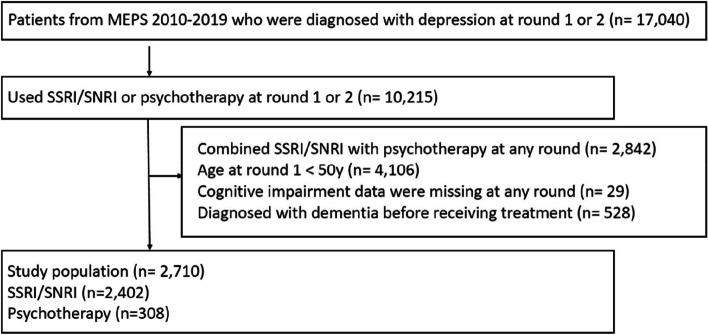
- Retrospective cohort using 2010–2019 US Medical Expenditure Panel Survey data; included adults aged ≥50 with depression diagnosed in round 1 or 2 who initiated SSRI/SNRI or psychotherapy, excluding concomitant use of both, missing cognitive impairment data, and dementia before the index round.
- Exposure was SSRI/SNRI use from prescribed medicines questionnaires vs psychotherapy from outpatient/office-based visit files; outcome was new dementia within the 2-year survey panel identified by ICD-9/ICD-10 codes from the Medical Conditions file.
- Analysis used multiple imputation, propensity score trimming, stabilized inverse probability treatment weighting, and survey-weighted multivariable logistic regression with a doubly robust approach; subgroup and sensitivity analyses were also performed.
Limitations
- The paper states MEPS follows patients for at most 2 years, which may underestimate dementia risk; lack of washout period prevented identifying incident new users and addressing depletion of susceptibles; duration of depression, death as a competing risk, and SSRI/SNRI dose and duration were unavailable.
- The paper also notes small sample sizes after stratification as a possible reason for null subgroup findings.
- Evident from the text: this is an observational study using self-reported medication data and administrative diagnosis codes, so residual confounding and exposure/outcome misclassification remain possible.
Model-written summary. Check it against the paper before relying on it.
Integrity signals
Registry
Cites
Statistics
Figures
Verification
Claims the paper makes
22 Own result · 10 No full text of the sources · 9 Partly supported · 9 Own method · 4 Supported · 3 Couldn’t confirm · 3 Own interpretation · 2 No basis given · 1 Not supported · 1 Sources not found · 1 Not checked yet · accuracy not yet measured
At least one cited source doesn’t support this claim or points to a different paper, and none confirmed it — see the verdicts below.
In the paper
“Depression was identified using International Classification of Disease (ICD) codes (ICD-9: 296.20-296.25, 296.30-296.35, 300.4, 311; positive predictive value [PPV] = 92.0%; ICD-10: F32.0-32.9, F33.0-33.3, F33.8, F33.9, F34.1 & F41.2; PPV = 91.1%) [18].”
§ Association between first-line antidepressant use and risk of dementia in older adults: a retrospective cohort study > Methods > Study design
What the sources say
- Disputedcites [18] Pena-Gralle APB, Talbot D, Trudel X, Aubé K, Lesage A, Lauzier S, et al. Validation of case definitions of depression derived from administrative data against the CIDI-SF as reference standard: results from the PROspective Québec (PROQ) study. BMC Psychiatry. 2021;21(1):1–9. sourceExperimental — accuracy not yet measured
The Methods (Administrative cases of depression; page unavailable) use ICD-9 and ICD-10 codes to identify cases, but list different code ranges from those in the citing sentence. The Results (Table 2; page unavailable) report PPVs of 32.8% and 25.6% for the two administrative case definitions, not 92.0% for ICD-9 or 91.1% for ICD-10. (LLM, conf=0.90)
Checked by a reasoning model — may be wrong.
plain- Asserted: passes — The authors put it forward as true.
- Checkable: passes — It can be checked against evidence.
- Load-bearing: passes — The paper’s conclusions depend on it.
- Based: passes — The paper gives a reason why it holds.
- Disputed
Every source the paper cites for this claim was checked and supports it.
In the paper
“For example, a meta-analysis including observational studies with at least a 1-year follow-up period showed that SSRI use was associated with an increased risk of dementia compared to no SSRI use, with a pooled risk ratio (RR) of 1.75 (95% CI: 1.03–2.96).”
§ Association between first-line antidepressant use and risk of dementia in older adults: a retrospective cohort study > Discussion
What the sources say
- Supportedcites [11] Wang Y-C, Tai P-A, Poly TN, Islam MM, Yang H-C, Wu C-C et al. Increased Risk of Dementia in Patients with Antidepressants: A Meta-Analysis of Observational Studies". Behav Neurol. 2018;2018:8. Article ID 5315098. https://doi.org/10.1155/2018/5315098. source
The Eligibility Criteria section excludes studies with less than one year of follow-up. The Meta-Analysis section reports that SSRI use was associated with increased dementia risk compared with nonuse, with a pooled RR of 1.75 (95% CI: 1.033–2.964), matching the claim after rounding. (LLM, conf=0.94)
plaincorrelational- Asserted: passes — The authors put it forward as true.
- Checkable: passes — It can be checked against evidence.
- Load-bearing: unclear — It is unclear whether the paper’s conclusions depend on it.
- Based: passes — The paper gives a reason why it holds.
- Supported
The cited sources that could be checked couldn’t confirm or dispute this claim.
In the paper
“However, the findings were inconsistent in other studies.”
§ Association between first-line antidepressant use and risk of dementia in older adults: a retrospective cohort study > Background
What the sources say
- Could not verifycites [13] Eisch AJ, Petrik D. Depression and hippocampal neurogenesis: a road to remission? Science. 2012;338(6103):72–5. sourceExperimental — accuracy not yet measured
The paper discusses conflicting findings about hippocampal neurogenesis and antidepressant effects (Abstract; page unavailable), not dementia risk. Searches for antidepressant use and dementia risk found no passage addressing whether findings on that relationship were inconsistent across studies. (LLM, conf=0.76)
- Not checked — no full text of the sourcecites [14] Jacob L, Bohlken J, Kostev K. Risk of Dementia in German patients treated with antidepressants in general or psychiatric practices. Int J Clin Pharmacol Ther. 2017;55(4):322–8. source
plain- Asserted: passes — The authors put it forward as true.
- Checkable: passes — It can be checked against evidence.
- Load-bearing: passes — The paper’s conclusions depend on it.
- Based: passes — The paper gives a reason why it holds.
- Could not verify
The cited sources support only part of this claim — read each source’s verdict below.
In the paper
“We adjusted for confounders associated with both the exposure and the outcome, which were identified based on the literature review and clinical knowledge [19–21].”
§ Association between first-line antidepressant use and risk of dementia in older adults: a retrospective cohort study > Methods > Confounder ascertainment
What the sources say
- Partly supportedcites [19] Campbell NL, Unverzagt F, LaMantia MA, Khan BA, Boustani MA. Risk factors for the progression of mild cognitive impairment to Dementia. Clin Geriatr Med. 2013;29(4):873–93. sourceExperimental — accuracy not yet measured
The Summary identifies the paper as a review of risk factors for progression from MCI to dementia, so it could inform the citing authors’ literature-based choice of variables. The Comorbidity and Other Clinical Characteristics section describes adjustments made in another study, but does not say that this review adjusted for confounders or that the citing authors selected variables associated with both their exposure and outcome using clinical knowledge. In the citing sentence, “We adjusted” describes the citing authors’ own method, not this source’s. (LLM, conf=0.77)
- Partly supportedcites [20] Jia L, Du Y, Chu L, Zhang Z, Li F, Lyu D, et al. Prevalence, risk factors, and management of Dementia and mild cognitive impairment in adults aged 60 years or older in China: a cross-sectional study. The Lancet Public Health. 2020;5(12):e661–71. sourceExperimental — accuracy not yet measured
The statistical analysis passage in our copy (labelled “2019 China statistical yearbook”; page unavailable) lists variables included in logistic regression models, supporting the use of adjusted analyses. It does not say that the variables were selected because they were associated with both exposure and outcome, or that selection was based on a literature review and clinical knowledge. (LLM, conf=0.82)
- Partly supportedcites [21] Baumgart M, Snyder HM, Carrillo MC, Fazio S, Kim H, Johns H. Summary of the evidence on modifiable risk factors for cognitive decline and Dementia: a population-based perspective. Alzheimer’s Dement. 2015;11(6):718–26. sourceExperimental — accuracy not yet measured
The Introduction describes a review of evidence and consultation with dementia-risk experts, and the Conclusions identify risk factors for cognitive decline and dementia. This could inform the citing authors’ choice of variables, but the source does not establish that those variables were associated with both the citing study’s exposure and outcome. It also does not document the citing authors’ confounder adjustment. (LLM, conf=0.83)
plain- Asserted: passes — The authors put it forward as true.
- Checkable: passes — It can be checked against evidence.
- Load-bearing: passes — The paper’s conclusions depend on it.
- Based: passes — The paper gives a reason why it holds.
- Partly supported
Every source the paper cites for this claim was checked and supports it.
In the paper
“That is, the progression of depression [36] may play a critical role in the risk of dementia, and thus masking the effect of SSRIs/SNRIs.”
§ Association between first-line antidepressant use and risk of dementia in older adults: a retrospective cohort study > Discussion
What the sources say
- Supportedcites [36] Byers AL, Yaffe K. Depression and risk of developing Dementia. Nat Rev Neurol. 2011;7(6):323–31. source
The sections on late-life and earlier-life depression report that greater symptom severity and more recurrent depressive episodes are associated with higher dementia risk. The SSRIs/SNRIs masking explanation is the citing authors’ inference, not the point for which the citation is attached. Page numbers were not available in our copy. (LLM, conf=0.86)
hedgedconditional- Asserted: passes — The authors put it forward as true.
- Checkable: passes — It can be checked against evidence.
- Load-bearing: passes — The paper’s conclusions depend on it.
- Based: passes — The paper gives a reason why it holds.
- Supported
The cited sources that could be checked couldn’t confirm or dispute this claim.
In the paper
“The PPV values of using these ICD codes to identify dementia ranged from 73.2 to 93.6% [18].”
§ Association between first-line antidepressant use and risk of dementia in older adults: a retrospective cohort study > Methods > Outcome ascertainment
What the sources say
- Could not verifycites [18] Pena-Gralle APB, Talbot D, Trudel X, Aubé K, Lesage A, Lauzier S, et al. Validation of case definitions of depression derived from administrative data against the CIDI-SF as reference standard: results from the PROspective Québec (PROQ) study. BMC Psychiatry. 2021;21(1):1–9. sourceExperimental — accuracy not yet measured
The Results (Table 2; page unavailable) report PPVs of 25.6%–32.8% for administrative definitions of depression, not dementia. A search for dementia and the claimed 73.2%–93.6% range found no passage evaluating ICD codes for dementia, so our copy cannot verify the cited claim. (LLM, conf=0.77)
plain- Asserted: passes — The authors put it forward as true.
- Checkable: passes — It can be checked against evidence.
- Load-bearing: passes — The paper’s conclusions depend on it.
- Based: passes — The paper gives a reason why it holds.
- Could not verify
The cited sources support only part of this claim — read each source’s verdict below.
In the paper
“The association also did not exist in patients with underlying cognitive impairment, which is probably because clinicians are more concerned about the risk of dementia if patients have prior cognitive impairment, and thus psychotherapy is preferred to SSRI/SNRI use [11].”
§ Association between first-line antidepressant use and risk of dementia in older adults: a retrospective cohort study > Discussion
What the sources say
- Partly supportedcites [11] Wang Y-C, Tai P-A, Poly TN, Islam MM, Yang H-C, Wu C-C et al. Increased Risk of Dementia in Patients with Antidepressants: A Meta-Analysis of Observational Studies". Behav Neurol. 2018;2018:8. Article ID 5315098. https://doi.org/10.1155/2018/5315098. sourceExperimental — accuracy not yet measured
The Discussion (section 4.1; page unavailable) says the findings may make physicians more cautious about prescribing antidepressants, which supports the general concern about dementia risk. The Results (section 3.4; page unavailable) report an overall association, but the paper does not report a lack of association in patients with underlying cognitive impairment or say that clinicians prefer psychotherapy to SSRI/SNRI use for those patients. (LLM, conf=0.76)
hedgedconditional- Asserted: passes — The authors put it forward as true.
- Checkable: unclear — It is unclear whether it could be checked against evidence.
- Load-bearing: unclear — It is unclear whether the paper’s conclusions depend on it.
- Based: passes — The paper gives a reason why it holds.
- Partly supported
None of the sources cited for this claim have been checked yet.
In the paper
“The association also did not exist in patients with underlying cognitive impairment, which is probably because clinicians are more concerned about the risk of dementia if patients have prior cognitive impairment, and thus psychotherapy is preferred to SSRI/SNRI use [11].”
§ Association between first-line antidepressant use and risk of dementia in older adults: a retrospective cohort study > Discussion
hedged- Asserted: passes — The authors put it forward as true.
- Checkable: passes — It can be checked against evidence.
- Load-bearing: unclear — It is unclear whether the paper’s conclusions depend on it.
- Based: passes — The paper gives a reason why it holds.
A result the paper reports from its own data — it cites no other source for it, so there is none to check. The quote shows it is in the paper.
In the paper
“After adjusting for patients’ baseline characteristics, the aOR was 1.36 (95% CI = 1.06–1.74)”
§ Association between first-line antidepressant use and risk of dementia in older adults: a retrospective cohort study > Results > Association between antidepressant use and the risk of dementia, main analysis
plaincorrelational- Asserted: passes — The authors put it forward as true.
- Checkable: passes — It can be checked against evidence.
- Load-bearing: passes — The paper’s conclusions depend on it.
- Based: passes — The paper gives a reason why it holds.
A result the paper reports from its own data — it cites no other source for it, so there is none to check. The quote shows it is in the paper.
In the paper
“Subgroup analyses yielded similar findings as the main analyses, except no significant association for patients who were aged < 65 years (1.23, 95% CI = 0.93–1.62), male (1.34, 95% CI = 0.95–1.90), Black (0.76, 95% CI = 0.48–1.19), had a higher PHQ-2 (1.39, 95% CI = 0.90–2.15), and had underlying cognitive impairment (1.06, 95% CI = 0.80–1.42).”
§ Association between first-line antidepressant use and risk of dementia in older adults: a retrospective cohort study > Abstract > Results
plain- Asserted: passes — The authors put it forward as true.
- Checkable: passes — It can be checked against evidence.
- Load-bearing: unclear — It is unclear whether the paper’s conclusions depend on it.
- Based: passes — The paper gives a reason why it holds.
A result the paper reports from its own data — it cites no other source for it, so there is none to check. The quote shows it is in the paper.
In the paper
“In the subgroup analyses, we found that the association between SSRI/SNRI use and dementia risk did not exist in patients with a higher PHQ-2 score.”
§ Association between first-line antidepressant use and risk of dementia in older adults: a retrospective cohort study > Discussion
plain- Asserted: passes — The authors put it forward as true.
- Checkable: passes — It can be checked against evidence.
- Load-bearing: passes — The paper’s conclusions depend on it.
- Based: passes — The paper gives a reason why it holds.
A result the paper reports from its own data — it cites no other source for it, so there is none to check. The quote shows it is in the paper.
In the paper
“The sensitivity analyses yielded similar findings as the main analysis.”
§ Association between first-line antidepressant use and risk of dementia in older adults: a retrospective cohort study > Results > Association between antidepressant use and the risk of dementia, subgroup and sensitivity analyses
plain- Asserted: passes — The authors put it forward as true.
- Checkable: passes — It can be checked against evidence.
- Load-bearing: unclear — It is unclear whether the paper’s conclusions depend on it.
- Based: passes — The paper gives a reason why it holds.
A result the paper reports from its own data — it cites no other source for it, so there is none to check. The quote shows it is in the paper.
In the paper
“Subgroup analyses yielded similar findings as the main analyses, except no significant association for patients who were aged < 65 years (1.23, 95% CI = 0.93–1.62), male (1.34, 95% CI = 0.95–1.90), Black (0.76, 95% CI = 0.48–1.19), had a higher PHQ-2 (1.39, 95% CI = 0.90–2.15), and had underlying cognitive impairment (1.06, 95% CI = 0.80–1.42).”
§ Association between first-line antidepressant use and risk of dementia in older adults: a retrospective cohort study > Abstract > Results
plain- Asserted: passes — The authors put it forward as true.
- Checkable: passes — It can be checked against evidence.
- Load-bearing: unclear — It is unclear whether the paper’s conclusions depend on it.
- Based: passes — The paper gives a reason why it holds.
A result the paper reports from its own data — it cites no other source for it, so there is none to check. The quote shows it is in the paper.
In the paper
“Most subgroup analyses reported consistent results with the main analysis, except for patients who were aged < 65 years, male, Black, had a PHQ-2 score of 3–6, and had underlying cognitive impairment, for whom the adjusted ORs (95% CI) were 1.23 (0.93–1.62), 1.34 (0.95–1.90), 0.76 (0.48–1.19), 1.39 (0.90–2.15), and 1.06 (0.80–1.42), respectively.”
§ Association between first-line antidepressant use and risk of dementia in older adults: a retrospective cohort study > Results > Association between antidepressant use and the risk of dementia, subgroup and sensitivity analyses
plaincorrelational- Asserted: passes — The authors put it forward as true.
- Checkable: passes — It can be checked against evidence.
- Load-bearing: unclear — It is unclear whether the paper’s conclusions depend on it.
- Based: passes — The paper gives a reason why it holds.
A result the paper reports from its own data — it cites no other source for it, so there is none to check. The quote shows it is in the paper.
In the paper
“Subgroup analyses yielded similar findings as the main analyses, except no significant association for patients who were aged < 65 years (1.23, 95% CI = 0.93–1.62), male (1.34, 95% CI = 0.95–1.90), Black (0.76, 95% CI = 0.48–1.19), had a higher PHQ-2 (1.39, 95% CI = 0.90–2.15), and had underlying cognitive impairment (1.06, 95% CI = 0.80–1.42).”
§ Association between first-line antidepressant use and risk of dementia in older adults: a retrospective cohort study > Abstract > Results
plain- Asserted: passes — The authors put it forward as true.
- Checkable: passes — It can be checked against evidence.
- Load-bearing: unclear — It is unclear whether the paper’s conclusions depend on it.
- Based: passes — The paper gives a reason why it holds.
A result the paper reports from its own data — it cites no other source for it, so there is none to check. The quote shows it is in the paper.
In the paper
“Subgroup analyses yielded similar findings as the main analyses, except no significant association for patients who were aged < 65 years (1.23, 95% CI = 0.93–1.62), male (1.34, 95% CI = 0.95–1.90), Black (0.76, 95% CI = 0.48–1.19), had a higher PHQ-2 (1.39, 95% CI = 0.90–2.15), and had underlying cognitive impairment (1.06, 95% CI = 0.80–1.42).”
§ Association between first-line antidepressant use and risk of dementia in older adults: a retrospective cohort study > Abstract > Results
plain- Asserted: passes — The authors put it forward as true.
- Checkable: passes — It can be checked against evidence.
- Load-bearing: unclear — It is unclear whether the paper’s conclusions depend on it.
- Based: passes — The paper gives a reason why it holds.
A result the paper reports from its own data — it cites no other source for it, so there is none to check. The quote shows it is in the paper.
In the paper
“Most subgroup analyses reported consistent results with the main analysis, except for patients who were aged < 65 years, male, Black, had a PHQ-2 score of 3–6, and had underlying cognitive impairment, for whom the adjusted ORs (95% CI) were 1.23 (0.93–1.62), 1.34 (0.95–1.90), 0.76 (0.48–1.19), 1.39 (0.90–2.15), and 1.06 (0.80–1.42), respectively.”
§ Association between first-line antidepressant use and risk of dementia in older adults: a retrospective cohort study > Results > Association between antidepressant use and the risk of dementia, subgroup and sensitivity analyses
plaincorrelational- Asserted: passes — The authors put it forward as true.
- Checkable: passes — It can be checked against evidence.
- Load-bearing: unclear — It is unclear whether the paper’s conclusions depend on it.
- Based: passes — The paper gives a reason why it holds.
A result the paper reports from its own data — it cites no other source for it, so there is none to check. The quote shows it is in the paper.
In the paper
“the marginal effect suggested that receipt of SSRIs/SNRIs was associated with a 31.0% (95% CI = 6.6-55.3%) increased risk of dementia within two years compared to those receiving psychotherapy among older adults with depression after adjusting for the confounders (i.e., age, sex, race/ethnicity, insurance type, marital status, region, poverty, education, PHQ-2 score, cognitive impairment, smoking,”
- Also stated in: § Discussion · plain
“In this retrospective cohort study using nationally representative survey data in the US, we found that older adults with depression receiving SSRIs/SNRIs were associated with a 31% increased risk of dementia within two years compared to those receiving psychotherapy after adjusting for patient characteristics such as age, sex, race/ethnicity, depression severity, underlying cognitive impairment,”
§ Association between first-line antidepressant use and risk of dementia in older adults: a retrospective cohort study > Results > Association between antidepressant use and the risk of dementia, main analysis
plaincorrelational- Asserted: passes — The authors put it forward as true.
- Checkable: passes — It can be checked against evidence.
- Load-bearing: passes — The paper’s conclusions depend on it.
- Based: passes — The paper gives a reason why it holds.
- Also stated in: § Discussion · plain
A result the paper reports from its own data — it cites no other source for it, so there is none to check. The quote shows it is in the paper.
In the paper
“The SSRI/SNRI users had a higher crude incidence of dementia than the psychotherapy group (16.4% vs. 11.8%), with an aOR of 1.36 (95% CI = 1.06–1.74).”
- Also stated in: § Conclusions · hedged
“Our findings suggested that older adults with depression receiving SSRIs/SNRIs were associated with an increased dementia risk compared to those receiving psychotherapy.”
§ Association between first-line antidepressant use and risk of dementia in older adults: a retrospective cohort study > Abstract > Results
plaincorrelationaln = 2,710 ·- Asserted: passes — The authors put it forward as true.
- Checkable: passes — It can be checked against evidence.
- Load-bearing: passes — The paper’s conclusions depend on it.
- Based: passes — The paper gives a reason why it holds.
- Also stated in: § Conclusions · hedged
The paper states this without a source or data behind it here, so there is nothing to check it against. The quote shows it is in the paper.
In the paper
“The association also did not exist in Black adults, probably because Black adults are less likely to receive SSRI/SNRI than White adults even though they have similar severity of depression, [37] which may dilute the drug effect as well.”
§ Association between first-line antidepressant use and risk of dementia in older adults: a retrospective cohort study > Discussion
hedged- Asserted: passes — The authors put it forward as true.
- Checkable: passes — It can be checked against evidence.
- Load-bearing: unclear — It is unclear whether the paper’s conclusions depend on it.
- Based: passes — The paper gives a reason why it holds.
A result the paper reports from its own data — it cites no other source for it, so there is none to check. The quote shows it is in the paper.
In the paper
“Most subgroup analyses reported consistent results with the main analysis, except for patients who were aged < 65 years, male, Black, had a PHQ-2 score of 3–6, and had underlying cognitive impairment, for whom the adjusted ORs (95% CI) were 1.23 (0.93–1.62), 1.34 (0.95–1.90), 0.76 (0.48–1.19), 1.39 (0.90–2.15), and 1.06 (0.80–1.42), respectively.”
§ Association between first-line antidepressant use and risk of dementia in older adults: a retrospective cohort study > Results > Association between antidepressant use and the risk of dementia, subgroup and sensitivity analyses
plain- Asserted: passes — The authors put it forward as true.
- Checkable: passes — It can be checked against evidence.
- Load-bearing: unclear — It is unclear whether the paper’s conclusions depend on it.
- Based: passes — The paper gives a reason why it holds.
A result the paper reports from its own data — it cites no other source for it, so there is none to check. The quote shows it is in the paper.
In the paper
“Most subgroup analyses reported consistent results with the main analysis, except for patients who were aged < 65 years, male, Black, had a PHQ-2 score of 3–6, and had underlying cognitive impairment, for whom the adjusted ORs (95% CI) were 1.23 (0.93–1.62), 1.34 (0.95–1.90), 0.76 (0.48–1.19), 1.39 (0.90–2.15), and 1.06 (0.80–1.42), respectively.”
§ Association between first-line antidepressant use and risk of dementia in older adults: a retrospective cohort study > Results > Association between antidepressant use and the risk of dementia, subgroup and sensitivity analyses
plaincorrelational- Asserted: passes — The authors put it forward as true.
- Checkable: passes — It can be checked against evidence.
- Load-bearing: unclear — It is unclear whether the paper’s conclusions depend on it.
- Based: passes — The paper gives a reason why it holds.
A result the paper reports from its own data — it cites no other source for it, so there is none to check. The quote shows it is in the paper.
In the paper
“Most subgroup analyses reported consistent results with the main analysis, except for patients who were aged < 65 years, male, Black, had a PHQ-2 score of 3–6, and had underlying cognitive impairment, for whom the adjusted ORs (95% CI) were 1.23 (0.93–1.62), 1.34 (0.95–1.90), 0.76 (0.48–1.19), 1.39 (0.90–2.15), and 1.06 (0.80–1.42), respectively.”
§ Association between first-line antidepressant use and risk of dementia in older adults: a retrospective cohort study > Results > Association between antidepressant use and the risk of dementia, subgroup and sensitivity analyses
plaincorrelational- Asserted: passes — The authors put it forward as true.
- Checkable: passes — It can be checked against evidence.
- Load-bearing: unclear — It is unclear whether the paper’s conclusions depend on it.
- Based: passes — The paper gives a reason why it holds.
A result the paper reports from its own data — it cites no other source for it, so there is none to check. The quote shows it is in the paper.
In the paper
“The SSRI/SNRI users had a higher crude incidence of dementia than the psychotherapy group (16.4% vs. 11.8%), with an aOR of 1.36 (95% CI = 1.06–1.74).”
§ Association between first-line antidepressant use and risk of dementia in older adults: a retrospective cohort study > Abstract > Results
plaincorrelationaln = 2,710- Asserted: passes — The authors put it forward as true.
- Checkable: passes — It can be checked against evidence.
- Load-bearing: passes — The paper’s conclusions depend on it.
- Based: passes — The paper gives a reason why it holds.
A result the paper reports from its own data — it cites no other source for it, so there is none to check. The quote shows it is in the paper.
In the paper
“Subgroup analyses yielded similar findings as the main analyses, except no significant association for patients who were aged < 65 years (1.23, 95% CI = 0.93–1.62), male (1.34, 95% CI = 0.95–1.90), Black (0.76, 95% CI = 0.48–1.19), had a higher PHQ-2 (1.39, 95% CI = 0.90–2.15), and had underlying cognitive impairment (1.06, 95% CI = 0.80–1.42).”
§ Association between first-line antidepressant use and risk of dementia in older adults: a retrospective cohort study > Abstract > Results
plain- Asserted: passes — The authors put it forward as true.
- Checkable: passes — It can be checked against evidence.
- Load-bearing: unclear — It is unclear whether the paper’s conclusions depend on it.
- Based: passes — The paper gives a reason why it holds.
A result the paper reports from its own data — it cites no other source for it, so there is none to check. The quote shows it is in the paper.
In the paper
“In Table 2, the crude incidence of dementia within two years was 16.4% in SSRI/SNRI users and 11.8% in the psychotherapy group.”
§ Association between first-line antidepressant use and risk of dementia in older adults: a retrospective cohort study > Results > Association between antidepressant use and the risk of dementia, main analysis
plain- Asserted: passes — The authors put it forward as true.
- Checkable: passes — It can be checked against evidence.
- Load-bearing: passes — The paper’s conclusions depend on it.
- Based: passes — The paper gives a reason why it holds.
In the paper
“Another study by Lee et al., restricted to older adults with depression, found that SSRI use was associated with an increased risk of incident dementia, with an adjusted OR of 2.48 (95% CI: 2.27–2.71) [32].”
§ Association between first-line antidepressant use and risk of dementia in older adults: a retrospective cohort study > Discussion
What the sources say
- Not checked — no full text of the sourcecites [32] Lee CW-S, Lin C-L, Sung F-C, Liang J-A, Kao C-H. Antidepressant treatment and risk of Dementia: a population-based, retrospective case-control study. J Clin Psychiatry. 2016;77(1):961. source
plaincorrelational- Asserted: passes — The authors put it forward as true.
- Checkable: passes — It can be checked against evidence.
- Load-bearing: unclear — It is unclear whether the paper’s conclusions depend on it.
- Based: passes — The paper gives a reason why it holds.
In the paper
“However, in a population-based study with a mean follow-up of 8 years, the incidence of dementia was 13% among older adults with depression, [39] similar to our findings.”
§ Association between first-line antidepressant use and risk of dementia in older adults: a retrospective cohort study > Discussion
What the sources say
- Not checked — no full text of the sourcecites [39] Mirza SS, Wolters FJ, Swanson SA, Koudstaal PJ, Hofman A, Tiemeier H, et al. 10-year trajectories of depressive symptoms and risk of Dementia: a population-based study. The Lancet Psychiatry. 2016;3(7):628–35. source
plain- Asserted: passes — The authors put it forward as true.
- Checkable: passes — It can be checked against evidence.
- Load-bearing: unclear — It is unclear whether the paper’s conclusions depend on it.
- Based: passes — The paper gives a reason why it holds.
In the paper
“Therefore, we could not address the depletion of susceptibles, [40] meaning that patients who were using SSRI/SNRI may be the ones who were less likely to incur dementia.”
§ Association between first-line antidepressant use and risk of dementia in older adults: a retrospective cohort study > Discussion
What the sources say
- Not checked — no full text of the sourcecites [40] Renoux C, Dell’Aniello S, Brenner B, Suissa S. Bias from depletion of susceptibles: the example of hormone replacement therapy and the risk of venous thromboembolism. Pharmacoepidemiol Drug Saf. 2017;26(5):554–60. source
plain- Asserted: passes — The authors put it forward as true.
- Checkable: passes — It can be checked against evidence.
- Load-bearing: unclear — It is unclear whether the paper’s conclusions depend on it.
- Based: passes — The paper gives a reason why it holds.
In the paper
“We certify that this work is novel. This work is the first to compare first-line antidepressants (i.e., SSRI/SNRI) to an active comparator (i.e., psychotherapy) to reduce confounding by indication instead of comparing antidepressant use to no use in prior studies.”
§ Association between first-line antidepressant use and risk of dementia in older adults: a retrospective cohort study > Impact statement
What the sources say
- Not checked — no full text of the sourcecites [15] Liew TM. Antidepressant and risk of Dementia: confounding by indication. J Am Med Dir Assoc. 2019;20(7):920–2. source
plain- Asserted: passes — The authors put it forward as true.
- Checkable: passes — It can be checked against evidence.
- Load-bearing: passes — The paper’s conclusions depend on it.
- Based: unclear — It is unclear why the paper says it holds.
What the paper did — it cites no source for this, so there is none to check. The quote shows it is in the paper.
In the paper
“Fifth, dose and duration of SSRI/SNRI use may be associated with dementia risk, yet MEPS data does not provide such information.”
§ Association between first-line antidepressant use and risk of dementia in older adults: a retrospective cohort study > Discussion
plain- Asserted: passes — The authors put it forward as true.
- Checkable: passes — It can be checked against evidence.
- Load-bearing: unclear — It is unclear whether the paper’s conclusions depend on it.
- Based: passes — The paper gives a reason why it holds.
In the paper
“Prior studies are limited by only comparing antidepressant exposure with no exposure, which may be subject to confounding by indication and severity [15].”
§ Association between first-line antidepressant use and risk of dementia in older adults: a retrospective cohort study > Background
What the sources say
- Not checked — no full text of the sourcecites [15] Liew TM. Antidepressant and risk of Dementia: confounding by indication. J Am Med Dir Assoc. 2019;20(7):920–2. source
hedgedconditional- Asserted: passes — The authors put it forward as true.
- Checkable: passes — It can be checked against evidence.
- Load-bearing: passes — The paper’s conclusions depend on it.
- Based: passes — The paper gives a reason why it holds.
In the paper
“while depression itself can be a risk factor for dementia, making separating the drug effect from depression severity challenging [15].”
§ Association between first-line antidepressant use and risk of dementia in older adults: a retrospective cohort study > Background
What the sources say
- Not checked — no full text of the sourcecites [15] Liew TM. Antidepressant and risk of Dementia: confounding by indication. J Am Med Dir Assoc. 2019;20(7):920–2. source
plaindirect- Asserted: passes — The authors put it forward as true.
- Checkable: passes — It can be checked against evidence.
- Load-bearing: passes — The paper’s conclusions depend on it.
- Based: passes — The paper gives a reason why it holds.
What the paper did — it cites no source for this, so there is none to check. The quote shows it is in the paper.
In the paper
“Our survey data analysis addressed these issues by including patients’ PHQ-2 score, co-use of other antidepressants, and underlying cognitive impairment.”
§ Association between first-line antidepressant use and risk of dementia in older adults: a retrospective cohort study > Discussion
plain- Asserted: passes — The authors put it forward as true.
- Checkable: passes — It can be checked against evidence.
- Load-bearing: passes — The paper’s conclusions depend on it.
- Based: passes — The paper gives a reason why it holds.
What the paper did — it cites no source for this, so there is none to check. The quote shows it is in the paper.
In the paper
“Unlike previous studies largely comparing antidepressant users with nonusers, our study adopted the active comparison group approach to reduce confounding by indication and severity in older adults with depression.”
§ Association between first-line antidepressant use and risk of dementia in older adults: a retrospective cohort study > Discussion
plaindirect- Asserted: passes — The authors put it forward as true.
- Checkable: passes — It can be checked against evidence.
- Load-bearing: passes — The paper’s conclusions depend on it.
- Based: passes — The paper gives a reason why it holds.
What the paper did — it cites no source for this, so there is none to check. The quote shows it is in the paper.
In the paper
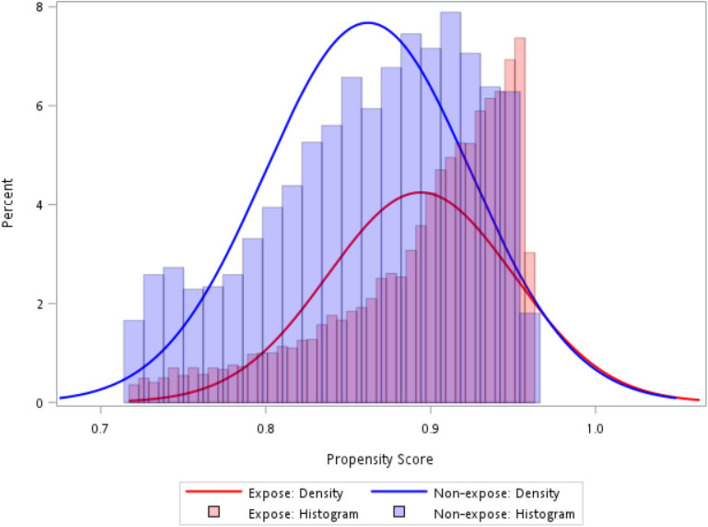
“This figure shows that the propensity scores of the SSRI/SNRI and psychotherapy groups highly overlapped with each other after trimming”
§ Association between first-line antidepressant use and risk of dementia in older adults: a retrospective cohort study > Results > Baseline characteristics
plain- Asserted: passes — The authors put it forward as true.
- Checkable: passes — It can be checked against evidence.
- Load-bearing: passes — The paper’s conclusions depend on it.
- Based: passes — The paper gives a reason why it holds.
In the paper
“Third, although we conducted several subgroup analyses to address potential heterogeneity in the drug effect across patient subgroups, we were unable to include potential confounders such as duration of depression [37].”
§ Association between first-line antidepressant use and risk of dementia in older adults: a retrospective cohort study > Discussion
What the sources say
- Not checked — no full text of the sourcecites [37] Remmert JE, Guzman G, Mavandadi S, Oslin D. Racial Disparities in Prescription of Antidepressants Among U.S. Veterans Referred to Behavioral Health Care. Psychiatr Serv. 2022;73:984–90. https://doi.org/10.1176/appi.ps.202100237. source
plain- Asserted: passes — The authors put it forward as true.
- Checkable: passes — It can be checked against evidence.
- Load-bearing: unclear — It is unclear whether the paper’s conclusions depend on it.
- Based: passes — The paper gives a reason why it holds.
In the paper
“That is, patients taking antidepressants are likely to suffer from more severe depression than nonusers, while depression itself can be a risk factor for dementia, making separating the drug effect from depression severity challenging [15].”
§ Association between first-line antidepressant use and risk of dementia in older adults: a retrospective cohort study > Background
What the sources say
- Not checked — no full text of the sourcecites [15] Liew TM. Antidepressant and risk of Dementia: confounding by indication. J Am Med Dir Assoc. 2019;20(7):920–2. source
hedgedcorrelational- Asserted: passes — The authors put it forward as true.
- Checkable: passes — It can be checked against evidence.
- Load-bearing: passes — The paper’s conclusions depend on it.
- Based: passes — The paper gives a reason why it holds.
What the paper did — it cites no source for this, so there is none to check. The quote shows it is in the paper.
In the paper
“Second, we were unable to identify incident new users of SSRIs/SNRIs and psychotherapy due to the lack of a washout period.”
§ Association between first-line antidepressant use and risk of dementia in older adults: a retrospective cohort study > Discussion
plain- Asserted: passes — The authors put it forward as true.
- Checkable: passes — It can be checked against evidence.
- Load-bearing: passes — The paper’s conclusions depend on it.
- Based: passes — The paper gives a reason why it holds.
- Probably not a substantial claim. 14
- It may state two separate claims as one. 11
- The quote only partly states this claim. 3
The cited sources support only part of this claim — read each source’s verdict below.
In the paper
“The PHQ-2 score was used to estimate the severity of depression, which assessed the frequency of depressed mood and anhedonia over the past two weeks [22].”
§ Association between first-line antidepressant use and risk of dementia in older adults: a retrospective cohort study > Methods > Confounder ascertainment
What the sources say
- Partly supportedcites [22] Arroll B, Goodyear-Smith F, Crengle S, Gunn J, Kerse N, Fishman T, et al. Validation of PHQ-2 and PHQ-9 to screen for major depression in the primary care population. The Annals of Family Medicine. 2010;8(4):348–53. sourceExperimental — accuracy not yet measured
The Introduction (page unavailable) says the PHQ-2 asks how frequently depressed mood and anhedonia occur, with each item scored from 0 to 3. But the paper presents the PHQ-2 as a depression screening tool, not a measure of depression severity, and the passages found do not specify a two-week timeframe. The Measures section gives severity thresholds for the PHQ-9 instead. (LLM, conf=0.86)
plain- Asserted: passes — The authors put it forward as true.
- Checkable: passes — It can be checked against evidence.
- Load-bearing: fails — The paper’s conclusions may not depend on it.
- Based: passes — The paper gives a reason why it holds.
Probably not a substantial claim. The paper’s conclusions may not depend on it.
- Partly supported
The cited sources support only part of this claim — read each source’s verdict below.
In the paper
“Using the sIPTW-adjusted MLR, we were able to estimate the average treatment effect in the treated (ATT) [26].”
§ Association between first-line antidepressant use and risk of dementia in older adults: a retrospective cohort study > Methods > Statistical analysis
What the sources say
- Partly supportedcites [26] Austin PC. Variance estimation when using inverse probability of treatment weighting (IPTW) with survival analysis. Stat Med. 2016;35(30):5642–55. sourceExperimental — accuracy not yet measured
The section on propensity-score weighting says IPTW–ATT weights can estimate the ATT, and the Case study > Data and analyses section uses logistic regression to estimate propensity scores. But the paper assigns stabilized weights to the ATE, not the ATT, and estimates the treatment effect with a weighted Cox proportional hazards model—not multivariable logistic regression. (LLM, conf=0.90)
plain- Asserted: passes — The authors put it forward as true.
- Checkable: passes — It can be checked against evidence.
- Load-bearing: passes — The paper’s conclusions depend on it.
- Based: passes — The paper gives a reason why it holds.
Probably not a substantial claim.
- Partly supported
The cited sources support only part of this claim — read each source’s verdict below.
In the paper
“First, we used MEPS data, which only follow a patient for at most 2 years, which may not be long enough for dementia to occur and underestimate the risk of dementia [38].”
§ Association between first-line antidepressant use and risk of dementia in older adults: a retrospective cohort study > Discussion
What the sources say
- Partly supportedcites [38] Goudsmit J. The incubation period of Alzheimer’s Disease and the timing of tau versus amyloid misfolding and spreading within the brain. Eur J Epidemiol. 2016;31(2):99–105. sourceExperimental — accuracy not yet measured
The paper’s Fig. 1 caption describes a preclinical Alzheimer’s disease period that might last 17 years, supporting the concern that two years may be too short to observe clinical onset. It does not discuss MEPS or show that a two-year follow-up underestimates dementia risk; that is the citing authors’ inference. (LLM, conf=0.83)
hedgedconditional- Asserted: passes — The authors put it forward as true.
- Checkable: passes — It can be checked against evidence.
- Load-bearing: unclear — It is unclear whether the paper’s conclusions depend on it.
- Based: passes — The paper gives a reason why it holds.
It may state two separate claims as one.
- Partly supported
Every source the paper cites for this claim was checked and supports it.
In the paper
“Fourth, we balanced the characteristics between patients receiving SSRIs/SNRIs and those receiving psychotherapy using the stabilized inverse probability treatment weighting (sIPTW) approach, which preserves the sample size of the original data and avoids underestimating the variance compared to IPTW [25].”
§ Association between first-line antidepressant use and risk of dementia in older adults: a retrospective cohort study > Methods > Statistical analysis
What the sources say
- Supportedcites [25] Pezzi A, Cavo M, Biggeri A, Zamagni E, Nanni O. Inverse probability weighting to estimate causal effect of a singular phase in a multiphase randomized clinical trial for Multiple Myeloma. BMC Med Res Methodol. 2016;16(1):150. source
The citation supports the methodological rationale for sIPTW, not a claim that Pezzi et al. studied SSRI/SNRI or psychotherapy groups; those are the citing study’s groups. The Methods section (‘Stabilized inverse probability of treatment weight’) states that sIPTW preserves the original sample size and provides appropriate variance estimation, unlike unstabilized IPTW. (LLM, conf=0.92)
plain- Asserted: passes — The authors put it forward as true.
- Checkable: passes — It can be checked against evidence.
- Load-bearing: passes — The paper’s conclusions depend on it.
- Based: passes — The paper gives a reason why it holds.
Probably not a substantial claim.
- Supported
The cited sources support only part of this claim — read each source’s verdict below.
In the paper
“The independent variables of the MLR included not only exposure (i.e., receiving SSRI/SNRI vs. psychotherapy) but the unbalanced covariates (ASMD > 0.1) after sIPTW (i.e., doubly robust approach) [30].”
§ Association between first-line antidepressant use and risk of dementia in older adults: a retrospective cohort study > Methods > Statistical analysis
What the sources say
- Partly supportedcites [30] Funk MJ, Westreich D, Wiesen C, Stürmer T, Brookhart MA, Davidian M. Doubly robust estimation of causal effects. Am J Epidemiol. 2011;173(7):761–7. sourceExperimental — accuracy not yet measured
The Abstract and “The doubly robust estimator” section describe combining propensity-score weighting with an outcome model that includes covariates. The paper does not prescribe selecting covariates with ASMD > 0.1 after stabilized weighting; its concluding discussion says strategies for selecting covariates for the component models have not been adequately evaluated. (LLM, conf=0.87)
plain- Asserted: passes — The authors put it forward as true.
- Checkable: passes — It can be checked against evidence.
- Load-bearing: passes — The paper’s conclusions depend on it.
- Based: passes — The paper gives a reason why it holds.
Probably not a substantial claim.
- Partly supported
The cited sources that could be checked couldn’t confirm or dispute this claim.
In the paper
“Patients with a higher PHQ-2 score might reflect those with more severe depression or uncontrolled depression, which may confound the drug effect [35].”
§ Association between first-line antidepressant use and risk of dementia in older adults: a retrospective cohort study > Discussion
What the sources say
- Could not verifycites [35] Si T, Wang P. When is antidepressant polypharmacy appropriate in the treatment of depression? Shanghai Arch Psychiatry. 2014;26(6):357–9. sourceExperimental — accuracy not yet measured
The paper’s Abstract discusses depression that persists despite antidepressant treatment, but does not address PHQ-2 scores or whether depression severity confounds an estimated drug effect. Searches for PHQ-2 and severity-related confounding found no passage making that connection; no page number is available in our copy. (LLM, conf=0.72)
hedgedconditional- Asserted: passes — The authors put it forward as true.
- Checkable: passes — It can be checked against evidence.
- Load-bearing: passes — The paper’s conclusions depend on it.
- Based: passes — The paper gives a reason why it holds.
It may state two separate claims as one.
- Could not verify
The cited sources support only part of this claim — read each source’s verdict below.
In the paper
“Nonetheless, Peakman et al., 2020 [33] and Goveas et al., 2012 [34] pointed out that even though antidepressant use was found to be associated with the risk of dementia (adjusted hazard ratio [HR]: 1.32 [95% CI: 1.01–1.74] and 1.69 [95% CI: 1.21–2.35], respectively), an association was not found for SSRIs (adjusted HR: 1.07 [95% CI: 0.91–1.25] and 1.50 [95% CI: 0.89–2.53], respectively).”
§ Association between first-line antidepressant use and risk of dementia in older adults: a retrospective cohort study > Discussion
What the sources say
- Supportedcites [33] Peakman G, Karunatilake N, Seynaeve M, Perera G, Aarsland D, Stewart R, et al. Clinical factors associated with progression to Dementia in people with late-life depression: a cohort study of patients in secondary care. BMJ Open. 2020;10(5): e035147. source
Split into 2 atoms — 2 confirmed, 0 partially supported, 0 disputed, 0 misattributed, 0 unverifiable. Expand the claim to see per-atom verdicts.
- Partly supportedcites [34] Goveas JS, Hogan PE, Kotchen JM, Smoller JW, Denburg NL, Manson JE, et al. Depressive symptoms, antidepressant use, and future cognitive health in postmenopausal women: the women’s Health Initiative Memory Study. Int Psychogeriatr. 2012;24(8):1252–64. sourceExperimental — accuracy not yet measured
Split into 2 atoms — 0 confirmed, 2 partially supported, 0 disputed, 0 misattributed, 0 unverifiable. Expand the claim to see per-atom verdicts.
plaincorrelational- Asserted: passes — The authors put it forward as true.
- Checkable: passes — It can be checked against evidence.
- Load-bearing: passes — The paper’s conclusions depend on it.
- Based: passes — The paper gives a reason why it holds.
It may state two separate claims as one.
- Supported
Every source the paper cites for this claim was checked and supports it.
In the paper
“We then used a multiple imputation approach to address the missingness in the covariates, which imputed multiple sets (i.e., 10) of missing data based on the observed data and pooled the imputed results together in the survey sample [23].”
§ Association between first-line antidepressant use and risk of dementia in older adults: a retrospective cohort study > Methods > Statistical analysis
What the sources say
- Supportedcites [23] Sterne JA, White IR, Carlin JB, Spratt M, Royston P, Kenward MG, et al. Multiple imputation for missing data in epidemiological and clinical research: potential and pitfalls. BMJ. 2009;338:b2393. source
The “What is multiple imputation?” section describes replacing missing values using observed data, analysing multiple imputed datasets, and combining the results. The “Omitting the outcome variable from the imputation procedure” section specifically discusses imputing missing predictor values. The cited paper supports the method; the choice of 10 datasets describes the citing study’s own implementation. (LLM, conf=0.90)
plain- Asserted: passes — The authors put it forward as true.
- Checkable: passes — It can be checked against evidence.
- Load-bearing: fails — The paper’s conclusions may not depend on it.
- Based: passes — The paper gives a reason why it holds.
Probably not a substantial claim. The paper’s conclusions may not depend on it.
- Supported
The cited sources support only part of this claim — read each source’s verdict below.
In the paper
“In addition, TCAs are currently second-line pharmacotherapy for depression due to their higher anticholinergic burden that may increase multiple side effects (e.g., cognitive decline) [16].”
§ Association between first-line antidepressant use and risk of dementia in older adults: a retrospective cohort study > Background
What the sources say
- Partly supportedcites [16] Dudas R, Malouf R, McCleery J, Dening T. Antidepressants for treating depression in Dementia. Cochrane Database Syst Rev. 2018;8(8):CD003944–CD. sourceExperimental — accuracy not yet measured
The Description of the intervention section says TCAs have anticholinergic effects associated with a negative impact on cognition and lists other potential side effects. It says SSRIs are more widely used for older people, but does not establish that TCAs are second-line pharmacotherapy for depression generally. (LLM, conf=0.87)
hedgedconditional- Asserted: passes — The authors put it forward as true.
- Checkable: passes — It can be checked against evidence.
- Load-bearing: passes — The paper’s conclusions depend on it.
- Based: passes — The paper gives a reason why it holds.
It may state two separate claims as one.
- Partly supported
The cited sources support only part of this claim — read each source’s verdict below.
In the paper
“However, the heterogeneity in the meta-analysis was extremely high, and one out of five included studies suggested that SSRI use was associated with a lower risk of dementia (RR: 0.58, 95% CI: 0.50–0.68) [11].”
§ Association between first-line antidepressant use and risk of dementia in older adults: a retrospective cohort study > Discussion
What the sources say
- Partly supportedcites [11] Wang Y-C, Tai P-A, Poly TN, Islam MM, Yang H-C, Wu C-C et al. Increased Risk of Dementia in Patients with Antidepressants: A Meta-Analysis of Observational Studies". Behav Neurol. 2018;2018:8. Article ID 5315098. https://doi.org/10.1155/2018/5315098. sourceExperimental — accuracy not yet measured
Section 3.4 (page unavailable) reports five SSRI studies and extremely high heterogeneity (I² = 98.553). It does not report that one of those studies found a lower dementia risk with SSRI use, or give the claimed RR of 0.58 (95% CI 0.50–0.68); the pooled SSRI estimate instead indicates increased risk. (LLM, conf=0.86)
hedgedcorrelational- Asserted: passes — The authors put it forward as true.
- Checkable: passes — It can be checked against evidence.
- Load-bearing: unclear — It is unclear whether the paper’s conclusions depend on it.
- Based: passes — The paper gives a reason why it holds.
It may state two separate claims as one.
- Partly supported
A result the paper reports from its own data — it cites no other source for it, so there is none to check. The quote shows it is in the paper.
In the paper
“Most subgroup analyses reported consistent results with the main analysis, except for patients who were aged < 65 years, male, Black, had a PHQ-2 score of 3–6, and had underlying cognitive impairment, for whom the adjusted ORs (95% CI) were 1.23 (0.93–1.62), 1.34 (0.95–1.90), 0.76 (0.48–1.19), 1.39 (0.90–2.15), and 1.06 (0.80–1.42), respectively.”
§ Association between first-line antidepressant use and risk of dementia in older adults: a retrospective cohort study > Results > Association between antidepressant use and the risk of dementia, subgroup and sensitivity analyses
plaincorrelational- Asserted: passes — The authors put it forward as true.
- Checkable: passes — It can be checked against evidence.
- Load-bearing: unclear — It is unclear whether the paper’s conclusions depend on it.
- Based: passes — The paper gives a reason why it holds.
The quote only partly states this claim.
A result the paper reports from its own data — it cites no other source for it, so there is none to check. The quote shows it is in the paper.
In the paper
“Most subgroup analyses yielded similar results, except for patients who were aged < 65 years, male, Black, had a PHQ-2 score of 3–6, and had underlying cognitive impairment, which did not show significant differences in the risk of dementia between SSRI/SNRI use and psychotherapy.”
§ Association between first-line antidepressant use and risk of dementia in older adults: a retrospective cohort study > Discussion
plain- Asserted: passes — The authors put it forward as true.
- Checkable: passes — It can be checked against evidence.
- Load-bearing: unclear — It is unclear whether the paper’s conclusions depend on it.
- Based: passes — The paper gives a reason why it holds.
It may state two separate claims as one.
A result the paper reports from its own data — it cites no other source for it, so there is none to check. The quote shows it is in the paper.
In the paper
“The adjusted ORs (95% CI) were 1.27 (1.18–1.37) using the 1:1 PS matching and 1.12 (1.05–1.20) when removing comedications from the PS calculation.”
§ Association between first-line antidepressant use and risk of dementia in older adults: a retrospective cohort study > Results > Association between antidepressant use and the risk of dementia, subgroup and sensitivity analyses
plaincorrelational- Asserted: passes — The authors put it forward as true.
- Checkable: passes — It can be checked against evidence.
- Load-bearing: unclear — It is unclear whether the paper’s conclusions depend on it.
- Based: passes — The paper gives a reason why it holds.
The quote only partly states this claim.
A result the paper reports from its own data — it cites no other source for it, so there is none to check. The quote shows it is in the paper.
In the paper
“Among 2,710 eligible patients (mean age = 61 ± 8, female = 69%, White = 84%), 89% used SSRIs/SNRIs, and 11% received psychotherapy.”
- Also stated in: § Baseline characteristics · plain
“a total of 2,710 patients were eligible for the analysis, with 89% receiving SSRIs/SNRIs and 11% receiving psychotherapy.”
§ Association between first-line antidepressant use and risk of dementia in older adults: a retrospective cohort study > Abstract > Results
plainn = 2,710- Asserted: passes — The authors put it forward as true.
- Checkable: passes — It can be checked against evidence.
- Load-bearing: fails — The paper’s conclusions may not depend on it.
- Based: passes — The paper gives a reason why it holds.
Probably not a substantial claim. The paper’s conclusions may not depend on it. It may state two separate claims as one.
- Also stated in: § Baseline characteristics · plain
A result the paper reports from its own data — it cites no other source for it, so there is none to check. The quote shows it is in the paper.
In the paper
“The adjusted ORs (95% CI) were 1.27 (1.18–1.37) using the 1:1 PS matching and 1.12 (1.05–1.20) when removing comedications from the PS calculation.”
§ Association between first-line antidepressant use and risk of dementia in older adults: a retrospective cohort study > Results > Association between antidepressant use and the risk of dementia, subgroup and sensitivity analyses
plaincorrelational- Asserted: passes — The authors put it forward as true.
- Checkable: passes — It can be checked against evidence.
- Load-bearing: passes — The paper’s conclusions depend on it.
- Based: passes — The paper gives a reason why it holds.
The quote only partly states this claim.
In the paper
“The association also did not exist in Black adults, probably because Black adults are less likely to receive SSRI/SNRI than White adults even though they have similar severity of depression, [37] which may dilute the drug effect as well.”
§ Association between first-line antidepressant use and risk of dementia in older adults: a retrospective cohort study > Discussion
What the sources say
- Not checked — no full text of the sourcecites [37] Remmert JE, Guzman G, Mavandadi S, Oslin D. Racial Disparities in Prescription of Antidepressants Among U.S. Veterans Referred to Behavioral Health Care. Psychiatr Serv. 2022;73:984–90. https://doi.org/10.1176/appi.ps.202100237. source
hedgedconditional- Asserted: passes — The authors put it forward as true.
- Checkable: passes — It can be checked against evidence.
- Load-bearing: passes — The paper’s conclusions depend on it.
- Based: passes — The paper gives a reason why it holds.
It may state two separate claims as one.
The paper states this without a source or data behind it here, so there is nothing to check it against. The quote shows it is in the paper.
In the paper
“Other reasons contributing to the conflicting findings from the existing studies include prior claim-based studies unable to include the severity of depression and cognitive impairment status in the analysis.”
§ Association between first-line antidepressant use and risk of dementia in older adults: a retrospective cohort study > Discussion
plain- Asserted: passes — The authors put it forward as true.
- Checkable: passes — It can be checked against evidence.
- Load-bearing: passes — The paper’s conclusions depend on it.
- Based: passes — The paper gives a reason why it holds.
Probably not a substantial claim.
What the paper did — it cites no source for this, so there is none to check. The quote shows it is in the paper.
In the paper
“The PSs of the SSRI/SNRI and psychotherapy groups highly overlapped with each other after trimming (Fig. 2), and most covariates were balanced between the SSRI/SNRI users and psychotherapy users (Table 1).”
§ Association between first-line antidepressant use and risk of dementia in older adults: a retrospective cohort study > Results > Baseline characteristics
plainn = 2,710- Asserted: passes — The authors put it forward as true.
- Checkable: passes — It can be checked against evidence.
- Load-bearing: passes — The paper’s conclusions depend on it.
- Based: passes — The paper gives a reason why it holds.
It may state two separate claims as one.
A conclusion the paper draws from its own results — it cites no other source for it, so there is none to check. The quote shows it is in the paper.
In the paper
“Our findings were consistent with some of the prior studies.”
§ Association between first-line antidepressant use and risk of dementia in older adults: a retrospective cohort study > Discussion
plain- Asserted: passes — The authors put it forward as true.
- Checkable: fails — It may be too vague to check against evidence.
- Load-bearing: fails — The paper’s conclusions may not depend on it.
- Based: passes — The paper gives a reason why it holds.
Probably not a substantial claim. It may be too vague to check against evidence. The paper’s conclusions may not depend on it.
In the paper
“Among the antidepressant classes, selective serotonin reuptake inhibitors (SSRI, e.g., fluoxetine) and serotonin norepinephrine reuptake inhibitors (SNRI, e.g., venlafaxine) are considered first-line pharmacological pharmacotherapy due to fewer side effects compared to others such as tricyclic antidepressants (TCAs, e.g., amitriptyline) [10].”
§ Association between first-line antidepressant use and risk of dementia in older adults: a retrospective cohort study > Background
What the sources say
- Not matchedcites [10] Barrisford GW, Steele GS. Acute urinary retention. In: Post T, ed. UpToDate. Waltham, MA: UpToDate; 2018. www.uptodate.com/contents/acute-urinary-retention External link. Updated September 29, 2021. Accessed 11 June 2022.
Couldn’t be matched to a paper in Crossref, so it can’t be checked.
plaindirect- Asserted: passes — The authors put it forward as true.
- Checkable: passes — It can be checked against evidence.
- Load-bearing: fails — The paper’s conclusions may not depend on it.
- Based: passes — The paper gives a reason why it holds.
Probably not a substantial claim. The paper’s conclusions may not depend on it.
- Not matched
A conclusion the paper draws from its own results — it cites no other source for it, so there is none to check. The quote shows it is in the paper.
In the paper
“However, this group of patients is at high risk of dementia, which may lead to mitigation of the risk in the SSRI/SNRI group.”
§ Association between first-line antidepressant use and risk of dementia in older adults: a retrospective cohort study > Discussion
hedgedconditional- Asserted: passes — The authors put it forward as true.
- Checkable: passes — It can be checked against evidence.
- Load-bearing: fails — The paper’s conclusions may not depend on it.
- Based: passes — The paper gives a reason why it holds.
Probably not a substantial claim. The paper’s conclusions may not depend on it. It may state two separate claims as one.
In the paper
“Psychotherapy and antidepressants are considered the mainstay treatments for depression [7].”
§ Association between first-line antidepressant use and risk of dementia in older adults: a retrospective cohort study > Background
What the sources say
- Not checked — no full text of the sourcecites [7] Wolf NJ, Hopko DR. Psychosocial and pharmacological interventions for depressed adults in primary care: a critical review. Clin Psychol Rev. 2008;28(1):131–61. source
plain- Asserted: passes — The authors put it forward as true.
- Checkable: passes — It can be checked against evidence.
- Load-bearing: fails — The paper’s conclusions may not depend on it.
- Based: passes — The paper gives a reason why it holds.
Probably not a substantial claim. The paper’s conclusions may not depend on it.
What the paper did — it cites no source for this, so there is none to check. The quote shows it is in the paper.
In the paper
“To test the robustness of our findings, we performed two sensitivity analyses.”
§ Association between first-line antidepressant use and risk of dementia in older adults: a retrospective cohort study > Methods > Subgroup and sensitivity analyses
plain- Asserted: passes — The authors put it forward as true.
- Checkable: passes — It can be checked against evidence.
- Load-bearing: fails — The paper’s conclusions may not depend on it.
- Based: passes — The paper gives a reason why it holds.
Probably not a substantial claim. The paper’s conclusions may not depend on it.
What the paper did — it cites no source for this, so there is none to check. The quote shows it is in the paper.
In the paper
“Fourth, death was a competing risk in our study (i.e., if patients died, then they would not experience dementia afterwards), yet we were unable to measure this using MEPS data.”
§ Association between first-line antidepressant use and risk of dementia in older adults: a retrospective cohort study > Discussion
plain- Asserted: passes — The authors put it forward as true.
- Checkable: passes — It can be checked against evidence.
- Load-bearing: unclear — It is unclear whether the paper’s conclusions depend on it.
- Based: passes — The paper gives a reason why it holds.
It may state two separate claims as one.
A conclusion the paper draws from its own results — it cites no other source for it, so there is none to check. The quote shows it is in the paper.
In the paper
“Finally, the reason for no association among these subgroups could also be due to the small sample sizes after stratification.”
§ Association between first-line antidepressant use and risk of dementia in older adults: a retrospective cohort study > Discussion
hedgedconditional- Asserted: passes — The authors put it forward as true.
- Checkable: passes — It can be checked against evidence.
- Load-bearing: fails — The paper’s conclusions may not depend on it.
- Based: passes — The paper gives a reason why it holds.
Probably not a substantial claim. The paper’s conclusions may not depend on it.
What the paper did — it cites no source for this, so there is none to check. The quote shows it is in the paper.
In the paper
“To evaluate the heterogeneity in the drug effect among different patient subgroups, we grouped patients by sex (i.e., male and female), age group (i.e., < 65 y and ≥ 65 y), race/ethnicity (i.e., White and Black), severity of depression (i.e., PHQ-2 score 0–2 and 3–6), concomitant use of non-SSRI/SNRI antidepressants (i.e., yes and no), and underlying cognitive impairment (i.e., yes and no).”
§ Association between first-line antidepressant use and risk of dementia in older adults: a retrospective cohort study > Methods > Subgroup and sensitivity analyses
plain- Asserted: passes — The authors put it forward as true.
- Checkable: passes — It can be checked against evidence.
- Load-bearing: fails — The paper’s conclusions may not depend on it.
- Based: passes — The paper gives a reason why it holds.
Probably not a substantial claim. The paper’s conclusions may not depend on it.
The paper relies on this without support.
No unmeasured confounding remains after adjustment for measured covariates and propensity score methods.
“we aimed to compare the risk of dementia among older adults using SSRIs/SNRIs (i.e., first-line pharmacological treatments) versus those on psychotherapy, adjusting for patients’ demographics, socioeconomic status, comorbidities, comedications, and most importantly, the severity of depression to minimize confounding by indication.”
The paper relies on this without support.
MEPS data accurately capture SSRI/SNRI use and psychotherapy receipt.
“We identified SSRI/SNRI use from the questionnaires in the prescribed medicines files using therapeutic classification variables from Cerner Multum, Inc. (Appendix Table 1). Psychotherapy used was identified from the Outpatient Visits or Office-Based Medical Provider Visits files.”
The paper relies on this without support.
The two-year survey panel period is sufficient to detect incident dementia associated with SSRI/SNRI use.
“The outcome was a new diagnosis of dementia within 2 years (i.e., survey panel period) identified using ICD-9/ICD-10 codes from the Medical Conditions file.”
“We followed up patients until the dementia outcome occurred or the end of each survey panel period (i.e., two years).”
Claims other papers make about this one
Each is checked against this paper’s own text: does it say what the citing paper says it does?
The cited source says what the claim attributes to it.
In the citing paper
“Our findings are consistent with prior studies [12, 20-22, 27, 36].”
From Long-Term Antidepressant Use and Dementia Risk: A Propensity Score-Matched Study of Swiss Older Adults, with an Anticholinergic-Specific Analysis (2026) · cites this paper as [12]
The cited source says what the claim attributes to it.
In the citing paper
“Prior studies have employed various methodological approaches, including propensity score matching, to control for confounding factors and strengthen causal inferences when analyzing large observational datasets [12, 30].”
From Long-Term Antidepressant Use and Dementia Risk: A Propensity Score-Matched Study of Swiss Older Adults, with an Anticholinergic-Specific Analysis (2026) · cites this paper as [12]
Self-check
Percentages, sums and reported differences re-computed from the paper’s own numbers.
Each contradiction between two passages listed here was confirmed by an independent check.
Rated major: it would touch a result — a value a result rests on, reported and recomputed p-values on opposite sides of the significance level, two passages that conflict with no sign which is right, or a cited work retracted before this paper was published.
In the paper
§ Association between first-line antidepressant use and risk of dementia in older adults: a retrospective cohort study > Methods > Study design
“had missing cognitive impairment data at all rounds during 2010–2019”
§ Association between first-line antidepressant use and risk of dementia in older adults: a retrospective cohort study > Methods > Study design
“missed cognitive impairment data at any round (n=29)”
Rated minor: it would not touch a result — a value no result rests on, a p-value that stays on the same side of the significance level, or a conflict that is clerical, resolved elsewhere in the paper, or outside its own findings.
In the paper
§ Association between first-line antidepressant use and risk of dementia in older adults: a retrospective cohort study > Results > Baseline characteristics
“| Black | 161 (7.9) | 42 (15.7) | 0.24* | 153 (9.3) | 26 (12.7) | -0.11* |”
§ Association between first-line antidepressant use and risk of dementia in older adults: a retrospective cohort study > Methods > Statistical analysis
“Differences in baseline characteristics between the two groups were compared using the absolute standardized mean difference (ASMD).”
Rated minor: it would not touch a result — a value no result rests on, a p-value that stays on the same side of the significance level, or a conflict that is clerical, resolved elsewhere in the paper, or outside its own findings.
In the paper
§ Association between first-line antidepressant use and risk of dementia in older adults: a retrospective cohort study > Methods > Statistical analysis
“First, we excluded the covariate “type of insurance” since its missingness was too high (90.8%).”
§ Association between first-line antidepressant use and risk of dementia in older adults: a retrospective cohort study > Results > Association between antidepressant use and the risk of dementia, main analysis
“after adjusting for the confounders (i.e., age, sex, race/ethnicity, insurance type, marital status, region, poverty, education, PHQ-2 score, cognitive impairment, smoking, physical activity, access to healthcare information, comorbidities, and comedications).”
Rated minor: it would not touch a result — a value no result rests on, a p-value that stays on the same side of the significance level, or a conflict that is clerical, resolved elsewhere in the paper, or outside its own findings.
In the paper
§ Association between first-line antidepressant use and risk of dementia in older adults: a retrospective cohort study > Methods > Study design
“of which 10,215 patients used SSRI/SNRI at round 1 or 2.”
§ Association between first-line antidepressant use and risk of dementia in older adults: a retrospective cohort study > Methods > Study design
“There were 2,710 patients included in out analytical cohort, with 2,402 (89%) using SSRIs/SNRIs and 308 (11%) receiving psychotherapy.”
Citations
Cites
Sterne, J. A. C., White, I. R., Carlin, J. B., Spratt, M., Royston, P., Kenward, M. G., Wood, A. M., & Carpenter, J. R. (2009) · BMJ · doi:10.1136/bmj.b2393 · Cited by 7,299
2019 Alzheimer’s disease facts and figures.
Alzheimer's Association (2019) · Alzheimer's & Dementia · doi:10.1016/j.jalz.2019.01.010 · Cited by 2,461 · cited 2×
“One out of ten older adults aged ≥ 65 years suffers from dementia in the United States (US), and the prevalence dramatically increases with age [1].”
BackgroundJia, L., Du, Y., Chu, L., Zhang, Z., Li, F., Lyu, D., Li, Y., Li, Y., Zhu, M., Jiao, H., et al. (2020) · The Lancet Public Health · doi:10.1016/s2468-2667(20)30185-7 · Cited by 1,829
Epidemiology of Adult DSM-5 Major Depressive Disorder and Its Specifiers in the United States
Hasin, D. S., Sarvet, A. L., Meyers, J. L., Saha, T. D., Ruan, W. J., Stohl, M., & Grant, B. F. (2018) · JAMA Psychiatry · doi:10.1001/jamapsychiatry.2017.4602 · Cited by 1,737 · cited 1×
“Furthermore, depression affects approximately 8.4% of US adults, [2] especially those aged 15–49 years [3].”
BackgroundInfluentialBaumgart, M., Snyder, H. M., Carrillo, M. C., Fazio, S., Kim, H., & Johns, H. (2015) · Alzheimer's & Dementia · doi:10.1016/j.jalz.2015.05.016 · Cited by 1,660
Validation of PHQ-2 and PHQ-9 to Screen for Major Depression in the Primary Care Population
Arroll, B., Goodyear-Smith, F., Crengle, S., Gunn, J., Kerse, N., Fishman, T., Falloon, K., & Hatcher, S. (2010) · The Annals of Family Medicine · doi:10.1370/afm.1139 · Cited by 1,279
Depression and risk of developing dementia
Byers, A. L., & Yaffe, K. (2011) · Nature Reviews Neurology · doi:10.1038/nrneurol.2011.60 · Cited by 1,265
Doubly robust estimation of causal effects
Funk, M. J., Westreich, D., Wiesen, C., Stürmer, T., Brookhart, M. A., & Davidian, M. (2011) · American Journal of Epidemiology · doi:10.1093/aje/kwq439 · Cited by 1,158
Generalizing Observational Study Results: Applying Propensity Score Methods to Complex Surveys
DuGoff, E. H., Schuler, M., & Stuart, E. A. (2014) · Health Services Research · doi:10.1111/1475-6773.12090 · Cited by 605
Austin, P. C. (2016) · Statistics in Medicine · doi:10.1002/sim.7084 · Cited by 542
Research works printed but not linked: 1
- Wedding D. In: Corsini RJ, editor. Current psychotherapies: Cengage Learning; 2013.
Cited by
Sorted by citations
Antidepressant use and cognitive decline in patients with dementia: a national cohort study
Mo, M., Abzhandadze, T., Hoang, M. T., Sacuiu, S., Jurado, P. G., Pereira, J. B., Naia, L., Kele, J., Maioli, S., Xu, H., et al. (2025) · BMC Medicine · doi:10.1186/s12916-025-03851-3 · Cited by 45
The effect of exercise on depression and gut microbiota: Possible mechanisms
Yao, M., Qu, Y., Zheng, Y., & Guo, H. (2024) · Brain Research Bulletin · doi:10.1016/j.brainresbull.2024.111130 · Cited by 26
Late-Life Depression, Antidepressant Treatment, and Cognition: The Short Haul and the Long Haul
Steffens, D. C. (2024) · American Journal of Psychiatry · doi:10.1176/appi.ajp.20231022 · Cited by 21
Oh, S. N., Kim, H. J., Shim, J., Kim, K. W., Jeong, S., Park, S. J., Lee, S. H., Ha, J. W., & Park, S. M. (2024) · Scientific Reports · doi:10.1038/s41598-024-74817-3 · Cited by 11
Parlapani, E., Kirka, A., Holeva, V., & Kaprinis, S. G. (2026) · Journal of Psychiatric Research · doi:10.1016/j.jpsychires.2026.01.022 · Cited by 7
Metadata
- Authors
- Wang, G. H.-M., Chen, W.-H., Chang, S.-H., Zhang, T., Shao, H., Guo, J., & Lo-Ciganic, W.-H.
- Affiliations
- University of Florida (US)
- Emory University (US)
- Venue
- BMC Geriatrics
- Published
- 2023-12-08
- Volume
- 23
- Issue
- 1
- Pages
- 825-825
- ISSN
- 1471-2318 (ISSN-L)
- PMC
- PMC10709864
- OpenAlex
- W4389475855
- Semantic Scholar
- 6f3d19770f8bda42613ed64416f65d7d258c10f1
- Cited by
- 13
- References
- 38
- Citations by year
- 2026: 7 · 2025: 2 · 2024: 4
- FWCI
- 2.19
- Type
- journal article
- Language
- en
- Open access
- gold
- doi.org
- Locations
- BMC Geriatrics (publishedVersion, cc-by)
- Research Square (acceptedVersion, cc-by)
- PubMed Central (publishedVersion, cc-by)
- PubMed (publishedVersion)
- PubMed Central (submittedVersion, cc-by)
- DOAJ (DOAJ: Directory of Open Access Journals) (submittedVersion, cc-by-sa)
- Funders
- National Institute of Mental Health (R01MH121907)
- National Institute on Drug Abuse (R01DA050676, R01DA044985)
- Topics
- Health Sciences › Medicine › Psychiatry and Mental health › Dementia and Cognitive Impairment Research
- Health Sciences › Medicine › Pharmacology (medical) › Treatment of Major Depression
- Health Sciences › Medicine › Geriatrics and Gerontology › Pharmaceutical Practices and Patient Outcomes
- Keywords
- antidepressant use, dementia risk, older adults, depression, selective serotonin reuptake inhibitors, serotonin-norepinephrine reuptake inhibitors, psychotherapy, confounding by indication, cognitive impairment, sex differences, racial and ethnic differences, depression severity, polypharmacy, antidepressant safety, Medicare claims data, PHQ-2
About these checks
Registry, retraction, Cites and statistics results are computed, not judged, with one exception: a printed reference that no index lists is read once by a model before it counts as a citation error. Claims are extracted by a model and kept only when their quote appears verbatim in the text; each cited source is then checked, with a model’s help, for whether it says what the claim relies on. Those verdicts can be wrong — read the claim’s quote and the cited source before relying on one.
A language model drew the claims from the paper on 2026-11-07, under version 3 of the claim definition (model deepseek-v4.1-flash, prompt extract-v3).
A second model labelled each claim on 2026-11-07 (model jev-1.13-20260917, definition revision gold-guideline-v0.2).
Cited sources are checked with a language model’s help (gpt-6-sol).
Statistics and arithmetic are recomputed, not judged.
Confidence bands are shown only for fields calibrated on our annotated test set. None is calibrated yet, so no band is shown.
What counts as a claim ›How we measure confidence ›How we check this ›
Are you an author, or do you see a problem with this page? Request a review
