

Euthanasia for people with psychiatric disorders or dementia in Belgium: analysis of officially reported cases
Open accessThe DOI matches its Crossref record; 43 of the 43 references it cites were found in a registry or an index.
Abstract
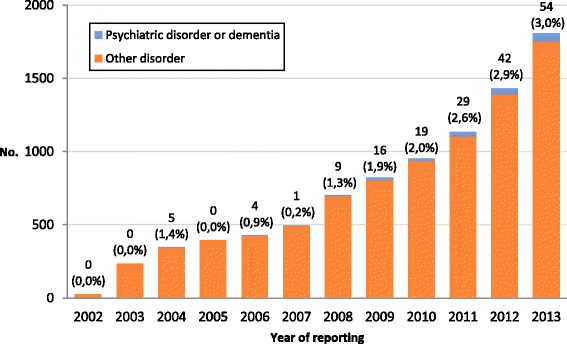
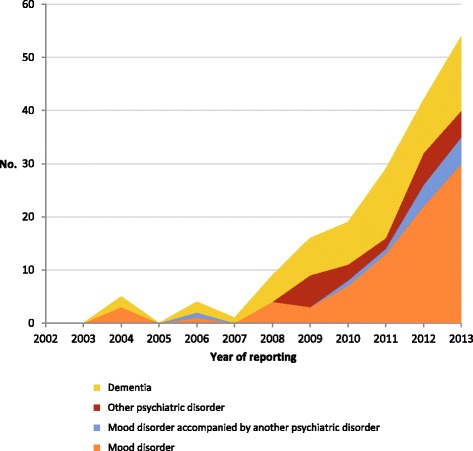
BACKGROUND: Euthanasia for people who are not terminally ill, such as those suffering from psychiatric disorders or dementia, is legal in Belgium under strict conditions but remains a controversial practice. As yet, the prevalence of euthanasia for people with psychiatric disorders or dementia has not been studied and little is known about the characteristics of the practice. This study aims to report on the trends in prevalence and number of euthanasia cases with a psychiatric disorder or dementia diagnosis in Belgium and demographic, clinical and decision-making characteristics of these cases. METHODS: We analysed the anonymous databases of euthanasia cases reported to the Federal Control and Evaluation Committee Euthanasia from the implementation of the euthanasia law in Belgium in 2002 until the end of 2013. The databases we received provided the information on all euthanasia cases as registered by the Committee from the official registration forms. Only those with one or more psychiatric disorders or dementia and no physical disease were included in the analysis. RESULTS: We identified 179 reported euthanasia cases with a psychiatric disorder or dementia as the sole diagnosis. These consisted of mood disorders (N = 83), dementia (N = 62), other psychiatric disorders (N = 22) and mood disorders accompanied by another psychiatric disorder (N = 12). The proportion of euthanasia cases with a psychiatric disorder or dementia diagnosis was 0.5% of all cases reported in the period 2002-2007, increasing from 2008 onwards to 3.0% of all cases reported in 2013. The increase in the absolute number of cases is particularly evident in cases with a mood disorder diagnosis. The majority of cases concerned women (58.1% in dementia to 77.1% in mood disorders). All cases were judged to have met the legal requirements by the Committee. CONCLUSIONS: While euthanasia on the grounds of unbearable suffering caused by a psychiatric disorder or dementia remains a comparatively limited practice in Belgium, its prevalence has risen since 2008. If, as this study suggests, people with psychiatric conditions or dementia are increasingly seeking access to euthanasia, the development of practice guidelines is all the more desirable if physicians are to respond adequately to these highly delicate requests.
Overview
The claims and statistics of this paper haven’t been checked yet.
Free: it reads the open-access text and checks the first 5 claims that cite a source we can check. Create a free account to check every claim.
Integrity signals
Registry
Cites
Statistics
Figures
Verification
Claims the paper makes
The claims and statistics of this paper haven’t been checked yet.
Free: it reads the open-access text and checks the first 5 claims that cite a source we can check. Create a free account to check every claim.
Claims other papers make about this one
Each is checked against this paper’s own text: does it say what the citing paper says it does?
The source backs part of the claim, not all of it — or backs it for a different population, condition or comparison.
In the citing paper
“Currently, guidelines are silent on whether suicidal ideation and behavior should play a role in how “irremediability” is defined, potentially exacerbating the risk for error.”
From Psychiatric euthanasia, suicide and the role of gender (2022) · cites this paper as [33]
Experimental — accuracy not yet measuredThe source backs part of the claim, not all of it — or backs it for a different population, condition or comparison.
In the citing paper
“In Belgium, MAiD-NT due to psychiatric disorder have increased from 0.5% of all cases reported in the period 2002–2007 to 3.0% of all cases reported in 2011, [60]”
From Debating Euthanasia and Physician-Assisted Death in People with Psychiatric Disorders (2022) · cites this paper as [60]
Experimental — accuracy not yet measuredThe source backs part of the claim, not all of it — or backs it for a different population, condition or comparison.
In the citing paper
“Some authors interpret historical trends in countries such as the Netherlands and Belgium as evidence of incremental expansion in MAiD use, though the data remain limited and difficult to compare.39 40”
From Medical Assistance in Dying for the Sole Underlying Condition of Mental Disorder (MAiD MD-SUMC): an analysis and qualitative evidence synthesis (2026) · cites this paper as [40]
Experimental — accuracy not yet measuredThe source backs part of the claim, not all of it — or backs it for a different population, condition or comparison.
In the citing paper
“Patients with only mood disorders were generally older than 60 years of age (65%), whereas the others were generally younger than 60.”
From Euthanasia and assisted suicide in psychiatric patients: A systematic review of the literature (2021) · cites this paper as Dierickx et al., 2017
Experimental — accuracy not yet measuredThe source backs part of the claim, not all of it — or backs it for a different population, condition or comparison.
In the citing paper
“Women were preponderant in both pEAS-C and pEAS-R (Dierickx et al., 2017;Groenewoud et al., 1997;Kim et al., 2016;Nicolini et al., 2019;Thienpont et al., 2015a;van Veen et al., 2018).”
From Euthanasia and assisted suicide in psychiatric patients: A systematic review of the literature (2021) · cites this paper as Dierickx et al., 2017
Experimental — accuracy not yet measured
18 more claims about this paper
Create a free account to see every claim other papers make about this one.
Self-check
Percentages, sums and reported differences re-computed from the paper’s own numbers.
The self-check needs the paper’s full text.
Citations
Cites
The empirical status of cognitive-behavioral therapy: A review of meta-analyses
Butler, A. C., Chapman, J. E., Forman, E. M., & Beck, A. T. (2006) · Clinical Psychology Review · doi:10.1016/j.cpr.2005.07.003 · Cited by 3,215
Cooney, G. M., Dwan, K., Greig, C. A., Lawlor, D. A., Rimer, J., Waugh, F. R., McMurdo, M., & Mead, G. E. (2013) · Cochrane Database of Systematic Reviews · doi:10.1002/14651858.cd004366.pub6 · Cited by 1,834
Cipriani, A., Furukawa, T. A., Salanti, G., Geddes, J. R., Higgins, J. P., Churchill, R., Watanabe, N., Nakagawa, A., Omori, I. M., McGuire, H., et al. (2009) · The Lancet · doi:10.1016/s0140-6736(09)60046-5 · Cited by 1,654
Kim, S. Y. H., De Vries, R. G., & Peteet, J. R. (2016) · JAMA Psychiatry · doi:10.1001/jamapsychiatry.2015.2887 · Cited by 320
End-of-life decisions in medical practice in Flanders, Belgium: a nationwide survey
Deliens, L., Mortier, F., Bilsen, J., Cosyns, M., Stichele, R. V., Vanoverloop, J., & Ingels, K. (2000) · The Lancet · doi:10.1016/s0140-6736(00)03233-5 · Cited by 307
A meta-analysis of electroconvulsive therapy efficacy in depression
Kho, K. H., van Vreeswijk, M. F., Simpson, S., & Zwinderman, A. H. (2003) · The Journal of ECT · doi:10.1097/00124509-200309000-00005 · Cited by 265
Mental capacity in psychiatric patients: Systematic review
Okai, D., Owen, G., McGuire, H., Singh, S., Churchill, R., & Hotopf, M. (2007) · British Journal of Psychiatry · doi:10.1192/bjp.bp.106.035162 · Cited by 262
Thienpont, L., Verhofstadt, M., Van Loon, T., Distelmans, W., Audenaert, K., & De Deyn, P. P. (2015) · BMJ Open · doi:10.1136/bmjopen-2014-007454 · Cited by 231 · cited 1×
“This finding differs from a recent study of 100 people suffering from a psychiatric disorder who requested euthanasia, which found that most cases involved younger people [38].”
ResultBolt, E. E., Snijdewind, M. C., Willems, D. L., van der Heide, A., & Onwuteaka-Philipsen, B. D. (2015) · Journal of Medical Ethics · doi:10.1136/medethics-2014-102150 · Cited by 178 · cited 1×
“A Dutch study, however, has shown that a minority of Dutch physicians find it conceivable that they would grant a euthanasia request in the case of a psychiatric disorder (34%) or early-stage dementia (40%) [22].”
BackgroundOwen, G. S., Richardson, G., David, A. S., Szmukler, G., Hayward, P., & Hotopf, M. (2008) · BMJ · doi:10.1136/bmj.39580.546597.be · Cited by 172
Trachsel, M., Irwin, S. A., Biller-Andorno, N., Hoff, P., & Riese, F. (2016) · BMC Psychiatry · doi:10.1186/s12888-016-0970-y · Cited by 148
Smets, T., Bilsen, J., Cohen, J., Rurup, M. L., Mortier, F., & Deliens, L. (2010) · BMJ · doi:10.1136/bmj.c5174 · Cited by 137
Self-citationReliability of mental capacity assessments in psychiatric in-patients
Cairns, R., Maddock, C., Buchanan, A., David, A. S., Hayward, P., Richardson, G., Szmukler, G., & Hotopf, M. (2005) · British Journal of Psychiatry · doi:10.1192/bjp.187.4.372 · Cited by 135 · cited 1×
“However, studies of mental capacity in psychiatric patients show that mental capacity can be reliably assessed [26, 27].”
BackgroundPhysician-assisted deaths under the euthanasia law in Belgium: a population-based survey
Chambaere, K., Bilsen, J., Cohen, J., Onwuteaka-Philipsen, B. D., Mortier, F., & Deliens, L. (2010) · Canadian Medical Association Journal · doi:10.1503/cmaj.091876 · Cited by 129
Self-citationLong-term outcome of major depressive disorder in psychiatric patients is variable
Holma, K. M., Holma, I. A. K., Melartin, T. K., Rytsälä, H. J., & Isometsä, E. T. (2008) · The Journal of Clinical Psychiatry · doi:10.4088/jcp.v69n0205 · Cited by 120
Attitudes and Experiences of Belgian Physicians Regarding Euthanasia Practice and the Euthanasia Law
Smets, T., Cohen, J., Bilsen, J. J. R., Wesemael, Y. V., Rurup, M. L., & Deliëns, L. (2010) · Journal of Pain and Symptom Management · doi:10.1016/j.jpainsymman.2010.05.015 · Cited by 118
Self-citationComparison of the Expression and Granting of Requests for Euthanasia in Belgium in 2007 vs 2013
Dierickx, S., Deliens, L., Cohen, J., & Chambaere, K. (2015) · JAMA Internal Medicine · doi:10.1001/jamainternmed.2015.3982 · Cited by 117
Self-citationWeyerer, S., Eifflaender-Gorfer, S., Wiese, B., Luppa, M., Pentzek, M., Bickel, H., Bachmann, C., Scherer, M., Maier, W., & Riedel-Heller, S. G. (2013) · Age and Ageing · doi:10.1093/ageing/afs184 · Cited by 113
Legalisation of euthanasia or physician-assisted suicide: survey of doctors’ attitudes
Seale, C. (2009) · Palliative Medicine · doi:10.1177/0269216308102041 · Cited by 112
New paradigms for treatment‐resistant depression
Zarate, C., Duman, R. S., Liu, G., Sartori, S., Quiroz, J., & Murck, H. (2013) · Annals of the New York Academy of Sciences · doi:10.1111/nyas.12223 · Cited by 109
McCormack, R., Clifford, M., & Conroy, M. (2012) · Palliative Medicine · doi:10.1177/0269216310397688 · Cited by 106 · cited 1×
“In the UK, the majority of physicians are opposed to changes in legislation on assisted dying, with significantly less support in the case of non-terminally ill people [23, 24].”
BackgroundWishes to Die in Older People: A Quantitative Study of Prevalence and Associated Factors
Rurup, M. L., Deeg, D. J. H., Poppelaars, J. L., Kerkhof, A. J. F. M., & Onwuteaka-Philipsen, B. D. (2011) · Crisis · doi:10.1027/0227-5910/a000079 · Cited by 103 · cited 1×
“However, research also showed that a majority of older respondents with a wish to die suffered from depressed mood without meeting the diagnostic criteria to qualify for a depressive disorder [40, 41].”
BackgroundCapacity evaluations of psychiatric patients requesting assisted death in The Netherlands
Doernberg, S. N., Peteet, J. R., & Kim, S. Y. H. (2016) · Psychosomatics · doi:10.1016/j.psym.2016.06.005 · Cited by 103
Tomlinson, E., & Stott, J. (2015) · International Journal of Geriatric Psychiatry · doi:10.1002/gps.4169 · Cited by 99
Treatment-resistant major depressive disorder and assisted dying
Schuklenk, U., & Vathorst, S. V. D. (2015) · Journal of Medical Ethics · doi:10.1136/medethics-2014-102458 · Cited by 93
Daily hassles, physical illness, and sleep problems in older adults with wishes to die
Lapierre, S., Boyer, R., Desjardins, S., Dubé, M., Lorrain, D., Préville, M., & Brassard, J. (2012) · International Psychogeriatrics · doi:10.1017/s1041610211001591 · Cited by 91 · cited 1×
“However, research also showed that a majority of older respondents with a wish to die suffered from depressed mood without meeting the diagnostic criteria to qualify for a depressive disorder [40, 41].”
BackgroundGeorges, J.-J., The, A. M., Onwuteaka-Philipsen, B. D., & van der Wal, G. (2008) · Journal of Medical Ethics · doi:10.1136/jme.2007.020909 · Cited by 86 · cited 1×
“Dealing with euthanasia requests is a challenging task for physicians, especially so when a request is based on psychological suffering [4, 9, 25].”
BackgroundEuthanasia in Belgium: trends in reported cases between 2003 and 2013
Dierickx, S., Deliens, L., Cohen, J., & Chambaere, K. (2016) · Canadian Medical Association Journal · doi:10.1503/cmaj.160202 · Cited by 73
Self-citationAssisted dying: law and practice around the world
Dyer, O., White, C., & García Rada, A. (2015) · BMJ · doi:10.1136/bmj.h4481 · Cited by 68 · cited 1×
“While assisted dying legislation is restricted to those with terminal illness and a limited life expectancy due to somatic disorder in some US states and Canada, assisted dying for people who are not terminally ill, such as those suffering from psychiatric illness or early stage dementia, is legal in the Netherlands,…”
BackgroundShould assisted dying for psychiatric disorders be legalized in Canada?
Kim, S. Y. H., & Lemmens, T. (2016) · Canadian Medical Association Journal · doi:10.1503/cmaj.160365 · Cited by 68
McCormack, R., & Fléchais, R. (2012) · Psychosomatics · doi:10.1016/j.psym.2012.03.005 · Cited by 67
Physician-assisted suicide in psychiatry and loss of hope
Berghmans, R., Widdershoven, G., & Widdershoven-Heerding, I. (2013) · International Journal of Law and Psychiatry · doi:10.1016/j.ijlp.2013.06.020 · Cited by 61 · cited 1×
“As a wish to die can be a symptom of mood disorder, an area of tension arises between respecting the patient’s autonomy on the one hand and suicide prevention and harm reduction on the other [37].”
BackgroundDeschepper, R., Distelmans, W., & Bilsen, J. (2014) · JAMA Psychiatry · doi:10.1001/jamapsychiatry.2014.185 · Cited by 58 · cited 1×
“Dealing with euthanasia requests is a challenging task for physicians, especially so when a request is based on psychological suffering [4, 9, 25].”
BackgroundEuthanasia: The role of the psychiatrist
Naudts, K., Ducatelle, C., Kovacs, J., Laurens, K., Van Den Eynde, F., & Van Heeringen, C. (2006) · British Journal of Psychiatry · doi:10.1192/bjp.bp.105.010256 · Cited by 52 · cited 1×
“Furthermore, the irreversibility of psychiatric disorders is often questioned since the course of these disorders may fluctuate and can be hard to predict, and prognosis is often uncertain [9, 11, 12].”
BackgroundChanges in medical end-of-life practices during the legalization process of euthanasia in Belgium
Bilsen, J. J. R., Stichele, R. V., Broeckaert, B., Mortier, F., & Deliëns, L. (2007) · Social Science & Medicine · doi:10.1016/j.socscimed.2007.04.016 · Cited by 49
Trends in Medical End-of-Life Decision Making in Flanders, Belgium 1998–2001–2007
Chambaere, K., Bilsen, J., Cohen, J., Onwuteaka-Philipsen, B. D., Mortier, F., & Deliens, L. (2011) · Medical Decision Making · doi:10.1177/0272989x10392379 · Cited by 47
Self-citationThe Belgian Act on Euthanasia of May, 28th 2002
(2002) · Ethical Perspectives · doi:10.2143/ep.9.2.503856 · Cited by 47
Vergunst, F. K., Fekadu, A., Wooderson, S. C., Tunnard, C. S., Rane, L. J., Markopoulou, K., & Cleare, A. J. (2013) · Psychiatry Research · doi:10.1016/j.psychres.2013.03.022 · Cited by 45 · cited 1×
“Further, consensus about the meaning of medical futility in the context of psychiatry is lacking [28] and long-term outcomes of psychiatric illness are complicated to determine [29, 30].”
BackgroundPalliative psychiatry for severe and persistent mental illness
Trachsel, M., Irwin, S. A., Biller‐Andorno, N., Hoff, P. T., & Riese, F. (2016) · The Lancet Psychiatry · doi:10.1016/s2215-0366(16)00005-5 · Cited by 43 · cited 1×
“Further, consensus about the meaning of medical futility in the context of psychiatry is lacking [28] and long-term outcomes of psychiatric illness are complicated to determine [29, 30].”
BackgroundTreatment-resistant depression and physician-assisted death
MIller, F. G. (2015) · Journal of Medical Ethics · doi:10.1136/medethics-2015-103060 · Cited by 34 · cited 1×
“Furthermore, the irreversibility of psychiatric disorders is often questioned since the course of these disorders may fluctuate and can be hard to predict, and prognosis is often uncertain [9, 11, 12].”
BackgroundGostin, L. O., & Roberts, A. E. (2016) · JAMA · doi:10.1001/jama.2015.16586 · Cited by 30
Cooney, G. (2013) · Journal of Evidence-Based Medicine · doi:10.1111/jebm.12076 · Cited by 19
Media Coverage of Medical Decision Making at the End of Life: A Belgian Case Study
Brussel, L. V., Landeghem, P. V., & Cohen, J. (2013) · Death Studies · doi:10.1080/07481187.2012.738766 · Cited by 9 · cited 1×
“Additionally, heightened media attention in cases that are often controversial [20] may have increased awareness among the general public of the legal possibilities in cases of psychiatric disorder or dementia.”
BackgroundSelf-citation
Research works printed but not linked: 1
- Tholen A Berghmans R Huisman J Legemaate J Nolen W Polak F Guideline dealing with the request for assisted suicide by patients with a psychiatric disorder [Richtlijn omgaan met het verzoek om hulp bij zelfdoding door patiënten met een psychiatrische stoornis (in Dutch)] 2009 Utrecht Dutch Psychiatric Association
Cited by
Assisted dying around the world: a status quaestionis
Mroz, S., Dierickx, S., Deliens, L., Cohen, J., & Chambaere, K. (2021) · Annals of Palliative Medicine · doi:10.21037/apm-20-637 · Cited by 264
“In Canada, Luxembourg and the United States, a person must be at least 18 years old to request physician-assisted suicide (7).”
BackgroundInfluentialSelf-citationEuthanasia and assisted suicide in psychiatric patients: A systematic review of the literature
Calati, R., Olié, E., Dassa, D., Gramaglia, C., Guillaume, S., Madeddu, F., & Courtet, P. (2021) · Journal of Psychiatric Research · doi:10.1016/j.jpsychires.2020.12.006 · Cited by 88
A systematic review of older adults’ request for or attitude toward euthanasia or assisted-suicide
Castelli Dransart, D. A., Lapierre, S., Erlangsen, A., Canetto, S. S., Heisel, M., Draper, B., Lindner, R., Richard-Devantoy, S., Cheung, G., Scocco, P., et al. (2021) · Aging & Mental Health · doi:10.1080/13607863.2019.1697201 · Cited by 77
Nicolini, M. E., Kim, S. Y. H., Churchill, M. E., & Gastmans, C. (2020) · Psychological Medicine · doi:10.1017/s0033291720001543 · Cited by 77
Evenblij, K., Pasman, H. R. W., Pronk, R., & Onwuteaka-Philipsen, B. D. (2019) · BMC Psychiatry · doi:10.1186/s12888-019-2053-3 · Cited by 75
Metadata
- Authors
- Dierickx, S., Deliens, L., Cohen, J., & Chambaere, K.
- Affiliations
- Vrije Universiteit Brussel (BE)
- Corresponding author
- Dierickx, Sigrid
- Venue
- BMC Psychiatry
- Published
- 2017-06-23
- Volume
- 17
- Issue
- 1
- Pages
- 203-203
- ISSN
- 1471-244X (ISSN-L)
- PMC
- PMC5481967
- OpenAlex
- W2617356614
- Cited by
- 129
- References
- 43
- Citations by year
- 2026: 6 · 2025: 11 · 2024: 13 · 2023: 12 · 2022: 18 · 2021: 18 · 2020: 29 · 2019: 17 · 2018: 2 · 2017: 3
- FWCI
- 13.10
- Type
- journal article
- Language
- en
- Open access
- gold
- doi.org
- Licence
- cc-by
- Locations
- BMC Psychiatry (publishedVersion, cc-by)
- Europe PMC (PubMed Central) (publishedVersion, other-oa)
- PubMed Central (publishedVersion, cc-by)
- PubMed (publishedVersion)
- Ghent University Academic Bibliography (Ghent University) (submittedVersion, cc-by)
- DOAJ (DOAJ: Directory of Open Access Journals) (submittedVersion)
- VUBIR (Vrije Universiteit Brussel) (submittedVersion)
- Funders
- Internal funding
- Topics
- Health Sciences › Medicine › Public Health, Environmental and Occupational Health › Palliative Care and End-of-Life Issues
- Health Sciences › Medicine › Public Health, Environmental and Occupational Health › Palliative and Oncologic Care
- Health Sciences › Medicine › Public Health, Environmental and Occupational Health › Ethics and bioethics in healthcare
- Keywords
- euthanasia, mental illness, dementia, mood disorders, prevalence trends, Belgium, euthanasia legislation, unbearable suffering, physician decision-making, clinical guidelines
- MeSH terms
- Mental Disorders, Belgium, Decision Making, Dementia, Euthanasia, Female, Humans, Male, Middle Aged, Sex Factors
About these checks
Registry, retraction, Cites and statistics results are computed, not judged, with one exception: a printed reference that no index lists is read once by a model before it counts as a citation error. Claims are extracted by a model and kept only when their quote appears verbatim in the text; each cited source is then checked, with a model’s help, for whether it says what the claim relies on. Those verdicts can be wrong — read the claim’s quote and the cited source before relying on one.
Statistics and arithmetic are recomputed, not judged.
Confidence bands are shown only for fields calibrated on our annotated test set. None is calibrated yet, so no band is shown.
What counts as a claim ›How we measure confidence ›How we check this ›
Are you an author, or do you see a problem with this page? Request a review
Data sources
Bibliographic data: Semantic Scholar, OpenAlex, Crossref.
Contains information from the Semantic Scholar Academic Graph Datasets, made available under the ODC Attribution License (ODC-BY 1.0).
Semantic Scholar’s data is described in: Kinney, R., et al. (2023). The Semantic Scholar Open Data Platform. arXiv:2301.10140.
